Category: OSINT & Investigations

  • Nuclear Weapons Waste Made Workers Sick. Despite a Law Meant to Help, the DOE Keeps Fighting Their Claims.

    Nuclear Weapons Waste Made Workers Sick. Despite a Law Meant to Help, the DOE Keeps Fighting Their Claims.

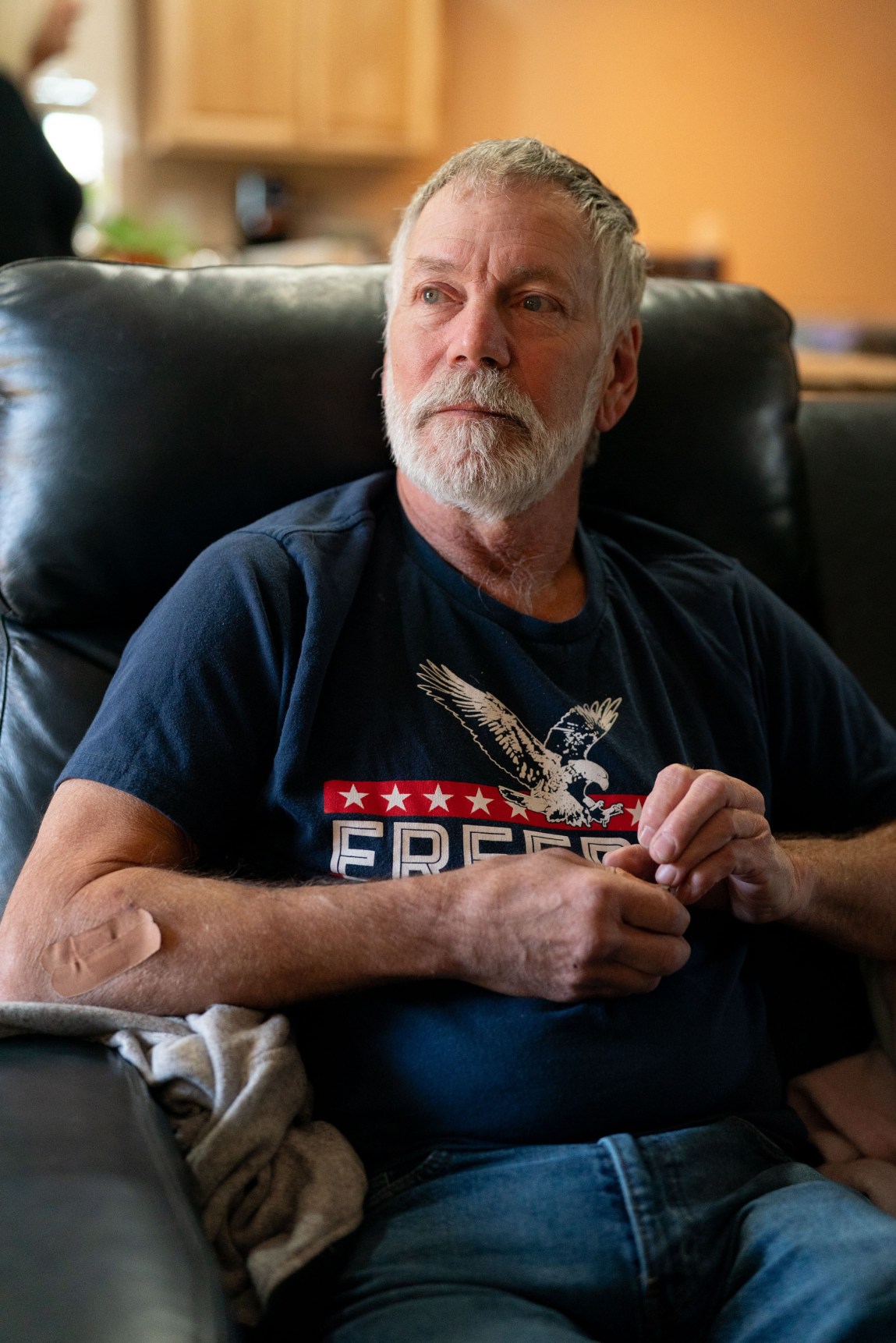
    A white man sits in a leather chair with his hands in front of his chest.
    Lonnie Rouse was diagnosed with a neurological disorder that medical experts attributed to exposure to chemicals during his work cleaning up the Hanford nuclear site in Washington. Margaret Albaugh for ProPublica

    Lonnie Rouse shuffled into a wood-paneled conference room at the Washington state Capitol in March 2018. It had been nearly a decade since medical experts diagnosed him with a neurological disease they attributed to his exposure to chemicals at work. In the time since, he had acquired a stutter, begun limping and lost several teeth biting into a banana.

    For nearly 20 years, Rouse had packaged plutonium and monitored radioactive waste at the Hanford Site, a now-decommissioned Department of Energy nuclear weapons production plant in south-central Washington and one of the most contaminated nuclear sites in the country. Tanks full of radioactive sludge exposed him to at least 48 potentially hazardous chemicals. The worksite was so toxic, he said, that the floor once melted the rubber off his boots. 

    Rouse was among the thousands of workers responsible for the ongoing environmental cleanup at Hanford, which has been underway since the DOE shut down the last reactor in the late 1980s. Congress has acknowledged, based on voluminous studies, that radiation at DOE sites poses health risks to workers.

    Over time, some people at Hanford became so sick they could no longer work. Like Rouse, they filed for workers’ compensation. The DOE consistently challenged their claims and tried to shift the blame onto the workers themselves. 

    By the time Rouse took his place behind then-Gov. Jay Inslee, he was desperate. His 2009 workers’ compensation claim had been denied. He had burned through his retirement savings and declared bankruptcy. 

    As he watched, the governor signed a bill that was supposed to change his life.
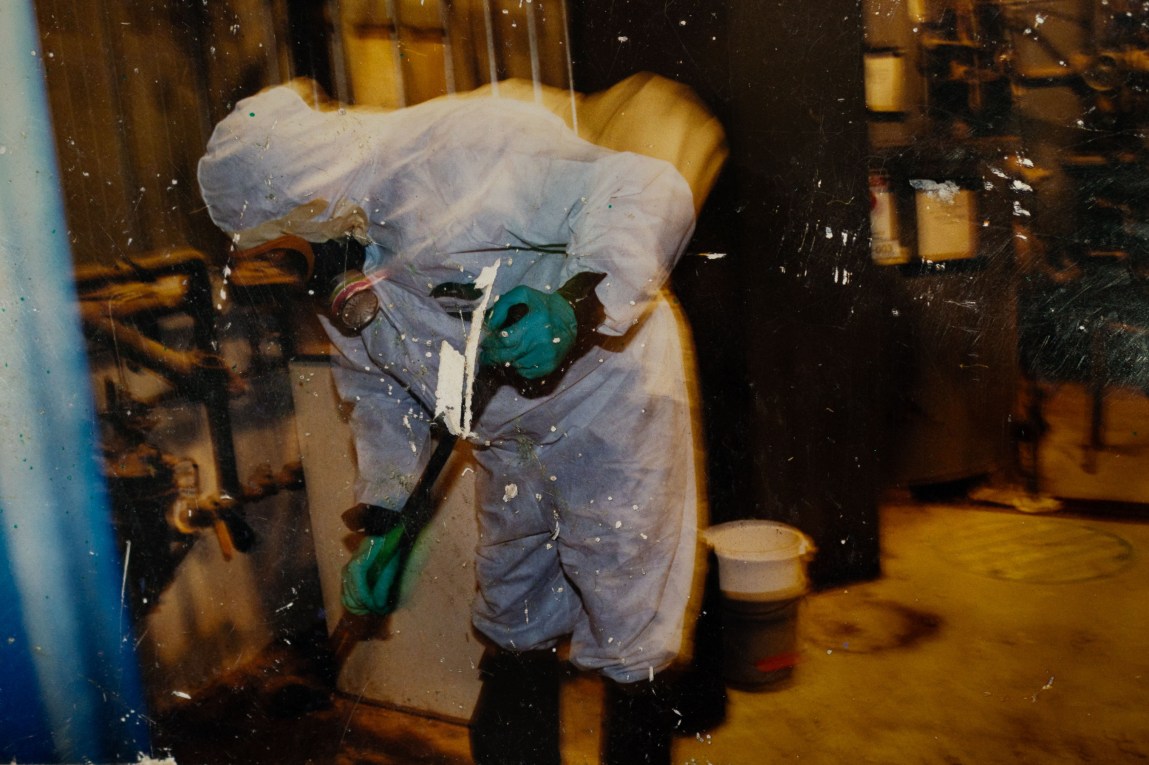
    A scuffed-up photo of a man in a hazmat suit cleaning.
    Rouse hung onto an old photo of himself cleaning rodent feces while working at the Hanford Site. Rouse packaged plutonium and monitored radioactive waste at the site for almost 20 years. Image photographed by Margaret Albaugh for ProPublica

    For years, Hanford employees filing workers’ compensation claims had to prove the chemicals they were exposed to on the job made them sick. The new law Inslee signed flipped that burden of proof. Under the law, agencies were instructed to presume that working at Hanford had caused certain cancers, neurological diseases and respiratory illnesses. Now the Department of Energy would have to prove to the state that something other than the job had made the workers sick if it wanted to deny their claims. 

    Rouse thought the presumption law would speed up his claim for benefits. State lawmakers and the former governor thought it would force the DOE to take responsibility for the harm Hanford workers were experiencing. 

    But despite the law, the DOE continues to fight new and existing claims, Cascade PBS and ProPublica found. We asked the state for claims records going back to the presumption law’s passage in 2018, but the state only provided records going back three and a half years, to 2023. In that period, workers filed 102 new claims for benefits, state data shows. The DOE did not recommend approving a single one. 

    The state, which has final say, overruled the DOE and approved 75% of those claims. The DOE appealed all but seven of those approvals.

    Cascade PBS and ProPublica spoke to workers, surviving family members, lawyers representing workers and state officials. They all pointed to a pattern: The DOE systematically challenges and then drags out workers’ compensation claims for years with recommended denials and subsequent legal appeals. Along the way, it has spent millions on outside lawyers and expert testimony, including doctor evaluations that point to other causes for workers’ illnesses. 

    The DOE has paid out benefits to Hanford workers in some cases, lawyers and families said, but it has done so while still actively appealing the claims. It warns workers that they may have to pay the money back.  

    Our reporting found that not even death ends the cycle of appeals. About 152 workers’ claims remain stranded in this legal limbo — approved by the state but still under appeal by the DOE. Half of those workers are dead. The DOE continues to fight to deny their families survivors’ benefits.

    “It seems pretty coldhearted, calculated, that they’re trying to save money on the back of sick workers who they made sick,” said Gerry Pollet, one of the Washington state representatives who sponsored the 2018 presumption law, who is also a co-founder of the Hanford cleanup watchdog group Heart of America Northwest. “That’s why we needed a state law.”

    After Cascade PBS and ProPublica raised questions about the DOE’s pattern of litigating claims, regulators at the Washington State Department of Labor and Industries met twice with DOE staff, state agency spokesperson Carrie McCausland said. But she could not point to any other actions the agency has taken beyond the two meetings.

    “Agency staff are concerned and are right now assessing the severity of patterns we’ve seen,” McCausland wrote in an email.

    The DOE did not answer detailed questions or respond to the newsrooms’ findings. In a statement, a spokesperson wrote that the DOE is following “all applicable local, state, and federal laws” and “has a long and successful record of accomplishment of protecting human health and the environment.”

    The DOE has the right to file multiple appeals against a claim. According to court records, its appeals have sought to overturn claims approved by the state, narrow the period of back wages, or block survivors’ benefits, among other things. In appeals filings, the DOE’s lawyers have argued that factors other than work at Hanford played a role in the workers’ illnesses, including smoking, drinking, obesity or genetics.

    In Rouse’s case, the energy department blamed alcoholism and family conflicts. The state agency that handles appeals did not find those arguments persuasive. DOE awarded Rouse most of his back pay in 2024, his lawyer said. Rouse declined to say how much that was, but said he is not touching the money until the legal process concludes.
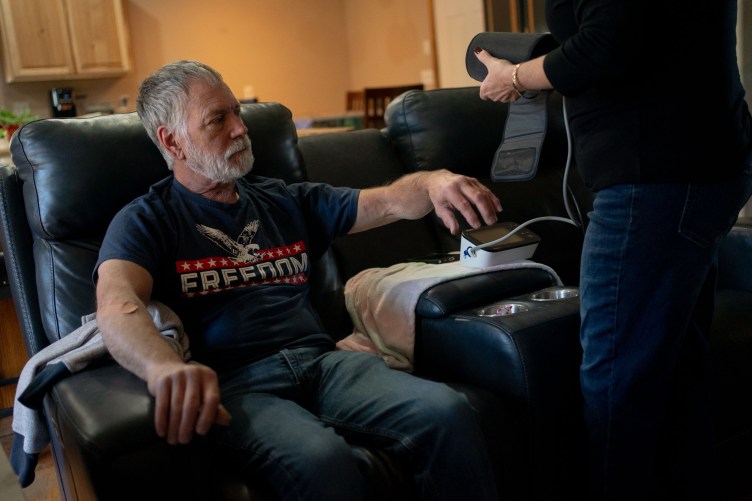
    A woman holds a blood pressure cuff while Lonnie Rouse raises his arm to allow her to put the cuff on.
    Rouse’s wife, Melinda, takes his vital signs. Margaret Albaugh for ProPublica

    In the nearly eight years it has been fighting his claim, the DOE has filed more than 20 appeals contesting different aspects of his claim. 

    “We were always told that nothing is out here that’s going to harm you — you do what you are supposed to do, and you do what you are trained to do, and you’re going to be fine,” said Rouse, who now receives 24-hour care.

    “But that’s not what happens.” 

    “Depleted and Disgusted”  

    The smell of ammonia serves as a warning, workers say, that the underground tanks holding a mix of radioactive sludge have burped chemical vapors into the air above. From 1998 to 2008, it was Rouse’s job to monitor the toxic waste held in the “tank farms.” The containers together hold more than 50 million gallons of liquid waste. Rouse says he lost count of how many times tanks released toxic vapor that took his breath away, sometimes knocking him to the ground and making him vomit and bleed from his nose. According to a 2014 report funded by the federal government, tank farm workers exposed to chemical vapors commonly reported nausea, headaches and nosebleeds.

    The liquid sloshing around in those tanks represented the radioactive byproducts of the Cold War. Hanford produced two-thirds of the plutonium for the nation’s nuclear arsenal and fueled the atomic bomb dropped on Nagasaki, Japan, in 1945. 
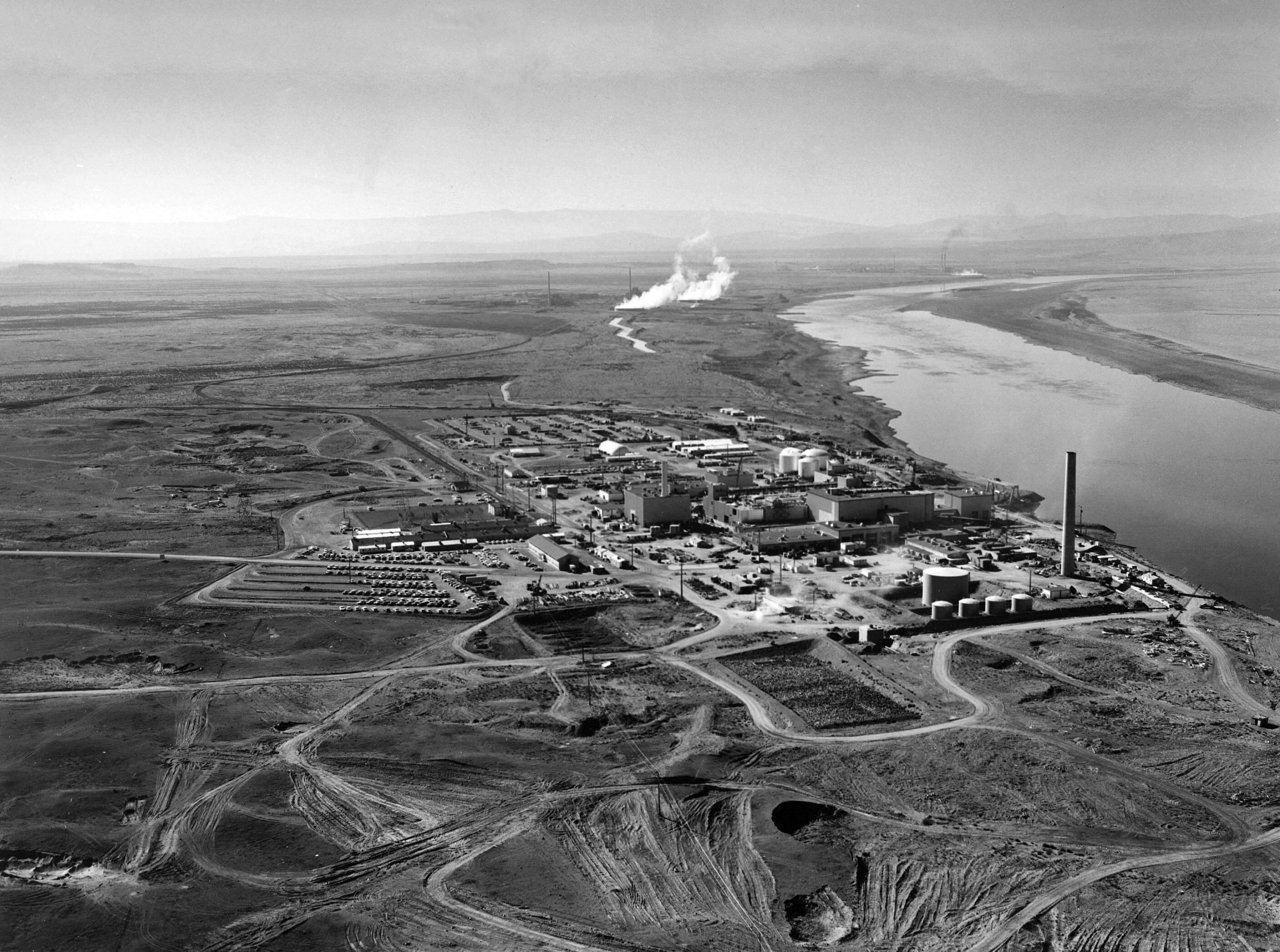
    A black-and-white aerial photo of a plant with a tall smokestack and many big and small buildings. It sits in a dry environment next to a wide river.
    The Columbia River flows by nuclear reactors at the Hanford Site in Washington state in 1960. Department of Energy

    The end of production in the late 1980s launched a cleanup effort that is expected to continue until at least 2086. As of January 2025, more than 13,000 people were working at Hanford, nearly all of them for private companies contracted by the DOE. It is one of the largest and most expensive efforts to remediate toxic waste in the nation’s history. 

    In 2000, Congress passed the Energy Employees Occupational Illness Compensation Program Act, which provides medical care and one-time payouts to workers at DOE sites across the country. It was an acknowledgement that the nation’s nuclear weapons workers had been exposed to radioactive substances known to cause cancer. In it, lawmakers referred to a DOE policy “to litigate occupational illness claims, which has deterred workers from filing workers’ compensation claims and has imposed major financial burdens for such employees who have sought compensation.”

    But the benefits of the federal program were limited: It capped payouts at $400,000. 

    Washington’s workers’ compensation system, by contrast, can provide steady wage replacement or a pension benefit, in some cases, for the rest of an injured employee’s life. It’s a program that can easily surpass the maximum federal benefit. 

    The state went further with its 2018 presumption law. Such laws generally protect firefighters who are regularly exposed to smoke, burned plastics and extreme heat. The National Council on Compensation Insurance, the Washington state attorney general and Pollet all said they were unaware of any other state that has extended that protection for radiological workers.

    The federal government challenged Washington’s state law later that year in court, arguing it was discriminatory because it only applied to Hanford and the DOE.

    Anticipating a Supreme Court decision that ultimately agreed, lawmakers passed an expanded version that covered all workers at “radiological hazardous waste facilities” in the state, including the state’s only functioning nuclear power plant and a French-owned facility that manufactures nuclear fuel rods. Nonetheless, roughly 75% of the 428 claims filed since 2018 have come from the DOE’s Hanford workers, according to the state Department of Labor and Industries. 

    Kathleen Kersey spent 10 years at Hanford, during both the production and cleanup stages. Much of her work involved measuring radiation around the site and making sure levels were safe. She says her safety training covered radiation, but not other hazards like chemical vapors burping from the waste tanks.

    Kersey struggles to walk, has short-term memory problems and at one point lost vision in her right eye for three months. A doctor diagnosed her with multiple sclerosis, which is a neurological disorder, one of the categories of illnesses the state’s presumption law recognizes as related to chemical exposure at Hanford. In 2019 she filed a claim, which the state approved. 

    The DOE has appealed, arguing that something other than her time at Hanford caused her multiple sclerosis.

    Kersey is one of the 152 workers still awaiting a resolution on her workers’ compensation claim. The DOE has not paid her any back wages, she said. The DOE declined to comment on her case. 

    “I feel depleted and disgusted,” Kersey said of the appeals process. “It makes me feel like I’m worthless. I have no value.” 

    “When Does This End?”

    State records show that the DOE has filed more than 500 appeals since the presumption law passed in 2018. In 20 cases, as it did with Rouse, the DOE has appealed a single worker’s claim half a dozen times or more.

    “We have seen tremendous pushback from DOE on essentially almost every single case that’s been brought,” said Washington State Attorney General Nick Brown. 

    Rouse’s wife, Melinda, said she knew something was wrong when he could not remember how to cut an orange. His vision started to blur, he stumbled often, and suddenly he felt irritable all the time. His primary care physician first thought he might have had a brain tumor. The physician referred him to a neurologist who noted cognitive impairment, possibly due to exposure to multiple toxins at the Hanford Site. The neurologist then referred him to a neuropsychologist, who diagnosed him with “toxic encephalopathy” in 2009, saying it was “more likely than not” that chemical exposure damaged his brain, according to court records.

    Rouse at home with his wife, Melinda, and their dogs. After working at Hanford, he developed a neurological disorder that medical experts attributed to exposure to chemicals on the job. Lizz Giordano/Cascade PBS

    The U.S. Department of Labor agreed too, approving him in 2010 for benefits under the Energy Employees Occupational Illness Compensation Program Act, saying it was “at least as likely as not” that Hanford contributed to his illness. A federal medical consultant even praised the neuropsychologist who assessed Rouse for his “unusually thorough analysis of causation.” 

    Rouse refiled his 2009 state workers’ compensation claim under the new law in 2018. Washington state approved it later that year. 

    The DOE appealed. It hired a medical toxicologist, who reviewed Rouse’s medical records and testified that he did not have the disease he claimed, and brought in an industrial hygienist, who downplayed the exposure risks at Hanford. The DOE’s toxicologist testified that Rouse’s drinking was “the most significant, what we might term, ‘toxic exposure’ that’s described in the medical record.”

    A group of three physicians and an industrial hygienist have collectively earned over $1.7 million testifying against Hanford workers since the presumption law’s passage, according to DOE invoices the newsrooms obtained by a federal records request. One of the DOE’s go-to expert witness doctors earned more than $200,000 from the DOE last year alone. He did not respond to multiple emails seeking comment. 

    A single law firm, Wallace, Mann, Capener, Bishop & Debney, handles all of the DOE’s appeals. In addition to the fees paid to expert witnesses, the department paid the firm nearly $10 million between 2018 and 2025. The law firm did not reply to multiple requests for comment. 

    In cases where the DOE has appealed the state’s approval of a claim since 2018, the agency that handles appeals has sided with workers nearly 9 times out of 10, according to state data. 

    Pollet, the state representative who sponsored the 2018 presumption bill, acknowledged that the law has fallen short of his expectation. 

    “This was supposed to have ended a decade ago,” he said about sick Hanford workers still awaiting back wages and medical care. “It’s even worse than it was 10 years ago.”

    “I think their actions are not only despicable, but they are criminal,” he said of the DOE. 

    The state Department of Labor and Industries said it expected “to engage further with the DOE,” which could include putting the department on an improvement plan and monitoring its progress. 

    Another option state regulators have is to revoke the DOE’s ability to accept and pay out claims directly. According to the state Department of Labor and Industries, the contractors that employ Hanford workers on behalf of the DOE would then decide whether to join the state-managed fund or seek state approval to manage claims themselves. Doing so could limit the DOE’s power to appeal, but contractors would still have that right. 

    Brown, the state attorney general, said he wants to wait and see how the DOE’s appeals of claims play out in higher courts. He hopes that once the DOE’s losses start stacking up, it will slow the volume of its litigation. 

    Attorney Charlynn Hull said she thought the DOE’s approach might soften during the Biden administration. But Hull said she observed no change in the DOE’s behavior. Her firm, Smart Law, represents the majority of Hanford workers’ compensation claimants, including Rouse and Kersey.

    One of the hardest things about the DOE’s appeals, Hull said, is the testifying that the children and spouses of dead workers must do. 

    “I think that it’s just, it’s tormenting to them, in many ways, to relive how awful that experience was, especially with the cancer-related death,” Hull said. “When does this end?”
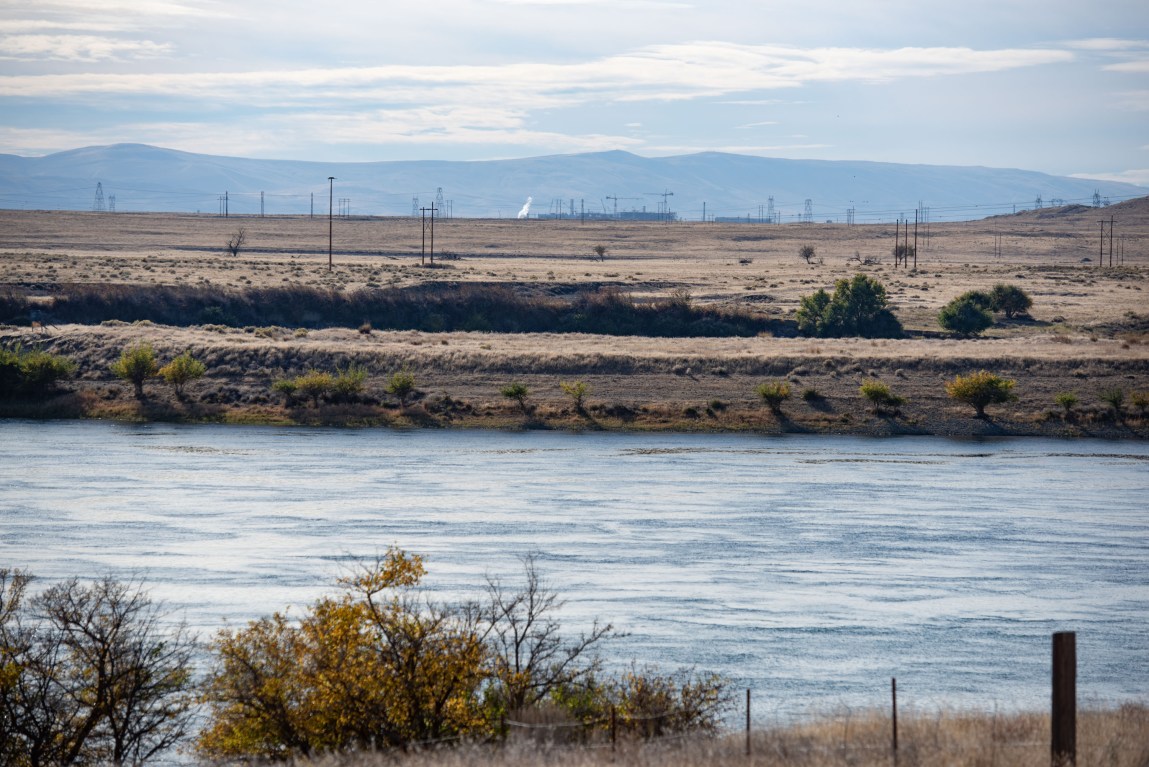
    Telephone poles and some low buildings stick up from the desert, as seen from across the Columbia River. Mountains rise up behind the site.
    A view of the Hanford Site, which is undergoing one of the largest and most expensive toxic waste remediation efforts in the nation’s history. Margaret Albaugh for ProPublica

    Dying While Under Appeal

    For Isidoro Mata Jr., it ended with his children draining fluid from his lungs through a tube doctors had surgically inserted into his chest.

    Mata demolished buildings at Hanford for nearly 30 years. Court records show he was diagnosed in 2015 with thyroid cancer, one of the illnesses that Washington’s law ties to work at Hanford. Sara Chilcoat, his daughter, said he kept working as long as he could.

    State claims managers approved Mata’s claim in 2019. The DOE appealed, arguing that “medical opinion supports denial of this claim as not related to the distinctive conditions of employment.” The appeal did not elaborate further. The state forced the DOE to pay his wages and the cost of his medications, Chilcoat said. But the DOE filed a separate motion to stop his benefits while the appeal was adjudicated. 

    In its motion, the DOE argued that it was likely to prevail in its appeal because a doctor who examined Mata in 2019 believed his cancer was unrelated to his work at Hanford, according to court records. The state found the doctor’s examination “lacking in objective findings.” 

    “He was fighting for his life while they were trying to do that,” Chilcoat said. “That makes me mad.” 

    Mata’s case file notes that he missed three meetings with DOE lawyers in 2020. The state attorney general’s office sent the appeals judge a letter in July explaining that Mata was unable to participate because of his chemotherapy treatments. The DOE, which did not respond to questions about Mata’s case, dropped its appeal in December.

    Less than three months later, Mata died.

    Source: ProPublica · 2026-10-22
  • Can LLMs Supercharge Geolocations? Our Tests Show Big Improvements But Humans Remain Key

    Can LLMs Supercharge Geolocations? Our Tests Show Big Improvements But Humans Remain Key

    Sign up here to receive Bellingcat’s biggest investigations by email as soon as they are published.

    In September, the AI company Anthropic published a blog post that claimed its models were approaching “superhuman capabilities for geolocating outdoor photos”. Anthropic made this claim by comparing its models’ performance to that of players of the popular online game GeoGuessr, which challenges users to geolocate Google Street View images. 

    Bellingcat has been running its own benchmark tests on AI models since June 2025, right around the time when Large Language Models (LLMs) began to challenge reverse image searches for assisting with geolocation tasks. In our first round, GPT 4o-mini from OpenAI appeared to be the best tool for geolocating, a title which was taken by Google AI mode when we performed our second round of tests a few months later in August 2025. 

    This time, we significantly upped the ante for the models, providing increasingly challenging photos and asking for only one set of coordinates. We tasked not only closed-weight models from Claude, Grok, Gemini, ChatGPT, and Mistral, but also open-weight models from Moonshot AI’s Kimi, commercial provider GeoSeer and the non-generative geolocation model GeoClip. In total, we fed each model 52 photos that had not been published anywhere on the internet before.

    The results showed that the current generation of models have markedly improved geolocation capabilities. Anthropic’s Opus and Fable, as well as Google’s recent Gemini 4 Argon model, performed the best on geolocation tasks, narrowing down locations from images faster than a human could under specific conditions. Preliminary tests of a set of agentic skills and tools being developed internally by Bellingcat also showed promising results in further improving the geolocation performance of generic-use AI agents.

    But crucially, the tests also showed why humans remain necessary for accurate and trustworthy geolocation work, as no models were foolproof. This is particularly important given the increased use of AI in military contexts. The Anthropic blog post focused specifically on geolocating photos for military and intelligence purposes such as targeting, a historically labour-intensive process requiring significant human expertise. 

    While our tests showed some models performed extremely well at narrowing down results to the correct general area, none were close to being perfect at finding the exact spot a picture was taken. That accuracy is extremely important in geolocation, especially in military contexts where the cost of incorrect information can be life or death. It is also important for organisations like Bellingcat whose reputation relies on pinpoint factual accuracy.

    Our Methods

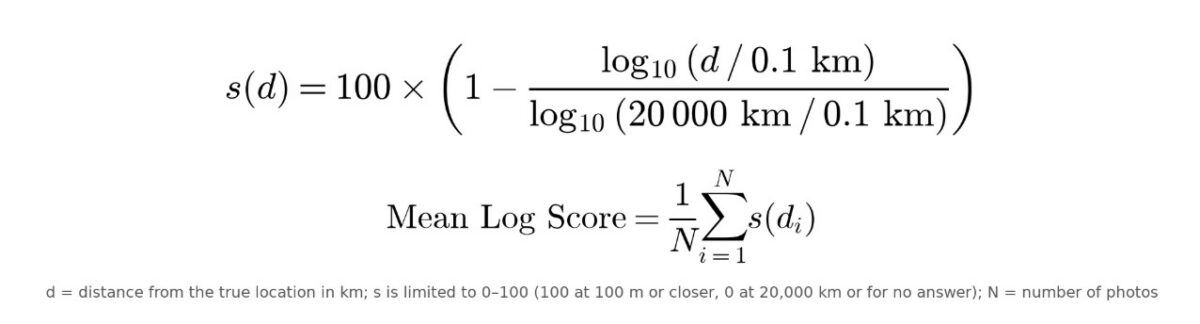
    To compare model results, we used two metrics built on the distance in kilometres between a prediction and the real location. GeoGuessr Score was used to assess whether models could systematically identify the general area, while the Mean Log Score (explained below) measured which models most accurately pinpointed the correct location in the final few kilometres. 

    The GeoGuessr Score metric is based on the online game of the same name, whose scoring system Stanford University academics reverse-engineered in a 2024 study. This system rewards answers close to the general area an image was taken, but does not strongly distinguish between guesses close to the precise location. For example, an answer 200km from the correct location with more points than one 2,000km away. However, an answer 500m from where a picture was taken and another 5km away achieve a similar score. For real-world geolocations, that distance matters a great deal.

    For more precision, we introduced a custom metric that grades models higher if they narrow down the search in the last few kilometres. This metric, the Mean Log Score, assigns a value from 0 (completely inaccurate) to 100 (perfect model) and works on a logarithmic scale instead of a linear one like GeoGuessr score.

    Therefore, a 10-fold improvement in distance means the same whether it is from 5km to 500m or from 500km to 50km. You can compare both metrics here.

    Below are the model results sorted by either metric, showing how many photos each model geolocated within distance bands from the true location.

    Several models placed at least 10 out of the 52 photos correctly within one kilometre, and the top-performing models placed over 50 percent of the photos within 25 kilometres.

    NOTE: Geoseer-fast refused to answer on four of the 52 photos, claiming “This image is not suitable for geolocation”, while Mistral-large-4 refused once with “insufficient information in image to identify location”. Kimi-k2.6 also failed to provide a set of coordinates on one photo, and Gemini 4 Argon timed out repeatedly on one photo.

    Our Test

    To independently assess the models, we sought to give them very specific instructions and some images that were harder to geolocate than those provided in our past tests. The prompt asked for a single set of coordinates reflecting the photographer’s location. The purpose of restricting the response in this way was to prevent hedging, such as multiple guesses or confidence scores, and make the grading more uniform across different models. Models were allowed to use their providers’ built-in tools: search, code execution and page fetch. We capped their token output at 64,000 and ran each model under its default effort setting with a maximum time of 15 minutes per photo. If a model did not return coordinates on the first prompt, we also allowed a single rescue prompt asking it to do so using its previous reasoning and without using any tools.

    The images provided were unique, from around the world, not published on the internet before, scrubbed of metadata and provided without any context. They did not contain significant landmarks. We also included images in snowy, foggy and nighttime conditions.

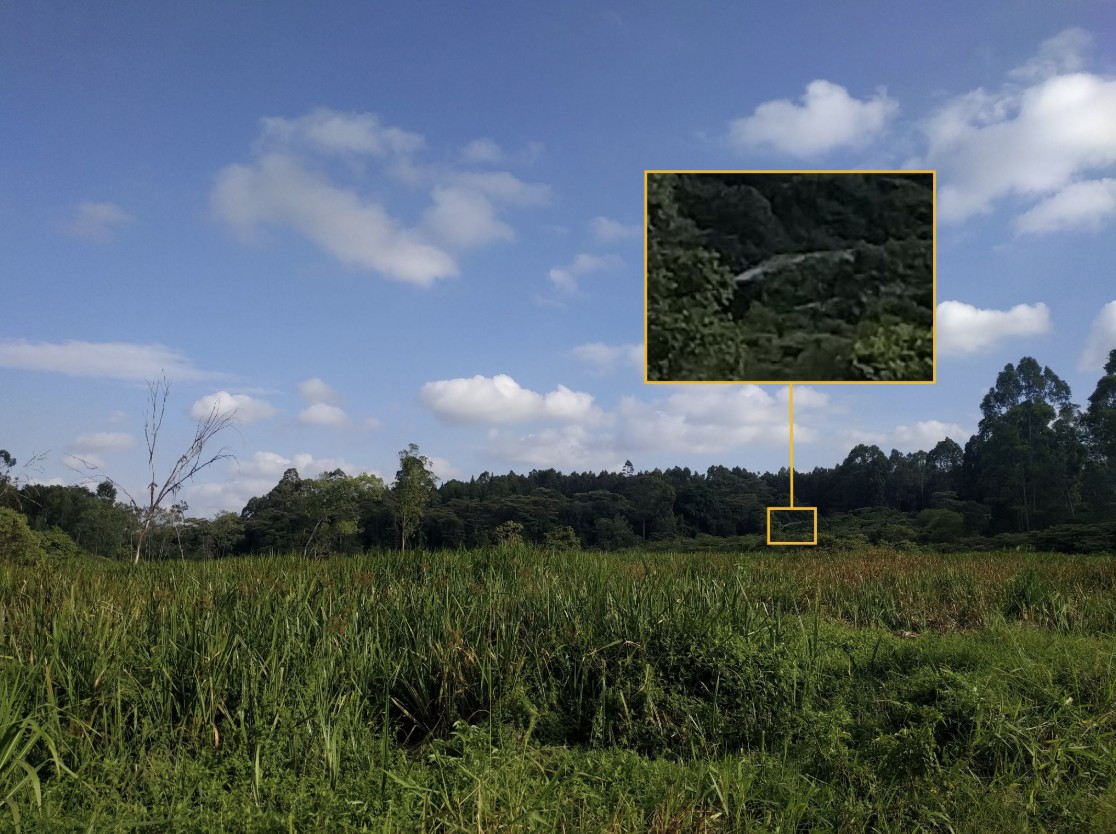
    The results show that the LLMs tested could, in many circumstances, successfully narrow down a location much faster than a human can geolocate even without any context. This is not limited to Google Street View-style images. Take, for example, this image of vegetation and a very small part of a rooftop.

    An example of a photo used for testing, with annotation added after the test to highlight the only man-made object visible. Credit: Bellingcat
    An example of a photo used for testing, with annotation added after the test to highlight the only man-made object visible. Credit: Bellingcat.

    For an average person, identifying the country this photo was taken in without any context could take a significant amount of time. However, multiple models quickly narrowed it down to Kenya. You can navigate their answers in the map below. Notice how several correctly inferred enough vegetation details to narrow down the exact part of the world and the park itself, but also that for many, the final response was a best guess only. It is important to note that even though some models were correct, others were significantly off.

    The full model results for all 52 photos can be seen in the table below.

    Of the models tested, Gemini 4 Argon scored highest on the Mean Log Score, and Claude’s models (Opus and Fable) were at the top of the table regardless of the score metric. Even Claude Sonnet, the weakest of its lineup, consistently came close to the real location while being the fastest to answer across all models.

    This was followed by GPT-6 Astra and GPT-6.1 Sol, as well as other Claude and Gemini models, and then the geolocation-specific model, GeoSeer Fast, which provided good results but also timed out frequently. We tested GeoSeer’s more competent Agent model, but it refused to answer on eight photos and regularly timed out.

    For secondary factors like time and cost, Claude also performed well on both metrics, and Gemini Argon, while much slower, came at a similar cost to Opus. Based on API rates, Argon and Opus models offered the best balance of accuracy and cost, especially compared to Fable and Grok. Grok was the most expensive option and had an underwhelming bottom-half performance. Meanwhile, GeoClip was freely available but only outperformed Claude Haiku.

    Model Limitations

    While we sought to analyse the most prominent models, there was one that we could not include as it has yet to be fully released.

    Support Bellingcat

    Your donations directly contribute to our ability to publish groundbreaking investigations and uncover wrongdoing around the world.

    In its blog post, Anthropic claimed its Mythos model beats “even the strongest human baseline on median distance error, scoring 37.0km and 47.2km across 6,000 photos (placing 23.7 percent and 23.1 percent within 1km).“ But Nuno Moniz, Associate Research Professor at the Lucy Family Institute for Data & Society at the University of Notre Dame, told Bellingcat that “the median represents a strong simplification of what would be acceptable to compare AI-based system performance with regards to humans”. 

    Anthropic compared its models to competitive GeoGuessr players and their success in identifying the location of Google Street View images. The entire set of test images was online and there was no guarantee the models were processing the imagery for the first time. 

    While Anthropic has been relatively open about these methods, not all developers have been as forthcoming. It is therefore difficult to assess whether the same limitations will impact all other models, or whether there will be further caveats that we are simply not aware of. 

    Moniz said that “the increasing availability of benchmarking tools and datasets has made it somewhat difficult to measure reliability in test results such as these”. Specifically, due to the ”uncertainty as to whether that data was included in its training”. This is why we ran our Bellingcat tests with non-published photos sourced from Bellingcat staff and the Bellingcat Volunteer Community.

    A further limitation of any models comparing performance to GeoGuessr scores is that the game uses images from Google Street View, which is limited to a select number of countries, and within these, a limited number of roads. Street View is also intentionally skewed to feature clear, high-quality photos taken during daytime that are useful for navigation, and users can pan around their view. There are also some well-known tricks that allow GeoGuessr players to bypass actual geolocation to correctly guess the location of photos: for example, Google is known to use a black car in Jordan and a white car in the UAE to capture imagery. While this wouldn’t necessarily impact model performance, it is a drawback of measuring against GeoGuessr score as the game has a set of workarounds that can bypass geolocation skill.

    Anthropic’s data consisted of thousands of social media photos of various scenes. Once again, though, these photos were online and may have featured in the model’s training data. Anthropic’s blog post contained four images as an example of this dataset.

    Images used as part of Anthropic's dataset. Credit: Anthropic
    Images used as part of Anthropic’s dataset. Credit: Anthropic.

    The examples Anthropic shared are relatively easy to geolocate as they feature recognisable buildings and signs. But footage that requires geolocation often comes from regions where access is limited and which do not feature on social media or Street View.

    Specifically, in a military and intelligence context, footage often involves low-resolution material and intentionally obscured details recorded in remote or inaccessible areas. Context that could be found online can be uncertain or plain wrong, especially during a developing situation, such as the image below that Bellingcat investigators geolocated when verifying a US strike on a school in the city of Minab in Iran that killed at least 120 children earlier this year.

    An example of footage geolocated by Bellingcat. Screen shot from Mehr News.

    Anthropic researchers acknowledge this caveat, writing that it “does not as clearly emulate the task of precisely pinning down a location in near-real-time in a less populated battlefield setting; that is a task for future research.”

    As noted, it is also possible that similar caveats need to be applied to other models when seeking to understand and interpret any geolocation-related benchmarking.

    Supercharged Models

    In parallel to the above models, we also tested a set of agentic skills and tools being developed internally by Bellingcat. These are researcher-informed instructions and code that can equip generic-use AI agents to augment their geolocation ability. For instance, we designed skills such as allowing it to download Environmental Systems Research Institute (ESRI) satellite imagery tiles. We also designed another skill that enabled direct access to data from Bellingcat’s OpenStreetMaps search tool, which aims to assist geolocation efforts by comparing items identified in imagery (like the position of a pylon compared to a nearby railway line) to OpenStreetMaps data. GeoSleuth is a similar project that has already been published, which we used for comparison. We picked Claude’s Opus 5.5 model to run both skills customisations because of its strong performance and reasonable pricing, and ran all the photos through the supercharged models under the same conditions – except that they had no timeout enforced as the supercharged models required more time to utilise their extra skills. 

    The different timeout conditions and expanded toolset do not allow for a direct comparison of the customised models to the previous off-the-shelf models’ results, even if they both outperformed the barebones Opus model they were based on, and all other models on GeoGuessr Score, with only Argon ranking above Bellingcat’s agent in Mean Log Score.

    Still, this test allows us to showcase why skill customisations can bring value. Take the following photo.

    An image captured at the Global Campus of Human Rights in Venice. Credit: Bellingcat.

    This is not an exceptionally hard geolocation, and 11 of 17 models answered within 5km of the actual capture location in Venice, Italy. GPT-Sol answered with the correct monastery, but only Bellingcat’s agent and GeoSleuth answered with the exact camera position coordinates. This was possible because both model customisations can download and compare satellite imagery tiles, which allows them to validate not just which monastery the photo was taken at but also the correct courtyard position and orientation from visual cues. You can click the buttons in the list below to audit each model’s final answer.

    While in this instance the supercharged models got the exact spot, there were other instances where they did not, as the scores in the results table above show. This again emphasises that even with extra skill sets added, these models were still far from infallible.

    Tests Conclusions

    Despite increased model improvement, our analysis shows that important caveats remain and it is important to keep a human in the loop when seeking to guarantee a geolocation is precise and correct.

    Our tests show that the coordinates models provide as answers are rarely an exact match, even with supercharged models. Invariably, even the best models, with the best tools, can confidently claim a wrong position. Anthropic says its Mythos model was able to pinpoint less than a quarter of its social media photos dataset within a 1km radius. But narrowing down a location is rarely the trickiest part of geolocation work. A large part of important geolocation work is in the final stretch: finding specific coordinates from a general area. This level of specificity is needed because a general area is not a match. Matching features and perspective are necessary for an accurate geolocation, and in many cases that is done on very low-quality images or even by cross-referencing multiple sources. 

    This level of precision is essential for investigations where it matters what building a person could be found at, what lines of sight individuals might have had, or what impact an air strike might have led to. 

    Since LLMs can still confidently get things wrong, as our analysis shows, all results still have to be verified independently. Strong human geolocation skills therefore remain crucial, as the more one understands about geolocations, the better one can verify or take to completion an automated result. 

    Though it can speed up geolocation work significantly, especially in narrowing down an area of interest, AI models remain a useful assistant rather than a tool we can blindly delegate geolocations to.


    Bellingcat is a non-profit and the ability to carry out our work is dependent on the kind support of individual donors. If you would like to support our work, you can do so here. You can also subscribe to our Newsletter and follow us on Bluesky here, Instagram here, Reddit here and YouTube here.

    Source: Bellingcat · 2026-10-22

  • Ballot Rejections Soared in Rural Counties After USPS Reduced Mail Service

    Ballot Rejections Soared in Rural Counties After USPS Reduced Mail Service

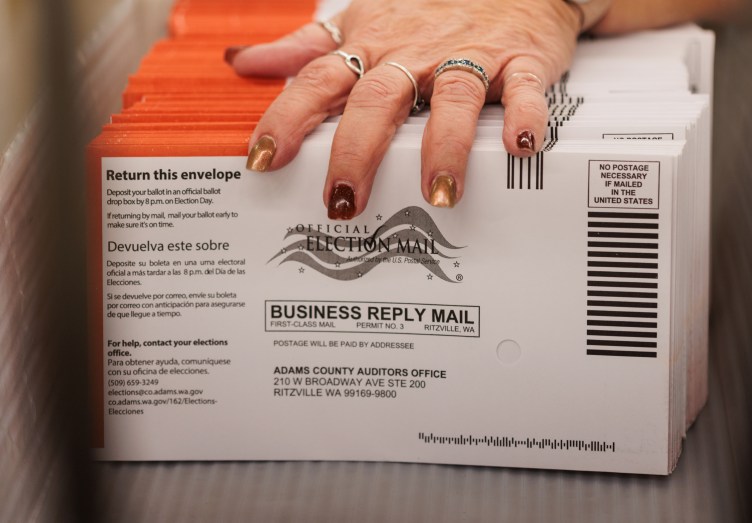
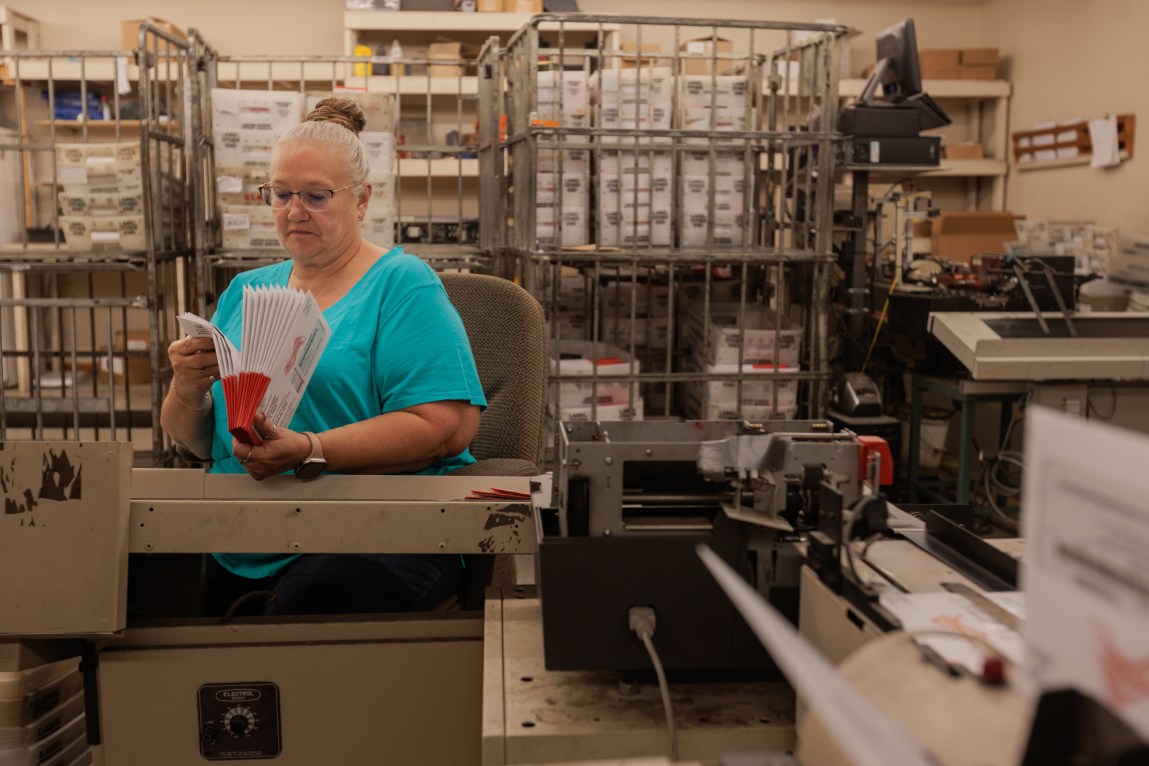
    A woman wearing glasses and a teal T-shirt fans through a stack fo red-and-white ballot envelopes in an industrial workspace.
    Jacque Laird, elections administrator for Adams County, Washington, prepares ballot envelopes for delivery to voters at a third-party processing center that sorts mail, Direct Mail Enterprises, in Spokane. Adams County was one of the eastern Washington counties that saw a spike in the number of mailed ballots being rejected for arriving too late after U.S. Postal Service changes. Rajah Bose for ProPublica

    In early August, election workers north of Spokane, Washington, went across the street to the post office to check for late mail-in ballots. It was three days after the primary and they were expecting no more than a few dozen.

    Instead, their mailbox was brimming with envelopes — more than 500 of them, each a vote that wouldn’t count. The sight was “jarring,” said Auditor Lori Larsen, a Republican who oversees voting in Stevens County.

    Across the region, other election officials were getting similar jolts. In the 11 predominately rural counties in eastern Washington, nearly 2,000 ballots came in late, compared to about 600 in 2022, the previous midterm primary.

    In recent weeks, concerns about mail-in voting disruptions have focused almost entirely on President Donald Trump’s now-shelved plan to sharply restrict who can vote by mail. 

    But a ProPublica data analysis shows that delays resulting from the U.S. Postal Service’s cost-cutting measures have endangered the validity of ballots cast in rural areas, not only in Washington, but across the country.

    Over the past three years, as mail volume continued to plummet and annual deficits ballooned, the Postal Service started consolidating the processing of first-class mail at larger regional plants instead of at smaller hubs closer to local post offices. Then, in a little-noted switch that mostly took effect after the 2024 election, the agency cut the frequency of mail pickups in half at many post offices 50 miles or more from these processing plants, from twice daily to once.

    The changes often added a day or more to delivery time and, most importantly for ballots, pushed back postmarking, which doesn’t happen until mail reaches the regional centers. 

    In this year’s primary, the effects of the cuts were clearest in five states that make detailed data on mail-in ballots available: Washington, California, Ohio, North Carolina and Oregon. All have or recently had grace periods allowing ballots to count if they come in after Election Day as long as they’re postmarked by the deadline.


    Help Us Report on Key Election Issues

    ProPublica’s reporters are on the lookout for what’s going right and what isn’t. We’re monitoring voter suppression and interference, election observers and poll watchers, extremism tied to the election, and ICE activity at the polls. Have you seen something?


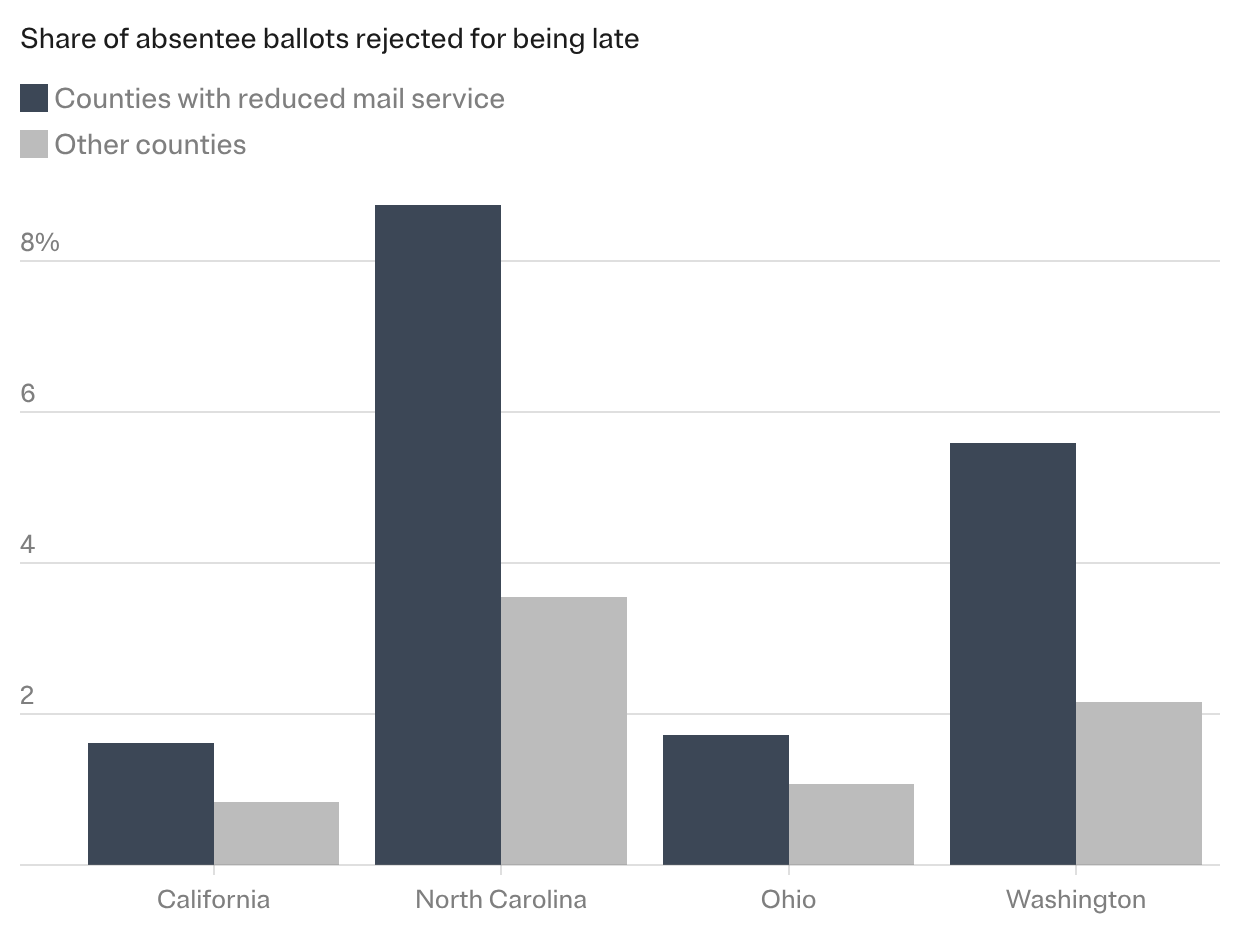
    In these states, the number of ballots rejected for arriving late soared in counties affected by the service changes compared to 2022, ProPublica’s analysis showed. 

    Rejection rates in counties where services were cut doubled or tripled from what they were four years ago, dwarfing any increases in counties where postal pickups remained as they were, our analysis showed. In urban Spokane, for example, the number of ballots rejected for being late actually dropped this year.

    Across the five states, the delays have had the most substantial effect in areas that voted for Trump in 2024, ProPublica’s analysis shows. In Washington, Secretary of State Steve Hobbs, a Democrat, said he sees the service changes directed by Republican appointees leading the Postal Service as a way to undermine mail-in voting. 

    “I don’t think they realized how much it was going to affect their voter base,” he said, adding that Washington has “a lot of rural Republican voters.”

    Rates of Rejection Due to Late Ballots Were Higher in Counties with Reduced Mail Service

    A bar chart comparing the share of ballots rejected for being late in four states shows counties with reduced mail service had higher rejection rates than other counties. North Carolina had an 8.7% rejection rate in counties where mail service was reduced and a 3.5% rejection rate in counties where it was not. In Washington, the rates were 5.6% and 2.2%. In Ohio, it was 1.7% and 1.1%. In California, it was 1.6% and 0.8%.
    Note: The chart shows the four states where data on all returned absentee ballots was available. Data from North Carolina and Washington tracked absentee ballots returned by mail. Data from California and Ohio tracked absentee ballots returned by any method, including drop boxes. Sources: California secretary of state, North Carolina State Board of Elections, Ohio secretary of state, Washington secretary of state. Ken B. Morales/ProPublica

    Postal Service leaders say such delays are less likely in the Nov. 3 general election because of “extraordinary measures” the agency puts into place for these votes, when there’s typically far more turnout. They have circulated a memo to the nation’s more than 30,000 post offices saying that for the 10 days before the election, managers should separate completed ballots from other first-class mail and deliver those intended for local election offices the day they come in.

    At an Oct. 15 news conference, Postal Service leaders emphasized the agency’s longstanding recommendation that voters mail ballots back at least a week before their states’ deadlines, while defending the agency’s ability to fast-track ballots through the system. 

    “We work to identify and address issues quickly,” said Amber McReynolds, chair of the Postal Service board of governors, “so ballots can continue to move swiftly from election offices to voters and from voters back to election offices.”

    Election consultants, researchers and former Postal Service officials told ProPublica that the guidance for the upcoming vote gave more detailed directions on how to expedite ballots. They said they hoped the agency’s special measures would limit delays, but some said mistakes were likely. 

    “I don’t think we can say with any kind of conviction that there will be no ballots rejected,” said Tammy Patrick, chief programs officer of the National Association of Election Officials. “It isn’t a question of ‘if,’ but a question of ‘how many.’”

    A pilot program instituting the delivery changes in 18 regions before the 2024 election ran into problems. An audit by the Postal Service’s inspector general found that agency staff in these areas sometimes didn’t handle ballots correctly, mainly because instructions weren’t clearly communicated. (A Postal Service spokesperson said “learnings from the pilot” have been applied as the program has expanded.)

    After this year’s primary, reports by media outlets noted that mail-in ballot rejection rates were higher than in the past, but ProPublica’s analysis shows these increases were directly connected to Postal Service changes. Research published in September by the Brookings Institution also found this connection, projecting that if the pattern held in the general election, tens of thousands of mail-in ballots could be rejected.

    At least seven closely contested congressional districts — including Washington’s 3rd, California’s 22nd and North Carolina’s 11th — are in areas that were affected by service changes in the primary, ProPublica found.

    Elena Patel, who conducted the Brookings analysis, said service changes may still imperil mail-in votes in the general election.

    “I think there remain risks to ballots,” she said, adding that the Postal Service’s plan for the general election “depends on flawless execution.”


    Mail-in voting has become more popular over the last decade, with many states broadening access to it during the COVID-19 pandemic. 

    Nearly 1 in 3 Americans voted this way in 2022 and 2024. Trump himself frequently votes by mail, and in recent weeks has started to encourage his supporters to do so as well, though he has claimed without evidence that the process is rife with fraud.

    The Postal Service has mostly ensured the timely delivery of hundreds of millions of ballots, even as mail volume overall has dropped 50% from its high in 2006. 

    When Louis DeJoy was appointed postmaster general in spring 2020, he inherited an $81 billion operating deficit and rapidly took steps such as eliminating overtime to reduce costs, under pressure from Trump and others in his administration. (DeJoy did not respond to questions from ProPublica.)

    The NAACP sued that August, alleging the measures could affect mail-in votes in that year’s general election. Courts ordered DeJoy to reverse some of the cuts and the Postal Service agreed to implement special procedures to ensure ballots weren’t delayed. The Postal Service has continued following those procedures since. 

    Still, DeJoy went forward with a 10-year restructuring plan designed to save the agency billions. It ended evening pickups from some post offices, often in rural areas. Trucks serving these places travel long distances and at times were mostly empty. This part of the plan — called regional transportation optimization, or RTO — was projected to eventually save the Postal Service $4 billion a year.

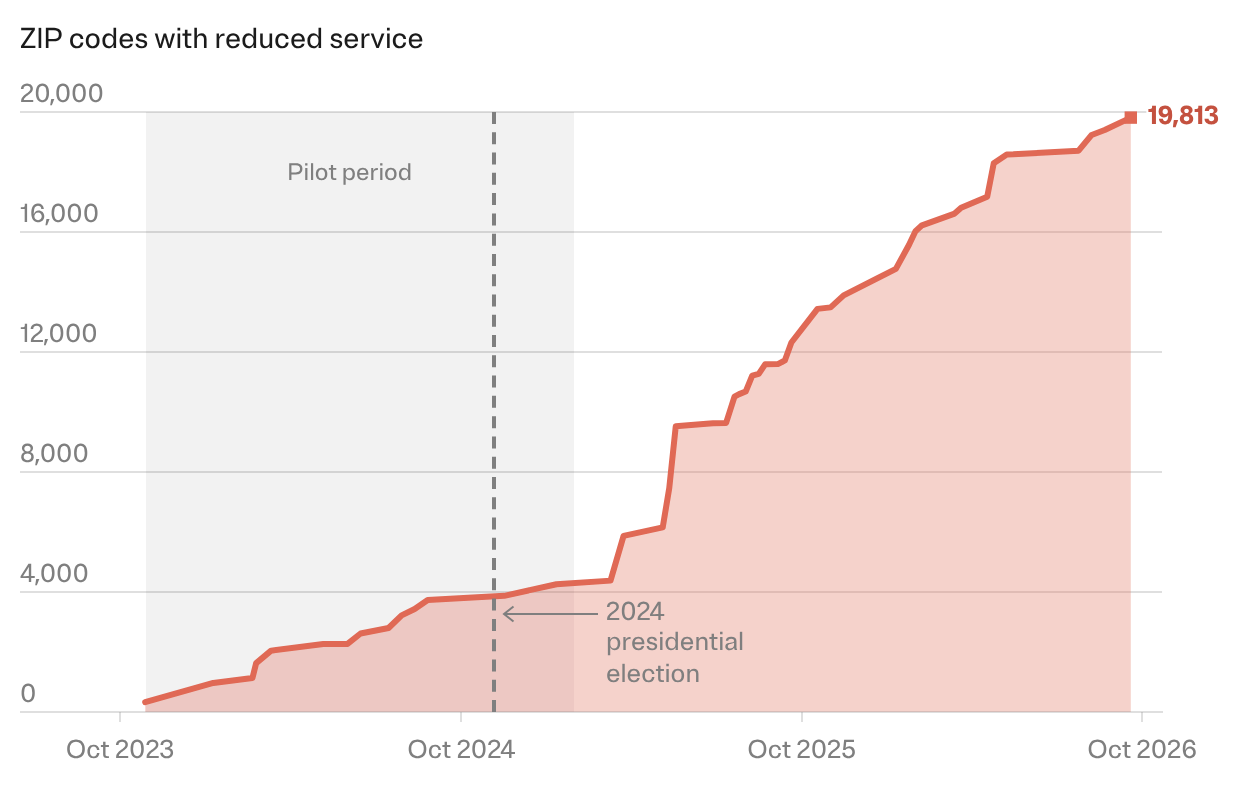
    The agency announced the national rollout of the RTO plan in 2024, but DeJoy agreed to pause it leading up to that year’s November election, leaving only about 4,000 ZIP codes in the pilot project affected by the service changes.

    Mail Services Have Been Cut in 16,000 More ZIP Codes Since the 2024 Election

    A pilot program that reduced mail pickups to save money was paused in the lead-up to the 2024 election. The rollout has since resumed, and the changes have been made in five times as many ZIP codes for the 2026 midterms.

    A chart showing the number of ZIP codes that are part of a plan that reduces mail service. The number rises from near zero in October 2023 to 19,813 in September 2026, with slow growth during the pilot period, which spans the year leading up to and just after the 2024 presidential election, and a sharp acceleration starting in 2025.
    Source: ProPublica analysis of Postal Regulatory Commission filings Ken B. Morales/ProPublica

    In January 2025, the Postal Regulatory Commission, which oversees the Postal Service, warned that moving forward with the plan would be disruptive to rural communities and might not save as much money as expected. The Postal Service rolled out the reductions anyway, extending the changes to almost 20,000 ZIP codes to date. Officials said they expect the system to be fully implemented within two years.

    This January, the agency put out a statement saying the transportation cuts would mean it took longer for mail, including ballots, to be postmarked and delivered. But the Postal Service didn’t specify which voters would be affected by the slowdowns and which wouldn’t.

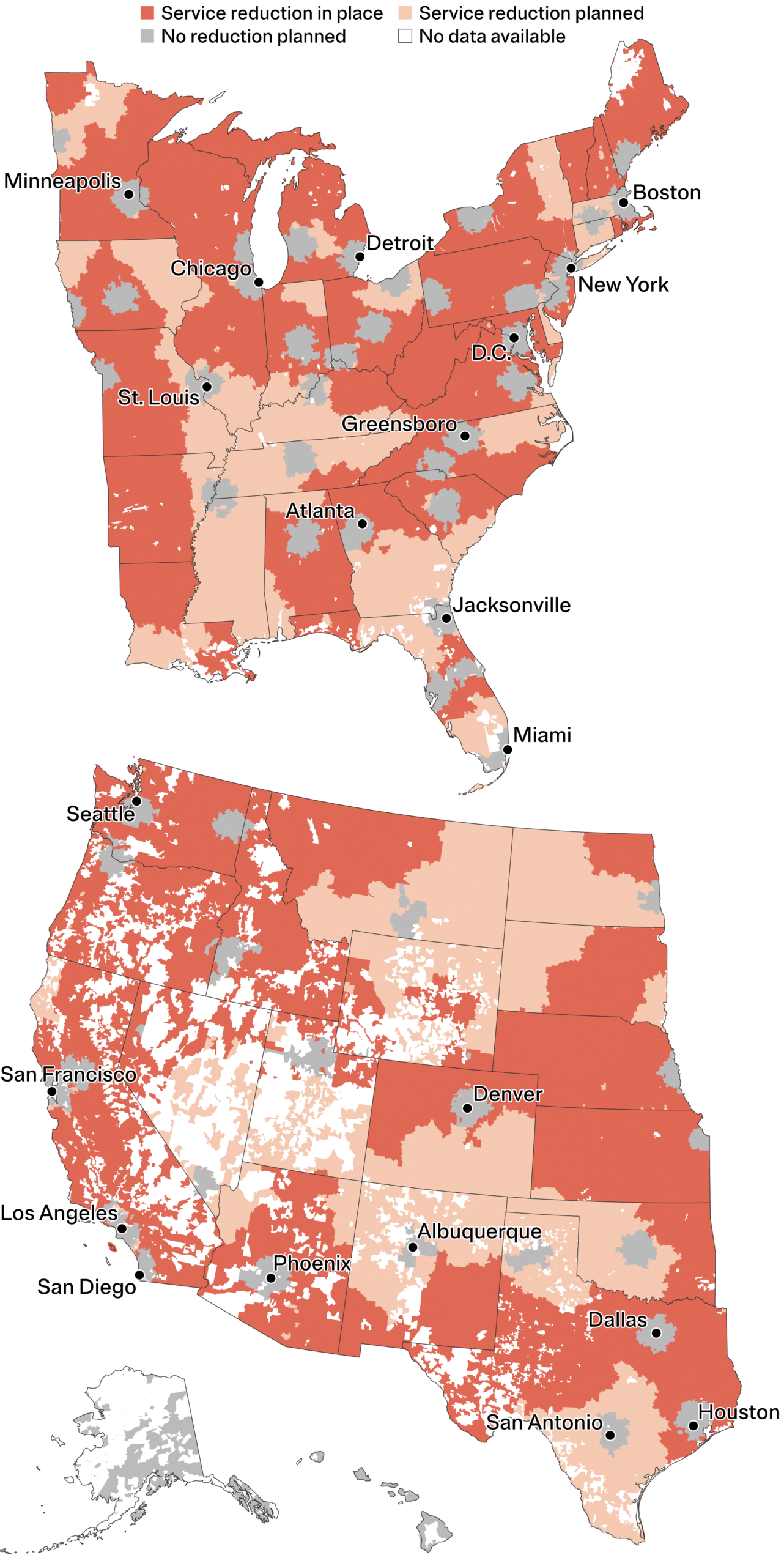
    Mail Service Has Been Cut in Large Swaths of Rural America

    A plan to reduce mail pickup frequency is being rolled out in ZIP codes that are more than 50 miles from a sorting facility. Areas not subject to the plan are mostly in or near large cities.

    A map showing ZIP codes where a plan to reduce mail pickup frequency is active or soon to be active in all 50 states and the District of Columbia. The plan has been rolled out in most of the Northeast, Midwest and West. Much of the South is expected to be part of the plan in the future, including large sections of Alabama, Florida and Georgia, according to ProPublica’s analysis. ZIP codes marked as not subject to reductions are located within 50 miles of a sorting facility and are mostly in or near large cities.
    Source: ProPublica analysis of Postal Regulatory Commission filings Chris Alcantara/ProPublica

    Though the delay from RTO is often only a day, mail can be delayed longer if it’s deposited in a mailbox after the daily pickup time, or just before Sunday or a holiday.

    A Postal Service spokesperson said the agency told election officials that RTO would change schedules and reemphasized the need for voters to get their ballots in the mail at least a week ahead of time. Election officials in Washington said the Postal Service wasn’t direct enough about the fact that the changes would lead to delays in delivering and postmarking ballots.

    “What they said was, ‘We are going to change the way we do postmarks,’” said Hobbs, Washington’s secretary of state. “That was it.”

    Patel, the Brookings analyst and a former Postal Regulatory Commission employee, said that more direct communication to voters could have helped change their behavior. “That’s the part that I think has not been super transparent about the whole process,” she said.


    Many of the areas that saw a spike in late ballots were in Western states, which were the earliest and most enthusiastic adopters of expanded mail-in voting.

    In 2004, Washington became the second state to start conducting all-mail elections, in which every eligible voter automatically receives a mail-in ballot. Most residents vote by putting their ballots in drop boxes. Still, in 2024, about 33% put them in the mail.

    In the 30 mostly rural Washington counties most affected by RTO, the percentage of ballots postmarked late more than tripled compared to the 2022 primary, ProPublica found.

     Is your ZIP code subject to reduced mail service? Use our lookup tool to find out.

    In Garfield County, in southeastern Washington, 19 ballots — nearly 1 in 10 cast — had late postmarks this year. In 2022, only a single ballot was postmarked late. In Pend Oreille County, in northeast Washington along the Idaho panhandle, 6% of ballots were rejected for arriving late, compared to 1% in the 2022 primary.

    “It was pretty awful telling people we couldn’t count their votes,” said Marianne Nichols, Pend Oreille’s longtime auditor. “They were quite upset because they felt like, ‘Why? This was in the mailbox on election day, the post office picked it up and had it.’ They felt like it should have counted.”

    In Stevens County, the percentage of ballots rejected for having a late postmark jumped to 8%, from 1% in 2022.

    Steve Hutkins, a retired professor who analyzes the effect of Postal Service changes on Savethepostoffice.com, also found that places in Washington with RTO had more ballot rejections during local elections earlier this year for school board and other measures. The patterns “set off the alarm bells,” he said.

    Stuart Holmes, the state’s director of elections, said he reached out to Postal Service officials to find out what had happened, but got few answers and no specifics on delays related to RTO, which were a “total surprise,” he said.

    Election officials in California and Oregon also reported thousands more ballots rejected for arriving late during their primaries. Counties affected by RTO, including Kern County, California, had substantially higher rates of ballots rejected for mail-related reasons, ProPublica found.

    Kern County’s assistant registrar of voters, Laura Cantu, said election officials are urging rural voters to use drop boxes to cast their ballots in the general election.

    The expansion of RTO had a similar effect in North Carolina and Ohio, where the rates of late ballots were about twice as high in counties affected by the restructuring as rates in counties that weren’t. Since 2022, these states have also eliminated grace periods in which ballots postmarked by Election Day could count even if they arrived later. Voters unused to the tighter deadlines also could have contributed to an increase in late ballots.

    ProPublica didn’t find any association between RTO and higher rates of late ballots in Wisconsin, even though clerks reported delays involving mail-in ballots cast in its state election, held this spring. (Other Postal Service changes may have contributed to the delays.) 

    Wisconsin’s data does not distinguish ballots sent by mail from those cast in drop boxes or in person, making it impossible to definitively measure rejection rates just for ballots returned by mail. Election researchers said Wisconsin’s deadline for mail ballots, which must come into election offices by 8 p.m. on Election Day, also probably had an effect. 

    “If you know that you don’t have a grace period, it probably affects voter behavior,” said Patel, the Brookings researcher. 

    Mail ballot envelopes are prepared for Adams County, Washington, midterm voters at a third-party processing center for mail, Direct Mail Enterprises, in Spokane. Rajah Bose for ProPublica

    Recent Postal Service audits have found that RTO-related changes had saved the agency about $2.8 billion by the end of fiscal year 2025 — less money than expected — and are slowing down all first-class mail, not just ballots. Residents of rural areas are waiting longer for everything from prescriptions to bills, a report published in September by the Postal Service’s inspector general said.

    A Postal Service spokesperson still defended the plan, both for financial reasons and to adjust to the changing marketplace. “These savings are both significant and necessary,” he said.

    In the lead-up to Nov. 3, the agency’s plan is to route ballots meant for local election offices to a nearby postal facility or directly to their destination. They shouldn’t go to regional plants, which the Postal Service says should minimize delays.

    Larsen, the Stevens County auditor, is encouraging Washington voters to deposit their ballots in drop boxes rather than relying on the mail. Since the primary, she’s increased the number of red, white and blue drop boxes that sit outside government buildings from seven to 12. Near each box, there’s a large sign encouraging people to take selfies when they vote and send the photos to Larsen. 

    In prior years, Larsen said, she avoided telling voters how or when to vote, concerned they might regret choices they made if critical information later emerged about the candidates. That’s no longer uppermost in her mind.

    “Now we are more concerned that we get your ballot,” she said.

    Source: ProPublica · 2026-10-22

  • Sexual Assaults on Campus No Longer Scrutinized as Closely Under Trump’s Education Department

    Sexual Assaults on Campus No Longer Scrutinized as Closely Under Trump’s Education Department

    An illustration of three yellow pencils forming the shape of an arrow pointing down and diagonally to the right.
    Shoshana Gordon/ProPublica

    The civil rights arm of the U.S. Department of Education has dramatically scaled back investigations involving schools and colleges since the second Trump administration began, even as complaints continue to pour in, a ProPublica analysis of newly obtained records found.

    The analysis shows how severely the department’s Office for Civil Rights has retracted from its mission, launching an average of about 100 new investigations a month — 1,839 total from Inauguration Day in 2025 through July 2026. The OCR launched an average of 310 new investigations each month in 2024 during the Biden administration, according to data previously obtained by ProPublica.

    Under President Donald Trump, the OCR abandoned the public-facing list of schools it was investigating and the reasons for those investigations, including claims of discrimination based on race, sex and disability. ProPublica sued the department to obtain internal case data. The government subsequently provided records of the OCR’s actions in the first 18 months of Trump’s return to power, and we are publishing the data so the public can search the cases.

    Search for School Civil Rights Investigations

    See where the U.S. Department of Education’s Office for Civil Rights under the Trump administration has launched investigations into alleged discrimination in schools and colleges or dismissed complaints without investigating. The table also includes complaints filed with the OCR during the Trump administration that the office has not yet decided to investigate. 

    The OCR uses “case opened” to record when complaints were received by the agency. “Investigation start date” indicates the date the agency initiated an investigation.

    Loading data…

    Source: U.S. Department of Education Office for Civil Rights, as of July 2026. Note: The data includes complaints closed and investigations opened from Jan. 20, 2025, through July 2026, as well as open complaints received from Jan. 20, 2025, through May 26, 2026. This data was derived from two files covering complaints received by the OCR and investigation notices it sent to institutions. If a case was present in both, the table displays the case information from the complaint file. Some cases do not stem from a complaint but are initiated by the agency. In those cases, “case open” indicates when the case was launched internally. For more on our methodology, see here.

    ken schwencke/propublica

    The decline in investigations is especially dramatic for cases involving sex discrimination. More than 200 new complaints were filed with the office related to schools’ handling of sexual violence — rape, assault and abuse. But the Trump administration launched investigations in only 29 of them, finding fault with a school district only once, according to the newly obtained data. It’s typical for there to be at least 60 sexual violence investigations opened each year.

    The department addressed fewer of these cases despite continued concerns about the persistence of the problem — as demonstrated by the intense public scrutiny over how Cornell University addressed a student’s report of a 2024 gang rape.

    Beyond that, the OCR launched only two investigations into discrimination based on sexual orientation.

    “They’re barely doing anything to protect women and girls, including survivors of sexual violence,” said Shiwali Patel, an attorney who previously worked at the OCR and is now with the National Women’s Law Center. “They just don’t care about women and girls.”

    The organization and more than 120 other advocacy, civil rights and education groups sent a letter on Tuesday to Congress’ ranking education committee leaders urging them to hold the OCR accountable for “its failure to enforce civil rights law and protect students from sexual violence.”

    With OCR’s online database idle since Trump took office, the only way to know where the agency has launched investigations has been through selective department press releases, when OCR employees provided internal data to reporters or from schools and colleges that acknowledged that their institutions had become targets of the investigations.

    The data ProPublica received as a result of our lawsuit can now fill that gap on the more than 1,800 civil rights investigations that the department initiated from Jan. 20, 2025, to July 29 of this year. The database also reflects the 24,000 new complaints logged through May and the nearly 17,000 new and old cases the department closed — almost always by dismissing them. 

    The agency is dismissing complaints more frequently than in prior years, the records show. And fewer than 700 cases opened by the administration were resolved with a finding of wrongdoing.

    The data does not include investigations that had been opened before Trump retook power but that are pending decisions by OCR — a backlog of more than 10,000 cases.

    In response to questions from ProPublica, an Education Department spokesperson blamed the Biden administration for leaving office with 19,000 unresolved cases, which the Trump administration has worked to address.

    “Spare us the crocodile tears as the Trump Administration is working to restore OCR to its original purpose: enforcing the law to ensure all students can receive an education free from discrimination,” spokesperson Sabin Sidney wrote.

    He added that the administration “treats any form of discrimination on the basis of race or sex as illegal.” And he criticized the prior administration for endorsing policies that allowed transgender girls and women to compete in women’s athletics and use women’s restrooms.

    The data disclosure comes as the administration is moving forward with efforts to shut down the department and move the OCR under the Department of Justice. Disability rights advocates and others have been critical of the move, while the administration says it will lead to more efficiency and do a better job protecting students’ rights. The majority of cases before the OCR involve students with disabilities, as has been the case historically.

    In the early months of Trump’s second term, Education Secretary Linda McMahon fired hundreds of employees and closed seven regional OCR offices, leaving the department severely diminished. Its remaining civil rights workers have described untenable case loads and pressure to dismiss complaints.

    The remaining attorneys “are navigating pure chaos,” said Rachel Gittleman, president of the American Federation of Government Employees Local 252, the union that represents OCR staff. “They are being asked to use the tools they have used for their entire careers not for good, not to protect students, but to harm students. You see it in the case dismissals, the cases that target trans students or people of color.”

    In examining the new records, ProPublica found the extent to which the agency has shifted its focus, as the OCR places a new emphasis on complaints that men faced discrimination. The agency launched 172 investigations into alleged “discrimination against males,” compared with 104 cases of alleged “discrimination against females” in the period examined.

    It also has investigated allegations that campus programs or scholarships excluded men. For example, it investigated a complaint against Skyline College in California that had been filed in 2023 but that President Joe Biden’s administration had not acted on, according to records from the university. The complaint alleged that Skyline discriminated against men by listing scholarships on its website that are exclusively for women and for promoting a program for women.

    The civil rights office opened the investigation in mid-April, and two weeks later the community college agreed that it would remove the scholarships from its website and add language that the program was open to all students. A Skyline College spokesperson did not respond to questions from ProPublica.

    At the same time, the agency chose to open fewer than 370 new investigations involving racial discrimination, even though about 5,000 complaints were filed.

    Of those new investigations, about 11% involved allegations of discrimination against white students. Over the summer, the department announced investigations into five medical schools’ admissions policies.

    “They are not allocating their resources to racial discrimination complaints, to sexual assault complaints, to the types of complaints that really often speak to systematic discrimination and problems,” said Johnathan Smith, managing director of education at the nonprofit National Center for Youth Law.

    That organization also has sued the Education Department for similar information obtained by ProPublica; the lawsuit is pending.

    Help Us Report on How the Department of Education Is Handling Civil Rights Cases

    Have you recently filed a civil rights complaint or do you have a pending case? We need your help to get a full picture of how the dismantling of the Office for Civil Rights is affecting students, parents, school employees and their communities.

    Source: ProPublica · 2026-10-22
  • Is a GAIA ID completely useless in big 2026?

    Was investigating my gmail account (just for fun) and got to know about the concept of a GAIA ID. What can it exactly do? Google doesn’t give any answers.

    Like, can it find my YouTube channel? Or is it limited to Google Maps review?

    submitted by /u/TheMoon-Sparks
    [link] [comments]

    Source: Reddit r/OSINT · 2026-10-22

  • From Flights to ‘Incentives,’ Indonesian Nickel Giant Harita Approved Payments for Local Politicians and Leaders

    From Flights to ‘Incentives,’ Indonesian Nickel Giant Harita Approved Payments for Local Politicians and Leaders

    When senior mining executive Stevi Thomas was convicted alongside an Indonesian governor for bribery in 2024, the ruling was seen as a rare case of accountability for corruption in the Southeast Asian nation. 

    The court case revealed how the politician had received some $60,000 in bribes for facilitating permits for Harita Group, a conglomerate that has sourced up to eight percent of the world’s nickel supply in recent years  — and has also left a trail of environmental damage in its wake. 

    Now, leaked internal records obtained by OCCRP reveal a host of other payments that Harita executives earmarked for local politicians, individuals identified by the firm as community leaders, and the military between 2013 and 2023. 

    The planned or approved payments amounted to at least $389,000 and took the form of flights for politicians, “incentives” for the community leaders, and financial support for military projects. 

    Evidence of these outlays was found in leaked company emails, internal memos, and invoices.

    Reporters were unable to independently verify if the money was ultimately disbursed in every instance, or establish the precise purpose of some of the approved payments.

    But anti-corruption and mining experts said that some of the planned payments could violate Indonesian laws, including those regulating the giving of gifts to officials and a mining company’s use of corporate social responsibility funds. 

    Harita Group and the employees involved in approving the payments did not respond to requests to comment.

    Though many of the individual outlays were not large in size, such as $80 earmarked for the head of the local port office, money of this magnitude can go far in Indonesia, where the average monthly salary is approximately $200.

    The findings raise questions about whether the cash was used to reward individuals who acted in Harita’s commercial interests. In one case, Harita approved payments for a village chief who later, according to an internal company memo, monitored local residents who were protesting the miner’s operations. 

    The documents also provide a glimpse into the dealings between Harita executives and Indonesian officials, including how in one instance, the company drafted its own government permission decision and ultimately removed a legally-required clause. 

    “Harita or any private company has no legal authority to draft a government’s own policy or decision document, at any level of government,” Aryanto Nugroho, the national coordinator of the transparency organization Publish What You Pay Indonesia, told OCCRP. 

    “Drafting government decisions is a state function, not something delegated to the party the decision is meant to regulate.”

    The Indonesian government did not respond to requests to comment. 

    In most cases, the payments were authorized by senior Harita executives such as Thomas, the company director who was imprisoned in 2024 for bribery, the leaked emails show. Thomas did not respond to requests to comment. 

    Harita is one of the largest nickel producers in Indonesia, and its mines feed the supply chains of some of the world’s biggest electric vehicle makers. But it has also come under scrutiny for its environmental record. In 2025, an investigation by OCCRP and partners found the company knew for a decade that its mining operations were regularly breaching legal limits on the release of a toxic chemical into surrounding waterways, and that the contamination had reached residents’ main source of drinking water.

    Ferdian Yazid, a researcher at Transparency International Indonesia, said that the bribes that landed Harita executive Thomas and the governor in prison set “a bad precedent” in a country where anger over corruption erupted into nationwide protests late last year.

    “Although Harita claims to adhere to anti-corruption and environmental principles, the reality is far from what it has stated.”

    Yazid added that private companies such as Harita have disproportionate influence over regulatory frameworks at the expense of the public interest.

    Given the severity of corruption in Indonesia’s nickel sector, he added, “corruption prevention must be strategic, targeting critical minerals.”

    ‘Building Relations’

    The small island of Obi, which forms part of the North Maluku province in eastern Indonesia,  is covered in dense, mountainous forest. Harita opened a nickel mine there in 2010, and five years later, the company started building the first in a series of new smelters to process nickel ore into a material used in the production of stainless steel. 

    At the groundbreaking ceremony for Harita’s first smelter on Obi Island in June 2015, members of the Kasuba family, a powerful force in regional politics, watched on and gave the project their blessing. 

    But some residents of Kawasi — a village now encircled by Harita’s facility — were less cheerful about the expansion after already having seen the company’s mines strip away rainforest surrounding their homes.

    Internal company emails show that Kawasi villagers met with company representatives and accused Harita of breaking the law by failing to hold a public consultation into the construction of the smelter. They also demanded that the company stop work and allow time for a new environmental impact assessment. 

    But Harita’s senior general manager dismissed their concerns, writing in an email to a colleague in July 2015 that he suspected “a third party is stirring up the public.” 

    It turns out Harita had already established financial ties with local residents they referred to as “influential” local officials and community members.

    In 2013,  an internal Harita spreadsheet titled “building relations” detailed planned payments totaling $2,300 for Kawasi’s elected leader, Arifin Saroa, and at least 11 other individuals. Around $400 of this total was earmarked specifically for Saroa, who could not be reached for comment. 

    Another July 2014 email chain marked as “confidential” details around $13,500 in “incentives” between March and July designated for dozens of individuals identified as community figures, including local imams and pastors listed as “partners” and “stakeholders.” 

    While the emails don’t state the exact reason for what were marked as monthly outlays, the correspondence shows Harita’s senior general manager evaluating payments based on the community figures’ level of influence.

    In one message, he wrote that a certain reverend’s “role was quite significant” despite being from a different town, as he had managed to make a phone call that stopped a threat from protesters to halt production. 

    While it could not be confirmed if there was any connection to Harita’s planned payment, several years later Kawasi’s village head Saroa appeared to be providing the company with a valuable service. A 2020 internal security memo from Harita noted that he would be passing on any information about members of the community “suspected of being masterminds or participants” in a protest against the company. 

    This would allow the company to “give them special attention by rejecting them and their families” from employment opportunities, the document says.

    According to the memo, Saroa had confirmed that “every [Harita] applicant from the village must go through the Kawasi Village Head for recommendation or otherwise be blacklisted,” and that a local widow was being monitored by the Kawasi village authorities.

    Four Kawasi residents confirmed to OCCRP that those who wanted to work for Harita or sell supplies to the company had to go through Saroa for a recommendation. 

    They also alleged the company had offered financial incentives to those who complained about the damage caused by the mine, and who have also faced intimidation.

    “Whenever people refuse to sell their land [to Harita], police personnel show up at odd hours to persuade and intimidate them,” said one resident, whose name OCCRP has chosen not to publish to protect him from potential reprisals. “Even the slightest protest here is immediately reported to the police or the military.”

    Head of the village Saroa himself did sell land to the company among other substantial financial transactions with the Harita Group, the documents show. 

    He earned approximately $304,000 primarily between January 2020 and August 2022 in return for selling cropland close to Kawasi that he either owned or farmed, according to more than a dozen joint agreement letters seen in the leaked records by OCCRP. Harita planned to use the land to build a second smelter and other infrastructure, the documents say.

    Separately, Harita had also contracted two companies it understood to be owned by Saroa to provide loading services at the island’s port, according to a contract and loading report. 

    In 2021, Harita’s stakeholder engagement plan identified the village leader as “critical” for the mine’s success — stating that he provided a high-level of support, and remained in regular contact with the company.

    Harita did not respond to questions about where the funds for its various payments were drawn from.

    However, in one case, reporters found that $1,400 earmarked for the military’s inauguration of a navy ship was categorized internally as CSR spending. 

    Under Indonesian law, mining companies are required to put CSR funds towards improving the quality of life of the community directly impacted by mining, as well as the broader society.

    “Corporate social responsibility is supposed to be given to the community,” said Laode Muhammad Syarif, a former commissioner for Indonesia’s Corruption Eradication Commission.

    “A volleyball court is built because there’s no place to play, or the mobile clinic is improved — that’s CSR. But if it’s given to the police and military, what’s the connection?”

    The military did not respond to requests for comment.

    ‘Good Relations’ 

    In the summer of 2016, Harita’s senior director Lalu Mahfi had a problem. Harita was already a year into the building of its first smelter on Obi Island, but the company did not have a construction permit. 

    “Normally, a building should not be constructed without first obtaining an IMB [building permit], but through good relations with the local government, we have been able to continue the smelter construction,” Mahfi wrote in an email to colleagues that June. “In other places, such a project could be shut down or ordered to stop.”

    In the same email Mahfi urged staff to make a hotel booking at a four-star hotel in Jakarta for Bahrain Kasuba, the nephew of Abdul Ghani Kasuba — the governor later jailed for accepting bribes from Harita in a separate instance — and several team members. At the time, Bahrain was serving as regent — a position equivalent to a district head — of South Halmahera, an area that includes Obi island.

    Though there is no evidence Bahrain ultimately facilitated the construction permit for Harita, Mahfi explained in an email to colleagues that his “arrival in Jakarta is very important for the company in securing the building permit for the smelter.”

    Mahfi did not respond to requests to comment and reporters sent questions for Bahrain through the regency government, which is currently headed by his cousin, but did not receive a response. 

    By that point Harita and Bahrain already had a working relationship. A year earlier, on the day he took office, the official signed a joint agreement with companies belonging to Harita Group to “smooth and accelerate” the company’s mining operations in “anticipation of social conflict” around the mining areas, the document says.  

    Although Bahrain canceled the June 2016 Jakarta plans, the company ultimately booked six flight tickets between North Maluku and Jakarta for the official and in one case his wife over the next five years, according to receipts, booking forms, and memos from Harita’s finance department. None of the documents provide a reason for why the company purchased these flights.

    On November 15, 2016, Harita finally obtained the construction permit for the new smelter. 

    Yassar Aulia, researcher at Indonesia Corruption Watch, said the hotel booking and flight purchases raise questions over the propriety of Harita’s relationship with a public official, and whether there was any “kickback intent.”  

    The country’s Corruption Eradication Commission did not respond to queries about whether Bahrain reported the flight purchases. 

    Under Indonesian law, public officials have 30 working days to report any gift to the Commission, and must prove the gift was not a bribe in cases where the value is over $440. For lower value gifts, evidence of a bribe would need to be proven by a prosecutor, the law states. (The costs of the flights for Bahrain and his wife that are mentioned in the documents were typically around $140.)   

    In August 2017, Mahfi also sent the senior general manager a draft contract to hire Muhammad Kasuba —  Abdul Ghani Kasuba’s brother and a former regent of South Halmahera — as an external relations consultant to, among other tasks, “foster relations with the Regional Government and community” for a minimum of $3,700 per month, a figure 20 times the average salary.

    It is not known if Muhammad Kasuba ever signed the draft contract, but the former official has continued to publicly champion Harita as recently as last year. He did not respond to requests to comment.

    Drafting a Government ‘Decision’

    Company emails indicate that Harita was given an unusual level of free rein by authorities.  

    In May 2016, Mahfi emailed Harita’s then-president director a draft government “decision”  permitting the company to store hazardous waste. 

    Although the official government document was to be signed by Bahrain — the regional official who would later have flights booked by Harita — it was apparently put together by Mahfi himself.

    “I compiled this draft from various sources,” Mahfi wrote in an email to colleagues.

    The emails show Mahfi went on to further edit the decision, removing a clause which stated that the permit had been issued after a legally-required field verification.

    Nugroho, the national coordinator of Publish What You Pay Indonesia, described this intervention as “a private party stepping into a function that belongs exclusively to the state.” 

    “That is precisely the mechanism governance experts describe as state capture.”

    He also added that if the regency government issued the permit as written by Mahfi without the field verification clause, the permit could be revoked and the officials who signed off on it could be liable to either civil or criminal action.

    Paying for Positive News 

    In 2018, international consultancy firm Hatch delivered a technical review commissioned by Harita into the company’s smelter operations. 

    According to the review, which OCCRP found a copy of in the leaked Harita emails, the company used hazardous waste materials during the construction of the smelter without government permission. 

    Harita had also not completed a number of crucial environmental and social impact assessments, the report said.

    However, Harita spent money painting a different picture to the public.

    Between August 2022 and January 2023, Stevi Thomas signed off on spending a total of about $6,000 to place news stories about Harita in more than 40 Indonesian media outlets, internal memos show.  

    The stories described Harita’s contribution to the economy, the job market, and how the nickel industry was on track to meet net zero targets, among other topics. 

    On the ground, meanwhile, Kawasi villagers blame Harita’s operations for the degradation of their farmland through landfilling, flooding, and groundwater contamination. Most were eventually relocated to an “eco-village” built by the company. 

    Today, only a handful remain in the original Kawasi village, where homes and streets are subject to frequent blackouts, as well as severe flooding with contaminated water from the mine’s overflowing sediment pond.

    Source: OCCRP · 2026-10-22

  • Collapsed Surrogacy Agency Loses U.S. Civil Case After Court No-Show

    Collapsed Surrogacy Agency Loses U.S. Civil Case After Court No-Show

    Collapsed international surrogacy agency World Center of Baby has been dealt a double blow in Florida, with a judge ruling against its U.S. corporate entity in a civil lawsuit – shortly after another case against the company was filed.

    The developments come just over a month after OCCRP published a global investigation into the chaos World Center of Baby left in its wake after announcing it was filing for bankruptcy, including surrogates left unpaid and unsupported, and prospective parents abandoned. 

    In a decision made publicly available on Tuesday, Judge Thomas Ramsberger in Florida’s Sixth Circuit Court ruled in favor of a U.K.-based couple who brought a case against the agency’s U.S. corporate entity World Center Group Corp and two of its representatives. The complaint was on five counts, including breach of contract and fraud. 

    The lawsuit accused the company of “a calculated and coordinated scheme” to secure substantial payments for promised services despite its worsening financial and operational problems.

    The judge noted that the decision was a default judgement as none of the three defendants — World Center Group Corp, its former listed president Yuri Star, and listed director Malvina Jonas — responded to summons sent to the addresses listed on the company’s corporate documents. The ruling followed an October 5 hearing that the defendants failed to attend. 

    World Center Group Corp, Star, and Jonas were ordered to recover funds for the couple amounting to $87,415 which they had paid for a World Center of Baby program that was meant to provide surrogate matching, medical coordination, and program management through the birth of two children. In the end, they received none of it.

    The couple, who spoke with reporters, but asked not to be named, said: “Although we have a judgement, we are not yet clear on what our chances of recovery are.”

    The case was tried in Pinellas County on Florida’s west coast, because that is where the most recent incorporation documents list an address for World Center Group Corp. 

    Just before the judgement, a second civil lawsuit was filed in Pinellas County against Yuri Star and World Center Group Corp. by another intended parent who alleges they paid the agency more than $40,000 for medical procedures that were due to take place in Mexico, but did not happen and were not refunded. The plaintiff had been urged to pay the money up front in exchange for a discount, the complaint alleges. 

    That lawsuit lays out four counts against World Center Group Corp, including fraud and breach of contract, citing OCCRP’s investigation as part of the submitted evidence. 

    The complaint also alleges that the plaintiff was unaware that the agency did not actually employ medical staff in Mexico and instead used third-party clinics. Former World Center of Baby employees later told the plaintiff that the agency had stopped paying its partner clinics and employees around the time that the plaintiff traveled to Mexico for a clinic visit. 

    OCCRP’s investigation into World Center of Baby found that the agency’s operations and ownership were difficult to pin down, including basic information such as who owns it, its corporate structure, and what led to its demise. 

    Star, the former listed president, told reporters during the investigation that he had been hired as a consultant to register the company and knew nothing about it or why it collapsed. He said he was not a shareholder, investor, or beneficiary, and was still owed money for his services. 

    Star did not respond to a request for comment on the judgement against him.

    Reporters were unable to reach Jonas, the listed director. Five employees who spoke with reporters said they had never met or spoken with her and one of the employees claimed her signature was automated. 

    Ukrainian businessman Vladyslav Natochii, who is variously listed on previous versions of the agency’s website as its founder, owner, and managing director, but is not on the paperwork of the Florida-registered entity told reporters that World Center of Baby had “experienced a severe financial and operational crisis,” and denied wrongdoing.

    Source: OCCRP · 2026-10-22

  • New US law requires dating apps to include warnings on romance scams

    New US law requires dating apps to include warnings on romance scams

    A new U.S. law signed by President Donald Trump Tuesday will require online dating services to notify users when someone they’ve been talking to is banned from the platform for fraud.

    The bipartisan Romance Scam Prevention Act, backed by senators Marsha Blackburn of Tennessee (R-Ten) and John Hickenlooper of Colorado (D-Colo), was passed unanimously by the Senate in late September and went to the president for signature earlier this month.

    Romance fraud schemes accelerated during the COVID-19 pandemic when more seniors turned to dating sites for companionship, followed by scammers. Romance scams incurred record-high losses in 2025, with Federal Trade Commission data showing over 70,000 reports and a staggering $1.47 billion lost in the U.S. Losses also reportedly surged in the U.K., South Korea, Australia and across Africa.

    Some dating sites already remove fraudsters’ accounts but a victim may continue talking to a scammer off the app long after a scammer’s profile has been deleted. The Romance Scam Prevention Act aims to close that gap by requiring dating platforms to send a fraud ban notification to anyone who has communicated with someone with a fraudulent account.

    https://www.icij.org/news/2026/07/dating-app-scam-models-influencers-social-discovery-group/

    Accountability Inside the Matrix: How models, influencers and engagement quotas power the Social Discovery Group’s dating machine and global profits Jul 23, 2026

    https://www.icij.org/news/2026/09/tinder-swindlers-plan-for-a-dating-app-sparks-industry-backlash/

    Collaborative Journalism ‘Tinder Swindler’s’ plan for a dating app sparks industry backlash Sep 18, 2026

    https://www.icij.org/investigations/coin-laundry/crypto-giant-circle-rebuffed-efforts-to-help-scam-victims-police-say/

    CRYPTOCURRENCY Crypto giant Circle rebuffed efforts to help scam victims, police say Jul 08, 2026

    Recommended reading Accountability Inside the Matrix: How models, influencers and engagement quotas power the Social Discovery Group’s dating machine and global profits Jul 23, 2026 Collaborative Journalism ‘Tinder Swindler’s’ plan for a dating app sparks industry backlash Sep 18, 2026 CRYPTOCURRENCY Crypto giant Circle rebuffed efforts to help scam victims, police say Jul 08, 2026

    Source: ICIJ · 2026-10-21

  • Citizen Lab Director Slams Trump Administration, ‘Techno-Fascist’ Executives

    Director Ron Deibert spoke to a crowd in his keynote address at SecTor 2026, warning that the threats that the Citizen Lab investigates are being “super-charged” thanks to AI. In particular, he criticized the United States’ “descent into authoritarianism” and use of AI to spread propaganda.

    Source: Citizen Lab · 2026-10-21

  • In a Vienna Bakery, Fresh Pastries and a Backdoor for Serbian Votes

    In a Vienna Bakery, Fresh Pastries and a Backdoor for Serbian Votes

    For the ordinary Viennese, it’s just another neighborhood Balkan bakery.

    But to the more than 76,000 Serbians living in the Austrian capital, the shop known as Pekarica — “little bakery” — offers a fragrant touch of home, where orders are exchanged effortlessly in their native tongue as the scent of dough wafts from the oven.

    That’s not all. On one recent morning, a customer stepped to the front of the counter, ignoring the steaming trays of braided breads and glossy pretzels entirely.

    “Excuse me,” he said. “I was told by my colleagues that I can register to vote here.”

    “Yes, you can,” the clerk replied, unfazed by the question. “Not here exactly, but further down. Come, I’ll take you.”

    She led him out the door and a few steps down the pavement to the modest storefront housing the Association of Serbs in Austria. Inside, the walls were plastered with campaign posters, slogans, and portraits of Serbia’s long-serving president, Aleksandar Vučić, and his ruling Serbian Progressive Party (SNS).

    At a desk covered with voter lists and photocopied identity documents, two people were busy processing applicants. The association is a non-governmental organization registered under Austrian law. Legally, it has no authority to collect voter registration materials on behalf of Serbian authorities. 

    Yet behind these closed doors, that is exactly what it has been doing — specifically for those who support the ruling party, an investigation by the Serbian investigative outlet KRIK found. Journalists obtained three recordings made by applicants that captured the process, as well as WhatsApp messages and flyers shared by the association with voters.

    The parliamentary elections scheduled for Sunday in Serbia could be pivotal, with Vučić’s long-dominant party facing a significant challenge from a student-led movement fed up with corruption and state capture. 

    Yet Serbian elections have long been marred by irregularities and a voting landscape warped in favor of the SNS, according to international and local observers.

    Following the last parliamentary poll in December 2023, the Organization for Security and Cooperation in Europe (OSCE) concluded that the vote was technically well-administered but fundamentally skewed by the president and the ruling party’s systemic advantages. The mission warned of an unlevel playing field in the form of pervasive media bias, pressure on public-sector employees to vote for the ruling party, and the routine misuse of state resources for partisan campaigning.

    The association in Vienna’s 16th District reveals how those imbalances can also reach across international borders.

    Under Serbian election law, overseas voter registrations must be handled exclusively by Serbia’s diplomatic missions. But multiple Serbians living in Austria say registering through the embassy or consulate is almost impossible for some: phones ring unanswered, appointments are nearly impossible to get, and applicants are routinely turned away for missing paperwork. 

    Jelena Živanović Valtner, a quality coordinator in the pharmaceutical industry who has lived in Vienna with her daughter since 2009, told KRIK that she tried to register through the official consular channel, but was stonewalled.

    “As required, I sent the consular department a completed and hand-signed application,” she said. 

    She later received a blunt email from the embassy written in all caps: “YOUR APPLICATION IS INCOMPLETE.”

    Živanović Valtner followed up over email and eventually filed formal appeals with both the Republic Electoral Commission and the embassy in Vienna. She says she received a phone call assuring her that her application was under review, but that it was ultimately rejected again, without any explanation.

    Now, she can only vote if she travels back to Serbia on election day.

    “If my job allows me to travel to Serbia to vote, I’ll go,” she said. “If not, well, that’s that.”

    Inside the association next to the bakery, meanwhile, the process appears to be entirely frictionless — for those bearing the right political stripes. 

    According to the undercover recordings made by applicants and obtained by KRIK, staff members processed registrations in less than five minutes. They copied identity papers, filled out forms, and took phone numbers so they could send confirmation once the registration was cleared through the Serbian embassy.

    Applicants were also asked to leave the contact numbers of family and friends living in Austria who were likely to support the ruling party.

    “We don’t register those road-blockers and fools,” a male voice can be heard telling an applicant in one recording, referring to the student protesters who have shut down highways and bridges during anti-government demonstrations. “We only communicate with our people who support Vučić.”

    Those who registered walked out with gift bags emblazoned with the ruling party’s logo, packed with pens, lighters, and candy.

    In another audio recording, a young man who walked into the association to ask about signing up was initially met with a chilly response. 

    “Who are you voting for?” a voice can be heard asking him suspiciously.

    The person then indicated that the registration services were conditional: “If you’re voting for those others, then you’ll have to go register somewhere else! … Who else would you vote for, if not Vučić?”

    After the young man told them he did not support the students, the atmosphere changed. “Those road-blockers pissing you off? Good on you!” he was told.

    Outside the Law

    According to Vladimir Tupanjac, an attorney who has monitored Serbian elections alongside the Center for Research, Transparency and Accountability (CRTA), the Vienna association’s registration drive has been crossing several legal lines. 

    Under Serbia’s Law on the Financing of Political Activities, civic associations and foreign legal entities such as this one are prohibited from conducting election campaigns, assisting voters, or handing out party promotional materials.

    “This kind of conduct is definitively unlawful,” Tupanjac told KRIK.

    The operation also ignored a rule requiring voters to personally submit their voter registration applications, he said.

    In one recorded phone call, an association representative assured a prospective applicant that third-party submissions were fine.

    “You can notify anyone you know who supports the policies of our president; they can come with you,” the woman said. “If they trust you, they can give you their document — they don’t have to be physically present.”

    Help was offered for other embassy services as well.

    “Whatever else you need in terms of paperwork, or other appointments, we try to sort it out. Like I said, if you need the embassy or the consulate, well, we’re in touch with all of them.”

    When KRIK reporters showed up at the association’s door to ask questions, their path was quickly blocked.

    An older man stepped out front, barring the entrance. He wore a vest that read “Vučić Team Serbia” and introduced himself as Željko Vojinović, a security guard and former boxer.

    “An SNS association — yes, we are,” Vojinović said in a calm, matter-of-fact tone when asked about the vest. While he kept the reporters talking outside, a man inside locked the front door.

    A few minutes later, Andrej Leskovac, the person who had been the main point of contact for voters arriving to register in the undercover recordings, arrived. 

    When asked who had organized the voter registration drive inside the association, he acted surprised.

    “I don’t know who gave you that information. Our people all register at the embassy,” he said, claiming the association focuses strictly on humanitarian work. “No votes are being collected here … There are no registrations here, no forms. If you saw them, you didn’t see right.”

    He insisted there was no official link between the association, the Serbian embassy, or the ruling party, though he made no secret of his personal admiration for Vučić.

    For Tupanjac, the recordings suggest a coordinated effort designed to manipulate the diaspora vote in the ruling party’s favor.

    “All these irregularities, abuses, and unlawful practices indicate that there is a systematically organized mechanism for manipulating the voter register, buying votes, and swaying the electoral will of the citizens,” he said.

    The Serbian Embassy in Vienna did not answer questions about the association’s role in voter registration, referring reporters to the Ministry of Foreign Affairs in Belgrade, which never replied.

    The bakery and the SNS party did not respond to questions. 

    Source: OCCRP · 2026-10-21

    Documents