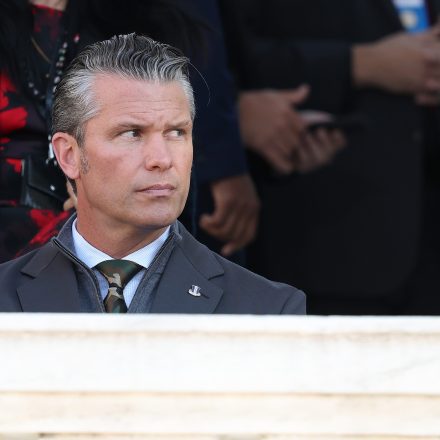
The Intercept and Freedom of the Press Foundation sued Pete Hegseth’s Pentagon in a pair of lawsuits demanding the release of documents related to the number of U.S. casualties in its war on Iran and the Department of Defense’s secretive blacklist of journalists.
One lawsuit, filed on Friday, responds to the department’s “repeated, unexplained changes” to its publicly available tracker showing U.S. service members killed or injured in the conflict with Iran — including a failure to acknowledge one soldier’s death for the six months after he died — that were documented by Intercept reporter Nick Turse. The shifting figures led one defense official to call the undercount a “casualty cover-up.”
In August, Turse requested from the Pentagon, through the Freedom of Information Act, casualty-related records and briefing materials presented to Defense Secretary Hegseth and his chief of staff, directives and guidance on casualties, as well as communications related to casualties between Hegseth and his staff of advisers. A later request filed by The Intercept in September sought the financial costs of the Iran war since its start in February. In all cases, the government stopped responding to The Intercept and has failed to provide any documents.
“They need to come clean to the American people.”
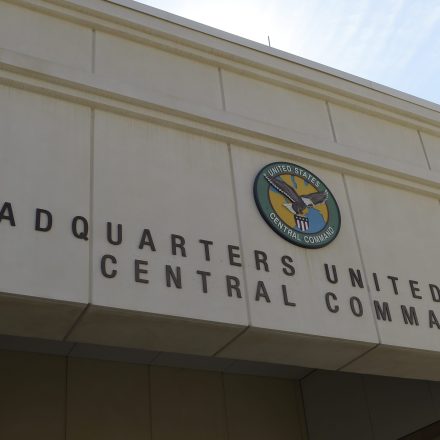
A second lawsuit against Hegseth’s DoD, filed on Monday, follows a July conversation with The Intercept in which a spokesperson for U.S. Central Command admitted the military post keeps a blacklist of media members. While reporting on the shifting U.S. soldier casualty figures, the CENTCOM spokesperson, Richard Allee, threatened Turse that he would be “put on a list of people to disregard” for calling the command too often.
CENTCOM later denied the existence of such a list. But Turse spoke with an unnamed U.S. official who confirmed that “Hegseth’s office had a standing order not to engage with [Turse] and would deny it if challenged.” During the first Trump administration, Turse had been placed on a separate blacklist kept by U.S. Africa Command, also within the Pentagon, after he reported on the torture of prisoners at a remote military base in Cameroon used by the U.S. for drone surveillance.
Turse has since filed a public records request seeking a copy of any “lists of journalists that CENTCOM discriminates against or disregards.” The Freedom of the Press Foundation also filed a request for communications and guidance related to the blacklist, as well as any records related to the command’s response to Turse’s article on the matter, published in August. The government has yet to provide any such information to The Intercept or Freedom of the Press Foundation.
“The military doesn’t get to decide which reporters it speaks to or ignores, especially when it’s engaged in legally questionable military actions and the human cost is at its highest. It’s not just the journalists who are harmed when the Pentagon behaves this way — the public and Congress are each denied critical information about what the military is doing in our name and with our taxes,” said Lauren Harper, Daniel Ellsberg chair on government secrecy, who filed FOIA requests for the blacklist on behalf of FPF. “If the Defense Department refuses to answer basic questions about how it engages with journalists, we’ll use the Freedom of Information Act to compel them in court.
The Intercept’s Turse called the Pentagon’s journalist blacklist “fundamentally un-American” and a way to avoid accounting for the real human toll of the ongoing war.
“Central Command wants to keep the sordid details of its wars — from civilian casualties in Iran and Yemen to U.S. military casualties across the Middle East — under wraps,” he said. “They need to come clean to the American people. We have to hold them accountable.”
Hegseth’s Department of Defense has long been hostile toward members of the media. In February 2025, days after Hegseth assumed office, the department forced out outlets such as NBC News, NPR, the New York Times, Politico, CNN, and the Washington Post from their Pentagon press desks. That October, Hegseth issued a new requirement in which journalists could only gain access to the Pentagon if they pledged to only report on information from government employees pre-approved by the Defense Department. This prompted most media outlets, except for the right-wing MAGA-friendly One America News Network, to surrender their press passes.
Trump has also targeted specific media outlets and individual journalists by barring them from the White House or Air Force One, though a federal court judge has since paused the bans, cautioning against possible violations of the First Amendment.
The Intercept and FPF’s lawsuits arrive days after Hegseth narrowly survived an impeachment attempt over his handling of the Iran war. The effort, led by Rep. Thomas Massie, R-Ky., and backed by Democrats, failed to garner enough votes to impeach Hegseth.
In addition to the war on Iran, incoming Democratic members of Congress, along with human rights groups, seek to hold Hegseth accountable for his bloody airstrike campaign on boats in the Caribbean Sea and Pacific Ocean, in which the U.S. has killed more than 240 civilians, and his overseeing of the U.S. invasion of Venezuela.
Jose Rosito Roca Estrada and his friends were on their way to work in a van on June 27, when a car in front of them slammed on its brakes, forcing them to crash into it and ricochet backward on the busy highway.
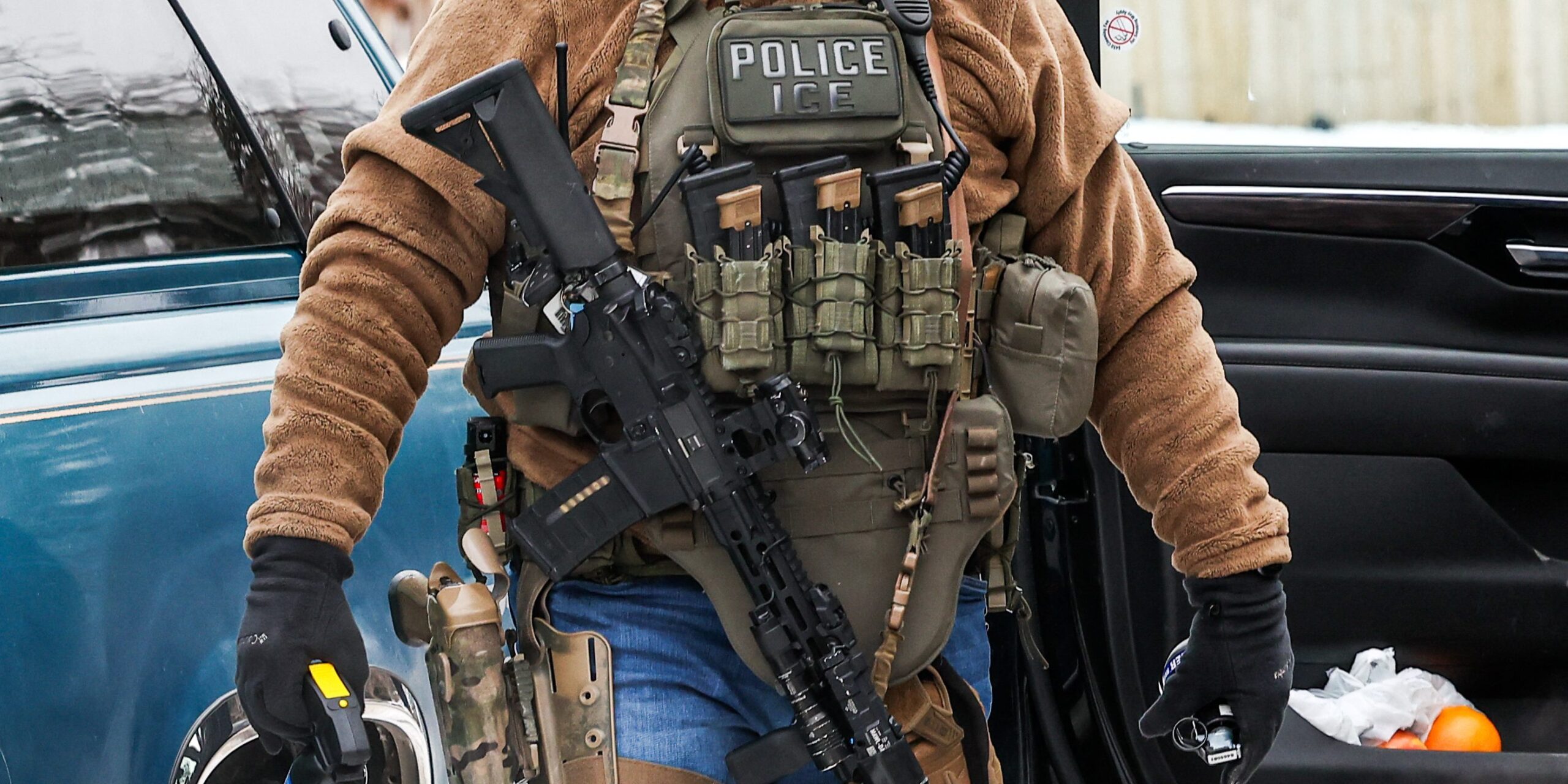
Three more cars surrounded theirs, and an estimated 10 to 12 officers poured out. The agents screamed at the men to get out of the vehicle despite traffic whipping by, Roca Estrada and fellow passenger Elvis Manuel Mejia told The Intercept. The stalemate ended with the sound of shattering glass and an asphyxiating cloud of chemicals flooding the car.
According to a new federal lawsuit and photos from the scene shared with The Intercept, federal agents smashed the car’s back windows and “sprayed the occupants with pepper spray through the lowered side windows.”
Officers then dragged a scared and temporarily blinded Roca Estrada from the car. “I was afraid they might be robbing me,” 24-year-old Roca Estrada told The Intercept through a translator. “They did not identify themselves. I was worried they were kidnapping me because they were asking very personal questions.”
“They did not identify themselves. I was worried they were kidnapping me.”
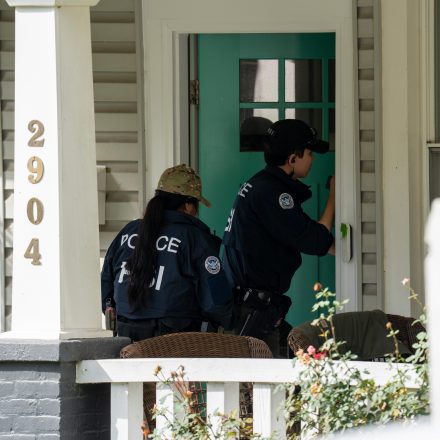
The June attack is one of six stories described in a lawsuit brought by several groups — including the American Civil Liberties Union of Virginia, the Washington Lawyers Committee for Civil Rights and Urban Affairs, the Legal Aid Justice Center, and multiple law firms — alleging widespread “unlawful and dangerous” warrantless arrests by immigration officials in Virginia.
On behalf of Roca Estrada and other plaintiffs, the groups are suing the Department of Homeland Security, DHS Secretary Markwayne Mullin, Immigration and Customs Enforcement, Acting Director of ICE David Venturella, and ICE D.C. Field Office Director Robert Guadian. They’re asking the court in the Eastern District of Virginia to force DHS to comply with congressional limits on warrantless immigration arrests and prohibit the agency from making immigration arrests without legally required individual assessments.
“They have a mandate from the Trump administration … to get creative and make arrests, however they see fit,” said Sophia Gregg, an immigrants’ rights attorney at the ACLU of Virginia. “The agents are ill-trained, and even when they do violate the law, there are no consequences.”
Roca Estrada said that the officers demanded to search his pockets, and when he declined, an agent threw him to the ground headfirst and dug his knees into his upper back. He remembered screaming as pain began to radiate through his collarbone. An X-ray reviewed by The Intercept would later confirm it was broken.
According to Roca Estrada and the lawsuit, officers began to punch and hit him in the back, eventually twisting his arm to place him in handcuffs and into the vehicle. Roca Estrada said that nurses who examined him after the alleged assault told him that blood had filled his lungs, and the lawsuit notes he was diagnosed with a broken clavicle and a lung injury. At no point, the lawsuit alleges, did officers ask the necessary questions to determine whether Roca Estrada was deportable or whether he was a flight risk.
Immigration officers are only supposed to make warrantless immigration arrests if they have determined “probable cause” to believe a person is unlawfully present likely to escape before a warrant can be obtained. But in an effort to meet the Trump administration’s nationwide quota of 3,000 immigration arrests per day, the lawsuit alleges, the Department of Homeland Security has chosen to pursue an unlawful policy and practice of “arrest-first, investigate-later” — leaving a trail of traumatized victims who should have never been arrested in the first place.
In the first year of the Trump administration, immigration arrests drastically increased in Virginia. According to the lawsuit, in 2025, ICE made “970 arrests each month in Virginia and Washington, D.C. — nearly five times the average monthly arrest volume in 2024.”
Reached by The Intercept, a DHS spokesperson said that agency had “arrested Jose Rosito Roca Estrada, an illegal alien from Guatemala,” using Roca Estrada’s full name even though The Intercept had not provided it, but denied that its officers “fractured a detainee’s collarbone.” The spokesperson did not deny that officials had deployed chemical weapons, saying, “staff relied on their training to gain compliance.”
“Claims that agents did not properly identify themselves are FALSE. When our heroic law enforcement officers conduct operations, they clearly identify themselves as law enforcement,” wrote the spokesperson. “At NO time were any of the detainees thrown to the ground during the arrest. Allegations that our officers fractured a detainee’s collarbone during the arrest are FALSE.”
Six weeks after Roca Estrada’s arrest, 18-year-old Britney Ramirez Corona was home caring for her 4-year-old sister in Norfolk, Virginia, when she found out ICE had detained her fiancé, his brother, and his brother-in-law.
It was another traffic stop, and Ramirez Corona, a U.S. citizen and recent high school graduate, had to go pick up their abandoned car. There, according to the lawsuit, an ICE officer demanded her identification, refused to let her get her wallet, and accused her of lying about who owned the vehicle. They handcuffed and pinned her, the lawsuit alleges — leaving her little sister to cry and wander into a busy road.
Eventually, ICE allowed another sister, 15, to come pick up the 4-year-old, then took Ramirez Corona into custody. She sat in “handcuffs, ankle shackles and a waist chain” for hours, according to the lawsuit, until her 15-year-old sister was able to bring her birth certificate — showing she was a natural-born U.S. citizen.
The lawsuit argues that Ramirez Corona’s arrest exemplifies an out-of-control trend of warrantless and often nonsensical arrests. Stephen Miller, then homeland security adviser and now the White House chief of staff, directed agents to “just go out there and arrest,” and the department seems to have complied.
“More than half of all the people ICE arrested in July 2026 did not have a criminal record,” the plaintiffs note. “And more than 500 people detained by ICE since January 2025 are U.S. citizens — another likely undercount — like Ms. Ramirez Corona.”
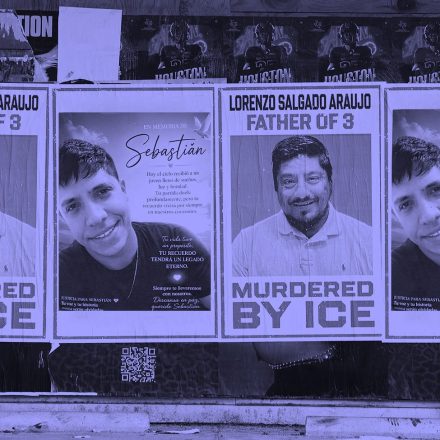
The same month that Roca Estrada says that federal agents temporarily blinded him, broke his collarbone, and beat him until his lungs filled with blood, Congress approved another $72 billion in funding for Immigration and Customs Enforcement. Immigrant advocacy groups warned ahead of the funding vote that additional money for ICE and President Donald Trump’s brutal immigration crackdown would mean more people would suffer a fate like Roca Estrada’s — or worse. The next month, ICE agents fatally shot Lorenzo Salgado Araujo in Texas and Joan Sebastián Durán Guerrero in Maine, both in their cars.
Physicians for Human Rights and the UC Berkeley Human Rights Center documented over 412 incidents of misuse of force by law enforcement agents at immigration protests from June 2025 to May 2026, including the use of chemical irritants like pepper balls and pepper spray — the same family of weapons Roca Estrada and Mejia suspect was set off in their car.
In ICE custody, 52 people have died during the first 500 days of the second Trump administration, according to Human Rights Watch, while use-of-force by guards remains largely unknown.
“We have received many more reports of violent use of force against people,” said Jeff Migliozzi, the communications director for Freedom for Immigrants, which runs the National Immigration Detention Hotline, referencing hotline numbers from June and July. “The overwhelming forces of intimidation and fear and retaliation, the M.O. of ICE has not changed. But certainly, as more people are detained, there’s more incidents [of violence].”
The DHS spokesperson claimed that Roca Estrada and everyone arrested along with him were offered medical care but declined, adding that “one of the detainees indicated that he had a prior shoulder injury.”
Roca Estrada tells a very different story.
He says he spent the next month tossed between detention centers in Virginia and West Virginia. Because he was not given a sling, Roca Estrada fashioned one for his broken collarbone out of bedsheets. He said he largely went without medical care despite agonizing pain that prevented him from laying down at night.
Roca Estrada said it got so bad he nearly fainted, at which point he was taken to a hospital.
“After medical personnel offered to document his injuries and consult a forensic physician, officers abruptly removed him from the hospital and returned him to detention,” the lawsuit alleges. “For weeks thereafter, Defendants failed to provide the promised follow-up care.”
According to the lawsuit, none of this should have happened because Roca Estrada never should have been detained in the first place.
The suit alleges that immigration officers never asked the 24-year-old “about his immigration history, whether he possessed lawful status, where he worked, how long he had lived in Virginia, whom he lived with, whether he had family or community ties in the United States, or similar questions to assess whether he was likely to escape before a warrant could be obtained.”
Other stories in the lawsuit follow a similar pattern. Catarina Rebeca Us Lopez, a 24-year-old woman from Guatemala, was detained in Centreville, Virginia, during a traffic stop around 6:00 a.m. with her husband. She alleges that masked officers blocked her car at a traffic light and forced her and her husband from the vehicle.
The officers falsely claimed that her husband had a deportation order, according to the lawsuit. But when her husband asked questions about the stop, Us Lopez alleges an agent pepper-sprayed him in the face and threatened to draw their weapons.
According to Us Lopez, officers did not “inquire about her immigration status, ask where she lived, inquire about her family, ask about her ties to the community, or otherwise conduct any individualized investigation concerning whether she was lawfully present in the United States or likely to escape before a warrant could be obtained.”
Instead, she claims that officers ignored her as she explained that she had work authorization and did not have a deportation order in place, and allegedly mocked her requests for answers and legal assistance.
For Roca Estrada, his physical injuries and trauma left him unable to work for a month. While he was detained, he also lost his apartment and had his personal belongings sent back to Guatemala without his consent, according to the lawsuit.
“The way that I was arrested … and the immense pain that I had to go through during this whole experience,” said Roca Estrada. “What happened to me was not just.”
Learn when to check crypto fear and greed indexes, from Bitcoin crashes and rallies to FOMO, contrarian trades, and conflicting market signals and trends.
XRP gains institutional interest as Ripple’s SEC case ends, spot ETFs launch, and financial firms turn to the token for payments and treasury holdings.
Finance – United States of America
Burney Wealth Management provides a comprehensive suite of financial services including financial planning, investment management, tax planning, and retirement planning, aimed at helping clients grow and preserve their wealth. The firm emphasizes a cohesive approach through a dedicated team of fiduciaries, certified financial planners, and credentialed investment professionals. Their target clientele includes business owners and individuals planning for retirement, who seek tailored and tax-efficient wealth management solutions. Established in 1974, Burney Wealth Management is recognized nationally for its dedication to service and professional excellence.
Group: shiba
Discovered: 2026-11-16 20:19 UTC
This entry reflects a claim published by an extortion group and collected by a public tracker. It has not been independently verified.
infflux.com Infflux is an international IT consulting and software development company specializing in digital transformation, custom software, cloud solutions, AI/ML and DevOps for enterprise clients. With approximately 50 to 150 employees and estimated revenue of 5 to 20 million dollars, it operates through a global delivery model spanning the US, Latin America and Europe. Its technology stack covers AWS, Azure, Java, Python, React, Kubernetes and TensorFlow. Services include custom development, data engineering, UI/UX design, QA automation and IT staff augmentation. It serves clients across finance, healthcare, retail and technology sectors. The company leverages nearshore delivery from Latin America with offices in Colombia, Mexico and Argentina for cost-effective engineering talent.
Group: the gentlemen
Discovered: 2026-11-16 20:24 UTC
This entry reflects a claim published by an extortion group and collected by a public tracker. It has not been independently verified.
livingwellhomecare.com Living Well Home Care is a home health agency founded in 2012 in Pearl City, Hawaii, providing skilled nursing, physical therapy, occupational therapy, speech therapy and personal care services across all Hawaiian Islands. With approximately 100 to 200 employees including registered nurses, therapists and home health aides, it serves elderly and recovering patients who need hospital-level care at home. It is Medicare certified, Medicaid enrolled and TRICARE approved, accepting most major insurance plans. Its specialized programs cover post-surgical recovery, stroke rehabilitation, heart failure management, diabetes care and palliative support. Revenue is estimated at 5 to 15 million dollars with operations spanning Oahu, Maui, Big Island and Kauai. The company positions itself as a compassionate home care provider delivering clinical excellence in a comfortable home setting.
Group: the gentlemen
Discovered: 2026-11-16 21:00 UTC
This entry reflects a claim published by an extortion group and collected by a public tracker. It has not been independently verified.