Category: OSINT & Investigations

  • Colorado Marijuana Regulators Failed to Protect Consumers From Potential Contamination, Audit Finds

    Colorado Marijuana Regulators Failed to Protect Consumers From Potential Contamination, Audit Finds

    Capped test tubes of green liquid are clipped horizontally around a circle.
    Cannabis samples in the process of testing at Kaycha Labs in Denver Stephen Swofford/The Denver Gazette

    The agency charged with regulating Colorado’s first-in-the-nation legal recreational marijuana market potentially put consumers at risk of using contaminated products, a new state audit found.

    The report pointed to inconsistent oversight by the Marijuana Enforcement Division and loose state rules around testing marijuana products or contaminants. As a result, it found, nearly 75% of marijuana processed for eventual sale from 2023 through 2025 evaded testing for pesticides.

    The audit, released Monday, identified a host of issues, including regulators’ failure to meet regular inspection schedules or to conduct sufficient random checks at dispensaries for contaminated products. It also found that delayed agency warnings to the public allowed potentially contaminated products to remain on shelves for months, sometimes years.

    The audit’s conclusions echo several findings of an investigation this year by The Denver Gazette and ProPublica into the Marijuana Enforcement Division’s lapses in policing contaminants entering the legal marketplace.  

    In one case highlighted by the newsrooms, it took 15 months for a manufacturer to discontinue production of a marijuana sleep aid pill despite consumers warning regulators that the product was harming their livers. The pills had herbal extracts that researchers say can cause liver damage.

    Auditors said they did not identify evidence of “widespread health and safety issues” but did find that deficient regulations still left consumers vulnerable.

    The audit found that unsafe products had remained on the market for as long as three years before the Marijuana Enforcement Division issued a public warning. The auditor’s review of the agency’s health and safety advisories found that, on average, from 2023 through 2025, contaminated products that were the subject of an advisory remained on shelves for more than seven months. That’s the same number of months the news organizations found contaminated products stayed on shelves before warnings were issued.

    The audit also found that it took the agency three and a half months, on average, in 2025 to issue an advisory once it launched an investigation into potential contamination. Even after investigators determined an advisory was needed, it still took the agency a month on average to issue one. 

    “These issues limit MED’s ability to meet its core objective to identify product safety risks and to help ensure that licensed marijuana businesses meet product safety requirements,” the audit stated. “As a result, there is an increased risk that marijuana products sold in Colorado may have contaminants or that the potency listed on the labels is inaccurate.”

    Colorado allows marijuana businesses to test far less frequently than required by state guidelines if they can show consistent compliance with testing rules. The reduced testing program results “in a significant portion of the marijuana product being sold in Colorado not undergoing testing to ensure it is safe,” the audit stated. Manufacturers also can rely on other testing exemptions, such as for certain marijuana-derived skin and body products, but there is “limited MED oversight” of how manufacturers determine they qualify for an exemption.

    Auditors reported that a survey of MED investigators found that more than half said there are or may be widespread marijuana product safety issues in Colorado’s regulated market. 

    In a statement released Monday night, the Marijuana Enforcement Division emphasized that state auditors found no evidence “to support claims of widespread health and safety issues” with marijuana products for sale in Colorado, but the agency agreed the audit identified areas for improvement. It said that among other things, it would be assessing exemptions to tests currently allowed under state laws and regulations.

    The state auditor’s review “allows us to take a critical look at how we can continue to carry out our work, consistent with our commitment to integrity, safety, and continuous operational improvement,” Dominique Mendiola, senior director of the MED, said in a statement.

    The auditor’s report highlighted a criticism her agency has repeatedly sidestepped: the absence of independent collection of samples for safety testing. The Denver Gazette and ProPublica found that more than half of states with regulated marijuana markets rely on private labs or an independent third party to collect samples. Colorado marijuana businesses are free to collect their own samples submitted for testing.

    The enforcement division’s own investigators told auditors that, as a result, Colorado relies largely on an honor code to ensure the safety of marijuana sold in the state’s dispensaries.

    Auditors said that allowing businesses to select their own samples “increases the risk that businesses do not pick samples that are representative of the overall quality of their marijuana product.” 

    MED regulators at the start of the year said they planned to pursue an overhaul that would have required private lab personnel to collect samples, but they abandoned that effort after manufacturers said it would increase their costs. On Monday, Kyle Lambert, the enforcement division’s deputy senior director, told legislators that the agency opted against an overhaul this year, chiefly because he said it would be a geographic challenge to do away with self-sampling for rural businesses. 

    “It was decided now wasn’t the right time to propose that as a policy change,” Lambert said, adding that the agency still might revisit the issue.

    State Sen. Byron Pelton, a Republican from Sterling, pushed back, saying it was a loophole he thinks the agency should consider closing.

    “If I’m a shady character, I know which products I’m going to go sampling and which ones I’m not,” he said. “That’s a pretty gray area to me.”

    The audit also questioned the agency’s reliance on businesses voluntarily recalling contaminated marijuana products, saying that “some of these recalls did not succeed at stopping the businesses from selling potentially unsafe product.”

    Just last month, The Denver Gazette and ProPublica reported that a Colorado manufacturer voluntarily flagged 49 of its popular marijuana vapes for recall, nearly six weeks after a third-party lab notified the company and regulators that it detected methylene chloride, a chemical the Environmental Protection Agency has sought to ban for most uses because it can cause cancer. The MED issued a health and safety advisory a day after the publications first reported the manufacturer had warned dispensaries to stop selling the vapes, which consumers had been purchasing for over a year.

    Source: ProPublica · 2026-10-21

  • Liechtenstein Discontinued Investigation into Swiss Banker

    Liechtenstein Discontinued Investigation into Swiss Banker

    In 2023, OCCRP reported that Venezuela’s former head of the treasury under President Hugo Chávez had been under investigation in Liechtenstein for allegedly laundering money using gold bars.

    Reporters found that investigators had also looked into Swiss banker Ronnie Budja, but could not confirm whether he faced any charges.

    Liechtenstein authorities have since confirmed that an official investigation into Budja was discontinued in 2024 due to insufficient grounds to initiate criminal proceedings.

    Source: OCCRP · 2026-10-21

  • Vučić Rejects Russia Sanctions, Blames Foreign Powers for Protests

    Vučić Rejects Russia Sanctions, Blames Foreign Powers for Protests

    Serbian leader Aleksandar Vučić stated Tuesday that Serbia will continue resisting pressure to impose sanctions on Russia, speaking in an interview published by Ksenia Sobchak, the daughter of Vladimir Putin’s former political mentor. He claimed the opposition would introduce sanctions within 10 days of taking power and recalled a conversation in which Putin questioned his decision to resign. Vučić defended Serbia’s foreign policy as independent of both Moscow and Western powers, while warning that escalating global tensions could lead to a wider war.

    Ahead of Serbia’s October 25 parliamentary elections, Vučić accused foreign powers of pouring hundreds of millions or even billions of euros into NGOs and media outlets to destabilize Serbia and overthrow its government, though he presented no evidence. He portrayed the mass protests sparked by the 2024 Novi Sad railway station disaster, which killed 16 people, as an attempt to seize power without elections. The student-led demonstrations have since grown into a nationwide anti-corruption movement, posing a major challenge to his ruling Serbian Progressive Party. Vučić expressed confidence in an electoral victory that would allow him to return as prime minister.

    Source: OCCRP · 2026-10-20

  • How to Locate Scotland Court Rolls?

    I am searching for information on a criminal case decided through the Scotland High Court in 2024, but the High Court’s website only displays rolls for cases that occurred in the last few months of this year.

    Any information and advice to access older rolls and case information would be very much appreciated. Thanks doves xx

    submitted by /u/Sea_Captain6164
    [link] [comments]

    Source: Reddit r/OSINT · 2026-10-19

  • TikTok comments

    Hello,

    Is there any way to find a specific account’s comments across TikTok videos? We kinda able to do this in instagram via search engines but I don’t know how on TikTok.

    Thanks

    submitted by /u/XD_Q0
    [link] [comments]

    Source: Reddit r/OSINT · 2026-10-18

  • Drive Specifications Matter (Complete)

    Drive Specifications Matter (Complete)

    This post consists of both “Drive Specifications Matter” articles from UNREDACTED Magazine Issues 011 and 012, plus updates.

    In previous posts, I have discussed drive speed limitations as an important factor when considering docks and adapters. This also applies to any external drive. With so many options, such as Thunderbolt 3/4/5, USB 2/3.2 Gen 2/3.2 Gen 2×2/4, PCIe Gen 2/3/4/5, and SATA I/II/II, finding the fastest and most affordable way to add storage to your devices can be quite difficult.

    Marketing and hype around a product’s speed often disappoints users when they find out their reality does not match Amazon reviews. Supporting 40Gbps and actually accessing data at that speed can be two very different things. The goal of this article is to break down the vital differences to provide fast storage for your specific needs.

    First, let’s discuss pre-built external USB drives. I have used SanDisk Extreme USB SSDs for many years. In one book, I discouraged users from purchasing the more expensive “Pro” variant since most computers at the time could not take advantage of the speed boost. That has changed with newer ports being more common now, but I still don’t recommend them. We can do so much better today.

    Consider the standard SanDisk Extreme drive. This USB-C SSD has impressive speed for an external.

    It has the USB 3.2 Gen 2 protocol. The Pro variant has the USB 3.2 Gen 2×2 protocol. That minor change has a drastic effect on the advertised speed of almost 2000 MB/s, but it requires a Gen 2×2 USB port on your computer. My MacBook Pro M1 does not have that, so it falls back to Gen 2. On my machine, that spec bump made very little difference. These drives are quite dated now, and only recommended if you need an affordable way to copy data and stow it away.

    I prefer NVMe drives within USB-C enclosures. These small drives can be used as primary internal drives on newer motherboards or external access drives with an adapter. I swap mine around often. My Linux laptop can store two NVMe drives which allows me to truly dual-boot two secure full-disk encrypted systems. If I ever upgrade those drives, the old drives make for great external options.

    This is where specifications matter. Most modern NVMe drives are marketed as either PCIe Gen 3 or Gen 4. Gen 3 will possess a speed around 3,000 MB/s while Gen 4 will hit around 7,000 MB/s. However, you may not be able to hit those speeds. I placed a fast PCIe Gen 4 drive within a $20 10 Gbps enclosure and received the following results.

    The drive offered over 7,000 MB/s in my laptop as the primary drive, but I only get less than 1,000 MB/s when used as an external. This is because the USB enclosure only supports 10 Gbps (1,250 MB/s) as a theoretical maximum speed. I could have placed a much cheaper Gen 3 drive in this enclosure and received the same result. However, it is still faster than the prebuilt units such as the SanDisk options.

    We want to look at the advertised Gbps of the enclosure. Modern units are now offering 40 Gbps and 80 Gbps USB-C enclosures which will better take advantage of the drives we place inside them. There are numerous 40 Gbps (5,000 MB/s) enclosure available online. Most are new unknown brands and pricing is all over the place. I first tried the cheapest enclosures assuming they would work the same as any others. I was wrong.

    The two cheapest options were made by Rosewill and Maiwo. Each were about $40. Both had a loud cooling fan, but I was OK with that. Initial speed tests were positive with speeds as expected for this specification. However, both of them failed in real-world usage. My stress test was to copy over a 250 GB SQL database. After a few seconds of decent performance, the units became very hot and transfer speed dropped significantly. This is a common issue with cheap enclosures. The bottleneck was not the drive or the machine, it was the adapter itself.

    I upgraded to a Qwiizlab fanless USB4 enclosure (https://amzn.to/3OgrIub), which is pictured below, using the same 990 Pro NVMe drive (https://amzn.to/4qwf7Ar). You may notice some NVMe drives are $100 less than others (https://amzn.to/3ZAfLlG). Some are advertised at up to 5,000 MB/s while the more expensive units are 7,500 MB/s.

    Remember that 40 Gbps = 5,000 MB/s. The faster NVMe drive would do us no good in this test. A $200 2TB Crucial (https://amzn.to/3OENI1U) would also offer the same speeds in a 40 Gbps enclosure. In Thunderbolt 4, it provided the following result.

    On a different machine with a USB4 40 Gbps port, it provided the following.

    Let’s compare this to the speed of my internal drive on a MacBook Pro with M1 Pro chip.

    In other words, we are achieving roughly half of the speed of expensive internal Apple drives by using a 40 Gbps enclosure and NVMe drive. 3,000 MB/s is really good. It is triple the speed we received with the 10 Gbps external SSDs. It is also the approximate speed I would have received with an internal Apple drive if I had not chosen a more expensive Pro chip.

    This fanless unit did heat up during file transfer, but it was no warmer than the units with loud fans. My large file had consistent speed throughout the transfer. Make sure you use the thermal pads which are provided with practically any NVMe enclosure.

    Notice the port and adapter advertised 40 Gbps (5,000 MB/s), but the speed tests did not deliver. This is because there is always overhead with actual usage. I do not believe you will ever achieve full 40 Gbps speed with a drive and port with that specification. I usually see results which are a little more than half of the theoretical maximum.

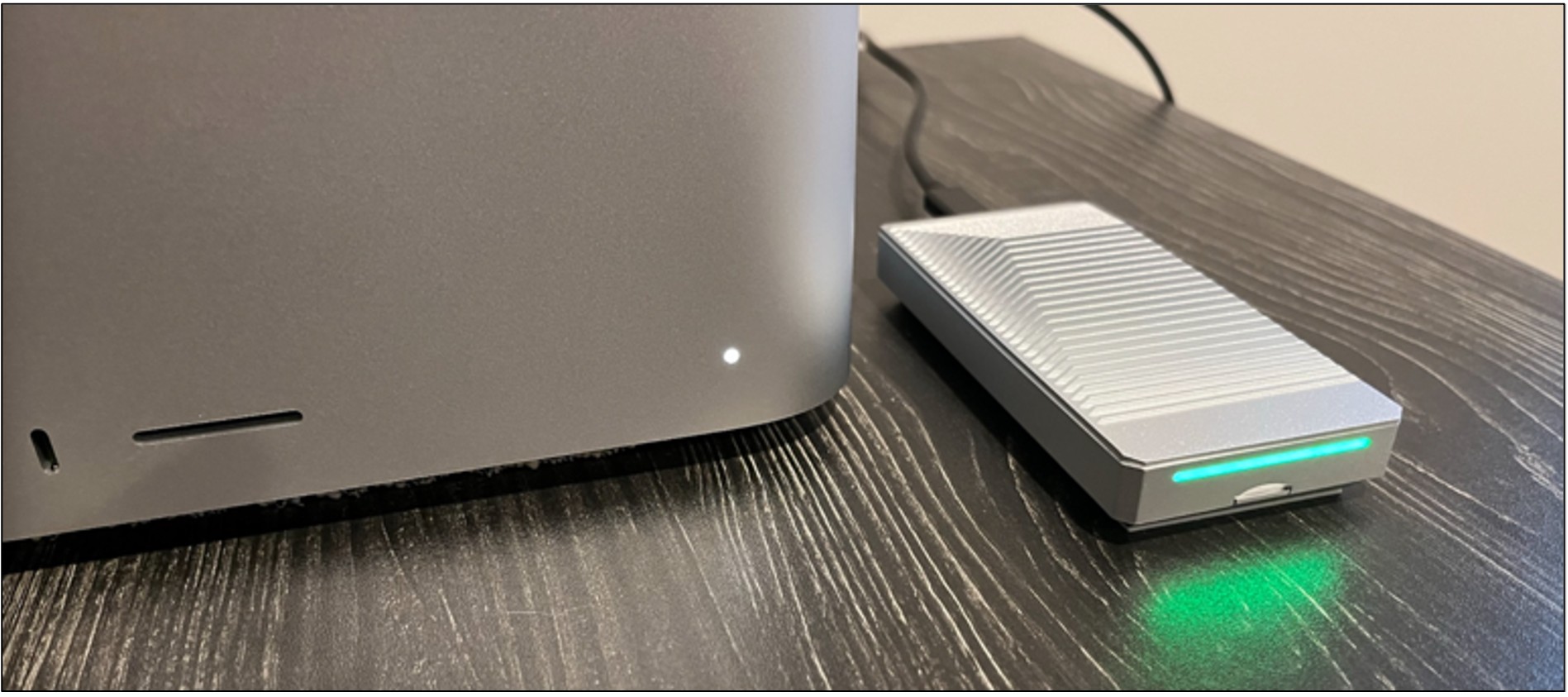
    Now that we had tested the Qwiizlab 40Gbps USB4 enclosure, I went back to test their 80Gbps option (https://amzn.to/3Nj3zD2). I inserted the same 4 TB Samsung 990 Pro NVMe drive into the new enclosure and began my tests. The following image displays the device next to a Mac Studio computer.

    I first tried it on my aging MacBook Pro M1 Pro which only has Thunderbolt 4 ports. As expected, I achieved results similar to the tests with the 40Gbps enclosure within the magazine. This is because port specifications matter. That computer simply does not have ports capable of taking advantage of an enclosure offering 80Gbps. For that computer, a less expensive enclosure and drive would work almost as well. However, this was a much different story when connected to a more modern computer. I found the fastest computer in the office, a Mac Studio with a M4 Max chip and Thunderbolt 5 ports. First, I tested the internal 2TB drive for reference:

    This was standard for the large drive and Max chip. This gives me blazing fast access to large chunks of data on the internal drive. Next, I tested the external 80Gbps enclosure:

    I was shocked. I was getting faster speeds from an external, non-apple, drive than the overpriced Apple drive soldered onto the motherboard. I was skeptical at first, but larger data speed test were just as fast. I pivoted to my real-world test. I copied a 250 GB database from the internal drive to the external. There were no pauses or signs of throttling. In less than a minute, I copied over this huge database which would have taken 30 minutes on a portable USB disk. The device did get warm, but never hot. There is no fan, so it is important to attach the included thermal pad to the drive as explained in the manual.

    The catch: price. Like any other technology, the latest advancements will cost more than the previous generation. I once paid $500 for a 1TB, dual 3.5″ SATA disk array many years ago. It was slow but offered unbelievable storage at the time. I now pay less than $100 for a 1 TB microSD card which is tiny and faster. Expect to pay just under $200 for an 80Gbps enclosure while the 40Gbps options will be less than $70. I suspect we will see these prices eventually drop, but it may be a while before we see 120Gbps drives emerge. We will need faster NVMe options before that can be a possibility, but I am thrilled with 7,000 MB/s in real-word use.

    Who is this for? Only people who have the need for the speed. If you have a computer with ports capable of 80Gbps or higher, then you might be justified in this upgrade. Since I move huge databases around often, I am now hooked on this enclosure. I was able to offload a terabyte of data from my internal drive to the external in approximately two minutes. It seems too good to be true.

    Identify your port specifications and only purchase hardware which will take advantage of the limits. If you start salivating over the latest NVMe speed capabilities, some advertising 10,000 MB/s, have a reality check on your limits. Your internal Windows or Linux NVMe port may not take advantage of those speeds, and the current enclosures on the market won’t get you all the way there either.

    Also, don’t eliminate the possibilities with those old spinning-disk drives you might have laying around. They still hold data and can be great to store backups or other data which does not need accessed often. I have a 4TB 2.5″ drive which sits in a Qwiizlab Mac mini Dock & Hub (https://link.amazon/B093juR8R) under my Mac Studio (this hub was intended for the old Mini’s which were once the same size as the current Studio). Both the hard drive and NVMe slots are restricted to 10 Gbps. The hard drive would never achieve anything higher anyway and the NVMe is used for a 500 GB backup. Neither need the speed.

    The backup NVMe speeds were as expected:

    Reality: My first hard drive was a 5400 RPM spinning disk which achieved 100 MB/s. The later 7200 RPM drives achieved 130 MB/s and the rich people who had SCSI drives were getting 150 MB/s. When I had an early SSD offering 480 MB/s , I was confident that was the end. I never imagined that we would get 20x those speeds on sold-state medium back then. I often remind myself of this when I start looking at the latest gadgets. We are truly spoiled.

    Disclosures: I am not affiliated with any companies mentioned within this article. I was not paid or asked to write this article. I receive commissions through Amazon affiliate links, but not directly from any of these companies.

    Source: IntelTechniques · 2026-10-18

  • The Lawful Access Act’s threats to Canada’s national security

    “The assumption by government officials that technology companies can find “safe ways” to weaken critical cybersecurity protections badly misreads the current threat landscape,” argues the Citizen Lab’s Kate Robertson in a new piece for The Globe & Mail.

    She warns that, if passed, the controversial Bill C-22 (“Lawful Access Act”) would empower the government to require surveillance capabilities be built into any communications technology in Canada. Everything from smartphones, smartwatches, banking apps, health apps, video game platforms, and public WiFi or CCTV networks could be accessed by law enforcement under the new bill.

    The Lawful Access Act has drawn heavy criticism from tech companies, cybersecurity experts, and international standards bodies for endangering Canadians’ cybersecurity and for violating constitutional standards. 

    Source: Citizen Lab · 2026-10-16

  • Panama removed from EU’s tax haven ‘blacklist’ a decade after the Panama Papers

    Panama removed from EU’s tax haven ‘blacklist’ a decade after the Panama Papers

    The European Union has removed Panama from its tax haven “blacklist” in a move acknowledging corporate and tax transparency reforms made by a country infamously synonymous with offshore financial secrecy.

    The update to the EU’s list of non-cooperative jurisdictions for tax purposes was made by EU Finance Ministers last week, and comes a decade after Panama dealt with the fallout from the Panama Papers, an investigation led by the International Consortium of Investigative Journalists and German newspaper Süddeutsche Zeitung into 11.5 million financial and legal records. The investigation exposed how a single Panama-based law firm registered 214,000 shell companies in over 200 countries, enabling companies and people to hide wealth and transactions.

    “The Panama Papers revelations exposed weaknesses in the global financial system, with a particular focus on Panama and the lax regulations regarding transparency that were in place there at the time,” said Luis Moreno, an economist with the Global Alliance for Tax Justice and International Taxation Director at Latindadd.

    “After the Panama Papers, Panama addressed various recommendations — including those from the OECD regarding tax transparency — which is precisely why it has now been removed from the ‘blacklist,’” Moreno added.

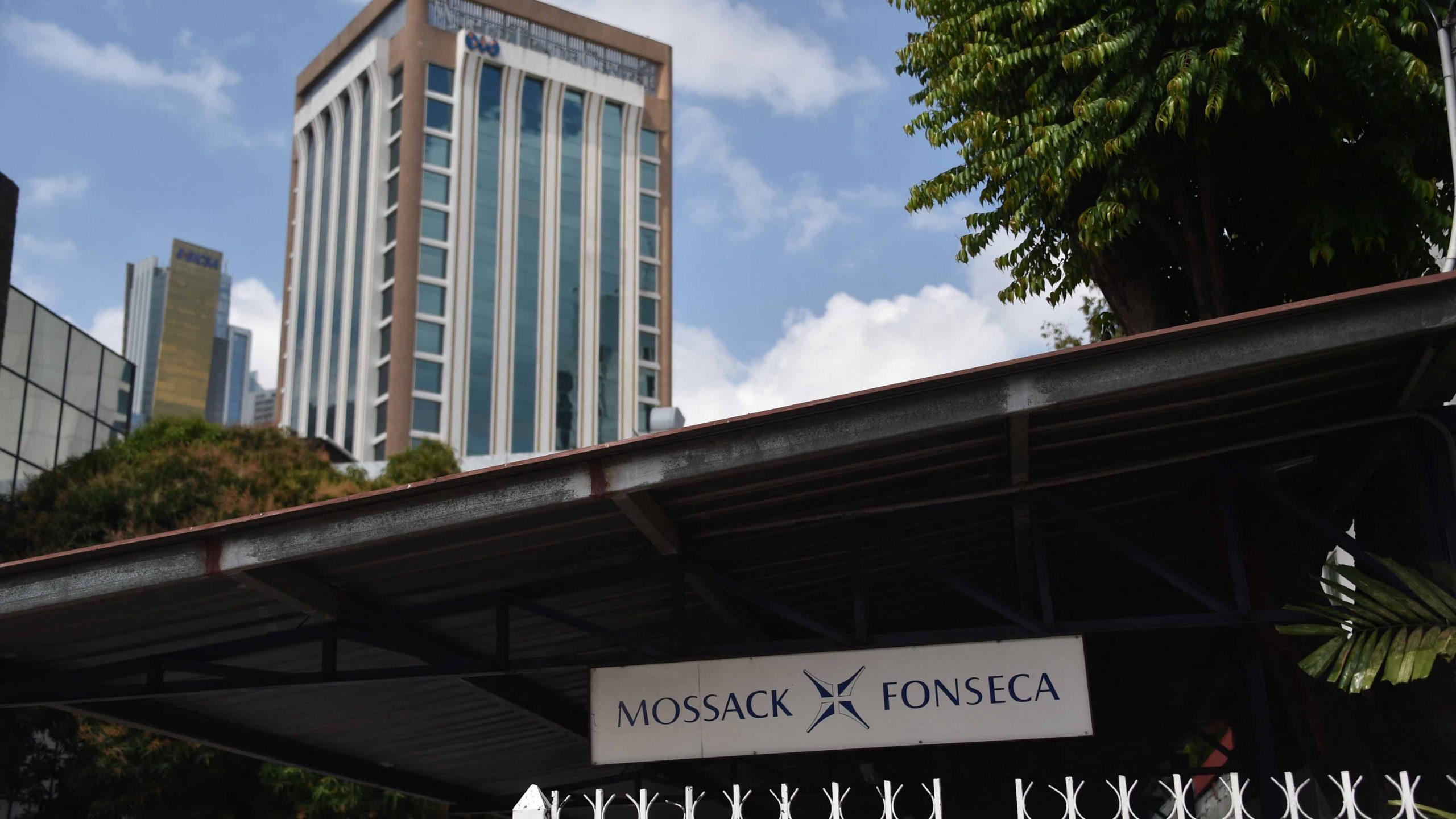
    A "Mossack Fonseca" sign in front of a building

    https://www.icij.org/investigations/panama-papers/former-co-owner-of-panama-papers-law-firm-convicted-of-aiding-and-abetting-tax-evasion/

    IMPACT Former co-owner of Panama Papers law firm convicted of aiding and abetting tax evasion Apr 24, 2026

    https://www.icij.org/investigations/panama-papers/swedbank-fined-50-million-by-new-york-authorities-over-panama-papers-revelations/

    IMPACT Swedbank fined $50 million by New York authorities over Panama Papers revelations Jul 17, 2026

    https://www.icij.org/investigations/panama-papers/watch-the-panama-papers-ten-years-of-impact/

    VIDEO WATCH: The Panama Papers — ten years of impact Apr 02, 2026

    Recommended reading IMPACT Former co-owner of Panama Papers law firm convicted of aiding and abetting tax evasion Apr 24, 2026 IMPACT Swedbank fined $50 million by New York authorities over Panama Papers revelations Jul 17, 2026 VIDEO WATCH: The Panama Papers — ten years of impact Apr 02, 2026

    Source: ICIJ · 2026-10-15

  • Satellite Images Show Extent of Trump Admin’s Tree-Felling at DC Golf Course

    Satellite Images Show Extent of Trump Admin’s Tree-Felling at DC Golf Course

    Sign up here to receive Bellingcat’s biggest investigations by email as soon as they are published.

    Satellite imagery obtained by Bellingcat lays bare the extent of tree-felling at a Washington DC golf course that President Trump is reportedly seeking to transform into a championship-level course, despite moves to protect the site by conservationists. 

    The extent and circumstances surrounding the rapid changes prompted a judge to call an emergency hearing earlier this week, banning any further changes until later this month.

    Reports on Wednesday detailed that 430 trees were cut down at the East Potomac Golf Links  which is owned by the Federal government and managed by the National Park Service (NPS). This is despite a judge reportedly stating earlier this year that no more than 10 trees at the course could be cut down without first notifying the court. 

    NPR reported that officials notified the court just before 5pm on Friday Oct. 9 of plans to remove up to 529 trees in phases starting  the next day on Saturday Oct. 10. That prompted US District Court Judge Ana Reyes to call an emergency hearing on Oct. 12. By that time, 430 trees had reportedly been cut down.

    Reyes is reported to have said she was “furious” with the Justice Department for the lack of time afforded the court and plaintiffs before the tree removal was carried out.

    She was also reported to have said that the government’s actions had cost it “all of its credibility with me in this case.”

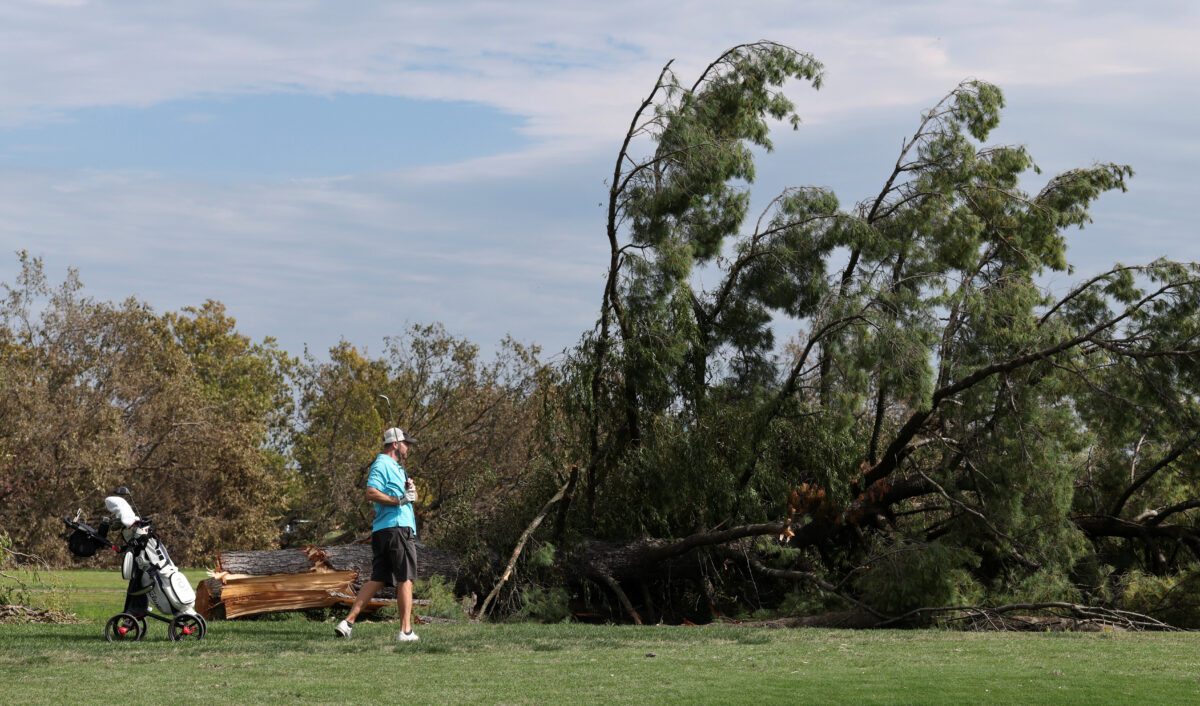
    Images taken at the course earlier this week show trunks and branches strewn out across fairways.

    But satellite imagery affords a broader look at exactly what sections of the course have been impacted.

    The Image below from Planet Labs taken on October 8 shows the golf course before the tree-felling was carried out.

    A satellite image from Planet Labs PBC shows the East Potomac Golf Links on October 8.
    A satellite image from Planet Labs PBC shows the East Potomac Golf Links on October 8. Larger version visible here.

    Planet Labs imagery captured on Oct. 13 shows large barren sections towards the south and west of the course, where trees were removed.

    A satellite image from Planet Labs PBC shows the East Potomac Golf Links on October 13. Larger version visible here
    A satellite image from Planet Labs PBC shows the East Potomac Golf Links on October 13. Larger version visible here.

    A before and after slider allows for easy comparison of the Oct. 8 and Oct.13 images.

    Support Bellingcat

    Your donations directly contribute to our ability to publish groundbreaking investigations and uncover wrongdoing around the world.

    Reuters reported that an organisation called The ​DC Preservation League said in a February ​2026 lawsuit that President Donald Trump was flouting ⁠environmental laws to “irreparably destroy a priceless piece of American history” so he could “convert a public recreation space into an exclusive, high-end golf course.”

    Kevin Griess, an NPS official, reportedly stated at Monday’s hearing that tree removal was part of a 2019 plan that predates Trump’s aims for the course and sought to restore links-style vegetation.

    Bellingcat contacted NPS as well as the Department of Justice but did not receive a response before publication.

    A golfer hits toward felled trees at the East Potomac Golf Links. REUTERS/Kevin Lamarque
    A golfer hits toward felled trees at the East Potomac Golf Links. REUTERS/Kevin Lamarque

    The changes to the golf course are not the only ones President Trump has sought in Washington DC and the surrounding area since the beginning of his second term. In October last year  demolition began on the East Wing of the White House with the aim of building a new ballroom claiming it was “the safest building ever built.”  

    Trump has also proposed a 250-foot-tall “Triumphal Arch” to be built just outside the Arlington National Cemetery in Virginia.


    Correction: This article was updated on October 15 to reflect that a judge told the US government not to cut down more than 10 trees before providing notice. The article previously said that no more than 10 trees could be felled without the court’s approval. The headline has also been changed to reflect this.

    Bellingcat is a non-profit and the ability to carry out our work is dependent on the kind support of individual donors. If you would like to support our work, you can do so here. You can also subscribe to our Newsletter and follow us on Bluesky here, Instagram here, Reddit here and YouTube here.

    Source: Bellingcat · 2026-10-15

  • Leaked files reveal how Deloitte Cyprus helped Roman Abramovich hide $10B fortune

    Leaked files reveal how Deloitte Cyprus helped Roman Abramovich hide $10B fortune

    The accounting giant Deloitte helped doctor a paper trail that enabled Russian billionaire Roman Abramovich to conceal billions in assets and dodge millions in tax, according to a joint investigation by the Bureau of Investigative Journalism and BBC Panorama.

    A forensic analysis of corporate records obtained as part of the Cyprus Confidential leak reportedly shows how staff at Deloitte’s Cyprus branch, and its offshoot MeritServus, routinely falsified documents while managing the oligarch’s vast offshore fortune.

    Between 1999 and 2013, Abramovich’s associates worked closely with the financial services providers to backdate and rubber-stamp more than 1,000 documents, the investigation found, including as part of an alleged scheme that one leading expert described as “straightforward and blatant” tax evasion.

    “What you take away from it is that there are professionals who are prepared to bend and break the rules of their profession and therefore the law,” Andrew Mitchell KC, a financial crime barrister who reviewed the findings, told BBC Panorama. “And it looks that they will stop literally at nothing in terms of creating documents.”

    Around 2006,


    after Cyprus introduced new corporate disclosure rules,

    more than $600 million in luxury assets — including a French château, superyachts and private jets — disappeared from the accounts of one of Abramovich’s Cypriot companies, Amiscan Investments, TBIJ and the BBC reported. A separate yearslong maneuver wiped nearly $2 billion from the balance sheet of Kravin Investments, another Cypriot company, by effectively rewriting its financial history.

    The revelations from TBIJ and the BBC, alongside the Guardian and the Organized Crime and Corruption Reporting Project, are the latest from the Cyprus Confidential leak obtained by Paper Trail Media and Distributed Denial of Secrets and shared by the International Consortium of Investigative Journalists. The leak includes about 450,000 files from Meritservus, a family-run Limassol firm that spun off from Deloitte in 2005.

    The Deloitte headquarters in Cyprus. Image: Kostas Pikoulas/NurPhoto via Getty Images

    Despite the public split, the firms worked together closely behind closed doors and served as key financial advisors to Abramovich for nearly 20 years, severing ties after he was sanctioned by the United Kingdom and the European Union in response to Russia’s 2022 invasion of Ukraine. ICIJ’s previous reporting on the MeritServus files connected Abramovich to 261 companies and trusts in Cyprus, the British Virgin Islands, Jersey and other secrecy jurisdictions.

    In response to TBIJ and the BBC’s findings, Abramovich’s lawyers denied their client was aware of unlawful backdating, evaded taxes or misled Cypriot authorities: “If an arrangement was proposed by professional advisers of Deloitte’s standing, it would have been entirely proper for companies linked to our client … to rely on it.”

    Deloitte Cyprus said that it “acts in compliance with all applicable laws.”

    The vanishing billions

    Abramovich made his fortune in the 1990s by buying Russia’s state-owned oil company Sibneft after the fall of the Soviet Union for roughly $250 million. A decade later he sold the company back to the government for billions in profit, which he parlayed into investments in real estate, superyachts, a nearly $1 billion art collection and the Chelsea Football Club.

    In 2003, one of Abramovich’s Cypriot companies, Kravin Investments, received a windfall of $3 billion from his sale of Sibneft shares, TBIJ and the BBC reported. Around $2 billion was left accruing interest in Kravin’s bank account — and becoming a tax liability.

    View embedded content

    Leaked emails show how members of Abramovich’s inner circle, who oversaw his financial affairs from London, agreed on a plan to solve the tax issue with his advisors in Cyprus, including MeritServus founder Demetris Ioannides and Antonis Taliotis, a senior tax advisor at Deloitte Cyprus until earlier this year. In one email, Deloitte advised that “certain changes will have to be made to the accounts (bank account balances, interest income, profit and loss account).”

    Ioannides’ lawyers told TBIJ and the BBC that he was unable to respond to requests for comment. Talitotis declined to comment through Deloitte Cyprus.

    From 2005, MeritServus began backdating documents to 2003, making it appear as though the $3 billion was transferred out of Kravin’s accounts to another of Abramovich’s companies in the British Virgin Islands instead of sitting untouched for years, the investigation found.

    MeritServus reportedly then created a backdated agreement claiming that Kravin had been holding and investing the money on the other company’s behalf and therefore shouldn’t be taxed in Cyprus. To add to the illusion, MeritServus also drafted fake correspondence between the companies as well as other corroborating documents — some reportedly as recently as 2008.

    Several experts, including Mitchell, told TBIJ and the BBC that the backdated records were devised to evade taxes.

    A couple stand together, linking arms andsmiling at a gallery opening

    https://www.icij.org/investigations/cyprus-confidential/chelsea-fc-fined-millions-over-secret-payments-under-abramovich-ownership/

    IMPACT Chelsea FC fined millions over secret payments under Abramovich ownership Mar 17, 2026

    https://www.icij.org/investigations/cyprus-confidential/uk-mps-push-for-probe-into-russian-billionaires-possible-1b-tax-dodge/

    TAX HAVENS UK MPs push for probe into Russian billionaire’s possible $1B tax dodge Feb 05, 2025

    https://www.icij.org/investigations/russia-archive/leak-reveals-majority-interest-in-roman-abramovichs-nearly-1-billion-art-collection-was-transferred-to-his-ex-wife-ahead-of-sanctions/

    Art Leak reveals majority interest in Roman Abramovich’s nearly $1B art collection was transferred to his ex-wife ahead of sanctions Sep 22, 2023

    Recommended reading IMPACT Chelsea FC fined millions over secret payments under Abramovich ownership Mar 17, 2026 TAX HAVENS UK MPs push for probe into Russian billionaire’s possible $1B tax dodge Feb 05, 2025 Art Leak reveals majority interest in Roman Abramovich’s nearly $1B art collection was transferred to his ex-wife ahead of sanctions Sep 22, 2023

    Source: ICIJ · 2026-10-14