I read a lot. I also travel a lot. Many years (maybe decades) ago I would buy a paperback book and throw away the pages as I traveled, making the book lighter and smaller as the trip went on. E-readers solved that. Just a few years ago, I reviewed the largest readers I could find. I wanted a huge 13.3″ device which could serve me my daily newspapers in PDF format. I still use my Boox Note Max every day to read two newspapers.
This review goes in the opposite direction. I have been seeing pre-orders and gossip about tiny e-readers, some smaller than a cellular phone (which isn’t hard these days with the oversized Pop-Tarts we are forced to carry around). I finally settled on the XTEINK X4 Pro.
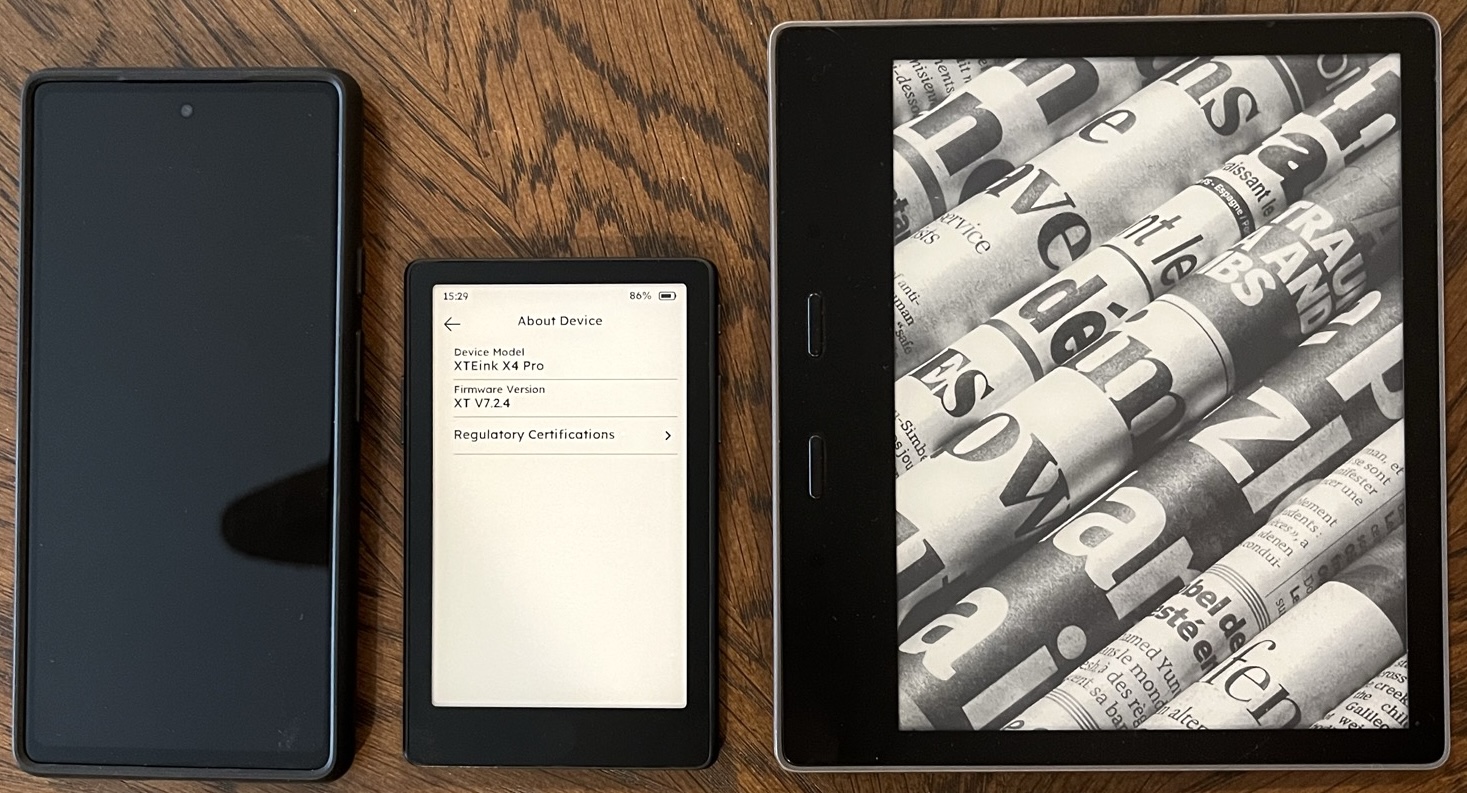
The 13.3″ Boox serves a very specific purpose for me. I do not take it on most travel due to the size. It is my morning companion at home. The XTEINK X4 Pro is tiny with a 4.3″ screen and can go everywhere. The following compares the XTEINK X4 Pro (middle) with a 6.1″ Pixel (left) and Kindle Paperwhite (right).
When I powered the unit, it asked me to select my language. It then prompted me to download additional fonts for a smoother experience. When browsing Wi-Fi networks, it only detected 2.4 GHz networks and not my 5 GHz routers. I was fine with this, as I don’t need fast internet access. Actually, I don’t need any internet access.
Most of the e-readers I have tested over the past several years were simply e-ink tablets running a minimal version of Android. This is great for side-loading apps, but I never really needed Android for this purpose. The XTEINK X4 Pro runs on its own minimal and lightweight firmware which appears to be less than 6 MB in size.
This is the main reason I wanted the XTEINK X4 Pro. It allows you to install your own open-source firmware to run the system. The most popular are CrossPoint and CrossInk. These are backed by a large community of e-reader enthusiasts. I wanted to install CrossInk, so I ignored all of the onboarding.
There is no USB port on the device. Instead, you also receive a magnetic adapter which connects to the back and supplies a USB-C port. I connected the device to my computer and navigated to the online tool at https://inky.crossink.dev/#flash-tools. This will prompt you to allow an extension, but it is actually just using Firefox’s built-in serial access software. There is nothing to install or uninstall.
The online tool prompted me to select my device model and the latest version of the software. I had to flash it twice, but the process was quick and smooth. I now had a fully open-source firmware with many more features and fonts than the stock option.
Loading books is as easy as dragging them to the included 16 GB microSD. You can create any folders desired if you want organization. You can connect to the device via USB or connect the card to your computer. I prefer the latter. I try to keep my entire eBook collection in EPUB format, and every file I threw at it loaded fine. The first load takes a few seconds but subsequent loads are fast.
I have used traditional Kindle-sized readers which sit in the middle of the XTEINK X4 Pro and a 13.3″ reader. At first, reading on the XTEINK X4 Pro was awkward. The small screen sort of reminded me of those speed-reading trainers which show you a limited number of words in fast succession. After about 5 minutes, my brain understood what was going on.
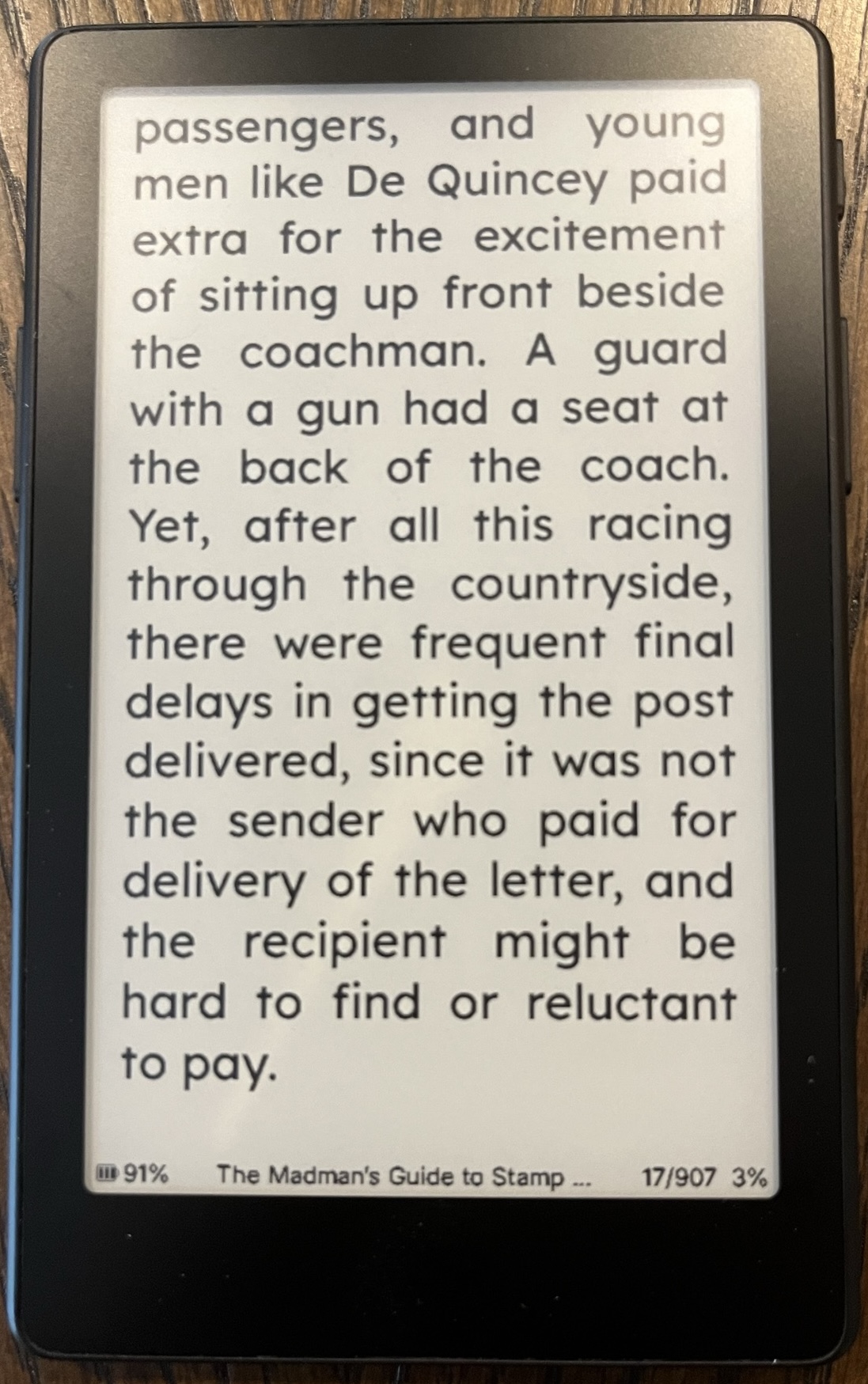
The default font was a little small for my eyes. I increased the font within settings and allowed my book to re-index. This looked better to my eyes.
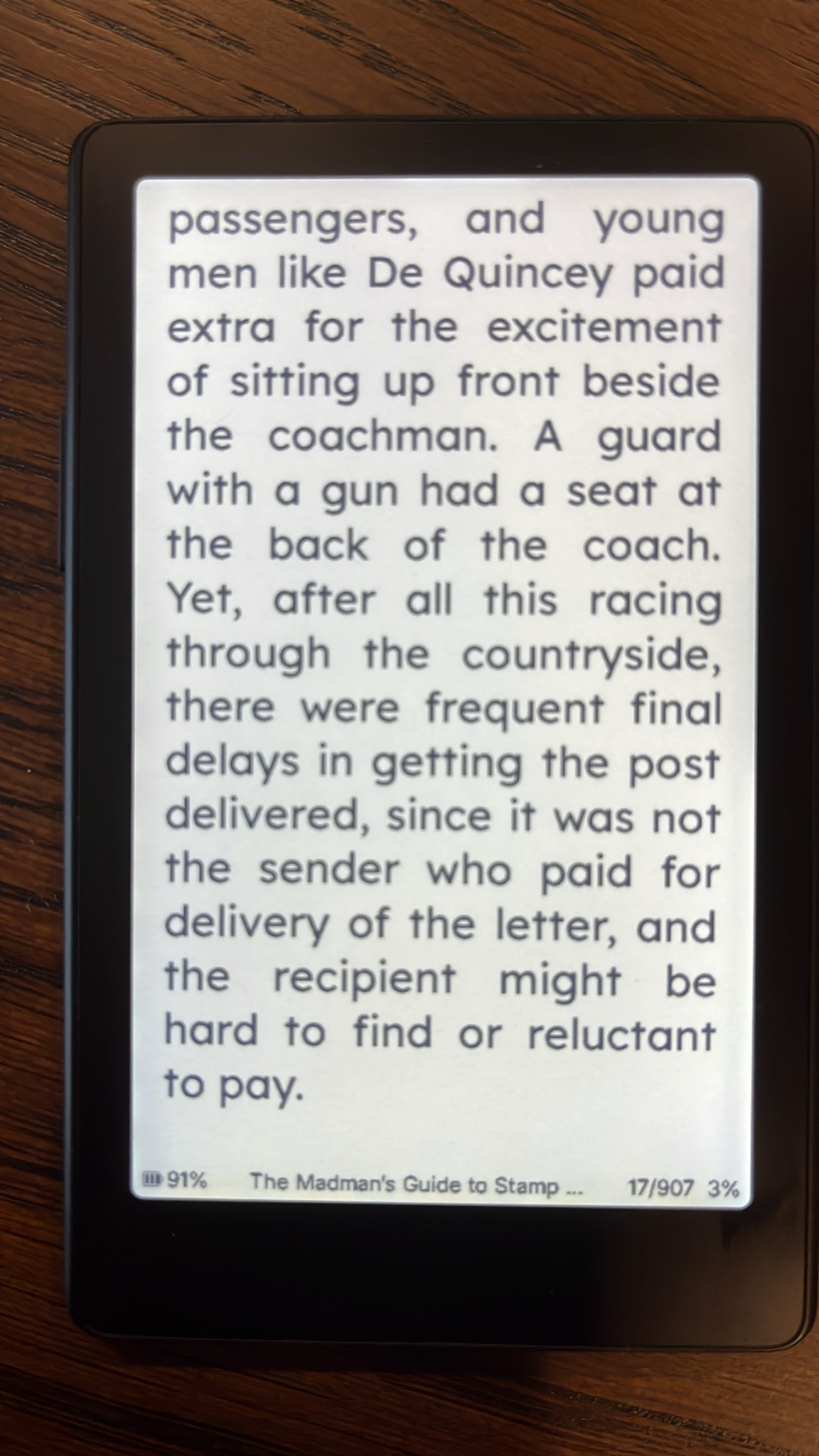
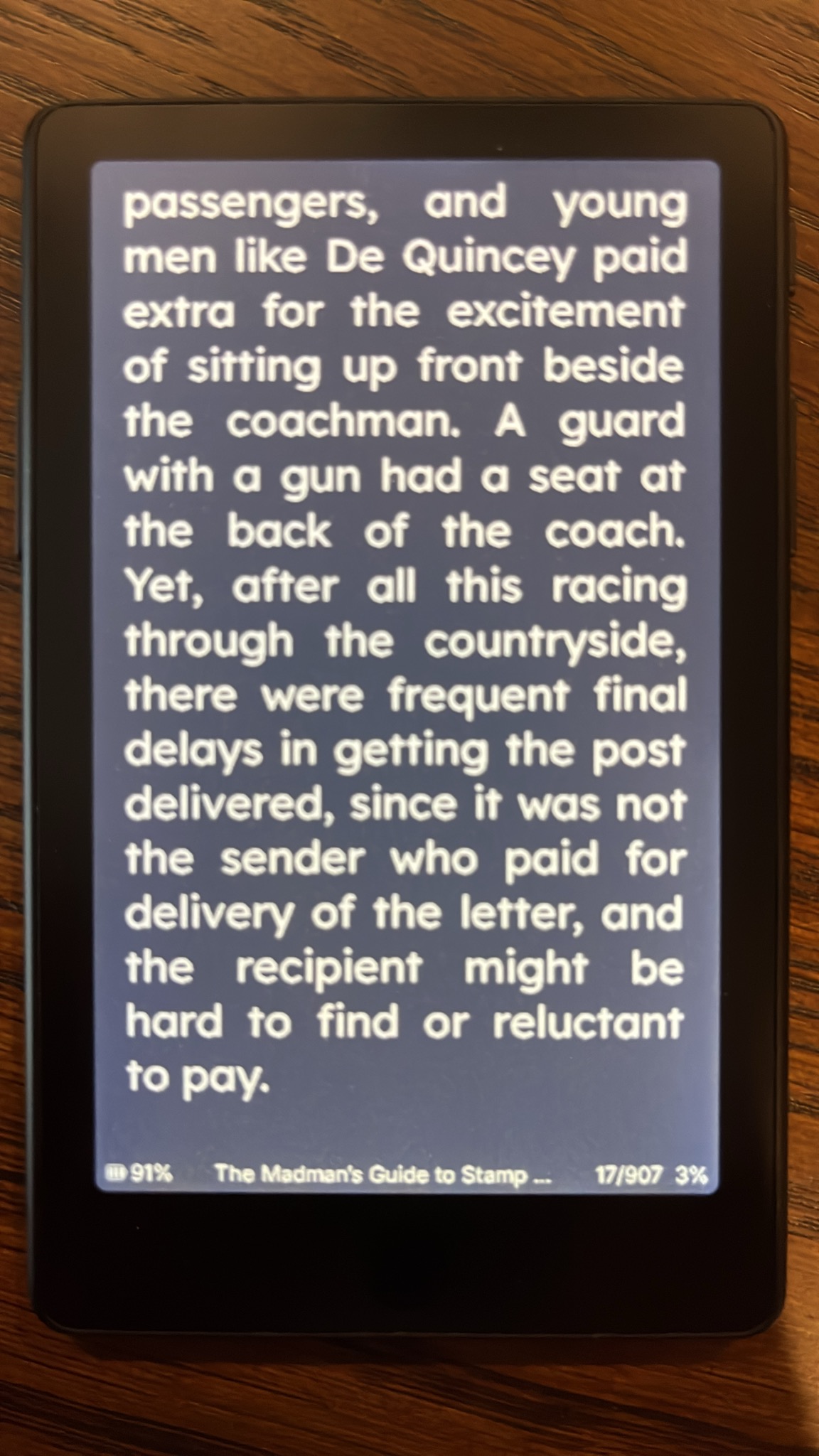
The Pro model includes a front light, but I typically read in decent lighting. The following images show the front light in use on both a light and dark theme. The dark theme is only available with the custom firmware.
My initial complaint is the same issue I have always had with books on these devices. It is hard to understand how far into the content you are. This is not a fault of this unit, but all readers in general. With PDFs on large readers, this is somewhat remedied because I am reading the intended layout. Each page flip is a true page flip. The EPUB files reposition the text as needed for the reader. A 200-page eBook on a Kindle might be 1200 pages on the XTEINK X4 Pro. Again, no fault of the devices.
After a while, I got over this. I was sitting on a plane holding the XTEINK X4 Pro. I noticed my eyes did not need to travel as much with the smaller screen. It felt as if I was reading faster than a traditional book or Kindle. I was definitively ingesting data faster than a large device.
The biggest feature to me was the page turn buttons on both sides of the screen. I am used to readers which have “up and down” buttons on one side of the device. This is not natural to me. This unit has a button on the left to go back and on the right to go forward. It made sense, especially holding with one hand. Battery life was phenomenal, as expected with such a small screen. Page refreshes were quick and clean. I saw no ghosting of previous text. After reading for any extended time, my mobile device felt huge.
At the time of this review, the XTEINK X4 Pro was $85 on Amazon (https://link.amazon/B0crT7xQO). Retail is $99. If you do not want the front light and touch screen, the X4 was only $75 with a retail of $90 (https://link.amazon/B09plEaDk). Personally, I believe it is worth the $10 for these features.
If you want a truly portable and tiny e-reader, this is the way to go. Understand the limitations. You are not going to read large PDFs on this thing or any DRM-protected files. EPUBs work great. It really is a single-purpose device. It makes sense for me during travel or for notes during a presentation. I like that mine has never connected to the internet, has no apps, and runs on open-source firmware. I just want to read.
Disclosures: I am not affiliated with any companies mentioned within this article. I was not paid or asked to write any reviews. I receive commissions through Amazon affiliate links within this blog, but not directly from any of these companies.
I have been preaching about dash cams for years. I believe everyone should have one and I won’t drive a vehicle without one. I have reviewed numerous dash cams on my podcast and within the magazine, and I recently encountered a situation which forced me to review my recommendations.
I have a friend who has always been resistant to placing a dash cam in his vehicle. He understands my reasons for using them, but had always assumed he would never find himself in a situation to need one. Recently, he was involved in a minor traffic crash where the vehicle in front of him backed into him while trying to allow someone to turn in front of them. The police showed up and made a report and my friend assumed it was no big deal. The car in front of him later told their insurance that they did not back in to my friend, but in fact, my friend had struck them. My friend’s insurance took the stance of 50% fault to each party, which was likely to raise my friend’s insurance rates. He finally wanted a dash cam.
I picked him up and showed him the unit within my vehicle. A few years ago, when I was testing dash cams, I started with the popular brands from the big box stores. What I learned was that those overpriced devices worked the same as more affordable options available online. I felt like I was paying more for the marketing team instead of the hardware. After extensive review, I began using the VIOFO (https://link.amazon/B08O68uyS) dash cams in my vehicles.
What I liked about the VIOFO cameras is that they were small and out-of-the-way. These compact devices fit behind my rearview mirror and I cannot see them while I am driving. I forget that they are there. I showed my friend my camera and offered to play back video from just a few minutes prior.
His response was neutral. He didn’t like the small screen, and he did not like the placement. He wanted a unit with a larger screen which could be viewed at any time within the vehicle. He wanted something he could use to show a police officer what had happened in the event of another crash. He wanted more “oomph” to let people know he was recording while I prefer to stay discreet.
I have never cared much about playing video in the car. I assume that I will always extract my own video from the microSD card when needed, and I don’t ever need to show anyone video from the device itself (aside from this demonstration). My friend insisted on something bigger, so I began my research. I landed on the OLYVUE V78 (https://link.amazon/B0aehLDRA).
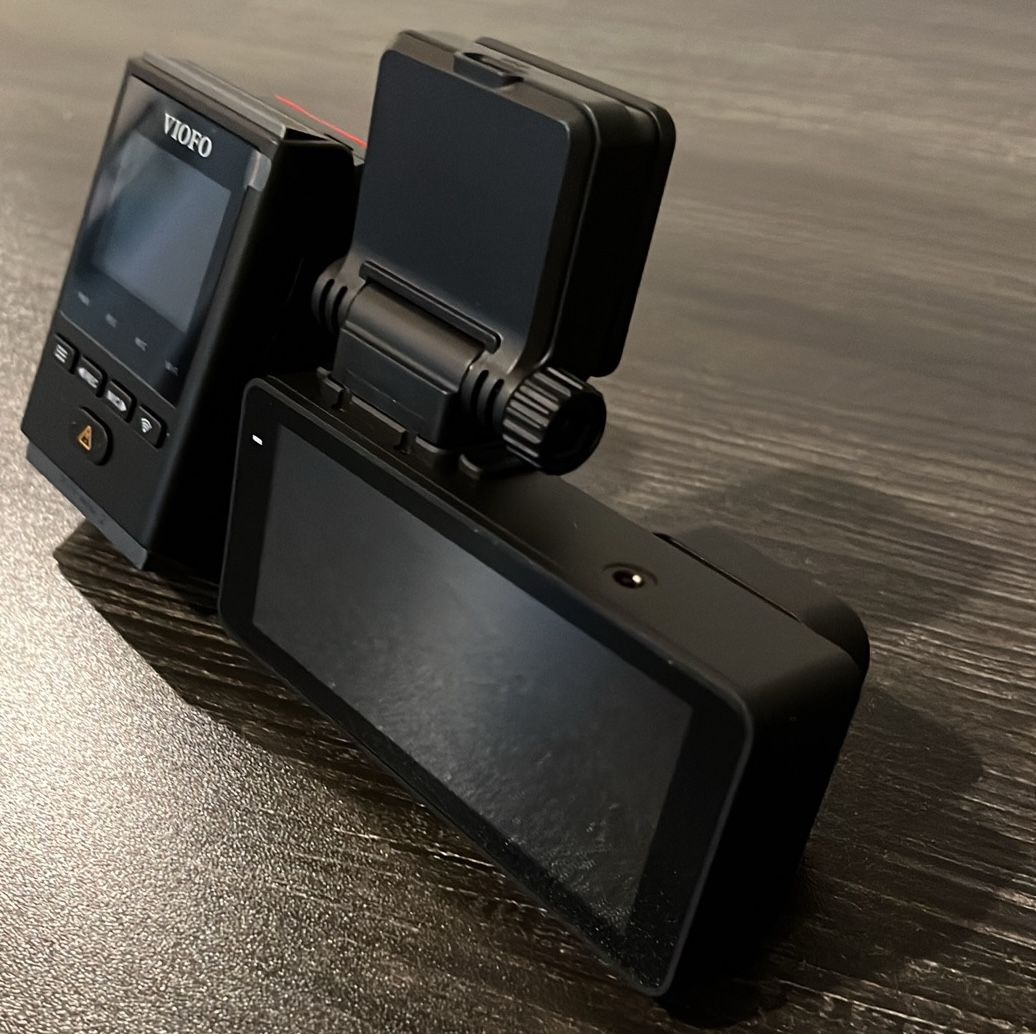
This unit has all of the common specs. 4K video in front with 2K in rear with access directly via SD card or over Wi-Fi. These are the standards. What I liked for my friend was the size. I tried to capture the difference in size and screen from the VIOFO (left) and OLYVUE (right).
We hooked it up and ran it through our tests. Video was sharp and everything worked right out of the box. Auto-recording to the included 64 GB SD card was already configured. However, he decided to buy a larger card.
The V78 came with a rear camera. I typically do not use these, but I understand those who do. You place it in the rear window, but must run a cable from the rear to the front device. With enough time and skill, you can hide this fairly well. He wanted the full protection while I can take it or leave it.
The unit is very lightweight and the provided adhesive was more than efficient. Video was always stable and the device never seems like it is going to detach. GPS coordinates are embedded and we decided to disable the audio. I believe this is appropriate for the other people in my car and my own embarrassment if caught singing.
You can download their app and connect to the device and recordings over Wi-Fi. I did not test this as I never use this feature. I simply want a reliable dash cam to capture the files. They can always be copied from the SD card or viewed from the device.
The price on the OLYVUE V78 is fair. As of this writing, the unit with both front and rear cameras with 4K on front was $159 on Amazon (https://link.amazon/B0aehLDRA). Similar devices in stores were over $300.
Do I really need 4K video of my driving? I guess it depends on whether I will ever need the detail. I think I could get away with 1080p at a minimum. However, if I end up in court over someone else’s behavior, I want the best clarity I can get. Ideally, I will never need my dash cam footage and this is all a waste of money. If I am wrong, I will be glad I added one to my daily routine.
Disclosures: I am not affiliated with any companies mentioned within this article. I was not paid or asked to write any reviews. I receive commissions through Amazon affiliate links within this blog, but not directly from any of these companies.
Paragon Solutions vowed not to sell its mobile spyware to governments with poor human rights records and to cut off customers who misuse its products. However, in 2025 researchers at the Citizen Lab confirmed that the spyware had been used to target Italian activists and journalists. In an exclusive interview with WIRED, Paragon’s CEO Andrew Boyd revealed the limits of the company’s promise: that it has no way to know if customers misuse its software, and it doesn’t have a “kill switch” to disable customers when there is misuse.
Speaking with WIRED, Citizen Lab’s senior researcher John Scott-Railton noted that Paragon has “less oversight, less transparency, less contractual protection against abuses than NSO Group,” another spyware company that has faced criticism for its use against journalists, activists, and others.
“It’s exactly the opposite of the picture that Paragon has painted for itself for years,” says Scott-Railton, “And it signals to lawmakers and regulators that the spyware industry cannot be trusted to self-regulate.”
Psiphon, a software company spun out of the Citizen Lab that helps internet users living under oppressive regimes evade online censorship, plans to leave Canada if the federal government’s lawful-access bill passes in its current form, reports The Globe and Mail.
If passed, Bill C-22 would require electronic service providers to make secret changes to their systems to provide police services and the Canadian Security Intelligence Service (CSIS) with surveillance and monitoring capabilities.
Psiphon was originally created as a Citizen Lab project in 2006, and became a private company soon afterward. It has 20 million monthly users worldwide that rely on the software to bypass online censorship in countries such as Iran, Myanmar, Russia, and China.
Despite its Toronto roots, the company says it is prepared to move its operations out of Canada if Bill C-22 is passed, as it would be forced to compromise crucial safety features put in place to protect the privacy of its users.
Citizen Lab director and founder Ron Deibert says that Bill C-22 “will make it impossible for a large number of invaluable privacy-preserving tools and applications from operating in Canada.”
Sign up here to receive Bellingcat’s biggest investigations by email as soon as they are published.
US non-profits whose founding leaders or organisations have been associated with India’s controversial Rashtriya Swayamsevak Sangh (RSS) – or initiatives the Hindu nationalist group has endorsed – received millions of dollars over recent years through grants that allow donors to remain anonymous, a Bellingcat analysis has found.
The right-wing and Hindu nationalist volunteer organisation is widely considered the ideological parent of India’s ruling Bharatiya Janata Party (BJP). Prime Minister Narendra Modi, a former RSS worker, is one of its most famous supporters.
But the RSS’ vision of India as a Hindu nation is controversial both at home and abroad: it was previously banned in India three times, and a bipartisan US commission on religious freedom recently called for the US government to sanction the group “for their responsibility and tolerance of severe violations of religious freedom”. Almost a hundred US politicians, both Democratic and Republican, recently pledged not to take funding from RSS-linked entities.
India’s far-right Hindu nationalist volunteer group RSS remains an unregistered entity in India. Source: Prabhat Kumar Verma/ZUMA Press Wire via Reuters Connect
“The RSS functions without independent oversight of its resources, finances, influence, and activities,” said Dr Angana P Chatterji, an anthropologist and scholar of South Asia studies at the University of California, Berkeley. “This is not proportional to the vast power, reach, and influence it possesses. Its leadership and cadre are protected from accountability and scrutiny,” she added.
The RSS had not responded to multiple requests for comment, as of publication.
Bellingcat identified two US-registered non-profits that appeared to have past and present ties to the RSS, or organisations associated with them, based on the non-profits’ or RSS websites and publications, as well as statements by the non-profits’ founders and spokespeople. The non-profits were the Ekal Vidyalaya Foundation of USA Inc (Ekal USA) and Sewa International Inc (referred to as Sewa USA).
We looked at all Form 990s – tax returns that US non-profit organisations are required to file annually – listing Ekal USA and Sewa USA as grant recipients, as well as the Form 990s of the charities themselves, from 2020 to 2024. As of September, the latest available Form 990s for Sewa USA were for the fiscal year ending December 2024, while Ekal USA also filed a form for the fiscal year ending December 2025, which was excluded for consistency, although the same pattern was observed during this period.
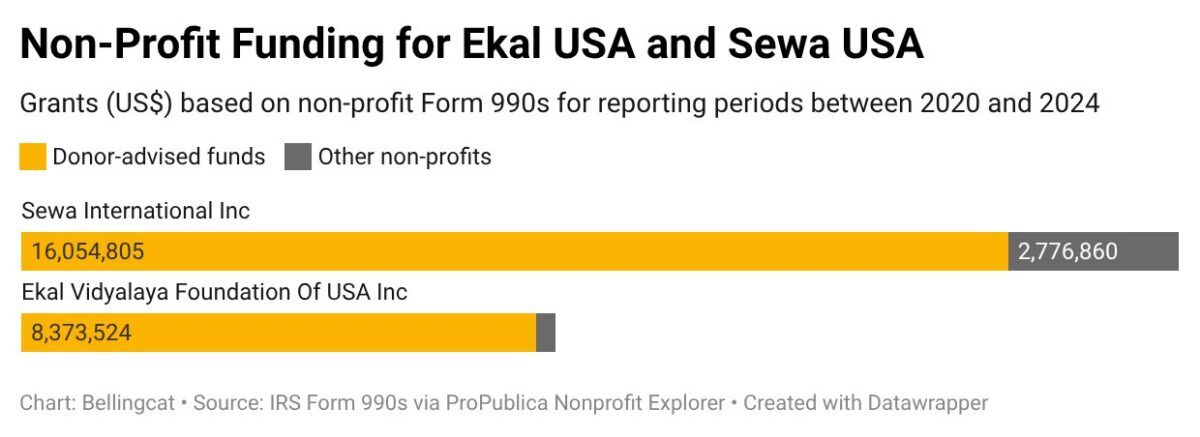
This analysis showed that the charities received at least US$24.4 million from 34 organisations that manage donor-advised funds (DAFs), or 20.7 percent of the total $117.8 million they reported receiving in contributions and grants during this period.
The actual amount from DAFs may be higher, as we excluded filings that covered partial years outside of this period – for example, June 2019 to June 2020. The filings from the two charities we identified were based on the calendar year.
The Form 990s also revealed that the vast majority of the money spent by these two charities on grants to other organisations or individuals was in India or the South Asia region rather than in the US: Ekal USA donated $33.7 million in foreign grants – all of which went towards the Ekal Vidyalaya project in India according to its filings – and none in domestic grants in the five years from 2020 to 2024, while Sewa USA reported $29.7 million in foreign grants and $622,613 in domestic grants during the same period.
Support Bellingcat
Your donations directly contribute to our ability to publish groundbreaking investigations and uncover wrongdoing around the world.
DAFs are common vehicles for people in the US who want to make donations to charitable causes while receiving tax relief or benefits. Donors do not control the money once they donate it but can advise on which charities the money eventually ends up at.
These funds are legally maintained and operated by non-profit sponsoring organisations. As public charities, DAF sponsor organisations detail the amounts and recipients of grants that they make on behalf of their donors in their Form 990s. However, they do not disclose who their donors are, and donors can choose to remain anonymous. (Note: Bellingcat USreceives grants from donor-advised funds, and some grants do not disclose the name of the grant recommender. However, many of our donors are listed on our funding page.)
There are many more organisations reportedly linked to the RSS that are not included in this analysis, but we focused on these two because of the large amounts of grants they received through DAFs, with the original sources of the funds untraceable from public information, as well as evidence pointing to both historical and current connections between them and the RSS or organisations associated with the RSS.
It is worth noting that some of the evidence we found pointing towards a connection between the two charities and the RSS or organisations associated with the RSS was from before or after the period we analysed (2020 to 2024). There is no evidence that DAF grants funded the RSS, only that they went to organisations that appear to have connections with the RSS. Experts told us that DAF grants undergo less regulatory scrutiny than other charitable donations and that DAF sponsor organisations have discretion over whether to restrict or permit donations to certain recipients.
Ekal USA
Houston, Texas-based Ekal USA is a non-profit that describes its mission in its Form 990s as “to provide free elementary education and free primary healthcare to children in remote and rural India”. The USA branch of Ekal Vidyalaya, according to its website, was founded in 2001 as part of efforts to “reach out to the global diaspora” in order to achieve a goal to “expand the reach of Ekal to 100,000 villages”.
RSS chief Mohan Bhagwat has appeared at multiple Ekal Vidyalaya events in India promoting the initiative over the years, as far back as 2014 and most recently in May.
Ekal USA was started in the late 1990s as a programme of the Vishwa Hindu Parishad of America (VHPA), or World Hindu Council of America, VHPA spokesperson Shyam Tiwari told Bellingcat in an email response. He added that it was set up as an independent organisation in early 2000. According to VHPA’s website, Ekal USA was established in 2002.
VHPA is based in the US, while the similarly named Vishwa Hindu Parishad (VHP) is in India. VHP lists VHPA in the “Hindus Abroad” section of its website. A 2017 article from VHPA’s magazine states that late founder Mahesh Mehta was trained by the RSS since he was 10 years old, and that the VHPA was born after Mehta was advised by the former supreme leader of the RSS to “build VHP in USA”. The national spokesperson of VHP in India, Vinod Bansal, said that it is an independent organisation that “sometimes shares ideology” with VHPA.
RSS’ website states that VHP was launched to organise Hindus and “reconvert all those who had been knowingly or unknowingly proselytised to alien faiths and are now desirous of coming back to the Hindu fold”. Bansal referred to VHP as an “independent part of the RSS” and an “ideological brother”.
Ekal USA Chairman-Advisor Subhash Gupta wrote in an Ekal USA publication this year that in the ‘80s and ‘90s, he was “president of the VHP’s Houston chapter” and “often received many high-profile guests from RSS and VHP”.
Gupta did not respond to requests for comment as of publication.
From 2020 to 2024, Ekal USA reported receiving more than $48.4 million in contributions and grants. Of this amount, at least $8.3 million was from DAF grants, based on Form 990s that listed Ekal USA as a grantee.
According to Ekal USA’s Form 990s, it transferred $33.7 million in foreign grants during this period and none in domestic grants for organisations or individuals. The forms also show that all the foreign grant money went towards building Ekal Vidyalaya schools in India. The rest of its expenses involved operational costs such as staff salaries.
The Ekal Vidyalaya movement has been criticised over reports that allege the schools are used to indoctrinate millions of India’s poorest and most vulnerable children and women with Hindu nationalist ideology, including that Muslims and Christians are “enemies of Hinduism”. Ekal Vidyalaya in India did not respond to multiple requests for comment.
Ekal USA did not respond to Bellingcat’s questions about these reports or any relationship it may have with the RSS. However, on its FAQ page, the group states that it does not teach religion in its schools and “does not discriminate based on caste, religious affiliation or linguistic affiliations”.
Sewa USA
Sewa USA, also based in Houston, describes itself as a “Hindu faith-based, humanitarian, nonprofit service organisation” and is listed under the heading of “Sewa Movement” on the website of India-based charity group Sewa International.
Sewa USA Vice President of Public Affairs Rakhi Israni told Bellingcat over email that the organisation “does not operate as a branch or affiliate of the RSS” or participate in political activity.
But multiple pages on the organisation’s website appear to indicate a connection between the non-profit and the RSS. In 2022, Sewa USA reposted an article on its website referring to Sewa International as “the US-based charitable non-profit organisation with links to the Rashtriya Swayamsevak Sangh (RSS)”. In a press release about the death of its founding member Ved Prakash Nanda in 2023, it noted that Nanda was “immersed in the ideals of the [RSS]”. And two different blog posts from 2021 and 2024 on Sewa USA’s website had volunteers citing RSS-led activities as the starting point for their involvement.
In addition, Sewa USA has also posted multiple times on social media and its website about an India-based organisation – Sewa Bharati – that appears to have the support of the RSS.
Sewa USA referred to Sewa Bharati as a “sister organisation” in an X post in 2014, and its regional chapter in Purvanchal as a “partner organisation” in a Facebook post in 2022.
On its website, Sewa USA said in a post that volunteers from its “partner organisations in India” had participated in rescue operations related to the 2023 train accident in Odisha, and listed several initiatives by Sewa Bharati in India. It also launched a fundraiser for families affected by floods in Maharashtra in September 2025, which mentioned that over 100 Sewa Bharati volunteers were already on the ground clearing debris and assisting communities.
“Foreign grants awarded to partner agencies in India, including service-oriented NGOs like Sewa Bharati, are strictly project-based, fully audited, and evaluated based on measurable humanitarian impact in education, health, and disaster relief,” Israni told Bellingcat.
Subscribe to the Bellingcat newsletter
Subscribe to our newsletter for first access to our published content and events that our staff and contributors are involved with, including interviews and training workshops.
RSS’ website links directly to the main website of Sewa Bharati through a tab on its main navigation bar labelled “Sewa”, and Sewa Bharati is mentioned in RSS’ 2016 annual report under the heading “Seva Vibhag”, a Sanskrit term for “service department”.
A blog post on Sewa Bharati’s website from December 2024 about an event the group organised described Indian Defence Minister Rajnath Singh as highlighting the role of RSS leaders in establishing Sewa Bharati in his address and noting that “RSS not only builds the nation but also the individual”. RSS Joint General Secretary Alok Kumar also spoke at the Sewa Bharati event, according to the blog post.
In response to Bellingcat’s queries, Israni said that Sewa USA had “no role in Sewa Bharati’s governance or operations”. Sewa Bharati did not respond to multiple requests for comment as of publication.
Sewa USA received almost $69.4 million in contributions and grants from 2020 to 2024, according to its Form 990s. Filings listing Sewa USA as a grantee show that at least $16 million was from DAFs. In its expenditure statements, Sewa USA reported giving $29.7 million in foreign grants to groups in South Asia during this period and about $622,613 in grants domestically in the US, while the rest of its expenditures included operational costs such as salaries and travel. It is not specified in the forms how much funding, if any, Sewa USA transferred to Sewa Bharati during this period, and Sewa USA did not respond to questions about any amounts transferred as of publication.
‘Cause-Neutral’ Funding
Experts told Bellingcat that there was less regulatory scrutiny of grants distributed through DAFs than some other types of charitable donations.
“For donor-advised funds, there’s actually less oversight by the IRS because donor-advised funds are considered public charities rather than private foundations,” said Samuel Brunson, a law professor at Loyola University Chicago.
“If a private foundation were giving money to organisations in India, that would be a little bit trickier. But if it’s a public charity … there’s not really a ton of oversight on that as long as the money that the US tax-exempt organisation is giving meets its charitable purpose.”
Lloyd Hitoshi Mayer, a law professor at the University of Notre Dame who specialises in non-profits, said that it was “irrebuttably presumed” that funds granted to US organisations with the non-profit 501(c)(3) tax status were being used for good charitable purposes.
“The existing federal tax laws related to donor-advised funds put some restrictions on what grants donor-advised fund sponsor organisations, which actually control the funds, can make. But the big exception is that Congress said, ‘If you make a grant to a Section 501(c)(3) charity, you’re good.’ You don’t have to do any additional oversight.”
Some DAF sponsor organisations have previously faced criticism for granting money to charities that have promoted homophobic, anti-immigrant or anti-Muslim views. Several were also criticised for pausing funding to the Southern Poverty Law Centre earlier this year, although this case demonstrated how DAFs can prevent funds from going to some groups recommended by donors, if the DAFs deem them unsuitable.
Brunson told Bellingcat that DAF sponsor organisations “absolutely have the right and ability” to halt processing donations to certain organisations. “Whether we want them to do that or not is a separate question,” he said.
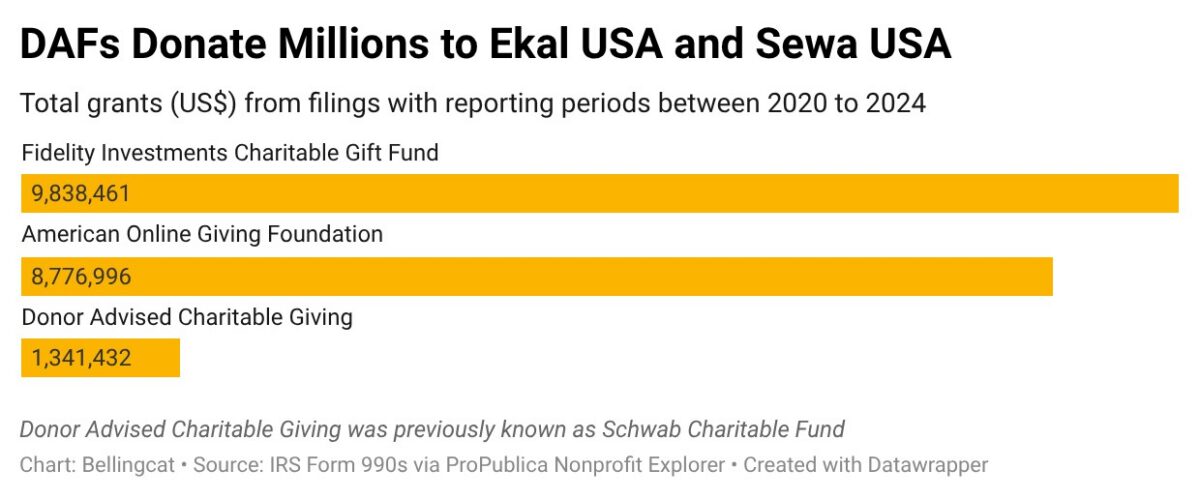
Bellingcat reached out to the top three DAF sponsor organisations that donated to the two non-profits we identified – Fidelity Investments Charitable Gift Fund (Fidelity Charitable), American Online Giving Foundation (AOGF) and Charles Schwab-affiliated Donor Advised Charitable Giving (DAFgiving360; known before 2024 as Schwab Charitable) – to ask about their internal policies on assessing charities receiving donations through their funds. In total, the three DAFs accounted for almost $20 million, or 81.7 percent, of the DAF grants to Ekal USA and Sewa International for full reporting years between 2020 and 2024.
Fidelity Charitable, AOGF and DAFgiving360 all told Bellingcat that they had due diligence processes in place when evaluating non-profits.
Fidelity Charitable’s website states that it is a “cause-neutral” charity, but it ensures grants are used solely for charitable purposes. AOGF said non-profits must comply with eligibility requirements regarding hate speech, discrimination and the use of funds.
Meanwhile, DAFgiving360 said that a grant recipient may be subject to monitoring or placed under temporary suspension “due to circumstances that DAFgiving360 deems appropriate”, such as if there is a public interest consideration or if the recipient does not further DAFgiving360’s mission.
Bellingcat is a non-profit and the ability to carry out our work is dependent on the kind support of individual donors. If you would like to support our work, you can do so here. You can also subscribe to our Newsletter and follow us on Bluesky here, Instagram here, Reddit here and YouTube here.
Citizen Lab director Ron Deibert is quoted in an article in the Guardian about Sheikh Tahnoon bin Zayed Al Nahyan’s increasing influence on AI dominance. “For the last 20 years, democracy has been in decline,” says Deibert. “That happens to coincide with an enormous expansion of digital surveillance capabilities for both commercial and national security purposes. The epicentre of a lot of this is the UAE. And where do all roads lead in the UAE? They lead to Sheikh Tahnoon.”
The article states that Sheikh Tahnoon is embedding himself in the infrastructure that “will underpin our digital future” and that his power is going to extend over more human lives than ever before because he is one of the most influential AI financiers in the world.
The Guardian also cited the Citizen Lab’s 2016 investigation into NSO Group’s hacking of activist Ahmed Mansoor to show how those controlling technology can weaponize it to surveille, intimidate, and silence dissent.
“Hi everyone! I’m completely new to OSINT (started less than a week ago) and wanted to share my first practice geolocation exercise. I took a military ambush video, and managed (i think, not sure if i got it right but im pretty sure) to geolocate the exact spot in Kuchlak (30.328722, 66.936694). I’ve put together a step-by-step PDF write-up. I would love to get your opinions since im a noob in all of this, and maybe made some mistakes in the process or even got it all wrong. So please, any type of feedback and corrections are welcome. Thanks yall.
I don’t know if this is just my account or something, but in the last few months, Facebook seems to now prevent any searches of a profile that include most names: Camille, Olga, Mary, etc. Any idea if this is specific to my account and/or any workarounds?