After the Mississippi attorney general cleared a white cop for firing into a car and killing a Black toddler in a Walmart parking lot, video footage released by the Mississippi Department of Public Safety has revealed the fullest picture to date of what happened.
The videos, provided to The Intercept in response to a public records request, come on the heels of leaked footage that exposed how a needlessly aggressive and reckless police confrontation of two suspected shoplifters led to 1-year-old Kohen Wiley’s violent death in his mother’s arms.
While the newly released videos include redacted versions of the previously leaked footage — including body camera footage for some of the officers, as well as Walmart surveillance video — the new footage reveals for the first time the body camera video belonging to the Senatobia police officer who fired the shots that killed Kohen Wiley: Sgt. Hunter Foster.
While the state concluded that the shooting was “justified” based on a probe by the Mississippi Bureau of Investigation, the videos show how police escalated a non-life-threatening situation — one that could have ended with a mere shoplifting charge — by pursuing Kohen’s mother, Vel’lesiya Wiley, and the driver, Latoya Ferrell, after they ran from the store and tried to drive away.
Foster’s body camera footage makes clear that he positioned himself in front of the vehicle, aimed his gun at the car, and fired the fatal shot into the passenger side window after the car was moving past him and posed no threat.
This is consistent with the conclusions of Dr. Roger Mitchell, a forensic pathologist hired by Kohen Wiley’s family, who determined in June that the fatal bullet was most likely fired into the side window, entering his small body on his right side and exiting his left.
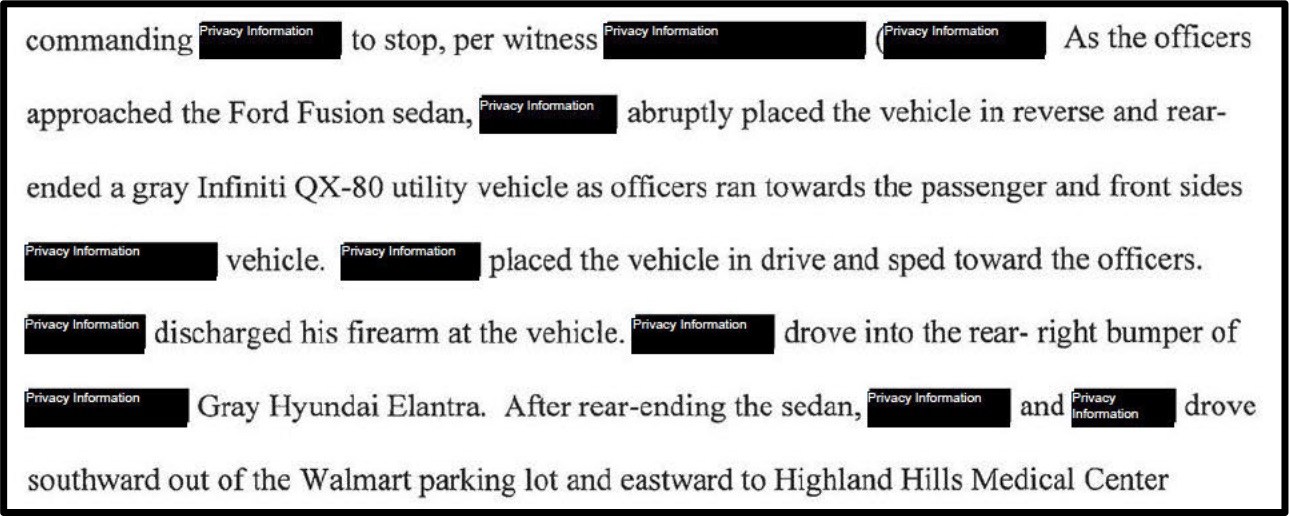
The report’s narrative is misleading: Its only description of the shooting is that one officer “discharged his firearm” after the car “sped toward the officers.” The report does not discuss the fact that the firing officer was beside the car when he first fired, which is clear in Foster’s body camera footage. The report also redacts Kohen Wiley’s cause of death.
An excerpt of the report on the police shooting of Kohen Wiley from the Mississippi Bureau of Investigation released on Oct. 22, 2026, through a public records request.Screenshot: The Intercept
Foster resigned from the Senatobia police department on Wednesday. Afterward, Foster’s lawyer told CNN, “The driver of the vehicle was attempting to kill those 5 officers, and Hunter Foster had no choice but to discharge his weapon.” (Neither Foster nor his lawyer responded to The Intercept’s requests for comment.)
Residents of Senatobia had called for months for the body camera footage and Walmart surveillance videos to be released. After the state attorney general announced that the police had been cleared, a spokesperson for the Mississippi Department of Public Safety, which houses the state’s Bureau of Investigations, told The Intercept that the videos would be released after the family had a chance to watch them.
Instead, as with the attorney general’s announcement, the family first saw the leaked videos on social media. By the time Kohen Wiley’s parents and grandparents met with state officials to view the videos on Thursday morning, most of the footage had been circulated online. At a press conference on Thursday afternoon, Kohen’s maternal grandmother, Veronica Roberson, called it “a slap in the face.”
Roberson said she’d been haunted by the word “justified” all week, slamming the idea that Foster fired the lethal shots because he feared for his life.
“You shot my grandbaby from the side of the car,” she said. “How are you in danger?”
“Get the Car!”
The incident began with what appeared to be a routine occurrence in retail outlets all over the country: a shoplifting allegation.
The earliest footage is from a Walmart security camera. An apparent Walmart employee dressed in a black hoodie is stationed by the store entrance when Wiley and Ferrell approach, carrying a child and a box of diapers. They pause at the door and appear to have a brief exchange with the Walmart employee before breaking into a run toward the parking lot.
In body camera footage, which begins moments later, the staffer in the hoodie appears in the doorway of a small security room, where other Walmart employees, three Senatobia police officers, and two Tate County sheriff’s deputies are gathered around a pair of computer monitors. According to the MBI report, the officers had been called to the store in response to a complaint that a man was sexually harassing customers.
The employee in the hoodie tells the cops and Walmart staffers that two people are running and gestures toward the store entrance.
Moments later, the five officers dash from the room and out into the parking lot, running toward a gray sedan. A sheriff’s deputy reaches the driver’s side door and puts his hand on the hood of the car while someone yells “stop.” The car backs up and starts to turn, but hits a parked SUV. Someone yells, “Stop the car!”
As the officers continue to run toward the car, it begins to move forward. At one point, two officers are directly in front of the vehicle, including Foster, the police sergeant identified as the shooter, who aims his gun at the front windshield.
The car starts to turn left, away from the three officers on the vehicle’s right side, and either narrowly misses or grazes Foster, who stumbles to the passenger side and aims his gun at the window. He then appears to fire three shots in rapid succession.
As the car pulls away, the officers continue their pursuit.
“Get the car! Get the car! Get the car!” one of them yells.
The gray sedan pauses briefly before taking off again.
The records released by state officials do not include any footage of what happened after the officers return to their vehicles. But the leaked footage, which was compiled into a nearly 7-minute long video, shows Foster pacing next to a police vehicle outside the nearby Highland Hills Medical Center an hour and 20 minutes after the shooting.
“I didn’t even see a fucking baby in her lap,” Foster says.
His colleague responds that nobody else did either: “All I saw was two females in the car.”
Reckless and Aggressive
As the leaked video began to circulate on social media on Tuesday, much of the attention focused on the moment the car moved toward Foster.
The Senatobia Police Department claimed from the start that the car drove toward officers and nearly hit one, suggesting the shots were fired in self-defense. Darkhorse Press, the independent Mississippi outlet that first published the leaked footage, even stated in a headline that the car “actually hit at least two officers.”
Among those who have repeated a version of this story is Republican Gov. Tate Reeves, who said the driver tried to “run over the policeman,” despite admitting that he had not actually watched the footage.
What the videos show is that the police officers themselves needlessly escalated a shoplifting incident into the scenario that they claim put them at risk. Almost immediately after being informed that two people were “running,” the five armed officers sprinted out to the parking lot, surrounded the car, and, at various points in the confrontation, drew their guns. They also positioned themselves in a way that cut off any escape route for the driver.
These are reckless, aggressive tactics in response to a minor shoplifting charge. They also violate best practices in policing.
Most departments today prohibit officers from standing in front of the possible escape route of a car when someone inside is suspected of only minor offenses. Many also require officers to get out of the way of a vehicle if it drives toward them. While most departments authorize a police officer to use deadly force if they “reasonably” believe it’s necessary to protect their or others’ lives, this generally does not excuse using lethal force if the “reasonable” fear arose from a cop’s own violation of department policy.
The police officers themselves needlessly escalated a shoplifting incident into the scenario that they claim put them at risk.
Policies and best practices, however, don’t establish the bounds of legal liability; they are related but separate. Under the landmark Supreme Court case Tennessee v. Garner, a police officer can use deadly force if he “has a good-faith belief that the suspect poses a significant threat of death or serious physical injury to the officer or others.” The law is less clear about criminal liability when an officer’s own illegal or ill-advised actions caused the circumstances that led him to fear for his safety.
Other examples of self-defense law hold people criminally liable if their own actions put them in harm’s way. In general, those cases indicate that a person can’t argue self-defense after killing someone if they instigated the altercation that led to the killing — even if it was reasonable to deploy lethal force when they did.
By that standard, if an officer puts themselves in the path of a moving vehicle, they shouldn’t be able to justify lethal force by claiming to fear for their life because the vehicle was about to hit them. The law, however, isn’t crystal clear on this, and there’s at least some indication that the current Supreme Court may adopt a more lenient standard for police officers.
Moving Vehicle
Most police departments prohibit officers from shooting into moving vehicles unless someone inside poses a direct threat to the safety of others unrelated to use of the vehicle itself — for instance, if the person is armed and shooting at people. The reason is simple: Killing the driver of a moving car does not stop the car and can therefore exacerbate threats to public safety.
Like many other departments, the Senatobia police department’s policy contains vague language warning officers that firing into moving vehicles is dangerous to bystanders and unlikely to stop a car; it reads more like guidance than prohibition. One portion of the policy, however, is much clearer: Officers “will not” discharge firearms into a fleeing vehicle — with “will not” underlined for emphasis.
It seems clear from the leaked footage that Ferrell, the driver, maneuvered the car in what appeared to be an attempt to flee rather than to kill or injure officers. The video shows her at first trying to reverse away from police. After striking the SUV, however, she then appears to try to drive around and then between the officers. She then strikes another car while trying to drive away.
The videos depict a driver showing far more awareness for the officers’ safety from behind the wheel than Foster showed for the occupants of the car — or the surrounding bystanders.
Foster’s actions aren’t consistent with any reasonable concept of self-defense. Footage shows that he fired at least three shots into the passenger side of the car. This was already apparent in the leaked body camera footage. It’s even clearer in the newly released video from Foster’s camera. By the time he fires the first of the three shots, he is clearly beside — not in front of — the car. By the time he fires the last shot, the car has passed him.
Even if Foster wanted to claim that he fired to disable the driver — and, again, his own department firmly prohibits shooting at a fleeing car — he fired through the passenger side window. He did so despite being told that there were two people inside, which means that whatever the driver was doing, he was also putting the other person at risk.
Ultimately, the videos depict a driver showing far more awareness for the officers’ safety from behind the wheel than Foster showed for the occupants of the car — or the surrounding bystanders.
Police policies should reflect how people behave in the real world, and people accused of stealing tend to flee. For armed officers to quickly escalate a shoplifting allegation puts everyone nearby at risk. Amid the frenzied response from the cops, Ferrell struck two other cars while attempting to escape. Anyone in or near those cars could have been injured or killed. Foster also fired his gun in a crowded parking lot. That, too, could have resulted in additional death or injury.
The police had other options. They could easily have written down the car’s license plate or obtained the plate number from the numerous surveillance tools at their disposal: their body camera footage, Walmart security footage, or one of the many Flock cameras nearby.
If they had to arrest the women, they could have done so later, at home and under less duress. They may not have caught Wiley or Ferrell red-handed with the alleged stolen goods, theoretically making a shoplifting prosecution more difficult. Creating an obstacle to prosecuting a shoplifting case, however, should be an easy tradeoff for not putting lives at risk.
Walmart’s Role
Finally, the leaked video footage raises important questions about Walmart’s role in Kohen Wiley’s death. The company has yet to publicly comment about the incident — and has not responded to repeated inquiries from The Intercept.
When the Walmart employee in the hoodie entered the room where officers were viewing security monitors, he told them that two people were fleeing the store. He did not say that one of them had a baby in her arms, even though surveillance footage showed Wiley carrying Kohen as she passed him. This would prove consequential, as Foster said in video footage that he had no idea there was a baby in the car.
Does Walmart policy require staff to tell police when a suspected shoplifter is accompanied by children? And how often does Walmart call on police for such minor crimes?
This isn’t the first time aggressive policing of shoplifting at a Walmart has resulted in the death of an unarmed person. Earlier this year, deputies shot suspected shoplifters in two separate incidents at Walmarts in Florida. When police tackled a fleeing shoplifter in Anchorage, Alaska, recently, he pulled a gun and shot two officers before they returned fire, killing him.
Even the best policing policies are useless if they aren’t enforced when officers violate them.
Walmart seems to have wavered over the years between aggressive crackdowns on suspected shoplifters and more lenient policies that factor in whether the suspect has been accused before, the necessity of the items they’re accused of stealing, and the value of the stolen goods.
Like many national retailers, the company’s policy when it comes to its own employees is to avoid confrontations with suspected shoplifters. A previous lawsuit revealed that the company’s stated policy as of 2010 was “PUT PEOPLE FIRST” (all caps in original) and prioritized “the physical well-being of suspects, customers and Walmart associates.”
That policy means little if the store simply outsources enforcement to police who take a far more aggressive approach. Walmart itself has also been criticized by police groups, who claim that cost-saving reductions in staff have made the store a more attractive target for shoplifting, which then leads to more calls to police.
And in Senatobia, the last high-profile incident of police violence before Kohen Wiley was killed took place in 2025 — at the same Walmart parking lot.
Even the best policing policies are useless if they aren’t enforced. And officers are rarely prosecuted, period. Foster’s resignation is at least some form of accountability, but the insistence from state officials that police did nothing wrong means there will be little to stop similar killings from happening again.
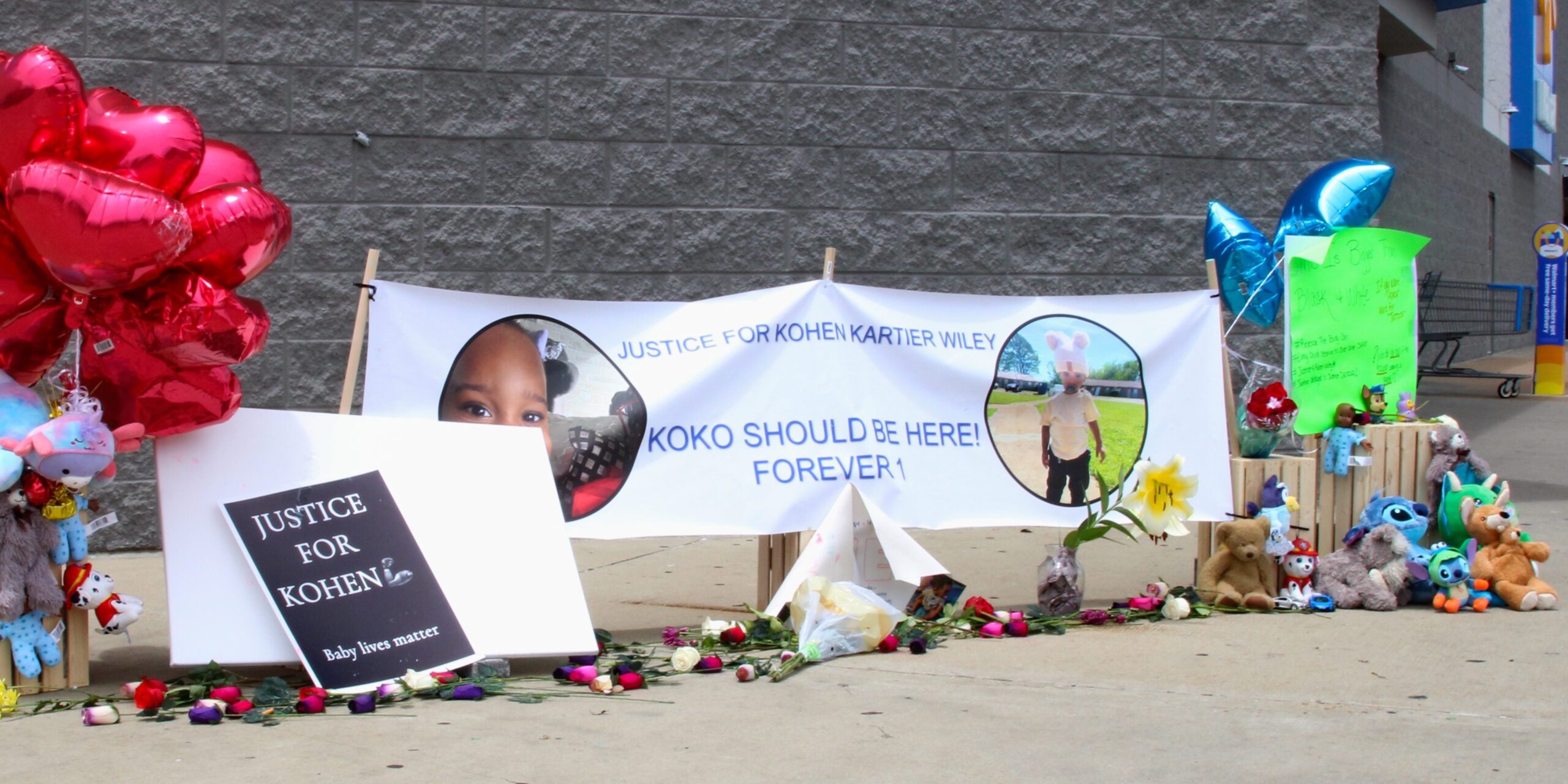
This week, residents of Senatobia returned to the Walmart for a vigil in honor of Kohen Wiley, in the same place where a makeshift shrine once stood. A community gathering has also been scheduled next weekend to mark what would have been his second birthday.
At the press conference Thursday, family and activists vowed to keep fighting for justice. As with so much police violence, however, the most pressing question isn’t whether Foster himself is punished. It’s whether we’re willing to tolerate more deaths like that of Kohen Wiley — whether Senatobia, Walmart, and the state of Mississippi will do anything to make clear that a 1-year-old’s life is more important than a pack of diapers.
Democrats may be ahead in the polls. But can they withstand billions in campaign spending by Elon Musk and other MAGA oligarchs? Will the election be safe from intimidation and interference? And even if they do prevail, what would a Democratic Congress actually do to obstruct Trump’s attacks on democracy?
For decades, former Labor Secretary Robert Reich has been sounding the alarm about rising inequality and the concentration of power in America. Having served in three presidential administrations, he’s become one of the loudest and clearest voices challenging Democrats for their failures in the Trump era.
Reich joins Intercept Briefing host Akela Lacy for a live conversation about the most pressing issues this midterm season. He is the author of numerous books, including his memoir “Coming Up Short,” out in paperback now. His media company, Inequality Media, has also made a timely new documentary, called “The Work in Progress,” exploring how everyday Americans across the country are navigating our democracy in these times.
Debit and credit cards have long used microchips, which protect against skimming. Now the U.S. Department of Agriculture is mandating that all 50 states adopt the technology to prevent SNAP benefit theft. Ramon Dompor
The Trump administration this week announced an overhaul of the nation’s food stamp payment system, aimed at modernizing benefit cards to protect families from electronic theft. The move comes a week after ProPublica published an investigation showing how $470 million in Supplemental Nutrition Assistance Program, or SNAP, benefits were stolen from recipients last year alone, in large part because these cards are technologically outdated.
ProPublica’s story highlighted victims’ experiences and examined repeated failures by Congress and the U.S. Department of Agriculture to upgrade Electronic Benefits Transfer, or EBT, cards nationally. ProPublica’s reporting was shared around the department, according to two USDA officials.
The new proposed rule, officially issued by the USDA’s Food and Nutrition Administration on Friday, has been in the works since 2023 — but it was continually delayed until now. Reasons included understaffing at the USDA, especially in the wake of the Department of Government Efficiency’s cuts last year, and a backlog of other regulations that the White House budget office had prioritized. White House and USDA officials did not immediately respond to a request for comment on the sudden shift.
The rule will mandate that all 50 states transition from EBT cards with just a magnetic stripe on the back — which are easy for criminals to skim data from — to ones with digital microchips, which credit and debit cards have had for more than a decade, and tap-to-pay technology. Other changes include creating new federal “SNAP EBT Operating Standards” to be revised on an ongoing basis, so that the feds and states together can do a better job of keeping up with best practices in the credit card industry and the changing tactics of fraudsters.
A handful of states have already transitioned to chip cards on their own, including California, where the theft of SNAP and other public benefits was reduced by 83% in two years after the technology was adopted. But more than 40 states haven’t added chips, and hundreds of thousands of lower-income Americans continue to show up at grocery store checkout lines only to find that their food assistance for the month has been drained by thieves. NPR and other news outlets have also recently reported on this crisis.
Members of the public, including state SNAP administrators and grocery store owners who may have logistical questions about how to overhaul their EBT systems, now have 60 days to submit comments on the new USDA regulation; these will be reviewed by agency officials before the rule is formally enacted. After that, states will have two years to switch to chip cards, although their ability to meet that deadline will depend on several factors. For one, many are budget-strapped right now, due in large part to the fact that President Donald Trump’s One Big Beautiful Bill Act slashed states’ funding for administering their SNAP programs — dollars that they could have used to upgrade their EBT systems and print and mail out the new cards.
Multiple current and former FNA officials, as well as state program administrators, told ProPublica that they are worried the agency is mandating expensive changes for states but that Congress so far has shown little sign it will provide federal funding for the chip card transition. As ProPublica reported last week, the Senate’s version of this year’s Farm Bill includes money for this purpose, but the House version does not; Democrats and Republicans remain at loggerheads about overall SNAP spending, and it is unclear what will happen. The estimated total federal and state cost of the changes is $283 million, as compared with the more than $600 million in SNAP and other benefits that are stolen from existing cards every year.
Still, the mandate that all states implement chip EBT cards “is a big deal for low-income households,” said Justin King, a longtime safety net advocate who is now the policy director for Propel, a company that helps SNAP recipients access their benefit information. He added that he was “legit surprised” by the administration’s decision.
“Theft rings don’t care about state lines. You’re just squeezing a balloon if you update one state at a time,” King said of the prospect of individual states continuing to gradually adopt chip cards without a federal requirement. “A national standard means there’s nowhere left to go” for the criminals, he said.
For the moment, at least, there are signs that the Trump administration’s posture toward this issue has shifted more broadly. On Wednesday, while barnstorming in Ohio for Republican candidates, Vice President JD Vance (whose roles include serving as the administration’s “fraud czar”) called a press conference and made a point of emphasizing that low-income families are often the victims of SNAP fraud.
This was at odds with how Vance has portrayed the problem in the past. “There are people who have Lamborghinis who currently receive SNAP benefits,” he has previously said, in a typical comment. For ProPublica’s previous article, research reporter Gabriel Sandoval reviewed dozens of speeches, social media posts and press accounts of statements made by Vance and other Trump officials, and found that they have consistently portrayed SNAP recipients as the perpetrators of fraud.
Vance also took a startlingly different tone this week toward the food stamp program itself. In his 2016 memoir “Hillbilly Elegy,” which first propelled him to fame, he wrote that SNAP recipients in Kentucky and Ohio “live off of government largesse”; he said that people in that part of the country are largely “hardworking, except of course for the many food stamp recipients who show little interest in honest work.”
But this week from the stage in southern Ohio, he said, “Step back for a minute and realize that the [SNAP] program is one of the most important social service programs that we have in the United States of America.” He went on at length: Food stamps ensure that “all of our fellow citizens, particularly children, are able to have a full belly at the end of every single night, that regardless of whether they can pay for a meal, we don’t let American children and American families go hungry. That is one of the most important and sacred things that our tax dollars go to.”
The White House and Vance’s press office did not immediately respond to a request for comment on his rhetorical about-face.
Vance then had Attorney General Todd Blanche and other top officials give more details on multiple recent SNAP theft prosecutions. These included several ongoing EBT card skimming cases in Oregon in which criminal groups had allegedly pilfered the SNAP account numbers and PINs of legitimate beneficiaries and then used that data to buy bulk quantities of goods like energy drinks and baby formula — which the scammers resold for over $3 million. This is exactly the type of case that ProPublica reported on last week.
“The simple reality is that it is actually a very tough thing to go through a [grocery store checkout] line with kids,” Vance said. “To present that card, to expect to be able to take that food home to your family, to be able to cook it and provide a meal for your kids, and to be told that because of the theft of a fraudster, that you are being rejected. And there are hundreds of thousands of families all across our country, all across the state of Ohio who have had that experience.”
Senior research associate Kate Robertson spoke about the legal concerns that Canada’s proposed Lawful Access Act poses in a discussion hosted by the Canadian Internet Society. She emphasized the importance of repairing and preventing vulnerabilities “rather than drilling more holes in our every day communications systems.”
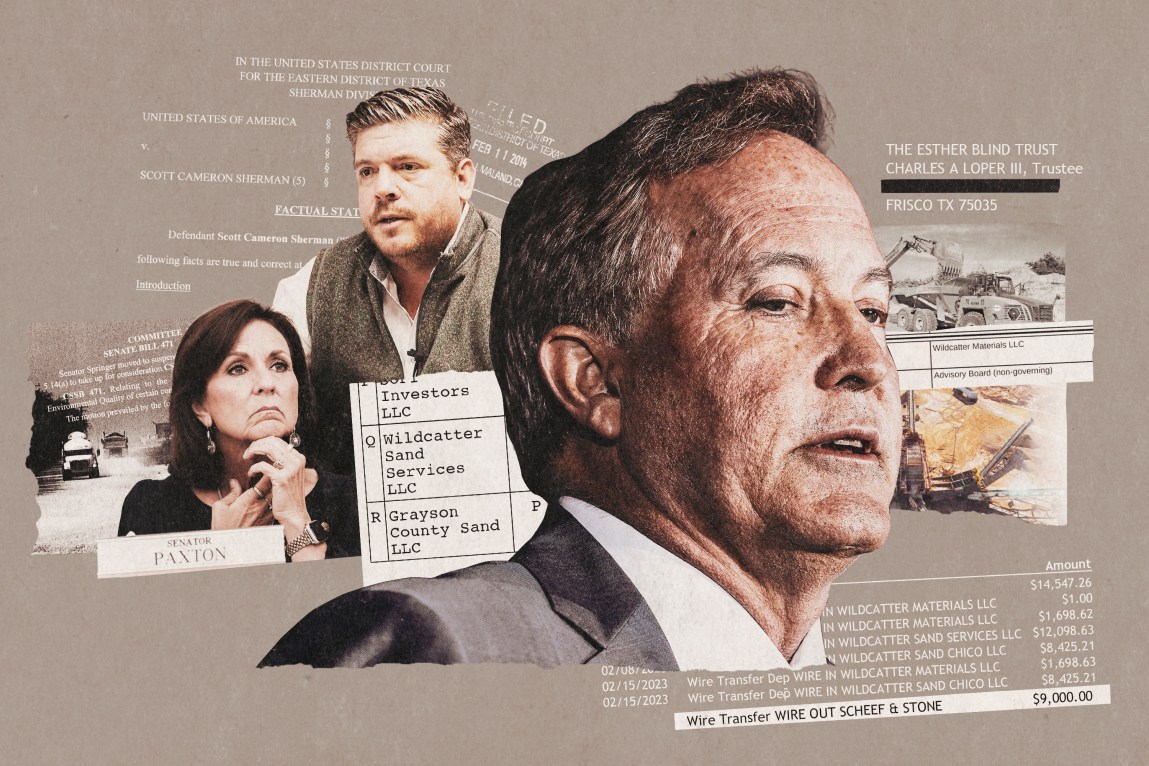
Photo illustration by Emily Scherer for ProPublica and The Texas Tribune. Source images: The Texas Tribune, documents obtained by ProPublica and The Texas Tribune, and YouTube.
Four years after North Texas home builder Scott Sherman completed a federal prison sentence for mortgage fraud, his new construction materials business received a $600,000 cash infusion.
The financial boost came from a blind trust set up to prevent Texas Attorney General Ken Paxton and his wife, state Sen. Angela Paxton, from any overlap in their personal investments and their actions as elected officials. But previously unreleased records from the attorney general’s 2023 impeachment investigation show the trust was far from blind and did not shield the Paxtons from its business dealings, including the investment in Sherman’s business.
Before long, Wildcatter Sand Services and Grayson County Sand and Gravel, which Sherman built with his father, grew into a vast enterprise with various locations and subsidiaries. And along the way, some of those businesses stopped paying taxes to local governments, including school districts.
But as their tax debts stacked up, Wildcatter companies wired the Paxtons tens of thousands of dollars in the months leading up to and during the attorney general’s impeachment on charges of corruption and bribery. Paxton was eventually acquitted by the Legislature and is now in an expensive and tight race for a U.S. Senate seat against Democrat James Talarico, a state lawmaker.
While Paxton has been in public office for more than two decades, the blind trust he established upon becoming attorney general has largely obscured his business dealings. The Paxtons’ investment in Wildcatter through that trust offers a new, previously unreported look at both the limits of that trust and the attorney general’s financial association with the very type of business executives whose prosecutions he typically celebrates.
“In Texas, we fight fraud head-on and will not rest until every last corrupt actor is brought to justice,” Paxton said in a news release last year. In a recent social media post linking to a newly released campaign ad, he wrote, “As Attorney General, I’ve made big pharma and fraudsters pay billions.”
Doing business with a recently convicted felon undermines that narrative and erodes public trust in his role as the state’s top anti-fraud watchdog, ethics experts told ProPublica and The Texas Tribune.
Richard Painter, who served as the chief ethics lawyer for President George W. Bush, said he would have thought “the attorney general of Texas would have the good sense not to be dealing with a convicted felon.”
“They’ll pay out their friends while they’re not paying their taxes, run up debt,” said Painter, who has been critical of staunch Paxton ally President Donald Trump. “But the question is, why is the attorney general of Texas dealing with those kinds of people?”
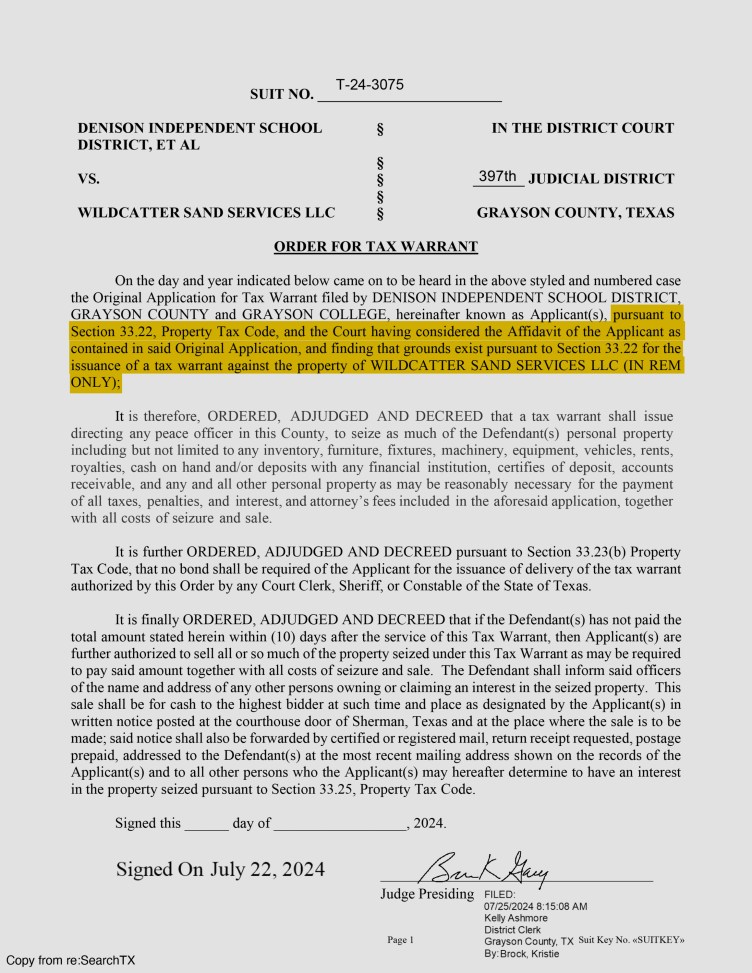
Wildcatter Sand Services had a tax warrant issued against it for back taxes after facing a lawsuit by local governments.Obtained and highlighted by ProPublica and The Texas Tribune
Ken Paxton did not answer detailed questions from the news organizations about the Wildcatter investment or whether he knew of Sherman’s conviction. He has previously defended his business dealings, saying he follows ethics laws. A spokesperson for Angela Paxton, who filed for divorce last year, said that she was not aware of Sherman’s criminal history.
Sherman ran a homebuilding firm, Artisan Operating LP, when he pleaded guilty in 2014 for his role in a mortgage fraud conspiracy. The scheme involved artificially inflating home prices to obtain larger loans for more than two dozen properties in cities across the Dallas-Fort Worth area. Sherman did not respond to calls made to his cellphone and company or to emailed questions.
Paxton’s connection to Sherman is the second revelation in recent weeks of the attorney general engaging with people charged with federal crimes. Last week, The Wall Street Journal reported that Paxton celebrated New Year’s Eve 2024 in Dubai with two Americans who failed to return to the U.S. after being indicted months before on federal healthcare-fraud charges. A spokesperson for Paxton didn’t address his association with the defendants but said in a statement to the Journal that the attorney general has been “politically persecuted for years.”
ProPublica and the Tribune found the Paxtons’ investment in Wildcatter by reviewing records collected by impeachment investigators.
The records show that Ken Paxton had at least some knowledge of the blind trust’s investments, which could violate terms the Paxtons set when establishing the trust.
It would also run afoul of U.S. Senate rules, which Paxton would be bound by if elected, said Donald Kettl, an ethics expert and former dean of the University of Maryland’s School of Public Policy. Those rules, Kettl said, require senators with a blind trust to have no knowledge of its investments.
“It’s reasonable to ask whether a candidate for the U.S. Senate has followed the ethics rules for financial reporting of blind trusts that would be required if the candidate became a senator,” he said.
In setting up the blind trust, the Paxtons agreed that their friend Chip Loper would manage the assets without consulting with them or taking “any instructions regarding investment matters,” according to incorporation documents. Loper did not respond to a request for an interview and did not answer questions about the Paxtons’ involvement in selecting investments.
Text messages that emerged during the impeachment probe, however, showed he and Ken Paxton discussed certain investments. Mortgage and deed records show that Paxton purchased eight properties between 2015 and 2026 and then transferred them into the trust.
The Wildcatter investment also appears to have slipped past the required firewall.
Angela Paxton served for years on a Wildcatter advisory board beginning in 2022. ProPublica and the Tribune could not find any documents describing her responsibilities in the role, which she described as “non-governing” on her personal financial disclosures. While on the board, she voted for legislation that shielded a subsidiary from certain environmental complaints.
The Paxtons also claimed more than $93,000 in itemized losses from Wildcatter Sand Services and Grayson County Sand and Gravel on their 2020 federal joint income tax return.
“That is proof positive that there’s nothing blind about this trust,” said Kathleen Clark, a law professor at Washington University in St. Louis who specializes in legal and government ethics. If Ken Paxton “can report on his tax return a transaction, then he is not blind to the transaction.”
A Board Seat and a Vote
After Wildcatter received the cash injection from the Paxtons’ blind trust, Sherman went on a shopping spree.
He purchased a sand mine in the North Texas town of Denison and a concrete plant 40 miles down the road in Gunter, a city of about 2,000 residents. Both are in Grayson County near the Oklahoma border.
Neighbors complained to Texas environmental regulators about clouds of dust from Wildcatter and other companies located at the Gunter site that they said coated their properties for up to 12 hours a day.
In 2021 and 2022, the Texas Commission on Environmental Quality issued violation notices to Wildcatter Redi-Mix, the company that runs the Gunter plant. At least one dust-related violation was resolved when a road leading to the plant was paved in 2022, according to TCEQ documents. TCEQ did not respond to a request for comment.
Neighbors continued to raise concerns about the plant.
Angela Paxton joined the advisory board of Wildcatter Materials, which owns Wildcatter Redi-Mix, a year later. The IRS defines advisory boards as lacking legal and financial authority over companies. She was still serving on the board in 2025 as of her last financial disclosure.
Complaints against the company continued. At one point, Gunter resident Deirdre Diamond, a respiratory therapist and lead advocate for a local group created to fight pollution from concrete batch plants, reached out to her representative in the Legislature, then state Sen. Drew Springer.
Despite the TCEQ’s previous violation notices, Springer concluded that the neighbors’ complaints were “abusive” and filed a bill that he said at the time would prevent efforts to “weaponize the system.” He made similar comments in a recent interview with the news organizations. Springer’s bill allowed the TCEQ to ignore residents after more than five unsubstantiated complaints in seven years.
Diamond and other opponents believed the bill was an attempt to keep residents from exercising their rights and argued that the language was too vague. They said the legislation did not make clear what would constitute an unsubstantiated complaint and that some complaints may be repeated over the years because of TCEQ inaction.
When the bill reached the Senate floor, Angela Paxton voted for its passage.
Matt Welch, a spokesperson for Angela Paxton, pointed to the measure’s bipartisan support in the Senate, saying it was needed “to stop a small group of environmental activists from wasting taxpayer dollars by weaponizing the complaint process.”
He said that between 2019 and 2023, the group filed more than 100 complaints against Dallas-area industrial sites that did not result in findings by the state environmental agency. “These frivolous complaints divert state resources from legitimate violations.”
Angela Paxton did not recuse herself from voting on the bill because it did not relate to any specific company, Welch said. He added that Paxton’s role on the advisory board “carried no decision-making authority” and that she was unaware of any complaints or violations against Wildcatter.
Ethics experts said she should have disclosed her relationship with the company and recused herself. State law bars lawmakers from voting on bills that benefit them or their businesses. The prohibition does not, however, apply to legislation that regulates an entire industry, Senate Secretary Patsy Spaw said.
Because lawmakers write the laws governing what they must disclose and when they should recuse themselves, “a good amount of the time, the guardrails that they create for themselves are not enough,” according to Andrew Cates, a San Antonio ethics lawyer, who said this is one such instance.
Meanwhile, neighbors of Wildcatter’s Gunter plant said the new law left them demoralized and convinced that lawmakers were not interested in protecting them or their land. Diamond moved away after the bill passed. She said she feared the plants’ impact on her children’s health and believed the regulators were on the side of the company.
She was stunned to learn about the Paxtons’ investment in the company.
“You can’t pretend to be about protecting the people when you directly profit from it,” Diamond said in an interview.
A bank statement from the Paxtons’ blind trust checking account shows various deposits from Wildcatter in early 2023.Obtained, highlighted and redacted for privacy by ProPublica and The Texas Tribune
Wildcatter Helps Paxton in Difficult Times
In the months leading up to the bill passing the Legislature, four Wildcatter companies wired more than $73,000 to the Paxtons, according to bank statements reviewed by the news organizations that were part of the previously unreported impeachment documents.
About $10,000 arrived in the two weeks before Angela Paxton voted on the environmental bill. An additional $12,000 was wired the week after the legislation passed in the Senate.
Because the records ProPublica and the Tribune reviewed are limited, the news organizations cannot say with certainty why the payments were made and how they were accounted for on the companies’ books.
The payments came as some Wildcatter companies were failing to pay local property taxes.
At the time, Wildcatter Sand Services, the company the Paxtons’ trust had invested in, already owed more than $31,000 in back taxes, according to Grayson County public records.
Several Wildcatter companies also owed hundreds of thousands of dollars in local taxes in 2023 that soon became delinquent.
That year, Ken Paxton was facing his own troubles as allegations of bribery and corruption reached a fever pitch.
Early in 2023, the U.S. Justice Department’s public integrity unit, known for handling high-stakes political corruption cases, took over an investigation into allegations by Paxton’s senior advisers that he abused his office. (It was later dropped in 2025.)
Paxton also reached a tentative $3.3 million settlement with some of those employees. They had accused him of firing them after they went to authorities with allegations that he had used his office to go after the enemies of an Austin real estate investor and donor. The proposed payout required legislative approval, drawing the ire of lawmakers who questioned why taxpayers should be on the hook. After the Legislature took no action, a judge awarded the whistleblowers $6.6 million in 2025. Paxton called the ruling a “bogus judgment in support of baseless claims by rogue employees.”
Some of the Wildcatter payments came while a House committee was investigating the whistleblowers’ claims about the attorney general’s conduct.
On May 19, a week before Paxton was formally impeached, the blind trust wired $9,000 to attorney Mitch Little’s firm. Little later represented both the trust and Paxton in his impeachment trial. It’s unclear whether the money from Wildcatter was used to pay for the legal representation. The trust’s checking account would not have had enough money for that payment without deposits from the companies earlier in the month, records show. At the time, the trust also had an investment account with $9,300 in cash and just under $1 million in securities, but records do not show any distribution from that account to the checking account in that period.
Neither Loper nor Little, now a state representative, responded to questions about the transaction. Angela Paxton’s spokesperson said she has no knowledge of any payments for impeachment lawyers.
Craig Holman, ethics lobbyist for consumer-advocacy group Public Citizen in Washington, D.C., said it would be particularly problematic if any of the money was used as a “passthrough” for Paxton’s legal fees.
All told, Wildcatter companies wired the Paxtons’ trust 15 payments between January and June 2023 totaling more than $83,000. It is unclear whether payments continued after that date because the records collected by impeachment investigators ended in June.
The following year, two of those companies became delinquent on nearly $200,000 in 2023 property taxes to local schools, cities and counties.
The governments had to sue to recover what they were owed.
The Cypriot Parliament this week discussed recent revelations about corporate maneuvers that allowed firms ultimately owned by Russian billionaire Roman Abramovich to sidestep tax and transparency requirements.
The parliamentary hearings followed an investigation last week by OCCRP, CIReN, BBC, and TBIJ. The reports detailed how the Cyprus affiliate of multinational accountancy firm Deloitte, and corporate service provider MeritServus, worked together to backdate documents relating to companies beneficially owned by Abramovich.
Doing so helped the companies retroactively transfer billions of dollars in assets from Cyprus to the British Virgin Islands, where they would not be subject to Cypriot laws on tax and public disclosure.
OCCRP reached out to Deloitte’s offices in Cyprus and internationally for comment on the parliamentary hearing, but did not receive a response by the time of publication. Deloitte Cyprus previously told OCCRP it “acts in compliance with applicable laws.”
MeritServus has been dissolved and it was not possible to obtain a comment.
Lawyers for Abramovich, from the London firm of Kobre and Kim, noted that he “has not been identified as the subject of any investigation, nor has he been charged with any wrongdoing.”
“Our client’s position is that he denies that he evaded tax or concealed his assets,” the firm said in an emailed response to questions.
During the session of Parliament’s Standing Committee on Institutions on Wednesday, representatives of several state bodies were questioned about the findings of the journalistic investigation. Government institutions present included the Finance and Justice Ministries, the Tax Commissioner’s Office, the State Prosecutor and Police, Auditor General, and Central Bank, as well as the Cyprus Securities and Exchange Commission.
An official from the Justice Ministry told the committee that information published by the media outlets would be assessed, and that police investigations would be carried out to determine whether any criminal acts had been committed.
A representative of the Cyprus Public Audit Oversight Board said the body had been in contact with Deloitte Cyprus since the publication of the reports. The representative referred to difficulties Deloitte Cyprus was experiencing in retrieving data and communications from the relevant period, but stated that the company would provide all relevant information as it became available.
Several representatives of regulatory bodies present at the hearings highlighted general improvement made in Cyprus since the period covered by media reports, particularly as a result of E.U. directives being transposed into national law.
Tax reform laws introduced in Cyprus in January increased the possible fine for failure to pay the Special Defense Contribution, one of the taxes the companies beneficially owned by Abramovich were obliged to pay. A fine could be as much as 100,000 euros ($112,200) in addition to four times the originally owed tax for repeat offenders.
Riding an extraordinary wave of public mobilization, Serbia’s student-led opposition heads into Sunday’s snap parliamentary election genuinely believing it can break President Aleksandar Vučić’s 14-year grip on power.
Yet beneath the euphoria of this week’s mass rallies lies a pervasive conviction among its supporters that the contest will be anything but fair—and that the ruling party will resort to outright ballot theft rather than concede defeat.
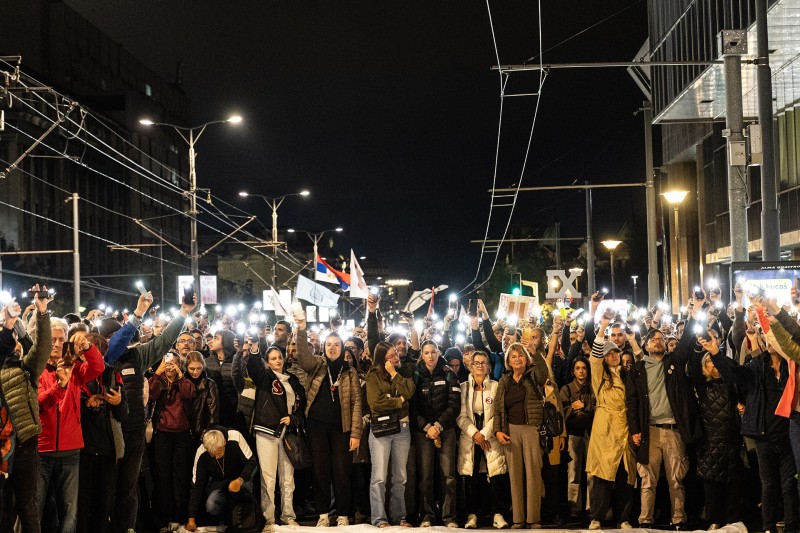
On Thursday night, that tension was on full display as hundreds of thousands of people flooded into Belgrade’s central Slavija Square, filling the surrounding boulevards in a buoyant, flag-waving display of collective defiance. The assembly marked the movement’s final campaign rally ahead of an early vote that serves as the culmination of nearly two years of youth-led unrest against Vučić’s rule.
What began in November 2024 as grief and outrage following the collapse of a newly renovated railway station canopy in the northern city of Novi Sad—a disaster that killed 16 people and was turned by the protesting youth into a lethal symbol of state corruption and crony contracting—has since metastasized into a nationwide rebellion.
Now polling in a dead heat with the governing Serbian Progressive Party (SNS), the youth movement’s “Students’ List” has mounted the most formidable electoral challenge Vučić has faced in over a decade. But across the sea of demonstrators in the capital, few harbored illusions about how the ruling machine will be handling the vote.
“I believe he will do anything he can to steal the votes and remain in power,” said Katarina Zajić, 45, a food technologist who works as an administrative clerk in the Belgrade municipality of Zemun.
That skepticism is informed by years of documented electoral abuse. International election observers, led by the Organization for Security and Co-operation in Europe (OSCE) and backed by European Union institutions, have consistently found that while Serbian elections offer voters a nominal choice of candidates, the playing field is fundamentally compromised. In report after report, monitors have cited pervasive state capture of broadcast media, intense pressure on public-sector workers to mobilize for the ruling coalition, the routine abuse of public resources for partisan gain, and deep-seated anomalies in the voter register.
Domestic watchdogs have leveled even harsher verdicts. The Center for Research, Transparency and Accountability (CRTA), Serbia’s prominent independent election observation group, concluded that recent election cycles—including the disputed parliamentary and municipal votes in 2023 and 2024—were “not free and fair.” The watchdog documented organized voter migration schemes, the mass registration of “phantom voters,” and the wholesale erasure of the boundary between state institutions and the ruling party.
Vučić and his party have vehemently denied any wrongdoing, routinely dismissing allegations of electoral manipulation as the reflexive excuses of “sore losers” fabricating an alibi for their own political weakness.
“These were by far the cleanest and fairest elections to date, and everyone knows it,” Vučić declared following the 2023 ballot, even as opposition leaders launched hunger strikes and thousands took to the streets to protest organized cross-border voter bussing.
For many of those who massed in Belgrade on Thursday, however, the gap between the government’s assurances and the documented reality on the ground has left them preparing for a confrontation that will not end at the ballot box.
“Vučić never organized fair elections. He never won the elections he didn’t organize, and there won’t be any difference this time,” said David, 45, who attended Thursday’s rally. “The more people come out for the elections, the bigger the chance to win against him. But if he still tries to steal, well, I don’t know… the streets.”
He paused, measuring the consequences of what might follow Sunday night.
“Violence is the last answer,” he said. “But if that’s the answer, we’re probably going to have to go that way.”
Since June, however, the only candidates Fellowship PAC has spent on have been Democrats, including those who have criticized the president’s meme coin, and it is getting help from a former Trump administration official’s company.
Since June, the only candidates Fellowship PAC has spent on have been Democrats.
Fellowship PAC funneled $600,000 since this summer through a firm co-founded by former Trump crypto adviser Bo Hines to help reelect Rep. Ritchie Torres of New York; Rep. Maggie Goodlander of New Hampshire; and Sen. Mark Warner of Virginia. The Democrats are considered crypto allies, and none of them are facing competitive elections this fall.
All those advertising dollars have been spent through a vendor called Nxum Group, which was co-founded by Hines, a former Republican congressional candidate and Trump administration official.
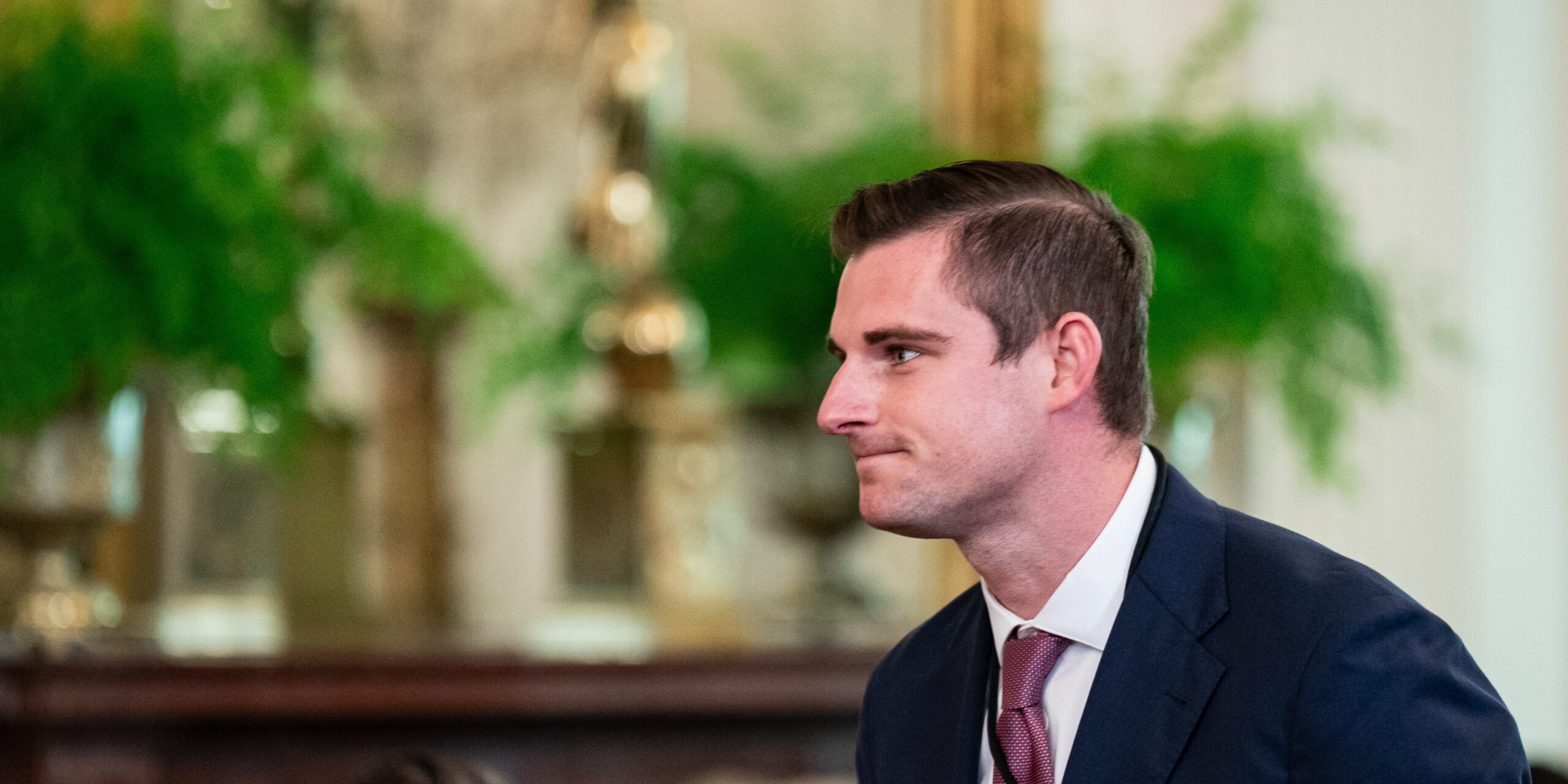
Hines did not return a request for comment, and it is not known whether he has personally been involved in the Nxum Group’s work on behalf of Fellowship PAC. In congressional races in 2022 and 2024, he presented himself as a Trump-loving MAGA acolyte.
There is a thick web of ties between Hines, Fellowship PAC, and one of the biggest players in the crypto industry, a stablecoin company called Tether.
Before Trump’s election, Hines was involved in promoting a Trump-themed meme coin that made a handful of investors millions before plummeting in value. After Trump’s election, the president tapped Hines to serve as the head of the White House Council of Advisers on Digital Assets. In that role, Hines helped pass a law that created stablecoin regulations that benefited Tether.
As Hines served in the Trump administration, Tether was paying money to the firm that Hines co-owned, Nxum Group, according to a report last week in the Wall Street Journal. Nxum Group told the news outlet that Hines had no involvement in the company’s business dealings with Tether during that time. Hines said in a June 2025 ethics disclosure that he had only a “passive investment interest” in the company.
Hines left the Trump administration in August 2025 and, a month later, Tether announced that he would serve as the CEO of its U.S. branch.
Tether also has ties to Fellowship PAC. The newly created Fellowship PAC received a $10 million donation in January from Tether’s U.S. banking firm, Cantor Fitzgerald. In April, Fellowship PAC announced that Tether’s vice president of regulatory affairs would serve as its chair.
Although it launched with a splash last year by claiming that it had a $100 million war chest, the PAC has never reported as much as that in official campaign finance disclosures. The PAC’s last receipt was in January, and its cash on hand dwindled to $250,000 as of October 14.
Throughout the midterm elections, Fellowship PAC has leaned heavily on Nxum Group to spend advertising dollars on various congressional races.
Fellowship PAC spent exclusively on Republicans until its first expenditure on behalf of a Democrat, Torres, in June. That spending coincided with public polls showing increasingly dismal fortunes for Republicans in the midterm elections. Since then, the PAC has spent exclusively on Democratic candidates.
Torres’s and Warner’s campaigns did not respond to requests for comment. Goodlander’s campaign said she had nothing to do with the $150,000 that Fellowship PAC spent on digital advertising in her race. The money, the PAC disclosed in filings, had been routed through Nxum Group on August 31.
“Congresswoman Goodlander has been one of the strongest advocates in Congress for cracking down on Big Tech and crypto profiteering and getting dark money out of politics,” her campaign said in a statement. “Like all campaigns, we’re legally barred from coordinating with outside groups like these, so you’d need to ask them why they’re spending in this race.”
Goodlander, Torres, and Warner are all rated as strong supporters of the crypto industry on an industry scorecard. Still, all three have been critical of Trump’s personal dealings in the industry though his $TRUMP meme coin, which has helped make him $1.4 billion from crypto ventures.
Warner recently ran an ad of his own attacking Trump over the meme coin.
“That’s not governing. It’s grifting,” the Democratic senator said. “The corruption needs to stop.”
Brazilians will head to the polls on Sunday in one of the most consequential presidential elections of the last decade. The run-off election will determine the future of the largest democracy in Latin America and the fate of the Amazon rainforest.
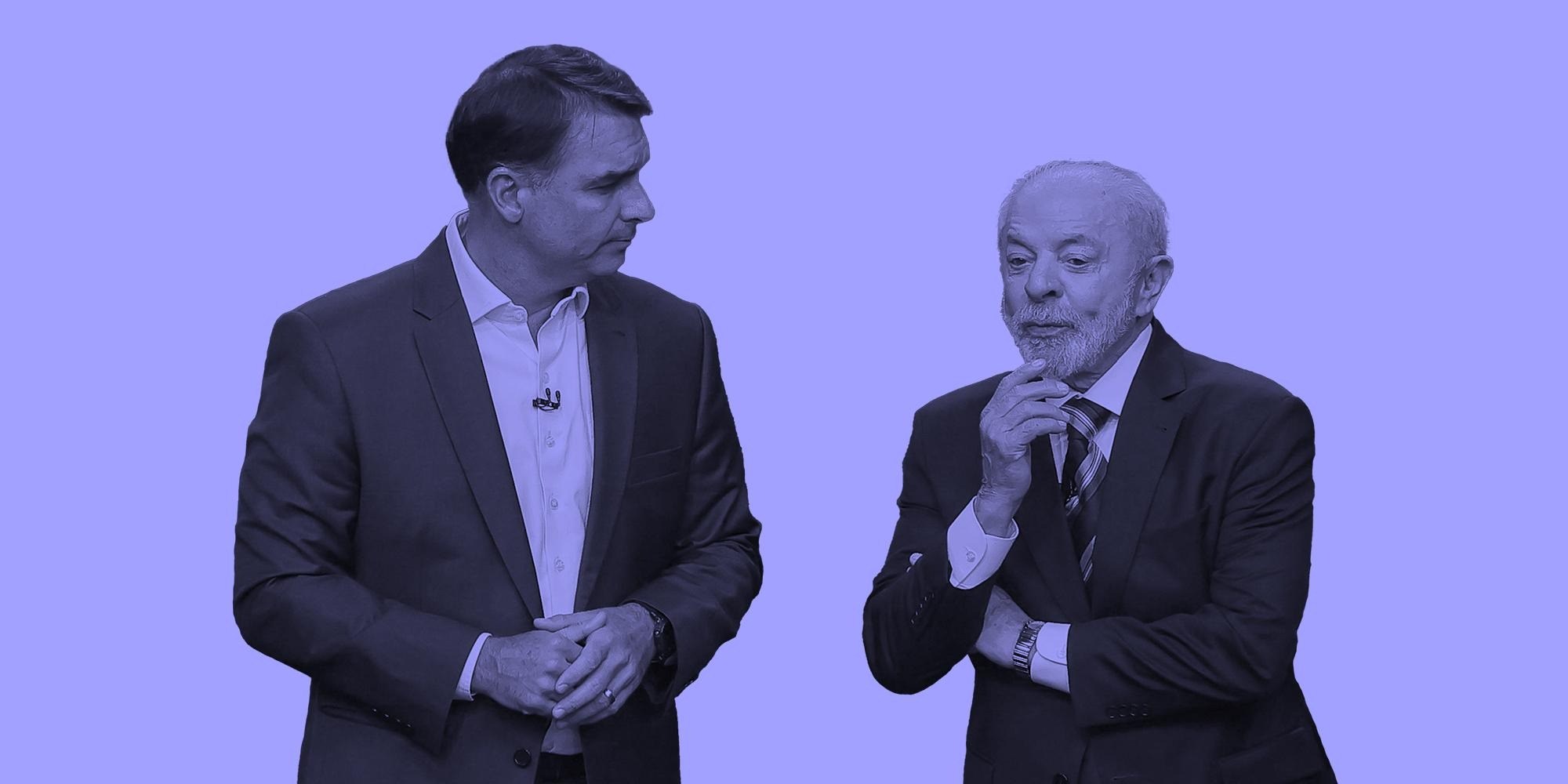
Incumbent President Luiz Inácio Lula da Silva is facing off against Flávio Bolsonaro, the son of former President Jair Bolsonaro. The elder Bolsonaro is currently on house arrest for his role in a failed 2023 military coup that intended to assassinate Lula, his vice president, and a Supreme Court justice. Despite his father’s attempted coup, Flavio Bolsonaro is currently the frontrunner, after coming out slightly ahead in the first round of voting.
“If they don’t win this election, then not only is Jair going to stay in jail, most likely, but Eduardo, Flávio’s brother and Jair’s son, who is in self-exile in the U.S., he has a multiyear prison sentence for his actions in the U.S. lobbying against Brazil’s foreign interests. He’s not going to be able to go home if they lose this election,” says Andrew Fishman, a Rio de Janeiro-based investigative journalist. “So they’re really just willing to do whatever they can to make sure that they win because this is their only get-out-of-jail-free card.”
Sound familiar? This week on The Intercept Briefing, host Jessica Washington speaks with Fishman, president and co-founder of The Intercept Brasil, about what’s at stake for Brazil and the planet in Sunday’s election.
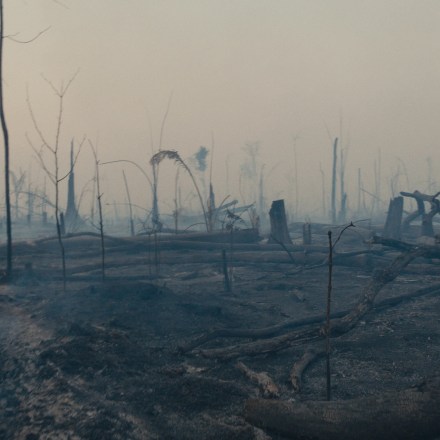
“It’s a global election. The voters in Brazil will be deciding the future of humanity,” Fishman tells The Intercept. Jair Bolsonaro oversaw significant deforestation of the Amazon rainforest, leaving the ecological and climate linchpin in danger of becoming a “savanna.” Now, he argues, his son can finish the job. “You’re going to have an international migration crisis,” says Fishman. “It’s really self-defeating because the cattle ranchers are his base. They are the ones that are wanting to do the things that will end their future profitability — the future existence of their business.”
President Donald Trump has taken a particular interest in the race, as he seeks to expand U.S. influence and control across the Western Hemisphere. “Brazil — as the biggest economy, the biggest country, the most powerful entity in the hemisphere besides the United States — if Brazil falls, then the rest falls in line,” says Fishman. “But if Brazil remains as this big island of resistance in the middle of the continent, it really messes up [the Trump administration’s] plans, doesn’t it?”
Big Tech is also looming large over the race. “There’s all these pieces of circumstantial evidence that suggest that Meta is interfering in this election, and they have every incentive to do so. They will have a much better regulatory environment if Flávio wins because of Flávio’s submissiveness to U.S. interests and his willingness to play ball with whatever Trump tells him to,” adds Fishman.
In a request for comment, Meta said, “Meta applies the same rules to every candidate, every party and every political viewpoint in Brazil, as we do in elections around the world. We do not suppress content to disadvantage one side, and we do not give preferential treatment to any side. Each of the incidents cited by Lula’s campaign has a straightforward, documented explanation. … Brazilian voters deserve facts, not a political narrative built by combining unrelated technical issues. Meta will continue to enforce its rules, comply with Brazilian electoral law, fix mistakes when they occur and provide a level playing field for everyone who uses our services.”
As U.S. leaders attempt to mold Brazil into a satellite state, Fishman argues the United States is slowly becoming more and more like its southern neighbor.
“It’s not that Brazil is becoming more like the United States, it’s that the United States is becoming more like Brazil,” says Fishman. “You have just shrinking spheres of democracy while oligarchs have increasing power and control and are able to do what they want and insist on decisions for the country that are bad for all of the society and the people, but good for their individual interests.”
For more, listen to the full conversation of The Intercept Briefing on Apple Podcasts, Spotify, YouTube, or wherever you listen to podcasts.
Transcript
Jessica Washington: Welcome to The Intercept Briefing, I’m Jessica Washington, politics reporter at The Intercept.
Akela Lacy: I’m Akela Lacy, senior politics reporter at The Intercept. Jessie, what do our listeners need to know about this week?
JW: I’ve been following a pretty disturbing story that’s actually centered on a campaign ad. Ohio gubernatorial candidate Vivek Ramaswamy released what I would argue is the ugliest campaign ad of a dark season. That is, of course, a season of campaign ads filled with Islamophobic, transphobic, sexist rhetoric, and racist rhetoric as well. But in the ad, the mother of Democratic candidate Amy Acton accuses her daughter of being a liar, claiming “she’s lied her whole life.”
Now, what makes this really dark is that Acton was removed from her mother’s care at 12 years old, after she alleges she was raped by her mother’s then-40-year-old husband.
AL: That’s horrible. Has Acton responded?
JW: Acton responded to the attack ad saying, “My brother Phil and I endured abuse, hunger, and neglect. We were often kept in a dark basement, were frequent-fliers with child protective services, and lived in fear of our birth mother’s violent and erratic temper. I’ve always known that she was deeply sick and unwell, and it’s sad to see Vivek Ramaswamy exploit her all for his own political gain.”
This is one, as I’ve said, of the darkest campaign ads in a really horrifying season of campaign ads.
Akela, I know you’ve been tracking another big election story this week on a beat you’ve covered for a really long time, and that’s [American Israel Public Affairs Committee].
AL: So we have been covering extensively the way that AIPAC’s strategy has changed over the last few election cycles since they started spending directly on campaigns.
If you’ve been following our reporting, you know that we’ve written a lot about both their super PAC, United Democracy Project, and this shell PAC strategy where there were a number of different groups that popped up throughout the midterm season, took money from AIPAC, spent against candidates that AIPAC didn’t like, and then — per filings that came out this week — shut down and gave all their money back to AIPAC.
So the idea being that, they had been trying to shield what was an increasingly toxic reputation amid the ongoing genocide in Gaza from creating backlash against their activity in these races.
Jewish Insider scooped on Wednesday that AIPAC announced that it will no longer endorse candidates or give PAC contributions through its AIPAC PAC. Now, this doesn’t mean that they will stop spending on elections. Their super PAC, United Democracy Project, will continue to spend, as it has been pouring record amounts of money into various races. But this is getting a lot of attention, both from the left and I would say from the center.
The left, Justice Democrats in particular, and candidates who are no longer in Congress, but I saw Jamaal Bowman talking about this, saying that this is the culmination of the fight that the left has been putting up against AIPAC in elections. I don’t know that I would categorize this as a win necessarily, considering that the super PAC seems like it’s going to continue to spend a lot of money. But that was the big news in my campaign finance world this week.
JW: You’ve done a lot of really interesting coverage of how AIPAC is moving their money around through these different PACs and trying to get around the fact that people really dislike AIPAC, and that it has really tarnished the reputation of candidates who take this money. Obviously, this is a maneuver to get rid of the reputational harm of AIPAC money while still giving people AIPAC money.
I’ve actually been tracking a story completely off our election cycle, and that’s what’s going on in France. I know we touched on that a couple weeks ago but, really, these protests have taken on another life.
For those who don’t know, in France, there were these protests that were initially launched by students primarily in the suburbs concerned about educational inequality. This meant staffing shortages and poor facilities. But it has exploded into a nationwide uprising about the cost of living and broader economic inequality.
Now, perhaps unsurprisingly, and not to bring it too quickly back to the U.S., but President Donald Trump has used this as an opportunity to rail against immigrants. So despite the fact that there is zero indication any of the violence has been spurred on by immigrants. At a campaign rally on Monday, he told the crowd, “If Europe doesn’t close its borders and bring the criminals out, like the people that are protesting, Europe is finished.”
So yeah, that’s just one other example of how Donald Trump has inserted himself into international politics.
AL: Trump has also inserted himself into politics in a different region in the world. We have the Brazilian elections for president heading to a runoff this week. I know you spoke, Jessie, to Andrew Fishman, an investigative reporter and president and co-founder of The Intercept Brasil, about those elections.
JW: It’s a really interesting election with a ton of parallels to the political situation in the United States, as well as, as you’ve pointed out, a ton of influence from the United States. On Sunday, Brazil will have a run-off presidential election that will determine the future of not only Latin America’s largest democracy, but also — and this is really important — the fate of the Amazon rainforest, and one could argue, the planet.
This is the first presidential election since former Brazilian President Jair Bolsonaro was imprisoned on house arrest in an attempted military coup, a sentence that his son, the current frontrunner, Flávio Bolsonaro has promised to overturn.
I talked to Andrew about the media landscape, the history of military leadership, and the outside influences that have made this a tight race, despite the fact that the perceived frontrunner is running on freeing the man who attempted a coup years prior.
President Luiz Inácio Lula de Silva is running for reelection. He’s accused both President Donald Trump and Meta of attempting to sway the election in favor of Flávio Bolsonaro.
The Intercept reached out to Meta for comment, and Meta denied interfering in the election process, saying they do not suppress content to disadvantage one side or give preferential treatment to the other.
But this is a really interesting conversation with Andrew, and I’m excited for people to get to hear it.
AL: As am I. Let’s hear it.
JW: Andrew, welcome to The Intercept Briefing.
Andrew Fishman: Hi, thanks for having me.
JW: On Sunday, Brazilians will head to the polls in a runoff presidential election between right-wing senator Flávio Bolsonaro, son of former President Jair Bolsonaro, and incumbent left-wing President Luiz Inácio Lula da Silva to determine the leadership of Latin America’s largest democracy and biggest economy.
Now, this is the first presidential election since former President Jair Bolsonaro’s supporters stormed the Capitol in 2023 and attempted to overturn the election results. Now, Flávio Bolsonaro, his son and ally, is widely considered to be the frontrunner after coming out slightly ahead in the first round of voting.
But as of Tuesday, his lead in the polls has been narrowing. Andrew, big picture, what are the major issues at play in this election on Sunday?
AF: If you want to be really direct about it, it’s the future of humanity.
You have one candidate who’s been responsible for record reductions of deforestation in the Amazon; and you have another one who’s saying, let’s chop it all down, and farmers should be able to do whatever they want on their land.
And under his father’s leadership, deforestation in the Amazon soared, as in the other regions in the area. Scientists think that there’s a major tipping point that we could be on the cusp of, that if we were to reach that, the Amazon will turn into a savanna. There would be no going back from that.
If that were to happen, all of the rain in South America comes from the Amazon, basically. [That would affect] the cattle ranching that’s doing the deforestation, no more of the soy that’s doing the deforestation — people would have trouble feeding themselves. São Paulo would probably run out of water, which it has done in the past.
It’s very precarious. So you would be having mass refugee influxes, migrations. I really do think that this election is on that scale; it’s a global election. The voters in Brazil will be deciding the future of humanity, very possibly.
JW: To your point, his father, former President Jair Bolsonaro’s administration oversaw significant deforestation of the rainforest, which houses 10 percent of all [known] species on Earth, and his son appears to be moving in that same direction.
Flávio told reporters in August that he did not believe in climate change and that “the best way to address environmental issues is what we did during the Bolsonaro administration,” referring, of course, to the senior Bolsonaro’s administration.
What is at stake for climate change when we’re talking about this massive deforestation that could potentially be happening if Flávio wins?
AF: Every ecosystem in South America is interconnected and in the world. If the Amazon collapses and turns into savanna and the rainfall stops, and you have this massive drying out of the continent — which is one of the major exporters of food in the world — you’re going to have all of those issues locally, and that’s going to impact local markets and everything. You’re going to have an international migration crisis.
But on top of that, we have no idea what the ecological knock-on effects of that could be. With that, we could be having a more rapid increase in polar ice cap melting. With the temperatures increasing, it could be exacerbating the death of the Atlantic Meridional Overturning Current, which is the thing that would put Europe back into an ice age. It’s very possible that’s already happening right now.
We’re at this really tenuous moment for the climate, for the Earth, for humanity. And you have a candidate that says very proudly [he] doesn’t believe in any of that and wants to slash all mechanisms that are used to have more responsible management of land and prevent this massive catastrophe in just this proudly Luddite sort of way.
It’s really self-defeating because the cattle ranchers are his base. They are the ones that are wanting to do the things that will end their future profitability — the future existence of their business. It’s really self-defeating in this way for the Brazilians, and these very short-term benefits for massive long-term costs.
There’s estimates that the impact that the Amazon has for the global economy is in the hundreds of billions of dollars a year, and that benefit is far larger than the profits that they get out of these extractive industries that they do with farming and mining. It’s really hard to overstate the potential impacts that this could have.
JW: Is that urgency resonating with voters?
AF: Absolutely not. That is not what people are voting about, unfortunately. It’s what the people living in the heavy agricultural regions — where their local economy depends on that — they’re voting for Flávio for that reason. But the people who are voting against him, yes, there’s many people that care about the Amazon and want to preserve it, but it’s not the issue that’s being discussed day to day on TV, in the news, on the streets.
People are talking more about more human issues of corruption and who has better communication, security, economics. They’re not talking about the Amazon, unfortunately.
JW: That’s hardly surprising in the U.S. context, which I’m a little bit more acquainted with. Certainly climate, the environment, have never been top issues for voters, even if they’ve resonated more so with young people.
I did want to talk about another issue in the election, and that is the fate of Jair Bolsonaro. His son, Flávio Bolsonaro, has promised to free him. Jair Bolsonaro has been imprisoned on house arrest since 2025 for plotting a military coup. How is that particular campaign promise landing with the electorate in Brazil, and are you at all surprised by the public’s response?
AF: It’s very clear that for the Bolsonaros, this is an all-or-nothing for them. If they don’t win this election, then not only is Jair going to stay in jail, most likely, but Eduardo, Flávio’s brother and Jair’s son, who is in self-exile in the U.S., he has a multiyear prison sentence for his actions in the U.S. lobbying against Brazil’s foreign interests. He’s not going to be able to go home if they lose this election.
For them, it’s been very clear, and they’ve even said it in moments, that’s what this is about for them: their ability to get their father out of prison and to get themselves off the hook. Also, if you’re elected president, the investigations on things you did before you got elected, they go away.
“They’re really just willing to do whatever they can to make sure that they win, because this is their only get-out-of-jail-free card.”
So then Flávio’s off the hook, and he’s so wrapped up in so many different schemes and accusations and active investigations, some of which that we have revealed, including U.S. and abroad and offshore bank accounts and money laundering and potential connections to organized crime and militias. So they’re really just willing to do whatever they can to make sure that they win because this is their only get-out-of-jail-free card. To do that, they’re going to completely change the structure of the Supreme Court, and they’ll be able to put in a majority even without impeachment. They already have the Senate and the lower house of Congress.
They would control all of the executive branch. They have the majority of governorships that are in their coalition, and they run the local police. And the executive has control over the federal police and all the investigative and regulatory agencies. So they would have just absolute lockstep control over every branch of government federally and most of local government as well.
It would be a democratically elected coup.
JW: And voters, do they care about that? Do they care about the preservation of democracy? Is this ranking as a top election issue?
AF: It’s always double speak, right? Both sides say that they’re preserving democracy. The Bolsonaristas say that Lula and the Supreme Court are running a judicial dictatorship right now because they were getting censored and put in jail for actively plotting a coup, which included active planning to assassinate Lula after he was elected, his vice president after he was elected, and a member of the Supreme Court. So that’s what they’re [Jair Bolsonaro and military officials] in jail for. That’s why they were getting pushback, and they’re saying that having the pushback against that is a dictatorship.
In the meantime, you have the Lulistas who are saying that what the Bolsonaros want to do is a coup because they actively have said year after year, over and over again, “We want a coup. We love the military dictatorship. The military dictatorship was great! When we were torturing everybody, that was good.” Jair said, “When I’m elected, we’re going to take a machine gun and shoot down all of the leftists, the petistas, the Workers’ Party [Partido dos Trabalhadores] supporters.”
Remember that the military government was going alive and strong into the ’80s. It happened in ’64, and it went through the ’80s. So it’s very recent.
The people that are in his orbit, they were actually part of the military coup government until very recently. And I think that Lula supporters are very, very concerned about this. They really do care.
The Bolsonarista supporters, which are about 30 percent lockstep — same as it is in the U.S. with Trump — they’re just in their own information ecosystem, and they want Bolsonaro to win. It doesn’t matter, and anything that he does is good because it’s him.
“They’re just in their own information ecosystem, and they want Bolsonaro to win.”
It’s not, there are people that support the Workers’ Party, and there are people that support Bolsonaro. The Bolsonaro movement is essentially anti Workers’ Party, anti-petismo. The Bolsonaros have been seen as the greatest vehicle for getting rid of the Workers’ Party, which has been so hard to do because they’ve been so popular because of all the policies they’ve put into place over the years.
But you’ve had the media saying for 30 years now, just drilling it in, that the PT [Partido dos Trabalhadores] equals corruption, the PT invented corruption. The PT is everything that is bad in Brazil, and anything that is not the PT is everything that is good in Brazil. You’ve had a generation of this narrative being repeated over and over in all these different instances that it’s really hard to shake.
JW: Could you talk more about that legacy of military leadership in Brazil, and for Brazilians, how they feel about it on the day to day? I recognize that it’s a very large country, as we’ve mentioned multiple times. I assume not everyone feels the same way, but I am curious about that legacy and how people respond to it.
AF: Brazil has been a country of negotiated solutions. So when they were the last in the Western Hemisphere to abolish slavery in 1888, it was not some sort of civil war or uprising. It was a negotiation: “OK, I think it’s time that we do this, but let’s just make sure that everyone that did own slaves is in the best possible situation, and let’s make sure that we have some sort of semi-slavery going on afterwards.”
It was really the same thing with the dictatorship. It was a moment where the economy was going into the can. It was very unpopular. It wasn’t having the economic glory years of before, and so they said, “All right, we’ll step back. We’ll let you run some elections, but we’re going to make sure that we’re never held accountable, that we’re able to continue exercising power in the way we want.”
As part of that, they were able to help control the narrative. So during the military dictatorship, there was an impression — and it continues today — that there wasn’t corruption. The reason why they had that impression, it was actually very corrupt, very corrupt. But the impression exists because there was censorship of the media, so the corruption that existed just wasn’t exposed.
When the Lula government came into power the first time in the early 2000s, they started making the federal police stronger. They made the judiciary stronger and more independent. They increased the ability of the federal government to investigate and uphold the rule of law. As a result of that, many corruption schemes started coming out of the woodwork that were legacy of the military leadership.
“It was the business elite together with the military that did the coup and ran everything.”
It was called a civil military dictatorship, technically, in Brazil, because it was the business elite together with the military that did the coup and ran everything.
So that business elite didn’t change. It’s still the same families. They were running the same corruption schemes back then. They were running it through re-democratization. Whether it’s a right-wing government or a left-wing government in power, they’re making sure that their interests are being served. That corruption is just this constant throughline. People don’t really see that because that’s not how it’s presented in the media and in the day-to-day in communications.
I know for a fact that there’s lots of people that really want us to go back to the dictatorship. There are people that really want us to go back to the monarchy because they see it as a better, simpler time when things were the way that they should be. Everyone was in the right place and things were safer and everything was just better, this idealized past, “Make Brazil Great Again” sort of thing. How far back do you want to go?
Then there are the people that, like Dilma Rousseff, who was the successor to Lula after a second term — who fought against the dictatorship — that are currently active in politics, that are still around, and they were tortured. Their friends were murdered. They know exactly what a dictatorship means and what it means for people like them, anyone that stands against those entrenched powers of the old elites that go back for centuries.
That’s why you have a lot of older voters tend to vote PT [Workers’ Party] because they came up with the workers’ struggle with re-democratization. They understand what that means. It’s this interesting dynamic now where you have more younger people that are starting to tip more to the right because they don’t have this memory.
They don’t remember what it was like in the ’80s in the northeast when there was water shortages and food shortages, and the standard of living was so much lower. You have this new narrative being rewritten in real time online.
“You have more younger people that are starting to tip more to the right because they don’t have this memory.”
JW: The parallels to the United States and Brazil are just incredibly striking in what you’re saying. This kind of the “Make America Great Again” movement and the Make Brazil Great Again, even if they’re not using those exact same phrases. There are just so many points of similarity, especially with what we’ve seen with youth even in the United States, some of whom have taken a rightward tilt.
I want to get into the relationship between Brazil and the U.S. because that’s obviously been such a big issue in this election. In a Lula ad earlier this month, his campaign called Flávio Bolsonaro Trump’s candidate, arguing that, “What Trump wants is to colonize Brazil, take our riches, steal our future, and leave us in the dust.”
Now, this comes after President Lula confirmed that Brazil denied visas to two U.S. officials over election interference concerns. The State Department has denied any claims of election meddling, telling reporters, “Any insinuation of a ‘ploy’ to undermine a democratic nation’s election is a baseless lie.”
Andrew, is there any evidence that the Trump administration is attempting to sway this election? Does it veer into election interference as we generally understand it?
AF: The answer is oh God, yes. So much so it’s overwhelming. Overwhelming evidence, and it’s the same thing they’ve been doing across the region, which is why there’s been this rightward swing in elections across Latin America.
That’s why they’re so interested in Brazil right now because Brazil — as the biggest economy, the biggest country, the most powerful entity in the hemisphere besides the United States — if Brazil falls, then the rest falls in line.
But if Brazil remains as this big island of resistance in the middle of the continent, it really messes up their plans, doesn’t it? The interference has been done on many levels. The reality is that we don’t know the full extent of it, and we won’t know the full extent of it for years. We’re still learning about things that happened in 1964 with the U.S. role in the coup.
There’s dirty tricks happening that’s being run through intelligence agencies. That’s absolutely positive. There’s very, very strong signs that they’re using U.S. companies, Big Techs like Meta, who’s been getting a lot of attention — a lot of flak — lately because of clear signs that its algorithm is favoring Bolsonaro and suppressing Lula.
Multiple instances that they even admit happens, “Oh, but no, but it was just a mistake. It was just a mistake.” Meta and the Big Techs in the U.S., they’re really concerned about what a Lula government could do for their profits. Maybe Lula wants to have more sovereignty and control over what they’re doing.
The Brazilian government doesn’t even know how much money they make in Brazil, the Big Techs. They just know how much money they send out through the tax bills that they pay and the money they send out of the country. The Big Techs in the U.S. are really concerned about getting their access on rare earths and on lithium reserves, which Brazil has the largest deposits of rare earths after China. This whole trade war with China, Brazil becomes much more important. It’s a huge market.
So you have one candidate that is just completely submissive — like painfully, embarrassingly submissive — to U.S. interests. So much so that one of his former closest allies, a general, Santos Cruz, who’s a very famous well-known general, he came out recently and said, “I’m a conservative. I’m right-wing. This is not conservatism. This is not right wing. This is just ‘voluntary submissiveness.’”
“You have one candidate that is just completely submissive — like painfully, embarrassingly submissive — to U.S. interests.”
They’re just absolutely scamming Brazilians with this level of supplicancy that we’ve never seen before, that the military dictatorship even didn’t do, which was hand in glove with the U.S. interests. This is completely next level, and it’s something that obviously the left is very concerned about.
But people like Santos Cruz, Brazilians that actually believe in Brazilian sovereignty, and that it’s important for Brazil to be able to pursue its own interests rather than the interests of foreign powers — they’re very concerned about that, which is, some segments of the elite.
Whenever you have a submissive local government in an imperialist relationship, there are people that benefit. There are local people that will get special contracts, that will get special treatment. They’ll be able to crush their enemies through these relationships. And that’s what they’re doing in Bolivia and in Peru and in Ecuador right now.
“Whenever you have a submissive local government in an imperialist relationship, there are people that benefit.”
What they did in Venezuela, where they just came in and took all of the oil and said, “All right. We’re going to take 90 percent of the oil profits, and we’ll give you a couple billion a year.” People are seeing this in Brazil. They see what Trump has done. And they’re still saying, “Well, we like Bolsonaro, so we’re going with Bolsonaro. I’m sure it’ll be fine.”
It’s a massive issue, and I really, I don’t think we know how bad it will be and how submissive they’ll be this time around. Because it always is the case that, with right-wing authoritarian governments, it’s the second term where they really take off whatever mask was left and decide, “We have a mandate and we can do whatever we want.”
You saw it in the U.S. with Trump. They saw it in Turkey with Erdoğan. They saw it in Hungary with Orbán. They saw it in India with Modi. This is what always happens. It’s the second term where they say, “OK. We showed them who we are, and everyone said it’s fine.” They’re able to smoke out all of their rivals in the first term. They map them out, and so when the second time comes around, it’s just bang, bang, bang. Let’s get rid of them. Let’s maximize our power and do whatever we want.
“With right-wing authoritarian governments, it’s the second term where they really take off whatever mask was left. … It’s the second term where they say, ‘OK. We showed them who we are, and everyone said it’s fine.’”
The result’s not going to be positive for Brazil. That’s the thing: If I were a Brazilian billionaire — which I am not — it would be in my personal interest for Brazil to follow the economic path that the Lula government is following, much more than what Bolsonaro is proposing.
Lula’s not some left-wing radical. He’s center-right. He was left, then he became center-left, and he’s moving ever more to the right. This last election, his vice presidential candidate was his former presidential rival, the center-right guy. They’re very much doing what the big banks want. They’re helping the big agro get what they want. They give tons of subsidies to major industries. But the thing that they do, they take a little bit of that money, and they spread it around to the poorest people with public services with access to education, with some cash transfers. We’re talking about 60 bucks or 80 bucks a month to families, and that is what is making the economy grow. Because if you don’t have consumers in your economy, and you have domestic industries you’re trying to build, then no one’s going to buy the things. Your employees can’t buy the things.
That’s intolerable to some people in Brazil, and they can’t see that it benefits their own economic interests.
You’re in this kind of crazy situation where it doesn’t really make sense what they’re doing. And they saw it happen with Bolsonaro, with Jair! They all supported him, and then he crashed the economy. Then they all went back to Lula begrudgingly and said, “OK, we’re going to support you in ’22 because things aren’t going very well.”
Then Lula turned it around immediately, and now they’re forgetting again and going back to Bolsonaro. Logically, it doesn’t make sense. It’s more psychological. Freud has to explain what’s going on.
“Lula’s not some left-wing radical. He’s center-right. He was left, then he became center-left, and he’s moving ever more to the right.”
JW: Again, the parallels between the United States and Brazil are very apparent in terms of some of those economic choices. You’ve already gone over what the U.S. wants to gain from involvement in this election. But there’s another foreign power that’s also interested in the election. Flávio Bolsonaro has been cozying up to Israeli Prime Minister Benjamin Netanyahu, obviously in stark contrast to President Lula, who’s been an ardent supporter of the Palestinians. What would a Flávio Bolsonaro presidency look like for Brazil’s stance towards Israel?
AF: You can’t say that Lula has been the heroic savior, but he has made statements saying, “This is a genocide. This is very bad. This shouldn’t happen.”
At the same time, he’s allowed Petrobras to ship petroleum products to the Israeli government that are being used in the genocide. He’s allowed one of the major steel manufacturers to ship steel and ore to the Israeli weapons companies that are using it to build rifles and bombs to use in Gaza.
It’s not like you’re dealing with the leader of BDS [Boycott, Divestment and Sanctions movement] versus Netanyahu’s best friend. It’s a run-of-the-mill European-style center-left social democrat leader that’s kinda disappointing on this issue, versus someone that just wants to be absolutely submissive to everything that Israel wants and does and just completely supports it.
Again, you said, there’s so many parallels to the U.S. The parallels in Brazil, why does this make sense? Why would they care about supporting Israel? Why would this be something that they would want to put their name on, like these horrible scenes that people have been seeing for years online?
Everyone’s seeing it. Why would they want to support it? They kind of want to do the same thing in Brazil. One of the things that Jair always complains about is that he’s jealous of the U.S. because their cavalry was more effective at exterminating the Indigenous population than the Brazilian cavalry was. They’re upset that they have these relatively small numbers of Indigenous people that have claims to these massive swaths of land, much of which in the Amazon, that they want to get their hands on so they can cut down the trees and throw cows in and do mining. So a colonial–settler project that involves extermination of the Indigenous population to benefit their economy.
“They’re upset that they have these relatively small numbers of Indigenous people that have claims to these massive swaths of land, much of which in the Amazon, that they want to get their hands on.”
That’s what Israel’s doing, and that’s what they want to do in Brazil: “Why don’t you give me all the fun, fancy tools of espionage and surveillance and war and suppression that you guys have developed and honed in Israel for the last decades, and let me get my hands on them too so I can do the same thing back here.”
I think that’s one of the main reasons ideologically. Plus the whole political, evangelical right-wing movement, which was a concerted project by the CIA to implant in Latin America, bringing in prosperity gospel to get rid of the Catholic Church and all their support of left and workers movements.
This is all very well documented, that they brought it in because it’s more individualist ideology, and that individualist ideology also includes the idea that all the Jews need to go to Israel for the reckoning.
There are a ton of parallels between Brazil and the U.S., and that’s because almost all of the worst ideas in the United States have been intentionally exported to Brazil as a way to make Brazil a worse country that’s more in line with U.S. interests.
That includes healthcare companies. The U.S. model of healthcare. They have free, independent public healthcare in Brazil called SUS [Sistema Único de Saúde]. It’s an incredible system that’s very popular. They want to privatize it. They want to get rid of it to create more profit. Prosperity gospel with all this right-wing ideological movements, they love it.
“Almost all of the worst ideas in the United States have been intentionally exported to Brazil as a way to make Brazil a worse country that’s more in line with U.S. interests.”
The NRA sent lobbyists down in 2002 to Brazil to work with the right-wing movements to say, “This is the game plan for how you create a gun movement in Brazil.” And what happened? It manifests itself in the Jair Bolsonaro administration, where they just opened up the floodgates for access to guns, increasing the number of guns you have, the type of guns that you could have, the number of bullets you could have, and getting rid of anything that could help prevent organized crime from getting massive amounts of assault rifles and unmarked bullets they can use in crimes. Under Bolsonaro, that’s one of the things that spread more than ever.
There’s all these little levers that they’re really just doing copy and paste, and we’ve seen these alliances with JD Vance and the Rockbridge [Network], which is a group that he created before he was vice president with a bunch of Peter Thiel and other billionaires in the U.S. They’ve created a subsidiary in Korea and now one in Brazil that they were using to do the same sort of alignment with the local elites that they did before, in the lead-up to the ’64 coup. I can go on for hours about all the different connections and ties.
JW: To your point, you’ve talked about how this is much bigger than just Brazil.
To me, the “Donroe Doctrine” is hanging over all of this. Last November, President Donald Trump released what he described as a corollary to the 1823 Monroe Doctrine, the “Donroe Doctrine,” which effectively calls for the U.S. to take an aggressive interventionist stance in Latin America under the guise of protecting the United States’ national security and economic interests in the region.
Andrew, from your perspective, what more should we understand about what the United States is doing in Brazil and kind of the wider context of the Trump administration’s actions in Latin America over the last two years?
AF: It’s pretty simple. They are fighting the Cold War against China in Latin America, just like they used to do against the Soviets. As part of that war, they are aligning with far-right upstart leaders that are seen as anti-establishment, even though they’re usually tied to billionaires or even billionaires themselves, like in Ecuador.
There’s this weird coincidence with all of them that they almost all have connections to organized drug trafficking. They’re almost all known drug smugglers or connected to them or have some sort of financial relations. While they’re doing that, they’re arguing that “We are working together with these local governments in South and Latin America to fight drug trafficking,” which is obviously a farce.
That’s what they did in Ecuador. The president of Ecuador, Noboa, he’s the son of a banana dynasty that does a lot of exporting bananas, and in those crates of bananas, they’ve also been known to export a lot of kilos of cocaine. Their allies in Colombia have always been this way, and the things that they’re doing in Bolivia, it’s the exact same thing. The [Bolivian] attorney general who was trying to push back against the corruption of this right-wing government that has allied with Trump, well Trump and Rubio came in and said listen, you need to go after this attorney general and get rid of him. So he was arrested because he was going after their allies.
They don’t care about drug trafficking, obviously. The U.S. government never cared about drugs. It’s always been a weapon or a tool for them. So they’re aligning with these people to create this lockstep union that they’re calling the “Shield of the Americas.” It’s this new alliance that they’re using instead of the existing, the U.N. or other mechanisms. They’re creating all their own, just like they did with the “Board of Peace.” They’re working to make sure that those economies just stay in their sphere of influence just a little bit longer.
They know that China’s winning. China is the main trade partner with all of these countries now. They’re Brazil’s biggest trade partner. The United States cannot absorb all of the exports that Brazil produces that goes to China. They’re not going to get Brazil to stop trading with China or stop having relations with China. They compete on corn and ethanol and soy exports. They can’t absorb what China’s buying.
“They’re really just trying to buy a little bit more time as their empire is slowly waning, but at the cost of what?”
They’re really just trying to buy a little bit more time as their empire is slowly waning, but at the cost of what? At the cost of tens of thousands, hundreds of thousands, millions of lives? It’s not clear what the indirect results of this will be. At the cost of destroying the democratic institutions in these countries that are already, many of them struggling and teetering, and potentially at the cost of massive ecological devastation, as would be the case in the collapse of the Amazon under a Bolsonaro government?
It’s uplifting, right?
JW: Very uplifting. That is my first word that comes to mind. You’ve pointed out everything that Donald Trump is doing, but we also know that tech oligarchs are involved as well. Tech tycoons like Elon Musk and Peter Thiel have taken a massive interest in Latin American politics.
What impact do you think that is having on the rightward shift we’re seeing throughout the Americas?
AF: Oh, big time. Big time. I think the biggest tycoon that’s most in the news lately is Mark Zuckerberg. He’s the guy who runs Meta. Something like 99 percent of people in Brazil use WhatsApp as their primary form of communication.
The idea of sending a text message in Brazil is like, “What are you, some sort of barbarian? What decade is this?” People only use WhatsApp. And for a lot of people, you get a cheap phone, and you get a prepaid phone plan because they didn’t have net neutrality like it was passed in the U.S. It’ll come with free credits for WhatsApp and Facebook, and it’ll come preinstalled on the phone even, and it’s part of the plan.
So for a lot of people, Facebook for many years and WhatsApp were the internet. Now Instagram as well. Instagram is really the main tool of political communication at this point. As we know, [it is] highly censored. You guys saw recently at the No Kings protests what Meta can do if it just decides to suddenly have a technical error that they fail to fix for eight hours.
That’s what they’ve been doing in Brazil for months now. So you have a young right-wing member of Congress named Nikolas Ferreira. He comes from a right-wing evangelical church, and he’s very charismatic, and he’s really good on social media, and he’s got something like 22 million followers or something. Brazil has 214 million people.
When Lula was having this dispute a year or two ago with foreign tech interests, including Meta’s interests, Nikolas Ferreira planted this fake news that Lula was trying to tax the main financial instrument that people use called Pix. It’s this free instant cash transfers that you can do that’s created by the central bank, and everyone loves it. Trump hates it because it competes against Mastercard and Visa.
So [Ferreira] created this fake news that what Lula was trying to do was tax all transactions and so therefore you were just going to get taxed even more, and you, the poor working man, was going to get screwed. In reality, there was no tax involved, and it was an anti-money laundering initiative that any transactions over 1,000 reais [Editor’s note: 5,000 Brazilian reais] would be immediately reported so they can trace questions of money laundering, which is a huge problem in Brazil.
That video was seen, the last time I checked, over 300 million times in a country that has 214 million people, and not all of them are on Instagram. That’s just Instagram — not including the other social networks. And in the last few weeks of the election, Nikolas Ferreira’s account has had greater engagement and views than every global celebrity you can name. I don’t know the exact numbers off the top of my head, but three times more than Beyoncé. Just think of the most famous person that you can think of in the world and their account, and Nikolas Ferreira — who you hadn’t heard of until I said his name just now — is crushing them.
“Just think of the most famous person that you can think of in the world and their account, and Nikolas Ferreira — who you hadn’t heard of until I said his name just now — is crushing them.”
That’s being seen as probable algorithmic manipulation by Meta in favor of the right-wing movement. OK, that’s one example, we don’t have access to the algorithm, we can’t be sure about that. Well. if you go onto the Meta’s AI in WhatsApp, and you say, “Create me a political poster for Flávio, vote Flávio,” it’ll do vote Flávio, and they’ll use his election number, 22.
And you say, “Vote for a capybara, vote for a flamingo,” They’ll say, “Vote 22.” They’ll use Flávio’s number. And then if you say, “Do another poster, but say vote Lula,” it’ll say, “We can’t do that. That’s an election interference, and we’re not allowed to do that.” And say you just did it for Flávio,” and then the AI will be like, “Oh, you’re right. That’s a mistake.” But then it keeps happening, and it’s been happening for weeks now. People have been pointing it out for weeks.
They blocked Lula’s Meta account from being able to run paid ads like 10 days before the first round of the elections. They said, oh, that was a mistake. It was my bad. Lots of left-wing accounts have seen these weird number shifts.
So they’ll have, let’s say, 20,000 comments, but it’ll say zero shares, or the views will go down to zero, or people have been talking about, “My engagement just has been completely in the tank since this election has started.” Not everybody, but some people.
There’s all these pieces of circumstantial evidence that suggest that Meta is interfering in this election, and they have every incentive to do so. They will have a much better regulatory environment if Flávio wins because of Flávio’s submissiveness to U.S. interests and his willingness to play ball with whatever Trump tells him to.
So that’s just one case. That’s just Mark Zuckerberg.
JW: Cutting in here, from the future. After our conversation with Andrew. We requested comment from Meta who sent a lengthy response, but in summary, they said, “Each of the incidents cited by Lula’s campaign has a straightforward, documented explanation. … None reflects political targeting. None reflects manipulated distribution. None reflects an effort to influence the election.”
Meta said Lula’s campaign ad account was disabled for one hour by mistake, not for political reasons. The company also claimed that issues with ad creation and video view count were global errors, and not politically motivated.
On Monday, a Brazilian court gave Meta 24 hours to prove that it was not favoring Flávio Bolsonaro over President Lula in its feeds, or it would face an escalating fine. This comes after that same judge ruled that while he could not find evidence of deliberate interference, the company had 24 hours to prove that the issues affecting the Lula campaign were solved and would not reoccur.
OK, now back to Andrew.
AF:Elon’s coming down here. Peter Thiel was just down in Argentina to hang out with Javier Milei, who’s the president who’s been destroying the economy and businesses are shuttering, unemployment’s up, costs of living have gone through the roof, but he’s this anarcho-capitalist, hyper-libertarian that’s just been cutting everything with a literal chainsaw. He came on stage with a chainsaw saying, just like Elon Musk did, I’m going to cut through all the regulations and the red tape.
That’s what they want, and Flávio Bolsonaro said, I’m going to do that. I want to follow the Milei model. In the last debate that they had, the first debate, which was just the other night, Lula asked Flávio about this: Are you going to be Milei?
He was just sort of refusing to answer the question. Eventually OK, what model are you going to follow? [Lula] said, I’m going to follow the Lula model, the one that I’ve been doing that’s been working. What are you going to do? Answer the question. But, outside of that debate, [Flávio] had been saying that he loves Milei.
Milei gave him an official endorsement, just like Benjamin Netanyahu did an official endorsement for Flávio, which is something that doesn’t happen in international relations. Foreign leaders just as a matter of course don’t endorse a candidate in a foreign election. So they’re being very overt in this, and they’re all working together with their billionaire buddies who have controls over huge levers of power in Brazil because of how Big Techs work in the world.
That’s one of the main issues for leftist voters in Brazil right now. They want sovereignty for their country. They want Brazil to be able to govern Brazil under Brazilian law and have control over Brazil to serve Brazilian interests.
Flávio Bolsonaro does not care about that. Trump and Musk and Zuckerberg do not want that because it would be a limitation on their ability to exert power in Brazil and in the world. They don’t want it to be a model for the rest of the world.
“That’s one of the main issues for leftist voters in Brazil right now. They want sovereignty for their country.”
JW: Listening to everything you’re saying, obviously, we’re not going to fix the issue of tech oligarchs meddling in foreign elections by Sunday. But are there any final thoughts that you have just about this election?
AF: I would say that this election is so important and relevant for the United States and for the world. For many years, there’s been this concept called the Brazilification of the United States.
Brazil wants to become, or, people that vote for Flávio at least, they want Brazil to become the United States. They see the U.S. as the country where everything works, where everything is perfect and goes well, and they don’t see all the bad stuff that listeners and readers of The Intercept know all about far too well.
But in reality, it’s not that Brazil is becoming more like the United States, it’s that the United States is becoming more like Brazil.
The middle class is getting squeezed and disappearing. In Brazil, 90 percent of the country makes $1,200 or less a month. The middle class would be considered extremely poor by U.S. standards, and what it does exist of a U.S.-style middle class is just teeny-tiny. You have just shrinking spheres of democracy, while oligarchs have increasing power and control and are able to do what they want and insist on decisions for the country that are bad for the society, bad for all of the society and the people, but good for their individual interests.
It’s just this more polarized, divided, K-shape economies, what you guys call it in the U.S. That’s where things are going. So you should really pay attention to this Brazilian election because the things that are happening here and the things that are going to happen in the next few days are very likely to be happening in the United States in the near future, if they’re not already happening.
JW: The Brazilification of the United States is a really good way to put it. I think so often people in the U.S., and, I can include myself, we think about the impact that the United States has on other countries, but we rarely think about the mutual shared relationships and larger shared ideas that people have between countries, between continents. So I think that’s a really good point.
We’re going to have to leave it there, but Andrew, thank you so much for joining me on The Intercept Briefing. You can find more of Andrew Fishman’s reporting at The Intercept Brasil.
AF: Thank you. Keep up the good work.
JW: That does it for this episode.
We want to hear from you. Tell us what you’re following or want to see more coverage of. Email us at podcasts@theintercept.com or leave us a voice mail at 530-POD-CAST that’s 530-763-2278
This episode was produced by Laura Flynn. Jordan Uhl is our social media producer. Ben Muessig is our editor-in-chief. Maia Hibbett is our managing editor.
Nara Shin is our copy editor. William Stanton mixed our show. Legal review by David Bralow.
This show and our reporting at The Intercept do not exist without you. Your donation, no matter the amount, makes a real difference. Keep our investigations free and fearless at theintercept.com/join.
And if you haven’t already, please subscribe to The Intercept Briefing wherever you listen to podcasts. Do leave us a rating or a review, it helps other listeners find our reporting.
Brendon Luo was sanctioned in June by the U.S. Treasury Department, which alleged he was an investor in a cyber-scam compound operated by Cambodia’s Prince Group. Property records show he still owns a mansion in a gated community in southern California.
The Prince Group is widely accused of involvement in compounds in Cambodia where thousands of trafficked workers were forced to commit industrial-scale cyberfraud. The Prince Group has strongly denied the accusations, but the U.S. has sanctioned more than 140 allegedly-associated entities and individuals, including Luo.
The sanctions have not disrupted Luo’s ownership of a five bedroom mansion in Yorba Linda, a city of about 68,000 people that is part of the Los Angeles metropolitan area. Although no sale price was identified in property records, online real estate portals value the property at roughly $5 million.
Luo was born in China and acquired passports from Cambodia, Vanuatu and Cyprus, according to information from sanctions notices as well as immigration records obtained by OCCRP.
A Cambodian government factsheet distributed to the media in September stated that Luo was the “registered owner” of Legend Innovation Co. Ltd. That company allegedly operated a scam compound named 8Park, which was dismantled this year by Cambodian authorities.
The U.S. sanctions notice alleged that Luo and another individual were “major investors in a Prince Group… scam compound that was used to facilitate fraud operations.”
A Prince Group spokesperson said in an emailed response to questions that the conglomerate has “never had any relationship with Legend Innovation.”
“Brendon Luo had no role within the Prince Group of companies, nor was he associated with their operations throughout South Asia,” the spokesperson added.
Legend Innovation was sanctioned separately by the U.K. government in March. The U.K. Treasury said 8Park was “believed to be Cambodia’s largest scam compound, with capacity to accommodate 20,000 trafficked workers”.
Luo did not reply to requests for comment sent to multiple company email addresses, and no one answered calls to phone numbers listed for his Cambodian firms. However, a representative for Luo did respond to questions via the Prince Group spokesperson.
“Mr. Luo did not own Legend Innovation and had no role in it, or the construction or operation of any business that was conducted by it on the land in question,” Luo’s representative said. “Mr. Luo has never been associated with, nor had any ownership interest, in the companies referenced, or in their alleged scam operations.”
The representative added that Luo “never held a role of any kind with Prince.”
Luo’s California mansion in the “Enclave at Yorba Linda” development is down the street from a property that was owned by Chen Sokly. OCCRP recently identified Chen Sokly as the person referred to as “co-conspirator 2” in a U.S. federal court indictment of Prince Group founder and chairman Chen Zhi. The indictment charges Chen Zhi with alleged wire fraud and money laundering conspiracy.
American authorities alleged that co-conspirator 2 was a Prince Group “enforcer” who protected the conglomerate’s scam operations from police. Chen Sokly has not been charged in the case.
The Prince Group spokesperson previously told OCCRP that the conglomerate and its chairman were innocent of the U.S. allegations, adding that it was “not a criminal syndicate but a collection of legitimate businesses serving millions of people and employing tens of thousands of people across the globe.”
Luo was listed as a director of Prince Plaza Investment Co. Ltd. In October 2025, the U.S. Treasury Department included that company on a list of sanctioned firms it said were “owned or controlled by, or purport to act for or on behalf of, members of Prince Group TCO [Transnational Criminal Organization].”
As previously reported by OCCRP, Luo’s real estate portfolio also includes a luxury condominium in downtown Tokyo.