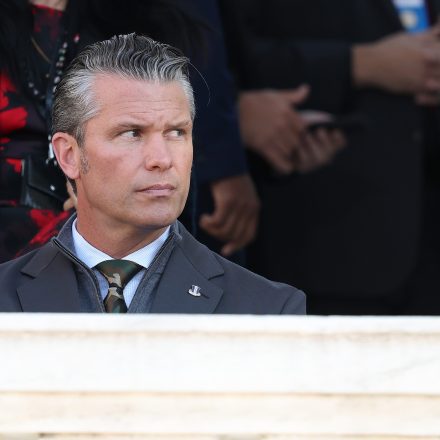
The Intercept and Freedom of the Press Foundation sued Pete Hegseth’s Pentagon in a pair of lawsuits demanding the release of documents related to the number of U.S. casualties in its war on Iran and the Department of Defense’s secretive blacklist of journalists.
One lawsuit, filed on Friday, responds to the department’s “repeated, unexplained changes” to its publicly available tracker showing U.S. service members killed or injured in the conflict with Iran — including a failure to acknowledge one soldier’s death for the six months after he died — that were documented by Intercept reporter Nick Turse. The shifting figures led one defense official to call the undercount a “casualty cover-up.”
In August, Turse requested from the Pentagon, through the Freedom of Information Act, casualty-related records and briefing materials presented to Defense Secretary Hegseth and his chief of staff, directives and guidance on casualties, as well as communications related to casualties between Hegseth and his staff of advisers. A later request filed by The Intercept in September sought the financial costs of the Iran war since its start in February. In all cases, the government stopped responding to The Intercept and has failed to provide any documents.
“They need to come clean to the American people.”
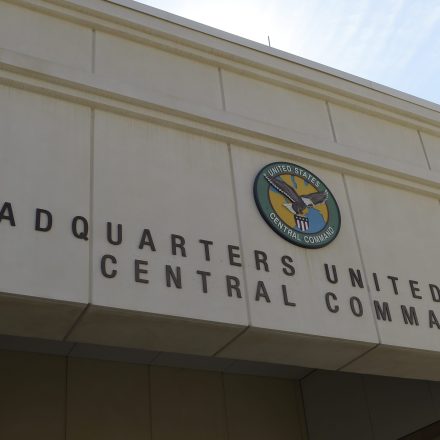
A second lawsuit against Hegseth’s DoD, filed on Monday, follows a July conversation with The Intercept in which a spokesperson for U.S. Central Command admitted the military post keeps a blacklist of media members. While reporting on the shifting U.S. soldier casualty figures, the CENTCOM spokesperson, Richard Allee, threatened Turse that he would be “put on a list of people to disregard” for calling the command too often.
CENTCOM later denied the existence of such a list. But Turse spoke with an unnamed U.S. official who confirmed that “Hegseth’s office had a standing order not to engage with [Turse] and would deny it if challenged.” During the first Trump administration, Turse had been placed on a separate blacklist kept by U.S. Africa Command, also within the Pentagon, after he reported on the torture of prisoners at a remote military base in Cameroon used by the U.S. for drone surveillance.
Turse has since filed a public records request seeking a copy of any “lists of journalists that CENTCOM discriminates against or disregards.” The Freedom of the Press Foundation also filed a request for communications and guidance related to the blacklist, as well as any records related to the command’s response to Turse’s article on the matter, published in August. The government has yet to provide any such information to The Intercept or Freedom of the Press Foundation.
“The military doesn’t get to decide which reporters it speaks to or ignores, especially when it’s engaged in legally questionable military actions and the human cost is at its highest. It’s not just the journalists who are harmed when the Pentagon behaves this way — the public and Congress are each denied critical information about what the military is doing in our name and with our taxes,” said Lauren Harper, Daniel Ellsberg chair on government secrecy, who filed FOIA requests for the blacklist on behalf of FPF. “If the Defense Department refuses to answer basic questions about how it engages with journalists, we’ll use the Freedom of Information Act to compel them in court.
The Intercept’s Turse called the Pentagon’s journalist blacklist “fundamentally un-American” and a way to avoid accounting for the real human toll of the ongoing war.
“Central Command wants to keep the sordid details of its wars — from civilian casualties in Iran and Yemen to U.S. military casualties across the Middle East — under wraps,” he said. “They need to come clean to the American people. We have to hold them accountable.”
Hegseth’s Department of Defense has long been hostile toward members of the media. In February 2025, days after Hegseth assumed office, the department forced out outlets such as NBC News, NPR, the New York Times, Politico, CNN, and the Washington Post from their Pentagon press desks. That October, Hegseth issued a new requirement in which journalists could only gain access to the Pentagon if they pledged to only report on information from government employees pre-approved by the Defense Department. This prompted most media outlets, except for the right-wing MAGA-friendly One America News Network, to surrender their press passes.
Trump has also targeted specific media outlets and individual journalists by barring them from the White House or Air Force One, though a federal court judge has since paused the bans, cautioning against possible violations of the First Amendment.
The Intercept and FPF’s lawsuits arrive days after Hegseth narrowly survived an impeachment attempt over his handling of the Iran war. The effort, led by Rep. Thomas Massie, R-Ky., and backed by Democrats, failed to garner enough votes to impeach Hegseth.
In addition to the war on Iran, incoming Democratic members of Congress, along with human rights groups, seek to hold Hegseth accountable for his bloody airstrike campaign on boats in the Caribbean Sea and Pacific Ocean, in which the U.S. has killed more than 240 civilians, and his overseeing of the U.S. invasion of Venezuela.
Jose Rosito Roca Estrada and his friends were on their way to work in a van on June 27, when a car in front of them slammed on its brakes, forcing them to crash into it and ricochet backward on the busy highway.
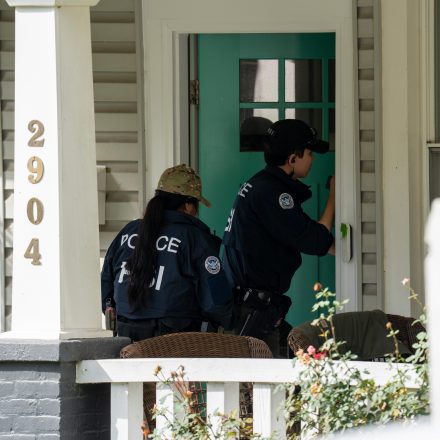
Three more cars surrounded theirs, and an estimated 10 to 12 officers poured out. The agents screamed at the men to get out of the vehicle despite traffic whipping by, Roca Estrada and fellow passenger Elvis Manuel Mejia told The Intercept. The stalemate ended with the sound of shattering glass and an asphyxiating cloud of chemicals flooding the car.
According to a new federal lawsuit and photos from the scene shared with The Intercept, federal agents smashed the car’s back windows and “sprayed the occupants with pepper spray through the lowered side windows.”
Officers then dragged a scared and temporarily blinded Roca Estrada from the car. “I was afraid they might be robbing me,” 24-year-old Roca Estrada told The Intercept through a translator. “They did not identify themselves. I was worried they were kidnapping me because they were asking very personal questions.”
“They did not identify themselves. I was worried they were kidnapping me.”
The June attack is one of six stories described in a lawsuit brought by several groups — including the American Civil Liberties Union of Virginia, the Washington Lawyers Committee for Civil Rights and Urban Affairs, the Legal Aid Justice Center, and multiple law firms — alleging widespread “unlawful and dangerous” warrantless arrests by immigration officials in Virginia.
On behalf of Roca Estrada and other plaintiffs, the groups are suing the Department of Homeland Security, DHS Secretary Markwayne Mullin, Immigration and Customs Enforcement, Acting Director of ICE David Venturella, and ICE D.C. Field Office Director Robert Guadian. They’re asking the court in the Eastern District of Virginia to force DHS to comply with congressional limits on warrantless immigration arrests and prohibit the agency from making immigration arrests without legally required individual assessments.
“They have a mandate from the Trump administration … to get creative and make arrests, however they see fit,” said Sophia Gregg, an immigrants’ rights attorney at the ACLU of Virginia. “The agents are ill-trained, and even when they do violate the law, there are no consequences.”
Roca Estrada said that the officers demanded to search his pockets, and when he declined, an agent threw him to the ground headfirst and dug his knees into his upper back. He remembered screaming as pain began to radiate through his collarbone. An X-ray reviewed by The Intercept would later confirm it was broken.
According to Roca Estrada and the lawsuit, officers began to punch and hit him in the back, eventually twisting his arm to place him in handcuffs and into the vehicle. Roca Estrada said that nurses who examined him after the alleged assault told him that blood had filled his lungs, and the lawsuit notes he was diagnosed with a broken clavicle and a lung injury. At no point, the lawsuit alleges, did officers ask the necessary questions to determine whether Roca Estrada was deportable or whether he was a flight risk.
Immigration officers are only supposed to make warrantless immigration arrests if they have determined “probable cause” to believe a person is unlawfully present likely to escape before a warrant can be obtained. But in an effort to meet the Trump administration’s nationwide quota of 3,000 immigration arrests per day, the lawsuit alleges, the Department of Homeland Security has chosen to pursue an unlawful policy and practice of “arrest-first, investigate-later” — leaving a trail of traumatized victims who should have never been arrested in the first place.
In the first year of the Trump administration, immigration arrests drastically increased in Virginia. According to the lawsuit, in 2025, ICE made “970 arrests each month in Virginia and Washington, D.C. — nearly five times the average monthly arrest volume in 2024.”
Reached by The Intercept, a DHS spokesperson said that agency had “arrested Jose Rosito Roca Estrada, an illegal alien from Guatemala,” using Roca Estrada’s full name even though The Intercept had not provided it, but denied that its officers “fractured a detainee’s collarbone.” The spokesperson did not deny that officials had deployed chemical weapons, saying, “staff relied on their training to gain compliance.”
“Claims that agents did not properly identify themselves are FALSE. When our heroic law enforcement officers conduct operations, they clearly identify themselves as law enforcement,” wrote the spokesperson. “At NO time were any of the detainees thrown to the ground during the arrest. Allegations that our officers fractured a detainee’s collarbone during the arrest are FALSE.”
Six weeks after Roca Estrada’s arrest, 18-year-old Britney Ramirez Corona was home caring for her 4-year-old sister in Norfolk, Virginia, when she found out ICE had detained her fiancé, his brother, and his brother-in-law.
It was another traffic stop, and Ramirez Corona, a U.S. citizen and recent high school graduate, had to go pick up their abandoned car. There, according to the lawsuit, an ICE officer demanded her identification, refused to let her get her wallet, and accused her of lying about who owned the vehicle. They handcuffed and pinned her, the lawsuit alleges — leaving her little sister to cry and wander into a busy road.
Eventually, ICE allowed another sister, 15, to come pick up the 4-year-old, then took Ramirez Corona into custody. She sat in “handcuffs, ankle shackles and a waist chain” for hours, according to the lawsuit, until her 15-year-old sister was able to bring her birth certificate — showing she was a natural-born U.S. citizen.
The lawsuit argues that Ramirez Corona’s arrest exemplifies an out-of-control trend of warrantless and often nonsensical arrests. Stephen Miller, then homeland security adviser and now the White House chief of staff, directed agents to “just go out there and arrest,” and the department seems to have complied.
“More than half of all the people ICE arrested in July 2026 did not have a criminal record,” the plaintiffs note. “And more than 500 people detained by ICE since January 2025 are U.S. citizens — another likely undercount — like Ms. Ramirez Corona.”
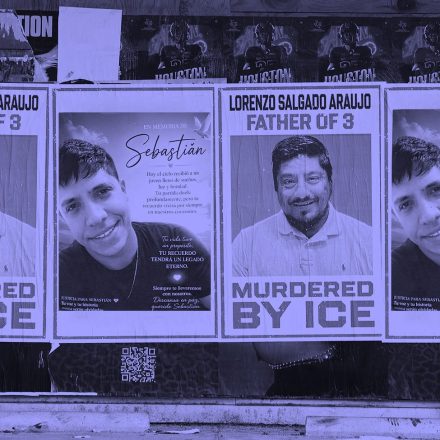
The same month that Roca Estrada says that federal agents temporarily blinded him, broke his collarbone, and beat him until his lungs filled with blood, Congress approved another $72 billion in funding for Immigration and Customs Enforcement. Immigrant advocacy groups warned ahead of the funding vote that additional money for ICE and President Donald Trump’s brutal immigration crackdown would mean more people would suffer a fate like Roca Estrada’s — or worse. The next month, ICE agents fatally shot Lorenzo Salgado Araujo in Texas and Joan Sebastián Durán Guerrero in Maine, both in their cars.
Physicians for Human Rights and the UC Berkeley Human Rights Center documented over 412 incidents of misuse of force by law enforcement agents at immigration protests from June 2025 to May 2026, including the use of chemical irritants like pepper balls and pepper spray — the same family of weapons Roca Estrada and Mejia suspect was set off in their car.
In ICE custody, 52 people have died during the first 500 days of the second Trump administration, according to Human Rights Watch, while use-of-force by guards remains largely unknown.
“We have received many more reports of violent use of force against people,” said Jeff Migliozzi, the communications director for Freedom for Immigrants, which runs the National Immigration Detention Hotline, referencing hotline numbers from June and July. “The overwhelming forces of intimidation and fear and retaliation, the M.O. of ICE has not changed. But certainly, as more people are detained, there’s more incidents [of violence].”
The DHS spokesperson claimed that Roca Estrada and everyone arrested along with him were offered medical care but declined, adding that “one of the detainees indicated that he had a prior shoulder injury.”
Roca Estrada tells a very different story.
He says he spent the next month tossed between detention centers in Virginia and West Virginia. Because he was not given a sling, Roca Estrada fashioned one for his broken collarbone out of bedsheets. He said he largely went without medical care despite agonizing pain that prevented him from laying down at night.
Roca Estrada said it got so bad he nearly fainted, at which point he was taken to a hospital.
“After medical personnel offered to document his injuries and consult a forensic physician, officers abruptly removed him from the hospital and returned him to detention,” the lawsuit alleges. “For weeks thereafter, Defendants failed to provide the promised follow-up care.”
According to the lawsuit, none of this should have happened because Roca Estrada never should have been detained in the first place.
The suit alleges that immigration officers never asked the 24-year-old “about his immigration history, whether he possessed lawful status, where he worked, how long he had lived in Virginia, whom he lived with, whether he had family or community ties in the United States, or similar questions to assess whether he was likely to escape before a warrant could be obtained.”
Other stories in the lawsuit follow a similar pattern. Catarina Rebeca Us Lopez, a 24-year-old woman from Guatemala, was detained in Centreville, Virginia, during a traffic stop around 6:00 a.m. with her husband. She alleges that masked officers blocked her car at a traffic light and forced her and her husband from the vehicle.
The officers falsely claimed that her husband had a deportation order, according to the lawsuit. But when her husband asked questions about the stop, Us Lopez alleges an agent pepper-sprayed him in the face and threatened to draw their weapons.
According to Us Lopez, officers did not “inquire about her immigration status, ask where she lived, inquire about her family, ask about her ties to the community, or otherwise conduct any individualized investigation concerning whether she was lawfully present in the United States or likely to escape before a warrant could be obtained.”
Instead, she claims that officers ignored her as she explained that she had work authorization and did not have a deportation order in place, and allegedly mocked her requests for answers and legal assistance.
For Roca Estrada, his physical injuries and trauma left him unable to work for a month. While he was detained, he also lost his apartment and had his personal belongings sent back to Guatemala without his consent, according to the lawsuit.
“The way that I was arrested … and the immense pain that I had to go through during this whole experience,” said Roca Estrada. “What happened to me was not just.”
In a rare bid to assert state authority inside a paramilitary-controlled enclave, the Iraqi government has launched a campaign to dismantle oil smuggling networks in Jurf al-Nasr, a stronghold of Iran-backed militias along the Euphrates River, roughly 30 miles southwest of the capital.
The crackdown takes direct aim at an illicit fuel trade operating inside an area that has long functioned outside of Baghdad’s authority.
The move followed the leak of an intelligence report, seen by OCCRP, that detailed the smuggling operation and included satellite imagery showing container truck movements between pipelines and local storage facilities from 2022 to 2026. The report cited evidence of perforated oil pipelines and makeshift storage facilities, adding that the armed groups controlling the area smuggled the fuel along three suspected routes leading into Baghdad province.
On Saturday, Iraqi Prime Minister Ali al-Zaidi announced on Facebook that he had ordered all suspects referred to the judiciary and dismissed nine police, intelligence and government officials—including the commander of the Popular Mobilization Forces (PMF) in Babil province. The dismissals followed a Friday inspection by a special government committee created by Zaidi, which uncovered indications of oil smuggling in the area, according to government spokesperson Haider al-Aboudi.
The leaked intelligence also triggered political fallout in Babil province, where Governor Ali Turki al-Jamali resigned last week without an official explanation. Meanwhile, Iraq’s Integrity Commission said on Sunday that authorities have recorded 152 criminal cases tied to oil smuggling nationwide over the past two years; 53 remain under investigation, and 11 have been referred to the courts.
Jurf al-Nasr is a district in central Iraq’s Babil province that Iraqi security forces and PMF factions recaptured from the Islamic State group in 2014. The PMF, an umbrella organization comprising dozens of mostly Shiite militias, remains the dominant authority in the district, which is largely closed off to regular Iraqi troops.
“Although the PMF are legally a state institution, in practice they retain highly autonomous control and influence,” a 2024 EU Agency for Asylum report said. “The PMF are heterogeneous in nature and maintain different alliances, with some prominent militias receiving orders from Iran.”
While the intelligence report did not name the specific groups controlling the enclave or clarify where the smuggled oil went once it reached Baghdad, retired Iraqi army commander and security expert Safaa Diyaa al-Asam told OCCRP that “the continued presence of ‘resistance factions’—specifically Kata’ib Hezbollah—in the region has persisted far longer than necessary.”
Kata’ib Hezbollah, or the Hizballah Brigades in Iraq, is a U.S.-sanctioned militia described as “the most significant player” inside the PMF in a 2024 report by the Washington Institute for Near East Policy.
Asam said curbing the smuggling is critical to Iraq’s ability to ensure stability and attract much-needed foreign investment—goals undermined as long as Iran-linked armed groups maintain control over parts of the country. He added that he expects the standoff in Jurf al-Nasr to end following “the bold move taken by the prime minister.”
In a statement to an Iraqi television channel on Friday, however, a Kata’ib Hezbollah official denied the allegations, denouncing what he called “malicious information” regarding oil smuggling operations.
Late on a Tuesday night in September 2019, Tina’s phone pinged with a message. The subject line read, in part, “fuck you slut!!!!!” The message contained a link to Pornhub, the world’s most popular porn site.
At the time, Tina — who spoke to the International Consortium of Investigative Journalists on the condition that her last name not be used — had recently ended a relationship with an abusive boyfriend. When she had tried to break up with him months earlier, Tina said he coerced her into making sexually explicit videos. It was his way, she told ICIJ, of controlling her.
Tina’s ex-boyfriend had now published those videos on Pornhub. It was the beginning of a months-long campaign of harassment and death threats: He posted videos and photos of her more than 100 times on Pornhub, according to emails reviewed by ICIJ, using accounts created in her name and including her address, phone number and employer.
He also posted photographs of her underage daughters at the beach in bikinis, along with their names and contact information. He emailed one daughter with a link to the videos of Tina and told her to ask her mother “why she put you all in danger from weirdos all over the country.”
“My ex wanted to kill me,” Tina said. “And he used Pornhub as the gun.”
Pornhub’s owner, the Montreal-based company Aylo, runs some of the world’s most popular websites. Its network of over 100 sites — including Pornhub, YouPorn and RedTube — attracts more than 100 million visits every day and has generated hundreds of millions of dollars in annual revenue, according to the most recent available data.
Aylo’s profits were built in part on some of the most heinous material on the internet. At the time of Tina’s abuse in September 2019, anyone could create a free account on Pornhub and upload videos; Pornhub did not require verification of the uploader’s identity.
Aylo has long employed moderators, whose job includes the identification of instances of sex trafficking, as well as photos and videos of minors. But the company was overwhelmed by the deluge of content: More than 6.8 million videos were uploaded to Pornhub in 2019; the company bragged in its 2019 “year in review” that if a viewer started watching all of them in 1850, they would still be watching.
Tina is just one of the many individuals victimized on the company’s websites. In 2020, Aylo removed more than 347,000 videos for nonconsensual content, according to a complaint filed by the Federal Trade Commission and the state of Utah. Aylo has made numerous changes since then — such as verifying the identity of uploaders — but its own reports show that potentially abusive and exploitative content continues to be published on Pornhub.
ms because, in the words of one employee in an email to a colleague, they were used frequently in BDSM and staged blackmail videos, and thus “relatively compliant” with the company’s terms of service (Pornhub told ICIJ that “blackmail” and “forced” are currently banned on all Aylo platforms).
This exchange was included in court documents reviewed by ICIJ from a class-action lawsuit against Aylo filed in Alabama in February 2021. The documents, which were supposed to be sealed, inadvertently became publicly accessible on the court’s electronic docket for eight months because of a filing error. A judge recently granted preliminary approval to a settlement agreement in that case and a related California class action. As part of the settlement, Aylo committed to the single largest known payout to victims in the company’s history.
Aylo does not want the world to see what these records reveal about its business practices. After ICIJ approached the company for comment for this article, Aylo asked a federal judge in Alabama to bar ICIJ from publishing “any information learned or derived from” the documents. This extraordinary request threatened to muzzle ICIJ’s reporting on Aylo’s behavior, far beyond the contents of the court filings.
The judge rejected Aylo’s motion to prevent ICIJ from publishing an article based on the records.
blurred out laptop screen in the background on the Pornhub website” width=”1138″ height=”640″ srcset=”https://media.icij.org/uploads/2026/11/Pornhub-GettyImages-2194231473-1138×640.jpg 1138w, https://media.icij.org/uploads/2026/11/Pornhub-GettyImages-2194231473-760×427.jpg 760w, https://media.icij.org/uploads/2026/11/Pornhub-GettyImages-2194231473-768×432.jpg 768w, https://media.icij.org/uploads/2026/11/Pornhub-GettyImages-2194231473-1536×864.jpg 1536w, https://media.icij.org/uploads/2026/11/Pornhub-GettyImages-2194231473-1109×624.jpg 1109w, https://media.icij.org/uploads/2026/11/Pornhub-GettyImages-2194231473.jpg 1920w” sizes=”(max-width: 1138px) 100vw, 1138px” /> An age-restriction warning screen on the Pornhub website.
Image: Leon Neal/Getty Images
The documents, which largely concern abusive content posted in 2020 and earlier, show a company that often fell short of those standards. Even notification from law enforcement of CSAM on the company’s sites was no guarantee that the illegal content would be promptly removed. In one instance, according to a deposition of an Aylo employee included in the court filings, Pornhub kept a video featuring the abuse of a 12-year-old boy online for more than a month after being informed of it by an Alabama law enforcement special agent.
In an internal email, an Aylo employee wrote that there was a request in this case “NOT to remove the content.” A separate civil complaint filed by the abused boy’s mother alleged that law enforcement officers informed Aylo that the illegal content was on its site three times, over a period of multiple weeks, and requested that it be removed.
Other CSAM videos remained on the site for years. And when discovered, some Aylo employees viewed their presence more with bemusement than horror.
“You guys want to laugh,” one moderator wrote to colleagues in 2020, as the company tested new CSAM detection software. “It caught a cp [child pornography] video from 2009 … a full on cp video on the site for 11 yrs.”
Another employee described a former moderator as “almost blind,” and wrote that he “put through so much stuff loool.”
Pornhub’s victims described a cycle of trauma as they struggled to scrub their name and images from the internet. Tina said Pornhub was too slow to take down the accounts with her name and contact information. And when they were finally removed, she said, her ex-boyfriend would simply create a new account and post the videos again.
The Pornhub email address used by victims to submit takedown requests included an automated response stating that an employee would respond within two days. Perversely, the response also promoted a program enabling users to “make money from your homemade videos.”
Tina would often realize the videos had been reposted because men would deluge her with lewd calls. Pornhub notified Tina that it “fingerprinted” her videos, a technology that generates a unique digital signature of a video to prevent its reupload, seven months after she first notified the company of them, according to emails reviewed by ICIJ.
Even before Tina’s videos first appeared, Pornhub had publicly touted its “state-of-the-art” fingerprinting technology to prevent revenge porn from being reuploaded. As Tina was struggling frantically to get her videos offline, Pornhub’s executives formulated a policy that called for victims of revenge porn to be offered fingerprinting services. But Tina says Pornhub did not tell her that her videos had been fingerprinted until she sent an all-caps email notifying the company that she was a crime victim. “DO BETTER PORNHUB!!!!,” the email read.
But Tina’s nightmare was still not over. Even after Pornhub removed the videos, it would sometimes leave the page on which they resided that included her personal information, emails reviewed by ICIJ showed. To this day, a Google search of her name brings up Pornhub results, though not the videos themselves ; other porn sites also include her address at the time.
Tina eventually moved to a new city because she no longer felt safe in her neighborhood. She became anxious if someone looked at her too long or when she was around large groups of men. She wasn’t in a relationship for years.
“I wish I had been raped physically because then it would only have been once,” she said. The reuploading of the videos, the online comments about her body by strangers, the lewd calls, she said, “felt like a rape every single time.”
Recommended reading Accountability Inside the Matrix: How models, influencers and engagement quotas power the Social Discovery Group’s dating machine and global profits Jul 23, 2026 ROMANCE SCAMS New US law requires dating apps to include warnings on romance scams Oct 21, 2026 Accountability Trump administration gave firm with ties to ballroom donor the green light to do business with a sanctioned Russian bank Sep 21, 2026
GettyImages-1983625964-760×427.jpg 760w, https://media.icij.org/uploads/2026/11/Friedman-GettyImages-1983625964-768×432.jpg 768w, https://media.icij.org/uploads/2026/11/Friedman-GettyImages-1983625964-1536×864.jpg 1536w, https://media.icij.org/uploads/2026/11/Friedman-GettyImages-1983625964-1109×624.jpg 1109w, https://media.icij.org/uploads/2026/11/Friedman-GettyImages-1983625964.jpg 1920w” sizes=”auto, (max-width: 1138px) 100vw, 1138px” /> Canadian lawyer, co-founding partner of Ethical Capital Partners and owner of adult website Pornhub’s parent company Aylo, Solomon Friedman.
Image: Joel Saget/AFP via Getty Images
The documents in the Alabama case also cast doubt on the company’s assurances about its methods to prevent the spread of CSAM. In a 2020 blog post, for example, the company touted its use of fingerprinting technology, which meant that any CSAM videos it found “cannot be re-uploaded,” it wrote.
But a few months before that blog post was published, Aylo executives drafted a policy covering how to respond when law enforcement officers report the existence of CSAM to the company. Aylo would not “communicate fingerprinting action back to complainant unless asked,” the document stated, “because we do not want to be seen as offering a guarantee” that the content would not reappear. This was necessary because the contractor providing fingerprinting services “has its limitations.”
Aylo’s then-CEO also told a Canadian parliamentary committee that requiring uploaders to provide government-issued identification to verify their age and identity meant that “every piece of content on our websites can be traced back to its uploader.” But the court documents show that the contractor tasked to verify the IDs of uploaders warned Aylo that “sophisticated and determined fraudsters” could defeat its technology.
This requirement would also not have thwarted some of the previous abusers mentioned in the Alabama court documents. The person who abused the Jane Doe at the center of the Alabama class-action lawsuit was verified. The abuser who victimized the 12-year-old boy was not only verified but allegedly sold videos of the abuse for $5 to $20 through Pornhub’s revenue-sharing program, according to the civil complaint filed by the boy’s mother. Some of the videos remained for sale for almost seven months and attracted more than 180,000 views and 1,100 subscribers — meaning that Aylo profited directly from the abuse, the complaint alleges.
The internet is terrestrial. It’s people going into buildings every day and making decisions. — Justine Li, cyber exploitation victims’ advocate
Tina and other victims described to ICIJ obsessively searching their names on Google, agonizing over the continued presence of their abuse online. For them, one of the most important interventions is the erasure of their names and intimate images from the internet. But it is often relief that remains out of reach.
Justine Li, a sex trafficking survivor herself, launched the National Center for Victims of Internet and Cyber Exploitation last year to offer victims a single portal through which they can manage takedown requests.
Li’s strategy is to target what she calls the “internet iceberg.” At the top are the operators of the sites that host the illegal content. Below the surface are other companies — hosting providers, payment processors and advertising networks — that keep the sites operational and making money.
She works to identify all of the companies that are supporting a site hosting illegal content, along with their contact information — pressure points on an industry that she says is too callous to act.
Li tells victims she will never stop fighting to get their images off the internet. But she is careful not to offer them any guarantees. “We can’t promise that things will come down,” she said. “That’s not the reality.”
Even failure, Li believes, has a purpose. She can use evidence that the options for victims are not working to push for new laws.
“People think the internet is this celestial realm where laws cannot be enforced,” Li said. “No, the internet is terrestrial. It’s people going into buildings every day and making decisions. … There’s a lot we can do that’s still on the table.”
In testimony before Canada’s House of Commons Sub-Committee on International Human Rights, senior research fellow Jon Penney argues that artificial intelligence is having a twofold effect on human rights by making abuses easier and activism more difficult.
Artificial intelligence is supercharging mass surveillance while making it easier to threaten and target journalists and dissidents using methods like facial recognition and the production of deepfakes. The rise in AI-generated videos and images is making disinformation easier to produce, causing confusion in the media ecosystem.
Penney calls on the Canadian government to restrict surveillance and data collection, require transparency from AI companies, limit profiling, and hold enablers accountable.
A new political party organized by student protesters made history last month when it ousted Serbia’s longtime leader Aleksandar Vučić at the polls, ending his party’s 14-year stranglehold on power.
Long seen as immovable, Vučić was defeated by students who managed to rally support from across the country around a central, unifying goal: freeing Serbia’s institutions and economy from the corruption that flourished under the rule of his Serbian Progressive Party (SNS).
Their electoral victory was decisive and undeniable. But dismantling the former regime’s networks of influence will not be easy. Serbia’s democratic credentials deteriorated under Vučić, with the leader and his party accused of cultivating extensive patronage networks inside the country’s judiciary, security forces, media, and private sector.
The students, whose leaderless protest movement selected a range of political novices to represent them in parliament under the banner of the “Student List,” have vowed to restore independence to state bodies and end impunity for the corrupt.
OCCRP spoke to Tena Prelec, an assistant professor at the University of Rijeka who has researched corruption and kleptocracy in the Western Balkans, about the opportunities and pitfalls that await the incoming government, and how they should balance calls to prosecute corruption in the past with plans to steer Serbia towards a more democratic future.
Let’s start with what the incoming government will be inheriting after 14 years of domination by the SNS party. Vučić and the former ruling party are accused of “state capture” — a term used to describe a type of systemic corruption in which elites amass influence over key institutions or oversight bodies, and rewrite the rules of the game to their own benefit. What has state capture looked like in Serbia?
So after nearly 15 years, we have a situation in which you don’t have only corruption within individual institutions, but it’s really a system in which political loyalty but also public resources and private interests are deeply, deeply intertwined. And so there has been this capturing at the level of the state, but also in some sense a societal capture too, because the extent to which everything has become interconnected is really deep in Serbia.
The important thing for the incoming government will be to dismantle the mechanisms of state capture without simply replacing one set of loyalists with another. Now, the positive aspect of this great change at the elections, this really remarkable achievement that very few thought was possible — that a leaderless movement would manage to get to such a convincing electoral victory despite the state capture mechanisms at the level of electoral manipulation — is that the incoming government will have a mandate to dismantle state capture because this is what unites all the voters who voted for the Student List. They want a renovation, they want a different Serbia.
They [the Student List candidates] all focused on the aspects of governance, on the rule of law, and so on and so forth. And that’s also why in their program you won’t see so much about issues related to foreign policy, for instance, but you had a lot of focus on basically dismantling these mechanisms and giving Serbia a fighting chance for a democracy at some point down the line.
Which parts of Serbia’s captured state do you think could present the biggest challenge to the incoming government? Do you expect SNS to maintain loyalties in some of these areas that could complicate the newcomers’ efforts to pass reforms?
The ruling party has definitely been embedded in a number, if not all, areas of society. Clearly the entrenched networks in Serbian society are very strong and the incoming government will be subject to huge pressures from these sectors and others. So this should not be underestimated.
On the other hand, what we’re seeing now is that things are changing quite quickly. There is quite a big momentum of change. And it seems that quite a lot of people who were close to the regime have been trying to jump off the boat even before being given a clear signal that they should leave, or before being fired.
So now there is a window of opportunity and it’s very crucial to act quickly because otherwise these pressure groups might regroup and mount even a bigger challenge to the student movement.
I would distinguish three particularly different areas in terms of dismantling state capture. One is the security services and the police. This is potentially the hardest because of the institutional secrecy, the hierarchies, the access to sensitive information, and so on and so forth. But we’re seeing even here recent arrests that are an encouraging signal of things happening maybe even faster than many people have thought.
A second particularly difficult area will be the judiciary and prosecution. We know that vetting the judiciary and generally a renovation of the whole judicial apparatus is something that is very difficult to do. It can be done, but it often takes a long time, and there are entrenched interests here too.
A third area I would also highlight are public enterprises and procurement, and this is perhaps the most underestimated challenge. Because this is where patronage connects to money but also employment, private sector beneficiaries, and also foreign investors, and so on and so forth. So these networks tend to survive a change of government. They’re quite difficult to dismantle.
But as I said, the speed of change is very remarkable in these first days after the elections. You’ll have seen that some media personalities and even whole editorial teams have resigned before even being asked to resign. So you can see that the challenge is immense, but the momentum is big too.
How should the incoming government balance a desire to right the wrongs of the past with their ambition to reshape Serbia for the future?
Both are important. History is important and the future is important because if you don’t deal with the history of state capture, you risk relapsing into it. And Serbia has already already been through this after the changes that happened in October 2000 and this opportunity for a different paradigm. Unfortunately, there has been this relapse. So they know now that these mistakes shouldn’t be repeated.
On the other hand, it’s also important to immediately show that this is a new paradigm with a new generation. And this is so clear to everybody: That the old generation is on its way out, and that this is the upcoming generation that is behind this big change. And crucially, I mean it’s not even the ones who might be seated in parliament that are driving it — it’s really those students, those who are the youngest in society. So a different paradigm is here.
And the focus on the future is intrinsic within this moment. I would mention the great opportunity that Serbia has to reactivate vast portions of society who have been unable to participate in change and in building their institutions so far because they’ve been sidelined, because the machinery of state capture didn’t allow them to be part of decision making, of giving input to what was going on. Well now the political will is there to reactivate them and Serbia has a wealth of knowledge and of skill inside the country, in think tanks, civil society, academia, and so on and so forth, but also outside the country in the diaspora, where a lot of people have moved because they didn’t agree with the rules of the game in Serbia. Well, now they can participate in rewriting these rules of the game themselves.
Serbia’s trajectory has often been compared to that of Hungary’s, where one of Vučić’s political allies, Viktor Orbán, was also recently ousted at the polls after a long run in power that saw his party bend the country’s institutions and media to its will. What can Serbia learn from Hungary?
There are big similarities between Serbia and Hungary. We’ve seen how the [former] leaders of these two countries have gotten along very well in many respects, in their modus operandi, in their countries, but also with international deals, on the other hand, have learned from each other for a long time. So the similarities are there, but the ways in which this change has happened at the ballot box are quite different. In Hungary, there has been a much more conventional type of party structure and approach with a clear leader, Péter Magyar, and his party, Tisza. So the challenge in front of the Student List is different. They will now have to change the way that they’ve been operating, which so far has been very bottom-up, and they will have to insert a bit more hierarchy in what they’re doing.
At the same time they have, I think, the confidence that the innovative methods through which they’ve approached deliberation and really a new way of doing democracy have worked despite the odds, despite what many critics would have said. So there is an opportunity to insert into political life some of these innovations that have already shown [to be successful].
One aspect that I would also highlight in terms of whether the Student List and the new government makes it or not is to manage expectations well. Because in this moment the hopes they’ve raised are so high among the population that they might, you know, get ahead of themselves and perhaps be exposed to criticism if they don’t make it very clear what they have already said in a way, which is that this government and this experiment is indeed an experiment and the transition from one way of doing things to another.
So they need to keep their eye on the prize, on the goal, which is to frame it over and over again that they are actually engaging in a transition period to give Serbia a chance to do things differently. And if they manage to do that, they will also be less exposed to criticism, for instance, about their values or stances in terms of foreign policy or other areas, because they’ll manage to send a message that what matters now is that their priorities lie in a different field, which is the one related to governance, the rule of law, and the fight against corruption, which should be indeed front and center now.
Your research has focused on the role of “corrosive capital,” which refers to state or private financing that lacks transparency and accountability. One example could be the Chinese-led reconstruction of the railway canopy in northern Serbia whose collapse killed 16 people two years ago and triggered the protest movement that culminated in this recent electoral victory. How should the new government tackle this type of complex and transnational corruption?
So a faux pas that has been made repeatedly in the European Union in particular is their focus on foreign influence in the Balkans. There is no denying that a lot of what has been termed in research and academia as corrosive capital happens between authoritarian countries and countries in regions such as the Western Balkans, and further, it’s not only limited to the Western Balkans.
But we need to be aware of the fact that it’s not only a unilateral one-way approach from the outside. Corrosive capital and transnational corruption is always co-produced, right? So the domestic elites have a key role in providing the basis for this to happen. So that’s why, for instance, the Chinese investments in mining and in other sectors in Serbia have been so corrosive environmentally, also socially, sometimes in work in terms of workers’ rights and so on and so forth. Whereas in Croatia, [a state-owned Chinese company] has just participated in an EU tender and completed a bridge, Pelješac Bridge, within the framework of EU procurement rules, albeit not without controversy. So there is this difference.
Furthermore, in addition to these foreign and internal and domestic aspects, there is also the element of the transnational enablers. To join the dots, there are professional service providers who provide these activities sometimes in big financial centers, in rule of law jurisdictions. So they participate in something which is ultimately a corrosive type of a network with corrosive effects, but from a legal standpoint. So this is a key thing that will be very difficult now to pick apart in a captured state such as Serbia was and still is. Which is the fact that a lot of the corruption will be legal, a lot of it has been legalized, and a lot of it has happened in ways that will not be possible to point at the predicate crime itself.
Investigating this type of transnational corruption while there is political will — by following the money, getting to the bottom of it — is crucial. But another policy solution that my colleagues and I have proposed is the so-called Kleptocratic enterprise, meaning that we need to designate the people who are part of a network committing a crime, or you know a corrupt and illicit activity at the beginning of it, when the source of wealth is still quite visible. Because afterwards, in these many opportunities that the international political economy gives to kleptocrats and other corrupt people, this nexus gets more and more diluted, and therefore we lose sight of what was the predicate crime. Now, this might seem outlandish at first, but actually it has already been put in law, for instance, in Italy, where the mafia laws have allowed law enforcement to gather and to identify the networks that comprise basically a mafiosi structure in a much clearer way and in a way in which law enforcement was able to act upon.
So Serbia now in this moment, in this window of opportunity, will have the incredible, you know, chance to put this in action and to really try to get to the bottom of some complicated issues and complicated international scandals, and it should take it.
President Donald Trump announces tariffs at the White House in April 2025. Brendan Smialowski/AFP via Getty Images
When Stanley Black & Decker, one of the world’s largest tool companies, got hit with President Donald Trump’s tariffs last year, the firm made clear that it would be sharing the pain with its customers.
The Connecticut-based company raised prices again and again, moves its executives said were necessary because of the new fees on imports.
Now, after the Supreme Court struck down Trump’s most sweeping tariffs earlier this year, the company is getting at least $298 million refunded. Instead of sharing that bounty with its customers, however, the firm has chosen different recipients:
Its own leaders.
The company is one of at least nine that have disclosed that they are using their refunds not to pay back the cash-strapped consumers who generally covered much of the tariff costs through higher prices, but to give bonuses, according to a ProPublica analysis of thousands of securities filings and earnings calls for publicly traded companies.
Other recognizable companies include the owners of discount department stores TJ Maxx and Marshalls and the golf equipment brand Titleist.
Dozens of other firms have said little about how they plan to use the money other than to characterize the windfall as the kind of earnings they use to determine executive bonuses.
The Trump administration has not publicly detailed which companies are getting the roughly $170 billion in refunds or how much they’ve asked for, and it has denied ProPublica’s requests for this information. But reporters found some of these details while reviewing the disclosures of thousands of publicly traded companies.
Some have described vague plans to pay the money forward by, for example, “returning tariff refunds to our members through pricing,” though they generally don’t say whether that involves price cuts or limiting future increases. Others are paying back businesses they sold products to because they had itemized receipts that detailed the tariff markups.
But consumers hoping for refunds appear to be largely out of luck. With the help of artificial intelligence, ProPublica identified companies that said they planned to refund customers with their tariff windfalls. Almost all of them deal with other businesses, not consumers.
“Executive bonuses are probably the least just way to use this money because it wasn’t anything the executives did that they should be rewarded for. It was a government mistake that resulted in a refund,” said Gregory Germain, a corporate law professor at Syracuse University. “It really explains why it’s so important for the government, when they’re doing something like this, to think it through to make sure consumers don’t pay extra money and not get it back.”
The chain reaction that led to these bonuses began in the first months of Trump’s second term. In February 2025, Trump declared a national emergency over illegal drugs coming in across the border and unilaterally announced new tariffs on goods from the countries he deemed responsible: Canada, Mexico and China.
Then, in April, he declared a second national emergency, this one over the U.S. trade deficit — the fact that the U.S. was importing more than it exported. Declaring it “Liberation Day,” Trump unveiled a poster in the Rose Garden detailing his most sweeping tariffs yet on goods from more than 100 countries.
“Executive bonuses are probably the least just way to use this money.”
Gregory Germain, corporate law professor at Syracuse University
Those tariffs remained in place, with some tweaks, until earlier this year when the Supreme Court struck them down, ruling that Trump had needed congressional approval to impose them.
That left the federal government scrambling to figure out how to refund billions in duties it had collected over the prior year on more than 53 million imported shipments. U.S. Customs and Border Protection set up an online application system. But only the direct payers of the tariffs — called the “importers of record” — are eligible to apply, not the businesses and consumers who took a hit downstream.
The administration and Congress have not placed constraints on how companies use the tariff refunds, though there have been calls to do so. After the Supreme Court ruling, a group of Democratic senators wrote to the president, asking if he would require companies to pass along part of their payments to consumers and assign penalties to those that did not. Doing otherwise, said Sens. Elizabeth Warren, Cory Booker and Peter Welch, would render the refunds “a giveaway to giant corporations that amounts to theft from the middle class.”
Though Treasury Secretary Scott Bessent has denied that the tariffs resulted in significantly higher prices, he has acknowledged the fundamental unfairness of only importers of record getting the refund. “I got a feeling the American people won’t see it,” he said in February at an Economic Club of Dallas event.
Bessent has made the argument that it’s the Democrats who challenged the tariffs in court, not the administration that imposed the tariffs, who are responsible for the transfer of wealth from American consumers to companies.
“The Democratic attorney generals who filed a ridiculous lawsuit against this administration wanted the money to go back to the payer of record,” he said at a press conference. “If I hear another Democratic legislator make the inane remark, ‘The American people should get the money’ — the American people had the money in the U.S. Treasury and we were forced to give it back.”
“I got a feeling the American people won’t see” the refund money.
Treasury Secretary Scott Bessent
In some cases, companies have said that they will be splitting at least some of their refund checks with their customers. ProPublica’s analysis shows these companies’ customers are generally other businesses, not average consumers. Among them is Varex Imaging Corp. in Utah, which sells X-ray imaging components for medical businesses and cargo screeners. Varex and firms like it have not elaborated on why they are passing along refunds, but trade experts suspect these business-to-business vendors have detailed contracts that itemize tariff costs.
Shipping companies, like UPS and FedEx, have set up online portals for customers seeking refunds. Though the firms are technically importers of record, they imported goods on behalf of businesses and individuals that paid them to ship products. The companies are itemizing how much customers paid in tariffs and reimbursing them.
A series of lawsuits are attempting to force companies that sell directly to consumers to share some of their refunds. Dozens of firms have been sued, including big-box stores Walmart and Target and apparel companies such as Nike and Lululemon. Apparel and leather costs were some of the hardest hit by Trump’s tariffs. Legal analysts have cast doubt on whether these lawsuits will succeed, though some trade experts have speculated that businesses that used the tariffs as cover to raise prices more than they needed to might settle to avoid embarrassing disclosures.
One of the companies facing a lawsuit is Stanley Black & Decker, the toolmaker that ProPublica found was using some of its refund on bonuses. The named plaintiff is a Wisconsin resident who bought a handheld blower, an impact wrench, a hedge trimmer and other tools from the company last year, but the lawsuit seeks to represent thousands of other customers as well.
“Unless restrained by this Court,” the complaint reads, the company “stands to recover the same tariff payments twice — once from consumers through tariff-inflated prices and again from the federal government through tariff refunds.”
On multiple occasions, the company has acknowledged publicly that it was raising prices because of the tariffs.
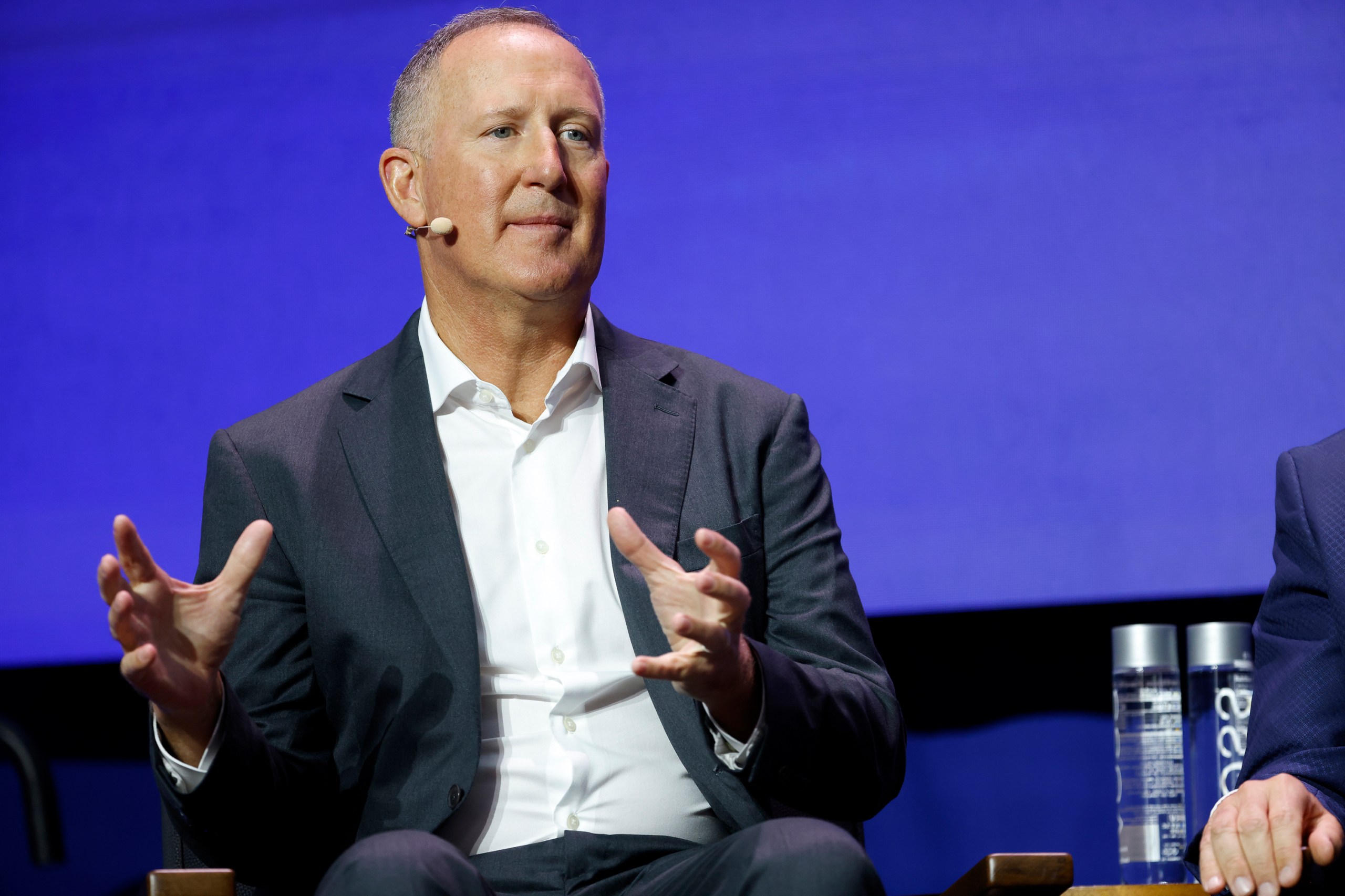
Chris Nelson, president and CEO of Stanley Black & DeckerJeff Kowalsky/Bloomberg via Getty Images
The month before the November 2024 election, as Trump was campaigning on dramatic new tariffs, the toolmaker’s then-CEO, Donald Allan Jr., told shareholders that Stanley Black & Decker was preparing for the possibility. “Obviously, coming out of the gate, there would be price increases associated with tariffs that we put into the market,” he said during an earnings call. Then, a few months after Trump unveiled his tariffs, Allan said his team was “remaining focused on executing our robust plan designed to mitigate tariffs” that he said included “targeted pricing actions to improve our gross margin.” Later that year, his successor as chief executive, Chris Nelson, described more price hikes: “We are implementing a second price increase during the fourth quarter to maintain our innovation and brand investments, given the pressures resulting from tariff-related cost increases.”
In its more recent disclosures, the company has been vague about how much of its refund was going to executives, simply saying that some of that gain “was partially offset by directly attributable costs for variable incentive compensation.” “Incentive compensation” is a term the toolmaker uses to describe bonuses.
The company has not responded to the allegations in the lawsuit brought by the Wisconsin resident and did not answer ProPublica’s questions about who is getting paid the bonuses, how much they’re worth and whether customers should be reimbursed.
Securities experts who reviewed the disclosures for ProPublica said it appeared the windfall boosted the company’s profits, which factor into formulas that help determine bonus pay for executives and other employees.
“It wasn’t the executive that triggered that extra profit, so why should their compensation go up?” Germain, the corporate law professor said. “This is one of many examples where these formulas don’t do what they should do.”
The company’s leaders, securities experts said, could have given money back to consumers or lowered prices. Retail giant Burlington Stores, formerly known as Burlington Coat Factory, appears to have done just that.
CEO Michael O’Sullivan recently said the company got $55 million in tariff refunds and “rather than taking a one-time boost to earnings” the company plans “to deliver even sharper values to our shoppers,”
“Over the last few years, the rising cost of living has made life difficult for many customers,” O’Sullivan said, adding that the coming discounts meant investors should expect the “direct impact of tariff refunds to be neutral.”
A company spokesperson confirmed to ProPublica that none of its tariff refund will be going to bonuses.
Not so for other companies.
Burlington Stores CEO Michael O’Sullivan says that the company plans to use its tariff refunds to lower costs for consumers.Eva Marie Uzcategui/Bloomberg via Getty Images
Acushnet, the Massachusetts golf equipment company that includes the brand Titleist, disclosed an “incentive compensation expense of approximately $12.0 million” out of its refund. Acushnet declined to respond to questions from ProPublica.
TJX, the Massachusetts parent company of TJ Maxx and Marshalls, said it got back $331 million, but as a result, it “accrued incremental expenses of $112 million for year-end incentive compensation and discretionary bonuses for eligible Associates globally.”
The company declined to answer questions from ProPublica about how far down the chain of command the bonuses would go and how much of them would be reserved for top managers. “Given that this is an accrual, and we have not reached the end of our current fiscal year, we have not disclosed any breakout beyond this,” a spokesperson said. The company also declined to say whether it would lower prices or pay back customers with the rest of its refund, saying only that “the remaining amount will be used to support our future growth.”
ProPublica’s examination of tariff refunds was limited to publicly traded companies, which are required to disclose detailed financial information. None of the companies that said they are using the money for bonuses have ever said they planned to refund customers. How private companies are using their refunds is unclear because they aren’t normally required to disclose such information.
Nick Guest, an accounting professor at Cornell University who has studied executive compensation, said the argument for granting leaders bonuses based on the tariff refunds could go both ways.
“If they were penalized for something out of their control,” he said, referring to earnings hits caused by Trump’s tariffs last year, rewarding them now “seems reasonable.”
“But you could say the same thing about customers. If they were penalized, then is it reasonable that they’re not getting rewarded now?” Guest asked. The companies, he said, are “not obligated to give refunds or reduce prices, but doing so could certainly build goodwill with customers.”
The recent midterm election cycle marked by historic levels of pro-Israel spending saw an emerging trend that aimed to counter their influence: a new crop of pro-Palestine PACs.
Led by American Priorities PAC, which formed in January as part of an effort by donors, including supporters of New York City Mayor Zohran Mamdani, who opposed U.S. military support for Israel, a cadre of pro-Palestine organizations spent more than $14.4 million on races this cycle. Almost all of their candidates won.
“In the midst of the genocide, we felt compelled to push every lever and engage in every way possible to push candidates and the [Democratic] party to catch up to its base,” said Margaret DeReus, who leads the Institute for Middle East Understanding Policy Project and the Peace, Accountability, and Leadership political action committee, or PAL PAC. Both groups spent on pro-Palestine ads for the first time this cycle.
As DeReus and other leaders of the emergent pro-Palestine lobby told The Intercept, voters, especially Democratic ones, have become increasingly disillusioned with Israel and frustrated with politicians who support unchecked military aid to the country. “I don’t think there is an issue that I can think of where the party position, the mainstream party position, is so out of step with the base,” DeReus said.
The new pro-Palestine spending is a drop in the bucket compared to the more than $84 million the pro-Israel lobby poured into elections this cycle. AIPAC’s super PAC outspent pro-Palestine groups almost 6 to 1 — and that doesn’t include the more than $50 million AIPAC funneled directly to candidates. The pro-Palestine side may never match their opponents dollar for dollar.
“The point is, nobody has to outspend AIPAC,” said Beth Miller, political director at the advocacy group Jewish Voice for Peace Action. Her group doesn’t spend directly on elections and instead focuses on mobilizing anti-Zionist Jewish voters. “AIPAC is spending this much money because the message they are trying to force down voters’ throats is unpopular.”
“AIPAC is spending this much money because the message they are trying to force down voters’ throats is unpopular.”
The pro-Israel lobby long dominated the discourse on Israel policy before its flagship group, the American Israel Public Affairs Committee, started spending directly on elections for the first time in the 2022 cycle. But as AIPAC and other pro-Israel groups find their brand growing increasingly toxic amid public outcry over U.S. military support for Israel’s genocide in Gaza, pro-Palestine money is shifting the terrain when it comes to election spending.
Simply put, Miller said, “Their message goes further because it’s popular.”
Whether the spending is for or against the pro-Israel lobby, it’s rare to see political ads that directly address U.S. policy toward Israel. For one thing, the topic can be controversial — even if the controversy is manufactured.
When Rebellion PAC, a committee founded to back the 2020 congressional campaign of left-wing commentator Cenk Uygur, ran an ad supporting Abdul El-Sayed and connecting high grocery prices to U.S. support for Israel, the fallout threatened to upend the Michigan Senate race. Rep. Haley Stevens, D-Mich., called the ad antisemitic and took it as an opportunity to air her grievances with her former primary opponent, eventually switching her endorsement to Republican Mike Rogers. The PAC originally ran a version of the ad during Uygur’s short-lived 2024 presidential bid.
Voters didn’t seem to be swayed by the controversy, and El-Sayed beat Rogers by a comfortable 7 percentage points. “The drama comes from a handful of elected officials and an establishment that, at best, takes an outdated view of how Israel and AIPAC operate,” said Greg Krieg, spokesperson for American Priorities, which was not affiliated with the Rebellion PAC ad but did produce other ad spots that criticized the U.S. relationship with Israel.
“Not every ad we ran was about Israel, obviously, but the topic came up often because it united Democrats across the party’s ideological spectrum,” Krieg said. “This is not a controversial issue at a grassroots level.”
That new, vocally pro-Palestine PACs are backing successful candidates alongside veteran left organizations is a sign of health for a nascent effort, Miller said.
The midterms were “a test case of: Will this message resonate with voters? And the answer overwhelmingly was yes,” Miller said. “This is a sign of the increasing power and mobilization of the Palestinian rights movement in the political and electoral space.”
Groups like American Priorities and PAL PAC often endorsed the same candidates as progressive bench-builders like Justice Democrats and the Working Families Party. In some cases, the Palestine solidarity movement seemed to breathe a much-needed new life into the electoral left.
The pro-Israel lobby doled out bruising defeats last cycle, after making a promise to unleash its full arsenal to oust critics of Israel from Congress. AIPAC’s super PAC spent more than $25 million to unseat then-Reps. Cori Bush, D-Mo., and Jamaal Bowman, D-N.Y. — a quarter of the $100 million it spent on primaries in 2024.
Reeling from those losses, progressive and Democratic strategists went back to the drawing board. Alone, they could never hope to have the same infrastructure or wield the same influence as a group like AIPAC. But together, they could more effectively pool their resources to tap into public opinion shifting further each year in their favor.
One of the new pro-Palestine groups, American Priorities, was born out of a desire to leverage that shifting public opinion against U.S. support for Israel into electoral wins. As the first truly pro-Palestine super PAC, the group spent $8.15 million backing 15 candidates this cycle, 13 of whom won. (The group also considered spending for Angie Nixon, a Florida democratic socialist who narrowly lost her bid for U.S. Senate, but ended up putting the money into another race.)
The growing networks allowed groups like Justice Democrats to get involved in more races. It came back from its losses and had its most successful cycle yet, electing eight of the 15 candidates it endorsed, four of whom unseated Democratic incumbents. The group spent $5.5 million in total this cycle, including $4.6 million on ads across all its races. And it went much further: Last cycle, Justice Democrats spent a combined $3.3 million alone backing Bush and Bowman before they lost.
Together, IMEU Policy Project and PAL PAC spent $2.15 million on ads and bundling for candidates. “We ran on proud anti-genocide and pro-freedom platforms,” DeReus said. “We knew that this was a cycle where that platform could win, and we wanted to be a part of making that happen.”
Meanwhile, AIPAC and other pro-Israel groups saw diminishing returns on election spending this cycle, as they battled waning public opinion and increasingly concealed their spending in races.
“Their names often tell you very little about who’s behind them or what they’re actually trying to do — and their ads almost never mention Israel,” Krieg said. “Everybody is looking at the same polling. We have voters who agree with us, so we’re willing to say plainly what we stand for and put our names on it. When you’re pushing a position that voters don’t support, you’re naturally going to be a lot less transparent about what you’re doing.”
“When you’re pushing a position that voters don’t support, you’re naturally going to be a lot less transparent about what you’re doing.”
The general public had a greater knowledge of AIPAC’s brand and its role in maintaining a pro-Israel U.S. policy this time around, said Justice Democrats spokesperson Usamah Andrabi. This cycle also saw more candidates willing to translate public agitation against U.S. support for Israel into campaigns, he said, pointing to other efforts he said helped voters understand AIPAC’s role in elections from groups like TrackAIPAC.
“Voters’ awareness and opposition to Israel’s genocide and apartheid was raised so much higher due to grassroots movements and groups that organized against it,” Andrabi said. “We were able to — across every single one of our campaigns — talk about AIPAC as AIPAC, and talk about the genocide as something we wanted to end, and connect the dots for people.”
It’s a stark contrast to 2024, when Justice Democrats met with candidates whose top concerns were avoiding AIPAC’s wrath, Andrabi said. “Even then, in 2024, we were telling these campaigns, ‘Look, there’s no going under, around, behind, over AIPAC. The only way to defeat this lobby is to go right through them,” he said. “The political courage amongst a lot of Democratic candidates and a lot of people within the Democratic Party was just not there in 2024.”
As the 2028 presidential race begins to take shape, the same pro-Palestine groups are preparing to push candidates to meet voters where they are on Israel policy.
“Particularly with Abdul’s victory in Michigan, that win capped off a year that has really proved that Palestinian rights is an asset, not just in safe blue districts, but in the most critical of swing states,” DeReus said. Even President Donald Trump knows how much of a liability being pro-Israel has become, she added, pointing to his late-breaking claim on Election Day that the U.S. would end military support to Israel.
Potential Democratic contenders in 2028 would do well to take that lesson to heart, DeReus said, as groups like hers gear up to push candidates to support an arms embargo, sanction Israel, and recognize the genocide. She said the group hopes to see someone like Sen. Chris Van Hollen, D-Md., enter the race, but that it would also support Rep. Alexandria Ocasio-Cortez, D-N.Y., should she decide to run.
In DeReus’s view, “2024 was the last presidential election we will see where Palestinian rights were disregarded.”
Illustration by Matt Rota for ProPublica. Animation by Henrike Lendowski for ProPublica.
When the city of Chicago eventually finishes its spending plan for 2027, $3.9 billion will come right off the top.
Taxpayers will have nothing to show for it. Not a single cent of that money will be used to fill a pothole, pick up a can of garbage, pay a firefighter to respond to an emergency or address lead poisoning in children.
Strapped into a straitjacket made up of the city’s debt, there is nothing Chicago’s mayor or City Council can do about it, forced to spend billions every year simply to stay current on the $55 billion it owes to banks and its pension funds.
No other big city will pay more toward its debt this year or next, according to an analysis by WTTW News and ProPublica. This year, $3.6 billion out of a $16.6 billion budget was consumed by debt.
New York City, with a population three times the size of Chicago’s and a budget more than seven times as big, has $47 billion in debt backed by tax revenues. Los Angeles, which has approximately 1 million more residents than Chicago but a smaller budget, has $1 billion in debt set to be paid back with taxes, records show.
According to all four of the major Wall Street credit-rating agencies, New York’s and Los Angeles’ fiscal health make them much better choices for investors. Chicago’s history of questionable borrowing and budgeting — it chose to either ignore or short its pension payments for years — has undermined its credibility.
Its credit rating now sits just two or three levels above junk status, making the cost of borrowing even more onerous. And the city’s chief financial officer, tasked with managing city debt and relationships with credit agencies, resigned last week in stunning fashion, saying she no longer could continue in the role because it would compromise her “integrity and professional obligations.” She had come from Fitch Ratings, a credit agency, and had been on the job for only three months.
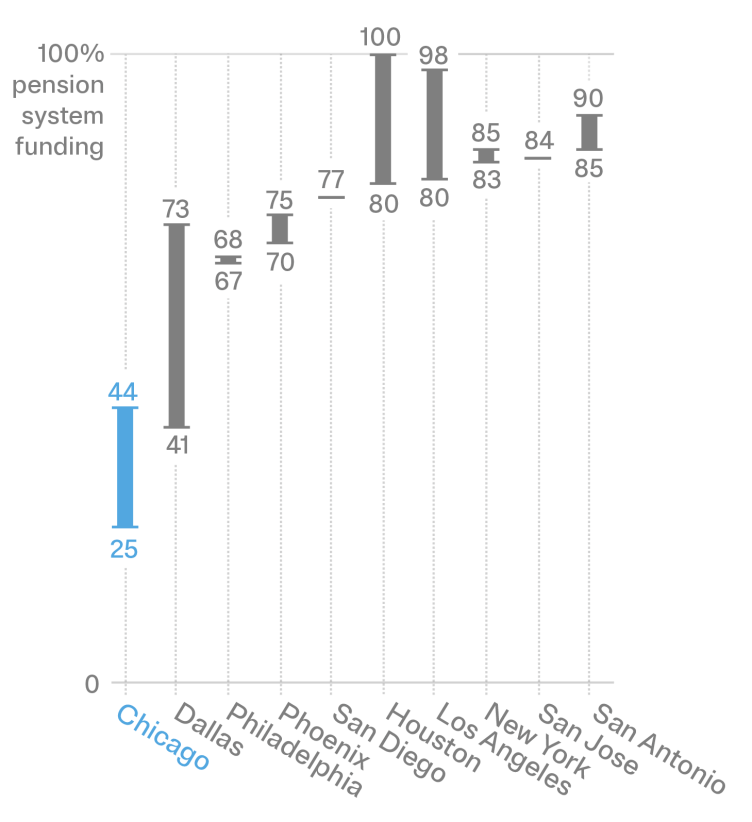
Chicago’s Pension Systems Are Less than 50% Funded
The city is an outlier among other large cities, where most pensions are at least 75% funded.
Note: Most cities have multiple pension funds. This chart displays the range between the pension fund with the least funding and the most funding within each city. Percentages are rounded to the nearest whole number. Source: 2025 city budgets and pension reports (data as of September 2026)Lucas Waldron/ProPublica
Options for a financial rescue are limited or unpalatable. Pension obligations, locked in by law and political realities, remain untouchable. There is little public or political appetite to raise property taxes or cut city jobs, particularly among the ranks of police, the city’s largest workforce. A windfall from the city’s still-under-construction casino grows more unlikely than ever.
The office of Mayor Brandon Johnson, who is finishing up his first term in office, blames “reckless financing methods” from past administrations for the city’s financial bind.
“Savings and efficiencies alone cannot solve the city’s persistent structural gap,” the city’s Office of Budget and Management wrote to WTTW and ProPublica in response to questions for this story. In searching for revenue streams, Johnson has sought to impose new taxes on the city’s biggest corporations — an effort that has met stiff resistance.
Tackling the pension crisis, the city since 2023 has paid an additional $1 billion into its four pension funds above what is required by state law, records show, an infusion that the city touts as a stabilizing force.
But, like his predecessors, Johnson continues to rely on borrowing. Since taking office in 2023, Johnson has added $1.9 billion to the city’s debt obligations, according to city data.
That borrowing has “advanced desperately needed investment in economic development and affordable housing in historically underserved communities on the South and West sides,” according to Johnson’s spokesperson.
It also has been used to keep the city functioning. In 2026, for example, Chicago borrowed $166 million to pay firefighters what they were owed for working without a contract — and annual raises — for four years. Officials acknowledged they failed to set enough cash aside annually to cover those widely anticipated costs. The city borrowed an additional $267 million to cover the soaring cost of lawsuits alleging Chicago police officers committed a wide range of misconduct.
In some cases, the Johnson administration has negotiated agreements with its lenders that allow the city to pay only interest for several years, backloading its debt burden.
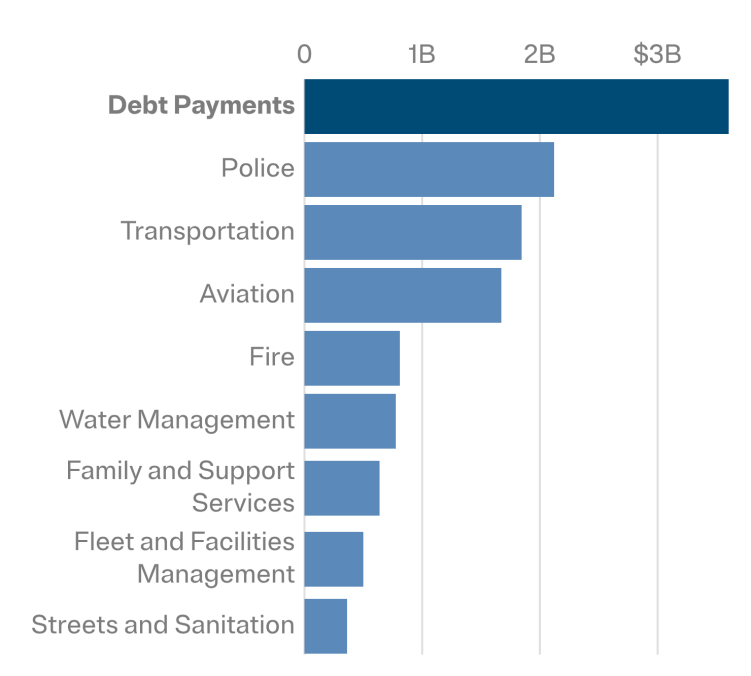
Chicago’s Debt Payments Were the Largest Category of the City’s Budget in 2026
Note: The aviation budget funds the operation of Chicago’s airports, O’Hare International and Midway International. Source: 2026 Chicago city budgetLucas Waldron/ProPublica
With so much of the city budget dedicated to debt and pensions — and more cordoned off by federal and state laws that mandate spending for specific purposes, such as transportation — Chicago officials get to decide how to spend just one-third of its annual budget, records show.
The result for residents: Restaurant inspections are lagging. Complaints about crumbling sidewalks and injuries from those hazards pile up, without timely repairs. The city’s Public Health Department doesn’t have enough caseworkers to handle the intensive intervention needed for children suffering from lead poisoning.
The budget pressures are unrelenting. In August, Johnson announced another borrowing plan to fix a budget shortfall that emerged midyear. He blamed the City Council for overestimating the impact of new revenue streams while his council foes accused him of continuing a pattern of questionable borrowing habits.
Amid the finger-pointing, Johnson acknowledged the bind facing his administration and the city as a whole. “We cannot continue to budget by searching for loose change in the couch,” he said.
“We cannot continue to budget by searching for loose change in the couch.”
Chicago Mayor Brandon Johnson
Watching the annual struggles of city officials to climb out of its money pit leaves many residents feeling more than a little uneasy about what comes next.
“It is the feeling that people get when they max out their credit card and they’re barely paying the minimum,” said Alderperson Andre Vasquez, who represents the 40th Ward and speaks often of growing up in a family that struggled to pay the rent every month. “You’re behind on your utilities. So you get mail every month, letting you know you’re behind.
“And at some point, you’re not even gonna open the envelope anymore, because the feeling of dread, even trying to see it, is a challenging one. That’s how people in Chicago feel.”
Unhealthy Fallout
When Johnson ran for mayor in 2023, he repeatedly emphasized his commitment to invest in the city’s neighborhoods in order to build a healthier city. Central to his message was a pledge to reopen six mental health clinics closed by former Mayor Rahm Emanuel when he faced his own budget pressures in 2011.
Those closures fueled a terrible cycle, Johnson has said. Chicagoans in desperate need of counseling and medication instead found themselves in crisis, forced to call 911 for help or struggle alone.
But during Johnson’s time in office, the city has reopened just two clinics. The city’s lack of capacity has forced nonprofit organizations to pick up the slack, despite their own funding woes and staffing challenges.
Johnson, who has touted his record of investing in “historically underserved communities,” is promising to open another clinic in 2027. But fulfilling that promise hinges on the outcome of a court fight over whether Chicago can levy taxes on social media companies like Facebook and YouTube.
“The need is big and growing,” said Mark Ishaug, CEO of Thresholds, a nonprofit group that specializes in community care. “We don’t have enough money, and what we do have is being threatened.”
Hemmed in by the city’s budget, Johnson has worked to expand mental health services outside the traditional clinic setting by offering counseling at libraries across the city several times a week and launching a “street psychiatry” program focused on unhoused Chicagoans.
The Beverly-Morgan Park Mental Health Clinic is one of six mental health clinics that were designated for closure in 2011 and that Mayor Brandon Johnson pledged to reopen when he ran for mayor. It has yet to reopen.Taylor Glascock for ProPublica
Chicago’s wide range of public health needs often have solutions that require money the city lacks.
In recent years, for example, the Public Health Department’s food safety programs have been “not in substantial compliance,” according to a 2025 state audit. The department has had to prioritize restaurants and other eateries that are considered high risk while lower-risk establishments are inspected less frequently. But even that effort falls short. State law requires three inspections a year for high-priority eateries, yet that happens at only 15% of those, records show.
Inspections also were at the center of a 2023 City Council proposal to prevent lead poisoning, especially among the city’s vulnerable children living in aging or neglected housing. More than 600,000 houses and apartments, the majority of the city’s homes, were built before 1978, when lead paint was banned by the federal government. Lead paint poses a hazard in 99% of homes built before 1978, officials have said.
One solution suggested by an alderperson would’ve mandated that the city inspect every Chicago home or apartment every five years for lead paint and other health hazards. But the proposal would have required the Public Health Department to hire 600 new inspectors, more than doubling its total workforce — and its budget. Ultimately, not a single hearing was held on the idea.
This March, the issue came up again, when the City Council created a working group to develop a plan to proactively inspect all Chicago homes offered for rent. The first step would be a study and recommendations within six months. But that deadline passed without any public progress, despite several community meetings.
The department’s current efforts to address child lead poisoning underscore the impact of budget pressures.
The department receives more than 1,000 notifications each year about children with lead poisoning. Each report kicks off a complicated remediation process, involving multiple city departments, designed to identify and remove the lead source from the child’s home. Health department nurses work with the families to monitor their children’s health and assess whether the city’s abatement efforts are working.
Public health records provide a snapshot of workloads for caseworkers during the first quarter of the year, with several handling more than 200 cases at a time. “Concerns remain for case managers with persistently high caseloads,” wrote a supervising nurse in an April email to department leaders.
A department spokesperson said it reaches out to all families in these situations, “providing at minimum direct outreach and educational materials.” More than 96% of families that are contacted get a home visit from department staff. The spokesperson did not say what percentage of families the city is able to reach.
In the coming months, Public Health will have to do even more with its limited budget. The state of Illinois has lowered the threshold for elevated levels of lead in the blood, which will lead to increases in positive tests.
Coupled with the city’s efforts to expand blood tests for children in areas on the South and West sides, even more families are expected to enter the queue for case management.
Patchwork Solutions
Felicia Nalls-Bradley just wanted to get to work. It was her first week on the job.
But she tripped over an uneven sidewalk on the South Side in 2022. As she fell, she struck a fence and suffered injuries to her head, neck, shoulders, hands and back that required surgery and almost a week in the hospital. Records describe the path as “unreasonably hazardous,” with a 2-inch difference in elevation between two portions of the walkway.
She sued the city for negligence and settled for $400,000 last year. It was one of more than 350 sidewalk-related cases the city has settled since 2010, records show. The city has paid at least $16.1 million to resolve such claims during that period.
Records and deposition testimony from those cases describe a largely reactive maintenance system that relies heavily on residents to report problems.
A city engineer testified in a sidewalk-injury deposition in 2024 that Chicago does not routinely inspect its sidewalks. He also said that employees investigating a complaint are not expected to identify other hazards nearby.
In separate testimony in 2017, another engineer said the city responded to about 13,000 sidewalk maintenance requests annually but had only a handful of crews rotating across Chicago to make repairs.
The engineer’s testimony in another case contrasted his professional desires with the limitations of his resources. “In a perfect world I would like to do that, yes,” he said about inspecting every sidewalk complaint.
He then added a caveat: “This is the real world.”
Injuries — and lawsuits — are not the only consequence of poor sidewalk maintenance. Iliana Haven, who uses a power wheelchair and scooter because of a neuromuscular condition, said they regularly encounter obstacles as they struggle to get around.
A thwarted trip to the Puerto Rican People’s Day Parade exemplified their problems as they encountered broken and uneven sidewalks on their scooter. After being unable to find a passable route, Haven called family for help.
Iliana Haven in their Near West Side neighborhoodTaylor Glascock for ProPublicaAn uneven sidewalk in Haven’s neighborhoodTaylor Glascock for ProPublica
It took about 30 minutes for relatives to find Haven. Family members returned home to get a motorized wheelchair, which could more easily carry Haven to the event. But it had nearly concluded by the time everybody got through the entrance gate. Haven appreciated the help and took it with good humor, but the ordeal highlighted a lesson.
“It is a rule of mine to never leave anywhere by myself if I can help it,” Haven said.
They also understand the frustration of others challenged by sidewalks. The lack of access impacts businesses in the end, they said.
“There’s a huge number of disabled people in the city of Chicago. We would love to go and spend our money,” Haven said. “We can only do that if we can leave our house.”
The Debt Burden
After declaring that he would run again for mayor in next year’s election, Johnson gathered the media in early October to tout what his administration called a success story, a concrete example of his commitment to building up neglected areas of the city.
Under bright skies, he cut the ribbon on seven new two-flats in North Lawndale, a West Side neighborhood that has seen its population dwindle and its crime rate remain stubbornly high. The only way to reverse those entrenched trends, he said, is to create safe, affordable new homes that will allow Chicagoans to “put down roots and build wealth.”
Developers and city officials, including Johnson, third from right, cut the ribbon on seven two-flat buildings in the North Lawndale neighborhood on the city’s West Side in October. These homes are the first to open as part of a city initiative to create more market-rate housing in neglected neighborhoods.Michael Liptrot/Block Club Chicago
The homes were built on city-owned vacant land; they also were built on more city debt. The Johnson administration used $5.4 million from the $1.25 billion Johnson borrowed in 2025 to fund housing and economic development projects across the city.
The debate over that borrowing crystalized Chicago’s current governing dilemma: Should it reduce its dependence on debt or address crucial needs for Chicagoans? And is it possible to do both?
Some alderpersons warned the city could not afford to borrow another $1.25 billion and questioned the wisdom of a payment schedule that avoids paying any principal until 2028. If that debt is not retired until 2055, as scheduled, taxpayers will have paid more than $98.9 million in interest costs alone, records show.
That borrowing is at the heart of Johnson’s attempt to expand the city’s economic capacity and invest in neighborhoods that have long been ignored by City Hall. His administration defends the borrowing by saying there is a plan to pay it back with a new approach that doesn’t affect taxpayers. Nearly four dozen tax-increment financing districts are set to expire by 2039, allowing more than $2 billion to flow back to the city, Chicago Public Schools and other taxing districts in coming years, records show.
Some alderpersons remain skeptical of Johnson’s budget strategy, and his overall financial stewardship was dealt a significant setback when Chief Financial Officer Ashlee Gabrysch resigned Friday. She described a deep rift with the administration over how to portray the city’s finances.
Chief Financial Officer Ashlee Gabrysch resigned Friday.City of Chicago via LinkedIn
“The Chief Financial Officer’s statements about the City’s finances are relied upon by investors, rating agencies, City Council, and taxpayers, and they must be complete and accurate,” she wrote to Johnson. “I am not able to fulfill those obligations under the conditions in which I have been asked to serve.”
The city responded by criticizing her job performance, saying she had been “largely absent” as Johnson’s team worked on its 2027 budget.
In the aftermath, alderpersons are seeking an audit of city finances. A majority already have been sparring with Johnson over borrowing.
They moved in September to make it harder to take on new debt by requiring the votes of at least 30 alderpersons, not just a simple majority from the panel of 50. Johnson blasted that change, saying it would stop investment flowing to neighborhoods like North Lawndale, and vetoed it.
Justin Marlowe, a professor at the University of Chicago Harris School of Public Policy and the director of the Center for Municipal Finance, said Johnson faces hard choices as he tries to implement his agenda.
“I give the mayor credit for having aspirations to make housing more affordable and to expand behavioral and mental health care,” Marlowe said. “These are all noble goals. But the city can’t afford it.”
Less than two weeks later, Johnson was back at City Hall, giving his 2027 budget address and outlining his plans to fill yet another large gap. Among his solutions again was a corporate tax, which once again was deemed dead-on-arrival by key alderpersons. But the City Council may have no choice but to go along with Johnson’s plan for more borrowing.
Johnson delivers his annual budget address to the Chicago City Council in October.Victor Hilitski/WTTW News
He proposed borrowing $481 million in 2027 to cover the cost of resolving lawsuits alleging that police misconduct led to wrongful convictions and deadly pursuits. If approved by the council, it would mark the second straight year that the city has borrowed to cover its bills, a move that financial experts consider a sign of worsening financial distress.
Marlowe said the city has no choice but to borrow to cover those costs, calling it the “least bad option” available to the city.
But Joseph Ferguson, who heads the Civic Federation, a nonpartisan budget watchdog group, was unimpressed by Johnson’s presentation. He’s seen a pattern over decades in which city officials plan to make it through the next election cycle or the next budget fight without looking toward lasting solutions.
Johnson’s plan, Ferguson said, shifts costs onto future taxpayers and only manages to “dig the city deeper into a financial hole.”
Clutching a Shake Shack bag in the Denver airport Saturday, Lis Smith held forth on her “do’s and don’ts” for the Democrats. Do: Focus on cost of living and accountability for the excesses of the Trump administration. Don’t: Prioritize revenge on Trump before hitting your affordability goals.
“The voters who helped us get this majority were voters that said we want you to lower our costs, we want you to listen to us, we want you to root out corruption,” said Smith, a prominent strategist for the centrist wing of the Democratic Party. “We’re living in the middle of a cost-of-living-crisis, and if you’re not talking to voters about that issue, not meeting them where they are in terms of their anger at the system, at both the economic and political system, like, you’re doing it wrong.”
Smith was among the flotsam and jetsam of exhausted Democratic politicos swirling about Denver International Airport in a surreal coda to a gathering she’d helped organize: a two-day conference of moderate and center-left Democrats exploring the future of the party, aptly dubbed “What’s Next.”
It was organized by the self-styled pragmatists of Majority Democrats, a hybrid political action committee and super PAC bankrolled by the hedge fund tycoon Stephen Mandel and his wife, Sue, and co-signed by the Searchlight Institute, a centrist think tank launched by former staffers of John Fetterman who have sought to quash the party’s focus on more left-leaning policy. The conference was seen as a practice ground for stump speeches from potential 2028 presidential candidates, heavy on party unity and light on ideological debate.
Within the confines of the Mission Ballroom complex in Denver’s River North neighborhood, it was a safe space for hopefuls like former Transportation Secretary Pete Buttigieg, Sen. Elissa Slotkin of Michigan, Sen. Ruben Gallego of Texas, Gov. Josh Shapiro of Pennsylvania, and Sen. Corey Booker of New Jersey to test out their lines for next cycle — before they have to go in front of the public.
But now, it was stuck.
On Friday, the Federal Aviation Administration issued a rare nationwide ground stop order, throwing the nation’s airports into chaos and canceling thousands of flights. As the situation was unfolding, Buttigieg joked onstage that he’d be available to help anyone looking to rebook their flight. On Saturday, 24 hours later, that joke might have been less funny to the likes of Georgia Sen. Raphael Warnock, who told The Intercept he had been unceremoniously deplaned from a flight canceled at the last minute.
Despite the airline chaos, Smith was feeling good. To her, the attendees represent the future in a post-Blue Tsunami landscape — and you better not call them the establishment.
“Majority Democrats does not consider itself a centrist organization,” said Smith, who worked on Buttigieg’s 2020 presidential run, former New York Gov. Andrew Cuomo’s 2018 reelection campaign, and Cuomo’s 2021 response to sexual harassment allegations. “So we want to be an alternative to the stale establishment that puts up candidates like Joe Biden or like Andrew Cuomo for mayor.”
Smith said she welcomed it when “What’s Next” became the scene of early shots in a battle over Democratic leadership in the Senate. On Thursday, the first night of the conference, at about 7 p.m. Mountain time, news broke that Sen. Chris Van Hollen — a Maryland Democrat, conference invitee, and rumored 2028 hopeful — planned to mount a challenge to Sen. Chuck Schumer, D-N.Y., for party leadership.
“I think a little democracy in the United States Senate caucus is a good thing,” he said at his first press conference on the matter on Friday. “I think it’s important that we give Senate Democrats a choice. We gave voters all over the country a choice, and they chose change.”
Van Hollen, who has differentiated himself from Schumer with his critical stance on Israel, told reporters he had decided to abandon a go for the White House in 2028 in favor of shaking up the party’s presence in the Senate.
It was a slight departure from the celebratory mood in Denver, where the words “big tent” were frequently bandied about. At the airport, Smith told The Intercept she and other organizers were as surprised as anyone by Van Hollen’s announcement. “We invited Van Hollen just as we invited anyone who was on the list of potential 2028ers,” she said. “But what better place to do it, I guess!”
Aside from Van Hollen positioning himself as a progressive challenger to Schumer, there was a noted absence of the party’s left flank. The progressives who did make the invite list stayed on message with the “takes all kinds” approach to Democratic victory.
“It’s a really good time to be a Democrat right now,” said Morris Katz, a campaign adviser to New York City Mayor Zohran Mamdani and, later, to Maine Senate candidate Graham Platner. “I think if you look at the historic wins that we had across the country and the way those candidates spoke, they sound a lot more like Bernie Sanders in 2016 than Hillary Clinton in 2016.”
But not everyone was feeling the love. Shelby Green, an organizer for a campaign in Florida to turn the state’s bankrupt Brightline railroad service into a public asset, criticized the conference organizers for having few Black women speakers on the main stage. She spoke bitterly of what she described as the party’s failure to properly support Angie Nixon, a Democratic Socialists of America-backed candidate who narrowly lost her contest for Senate in Florida.
“They waited until just weeks before the election to do a get-out-the-vote push, when they should have been doing voter registration,” Green said. “I think there should have been a space to apologize to Angie Nixon and to apologize to the South and say, ‘I’m sorry we underinvested, what can we do to make sure we don’t miss the ball next time?’”
Perhaps the most heated moments came when the conference attendees were forced to interact with members of the public — particularly those who disagreed with them.
On Friday morning, moments into a sit-down interview on the main stage between Jessica Tarlov, a token Democrat on Fox News, and New York Rep. Hakeem Jeffries, heir apparent to the Democratic leadership in the House, a small group of protesters stood up and started to shout for some of the left-wing policies that had gone largely unmentioned inside the conference.
“When is it time for Medicare for all?” one protester called out, prompting boos and jeers from the crowd. “When is it time for an arms embargo?”
As the protesters were ushered out, Jeffries began to speak of the honor he felt at “the trust placed in us by the American people.”
“Nobody trusts you!” another protester called out.
The conference shielded its attendees from most of the dissent. On the drive into the city on Thursday morning, The Intercept spotted a gaggle of protesters from the group Indivisible hoisting a huge banner on a highway overpass declaring “No Schumer Coronation,” objecting to the New York Democrat’s presumed rise as Senate majority leader. The group reappeared outside the convention center on Friday morning alongside protesters from Sunrise Movement demanding a Green New Deal, while police in riot gear milled around an armored vehicle looking bored and over-equipped. Onboard a shuttle bus ferrying conference-goers from their hotels to the convention center, one battle-hardened Democratic operative derided the protesters as “wacktivists,” expressing a distaste for the so-called “groups” blamed by many in the Democratic establishment for dragging the party left on social issues, to its detriment in 2024.
On the street corner on Friday morning, Tammy Butters, a retired teacher, told The Intercept that she was merely there to encourage those inside to not “chicken out” of holding the Trump administration accountable.
“There’s all this talk of compromise and talking to the other side, and I get that,” Butters said. “But I think we the people are screaming for accountability, and accountability and affordability are not separate issues. We are capable of doing both.”