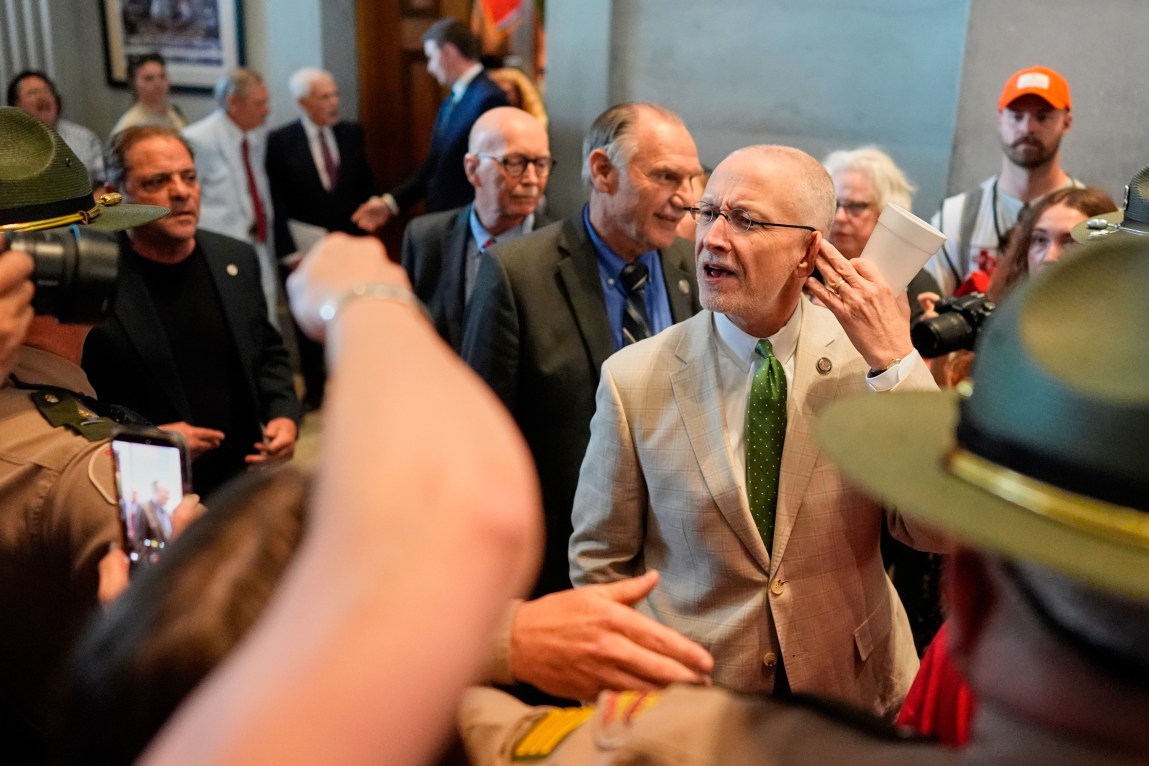
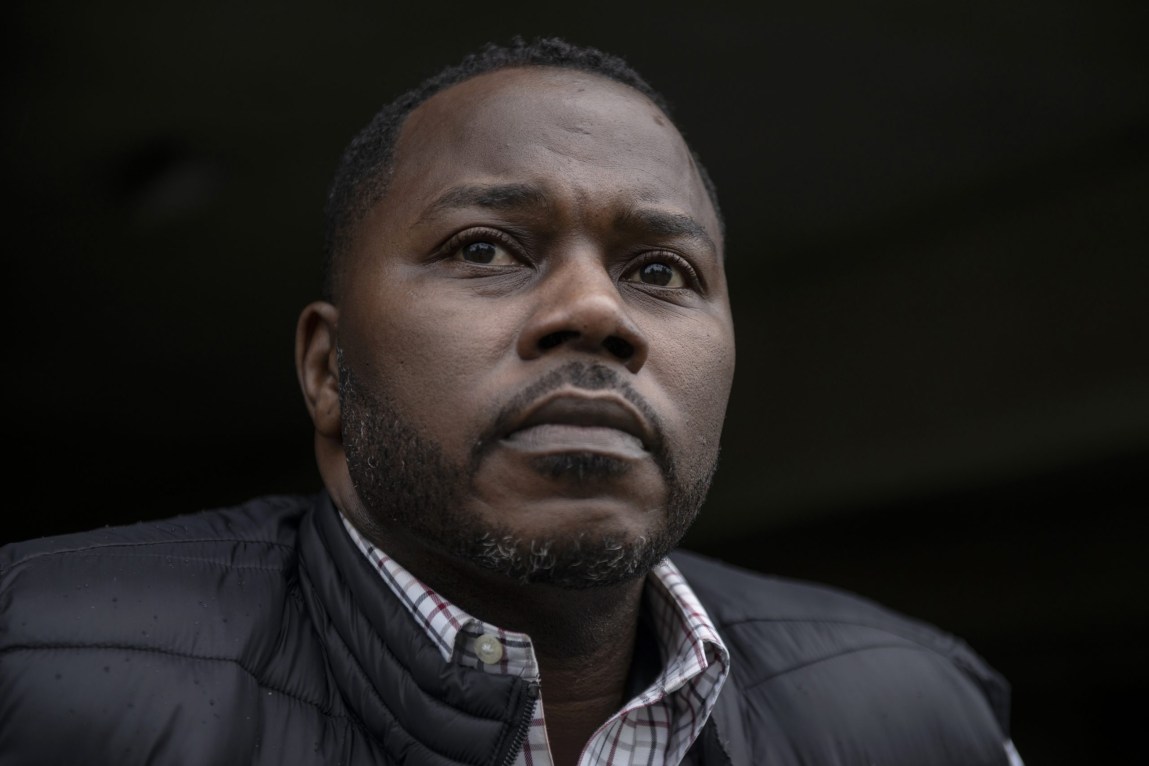
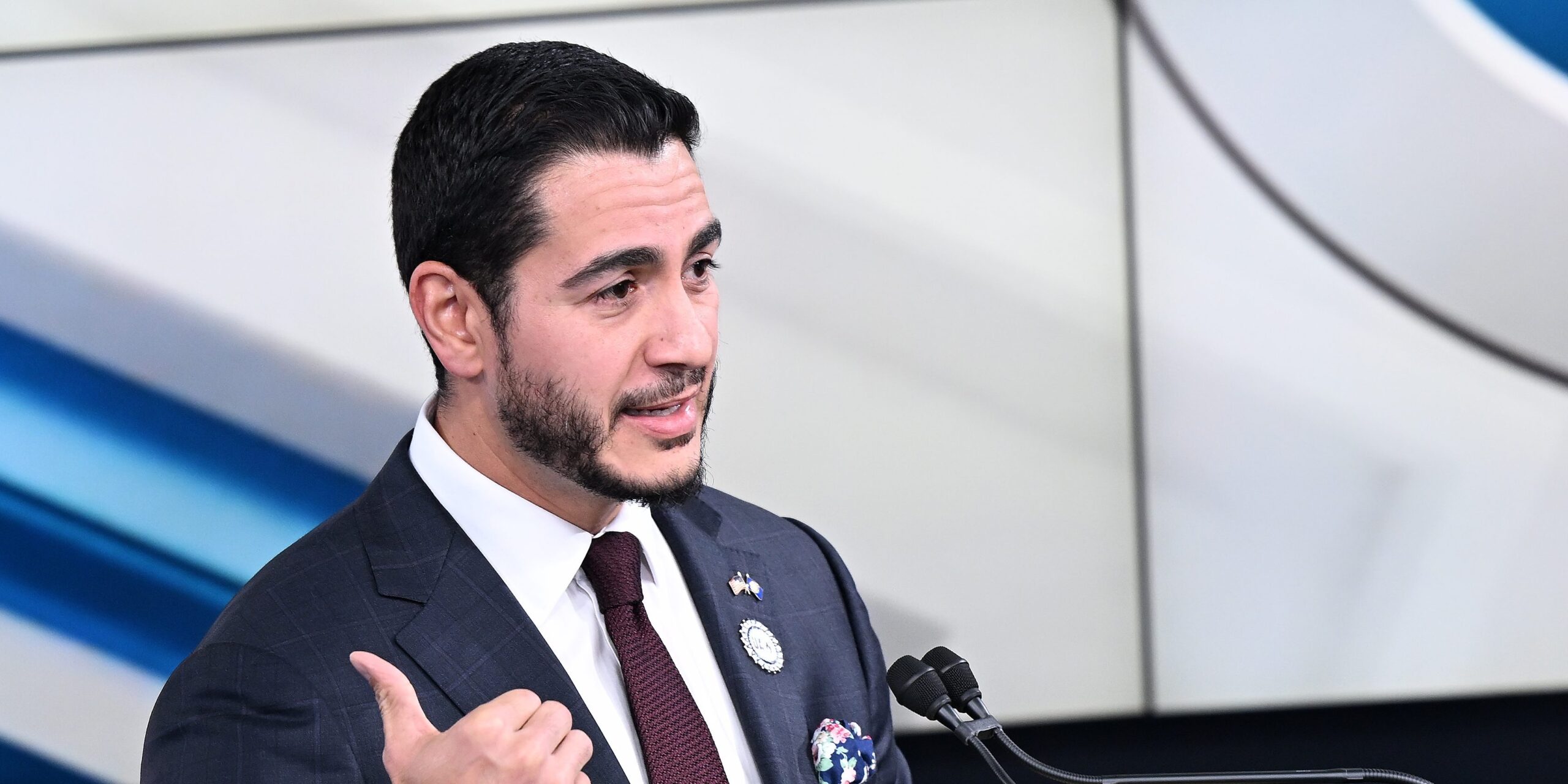
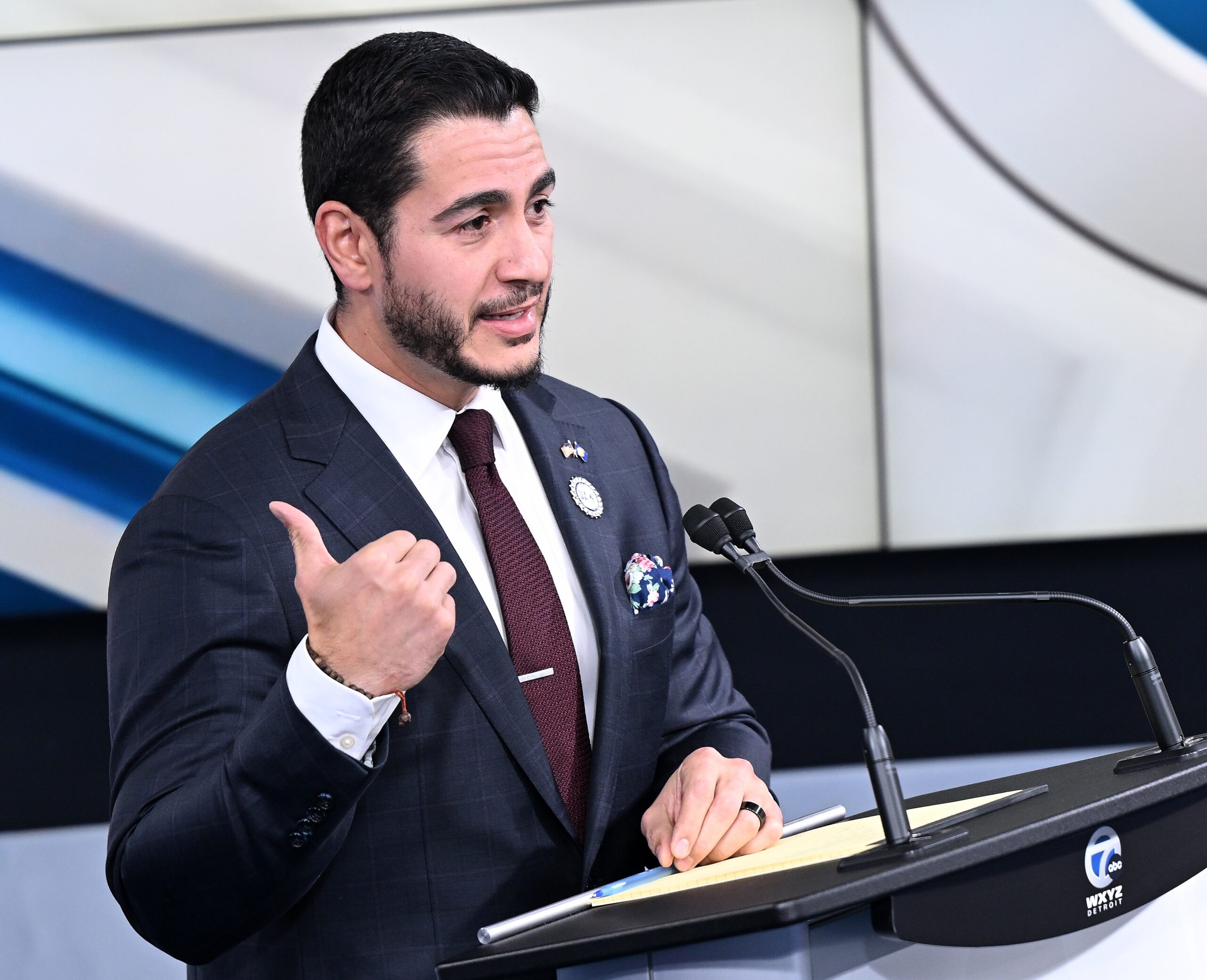
State Sen. Brent Taylor, R-Memphis, interacts with protesters as he leaves the Senate chamber after a special session of the state legislature to redraw the U.S. congressional voting map in Nashville, Tennessee, in May. George Walker IV/AP
Not two weeks after the Tennessee legislature carved Memphis into three congressional districts this spring, in a move designed to eliminate Democratic representation, Republican state Sen. Brent Taylor made his electoral expectations clear in a photo posted on social media.
Taylor and U.S. Rep. Tim Burchett, a fellow Republican, sat side by side on the U.S. Capitol steps. “My friend Tim Burchett showing me the dadgum ropes,” Taylor wrote in a Facebook post.
On May 7, the same day that the new districts were approved, Taylor had announced his bid to represent the redrawn Congressional District 9, which for more than four decades had stood as the state’s sole majority Black district. During that time, it covered mostly the Memphis area; it now stretches across half the state and is majority white.
Taylor, 58, already has a track record with many of the voters he is now seeking to represent in Washington, D. C.: In his nearly four years as a state senator, he has taken steps to strip authority from local officials elected by many of those same voters. With the backing of a Republican supermajority, Taylor, who is white, pushed through half a dozen laws that superseded the power and priorities of local politicians.
Around the country, state legislatures from both parties have used preemption laws to control local governments. That tactic has been embraced by Republican-dominated statehouses in recent years as a way to restrict the ability of Democratic-led cities to enact policies state leaders disagree with, including protections for civil rights, public health and workers.
Memphis has long struggled with high rates of violent crime that have begun to fall only in the last couple of years. This is where Taylor focused his legislative efforts. He led the charge to prohibit judges from considering a defendant’s ability to pay when making bail decisions. He has tried to oust Steve Mulroy, the first Democrat elected as Shelby County district attorney in 25 years, and pushed through legislation authorizing the state to review every decision made by his office. And he co-sponsored a law that voided the Memphis City Council’s ban on police stops for minor traffic infractions, which had been passed after the 2023 beating death of Black motorist Tyré Nichols.
The question of how to keep communities safe has drawn divergent political approaches in Memphis — from Mulroy’s focus on rehabilitation as part of his effort to lower violent crime, to Taylor’s emphasis on aggressive prosecution and incarceration. Those approaches can mean very different experiences for the people of Memphis, which makes up most of Shelby County. Some elected officials and criminal justice experts warn that the laws Taylor has championed will embolden police to detain drivers without justification and the criminal justice system to lock up more people for longer periods in the already overcrowded county jail, where more than 65 people have died since 2018.
“I think he’s very dangerous for Shelby County, and he’s going to be very dangerous for the Ninth District if he gets elected,” said former Shelby County General Sessions Court Judge Bill Anderson, referring to how Taylor’s policies could especially harm Black men. Anderson retired in May 2025 after clashing publicly with Taylor over bail reform measures. (Anderson supported them; Taylor opposed them.)
Taylor is favored to win because of redistricting by Tennessee Republicans after a U.S. Supreme Court ruling in April made it harder to challenge gerrymandering that dilutes the Black vote. The Mississippi native, who lives in an antebellum-style mansion in a tiny and heavily white community east of Memphis, has loaned his congressional campaign $1.5 million. The candidate made millions after selling his funeral home businesses to a private equity firm.
Taylor’s opponent is state Rep. Justin J. Pearson, a 31-year-old Black Democrat who has taken a very different approach to what the district needs. Pearson has called for addressing the root causes of crime by improving schools and economic opportunities instead of a singular focus on incarceration. He first made national headlines for his role in stopping the construction of an oil pipeline in a Black Memphis neighborhood. He is also one of two Democratic legislators expelled by the Republican supermajority after leading a protest calling for gun control following a 2023 school shooting. With deep family roots in southwest Memphis, Pearson has positioned himself as the better fit for the historically Democratic Ninth Congressional District. He has also received support from national Democrats and has outraised Taylor in campaign donations.
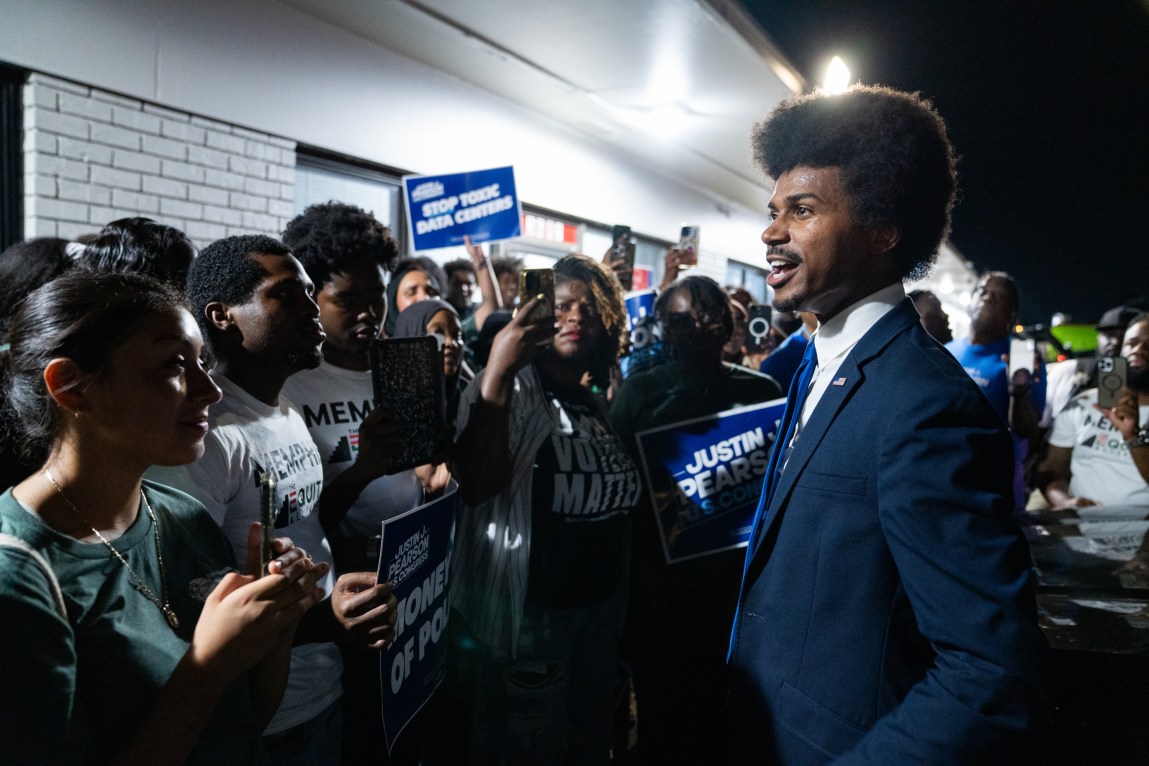
Democratic congressional candidate state Rep. Justin J. Pearson speaks to supporters after an election night watch party for the state’s primaries in Memphis, Tennessee, in August.Kevin Wurm/MLK50/CatchLight Local/Report for America
Taylor, who declined to be interviewed for this story, has said that the laws he has championed prioritize public safety. He did not respond to detailed questions.
But John Pfaff, a professor at Fordham School of Law who has studied how state preemption laws impact prosecutors, said tough-on-crime laws like the ones Taylor helped pass have historically been “a form of social control against disliked minority groups” under the guise of public safety. Non-urban voters, Pfaff said, “do feel, however incorrectly, sort of victimized by expanding civil rights” that urban voters choose. While these voters cannot cast ballots in city elections, he said, they have another path by which to exert power: “If the suburbs and rural areas control the governor’s mansion and the state legislature, they then can use their power there through preemption laws that finally tell Memphis what they want Memphis to do.”
Prohibiting Limits on Police Traffic Stops
In January 2023, the month Taylor took office, the nation was shaken by video of violent policing in Memphis.
A street surveillance camera and police body cameras captured what happened after undercover Memphis police officers pulled over 29-year-old Nichols just a few blocks from his mother’s home. For three minutes, officers repeatedly punched the unarmed man in the face, hit him with a baton and kicked him as he screamed for his mom. Nichols would die from his injuries in the hospital three days later.
After pressure from Nichols’ family and community organizers, the Memphis City Council unanimously passed an ordinance in April of that year barring police from pulling motorists over for minor traffic violations, such as a broken tail light, as a pretext for investigating an unrelated, more serious crime. Research shows that these stops are disproportionately used to detain Black drivers, undermine the public’s trust in police and create unnecessary police encounters that can turn deadly.
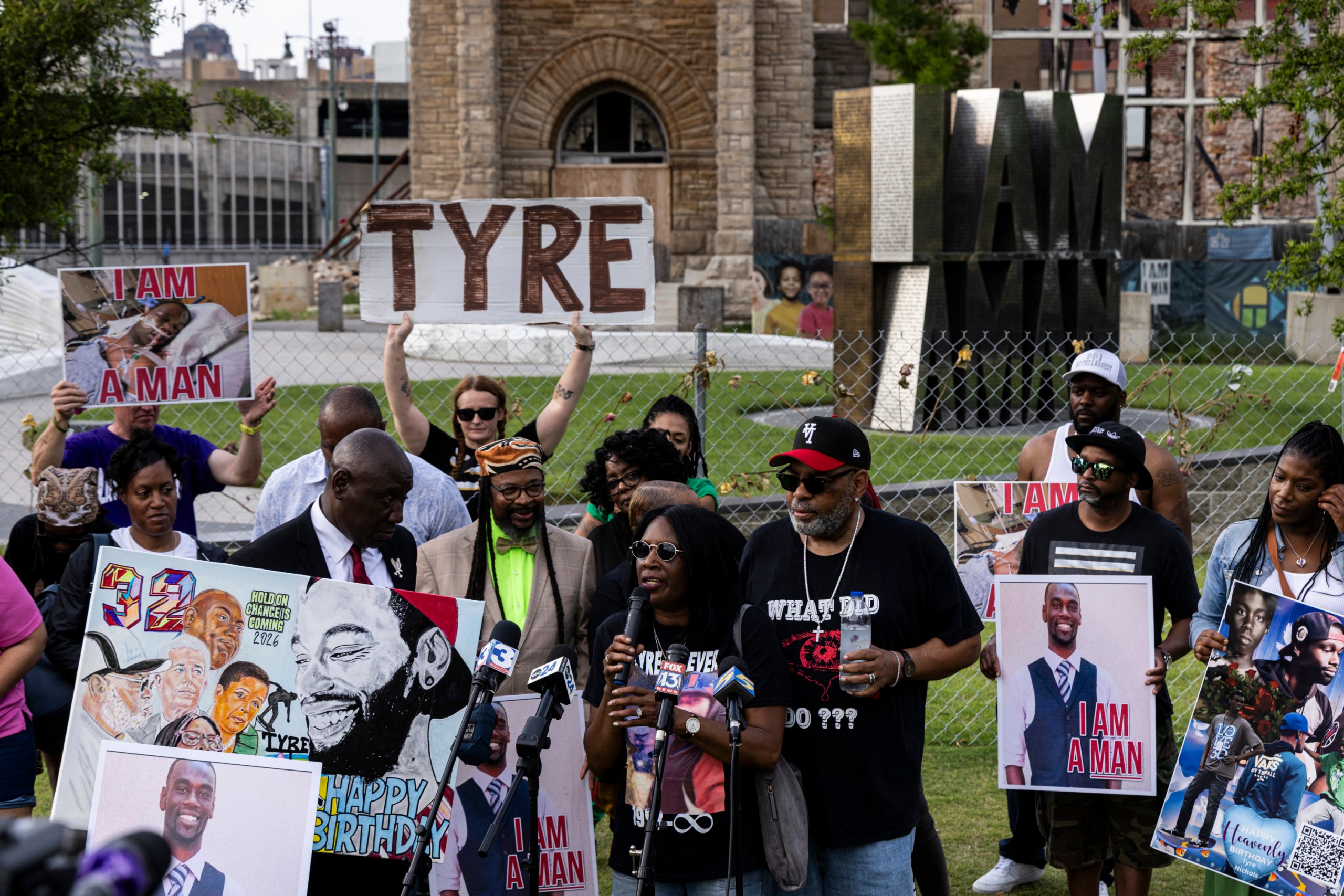
RowVaughn Wells, center, with family, friends and supporters during a community rally and celebration of what would have been Tyré Nichols’ 32nd birthday outside of the I Am a Man Plaza in Memphis in June 2025.Brad Vest for MLK50
Taylor, who had been in the state Senate for a few months when the city ordinance passed, said it made the public less safe by limiting the potential for police to investigate more serious crimes. The next year, he and state Rep. John Gillespie, a Shelby County Republican, sponsored legislation that prohibited local government from curbing law enforcement’s ability to conduct traffic stops, effectively undoing Memphis’ ordinance.
Nichols’ mother, RowVaughn Wells, pleaded with lawmakers to drop the bill. Speaking on the Senate floor, Taylor responded, saying that as a funeral home director, he empathized with the Nichols’ family, but “we can’t let that empathy, Mr. Speaker, cloud our judgment in protecting 7 million Tennesseans.”
Taylor’s intervention suggests “that Memphis voters don’t know what their best interests are,” said Martavius Jones, who was chair of the Memphis City Council when the city ordinance passed. “What we were trying to do would not jeopardize the safety of anyone — not even in Memphis, but much less the rest of the population of Tennessee.”
Tennessee Gov. Bill Lee, a Republican, told reporters before signing the law that no one should limit police in their enforcement methods and officers should be held accountable for their actions.
“I think what’s most important for us to remember is that we can give law enforcement tools,” Lee said, “but we’ve got to hold law enforcement to a standard of using those tools appropriately, where there’s an appropriate interaction with the public.”
Eight months after Tennessee lawmakers passed Taylor’s preemption bill, the U.S. Department of Justice released its investigation of the Memphis Police Department, finding that its aggressive traffic enforcement had harmed Memphians. The Justice Department recommended that the city limit the use of pretextual stops. Such police activity enabled the “regular use of excessive force with impunity” and unlawfully discriminated against Black residents, the Biden administration’s report said. When President Donald Trump took office in 2025, his Justice Department retracted those findings.
Over the last year, law enforcement has ramped up the use of such stops, especially in immigration enforcement, as Trump’s Memphis Safe Task Force — a collection of more than two dozen state and federal law enforcement agencies, including the National Guard — descended upon the city. Taylor supported the effort, testifying before the U.S. Senate days before it began that the task force would “succeed in doing the hard work to infiltrate gangs and arrest more routine criminals.”
Unprecedented Scrutiny of a District Attorney
Since his first year in the state Senate, Taylor had also been working to displace the decision-making authority of another locally elected office: district attorneys, especially Mulroy, one of Tennessee’s two Democratic county prosecutors. Taylor called him a “far-left zealot” who “has the potential to make the scourge of violent crime even worse.”
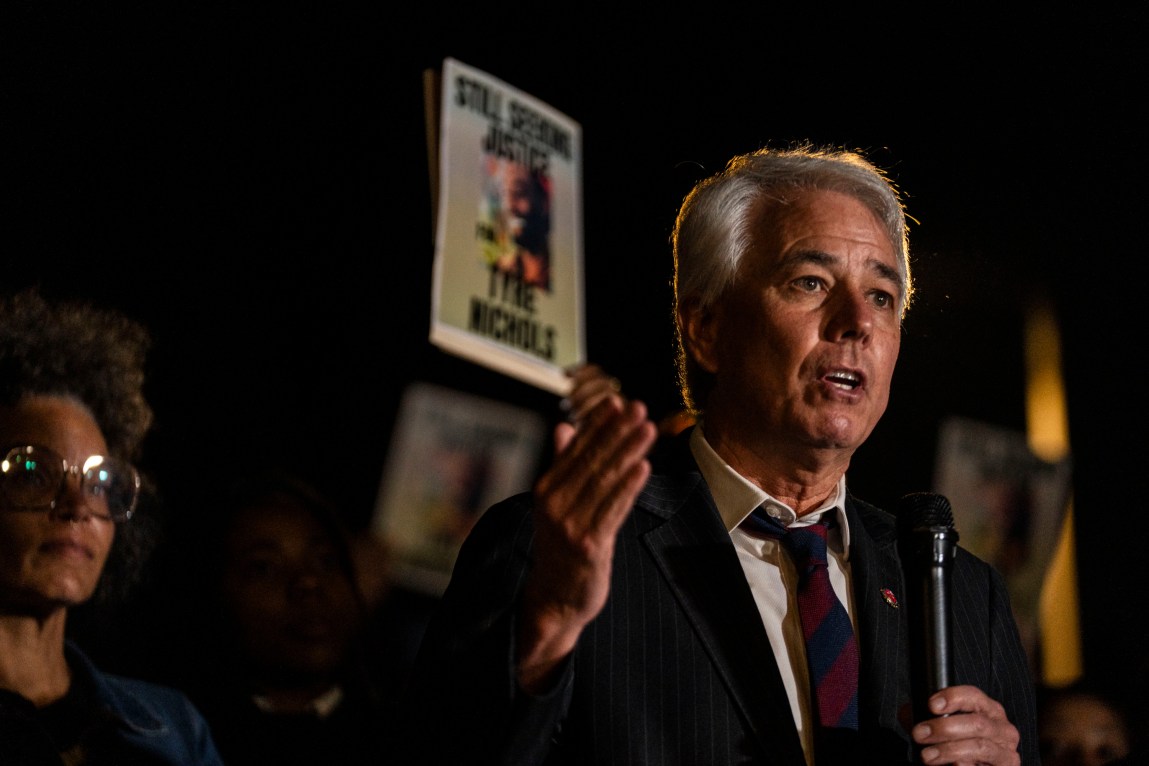
Shelby County District Attorney Steve Mulroy speaks at a vigil for the third anniversary of Nichols’ death in Memphis in January.Andrea Morales/MLK50
In 2023, Taylor sponsored a law that transferred the power to review certain death penalty cases from county prosecutors, who are elected, to the state attorney general, who is appointed by the state Supreme Court. While the law applied statewide, it disproportionately impacted Shelby County, where half of the state’s 40 death row prisoners were prosecuted. The law, Mulroy said at the time, “effectively disenfranchises the voters” who chose their district attorney.
Taylor would go on to further weaken Mulroy’s office following Trump’s 2025 deployment of his crime task force to Memphis. As arrests soared, Taylor worked to place the district attorney’s decisions under unprecedented scrutiny, saying he wanted to ensure that the prosecution of task force cases was as aggressive as the task force itself.
One new law, co-sponsored by Taylor, authorized the state attorney general to review every case that comes through Mulroy’s office, including those that stem from arrests made by Trump’s task force, “to ensure the proper administration of justice necessary to protect the safety of the community.” The dispositions of each case, along with bail recommendations, would be reported to legislative leaders.
Republican state Rep. Andrew Farmer, who introduced the bill in the House, noted that it is designed to ensure that “all crimes that deserve to be prosecuted are prosecuted.”
Mulroy is “just going to have to work harder and ensure that people are continuing to stay safe,” Farmer said on the House floor. “We want Memphis to continue on the path that it’s going — up.”
The state’s district attorneys general conference, led by Republican former District Attorney Stephen Crump, opposed an early version of the bill, which would have applied to district attorneys across the state, because it could lead prosecutors to second-guess their decisions. He dropped his objections after the bill was narrowed to apply to only Mulroy.
That law has another provision aimed at Mulroy as well: If he declines to prosecute specific categories of crime, the state attorney general can ask the state Supreme Court to intervene by installing a temporary district attorney who would then decide whether to prosecute. Taylor has long sought to limit Mulroy’s authority, and the provision would be a way to do so. Mulroy said the effect would be “an unelected shadow DA operating in parallel to the duly elected DA.”
“Prosecutorial discretion and prosecutorial independence is a key fundamental part of our criminal justice system,” Mulroy said. “It’s clear under both the text of the Tennessee constitution and Tennessee Supreme Court case law, and this bill does great violence to those principles.”
Taylor co-sponsored a second law, passed in May, that requires Mulroy’s office to report to the state and the U.S. Department of Justice within 10 business days every time it has entered into a plea deal, or dismissed or lowered the charges on a felony offense that resulted from a task force arrest.
“Memphis residents deserve confidence that the significant investments being made to combat violent crime are matched with accountability at every level of the justice system,” Gillespie, who co-sponsored the bill in the House, said at the time.
Mulroy has sued to stop both laws, claiming they are unconstitutional because they unfairly single out Shelby County and create an administrative burden. The lawsuit is pending in state court. Meanwhile, Mulroy has objected to his staff spending time on the reporting requirements, which he called “pointless busywork.”
Mulroy’s election in 2022 as the county’s first Democratic district attorney in more than two decades came on the heels of a year with a record number of homicides. But Republicans’ tough-on-crime approach had grown unpopular with voters, and Mulroy vowed to be an alternative. He promised to deprioritize the prosecution of low-level offenses such as marijuana possession and shoplifting; emphasize rehabilitation such as drug treatment, mental health counseling and job training; and establish a unit to examine the validity of convictions.
One of the people who campaigned for him was William Arnold, who had spent nearly seven years in state prison before his conviction was dismissed following examination by a Davidson County conviction review unit. The community organizer said he saw Mulroy’s candidacy as a way to “support someone who could help Memphians in a different way.”
To see Mulroy’s power being muted by Taylor is disheartening, Arnold said. But that is not surprising to him, given how the state legislature has long treated the predominantly Black city, including replacing the Memphis Shelby County Schools’ elected board with a state-appointed one.
William Arnold, who spent nearly seven years incarcerated for a crime he did not commit, is now a community organizer and a supporter of Mulroy.Brandon Dill for MLK50
Bail Calculator Scrapped
Among the preemptive legislation Taylor has sponsored, a 2023 effort stood out: the dismantling of a bipartisan effort to ensure Shelby County’s bail practices did not discriminate against poor people, who are disproportionately Black.
Under state law, magistrates are to “impose the least onerous conditions” when deciding bail and should set bail “as low as the court determines is necessary” to assure the defendant returns to court.
But in practice, hundreds of people were being detained at the Shelby County Jail simply because they couldn’t afford bail, according to Just City, a Memphis criminal justice reform organization, which along with the American Civil Liberties Union threatened to sue the county in 2021 for violating existing state law. Being jailed while awaiting trial can cause arrestees to lose jobs and child custody, the organizations argued.
In August 2022, the organizations and county officials — including Mulroy’s predecessor, Republican District Attorney Amy Weirich — agreed on a new bail order that included an “ability to pay” calculator.
That tool quickly drew Taylor’s ire, and by the following January he had co-sponsored a bill to kill it, characterizing the calculator in a Senate Judiciary Committee meeting as a way of “essentially asking defendants how much money they happen to have in their pocket so that they can make bail.”
The bill’s supporters said judges should prioritize public safety when deciding whether to release defendants. “There is blood running in the streets of Memphis today because they’re letting people out,” state Rep. William Lamberth, a Republican, said on the House floor.
State law requires judges, when setting bail, to consider several factors, including a defendant’s financial condition. And Josh Spickler, executive director of Just City, said that’s exactly what the tool helped judges do.
Under Taylor’s law, however, “the defendant’s ability to pay shall not be considered.”
“That tied our hands as judges,” Anderson, the former Shelby County judge, said in an interview.
A 2025 University of Memphis study found that the median bail amount increased after Taylor’s law took effect. And the law’s impact falls hardest on Black residents, Anderson said, because they are more likely to be low-income and make up a disproportionate share of Shelby County jail occupants.
“To those of us in the system, it’s obvious what he’s doing,” said Anderson, who resigned in 2025 with six years left of his eight-year term. “He called them reform acts, but they’re not reform.”
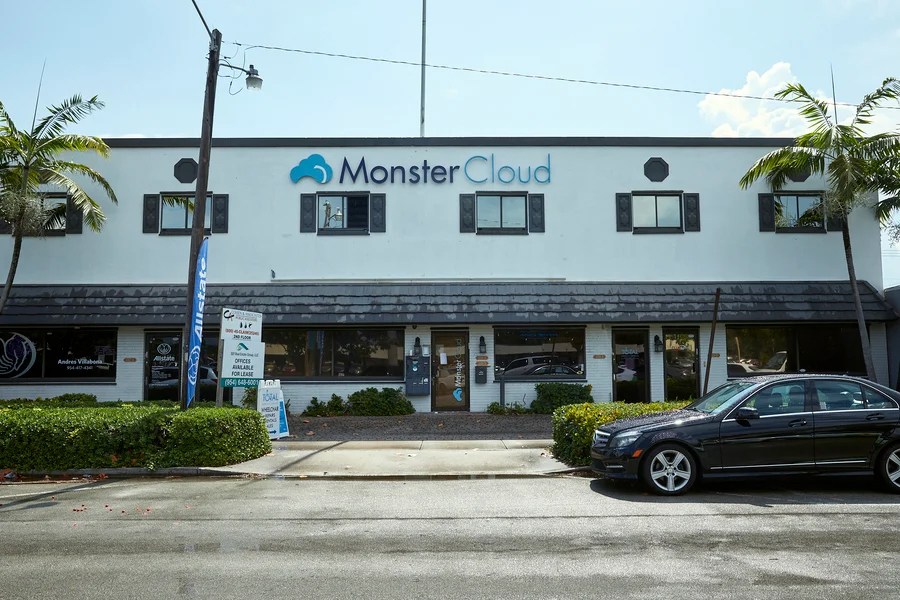
A federal grand jury indicted Zohar Pinhasi last month for allegedly defrauding clients of his ransomware data recovery business, MonsterCloud. Jeffery Salter, special to ProPublica
A Florida man who was the subject of a 2019 investigation by ProPublica was indicted last month on federal charges that he defrauded clients of his ransomware data recovery firm.
According to the Justice Department, the man, Zohar Pinhasi, told customers he could recover their encrypted files without having to pay hackers, when, in reality, he paid the ransom and charged victims a hefty fee on top.
The indictment mirrors the findings from ProPublica’s 2019 article “The Trade Secret,” which centered on Pinhasi and his scheme. The outlet found that the ransomware victims were being harmed twice: once by the hackers, who locked their targets’ files and demanded ransom, and a second time by MonsterCloud, Pinhasi’s Florida-based data recovery firm, which misled its clients about not paying ransoms.
“By falsely claiming to decrypt ransomware without paying off the ransomers, the defendant re-victimized his clients while extracting a hefty profit for himself,” U.S. Attorney Joseph Nocella said in an Oct. 7 press release. “Our Office will vigorously prosecute ransomware attackers who prey on Americans from across the world and those who cynically profit from their criminal activity.”
When ProPublica published its story in 2019, ransomware was growing into one of the world’s most pervasive cyberthreats. Hackers locked the data of governments, schools and businesses, holding the decryption key for a ransom payment, which they usually demanded in bitcoin and other types of difficult-to-trace cryptocurrency.
ProPublica’s reporting focused on how U.S. industries, from data recovery firms like MonsterCloud to insurance giants that cover ransom payments, all fueled the extortion economy. Ransomware remains a widespread threat today, and the threat to national security has grown as hackers linked to hostile foreign governments are believed to use ransomware as a cover for espionage. The prevalence of AI tools is also making it easier for attackers to spread ransomware.
Pinhasi, who went by the alias Zack Green, told ProPublica in 2019 that MonsterCloud never promised clients that their data will be recovered by any particular method. “How we do it, it’s our problem,” he told ProPublica. “You will get your data back. Sit back, relax and enjoy the ride.” He called MonsterCloud’s data recovery methods a “trade secret.”
Pinhasi hung up when reached on his cellphone this month. A message left with a representative at MonsterCloud’s office phone number and a message left with his attorney were not returned. A spokesperson for the U.S. Attorney’s Office said Pinhasi pleaded not guilty to the federal charges.
In its 2019 investigation, ProPublica interviewed MonsterCloud’s clients and ransomware experts and found that in certain cases the firm must have paid ransoms on behalf of clients. MonsterCloud’s services were particularly popular with local law enforcement agencies, who are loath to engage with or pay criminal hackers. Several interviewed by ProPublica at the time said they chose MonsterCloud to help them recover from ransomware because they believed the firm would never pay a ransom.
Pinhasi, who described himself to ProPublica as a former IT security intelligence officer for the Israeli military, said in 2019 that MonsterCloud handled up to 30 calls a day and had about 20 employees in South Florida as well as extensive global contacts.
Federal investigators found that, over the course of the scheme, Pinhasi allegedly charged clients more than $19 million and paid more than $8 million in ransom payments. In one example, Pinhasi made a ransom payment of about $8,200 but charged the client about $150,000. If convicted, he faces up to 20 years in prison.
In the Justice Department’s October press release, an FBI official said Pinhasi had “turned the victim’s crisis into his own profit center. This deception is unacceptable, and the FBI is committed to ensuring accountability for those who choose to victimize the very people who trusted them for help.”
The Justice Department did not address ProPublica’s 2019 finding that one of the FBI’s own was among Pinhasi’s associates at MonsterCloud. John Pistole, a former deputy director of the FBI under Robert Mueller, was prominently featured in a promotional video on MonsterCloud’s homepage. “Police departments, government agencies, hospitals, small business and Fortune 500 firms trust MonsterCloud to help recover from attacks and protect against new ones,” Pistole said in the video. “MonsterCloud’s proprietary technology and expertise protects their professional reputations and organizational integrity.”
Pistole was not mentioned by name in the Pinhasi indictment.
In 2019, Pinhasi touted MonsterCloud’s ties to law enforcement as evidence of its integrity. Pistole, who also headed the Transportation Security Administration under President Barack Obama, was listed on MonsterCloud’s website as the only member of its “Cyber Security Advisory Council.”
Pistole did not respond to a request for comment for this story. In a 2019 interview, he said he became acquainted with Pinhasi after MonsterCloud reached him through a speaker’s bureau and that MonsterCloud paid him indirectly through that group. He said Pinhasi scripted his testimonial and that he was well aware that in most cases — including MonsterCloud’s — the only way to decrypt data locked by ransomware is to pay the hackers. “That’s the business model as I understood it,” Pistole told ProPublica at the time. “Based on my experience and knowledge, ransom is paid and they facilitate the best practices moving forward.”
A spokesperson for the U.S. Attorney’s Office declined to comment on Pistole’s connection to MonsterCloud.
John Pistole, a former deputy director of the FBI under Robert Mueller, was prominently featured in a promotional video on MonsterCloud’s homepage.Screenshot by ProPublica
A firm owned by Hungarian construction mogul László Szíjj — who amassed a fortune under previous Prime Minister Viktor Orbán — donated about $863,000 to Megafon, a political advertising agency that promoted the former ruling party.
The donations are detailed in two years of annual financial statements from Szíjj’s firm, Vakond Via Kft., which were examined by OCCRP and Direkt36. The company made “cash grants” that totaled 300 million Hungarian forints to Megafon Digital Incubator Center, adding up to about $252,000 in 2024, and $611,000 the following year.
Launched in 2020, Megafon became one of Hungary’s most influential political advertising agencies, mainly running social media campaigns in support of Orbán’s Fidesz party.
But since Orbán’s stunning electoral defeat in April, after 16-years in power, Megafon has kept a low profile. The company’s website was taken offline in August, and its employees have fallen from 72 to three, according to information from a firm that provides commercial registry data.
Neither Megafon nor Szíjj responded to requests for comment.
Megafon’s situation mirrors the condition of other media organizations that backed Fidesz, and received generous state advertising contracts or donations from government-friendly entrepreneurs.
Since coming to power, Hungary’s new prime minister, Péter Magyar, has taken steps to halt state advertising being funneled into pro-Fidesz media. Some outlets have stopped publishing, while others have downsized as their budgets dried up.
OCCRP and Direkt36 recently reported that Megafon had received about $12 million between 2022 and 2024 from a firm owned by Lőrinc Mészáros, another wealthy pro-Orbán businessman. Mészáros, who is also a business partner of Szíjj, did not respond to questions at the time.
Magyar cited those findings in a Facebook post following publication, saying the reporting confirmed that Mészáros’ firm, while “funded by public money,” had supported Megafon’s “propaganda.” Magyar asked in the post how long the State Audit Office would “remain silent” about the funding.
The State Audit Office has confirmed to Direkt36 it is investigating finances around this year’s election.
“The audit naturally includes an evaluation of news reports and conclusions published in the press, including an examination of Megafon’s activities,” the office said in an emailed response to questions.
It is unknown if Szíjj’s firm, Vakond Via, made donations to Megafon this year. Vakond Via’s 2026 annual financial reports are not yet available, and the company did not respond to a request for comment.
Vakond Via is part of Szíjj’s sprawling Duna Group of companies. The conglomerate’s flagship firm, the road-building company Duna Aszfalt Út és Mélyépítő Ltd., “won the highest value of public contracts” in a ranking compiled by Transparency International.
The anti-corruption group’s Hungarian chapter calculated that Duna Aszfalt received around $2 billion worth of public contracts between 2018 and 2020.
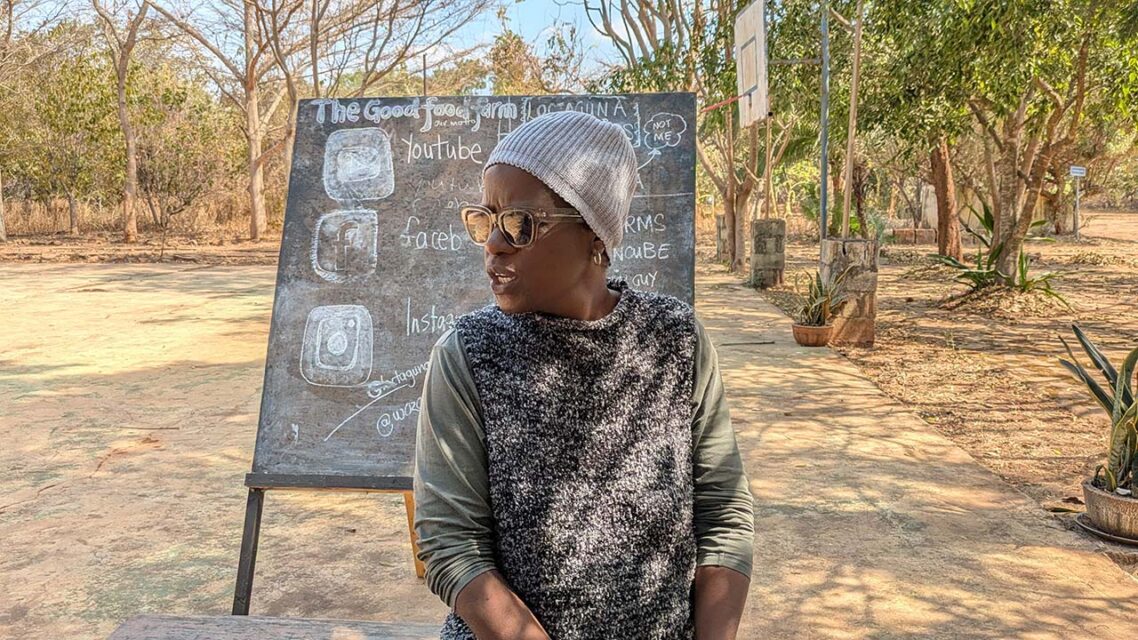
As Kanangwa Newlove walked through her 10-acre farm just outside Lusaka, Zambia, one day in October 2025, she felt as if her dreams were withering away in front of her. The spinach, lettuce and mustard wilted in the heat. Tomatoes shriveled on their vines. She uprooted entire rows of organic vegetables — once sought-after by discerning customers, now rotting in the sun — and fed them to her pigs. “The crops that suffered the most without water were our mainstay,” she told a reporter for the International Consortium of Investigative Journalists. “There was nothing we could do. There was no water for the crops because there was no electricity.”
Every few days, she needed nearly 8,000 gallons of water from borehole pumps to keep her farm going. The pumps required a reliable supply of electricity, but since March 2024, Zambia’s rolling blackouts had left swathes of the country without power, turning everyday tasks into Herculean struggles. Sometimes she had only four hours of power a day.
The blackouts had a “cascading effect,” Newlove said. Without electricity she couldn’t refrigerate the few meager vegetables she could harvest. She stopped breeding and slaughtering animals. She was unable to sell to many of her regular customers, like local “mom and pop shops.” She had to drastically reduce the area she farmed and cut back on planting, and she couldn’t hire seasonal workers.
The rolling blackouts affecting Newlove’s farm were a result of “load shedding,” scheduled power cuts meant to reduce demand on the grid. ZESCO, the state-owned power company supplying almost all of Zambia’s energy needs, alerted its customers to the load shedding schedule, but these schedules weren’t consistent or reliable, Newlove told ICIJ, making it hard to plan how to maintain — or save — her crops. “One week you’d get a schedule from, say, morning to midday and you’d make a plan based on that,” she said. “Then, without prior notice, it would change.”
She couldn’t run a farm on four hours of electricity. For the first time since she’d started the farm over a decade earlier — a labor of love she launched while working for a social enterprise — she began to wonder if she’d need to shut it down. “Farmers are optimistic people until that is obliterated entirely by reality. … It’s a mammoth thing to fathom, that you’re going to kill a business that you’ve worked so hard for for so many years,” she said.
Kanangwa Newlove started farming just outside Lusaka in 2012, selling organic produce to local businesses. Image: Micah Reddy / ICIJ
Newlove and other small-business owners across Zambia faced collapse amid a perfect storm in which environmental and economic shocks were exacerbated by the country’s deep-seated financial problems. Zambia — where roughly 60% of the population lives in poverty — is overwhelmingly dependent on hydropower, but a severe drought in 2024 left dams empty and forced ZESCO to ration electricity usage. While Zambia is drought-prone, ZESCO’s financial woes left it uniquely ill-prepared for the drought, the worst in decades.
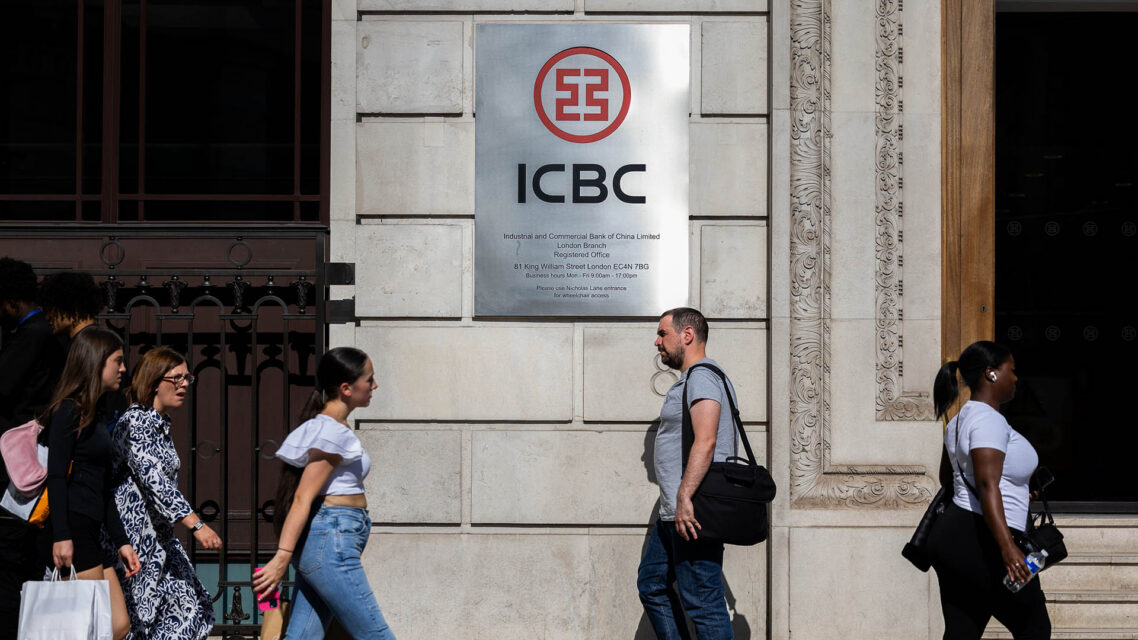
The company was sinking financially. Among its biggest expenses was a long-term loan of nearly $285 million from the Industrial and Commercial Bank of China (ICBC) with tough repayment terms. The loan was signed more than a decade before, in 2011, and in the following years, ZESCO had taken on more and more debt from ICBC and other Chinese lenders. Beholden to Chinese creditors, the power utility mirrored Zambia, one of the world’s most indebted countries and the first in Africa to default on its sovereign debt during the COVID-19 pandemic. As the country’s largest state-owned company, ZESCO was a significant contributor to Zambia’s overall debt.
Now, newly revealed documents show how Chinese lenders, working with Chinese contractors in Zambia, piled loans onto the country and its ailing state-owned enterprises. When it came time for ZESCO to pay, ICBC adopted what analysts see as a hardball stance to recover debt from a struggling borrower.
These documents form part of China Capital, an ICIJ-led investigative collaboration with 23 media partners. Based on a trove of 4.8 million documents, including client dossiers, due diligence reports, loan agreements, meeting minutes and internal emails in English and Chinese, China Capital exposes the inner workings of ICBC’s U.K. subsidiary and London branch, and the crucial role ICBC London has played in advancing Chinese interests in Africa.
China Capital lays bare what experts describe as the bank’s muscular lending tactics, which burdened some of Africa’s most economically vulnerable states — claims the Chinese Embassy in Zambia denied. The project reveals the complex picture of Zambian debt arrangements and the role played by lenders such as ICBC, which presents itself as a commercial bank but acts as a foreign policy tool of the Chinese state, advancing Chinese strategic interests in resource-rich countries like Zambia.
Although China became a vital lender for Zambia and helped the country fill an enormous infrastructure gap, Chinese objectives were not always aligned with Zambia’s best interests. Chinese lenders like ICBC were willing to make onerous and high-risk loans to a country that could not afford them. Meanwhile, Chinese companies seeking infrastructure contracts urged Zambian state entities to take on new debt to fund those projects. Zambia’s government, eager for easily accessible credit to fund its infrastructure plans, needed little encouragement. These factors combined to push Zambia into a disastrous debt spiral in which it was unable to service its debt, followed by years of sluggish recovery.
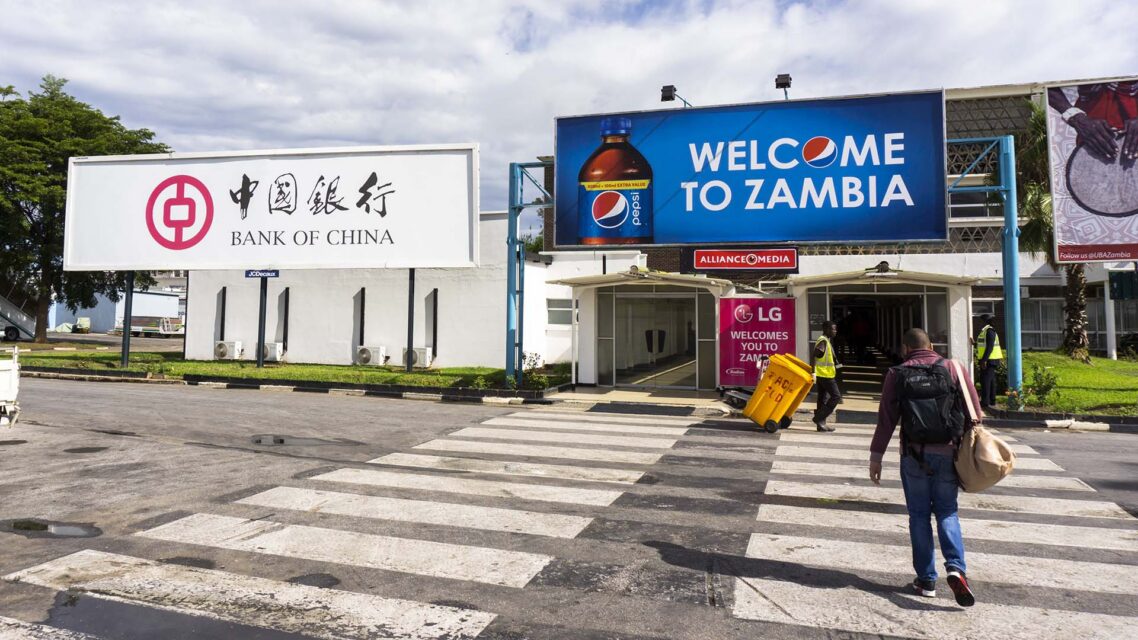
A Bank of China billboard, left, and a PepsiCo Inc. advertisement stand outside the arrivals area at Kenneth Kaunda International Airport in Lusaka, Zambia, on Tuesday, Dec. 11, 2018. Chinese funding was behind many major infrastructure projects, including parts of the airport. Image: Waldo Swiegers/Bloomberg via Getty Images
A $285 million loan
Zambia’s economic outlook was positive in 2011, the year ZESCO signed its $285 million loan agreement with ICBC.
The country had emerged from successful debt relief programs involving the World Bank, the International Monetary Fund and other international lenders years before. Relatively debt-free, it began to focus on funding new infrastructure projects, such as power lines, highways, stadiums and airports. To do so, it turned to the international financial market. Between 2012 and 2015, Zambia issued three international bonds worth $3 billion to foreign investors chasing high yields in the developing world.
At the same time that Zambia was eagerly courting foreign infrastructure investment, China was rapidly expanding its interests in Africa. In 2013, Chinese President Xi Jinping announced China’s Belt and Road Initiative, a strategy to bolster the country’s connectivity with the rest of the world through infrastructure and development. Chinese companies were encouraged to invest abroad, accompanied by a surge in Chinese foreign lending. To poor, landlocked countries like Zambia, China portrayed itself as an alternative to Western funders, untainted by accusations of paternalism and willing to engage developing nations as equals. It offered fewer economic policy conditions on its loans than its Western counterparts, whose legacies were associated with painful economic reforms forced onto indebted African countries.
Chinese investors were also willing to go where others were not. For Western companies, Zambia came with a risk premium that drove up the cost of capital and meant that they would invest only if high returns made up for the perceived risk. Barbara Dutzler, an economist with Germany’s main development agency and head of the agency’s Good Financial Governance in Zambia program, told ICIJ that, with China, there was “an alignment between state and industry” and an overarching geostrategic plan. That meant China could direct investment where it wanted and fund projects that would not hold up in purely commercial terms.
Although it presents itself as a commercial bank, ICBC remains majority state-owned and is driven not only by the profit-maximizing interests of shareholders but also the political prerogatives of the party-state. Documents from China Capital show that ICBC bankers routinely weighed Chinese strategic policies like the Belt and Road Initiative when considering loan decisions around the world.
Recommended reading OVERVIEW Chinese banking giant serves firms linked to oligarchs and autocrats to push Beijing’s agenda Sep 14, 2026 CORRUPTION ICBC promoted corrupt executive, ignored employee misconduct as it pursued global expansion Sep 14, 2026 HUAWEI Chinese bank helped Huawei spirit $1B out of London days after US indictment of the tech giant Sep 14, 2026
jiang region specializing in power transmission and renewable energy projects, arranged the financing for a project it was contracted by ZESCO to undertake: construct power transmission lines and infrastructure to supply electricity to Zambia’s Northern Province on the border of the Democratic Republic of Congo and Tanzania, and Eastern Province bordering Malawi and Mozambique.
This sort of “contractor-facilitated lending” became institutionalized in Zambia, where the government found it convenient to start “outsourcing much of the financing and mobilization process directly to Chinese contractor partnerships,” according to a paper by researcher Tianyi Wu at the Global China Initiative, part of Boston University’s Global Development Policy Center. Besides ICBC, the funds came from an array of Chinese financial institutions that were all too willing to provide high-risk loans. In these transactions, China benefited on both ends — as lender and contractor — while Zambia assumed the repayment obligation and much of the financial risk.
The former Finance Ministry official told ICIJ the ministry was supposed to oversee borrowing, but “a lot went on outside the Ministry of Finance, and they’d find out that ministry X had signed with Y company from China and organized the finance. It was a bit of a free-for-all for a while.”
Researchers at CARI found that among African countries with Chinese loans, Zambia had the highest number of lenders and the second-largest number of Chinese contractors securing Chinese-financed infrastructure projects. “Only Angola, which has borrowed four times as much from Chinese lenders, has more contractors, and even Angola has fewer Chinese lenders,” the researchers found.
Many analysts agree that widespread corruption, patronage and institutional weaknesses helped fuel Zambia’s debt spiral. The country’s bureaucracy lacked capacity to negotiate, evaluate and monitor its high levels of debt, while politicians had perverse incentives to keep accumulating it. The money was easily available for large infrastructure projects from which political elites could derive kickbacks and other illicit gains: “Patronage is part of the political landscape of Zambia,” the former Finance Ministry official said. “People were seeing things like roads being built, a new airport and stadium. Things were getting better in terms of infrastructure but at a very high price because of rent-seeking behavior.”
Chinese banks loan billions to Zambia
Sources: The China Africa Research Initiative (CARI) at the School of Advanced International Studies, Johns Hopkins University and the AidData research center at the College of William & Mary. The CARI data includes 2015-2019 loan commitments to ZESCO and 2000-2020 loan commitments to the Zambian central government.
An IMF report noted both that “large public investment projects were often transformed into vehicles for political patronage and rent seeking opportunities,” and that “embedded governance weaknesses cannot be overestimated in accumulation of sovereign debt and the subsequent crisis.”
Zambia was an increasingly risky prospect, but ICBC continued expanding its interests there. In 2016 and 2017, ICBC committed to finance three other ZESCO electricity supply projects worth over $100 million and, together with the Export-Import Bank of China (known as China Eximbank), was a joint lender in the $1.5 billion syndicated loan for the 750 megawatt Kafue Gorge Lower Hydropower Station, for which ICBC claimed $15 million in management fees from ZESCO. It also signed six additional loans with the central government between 2016 and 2018, committing over $1 billion to a range of projects, from police and defense force housing to the construction of a hospital and an international airport, not all of which were fully implemented. Borrowing “mushroomed during the [Lungu] administration … to the degree they couldn’t even disburse the loans,” said Dutzler — a view backed by findings of Zambia’s auditor general. This led to growing alarm among Zambian opposition politicians and civil society groups over alleged Chinese predatory lending, as well as international headlines warning of “debt-trap diplomacy” — where a creditor country overloads a borrower with debt with the intention of extracting concessions.
Meanwhile, Gerald Soko, the butcher, was still trading on Zambia’s good years and focusing on expanding his business, unaware of an approaching debt cliff and the years of economic strain ahead.
r the $20 million from a reserve account it held on behalf of ZESCO. This caused a stir among ICBC London staffers when they “later learned that [head office] had pushed [the London branch] to make the payment” without the necessary documentation being in place, according to an internal ICBC report in the China Capital documents.
The reserve account was firmly under ICBC’s control. “What this means is a bank doesn’t have to go to a separate bank, to ask for permission to touch the money in the [debt service reserve account]. They’re like, ‘I am the escrow account bank, I can do whatever the hell I want with this money,’ ” said Bradley Parks, executive director of AidData, a research center at the College of William & Mary that has tracked Chinese lending globally.
ICBC’s London branch was pressured to transfer $20 million from a ZESCO reserve account without securing the proper paperwork first, according to confidential bank records. Image: May James/SOPA Images/LightRocket via Getty Images
Later that year, S&P Global again downgraded Zambia “on rising fiscal deficits and debt burden.” In its analysis, it referred to mounting government arrears “to contractors involved in the construction of new roads and to ZESCO … which had to import emergency power to replace a shortfall of hydro-generated power.” It added that “the increase in debt accumulation has also been accompanied by rising debt service payments.” Between 2014 and 2019 the government’s debt to foreign creditors as a percentage of GDP more than quadrupled.
The effects of a severely strained economy soon reached ordinary Zambians. Zambia’s currency, the kwacha, depreciated, inflation rose and high interest rates made borrowing more expensive. “This has affected the ordinary person, this high inflation without GDP growth that can match the cost of living,” said Hambayi, the Zambian financial analyst.
By 2019, ICBC was “reportedly reluctant” to release funds because Zambia began defaulting on payments to other creditors, according to an AidData analysis. In 2020, a ZESCO subsidiary defaulted on its repayment obligations for the $1.5 billion China Eximbank-ICBC hydropower loan. ZESCO — which had guaranteed higher electricity prices from independent power producers than the tariffs it charged its customers — was insolvent. So was the country, after defaulting on its debt that year. Lungu’s government had run out of options and had begun talks to restructure its debt.
Among other measures to recover costs and reduce losses, the government began cutting subsidies, including for fuel, and increasing electricity tariffs. The escalating cost of living weighed heavily on Soko’s butchery business. “People complain about the cost of electricity … and are struggling to make ends meet. They keep asking for meat on credit, the same people who used to spend a lot,” he said, before listing the many neighboring businesses that had closed in recent years: barbers and salons, welders and fast-food franchises.
Zambia’s weakened fiscal position left it extremely vulnerable to the worst drought in four decades, which began in 2023 and led to the relentless power cuts that nearly ended Newlove’s farming business. During the most intense period of cuts, as her crops wilted, she and the farm supervisor scrambled to find a generator and eventually found someone willing to rent them an old one. It sputtered and shook and looked as if it would give out, but it got her through those difficult days. The generator’s high costs ate into her dwindling margins, though, forcing Newlove to use her personal savings to keep the business afloat. “If we didn’t have that reserve of money, we would have sunk,” she told ICIJ.
A crippling drought that began in 2023 wilted crops and led to rolling electricity outages, which made it difficult for Newlove to run pumps for irrigation and pushed her business to the brink of collapse. Image: Micah Reddy / ICIJ
The electricity crisis also dealt a heavy blow to Soko’s butchery, leaving fridgefuls of rotting meat. Customers stopped buying in bulk, worried that they would face the same problem, what Soko called the “trickle-down effects” of load shedding. He said that burglars twice took advantage of the darkness during power cuts to target his shop. To get through the worst of the outages, Soko too had to fork out for a generator he could barely afford to run. Sales from the butchery these days is less than half of what it was before load shedding, and he has had to put all his plans for expanding his business on hold. “There is no profit,” he told ICIJ.
Negotiating the future
After China became the world’s largest source of bilateral official lending to developing countries, it faced a critical test in Zambia: How would it negotiate to restructure an unusually complex mountain of debt? How would it work with other external creditors? As a creditor nation, China has not joined the Paris Club — an informal group of mostly high-income lending countries that coordinates solutions to heavily indebted developing countries — and Chinese creditor loan agreements often contain provisions to exclude them from collective debt-restructuring initiatives. Chinese lenders also had a reputation for taking a hard line and refusing to accept markdowns on their loans, “a core Chinese position,” said Dutzler of Good Financial Governance in Zambia. “They don’t give a haircut.” Among those at the negotiation table, she said, “China was the big unknown.”
The restructuring efforts began on shaky ground, as the negotiating parties — numerous governments and private lenders — went through back-and-forth talks that dragged on for years, hamstringing Zambia’s development and economic recovery.
The true scale of the country’s debt remained hidden, adding to the tension. Researchers at CARI, which had been tracking Chinese lending to Africa for almost a decade, found that “Zambia’s outstanding external debt to all Chinese financiers, official and commercial, was approximately $6.6 billion in August 2021.” This was nearly double the highest figure cited by the Zambian government. Part of the problem stemmed from the structure of the Chinese loans, which were cloaked in confidentiality clauses.
debt restructuring.” At the time, holders of Zambia’s bonds were “refusing to proceed with debt renegotiation, citing insufficient information about China’s claims on the country.”
In an email to ICIJ, the Chinese Embassy in Zambia said that claims about opaque lending were “baseless” and that China’s “overseas financing cooperation is fully open and transparent.”
Ultimately, the worst fears of Chinese predatory lending, rumors of China seizing national assets like ZESCO and screaming international headlines about debt-trap diplomacy turned out to be alarmist. China agreed to co-chair Zambia’s official creditors’ committee alongside France, signaling a willingness to work with others rather than go it alone. An important milestone came in 2024, when Zambia reached agreements in principle to restructure debt with Chinese commercial lenders, including ICBC. As of 2026, debt-restructuring negotiations were largely concluded, with most of the talks occurring under the government of Lungu’s rival and successor, Hakainde Hichilema.
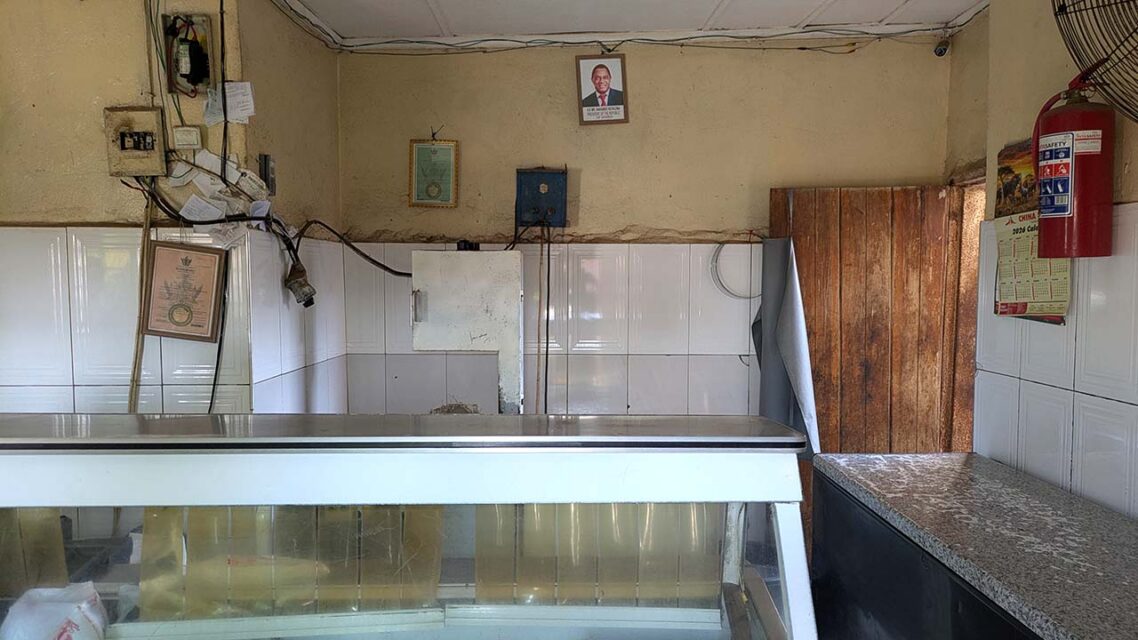
Ordinary Zambians still feel the lingering effects of years of intersecting crises that battered the economy and shifted perceptions of China’s role in Zambia. At Soko’s spartan butchery, the long queues of customers have been reduced to a trickle. Turnover is less than half of what it was, he said, leaning against a mostly empty display cabinet. Survey data shows that Zambians have grown increasingly skeptical of China’s role in their country. In 2014, 72% of those polled by Afrobarometer — an independent public opinion research network — viewed China’s economic and political influence positively. By 2022, that figure was down to 42%. China too was burnt by the debt troubles of developing nations; that’s part of the reason it has shifted focus to what it calls a “small and beautiful” approach to infrastructure projects, with smaller loans and shorter repayment windows.
A photo of Zambian President Hakainde Hichilema hangs on the wall of Soko’s butcher shop, which was a thriving business until the country’s electricity crisis hit and the economy stalled. Image: Micah Reddy / ICIJ
Newlove, the farmer, told ICIJ that she feels she has made it out of the crisis intact. Her farm is fully operational, and she avoided laying off any of her 14 full-time staff. They have begun replanting on portions of the land they were forced to abandon. The chickens, goats, rabbits and pigs survived, and she has since crisis-proofed her farm with large solar panels that soak up energy from Zambia’s mostly sunny skies. But on the other side of Newlove’s stone perimeter wall is dry, dusty scrubland — a graveyard for failed farms and a constant reminder of her close brush with disaster. “Our resilience was tested,” she said. “I knew a lot of farmers who shut down or changed business. … They were very lucrative, and I thought, ‘We’re next.’ ”
Contributing reporters: Scilla Alecci, Denise Ajiri, Jelena Cosic and Delphine Reuter (ICIJ)
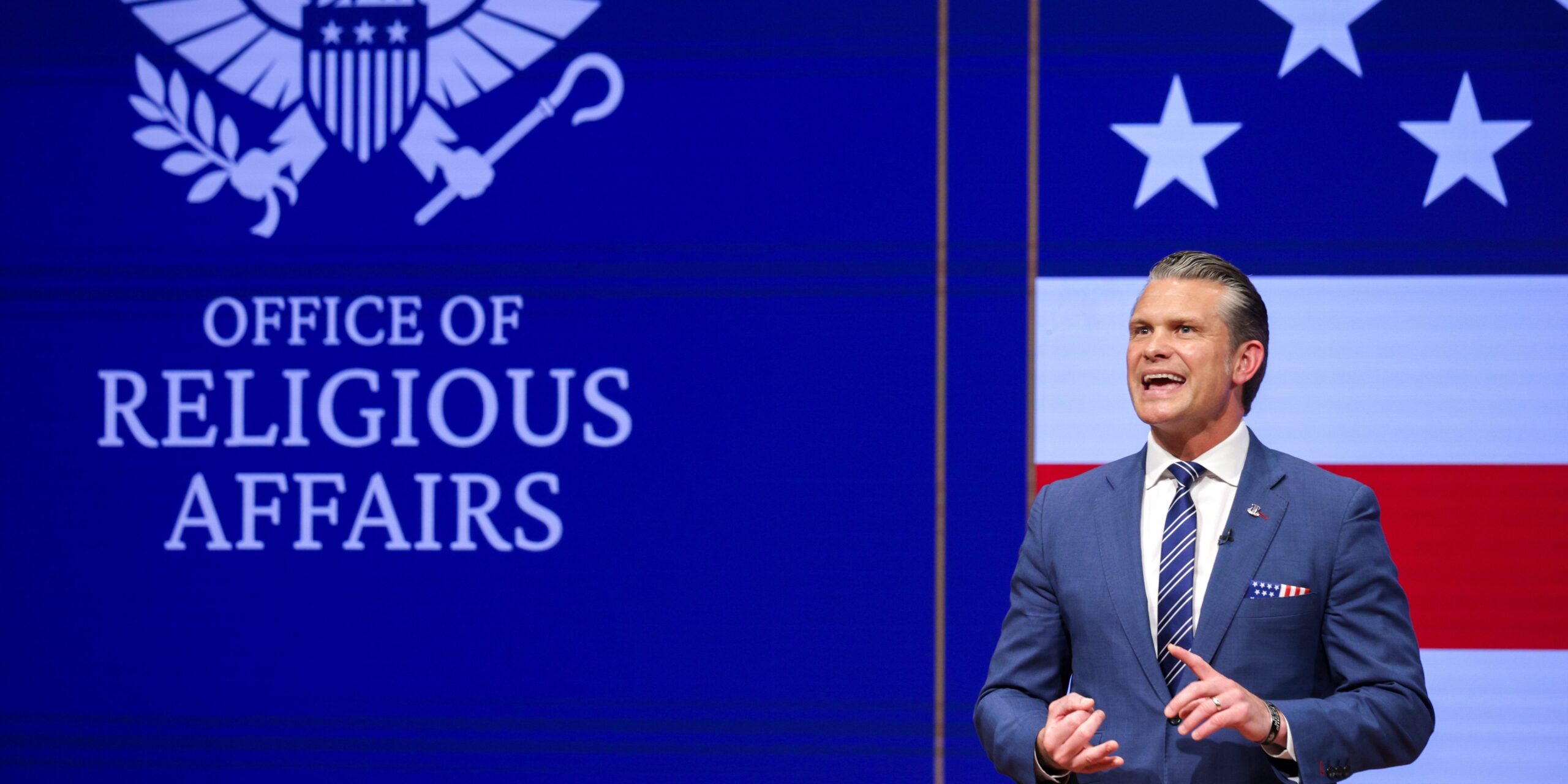
Defense Secretary Pete Hegseth has extended a line for the military’s religious leaders to reach him directly — and current and former military chaplains say they don’t want it.
Hegseth announced the creation of a new Office of Religious Affairs on September 30, vowing that the office would give members of the armed forces’ chaplain corps access to him without “bureaucratic dilution.” It coincides with his openly Christian “Send Me” campaign, an online propaganda effort that the Pentagon launched over the summer promoting a biblical phrase widely understood as a vow to accept a divine mission.
“We should not be in the business of wrapping the state’s mission in one particular religion,” an active-duty Army captain serving as a non-Christian chaplain told The Intercept. But as Hegseth’s Pentagon increasingly pushes Christianity, the chaplain, who was granted anonymity because he feared retaliation from the Defense Department, said he and other non-Christian chaplains worry the new religious affairs office will be used to do just that.
Hegseth’s body bears an assortment of Christian and Crusader imagery, including a Jerusalem cross across his chest and the Latin phrase “Deus vult,” or “God wills it,” on his bicep — a battle cry associated with the medieval Crusades that has since been adopted by far-right extremists. His forearm bears a cross and sword referencing Matthew 10:34, in which Jesus declares that he came not to bring peace but a sword, alongside the Hebrew name for Jesus. In 2021, a fellow National Guard member flagged Hegseth as a potential security threat over his Deus vult tattoo, before Hegseth was removed from an assignment protecting Joe Biden’s inauguration.
As defense secretary, Hegseth has frequently turned to messaging that centers religion and vengeance while promoting the U.S. and Israel’s unpopular war in Iran. His “Send Me” campaign is built around Isaiah 6:8, a biblical verse commonly invoked by Christians as a call to serve God. During his 9/11 speech last month at the Pentagon, Hegseth said the “struggle against evil” that followed the attacks continues today and “will continue until Judgment Day,” before turning to the current war with Iran.
“Using specific scriptural language for a military campaign inappropriately frames state-sanctioned armed conflict and government service as a Christian religious crusade,” the chaplain said. “Once a mission is declared God’s will, every act inside it is sanctified in advance.”
The new Office of Religious Affairs, the chaplain said, could entrench this dynamic. While the Pentagon memo establishing the office says it cannot compel religious participation or diminish the free-exercise rights of service members of any faith or no faith, the office’s director will report directly to Hegseth and the deputy defense secretary, oversee the Armed Forces Chaplains Board, and work with the civilian religious organizations that endorse military chaplains. The office will also oversee efforts to assess spiritual fitness, spiritual readiness, and spiritual resilience across the force. This consolidated control, the chaplain warned, may make it difficult to maintain pluralism among the chaplain corps.
“Our chaplain corps must serve [non-Christian service members], not just the soldiers that share a faith with the SecDef,” the Army chaplain said. While it’s too early to know what that authority will mean for non-Christian chaplains, he wondered how it might change the ranks of the chaplaincy itself.
“Will this group begin accepting fewer and fewer non-Christian chaplains into our ranks?” he said. “Will we begin seeing fewer and fewer non-Christian chaplains be chosen for promotions?”
The concerns extend beyond the active-duty chaplain. Rev. Dr. Rebekah Savage, a former military chaplain who now helps oversee the Unitarian Universalist Association’s endorsement of clergy serving as military chaplains, said the organization was not consulted before the office was established.
“I am deeply concerned about how this office will serve the religious needs of the members of the service,” she said. “I can’t speak for others who are a part of the chaplaincy corps, but I know I am not alone.”
In response to questions about the new office from The Intercept, Pentagon press secretary Kingsley Wilson wrote in a statement that the department “protects the constitutional right of every service member and civilian employee to practice their faith without coercion or discrimination. This is why Secretary Hegseth recently established the Office of Religious Affairs.” She said that prayer services and religious activities are always voluntary.
“The Christian faith is woven deeply into the fabric of our nation and shared by America’s wartime leaders like President George Washington, who prayed for his troops at Valley Forge, and President Franklin D. Roosevelt, who gifted Bibles to America soldiers during WW2 and encouraged them to read it,” Wilson added. “Despite the Left’s efforts to remove our Christian heritage from our great nation, Secretary Hegseth is among those who embrace it.”
In August, when “SEND ME” could still be dismissed as a string of social media posts, the Pentagon repeatedly declined to explain what the phrase meant or whether it represented a broader communications strategy.
As scholars of religion previously explained to The Intercept, the Pentagon’s use of the passage strips away part of the biblical story. Isaiah is not being sent to destroy God’s enemies; he is being sent to preach a warning to his own people. And the commission ends not in military triumph, but judgment. Cities are left empty, the land is devastated, and God’s own people suffer the destruction.
“Secretary Hegseth’s Send Me Tour is a military outreach and recruitment initiative focused on recognizing the Americans who volunteer to serve,” Wilson added in her statement. “We are grateful for the Americans—past, present, and future–who have raised their right hand and said, ‘Send Me.’”
Hegseth addresses Reserve Officers’ Training Corps cadets during a “Send Me” tour event at the University of Tennessee in Knoxville, on Oct. 17, 2026.Photo: Capt. Tessa Lindsey/U.S. Army National Guard
Questions about the Pentagon’s treatment of minority religious traditions predate the new office.
In June, Savage joined 10 other religious endorsers in a letter to Hegseth objecting to revisions to the military’s Religious Affiliations Code list. The signatories said the changes removed or obscured the identities of several religious communities, including Unitarian Universalists, historically Black churches, and Wiccan and Pagan practitioners.
The endorsers warned that the changes could affect religious accommodations, access to clergy, and the distribution of chaplaincy resources.
“Classification is resource allocation,” they wrote.
Savage said the earlier changes, combined with the establishment of the Office of Religious Affairs, “calls the Department’s commitment to meeting the spiritual needs of all of its members into question.”
The active-duty Army chaplain questioned how the office’s stated religious-freedom protections would work in practice under a defense secretary who has increasingly incorporated Christian scripture into his public messaging.
“What oversight will exist to prevent religious bias?” he said. “When investments are made, will they be defining spiritual fitness by Christian, or by more pluralistic metrics?”
The same concerns extend to money. The office’s funding priorities include faith-based home school support for military families, faith-based suicide-reduction programs, and contracts with faith-based organizations.
“Will the Humanists, Muslims, Jews, Hindus, and other groups receive an equal, commensurate amount of support and funding for such programs?” the Army chaplain said. “Or will all or most of the funding go to Christian based organizations?”
Beyond institutional support, the chaplain said the Pentagon’s religious messaging could interfere with one of the central responsibilities of his profession: helping service members navigate questions of conscience, morality, and killing.
In reporting for Task & Purpose last month, this reporter examined how Army chaplains were preparing to address the moral and spiritual consequences of artificial intelligence in warfare. As one scholar of military ethics pointed out, moral injury can arise when service members feel responsible for actions that violate their values, even when they have little meaningful control over those decisions.
The Army chaplain raised a related concern: What happens when the military itself invokes religious authority to justify its mission?
“What can I say to a non-Christian soldier who is being ordered to kill his fellow man or risk dying himself for a god he does not believe in?”
“If my role as a chaplain is to advise soldiers and commanders of issues of morality and ethics, what can I say to them now?” he said. “How can I advise a commander on doing moral and ethical actions if the state has announced that their god has ordained their war?”
For service members who do not share the religious beliefs invoked by military leadership, the Army chaplain said, that tension could be especially difficult to reconcile.
“What can I say to a non-Christian soldier who is being ordered to kill his fellow man or risk dying himself for a god he does not believe in?” he said. “What do I tell a soldier who believes an action is immoral, but also believes that God commanded it?”
Jaron Alexander, of Ingram, Texas, is one of more than 29,000 local law enforcement officers on the front lines of the Trump administration’s deportation campaign.
The new patrol officer parked his black Dodge Charger outside a house off Main Street and approached on foot. A Mexican ballad was playing. Someone had called in a noise complaint, claiming it sounded as if people were fighting.
But as the officer, Jaron Alexander, got closer, he found nothing of the sort. A middle-aged woman greeted him as her daughter, Joanna Martinez, petite and visibly pregnant, looked on. “What kind of party are you all having?” she remembers him asking. Behind her were three generations of an extended family. They were celebrating a 3-month-old’s baptism over pozole verde, horchata and beers.
Alexander ran some IDs and found no issues. The music wasn’t even that loud, he thought. He told them to have a good night, and then he left.
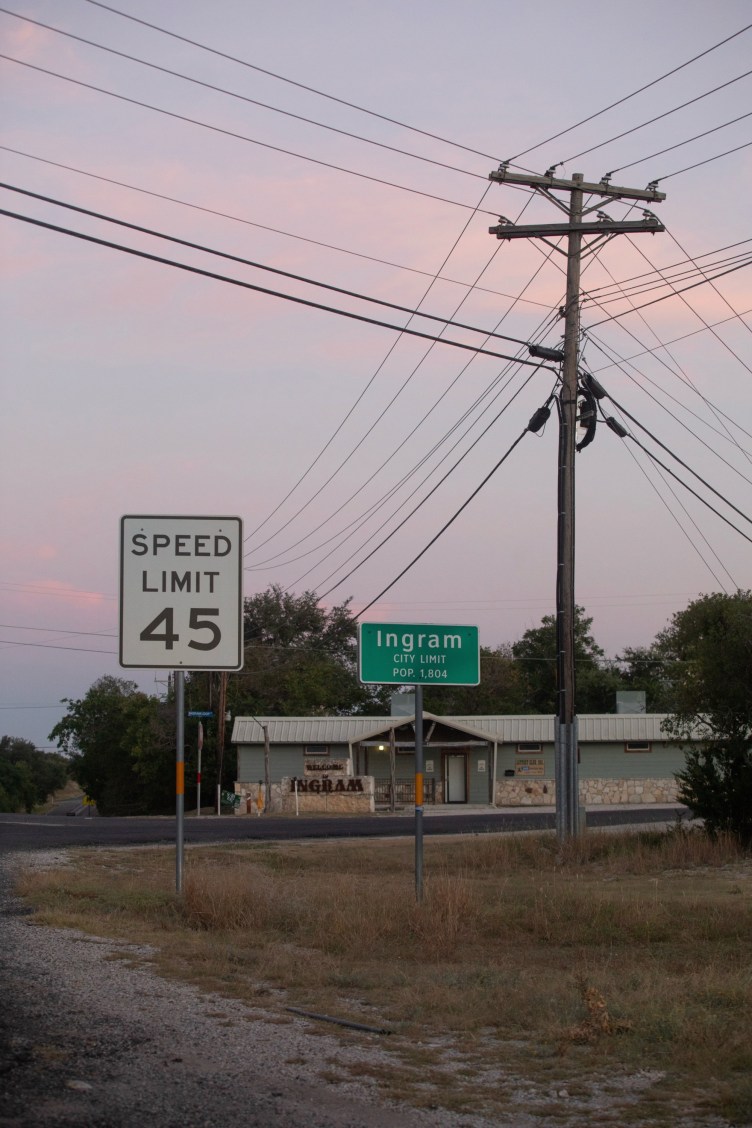
That encounter, in early October last year, was the first of many that Alexander and Martinez would have in tiny Ingram, Texas, a 1.5-square-mile town of 1,900 people beside the Guadalupe River. But it was the only one before Ingram signed an agreement with U.S. Immigration and Customs Enforcement that would roil the town and tear Martinez’s family apart.
“Her and I, at the beginning, I felt like we were running into each other all the time,” Alexander told us, in one of eight conversations over four months that offer a rare window into the thoughts of one of the local police officers on the front lines of the Trump administration’s deportation campaign.
In a town as small as Ingram, drivable in five minutes end to end, more run-ins were probably inevitable. Later that October, Alexander pulled over a work truck for rolling through a stop sign, and soon there Martinez was, demanding that he let her friends go rather than let immigration take them. He didn’t. He pulled over another driver in November who turned out to be her cousin, the father of the baby they celebrated at the baptism party. Alexander handed him over to immigration agents as well.
Ingram, a town of under 2,000 people, is — or was — 45% Latino. The police helped deport the equivalent of 10% of Ingram’s population.
He pulled over Martinez herself a few weeks before she was due to give birth, she says, surprising her when he knew her name and the type of car she typically drove. He warned her that the car’s window tint was illegal and let her go. After that, he says, he caught a glimpse of her and her husband and their newborn daughter in the toy aisle at Walmart. Martinez told us she doesn’t think it was even her that day — her baby girl was then just days old, and she couldn’t imagine running errands with her so soon. But in Alexander’s memory, she was shopping for Christmas presents, just like him.
Alexander, who is in his mid-30s, with dirty blond hair already turning gray, says he didn’t come back to Ingram to help deport his neighbors. In his telling, he just ended up making it part of his job. The town was where he started his law-enforcement career years earlier, before he took a better-paying position with the county, as a sheriff’s deputy. But things recently started to fall apart, first in his marriage, next at the sheriff’s office: A 185-page internal investigation found that he had an affair before his divorce was final and used a county vehicle to carry it out, then lied about it all. He says the investigator called him an “embarrassment to the profession.” The sheriff’s office fired him. (Alexander said at the time, and again to us, that he did not have the affair.)
Ingram’s Police Department took him back just when its new chief — its eighth in five years — was under pressure from the City Council to do more: more traffic stops, more citations, more arrests, more numbers. Alexander says he told the chief that the sheriff’s office had a deal with ICE and that Ingram should look into it; maybe it could help the department grow. “Blame me,” he eventually told people. “It’s my fault in a way.”
Donald Trump had retaken the presidency with a promise to carry out “the largest deportation in the history of our country.” America was still figuring out what that meant. Finding and expelling up to 4% of the U.S. population — the 14 million residents who are estimated to be undocumented — wasn’t something a few thousand ICE agents could do on their own.
Underway in Chicago that fall, and soon in Minneapolis, was one version of how the administration could try to do it: masked agents from across the federal government surging into a liberal city to round up immigrants, beating back — even killing — the citizens who tried to stand in their path.
But a quieter kind of surge was spreading across the country at the same time. In September 2025, ICE announced new incentives for a partnership program known as 287(g). The program’s most aggressive form, the so-called task force model, which Ingram opted in to, enlists local police officers as deputy immigration agents, and the new incentives included a $100,000 vehicle stipend, a $7,500 equipment stipend for every participating officer, quarterly performance bonuses and funding to help cover officer salaries and overtime. “By joining forces with ICE,” the announcement read, “you’re not just gaining access to these unprecedented reimbursement opportunities — you’re becoming part of a national effort to ensure the safety of every American family.”
Alexander completed an online course with ICE a few weeks after the baptism party, qualifying him for time-and-a-half pay whenever he helped the agency pick up immigrants. Here in the Texas Hill Country, he soon became the local face of the national crackdown.
“I’m friendly with the people that I meet,” Alexander says, “especially when they’re friendly to me.”
Ingram was just starting to recover from its worst natural disaster in a century, the flood that summer that killed at least 139 people up and down the Guadalupe River, including 25 girls at Camp Mystic. In the riverbed, towering bald cypress trees now stood at a lean, their branches swept back by a 30-foot surge of water and mud, their trunks still plastered with debris. As construction workers rebuilding the community traveled to their jobsites via Junction Highway, Ingram’s five-lane main thoroughfare, a black Charger began stopping them before they could get there.
Within three months of the baptism party, Alexander and Ingram’s other patrol officer had delivered at least 70 people to immigration agents, picking off what the police chief called a “dumbfounding” number of undocumented drivers. Within a year, they would hand over the equivalent of 10% of Ingram to ICE.
The weight of what Alexander was doing started to settle on him after Christmas. He says he was out patrolling as one of his new ICE handlers, a man in a ball cap and dark glasses, hovered nearby in an unmarked SUV. Around lunchtime, Alexander followed two Latino men in a 2008 GMC truck for several blocks before stopping them, they recall him saying, for failing to signal a turn.
A young man sat in the passenger seat. Alexander checked his papers along with the driver’s and determined that both were undocumented. The agent in the unmarked SUV rolled up behind them. Alexander realized who the man in the passenger seat was only after Martinez arrived in tears. It was her husband, Ulices Macias, the father of her newborn daughter.
“I don’t normally do this,” Martinez recalls Alexander telling her, “but I’m going to open up the car. I’m going to take the handcuffs off him.” He let the family have a moment together. In a video taken by Martinez’s younger sister, Alexander stood by, expressionless, as Martinez embraced Macias by the rear door of the Charger. He watched Macias cradle his 2-week-old baby girl, swaddled in a white blanket, and hug Martinez’s 4-year-old son, his stepson.
Then the ICE agent put the handcuffs back on Martinez’s husband, wrapped a chain around his waist and led him away. Alexander says Martinez threw herself to the ground and sobbed.
Images of the family he broke up shortly after Christmas would intrude on Alexander’s thoughts for months, he told us. But it didn’t keep him from doing his job. His next shift came a few days after he handed over Macias, and he was back in the Charger, back to stopping cars on Junction Highway.
Joanna Martinez’s husband, Ulices Macias, is detained by Alexander on Dec. 28, 2025, in this video taken by Martinez’s younger sister.Courtesy of the Martinez family
“Mini Guanajuato”
Alexander says he didn’t always want to be a police officer. He describes himself as “kind of a chameleon.” He grew up in nearby Harper, tried a few different colleges without graduating and spent his 20s cycling though jobs in freight logistics, pest control and insurance.
Still seeking his calling, he arranged a ride-along with a police officer outside Austin. What sold him on policing was the suburban officer’s power to enforce the law as he saw fit. That day, they pulled over a woman who had a warrant out for her arrest. She was coming back from the store with children and groceries in the back seat.
“You can use your discretion,” Alexander recalls the officer telling him. Wouldn’t they be doing more harm if they took her? What would the kids do without their mother? And wouldn’t it all create more paperwork? The officer let her go. Alexander imagined himself making the same kinds of judgment calls. In 2021, he enrolled in the police academy.
Even before the floods, tensions were rising in Ingram. Hundreds of Mexican immigrants and their families had settled there in recent decades as an increasingly militarized border made it harder for seasonal ranch hands and other workers to cross back and forth. Latinos would come to make up 45% of its population, and some residents began affectionately calling Ingram “mini Guanajuato,” after the central Mexican state where many have roots. Yet when Alexander returned, Ingram’s City Council still consisted of six white men.
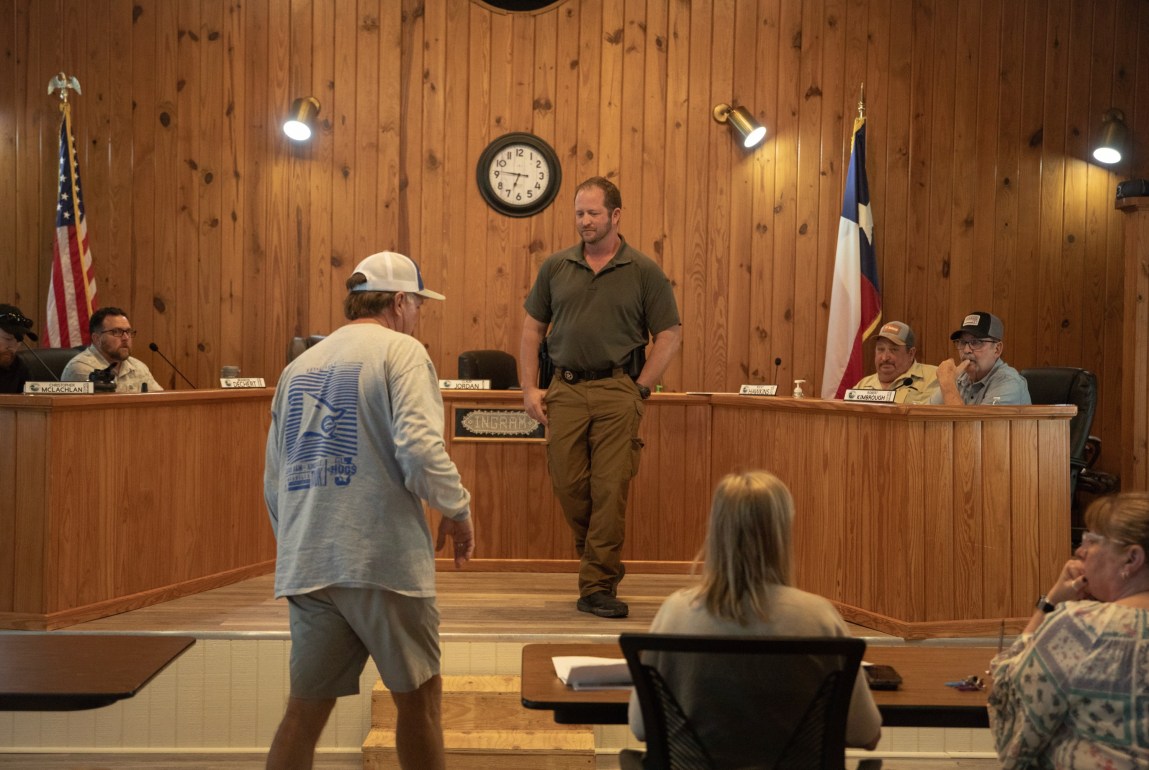
Mayor Claud Jordan (in shorts and cap), Chief Dustin Breshears (center) and Mayor Pro Tem Rocky Hawkins (seated second from right) attend an Ingram City Council meeting in August.
A council faction led by Claud Jordan, now the town’s mayor, and Rocky Hawkins, now the mayor pro tem, came to power in November 2020, in a revolt against a new sewer project. They abolished Ingram’s city administrator position and took direct control of the Police Department, cycling through chief after chief. Five former city employees say Hawkins regularly used racist slurs for Mexicans. Four say that he pressured the city to go after Latinos through code enforcement or targeted patrols, and two say that Jordan did, too. One of the employees recalls Hawkins complaining that Mexicans were “taking over Ingram.” (Hawkins and Jordan each declined to speak on the record or address detailed questions we sent them by email. In a brief text-message exchange, Hawkins said that none of it was right but declined to offer any specific concerns.)
These were the men the new chief, Dustin Breshears, had to answer to as ICE revived the task force program, which had been shut down for a dozen years until the day Trump returned to office in January 2025. ICE, under President Barack Obama, had phased out the program after some of the first sheriffs to participate in it, including Joe Arpaio of Maricopa County, Arizona, used it to disproportionately target Latinos in their communities. Investigations by the Department of Justice found that deputies in the task force program pulled over Latino drivers at up to nine times the rate of other drivers and that some retaliated violently against people who accused them of racial profiling. But now, under Trump, any law-enforcement agency, no matter how troubled or small, was encouraged to sign up.
Breshears began appearing at City Council meetings armed with statistics: number of arrests since the last meeting, number of traffic stops, number of cleared cases from the backlog of hundreds he inherited — and number of what he called “deportations.” (He later explained this was his imprecise shorthand for “immigration-related enforcement activities.”) At the council’s October 2025 meeting, held a couple of weeks after Alexander showed up at the Martinez family’s baptism party, Breshears reported a remarkable 162 traffic stops by Ingram’s two patrol officers — Alexander and Christian Perez, who was 25 — in just 20 days. (Perez declined to comment.) The officers made more stops in two months than the department had made in the entire previous year. The City Council gave Breshears an $18,000 raise.
Christian Perez, one of the other Ingram police officers, at a traffic stop. He and Alexander made more stops in two months than the department had made in the entire previous year.
Before Breshears arrived and Alexander returned in August 2025, the weekly blotter in The West Kerr Current, the local newspaper, documented the humdrum of community policing: loose dogs, neighborhood disputes, code violations. Then, suddenly, it was filled with drivers stopped for defective brake lights, damaged license plates, cracked windshields, illegal window tints or other unspecified “equipment violations.”
Breshears and Alexander strongly deny targeting Latinos. “It’s honestly not what’s happening,” Breshears says, noting that his half brother, wife and daughters have Mexican heritage. Ingram’s traffic stops were simply up across the board, he says, so more Latinos were getting stopped. He shared statistics showing that stops of Latinos were proportional to their share of the population.
Alexander, who on top of his roughly $70,000 base salary was now logging dozens of hours per month for ICE, told us the same. “I don’t care who’s in the car,” he says. “I really don’t.”
“El Charger Negro”
As the ICE program took hold in Ingram, warnings about Alexander and his black Charger — the department has several — spread through the Hill Country and far beyond. Groups on Facebook and WhatsApp seemed to track his every move. The Charger was outside Rita’s taco shop. The Charger was near Dollar General. The Charger was parked by the church. A member of one particularly active Facebook group texted him screenshots, and he scrolled through blurry photos of himself looming behind work trucks or leaning over car windows.
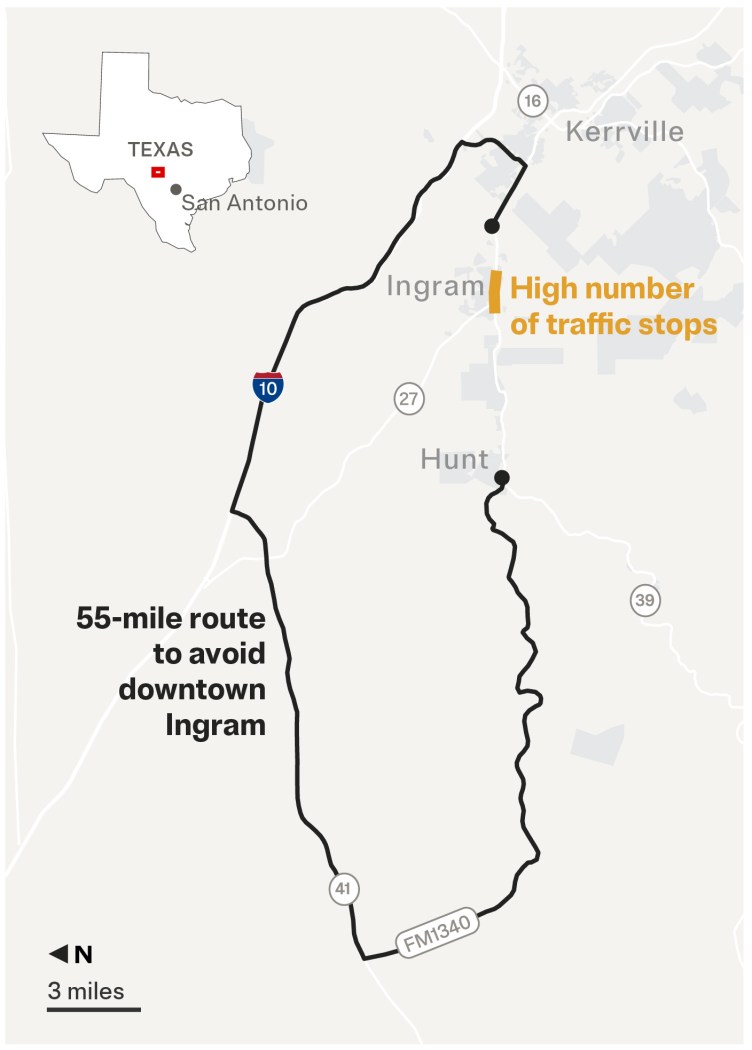
Many Latino motorists trying to reach worksites up the Guadalupe began driving an extra 90 minutes each day to avoid the section of Junction Highway that Alexander patrolled. Ranch hands began sleeping at their employers’ properties in nearby Hunt, coming to town only when they knew — or hoped — that Ingram’s officers would be off duty. Residents were rattled the day a Customs and Border Protection helicopter hovered above town and the elementary school went into lockdown as the police hunted for a Mexican man who had run from one of Alexander’s traffic stops.
Workers Driving Between Kerrville and Hunt Add an Extra 90 Minutes to Their Daily Commute to Avoid Traffic Stops in Ingram
Lucas Waldron/ProPublica
One family notarized guardianship papers, in case the parents were detained and the children left behind. One woman swore Alexander showed up outside a memorial service and asked people for IDs. Another woman said he detained her and her husband when they returned home from church. Parties dwindled. Invite lists shrank. People began to move away, to Kerrville and San Antonio, and Alexander’s reputation reached as far as La Ceja, a village in the mountains of central Mexico, where an elderly resident said he and his neighbors were familiar with the Texas town’s police. “El Charger negro,” he said, with a knowing nod. He estimated that some 20 or 30 people in the village were recent deportees from Ingram.
Alexander’s fortunes seemed to rise as the Martinez family’s fell. With her husband gone, Joanna Martinez couldn’t afford payments on the trailer they shared. She and their infant and her 4-year-old son moved back into her childhood bedroom in her mother’s crowded home, where several relatives and their children also lived. She tried to stay connected with her husband, Macias, via WhatsApp calls while working as much as she could as a house cleaner to keep afloat. “I can’t lock myself up in my room and just cry,” Martinez says.
Winter for Martinez and her family brought a string of dark incidents. The January arrest of her cousin near the carwash as she drove to pick up her children from school. A canceled baby shower for her older sister, Jazmin, over a rumor that the Charger planned to show up. Another cousin, himself the father of a newborn, stopped and taken right in front of her mother’s house as Martinez watched.
A half dozen of the attendees from the October baptism party would soon be gone from Ingram, after being detained and deported or leaving to join relatives who had been. Some people had gotten wind that Alexander was making money off his enforcement. When a Spanish-language Facebook page shared a photo of him questioning the passenger of a beige Ford pickup, someone posted an animated image in the comments: a stack of green dollar bills growing taller and taller in an endless loop.
A view of the stretch of Junction Highway where many people are detainedSean Cronen for The New York TimesA view of the stretch of Junction Highway where many people are detainedSean Cronen for The New York Times
Alexander received his first ICE payments in early December. In January, as the country’s attention turned to the violent immigration crackdown in Minneapolis, he was often spending three or four hours a day and sometimes entire shifts working on behalf of the federal agency. By the time federal authorities announced a drawdown in Minneapolis on Feb. 12, Alexander had already made $3,264.46 from his task force hours, according to his pay stubs.
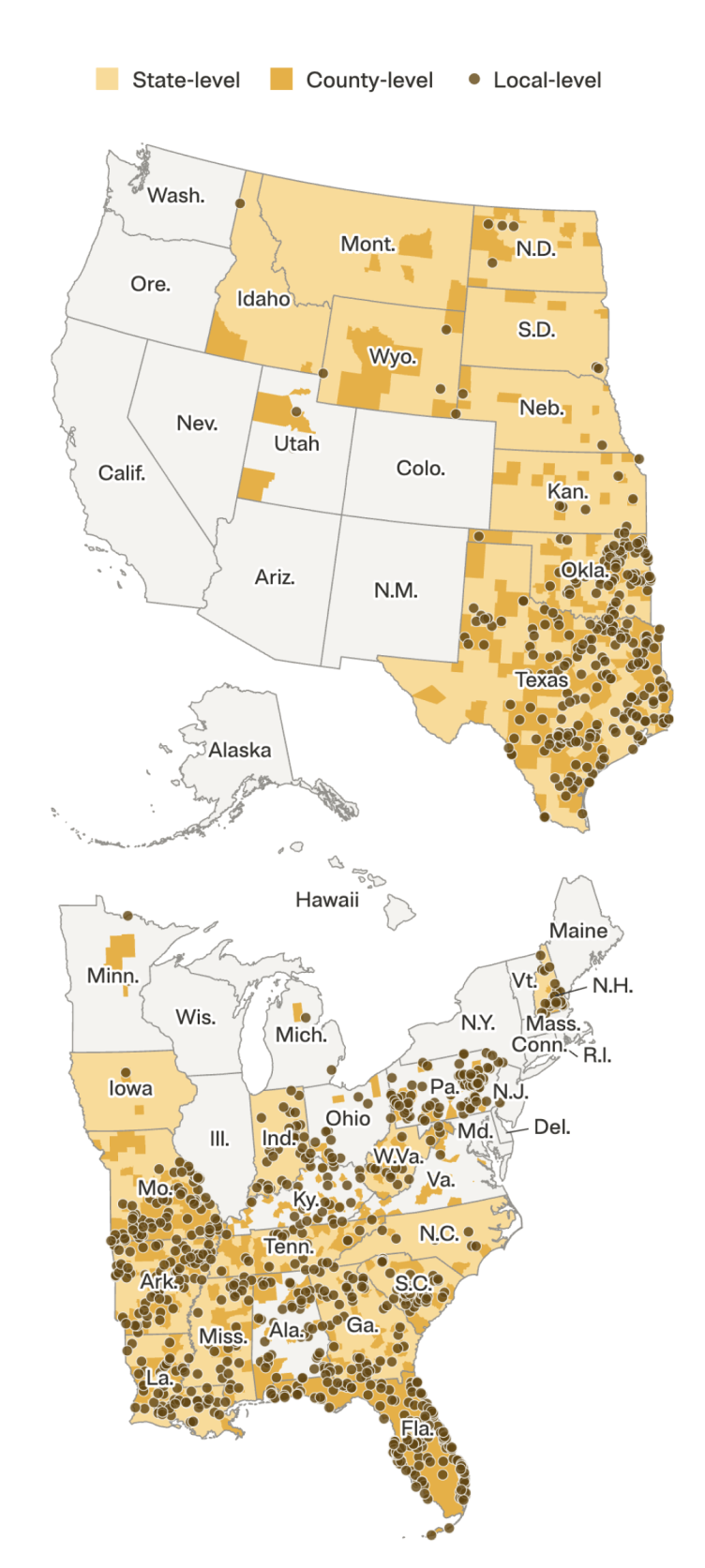
Ingram was by then one of more than 750 task force model partners around the country, up from not quite 500 when it signed up in October. At least 43 million U.S. residents, according to an analysis of ICE records by the legal data firm Titus Consulting, already lived in a county with an active task force agreement. Alexander was one of thousands of deputized officers in Texas alone.
Agencies With 287(g) Task Force Model Agreements
State-level
County-level
Local-level
Note: Though Pinal County, Arizona, is listed as having an active agreement in data maintained by ICE, the agreement is under permanent injunction, so it does not appear in this map. Source: Immigration and Customs Enforcement. Initial data analysis by Andrew Thrasher of the legal data firm Titus Consulting. Additional analysis by ProPublica.
Lucas Waldron/ProPublica
Agencies With 287(g) Task Force Model Agreements
Note: Though Pinal County, Arizona, is listed as having an active agreement in data maintained by ICE, the agreement is under permanent injunction, so it does not appear in this map. Source: Immigration and Customs Enforcement. Initial data analysis by Andrew Thrasher of the legal data firm Titus Consulting. Additional analysis by ProPublica.Lucas Waldron/ProPublica
In interviews, Alexander described the immigration system he was enforcing as “skewed” and “weird,” but he saw himself as largely separate from these concerns. “If you’re taking federal money to do a job,” he says, “I think you should do the job.”
Still, he seemed to struggle with the contradictions of his role. He told us he sometimes shared his lunch with the people he detained and that he let them hold on to their phones to call loved ones from the rear seat of the Charger. He handcuffed them with their hands in the front rather than the back so they could use their hands.
Martinez told us about a moment when she watched him detain one of her cousins. He allowed the man’s wife and children to hug him goodbye and waited until his 7-year-old daughter wasn’t looking to handcuff him. To Martinez, it seemed as if Alexander was trying to prove to her that he wasn’t a bad person. “But I’m not going to fall for it,” she says.
There was a protest in Ingram the following day against Trump’s mass deportations. Martinez decided to go. As she stood among a few dozen protesters waving a handmade sign with the name “J. Alexander” circled and crossed out, she saw him drive by again and again.
Alexander responding to a call. “If I’m being 100% honest,” he says, “I don’t enjoy when families are separated.”
A few weeks later, Katie Winer, the leader of the group that staged the protest, was following the Charger after Alexander detained another immigrant in a traffic stop. He approached her car and threatened to arrest her if she followed him in the future, on charges of interfering with public duties. But he also seemed to want to talk, and she recorded him as they discussed what was going on in Ingram. “I think you guys are making a bigger deal of it than they are,” he said of the people he handed over to ICE. The only outliers were “loudmouths” like Martinez and “her little crew.”
Winer interjected that Martinez’s husband was the family’s breadwinner, and it was Alexander’s actions that tore them apart.
“My actions did not,” Alexander said. “His actions did. I made a traffic stop. He was here illegally. That’s not my fault.”
Still, Alexander’s uncertainty seemed to be growing. In March, another of Martinez’s cousins confronted him outside the taco shop, pressing him about Macias as she filmed with her phone.
“If I’m being 100% honest,” he said, “I don’t enjoy when families are separated, like with the Joanna situation. That kind of fucked me up.”
“I Voted to Get the Bad Guys Out”
A month later, as Ingram’s handoffs to ICE surpassed 100 people, another video of Alexander circulated among a small group of community members. It showed an evening traffic stop, at least the fifth stop Alexander made that day. He had followed a silver Ford F-250 from the highway until it pulled into the gravel driveway of a mobile home. There, the man in the passenger seat, a landscaper named Victor Ramirez Hernandez, tried to hurry inside. Alexander grabbed him before he could get there.
The truck’s driver pulled out his phone and began filming. “Why are you arresting him?” he asked.
“I’m not,” Alexander answered, struggling to place handcuffs on Ramirez as he squirmed. “I’m detaining him.” Then he wrapped his hands around the laborer’s chest, lifted him off the ground and slammed him down on the driveway. “I played nice with you, and now I’m done,” he said. He straddled Ramirez and cuffed his hands behind his back.
“He’s bleeding because you hit him,” the driver said evenly. They argued back and forth.
“You’re an idiot,” Alexander said, his face reddening. “Shut up. The more you talk it’s just making you look stupider.” (Alexander declined to comment on this incident. Breshears, who reviewed body-camera footage, says Alexander’s use of force was justified to control a potentially dangerous situation.)
Acrimony pulsed through Ingram that spring. In the Latino community, family members and neighbors accused one another of snitching, which Alexander says did happen. Young women accused one another of having affairs with him, which he denies, insisting that people just misinterpreted his attempts to be kind. “I’m friendly with the people that I meet,” he says, “especially when they’re friendly to me.”
One subject of these rumors was Martinez. She and her older sister scoffed at them. “He’s taken our whole family at this point,” Jazmin says. “And she’s going to sleep with him? It’s really annoying.” But some in the community, even cousins, stopped speaking with her. “It’s like ‘Hunger Games,’” Martinez says.
As Latinos fled and avoided Ingram, the daily takeout orders at one Mexican restaurant on the edge of town dropped to 50 from 200. A corner store catering to immigrants lost around half its revenue and most of its Latino regulars. Landlords in a mobile-home park just outside town struggled to find tenants.
As Latinos fled and avoided Ingram, many businesses suffered. At Los Altos de Jalisco, a local restaurant, daily takeout orders dropped to 50 from 200.
But it wasn’t just Ingram’s Latino community that was reeling. For Ingram’s non-Hispanic business owners, including many Republicans in a county that voted 77% for Trump in the 2024 election, the immigration crackdown was becoming an outrage. It was taking people they worked with and knew well. It was interfering with flood reconstruction. It was hurting the local economy.
The owner of a heavily damaged strip mall on the western edge of town, Steve Edelstein, lamented the loss of two workers who were helping him rebuild. “Technically local law enforcement is doing their job,” he told a reporter for The West Kerr Current, emphasizing that he supported Trump. “But it isn’t helping the community.” A manager overseeing the rebuilding of Ingram’s Little League field, which was washed away in the flood, made an angry call to the city after two of his workers were picked up, Breshears says. A contractor helping rebuild Hunt’s destroyed post office had his crew reduced to eight workers from 30 — causing what should have been a four-day job to stretch to two weeks.
Among the people who called Jordan, the mayor, to complain was his onetime high school classmate Neal Secor, who describes himself as “one of the most conservative guys you’ll ever meet.” His family business, a cluster of rental cabins called Waltonia on the River, was nearly destroyed by the flood. He was struggling to rebuild. He says that in the spring, in two separate stops, the Ingram police detained four of his workers and handed them over to ICE — the second set as they returned from a job repairing the docks at a nearby youth camp, a favor Secor was trying to do for a neighbor.
Secor says Jordan’s defense was simple: You voted for this. They’d all voted for this.
“Let me tell you something,” Secor says he told Jordan. “I didn’t vote for this. I voted to get the bad guys out.” The two employees detained coming back from the youth camp were like family, his friends and co-workers for over a decade. “There’s still a lot of bad guys here,” he continued. “These guys aren’t them.”
Many local construction workers have been deported or have left Ingram, slowing down work, including recovery from the floods in 2025 and 2026.
Secor recalls Jordan saying that Ingram’s officers were just following the law. But, Secor wondered, why was it that he could drive 85 every day on the 75-mile-an-hour interstate and police officers just let him pass? He told Jordan he’d put 175,000 miles on his truck and never been pulled over. “It’s a matter of what laws you want to pick and choose,” he recalls telling the mayor. “We all break laws every day if you really want to get down to it.”
“God Wanted Me to Meet You”
On an unpaved side street in the Ingram hills in April, Alexander again faced a decision over whether to separate a young family. This time he had more of a choice; ICE had yet to arrive. A woman named Norma Luján took his hand and said she was praying for him.
Luján, 61, runs a successful housecleaning company based in Ingram. She had heard of Alexander long before she confronted him. She had seen him in the Charger, too: on the side of Junction Highway as she made her way to jobs at vacation homes or youth camps up in Hunt. On the side of the highway on the way back. In her rearview mirror for four excruciating minutes one afternoon as her “girls,” as she called her crew, held their breath and sank into their seats, protected by the tint of her car’s windows and the fact that a license-plate reader would show it was registered to her, a Texas-born U.S. citizen.
Norma Luján confronted Alexander after he detained the husband of a woman who worked for her housecleaning company. “I need you to look inside your heart,” she said, “and let him go.”
In January, at the carwash, Alexander had helped a sheriff’s deputy take one of Luján’s best employees into custody. The woman, Cinthya Carranza, was a single mother and asylum seeker from Guanajuato — and Joanna Martinez’s cousin. Carranza was on her way to get her children from school after she and Luján spent the day cleaning houses. Later that day, Luján saw a Facebook post showing a familiar face in a mug shot: Carranza’s. Luján broke into tears. To her, the arrest was a signal event. The Charger had mostly stopped men up to that point. This was the moment she understood that no one was safe.
Luján started losing workers in droves after Carranza was taken — some to traffic stops, most for fear of having to drive through Ingram. Her crew of 30 people dropped to fewer than 10. She worried for her business, but she worried more, she said, for her workers, the lives they had made in Ingram and the relationships she had built with them. They invited her to parties and baptisms, surprised her with presents on her birthday. She often led them in prayer. “I love them,” she says. She promised she would try to protect them.
When Luján’s employee Maria called that April afternoon to say the officer in the Charger was outside her house, detaining her husband as he returned from work, Luján jumped into action. Maria (who asked to be identified by her middle name because she is undocumented) was eight months pregnant and already terrified that she would have to give birth alone. Alexander had taken her brother a week earlier. Now Maria was hiding behind the curtains of her home, sneaking peeks outside, hoping Alexander would let her husband go.
One of Luján’s cleaning company employees, who is from Guatemala, cleaning a home in Kerrville, Texas. She asked that her name and face not be used to protect her privacy.
“Cálmate” — calm down — Luján told herself as she approached the Charger. “Cálmate.” She took a deep breath. She says Alexander was sitting in the driver’s seat with the door propped open, staring at a tablet computer.
“Look, his wife has had a complicated pregnancy,” she told him. (This was true.) “She’s in the hospital.” (For that lie, Luján says, she later prayed for forgiveness.)
Then Luján reached out and grabbed Alexander’s hand. “I pray for your being, for your soul,” she recalls telling him as she cried. “I want you to think about what you’re doing. Feel it. Feel it, please.” She squeezed his hand. “I need you to look inside your heart,” she continued, “and let him go.”
Alexander didn’t react at first, in Luján’s telling. “God wanted me to meet you,” she said. He met her gaze.
“I’m that guy that everyone talks about on Facebook,” she recalls him finally saying. “If you think I don’t lose any sleep, you’re wrong.”
Luján pushed through the lump in her throat to speak. “I’m going to pray for you every night,” she promised him. She says Alexander squeezed her hand back, then pulled away. He walked off to make a call. She couldn’t make out much of what he said. It was quiet, save for the sound of Luján’s sobs and the pebbles from the unpaved road crunching beneath the officer’s feet.
Then he returned to the Charger. “Get him out of the car,” Luján recalls him saying. “Hurry up.”
“God bless you,” Luján said. “God will repay you for this.”
Alexander says he doesn’t remember the details of his interaction with Luján, but he confirms that he let Maria’s husband go, calling it a matter of “human decency.” He knew how hard it was to raise children. “A woman needs rest,” he says. “She needs help.” Maria’s husband “needs to be there helping out.”
The night shift at a meat-processing plant in Ingram, two days before two employees driving to work there were detained and handed over to ICE. All the other male workers quit shortly after.
At first, nothing seemed to change. Over the next two months, as the Hill Country prepared to welcome summer tourists and campers back after the devastation of the floods, Alexander worked around 100 task force hours, earning close to $5,000 from ICE.
But the next time he ran into Joanna Martinez, he seemed to be having misgivings. It was early June, and he was eight months into the ICE program. He had pulled over another of her family friends on Junction Highway, a person she had known since childhood. Martinez got a phone call and rushed to the scene, as she had so many times before. “I don’t feel good about this,” she recalls him saying when she arrived. “I signed up to be a cop, not an ICE agent.” (Alexander says he remembers that they talked and that he could have said something like that.)
Later that month, he pulled over a young man from Honduras who was on his way to a soccer game with his cousin, a 12-year-old with developmental disabilities. The boy’s father says he and his wife hid across the street watching it all happen, too terrified to step out and claim their son. The parents sent a friend from church, but she was not a legal guardian. Alexander says he had no choice but to hand the boy over to ICE, adding though that if he was one of the parents, he would see it differently. “If I’m in that position, there’s no way I’m letting my kid go,” he told us. “I’m probably fighting someone.”
Within a couple of weeks, Alexander’s task force hours dropped by about 40%, according to his pay stubs. It remains unclear if he tried to step back from immigration work or whether the number of undocumented drivers in Ingram had simply dwindled because of all he had already done.
According to Chief Breshears, Ingram had logged 194 “immigration-related incidents” as of this August. Whether every handover led to a deportation, Breshears couldn’t say. Alexander says he doesn’t know how many of the 194 are people he stopped. But he says he has now let at least 10 people go — many, though not all of them, mothers of young children.
Alexander sees this, and his relationship to the Martinez family, as evidence of his humanity, despite what people say about him. “For context, I’ve deported like six of their family members, and they’re still friendly to me,” he says. “So I’m not the monster they make me out to be.”
On July 16, the skies over Ingram opened again, dropping nearly 19 inches of rain in a single day, and the Guadalupe again overtopped its banks, again destroying businesses and homes. In the predawn darkness in the early hours of the emergency, Alexander began racing toward Ingram in his black Charger to help. He had barely left his house when surging floodwaters consumed the vehicle, destroying the Charger’s engine block. A driver in a pickup truck took him back home, and that’s where he stayed until the storm receded.
“One Free Pass”
Alexander remains only one cog in a deportation machine for which the federal government has now earmarked $240 billion. Today more than 1,900 agencies in at least 30 states have signed up for ICE’s task force model, with more than 29,000 deputized officers. With their help, ICE recently hit a record of immigration arrests, totaling more than 50,000 in August.
On Sept. 11, Alexander met one of us at a taco spot on Junction Highway. Ingram had changed in the year since his return. Whole neighborhoods had emptied out, and residents noticed fewer drivers on the streets. In part because of the money from ICE, the Police Department had hired two additional officers. As a Mexican ballad played over the speakers, Alexander warned against making too much of the leniency he showed to families like Maria’s. “It’s like one free pass, I guess,” he said: If he encountered her husband again during a traffic stop, he would probably hand him over to ICE. He just thought letting the father-to-be go was the right call at the time. “I mean, don’t you?” he asked.
He said he hadn’t made all that much money working with ICE. But city records show that his earnings from the agency already totaled $18,793.25 in nine months, more than a quarter of his base salary. “I think it’s skewed a little bit,” he said, looking at the pay stubs we had gathered.
Alexander said it was hard for him to be out in public anymore. He can’t escape being recognized in Ingram and Kerrville. Sometimes he catches Latinos staring at him, then walking away, visibly uncomfortable. So he tries to do his shopping and errands in another town 30 minutes away.
A driver passing one of the Ingram Police Department’s black Chargers along Junction Highway.
He blamed the Facebook groups. They had created a climate of “unreasonable fear” in Ingram. “What do they think I’m going to do right now?” he asked, seated at his table in the taco shop. A steady stream of customers, many of them white, approached a counter staffed by two young Mexican sisters. He said their father used to hide out in Hunt to avoid being pulled over in town. Some of their co-workers had quit months before, too uncomfortable to serve Alexander when he came in for breakfast. But when the taco shop owner sees him, he said, she hugs him.
“I know the status of everybody in this room,” he said. He suggested everyone who worked there was undocumented. Whether they disappeared or were allowed to stay was up to him. And today, at least, he was just there for breakfast.
Authorities in Sri Lanka have failed to successfully prosecute a single transnational cyber scam case, police have said, despite more than a thousand arrests so far this year of suspected members of Asian fraud syndicates who have surged into the South Asian country.
The admission comes as experts warn the island nation is becoming a destination of choice for thousands of scam workers fleeing Southeast Asian nations such as Cambodia, which had in recent years become home to massive scam compounds, many of them reliant on trafficked workers.
Recently crackdowns in scam centers in Southeast Asia have driven mostly Chinese-origin scam syndicates to set up shop in vulnerable states from Madagascar to Papua New Guinea. Among the countries of South Asia, Sri Lanka stands out for being at “serious risk of becoming a hub for industrial-scale cyber scams,” the Global Initiative Against Transnational Organized Crime (GI-TOC) said last month.
From January until September, Sri Lankan police have conducted raids on 27 suspected scam compounds around the country and arrested 1093 people, Sri Lankan police spokesman Fredrick Wootler told OCCRP and Sri Lanka’s The Sunday Times.
The figure represents a dramatic rise from 2025, when just 26 people were arrested, Wootler said. An additional 573 suspected scammers were arrested the year prior.
Despite the well-publicized arrests, “we have not had a successful prosecution yet” of anyone suspected of using Sri Lanka as a base for scamming victims abroad, Wootler said.
The issue, Wootler explained, is that Sri Lanka’s current computer crime law, which dates from 2007, only allows cases to be opened on the basis of a complaint from a victim. Since the majority of those getting scammed live abroad, few complaints have been received.
Instead, he added, the vast majority of suspected scammers are being charged for visa violations and being removed from the country.
“The current government is …very much keen to see that this type of criminal networks [must] be taken away from Sri Lanka,” Wootler said.
The head of Sri Lanka’s police cyber crime unit, Chandima Arumapperuma, told reporters that the majority of suspects arrested so far carry passports from Asian countries such as China, Vietnam, India, and Indonesia. Many come with travel records showing they had previously been in Cambodia or Myanmar, both well-known scam hubs, she added.
Efforts to interview suspects are hampered by language barriers while devices are often encrypted and difficult to analyse, Arumapperuma added.
“The volume of devices we find in each raid is so high, usually about 200 phones and laptops, and we simply do not have the resources to process all of them,” she said.
Adding to the difficulty, experts say, is another factor: Sri Lanka is desperate for foreign exchange. The tourism-dependent country offers visa-free travel to passport holders from 40 countries, including China. It has also opened up investment for online gambling and brick-and-mortar casinos, and has opened up a “special economic zone,” known as Colombo Port City, to attract investors in the digital economy sector.
“Online gambling and offshore gambling operate in legal gray areas in Sri Lanka. The country has an economically distressed project, the Colombo Port City. And then it has a mechanism for bringing large numbers of foreigners,” said Jason Tower, a transnational crime expert at GI-TOC.
In contrast to Southeast Asian scam hubs, where compounds have operated out in public view with protection from politicians and armed groups, Sri Lanka’s scam industry remains clandestine. But failure to tackle these networks could allow the industry to grow to a scale at which criminals become a force powerful enough to defy the government, Tower warned.
“The imagination is the limit. Going from what’s hidden and clandestine to what is open and obvious, “ he said.
A Chinese cyber scam boss who was kidnapped and murdered in Sri Lanka’s capital in July went by three separate aliases and carried at least two passports, according to documents obtained by OCCRP and The Sunday Times.
Chen Guoqing, 31, was abducted from the Colombo Port City special economic zone in the early hours of July 23 by a group of over a dozen men, one of them brandishing a pistol, according to a copy of the police investigative report into the incident. He was driven to a rural area over 70 kilometers east of Colombo, tortured to death, and his body was abandoned.
The murder of Chen — and the hunt for his killers — received extensive media coverage in Sri Lanka, amid fears that the South Asian country is becoming a new base for Asian criminal syndicates that target victims around the world with sophisticated online fraud schemes.
Sri Lankan police told OCCRP and the Sunday Times that they have arrested five Chinese nationals over the murder and are seeking another three suspects, who are believed to have fled the country. Local authorities have said they believed Chen was involved at a high level in international criminal activity and was murdered over a money dispute with other criminals.
Investigative files show police recovered two passports belonging to the murder victim, each using a different name. One, a Cambodian passport, identified him as Chen Hao. The other, from Suriname, identified him as Tao Guoqing.
Reporters were able to find the murder victim’s real name — Chen Guoqing — by crosschecking his Cambodian passport with a publicly available copy of naturalization and name change records from that country’s Gazette.
Chen’s real name is not mentioned in the Sri Lankan police investigative report, and neither his Cambodian nor his Surinamese aliases have been reported in local media.
Details of Chen’s identitycome as OCCRP and the Sunday Times have revealed that, despite over a thousand well-publicized arrests, Sri Lanka has failed to successfully prosecute a single person for using the country as a base to conduct online scams targeting foreigners.
Brian Hanley, the Asia-Pacific Director of the Global Anti-Scam Alliance, said Chen’s murder highlights the vulnerability of Sri Lanka to infiltration by scam syndicates fleeing crackdowns in traditional Southeast Asian epicenters like Cambodia.
“There’s weak enforcement [by Sri Lankan authorities],” Hanley said. “Scams pay. Nobody gets caught. Or if they do, there’s no sanction.”
“For a country like Sri Lanka this level of scam activity could easily start to see a single digit contribution to their entire GDP.”
Democratic Senate candidate Abdul El-Sayed speaks during the WXYZ Channel 7 debate on Oct. 21, 2026, in Southfield, Mich.Photo: Robin Buckson-Pool/Getty Images
The PUMA spirit is back. The 2008 Democratic Party protest movement, inflamed by what Hillary Clinton supporters viewed as Barack Obama stealing the nomination from their primary candidate, scorned his general election campaign and embraced the mantra “Party Unity, My Ass.”
DSA-aligned progressives have won a number of party primaries and are set to help Democrats take the majority in Congress. But once in power, they’re likely to make demands — the kinds of demands that could upend decades of carefully crafted donor-friendly policymaking.
For moderate Democrats, “party unity” is only a goal worth pursuing to bully the left wing of the party to fall in line with their preferred candidate.
For moderate Democrats, “party unity” is only a goal worth pursuing to bully the left wing of the party to fall in line with their preferred candidate. When it’s on them to step up and vote for someone who might have different goals, that’s another story completely, and some centrists are even hoping for Republicans to win the House this November if the alternative is an empowered DSA Democratic wing.
James Carville, the fossilized Cajun strategist who was part of exactly one successful national political campaign, Bill Clinton’s 1992 White House victory, said on The Bulwark podcast last Sunday that he’d prefer a tight GOP hold on Congress over a narrow Democratic majority.
“I would be disappointed if it comes in at 225 House seats,” Carville told host Bill Kristol. “I would rather the Republicans keep the House by five than the Democrats to win by five, because, if that happens, they’re hostage to the DSA.”
To his credit, Kristol — who, in a sign of how people can change when they know which way the wind is blowing, spent the PUMA moment promoting Sarah Palin but is now a self-proclaimed Democrat — pushed back, saying he’d rather win.
Carville is the first of his cohort to explicitly call for a GOP victory rather than the left flank of the party getting more power, but he’s not the only centrist deprioritizing his party’s prospects in November.
Perhaps most consequentially, in Michigan, Democratic Senate nominee Abdul El-Sayed has faced an uphill battle since winning his party’s grueling primary. He’s now focused on winning in the general election and becoming the first Muslim U.S. senator, but resistance to his candidacy remains a concern.
Much of the difficulty has come from members of his own party and other liberals. Their antipathy toward a candidate whose positions aren’t so out of step with other members of the caucus has raised questions about what exactly is so objectionable about him. El-Sayed may skew to the progressive side of the party, but he’s not a socialist and not a member of the DSA; his positions on domestic policy should place him companionably among the likes of Sen. Elizabeth Warren’s wing.
Until recently, most of the anger after El-Sayed’s primary in early August was confined to X and occasional cable news hits.
That changed on October 16, when two Michigan Democratic Party power players, David Kramer and Lon Johnson, urged voters in a Detroit News op-ed to leave El-Sayed’s place on the ballot blank — effectively handing the Senate seat over to Republican Mike Rogers, an election denier and a lockstep Trump ally.
The piece tied El-Sayed to extreme elements of Islam and suggested his opposition to Israel’s genocide, war crimes, and occupation was based in hatred for the Jewish diaspora.
“Our gravest concerns involve El-Sayed’s associations with figures who have excused or minimized terrorism, his reluctance to unequivocally condemn dangerous rhetoric, and his support of extreme policies,” Kramer and Johnson wrote. “At a time of rising antisemitism, Democrats deserve leadership that unequivocally rejects rhetoric threatening Jewish communities.”
Comedian Mike Drucker accurately described on Tuesday the centrist rejection of El-Sayed as less “blue no matter who” and more “blue unless brown.”
But Democratic leaders like Carville, Kramer, Johnson, and others are panicked beyond their obvious Islamophobia — they can see the writing on the wall goes well past Michigan. It’s a full-on existential crisis.
Former Intercept writer Jon Schwarz once opined on what he termed the iron law of institutions: “The people who control institutions care first and foremost about their power within the institution rather than the power of the institution itself.”
What we’re seeing now is the iron law’s white blood cells fighting a threat they don’t believe can be easily assimilated into the existing power structure. It’s a danger to their status and power.
Their attacks on the left are going to backfire, leaving the Democrats’ centrist wing even less empowered than before.
That outcome is ideal for the party, the base, and the country. For centrists, it’s a disaster — but if the way to stop their coming irrelevance is to vote for a progressive American Muslim who opposes genocide, they’re incapable of taking that step.
Ultimately, all their griping may not matter. El-Sayed is regularly polling slightly ahead of Rogers, and 95 percent of Michigan Democrats said they intend to vote for him. Much like Jackson in Maine, should he win, El-Sayed will be even less beholden to the elements of the party power structure who are so desperately trying to prove he needs them, rather than the other way around.