Tag: News

  • Banks are blocking AI agents from customer accounts

    This week, Axios reported that major US banks were detecting third-party AI agents operating inside customer accounts. In many cases, customers have given the agents their usernames and passwords so they could act on their behalf. This kind of access can violate a bank’s rules.

    Bianco Research president Jim Bianco raised the question during Unchained’s Bits + Bips livestream on October 26:

    “Are you protecting me, or are you protecting your own profits?”

    Bianco described traditional finance’s business model as “based on laziness.” Customers may leave idle cash in low- or no-interest bank accounts rather than move it into a money market fund. An AI agent could make that move for them. “Now that you’re able to do it, the banks are afraid they’re gonna lose that revenue stream,” he said.

    The banks offer a different explanation. JPMorgan Chase CEO Jamie Dimon said the bank wouldn’t allow just any outside agent into its systems because doing so was “too risky for clients and for JPMorgan.”

    Both explanations can be true: banks can want to retain deposits while also facing real security problems when software acts through customers’ accounts.

    Handing over your banking login introduces another service into the security chain. A vulnerability in that service could expose your credentials or allow your account to be misused. And as Bank of America reportedly pointed out:

     “If you do share your credentials, keep in mind that you’re responsible for activity resulting from that access.”

    That’s the bank’s stated position, not a universal ruling on consumers’ legal rights. Still, it’s a warning worth taking seriously.

    Pros and cons

    An AI agent with permission to make purchases might find and buy an item at a lower price. But giving an agent access to your bank account also means sharing sensitive banking information with a third party. We’ve seen shared AI chats become searchable online too.

    Axios reported that many banks allow, or are moving toward allowing, read-only access. This can let a tool analyze transactions without giving it permission to move money.

    That’s an important boundary, but it doesn’t make the information harmless. An agent that can read bank statements may still disclose them if it’s compromised or manipulated. Preventing transactions and protecting confidentiality are separate security goals.

    How to keep control of your money

    For consumers, the practical question is not whether banks have perfectly selfless motives. It’s what access you’re giving away, and what could happen if the agent makes a mistake.

    • Don’t paste banking passwords or security codes into a general-purpose AI assistant. Major banks have explicitly warned customers against sharing their credentials.
    • Use your bank’s approved connection methods rather than giving an agent your login. Where supported, choose read-only access if all you need is analysis or budgeting help.
    • Give agents access to as little sensitive information as possible. An assistant comparing publicly advertised savings rates doesn’t need your bank statements. OpenAI recommends limiting agents to the data and credentials they need for the task.
    • Review consequential actions yourself. If an agent asks for confirmation, check exactly what it intends to do and what information it will share. Don’t treat a confirmation prompt as a formality.

    AI can make it easier to compare financial products and spot opportunities you might otherwise miss. But an assistant that finds a better rate and an agent that can act inside your account are different propositions.

    Let it help with the homework, but be cautious about handing it the keys.


    Let’s face it, an incognito window can only do so much. 
     
    Breaches, dark web trading, credit fraud. Malwarebytes Identity Theft Protection monitors for all of it, alerts you fast, and comes with identity theft insurance. 

    Source: Malwarebytes Labs · 2026-10-28

  • Russian Billionaire Takes Tiny Norwegian News Outlet to Court in London

    Russian Billionaire Takes Tiny Norwegian News Outlet to Court in London

    Russian tycoon Vitaly Orlov is suing The Barents Observer, a small Norwegian news outlet, over its reporting on sanctions against his fishing company. 

    The Barents Observer is a six-person non-profit newsroom in Kirkenes, a town of about 7,000 people in Norway’s far north. But the lawsuit isn’t taking place there — or even in Norway. Instead, Orlov has lodged a defamation suit in the High Court of London.

    “We don’t even have money for plane tickets to go to the court,” said Editor in Chief Thomas Nilsen.

    “It’s just not possible for us to defend ourselves against all of the claims,” he told OCCRP’s Norwegian media partner, NRK, adding that if Orlov is awarded some legal costs, The Barents Observer “will go bankrupt.” 

    Orlov’s fishing company, Norebo JSC, said in a statement provided to OCCRP that the choice of London as a venue for the lawsuit was related to the fact that The Barents Observer publishes in English.

    “The Barents Observer is a Norwegian publication that publishes in English and now complains at being sued in England. This is the very country The Barents Observer has courted,” the company said.

    The legal claim by Orlov’s lawyers, from the London firm Devonshires, states that The Barents Observer website received 190,000 hits from the U.K. in 2025, according to a web analytics firm. 

    But U.K. readers make up only 5 percent of The Barents Observer readers, according to a letter the publication sent to the court. 

    “It is difficult to understand the logic behind Vitaly Orlov bringing his grievances before a court in England,” The Barents Observer stated in its letter.

    The Barents Observer noted that it is based in Norway, and that Norebo is already engaged in a lawsuit against the Norwegian government in response to its ban on company vessels using its territorial waters and ports.

    Orlov is claiming damages as a result of “serious harm” to his reputation caused by five news stories published by The Barents Observer between May 2025 and January this year. The news reports covered the E.U. sanctioning of Norebo, but also included information about Orlov himself.

    The E.U. sanctions notice does not mention Orlov, and he has not been sanctioned. The sanctions notice alleges that Norebo vessels showed “movement patterns [that] align with malign objectives.”

    “The movement patterns have been linked, including by Member States and the authorities of third states, to the Russian state-sponsored surveillance campaign that employs inter alia, civilian fishing trawlers, to conduct espionage missions directed against civilian and military infrastructure in the North and Baltic Sea,” the sanctions notice states.

    In the claim brought to the High Court of London on behalf of Orlov, Devonshires lawyers note that “Norebo disputes the designation and has brought annulment proceedings before the General Court of the European Union.”

    Source: OCCRP · 2026-10-28

  • Chrome and Firefox updates fix serious security flaws. Install now

    Chrome and Firefox updates fix serious security flaws. Install now

    On October 27, Google issued a new Stable channel update for Chrome.

    Most users are on Chrome’s Stable channel. The desktop update brings Chrome to versions 156.0.8078.73/.74 for Windows and Mac and 156.0.8078.73 for Linux. The update includes 52 security fixes, including four rated Critical.

    On the same day, Mozilla issued Security Advisory 2026-118, which fixes 167 vulnerabilities. Firefox 159 also introduces several new features.

    Both updates will roll out over the coming days and weeks.

    How to update Chrome

    The easiest option is to allow Chrome to update automatically. But you can end up lagging behind on updates if you never close your browser or if something goes wrong, such as an extension preventing the update.

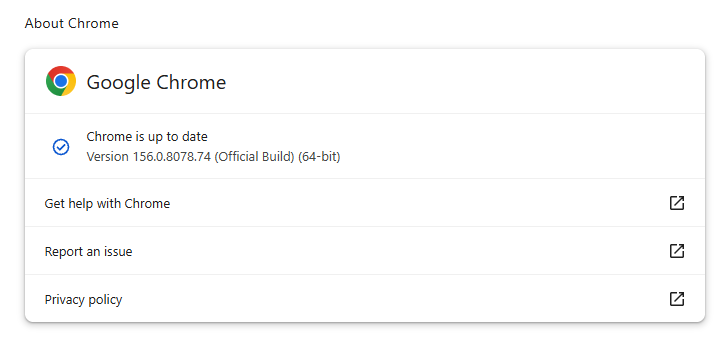
    If you don’t want to wait for the rollout to reach you, manually updating is easy. Open About Google Chrome from Chrome’s settings or Help menu. Chrome will check for updates. If one is available, click Relaunch to apply it.

    Chrome version 156.0.8078.74 is up to date
    Chrome version 156.0.8078.74 is up to date

    You can find an explanation of the version numbering system and step-by-step instructions in our guide: How to update Chrome on every operating system.

    How to update Firefox

    To update Firefox, open the browser and click the menu button at the right side of the Firefox toolbar, then go to Help and select About Firefox. The About Mozilla Firefox window will open.

    Firefox will automatically check for updates. If one is available, it will be downloaded. Once done, you’ll be prompted to click Relaunch. After Firefox restarts, it will be up to date.

    After the update, the version should be 159.0 or later
    After the update, the version should be 159.0 or later

    Technical details

    These Chrome and Firefox updates address a familiar problem: browser code mishandling memory while processing web content. Both releases fix use-after-free vulnerabilities, including flaws in page layout, JavaScript processing, and SVG graphics.

    A use-after-free vulnerability occurs when a program attempts to access a memory location after it has been freed. That can cause crashes or, in some cases, allow an attacker to run their own code.

    There’s another connection between these updates: both Google and Mozilla credit OpenAI Codex Security with finding bugs fixed in these releases. AI can help security teams examine browser code for weaknesses, alongside human code reviews and automated tests that check how software handles unexpected inputs.

    Mozilla’s collaboration with Anthropic shows how AI-discovered findings can lead to fixes: researchers validated vulnerabilities before reporting them, giving Mozilla’s team reproducible bugs to investigate, repair, and deliver to users.


    Browse like no one’s watching. 

    Malwarebytes Privacy VPN encrypts your connection and never logs what you do, so the next story you read doesn’t have to feel personal. Try it free → 

    Source: Malwarebytes Labs · 2026-10-28
  • ‘Bought-off, corrupt’: Argentine president attacks ICIJ member Hugo Alconada Mon

    ‘Bought-off, corrupt’: Argentine president attacks ICIJ member Hugo Alconada Mon

    Argentine president Javier Milei escalated his rhetoric against journalists on Friday, singling out veteran investigative reporter and ICIJ member Hugo Alconada Mon along with four other reporters as “mercenaries of lies” and suggesting they should be “burned at the stake.”

    Journalists associations in the country leapt to their colleagues’ defense, calling the remarks a “death threat” and asking the United Nations special rapporteur for freedom of expression to intervene. The remarks took place at a private, livestreamed event after a judge dropped a fraud investigation into Milei and his sister that was propelled by reporting into the so-called ‘$Libra scandal.’

    In 2025, the president posted on the social media platform X about $Libra coin, a cryptocurrency available for trade in Argentina, saying it would help finance small businesses. The price skyrocketed and then fell sharply after the president deleted his post, causing significant losses to some investors.

    Journalists, including Alconada Mon, subsequently reported ties between the creators of $Libra, Milei and his sister, Karina Milei, dating back to 2024, prompting investors to file a complaint accusing the president and his sister of fraud and influence peddling.

    Two men in suits giving a press conference in front of Costa Rican and American flags.

    https://www.icij.org/news/2025/09/journalists-in-peru-seek-protection-from-justice-system-amid-rising-threats-harassment-by-officials/

    PRESS FREEDOM Journalists in Peru seek protection from justice system amid rising threats, harassment by officials Sep 26, 2025

    https://www.icij.org/news/2024/11/many-journalists-have-left-how-post-election-repression-compounded-press-freedom-fears-in-venezuela/

    PRESS FREEDOM ‘Many journalists have left’: How post-election repression compounded press freedom fears in Venezuela Nov 15, 2024

    https://www.icij.org/news/2026/05/us-bars-executives-of-costa-ricas-leading-newspaper-la-nacion-from-entry/

    PRESS FREEDOM US bars executives of Costa Rica’s leading newspaper La Nación from entry May 06, 2026

    Recommended reading PRESS FREEDOM Journalists in Peru seek protection from justice system amid rising threats, harassment by officials Sep 26, 2025 PRESS FREEDOM ‘Many journalists have left’: How post-election repression compounded press freedom fears in Venezuela Nov 15, 2024 PRESS FREEDOM US bars executives of Costa Rica’s leading newspaper La Nación from entry May 06, 2026

    Source: ICIJ · 2026-10-27

  • U.S. Court Sentences Lender to 15 Years over  $76M Ponzi Scheme

    U.S. Court Sentences Lender to 15 Years over $76M Ponzi Scheme

    A U.S. federal court has sentenced a businessman to 15 years in prison for his role in running a Ponzi scheme that defrauded hundreds of investors out of millions of dollars. According to a statement from the Department of Justice, Edwin Brant Frost IV, the founder of a conservative, Christian lending firm in Georgia, defrauded more than 300 investors out of over $76 million in a massive Ponzi scheme. Frost, who was convicted of wire fraud in May after pleading guilty, will also have to pay back over $76 million in restitution to victims.

    According to federal prosecutors, Frost’s now-defunct company, First Liberty Building and Loan, LLC, ran the Ponzi scheme between at least 2021 and July 2025. Frost scammed investors by claiming he was making high-interest, short-term “bridge loans” to small businesses. Prosecutors stated that after most of the bridge loans defaulted, Frost began using new investor funds to pay interest to existing investors, while secretly diverting at least $5 million for lavish personal purchases and political contributions.

    Source: OCCRP · 2026-10-27

  • The web’s having a rough week. Here’s how to browse safely

    You recognize the website. You’ve visited it before. You may even have it bookmarked. Then it asks you to do something unusual: install an update, allow notifications, or run a command to prove you’re human.

    Stop and check first. A website you trust can still display instructions you shouldn’t follow. Our researchers have documented attacks in which criminals hacked legitimate websites and used them to deliver fake verification pages that trick visitors into installing malware.

    Within the same week, serious problems emerged in several parts of the web’s security infrastructure. Attackers were exploiting two flaws in PHP, researchers disclosed a critical flaw in Brotli software used by Node.js, and eight compromised security certificates raised concerns about how browsers and apps verify websites. The incidents have different causes and levels of risk, but their timing makes this an unusual cluster.

    PHP is used by about 7 in 10 websites whose underlying programming language is known. Node.js is used by 7.4% of websites with an identified web-server technology, according to W3Techs. Both run websites behind the scenes, so flaws in them can put the sites that rely on them at risk. Most browsers have blocked the certificates, though updates may still be needed for other software and devices.

    These problems don’t mean you need to stop browsing. But keep your software and security protection up to date, and be wary of unexpected requests.

    How to stay safe when browsing

    Check the website’s address, but remember that even the genuine site may have been compromised. The important question is whether the page’s instructions make sense. A familiar website may earn your visit, but that doesn’t mean you should automatically let it run software on your device.

    In documented campaigns, malicious instructions appeared on legitimate, hacked WordPress websites, not just lookalike domains.


    A secure connection doesn’t guarantee that a page is safe, either. HTTPS protects the connection between your browser and the site. Browser protections against dangerous content are a separate layer. A page asking you to install software or enter sensitive information still deserves scrutiny, even when the connection is encrypted.

    Ask yourself: “Does this request make sense for what I came here to do?”

    Reading an article shouldn’t require opening PowerShell. Watching a video shouldn’t require following a website’s instructions to “repair” your computer. These are familiar themes in ClickFix attacks, which disguise malicious commands as routine verification or troubleshooting steps.

    You can’t patch someone else’s web server, but you can keep the software on your own device updated. Turn on automatic updates for your operating system, browser, and applications where available, and don’t repeatedly postpone installing them. Updates fix security flaws that criminals could otherwise use to access your files or accounts.

    Keep your browser’s phishing and malware protection enabled, too. Free browser extensions like Malwarebytes Browser Guard warn about known dangerous websites, malicious downloads, and clipboard hijacking. Treat those warnings as a reason to leave, not as another obstacle to get round. These checks are a useful layer of protection, but they can’t certify that every unflagged page is safe.

    Use strong, unique passwords stored in a password manager, and enable multifactor authentication on important accounts. These measures help protect your accounts from unauthorized access.

    If a request involves running code or making changes to your device, verify it independently. If a website claims your browser needs updating, close the prompt and check through the browser’s own settings. If it says an account or service needs attention, check through the official app, help page, or support channel that you open yourself.

    Criminals often present the harmful step as the thing that will let you do what you came to do: fix the connection, enable the player, or complete the security check. The frustration of being blocked can make it tempting to follow their instructions.

    Use up-to-date, real-time anti-malware protection on your devices to help stop malware from wreaking havoc or stealing your information.

    Watch for unexpected content, downloads, redirects, and repeated login requests, even on familiar sites. If something looks wrong, leave the page. If you’re unsure, use Malwarebytes Scam Guard to check whether a request may be a scam and get possible next steps.


    From reporting threats to removing them.

    Cybersecurity risks should never spread beyond a headline. Keep threats off your devices by downloading Malwarebytes today.

    Source: Malwarebytes Labs · 2026-10-27

  • Samsung TVs without mics may listen through soundbars, researcher says

    A reverse engineer claims that their Samsung smart TV has been collecting audio without their consent.

    The researcher, who calls themselves “log4j,” said in an X thread that their 2025 Samsung TV was delivering ads that seemed suspiciously relevant to them. Investigating, they claim to have found a package called “always on voice,” which uses the TV’s built-in microphone to collect sounds from the room.

    The software logged events such as dogs barking and babies crying, log4j said, adding that these events are counted and reported back to Samsung.

    Samsung advertises similar features on some of its AI-enabled TVs. The company says its Pet Care and Family Care features use on-device AI to detect a dog barking or a baby crying and alert users. This doesn’t confirm log4j’s claims about the package or the data it reports.

    However, log4j says that on TVs without microphones, the software searches for connected devices such as soundbars or Bluetooth microphones and uses those to listen instead.

    The TV was also collecting geolocation data and mapping local networks, they said, adding that it ran a service on the TV that analyzes traffic on the local network.

    log4j also says that the system uses a neural network tailored to a particular region to analyze your viewing habits. A neural network is a type of machine-learning model. log4j said:

    “…in youtube it’s looking for videos you watch, ads you skip, progress in a video, etc.”

    The tracking that’s on the record

    While log4j’s claims haven’t been independently verified, Samsung has used automatic content recognition (ACR), a system that identifies what’s on screen. Earlier this year, Texas Attorney General Ken Paxton settled with Samsung, getting the company to agree that it would get Texans’ express consent before collecting or processing ACR viewing data.

    A class action complaint filed in New York in January also accused Samsung of using ACR to record video and audio passing through the TV. The complaint accused Samsung of using machine-learning algorithms to analyze and link this data back to consumers. This includes information displayed when the TV is used as a computer monitor, it said, adding that the information can be linked to different people using the TV. The case was voluntarily dismissed in July.

    The New York complaint added:

    “Samsung exploits this Sensitive Information by (a) selling targeted advertisements to its corporate advertising clients, and (b) providing it to third-party advertising companies such as Google and X (f/k/a Twitter) for targeted advertising.”

    A separate class action complaint filed in California this month accuses Samsung Electronics America of not being transparent about its ACR data collection.

    This isn’t the first time that Samsung has been criticized for allegedly picking up in-room audio. In 2015, privacy group EPIC filed a complaint with the FTC, accusing Samsung of recording conversations and relaying them elsewhere. The nonprofit said at the time:

    “Everything a user says in front of the Samsung SmartTV is recorded and transmitted over the internet to a third party regardless of whether it is related to the provision of the service.”

    EPIC identified text-to-speech company Nuance as the third party.

    What you can do

    We can’t confirm all of log4j’s allegations, and Samsung doesn’t appear to have commented. But there have been multiple complaints about the data smart TVs collect. You can turn off features such as ACR, internet-based advertising, and voice recognition where possible.

    log4j has also raised concerns about whether monitoring services are truly off. They said:

    “ACR off via your preferences menu on samsung TVs should not be assumed to actually disable ACR telemetry.

    i’ve found several instances where the checks (whether deliberate or not) are either incorrectly implemented or not checked at all.”

    log4j says disconnecting your TV from Wi-Fi is the best option for immediate peace of mind, though that also means losing internet-based TV features. They also suggest using an Apple TV or a modifiable Android TV box with open-source software.


    What do cybercriminals know about you?

    Use Malwarebytes’ free Digital Footprint scan to see whether your personal information has been exposed online.

    Source: Malwarebytes Labs · 2026-10-27

  • Proton To ‘Re-Interview’ Staff About AI To See Who Gets To Keep Their Job

    Proton To ‘Re-Interview’ Staff About AI To See Who Gets To Keep Their Job


    Proton To ‘Re-Interview’ Staff About AI To See Who Gets To Keep Their Job

    Proton, the company behind ProtonMail and other privacy-focused products, told staff on Monday it would be ‘re-interviewing’ staff across the company about how they use AI in their jobs, with the implication that the interviews may decide whether staffers have “continued employment,” according to an internal Proton email obtained by 404 Media.

    Source: 404 Media · 2026-10-26

  • ‘Students Have Won’: Overwhelming Turnout Shatters Serbia’s Entrenched Regime

    ‘Students Have Won’: Overwhelming Turnout Shatters Serbia’s Entrenched Regime

    When a handful of university students first spilled onto the streets two years ago to protest the deadly collapse of a railway station canopy, Serbia’s state-run media dismissed them as unruly kids merely looking for an excuse to cut class.

    They were grieving the 16 people crushed to death and demanding accountability for what they condemned as lethal state corruption and crony contracting, bearing banners that read: “Corruption kills” and “Your hands are bloody.”

    But those scattered demonstrations soon swelled into a generational revolt. Over two relentless years, the students slept in occupied lecture halls, barnstormed rural strongholds where state television branded them foreign mercenaries, and punctured a pervasive climate of fear with biting wit and viral banners.

    On Sunday, the kids actually did it.

    In a stunning ballot-box upset that shattered Aleksandar Vučić’s 14-year grip on power, Serbia’s student-led movement defeated the Balkan country’s formidable ruling machine, clinching a triumph so historic that even its young architects were left reeling in disbelief.

    “Fantastic. I can’t believe it,” Ilija Ratković, 30, told OCCRP. “A regime that ruled for 14 years, was corrupt, and killed people in Serbia is out.” He admitted he never expected Vučić to yield quietly: “I expected him to fight to the end.”

    The movement’s slogan, “Students are winning” (Studenti pobeđuju), mobilized Serbians at home and abroad to vote for the “Students’ List”—a slate of candidates chosen by activists to replace Vučić’s state apparatus. Though convinced the regime would try to manipulate the count, organizers aimed to counter fraud through overwhelming turnout, operating on a simple premise: elections can be stolen, but not in a landslide.

    “The higher the turnout, the less chance he has to steal it,” one voter who identified himself as David told OCCRP ahead of the poll.

    Then came Sunday. Even after Serbia’s Ministry of Foreign Affairs adjusted overseas polling hours to align with Belgrade’s time zone, thousands of diaspora Serbs lined up outside embassies and consulates in Australia and the United States in the dead of night. Some traveled thousands of kilometers from Brisbane to Sydney. In New York, voters showed up at 2:00 AM singing defiant songs, with several wearing pajamas, bathrobes, and sleep masks to mock a rule they viewed as blatant voter suppression.

    Inside Serbia, queues at polling stations stretched around city blocks. Voters brought sandwiches and flasks of tea and coffee, waiting patiently for hours to cast their ballots.

    A video circulating on social media on Monday perhaps best captured that determination: just one minute before polls were set to close, a man was filmed carrying a woman wearing house slippers toward a polling station entrance. “She delivered a baby two days ago!” he shouted to the people at the door, as another bystander rushed over to help carry her inside. She was the final voter admitted to the station.

    “Change requires participation. Citizens who do not participate in the democratic process – not in the public square through protest and engaged debate, nor through the ballot box – will achieve nothing,” political analyst Jasmin Mujanovic wrote in a commentary.

    With turnout approaching 70 percent—nearing a historic record—Vučić did the unthinkable roughly an hour and a half after polls closed at 8:00 PM. Preempting the official election commission tally, he conceded defeat from party headquarters, announcing that based on his party’s samples, the youth-led Students’ List had won decisively, projecting roughly 2.2 million votes for the “List” compared to 1.72 million for his party. 

    His admission unleashed an immediate explosion of jubilation across the country. Car horns blared, red flares illuminated squares, and crowds of weeping, laughing students spilled into the autumn night, dancing well past dawn.

    Asked how she felt as the news broke, Ana Novak, 54, said she was “relieved, very happy, ecstatic.” She, too, had doubted Vučić would concede.

    “I’m really hoping for a change—for a normal state, for a normal life in Serbia,” said Novak, who lives in Belgium with her family and is now considering moving back.

    As morning arrived, the magnitude of the shift began to sink in across the capital. During a live news broadcast from Belgrade downtown, a passerby interrupted a reporter who in her report mentioned the movement’s signature battle cry: “Students are winning!”

    “No,” the man interjected with a smile before walking away. “Students have won.”

    Source: OCCRP · 2026-10-26

  • FBI Cybercrime Operation Nets Nine Arrests in Nigeria

    FBI Cybercrime Operation Nets Nine Arrests in Nigeria

    The U.S. Federal Bureau of Investigation (FBI) announced on Monday the arrest of nine people in Nigeria as part of an international operation targeting cybercrime scam centers. According to a statement by FBI Director, Kash Patel, the operation resulted in identifying a total of $11 million in “potentially freezable funds” across multiple countries.

    The crackdown, code-named Operation Blackout, saw law enforcement confiscate 53 electronic devices used in the cybercrime operations. Patel added that the operation is aimed at dismantling international cybercriminal networks responsible for “stealing billions from Americans.”

    Source: OCCRP · 2026-10-26