Tag: News

  • Smart TVs can harbor unpatched security flaws and track what you watch

    Smart TVs and connected plugs accounted for a large share of recorded security weaknesses in household devices, according to Bitdefender’s 2026 IoT Security Landscape Report. The analysis covered approximately 10.4 million protected home routers between January and September. Televisions represented 22.7% of vulnerability observations, followed by smart plugs at 22.4% linked with a known software flaw. Top vulnerable device families (Source: Bitdefender) Household electronics can stay in use for five to ten years, while their … More →

    Source: Help Net Security · 2026-10-30

  • Amazon mining boss wanted by Brazil for sheltering Jair Bolsonaro’s spy chief has businesses, properties in Florida

    Amazon mining boss wanted by Brazil for sheltering Jair Bolsonaro’s spy chief has businesses, properties in Florida

    A Brazilian gold miner wanted for allegedly helping former President Jair Bolsonaro’s spy chief flee to Florida has built a network of companies and properties in the Sunshine State, ICIJ media partner Agência Pública reports.

    Rodrigo Martins de Mello and his family are under investigation by Brazil’s Federal Police for helping Alexandre Ramagem, the former director of the country’s intelligence agency, escape Brazil and sheltering him in Miami, ICIJ and Agência Pública reported on Oct. 22.

    De Mello, known as Rodrigo Cataratas, is a strong Bolsonaro supporter. Convicted of leading illegal gold mining on Yanomami Indigenous land, De Mello champions Brazil’s informal miners to his more than 43,000 Instagram followers, attacks the leftist government and calls for amnesty for Bolsonaro, Agência Pública reported. That campaign suffered a blow Oct. 25, when President Luiz Inácio Lula da Silva came from behind to defeat Bolsonaro’s son Flávio in the presidential runoff. Three days after the election, Flávio, under investigation in Brazil for alleged money laundering, also fled to Florida.

    Photo of Jair Bolsonaro and Alexandre Ramagem wearing yellow Brazil tshirts, each with one arm around one another and the other hand raised in the air.

    Photo of Panama City's skyline at dusk, with cars headlights illuminating a road in front of tall buildings.

    https://www.icij.org/news/2026/10/the-us-is-letting-a-convicted-bolsonaro-spy-chief-stay-in-florida-brazil-wants-answers/

    LATIN AMERICA The US is letting a convicted Bolsonaro spy chief stay in Florida. Brazil wants answers. Oct 22, 2026

    https://www.icij.org/news/2026/10/bought-off-corrupt-argentine-president-attacks-icij-member-hugo-alconada-mon/

    PRESS FREEDOM ‘Bought-off, corrupt’: Argentine president attacks ICIJ member Hugo Alconada Mon Oct 27, 2026

    https://www.icij.org/investigations/panama-papers/panama-removed-from-eus-tax-haven-blacklist-a-decade-after-the-panama-papers/

    PANAMA Panama removed from EU’s tax haven ‘blacklist’ a decade after the Panama Papers Oct 15, 2026

    Recommended reading LATIN AMERICA The US is letting a convicted Bolsonaro spy chief stay in Florida. Brazil wants answers. Oct 22, 2026 PRESS FREEDOM ‘Bought-off, corrupt’: Argentine president attacks ICIJ member Hugo Alconada Mon Oct 27, 2026 PANAMA Panama removed from EU’s tax haven ‘blacklist’ a decade after the Panama Papers Oct 15, 2026

    Source: ICIJ · 2026-10-29

  • Criminal Probe Launched in South Africa Over Contraband Baobabs Bound for Georgia

    Criminal Probe Launched in South Africa Over Contraband Baobabs Bound for Georgia

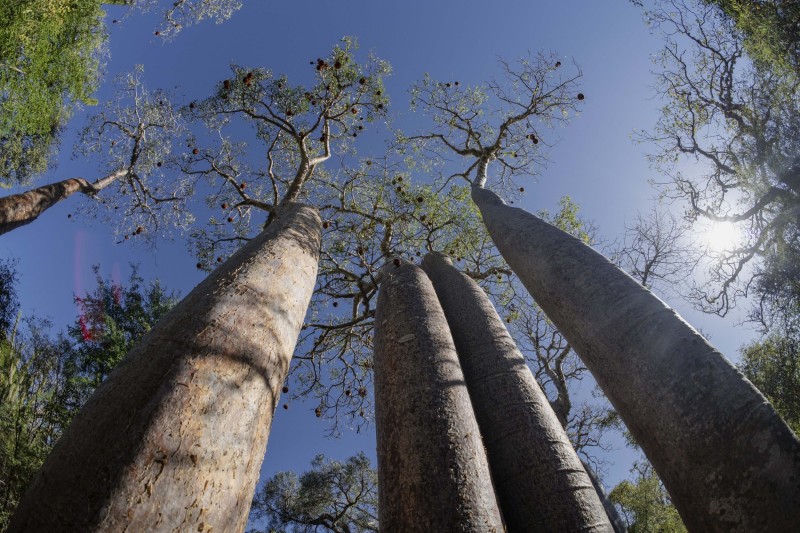
    South African authorities have opened a criminal investigation into the attempted illegal export of five baobab trees to Georgia, halting a massive shipment at the coastal port of Durban after discovering the exporter lacked required environmental permits.

    The five trees, estimated to be between 200 and 300 years old and weighing up to 30 tons each, remain impounded at a Durban logistics warehouse while investigators build a case under the country’s forestry laws.

    Under South Africa’s National Forests Act, the indigenous baobab is a protected species. It is illegal to cut down, harvest, transport, or export live specimens without explicit authorization from environmental regulators. While South Africa permits the commercial trade of processed baobab derivatives—such as fruit powder, seed oil, and cosmetic extracts—under strict licensing, the live specimen trade is tightly restricted to protect the slow-growing trees from international exploitation.

    According to the Daily Maverick, the shipment was intercepted this summer at a facility operated by Africa Global Logistics, a subsidiary of the maritime shipping firm MSC Group. Officials discovered that the exporter lacked the mandatory permits required to export the specimens. Days after the seizure, the exporter submitted a retrospective permit application, which environmental authorities rejected.

    “The department refused to issue a license retrospectively to regularize allegedly illegal criminal activities,” South Africa’s Department of Forestry, Fisheries and the Environment said in a statement to OCCRP, confirming that a criminal case had been opened under the National Forests Act.

    Department officials declined to publicly identify the exporter or the intended recipient in Georgia, citing the active investigation. However, a conviction carries severe penalties under South African law.

    “A person who contravenes the prohibition in the National Forests Act commits a first category offense and may upon conviction be sentenced to a fine or imprisonment for a period of up to three years, or to both,” Sello Molekwa, chief director of communication and advocacy at the department, told OCCRP.

    To botanists and conservationists, the uprooting of the trees—extracted from the Waterberg District in South Africa’s northern Limpopo province—represents a devastating loss of irreplaceable natural heritage.

    Dr. Sarah Venter, a baobab expert and founder of the Baobab Foundation in South Africa, explained that removing the trees required approval under two distinct pieces of South African legislation.

    “They didn’t have either,” Dr. Venter said, expressing hope that the impounded giants could still be saved. “I am hoping that the trees will be returned to Limpopo Province, where they came from, and replanted into their natural environment.”

    Although South African authorities have not officially named the buyer, the seizure coincides with reports in Georgian media indicating that a private residence linked to the country’s billionaire former prime minister, Bidzina Ivanishvili, is preparing for a major tree delivery.

    Ivanishvili has a documented history of importing ancient African trees for his personal estates and a public dendrological park on Georgia’s Black Sea coast. Between 2022 and 2023, eight massive baobabs were exported from Kenya to his park in Georgia. All eight trees withered and died last year, prompting the park’s management to issue an official statement blaming critical media coverage for extended procedures that then caused the demise of the trees.

    The appetite for live specimens appears to continue. On Sept. 15, Georgia’s independent Formula TV reported that a new private residence being built for Ivanishvili outside Tbilisi was undergoing a “special landscaping project,” with a new baobab expected to arrive by late October.

    The park is owned by a Georgia-registered firm ultimately controlled by Ivanishvili’s wife, while the residence is owned by its subsidiary. The director of the firm that owns the residence did not respond to requests for comment regarding whether the South African shipment was destined for the property. 

    Meanwhile, the five uprooted trees remain held at the Durban facility. Africa Global Logistics stated that it acted solely as a logistics agent, halted the shipment as soon as regulatory concerns were raised, and is cooperating fully with authorities without facing criminal charges.

    Source: OCCRP · 2026-10-29

  • Malicious Firefox extensions impersonate popular crypto wallets

    Malicious Firefox extensions impersonate popular crypto wallets

    Socket’s threat researchers found three malicious Firefox extensions that impersonated the Phantom, Jupiter, and Bitget crypto wallets.

    Once installed, the malicious extensions stole recovery phrases and private keys, which would provide the attacker with full control of a wallet.

    A crypto wallet is an app, browser extension, or physical device that lets you manage cryptocurrency such as Bitcoin. Despite its name, it doesn’t actually hold your coins. Those are recorded on a blockchain, a shared digital record of transactions. Instead, the wallet manages the secret digital keys that let you access and spend them.

    When you create a wallet, you may be given a recovery phrase: a list of words you can use to restore access. Write it down and store it offline. It’s a backup of your keys, not just an ordinary password. Anyone who gets hold of it can take control of your funds, which is why fake wallet extensions try to steal it.

    Cybercriminals listed three fake wallet extensions on Firefox Add-ons, impersonating Phantom, Jupiter, and Bitget. The genuine wallets offer extensions for other browsers: Jupiter lists Chrome, Brave, and Edge; Bitget’s extension is for Chrome; and Phantom says its Firefox extension is no longer supported.

    The malicious extensions looked for 12-, 15-, 18-, and 24-word recovery phrases, as well as Ethereum and Solana private keys. They could read input fields, detect pasted text, and scan screens displaying recovery phrases.

    A recovery phrase or private key is a bearer secret: whoever holds it controls the wallet and can move its assets. The Phantom variant’s backend logged captured secrets, sent them to a Telegram bot, and automatically moved funds to hardcoded payout addresses. Those addresses covered Ethereum, BSC, Polygon, Arbitrum, Optimism, Base, Avalanche, Solana, and Bitcoin. The Phantom variant could read a phrase both when it was typed during import and when it was displayed on a reveal screen.

    How to stay safe

    Socket says all three listings were live on Firefox Add-ons during its analysis and have since been removed. But if you find one of these extensions in your Firefox browser, you should:

    • Remove the extension. Use the three-dot menu next to it and choose Remove.
    • If you ever entered a phrase or key, create a new wallet on a clean device and move your assets immediately. Treat the old wallet as compromised.
    • In the future, install wallets only from the vendor’s official website link, not from store search results.
    • The fake Phantom listing asked to access data on all websites and had no privacy policy. These are warning signs to look out for.
    • Use an up-to-date, real-time anti-malware solution that blocks malicious websites.
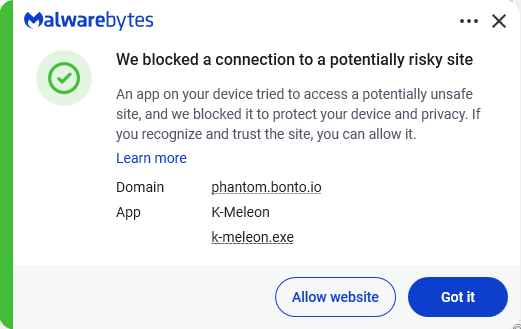
    Malwarebytes blocks phantom.bonto.io
    Malwarebytes blocks bonto.io subdomains

    Never enter your recovery phrase on a website. Enter it only in the official wallet app when restoring. Wallet support will never ask for it.

    IOCs

    The malicious extensions:

    • Phantom impersonator: add-on ID 3092199
    • Jupiter impersonator: add-on ID 3092666
    • Bitget impersonator: add-on ID 3092059

    Subdomains:

    • bonto[.]io
    • phantom[.]bonto[.]io
    • jupiter[.]bonto[.]io
    • bitget[.]bonto[.]io
    • coinbase[.]bonto[.]io
    • exodus[.]bonto[.]io

    IP addresses:

    • 104.21.34[.]69
    • 172.67.155[.]198

    From reporting threats to removing them.

    Cybersecurity risks should never spread beyond a headline. Keep threats off your devices by downloading Malwarebytes today.

    Source: Malwarebytes Labs · 2026-10-29

  • Iraqi MP Gets Six Years, $20M Fine for Oil Graft

    Iraqi MP Gets Six Years, $20M Fine for Oil Graft

    A specialized anti-corruption court in Iraq sentenced lawmaker Muthanna al-Samarrai to six years in prison and ordered him to repay nearly $20 million for exploiting his position to profit from state oil contracts.

    Al-Samarrai, who heads the Sunni political bloc Azm Alliance, used his parliamentary oversight role to benefit from public works and procurement deals involving the state-owned North and South Refineries companies. The lawmaker played a direct role in awarding contracts and steering payments to associates through four private companies, according to Iraq’s Federal Integrity Commission. The court ordered him to return 30 billion Iraqi dinars ($19.81 million) in illicit gains following his arrest in June 2026 alongside a former deputy oil minister.

    Source: OCCRP · 2026-10-29

  • Have an older iPhone or iPad? Apple has a security update for you

    Apple’s latest updates include a fix for a CoreGraphics bug that may have been exploited in targeted attacks. The fix is now available for older iPhones and iPads.

    Apple released security updates on October 26. Apple first fixed the flaw in iOS 26.7.1. Its latest updates also bring the fix to older devices that can’t run iOS 26, including the iPhone XS, iPhone XS Max, iPhone XR, and seventh-generation iPad.

    The iOS 18.7.11 update is a backport: it brings a fix from a newer software version to an older one. Here, Apple has made the fix available to older devices running iOS 18, so they can be protected without upgrading to an operating system they don’t support.

    Updates for your particular device

    The table below shows which updates are available and links to Apple’s security information for each one.

    Name and information link Available for
    iOS 27.2 and iPadOS 27.2 iPhone 11 and later, iPad Pro 12.9-inch 4th generation and later, iPad Pro 11-inch 2nd generation and later, iPad Air 4th generation and later, iPad 9th generation and later, and iPad mini 6th generation and later
    iOS 26.7.2 and iPadOS 26.7.2 iPhone 11 and later, iPad Pro 12.9-inch 3rd generation and later, iPad Pro 11-inch 1st generation and later, iPad Air 3rd generation and later, iPad 8th generation and later, and iPad mini 5th generation and later
    iOS 18.7.11 and iPadOS 18.7.11 iPhone XS, iPhone XS Max, iPhone XR, iPad 7th generation
    macOS Golden Gate 27.2 macOS Golden Gate
    macOS Tahoe 26.7.2 macOS Tahoe
    macOS Sequoia 15.8.2 macOS Sequoia
    tvOS 27.2 Apple TV 4K 2nd generation and later
    watchOS 27.2 Apple Watch Series 9 and later
    visionOS 27.2 Apple Vision Pro (all models)
    Safari 27.2 macOS Sequoia and macOS Tahoe
    tvOS 26.6.1 (no published CVE entries) Apple TV HD and Apple TV 4K 1st generation

    How to update your Apple devices

    How to update your iPhone or iPad

    For iOS and iPadOS users, here’s how to check if you’re using the latest software version:

    Go to Settings > General > Software Update. You will see if there are updates available and be guided through installing them.

    Turn on Automatic Updates if you haven’t already—you’ll find it on the same screen.

    How to update your Mac

    To update macOS on any supported Mac, use the Software Update feature, which Apple designed to work consistently across all recent versions. Here are the steps:

    • Click the Apple menu in the upper-left corner of your screen.
    • Choose System Settings (or System Preferences on older versions).
    • Select General in the sidebar, then click Software Update on the right. On older macOS, just look for Software Update directly.
    • Your Mac will check for updates automatically. If updates are available, click Update Now (or Upgrade Now for major new versions) and follow the on-screen instructions. Before you upgrade to macOS Tahoe 26, please read these instructions.
    • Enter your administrator password if prompted, then let your Mac finish the update (it might need to restart during this process).
    • Keep your Mac plugged in and connected to the internet until the update is done.

    How to update your Safari browser

    Safari updates are included with macOS updates, so installing the latest version of macOS will also update Safari. To check manually:

    • Open the Apple menu > System Settings > General > Software Update.
    • If you see a Safari update listed separately, click Update Now to install it.
    • Restart your device when prompted.

    Technical details

    The headline bug is CVE-2026-86950, in CoreGraphics, Apple’s framework for drawing graphics, images and PDF content. It’s an out-of-bounds write flaw, where software writes data outside the memory set aside for it. The result is that “processing a maliciously crafted file may lead to arbitrary code execution.”

    Apple says it is aware of a report that the flaw may have been exploited in an “extremely sophisticated attack against specific targeted individuals” on versions of iOS before iOS 27.

    That wording indicates Apple believes the bug was used in real attacks against a limited group of users.

    Usually, journalists, activists and officials are the targets of this kind of attack. If you think you could be a target of highly sophisticated spyware, you should update, restart your phone, and consider applying Apple’s Lockdown Mode.


    Scammers know more about you than you think. 

    Malwarebytes Mobile Security protects you from phishing, scam texts, malicious sites, and more. With real-time AI-powered Scam Guard built right in. 

    .wp-block-kadence-advancedbtn.kb-btns97520_6de029-2f{gap:var(–global-kb-gap-xs, 0.5rem );justify-content:flex-start;align-items:center;}.kt-btns97520_6de029-2f .kt-button{font-weight:normal;font-style:normal;}.kt-btns97520_6de029-2f .kt-btn-wrap-0{margin-right:5px;}.wp-block-kadence-advancedbtn.kt-btns97520_6de029-2f .kt-btn-wrap-0 .kt-button{color:#555555;border-color:#555555;}.wp-block-kadence-advancedbtn.kt-btns97520_6de029-2f .kt-btn-wrap-0 .kt-button:hover, .wp-block-kadence-advancedbtn.kt-btns97520_6de029-2f .kt-btn-wrap-0 .kt-button:focus{color:#ffffff;border-color:#444444;}.wp-block-kadence-advancedbtn.kt-btns97520_6de029-2f .kt-btn-wrap-0 .kt-button::before{display:none;}.wp-block-kadence-advancedbtn.kt-btns97520_6de029-2f .kt-btn-wrap-0 .kt-button:hover, .wp-block-kadence-advancedbtn.kt-btns97520_6de029-2f .kt-btn-wrap-0 .kt-button:focus{background:#444444;}

    ul.menu .wp-block-kadence-advancedbtn .kb-btn97520_074a67-a8.kb-button{width:initial;}.wp-block-kadence-advancedbtn .kb-btn97520_074a67-a8.kb-button{color:var(–color-neutral-10);background:var(–color-brand-blue-60);border-top-left-radius:40px;border-top-right-radius:40px;border-bottom-right-radius:40px;border-bottom-left-radius:40px;padding:var(–kb-btn-padding);margin:var(–kb-btn-margin);box-shadow:1px 1px 2px 0px rgba(0, 0, 0, 0.2);}.wp-block-kadence-advancedbtn .kb-btn97520_074a67-a8.kb-button:hover, .wp-block-kadence-advancedbtn .kb-btn97520_074a67-a8.kb-button:focus{box-shadow:0px 4px 0px 0px var(–color-brand-blue-90);}Try it now

    Source: Malwarebytes Labs · 2026-10-29

  • New evidence links Singapore palm oil giant to Indonesian deforesters, despite denials

    New evidence links Singapore palm oil giant to Indonesian deforesters, despite denials

    One of the world’s largest palm oil producers allegedly misled investors and corporate customers when it denied links to Indonesian suppliers accused of deforestation, a group of environmental organizations found.

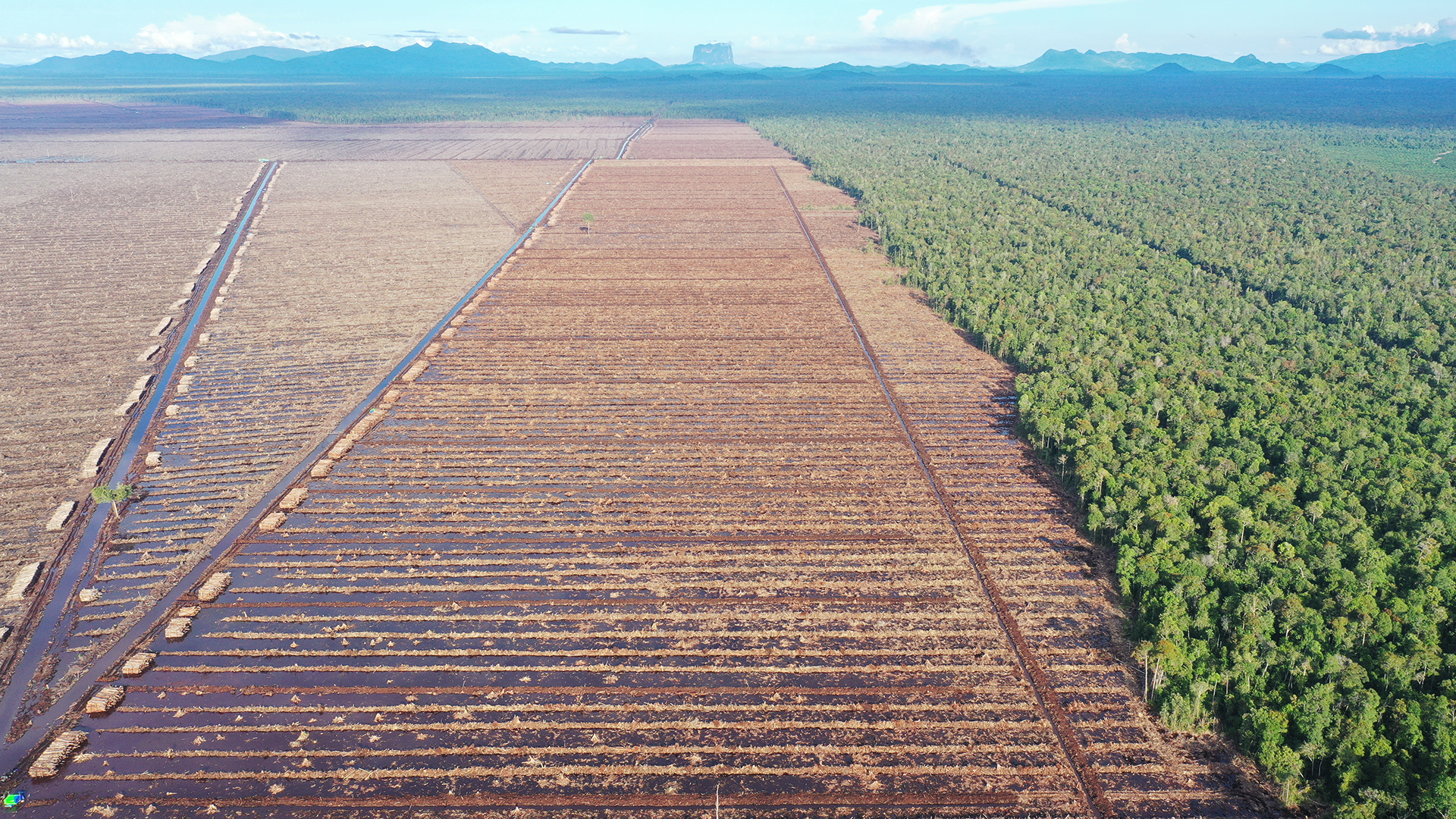
    The Singapore-based First Resources group, owned by the billionaire Fangiono family, oversees more than 270,000 hectares of oil palm plantations and is currently under scrutiny as Indonesia and neighboring nations battle a toxic haze caused by illegal fires used to clear land for agriculture.

    In 2024, First Resources rejected allegations by the Gecko Project, a partner of the International Consortium of Investigative Journalists, which had linked the conglomerate to a company now known as Kalimantan Agro Sejahtera (KAS) and palm oil firms allegedly responsible for deforestation on the island of Borneo. The findings were part of Deforestation Inc., a cross-border investigation led by ICIJ that exposed how a lightly regulated sustainability industry overlooks forest destruction and human rights violations when granting environmental certifications.

    Anderson Tanoto standing at a lectern

    https://www.icij.org/investigations/deforestation-inc/indonesian-billionaire-family-accused-of-controlling-shadow-company-group-linked-to-major-deforestation/

    DEFORESTATION INC Indonesian billionaire family accused of controlling ‘shadow company’ group linked to major deforestation Oct 30, 2024

    https://www.icij.org/investigations/deforestation-inc/an-anonymous-company-secretly-linked-to-an-indonesian-billionaire-is-destroying-borneos-rainforests-environmentalists-say/

    ACCOUNTABILITY An ‘anonymous’ company secretly linked to an Indonesian billionaire is destroying Borneo’s rainforests, environmentalists say Mar 19, 2024

    https://www.icij.org/investigations/deforestation-inc/brands-drop-singapore-listed-palm-oil-giant-after-deforestation-inc-expose/

    IMPACT Brands drop Singapore-listed palm oil giant after Deforestation Inc. exposé Mar 20, 2024

    Recommended reading DEFORESTATION INC Indonesian billionaire family accused of controlling ‘shadow company’ group linked to major deforestation Oct 30, 2024 ACCOUNTABILITY An ‘anonymous’ company secretly linked to an Indonesian billionaire is destroying Borneo’s rainforests, environmentalists say Mar 19, 2024 IMPACT Brands drop Singapore-listed palm oil giant after Deforestation Inc. exposé Mar 20, 2024

    he findings show that “buyers, investors and certification bodies need to step up their due diligence.”

    Source: ICIJ · 2026-10-29

  • Lawyers for ‘King of the South’ Try to Chip Away at U.S. Drug Trafficking Case

    Lawyers for ‘King of the South’ Try to Chip Away at U.S. Drug Trafficking Case

    Attorneys for alleged South American drug trafficker Sebastián Marset have asked a federal judge to halt the search of a potentially pivotal cellular phone until the U.S. government explains how it took control of the device from Bolivia.

    Marset, a Uruguayan national and self-proclaimed “King of the South,” was arrested in March in a pre-dawn raid in Santa Cruz, Bolivia. Soon after his arrest, he was expelled to Peru and then whisked to the U.S. where he faces money laundering, drug trafficking and narco terrorism charges.

    Law enforcement officers in Bolivia seized three phones from the house where they arrested Marset. However, it has emerged that they seized a fourth phone from an adjacent house.

    Defense lawyers say in their motion — dated October 23 — that “it is impossible” for them to “be certain as to the timing of the search and whether it was done at the behest of the DEA [Drug Enforcement Administration] or was otherwise valid under Bolivian law.”

    They argue that they weren’t notified about the fourth phone, which was a potential key piece of evidence for months, hampering their efforts and raising questions about the integrity of the operation.

    The phone was sent to the DEA in mid-April, but didn’t appear in any court documentation shared with the defense team until late July.

    “No contemporaneous report of the chain of custody appears to have been prepared,” Marset’s defense team wrote to U.S. District Judge Rossie Alston Jr., who presides in the Eastern District of Virginia.

    The DEA confirmed to the defense team, the filing said, that it had extracted data from the phone without a court order. The agent “theorized that the search did not require a court order because the defendant had previously ‘consented’ to the search of his other devices.”

    The lead prosecutor did not respond to a request for comment in time for publication. The DEA said it “does not comment on allegations.”

    The prosecution has alleged that the four phones were used by Marset to access cryptocurrency accounts.

    Crypto accounts have featured prominently in pre-trial disputes. Marset’s legal team alleges that DEA agents tried to trick his elderly mother into handing over passphrases for accounts that hold his digital currency, and later asked him to “donate” his $4 million in crypto assets. 

    “A seizure does not require asking the detainee’s mother for a photo of a notebook containing access phrases, which are used to move funds, not to secure them. Such contradictions warrant an explanation, which has yet to be provided,” Santiago Moratorio, Marset’s Uruguayan attorney, told OCCRP.

    In a September court proceeding, the lead DEA agent denied the allegation that they had asked for a donation.

    The Marset case is being closely watched across South America because of his connections to Colombia, and allegations that he had protection in Paraguay and Bolivia where more than a dozen officials were recently detained under suspicion that they had ties to Marset. 

    The State Department recently revoked visas for 12 Bolivian government, police, and political figures. It cited the need to defend against corruption and narco-trafficking, and said another unidentified nine Bolivians would be denied visas.

    Marset’s lawyers argue that the initial charge of money laundering is invalid because it involved a single wire transfer between Portugal and China that did not involve the servers of a U.S. bank. The lawyers say Marset never trafficked drugs to the U.S. and the narco terror groups cited in court were not designated as such at the time of his dealing with them. 

    In pre-trial conferences, Marset’s defense team has challenged several elements of the case, trying to get the judge to strike down portions of the indictments and weaken the prosecution. Alston has said he would rule on these motions by November 6.

    Source: OCCRP · 2026-10-28

  • Flávio Bolsonaro Flees Brazil After Election Defeat and Amid Fraud Probes

    Flávio Bolsonaro Flees Brazil After Election Defeat and Amid Fraud Probes

    Just three days after securing more than 59 million votes in a fiercely contested presidential runoff, Flávio Bolsonaro fled Brazil on Tuesday and landed in the United States, halting investigations at home over his alleged ties to a banker accused of financial fraud.

    A senior U.S. State Department official confirmed Tuesday that the U.S. “State Department will issue visas to Flavio Bolsonaro and his family and allow them entry into the United States.”

    Argentina’s National Directorate of Migration (DNM) confirmed on the social network X that Flávio—son of the convicted former Brazilian President Jair Bolsonaro—crossed into Argentina through the Tancredo Neves International Bridge, which connects the Brazilian city of Foz do Iguaçu with Argentina’s city of Puerto Iguazú.

    Accompanied by his wife and two daughters, Bolsonaro then boarded a private jet that made a short stop in Ecuador before landing in Miami, Florida.

    The defeated candidate is under investigation by the Brazilian justice system for a scheme involving million-dollar payments received from Daniel Vorcaro, the former owner of Banco Master, now in pre-trial detention for suspected $ 7 billion financial fraud. Vorcaro invested heavily in the production of “Dark Horse,” a biographical film about the life of Jair Bolsonaro.

    In May, the Intercept Brasil news outlet released audio recordings in which allegedly Flávio Bolsonaro is asking the banker, whom he referred to as “brother,” for 134 million reais ($26 million) to finance the feature film. Investigators allege that Vorcaro paid nearly half of that amount, and that the funds were diverted into U.S. accounts linked to the Bolsonaro family for personal use.

    Flávio Bolsonaro, who has not been charged in this case, previously claimed that in this case “a son was seeking private sponsorship for a private film about his father’s story,” adding that it involved “no public money at all.” He also stated that when negotiations with Vorcaro began in 2024, “there were no public accusations or suspicions about the banker.”

    Separately, a few days before the runoff election, Brazilian media reported that Bolsonaro is also being investigated for money laundering linked to Willer Tomaz, a close associate linked to the sports betting industry. Media reported that investigators suspect that Bolsonaro held a concealed interest in Tomaz’s activities through companies registered in Portugal. Both men deny the allegations.

    An electoral victory would have shielded Flávio Bolsonaro from both probes, as Brazilian law protects sitting presidents from prosecution during their term for acts committed prior to taking office.

    Source: OCCRP · 2026-10-28

  • China Sentences Ex Anti-Graft Official to Suspended Death for Bribery

    China Sentences Ex Anti-Graft Official to Suspended Death for Bribery

    A Chinese court sentenced a former senior anti-graft official at the China ​Securities Regulatory Commission, to a suspended death sentence for accepting more than 436 million yuan ($65.4 million) in bribes.

    Between 1998 and 2025, Wang Huimin abused his positions in the northwestern Xinjiang region and at the national securities regulator to secure business and fundraising favors for companies and individuals in exchange for the illicit payments, the state-run Xinhua news agency reported.

    A suspended death sentence gives the 67-year-old Wang Huimin a two-year reprieve from execution, after which the penalty is automatically commuted to life in prison under Chinese law.

    Source: OCCRP · 2026-10-28