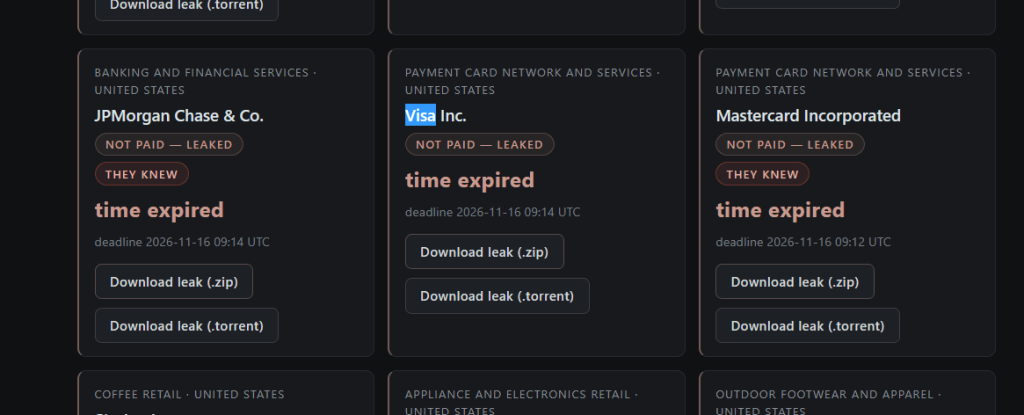
JPMorgan, Visa and Mastercard disclose third-party data breaches after the N0n extortion group claims to have stolen customer information.
The disclosures involving JPMorgan Chase, Visa and Mastercard highlight a familiar but often underestimated security problem: the risks introduced by third-party service providers. All three companies have confirmed incidents involving external vendors after the N0n extortion group claimed it had stolen customer information and published data allegedly taken from their systems.
The important distinction is that the companies haven’t reported breaches of their own payment infrastructure. Instead, the incidents appear to involve information held by outside providers, showing how a security failure at a supplier can expose data belonging to major financial institutions and their customers.
JPMorgan said the attackers may have accessed marketing information held by its service providers, including customer names and email addresses.
“Based on our investigation so far, we believe the attackers accessed certain marketing data held by those vendors, which may include some customer names and email addresses,” a JPMorgan spokesperson told Reuters, adding that the company would be contacting the affected customers directly.
The bank stressed that its services weren’t affected and that the incident had no connection to the technical problems some customers experienced earlier in the week. Where necessary, it plans to contact affected customers and offer free credit monitoring.
Visa confirmed that the incident it was investigating involved a third-party provider in the Asia-Pacific region. The company said its own systems hadn’t been affected and that there was no evidence that payment information, including card numbers, had been exposed.
Mastercard also acknowledged a security incident at an external provider. The company said the exposure involved a limited number of email addresses belonging to a small group of cardholders enrolled in a specific benefits program. It stressed that the information wasn’t related to payments and that its payment network remained fully operational.
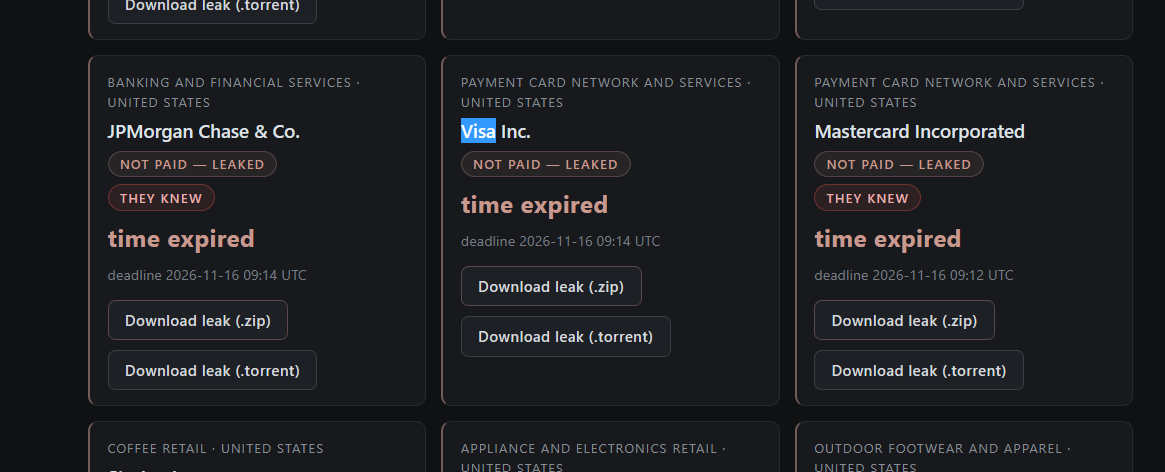
The N0n group had listed the three companies on its leak site on November 16, claiming to have obtained customer engagement and marketing data. It subsequently published the allegedly stolen information and marked the companies as having refused to pay. The group’s claims should be distinguished from the information independently confirmed by the companies.
The scale of the alleged exposure is significant. According to Reuters’ review, the JPMorgan-related files contained more than 16,000 customer email addresses, some associated with phone numbers and postal codes. Researchers also identified what appeared to be 124 email addresses belonging to bank employees.
The Visa dataset reportedly contained thousands of customer email addresses, phone numbers and marketing campaign records, mainly relating to Asia-Pacific markets. The available information also suggests that the exposure wasn’t limited to customer contact details, although the authenticity and completeness of the files remain important considerations.
Neither JPMorgan, Visa nor Mastercard has identified the affected service providers or disclosed the total number of customers involved. This leaves important questions unanswered, including how attackers accessed the providers’ systems, how long they maintained access and what security controls failed.
Even when attackers don’t obtain card numbers or account credentials, names, email addresses and phone numbers can be valuable. Criminals can use this information to create convincing phishing messages, impersonate financial institutions and target customers with fraudulent calls or messages. A message that includes a person’s name and references a genuine banking relationship is much more likely to attract attention.
For this reason, third-party risk management needs to go beyond contractual security requirements and periodic questionnaires. Organizations should know what information suppliers can access, limit the data they share, review access privileges and require timely incident reporting. They should also verify that providers apply appropriate security controls and have effective procedures to detect and contain intrusions.
The N0n group emerged in September and has listed roughly 200 alleged victims on its leak site. Its claims against the three financial companies show how cyber extortion can affect organizations through their suppliers, even when their core infrastructure and services remain operational.
Follow me on Twitter: @securityaffairs and Facebook and Mastodon
(SecurityAffairs – hacking, newsletter)
Source: Security Affairs · 2026-11-20