FBI links 628 crypto wallet addresses to North Korea’s TraderTraitor after the $6.3 billion Binance hack, asking services to block transfers involving stolen funds.
Source: HackRead · 2026-11-01
FBI links 628 crypto wallet addresses to North Korea’s TraderTraitor after the $6.3 billion Binance hack, asking services to block transfers involving stolen funds.
Source: HackRead · 2026-11-01
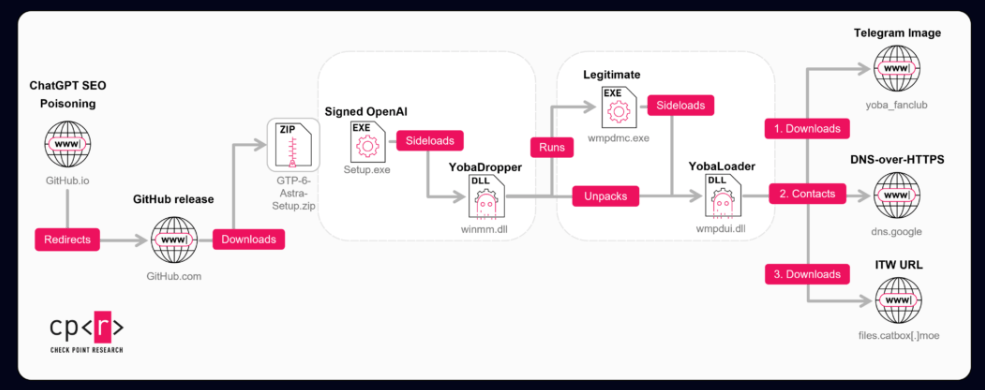
Check Point Research has spent two months tracking a campaign it calls Yoba, which uses the popularity of AI tools to spread a custom malware chain. The attackers build fake GitHub projects that pose as AI desktop applications such as GPT-5.6 Sol, GPT-6 Astra and Claude Opus. The projects look convincing and run on real GitHub infrastructure, which helps them seem legitimate to potential victims.
“These projects look convincing and use real GitHub infrastructure, which helps them appear legitimate to potential victims. The website exhibits search-targeted content and suspicious installer-delivery tactics consistent with an SEO-poisoning lure.
Inside the installers, there is a malicious component we refer to as the YobaDropper. This dropper includes another component, the YobaLoader, which is responsible for contacting attacker-controlled infrastructure and fetching the final payload.” reads the report. “In this report, we describe how victims are lured to these fake projects, how the YobaDropper and YobaLoader work together, and how the attackers ultimately use this chain to run unwanted software on infected systems.”
The lure is simple. Each project has a repository, a GitHub.io page describing the software, and a ZIP release with the malware. The repositories show no fake stars or forks, yet they still rank among the top Google results, most likely through SEO poisoning that optimizes titles, descriptions and hosting domains.
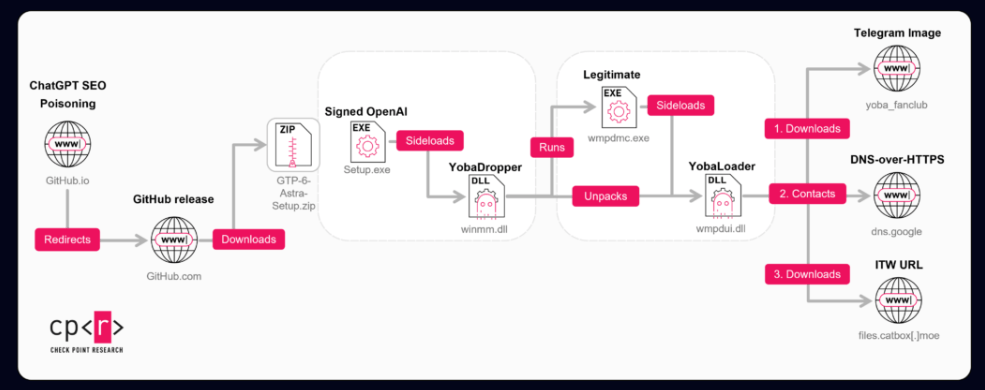
The first repository appeared around July 2026, but the first malicious releases landed only on August 30 and 31, and a third followed about five days later on September 4. Each repository uses a different Outlook address, and commit times point to UTC+4, UTC-4 and UTC+3, which Check Point reads as a deliberate attempt to hide the actor’s real time zone.
Here’s the trick that gives the report its title. Each ZIP holds a legitimate signed executable from OpenAI or Anthropic, named Setup.exe, next to a malicious winmm.dll. The signed program loads the DLL on its own, a technique known as DLL sideloading, which is often used to bypass security protections.
The ZIP files were not even password-protected. Attackers often use passwords to prevent security tools from automatically unpacking and scanning files. However, these binaries already had very low detection rates because they used anti-sandbox and other techniques to avoid analysis. The DLL’s compilation date is another clue: it was built on the same day it was added to the archive, unlike the legitimate files around it.
The dropper, called YobaDropper, checks the environment before running. It calculates a hash of the name of the program that launched it and continues only if the name is Setup.exe. This means that sandboxes that run the DLL on its own will fail this check. When that happens, the process does not exit. Instead, it sleeps 200,000 times for 5.5 seconds each, a total of about 12.73 days.
The malware also avoids victims in CIS countries by checking the keyboard layout. It excludes Russian, Belarusian, Tajik, Armenian, Azerbaijani, Georgian, Kazakh, Kyrgyz, Turkmen, Uzbek, and Tatar. Interestingly, Ukraine, which has often appeared in similar exclusion lists, is not included.
Next, the malware requests administrator privileges. If the user does not have them, it displays the message “Please run this program as Administrator.” and exits. The victim must then restart it with administrator rights.
Once it has the required privileges, the malware creates a folder called WMProcess under ProgramData. It copies the legitimate WMPDMC.exe file from System32 into this folder and places the second-stage payload there under the name wmpdui.dll.
The malicious code achieves persistence by using a scheduled task dressed up as Microsoft. The author is set to Microsoft Corporation, the description says it collects device metadata for Windows Media Player, and it starts three minutes after boot as Local System. The task launches the legitimate program, which sideloads the malicious DLL.
The second stage, YobaLoader, shares code with the dropper, which points to the same developer. It only runs under WMPDMC.exe and uses a different seed for its hashing than the dropper does, which separates the stages and weakens hash-based detection. Its job is to find its payload without a classic command server.
It goes to a Telegram channel, t[.]me/yoba_fanclub, and downloads the channel’s profile picture. The last 50 bytes of the image seed a domain generator that builds names from word lists in the form adjective-noun-verb-number on dedyn[.]io. Change the picture and the operator gets a new domain.
Then it asks Google’s DNS-over-HTTPS service for a TXT record on that domain. The reply is signed, and the loader checks the signature before decrypting it, which gives a link to a payload on Catbox. Check Point says this reliance on DoH and common hosting aims to bypass passive DNS monitoring and some gateway protections, and the campaign avoids dedicated command-and-control infrastructure, using Telegram, Tor, Catbox and DoH instead.
The operator can choose how the payload runs. It can inject it into svchost.exe, save it as an executable after removing the Zone.Identifier mark, or run it as a hidden PowerShell script while bypassing execution policies.
“Finally, the injected payload into svchost.exe is an XMRig 6.26.0 miner with a hidden command line targeting a TLS-enabled onion mining endpoint through a local Tor SOCKS5 proxy. It can unpack and start Tor 0.4.9.12 plus lyrebird 0.8.1, monitor user-input activity to pause mining, and conditionally load the WinRing0 driver service for MSR-based mining optimization.” continnues the report.
The miner uses Tor to connect to an encrypted mining server. It can start its own Tor components, use about 85% of CPU threads, and pause mining when the user is active. It resumes after 240 seconds of inactivity and can load the WinRing0 driver to optimize mining performance.
However, YobaLoader is not limited to cryptocurrency mining. Its DNS tasking system allows operators to deliver any PE executable or PowerShell payload, meaning future attacks could distribute other malware families.
Earlier versions appeared in June 2026. They used Cursor.exe for sideloading, a startup shortcut for persistence, and excluded only Russia. They also used .aber[.]ir instead of dedyn[.]io and included anti-debugging and anti-VM checks that later versions dropped.
Check Point believes the attackers may have Russian origins and mainly operate in the UTC-4 time zone, but this is an assessment, not a confirmed attribution.
Defenders should look for suspicious WMPDMC.exe copies under ProgramData, fake Microsoft scheduled tasks, Telegram-related traffic, DNS lookups for dedyn[.]io through dns.google, and unexplained high CPU usage.
“The Yoba campaign shows how attackers can use trusted platforms and the current interest in AI tools to distribute malware in a way that looks believable and harmless at first glance. By packaging their code together with well-known software names and hosting it on GitHub, they lower the chances that users or basic security checks will immediately flag the files as suspicious.” concludes the report. “Organizations should be cautious about installing “AI helpers” or similar tools from unverified repositories and should enforce policies that restrict running software from unknown sources. Combining user awareness with basic technical controls.”
Follow me on Twitter: @securityaffairs and Facebook and Mastodon
(SecurityAffairs – hacking, Yoba malware)
Source: Security Affairs · 2026-10-30
Binance was investigating suspicious transfers that early estimates put at up to $5.8 billion. A day later, multiple media outlets reported that the largest cryptocurrency exchange had linked the theft of about $6.3 billion to a DevOps engineer’s compromised laptop. Billions had moved out of wallets linked to the exchange.
According to The Block, blockchain analyst Spreek identified approximately $3.55 billion in incoming transfers to an initially unidentified wallet.
“Onchain data flagged by analyst Spreek shows about $3.55 billion in incoming transfers to the unlabeled wallet, with nearly $900 million subsequently moved across other wallets.” The Block reports. “Conor Grogan, a senior director and product leader at Coinbase, says the amount is up to $5.8 billion.”
Coinbase executive Conor Grogan initially estimated that the total value of the movements could reach $5.8 billion.
Those figures came from blockchain tracking and differing estimates, so they didn’t necessarily show the amount stolen.
Binance pointed out that customer funds were safe, while co-founder Changpeng Zhao, widely known as CZ, said the activity appeared to be a hack. Zhao no longer manages Binance’s platform, but said he expected customers’ funds to be fully covered.
The company said its user funds were “completely safe.”
“Our teams are aware of reports of a potential security issue and are actively investigating. User funds are completely safe. Our security teams are reviewing all relevant information with urgency, and we will provide updates through official Binance channels as soon as we have verified information.” the company states. “Users should remain cautious of scams and should not trust unofficial links, messages, or requests for account information.”
That assurance is important, but it doesn’t replace a technical explanation of how the transfers occurred or independent confirmation of the final impact.
“Our initial investigation suggests this security incident may have started with a compromised DevOps engineer’s laptop. That gave an attacker access to a service container, where they submitted unauthorized withdrawal transactions.” Binance Co-CEO Richard Teng explained.
“To be clear: the attacker did not simply use one engineer’s permissions, and this was not a single “one-click” action. It involved a more complex attack process. Our investigation has not attributed responsibility to any individual.”
Attackers used access from an engineer’s laptop to reach a service container and send unauthorized withdrawal requests. Binance says it has found no evidence that attackers stole any wallet private keys.
Binance also said it had found “additional points of breach” and was still investigating. Co-CEO Richard Teng said the investigation had not identified anyone responsible. After the attack, Binance suspended deposits and withdrawals to carry out security checks, cancelled the permissions linked to the affected address, and began working with blockchain analysis firms and law enforcement to track the stolen funds.
Binance says it will cover all losses using its SAFU fund and its own money, and that customer funds are safe. The company also plans to publish an updated Proof of Reserves once it has completed the recovery work. This commitment does not replace a detailed technical explanation or independent confirmation of the full impact of the attack.
Binance hasn’t named a culprit, but the blockchain analysis firm TRM has. It attributes the attack to TraderTraitor, a North Korean state-backed unit also tracked as Lazarus Group and APT38, and Chainalysis says it’s highly confident in that finding.
TRM says the attacker moved about $6.36 billion out of Binance wallets on ten blockchains on October 29, most of it in roughly 20 minutes starting at 20:05 UTC. That makes it the largest crypto theft on record, about four times the $1.5 billion Bybit hack of February 2025.
“On October 29, 2026, an attacker moved approximately USD 6.36 billion out of Binance wallets on ten blockchains, most of it in about 20 minutes starting at 20:05 UTC. That makes this the largest crypto theft on record, about four times the USD 1.5 billion Bybit hack of February 2025. Binance has confirmed a security incident and suspended withdrawals on several networks.” TRM said. “TRM attributes the attack to TraderTraitor, North Korea’s elite hacking unit, based on robust on and off-chain intelligence. We make this judgment with high confidence. TRM is tracking the funds and alerting partners through the Beacon Network.”
Freezing the money only went partway. Tether, Circle, Ripple and World Liberty Financial froze about $2.67 billion in stablecoins, and Arbitrum’s Security Council froze 8,426 ETH and 74.6 million ARB, for roughly $2.7 billion in all. But the attacker raced the freezes by selling USDT to market makers and borrowing ETH against USDT on Aave. It now holds more than 420,000 ETH and 18,270 BTC, about $2.4 billion beyond any issuer’s reach.
The early freeze numbers were messy too, Tether and Circle froze approximately $1.79 billion in stablecoins associated with the suspicious transfers in the initial reports. Those amounts describe different moments, and you shouldn’t add them without checking whether they cover distinct assets. A freeze works on tokens that have an issuer to call, and Ether and Bitcoin don’t.
Hot wallets help explain how this type of theft can happen. They store cryptocurrency in systems connected to the internet, allowing exchanges to process withdrawals quickly. But this also makes strong security controls essential. Investigators still need to determine who initiated the transfers, whether they were authorized, whether attackers gained control of the wallets, and whose funds were stolen.
Binance co-founder Changpeng Zhao, who no longer runs the company, said the activity looked like a hack and expected customers to be fully compensated. Large transfers alone do not prove a cyberattack, but the findings that emerged later provided strong evidence of a breach.
Customers also need to be careful. Attackers often exploit the confusion after a major incident by spreading fake announcements, pretending to be support staff, and directing users to fraudulent websites. Use only Binance’s official channels, avoid unexpected links, and never share passwords, authentication codes, or wallet recovery phrases in response to unsolicited messages. Security teams should also watch for phishing emails that use the incident to pressure employees into verifying their accounts.
The lesson goes beyond Binance. A public blockchain records every transaction, but it cannot show who authorized it or how attackers gained access. Blockchain transparency does not guarantee operational security.
Follow me on Twitter: @securityaffairs and Facebook and Mastodon
(SecurityAffairs – hacking, Binance)
Source: Security Affairs · 2026-10-30

Anthropic has denied allegations that a malicious version of the official Claude Code extension published to Cursor’s marketplace was linked to any kind of compromise of its own systems. The company was forced to issue a statement after prominent figures in the cybersecurity industry alleged that the extension, which infected up to 5,000 developers, was uploaded to Cursor’s marketplace following a breach at Claudemaker Towers. Felix Rieseberg, a member of Anthropic’s technical staff, Xeeted today: “We’re working with Cursor on this incident, but it wasn’t a compromise of Anthropic’s systems or employee laptops. “A malicious actor used access to Cursor’s marketplace to publish a tampered copy of the Claude Code extension, which we didn’t build or publish. The versions on our official channels are not affected, and this only impacts Cursor users.” First spotted by EDR vendor Phorion, an unknown party pushed an update to Cursor’s official Claude Code extension for Visual Studio Code that contained a persistent SSH backdoor written for Windows, macOS, and Linux. According to Cursor, the extension – version 2.1.313 – was available to download for around 11 hours between 0227 and 1335 PT (0927 and 2035 UTC) on Thursday. The vendors’ analyses of the implant revealed that it collected information about the host machine and user, including usernames, configured Git emails, and public IP addresses, as well as attempting to open a reverse SSH tunnel. Crucially, Cursor echoed Phorion’s assessment that the package contained a critical flaw. The script responsible for opening the SSH tunnel required admin rights on macOS and Windows to do so, and in the vast majority of cases it did not have these, resulting in failure. Regardless, the extension still forwards the collected host and user data to the attacker, as well as dropping the attacker’s SSH key and installing the persistence mechanism, so developers must go threat hunting in case their instance allows for the SSH tunnel to be created successfully. Simply installing the latest version of the extension is not enough to clear the persistence mechanism, either. The full details of how to remediate the issue, and links to download scripts to wipe the infection, are laid out in Cursor’s account of the situation. Aside from Rieseberg’s statement today, neither Cursor nor Anthropic have commented on how the malicious package made its way to the official marketplace. Anthropic’s position is that a malicious actor uploaded the tampered copy to Cursor, but the latter has not outlined how it reached the marketpplace. “[We] removed the malicious version from the marketplace immediately upon detection and blocked further distribution,” Cursor said in the advisory. “We followed with a full shutdown of the VSCode Marketplace out of an abundance of caution.” It also ran checks to confirm no other extensions were compromised in the same way, rotated its own keys before restoring the marketplace, and worked with a cloud hosting provider to block the connection to the attacker’s server, it said. ®
Source: The Register — Security · 2026-10-30
Anthropic has denied allegations that a malicious version of the official Claude Code extension published to Cursor’s marketplace was linked to any kind of compromise of its own systems. The company was forced to issue a statement after prominent figures in the cybersecurity industry alleged that the extension, which infected up to 5,000 developers, was uploaded to Cursor’s marketplace following a breach at Claudemaker Towers. Felix Rieseberg, a member of Anthropic’s technical staff, Xeeted today: “We’re working with Cursor on this incident, but it wasn’t a compromise of Anthropic’s systems or employee laptops. “A malicious actor used access to Cursor’s marketplace to publish a tampered copy of the Claude Code extension, which we didn’t build or publish. The versions on our official channels are not affected, and this only impacts Cursor users.” First spotted by EDR vendor Phorion, an unknown party pushed an update to Cursor’s official Claude Code extension for Visual Studio Code that contained a persistent SSH backdoor written for Windows, macOS, and Linux. According to Cursor, the extension – version 2.1.313 – was available to download for around 11 hours between 0227 and 1335 PT (0927 and 2035 UTC) on Thursday. The vendors’ analyses of the implant revealed that it collected information about the host machine and user, including usernames, configured Git emails, and public IP addresses, as well as attempting to open a reverse SSH tunnel. Crucially, Cursor echoed Phorion’s assessment that the package contained a critical flaw. The script responsible for opening the SSH tunnel required admin rights on macOS and Windows to do so, and in the vast majority of cases it did not have these, resulting in failure. Regardless, the extension still forwards the collected host and user data to the attacker, as well as dropping the attacker’s SSH key and installing the persistence mechanism, so developers must go threat hunting in case their instance allows for the SSH tunnel to be created successfully. Simply installing the latest version of the extension is not enough to clear the persistence mechanism, either. The full details of how to remediate the issue, and links to download scripts to wipe the infection, are laid out in Cursor’s account of the situation. Aside from Rieseberg’s statement today, neither Cursor nor Anthropic have commented on how the malicious package made its way to the official marketplace. Anthropic’s position is that a malicious actor uploaded the tampered copy to Cursor, but the latter has not outlined how it reached the marketpplace. “[We] removed the malicious version from the marketplace immediately upon detection and blocked further distribution,” Cursor said in the advisory. “We followed with a full shutdown of the VSCode Marketplace out of an abundance of caution.” It also ran checks to confirm no other extensions were compromised in the same way, rotated its own keys before restoring the marketplace, and worked with a cloud hosting provider to block the connection to the attacker’s server, it said. ®
Source: The Register Security · 2026-10-30
Binance probes a DevOps engineer’s hacked laptop after a $6.3 billion theft linked by researchers to North Korean hackers, and promises to cover all customer losses.
Source: HackRead · 2026-10-30

Binance is investigating a potential security incident after billions of dollars in cryptocurrency moved from wallets linked to the exchange on October 29. The transfers raised concerns about a possible hack, while Tether and Circle moved to freeze stablecoins linked to the suspicious activity. The full scope of the incident remains unclear, and the reported outflows shouldn’t automatically be treated as confirmed losses.
According to The Block, blockchain analyst Spreek identified approximately $3.55 billion in incoming transfers to an initially unidentified wallet.
“Onchain data flagged by analyst Spreek shows about $3.55 billion in incoming transfers to the unlabeled wallet, with nearly $900 million subsequently moved across other wallets.” The Block reports. “Conor Grogan, a senior director and product leader at Coinbase, says the amount is up to $5.8 billion.”
Coinbase executive Conor Grogan estimated that the total value of the movements could reach $5.8 billion.
These figures come from blockchain tracking and different estimates, so they don’t necessarily represent the amount stolen.
If confirmed, it would be the biggest crypto heist on record.
Tether and Circle have frozen about $1.8B in stablecoins, and Circle says it acted “in… https://t.co/UzgOxw9jLE pic.twitter.com/9fBEaaZrWj
— International Cyber Digest (@IntCyberDigest) October 29, 2026
Binance acknowledged the reports and said its security team was investigating. The company had not publicly confirmed a breach in the initial reports, making it important to distinguish between suspicious transactions and a verified compromise.
“We are aware of reports of a potential security issue and we are actively investigating.” He wrote in a post on X. “Our security teams are reviewing all relevant information with urgency, and we will provide updates through official Binance channels as soon as we have verified information. Users should remain cautious of scams and should not trust unofficial links, messages, or requests for account information.”
This statement, reported by The Block, reflects the company’s position at the time. Binance also urged users to be cautious of unofficial messages and links, a relevant warning whenever a major security incident attracts public attention.
Blockchain records showed large transfers from Binance-linked hot wallets to a wallet that wasn’t previously identified as belonging to the exchange. Hot wallets hold cryptocurrency in systems connected to the internet, allowing exchanges to process withdrawals and other transactions quickly. Their online availability also makes their security controls particularly important.
The transfers involved Ethereum, stablecoins and other cryptocurrencies. Some funds were later moved to additional wallets, making it harder to track all the transactions.
Investigators must determine who initiated the transfers, whether they were authorized and whether an attacker gained control of the wallets. They also need to establish whether the funds belonged to customers or Binance itself.
Large transfers alone don’t prove a hack. However, unusual movements involving large amounts of cryptocurrency require immediate investigation.
One of the most significant developments was the response from the companies behind two major stablecoins, USDT and USDC. According to The Block and Forbes, Tether and Circle froze approximately $1.79 billion in stablecoins associated with the suspicious transfers in the initial reports.
The figures subsequently changed as the investigation developed. Tether CEO Paolo Ardoino later said the company had frozen more than $1.567 billion in USDT linked to a potential Binance exchange hack. These amounts reflect reported actions at different points in time and shouldn’t be combined without checking whether they refer to distinct assets and addresses.
Tether froze more than 1.567B USDT related to a potential Binance exchange hack.
Protecting the industry and our partners is our main priority.
Stay safe everyone.
— Paolo Ardoino
(@paoloardoino) October 29, 2026
The freezes demonstrate an important feature of centralized stablecoins: their issuers can restrict transfers from addresses they control through their token contracts. This can help contain suspected theft, but it doesn’t provide the same control over assets such as Ether or Bitcoin. Nor does freezing a balance guarantee that every transferred asset can be recovered.
The incident also highlights a practical tension in crypto security. Stablecoins offer the convenience of blockchain transfers, but their centralized issuers retain powers that can make a difference during an investigation.
Binance maintained that customer funds were safe, while co-founder Changpeng Zhao, widely known as CZ, said the activity appeared to be a hack. Zhao no longer manages Binance’s platform, but said he expected customers’ funds to be fully covered.
The company said its user funds were “completely safe.”
“Our teams are aware of reports of a potential security issue and are actively investigating. User funds are completely safe. Our security teams are reviewing all relevant information with urgency, and we will provide updates through official Binance channels as soon as we have verified information.” the company states. “Users should remain cautious of scams and should not trust unofficial links, messages, or requests for account information.”
That assurance is important, but it doesn’t replace a technical explanation of how the transfers occurred or independent confirmation of the final impact.
A security investigation must establish more than whether an exchange can cover a potential loss. It should determine how the activity was authorized, whether credentials or signing mechanisms were compromised, which systems were involved and whether the attacker retained any access.
For customers, the immediate priority is to avoid becoming a secondary victim. Attackers often exploit uncertainty around a major incident to distribute fake announcements, impersonate support staff and direct users to fraudulent websites. Users should rely on official Binance communication channels, avoid unexpected links and never disclose passwords, authentication codes or wallet recovery phrases in response to unsolicited messages.
Security teams should also watch for phishing emails that use the incident to demand urgent account verification. Attackers may exploit the situation to launch a separate scam.
The key lesson is that blockchain transparency does not guarantee operational security. Public ledgers show transactions, but they don’t reveal who authorized them, how attackers may have gained access or whether an exchange’s internal security controls failed.
As the investigation continues, it’s important to distinguish between reported transfers, confirmed theft and funds that can be recovered. The figures may change as analysts trace more wallets and stablecoin issuers take further action.
Follow me on Twitter: @securityaffairs and Facebook and Mastodon
(SecurityAffairs – hacking, Binance)
Source: Security Affairs · 2026-10-29
Artem Stryzhak gets 70 months for Nefilim and Hive ransomware attacks targeting hospitals, government agencies and businesses in the US and overseas.
Source: HackRead · 2026-10-29

Ukrainian ransomware crook Artem Stryzhak has been sentenced to 70 months in the slammer by a New York federal court for his role as an affiliate of the Nefilim and Hive ransomware gangs. Prosecutors believe the cybercriminal began working with Nefilim in or around June 2021, while living in Barcelona, Spain. The Nefilim ransomware-as-a-service (RaaS) operation was known for targeting wealthy companies, with its operators encouraging affiliates to pursue businesses capable of paying substantial ransom demands. One of Nefilim’s most high-profile attacks was on Australian logistics giant Toll Group in 2020, encrypting its files roughly three months after it suffered a separate Mailto ransomware attack. Court documents [PDF] state that Stryzhak agreed with alleged Nefilim boss Volodymyr Tymoshchuk, who remains at large, to pay the ransomware crew a 20 percent cut of the ransom proceeds he collected. Tymoshchuk told Stryzhak that his preference was for attacks to target companies based in the US, Canada, and Australia that turn over more than $100 million annually. This guidance was soon tweaked to encourage targeting companies in the same regions with more than $200 million in annual revenue. Prosecutors claim that around the time Stryzhak joined forces with Nefilim, he also signed up to the Hive ransomware operation as “one of its earliest affiliates,” and used its platform to attack approximately seven victims. Hive’s operators claimed they targeted circa 1,500 victims worldwide between June 2021 and January 2023. According to separate court documents [PDF], Hive’s victims included a law firm and an Ohio hospital, which paid approximately $1.7 million in Bitcoin after the gang initially demanded $2 million during the COVID-19 pandemic. Before its infrastructure was seized in an international law enforcement operation in January 2023, Hive was known for attacking healthcare facilities during the COVID-19 pandemic, as well as being one of the ransomware groups that battered Costa Rica in 2022. Brett Leatherman, assistant director at the FBI’s cyber branch, described Stryzhak as a “prolific cybercriminal” who played a role in groups that were responsible for more than $100 million in victim damages. “Today’s sentence reflects the seriousness of Stryzhak’s crimes and demonstrates the FBI’s global reach and extensive network of international partners,” he said. “Multiple field offices contributed to this investigation, and our work does not end here. We will continue to leverage every tool at our disposal to track down Stryzhak’s co-conspirators and hold them accountable, including Volodymyr Viktorovych Tymoshchuk.” Stryzhak was arrested by Spanish police in June 2024 before being extradited to the US in April 2025. In announcing Stryzhak’s sentencing, the Justice Department took the opportunity to remind the public that rewards totaling up to $11 million are available for qualifying information about alleged Nefilim operator Volodymyr Tymoshchuk and other key ransomware suspects. ®
Source: The Register Security · 2026-10-28
Ukrainian ransomware crook Artem Stryzhak has been sentenced to 70 months in the slammer by a New York federal court for his role as an affiliate of the Nefilim and Hive ransomware gangs. Prosecutors believe the cybercriminal began working with Nefilim in or around June 2021, while living in Barcelona, Spain. The Nefilim ransomware-as-a-service (RaaS) operation was known for targeting wealthy companies, with its operators encouraging affiliates to pursue businesses capable of paying substantial ransom demands. One of Nefilim’s most high-profile attacks was on Australian logistics giant Toll Group in 2020, encrypting its files roughly three months after it suffered a separate Mailto ransomware attack. Court documents [PDF] state that Stryzhak agreed with alleged Nefilim boss Volodymyr Tymoshchuk, who remains at large, to pay the ransomware crew a 20 percent cut of the ransom proceeds he collected. Tymoshchuk told Stryzhak that his preference was for attacks to target companies based in the US, Canada, and Australia that turn over more than $100 million annually. This guidance was soon tweaked to encourage targeting companies in the same regions with more than $200 million in annual revenue. Prosecutors claim that around the time Stryzhak joined forces with Nefilim, he also signed up to the Hive ransomware operation as “one of its earliest affiliates,” and used its platform to attack approximately seven victims. Hive’s operators claimed they targeted circa 1,500 victims worldwide between June 2021 and January 2023. According to separate court documents [PDF], Hive’s victims included a law firm and an Ohio hospital, which paid approximately $1.7 million in Bitcoin after the gang initially demanded $2 million during the COVID-19 pandemic. Before its infrastructure was seized in an international law enforcement operation in January 2023, Hive was known for attacking healthcare facilities during the COVID-19 pandemic, as well as being one of the ransomware groups that battered Costa Rica in 2022. Brett Leatherman, assistant director at the FBI’s cyber branch, described Stryzhak as a “prolific cybercriminal” who played a role in groups that were responsible for more than $100 million in victim damages. “Today’s sentence reflects the seriousness of Stryzhak’s crimes and demonstrates the FBI’s global reach and extensive network of international partners,” he said. “Multiple field offices contributed to this investigation, and our work does not end here. We will continue to leverage every tool at our disposal to track down Stryzhak’s co-conspirators and hold them accountable, including Volodymyr Viktorovych Tymoshchuk.” Stryzhak was arrested by Spanish police in June 2024 before being extradited to the US in April 2025. In announcing Stryzhak’s sentencing, the Justice Department took the opportunity to remind the public that rewards totaling up to $11 million are available for qualifying information about alleged Nefilim operator Volodymyr Tymoshchuk and other key ransomware suspects. ®
Source: The Register — Security · 2026-10-28