Hackers compromised a third-party services provider and stole names, addresses, and driver’s license numbers.
Source: SecurityWeek · 2026-11-16
Malware Newsletter
Exchange for breakfast: Turla’s Cereal tricks are not for kids
Inside an AhsayCBS Intrusion: Hidden Webshells, a CryptoMiner, and a C2 Implant
Not All That Glitters Is Gold: Tracking CopperDragon’s Sparrow Framework Around the Globe
Remus Stealer Markets Persistent Gmail Access: Hudson Rock Investigates
Spied on by governments with Israeli spyware: in Europe, no one pays the price
School Bomb Threats: Hudson Rock Finds Reported Sender Accounts in Infostealer Data
ScreenConnect Attack: SCKit Turns Remote Support Into an Attack Platform
wfx: GitHub Actions Credential Stealer Hits 8,000 Repos
Gootloader Malware Disrupted in International Cyber Operation
When Everything Becomes Open-Source
MMD-072-2026 – ARTEX detection signature pack – from IOC w/playbook process
The Enemy Within. Tracking LIMINAL PANDA and SilentAir through Mobile Networks
AutoPYara: Next-Gen YARA Rule Generator for Malware Family Clustering
What Malware Actually Does: An Empirical Analysis of Post-Infection Behavior Across Malware Families
Cursor An update on our recent security incident
Ledger’s Response to the Hardware Implant Attack
Follow me on Twitter: @securityaffairs and Facebook and Mastodon
(SecurityAffairs – hacking, newsletter)
Source: Security Affairs · 2026-11-15
Maileva, a subsidiary of the La Poste group, was hit in mid-September in one of the biggest cyberattacks France has seen. La Poste confirmed it to AFP..
The stolen data includes first names, last names and postal addresses of 22 million people, which are “recipients of Maileva’s client companies.” The company confirms bank details weren’t compromiseda. The specialized sites FrenchBreaches and Cyberattaque.org had flagged the breach first.
According to Le Monde, Maileva sends documents on behalf of companies, including payslips, registered letters, invoices and shareholder meeting notices. It is part of Docaposte, a subsidiary of La Poste, and says it serves more than 70,000 users. In 2024, it sent 180 million documents. However, the 22 million people affected by the breach are not Maileva’s customers. They are the people who received documents sent through its platform.
This is important because most of these people had never heard of Maileva and had no direct relationship with the company. According to Cyberattaque.org, the affected organizations include social housing providers such as Flandre Opale Habitat and Altéal, as well as medical laboratories belonging to the Inovie group, including AXBIO, BioMedilab and Biofusion. Patients of Foch Hospital in Suresnes were also affected through one of its subcontractors.
That subcontractor is Kiwee.care, which handles friendly debt collection and medical billing, and which prints and mails through Maileva. A hacker reportedly read the content of some payment reminders. Those letters carried invoice numbers, treatment dates and amounts owed. Other Kiwee clients in healthcare may be affected as well.
Maileva already notified the CNIL, the French data protection authority, and filed a criminal complaint.
A judicial investigation is underway ,” it said. “In accordance with regulations, all affected companies have been informed of the incident by Maileva.”
It also notified every affected company. Whether those companies will now tell their own patients and tenants is a separate question.
La Poste isn’t new to cyberattacks. In December 2025, La Poste confirmed a major cyber incident knocked its information systems offline, disrupting digital banking and online services for millions of customers.
On social media, La Poste said the disruption temporarily rendered several platforms inaccessible, including its main website, mobile app, digital identity service, and the Digiposte document storage platform.
The attack temporary took down its online services, including La Banque Postale online and the mobile app, laposte.fr, Digiposte, La Poste Digital Identity, and the La Poste application.
The pro-Russian hacking group, Noname057, claimed responsibility for the cyberattack.
France has faced several major cyberattacks in recent years. In 2024, breaches at Almerys and Viamedis exposed the data of more than 33 million people, while an attack on France Travail affected another 36.8 million. In February, a hacker gained access to data from 1.2 million French bank accounts using stolen credentials belonging to a government official, according to the French Economy Ministry.
In June, Tchap, the encrypted messaging platform developed by the French government for its civil servants and made mandatory last year, was breached.
This summer, attacks targeting the tax authorities compromised data linked to nearly 700,000 people. Last week, Crédit Mutuel Arkéa also revealed that a cyberattack had cost the company around €100 million.
France remains an attractive target because of its economic importance and its political position on the war in Ukraine. The scale of the problem is growing: the French data protection authority (CNIL) recorded more than 5,600 data breaches in 2024, a 20% increase compared with the previous year. The Maileva incident is another reminder that personal data can be exposed through third-party providers that people may not even know they are using.
Follow me on Twitter: @securityaffairs and Facebook and Mastodon
(SecurityAffairs – hacking, La Poste)
Source: Security Affairs · 2026-11-15
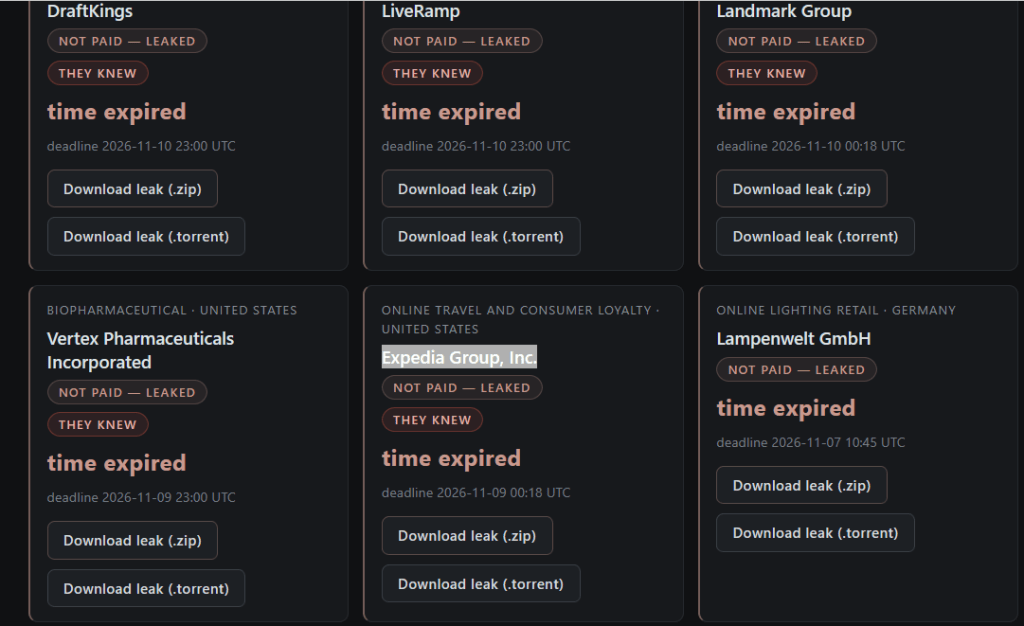
A newly formed Russian cyber extortion group called n0n claims it has hit Expedia, the world’s second-largest online travel agency, and taken data on nearly one billion travelers. Expedia confirmed to Skift on Thursday that attackers had breached its systems through a third-party data platform provider in a supply chain attack that also affected other companies.
“Expedia Group confirmed Thursday that attackers reached its systems through a compromised third-party data platform provider, in a supply chain cyberattack that also affected multiple companies.” reported the website Skift. “Acknowledgment came after several cybersecurity sites reported this week on allegations by an extortion group known as n0n that it had stolen Expedia data. “
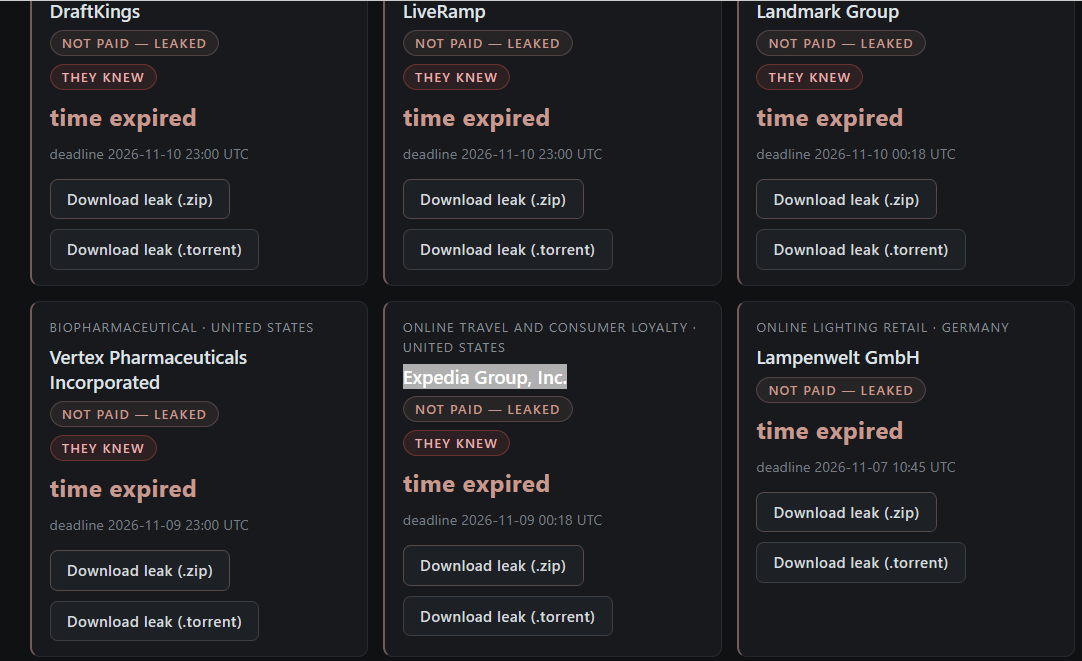
Expedia has not confirmed the figures reported by n0n and says its investigation is still ongoing. The company confirmed it was affected by a supply chain attack in which hackers compromised a third-party data platform provider and used its trusted access to reach several companies’ systems. Expedia says its platforms remain safe for both travelers and business partners.
The amount of data allegedly stolen is substantial. N0n claims to have obtained more than 830 million loyalty program records from 35 programs, including customer email addresses, membership IDs, and points balances.
“The alleged haul includes more than 830 million loyalty program records, 58 million traveler profiles, and over 333 million consumer account and credential records.” Forbes reports. “The hack was first reported days earlier by several cybersecurity companies, after a newly established Russian extortion group known as n0n bragged that it had stolen Expedia data.”
The group also claims to have stolen 58 million traveler profiles containing home airports and account information, 333 million consumer account records containing password-like tokens, nearly 2.5 million credit card spending records linked to hashed email addresses, 72 million consumer matching records, and 500,000 guest records containing accommodation details.
Cybersecurity firms Wiz and Sentra say the attack was carried out using a stolen vendor key from Qubole, a Google Cloud Platform partner. That access gave the attackers a trusted path into Expedia’s big data platform. N0n also claims to have taken source code through live credentials it captured the same way.
N0n emerged in mid-September and, according to SOCRadar, focuses on data theft and extortion without using ransomware. It operates with a specific pressure tactic: each victim appears on its dark web leak site only as a numbered company with a countdown timer labeled “pending exposure”, and “the group only exposes a company by name if it doesn’t pay.” The site claims 224 attacks since September.
Ransom negotiator Alex Waintraub, who is not working on the Expedia case, told Forbes that n0n’s claims appear to be a way to pressure victims into paying. He said the group’s approach is unusual because it lists victims as “Company 89” or “Company 90” without revealing their names until the countdown ends and no deal is reached. If this is how the group operates, Expedia’s decision to publicly confirm the breach is an unusual move that could weaken the hackers’ pressure tactics.
Expedia reported $14.7 billion in revenue in 2025 and operates Hotels.com, Vrbo, Travelocity, Orbitz, Hotwire, and Trivago alongside its main brand. If you have an Expedia account, a Hotels.com account or a Vrbo account, all three may draw from the same data pool.
Travelers should change the passwords for their Expedia accounts using a trusted device and avoid reusing the same passwords on other services. Although the stolen password-like tokens are hashed, attackers may still be able to crack them. The stolen loyalty program data also gives hackers access to customer email addresses and points balances, which they could use to create convincing phishing messages.
Expedia says it took steps to contain the attack as soon as it became aware of it and brought in external cybersecurity experts to investigate.
Follow me on Twitter: @securityaffairs and Facebook and Mastodon
(SecurityAffairs – hacking, Expedia)
Source: Security Affairs · 2026-11-14
The web scraping company says an intruder accessed customer accounts and obtained personal information or stored data.
Source: SecurityWeek · 2026-11-13
Shipping giant Maersk has confirmed that one of its systems was broken into by hackers who have stolen data. The WhiteArmor gang has claimed responsbility for the attack.
Read more in my article on the Hot for Security blog.
Source: Graham Cluley · 2026-11-12
The attackers accessed chat transcripts for fewer than 1% of Notion workspaces. Most transcripts were unattributable.
Source: SecurityWeek · 2026-11-12
The WhiteArmor ransomware group claims it stole 100GB of data from the shipping giant’s systems.
Source: SecurityWeek · 2026-11-12
A.P. Moller Maersk, the Danish shipping giant, says it identified an IT security incident involving unauthorized access and data extraction from one of its local legacy systems, one inherited from a previous acquisition.
“Maersk has identified an IT security incident involving unauthorised access and data extraction from one of our local legacy systems from a previous acquisition.” reads the statement published by Maersk on November 11. “Our findings so far strongly suggest no sensitive data has been disclosed. The incident is isolated to a local system, and we have found no indication that there has been any impact on other Maersk systems or customer and partner systems that connect to Maersk through integrations such as APIs and EDI.”
According to Maersk, its cyber security team started a full investigation as soon as it found the problem, and it’s still going. The company says swift action secured the affected system. Its findings so far strongly suggest no sensitive data has been disclosed, and it says the incident is isolated to that one local system.
Maersk has found no sign that other Maersk systems were affected, or the customer and partner systems that connect to it through integrations such as APIs and EDI. It doesn’t expect disruption for customers, who can book and manage shipments as usual. It promises updates and says it will inform any affected parties if it finds a need to.
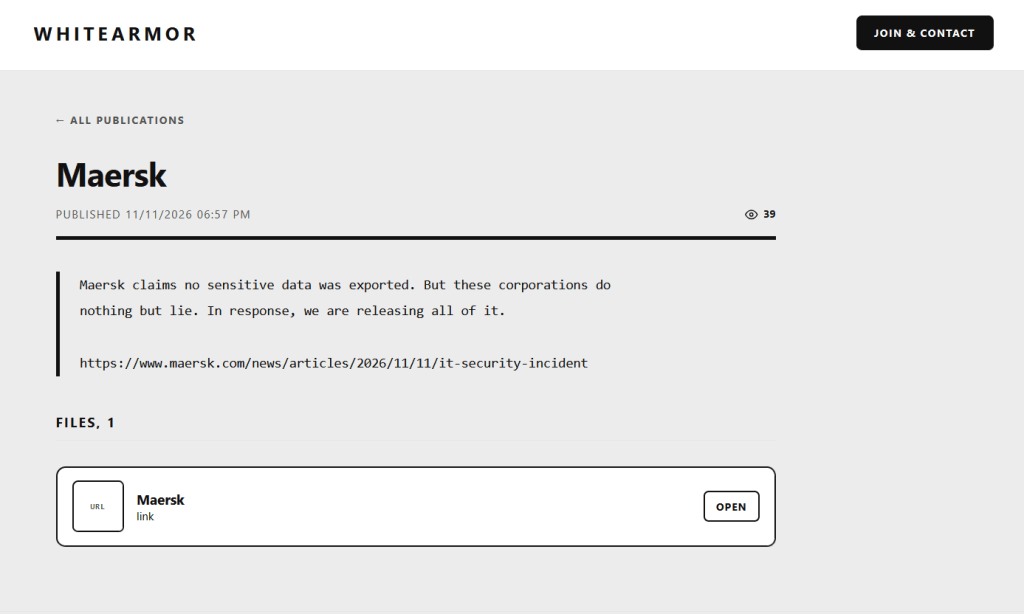
Maersk didn’t name the system, the type of data or the date of the intrusion. However, the cybercrime group WhiteArmor added the company to its Tor data leak site:
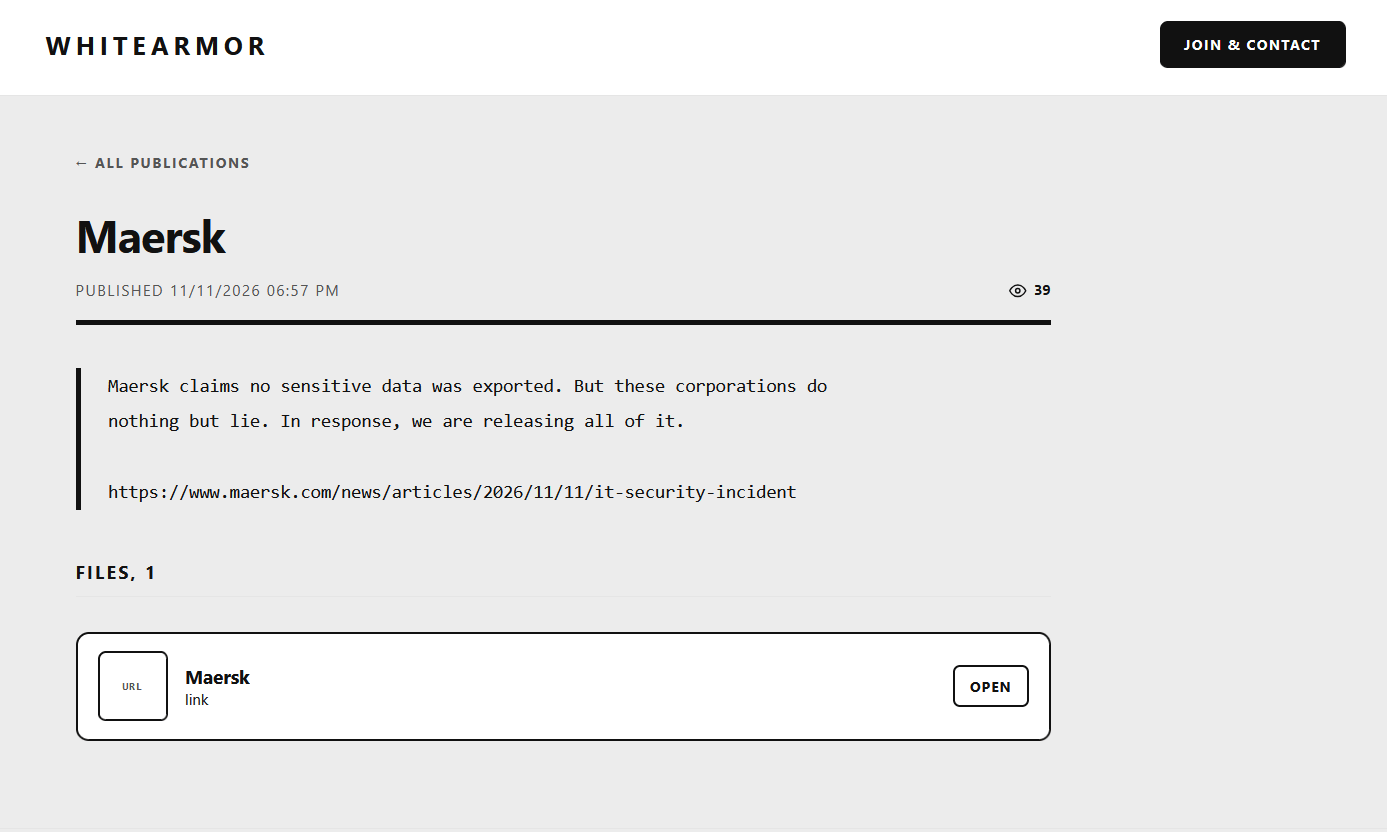
WhiteArmor demanded a $5 million ransom in Bitcoin, giving Maersk 30 days to pay. The group claims to have stolen about 100 GB of data from the OCF/LF Logistics platform, which supports logistics and supply chain operations.
“”Your contract-logistics arm, the former LF Logistics, runs fulfilment for many of the world’s largest consumer brands,” states the leak site. “Five million dollars is roughly four hours of that EBITDA.””
Maersk acquired LF Logistics, the company that developed the platform, from the Li & Fung Group in 2022. This could match Maersk’s reference to an old system inherited through an acquisition, although the company has not confirmed this connection.
According to the attackers, the stolen data includes nearly 30,000 driver records, passwords stored in plain text, 33 super admin accounts and signed delivery receipts. The group also claims to have stolen inventory records, purchase orders, advance shipping notices and 27,842 mobile device logs containing phone numbers, email addresses and IMEI numbers. These details come from the attackers and have not been independently verified. Maersk’s statement does not confirm their claims. WhiteArmor also tried to justify its demand, saying the $5 million ransom represents roughly four hours of revenue for the logistics business.
“We do not anticipate disruption to operations for customers at this time, and customers can continue to use Maersk platforms to book and manage their shipments as usual.” concludes the statement. “We will keep customers updated as more relevant information becomes available, and if we identify any need to inform impacted parties of any further findings, we will do so.”
The scale of Maersk’s operations explains why this incident matters. A.P. Moller-Maersk is one of the world’s largest integrated shipping and logistics companies, playing a major role in global trade and supply chains. It operates around 700 container ships, representing approximately 13.5% of global container fleet capacity, and manages 60 terminals across 35 countries. The company employs about 100,000 people in 130 countries and provides services covering ocean shipping, port operations, warehousing, customs clearance and end-to-end supply chain management.
Maersk reported approximately $54 billion in revenue and $2.9 billion in net profit in 2025. Its global reach and reliance on interconnected IT systems make cybersecurity a major concern. A breach involving even an older, locally operated platform could expose sensitive business and personal information, including data belonging to drivers, customers and logistics partners, even if the company’s main systems remain unaffected.
In 2017, NotPetya forced the company to reinstall more than 4,000 servers and 45,000 workstations from scratch. It operated without IT for ten days and took damages of up to $300 million.
Follow me on Twitter: @securityaffairs and Facebook and Mastodon
(SecurityAffairs – hacking, ransomware)
Source: Security Affairs · 2026-11-11