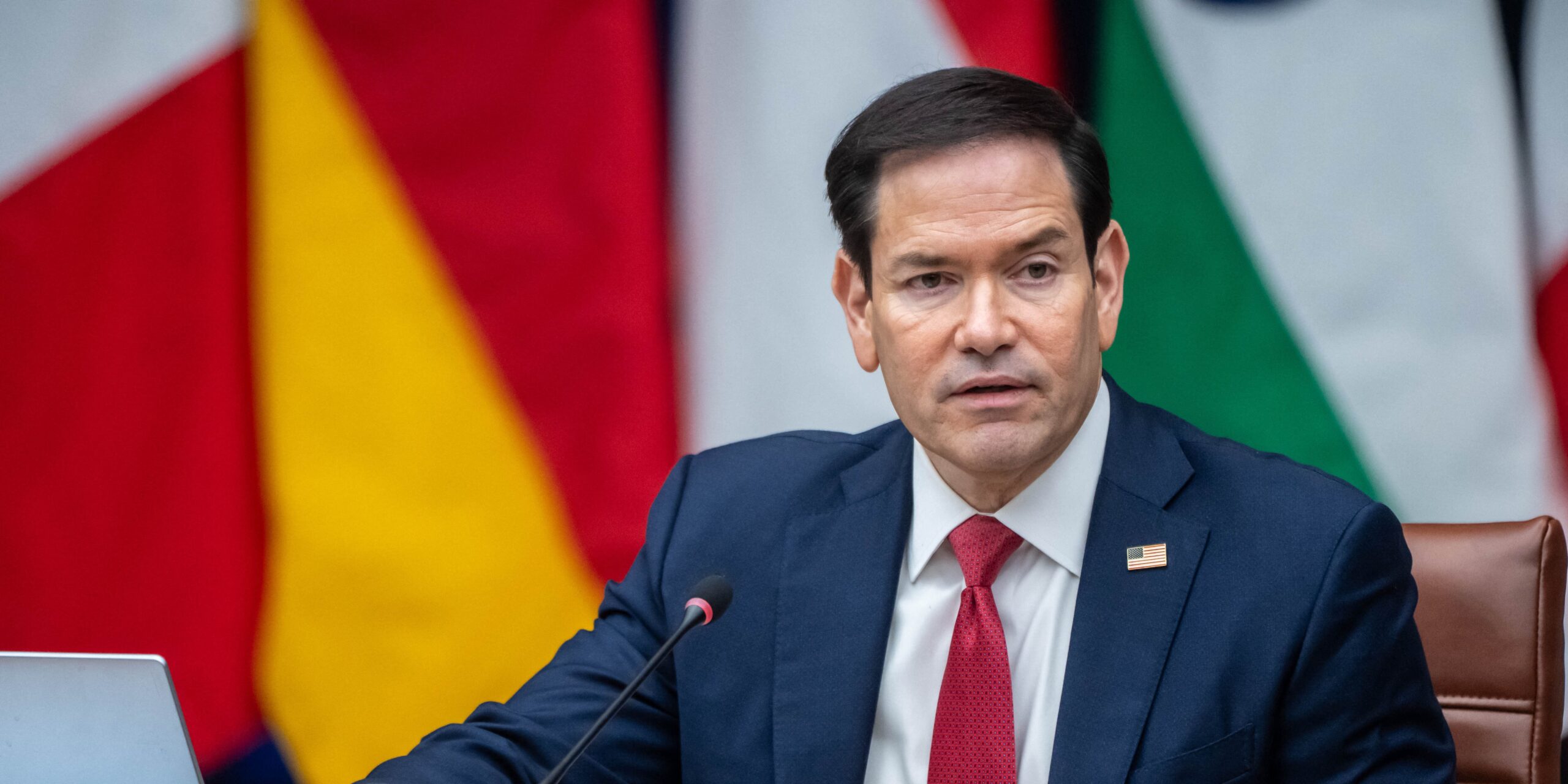
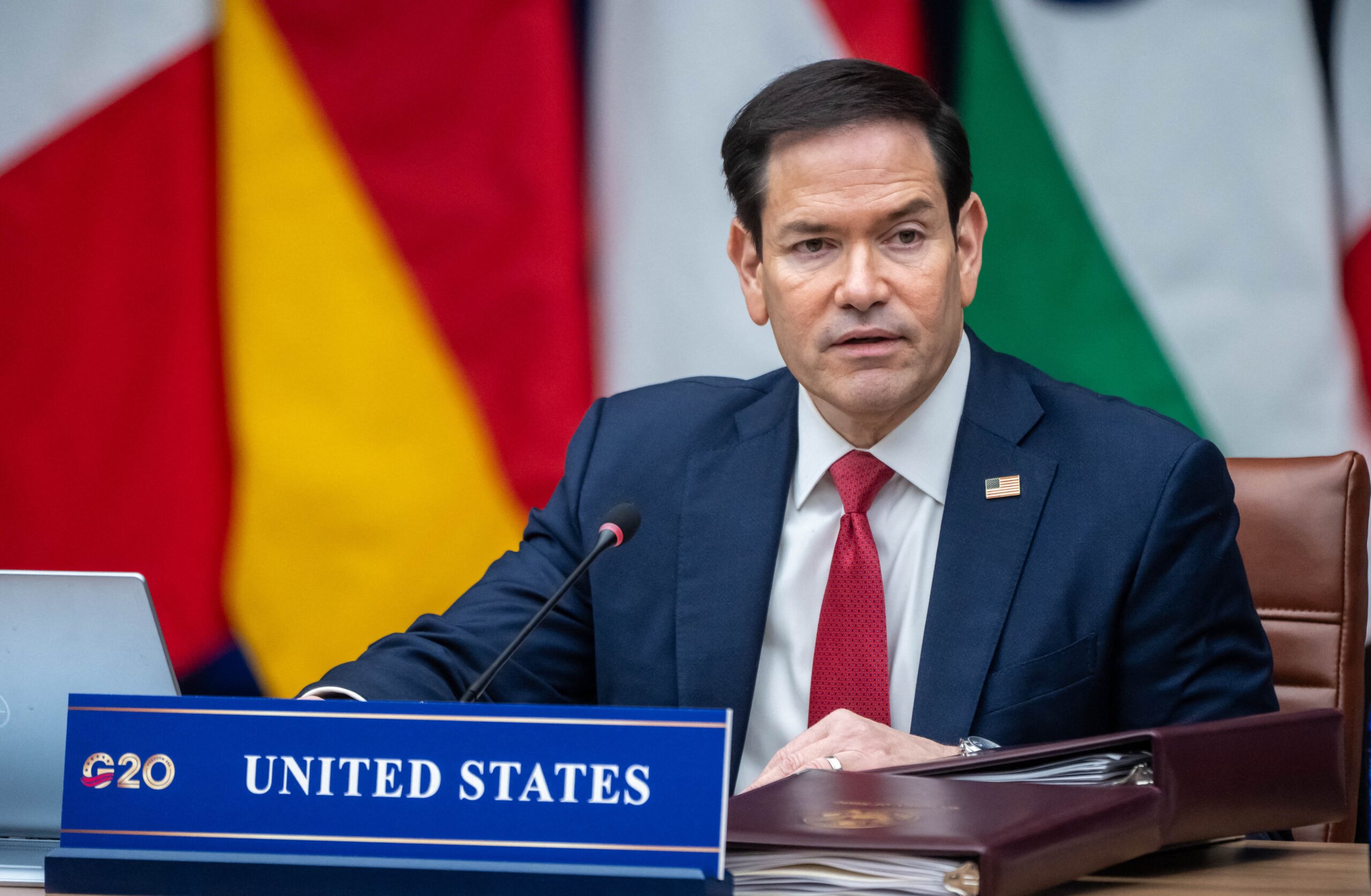
Secretary of State Marco Rubio speaks at the start of the G20 foreign ministers’ meeting on Oct. 30, 2026, in Atlanta.Photo: Michael Kappeler/picture alliance via Getty Images
Imperial ambitions are ever-shifting under President Donald Trump. Greenland, Venezuela, Iran, and Cuba are oftentimes spoken about as one continuous train of complete victories and soon-to-be-complete-victories. With the midterms fast approaching, and the date for an apparent telegraphed return to the Iran war on its heels, talk of easily overthrowing regimes has returned, if it ever truly left.
At a rally in Florida last Friday, Trump laid out his grand vision, which he promised would come to pass once the Islamic Republic is neutralized as a threat to the world: “We’re going to come back from Iran. Those beautiful ships will pass Cuba. We’ll have one of them stop about 50 yards off the coast. They’ll raise up their hands, and then we’re going to send Marco Rubio in to finish up the deal.”
Secretary of State Marco Rubio, the descendant of Cuban immigrants who left under President Fulgencio Batista (though Rubio later tried to claim his parents fled Castro, who came to power three years later), has long put overthrowing the Communist government in Havana at the top of his agenda, with the hope of replicating the relative ease of kidnapping Venezuelan President Nicolás Maduro in January. Rubio turned some heads last Friday when he publicly posted on X that those seeking “to create positive change in Cuba” could “seize this opportunity to create the change you desire through a discrete [sic] partnership with the CIA.”
The post was widely met with bewilderment (Bloomberg’s White House correspondent wrote: “Checked like four times that this was real”), but U.S. officials and members of Congress also shared the post, elevating the public call for collaboration. Recruiting in public might come across as strange and out of character to a public that imagines the CIA recruiting secret agents and informants through clandestine channels or hidden websites, as the agency had done to try and recruit agents inside Iran under Bush and Obama.
But public appeals of this kind are not wholly new. Under the Biden administration, the CIA recruited collaborators inside Russia via a public Telegram channel, as well as publishing videos on social media hoping to recruit Chinese, Iranian, and North Korean assets.
This kind of overt recruitment stems from the difficulties Western intelligence agencies face against adversaries who have built sophisticated surveillance networks of their own. A CIA official told ABC News in May 2025, “in today’s world of [universal technical surveillance], we can’t recruit sources the same way that we did 20 years ago, probably the same way you did 10 years ago.” This has not only affected intelligence operations targeting Beijing, but also Tehran and Havana, where both the U.S. and Israel’s lack of on-the-ground connections and limited official presence has led the CIA and the Mossad to try to recruit willing informants online.
While these limitations may govern the particulars of this strategy, those in power in their respective countries may not see it as evidence of constraints, but instead as evidence of the power of their new strategy: boasting about their national power, rather than keeping it behind closed doors where it supposedly remains useless. After all, what is the use of a deterrent if nobody knows it was you?
The scale of these public appeals, despite having started under Biden, has exploded under the second Trump term, but these moves were arguably preceded by Benjamin Netanyahu’s efforts to bring the Mossad’s operations much more into the public sphere. The Israeli prime minister’s bragging about numerous cyberattacks targeting Iran’s nuclear program in the late 2010s began to precipitate a shift in public discussion of the Mossad’s work, with many Netanyahu allies, like then-Justice Minister Ayelet Shaked, praising the fact that Iran could now “know it is exposed and that Israel can reach anywhere in the Islamic Republic.” A former deputy director of the Mossad said after the unveiling of Iran’s stolen nuclear archive that Netanyahu’s move “goes against our nature,” and that “the prime minister insisted on publicizing this.”
Netanyahu’s pick in 2021 for the director of the Mossad, David Barnea, has been credited with institutionalizing that change, shifting the secretive intelligence agency’s operations toward appealing to larger masses, and reportedly concerning Mossad veterans who were shocked by the publicizing of agents inside Iran. Casting Israel as a superpower capable of exerting its power anywhere has become a popular refrain under Netanyahu. In an interview with “60 Minutes,” one Mossad officer said of the 2024 pager attacks in Lebanon, which injured more than 2,000 people, that “they are walking proof of our superiority all around the Middle East,” with another officer saying the operation’s complexity and success demonstrated “the world is our stage.”
The U.S. has also gotten in the habit of flexing its superpower status under Trump, declaring the nation’s intent to conquer places like Greenland and Canada, to steal the natural resources of Venezuela and Iran to fill American coffers, and to openly and unabashedly place the Western Hemisphere under a Washingtonian protectorate known as the “Donroe Doctrine.” Rubio declared in Greece in early October, speaking in terms of civilizational battle against the backdrop of the Acropolis, that “we choose the unapologetic pursuit of national power.”
Openly siccing the CIA on foreign adversaries and ICE on domestic ones has been part of that strategy of embracing imperial fervor at home and abroad. Erik Prince, the founder of Blackwater and a private security contractor who remains influential in Trump world, said he was “jealous” of the pager attacks and publicly urged the CIA to take a lesson from the Mossad, saying “we should be getting those kinds of results.”
While both countries have openly sought deep intelligence penetration in adversarial nations, there are limitations to the power of clandestine and overt operations, even by superpowers and wannabes. While the CIA asserted its power in May by openly having its director meet with Cuban officials in Havana to demand “fundamental changes” in return for relief from economic strangulation, the agency’s history of attempts to overthrow the Communist Cuban government are as storied as they are unsuccessful. Earlier hopes for Iran to be as quick and as clean as taking control of Venezuela’s government were dashed early on in the conflict, with the war that was supposed to only take a few weeks now all but certain to extend past the midterm elections for another devastating round.
Even if the war with Iran ends so easily that American ships are able to go through Cuba on the way back ready for more, both outside analysts and even internal U.S. intelligence assessments do not see as easy a way to overthrow the Communist state. The New York Times reported in August that American intelligence sources indicate it could be a situation closer to Iran, where even if Raúl Castro (who has held no official position in the country since 2021) were captured, “few pragmatic officials” are likely to take power in his stead.
While Cuba’s military lacks the kind of advanced equipment Iran has, and shows of readiness (like with Venezuela) are no indication of a country’s actual willingness to fight a protracted campaign, Cuba’s military structure is similar to Iran’s in that it is based on decentralization and redundancies in leadership. In addition, Cuba has a political power structure that, also similar to Iran, is not actually based around a single individual, despite popular claims to the contrary.
Despite Trump’s constant bluster about the miracle of being able to take out Maduro without a single American death, the brazenness of that operation, and the openness with which the negotiations with Iran have been deceptive, appear to have had lessons for the Cuban leadership. President Miguel Díaz-Canelsaid in June: “All these elements create a lot of distrust in the Cuban people when it comes to conducting any type of negotiation. We continue to express our willingness for dialogue, but it has to be a dialogue between equals, without pressure and with respect for our sovereignty.” American officials have yet to internalize that sentiment. Discussing Cuba in March, Trump joyfully mused: “Whether I free it, take it, I think, I could do anything I want with it.” At the time, he was saying similar things about Iran.
This story was supported by the Pulitzer Center and the Fund for Investigative Journalism.
JOHANNESBURG, SOUTH AFRICA — When it opened in early 2024, Engage Men’s Health Clinic served as a free, one-stop shop for sexual health, gender-affirming medical care, and HIV prevention, testing, and treatment. Located within a short distance of seven universities, it was a place where many college students came before “they’d even had sex for the first time,” a former worker told The Intercept. This made Engage a “high-impact” clinic for distribution of the HIV prevention drug PrEP.
The building, on a tree-lined stretch of Reserve Street in Johannesburg, was adorned with the logo for the President’s Plan For AIDS Relief, or PEPFAR; a rainbow-colored mural of Simon Tseko Nkoli, the gay anti-apartheid activist who helped start one of Africa’s first Pride celebrations and who died of AIDS in 1998; and a sign for USAID saying the site was a gift “from the American people.”
Today, it would be very hard to get help here, despite the welcoming-but-outdated signage. The clinic, once staffed full-time by professionals, closed abruptly during the first hours of the second Trump administration. Its replacement, an unrelated volunteer clinic called USpace, is open a mere four hours a week. They can do HIV tests here. But they have no HIV treatment, HIV prevention, or gender-affirming medication to distribute.
South Africans account for about a fifth of the 41 million people living with HIV around the world. Out of a population of nearly 64 million, some 8 million people in South Africa are living with HIV, which is roughly 1 in 8. Managing their healthcare is a matter of international concern and requires global coordination and an immense local network. In a nation with such high rates of HIV, public health workers can’t just wait for people to walk into clinics; they must proactively go to them.
Yet over the last year and a half, this crucial work has been stymied. By Jacqueline Pienaar’s count, HIV prevention groups have lost track of approximately 20,000 people with HIV in the Johannesburg and Pretoria region alone since U.S. President Donald Trump came back to the White House. “It used to be if someone didn’t show up to get their medication, you’d go to them,” said Pienaar, a principal investigator and global health specialist at the Aurum Institute, an NGO that offers medical care and contact tracing for the region’s massive HIV-positive population.
For years, the U.S. Centers for Disease Control and Prevention funded her work. Many of her patients were homeless, unemployed, and extremely poor. If they are unaccounted for and unmedicated, their viral loads will spike, all but assuring large transmission increases in a country that is already home to 20 percent of the world’s HIV-positive population.
With U.S. funding vanished, South Africa now finds itself at risk of unmitigated HIV spread.
Now, at organizations like the Aurum Institute, interviews with Pienaar and other workers reveal how funding cuts have devastated the care apparatus. Employment in HIV care and prevention has become precarious, and resources to slow HIV transmission are increasingly scarce. As elsewhere in the world, this is creating a crisis of unemployment for Black LGBTQ+ workers, which itself creates higher risk for HIV. Gender-affirming care, which is a crucial tool for preventing HIV, has disappeared almost entirely.
Until the second Trump administration, the United States government sent a bit more than half a billion dollars a year to the Republic of South Africa. Of the $580 million the U.S. sent in 2024, 78 percent ($455 million) went towards HIV/AIDS.
But this money from America was hardly charity or lacking in self-interest. Because viruses know no borders, what happens with AIDS in the country with the most infections affects everyone on Earth. Controlling HIV in South Africa makes the entire world safer by preventing the emergence of dangerous viral mutations, reducing the global burden of infectious diseases, and strengthening health systems that detect future pandemics. Because viruses mutate rapidly when allowed to replicate unchecked, poorly controlled epidemics anywhere pose a direct threat to global health security.
South Africa also leads the world on another important front: medical research to address HIV. The republic is home to more clinical trials than any other country for seeing how medications of all kinds (including Covid vaccines) impact those with HIV. The profits of American drug companies depend on South Africans undergoing research trials.
And after a year-and-a-half of dialing down HIV funding and only allowing it with many caveats which have caused major harm, the United States announced in June — during America’s LGBTQ+ Pride Month — that it will end all HIV funding in South Africa.
The ramifications of this will be felt globally for years to come.
They are already being felt by the millions of South Africans for whom HIV care has become harder and harder to find. And the effects are most severe for those already on the margins of South African society: those already living with HIV/AIDS, immigrants, trans women, and the poor, including thousands of newly unemployed HIV prevention workers.
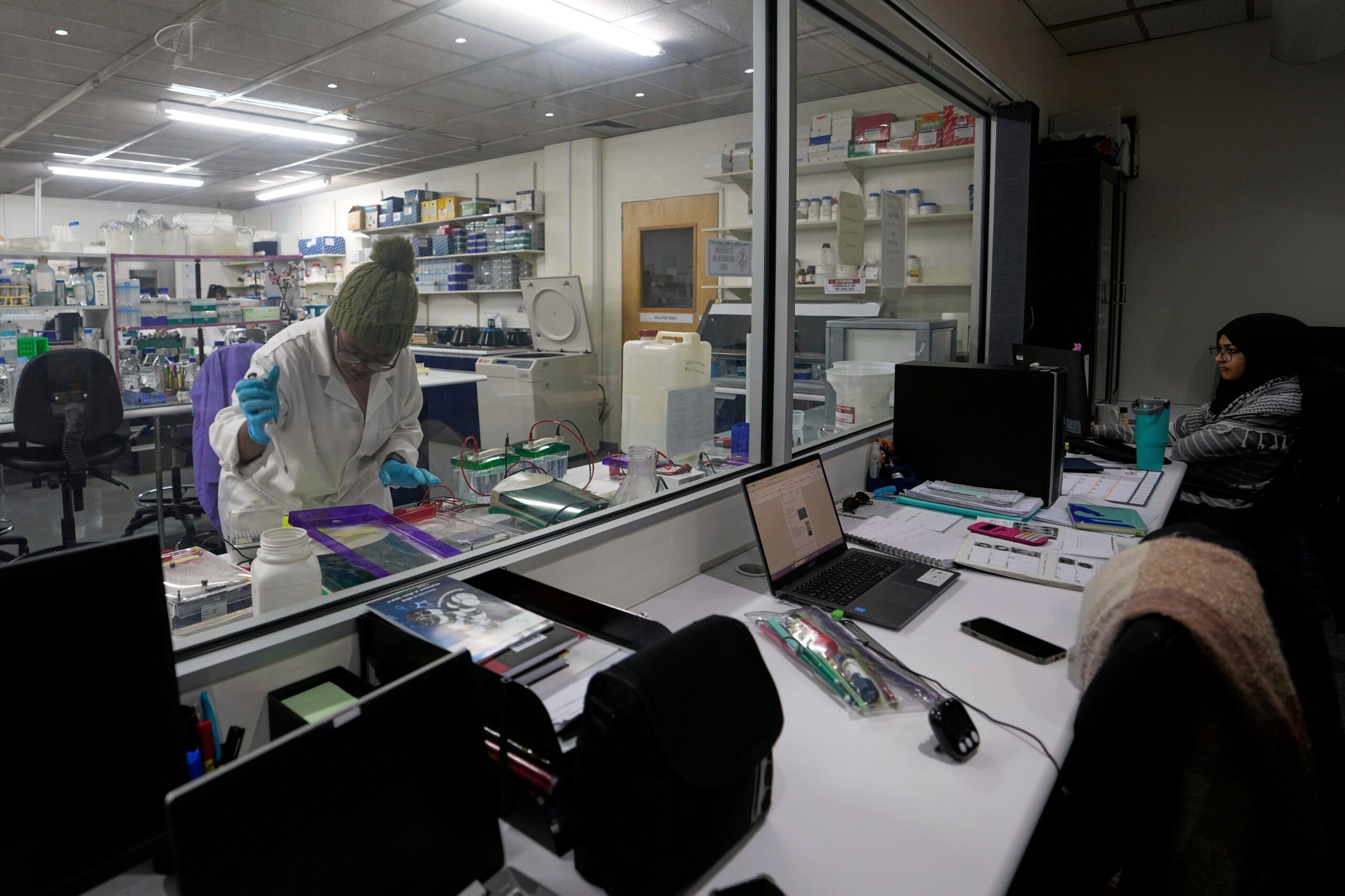
Laboratory technician Nozipho Mlotshwa works on samples at the Antiviral Gene Therapy Research Unit, at University of the Witwatersrand Medical School, in Johannesburg on May 22, 2025. Photo:Themba Hadebe/AP
On January 20, 2025, Trump signed two executive orders: 14169, “Reevaluating and Realigning United States Foreign Aid,” and 14168, “Defending Women from Gender Ideology Extremism and Restoring Biological Truth to the Federal Government.”
Within hours of Trump taking the oath of office, the vast majority of workers for OUT LGBT Well-Being, which ran the Engage clinic, were told not to come in to work the next day nor to even open their work laptops again. According to one, 82 of 86 workers were let go. They would become part of the one-third of South Africans who are already unemployed.
Trump executive order 14155 formally pulled the U.S. out of the World Health Organization in January 2026. Trump’s cuts came after the outgoing administration of President Joe Biden reportedly failed to pay some $130 million in 2024 WHO dues, leaving the organization with a $1.9 billion gap. As a consequence, WHO implemented a 30 percent reduction in its workforce.
South Africa’s response to HIV has been shaped by its two most famous citizens: Nelson Mandela and Elon Musk.
During Trump’s first term, with Musk merely cheering from the sidelines, U.S. funding for LGBTQ+ health and HIV did not decrease significantly, at home or abroad. But ahead of Trump’s second term, it was Musk who first recommended a U.S. “government efficiency commission” to Trump in 2024, planting the seeds for what was to come.
HIV funding nationally and globally have plummeted in Trump’s second term through cuts largely enacted at the behest of Musk’s short-lived Department of Government Efficiency. (These have been paired with an immigration policy so racist, over the last six months, literally the only refugees to enter the U.S. have been white South Africans.)
Musk quit just a few months into his tenure in 2025, before DOGE shut down entirely. He reportedly took a swath of DOGE data with him, saw his wealth skyrocket, and became the world’s first trillionaire. Reporting on mathematical projections about how many people have been or will be killed by the U.S. Agency for International Development, or USAID, cuts he pushed have ranged from hundreds of thousands to about 10 million to even tens of millions. (When Rep. Ro Khanna, D-Calif., accused Musk of executing “a death sentence for an estimated 4.5 million children around the world,” Musk threatened to sue him.)
“We have rights for trans women only on paper.”
But not all harm results in immediate, quantifiable fatalities. HIV-related deaths usually take many years to occur, and South Africans who die of HIV, or due to an increasingly transphobic healthcare system, are unlikely to be mourned in any numerically comprehensive database.
In South Africa, being trans is not a crime — it’s legally protected thanks to its 1996 constitution shaped by Mandela. And yet, as one trans HIV-prevention worker put it, “we have rights for trans women only on paper.” Because trans care was largely being financed largely by USAID, PEPFAR, and CDC research, when U.S.-money disappeared, trans care went away — along with a lot of the much-needed HIV prevention for everyone.
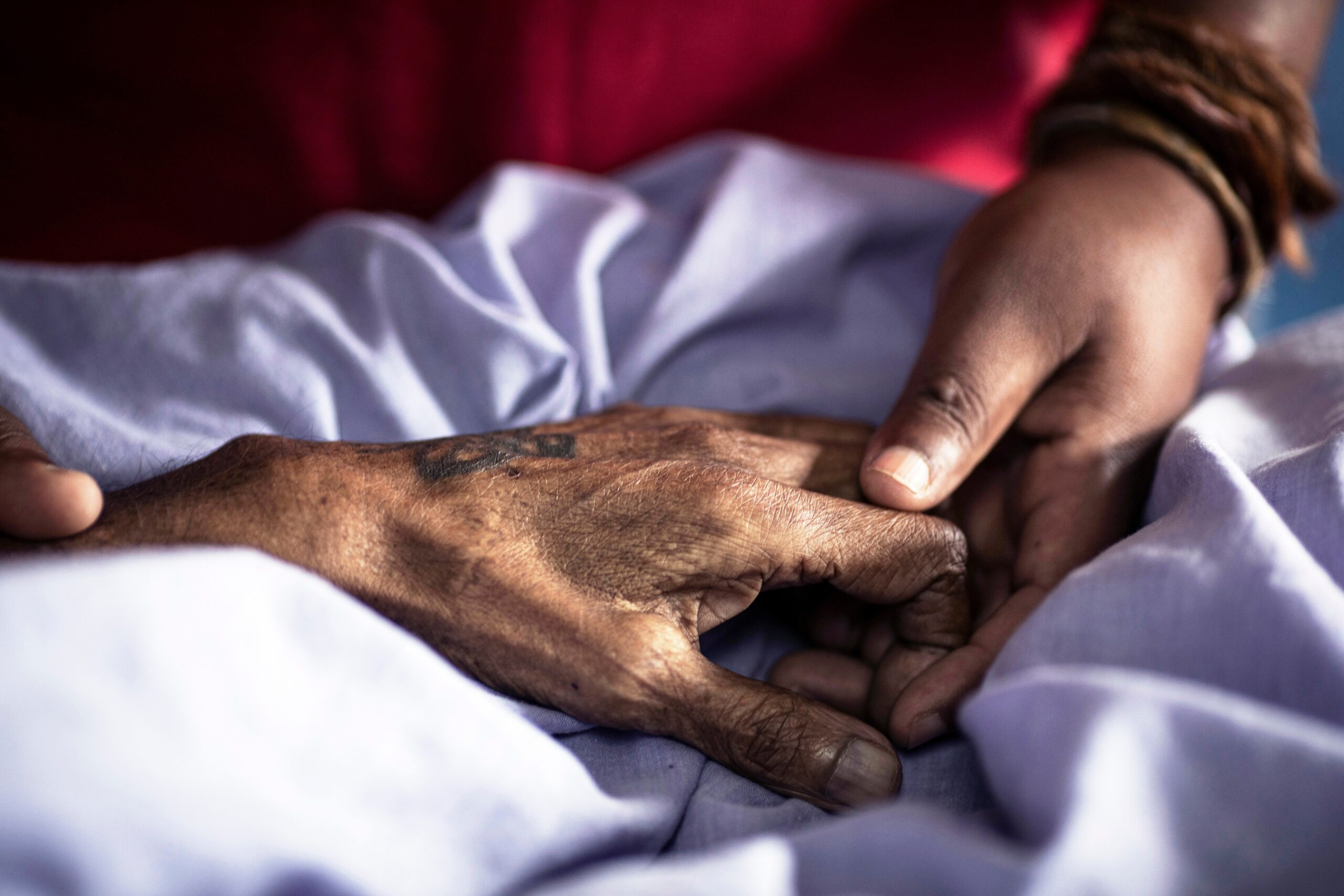
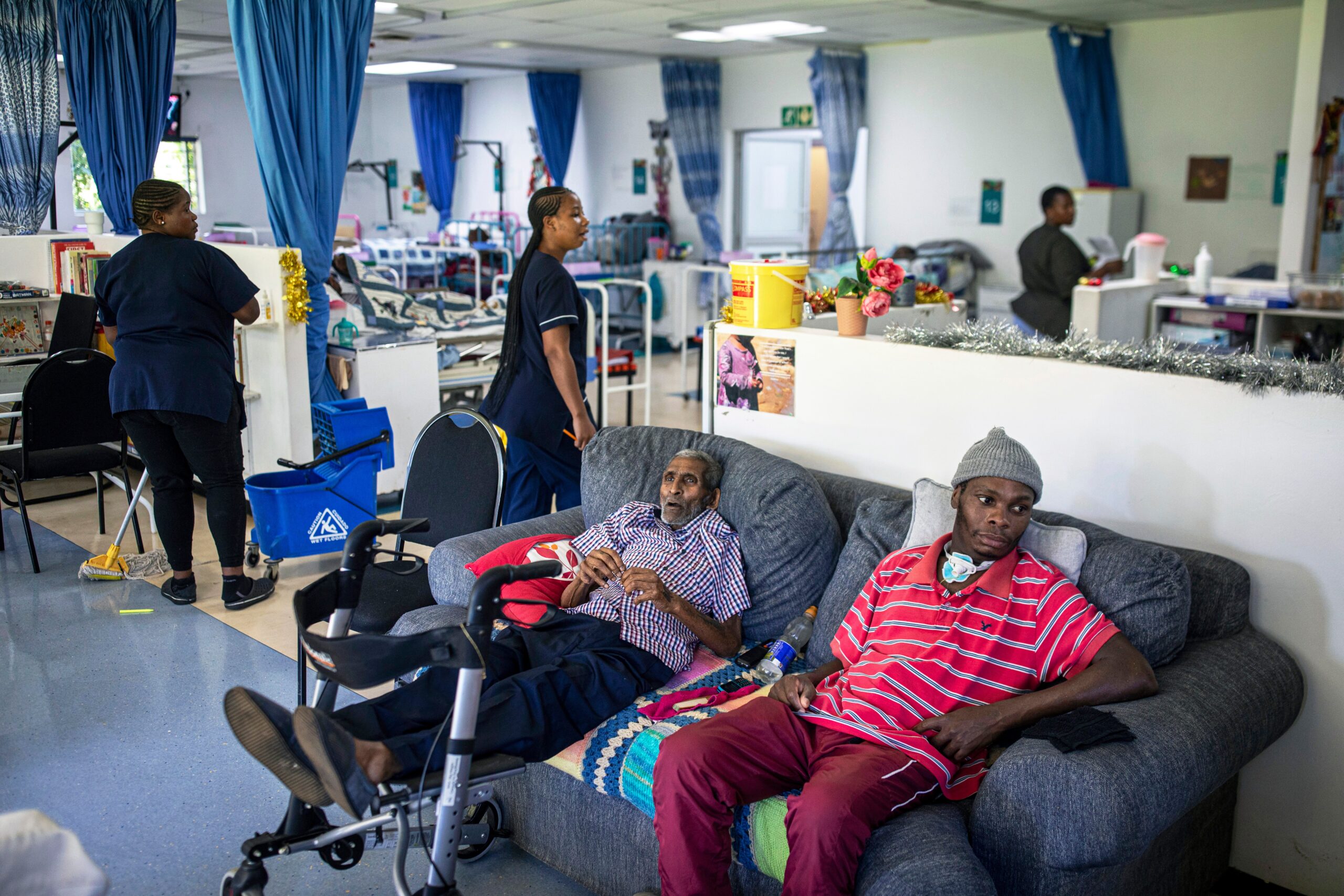
Patients watch a soccer game on TV in the hospice at Hillcrest AIDS Centre on Nov. 29, 2025, in Hillcrest outside of Durban, South Africa. Photo: Per-Anders Pettersson/Getty Images
In South Africa, LGBT Pride celebrations happen in the fall to connect gay history to the September 24 Heritage Day national holiday.
At last year’s Soweto Pride in the all-Black township where Winnie Mandela once lived, there were no corporate sponsors and zero presence from the U.S. Embassy or any U.S.-based NGOs.
It was here The Intercept first met Sibonelo Ncanana Trower, the worker at OUT LGBT Well-Being which had run the now-shuttered Engage clinic. He and his partner were wearing matching rainbow sweaters. Nearly nine months after being laid off, he was still looking for work — and it was one of his first times going to a gay event.
Though he was no longer getting paid, Sibonelo still was doing a lot of public health work for free, out of a sense of communal responsibility.
“If you go on Grindr — and I don’t suggest that you do, it’s too dangerous,” Sibonelo said, “you will see many of my former colleagues offering services.” People who had been trained as social workers and peer educators to provide care to sex workers were now working as sex workers. In an email to The Intercept, Sibonelo said he is back to working at OUT as of early June.
As the festivities continued, the almost entirely Black crowd danced to a mix of hip hop, rap, and dance hall on a grass field, bordered on one side by tents. Under the banner “The Queer Nation Has No Borders,” a group of volunteers and workers at the SafePlace International tent welcomed LGBTQ+ migrants and refugees and offered help for finding housing and work.
While Europeans are routinely worried about African refugees trying to cross the Mediterranean to Greece or Italy, SafePlace explained that most migrants in Africa are not trying to leave the continent at all — and most queer and African migrants fleeing legal persecution head down to South Africa. They try to go south because they’ve correctly heard that South Africa is legally good for queer Africans and that they can claim asylum. But they also come because they’ve heard — rather incorrectly — that South Africans welcome migrants. (In recent decades, migrants have faced great hostility in South Africa, especially in the lead-up to 2025’s G20 summit in Johannesburg, which Trump boycotted, and in increasingly bold xenophobic protests in 2026.)
Mpho is a lesbian from rural South Africa, and she spoke about a kind of refugee status few Westerners consider. Mpho explained that people who come from within South Africa to Cape Town, Durban, Pretoria or Johannesburg are often called immigrants, for their distinct cultures, languages (South Africa officially has 12 languages), and understandings of sexuality, gender, and being intersex. She herself knew she was different; but in her township, where there is not constant connectivity with mass media, she didn’t know anyone like her until she came to a big city.
Masi has had an even more challenging route. He is a trans man born in Zambia who made his way to South Africa, after surviving an arranged marriage and a community shunning.
Mpho and Masi have both known trans people who have experienced extreme body dysmorphia, including trans men who have started to have periods again once they lost access to hormone replacement therapy due to the Trump–Musk cuts. They know someone who has gone into the public health system, had their doctor leave the room in the middle of a genital exam — and then return with a group of colleagues to laugh at their body.
This has led to a wave of depression and suicides among their friends. Masi has made the difficult decision to only “socially transition.” He has chosen to dress and live as a man without hormonal or surgical intervention, because he does not want to begin any process that he can’t finish, or which could be taken away from him for any time.
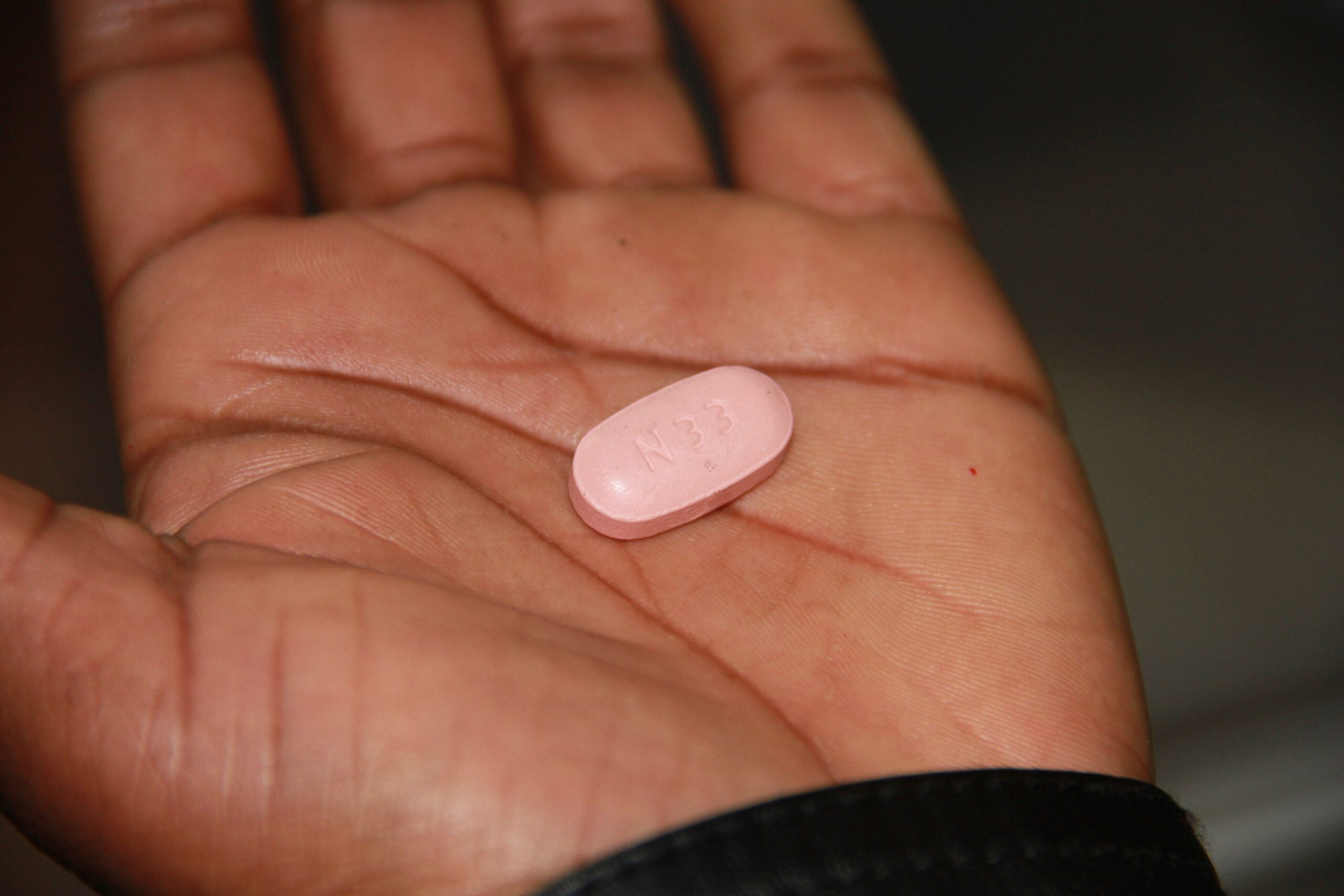
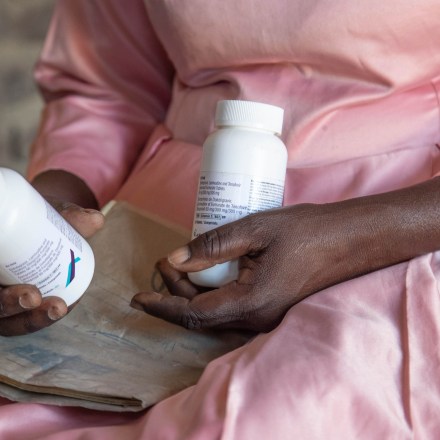
A 36-year-old HIV-positive sex worker and mother of one who requested anonymity shows a antiretroviral drug bought illegally on the black market in Johannesburg on June 20, 2025. Photo:Louise Dewast/AP
A few days later, Masi and Mpho drove into Johannesburg in a car early on a Saturday morning, decked out in “the queer nation has no borders” swag. With them was Mandi, a trans woman from Uganda. While Mandi waits for surgeries she plans to have, she has found a way to get estrogen — and stay on it — despite “the cuts.”
The three friends were on their way to perform an “Act of Kindness,” a part of SafePlace’s program where queer and trans people perform service projects which confer dignity upon each other. (SafePlace is privately funded, and like other privately funded NGOs, its work and workers are stressed in trying to meet the profound additional need in the wake of U.S. and WHO cuts.) Masi, Mpho, and Mandi would be serving lunch at a shelter for displaced queer women in the Vaal area, south of Johannesburg.
Mandi grew up assigned as a boy but knew she liked other boys. Uganda only made being gay a capital offense in the last couple of years, but it has been illegal in various forms since at least 2014. As in many places, Mandi’s legal problems did not come from random government surveillance; rather, she kissed a friend, whose parents found out, who told their school, who told the authorities, who arrested them both. This, in turn, outed Mandi to her family, who threw her out on the street. (She has never seen them again.)
Eventually, she made her way 5,000 kilometers by land to South Africa.
Mandi had an idea that South Africa “accepted people like me,” and while living on the streets of Cape Town (and then in the back of a restaurant where she did unpaid labor), someone pointed her to SafePlace. They found her a home, helped her get healthcare, and supported her in starting to live as a woman.
After crossing the Mandela Bridge, the roads shifted from highway to unpaved, red-clay-earth roads. They arrived in the Vaal and approached Orange Farm, an area well known to AIDS researchers for its high prevalence of HIV and for hosting many research studies, including the world’s first trial to see how circumcision could affect rates of HIV transmission.
Mpho, Masi, and Mandi pulled up to a nice home, double wide in size, which had a rainbow flag on its fence. This was the shelter where they’d be serving lunch.
The group set up a precarious gas stove in the garage and began cooking massive amounts of chicken, vegetables, and pap, the South African grain dish that is akin to Cream of Wheat in America or polenta in Italy.
Before the meal, Mandi got up in front of important community elders from the neighborhood and told her story. She implored them that the most important thing about having an LGBTQ+ child is to not kick them out and to stay connected. As a cautionary tale, she warned them that her elders now wanted her to return to Uganda to take care of them in old age — even after they’d abandoned her.
Gwendolyn Dube lives in the Orange Farm section of the Vaal, in a tin-roofed shack with no running water or electricity, not far from the Steve Biko Elementary School.
At 35, she has lived with HIV for more than 20 years; she was infected when she was raped as a child. She was among the first cohort of South African children to receive antiretroviral medication, or ARVs, in the early 2000s.
For many years, she received free medical care and ARVs at a clinic across the street from Eyethu Orange Farm Mall. It encompasses many buildings across a large campus, and its rooms are simple and very crowded. A small pride flag hangs on a poll beside the South African flag — both are at half mast, for no discernible reason.
While this is not officially an HIV clinic, Orange Farm has one of the highest rates of HIV anywhere in the world, and HIV is part of most medical care here. In a room with racked, connected plastic chairs like a bus terminal, signs read: “Are you or your child on ARVs? Do you know your VIRAL LOAD?”
Moving through the hall full of hundreds of mothers with children carried on backs in baby wraps, Gwendolyn recalled how difficult it’s become to get medicine. She used to get three months of treatment at a time, then two, then one. Then she was told there was no file for her.
“I think they say that when they’re overworked,” she said.
One of the workers behind the check-in desk told The Intercept that things have gotten much harder since the cuts: “We don’t turn people away. But we don’t have enough staff. People will come here and wait for 8, 10, even 12 hours — and sometimes they don’t even get to see someone about what they need.” (For people living in abject poverty, the loss of a day’s earnings can be devastating — especially if they have HIV and have to face this risk regularly.)
Another clinic worker shared that since the cuts, many visiting healthcare workers on U.S.-funded grants not only left, but also took their equipment with them.
“I used to send teams out every day. Now, it’s maybe once a week.”
The nurses of the clinic move with a military precision, even wearing military rank epaulets on their shoulders. The head of them is the “matron,” who, when asked by The Intercept, denied that they’ve run out of any medication, or that they turn people away (a claim Gwendolyn and others disputed). The matron conceded that sometimes people have to wait so long “they will leave” — and maybe don’t come back. She acknowledged that the clinic doesn’t always have the specific medication people need when they need it. She also bemoaned that it’s hard to keep staff, burnout and turnover are high, and that her mobile teams, which would go out into the townships, are severely limited.
“I used to send teams out every day,” she said. “Now, it’s maybe once a week.”
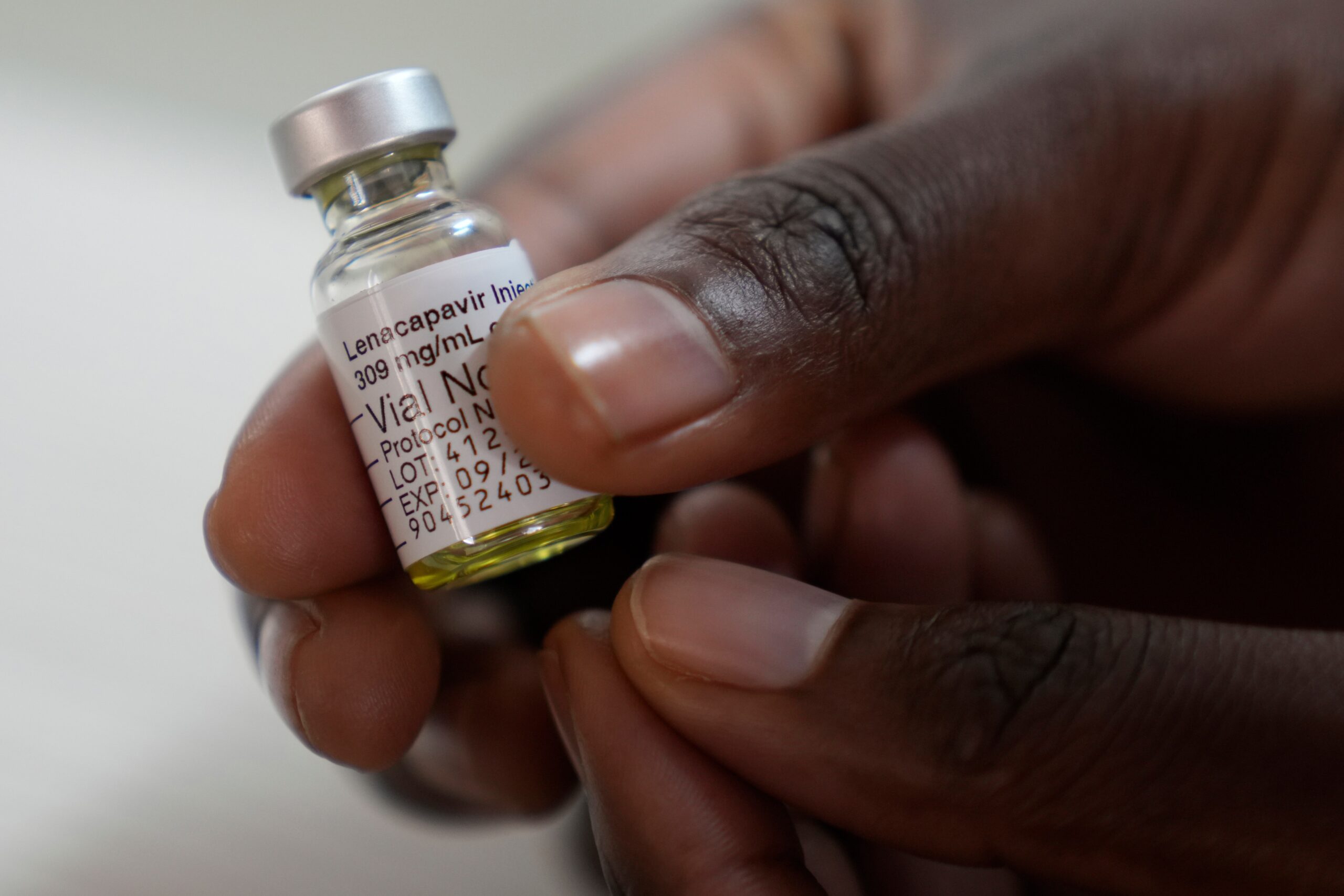
A pharmacist holds a vial of lenacapavir at the Desmond Tutu Health Foundation’s Masiphumelele Research Site in Cape Town, South Africa, on July 23, 2024. Photo: Nardus Engelbrecht/AP
Shon, a Black trans woman living with HIV, is still working at the Aurum Institute — at least for now. Unlike at the shuttered Engage clinic in Johannesburg, some staff remain in Aurum’s Pretoria office, but they decreased in number. As a result, Aurum is offering fewer services and steering patients to the public health system, where trans people receive little necessary care.
Aurum used to be a “one-stop shop” for trans women, Shon said. But now, after the cuts, doctors visits are no longer free and hormone drugs aren’t available at Aurum’s popular Pop Inn clinics. “The ladies do come to get [HIV medication], others come to get PrEP, but they cannot get hormones,” Shon said. “They’re told to go to a public clinic,” but “they don’t know anything about trans women!” Shon added that patients will be addressed with derogatory and incorrect terminology at such locations.
The stigma is too high to go to a public clinic, so Shon goes to a private doctor herself, when she can afford it. But getting hormones is now tough. While patients aren’t being blackmailed as they are in Uganda, “a pharmacist might say, ‘What do you need this for? No, I’m not giving it to you for that. I have other patients who really need it,’” Shon said.
Trans women are struggling, Shon said, recalling how she knew two “who were suffering from depression. One couldn’t take hormones, became really religious,” stopped hormones, and became suicidal. Another was suffering from liver problems after buying hormones on the contraband market, without the supervision of doctors.
Whenever transgender patients are taking contraband hormones via syringes which might not be sterile, they are being exposed to increased risks of contracting HIV and hepatitis — all because DOGE cuts took sterile medical care away from them.
Amid the devastating cuts to global HIV care, a potential breakthrough treatment is just beginning to reach patients. Lenacapavir, a new medication, promises to prevent HIV for six months with just one injection. But it comes with a prohibitively expensive $28,000-a-year price tag, making it out of reach for those who need it most.
Recently, the Global Fund for HIV, Tuberculosis, and Malaria struck a deal with pharmaceutical company Gilead Sciences to produce the shot for $40 in limited quantities. Small amounts are headed to South Africa.
At an outdoor cafe under a massive tree in the picturesque city of Cape Town, Fatima Hassan, a legal and HIV scholar, blasted the pilot study coming to the republic.
The government’s approach was “making the same mistake” of excluding those who were most affected: sex workers and men who have sex with other men.
The plan is to bring a one-time shipment of 40,000 doses — a woefully inadequate number for a country of more than 60 million people where about 1 in 5 adults is living with the virus is living with the virus.
Worse, only a tiny fraction — 5 percent, or 2,000 doses — is to be set aside for testing on men who have sex with men.
None are going to be set aside for sex workers.
And another problem: So many of the people who would be needed to distribute lenacapavir to the people who need it most — to the gay college students who used the shuttered Engage clinic on Joburg’s Reserve Street, to the trans women who went to the Pretoria Pop Inn clinic — have been fired. Without those workers, can South Africa even distribute the medication?
Steps from the cafe, within sight of well-appointed apartments topped with electrified razor wire and the Desmond Tutu Health Foundation, there is a shantytown of cardboard-and-wood dwellings, home to some 100 Black adults without anywhere else to live.
A conservative estimate means that probably at least 20 of them were living with HIV, if not more.
And because of Trump and Musk, the people who used to find them and treat them have been fired — and are at higher risk of HIV themselves.
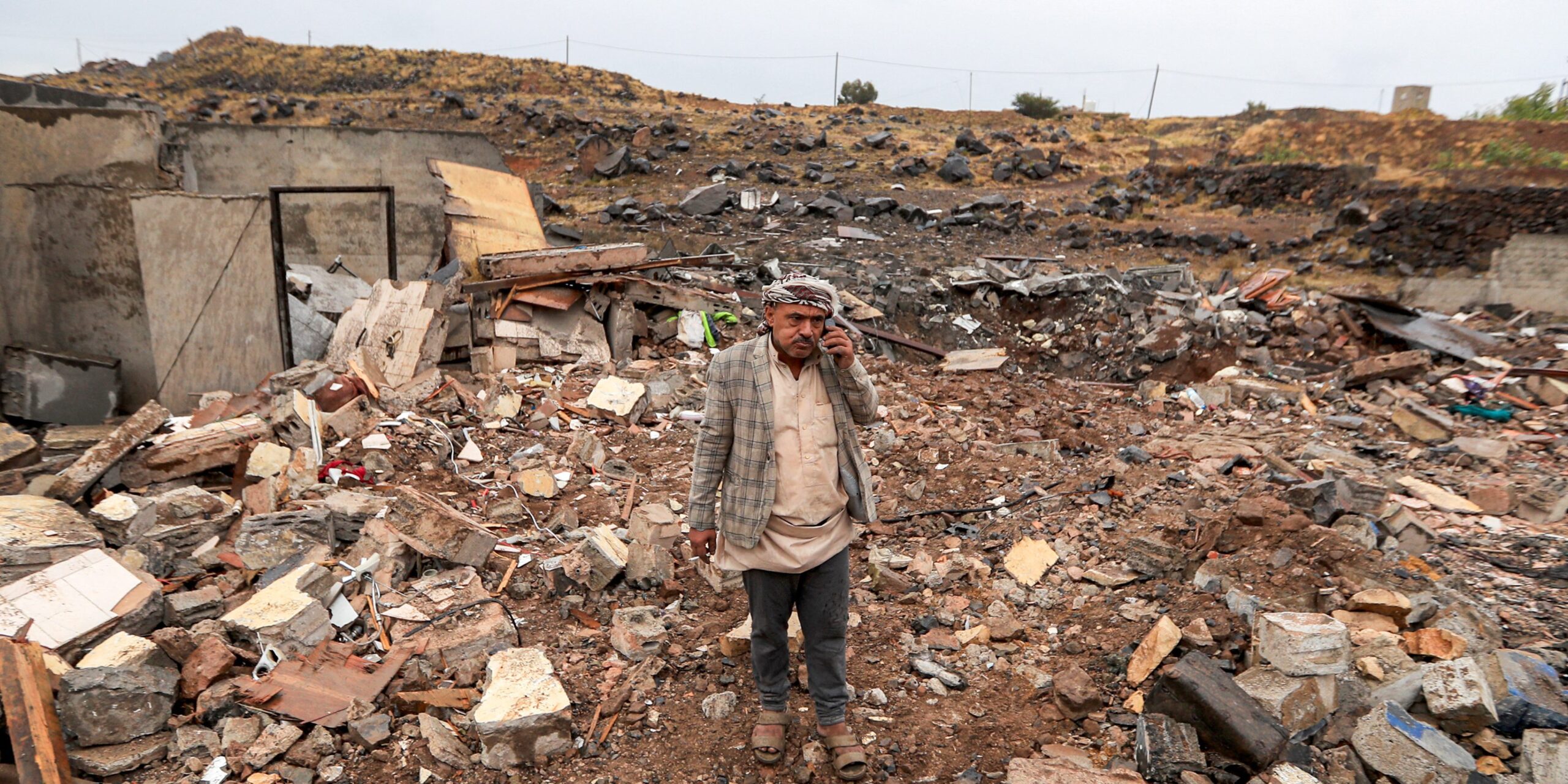
The failure of Tel Aviv and Washington to achieve their war aims in Iran has resulted in the most dramatic American retreat from a region since the U.S. flight from Vietnam in 1975. This startling American defeat — after a generation of forever war failures and stalemates — has been thrown into broad relief by the resumption of another regional conflict that has received far less attention than the Trump administration’s sputtering war with Tehran. This fall, the forces that most Americans know as “the Houthis” have conducted a blitzkrieg in their native Yemen and have been pummeling Saudi Arabia’s aviation and energy infrastructure with missiles and drones. In doing so, they have put a spotlight on the limits of American power, and the shrinking U.S. military footprint, in the Middle East.
The long-standing conflict between Saudi Arabia and northern Yemen’s Ansarullah, or “Helpers of God,” led by the Houthi clan, heated up again in July 2026, when Saudi Arabia struck Sanaa International Airport to prevent a Houthi delegation from landing on its return from the funeral in Iran for slain Ayatollah Ali Khamenei. The Ansarullah government launched its own attacks and, in October, managed briefly to close Saudi Arabia’s own airport. The renewed war has now expanded into a regional conflict, with Pakistan, Türkiye, and, recently, Egypt pledging to defend the kingdom from attack, though none of these regional powers appear eager to conduct operations in Yemen itself. Notably absent from the current conflict is Saudi Arabia’s most powerful ally, the United States, since President Donald Trump has repeatedly declined to intervene on behalf of his Saudi allies.
The typical U.S. press framing of Ansarullah as an “Iran-backed militia” is inaccurate, since the movement has local, Arab nationalist reasons for its actions and is a full-scale government that rules some 80 percent of Yemen’s population. Still, it does receive surreptitious technical and military support from Iran, though nothing like the hundreds of billions of dollars’ worth of high-tech armaments — from kits turning 2,000-pound “dumb” bombs into precision munitions to advanced air-to-air missiles — that the U.S. provides the Saudis. Ironically, Trump’s war on Iran, fought in conjunction with Israeli Prime Minister Benjamin Netanyahu, weakened the Saudis and exposed their vulnerabilities to military attack by Iranian drones and missiles, impelling them to seek a symbolic win over a less formidable enemy in neighboring Yemen. But the weaknesses exposed by Iran’s drones helped encourage a vigorous Ansarullah rejoinder.
The Incredible Shrinking Superpower
The American refusal to join Saudi Arabia’s war signals a profound degradation in U.S. capabilities and standing in the Middle East. The U.S. military had, for decades, dominated the region from a network of about 20 major bases. The U.S. Navy operated out of the headquarters of the Fifth Fleet in Manama, Bahrain. The U.S. Air Force flew missions from the massive al-Udeid Air Base in Qatar, which housed 10,000 U.S. personnel. Thousands of ground troops were barracked in Kuwait, the United Arab Emirates, and Jordan. The Pentagon admitted that “Iranian strikes damaged and destroyed hundreds of buildings and structures at U.S. bases in Kuwait, Bahrain, Qatar, UAE, Saudi Arabia, Iraq, Oman, and Jordan during the conflict. In addition, dozens of U.S. aircraft were destroyed or damaged during OEF.”
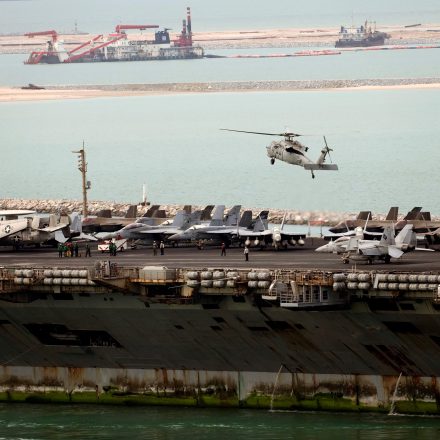
The naval base at Manama, one of America’s most important naval facilities and headquarters of the Navy’s Fifth Fleet, was destroyed by Iranian strikes. (Acting Navy Secretary Hung Cao admitted last month that Iran “blew the hell out of Bahrain.”) The loss of Manama led to supply shortages and poor morale aboard the USS Lincoln and other ships patrolling the Strait of Hormuz, bedeviling Secretary of Defense Pete Hegseth.
The CIA offices at the U.S. Embassy in Riyadh were annihilated. Iran struck al-Udeid’s evacuated Combined Air Operations Center in Qatar, from which the Pentagon had directed its strikes on enemies as diverse as the Taliban and ISIL over recent decades, and rendered this facility inoperable. All U.S. troops were also withdrawn from Iraq, a process accelerated by the inability of U.S. missile interceptors to protect them from attacks by Iran and allied Shiite militias there.
Iran’s deployment of swarms of Shahed drones caused the United States and Israel to use up much of their stock of interceptors, which are time-consuming and expensive to replace. A basic Shahed costs as little as $20,000, though new hardened versions are more expensive — whereas a Patriot interceptor costs $4 million. One reason the Trump administration may be reluctant to intervene in Yemen is that if the U.S. cannot fly missions from al-Udeid, and cannot be sure any new fighter-jet fleets stationed in the region will be safe from Iran, given the paucity of interceptors, the Pentagon will have a limited ability to rescue any U.S. pilots shot down over Yemen.
America’s Profound Weakness in the Middle East
Saudi Arabia launched a war against the ascendant Ansarullah in 2015 when the latter staged a coup in the capital of Sanaa. The Ansarullah movement is rooted in Yemen’s Zaidi Shiism, though it is more radical than traditional Zaidism. (Zaidi Shiism differs substantially from Iranian Shiism, having no ayatollahs and having relatively good relations with Sunnis.)
About a third of Yemenis are Zaidis, who predominate in the north of the country, and many have long resented the dominance of their politics and culture by neighboring, oil-rich, Sunni Saudi Arabia, whose official ideology is hard-line Wahhabism, a puritanical form of Islam that insists on a literal interpretation of the Quran. Wahhabi proselytizing among the Shia enraged the Houthi clan and their followers began rebelling against the government of military dictator Ali Abdullah Saleh in 2004. But when he was deposed by popular demonstrations during the Arab Spring in 2012, Saleh gradually allied with the Houthis, and by 2015 about half the Yemeni military rallied to their side, along with some major Sunni tribes.
In response to the Houthis’ rise, a Saudi-led coalition that included the United Arab Emirates began bombing Yemen in 2015. Until 2022, the U.S, then militarily dominant in the region, provided the Saudis with strategic advice, weaponry, and in-air refueling for their fighter jets in the Yemen war, though Riyadh’s tendency to bomb civilian infrastructure rather than confining themselves to military targets caused tension between the two allies. While the Saudis and their coalition pushed the Houthis out of much of the south of the country, including Aden, they were unable to dislodge them from the north. The Saudis implicitly acknowledged their failure with a United Nations-brokered truce in April 2022, which largely held until this past summer.
The Forever Wars Effect
America’s forever wars against Middle Eastern countries that decline to accept the Israel project or American corporate neocolonialism helped reignite the Saudi–Yemeni conflict. Iran is the last major state in the region that rejects Israel and is off-limits to U.S. corporate investment, a stance that inspires much of Washington’s animus. Netanyahu was therefore easily able to persuade Trump, as a privileged visitor to the White House Situation Room, to attack Iran in February.
The glib expectation of Netanyahu and of his Mossad chief at that time, David Barnea, that the Islamic Republic would crumble if Israel murdered Ayatollah Ali Khamenei and around 50 other high-ranking regime figures proved wishful thinking. The notion that Iran was vulnerable to a tightened petroleum blockade was turned on its head by the hard-liners who ascended to power after Khamenei’s death. Largely veterans of the grueling eight-year Iran–Iraq War of the 1980s, the country’s new leaders pursued a policy of “de-basing” toward the United States, taking out its main regional military facilities.
By successfully striking Saudi Arabia, Iran demonstrated that the kingdom’s ability to protect itself is imperfect and its infrastructure is vulnerable.
In addition, Iran launched precision strikes at the energy facilities of their Arab Gulf neighbors who had hosted those American bases. They struck Kuwait’s national petroleum company and its fields and refineries. They took out 17 percent of the production of Qatar’s Ras Laffan natural gas facility, even though Doha had good relations with Tehran and had mediated for Iran. Tehran also struck ships passing through the Strait of Hormuz, using missiles and drones, scaring the major shipping insurers into withdrawing their contracts. Few shipping magnates would risk cargoes worth billions of dollars without insurance.
Iran threw the world into an energy crisis reminiscent of the 1970s, which would have been even more devastating had China not released oil from its vast private and public petroleum reserves and cut its oil imports from 11.5 million barrels a day to under 9 million barrels a day, a move partially enabled by its turn to electric vehicles, which saved it 1.5 million barrels a day. High gasoline and diesel prices hurt Asia more than the United States, but prices rose globally. A third of the world’s helium, essential for cooling computer chips in the production process, comes from the Gulf, and that supply was also interrupted, increasing the price of electronics.
By successfully striking Saudi Arabia, Iran demonstrated that the kingdom’s ability to protect itself is imperfect and its infrastructure is vulnerable. By blockading the Strait of Hormuz in a way that the United States had difficulty undoing, Iran demonstrated the vulnerability of key world maritime arteries, something Ansarullah had already highlighted by striking at shipping in the Red Sea to protest the Gaza genocide.
Blockade for Blockade
When the Saudis bombed Sanaa’s airport in July 2026, Ansarullah’s leadership appears to have decided that Riyadh posed an ongoing existential danger to their state and sought to strangle the Yemeni economy, just as Israel had done to Gaza. Moreover, they sensed that the kingdom could be rolled back in the wake of the failure of the Israeli–U.S. war on Iran. Just as Iran had weakened the Gulf Arab states with its blockade of the Strait of Hormuz, the Houthis believed they could seriously degrade the Saudi economy by blocking Riyadh’s shipping through the Bab al-Mandab, “the Strait of Tears,” between the Red Sea and the Gulf of Aden.
Saudi exports through the Strait of Hormuz had fallen substantially. The kingdom did, however, have an escape valve: its East-West pipeline to Yanbu on the Red Sea. Ships loading at Yanbu then headed for Saudi Arabia’s major Asian markets through the Bab al-Mandab. If Ansarullah could make the tanker captains fearful of this transit, they could reduce Saudi Arabia’s income even further. The Houthi spokesperson, Muhammad Abd al-Salam, warned that the prohibition of Saudi shipping was only the first step in a tit-for-tat strategy of “blockade for blockade.” The idea wasn’t original. The Saudis and the U.S. had often attempted to blockade petroleum imports to northern Yemen during the seven-year Saudi–Yemeni War.
In the subsequent three months, Ansarullah deployed missiles and drones constructed from Iranian models by military engineers trained by the old nationalist government of Ali Abdullah Saleh, many of whom had joined the Ansarullah military, in what has been called a Yemeni “military industrial complex.”
Just as the kingdom’s interceptors had proven unable to prevent Iranian strikes on targets such as the CIA section of the U.S. Embassy in Riyadh, they sometimes failed to halt the barrage of Yemeni missiles and drones. Refineries and oil installations, even the headquarters of the state oil giant, Saudi Aramco, in Dhahran, were hit. In October, Ansarullah closed Riyadh’s International Airport, just as the Saudis had attempted to close that of Sanaa in July. Ansarullah also surged out of their mountain strongholds and made a major push to Yemen’s southwest coast, taking the strategic port of Mocha overlooking the Bab al-Mandab. They also moved on Taiz, an inland industrial city of nearly 1 million inhabitants, one of the last major population centers not already under their control, in a campaign that tested the ability of the small Saudi-backed government of Rashad al-Alimi in Aden to resist it.
Highlanders and Oil Sheikhs
Just as the Vietnam War was one conflict among many fought in the Third World during the Cold War between the U.S. and the Soviet Union, so the Saudi–Yemeni War of 2026 is part of the larger struggle between the U.S. and Israel and Iran. Still, just as Vietnam was more about Vietnamese anticolonialism, nationalism, and sovereignty than about Communism and the ownership of the means of production, so the Saudi–Yemeni War is about Yemeni autonomy more than it is about the loose Houthi alliance with Iran. The conflict is not primarily between Zaidism and Wahhabism, though religious tensions are part of the story, but is far more rooted in a struggle between desperately poor Yemeni highlanders and fabulously wealthy Saudi sheikhs.
The plutocratic Saudi ruling elite is closely tied to Washington and has secret dealings with the Israelis, with whom it shares a distrust of the poverty-stricken Palestinian resistance, and views Ansarullah as cat’s paws of Iran in the Arabian Peninsula and as radical republicans trying to overthrow the region’s oil monarchies in favor of populism. For its part, Ansarullah are Arab nationalists, anti-American, and seek to use oil resources for populist purposes. And they have been willing to attack Israel to defend the Palestinians of Gaza from genocide.
Last week, Ansarullah battered targets across Saudi Arabia, prompting a further pullback from the region by Washington. The Yemeni forces attacked King Fahd International Airport in Dammam. An Ansarullah spokesperson said the group also targeted the Saudi defense ministry in the capital, Riyadh, along with an Aramco site in Yanbu, and an airport in the southern city of Abha. Reports also emerged of an attack on another Aramco oil field.
“Houthis have increasingly engaged in hostilities against Saudi Arabia, including attacks on civilian airports and other critical infrastructure,” wrote State Department spokesperson Tommy Pigott in an October 21 post on X, after the wave of attacks, ordering “non-emergency U.S. government employees and their family members” out of Saudi Arabia.
It’s just the latest evidence of the most significant regional retreat by the U.S. in half a century and evidence of profound American military decline. The outcome of their war with the Saudis will not determine the issue of the U.S.–Israeli contest with Iran, but the very ability of Ansarullah to prosecute it points to the profound weakening of the American posture in the Middle East.
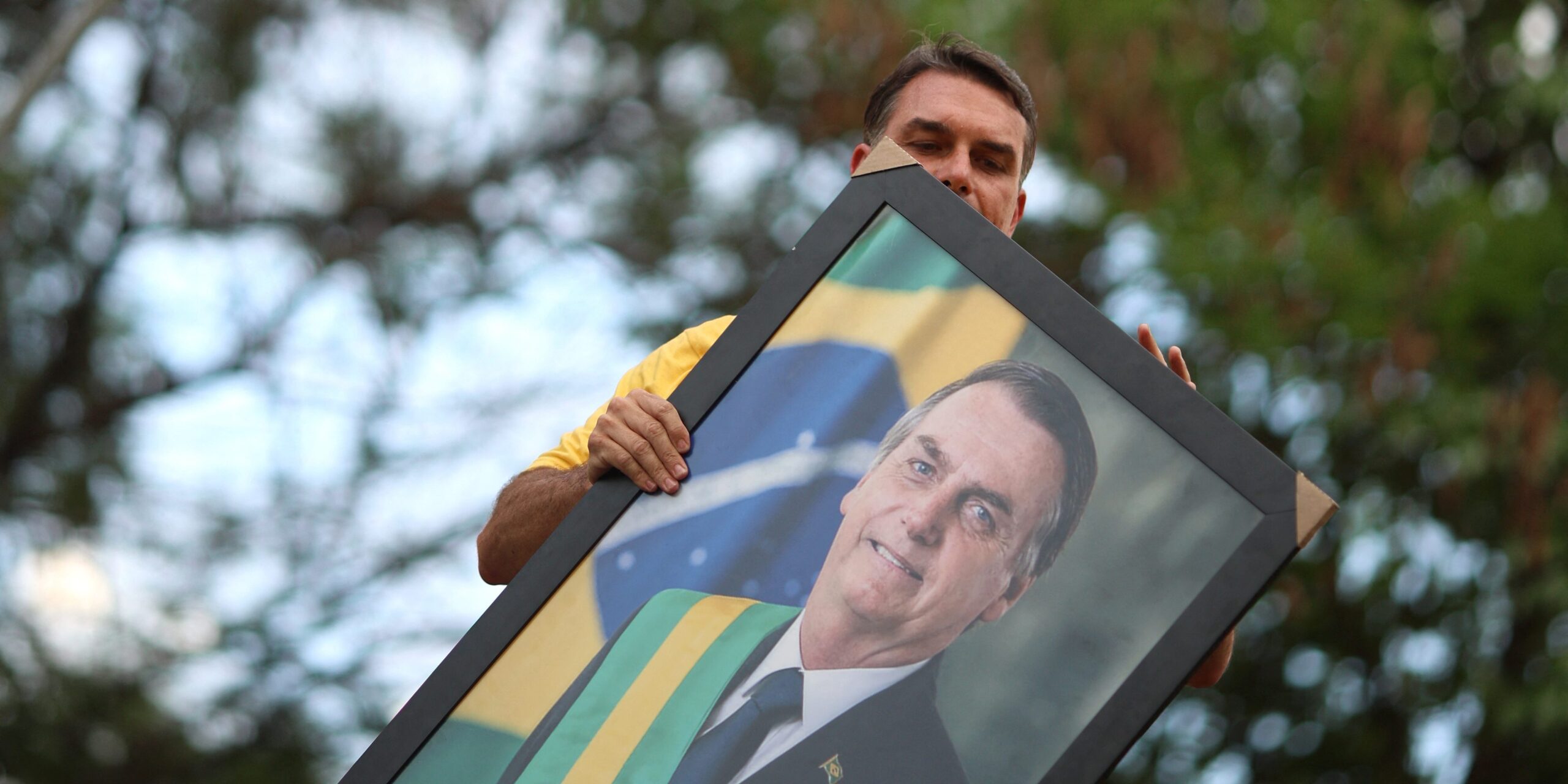
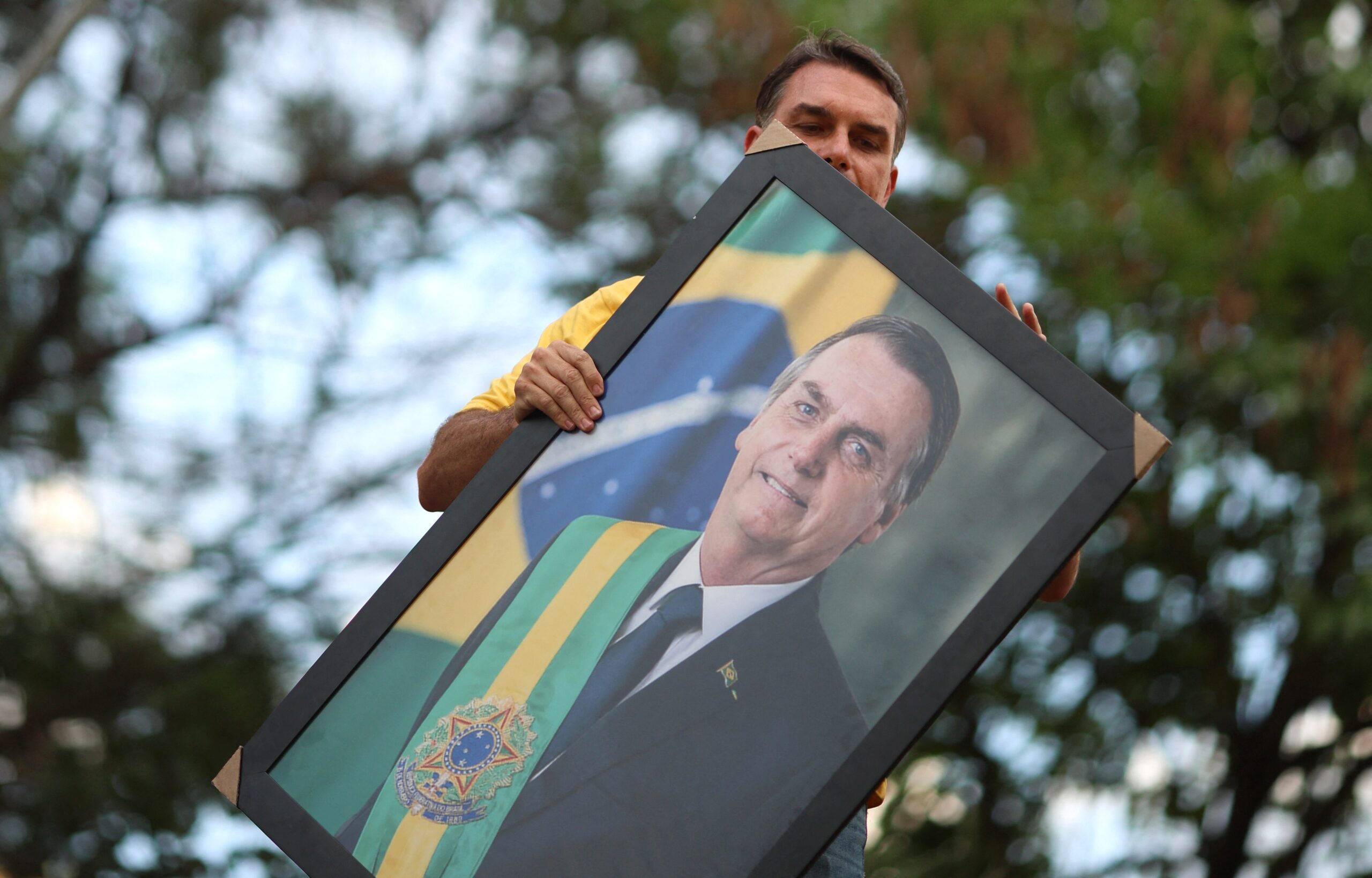
Brazilian right-wing presidential candidate Flávio Bolsonaro holds a picture of his father, convicted former President Jair Bolsonaro, during a motorcade with supporters in Goiania, Brazil, on Sept. 27, 2026.Photo: Sergio Lima/AFP via Getty Images
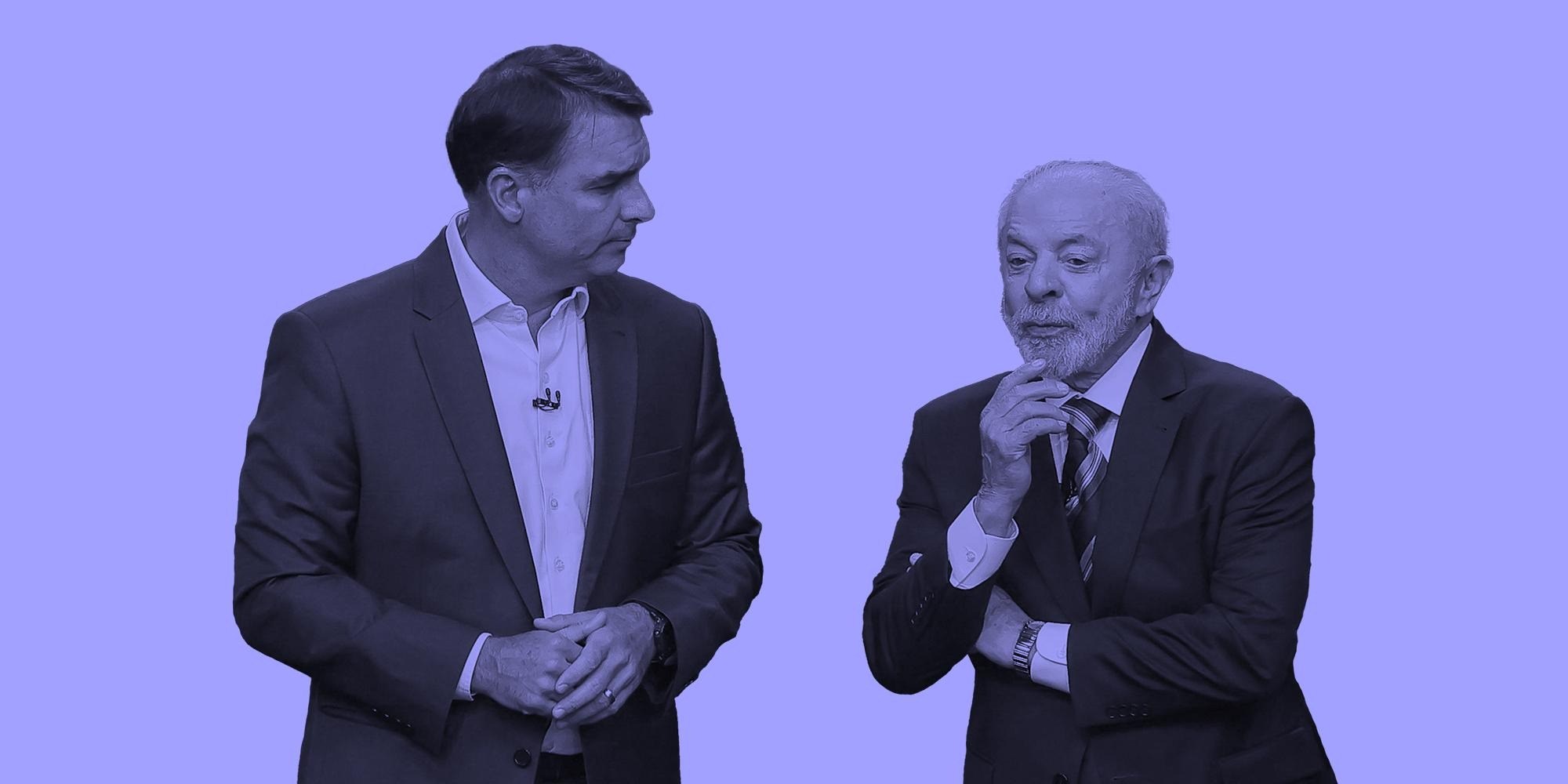
“I never thought about leaving the country,” Flávio Bolsonaro, a Brazilian senator and son of the deposed, disgraced leader, told his 16 million Instagram followers on Monday. It was the day after he lost the presidential election to President Luiz Inácio Lula da Silva by a margin of more than 4 million votes.
Flávio promised to stay in Brazil to “organize the opposition” during Lula’s next term.
“I’m the last obstacle to the Workers’ Party’s plan to destroy the country,” Flávio warned, referring to the party of Lula, who defeated his father four years earlier.
A few hours later, he left his mansion in Brasilia and sought asylum in the U.S. The Trump State Department told The Associated Press that it will grant him and his family visas.
The affinities become obvious when you watch Bolsonaro’s failsons end up in Trump’s America.
“I didn’t take sides, but it looked like another rigged election,” President Donald Trump told reporters on Monday, echoing Flávio’s election night talking points without providing any credible evidence that casts doubt on Lula’s come-from-behind victory — even as Flávio’s own party put out a statement acknowledging the results later that day.
It is no coincidence that the Trumps and the Bolsonaros are so fond of each other. Their modus operandi is nearly identical.
Both wrap themselves in the rhetoric of patriotism and moral righteousness, while treating their political offices as personal get-rich-quick schemes. And, when their lies finally catch up with them, you can be sure that they will jump ship to save themselves first and abandon their followers.
The affinities become obvious when you watch Bolsonaro, his failsons, and co-conspirators all end up in Trump’s America, where Flávio is about to join his brother, and in the denialism and violence that follow their failures.
Coups and Flight Risks
Flávio Bolsonaro’s election denial and hasty escape are his version of Trump’s infamous January 6 speech: Rile up the troops to do your dirty work and get the hell out of the way.
It’s not the first time a Bolsonaro ran this playbook. After Jair Bolsonaro became the first modern Brazilian president to lose a reelection bid, he refused to attend the January 2023 inauguration ceremony. Instead, he also fled to the U.S., staying in a Minions-themed children’s bedroom in the Orlando, Florida, home of retired UFC fighter José Aldo.
A week later, on January 8, the ex-president’s allies laid siege to the capital, Brasília, vandalizing Congress, the presidential palace, and the Supreme Court, as foot soldiers in a larger coup plotted to overthrow the Lula government. Nearly four decades of Brazilian democracy was only spared when key military leaders blinked before they could finish the job.
Jair Bolsonaro eventually returned to Brazil and was sentenced to 27 years in prison for leading the plot, which included a plan to assassinate Lula, Vice President Geraldo Alckmin, and Supreme Court Justice Alexandre de Moraes. Allies, including top military brass, were also convicted. Jair remains under house arrest — widely thought to be pinning his hopes for freedom on a Flávio presidency that wasn’t to be.
Flávio, however, will not be lonely in the States. His brother, former Brazilian Congress member Eduardo Bolsonaro, just received green cards for his family and is living in a $1.2 million McMansion in Southlake, Texas, in the Dallas-Fort Worth area, as we revealed in The Intercept Brasil earlier this year. Eduardo, who is a regular on the Trumpworld circuit, was sentenced in absentia to four years and two months in prison for lobbying the U.S. government to interfere in his father’s trial.
Flávio, too, seems poised to receive news of his own prison sentence while sitting on a couch in a Texas suburb. In May, our reporting at The Intercept Brasil put the first nail in the coffin of his presidential campaign when we published chat logs and audio recordings of the senator negotiating $24 million — and being wired $10 million — from disgraced billionaire banker Daniel Vorcaro, who is a sort of Brazilian cross between Charles Ponzi and Jeffrey Epstein.
The payments, wired to a U.S. account, were supposedly meant to finance “Dark Horse,” a biopic about Jair Bolsonaro starring Jim Caviezel. Brazilian Federal Police, though, have already poked holes in Flávio’s story as they investigate whether the money was actually used to bankroll Eduardo’s treasonous lobbying of the Trump administration to sanction Brazil and help his brother’s electoral chances.
Flávio is also being investigated for his alleged ties to a billion-dollar money-laundering scheme through an online betting company run by Willer Tomaz. The two are not only close friends but also business partners. Flávio even had unfettered access to one of Tomaz’s offshore bank accounts. You will not be surprised to learn that Tomaz left Brazil in August and is now living in Miami.
Police argued that, after losing the election, Flávio would pose a flight risk, especially in light of his closest associates’ recent actions. They asked the Brazilian Supreme Court to order Flávio to turn over his passport, which is permitted under Brazilian law. A top justice granted the request and, when the deadline passed, canceled the senator’s travel documents.
By then, Flávio was already on his way to the U.S.
During the Cold War, the Subic Bay Naval Base in the Philippines was a key enabler of U.S. military operations in the Pacific and beyond. It served as a critical support facility for the U.S. war in Vietnam and a transit point for U.S. weapons destined for American military personnel in the 1991 Persian Gulf War. That all changed in June of that year, when the Philippine Congress, under pressure from a grassroots anti-bases movement, refused to renew the lease for Subic Bay and other U.S. outposts in that nation.
After the closing of U.S. bases, military relations between the U.S. and the Philippines were conducted indirectly through arms transfers, joint training exercises, and deployments of Special Operations forces to aid Philippine counterinsurgency efforts, rather than by the permanent presence of tens of thousands of troops. The relationship was codified in 1999, when Washington and Manila entered into a Visiting Forces Agreement, which eased the movement of U.S. troops and equipment in and out of the Philippines and put U.S. personnel in the country under the jurisdiction of U.S. rather than Philippine authorities.
But now Subic Bay is back in play as part of a new expansion of the U.S. military presence in the Philippines. And this time around, private capital is financing these empire games.
Military Might Versus Human Rights
The long-standing U.S. military ties with the Philippines have come at a high price for the residents of that nation. Washington’s military and economic interests there have prompted it to look the other way as repressive leaders like Ferdinand Marcos and Rodrigo Duterte engaged in systematic human rights abuses against their own people.
To its credit, the Reagan administration eventually cut ties with Marcos — who was overthrown through peaceful protests known as the “People Power” revolt in 1986 — throwing its support behind his democratically elected opponent, Corazon Aquino. But there was no such shift with respect to Duterte, whose regime ruled the Philippines from 2016 to 2022, and engaged in extrajudicial killings of thousands of Filipinos, including journalists and land reform activists, all under the guise of a “war on drugs.” Duterte is now under indictment by the International Criminal Court, which has cited him for “the crimes against humanity of murder and attempted murder.”
While Marcos and his family fled the Philippines in the 1980s, his son — Ferdinand Marcos Jr. — returned and, in 2022, won the presidency in a landslide, in part by promising to continue some of the strongman policies introduced by Duterte. According to Human Rights Watch, since the younger Marcos took office:
Serious human rights violations have continued in the country largely unabated, including arbitrary arrests, extrajudicial killings and enforced disappearances by security forces. The murderous ‘war on drugs’ has continued, though with fewer killings. Leftist civil society activists, journalists, environmentalists, Indigenous leaders, trade unionists, and left-wing politicians remain under serious, at times deadly, threat.
During the Biden presidency, the U.S. expanded a 2014 pact — the Enhanced Defense Cooperation Agreement — which gave the U.S. military access to five major sites in the Philippines. In 2023, the number of bases was expanded to nine. The State Department has described the scope of the EDCA as authorizing “U.S. forces access to agreed locations in the Philippines on a rotational basis, for security cooperation exercises, joint and combined military training activities, and humanitarian assistance and disaster relief activities.” That official summary fails to admit the real reason for the signing of the EDCA: to give the U.S. access to territory that can be used in a future war with China.
The Privatization of Subic Bay
Building on his predecessor’s enhanced cooperation with the Philippines, President Donald Trump, who had been a staunch Duterte supporter, has pursued even tighter ties with Marcos’s government. This has been driven, in significant part, by the desire to use the Philippines as a platform for potential U.S. military interventions in the Pacific region and further economic penetration of Asia.
As part of the accelerating security partnership between the U.S. and the Philippines, military activities at Subic Bay have resumed. But this time, formal access has been secured by a private investment firm, Cerberus Capital Management, which controls the area through a 50-year lease granted through collaboration with a Philippine company, Agila.
A report by the New York Committee for Human Rights in the Philippines, a member of the International Coalition for Human Rights in the Philippines, summarized current activities at Subic Bay:
In mid-2025, the U.S. Congress approved a plan to build a forward operating base and ammunition production facility in Subic Bay. It is projected to be the world’s largest weapons hub. … The shipyard [is home to] HD Hyundai Heavy Industries, deep sea fiber optic data cables manufacturer Sub Com, defense contractor V2X and the Philippine Navy, which operates a portion of the facility.
Cerberus has strong ties to the Trump administration, first and foremost through its founder, Stephen Feinberg, who is deputy secretary of the Department of War, second in command at the Pentagon behind Pete Hegseth. In that role, Feinberg oversees the Pentagon’s Office of Strategic Capital, which makes loans to military tech companies, many of which are current or former Cerberus clients.
Feinberg “earned” his position the old-fashioned way — by giving millions to Rebuilding America Now, a super PAC devoted to supporting Trump, and hosting a $50,000-a-plate fundraiser, the proceeds of which also went to support candidate Trump in 2016.
Bloomberg News has identified four other former Cerberus executives now in key positions at the Pentagon: David Lorch, director of the OSC; George Kollitides, a special government employee who is simultaneously a director of D. Boral Acquisition, a company that brokers mergers and acquisitions in the weapons sector; and senior Pentagon advisers John Gallagher and Tom Rakusan.
On the other side of the revolving door, Cerberus has hired major Republican figures like former Treasury Secretary John Snow and former Vice President Dan Quayle, who serves as chair of the company’s global investment unit. Given these connections, the Pentagon is all-in behind Cerberus’s activities in the Philippines. But this has prompted a backlash. Activists in the Philippines and beyond are speaking out against the role of Cerberus, calling for public pension funds to withdraw their investments in the company for underwriting the militarization of the Philippines.
Another important avenue of increased cooperation between the U.S. and the Marcos government is the Philippines’ participation in Pax Silica, a U.S.-initiated cartel that the State Department describes as its “flagship effort on AI and supply chain security, advancing new economic security consensus among allies and trusted partners.” And by “supply chain security,” the declaration primarily means “reducing dependence on China” for critical minerals needed to feed and sustain the computing power now central to the Pentagon and the U.S. arms industry.
In addition to the Philippines, there are 24 other participants in Pax Silica, including two other key Asian partners, India and Japan, as well as Taiwan, which is an associate member of the cartel. Jacob Helberg, a former adviser to military tech giant Palantir who now serves as the State Department’s point person on Pax Silica, has stressed that the initiative goes well beyond just securing the supply of specific critical resources. “If the 20th century ran on oil and steel, the 21st century runs on [computing power] and the minerals that feed it,” he said. “This declaration [announcing Pax Silica] hails a new economic security consensus ensuring aligned partners build the AI ecosystem of tomorrow — from energy and critical minerals to high-end manufacturing models.”
The China Syndrome
Although it supplies many other benefits to U.S. corporations and America’s national security state, the enhanced effort to bring the Philippines more securely into the U.S. military, political and economic orbit is all rationalized as moves toward reining in China’s economic and military power and garnering Manila’s support in a possible war between China and the U.S.
The policy of economic warfare and aggressively preparing for a military conflict with China could not be more misguided. The oft-cited “need” to posture U.S. forces to do battle with China over Taiwan ignores the fact that there are diplomatic means of preventing such a conflict.
What is needed is a joint understanding on the status of Taiwan. For over 40 years, peace in the Taiwan Strait has been maintained through the U.S.–China agreement that Washington will not take steps toward recognizing Taiwan as an independent state and China would agree not to resolve the issue of Taiwan by force — the so-called “One China” policy. That agreement has been weakened by actions taken during both the Biden and Trump administrations. The simplest and best way for Washington and Beijing to avoid a war over Taiwan would be to revert to the “One China” policy.
Using trade wars and military buildups as the primary U.S. tool for influencing China simply will not work.
China does not pose a direct military threat to the United States. Its last major war was its invasion of Vietnam in 1979, a conflict in which its troops were badly beaten by battle-hardened Vietnamese forces. The U.S. also spends almost three times as much on its military as China does, and is far ahead of Beijing in numbers of advanced combat aircraft, naval firepower, and nuclear weapons.
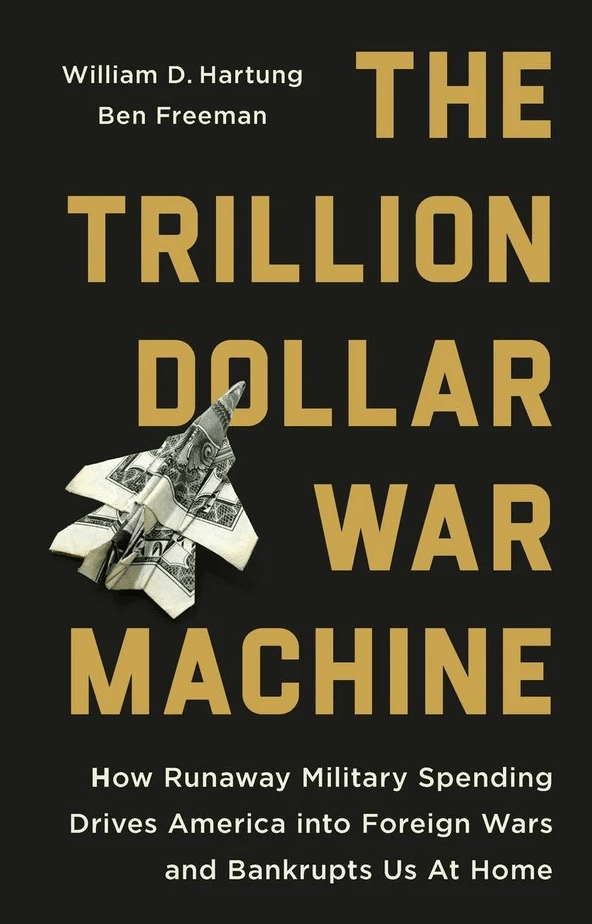
“The Trillion Dollar War Machine,” by William D. Hartung and Ben FreemanAvailable on Bookshop.org
In areas where China might be a peer competitor with the U.S. military, like AI-driven weapons, there need to be some rules of the road on how such systems can be used. Using trade wars and military buildups as the primary U.S. tool for influencing China simply will not work. The likely result of persisting in such an approach will be a dangerous arms race and an increased risk of outright war.
A more productive approach to U.S.–China relations would be to seriously explore cooperation on central issues like arms control, addressing the climate crisis, and stabilizing the global economy. There would still be a U.S. military strategy for the Asia–Pacific region, but it should be genuinely defensive in nature, a posture that could save hundreds of billions of dollars in the years to come.
Pursuing a more balanced policy toward China would open the way to developing more equal, less exploitative relations with the Philippines and other nations in the Pacific, and it would allow Washington to finally take a genuine interest in promoting human rights and opposing repression as central pillars of U.S. international relations.
At a time when armed conflict and threats of war are the bedrock of U.S. policy, from the Western Hemisphere to the Middle East, a shift toward diplomacy seems daunting. But it is the only way forward if we want to move toward a more peaceful world where no one nation or group of nations dominates, and where corporations aren’t bending foreign and domestic policies to their will.
Brazilians will head to the polls on Sunday in one of the most consequential presidential elections of the last decade. The run-off election will determine the future of the largest democracy in Latin America and the fate of the Amazon rainforest.
Incumbent President Luiz Inácio Lula da Silva is facing off against Flávio Bolsonaro, the son of former President Jair Bolsonaro. The elder Bolsonaro is currently on house arrest for his role in a failed 2023 military coup that intended to assassinate Lula, his vice president, and a Supreme Court justice. Despite his father’s attempted coup, Flavio Bolsonaro is currently the frontrunner, after coming out slightly ahead in the first round of voting.
“If they don’t win this election, then not only is Jair going to stay in jail, most likely, but Eduardo, Flávio’s brother and Jair’s son, who is in self-exile in the U.S., he has a multiyear prison sentence for his actions in the U.S. lobbying against Brazil’s foreign interests. He’s not going to be able to go home if they lose this election,” says Andrew Fishman, a Rio de Janeiro-based investigative journalist. “So they’re really just willing to do whatever they can to make sure that they win because this is their only get-out-of-jail-free card.”
Sound familiar? This week on The Intercept Briefing, host Jessica Washington speaks with Fishman, president and co-founder of The Intercept Brasil, about what’s at stake for Brazil and the planet in Sunday’s election.
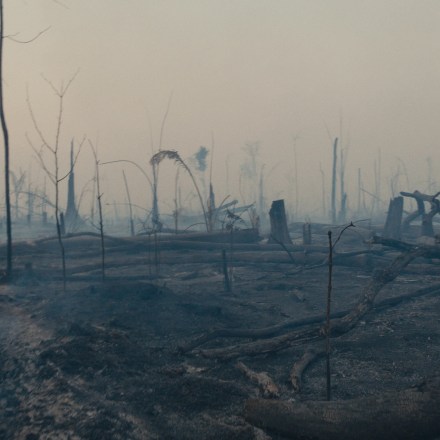
“It’s a global election. The voters in Brazil will be deciding the future of humanity,” Fishman tells The Intercept. Jair Bolsonaro oversaw significant deforestation of the Amazon rainforest, leaving the ecological and climate linchpin in danger of becoming a “savanna.” Now, he argues, his son can finish the job. “You’re going to have an international migration crisis,” says Fishman. “It’s really self-defeating because the cattle ranchers are his base. They are the ones that are wanting to do the things that will end their future profitability — the future existence of their business.”
President Donald Trump has taken a particular interest in the race, as he seeks to expand U.S. influence and control across the Western Hemisphere. “Brazil — as the biggest economy, the biggest country, the most powerful entity in the hemisphere besides the United States — if Brazil falls, then the rest falls in line,” says Fishman. “But if Brazil remains as this big island of resistance in the middle of the continent, it really messes up [the Trump administration’s] plans, doesn’t it?”
Big Tech is also looming large over the race. “There’s all these pieces of circumstantial evidence that suggest that Meta is interfering in this election, and they have every incentive to do so. They will have a much better regulatory environment if Flávio wins because of Flávio’s submissiveness to U.S. interests and his willingness to play ball with whatever Trump tells him to,” adds Fishman.
In a request for comment, Meta said, “Meta applies the same rules to every candidate, every party and every political viewpoint in Brazil, as we do in elections around the world. We do not suppress content to disadvantage one side, and we do not give preferential treatment to any side. Each of the incidents cited by Lula’s campaign has a straightforward, documented explanation. … Brazilian voters deserve facts, not a political narrative built by combining unrelated technical issues. Meta will continue to enforce its rules, comply with Brazilian electoral law, fix mistakes when they occur and provide a level playing field for everyone who uses our services.”
As U.S. leaders attempt to mold Brazil into a satellite state, Fishman argues the United States is slowly becoming more and more like its southern neighbor.
“It’s not that Brazil is becoming more like the United States, it’s that the United States is becoming more like Brazil,” says Fishman. “You have just shrinking spheres of democracy while oligarchs have increasing power and control and are able to do what they want and insist on decisions for the country that are bad for all of the society and the people, but good for their individual interests.”
For more, listen to the full conversation of The Intercept Briefing on Apple Podcasts, Spotify, YouTube, or wherever you listen to podcasts.
Transcript
Jessica Washington: Welcome to The Intercept Briefing, I’m Jessica Washington, politics reporter at The Intercept.
Akela Lacy: I’m Akela Lacy, senior politics reporter at The Intercept. Jessie, what do our listeners need to know about this week?
JW: I’ve been following a pretty disturbing story that’s actually centered on a campaign ad. Ohio gubernatorial candidate Vivek Ramaswamy released what I would argue is the ugliest campaign ad of a dark season. That is, of course, a season of campaign ads filled with Islamophobic, transphobic, sexist rhetoric, and racist rhetoric as well. But in the ad, the mother of Democratic candidate Amy Acton accuses her daughter of being a liar, claiming “she’s lied her whole life.”
Now, what makes this really dark is that Acton was removed from her mother’s care at 12 years old, after she alleges she was raped by her mother’s then-40-year-old husband.
AL: That’s horrible. Has Acton responded?
JW: Acton responded to the attack ad saying, “My brother Phil and I endured abuse, hunger, and neglect. We were often kept in a dark basement, were frequent-fliers with child protective services, and lived in fear of our birth mother’s violent and erratic temper. I’ve always known that she was deeply sick and unwell, and it’s sad to see Vivek Ramaswamy exploit her all for his own political gain.”
This is one, as I’ve said, of the darkest campaign ads in a really horrifying season of campaign ads.
Akela, I know you’ve been tracking another big election story this week on a beat you’ve covered for a really long time, and that’s [American Israel Public Affairs Committee].
AL: So we have been covering extensively the way that AIPAC’s strategy has changed over the last few election cycles since they started spending directly on campaigns.
If you’ve been following our reporting, you know that we’ve written a lot about both their super PAC, United Democracy Project, and this shell PAC strategy where there were a number of different groups that popped up throughout the midterm season, took money from AIPAC, spent against candidates that AIPAC didn’t like, and then — per filings that came out this week — shut down and gave all their money back to AIPAC.
So the idea being that, they had been trying to shield what was an increasingly toxic reputation amid the ongoing genocide in Gaza from creating backlash against their activity in these races.
Jewish Insider scooped on Wednesday that AIPAC announced that it will no longer endorse candidates or give PAC contributions through its AIPAC PAC. Now, this doesn’t mean that they will stop spending on elections. Their super PAC, United Democracy Project, will continue to spend, as it has been pouring record amounts of money into various races. But this is getting a lot of attention, both from the left and I would say from the center.
The left, Justice Democrats in particular, and candidates who are no longer in Congress, but I saw Jamaal Bowman talking about this, saying that this is the culmination of the fight that the left has been putting up against AIPAC in elections. I don’t know that I would categorize this as a win necessarily, considering that the super PAC seems like it’s going to continue to spend a lot of money. But that was the big news in my campaign finance world this week.
JW: You’ve done a lot of really interesting coverage of how AIPAC is moving their money around through these different PACs and trying to get around the fact that people really dislike AIPAC, and that it has really tarnished the reputation of candidates who take this money. Obviously, this is a maneuver to get rid of the reputational harm of AIPAC money while still giving people AIPAC money.
I’ve actually been tracking a story completely off our election cycle, and that’s what’s going on in France. I know we touched on that a couple weeks ago but, really, these protests have taken on another life.
For those who don’t know, in France, there were these protests that were initially launched by students primarily in the suburbs concerned about educational inequality. This meant staffing shortages and poor facilities. But it has exploded into a nationwide uprising about the cost of living and broader economic inequality.
Now, perhaps unsurprisingly, and not to bring it too quickly back to the U.S., but President Donald Trump has used this as an opportunity to rail against immigrants. So despite the fact that there is zero indication any of the violence has been spurred on by immigrants. At a campaign rally on Monday, he told the crowd, “If Europe doesn’t close its borders and bring the criminals out, like the people that are protesting, Europe is finished.”
So yeah, that’s just one other example of how Donald Trump has inserted himself into international politics.
AL: Trump has also inserted himself into politics in a different region in the world. We have the Brazilian elections for president heading to a runoff this week. I know you spoke, Jessie, to Andrew Fishman, an investigative reporter and president and co-founder of The Intercept Brasil, about those elections.
JW: It’s a really interesting election with a ton of parallels to the political situation in the United States, as well as, as you’ve pointed out, a ton of influence from the United States. On Sunday, Brazil will have a run-off presidential election that will determine the future of not only Latin America’s largest democracy, but also — and this is really important — the fate of the Amazon rainforest, and one could argue, the planet.
This is the first presidential election since former Brazilian President Jair Bolsonaro was imprisoned on house arrest in an attempted military coup, a sentence that his son, the current frontrunner, Flávio Bolsonaro has promised to overturn.
I talked to Andrew about the media landscape, the history of military leadership, and the outside influences that have made this a tight race, despite the fact that the perceived frontrunner is running on freeing the man who attempted a coup years prior.
President Luiz Inácio Lula de Silva is running for reelection. He’s accused both President Donald Trump and Meta of attempting to sway the election in favor of Flávio Bolsonaro.
The Intercept reached out to Meta for comment, and Meta denied interfering in the election process, saying they do not suppress content to disadvantage one side or give preferential treatment to the other.
But this is a really interesting conversation with Andrew, and I’m excited for people to get to hear it.
AL: As am I. Let’s hear it.
JW: Andrew, welcome to The Intercept Briefing.
Andrew Fishman: Hi, thanks for having me.
JW: On Sunday, Brazilians will head to the polls in a runoff presidential election between right-wing senator Flávio Bolsonaro, son of former President Jair Bolsonaro, and incumbent left-wing President Luiz Inácio Lula da Silva to determine the leadership of Latin America’s largest democracy and biggest economy.
Now, this is the first presidential election since former President Jair Bolsonaro’s supporters stormed the Capitol in 2023 and attempted to overturn the election results. Now, Flávio Bolsonaro, his son and ally, is widely considered to be the frontrunner after coming out slightly ahead in the first round of voting.
But as of Tuesday, his lead in the polls has been narrowing. Andrew, big picture, what are the major issues at play in this election on Sunday?
AF: If you want to be really direct about it, it’s the future of humanity.
You have one candidate who’s been responsible for record reductions of deforestation in the Amazon; and you have another one who’s saying, let’s chop it all down, and farmers should be able to do whatever they want on their land.
And under his father’s leadership, deforestation in the Amazon soared, as in the other regions in the area. Scientists think that there’s a major tipping point that we could be on the cusp of, that if we were to reach that, the Amazon will turn into a savanna. There would be no going back from that.
If that were to happen, all of the rain in South America comes from the Amazon, basically. [That would affect] the cattle ranching that’s doing the deforestation, no more of the soy that’s doing the deforestation — people would have trouble feeding themselves. São Paulo would probably run out of water, which it has done in the past.
It’s very precarious. So you would be having mass refugee influxes, migrations. I really do think that this election is on that scale; it’s a global election. The voters in Brazil will be deciding the future of humanity, very possibly.
JW: To your point, his father, former President Jair Bolsonaro’s administration oversaw significant deforestation of the rainforest, which houses 10 percent of all [known] species on Earth, and his son appears to be moving in that same direction.
Flávio told reporters in August that he did not believe in climate change and that “the best way to address environmental issues is what we did during the Bolsonaro administration,” referring, of course, to the senior Bolsonaro’s administration.
What is at stake for climate change when we’re talking about this massive deforestation that could potentially be happening if Flávio wins?
AF: Every ecosystem in South America is interconnected and in the world. If the Amazon collapses and turns into savanna and the rainfall stops, and you have this massive drying out of the continent — which is one of the major exporters of food in the world — you’re going to have all of those issues locally, and that’s going to impact local markets and everything. You’re going to have an international migration crisis.
But on top of that, we have no idea what the ecological knock-on effects of that could be. With that, we could be having a more rapid increase in polar ice cap melting. With the temperatures increasing, it could be exacerbating the death of the Atlantic Meridional Overturning Current, which is the thing that would put Europe back into an ice age. It’s very possible that’s already happening right now.
We’re at this really tenuous moment for the climate, for the Earth, for humanity. And you have a candidate that says very proudly [he] doesn’t believe in any of that and wants to slash all mechanisms that are used to have more responsible management of land and prevent this massive catastrophe in just this proudly Luddite sort of way.
It’s really self-defeating because the cattle ranchers are his base. They are the ones that are wanting to do the things that will end their future profitability — the future existence of their business. It’s really self-defeating in this way for the Brazilians, and these very short-term benefits for massive long-term costs.
There’s estimates that the impact that the Amazon has for the global economy is in the hundreds of billions of dollars a year, and that benefit is far larger than the profits that they get out of these extractive industries that they do with farming and mining. It’s really hard to overstate the potential impacts that this could have.
JW: Is that urgency resonating with voters?
AF: Absolutely not. That is not what people are voting about, unfortunately. It’s what the people living in the heavy agricultural regions — where their local economy depends on that — they’re voting for Flávio for that reason. But the people who are voting against him, yes, there’s many people that care about the Amazon and want to preserve it, but it’s not the issue that’s being discussed day to day on TV, in the news, on the streets.
People are talking more about more human issues of corruption and who has better communication, security, economics. They’re not talking about the Amazon, unfortunately.
JW: That’s hardly surprising in the U.S. context, which I’m a little bit more acquainted with. Certainly climate, the environment, have never been top issues for voters, even if they’ve resonated more so with young people.
I did want to talk about another issue in the election, and that is the fate of Jair Bolsonaro. His son, Flávio Bolsonaro, has promised to free him. Jair Bolsonaro has been imprisoned on house arrest since 2025 for plotting a military coup. How is that particular campaign promise landing with the electorate in Brazil, and are you at all surprised by the public’s response?
AF: It’s very clear that for the Bolsonaros, this is an all-or-nothing for them. If they don’t win this election, then not only is Jair going to stay in jail, most likely, but Eduardo, Flávio’s brother and Jair’s son, who is in self-exile in the U.S., he has a multiyear prison sentence for his actions in the U.S. lobbying against Brazil’s foreign interests. He’s not going to be able to go home if they lose this election.
For them, it’s been very clear, and they’ve even said it in moments, that’s what this is about for them: their ability to get their father out of prison and to get themselves off the hook. Also, if you’re elected president, the investigations on things you did before you got elected, they go away.
“They’re really just willing to do whatever they can to make sure that they win, because this is their only get-out-of-jail-free card.”
So then Flávio’s off the hook, and he’s so wrapped up in so many different schemes and accusations and active investigations, some of which that we have revealed, including U.S. and abroad and offshore bank accounts and money laundering and potential connections to organized crime and militias. So they’re really just willing to do whatever they can to make sure that they win because this is their only get-out-of-jail-free card. To do that, they’re going to completely change the structure of the Supreme Court, and they’ll be able to put in a majority even without impeachment. They already have the Senate and the lower house of Congress.
They would control all of the executive branch. They have the majority of governorships that are in their coalition, and they run the local police. And the executive has control over the federal police and all the investigative and regulatory agencies. So they would have just absolute lockstep control over every branch of government federally and most of local government as well.
It would be a democratically elected coup.
JW: And voters, do they care about that? Do they care about the preservation of democracy? Is this ranking as a top election issue?
AF: It’s always double speak, right? Both sides say that they’re preserving democracy. The Bolsonaristas say that Lula and the Supreme Court are running a judicial dictatorship right now because they were getting censored and put in jail for actively plotting a coup, which included active planning to assassinate Lula after he was elected, his vice president after he was elected, and a member of the Supreme Court. So that’s what they’re [Jair Bolsonaro and military officials] in jail for. That’s why they were getting pushback, and they’re saying that having the pushback against that is a dictatorship.
In the meantime, you have the Lulistas who are saying that what the Bolsonaros want to do is a coup because they actively have said year after year, over and over again, “We want a coup. We love the military dictatorship. The military dictatorship was great! When we were torturing everybody, that was good.” Jair said, “When I’m elected, we’re going to take a machine gun and shoot down all of the leftists, the petistas, the Workers’ Party [Partido dos Trabalhadores] supporters.”
Remember that the military government was going alive and strong into the ’80s. It happened in ’64, and it went through the ’80s. So it’s very recent.
The people that are in his orbit, they were actually part of the military coup government until very recently. And I think that Lula supporters are very, very concerned about this. They really do care.
The Bolsonarista supporters, which are about 30 percent lockstep — same as it is in the U.S. with Trump — they’re just in their own information ecosystem, and they want Bolsonaro to win. It doesn’t matter, and anything that he does is good because it’s him.
“They’re just in their own information ecosystem, and they want Bolsonaro to win.”
It’s not, there are people that support the Workers’ Party, and there are people that support Bolsonaro. The Bolsonaro movement is essentially anti Workers’ Party, anti-petismo. The Bolsonaros have been seen as the greatest vehicle for getting rid of the Workers’ Party, which has been so hard to do because they’ve been so popular because of all the policies they’ve put into place over the years.
But you’ve had the media saying for 30 years now, just drilling it in, that the PT [Partido dos Trabalhadores] equals corruption, the PT invented corruption. The PT is everything that is bad in Brazil, and anything that is not the PT is everything that is good in Brazil. You’ve had a generation of this narrative being repeated over and over in all these different instances that it’s really hard to shake.
JW: Could you talk more about that legacy of military leadership in Brazil, and for Brazilians, how they feel about it on the day to day? I recognize that it’s a very large country, as we’ve mentioned multiple times. I assume not everyone feels the same way, but I am curious about that legacy and how people respond to it.
AF: Brazil has been a country of negotiated solutions. So when they were the last in the Western Hemisphere to abolish slavery in 1888, it was not some sort of civil war or uprising. It was a negotiation: “OK, I think it’s time that we do this, but let’s just make sure that everyone that did own slaves is in the best possible situation, and let’s make sure that we have some sort of semi-slavery going on afterwards.”
It was really the same thing with the dictatorship. It was a moment where the economy was going into the can. It was very unpopular. It wasn’t having the economic glory years of before, and so they said, “All right, we’ll step back. We’ll let you run some elections, but we’re going to make sure that we’re never held accountable, that we’re able to continue exercising power in the way we want.”
As part of that, they were able to help control the narrative. So during the military dictatorship, there was an impression — and it continues today — that there wasn’t corruption. The reason why they had that impression, it was actually very corrupt, very corrupt. But the impression exists because there was censorship of the media, so the corruption that existed just wasn’t exposed.
When the Lula government came into power the first time in the early 2000s, they started making the federal police stronger. They made the judiciary stronger and more independent. They increased the ability of the federal government to investigate and uphold the rule of law. As a result of that, many corruption schemes started coming out of the woodwork that were legacy of the military leadership.
“It was the business elite together with the military that did the coup and ran everything.”
It was called a civil military dictatorship, technically, in Brazil, because it was the business elite together with the military that did the coup and ran everything.
So that business elite didn’t change. It’s still the same families. They were running the same corruption schemes back then. They were running it through re-democratization. Whether it’s a right-wing government or a left-wing government in power, they’re making sure that their interests are being served. That corruption is just this constant throughline. People don’t really see that because that’s not how it’s presented in the media and in the day-to-day in communications.
I know for a fact that there’s lots of people that really want us to go back to the dictatorship. There are people that really want us to go back to the monarchy because they see it as a better, simpler time when things were the way that they should be. Everyone was in the right place and things were safer and everything was just better, this idealized past, “Make Brazil Great Again” sort of thing. How far back do you want to go?
Then there are the people that, like Dilma Rousseff, who was the successor to Lula after a second term — who fought against the dictatorship — that are currently active in politics, that are still around, and they were tortured. Their friends were murdered. They know exactly what a dictatorship means and what it means for people like them, anyone that stands against those entrenched powers of the old elites that go back for centuries.
That’s why you have a lot of older voters tend to vote PT [Workers’ Party] because they came up with the workers’ struggle with re-democratization. They understand what that means. It’s this interesting dynamic now where you have more younger people that are starting to tip more to the right because they don’t have this memory.
They don’t remember what it was like in the ’80s in the northeast when there was water shortages and food shortages, and the standard of living was so much lower. You have this new narrative being rewritten in real time online.
“You have more younger people that are starting to tip more to the right because they don’t have this memory.”
JW: The parallels to the United States and Brazil are just incredibly striking in what you’re saying. This kind of the “Make America Great Again” movement and the Make Brazil Great Again, even if they’re not using those exact same phrases. There are just so many points of similarity, especially with what we’ve seen with youth even in the United States, some of whom have taken a rightward tilt.
I want to get into the relationship between Brazil and the U.S. because that’s obviously been such a big issue in this election. In a Lula ad earlier this month, his campaign called Flávio Bolsonaro Trump’s candidate, arguing that, “What Trump wants is to colonize Brazil, take our riches, steal our future, and leave us in the dust.”
Now, this comes after President Lula confirmed that Brazil denied visas to two U.S. officials over election interference concerns. The State Department has denied any claims of election meddling, telling reporters, “Any insinuation of a ‘ploy’ to undermine a democratic nation’s election is a baseless lie.”
Andrew, is there any evidence that the Trump administration is attempting to sway this election? Does it veer into election interference as we generally understand it?
AF: The answer is oh God, yes. So much so it’s overwhelming. Overwhelming evidence, and it’s the same thing they’ve been doing across the region, which is why there’s been this rightward swing in elections across Latin America.
That’s why they’re so interested in Brazil right now because Brazil — as the biggest economy, the biggest country, the most powerful entity in the hemisphere besides the United States — if Brazil falls, then the rest falls in line.
But if Brazil remains as this big island of resistance in the middle of the continent, it really messes up their plans, doesn’t it? The interference has been done on many levels. The reality is that we don’t know the full extent of it, and we won’t know the full extent of it for years. We’re still learning about things that happened in 1964 with the U.S. role in the coup.
There’s dirty tricks happening that’s being run through intelligence agencies. That’s absolutely positive. There’s very, very strong signs that they’re using U.S. companies, Big Techs like Meta, who’s been getting a lot of attention — a lot of flak — lately because of clear signs that its algorithm is favoring Bolsonaro and suppressing Lula.
Multiple instances that they even admit happens, “Oh, but no, but it was just a mistake. It was just a mistake.” Meta and the Big Techs in the U.S., they’re really concerned about what a Lula government could do for their profits. Maybe Lula wants to have more sovereignty and control over what they’re doing.
The Brazilian government doesn’t even know how much money they make in Brazil, the Big Techs. They just know how much money they send out through the tax bills that they pay and the money they send out of the country. The Big Techs in the U.S. are really concerned about getting their access on rare earths and on lithium reserves, which Brazil has the largest deposits of rare earths after China. This whole trade war with China, Brazil becomes much more important. It’s a huge market.
So you have one candidate that is just completely submissive — like painfully, embarrassingly submissive — to U.S. interests. So much so that one of his former closest allies, a general, Santos Cruz, who’s a very famous well-known general, he came out recently and said, “I’m a conservative. I’m right-wing. This is not conservatism. This is not right wing. This is just ‘voluntary submissiveness.’”
“You have one candidate that is just completely submissive — like painfully, embarrassingly submissive — to U.S. interests.”
They’re just absolutely scamming Brazilians with this level of supplicancy that we’ve never seen before, that the military dictatorship even didn’t do, which was hand in glove with the U.S. interests. This is completely next level, and it’s something that obviously the left is very concerned about.
But people like Santos Cruz, Brazilians that actually believe in Brazilian sovereignty, and that it’s important for Brazil to be able to pursue its own interests rather than the interests of foreign powers — they’re very concerned about that, which is, some segments of the elite.
Whenever you have a submissive local government in an imperialist relationship, there are people that benefit. There are local people that will get special contracts, that will get special treatment. They’ll be able to crush their enemies through these relationships. And that’s what they’re doing in Bolivia and in Peru and in Ecuador right now.
“Whenever you have a submissive local government in an imperialist relationship, there are people that benefit.”
What they did in Venezuela, where they just came in and took all of the oil and said, “All right. We’re going to take 90 percent of the oil profits, and we’ll give you a couple billion a year.” People are seeing this in Brazil. They see what Trump has done. And they’re still saying, “Well, we like Bolsonaro, so we’re going with Bolsonaro. I’m sure it’ll be fine.”
It’s a massive issue, and I really, I don’t think we know how bad it will be and how submissive they’ll be this time around. Because it always is the case that, with right-wing authoritarian governments, it’s the second term where they really take off whatever mask was left and decide, “We have a mandate and we can do whatever we want.”
You saw it in the U.S. with Trump. They saw it in Turkey with Erdoğan. They saw it in Hungary with Orbán. They saw it in India with Modi. This is what always happens. It’s the second term where they say, “OK. We showed them who we are, and everyone said it’s fine.” They’re able to smoke out all of their rivals in the first term. They map them out, and so when the second time comes around, it’s just bang, bang, bang. Let’s get rid of them. Let’s maximize our power and do whatever we want.
“With right-wing authoritarian governments, it’s the second term where they really take off whatever mask was left. … It’s the second term where they say, ‘OK. We showed them who we are, and everyone said it’s fine.’”
The result’s not going to be positive for Brazil. That’s the thing: If I were a Brazilian billionaire — which I am not — it would be in my personal interest for Brazil to follow the economic path that the Lula government is following, much more than what Bolsonaro is proposing.
Lula’s not some left-wing radical. He’s center-right. He was left, then he became center-left, and he’s moving ever more to the right. This last election, his vice presidential candidate was his former presidential rival, the center-right guy. They’re very much doing what the big banks want. They’re helping the big agro get what they want. They give tons of subsidies to major industries. But the thing that they do, they take a little bit of that money, and they spread it around to the poorest people with public services with access to education, with some cash transfers. We’re talking about 60 bucks or 80 bucks a month to families, and that is what is making the economy grow. Because if you don’t have consumers in your economy, and you have domestic industries you’re trying to build, then no one’s going to buy the things. Your employees can’t buy the things.
That’s intolerable to some people in Brazil, and they can’t see that it benefits their own economic interests.
You’re in this kind of crazy situation where it doesn’t really make sense what they’re doing. And they saw it happen with Bolsonaro, with Jair! They all supported him, and then he crashed the economy. Then they all went back to Lula begrudgingly and said, “OK, we’re going to support you in ’22 because things aren’t going very well.”
Then Lula turned it around immediately, and now they’re forgetting again and going back to Bolsonaro. Logically, it doesn’t make sense. It’s more psychological. Freud has to explain what’s going on.
“Lula’s not some left-wing radical. He’s center-right. He was left, then he became center-left, and he’s moving ever more to the right.”
JW: Again, the parallels between the United States and Brazil are very apparent in terms of some of those economic choices. You’ve already gone over what the U.S. wants to gain from involvement in this election. But there’s another foreign power that’s also interested in the election. Flávio Bolsonaro has been cozying up to Israeli Prime Minister Benjamin Netanyahu, obviously in stark contrast to President Lula, who’s been an ardent supporter of the Palestinians. What would a Flávio Bolsonaro presidency look like for Brazil’s stance towards Israel?
AF: You can’t say that Lula has been the heroic savior, but he has made statements saying, “This is a genocide. This is very bad. This shouldn’t happen.”
At the same time, he’s allowed Petrobras to ship petroleum products to the Israeli government that are being used in the genocide. He’s allowed one of the major steel manufacturers to ship steel and ore to the Israeli weapons companies that are using it to build rifles and bombs to use in Gaza.
It’s not like you’re dealing with the leader of BDS [Boycott, Divestment and Sanctions movement] versus Netanyahu’s best friend. It’s a run-of-the-mill European-style center-left social democrat leader that’s kinda disappointing on this issue, versus someone that just wants to be absolutely submissive to everything that Israel wants and does and just completely supports it.
Again, you said, there’s so many parallels to the U.S. The parallels in Brazil, why does this make sense? Why would they care about supporting Israel? Why would this be something that they would want to put their name on, like these horrible scenes that people have been seeing for years online?
Everyone’s seeing it. Why would they want to support it? They kind of want to do the same thing in Brazil. One of the things that Jair always complains about is that he’s jealous of the U.S. because their cavalry was more effective at exterminating the Indigenous population than the Brazilian cavalry was. They’re upset that they have these relatively small numbers of Indigenous people that have claims to these massive swaths of land, much of which in the Amazon, that they want to get their hands on so they can cut down the trees and throw cows in and do mining. So a colonial–settler project that involves extermination of the Indigenous population to benefit their economy.
“They’re upset that they have these relatively small numbers of Indigenous people that have claims to these massive swaths of land, much of which in the Amazon, that they want to get their hands on.”
That’s what Israel’s doing, and that’s what they want to do in Brazil: “Why don’t you give me all the fun, fancy tools of espionage and surveillance and war and suppression that you guys have developed and honed in Israel for the last decades, and let me get my hands on them too so I can do the same thing back here.”
I think that’s one of the main reasons ideologically. Plus the whole political, evangelical right-wing movement, which was a concerted project by the CIA to implant in Latin America, bringing in prosperity gospel to get rid of the Catholic Church and all their support of left and workers movements.
This is all very well documented, that they brought it in because it’s more individualist ideology, and that individualist ideology also includes the idea that all the Jews need to go to Israel for the reckoning.
There are a ton of parallels between Brazil and the U.S., and that’s because almost all of the worst ideas in the United States have been intentionally exported to Brazil as a way to make Brazil a worse country that’s more in line with U.S. interests.
That includes healthcare companies. The U.S. model of healthcare. They have free, independent public healthcare in Brazil called SUS [Sistema Único de Saúde]. It’s an incredible system that’s very popular. They want to privatize it. They want to get rid of it to create more profit. Prosperity gospel with all this right-wing ideological movements, they love it.
“Almost all of the worst ideas in the United States have been intentionally exported to Brazil as a way to make Brazil a worse country that’s more in line with U.S. interests.”
The NRA sent lobbyists down in 2002 to Brazil to work with the right-wing movements to say, “This is the game plan for how you create a gun movement in Brazil.” And what happened? It manifests itself in the Jair Bolsonaro administration, where they just opened up the floodgates for access to guns, increasing the number of guns you have, the type of guns that you could have, the number of bullets you could have, and getting rid of anything that could help prevent organized crime from getting massive amounts of assault rifles and unmarked bullets they can use in crimes. Under Bolsonaro, that’s one of the things that spread more than ever.
There’s all these little levers that they’re really just doing copy and paste, and we’ve seen these alliances with JD Vance and the Rockbridge [Network], which is a group that he created before he was vice president with a bunch of Peter Thiel and other billionaires in the U.S. They’ve created a subsidiary in Korea and now one in Brazil that they were using to do the same sort of alignment with the local elites that they did before, in the lead-up to the ’64 coup. I can go on for hours about all the different connections and ties.
JW: To your point, you’ve talked about how this is much bigger than just Brazil.
To me, the “Donroe Doctrine” is hanging over all of this. Last November, President Donald Trump released what he described as a corollary to the 1823 Monroe Doctrine, the “Donroe Doctrine,” which effectively calls for the U.S. to take an aggressive interventionist stance in Latin America under the guise of protecting the United States’ national security and economic interests in the region.
Andrew, from your perspective, what more should we understand about what the United States is doing in Brazil and kind of the wider context of the Trump administration’s actions in Latin America over the last two years?
AF: It’s pretty simple. They are fighting the Cold War against China in Latin America, just like they used to do against the Soviets. As part of that war, they are aligning with far-right upstart leaders that are seen as anti-establishment, even though they’re usually tied to billionaires or even billionaires themselves, like in Ecuador.
There’s this weird coincidence with all of them that they almost all have connections to organized drug trafficking. They’re almost all known drug smugglers or connected to them or have some sort of financial relations. While they’re doing that, they’re arguing that “We are working together with these local governments in South and Latin America to fight drug trafficking,” which is obviously a farce.
That’s what they did in Ecuador. The president of Ecuador, Noboa, he’s the son of a banana dynasty that does a lot of exporting bananas, and in those crates of bananas, they’ve also been known to export a lot of kilos of cocaine. Their allies in Colombia have always been this way, and the things that they’re doing in Bolivia, it’s the exact same thing. The [Bolivian] attorney general who was trying to push back against the corruption of this right-wing government that has allied with Trump, well Trump and Rubio came in and said listen, you need to go after this attorney general and get rid of him. So he was arrested because he was going after their allies.
They don’t care about drug trafficking, obviously. The U.S. government never cared about drugs. It’s always been a weapon or a tool for them. So they’re aligning with these people to create this lockstep union that they’re calling the “Shield of the Americas.” It’s this new alliance that they’re using instead of the existing, the U.N. or other mechanisms. They’re creating all their own, just like they did with the “Board of Peace.” They’re working to make sure that those economies just stay in their sphere of influence just a little bit longer.
They know that China’s winning. China is the main trade partner with all of these countries now. They’re Brazil’s biggest trade partner. The United States cannot absorb all of the exports that Brazil produces that goes to China. They’re not going to get Brazil to stop trading with China or stop having relations with China. They compete on corn and ethanol and soy exports. They can’t absorb what China’s buying.
“They’re really just trying to buy a little bit more time as their empire is slowly waning, but at the cost of what?”
They’re really just trying to buy a little bit more time as their empire is slowly waning, but at the cost of what? At the cost of tens of thousands, hundreds of thousands, millions of lives? It’s not clear what the indirect results of this will be. At the cost of destroying the democratic institutions in these countries that are already, many of them struggling and teetering, and potentially at the cost of massive ecological devastation, as would be the case in the collapse of the Amazon under a Bolsonaro government?
It’s uplifting, right?
JW: Very uplifting. That is my first word that comes to mind. You’ve pointed out everything that Donald Trump is doing, but we also know that tech oligarchs are involved as well. Tech tycoons like Elon Musk and Peter Thiel have taken a massive interest in Latin American politics.
What impact do you think that is having on the rightward shift we’re seeing throughout the Americas?
AF: Oh, big time. Big time. I think the biggest tycoon that’s most in the news lately is Mark Zuckerberg. He’s the guy who runs Meta. Something like 99 percent of people in Brazil use WhatsApp as their primary form of communication.
The idea of sending a text message in Brazil is like, “What are you, some sort of barbarian? What decade is this?” People only use WhatsApp. And for a lot of people, you get a cheap phone, and you get a prepaid phone plan because they didn’t have net neutrality like it was passed in the U.S. It’ll come with free credits for WhatsApp and Facebook, and it’ll come preinstalled on the phone even, and it’s part of the plan.
So for a lot of people, Facebook for many years and WhatsApp were the internet. Now Instagram as well. Instagram is really the main tool of political communication at this point. As we know, [it is] highly censored. You guys saw recently at the No Kings protests what Meta can do if it just decides to suddenly have a technical error that they fail to fix for eight hours.
That’s what they’ve been doing in Brazil for months now. So you have a young right-wing member of Congress named Nikolas Ferreira. He comes from a right-wing evangelical church, and he’s very charismatic, and he’s really good on social media, and he’s got something like 22 million followers or something. Brazil has 214 million people.
When Lula was having this dispute a year or two ago with foreign tech interests, including Meta’s interests, Nikolas Ferreira planted this fake news that Lula was trying to tax the main financial instrument that people use called Pix. It’s this free instant cash transfers that you can do that’s created by the central bank, and everyone loves it. Trump hates it because it competes against Mastercard and Visa.
So [Ferreira] created this fake news that what Lula was trying to do was tax all transactions and so therefore you were just going to get taxed even more, and you, the poor working man, was going to get screwed. In reality, there was no tax involved, and it was an anti-money laundering initiative that any transactions over 1,000 reais [Editor’s note: 5,000 Brazilian reais] would be immediately reported so they can trace questions of money laundering, which is a huge problem in Brazil.
That video was seen, the last time I checked, over 300 million times in a country that has 214 million people, and not all of them are on Instagram. That’s just Instagram — not including the other social networks. And in the last few weeks of the election, Nikolas Ferreira’s account has had greater engagement and views than every global celebrity you can name. I don’t know the exact numbers off the top of my head, but three times more than Beyoncé. Just think of the most famous person that you can think of in the world and their account, and Nikolas Ferreira — who you hadn’t heard of until I said his name just now — is crushing them.
“Just think of the most famous person that you can think of in the world and their account, and Nikolas Ferreira — who you hadn’t heard of until I said his name just now — is crushing them.”
That’s being seen as probable algorithmic manipulation by Meta in favor of the right-wing movement. OK, that’s one example, we don’t have access to the algorithm, we can’t be sure about that. Well. if you go onto the Meta’s AI in WhatsApp, and you say, “Create me a political poster for Flávio, vote Flávio,” it’ll do vote Flávio, and they’ll use his election number, 22.
And you say, “Vote for a capybara, vote for a flamingo,” They’ll say, “Vote 22.” They’ll use Flávio’s number. And then if you say, “Do another poster, but say vote Lula,” it’ll say, “We can’t do that. That’s an election interference, and we’re not allowed to do that.” And say you just did it for Flávio,” and then the AI will be like, “Oh, you’re right. That’s a mistake.” But then it keeps happening, and it’s been happening for weeks now. People have been pointing it out for weeks.
They blocked Lula’s Meta account from being able to run paid ads like 10 days before the first round of the elections. They said, oh, that was a mistake. It was my bad. Lots of left-wing accounts have seen these weird number shifts.
So they’ll have, let’s say, 20,000 comments, but it’ll say zero shares, or the views will go down to zero, or people have been talking about, “My engagement just has been completely in the tank since this election has started.” Not everybody, but some people.
There’s all these pieces of circumstantial evidence that suggest that Meta is interfering in this election, and they have every incentive to do so. They will have a much better regulatory environment if Flávio wins because of Flávio’s submissiveness to U.S. interests and his willingness to play ball with whatever Trump tells him to.
So that’s just one case. That’s just Mark Zuckerberg.
JW: Cutting in here, from the future. After our conversation with Andrew. We requested comment from Meta who sent a lengthy response, but in summary, they said, “Each of the incidents cited by Lula’s campaign has a straightforward, documented explanation. … None reflects political targeting. None reflects manipulated distribution. None reflects an effort to influence the election.”
Meta said Lula’s campaign ad account was disabled for one hour by mistake, not for political reasons. The company also claimed that issues with ad creation and video view count were global errors, and not politically motivated.
On Monday, a Brazilian court gave Meta 24 hours to prove that it was not favoring Flávio Bolsonaro over President Lula in its feeds, or it would face an escalating fine. This comes after that same judge ruled that while he could not find evidence of deliberate interference, the company had 24 hours to prove that the issues affecting the Lula campaign were solved and would not reoccur.
OK, now back to Andrew.
AF:Elon’s coming down here. Peter Thiel was just down in Argentina to hang out with Javier Milei, who’s the president who’s been destroying the economy and businesses are shuttering, unemployment’s up, costs of living have gone through the roof, but he’s this anarcho-capitalist, hyper-libertarian that’s just been cutting everything with a literal chainsaw. He came on stage with a chainsaw saying, just like Elon Musk did, I’m going to cut through all the regulations and the red tape.
That’s what they want, and Flávio Bolsonaro said, I’m going to do that. I want to follow the Milei model. In the last debate that they had, the first debate, which was just the other night, Lula asked Flávio about this: Are you going to be Milei?
He was just sort of refusing to answer the question. Eventually OK, what model are you going to follow? [Lula] said, I’m going to follow the Lula model, the one that I’ve been doing that’s been working. What are you going to do? Answer the question. But, outside of that debate, [Flávio] had been saying that he loves Milei.
Milei gave him an official endorsement, just like Benjamin Netanyahu did an official endorsement for Flávio, which is something that doesn’t happen in international relations. Foreign leaders just as a matter of course don’t endorse a candidate in a foreign election. So they’re being very overt in this, and they’re all working together with their billionaire buddies who have controls over huge levers of power in Brazil because of how Big Techs work in the world.
That’s one of the main issues for leftist voters in Brazil right now. They want sovereignty for their country. They want Brazil to be able to govern Brazil under Brazilian law and have control over Brazil to serve Brazilian interests.
Flávio Bolsonaro does not care about that. Trump and Musk and Zuckerberg do not want that because it would be a limitation on their ability to exert power in Brazil and in the world. They don’t want it to be a model for the rest of the world.
“That’s one of the main issues for leftist voters in Brazil right now. They want sovereignty for their country.”
JW: Listening to everything you’re saying, obviously, we’re not going to fix the issue of tech oligarchs meddling in foreign elections by Sunday. But are there any final thoughts that you have just about this election?
AF: I would say that this election is so important and relevant for the United States and for the world. For many years, there’s been this concept called the Brazilification of the United States.
Brazil wants to become, or, people that vote for Flávio at least, they want Brazil to become the United States. They see the U.S. as the country where everything works, where everything is perfect and goes well, and they don’t see all the bad stuff that listeners and readers of The Intercept know all about far too well.
But in reality, it’s not that Brazil is becoming more like the United States, it’s that the United States is becoming more like Brazil.
The middle class is getting squeezed and disappearing. In Brazil, 90 percent of the country makes $1,200 or less a month. The middle class would be considered extremely poor by U.S. standards, and what it does exist of a U.S.-style middle class is just teeny-tiny. You have just shrinking spheres of democracy, while oligarchs have increasing power and control and are able to do what they want and insist on decisions for the country that are bad for the society, bad for all of the society and the people, but good for their individual interests.
It’s just this more polarized, divided, K-shape economies, what you guys call it in the U.S. That’s where things are going. So you should really pay attention to this Brazilian election because the things that are happening here and the things that are going to happen in the next few days are very likely to be happening in the United States in the near future, if they’re not already happening.
JW: The Brazilification of the United States is a really good way to put it. I think so often people in the U.S., and, I can include myself, we think about the impact that the United States has on other countries, but we rarely think about the mutual shared relationships and larger shared ideas that people have between countries, between continents. So I think that’s a really good point.
We’re going to have to leave it there, but Andrew, thank you so much for joining me on The Intercept Briefing. You can find more of Andrew Fishman’s reporting at The Intercept Brasil.
AF: Thank you. Keep up the good work.
JW: That does it for this episode.
We want to hear from you. Tell us what you’re following or want to see more coverage of. Email us at podcasts@theintercept.com or leave us a voice mail at 530-POD-CAST that’s 530-763-2278
This episode was produced by Laura Flynn. Jordan Uhl is our social media producer. Ben Muessig is our editor-in-chief. Maia Hibbett is our managing editor.
Nara Shin is our copy editor. William Stanton mixed our show. Legal review by David Bralow.
This show and our reporting at The Intercept do not exist without you. Your donation, no matter the amount, makes a real difference. Keep our investigations free and fearless at theintercept.com/join.
And if you haven’t already, please subscribe to The Intercept Briefing wherever you listen to podcasts. Do leave us a rating or a review, it helps other listeners find our reporting.