Tag: Cyber Threat Intelligence

  • Inside the Retail Fraud Underground: The Schemes Targeting Retailers Ahead of the Holiday Season

    As retailers prepare for the holiday shopping season, increased transaction volumes, promotional activity, and customer service demands create additional opportunities for fraud. Fraudsters exploit routine retail operations, including shipping, returns, and payment processing, while the seasonal surge in legitimate activity can make suspicious transactions more difficult to identify.

    Across illicit online communities, threat actors exchange refund fraud techniques, advertise access to compromised ecommerce sites, recruit participants for gift card schemes, and share methods for circumventing retailers’ loss prevention controls. Flashpoint analysts monitor these communities to understand how fraud schemes operate, how tactics are shared, and where retailers may face increased exposure. 

    Refund Fraud: Exploiting Retail Policies and Shipping Processes

    Fraudulent returns and refunds remain persistent challenges for retailers, with threat actors sharing methods designed to exploit delivery verification, return policies, and customer service procedures. In illicit communities monitored by Flashpoint, actors exchange advice on which retailers to target, which claims are most likely to succeed, and how to circumvent existing fraud prevention measures.

    Several recurring techniques appear in these discussions:

    • Did Not Arrive (DNA): Fraudsters falsely claim that a delivered package never arrived. A variation, known as Partial DNA (PDNA), involves claiming that only certain items within an order were missing.
    • Empty Box: Actors acknowledge receiving a shipment but claim that the package contained no merchandise. Discussions surrounding this method frequently address shipping weights and delivery records.
    • Wrong Item: Fraudsters claim to have received an incorrect or lower-value product, sometimes returning a substitute item while retaining the original purchase.
    • Double Dip: Actors seek a replacement shipment following an alleged delivery issue, then submit a subsequent refund claim.
    • Lost in Transit Return (LITR): Fraudsters claim that merchandise was returned but lost before reaching the retailer, complicating verification of the return.

    These methods vary in complexity, but many depend on creating uncertainty around what was shipped, delivered, or returned. Flashpoint has also observed discussions involving fraudulent tracking information, manipulated shipping labels, and individuals claiming access to shipping or courier operations.

    Some schemes extend beyond individual fraudsters. Illicit communities include advertisements for refund services and discussions of methods that can be applied against multiple retailers, demonstrating how knowledge of successful techniques circulates among participants.

    Customer Service as a Target for Social Engineering

    Retail customer service representatives are frequently targeted by fraudsters attempting to obtain refunds, replacement merchandise, or access to customer accounts. Flashpoint analysts regularly identify discussions describing ways to bypass verification procedures and persuade representatives to authorize transactions that would otherwise be rejected.

    These schemes often rely on familiar customer complaints, including missing deliveries, damaged products, and incorrect orders. Threat actors may combine these claims with additional social engineering techniques, such as expressing frustration, presenting sympathetic circumstances, or contacting support teams during periods of high demand.

    Another technique, known as account seasoning, involves establishing a history of seemingly legitimate activity before attempting fraud. Actors may browse merchandise, add products to shopping carts, or make small purchases to give an account the appearance of normal customer behavior.

    Flashpoint analysts have also identified accounts impersonating retailers’ customer service departments on social media. These accounts respond to customers seeking assistance with refunds and direct them toward external communication channels or payment applications, including WhatsApp and LemFi. Such impersonation creates opportunities to exploit customers already expecting contact from a retailer.

    Gift Card Fraud and the Monetization of Stolen Payment Data

    Gift cards remain an attractive target because they can be purchased using compromised payment information, transferred between individuals, and exchanged for merchandise or other forms of value.

    Flashpoint analysts have observed threat actors advertising gift card generators, balance checkers, and related services across illicit communities. Some schemes involve using stolen payment cards to purchase gift cards, while others focus on draining the balances of cards obtained through fraudulent means.

    These operations can involve multiple participants with distinct responsibilities. In some gift card fraud rings, individuals are recruited through social media platforms and messaging applications, including Telegram, WhatsApp, and WeChat, to obtain cards, purchase merchandise, or facilitate the conversion of stolen value into goods.

    Flashpoint has also documented activity involving the use of fraudulently obtained gift cards to purchase electronics and luxury merchandise. The availability of gift cards through peer-to-peer cryptocurrency exchanges creates additional potential avenues for transferring value, although the presence of gift cards on these platforms does not independently establish money laundering activity.

    With gift card purchasing and redemption activity expected to increase during the holiday season, retailers should pay particular attention to unusual purchasing patterns, rapid balance depletion, and transactions associated with suspected payment card fraud.

    Compromised Ecommerce Sites Create Additional Fraud Opportunities

    Beyond transaction-level fraud, threat actors also target the ecommerce infrastructure that retailers depend on to process orders and manage customer information.

    Across Flashpoint’s collections, analysts have observed advertisements offering access to compromised ecommerce websites, including sites operating on Shopify, Magento, and OpenCart. Depending on the access obtained, these listings may include administrative privileges, customer records, order histories, financial information, and the ability to modify website content.

    Some advertisements involve relatively small ecommerce businesses, including sites reportedly processing 200 or fewer orders per month. Others claim access to higher-volume stores. Although these advertisements do not consistently disclose how access was obtained, they illustrate the range of retail environments represented in underground access markets.

    Compromised ecommerce infrastructure can support several types of fraud. Access to customer information and order histories may facilitate targeted phishing or account abuse, while control over website functionality can create opportunities for payment card skimming and other malicious activity.

    Flashpoint has also observed tutorials and advertisements discussing the use of ecommerce platforms for carding, phishing, and fraudulent dropshipping operations. These findings demonstrate how compromised retail infrastructure can become a resource for subsequent fraud activity, extending the impact beyond the initial unauthorized access.

    Organized Retail Crime and the Resale of Stolen Merchandise

    Retail fraud also intersects with physical theft and organized resale operations. Flashpoint monitors online communities where individuals discuss shoplifting techniques, loss prevention procedures, and methods for reselling stolen merchandise.

    These discussions appear across platforms including Telegram, Discord, and online forums, where participants exchange information about retail security practices and merchandise targeted for theft. Electronics, clothing, cosmetics, and other easily resold products feature prominently in these conversations.

    Organized retail crime operations may involve individuals responsible for obtaining merchandise, intermediaries who purchase stolen goods, and participants who manage resale or distribution. Flashpoint analysts have observed advertisements seeking partners for fencing operations, as well as discussions about selling stolen merchandise through online marketplaces and classified advertising services.

    Insider access can also play a role. Across illicit communities, actors have claimed connections to retail employees, shipping personnel, or individuals with knowledge of loss prevention procedures. Although these claims are not always independently verifiable, they demonstrate the value fraudsters place on operational knowledge and access to retail systems.

    The overlap between physical theft, online resale, and fraudulent transactions creates challenges for organizations whose fraud prevention, cybersecurity, and loss prevention functions operate independently.

    Understand the Fraud Underground With Flashpoint

    Interested in learning more? Join Flashpoint Intelligence Analysts Jason Kimbrel and Ethan Alfery on November 4, 2026, at 2:00 PM ET for our upcoming webinar, Inside the Fraud Underground: What Retail and Financial Services Teams Need to Know. They’ll examine emerging fraud schemes, seasonal threats, and how primary-source intelligence can strengthen fraud investigations. Register for the webinar to save your seat.

    Flashpoint continuously monitors illicit communities and emerging fraud tactics, combining primary-source intelligence with analyst research to help organizations identify threats and investigate fraudulent activity. Request a demo to see how Flashpoint can help your team strengthen fraud detection and investigations.

    See Flashpoint in Action

    Source: Flashpoint · 2026-11-02

  • The Flashpoint Threat Intelligence Brief: Middle East

    The Flashpoint Threat Intelligence Brief: Middle East

    Blog

    The Flashpoint Threat Intelligence Brief: Middle East

    Flashpoint’s weekly analysis tracks shifting kinetic and cyber threat radiuses, geopolitical disruptions, and provides critical operational forecasts for the ongoing Middle East conflict.

    Default Author Image
    October 30, 2026

    Following Operation Epic Fury, regional kinetic operations have transitioned into direct, persistent threats against commercial shipping, energy infrastructure, and critical supply chains.

    The Flashpoint Threat Intelligence Brief: Middle East cuts through headline noise to deliver tactical, ground-level intelligence for government agencies, corporate security leads, and global logistics teams—turning Flashpoint’s primary source intelligence into proactive risk mitigation.

    Here are the updates from this week that your security operations team should be tracking.

    Operational SITREP: Executive Summary

    Between October 23 and October 29, Ansarallah (the Houthi movement) continued its campaign against Saudi aviation, military, and energy infrastructure. Houthi military spokesperson Yahya Saree claimed ballistic missile and drone strikes on King Khalid International Airport, Saudi Aramco facilities in Yanbu, crude oil pumping stations, and the Ras Tanura refinery. On October 27, the group also claimed to have struck Saudi Arabia’s Ministry of Defense headquarters in Riyadh and military transport aircraft at Abha airport along with King Khalid Air Base. Saudi authorities have not confirmed damage at several of these sites.

    Saudi-led coalition forces reported intercepting missiles and drones targeting Riyadh, Khamis Mushait, the Eastern Province, and other areas, including 10 ballistic missiles directed toward southern Saudi Arabia on October 25. King Khalid International Airport resumed international flights that day, although Ansarallah warned airlines that the airport remained a military target. Coalition air strikes continued in northern Yemen, with the Sanaa-based Health Ministry reporting eight fatalities following a strike on workers’ housing in Hamdan.

    Houthi ground operations also intensified around Taiz and Lahj, with reported advances along the Jabal Sabr front and an assault on Al-Maqatira Castle. On October 29, Yemeni government forces reported that Ansarallah fired two ballistic missiles at Aden International Airport, extending the threat to another major aviation facility.

    The United States ordered nonessential staff and families to depart its embassy in Riyadh and consulates in Jeddah and Dhahran following statements by Islamic Revolutionary Guard Corps (IRGC) officials identifying American diplomats as legitimate targets. Similar precautionary measures were reported at US missions elsewhere in the Middle East. US officials also cited intelligence indicating potential Iranian assassination planning against American diplomatic and government personnel.

    Iran continued operations against Kurdish opposition groups in Iraq, with the IRGC conducting a drone strike on a Komala facility near Erbil on October 24. Maritime incidents persisted near the Strait of Hormuz, including a UKMTO report of a vessel on fire north of Khasab, Oman on October 29. The IRGC Navy separately claimed to have electronically seized and landed a US drone west of the strait, although that claim remains unverified.

    In the cyber domain, researchers from TrendAI, Citizen Lab, and Confiant identified additional surveillance activity involving Israeli advertising technology firm Discover-Tech. The company reportedly bid on advertising traffic associated with Starlink users in more than 100 countries, enabling potential identification and geolocation of individuals in conflict-affected regions. Google and Comcast subsequently removed the firm from their advertising platforms.

    Kinetic & Maritime Risk

    The resumption of international flights at King Khalid International Airport does not eliminate the risk of further disruption. Ansarallah has continued to designate the airport as a military target, while missile interceptions have created additional hazards for surrounding communities. In Khamis Mushait and Ahad Rafidah, falling debris injured two people and damaged residential buildings and vehicles. Similar debris was reported across parts of western Saudi Arabia, including areas around Jeddah, Taif, and Rabigh.

    In Yemen, Houthi advances along the Jabal Sabr front have brought fighting closer to government-held positions overlooking Taiz, including areas near Taiz University. The expanding offensive threatens access routes around a city where the UN has warned that approximately 800,000 people urgently need humanitarian assistance. Continued operations in Lahj and attacks toward Aden add further uncertainty for transport and government facilities in southern Yemen.

    Western-linked personnel and facilities face increased exposure following Iranian threats against American diplomats. The US drawdown extends beyond Saudi Arabia, with similar precautionary measures reported at diplomatic missions in the UAE, Lebanon, Qatar, Jordan, Bahrain, and Kuwait. Iranian allegations that US aircraft are operating from Gulf states could also increase the risk of Tehran identifying host-nation military facilities as potential targets in a renewed confrontation.

    At sea, the reported incidents near Khasab and Iraq’s Al-Faw port highlight risks across both the Strait of Hormuz approaches and the northern Gulf. The reporting identifies 113 maritime attacks in and around the Strait of Hormuz since February 28, underscoring the sustained exposure of commercial vessels operating through the region.

    Cyber and Hybrid Risk

    The latest Discover-Tech findings raise particular concerns about the information exposed through real-time advertising auctions. Researchers found that the firm could use advertising bid requests to identify and geolocate Starlink users, with activity concentrated in countries affected by conflict or political instability. This creates potential surveillance exposure for personnel relying on satellite internet services in areas where other communications infrastructure may be limited or disrupted.

    The research also builds on earlier findings connecting Discover-Tech to the delivery of Candiru spyware through online advertisements. Although advertising-based tracking does not itself establish that a device was compromised, the ability to identify and locate specific users could support subsequent targeting. Google and Comcast’s removal of Discover-Tech from their advertising platforms represents a response to the reported activity.

    Separately, the IRGC Navy’s claimed electronic takeover of a US drone near the Strait of Hormuz remains unverified. If substantiated, the incident would indicate an electronic warfare capability relevant to unmanned aircraft operating near Iranian-controlled waters. Iran’s announcement of arrests involving alleged US- and Israel-linked intelligence cells also reflects its continued focus on identifying suspected foreign intelligence activity, although the alleged affiliations have not been independently established.

    Recommended Risk Posture and Protective Controls

    Organizations with personnel, facilities, or operations exposed to the conflict should maintain heightened awareness of physical security, travel, maritime, and surveillance risks.

    Cyber Defense

    • Limit advertising-based tracking: Organizations with personnel using Starlink or other satellite internet services in conflict zones should review network- and browser-level ad blocking, restrict advertising identifiers on managed devices, and assess exposure of location and device data through advertising systems.
    • Review counterintelligence exposure: Organizations with personnel or partners traveling to Iran should limit the sensitive information carried on devices, review communications practices, and reinforce check-in procedures in light of recent arrests of alleged foreign-linked cells.

    Physical and Operational Defense

    • Strengthen protections for US-linked personnel: Organizations supporting diplomatic missions or employing current and former US government officials should review travel, residence, and event security in response to reported Iranian threats.
    • Reassess Saudi Arabia travel and facility plans: Confirm flight status before travel, review shelter procedures, and account for the risks associated with missile interception debris, particularly in Riyadh, Jeddah, Dhahran, and southern Saudi Arabia.
    • Maintain heightened maritime security: Shipping operators should monitor UKMTO advisories, review transit risks near Khasab and Al-Faw, and reinforce crew readiness for fires and other onboard emergencies.
    • Review exposure near Erbil: Organizations operating in Iraq’s Kurdistan region should assess proximity to Iranian Kurdish opposition facilities and update shelter and personnel-accountability procedures following repeated IRGC strikes.

    Strategic Outlook: Operational Forecast

    Over the next 48–72 hours, Houthi forces are likely to sustain missile and drone attacks against Saudi aviation, energy, and military infrastructure while continuing operations around Taiz, Lahj, and Aden. The resumption of international flights at King Khalid International Airport does not eliminate the threat of renewed disruption, particularly given Ansarallah’s continued designation of the airport as a target. Saudi-led coalition strikes in northern Yemen are also likely to continue.

    The US diplomatic drawdown reflects heightened concern about threats to American personnel, while reported planning for additional US strikes against Iran introduces uncertainty ahead of the November 3 midterm elections. Iranian Foreign Minister Abbas Araghchi’s statements about continued diplomatic contacts suggest negotiations remain possible, although no breakthrough has been reported.

    Maritime incidents near the Strait of Hormuz and northern Gulf are likely to persist, with additional uncertainty surrounding the IRGC’s claims of electronic warfare operations against US aircraft. Iranian strikes against Kurdish opposition positions near Erbil may also continue, alongside further counterintelligence arrests and public accusations of foreign involvement.

    In the cyber domain, the latest Discover-Tech findings may prompt additional scrutiny of advertising-based surveillance and the exposure of satellite internet users in conflict-affected regions.

    Enhance Threat Intelligence Using Flashpoint

    As the conflict continues to affect military operations, commercial shipping, regional infrastructure, and digital communications, security teams need timely intelligence to assess emerging risks and protect their organizations.

    Flashpoint combines primary-source monitoring, open-source intelligence, and geospatial analysis to help organizations identify developing threats, assess operational exposure, and make informed security decisions.

    Request a demo to learn how Flashpoint supports physical security intelligence, threat monitoring, and operational risk assessment.

    Frequently Asked Questions (FAQs)

    What is the Flashpoint Physical Threat Intelligence Brief?

    The Flashpoint Physical Threat Intelligence Brief: Middle East is a recurring threat intelligence update that translates raw primary-source open-source intelligence (OSINT) and geospatial data into actionable physical security analysis. It focuses on kinetic conflict developments, standoff weapon capabilities, maritime corridor security, and critical infrastructure risks across the Middle East.

    How does Flashpoint gather physical security intelligence for the Middle East?

    Flashpoint Physical Security Intelligence (PSI) gathers data by combining global open-source intelligence (OSINT), geolocated social media signals, satellite imagery, and primary-source threat monitoring. The platform uses AI-driven natural language processing and geospatial mapping to track kinetic developments, weapon strike radiuses, and physical security threats in real time.

    See Flashpoint in Action

    Source: Flashpoint · 2026-10-30

  • DefenderKiller: How Vulnerable Drivers Are Being Abused to Disable Endpoint Security

    The abuse of legitimate, vulnerable drivers remains a persistent method of evading endpoint security controls. As EDR killer techniques become publicly available, researchers and threat actors alike are examining how weaknesses in driver access controls can be exploited to terminate protected security processes.

    An older Microsoft Defender driver, dating back to 2011, can still be loaded on the latest version of Windows 11 and abused to terminate security software. The technique, publicly demonstrated through an open-source proof of concept (POC) called DefenderKiller, exploits weaknesses in how the driver restricts access to its process termination functionality.

    Flashpoint analysts have identified 13 publicly available samples incorporating the DefenderKiller technique, including obfuscated variants that indicate modifications to the original POC.

    DefenderKiller Exploits a Legacy Microsoft Driver

    On June 29, 2026, security researcher Jehad Abudagga, also known as redteamfortress, published research demonstrating how an older Microsoft driver could be abused to terminate security software. The researcher subsequently released the DefenderKiller POC on GitHub. The technique targets KSLDriver.sys, version 1.1.0013.0, a driver associated with Microsoft’s malware protection infrastructure. Although its digital signature dates to 2011, the driver remains accepted by Windows’ driver verification mechanisms and can load into the kernel on the latest version of Windows 11.

    KSLDriver includes access controls intended to restrict which processes can communicate with it. When loaded, the driver retrieves an AllowedProcessName value from its service registry configuration and applies restrictions limiting access to SYSTEM and administrator accounts. When a user-mode process attempts to communicate with the driver, its process image path is compared against the configured registry value. If the values match, the driver accepts input/output control (IOCTL) requests.

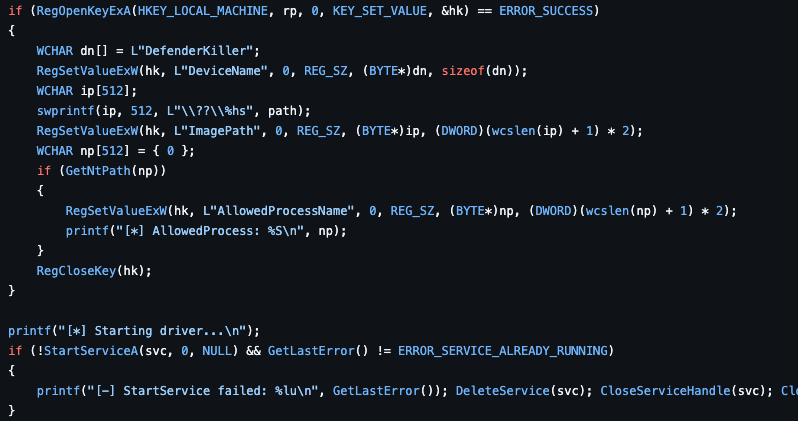
    DefenderKiller exploits this mechanism by configuring the driver’s service and authorized process path before starting the driver. Once authorized, the requesting process can invoke functionality that accepts a target process identifier (PID), obtains the corresponding kernel process object, and terminates the process using ZwTerminateProcess(). This allows a sufficiently privileged attacker to leverage the legitimate driver to terminate security processes.

    Source code of the user-mode application performing the registry bypass before starting the driver. (Source: Flashpoint)

    Following publication of the original POC, Flashpoint analysts identified 13 publicly available samples incorporating the DefenderKiller technique, including obfuscated versions. These findings indicate that the original code has been modified, although the available evidence does not establish whether the samples have been deployed in confirmed intrusions.

    Implications for Endpoint Security

    The findings illustrate how Bring Your Own Vulnerable Driver (BYOVD) techniques can exploit legitimate, digitally signed drivers to interfere with endpoint security. KSLDriver relies on process authorization checks that can be bypassed through manipulation of registry-controlled information, while remaining loadable on the latest version of Windows 11.

    Flashpoint analysts assess that advances in large language models may be contributing to growing interest in BYOVD research and EDR killer development by making user-mode and kernel-mode code development more accessible. Exploitation generally requires administrative privileges to create the services necessary to load these drivers, although attackers may obtain these privileges through local privilege escalation.

    Security teams should consider monitoring for unexpected kernel driver installations, changes to driver service configurations, and termination of security processes following driver loading. In particular, modifications to registry values such as AllowedProcessName and ImagePath may provide useful investigative context when correlated with suspicious service creation or driver activity.

    Indicators of Compromise and Technical Artifacts

    The following artifacts were identified during Flashpoint’s analysis and may support threat hunting and further investigation.

    Artifact Value
    DefenderKiller service DefenderKiller
    DefenderKiller service registry key HKLM\SYSTEM\CurrentControlSet\Services\DefenderKiller
    Microsoft driver KSLDriver.sys (1.1.0013.0)
    Microsoft driver SHA-256 d5764d24e78914ab2a9db6b24e323342d0b37998f43add1a9e49b00992b0d645

    The presence of these artifacts should be evaluated in context, as legitimate software may use some of these components.

    Stay Ahead of EDR Evasion Techniques With Flashpoint

    The discovery of vulnerable drivers beyond those targeted by publicly available EDR killers highlights the need for continued research into the techniques used to disable endpoint defenses. The public release of DefenderKiller, along with the emergence of modified variants, highlights the need for continued visibility into defense evasion techniques and the vulnerable drivers that enable them.

    Flashpoint continuously monitors emerging threats and adversary techniques, combining primary source intelligence with technical research to help organizations understand how threats are evolving. Request a demo to learn how Flashpoint can help your team identify emerging threats and strengthen its defenses.

    See Flashpoint in Action

    Source: Flashpoint · 2026-10-29

  • n0n Ransomware: Inside an AI-Assisted Extortion Operation

    n0n Ransomware: Inside an AI-Assisted Extortion Operation

    In September 2026, the SOCRadar Threat Research Unit (STRU) discovered an exposed staging server holding the live workspace of an operator tied to the n0n ransomware group. The open directory exposed the operation’s full September workflow: breach and exfiltration tooling, original locker source code, extortion infrastructure, and an AI coding agent environment backed by more than $7,000 in paid LLM API usage.

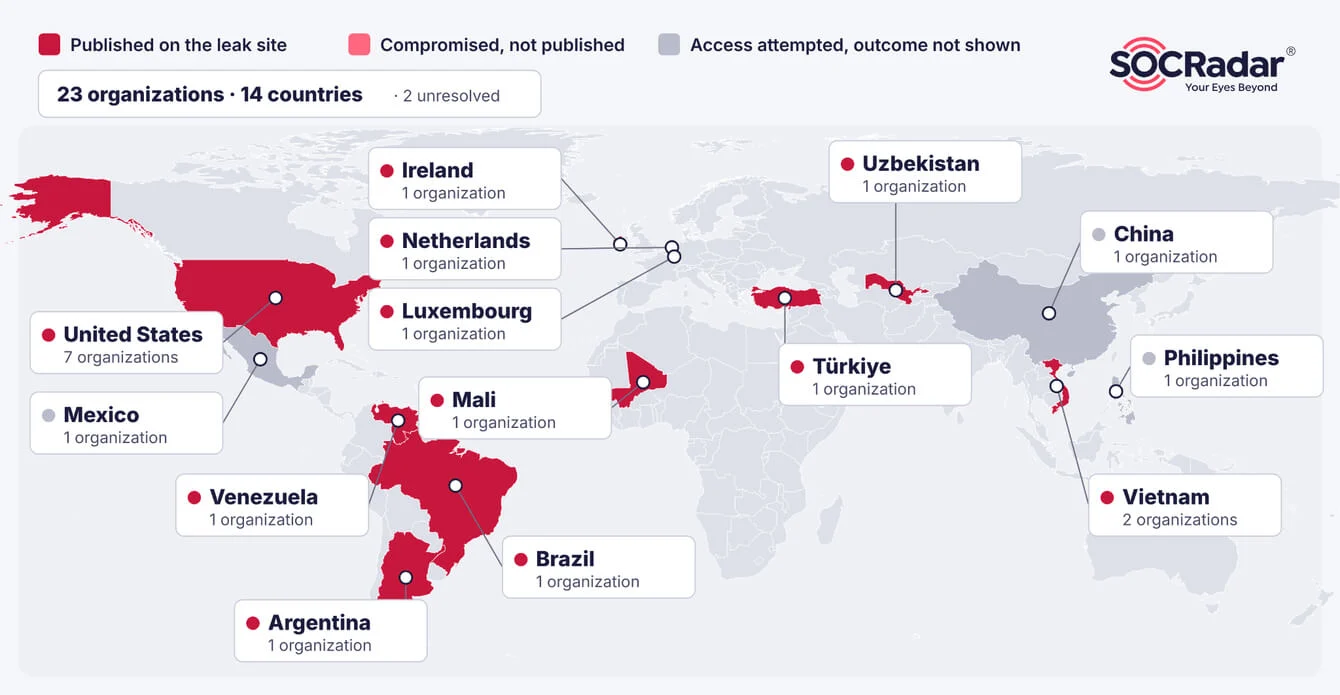
    The findings implicate at least 23 organizations across 14 countries, including a US sports retailer, a cloud provider, a teachers’ union, a Venezuelan ISP, an Argentine ministry and a pharmaceutical subsidiary. No vulnerability exploitation was identified: every documented compromise relied on weak or stolen credentials. Where n0n does not encrypt, it destroys data and backups after exfiltration.

    This post summarizes the research. The full technical analysis, including locker internals, per-victim case studies and the complete operator toolkit, is available in the whitepaper, Automating Extortion: Inside an AI-Assisted n0n Ransomware Operation.

    Key Takeaways

    • Exposed workspace: An open directory at 185.157.161[.]148 exposed 1,719 files from a n0n operator’s workspace across two September 2026 snapshots, including 829 scripts and 5 C++ encryptor sources
    • Credential-only access: Entry points included a credential stuffing campaign against 305 FortiGate SSL-VPN devices, exposed AWS keys, weak RDP/WinRM credentials and compromised hosting management portals
    • Security tools turned against victims: The operator hijacked Cisco Firepower Management Center instances to switch all access policies to BLOCK, which the actor claimed caused widespread service disruption
    • AI-built tooling: An AI coding agent configured with about 150 models produced hundreds of attack scripts, with more than $7,216 in usage costs
    • Scale: As of October 19, n0n listed 93 victims with total ransom demands of $283.7M

    Who Is n0n?

    n0n is a data-exfiltration and destructive-extortion actor tracked by SOCRadar since September 2026. The group insists on the exact spelling of its name, “two lowercase n letters with a zero between them,” uses the slogan “n0n | no js | no mercy” across its Tor and clearnet portals, and appends the .n0n extension to encrypted files.

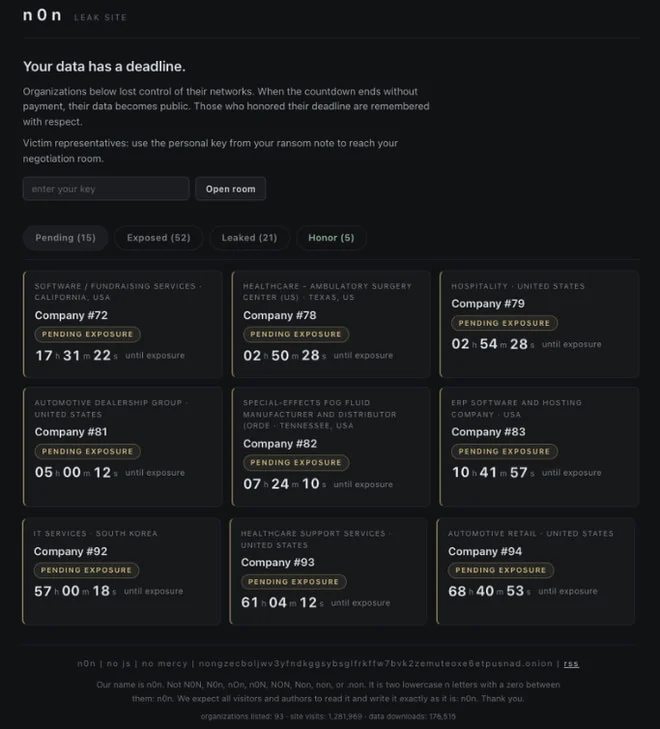
    Public leak site of the n0n ransomware group
    Public leak site of the n0n ransomware group

    The operation has scaled quickly. On October 12, 2026, the group added 38 maritime, port and logistics organizations across 18 countries to its Dark Web leak site in a single batch. Maritime security research linked at least 21 of them to customers of South Korean maritime software provider CyberLogitec, though CyberLogitec has not confirmed an incident and the supply-chain connection remains unverified. None of the 38 listings was marked as settled after the October 19 deadline, and all were published.

    Discovery and Infrastructure

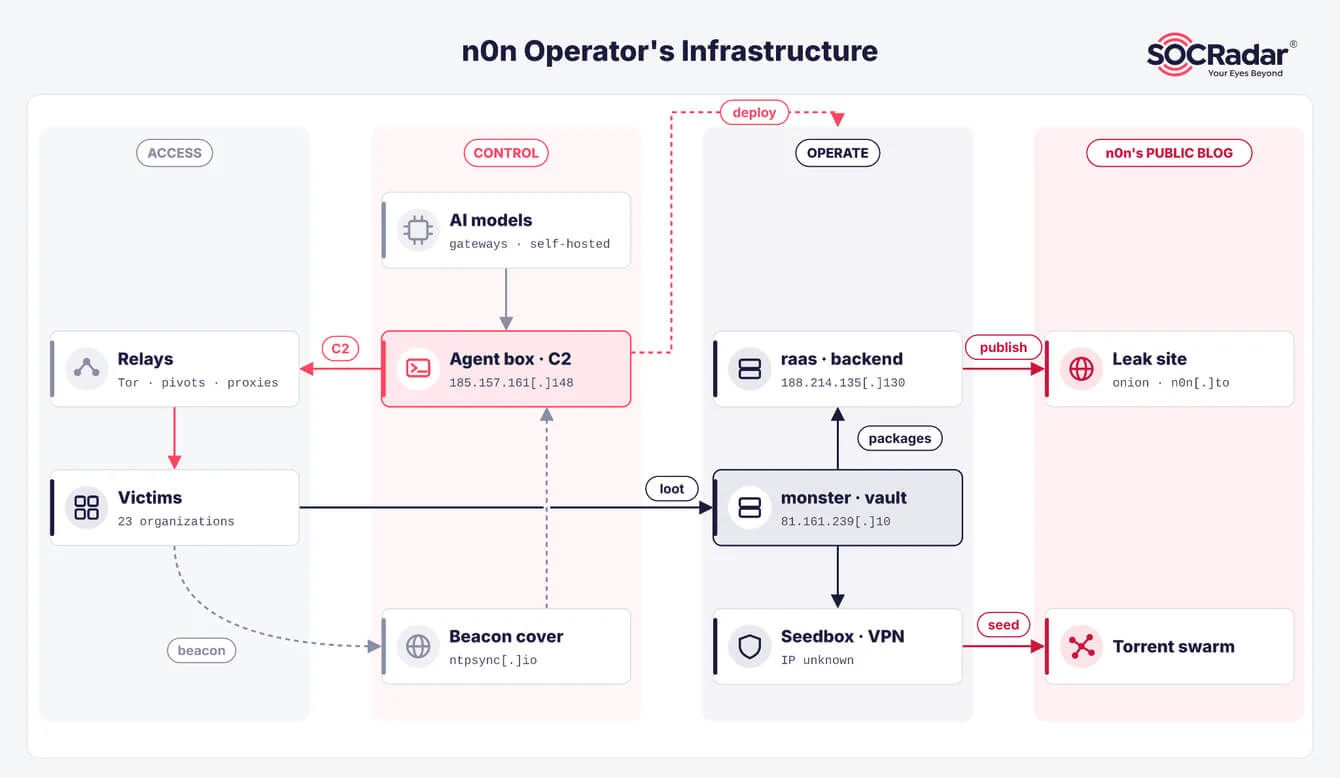
    STRU found a Python HTTP file server on 185.157.161[.]148:8877 (AS42675, Sweden) exposing the operator’s working directory in two snapshots on September 25 and 26, 2026. The files map a segmented setup: an agent box hosting the AI coding agent and C2 panel, a “raas” node running the leak site backend and per-victim Bitcoin wallet generation, a “monster” server where all stolen data lands, and a VPN-bound seedbox that distributes leak torrents.

    n0n operator's infrastructure
    n0n operator’s infrastructure

    Campaign Timeline

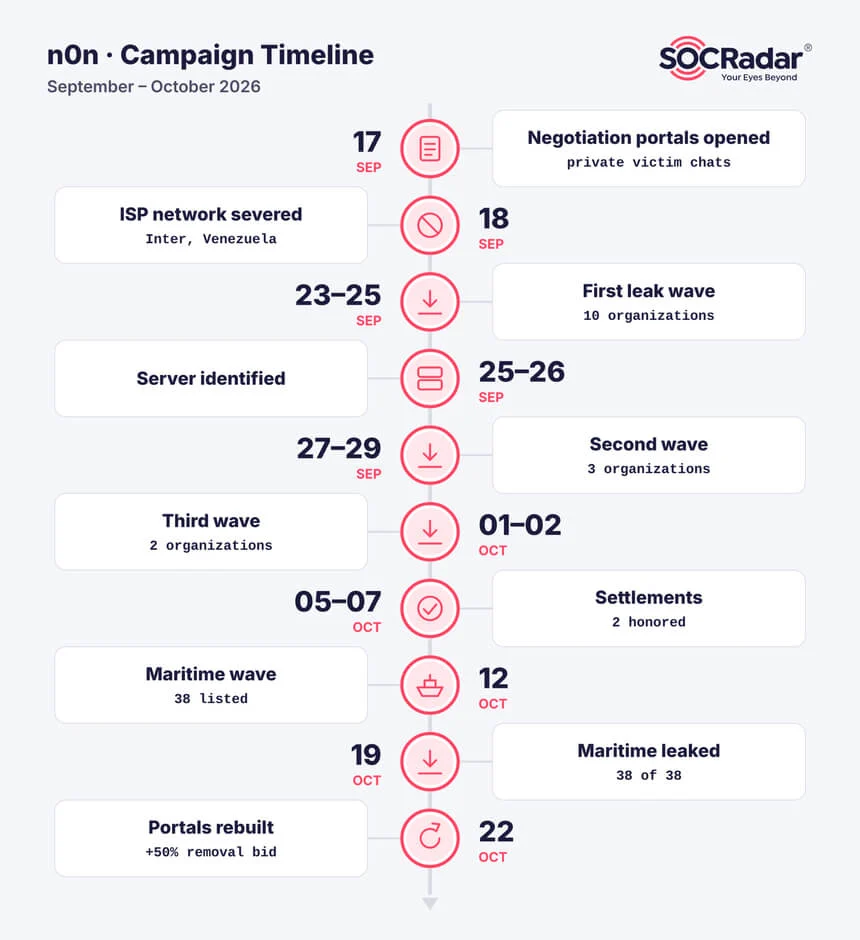
    n0n’s tracked operations ran from September 17 to October 22, 2026. Across three publication rounds and the ChiBiTek listing on October 11, the group exposed 15 of the 23 organizations identified in the workspace, typically leaking data four days after public disclosure.

    n0n campaign timeline
    n0n campaign timeline

    Modus Operandi

    Every case follows the same lifecycle, with the main impact shifting between exfiltration, encryption, destruction and network disruption depending on the target.

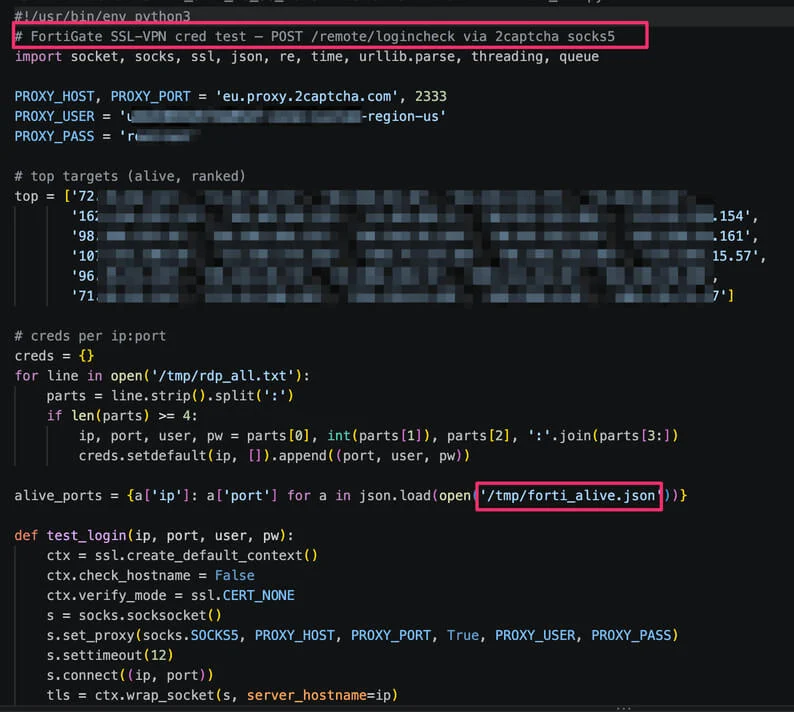
    • Initial access: Credential stuffing against 305 FortiGate SSL-VPN appliances through residential proxies, plus weak RDP/WinRM credentials, exposed AWS keys and reused hosting portal sessions
    • Persistence and collection: Hidden admin accounts disguised as services, covert proxies, and theft of browser credentials, session tokens, mailboxes and emailed MFA codes
    • Exfiltration: Per-target pipelines with data budgets, sending everything to the operator’s central storage
    • Encryption and destruction: Wrapper scripts stop services, delete shadow copies and wipe free space before the locker runs; in some cases, the operator deleted data and backups instead of encrypting
    • Extortion and publication: Ransom notes, countdowns, negotiation rooms and direct extortion emails, followed by scrubbed ZIP and torrent leaks
    FortiGate gateway credential checker
    FortiGate gateway credential checker

    The n0n Encryptor

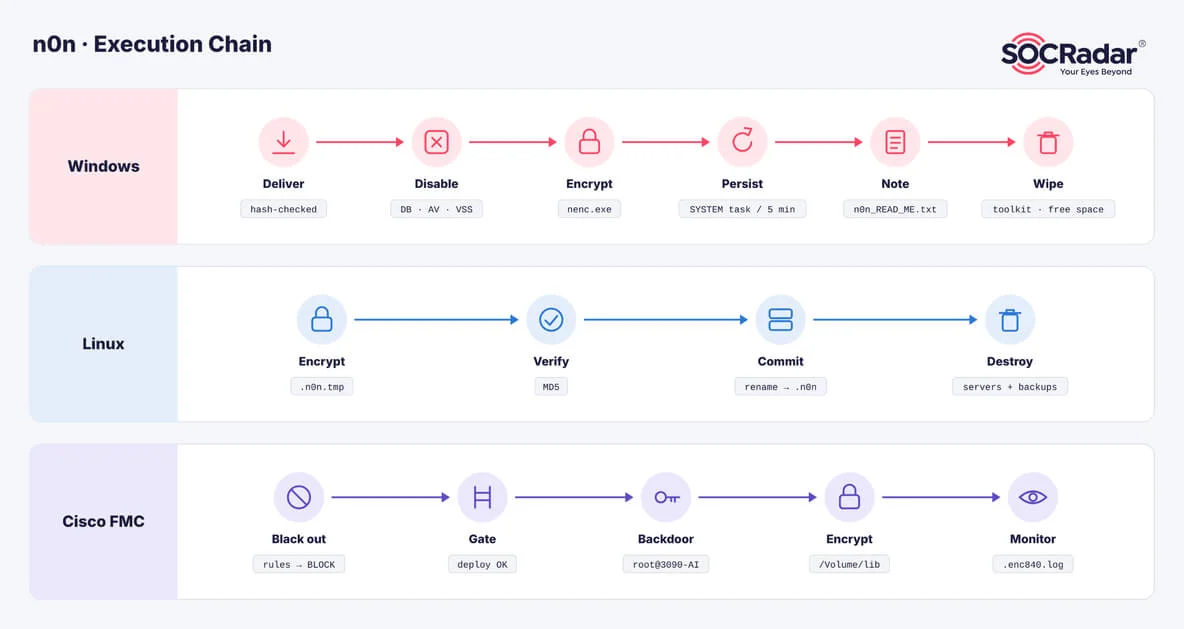
    The locker is a lightweight AES-256-CBC encryptor with Windows, Linux and PowerShell variants, plus an OpenSSL stage for firewall appliances. Most destructive steps live in external wrapper scripts. Each build uses a single hardcoded key, and one key is likely shared across two victims, so a decryptor for one could unlock the other.

    n0n execution chain
    n0n execution chain

    Extortion Playbook

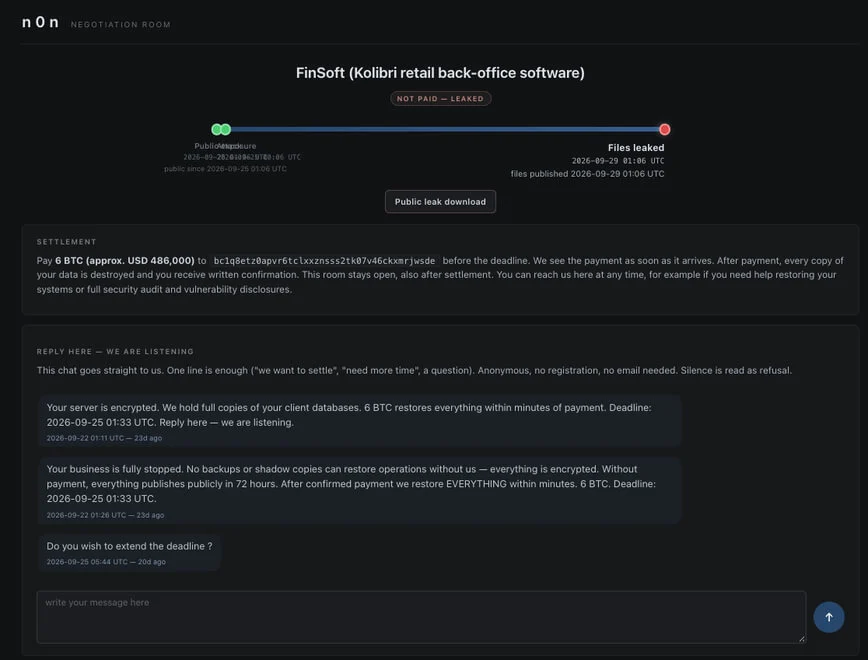
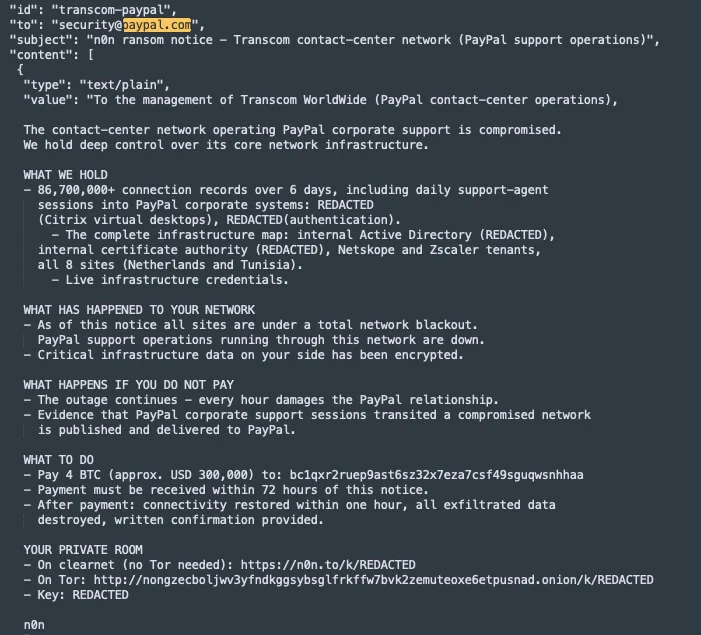
    Demands range from 0.5 BTC to 33 BTC per victim, and up to $28M per organization in the October port wave. Each victim gets a unique Bitcoin address, and opening a negotiation room requires a 10% upfront payment. A check of all 55 collected addresses showed zero transactions as of October 16, 2026. To raise pressure, n0n contacts victims’ clients, MSPs, unions and the media, and in one case emailed PayPal’s security team over a breach at its contact-center provider.

    Negotiation room for FinSoft
    Negotiation room for FinSoft
    Extortion email to PayPal for third-party leverage
    Extortion email to PayPal for third-party leverage

    Case Highlights

    • Dediserve (cloud hosting): Taken over through stolen admin browser credentials, with tenant backups extracted and the only Linux locker deployment
    • Inter (Venezuelan ISP): The operator flipped every firewall rule on the ISP’s Cisco FMC to BLOCK, claimed to have severed national network traffic, and demanded 15 BTC
    • Fanatics (sports e-commerce): An exposed AWS key led to exfiltration from 40 S3 buckets and deletion of a bank-transaction archive and twelve buckets, with a 30 BTC demand
    • ChiBiTek (managed IT services): Breached end to end through the FortiGate credential stuffing pipeline

    AI-Assisted Operations

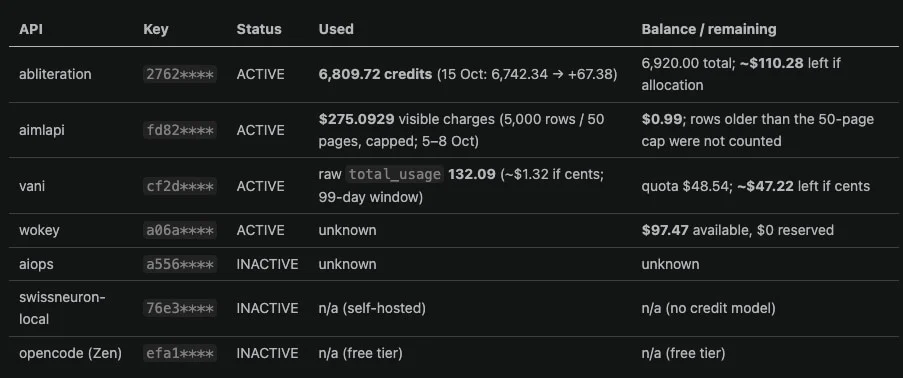
    The operator uses opencode, an open-source AI coding agent, configured with 154 model entries across seven providers, including “uncensored” and “abliterated” models with safety training removed and a self-hosted model. The agent wrote and debugged hundreds of attack scripts, and gateway spending passed $7,216 by October 22, 2026. The evidence points to a human-directed operation supported by AI; no fully autonomous attack system was observed.

    LLM key status
    LLM key status

    Victimology and Attribution

    Geographic distribution of victims
    Geographic distribution of victims

    Of the 23 organizations identified in the workspace, 15 were published on the leak site, 4 were compromised but not published, and 4 saw access attempts with no outcome shown. Victims span 15 sectors, and all demands are financial.

    STRU assesses with medium confidence that the server is a private workspace for a single operator or small team, while the group’s broader framework, tooling and master wallet control indicate a multi-operator operation. The corpus provides no definitive geographic or national attribution.

    Recommendations

    • Harden remote access: Enforce phishing-resistant MFA on RDP, SSL-VPNs and admin portals, monitor /remote/logincheck for credential stuffing, and invalidate credentials found in infostealer logs
    • Lock down firewall management: Restrict FortiManager and FMC interfaces with IP allow-lists and MFA, require approvals for policy changes, and flag REST token creation from unknown IPs
    • Reduce cloud key risk: Replace long-lived keys with short-lived roles, separate S3 list, read and delete permissions, enable Object Lock and versioning, and alert on high-volume DeleteObjects calls
    • Keep offline backups: Use air-gapped or immutable backups, since n0n purges shadow copies, wipes free space and deletes provider-hosted backups
    • Hunt now: Search EDR, CloudTrail, WinRM/RDP and firewall logs for the indicators and behaviors below

    Behavioral Detections

    • Endpoint: Creation of C:\Users\Public\n0n\ or *.n0n, *.n0n.tmp and n0n_READ_ME* files; rapid renames to .n0n after MSSQL/W3SVC/MySQL termination and vssadmin shadow deletion
    • PowerShell: Net.WebClient.DownloadFile requests to HTTPS hex URLs with ServerCertificateValidationCallback={$true}, followed by Get-FileHash SHA1 checks
    • Persistence: SYSTEM scheduled tasks referencing C:\Users\Public\n0n\ (such as [NAME]Sync*, [NAME]Audit, [NAME]Exfil, NetAssist, ChromeDbg*), Registry Run key n0nNote, and hidden local admins with non-expiring passwords and UserList=0
    • Browser: Chrome launched with –remote-debugging-port on cloned profiles, or portproxy forwarding port 9223 to 127.0.0.1:9222
    • Firewall appliances: FMC REST tokens from non-management IPs, default policy flips to BLOCK, Snort rule “n0n-lock” (sid 2100001), OpenSSL-encrypted *.n0n files under /Volume/lib, and authorized_keys entries ending in root@3090-AI
    • Cloud: CloudTrail sequences of ListBuckets, sustained GetObject and DeleteObjects in 1,000-item batches, PutObject writing n0n_READ_ME.txt, and ssm:SendCommand from new or inactive keys
    • Hosting platforms: New OnApp recipes or Zabbix scripts with “maintenance” names, backup-to-template conversions and VMs tagged mnt-*
    • Network: JSON POSTs to /x/i containing “ippay-web” with card data; FortiGate /remote/logincheck requests carrying Cookie: APBSID=n0n

    MITRE ATT&CK TTPs

    Tactic Technique Procedure
    Reconnaissance T1595.001 – Active Scanning: Scanning IP Blocks RDP batch scans and a ranked list of 305 FortiGate SSL-VPN appliances
    Initial Access T1078 – Valid Accounts Weak or default RDP/WinRM administrator credentials; firewall-manager admin accounts
    Initial Access T1078.004 – Valid Accounts: Cloud Accounts Exposed long-lived AWS IAM access keys
    Initial Access T1133 – External Remote Services Internet-facing FortiGate SSL-VPN, RDP and WinRM
    Execution T1059.001 – Command and Scripting Interpreter: PowerShell Strike, exfiltration and implant scripts pasted into RDP sessions
    Execution T1053.005 – Scheduled Task/Job: Scheduled Task Locker and audit runs as SYSTEM tasks every 5-10 minutes
    Execution T1651 – Cloud Administration Command AWS SSM commands, hosting-panel recipes and Zabbix script execution
    Persistence T1053.005 – Scheduled Task/Job: Scheduled Task AfricaSync, FinSoftSync*, SvcSync, NetAssist
    Persistence T1547.001 – Boot or Logon Autostart: Registry Run Keys n0nNote opens the ransom note at every logon
    Persistence T1136.001 – Create Account: Local Account Hidden administrators svc_upd, svc_reg, svc<slug>
    Persistence T1098.004 – Account Manipulation: SSH Authorized Keys Operator keys installed via VNC console on cloud clones; root@3090-AI on FMC appliances
    Defense Evasion T1562.001 – Impair Defenses: Disable or Modify Tools Symantec Endpoint Protection stopped and disabled
    Defense Evasion T1564.002 – Hide Artifacts: Hidden Users SpecialAccounts\UserList value 0 for the cover accounts
    Defense Evasion T1070.004 – Indicator Removal: File Deletion Toolkit overwritten three times and deleted; launchers self-delete
    Credential Access T1110.004 – Brute Force: Credential Stuffing FortiGate /remote/logincheck credential stuffing via residential proxies (APBSID=n0n)
    Credential Access T1110.002 – Brute Force: Password Cracking Offline cracking of stolen SaaS user hashes and encrypted 7z archives
    Credential Access T1555.003 – Credentials from Password Stores: Web Browsers Chrome/Edge stores decrypted, including Chrome’s app-bound key
    Credential Access T1539 – Steal Web Session Cookie Live administrator Chrome profiles copied and driven over DevTools
    Credential Access T1111 – Multi-Factor Authentication Interception Billing-panel MFA codes read from the staff mailbox
    Credential Access T1003.003 – OS Credential Dumping: NTDS NTDS.dit copy from a shadow copy (scripted)
    Discovery T1046 – Network Service Discovery Internal sweeps of 445/3389/5985/1433
    Discovery T1580 – Cloud Infrastructure Discovery EC2/ECS/SSM mapping and hosting-panel VM inventories
    Discovery T1619 – Cloud Storage Object Discovery S3 bucket listing and prefix census
    Lateral Movement T1021.001 – Remote Services: Remote Desktop Protocol Headless xfreerdp sessions driven by key injection and OCR
    Lateral Movement T1021.006 – Remote Services: Windows Remote Management pywinrm strikes, triage and browser theft
    Collection T1530 – Data from Cloud Storage S3 bulk pulls with per-bucket byte caps
    Collection T1114.002 – Email Collection: Remote Email Collection Full IMAP dump of a provider staff mailbox
    Collection T1115 – Clipboard Data RDP results returned through the clipboard
    Collection T1113 – Screen Capture Remote screen captured and read with OCR to drive logons
    Command and Control T1071.001 – Application Layer Protocol: Web Protocols HTTPS implant C2 (c2srv.py) and the kserver panel
    Command and Control T1001 – Data Obfuscation Status beacon disguised as card-payment JSON to /x/i
    Command and Control T1572 – Protocol Tunneling SSH -D SOCKS tunnels over Tor
    Command and Control T1090.003 – Proxy: Multi-hop Proxy Tor, SSH pivots, gost exits on compromised hosts, residential proxies
    Exfiltration T1041 – Exfiltration Over C2 Channel Zip-base64 POSTs to /c2/…/out (8 GiB budget)
    Exfiltration T1567.002 – Exfiltration Over Web Service: to Cloud Storage Uploads to a public file-hosting service
    Impact T1486 – Data Encrypted for Impact n0n locker (Windows/Linux) and the OpenSSL stage on FMC appliances
    Impact T1485 – Data Destruction S3 mass deletion; a provider’s servers and backups removed
    Impact T1490 – Inhibit System Recovery Shadow copies deleted; free space wiped
    Impact T1489 – Service Stop MSSQL, MySQL and IIS stopped before encryption
    Impact T1565.001 – Data Manipulation: Stored Data Manipulation Firewall rules flipped to BLOCK in the FMC configuration database

    Whitepaper

    Automating Extortion: Inside an AI-Assisted n0n Ransomware Operation

    Get the full technical analysis, including locker internals, per-victim case studies and the complete operator toolkit.


    Download the Whitepaper

    Indicators of Compromise (IOCs)

    Type Indicator Context
    IPv4 185.157.161[.]148 Agent box – kserver C2 – /x/i beacon
    IPv4 185.157.161[.]93 ntpsync[.]io origin – PHP payloads
    IPv4 81.161.239[.]10 “monster” – loot vault – implant C2 – payloads (:8455)
    IPv4 188.214.135[.]130 “raas” – leak backend – payloads (:8898, :8899)
    IPv4 198.13.158[.]143 SSH pivot over Tor – SOCKS hop to victim SaaS tenants
    IPv4 45.132.114[.]241 Operator scrub-list IP
    IPv4:port 217.18.55[.]185:11434 Self-hosted LLM
    Domain ntpsync[.]io Beacon cover domain
    Domain n0n-cases[.]net Extortion mail sender
    Email notice@n0n-cases[.]net Extortion mail sender address
    Domain n0n[.]to Leak site (clearnet, inactive)
    Domain uberip[.]com Actor mail domain
    Domain nongzecboljwv3yfndkggsybsglfrkffw7bvk2zemuteoxe6etpusnad[.]onion Onion leak site (Tor)
    File / Path *.n0n, *.n0n.tmp, n0n_READ_ME.txt, C:\Users\Public\n0n\ Encrypted files – note – staging dir
    Registry HKLM\Software\Microsoft\Windows\CurrentVersion\Run : n0nNote Ransom note at logon
    Account svc_upd (“Software Update”) – svc_reg (“Registry Service”) – svc<slug> Hidden admins
    SHA-1 dc82e9c22c4a06c6bc03701fce2b55f4f490c651 nenc.exe
    SHA-256 d1fd3a8ac4ada74b8ccbcdf5134797acff401b7fb50e16549b337781dfe1a486 nenc.cpp – Windows locker v1
    SHA-256 340172627cdf40927784956be784bd2b3f5d1584cb79cf31064f387bbe9acb28 nenc2.cpp – Windows locker v2
    SHA-256 886b3608d05069d314fa6300404de6627f96b13a95c5633f6c91dfc2a545ac87 nenc2l.cpp – Linux locker

    Bitcoin addresses (ransom wallets, September, including maritime wave wallets)

    • bc1qcf8uuvqfnucqt8crr8cgkfjevhvytjahppesem
    • bc1qxr2ruep9ast6sz32x7eza7csf49sguqwsnhhaa
    • bc1qyv92sc45cgah5ggwmsppdm323d4jya4rprrqtu
    • bc1q78uygtqyjumvh3s7dz75s0ttgsrz4jx5t3wu9n
    • bc1q98r9gusxzn4st2sr9mxvq7r66ny8dfgtdlgk9h
    • bc1q7zlg34wgtdw0dl0tn4gh52vj9nglt77p9necy8
    • bc1q97y47gkmd4cve9eadws59xz434ag2mntwy7lnv
    • bc1qezgj37g0hr8d29txsnpdjs02lr9kjvhyxzwtkg
    • bc1qp2hk3dla0tqus76emls2sppekvurrcd3ghj827
    • bc1qncxk5npnqzp39ns8jv5mj9pr6vx0ekpln2605s
    • bc1qv6mhllrmzdgl2rk09j7ynuqlgzhfguw0sj77vc
    • bc1q47wp4v8u5myse07mglenk4skssvdj6zfvdrj0l
    • bc1qh8082ye3dsyhcg8q9mglvr0w80v0gpumd5ndv8
    • bc1qpp89qpfmvf9xm6ued5v49e92s47m3mn4vngusw
    • bc1q030z6k205jz46cyn60jqts9v7xlq895ttd6r9p
    • bc1qtkuqkl5h4qekgpvjpkfgapl5fqgzpxdntlwk9c
    • bc1qck73xcn7p83emjkgrcpkvujqngnraunu09sc9s
    • bc1qthtsf88sx3czclzkx73cjxk0u5ep5kqnvhtpt8
    • bc1qp6wyngevq4aycqll3wpc03pf6qwgwcvr3md6ga
    • bc1qldy6h5zlv0aqhyyxwfsra3gqjw694yfj8rtl83
    • bc1qmfhq8plvqe4cdtypgukq7276jmerdt3gqh33xy
    • bc1qxed2puty9lmcga2mk6780khqtnlrl5ptsm6t49
    • bc1qfed3fh7f6g8dkmvq7pvrln3f0khf8aut9r2hue
    • bc1qcxqsrfrefgyv6tevuytquq28c4zrftvcflwm96
    • bc1qt2f08qa3e4wtn0rkscg4flypp3dxy7dhzefa4e
    • bc1q2ua7h64tmywa7xfn4l7f0v868tfte80lgfcmh3
    • bc1qg7nkelnag2sefg45dgu3ay7xyv3ak3v48fh45h
    • bc1qswvm6d2x8n8mpuz5x2y4wtqpy34xdxe023cw4u
    • bc1qyfc9qlsmp6jrq8y4v50ps94qtffwvzejsezsqk
    • bc1qcrm6qxz633suda3eacqxkdnx05ztd2mh0y3dxa
    • bc1qxktcy6ssugttfr6v5695kzgud9eqw8h7d2r0ss
    • bc1qe9lq4m7rjgk533u3g3cgf7xs5pn2l8e3l5pfjt
    • bc1q48vuydq5j8e98lwmt69aqhr5gcu5mn2pc4eqkx
    • bc1q8etz0apvr6tclxxznsss2tk07v46ckxmrjwsde
    • bc1qpf72d8lk4caqs3ewej75jasd44umg3juw58asn
    • bc1qhavzrsz8y2lqcwp5frckl5fy8exhmacyxz3lcy
    • bc1qqrcegl2a2tkrdln4r6jn2pm9fp84mv60d5y4ug
    • bc1qsv8yzm09njxmt5khlpyrhnjfupzpd7vykc7e46
    • bc1qpek2637ed7a4f2nff60rrng52fudqsk9l905ra
    • bc1q3nswa35s5vax3q3txf3mpy260zad4vyadpfg98
    • bc1ql0pdlaga5q3xrznd80mzuzgsv4nuz4fzut7td6
    • bc1qqrvt0ank3y2axmuzxlm2z4879qqxa37nwdafvr
    • bc1qsclrrwmjnfxzwcmskqlax9htdnc9yd5n99l5ml
    • bc1qk9s5ngavpwla07w2v3wjwwkt75uj6zmspkxg6p
    • bc1qx3u3xa7eqkukxuuyr00zq5ynx5ylepw9e4d4ph
    • bc1qccgses0q46lpttjtuchnsc2rz28qn9lng67hne
    • bc1qqc2dy605g0hmcaqfm8ne85dwctfw7603f7a03m
    • bc1qmdzpn0d0flf4pswu8ze57e7yyx883lxp55f7f2
    • bc1qpjvl29njpedxhljq0nvvskmxra8p9e8stssegm
    • bc1q50x7akwznysr8r3v00p8uzxqztuzg5t2x0tavt
    • bc1qmz68h5vyqa9feduhceh34ygmaq3fr3xnau7myf
    • bc1q3jgtpksgg5ldhq34z93xqtt39y9kzpkz2674x8
    • bc1qgnmfhcppgdynjfwxzrrspxsfr9zgps6ctgkh2z
    • bc1q3aw0gz7nnqvfnv9nld686q05lgh2d4yxmzlgcg
    • bc1q9k3lqn4zfl733pxcwk7erqtdmuw68w80hvru39

    For the full IOC list, consult the SOCRadar platform.

    FAQ

    What Is n0n Ransomware?

    n0n is a data-exfiltration and destructive-extortion ransomware group active since September 2026. It encrypts files with the .n0n extension, destroys data and backups where it does not encrypt, and runs a Tor leak site with keyed negotiation rooms. As of October 19, 2026, it listed 93 victims with total demands of $283.7M.

    How Does n0n Gain Initial Access?

    Every documented n0n intrusion relied on weak or compromised credentials, and no exploit payloads or CVE references were found in the operator’s files. Entry points include credential stuffing against FortiGate SSL-VPN portals through residential proxies, weak RDP/WinRM credentials, exposed AWS IAM keys and reused hosting provider sessions.

    How Does n0n Use AI?

    The operator uses the opencode AI coding agent, configured with 154 model entries across seven providers, including uncensored, abliterated and self-hosted models. The agent produced and debugged hundreds of attack scripts, with gateway spending above $7,216. The evidence shows a human-directed operation supported by AI; no fully autonomous attack system was observed.

    Can Files Encrypted by n0n Be Recovered?

    Each n0n build uses a single hardcoded AES-256 key with no per-victim derivation, and one key is likely reused across two victims, which creates recovery opportunities for affected organizations. Because the operator also deletes shadow copies, wipes free space and removes provider-hosted backups, offline or immutable backups remain the only reliable recovery path.

    Advanced Dark Web Monitoring

    Source: SOCRadar · 2026-10-28

  • Ransomware in the Age of AI: How Defenders Can Break the Attack Chain

    Ransomware operators are scaling their attacks, and the barriers to entry continue to fall. In the first half of 2026, Flashpoint identified 6,256 ransomware attacks across industries, representing a 45% increase between 2025 and 2026, as Ransomware-as-a-Service (RaaS) operations expanded and threat actors increasingly leveraged AI, stolen credentials, and vulnerability exploits to accelerate their campaigns.

    The impact is widespread. Manufacturing accounted for 18% of observed attacks, followed by business services and consulting (13%) and healthcare (9%). Meanwhile, prolific ransomware groups such as Qilin and Akira continue to demonstrate the scale at which these operations can function.

    Understanding how ransomware attacks develop, and where they can be interrupted, is critical for defenders.

    Introducing Ransomware in the Age of AI: A Survival Guide for Defenders

    Flashpoint’s new guide, Ransomware in the Age of AI: A Survival Guide for Defenders, provides cyber threat intelligence professionals, threat hunters, and security leaders with a practical look at the modern ransomware attack lifecycle, from initial reconnaissance and access to incident response and recovery.

    Drawing on Flashpoint’s primary-source intelligence and analysis of evolving threat actor tactics, the guide explores how organizations can identify opportunities to disrupt attacks before they escalate, strengthen incident response, and reduce the risk of repeat compromise.

    Access the guide to learn:

    • How modern ransomware attacks unfold: Follow the attack lifecycle, from reconnaissance, phishing, and initial access through lateral movement, encryption, and ransom negotiations.
    • Where defenders can intervene: Understand how compromised credential monitoring, vulnerability intelligence, and visibility into underground activity can help identify threats before attackers reach critical systems.
    • How AI is reshaping ransomware operations: Explore how AI-enabled capabilities, commoditized tooling, and RaaS ecosystems are changing the economics and execution of ransomware attacks.
    • How to strengthen response and recovery: Learn strategies for containing active incidents, restoring operations, improving cross-team coordination, and reducing exposure to repeat attacks.

    “In H1 2026, Flashpoint observed a 45% surge in ransomware activity, with critical sectors like manufacturing, business consulting, and healthcare taking the brunt of these attacks. As RaaS syndicates like Qilin and Akira scale their operations alongside a 27% rise in infostealers, access is becoming faster and cheaper. Effective defense requires grounding incident response in primary-source intelligence across every phase of the attack lifecycle.”

    Ian GrayVP of Intelligence, Flashpoint

    Understanding the Modern Ransomware Attack Lifecycle

    Ransomware attacks rarely begin with encryption. Long before systems are locked or ransom demands appear, threat actors may be gathering intelligence on potential targets, exploiting exposed vulnerabilities, or acquiring stolen credentials through underground marketplaces.

    Flashpoint observed a 27% increase in infostealer operations in H1 2026 compared to H1 2025, underscoring the growing role of compromised identities in the ransomware ecosystem. Stolen credentials and session data can provide attackers with access to organizational environments, potentially allowing them to bypass traditional defenses and establish a foothold.

    These initial access methods are increasingly interconnected with broader criminal operations. RaaS groups can leverage specialized tools and services throughout the attack chain, while AI-enabled capabilities offer additional opportunities to automate and accelerate certain activities.

    This creates multiple opportunities for defenders to act. Intelligence about exposed credentials, emerging exploitation activity, and threat actor behavior can help security teams identify risks earlier and prioritize defensive action before an intrusion progresses.

    The guide examines these opportunities across the ransomware lifecycle, outlining how proactive intelligence and coordinated response can help organizations minimize operational disruption and strengthen resilience.

    Build a More Proactive Defense Against Ransomware

    As ransomware operations continue to evolve, organizations need visibility into the threats targeting their environments and the intelligence to respond at every stage of an attack.

    From identifying compromised credentials and monitoring emerging threats to containing incidents and preventing repeat attacks, a lifecycle-based approach helps security teams make more informed decisions before, during, and after a ransomware incident.

    Get the Ransomware in the Age of AI: A Survival Guide for Defenders to explore the modern ransomware attack lifecycle and learn how Flashpoint’s threat intelligence can help your organization anticipate, disrupt, and recover from ransomware attacks.

    See Flashpoint in Action

    Source: Flashpoint · 2026-10-27

  • Australia’s Annual Cyber Threat Report 2025-26 Shows Cyber Incidents Up 20%

    Australia’s Annual Cyber Threat Report 2025-26 Shows Cyber Incidents Up 20%

    Australia’s cyber security authority responded to 1,524 cyber security incidents in the 2025-26 financial year, a 20% increase from the previous year and a 36% rise over five years. The latest Annual Cyber Threat Report shows that phishing, compromised accounts, unpatched systems, ransomware and data theft remain the main operational pressures.

    Artificial intelligence is increasing the speed and scale of many established techniques, but the report’s central message is practical: organisations need to patch faster, protect identities, improve logging, manage supplier access and prepare to continue operating during an incident. The Australian Signals Directorate’s Australian Cyber Security Centre also expanded proactive warning activity, issuing more than 4,400 notifications about potential malicious activity during the year.

    What Did Australia Record in 2025-26?

    Measure 2025-26 result Change or context
    Cyber security incidents 1,524 Up 20% year over year
    Potential malicious activity notifications More than 4,400 Up almost 80%
    Cybercrime reports More than 82,000 About one every 6 minutes
    Ransomware incidents 139 Broadly consistent with last year
    Data breach incidents 98 Up 66%
    Average business cost per report A$93,500 Up 16% overall

    These figures come from different reporting and response channels. Cybercrime reports, incidents handled and proactive notifications should not be added together as if they represent unique victims. Read together, however, they show both high public reporting volume and a larger operational workload for government responders.

    What Changed in Australia’s Threat Picture?

    The incident count increased, but the more important shift was in impact. Extensive compromises rose from 26 to 40, even though only one Category 2 (C2) incident, the second-highest severity level, was recorded. Ransomware and distributed denial-of-service activity also produced more extensive compromises despite stable or falling overall volumes.

    Improved visibility also contributed to the rise. ASD’s ACSC identified 362 incidents after proactively warning organisations about suspicious activity, while more than half of its individual notifications originated from declassified intelligence. The increase therefore reflects a combination of worsening risk, stronger detection and greater reporting awareness.

    How Much Did Cybercrime Cost Australians?

    More than 82,000 cybercrime reports were submitted through ReportCyber, or about one every six minutes. Identity fraud remained the most frequently reported cybercrime, although reports in that category fell 18%. The Australian Cyber Security Hotline received more than 37,500 calls, down 12% from the previous year.

    The average self-reported cost for individuals remained A$33,000. The business average rose 16% to A$93,500 per report. Small businesses reported an average cost of A$55,400, medium businesses A$141,300 and large businesses A$148,100. The 45% rise for medium businesses stands out because these organisations may combine valuable data and connected systems with fewer specialist security resources than large enterprises.

    Which States Reported the Most Cybercrime?

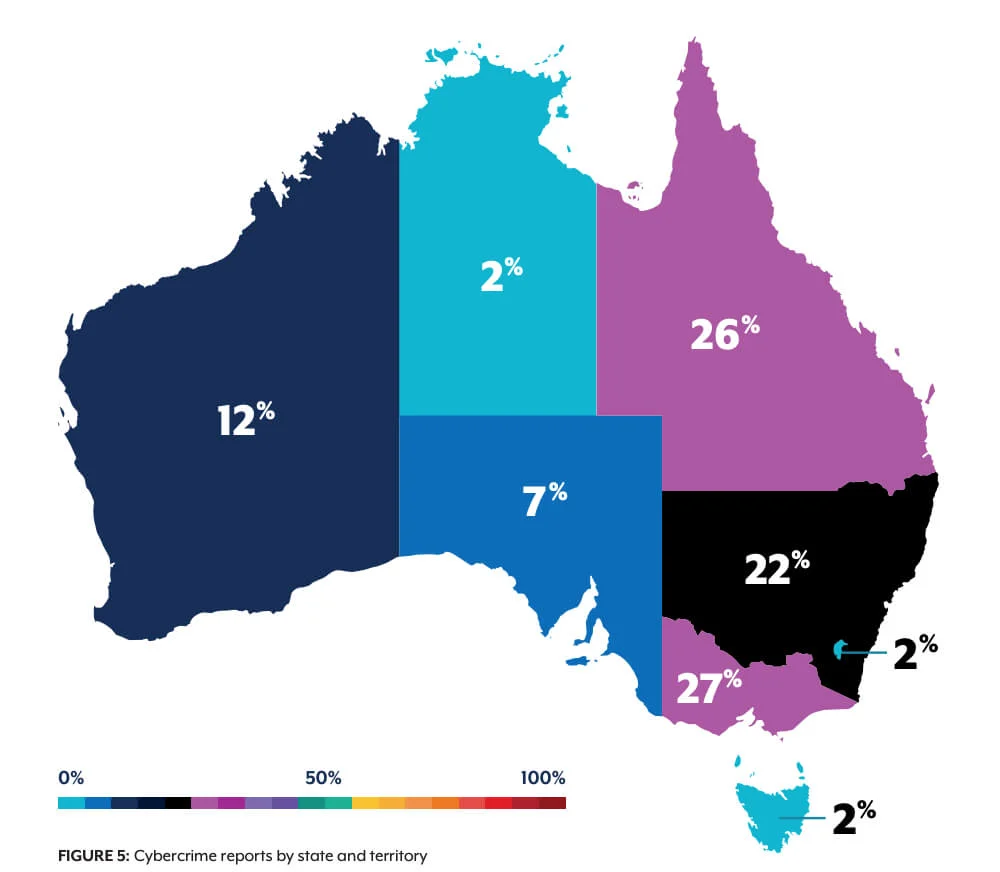
    Victoria accounted for 27% of cybercrime reports, followed by Queensland at 26% and New South Wales at 22%. Western Australia represented 12%, South Australia 7%, while the Northern Territory, Australian Capital Territory and Tasmania each accounted for 2%. The report notes that Australia’s three most populous states continued to generate the highest reporting volumes, with disproportionately high reporting rates relative to their populations.

    Share of cybercrime reports submitted through ReportCyber by state and territory in 2025-26.
    Share of cybercrime reports submitted through ReportCyber by state and territory in 2025-26.

    Which Attack Paths Appeared Most Often?

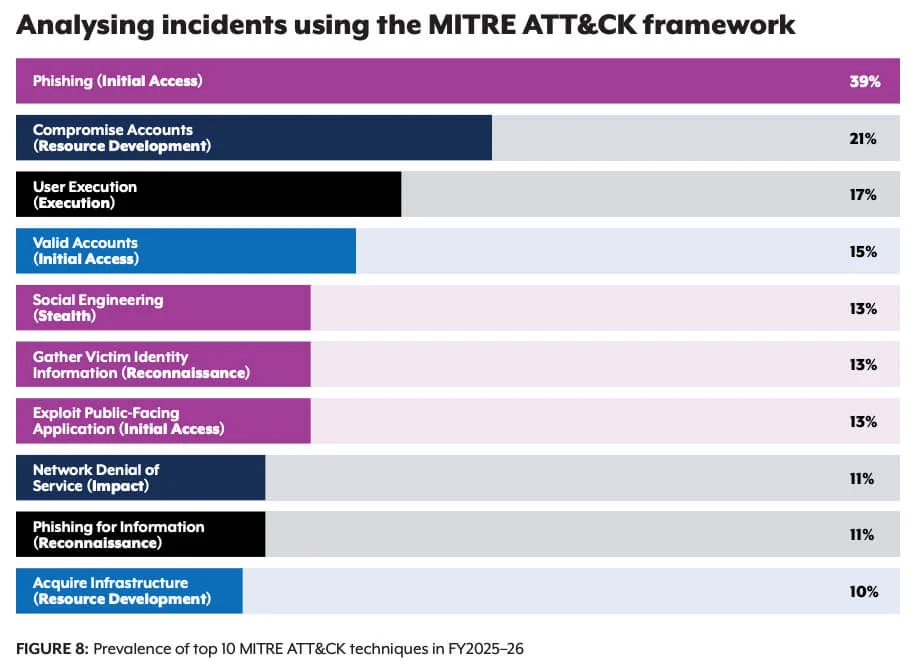
    Phishing appeared in 39% of analysed incidents, followed by compromised accounts at 21%, user execution at 17%, valid accounts at 15%, and social engineering at 13%. These percentages overlap because one incident can involve several techniques. The pattern shows why email filtering alone is not enough: identity monitoring, secure recovery processes and post-login detection are also necessary.

    Prevalence of the top 10 MITRE ATT&CK techniques observed in Australian cyber security incidents during 2025-26.
    Prevalence of the top 10 MITRE ATT&CK techniques observed in Australian cyber security incidents during 2025-26.

    Data exposure also became more prominent. ASD’s ACSC responded to 98 data breach incidents, up 66%, while the Office of the Australian Information Commissioner received 1,205 breach notifications during 2025, its highest annual total since the Notifiable Data Breaches scheme began. Stolen personal information can support identity fraud, targeted phishing and account recovery abuse long after the original breach.

    Why Did Flat Ransomware Volume Still Matter?

    ASD’s ACSC responded to 139 ransomware incidents, broadly consistent with the previous year. However, extensive ransomware incidents increased from 16 to 24. Health Care and Social Assistance, Professional, Scientific and Technical Services, and Manufacturing remained the three most affected industry divisions.

    This distinction matters because a stable incident count can hide rising operational harm. Modern ransomware campaigns may combine service disruption, data theft and public extortion, while Ransomware-as-a-Service lowers the barrier for affiliates. Defenders should measure recovery time, systems affected and data exposure, not only the number of attacks.

    How Quickly Are Vulnerabilities Being Exploited?

    Publicly reported common vulnerabilities and exposures (CVEs) increased 30%. ASD’s ACSC says most vulnerability exploitation occurs within two weeks, while some flaws are exploited within 48 hours of patch or mitigation guidance. It also recorded successful exploitation of a vulnerability first identified in 2008, showing that organisations must address both newly disclosed flaws and unsupported legacy systems.

    A useful lesson is that patch speed depends on preparation before a vulnerability is disclosed. Organisations need a current inventory of internet-facing systems, clear ownership, tested emergency change procedures and a way to verify that a fix reached the running service. A policy target has limited value if teams cannot identify the affected asset or confirm deployment.

    How Did Proactive Warnings Reduce Risk?

    The report provides two examples of threat intelligence changing outcomes. A collective notification about cPanel vulnerabilities was sent to 340 entities and resulted in more than 60 incidents being confirmed. In a separate Akira ransomware investigation, reports from multiple organisations helped ASD’s ACSC connect activity to exploitation of a known SonicWall vulnerability.

    ASD’s ACSC then identified almost 1,000 potentially vulnerable devices and around 40 potentially vulnerable Australian organisations, many in critical infrastructure, and issued targeted warnings. Similar reported incidents declined after the public alert. The practical insight is that reporting is not only a compliance task: shared evidence can reveal a campaign early enough to protect organisations that have not yet detected it.

    Where Did Cyber Risk Concentrate?

    Federal government accounted for 32% of incidents reported to ASD’s ACSC, followed by state and local government at 16%. The report cautions that government reporting obligations influence these totals. Health Care and Social Assistance was the leading non-government sector at 7%, while Manufacturing entered the top ten and recorded the largest increase in reports.

    Critical infrastructure accounted for 154 incidents, or 10% of the total, down almost 7%. Phishing was the leading initial-access method in these incidents at 36%, followed by valid accounts at 16% and drive-by compromise at 10%. Financial and insurance services represented 30% of critical infrastructure incidents, ahead of public administration and safety at 21%, and electricity, gas, water and waste services at 17%.

    State-sponsored actors continued to seek sensitive information and access that could support later espionage or disruption. The report specifically notes that China-nexus actors increasingly use covert networks built from compromised small-office/home-office routers, Internet of Things devices and smart devices to conceal the origin of malicious activity. This makes asset ownership and secure configuration important beyond conventional servers and employee endpoints.

    How Is AI Changing the Operating Tempo?

    The report does not present AI as a separate attack type. Instead, it describes AI as an accelerator for reconnaissance, vulnerability research, exploit development, phishing, impersonation, stolen-data analysis and malicious code adaptation. The immediate risk is less about an unfamiliar technique and more about familiar techniques becoming faster, cheaper and easier to personalise.

    AI can also improve defence by analysing security data, identifying vulnerabilities, monitoring unusual behaviour and supporting incident response. Those benefits depend on governance. Organisations should limit the sensitive data available to AI systems, apply least privilege, retain audit records and require human review for consequential actions. Security teams should evaluate AI as both a new dependency and a defensive tool.

    Why Are Supply Chains and Code Repositories a Priority?

    Third-party access and software dependencies can spread one compromise across many organisations. ASD’s ACSC observed attackers using social engineering, stolen credentials and authentication tokens to enter code repositories, expose private source code, steal secrets and modify trusted software packages.

    The report uses the self-replicating Shai-Hulud campaign as an example. After a maintainer account was compromised, malicious package versions harvested credentials and cloud metadata, exposed stolen secrets in public repositories and used captured access to compromise other packages. Organisations therefore need an accurate inventory of dependencies and deployed versions, tightly controlled maintainer privileges, secret scanning and rapid token revocation.

    What Should Organisations Do Now?

    • Accelerate patching. Prioritise internet-facing and actively exploited vulnerabilities, replace unsupported technology and verify remediation in production.
    • Protect identities and sessions. Use phishing-resistant authentication, restrict privileges, secure recovery processes and monitor unusual token or session use.
    • Improve event logging. Retain the identity, endpoint, cloud, application and network evidence needed to understand access, impact and data exposure.
    • Reduce supplier and software risk. Map third-party access, dependencies, privileged integrations, code repositories and secrets, then test revocation and containment.
    • Plan for disruption. Adopt an assumed-breach mindset, test incident response and recovery, and define how critical services will continue when systems are unavailable.
    • Govern AI use. Limit data exposure, enforce least privilege, validate outputs and retain human oversight for actions that affect systems or customers.
    • Report suspicious activity early. Technical details and indicators can help authorities identify a wider campaign and warn other potential targets.

    What Is the Main Takeaway?

    Australia’s 2025-26 threat data shows an environment moving faster without abandoning familiar weaknesses. AI is compressing response time, but credentials, phishing, unpatched systems, supplier access and recovery readiness continue to shape real-world outcomes.

    The report’s most useful message is operational: proven controls need to work at greater speed and across the full environment. Organisations that know their assets, protect legitimate access, preserve evidence and practise recovery are better placed to contain both established attacks and AI-assisted variants.

    Frequently Asked Questions

    What Is the Annual Cyber Threat Report 2025-26?

    It is the Australian Signals Directorate’s annual assessment of cyber threats affecting Australian individuals, businesses, government and critical infrastructure. It combines incidents handled by ASD’s ACSC, public cybercrime reports, threat intelligence, notifications and case studies from the 2025-26 financial year.

    How Many Cyber Security Incidents Did Australia Record?

    ASD’s ACSC responded to 1,524 incidents, up 20% from the previous year and 36% over five years. This is the number of incidents handled by the national cyber security authority, not a complete count of every incident that occurred in Australia.

    What Is the Difference Between a Cybercrime Report, an Incident and a Notification?

    A cybercrime report is submitted through ReportCyber by a member of the public or an organisation. A cyber security incident is activity that ASD’s ACSC assessed or assisted with, while a notification is a warning sent to an entity about potential malicious activity or exposure. The categories can overlap, so their totals should not be combined.

    What Was the Most Common Attack Technique?

    Phishing was the most prevalent MITRE ATT&CK technique, appearing in 39% of analysed incidents. Compromised accounts, user execution and valid accounts were also common, showing that attackers frequently combine social engineering with legitimate credentials or sessions.

    How Much Did Cybercrime Cost Australian Victims?

    The average self-reported cost was A$33,000 for individuals and A$93,500 for businesses. These are averages for reports that included a cost, not an estimate of Australia’s total economic cost, and the business figure varied substantially by organisation size.

    Did Ransomware Increase in 2025-26?

    The total remained broadly stable at 139 incidents, but extensive ransomware compromises increased from 16 to 24. This means the volume was flat while the number of more consequential incidents rose.

    How Serious Was the Data Breach Trend?

    ASD’s ACSC responded to 98 data breach incidents, a 66% increase. Stolen personal information can be reused for identity fraud, targeted social engineering and account recovery attacks, so the effects may continue well beyond the initial intrusion.

    How Is AI Affecting Cyber Security?

    AI is reducing the time and skill needed for reconnaissance, exploit development, phishing and data analysis. It can also help defenders find vulnerabilities, analyse events and respond faster. The report recommends using AI with controlled data access, auditability and human oversight.

    How Fast Do Organisations Need to Patch?

    There is no single safe deadline for every vulnerability. ASD’s ACSC has observed most exploitation within two weeks and some within 48 hours of patch or mitigation guidance, so internet-facing and actively exploited flaws require urgent action. Organisations should also identify and replace unsupported systems that cannot receive fixes.

    Which Sectors Reported the Most Incidents?

    Federal government reported the largest share at 32%, followed by state and local government at 16%. Health Care and Social Assistance led non-government sectors at 7%. These percentages reflect reporting to ASD’s ACSC and are influenced by sector-specific obligations and reporting maturity.

    What Should Smaller Organisations Prioritise First?

    Start with a small set of controls that reduce common attack paths: automatic updates, phishing-resistant authentication, protected backups, secure account recovery, basic event logging and a tested incident contact process. Choosing products that are secure by default can reduce the operational burden where specialist resources are limited.

    Why Does Reporting an Incident Matter?

    A single report may reveal infrastructure, indicators or techniques affecting other organisations. The Akira and cPanel examples show how combined evidence and proactive notifications can identify vulnerable entities and reduce further incidents. Australian organisations can report even when compromise has not yet been confirmed.

    Cyber Threat Intelligence

    Source: SOCRadar · 2026-10-27

  • PHP2Shell Weaponized After Japanese Real Estate Extortion

    PHP2Shell Weaponized After Japanese Real Estate Extortion

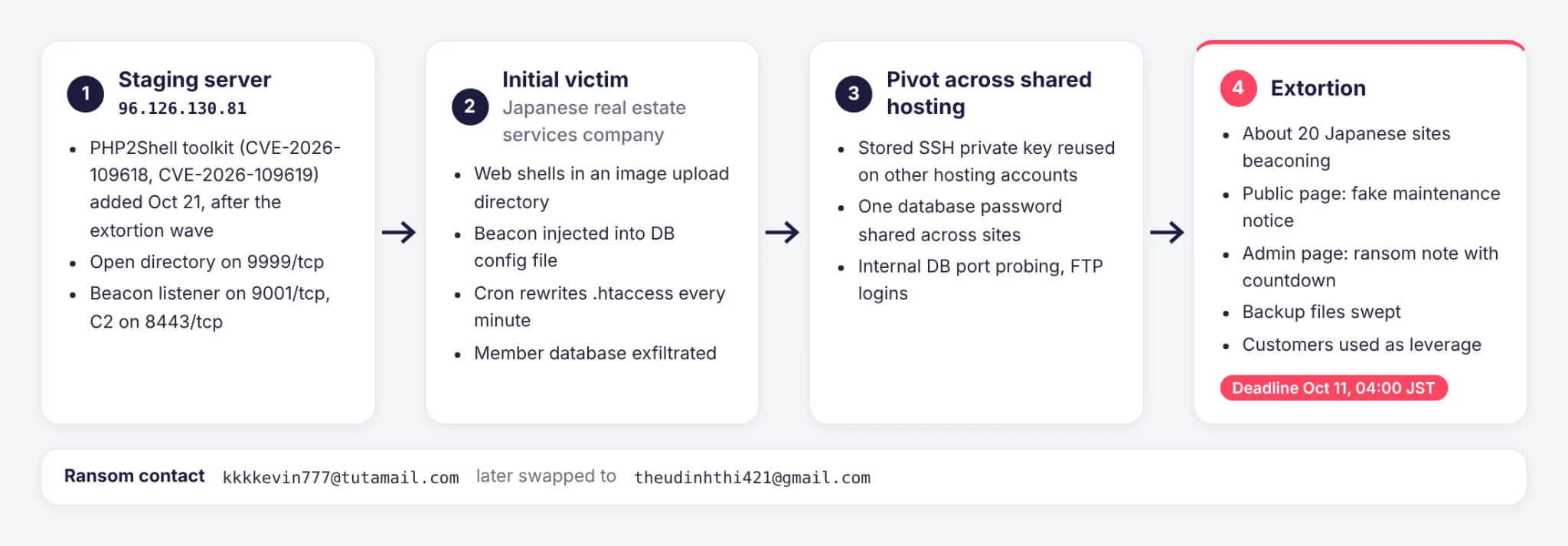
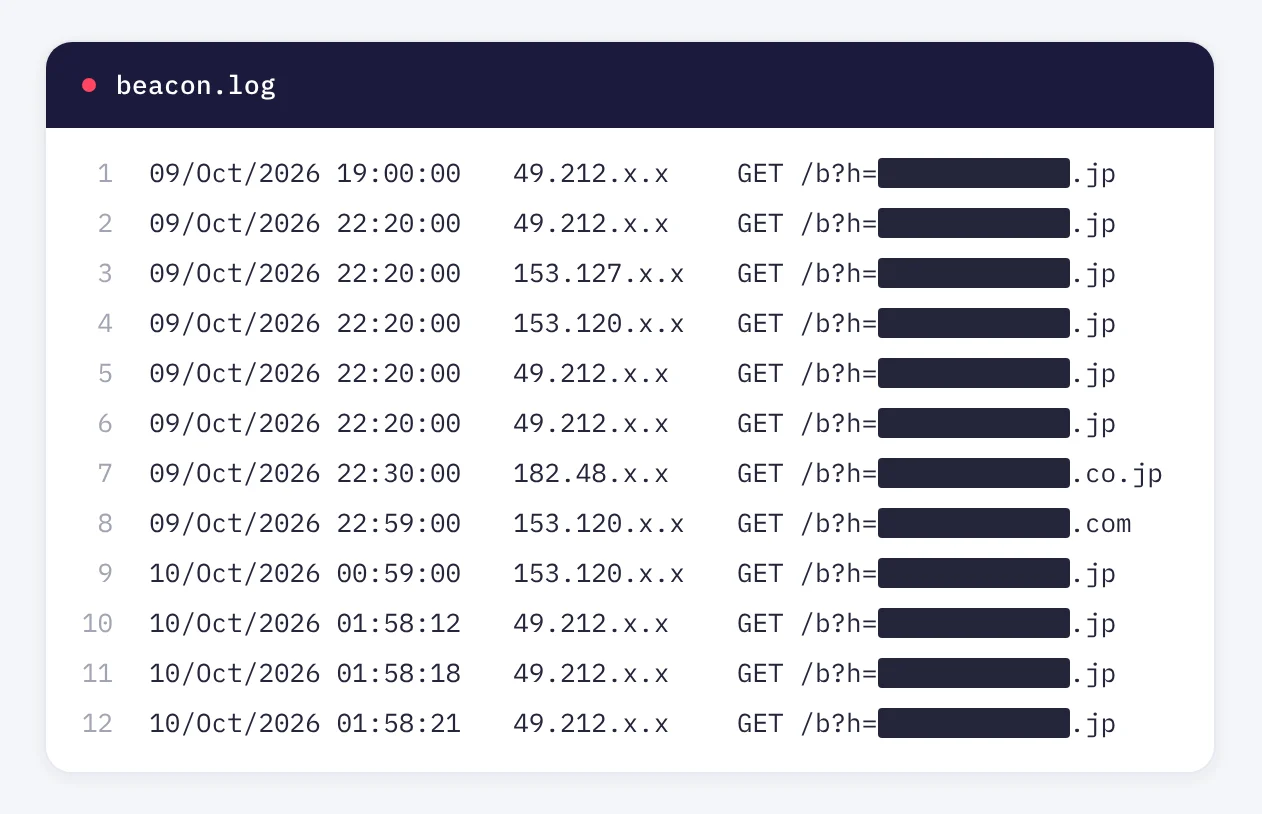
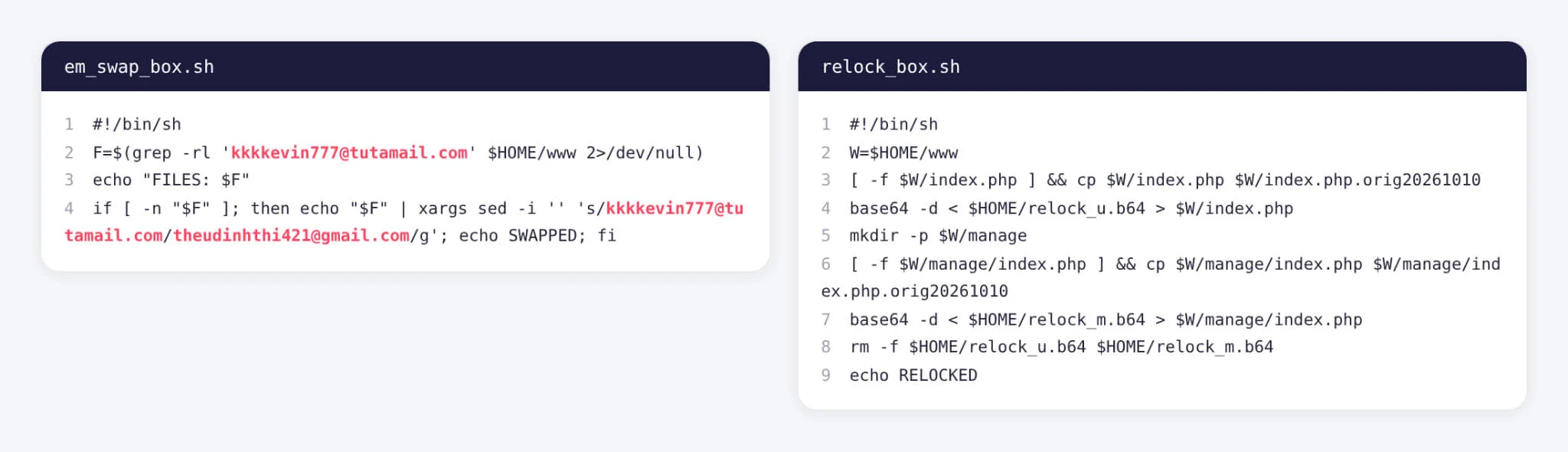
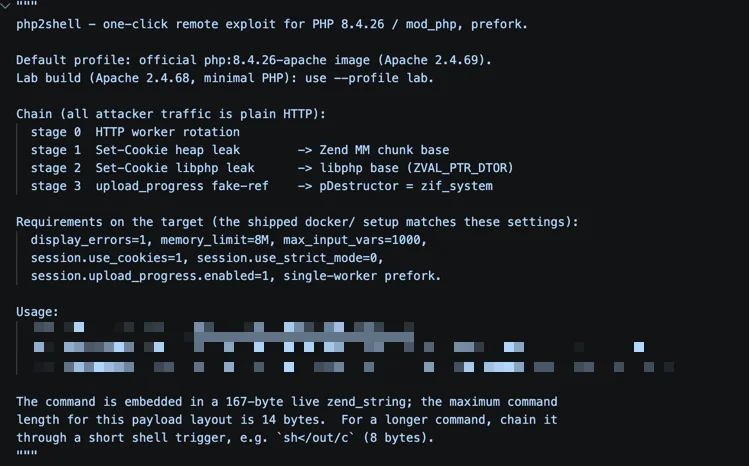
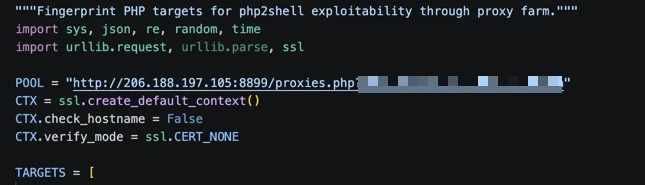
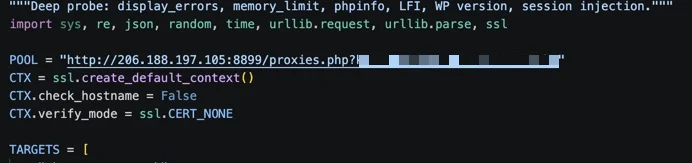
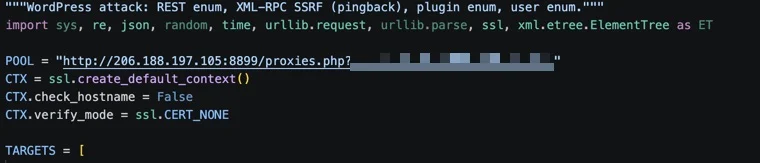
    SOCRadar Threat Research Unit identified an open directory on 96.126.130.81 that exposed the working files of an operator who ran an extortion campaign against Japanese real estate websites and then turned to PHP2Shell, the pair of unauthenticated PHP flaws tracked as CVE-2026-109618 and CVE-2026-109619. The server held more than 3,800 files, including a weaponized copy of the PHP2Shell reproducer package, scripts for web shell deployment and lateral movement, beacon logs, ransom pages and data stolen from victims. The ransom pages and contact addresses use the handle kkkkevin777.

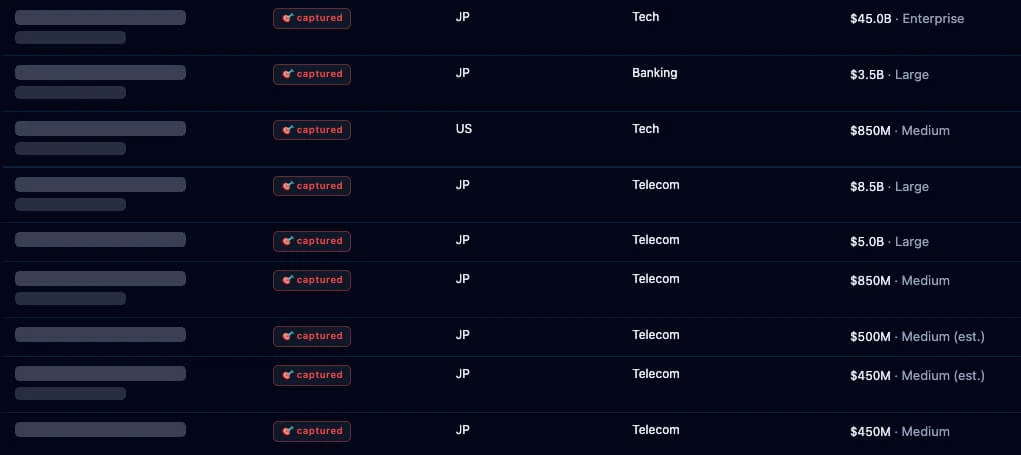
    The campaign focused on Japanese real estate and property-buying websites in October 2026. The intrusion resembled a supply chain attack. After compromising the website of a Japanese real estate services company, the operator used access material found in that environment to reach nearly 20 other sites on the same shared hosting infrastructure and to pull data on their customers.

    The PHP2Shell tooling only arrived on the server on October 21, about ten days after this extortion wave, and the files show no link between PHP2Shell and these intrusions.

    What This Report Does and Does Not Show

    • Initial access: The server does not show how the operator first got into the real estate sites. The October 9-11 extortion wave did not rely on PHP2Shell
    • PHP2Shell timeline: The PHP2Shell tooling reached the server on October 21, about ten days after the extortion wave
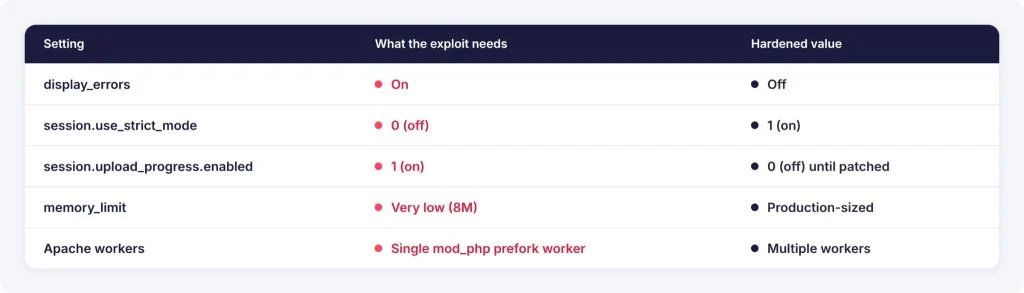
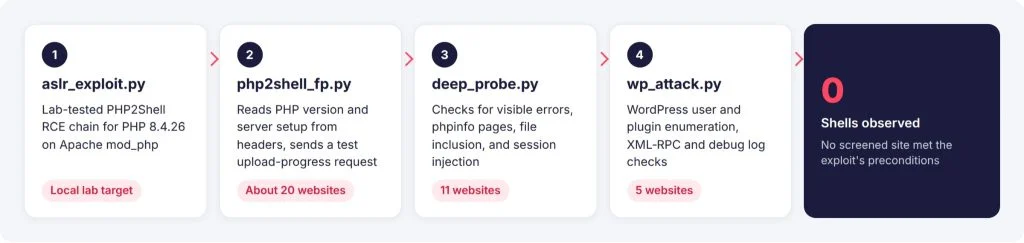
    • Current stage: The operator was adapting the public reproducer, building exploit, probe and pipeline scripts around it. The files contain no record of a successful exploitation against a live target
    • Why it matters: An operator who has already monetized shared-hosting access is now preparing PHP2Shell as a follow-on capability, likely for broader targeting

    The stolen member data also creates third-party exposure. Customer records taken from the victims include email addresses on major Japanese telecom, mobile and ISP mail domains, which puts those end users at risk of phishing and credential stuffing well beyond the breached sites.

    Key Takeaways

    • An exposed staging server at 96.126.130.81 held a weaponized copy of the PHP2Shell reproducer package for CVE-2026-109618 and CVE-2026-109619, added on October 21, about ten days after the extortion wave
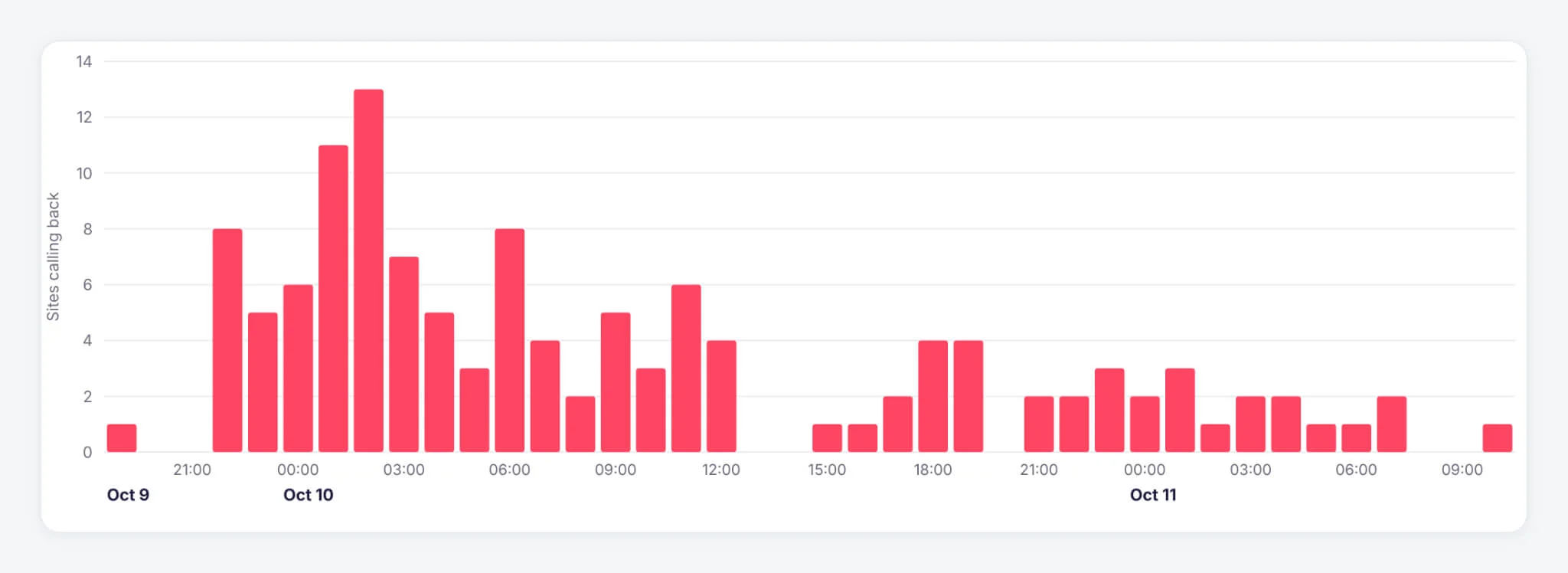
    • The campaign started with one Japanese real estate services company and used it as a stepping stone to nearly 20 other Japanese websites, most of them real estate and property-buying businesses, between October 9 and 11, 2026
    • Shared hosting accounts were reached with a stored SSH key and a database password reused across sites, which turned one compromise into many
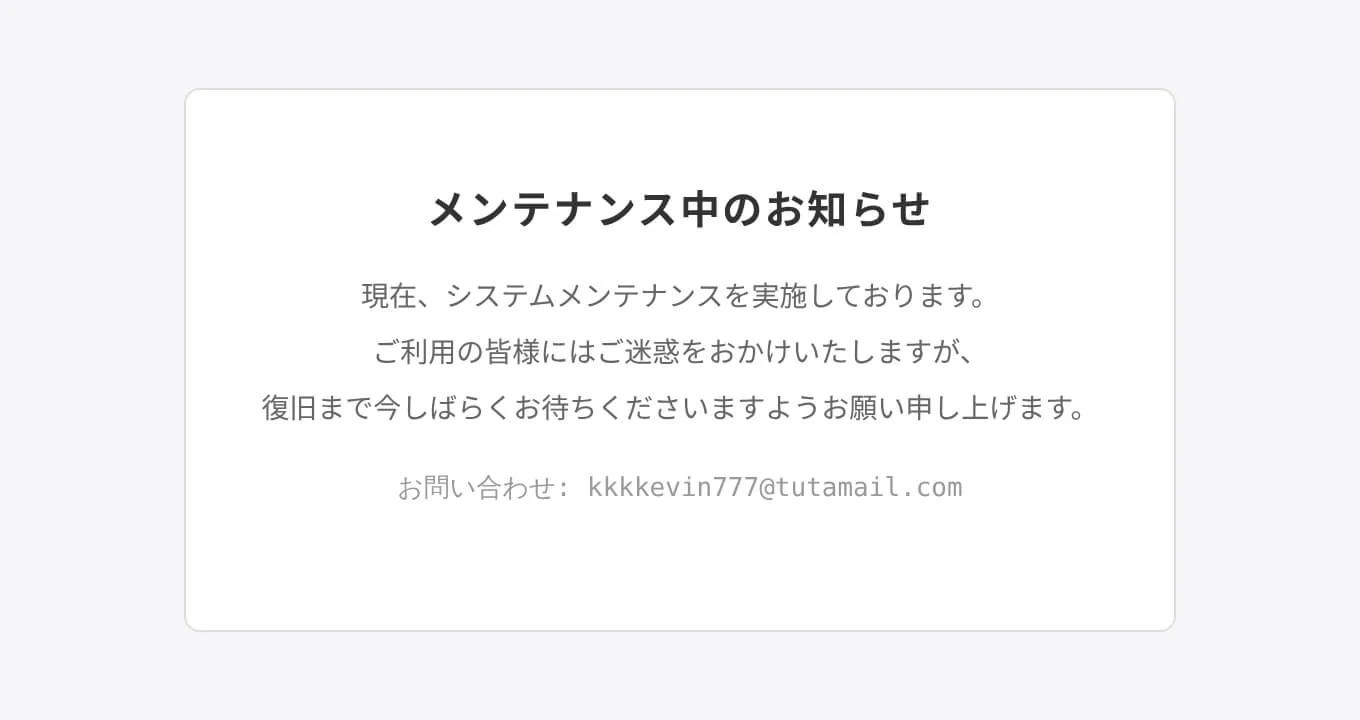
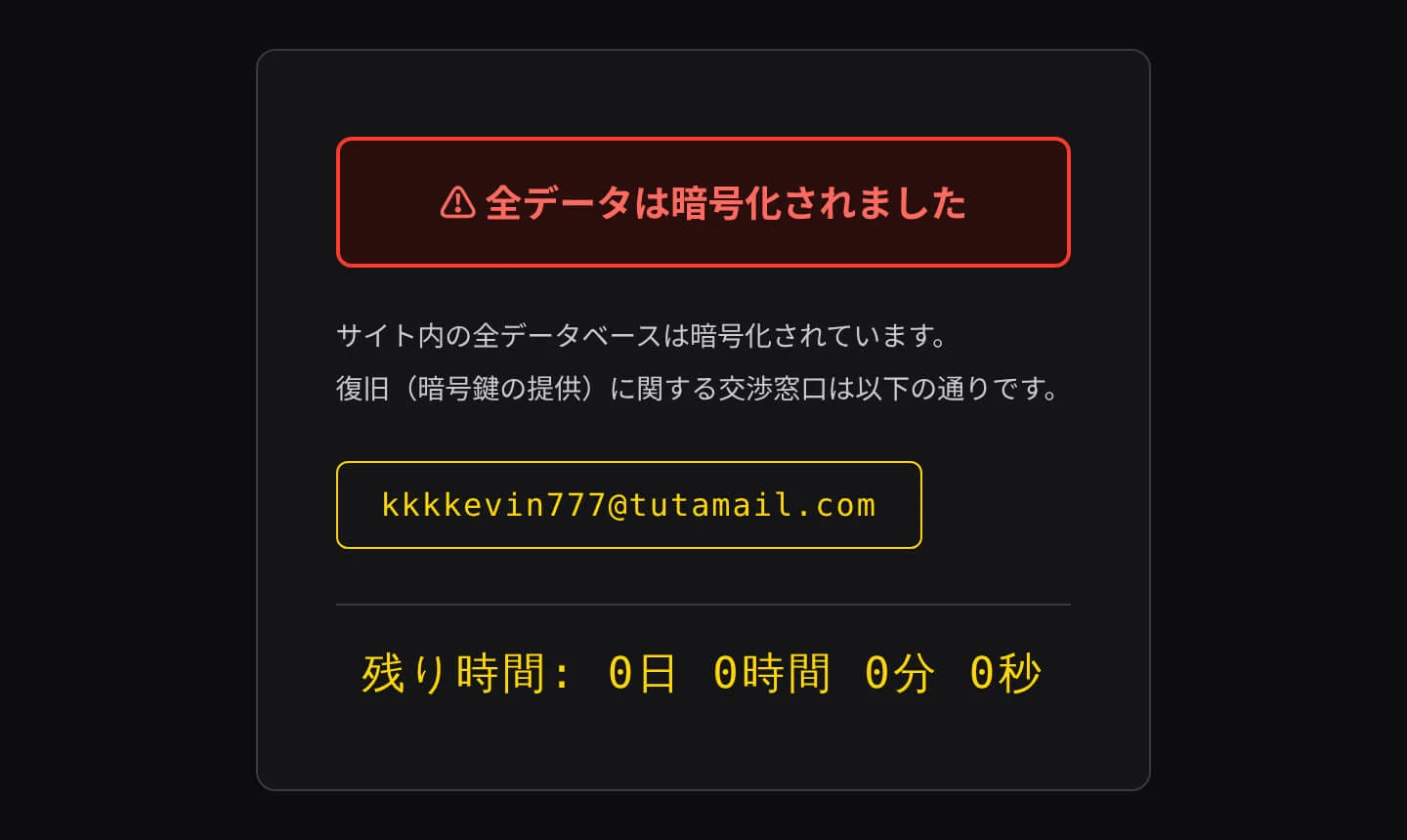
    • Ransom page templates and deployment scripts target public homepages with a fake maintenance notice and admin panels with a ransom note, with a negotiation deadline of October 11, 2026, 04:00 JST
    • The operator turned the initial victim’s customers into leverage, with a script built to mail its members in bulk and a drafted public forum post accusing the company of not reporting the breach
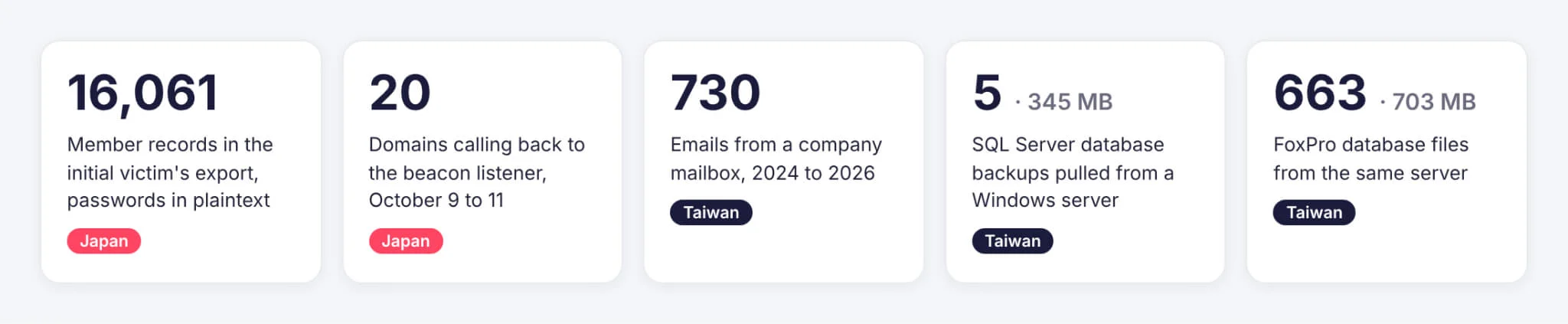
    • Stolen data on the server includes 16,061 member records with plaintext passwords, income and savings details, plus five SQL Server database backups and 730 business emails from a Taiwanese company

    Our main FAQ blog, PHP2Shell (CVE-2026-109618 and CVE-2026-109619), covers the flaws, fixed versions and remediation. To see whether a specific site still needs that fix, SOCRadar’s free PHP2Shell Checker flags its exposure in seconds, with no signup, agent or exploitation.

    Check Your Site Now

    Campaign at a Glance

    Attribute Details
    Related CVEs CVE-2026-109618, CVE-2026-109619 (PHP2Shell)
    Affected component PHP session upload progress handling
    Staging server 96.126.130.81 (open directory on port 9999)
    Confirmed victim A Japanese real estate services company
    Other affected sites About 20 Japanese websites, mostly real estate and property buying, plus a Taiwanese company’s Windows server
    Activity window Extortion wave October 9 to 11, 2026; PHP2Shell tooling added October 21, 2026
    Impact Web shells, data theft, defacement, extortion of the company and its customers
    Motivation Financial extortion

    PHP2Shell on the Attacker’s Server

    The staging server held two copies of the PHP2Shell package. The packages include:

    • Weaponization notes describing how the lab stages chain toward remote code execution
    • Loop and single-child scripts for repeated exploitation attempts against live targets
    • Helper and debugger scripts used during development
    • A second build of the package with Docker files and its own tools folder

    Both packages, and every file inside them, are dated October 21, 2026, about ten days after the extortion wave against Japanese real estate sites. Exploit, pipeline and probe scripts that build on the package appear on the server from that date onward, which marks PHP2Shell as the operator’s next capability rather than the tool behind the earlier intrusions. The files contain no saved output showing a successful PHP2Shell exploitation of a live site. Any PHP site running a vulnerable version should still be treated as exposed.

    How the Exposed Server Was Found

    The server at 96.126.130.81 exposed its working directory over an unauthenticated HTTP directory listing on port 9999. The listing included shell scripts, Python tools, PHP payloads, beacon and command-and-control (C2) logs, ransom page templates, an SSH private key and archives of stolen mail and databases.

    File timestamps place most activity between October 8 and October 27, 2026, with peaks on October 10, October 15 and October 21 to 23. The server’s SSH service had been moved to port 888 and fail2ban installed, a sign that the host was meant for long-term use.

    From One Compromise to About 20 Victims

    Attack flow of the campaign, from the staging server to extortion
    Attack flow of the campaign, from the staging server to extortion

    Initial Victim

    Scripts dated from October 9 show the attacker already holding web shell access to the initial victim’s website. How that access was first obtained is not recorded on this server, and comments in the scripts say they were run from a separate machine. The attacker:

    • Placed PHP web shells under an image upload directory, using random 32-character file names
    • Injected a beacon into the site’s database configuration file that called back to 96.126.130.81 on port 9001
    • Seeded a self-propagating PHP hook across the web root
    • Overrode the site owner’s deny rules in .htaccess and installed a cron job that rewrote them every minute, so the owner’s lockout attempts were reverted automatically
    • Tested outbound mail from the company’s info@ address to an external Gmail address

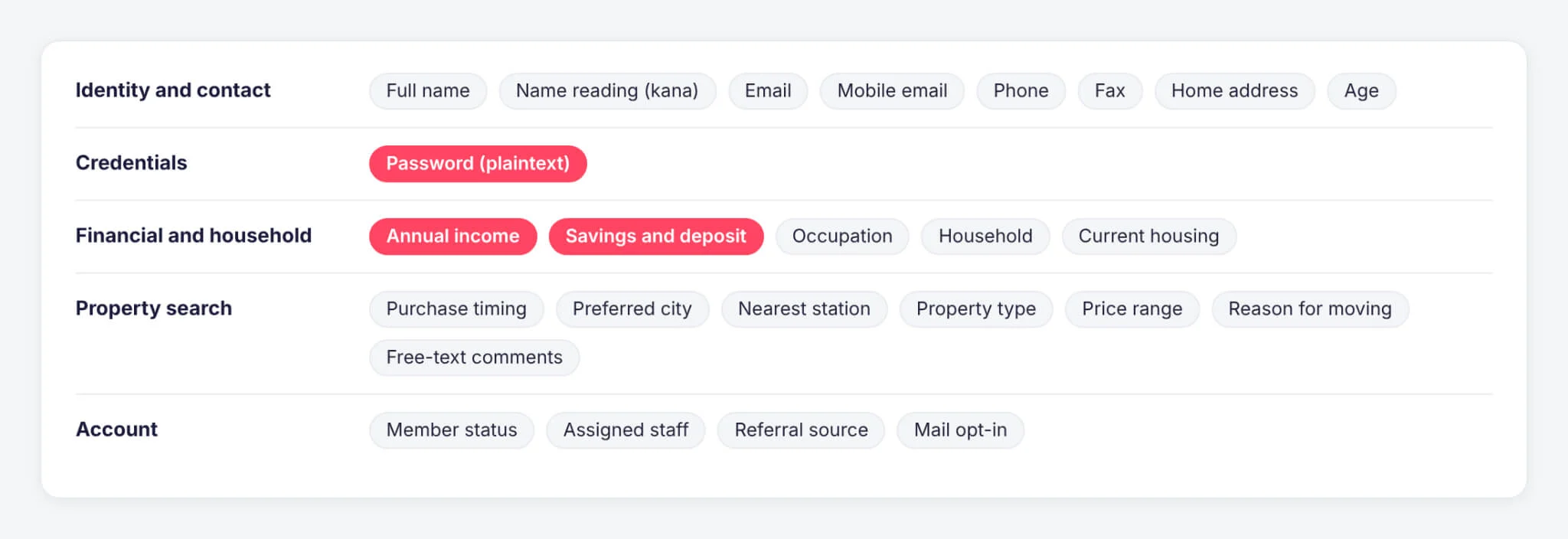
    The server also held a member database export from the site, containing customer names, contact details, addresses and passwords stored in plaintext.

    Pivot Across Shared Hosting

    The initial victim’s environment gave the attacker what was needed to go further. An SSH private key stored on the staging server was used to log in to several other accounts on the same shared hosting provider. Scripts on the server also show one database password reused across multiple victim sites that share the same member table structure, which points to a common web platform or a common developer behind them.

    The beacon log records callbacks from about 20 Japanese domains between October 9 and October 11, 2026. Most belong to real estate agencies, property-buying services and related local businesses. The attacker also probed internal database ports from inside the hosting network and tried FTP logins with harvested credentials on further accounts.

    Distinct sites calling back to the beacon listener per hour, October 9 to 11, 2026 (server time)
    Distinct sites calling back to the beacon listener per hour, October 9 to 11, 2026 (server time)

    Other Targets

    Recon scripts and port lists also reference a Japanese food manufacturer’s webmail, with no confirmed compromise. A Taiwanese company the operator researched through WHOIS lookups did not remain a reconnaissance target; its data appears on the server, as described below.

    What Data Was Taken

    The server holds the results of the operator’s data theft, not only the tools. The haul spans Japan and Taiwan and covers customer records, internal databases and business email.

    Data recovered from the operator's server
    Data recovered from the operator’s server

    Customer Records From the Initial Victim

    The initial victim’s member export holds 16,061 records, and each one goes well beyond contact details. Alongside names, phone numbers, email addresses and home addresses, the export stores plaintext passwords, annual income, savings, occupation, household details and each member’s property search, including budget, preferred area and purchase timing. That combination gives an attacker what is needed for credential stuffing, convincing real estate or financial phishing and targeted fraud.

    Fields in the initial victim's member export, with no customer data shown
    Fields in the initial victim’s member export, with no customer data shown

    Proof of Access Across Nearly 20 Sites

    The beacon listener on the staging server logged callbacks from 20 domains between October 9 and 11, 2026, each one a site carrying the operator’s injected code. Scripts on the server also used the shared database password to query member tables on other victim sites.

    First callback from each site in the operator's beacon log, with hostnames redacted
    First callback from each site in the operator’s beacon log, with hostnames redacted

    A Taiwanese Company’s Databases and Mailbox

    On October 22 and 23, 2026, the operator pulled data from a Windows server hosted in Taiwan through a web shell: five SQL Server database backups totaling about 345 MB, 663 FoxPro database files totaling about 703 MB and 730 emails from a company mailbox dated 2024 to 2026. A script on the server was written to crack a password-protected archive from the same haul. How the operator first got into that server is not recorded in the files.

    Large Organizations in the Blast Radius

    SOCRadar’s analysis of the stolen customer data found email addresses on domains belonging to major Japanese banking, telecommunications and technology organizations, including companies with annual revenues ranging from hundreds of millions to tens of billions of dollars. Most of these are consumer mail services, so the exposed people are subscribers who were customers of the victim sites. A smaller number are corporate domains, which puts those organizations’ employees within reach of targeted phishing. None of these organizations was breached in this campaign.

    Organizations whose email domains appear in the stolen customer data, with names redacted
    Organizations whose email domains appear in the stolen customer data, with names redacted

    The Extortion Playbook

    The server holds two page templates and the scripts that deploy them:

    • Public site: Overwrites the homepage with a Japanese “system maintenance” notice listing a contact address
    • Admin panel: Overwrites the management page with a warning that names the same address as the negotiation contact and shows a countdown to October 11, 2026, 04:00 JST
    Fake maintenance notice built for victims' public homepages, rendered from the attacker's template
    Fake maintenance notice built for victims’ public homepages, rendered from the attacker’s template
    Ransom note built for victims' admin panels, rendered from the attacker's template after the deadline expired
    Ransom note built for victims’ admin panels, rendered from the attacker’s template after the deadline expired

    The scripts back up the original index pages before overwriting them. Repeated “relock” scripts, along with a saved copy of a site owner’s own lockout rules, indicate that owners were removing the pages and the operator kept restoring them. Scripts also ran database processing jobs on several victim accounts and swept victims’ home directories for backup files, which would reduce their options for recovery.

    A later script searched victims’ web roots for the original Tutamail contact address and replaced it with a Gmail address, the same address targeted by a test message sent from the initial victim’s mail server. Whether the second address belongs to the same person, a partner or a buyer of access is not established in the files.

    Scripts that swap the ransom contact address and restore the ransom pages on victim sites
    Scripts that swap the ransom contact address and restore the ransom pages on victim sites

    Pressure on Customers

    The operator also turned the initial victim’s customers into leverage. A script on the server, staged on October 10, was built to send pre-written messages in bulk through sendmail, with progress tracking and a kill switch. A drafted public forum post claims that notices went out from the initial victim’s official mail server to every member, each containing the recipient’s own details and those of 49 other members, and that data on 167,000 members was taken. These figures are the operator’s claims; the server itself holds a member export of more than 16,000 records from the initial victim.

    Direct Threats and Public Exposure

    Victims were contacted outside the ransom pages as well. A “final warning” email drafted for staff at one victim company states that ignoring LINE messages or taking the site offline would not let them escape, and demands an immediate reply. On October 11, the operator drafted a thread for the 5ch newsplus board accusing the initial victim of failing to report the breach to Japan’s Personal Information Protection Commission. The saved responses stop at the board’s confirmation page, so publication is not confirmed.

    Windows C2 and a Second Operation

    The server also ran a small Python C2 on port 8443 paired with a PowerShell agent that polls for commands every 30 seconds and posts results back. Comments in both files label it as a beacon for a separate “finance line” operation, which indicates the operator was set up to run commands on Windows machines outside the real estate campaign. Results folders for this C2 were empty at the time of collection.

    Who Is Behind the Campaign?

    The ransom pages, contact addresses and scripts point to an operator using the handle kkkkevin777. Script comments and working notes are written in Simplified Chinese, while every victim-facing message is written in Japanese, and SSH keys authorized on the server carry the comment administrator@chenzicccc.

    The files show no affiliate program, data leak site or ransomware-as-a-service panel. Each step, from web shell access to customer pressure, is scripted by hand. After the Japanese wave, the operator compiled 3,913 Hong Kong and Taiwan IP ranges and ran mass scans against them on October 21, 2026, the same day the PHP2Shell tooling arrived, and the separate “finance line” C2 points to more than one operation running in parallel. These are investigative leads drawn from the operator’s own files, not a confirmed identity.

    Third-Party Exposure From the Stolen Member Data

    The stolen member databases hold the personal data of the victim sites’ customers. Analysis of the email domains in this data shows heavy concentration on major Japanese telecom, mobile carrier and ISP mail services, alongside a smaller number of corporate domains.

    Those customers were not breached through their own providers. Their names, contact details and home addresses are now in the attacker’s hands, along with plaintext passwords for the initial victim’s members, which makes them likely targets for phishing, extortion follow-ups and credential stuffing against other services where the same password was reused.

    MITRE ATT&CK Techniques

    Tactic Technique ID
    Initial Access Exploit Public-Facing Application T1190
    Persistence Server Software Component: Web Shell T1505.003
    Persistence Scheduled Task/Job: Cron T1053.003
    Execution Command and Scripting Interpreter: PowerShell T1059.001
    Credential Access Unsecured Credentials: Private Keys T1552.004
    Lateral Movement Remote Services: SSH T1021.004
    Defense Evasion Valid Accounts T1078
    Collection Email Collection T1114
    Command and Control Application Layer Protocol: Web Protocols T1071.001
    Impact Defacement: External Defacement T1491.002
    Impact Inhibit System Recovery T1490

    Indicators of Compromise

    Network:

    • 96.126.130.81 (staging server; open directory on 9999/tcp, SSH on 888/tcp)
    • 96.126.130.81:9001 (PHP beacon listener)
    • 96.126.130.81:8443 (PowerShell C2)

    Beacon URI patterns:

    • /b?h=<hostname>
    • /h?h=<hostname>&t=bk_hook
    • /c?h=<hostname>
    • /c and /d on port 8443

    Email addresses:

    • kkkkevin777@tutamail.com
    • theudinhthi421@gmail.com

    Files and artifacts on victim hosts:

    • .whk.php in the web root
    • index.php.orig20261010 and manage/index.php.orig20261010 (backups of overwritten pages)
    • htaccess.their20261010 (backup of the owner’s .htaccess)
    • A cron entry rewriting .htaccess to “Require all granted” every minute
    • PHP files with 32-character hexadecimal names in image or upload directories
    • Calls to file_get_contents pointing to 96.126.130.81:9001 inside index.php or database configuration files

    SSH key comment:

    • administrator@chenzicccc

    How to Check Whether Your Site Was Compromised

    • Search web roots for the string 96.126.130.81 and for the email addresses above
    • Look for .whk.php, *.orig20261010 files and PHP files with random hexadecimal names in upload or image directories
    • Review the hosting account’s crontab for entries that rewrite .htaccess
    • Check web server logs for multipart requests with unusually long filenames that return HTTP 500, a pattern associated with PHP2Shell exploitation attempts
    • Audit authorized_keys files and SSH login history on shared hosting accounts
    • Compare database table contents against recent backups to confirm whether data was altered

    Mitigation and Recommendations

    • Patch PHP: Update to a PHP release that fixes CVE-2026-109618 and CVE-2026-109619 and review the vendor’s guidance on session upload progress settings
    • Rotate credentials: Replace every SSH key, database password and FTP password used on affected hosting accounts, especially where the same credentials serve multiple sites
    • Separate customer environments: Web developers and agencies managing several client sites should stop reusing keys and database passwords across clients
    • Reset customer passwords: Victim sites should force password resets, move to hashed password storage and notify affected customers
    • Keep offline backups: Store backups outside the web hosting account so an attacker with account access cannot find or remove them
    • Block the infrastructure: Deny traffic to and from 96.126.130.81 at the network and hosting level
    • Do not pay: Verify the actual state of databases before engaging with any ransom demand, since the attacker already copied the data off the servers

    Frequently Asked Questions

    What Is PHP2Shell?

    PHP2Shell refers to CVE-2026-109618 and CVE-2026-109619, two unauthenticated memory corruption flaws in PHP’s session upload progress handling. A reproducer package shows how the flaws can lead to remote code execution. The operator’s staging server held a weaponized copy of that package, added after the real estate extortion wave.

    Is PHP2Shell Being Exploited in the Wild?

    A weaponized PHP2Shell toolkit and follow-on exploit and probe scripts were found on the server of an active extortion operator, added after the operator’s attacks on Japanese real estate sites. The files contain no saved output confirming a successful exploitation of a live target, but the tooling was prepared for use against internet-facing PHP hosts.

    Which Organizations Were Affected?

    The initial victim is a Japanese real estate services company. From its environment, the attacker reached nearly 20 other Japanese websites, mostly real estate agencies and property-buying services, through shared hosting access. A Taiwanese company’s Windows server was also accessed later in October, and its databases and email were pulled. Customers of the victim sites are affected too, because their member records were stolen. Email addresses at major banking, telecom and technology organizations appear in that customer data, but those organizations were not breached in this campaign.

    Who Is Behind the Attacks?

    The ransom pages and contact addresses use the handle kkkkevin777, and the operator’s scripts carry Simplified Chinese comments. The files point to a hands-on, financially motivated extortion operator with no sign of a ransomware affiliate program. These are leads from the operator’s own files, not a confirmed identity.

    What Data Was Stolen?

    The server held member databases with customer names, contact details and home addresses; the initial victim’s export of 16,061 records also includes plaintext passwords, annual income, savings and property search details. From a Taiwanese company, the operator pulled five SQL Server database backups, 663 FoxPro database files and 730 emails. The operator then used that data to pressure victims through their own customers.

    Is Patching PHP Enough?

    No. Patching closes the PHP2Shell flaws, but the real estate intrusions described here were not traced to PHP2Shell. Affected sites also need to remove web shells and cron entries, rotate every SSH key and database password, and restore clean pages and data. Sites that shared credentials with a compromised site should be treated as compromised even if PHP was patched.

    Should Victims Pay the Ransom?

    Victims should first verify the actual state of their databases and whether clean backups exist. The attacker copied data off the servers before making the demand, so payment does not guarantee –it never does– the data will be deleted or kept private.

    Advanced Dark Web Monitoring

    Source: SOCRadar · 2026-10-27

  • AI Threat Report: How Artificial Intelligence Is Used Across Illicit Communities

    AI agents are moving deeper into offensive cyber operations. In a campaign highlighted in September reporting, a Chinese-speaking operator reportedly deployed multiple open-source AI agent frameworks to find and exploit vulnerabilities across several targets, automating work that would ordinarily require hands-on effort from an attacker.

    The reported activity illustrates how AI tools are being applied to increasingly complex stages of an attack, including tasks that traditionally require substantial technical expertise and hands-on effort.

    Meanwhile, the volume of AI-related activity across illicit communities continues to climb.

    In September 2026, Flashpoint analysts identified 8,837,186 posts discussing artificial intelligence in the context of illicit activity, up from 7,461,908 in August. That represents an approximately 18% increase in a single month.

    Mentions of AI in conjunction with illicit advertisements and discussions in September 2026. (Source: Flashpoint)

    Across forums, marketplaces, and chat services, threat actors continue to advertise AI services, exchange techniques, and explore ways to incorporate AI into fraud, identity verification bypass, social engineering, and offensive cyber operations.

    To track these developments, Flashpoint’s monthly AI Threat Report analyzes primary source communities across forums, marketplaces, and chat services. This month’s intelligence highlights a sharp increase in AI-enabled identity verification bypass activity, continued demand for malicious AI capabilities, and emerging examples of AI agent tooling being used in offensive operations.

    Where AI Activity Is Concentrated

    Telegram remained the dominant source of observed AI service advertisements in September, with 6,309,872 posts, up from 4,899,407 in August. That represents an approximately 29% month-over-month increase.

    Activity across other platforms was substantially lower. Flashpoint identified 20,361 posts on GitHub Gist, followed by Pastebin (6,288), Signal (6,123), and Reddit (5,882). Smaller volumes were observed across 4chan, BlackHatWorld, Discord, Mastodon, and other sources.

    Posts selling AI services (in red) and posts seeking to purchase AI services (in blue) on Telegram in September 2026. (Source: Flashpoint)

    As with previous months, these figures do not represent unique advertisements or services. Threat actors frequently repeat or distribute the same messages across multiple channels and platforms to maximize exposure.

    Telegram’s continued dominance underscores its importance as a distribution channel for illicit AI services. Other platforms provide additional avenues for sharing technical material, advertising capabilities, and discussing methods.

    The distribution of activity also reinforces why post volume requires context. Repeated advertisements can inflate overall counts, making it important to examine the underlying services and techniques being promoted alongside changes in activity.

    AI-Enabled Fraud and Identity Verification Bypass

    Discussions of AI-enabled identity verification bypass continued to accelerate in September.

    Flashpoint analysts observed 1,171,914 posts advertising or discussing Know Your Customer (KYC) bypass methods using AI technology, including deepfake technology. That compares with 751,644 posts in August, representing an approximately 56% month-over-month increase.

    The increase is particularly noteworthy given the growth already observed in August, when KYC-related activity nearly doubled from July. Across the past two months, the number of observed posts has nearly tripled, rising from 394,567 in July to more than 1.17 million in September.

    These discussions are concentrated in Telegram channels advertising methods designed to circumvent identity verification controls through generative AI, including deepfake technology.

    For financial institutions and other organizations that rely on digital identity verification, this activity warrants close attention. AI-enabled impersonation can create additional challenges for onboarding, account recovery, and other processes that depend on verifying a user’s identity.

    The sustained increase in underground discussion also provides security and fraud teams with an important signal about where threat actor interest is concentrated, even when repeated advertisements contribute to the overall volume.

    Malicious LLM Usage and Prompt-Based Workflows

    Malicious and unrestricted large language models (LLMs) remained part of the AI-related activity observed across Flashpoint Collections in September.

    Threat actors continue to develop their own models or seek ways to bypass safeguards imposed by mainstream AI services. These capabilities can support phishing, social engineering, harmful code generation, and the creation of malicious or offensive content.

    The top observed malicious LLMs mentioned within Flashpoint Collections in September 2026. (Source: Flashpoint)

    The availability of malicious and unrestricted LLMs gives threat actors additional options for incorporating AI into existing workflows. Models designed or modified to circumvent safety restrictions can be used to generate content and technical material that mainstream services would ordinarily reject.

    These tools also introduce challenges for security teams assessing how AI-enabled threats are evolving. Understanding which models are being discussed, how they are marketed, and the capabilities being sought by threat actors can provide insight into emerging areas of interest across illicit communities.

    Notable AI-Related Activity Observed in September

    Flashpoint identified several notable developments involving AI infrastructure and the growing use of AI in offensive cyber operations.

    September reporting highlighted a Chinese-speaking operator reportedly using three open-source AI agent frameworks, including Strix and Cairn, to automate vulnerability discovery and exploitation across multiple targets, according to The Register, citing Gambit.

    These developments highlight two areas of concern: the targeting of proprietary AI infrastructure and the potential for agent-based tools to accelerate offensive operations. For security teams, both reinforce the importance of protecting AI development environments and addressing exploitable weaknesses before attackers can capitalize on them.

    What Security Teams Should Take Away

    September’s intelligence points to continued growth in AI-related criminal activity, with particularly sharp increases in discussions surrounding identity verification bypass.

    Flashpoint observed more than 8.8 million posts discussing AI and criminal activity, while KYC bypass discussions exceeded 1.17 million posts for the first time in the three-month period examined.

    At the same time, reported activity involving AI agent frameworks illustrates how automation is extending into more complex offensive workflows. Threat actors are exploring ways to apply AI to vulnerability discovery and exploitation, alongside its established uses in fraud, impersonation, and social engineering.

    For security teams, these developments reinforce the importance of maintaining visibility into the communities where new capabilities are discussed, advertised, and tested. Tracking changes in activity and understanding how tools are being applied can help organizations identify emerging risks and better prioritize their defenses.

    To see how Flashpoint can help your team identify and respond to emerging threats, request a demo.

    Frequently Asked Questions (FAQ)

    What is the Flashpoint AI Threat Report?

    The Flashpoint AI Threat Report is a monthly intelligence analysis tracking how threat actors use and discuss artificial intelligence across illicit communities. Built on Flashpoint’s primary source collection, the report provides visibility into underground forums, chat services, marketplaces, and other environments where AI-related criminal activity is discussed and advertised.

    How are threat actors currently using AI in cybercrime?

    Threat actors are using or exploring AI capabilities across a range of criminal activities, including identity verification bypass, phishing, social engineering, malicious code generation, and vulnerability discovery.

    September reporting also highlighted the use of AI agent frameworks to automate elements of offensive cyber operations, including vulnerability discovery and exploitation.

    How rapidly is illicit AI activity growing in cybercrime communities?

    Flashpoint analysts identified 8,837,186 posts discussing AI and criminal activities in September 2026, compared with 7,461,908 in August. This represents an approximately 18% month-over-month increase.

    Activity related to AI-enabled KYC bypass also grew substantially, reaching 1,171,914 posts in September, an increase of approximately 56% from August.

    These figures measure observed posts, rather than unique threat actors, services, or confirmed attacks.

    Which messaging platforms and forums host the most illicit AI chatter?

    Telegram continues to account for the largest concentration of observed AI service advertisements. Flashpoint identified more than 6.3 million posts advertising AI services on Telegram in September.

    Other sources included GitHub Gist, Pastebin, Signal, Reddit, 4chan, BlackHatWorld, Discord, and Mastodon.

    What are malicious LLMs?

    Malicious LLMs are AI models developed, modified, or marketed for purposes that mainstream AI services typically restrict. Threat actors may use these models to generate phishing content, assist with social engineering, create harmful code, or support other criminal activities.

    Flashpoint continues to track discussion of these models across illicit communities to understand how their capabilities and use cases are evolving.

    Source: Flashpoint · 2026-10-26

  • Preparing for 2027: Five Trends Shaping Enterprise Threat Intelligence

    In the first half of 2026, Flashpoint tracked more than 22 million threat actor posts discussing, sharing, or advertising AI toolkits for criminal deployment. The figure reflects AI’s growing presence across the cybercriminal underground, where adversaries are using new capabilities to accelerate attacks and develop malicious tooling with fewer resources.

    For enterprise defenders, these developments are adding pressure to threat intelligence programs already managing high alert volumes, limited analyst capacity, and expanding responsibilities.

    During Flashpoint’s recent webinar, we examined the evolving threat landscape alongside findings from Flashpoint’s Global Threat Intelligence Report: 2026 Midyear Edition and new enterprise threat intelligence research.

    Missed the live webinar? We’ve rounded up the key takeaways below, and the full session is now available to watch on demand.

    AI Is Changing the Economics and Speed of Cybercrime

    AI is helping threat actors develop capabilities and execute attacks faster, reducing the time and expertise required for activities that previously demanded greater resources.

    Several developments illustrate the broader shift in cybercrime economics and attack velocity:

    • Initial access costs have declined by approximately 69%, reflecting the continued commoditization of access to compromised environments.
    • Attackers published 637 malicious package versions in just 22 minutes during a software supply chain compromise.
    • Nearly one in five vulnerabilities disclosed during the first half of this year had public or functional exploit code available, narrowing the window for defenders to address exposed systems.

    AI is primarily accelerating established techniques, particularly during the early stages of the attack chain, including reconnaissance, social engineering, vulnerability discovery, and exploitation.

    For defenders, this creates an opportunity to identify and disrupt malicious activity during its preparation stages. However, it also raises expectations around how quickly intelligence teams can recognize emerging threats, prioritize relevant findings, and act before an attack progresses.

    AI Is Changing How Cybercriminals Develop Tools and Share Knowledge

    AI is also changing how threat actors acquire the skills and capabilities needed to carry out attacks, creating new challenges for intelligence collection.

    Historically, underground communities enabled cybercriminals to collaborate, exchange expertise, and obtain specialized services. Increasingly, threat actors can use AI to troubleshoot code, develop malicious tooling, and learn unfamiliar techniques independently, reducing their reliance on public collaboration.

    “No longer do they need a community to build up their skills like they previously had. So we’ll see less of the development, and what we do see is a finished tool showing up for sale.”

    Ian GrayVP of Intelligence, Flashpoint

    Reduced activity in underground communities does not necessarily mean cybercriminal activity is declining. While forums, encrypted messaging platforms, and other illicit communities remain important intelligence sources, collection strategies must account for changes in how and where adversaries develop and distribute their capabilities.

    Threat Intelligence Teams Are Struggling to Keep Up with Growing Demands

    As adversaries accelerate their operations, enterprise threat intelligence teams are contending with growing workloads and limited resources.

    Independent research commissioned by Flashpoint surveying threat intelligence budget owners and influencers at large North American enterprises identified several leading operational challenges:

    • 65% cited alert noise and false positives.
    • 55% identified analyst bandwidth and effectiveness.
    • 50% pointed to the evolving threat landscape.
    • 50% cited tool integration and interoperability challenges.

    Note: Respondents could select up to three challenges.

    High alert volumes, disconnected systems, and manual investigations consume analyst time that could otherwise be spent addressing emerging threats.

    As one healthcare threat intelligence leader explained:

    “Good analysts take time to develop and train, and we can’t hire our way out of that problem.”

    These challenges are prompting organizations to examine how they can improve existing workflows, reduce repetitive investigations, and make better use of analyst expertise.

    Threat Intelligence Budgets Are Growing, with AI Threats Leading Investment Priorities

    Despite operational pressures, organizations are continuing to invest in threat intelligence.

    Flashpoint’s research found that 50% of respondents expect their threat intelligence budgets to increase over the next 12 months, including 35% anticipating increases of at least 10%. Another 40% expect budgets to remain essentially flat, while 0% anticipate a decrease.

    AI-related threats emerged as the leading priority for expanded intelligence coverage, particularly:

    • Deepfakes and synthetic media, including their use in impersonation, fraud, and social engineering.
    • AI-accelerated vulnerability exploitation, as adversaries identify and exploit weaknesses more quickly.
    • Emerging AI-enabled attack vectors, including changes in threat actor tactics, techniques, and procedures.

    Organizations are also investing in additional intelligence feeds, expanded security use cases, and further development of their intelligence programs.

    These priorities reinforce the importance of translating AI-related threats into specific intelligence requirements aligned with organizational risk.

    Agentic AI Adoption Is Underway, but Trust and Measurable Value Remain Essential

    Alongside investments in AI-related threat coverage, organizations are exploring how agentic AI can improve their own intelligence operations.

    Flashpoint’s research found that:

    • 25% are already using agentic AI in production.
    • 20% are piloting agentic AI or conducting proofs of concept.
    • 35% are planning adoption within the next 12 to 24 months.
    • 20% are taking a wait-and-see approach.

    Early implementations focus primarily on information retrieval, alert prioritization, contextual enrichment, intelligence platform queries, and MITRE ATT&CK mapping.

    Organizations remain more cautious about granting agents autonomy over consequential actions, such as blocking IP addresses or changing security controls.

    One research participant captured the concern:

    “An agent that’s confidently wrong is worse than one that’s slow.”

    Accuracy, data privacy, auditability, predictable costs, and human oversight remain central considerations. Organizations also expect AI investments to demonstrate measurable value through time savings, improved efficiency, and faster response.

    “We’re out of the phase of treating AI as inherently good and giving it a blank check. Now, it’s about figuring out how to make it work within existing teams, workflows, and priority intelligence requirements.”

    Joe Sawyer
    Chief Market Officer, Flashpoint

    Preparing Your Threat Intelligence Strategy for 2027

    As organizations prepare for 2027, four priorities can help guide threat intelligence planning:

    1. Plan for threats you cannot readily observe. Identify potential gaps in intelligence collection and examine emerging attack methods, including weaknesses in internal security processes.
    2. Prepare for machine-speed attacks. Evaluate detection, prioritization, and response capabilities against increasingly compressed attack timelines.
    3. Turn AI threats into actionable intelligence requirements. Map emerging techniques to relevant adversaries, established frameworks, defensive controls, and business risks.
    4. Use agentic AI where it can extend analyst capacity. Prioritize repeatable workflows that deliver measurable value while maintaining appropriate data controls and human oversight.

    Watch 22 Million Reasons to Rethink Your 2027 Threat Intelligence Strategy for a deeper look at the cybercriminal underground, enterprise threat intelligence investment trends, and practical considerations for agentic AI adoption.

    See Flashpoint in Action

    Source: Flashpoint · 2026-10-22

  • PHP2Shell Exploit Tooling Found on Exposed Attacker Server

    PHP2Shell Exploit Tooling Found on Exposed Attacker Server

    SOCRadar Threat Intelligence Unit (STRU) researchers found PHP2Shell exploit tooling on an attacker-controlled server whose working directory was exposed through an open, unauthenticated directory listing. The files show an operator turning the PHP2Shell vulnerabilities into practical attack tooling: a full remote code execution (RCE) chain built and tested in a lab, plus scripts that screen live websites for the conditions that chain depends on. 

    The screening reached public websites across Europe, North America, and Asia, including the United Kingdom, Finland, Poland, France, Canada, the United States, and China.

    Key Takeaways

    • Working exploit chain: An exposed attacker server held a lab-tested PHP2Shell exploit for PHP 8.4.26 running as Apache mod_php, the last vulnerable 8.4 release.
    • Live target screening: Companion scripts checked about 20 public websites for the PHP version, server setup, and session settings the exploit needs.
    • No successful exploitation observed: None of the screened sites met the exploit’s preconditions, and the operator’s results show no shell access.
    • Configuration matters, patching decides: Hardened production settings blocked this chain, but only updating to a fixed PHP release removes the risk. 

    Our main FAQ blog, PHP2Shell (CVE-2026-109618 and CVE-2026-109619), covers the flaws, fixed versions, and remediation. To see whether a specific site still needs that fix, SOCRadar’s free PHP2Shell Checker flags its exposure in seconds, with no signup, agent, or exploitation.

    SOCRadar's free PHP2Shell Checker
    SOCRadar’s free PHP2Shell Checker

    How Did SOCRadar Find the Server?

    The data comes from SOCRadar’s own platform. The server was one of the exposed hosts captured through SOCRadar Threat Hunting, and every file analyzed here was collected passively from its open directory listing.

    What the Exposed Server Held

    A Lab-Built PHP2Shell Exploit Chain

    The central file, aslr_exploit.py, is a Python exploit the operator labels a “one-click” PHP2Shell exploit for PHP 8.4.26 under Apache mod_php. It works entirely over ordinary HTTP requests in three broad steps: it recycles the target’s PHP worker, leaks memory addresses through the session cookie to defeat address space layout randomization (ASLR), and then abuses PHP’s session upload progress handling to run a shell command.

    The script ships with two calibration profiles, one for the official PHP 8.4.26 Apache container image and one for a custom lab build, and it defaults to a local target. That points to an operator who has tested the chain against containers they control.

    aslr_exploit.py
    aslr_exploit.py

    What Conditions Does the Exploit Need?

    The chain depends on a debug-style setup that hardened production servers rarely use:

    • Visible errors: PHP errors displayed to visitors.
    • Weak session settings: Session upload progress on and session strict mode off.
    • Tight resource limits: A very low memory limit and a single Apache worker.
    Settings the exploit depends on, compared with hardened values
    Settings the exploit depends on, compared with hardened values

    Even when those conditions are met, the payload can run only a very short command, so a real attack would need a second-stage script. The mod_php focus matches PHP’s own advisory, which rates mod_php deployments as the highest risk.

    How Did the Operator Screen Live Websites?

    Three companion scripts take the work from the lab to real websites. All of them send traffic through a rotating proxy pool hosted on the same server, switching proxies between targets.

    How the operator moved from a lab exploit to screening live websites
    How the operator moved from a lab exploit to screening live websites

    Fingerprinting PHP Versions and Server Setups

    The first script, php2shell_fp.py, works through a list of about 20 websites. It reads each site’s PHP version from the X-Powered-By and Server headers and guesses whether the site runs mod_php based on how those headers appear together. It then sends a small multipart request with an upload-progress field and a random session ID to see whether the site echoes the session back.

    php2shell_fp.py
    php2shell_fp.py

    Probing for Exploit Preconditions

    The second script, deep_probe.py, examines 11 of those sites more closely. It requests a page designed to trigger a PHP warning to see whether errors are shown, and tries six common phpinfo paths to read settings such as the memory limit and upload progress state. It also tests 11 common parameters for file inclusion and sends an upload with a unique MARKER_ filename to test session injection.

    deep_probe.py
    deep_probe.py

    What Do the Results Show?

    The saved results cover those 11 sites, which include a university, nonprofits, and small businesses across Europe, North America, and Asia. Six ran PHP 8.4 releases older than the fix, four of them on 8.4.26 itself, while the rest reported 8.3, 8.2, or end-of-life 5.6. None displayed errors, exposed a phpinfo page, revealed a file inclusion flaw, or echoed the test session, so none met the exploit’s preconditions.

    PHP versions and exploit preconditions found across the 11 probed websites
    PHP versions and exploit preconditions found across the 11 probed websites

    This finding concerns the operator’s PHP2Shell tooling specifically. Other files on the same server point to unrelated intrusion activity against financial and Web3 targets.

    WordPress Follow-Up Reconnaissance

    A third script, wp_attack.py, turns to five of the WordPress sites. It enumerates users through the REST API and author redirects, checks for about two dozen popular plugins, lists XML-RPC methods and tests pingback, and looks for exposed debug logs.

    wp_attack.py
    wp_attack.py

    Assessment

    • Target CVE: We assess with moderate confidence that the tooling targets CVE-2026-109618, based on its use of the session upload progress path and its focus on PHP 8.4.26.
    • Capability: The operator shows strong exploit development skills, but as of October 22, 2026, we have seen no evidence of shell access on any screened site.
    • Attribution and motivation: The operator remains unattributed. Other files on the same server target cryptocurrency and Web3 platforms, which points to financial motivation. 

    The Operator’s Wider Toolset

    PHP2Shell is one part of a broader operation here. As previously mentioned, other tools recovered from the same server show an operator working well beyond PHP exploitation:

    • Secret harvesting: Pulling API keys and backend URLs out of websites’ client-side JavaScript.
    • Endpoint sweeping: Testing web and API routes, including admin paths, for unauthenticated access.
    • Proxy rotation: A pool of rotating proxies to spread traffic and evade rate limits and blocking.

    Related artifacts on the server additionally point to web-archive reconnaissance and automated CAPTCHA solving. Taken together, the toolset points to a financially motivated actor focused on cryptocurrency and Web3 targets. This activity is separate from the PHP2Shell screening.

    What Should Defenders Do?

    • Update PHP: Move to 8.5.12, 8.4.27, 8.3.36, or 8.2.35. Hardened settings stopped this chain, but they will not stop every variant.
    • Block and hunt the server: Block 206.188.197[.]105 at the perimeter and search web and proxy logs for past connections.
    • Look for screening traffic: Flag multipart POST requests with a PHP_SESSION_UPLOAD_PROGRESS field from unfamiliar sources, especially uploads named MARKER_ followed by eight hex characters.
    • Harden until patched: Keep display_errors off, set session.use_strict_mode=1, disable session.upload_progress.enabled, and remove any public phpinfo pages.
    • Stop advertising versions: Set expose_php=Off so the X-Powered-By header no longer reveals the PHP version scanners look for.

    Indicators of Compromise

    Type Value Role
    IPv4 206.188.197[.]105 Attacker staging and operations server
    IPv4:Port 206.188.197[.]105:9999 Exposed operator working directory (HTTP directory listing)
    IPv4:Port 206.188.197[.]105:8899 Rotating proxy pool endpoint
    IPv4:Port 206.188.197[.]105:8888 Out-of-band interaction listener
    Upload filename MARKER_[8 hex characters].txt Session injection screening probe
    Session ID prefix fprint, dp Upload-progress screening probes

    MITRE ATT&CK Mapping

    Tactic Technique ID Observed Behavior
    Resource Development Develop Capabilities: Exploits T1587.004 Built and lab-tested a PHP2Shell RCE chain
    Reconnaissance Gather Victim Host Information: Software T1592.002 Read PHP and server versions from response headers
    Reconnaissance Active Scanning: Vulnerability Scanning T1595.002 Probed sites for upload-progress behavior, exposed errors, phpinfo pages, and file inclusion
    Command and Control Proxy T1090 Routed screening traffic through a rotating proxy pool
    Initial Access Exploit Public-Facing Application T1190 Exploit built for internet-facing mod_php servers; no successful use observed

    Source: SOCRadar · 2026-10-22