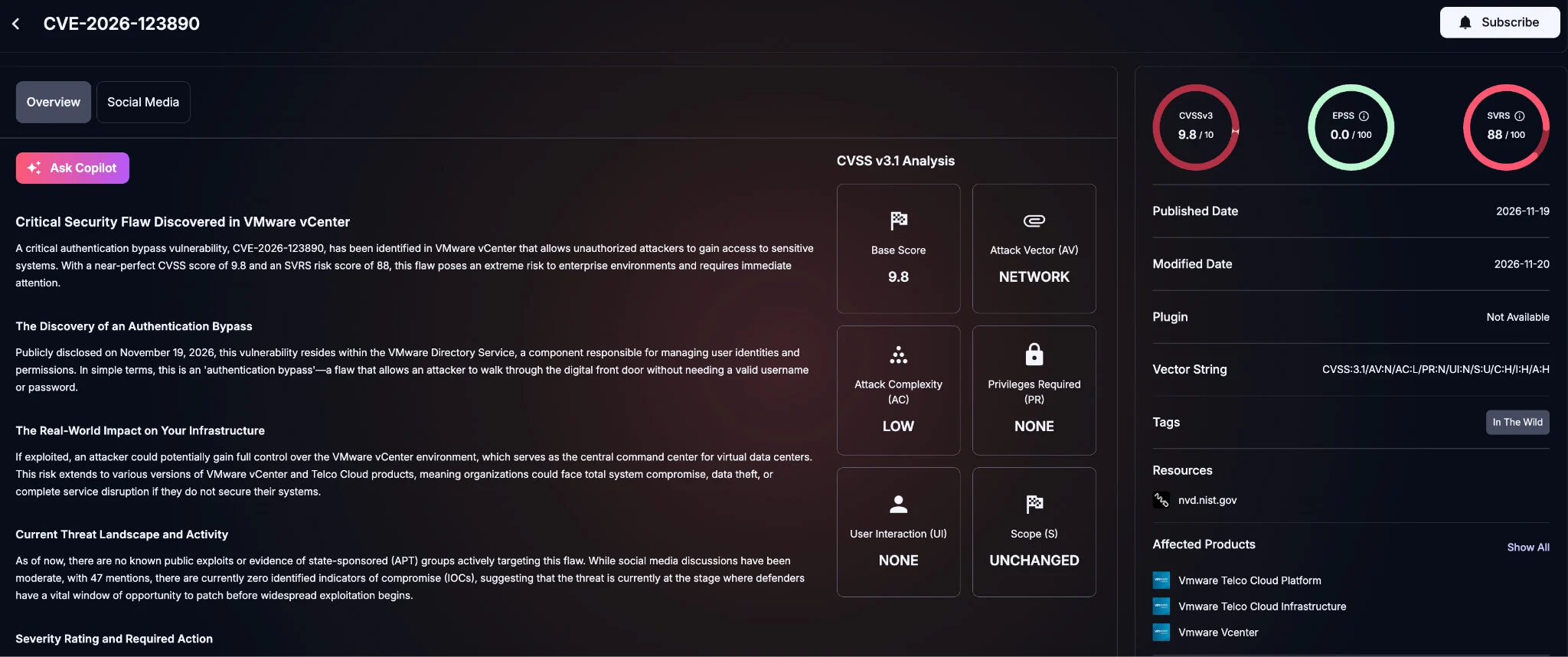
Broadcom has patched CVE-2026-123890, a critical VMware vCenter Server flaw that a suspected Chinese espionage group exploited as a zero-day for more than two months. There is no workaround, so vSphere teams need both the update and a compromise review.
What Is CVE-2026-123890?
CVE-2026-123890 (CVSS 9.8) is a critical authentication bypass in the VMware Directory Service (vmdir) of vCenter Server that lets a remote, unauthenticated attacker open a session as the built-in vCenter administrator. Broadcom fixed it on November 19, 2026, without mentioning in-the-wild exploitation.
New research has tied the attacks to Armory Castle, formerly tracked as UNC5221, and dated the first exploitation to early September 2026.
How Does an Unauthenticated Request Become administrator@vsphere.local?
vmdir is the directory behind vCenter Single Sign-On (SSO), holding the identities and credentials that vCenter trusts. The researchers found that the flaw leaks a Secure Remote Password (SRP) session key through vmdir’s RPC interface on TCP port 2012. An attacker holding that key is logged in as administrator@vsphere.local with no password required.
The flaw is rated 9.8 under CVSS v3.1, the highest score among the five issues in the advisory. Broadcom has not published the vulnerable function or request sequence, and no public exploit code has been reported.
CVE-2026-123890 is the second vmdir authentication bypass this year. Broadcom fixed CVE-2026-59309 on July 29, and its FAQ calls the new bug “a new and distinct issue.” The researchers go further: the exploitation tool they recovered worked on a vCenter already patched for CVE-2026-59309, and they report evidence that Armory Castle knew of CVE-2026-123890 before that July disclosure.
Two scope notes from Broadcom matter for triage. The flaw is in vCenter itself, so it applies whether or not Enhanced Linked Mode is in use. ESX hosts are not directly affected, although attackers who control vCenter can reach them.
Which vCenter Builds Close the Hole?
Broadcom fixed the flaw in three vCenter releases. The table below also covers bundled vCenter in VMware Cloud Foundation (VCF) and Telco products:
| Product and Branch | Affected | Fixed In |
|---|---|---|
| vCenter in VCF or vSphere Foundation 9.1.x | Before 9.1.1.0200 | 9.1.1.0200 |
| vCenter in VCF or vSphere Foundation 9.0.x | Before 9.0.2.0200 | 9.0.2.0200 |
| VMware vCenter 8.0 | Before 8.0 U3m | 8.0 U3m |
| VMware vCenter 7.0 | All | No public fix; extended support customers can request one from Broadcom |
| vCenter in VCF 5.x | Before 5.2.5 | vCenter 8.0 U3m through asynchronous patching (KB 88287), plus SDDC Manager 5.2.5 |
| Telco Cloud Platform 3.0, 4.x, 5.0.x, 5.1.x, 5.2 and Telco Cloud Infrastructure 3.0 | All listed | vCenter 8.0 U3m, per KB 463116 |
Broadcom does not assess end-of-support releases and advises treating vSphere 6.5 and 6.7 as vulnerable. The attack tooling reportedly works against vCenter 7.x and 8.x, so the lack of a public 7.0 fix leaves organizations still on that line exposed.
A few deployment details can slow the rollout:
- No Quick Patch: Quick Patch cannot deliver these cumulative vCenter updates
- Upgrade path conflict: Installing 8.0 U3m or 9.0.2.0200 prevents a later move to VCF 9.1.1, so Broadcom suggests teams heading there hold off briefly for VCF 9.1.2
- No workaround: Broadcom lists none, and says firewall controls may reduce exposure without replacing the patch
The same advisory fixes four lower-severity bugs rated 6.7 to 8.1: an SQL injection (CVE-2026-123891), a command injection (CVE-2026-123892) and a local privilege escalation (CVE-2026-123893) in SDDC Manager, and a SAML token signature bypass in VMware Tools for Windows (CVE-2026-123894) that applies only where Guest Alias mapping is configured. None has been reported as exploited.
From a BeyondTrust Appliance to Domain Controller Disks
The vCenter bug was one stage in a longer intrusion. The researchers reconstructed it in these stages:
- Initial access: Armory Castle first broke in through CVE-2026-102764, a BeyondTrust Remote Support zero-day abused since late August that CISA added to its KEV catalog on October 16
- Foothold: From there, the actor pivoted to an internal Linux appliance that had no EDR, planted SLIMSAVAGE web shells, gained root and probed for VMware systems on ports 443, 5480 and 2012
- vCenter takeover: A custom Go tool tracked as BONESAW abused CVE-2026-123890 to add a new SSO administrator and pull a copy of the directory database (data.mdb) over the vmdird RPC interface
- Identity forgery: Using the stolen SAML signing material, a second Go tool, SAWSNAKE, minted forged SAML tokens (Golden SAML) that let the attackers pose as other users and sidestep MFA
- Credential theft: The operators enabled SSH via the appliance management interface, collected the vCenter master key and PostgreSQL credentials, and disabled SSH again
- Reach into workloads: With vCenter under control, they reached ESXi hosts and extracted Active Directory database files from guest VM disks
The toolkit also included BEARBONES, a trojanized Dropbear SSH server that records passwords; CAGEMATCH, a JSP web shell; and LAZYBONES, a backdoor that communicates over Slack and was seen in an earlier intrusion. BONESAW carries a July 13, 2026, build timestamp, although Go build metadata can be edited before compilation, so the date is not conclusive.
The researchers describe Armory Castle as a suspected PRC-nexus espionage actor. That label is their assessment, hedged as “suspected,” and Broadcom has not attributed the activity.
What Should vSphere Teams Check After Patching?
Patching closes the vmdir flaw, but it does not remove access an attacker already holds. If SAML signing keys, the master key or database credentials were stolen, forged tokens and stolen secrets can keep working until they are rotated. The checks below draw on indicators the researchers published; treat anything beyond them as hunting leads.
- Network exposure: Limit vCenter ports 443, 2012, 5480 and SSH (22) to dedicated management hosts, and review who reached port 2012 in recent months
- SSO accounts: Look for administrator or machine accounts you did not create in vsphere.local; the attackers created one whose name began with “sps-“
- SSH toggling: Review appliance management logs for SSH being turned on and off, including PUT requests to /rest/appliance/access/ssh
- Appliance files: Search for ActiveSer.jsp, u.jsp, /tmp/123, /tmp/sss, /tmp/dbr, /tmp/123.key and /usr/bin/vmtoolscs
- ESXi hosts: Check root authorized_keys for added keys, look for a hidden “.a” directory on datastores or an unexpected vmfs-pydist.tar.gz, and review root and vpxuser logins from unusual sources
- SSH banners: Flag internal SSH services announcing “SSH-2.0-pulsesecure_23345” on high ports
- BeyondTrust path: If BeyondTrust Remote Support runs in your environment, include it and every vCenter reachable from it in the hunt
Where any of these checks turns up evidence, rotate the vCenter STS (SAML) signing certificate, the vCenter master key, database credentials and all SSO credentials, following Broadcom support guidance for your version. Missing log entries are not proof of a clean environment, since the actor turned SSH back off and Linux appliances without EDR gave defenders little telemetry. The baseline is twofold: apply the patches, then examine systems for signs of compromise.
How SOCRadar Can Help
SOCRadar helps teams follow CVE-2026-123890 and the Armory Castle campaign, and act on their own exposure:
- Vulnerability Intelligence: Follows CVE-2026-123890 and the rest of VMSA-2026-0009 as KEV status, exploitation reports and new fixed builds such as VCF 9.1.2 emerge, as part of the Cyber Threat Intelligence module
- Autonomous Exposure Management: Finds internet-facing VMware assets and management ports such as 443 and 5480, so teams know which vCenter instances to patch or isolate first
- Advanced Dark Web Monitoring: Surfaces exploit sales, access offers and attacker chatter about vCenter and BeyondTrust flaws across criminal forums, marketplaces and encrypted chat channels
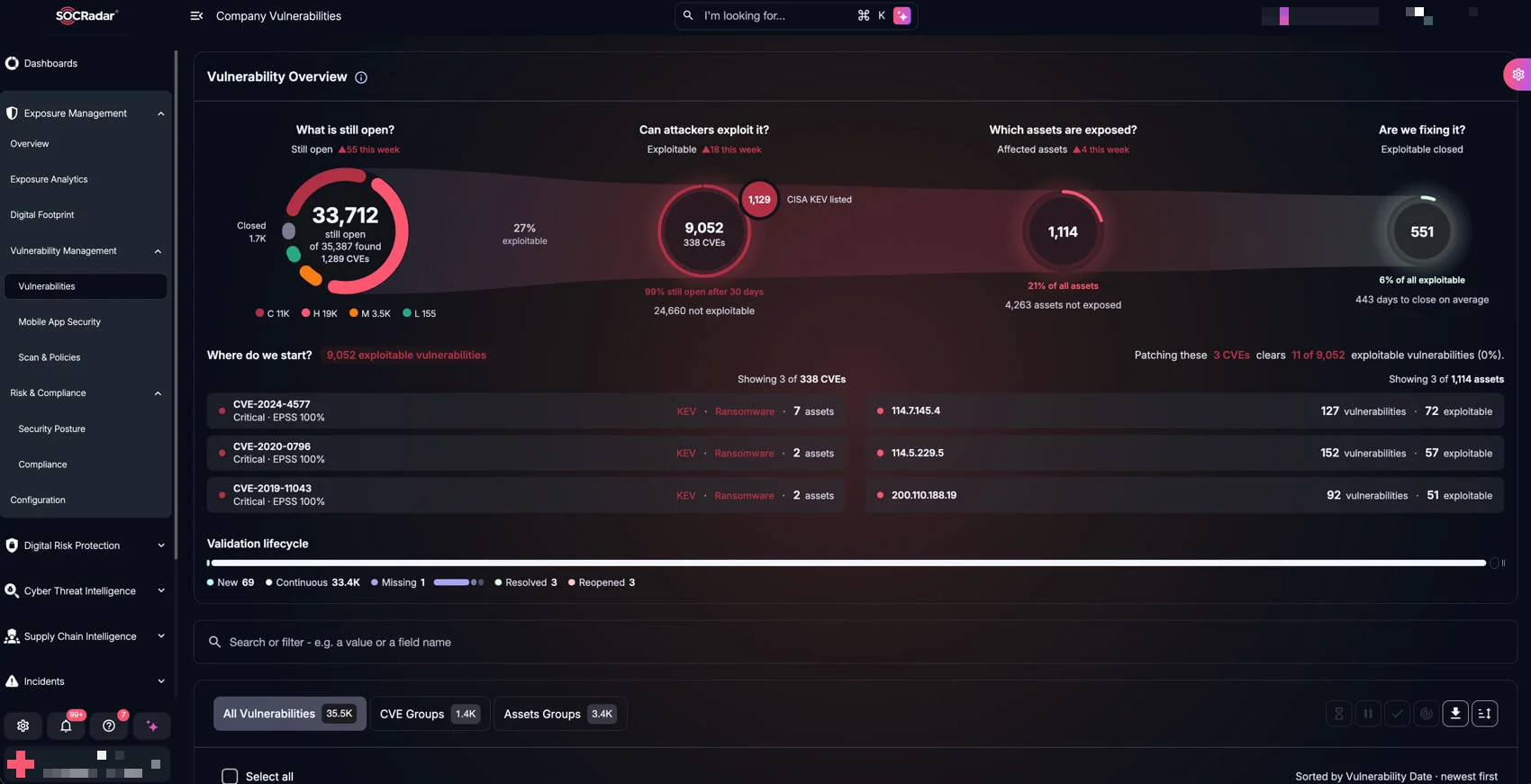
Exploitation status and Broadcom’s fix matrix for CVE-2026-123890 are still shifting, and SOCRadar keeps that picture current so teams can respond as soon as the risk changes.

Source: SOCRadar · 2026-11-20