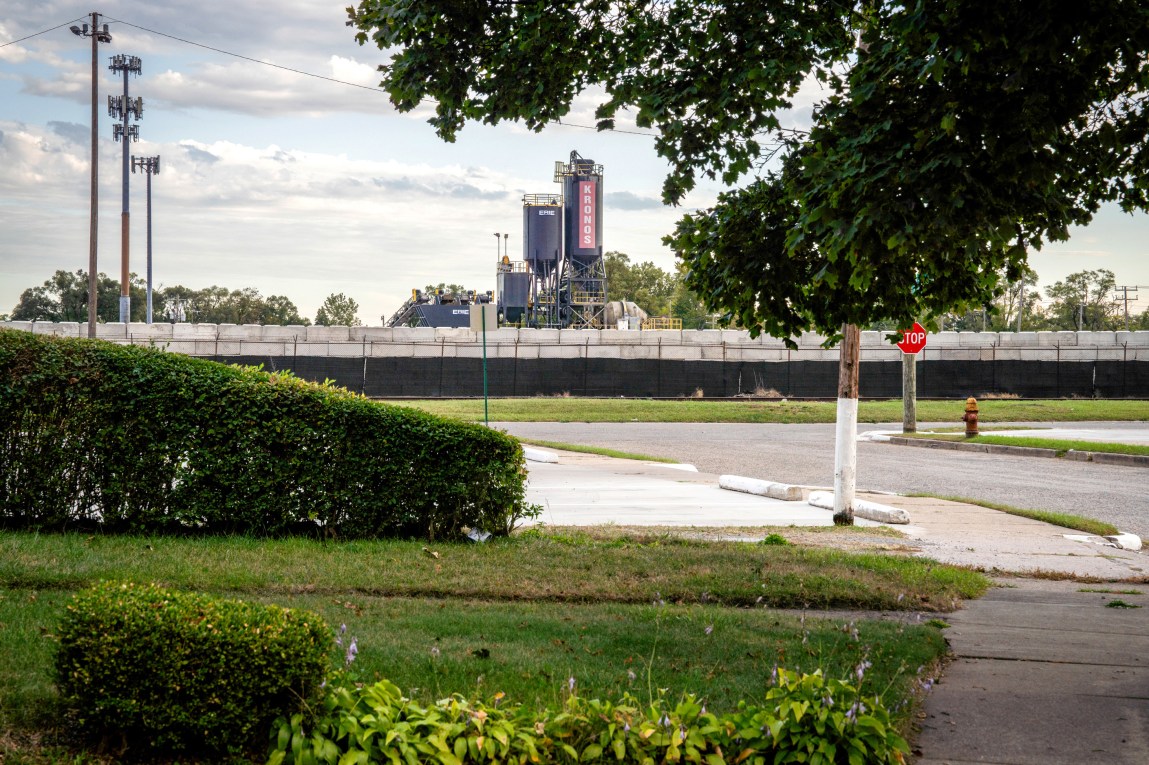
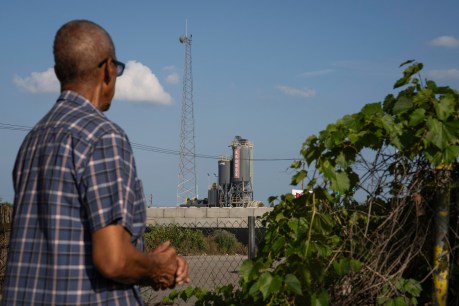
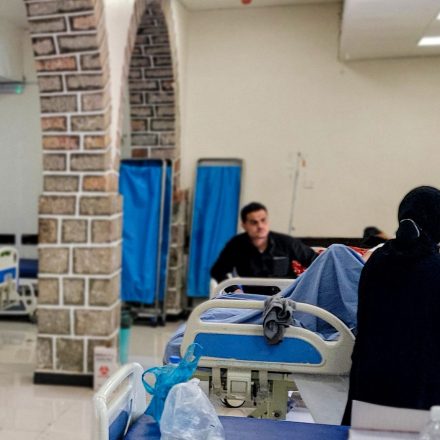
The Kronos concrete mixing plant overlooks the Cadillac Heights neighborhood in Detroit. Sarahbeth Maney/ProPublica
After years of community opposition, Detroit city officials have taken steps to stop a concrete mixing facility from further expanding into a residential neighborhood.
City Council members, acting on a recommendation last week from planning officials, will soon consider a rezoning measure that would restrict industrial activity at the site of the Kronos concrete plant and surrounding area. The concrete facility at its current size could stay and continue to operate as normal.
The planning recommendation comes after a BridgeDetroit and ProPublica investigation this year revealed how city officials helped Crown Enterprises, a real estate company owned by Detroit’s wealthy Moroun family, obtain property in Cadillac Heights and then provided latitude when its Kronos facility violated environmental laws. Residents have been filing complaints and protesting Kronos for years, frustrated by the dust, noise and other issues created by the concrete operation.
The City Planning Commission voted Oct. 22 to recommend a change to some of the zoning in the neighborhood from heavy to light industrial, which allows buildings such as warehouses but excludes facilities like concrete plants. The commission also recommended that other lots be zoned for residential and commercial purposes. Earlier this month, the commissioners unanimously voted to exclude industrial zoning in the area adjacent to Kronos, but they stepped back from that last week.
Crown has objected to any zoning change.
Sharon Buttry, who helped organize residents to protest against the Kronos plant, said she is glad the lots would be rezoned but was disappointed that the earlier recommendation, which was more pedestrian- and transit-friendly, didn’t stand.
Buttry said she fears that the latest zoning recommendation would make it easier for Crown to expand eventually. “We still want them to shut down or move,” she said.
The zoning plan was revisited at the request of City Planning Commissioner Fred Russell Jr., who said the adjustment would create a buffer between residents and the existing concrete plant.
The City Council, which will ultimately decide on the rezoning, has scheduled a public hearing for Nov. 19.
Over the last seven years, Crown has obtained dozens of parcels in Cadillac Heights — some through a land deal with the city in 2019 and others after residents sold their parcels and left. In all, the company now owns more than 160 lots in the neighborhood, most of which are barren.
How a 2019 Land-Swap Deal Accelerated the Morouns’ Foothold
The Moroun family spent decades, from 1966 to 2018, records show, gradually acquiring lots in Cadillac Heights through their various companies, eventually putting the parcels all under the ownership of Crown Enterprises. A May 2019 deal with the city of Detroit allowed Crown to acquire dozens of additional parcels during the next seven years.
Note: Sale dates for 19 parcels could not be identified, but records show Crown owned them as of June. Sources: City of Detroit, Detroit’s Office of the Assessor, Wayne County Register of Deeds, Detroit City Council.Chris Alcantara/ProPublica
In a letter to Detroit officials in mid-September and Oct. 22, a law firm representing Crown threatened legal action if city officials change the zoning, arguing that doing so would devalue the property and create uncertainty about future development.
Attorney Melvin Butch Hollowell also said if the rezoning goes through, the city would be backtracking on its commitment to support Crown’s development in Cadillac Heights. Crown obtained the land there in exchange for the company swapping property in another part of the city, which allowed automaker Stellantis to open the first new car plant in Detroit in three decades.
City officials have said they didn’t know Crown’s plans included a concrete facility. Crown did not present a specific plan at the time of the land transfer. But after the concrete plant opened, the city in 2022 signed a first-of-its-kind agreement with Crown that gave the company time to fix issues before being penalized. The agreement has allowed the company to avoid fines on several occasions, the news organizations have documented.
In response to questions from BridgeDetroit and ProPublica, a Crown spokesperson said the company has invested more than $10 million to develop the concrete operation based “on the City’s promises and actions of approving our plans for this facility.”
“The property was traded to us for the express purpose of redevelopment,” the spokesperson, Kenneth Dobson, wrote.
Dobson said that if the zoning changes, the company will not make the improvements it has promised, including new landscaping and sidewalks. He claimed the improvements would not be allowed under the new zoning and that they also wouldn’t be a sound business decision. City planning staff, however, said the company can still make the improvements.
The neighborhood surrounding Kronos has been zoned to allow heavy industry since the 1940s, when a rail line operated there. Before the concrete operation, the land was occupied by a trucking depot for decades.
Despite the zoning designation, the neighborhood attracted working-class families who lived in modest single-family houses. Buddy’s Pizza, famous as the birthplace of Detroit-style pizza, was founded there and drew crowds from across the city.
The City Planning Commission’s votes this month were four years in the making and part of a broader evaluation of land near the proposed Joe Louis Greenway, a walking and biking trail that will traverse the city and is already under construction.
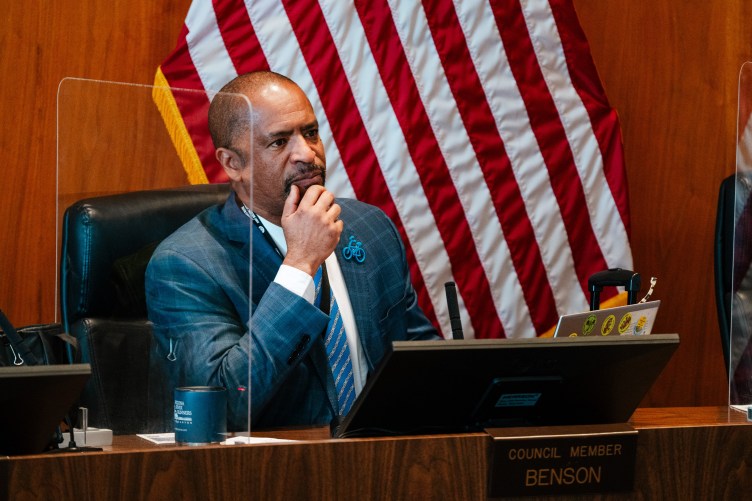
Scott Benson, the council member who represents Cadillac Heights, asked the planning commission in 2023 to consider whether the industrial zoned areas along the greenway should be rezoned to a use that better supports safety and public health. He said the request at first was unrelated to Kronos, but then community input further influenced the desire for change.
“That did play a role here,” he said in an interview. “The community came out and said, ‘Yes, we especially want this part done and it abuts the Joe Louis Greenway.’”
Scott Benson represents Cadillac Heights in the Detroit City Council.Nick Hagen for ProPublica
More than 30 people — some in favor of a zoning change and some against — spoke out at recent commission meetings. Kronos employees and others told the commission that the company has created jobs for Detroit residents and said Crown has invested in the neighborhood with new paving.
Terrell Daniel, whom the city identified in meeting minutes as a Kronos employee, urged the commission at its Oct. 1 meeting to continue to allow industry in the neighborhood.
“It’s bringing back the backbone of Detroit,” he said. He said the concrete plant has provided an opportunity “for guys who never had a chance to work in the city.”
Those in support of rezoning expressed concerns about the dust, air quality and Crown’s track record of not taking care of the neighborhood, which has included leaving vacant homes unsecured and messy.
A house that Crown purchased in January has no front door or first-floor windows, and trash litters the yard.Nick Hagen for ProPublica
Residents have filed about 80 complaints to both city and state environmental offices, according to records obtained by BridgeDetroit and ProPublica. They have described “literal whiteout conditions” and “dust clouds” that blanket their neighborhood and irritate their eyes.
The city has issued several tickets to Kronos for violating Detroit’s fugitive dust ordinance, passed in 2024 to limit pollution. The law requires businesses such as concrete plants and scrapyards to submit plans to limit dust and prevent it from spreading into neighborhoods.
On Oct. 7, the city received a complaint about Kronos and an inspector found the company had spread dust in the neighborhood and had piles of materials that should have been blocked from view, according to city spokesperson Georgette Johnson.
Kronos wrote in a letter to the city that it swept and watered the streets and reduced the height of the piles. Johnson said Crown corrected the problems.
Dobson said readings from its air monitors have never exceeded the city’s pollution limits and that a small number of people regularly complain. He previously said that the company planned to demolish a vacant home littered with trash but was waiting on utilities to be disconnected.
In the words of the biggest name in the outside elections-spending game, “Being pro-Israel is good policy and good politics.”
This midterms cycle, however, the American Israel Public Affairs Committee’s strategy seems to suggest the opposite. Contrary to its signature slogan, AIPAC’s name has become anathema to voters across the political spectrum repulsed by Israel’s genocide in Gaza and frustrated by Washington’s outpouring of military aid for a foreign government while domestic costs soar.
So it’s going underground. As The Intercept reported in December, AIPAC entered the 2026 midterms by returning to its strategic roots — funding other groups and uniting donors, rather than focusing on direct-to-candidate spending. Now, AIPAC has announced that it will no longer officially endorse or contribute directly to candidates.
Though progressives welcomed the announcement as evidence of AIPAC’s retreat, it’s far from a sign that AIPAC is backing down. The group is expected to continue spending heavily on elections through its super PAC, which took advantage of campaign finance loopholes to conceal its involvement in several races this cycle until after elections had already passed. To Lara Friedman, president of the Foundation for Middle East Peace, AIPAC’s opting for obscurity shows that “its brand has become politically radioactive.”
But how much has really changed? As AIPAC shifts strategy, a new project by The Intercept reveals the hundreds of candidates still taking its cash, plus how the money paid off for them. The data suggests that though the pro-Israel lobbying giant may be weakened, it’s still dominant.
The Intercept tracked how much the group and its super PAC spent on elections to put pro-Israel candidates on the ballot in this year’s midterms — including the money it tried to keep out of the public eye. While AIPAC makes use of a series of new pop-ups and pass-throughs, it still poured millions directly into 2026 midterm races. Its candidates usually still win.
The new data builds on a 2024 project in which The Intercept documented just how AIPAC shaped the last congressional class. At the time, Donald Trump was preparing for his return to the presidency as Kamala Harris ran a campaign hamstrung by public disillusionment over the Biden administration’s unflinching support for Israel’s genocide in Gaza. To critics of Israel desperate to stop the violence, the two parties looked equally bleak, and the pro-Israel lobby’s grip on Congress appeared unshakeable.
It’s been different this cycle. Primaries across the country saw candidates win after vowing to cut off or restrict military aid to Israel, and incumbents signed on to legislation blocking weapons transfers in an attempt to keep their seats. But the shift should not be overstated: AIPAC still waded into nearly three-quarters of races, and its candidates still won far more often than they lost.
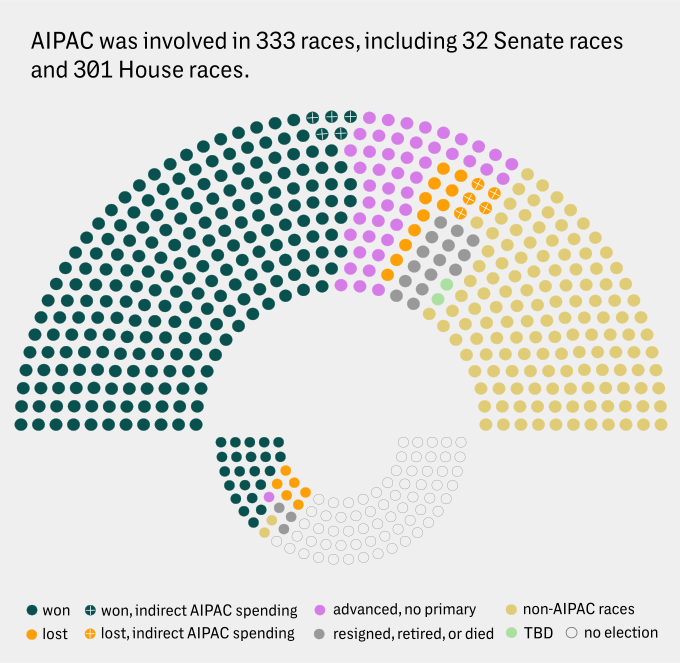
In total, AIPAC or its super PAC, United Democracy Project, spent on 333 of the 473 seats up for election this year.
Data visualizations: Stella Ioannidou
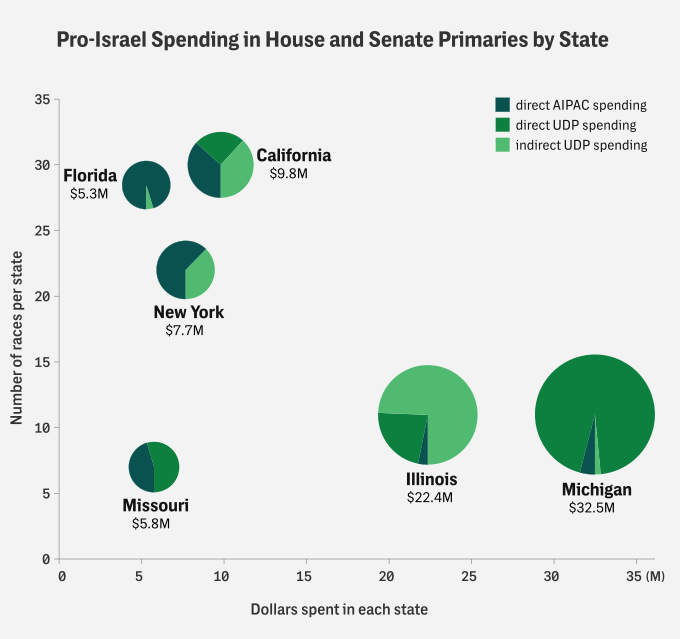
These are the dollars AIPAC and UDP spent directly in races. The former makes contributions to candidates, while the latter, as AIPAC’s leading super PAC, makes independent expenditures, like buying ads. They made up the bulk of the pro-Israel lobby’s known elections spending — $53.3 million from AIPAC and $66.7 million from UDP, compared to$53.7 million and $41.4 million last cycle. Simultaneously, the groups took up another tack: making it harder to tell which races they were actually involved in. The group’s donors poured money into races where AIPAC didn’t officially endorse a candidate. AIPAC’s board president hosted a fundraiser for a candidate who swore the group wasn’t backing her. And in a series of races, no one knew for certain that AIPAC had spent on the election until after it was over.
The group tested different strategies in different states, spending directly in the Michigan Senate race, for example, while concealing its spending in several other primaries. In those races, UDP gave money to other committees, including a series of “pop-up PACs,” groups that registered just before primaries, allowing them to delay disclosing their donors until after the election passed. Several of those groups took money from AIPAC’s super PAC, spent on ads against candidates critical of Israel, and then disappeared.
The pop-ups and pass-throughs represent AIPAC’s most talked-about new tactic, but the lobbying group and its flagship super PAC still sunk the bulk of their spending into key races and high-priority states. The Intercept analyzed where AIPAC employed which strategy, how UDP dollars flowed through pop-up PACs, and which candidates received the most AIPAC and UDP cash in their primaries.
The Direct Spending
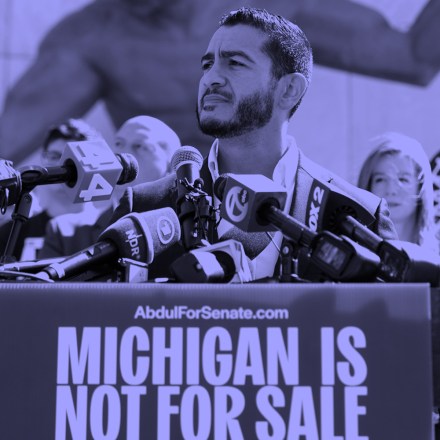
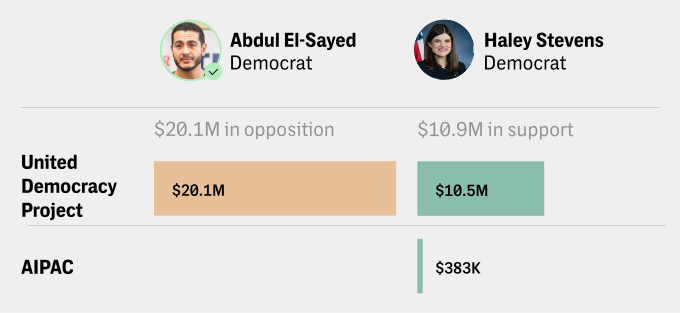
The pro-Israel lobby’s biggest investment in the primaries turned out to be a disappointment. UDP spent more than $30 million on ads attacking Democratic candidate Abdul El-Sayed in the Michigan Senate race or backing his opponent, Rep. Haley Stevens. Now that El-Sayed is the Democratic nominee, UDP is also battling El-Sayed in his general election contest with Republican Mike Rogers, spending just over $500,000 so far.
Data visualizations: Stella Ioannidou
Thanks in part to the deluge of spending, the El-Sayed–Stevens contest was one of the marquee primaries of 2026, pitting a vocal critic of the pro-Israel lobby who could become the first Muslim U.S. senator against an enthusiastic AIPAC cash recipient who famously said: “Israel comes to me in my dreams.” It’s one of the key races where we’re breaking down the money AIPAC and UDP spent in favor of one candidate and against a clear opponent. We’re skipping Democratic House candidate Adrian Boafo, who benefited from $5.7 million in UDP spending, because his Maryland primary included 23 other candidates.
Data visualizations: Stella Ioannidou
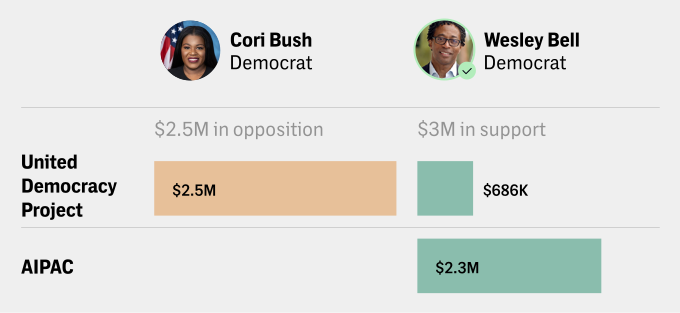
After Stevens and Boafo, the top AIPAC and UDP recipient from this year’s primaries was Rep. Wesley Bell, a moderate Democrat from Missouri who fended off a challenge from former Rep. Cori Bush to return to the House (AIPAC spent millions to oust her last cycle). When UDP spending is excluded, Bell received more AIPAC funding in the primaries than any other Democrat.
Data visualizations: Stella Ioannidou
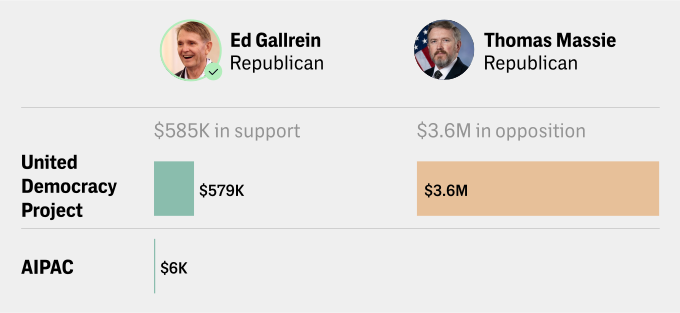
On the Republican side, the top beneficiary was Ed Gallrein, the Trump-backed challenger who unseated Rep. Thomas Massie in Kentucky. Massie, a libertarian critic of all foreign aid — including to Israel — was the relatively rare Republican incumbent AIPAC and UDP opposed.
Often, the pro-Israel groups backed Republican incumbents. Two more top recipients were Sen. Tom Cotton, who easily won his primary in Arkansas, and John Cornyn, who lost to state attorney general Ken Paxton in Texas.
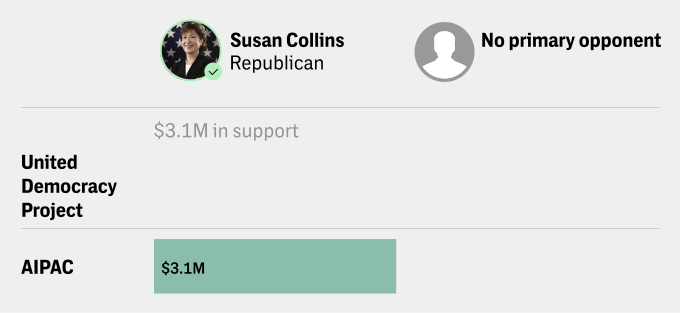
But the greatest Republican recipient of AIPAC largesse — ahead of Gallrein, when UDP is excluded — did not face a primary opponent.
Data visualizations: Stella Ioannidou
Republican Sen. Susan Collins of Maine, now facing a tight general election contest against Democratic candidate Troy Jackson, has been a longtime beneficiary of campaign cash aligned with the pro-Israel lobby. Asked by Zeteo last year for her comment on Americans killed by the Israeli military, Collins shook her head and said only: “I am pro-Israel.”
The Pop-Ups
On top of the $53.6 million it spent directly on races this cycle, United Democracy Project poured another $13.1 million into Democratic primaries by giving money to other committees whose names or stated agendas indicated no connection to Israel policy. That $13.1 million, more than triple the $3.5 million United Democracy gave through other groups last cycle, helped fund at least three pop-up PACs that formed this year.
The groups’ names offered little insight into their political agendas, as The Lever recently highlighted. UDP spent the most on popup PACs in a series of Democratic primaries around Chicago, where groups with names like Elect Chicago Women, Chicago Progressive Partnership, and Affordable Chicago Now! used their funds to attack candidates running on rejecting AIPAC money or ending U.S. military support for Israel. Several of the groups also received funding from major United Democracy Project donors, and three of them shut down after the primaries and gave their money back to United Democracy Project.
Data visualizations: Stella Ioannidou
In other cases, United Democracy Project funded long-established political action committees with ties to current or former House Democratic leaders, like Bold America, which was formed by former members of the Congressional Hispanic Caucus. That group got almost a quarter of the $12.2 million it reported raising this year from UDP. The UDP share, $2.8 million, was nearly equivalent to the $2.9 million Bold America spent against Darializa Avila Chevalier, a democratic socialist and pro-Palestine activist who defeated incumbent and Congressional Hispanic Caucus Chair Adriano Espaillat in New York.
The super PAC EDW Action Fund was similar. Former Democratic Congressional Campaign Committee Chair Cheri Bustos and former Rep. Annie Kuster formed that group in late 2023 as an offshoot of the political action committee Elect Democratic Women. Like Bold America, EDW Action got about a quarter of its funding from UDP. It also provided more than 80 percent of the funding for Pro-Choice Majority Action, a new PAC that formed in May and spent in 12 primaries. The group presents itself as supporting Democratic women, but Pro-Choice Majority Action notably spent against pro-Palestine candidates like Melat Kiros, who ran a primary challenge against Rep. Diana DeGette, D-Colo., and won.
In a statement to The Intercept, Pro-Choice Majority Action spokesperson Lenny Young dismissed reporting characterizing the group as a pop-up PAC and said it had backed 23 candidates with a range of views on Israel across the primaries and general election.
“To suggest that we would deny a Democratic woman from being elected to Congress because of her position on Israel, on either side, misses the whole point,” Young said. “We want more Democratic women in Congress because we believe it would improve the lives of women and families. Period.”
Bold America did not respond to The Intercept’s request for comment. Emails to Elect Chicago Women, Chicago Progressive Partnership, and Affordable Chicago Now! bounced back because the groups have shut down.
UDP gave another $2.65 million to groups that did not spend directly on ads in Democratic primaries this cycle.
In August, United Democracy Project gave $1.65 million to a group called SD PAC, also known as Save Democracy PAC, which registered in 2020 and has supported Democratic candidates in past general elections. The group did not directly conduct any outside spending in Democratic primaries this year, but it funneled money to affiliate groups that did — some of which funded attacks against progressives.
The other recipient of money from UDP, Palmetto Action, formed in May and only spent in South Carolina’s Republican Senate primary. The group backed Sen. Lindsey Graham before his death in July, then received a cash infusion from UDP and started supporting Graham’s sister, Darline, ahead of a special Senate primary. The group did not report any additional spending in its last filing due before the general election.
Palmetto Action, Save Democracy PAC, and EDW Action Fund did not respond to The Intercept’s requests for comment.
New pro-Palestine groups have sprung up to spend against AIPAC — though their pockets aren’t nearly as deep. When candidates went head-to-head this cycle in primaries defined by U.S. military support for Israel’s genocide in Gaza, pro-Palestine candidates often came out on top.
For decades before it started spending directly on elections, “AIPAC operated in the shadows,” Friedman, of Foundation for Middle East Peace, said. Its endorsements were once “clear but unofficial,” she added, and its funding operated through “informal understandings with big donors and allied but ostensibly independent PACs.”
Today, “AIPAC is trying out a sort of middle road,” Friedman said. “It will return in part to the shadows — no direct endorsements, no direct donations — but it will also continue to flex its power directly in elections, via tactics it has been testing and honing these past four years.”
If anything, next cycle could see an expansion of the recent pop-up PAC strategy, making it harder to tell when AIPAC is involved — until it’s too late.
The artificial intelligence industry was poised to act as a kingmaker in the midterm elections.
Super PAC networks bankrolled with millions of dollars from Anthropic and OpenAI executives spent heavily in competitive primaries earlier this year, including a high-profile race in New York City. They were touted as the looming successor to another single-issue group, the American Israel Public Affairs Committee, as AIPAC moved its spending underground.
Yet as public outrage over data centers and AI’s threat to jobs soared, artificial intelligence super PACs dramatically throttled back spending on congressional races compared to the primaries. The biggest AI super PAC network has spent only modestly ahead of next week’s general election — and mostly in safe seats.
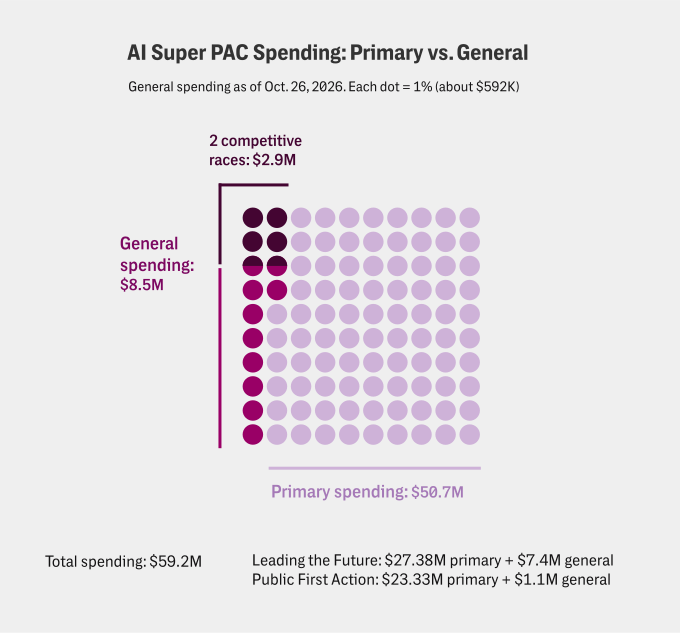
An Intercept analysis of AI spending in the 2026 midterms, based on Federal Election Commission records and independent race ratings, shows that only 5 percent of their direct expenditures have gone to contested general election races. The industry’s avoidance of the contested races that could determine control of the next Congress suggest that the PACs have realized how the public has soured on the tech, campaign finance and industry observers told The Intercept.
“Essentially these companies underestimated how much the public despises the data center buildout, and the inescapability of AI systems that no one asked for that say they will automate jobs and maybe kill us all,” said Rick Claypool, a research director for the president’s office at Public Citizen, a nonprofit campaign finance watchdog.
Although there is still time for a last-minute flurry of spending, the story of AI’s role in the 2026 midterm elections may turn out to be the story of a single race — a primary in New York — that forced the industry to step away from the limelight.
Claypool’s group released an analysis earlier this year of “corporate supremacist” super PACs, a new breed of campaign committees modeled on a crypto super PAC called Fairshake that spent tens of millions on the 2024 elections.
The model was to amass a massive war chest and use it to punish candidates who opposed the company’s preferred government regulations, while throwing cash at allies or potential allies from both parties.
The first big AI super PAC to launch in August 2025 was Leading the Future, which was bankrolled by the president of OpenAI and its investors. A rival super PAC network, Public First, launched months later with the goal of countering Leading the Future’s influence. Its donors include Anthropic CEO Dario Amodei, who gave $1 million. Anthropic has also given a nonprofit associated with Public First millions of dollars, while stipulating that the money cannot be used on elections. Public First says that it supports tighter regulations than its rival.
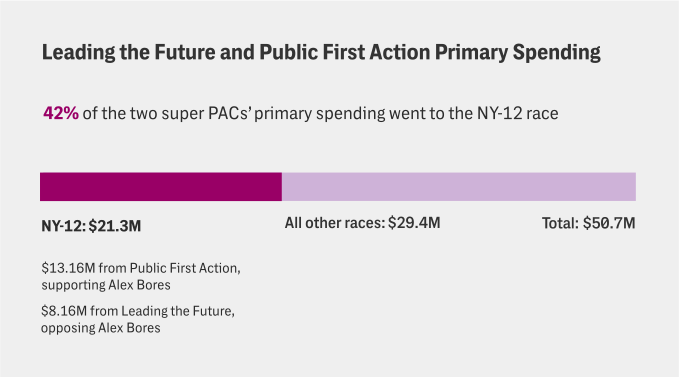
The two networks plowed $50.7 million into the primaries, campaign finance records show. Most of that money was spent on primary races where the outcome was in doubt, driven by an eye-popping $21.3 million the networks spent on supporting or opposing a single congressional candidate, Alex Bores, in the Democratic primary for New York’s 12th Congressional District.
Data visualizations: Stella Ioannidou
Bores, a New York State Assembly member, attracted the ire of those in the industry who favor a laissez-faire approach by authoring an AI regulation bill in the state legislature.
Leading the Future succeeded in defeating Bores, who lost to his State Assembly colleague Micah Lasher in June. But the group drew intense blowback in the process. Many observers suggested Leading the Future’s spending had boosted Bores rather than hurt him, because it gave him a chance to position himself as a foe of the AI industry — while also benefiting from a PAC aligned with the Public First network.
“Down to the wire, they were sweating,” Bores told The Intercept, referring to Leading the Future. “I think people who have been in politics for a while will realize that their spending really served to elevate the issue of AI.”
Leading the Future did not respond to a request for comment.
After wading into contested primary elections, the two leading AI super PAC networks have held back from spending on competitive general elections — even though they have plenty of money in the bank.
Until a few days ago, Public First had spent nothing on general election races. Leading the Future has spent only $7.4 million on general election races as of October 26, according to the FEC data, despite having $34 million in cash on hand across its network as of its most recent report.
Data visualizations: Stella Ioannidou
Only 31 percent of that total has gone toward competitive races, as measured by the independent analytics website FiftyPlusOne. The only reason Leading the Future has spent money on competitive general election races at all is because it’s backing U.S. Sen. Darline Graham, R-S.C., who filled the seat of her late brother Lindsey Graham and is now facing an unexpectedly fierce challenge from a Democrat to win a full term in ruby-red South Carolina.
“They are not going to have an impact on the balance of power in Congress,” said Shaunna Thomas, one of the founders of Guardrails Alliance, another new super PAC set up to counter Leading the Future’s influence. “They are spending money on candidates who they think will protect their ability to control if and how they are regulated.”
Public First has only recently started spending a relatively small sum on a handful of general election races. The spending had amounted to $1.1 million as of the morning of October 26, according to processed FEC data.
Asked for comment on how its strategy has changed since the primaries, a Public First spokesperson said that it was still trying to support “strong advocates for AI regulation.”
“Public First was founded as a counterweight to Leading the Future, and that fight looks very different today. Leading the Future is going dark. Its biggest backers are walking away,” said Anthony Rivera-Rodriguez, the spokesperson.
Into that gap have stepped new groups pushing for tougher AI regulation such as the Guardrails Alliance, which bills itself as a grassroots alternative to corporate-backed super PACs. It is funded in large part by Silicon Valley tech workers but has taken a more aggressive stance against “tech oligarchs.” Guardrails has spent about $2 million thus far and reported having $1.2 million on hand as of October 14.
About three-quarters of voters are less likely to support a candidate they know has received support from an AI super PAC, according to a Data for Progress poll of more than 3,000 likely voters in Iowa, Michigan, and Ohio commissioned by Guardrails. Voters were more concerned about spending from AI companies than from crypto companies or AIPAC.
Voters were more concerned about spending from AI companies than from crypto companies or AIPAC.
The dislike for data centers and AI cuts across party lines. In Michigan’s purple 7th Congressional District, Democratic candidate Will Lawrence has seized on data centers as one of his leading issues.
“The politics of this are terrible. Eighty percent of everybody is against it, whether you’re a Democrat, independent, or Republican,” he told supporters at a recent town hall.
Notably, neither of the super PAC networks has intervened in Lawrence’s race, despite it being one of the closest in the nation. (Lawrence’s campaign has pointed out that Elon Musk, who leads AI company xAI, has spent against Lawrence via his America PAC.)
There are emerging signs that the big AI super PAC networks are changing tactics in response to that public distaste. Public First’s dark-money affiliate donated $3 million since August to a preexisting super PAC supporting California state Sen. Scott Wiener, one of two Democrats vying to replace retiring Rep. Nancy Pelosi in California.
Leading the Future, meanwhile, gave a $500,000 donation on October 9 to a pro-data center nonprofit called Build American AI.
AI super PAC critics are also watching to see what Leading the Future will do, given its large war chest.
“I think they are going to continue to spend. I think they are going to try to do more and more spending that isn’t as easily tracked, because they are such political dead weight,” said Bores.
Delaware Corporations
When single-issue super PACs know their issue is unpopular, they use vague names, “pop-up” affiliates, and other dubious tactics to hide their activities from voters.
Add another one to the list: Leading the Future has routed more than $30 million of spending through newly minted Delaware corporations, blocking transparency during an election that has been defined by voter backlash against the industry.
Those apparent shell corporations have accounted for the lion’s share of the largest artificial intelligence super PAC network’s expenses during this year’s election.
The practice is a flagrant violation of Federal Election Commission guidelines that require campaign organizations to disclose which consultants, pollsters, and advertisers they are paying, a campaign watchdog alleged in a complaint filed in May.
There may be little recourse for observers worried about the lack of transparency for now, however. The FEC is short of the quorum that would allow it to take action on complaints such as the one filed by the Campaign Legal Center. (Leading the Future, which did not respond to a request for comment, has previously defended its tactics as legal in a statement to Wired.)
The Leading the Future network was funded in large part by an executive at or investors in OpenAI, one of the world’s largest AI companies. (In 2024, The Intercept sued OpenAI in federal court over the company’s use of copyrighted articles to train its chatbot ChatGPT. The case is ongoing.)
Company president Greg Brockman and his wife, Anna Brockman, donated $25 million to the network last year. When it came time to spend that money, the Leading the Future network leaned on two affiliate super PACs, one for Democratic candidates called Think Big and the other for Republican candidates called American Mission.
That is a typical tactic of the new breed of single-issue super PACs popularized by the crypto industry. Campaign finance reform advocates say it may help obscure the origin of campaign ads from voters but does not run afoul of any laws itself.
What those super PACs did next raised red flags for watchdogs, however. Since December, American Mission has reported spending $17.4 million through a Delaware-incorporated limited liability corporation called Summit Ridge Media Group, on services ranging from media placement to ad production to consulting.
Think Big has spent $21.3 million through a different Delaware corporation, Lantern Production Consultants, on a similarly wide range of expenses.
The grab bag of expenses is a giveaway that the super PACs are likely using the newly created corporations to hide their true vendors, according to Shanna Ports, a senior legal counsel at the Campaign Legal Center.
“There’s no way of knowing what is motivating this arrangement — but I know there is backlash to AI. It is possible that the vendors who are working with American Mission and Think Big don’t want to be identified in FEC reports,” Ports said.
Thomas, of the rival super PAC Guardrails Alliance, told The Intercept she thinks the network is obscuring its spending because a lax regulatory approach has become “politically toxic.”
“Their donors don’t want to be associated, their candidates don’t want their support, and their vendors don’t want to be associated,” Thomas said. “If you were public, you are running away. If you are not, you are interested in not being exposed.”
This story was supported by a grant from the Tarbell Center for AI Journalism.
Alicia Jackson, director of the Advanced Research Projects Agency for Health, speaks at an event earlier this year. Photo illustration by ProPublica. Photo by Tom Williams/CQ-Roll Call, Inc via Getty Images.
Last November, the Department of Health and Human Services announced the elimination of “black box” warnings on hormone replacement therapies, aiming to reverse nearly two decades of stigma surrounding a key treatment for menopause symptoms.
Among the officials at a press conference about the decision was Alicia Jackson, director of a federal health agency that invests taxpayer money in medical technology and research. As Jackson stood behind a lectern adorned with the HHS logo, she praised the new policy, calling it a victory for women and science.
“Today we have the opportunity to add up to a decade of healthy years to the life of every woman that you love,” Jackson said. “The science is clear: Hormone therapy is safe and effective. And it is hugely beneficial to the vast majority of women.”
Less clear that day were the financial benefits the new policy could bring Jackson, according to disclosure records obtained by ProPublica.
Jackson is the founder and former chief executive of Evernow, an online platform that connects women with medical experts who treat the symptoms of menopause. Although she left for federal service last year, she kept at least $115,000 in Evernow stock and an unknown amount of stock options, records show.
Those are just part of a multimillion-dollar portfolio Jackson holds with her husband, a venture capitalist, that poses potential conflicts of interest with her work overseeing the Advanced Research Projects Agency for Health, known as ARPA-H.
It’s unclear what role, if any, Jackson played in dropping the black box warning, the most serious type of federal safety warning that is reserved for drugs with severe side effects or life-threatening risks. A different agency, the Food and Drug Administration, regulates drugs, and its panel of experts had recommended an end to the warning requirement months before Jackson arrived in government.
But ethics experts called Jackson’s official endorsement of the warning removal “alarming” and an “obvious conflict of interest,” noting federal law prohibits government employees from participating “personally and substantially” in matters that could influence their personal finances — even making statements at a press conference or in a news release, as she also did.
“We should care because her company is apparently intending to profit off this change in policy that she endorsed as a government official while still retaining a financial interest in the company,” said Virginia Canter, who served as an ethics lawyer at the White House, Treasury Department and Securities and Exchange Commission during the presidencies of George H.W. Bush, Bill Clinton, George W. Bush and Barack Obama.
“I say it puts her within the zone of a potential violation,” she said.
Under federal law, agency officials like Jackson are required to submit financial disclosure forms, which must then be certified as complying with ethics laws. But Jackson’s two financial disclosures — filed last October and two months ago — remain uncertified. Canter said it is not unusual for an agency’s ethics office to ask the inspector general to investigate if staff cannot certify that an individual’s disclosure forms meet ethics standards.
Over two months, ProPublica sought comment from Jackson and submitted questions about her work, investments and ethics records. Jackson did not respond, and HHS never addressed our detailed questions.
But in a statement to ProPublica last week, an agency spokesperson said Jackson has been placed on administrative leave and HHS would “assess the facts before determining any change in her status. HHS requires all officials to comply with federal ethics laws, regulations, and policies.”
HHS declined to answer additional questions about the reasons for Jackson’s leave, the decision’s timing or whether the inspector general was investigating.
Earlier this week, Bloomberg Law reported on the HHS statement that Jackson was on leave and made public a draft memo by one of the agency’s senior officials that would have granted Jackson a conflict waiver involving many of her and her husband’s extensive investments. Since she joined ARPA-H, the memo said, Jackson and her husband’s financial ties required her to recuse herself from “a significant portion” of her duties, including discussions about funding awarded by her agency. The waiver named 30 investments and would have allowed Jackson to take part in decisions that could affect those interests. Evernow is not listed.
Bloomberg reported that two firms with ties to Jackson sought ARPA-H funding, but it was unclear if either received any. HHS did not respond to ProPublica’s questions asking whether the waiver was ever granted or if the firms had received money from ARPA-H. The Office of Government Ethics does not list Jackson among federal officials who have received waivers.
Jackson’s disclosures are among 2,400 added Thursday to ProPublica’s Trump Team Financials database, a searchable tool launched in March. The records detail the finances of more than 2,300 officials appointed by President Donald Trump. Since last year, we’ve requested disclosure records from 127 federal agencies and the White House. Disclosures from roughly 1,500 appointees remain unreleased.
The Trump administration’s massive cuts to the federal bureaucracy have taken a toll on the ranks of ethics staff. By the end of 2025, there were 274 fewer full-time ethics officials, according to a recent analysis of federal survey records by the government watchdog group Campaign Legal Center. Some agencies said the losses hampered ethics officers’ ability to conduct training and monitor employee compliance.
Trump appointees failed to file nearly 420 legally mandated public financial disclosure reports last year, almost a fourfold spike compared with the Biden administration’s last full year, the center found. Nevertheless, our database provides the most complete source yet for this administration’s ethics documents.
Potential Serious Conflicts
Jackson spent years navigating the worlds of technological research, government and entrepreneurship, according to her government bio and LinkedIn profile.
After earning a doctorate in materials science from the Massachusetts Institute of Technology in 2007, she worked briefly as a U.S. Senate policy staffer. She subsequently joined the Pentagon’s Defense Advanced Research Projects Agency as a program manager, later becoming deputy director of its first biotechnology office.
Jackson left the Defense Department in mid-2015, going on to lead several biotech businesses before starting Evernow in 2019. The San Francisco-based company connects women experiencing sometimes debilitating menopause symptoms with medical providers who prescribe treatments.
Evernow offers patients one-time treatments or memberships for frequent care. Its website lists celebrity angel investors, including Gwyneth Paltrow, Cameron Diaz, Demi Moore and Drew Barrymore.
Jackson was appointed by Trump as ARPA-H’s second director and was sworn in on Oct. 20, 2025. The agency, created three years earlier to spur revolutionary biomedical research and technologies, has a $1.5 billion budget. It has issued numerous contracts and grants, including $160 million for genetic medicines combating rare diseases and $144 million to study existing treatments for age-related illnesses.
In both of her financial statements, Jackson said she owned Evernow stock worth between $115,002 and $300,000. (Federal disclosures include value ranges, not specific figures.) She also listed company stock options whose value, she said in her most recent financial report, were “not readily ascertainable.” (In a statement late Wednesday, Evernow said Jackson does not currently hold a financial interest in the company. The firm did not immediately respond to follow-up questions.)
Jackson’s disclosures also show investments in Gameto Inc., a Texas-based biotechnology company working through a two-year, $10 million award from ARPA-H to create ovarian treatments preventing menopause-related diseases. The award predated Jackson joining ARPA-H. But as her office oversaw Gameto’s project, her stock’s value increased, documents show.
Jackson’s Gameto investment was worth between $15,001 and $50,000 in her October 2025 disclosure. Her Aug. 13 filing shows it grew to between $50,001 and $100,000. It’s unclear what drove the increase in value.
In addition, Jackson owns more than 60 venture capital and private equity funds that she says do not disclose their holdings to investors.
These include at least 13 funds managed by 137 Ventures, a venture capital firm co-founded by Jackson’s husband, Alex Jacobson. The company invests in a wide range of industries, including healthcare, digital health and medical device companies, according to its website.
Federal appointees must list their spouses’ employment, but Jackson never included her husband’s role at 137 Ventures on her public disclosures. Jacobson did not respond to requests for comment.
Ethics experts said Jackson’s funds could pose a serious conflict of interest if the underlying businesses they invested in received grants or contracts from her agency. To resolve such risks, federal agencies typically require employees to work with the investment vehicles to identify the contents of such funds. If the investment firms insisted on anonymity, employees could be required to sell the funds or recuse themselves from actions potentially affecting the assets, the experts said.
However, 10 months after starting work at HHS, Jackson retained the funds and their underlying investments remained undisclosed, according to her August financial statement.
Kedric Payne, Campaign Legal Center’s vice president, general counsel and senior director for ethics, said Jackson’s lack of disclosure about her husband and the funds she owns “suggests that agency leaders may be hiding their conflicts of interest from the public, and there is no ethics enforcement to stop it.”
The disclosures also show her husband owns between $5 million and $25 million worth of stock in Palantir Technologies, which had a $19 million contract from Jackson’s agency when she became ARPA-H director. Palantir, which has similar contracts with other federal agencies, is using its software and AI technology to build and improve ARPA-H’s data infrastructure and operational systems. In June, ARPA-H extended the company’s contract by a year, records show. The renewal is worth up to $13.7 million for Palantir.
The draft waiver obtained by Bloomberg would have allowed Jackson to take part in decisions that could affect Palantir, Gameto and more than two dozen other investments but says she must still comply with the terms of an ethics agreement. The draft waiver includes a note dated April 30 — six months after Jackson started the job — that says discussions about the ethics agreement were ongoing. In addition to Evernow, the waiver does not specifically mention the funds managed by 137 Ventures.
HHS officials would not answer repeated questions about whether Jackson recused herself from Palantir’s contract, has an ethics agreement or has divested any assets. The agency has not produced an ethics agreement in response to a July Freedom of Information Act request.
Public Good or Personal Gain?
Since January 2025, ProPublica has continually obtained disclosure records to investigate how personal financial interests have intersected with government decision-making inside the Trump administration. The new disclosures added to our searchable tool Thursday include many that have raised concerns about additional conflicts of interest, including at HHS.
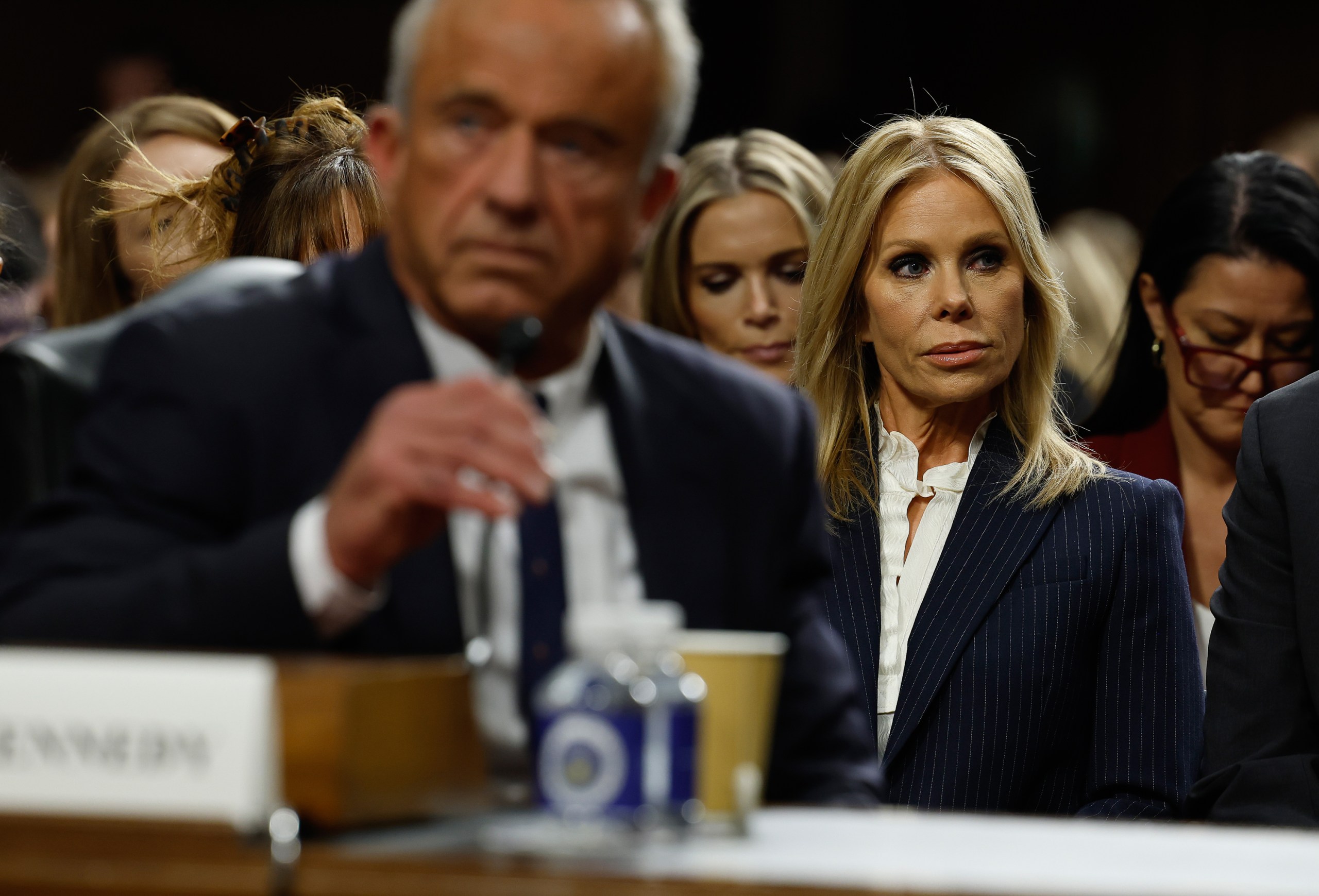
Health Secretary Robert F. Kennedy Jr., Jackson’s ultimate boss, has drawn questions about whether he used his office to help his wife, actress Cheryl Hines.
Cheryl Hines, wife of Health Secretary Robert F. Kennedy Jr., watches her husband testify during his Senate Finance Committee confirmation in 2025.Anna Moneymaker/Getty Images
According to his latest financial disclosure, Hines’ media company, Youngster Productions Inc., received $210,000 in consulting fees from MAHA Action, a nonprofit promoting Kennedy’s Make America Healthy Again agenda. Under the contract, Hines has vigorously advocated for MAHA Action, appearing in several videos and press releases. The group has also claimed credit for policy actions launched by Kennedy’s HHS.
News of the contract, first reported by The New York Times, prompted the Campaign Legal Center to ask the HHS inspector general to examine whether Kennedy made or influenced policies that benefited his wife. Kennedy also received more than $270,000 in gifts from allies working to bolster MAHA, his disclosure showed.
“Americans deserve to know whether their leaders are prioritizing the public good or focusing more on their personal financial gain,” said Payne of Campaign Legal Center.
HHS denied any wrongdoing by Kennedy, telling the Times the secretary “complies with all applicable federal ethics laws, regulations and financial disclosure requirements.”
Campaign Legal Center’s analysis of federal ethics staff this year found Kennedy’s cuts to the agency eliminated nearly 30% of HHS’ full-time ethics workers.
Another HHS official whose disclosures raised ethical alarms was the agency’s top attorney, Mike Stuart. Stuart was reassigned after a Washington Sun investigation found he invested in a company doing business with the department and repurchased stock in other businesses that ethics officials had required him to sell.
Stuart said he didn’t know of the company’s involvement with the department and immediately sold his stock when ethics officials raised questions. “My whole career, I’ve never had even a whiff of an ethical issue. I’m extra careful that I am completely in compliance,” Stuart told the Sun.
The disclosures obtained by ProPublica since early last year have revealed potential conflicts across the federal government, including at the highest levels.
In December, ProPublica reported that Trump had appointed more than 200 people who collectively owned — personally or with their spouses — between $175 million and $340 million in cryptocurrency investments at the time they filed their disclosures. Some hold positions overseeing or influencing crypto industry regulation.
Among them is Todd Blanche, Trump’s former criminal defense attorney and now the nation’s attorney general. Blanche’s disclosures show that he owned at least $159,000 in crypto-related assets last year when, as the Justice Department’s second-highest official, he shut down investigations into crypto companies, dealers and exchanges.
Democrats in Congress accused Blanche of a “glaring conflict of interest”; a Justice Department spokesperson said Blanche’s action was “appropriately flagged, addressed and cleared in advance.” An Office of Government Ethics official noted on Blanche’s latest disclosure that the inspector general “declined further action” related to the crypto holdings.
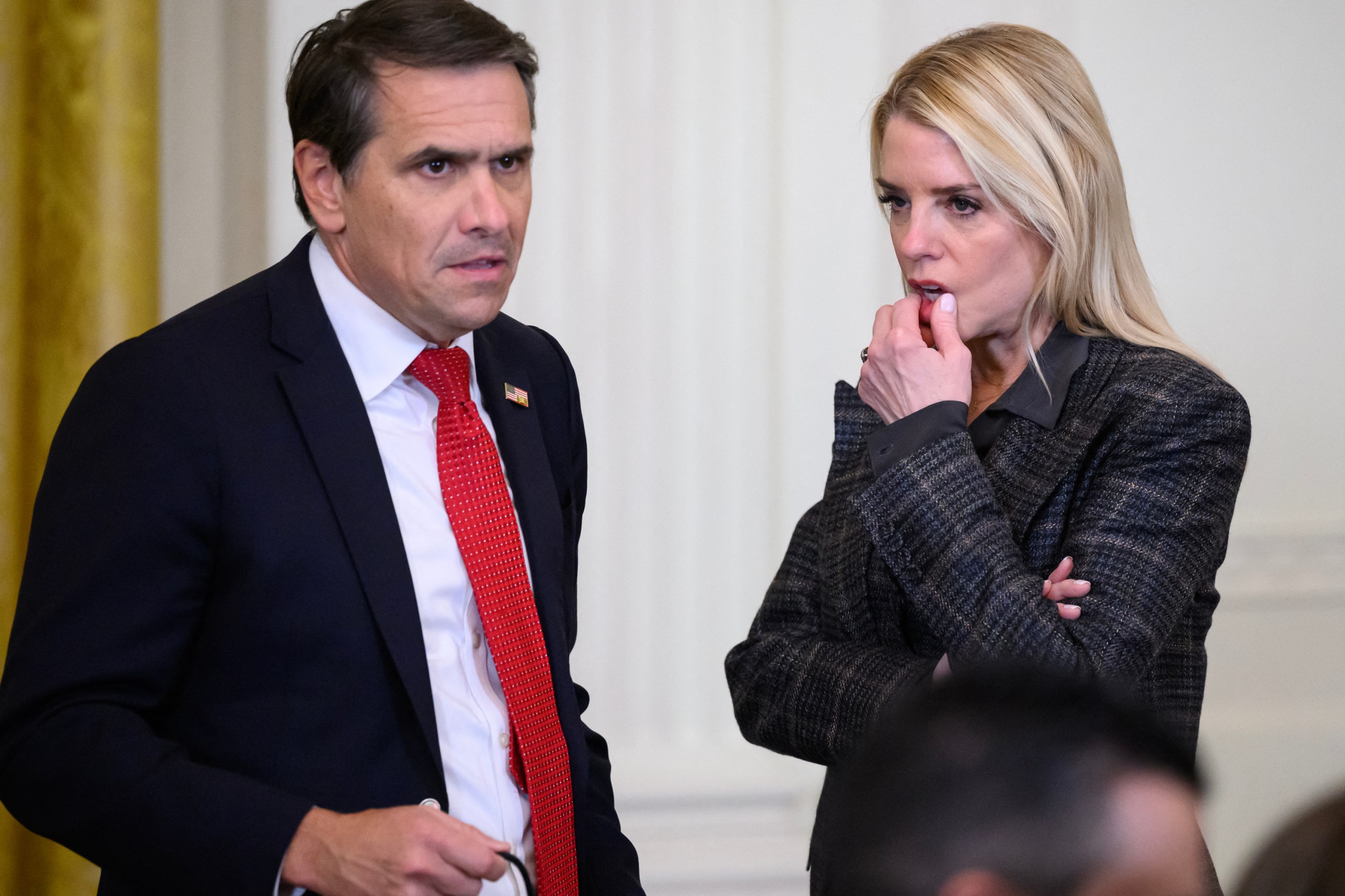
Former U.S. Attorney General Pam Bondi speaks with Todd Blanche, then her deputy and now attorney general, in the White House in January.Mandel Ngan/AFP via Getty Images
Other disclosures helped show that senior executive branch officials, including Pam Bondi when she was attorney general, made well-timed securities trades, selling stocks just before markets plunged because Trump announced new tariffs. (The officials either did not respond to requests for comment or denied having insider information before trading.)
Disclosure forms also revealed in July that Federal Communications Commission officials took pricey gifts from Paramount, including tickets worth $12,000 and skybox seats worth $125,000 each for the annual honors gala at the Kennedy Center. The media giant provided the perks while seeking FCC approval for its mergers with Skydance and Warner Bros. Discovery. (The FCC said agency ethics officers approved the commissioners’ attendance as consistent with ethics law.)
Our database has helped other news organizations uncover potential conflicts of interest. The Lever, for instance, found that the Pentagon’s chief technology officer was “a central figure in the decision to blacklist the AI company Anthropic” while owning a stake in a competitive AI developer. A Defense Department spokesperson said the official, Emil Michael, fully complied with ethics requirements.
One of the world’s largest palm oil producers allegedly misled investors and corporate customers when it denied links to Indonesian suppliers accused of deforestation, a group of environmental organizations found.
The Singapore-based First Resources group, owned by the billionaire Fangiono family, oversees more than 270,000 hectares of oil palm plantations and is currently under scrutiny as Indonesia and neighboring nations battle a toxic haze caused by illegal fires used to clear land for agriculture.
In 2024, First Resources rejected allegations by the Gecko Project, a partner of the International Consortium of Investigative Journalists, which had linked the conglomerate to a company now known as Kalimantan Agro Sejahtera (KAS) and palm oil firms allegedly responsible for deforestation on the island of Borneo. The findings were part of Deforestation Inc., a cross-border investigation led by ICIJ that exposed how a lightly regulated sustainability industry overlooks forest destruction and human rights violations when granting environmental certifications.
Recommended reading DEFORESTATION INC Indonesian billionaire family accused of controlling ‘shadow company’ group linked to major deforestation Oct 30, 2024 ACCOUNTABILITY An ‘anonymous’ company secretly linked to an Indonesian billionaire is destroying Borneo’s rainforests, environmentalists say Mar 19, 2024 IMPACT Brands drop Singapore-listed palm oil giant after Deforestation Inc. exposé Mar 20, 2024
he findings show that “buyers, investors and certification bodies need to step up their due diligence.”
The plastics industry spent decades convincing consumers that throwing used products stamped with the “chasing arrows” symbol into a curbside bin meant they would be recycled.
Now, amid growing awareness that many of those items never get reprocessed, the industry is championing a pair of proposals in Congress that would give misleading recycling claims the support of federal law.
On the surface, the two bipartisan House bills promise transparency for consumers by establishing national standards for recycling and recycled content labels.
But the legislation — promoted by oil, chemical and packaging companies that spend millions of dollars lobbying Congress each year — would forbid states from setting stricter requirements. That would neutralize efforts like California’s “truth in labeling” law, which bans the chasing arrow symbol on plastic products that contain toxic chemicals or that can’t realistically be recycled.
One of the measures would endorse a controversial form of “mass balance” accounting that allows companies to claim a product contains recycled content when virtually none of it came from reprocessed plastic. Two years ago, a ProPublica investigation exposed the misleading, mathematical sleight of hand used in that type of mass balance, which the Biden administration subsequently prohibited for specific products.
Both bills, which have gained momentum and could face a full House vote after the midterm elections, “are peak greenwashing,” Rachel Fullmer, a staff attorney on toxics and environmental health at the Natural Resources Defense Council, said in an email. They “champion deceptive, anti-consumer policies which would result in an increase in plastic production and plastic waste incineration, all while hiding behind the false brand of ‘recycling.’”
Experts say the best solution to the plastics crisis wreaking havoc on human health and the environment is to make and use less of the material; recycling remains a marginal solution at best.
The bills tackle a growing threat to the industry, as several states have proposed or passed laws that require manufacturers to more honestly acknowledge the challenges of recycling plastic. Those measures could force companies to spend money changing their packaging or labels.
The Consumer Brands Association, which represents the packaged goods industry including Amazon, PepsiCo and Land O’Lakes, praised the House bills.
These proposals “work in tandem to reduce consumer confusion and plastic waste while providing much-needed clarity to support new domestic innovations and investments,” the organization wrote to the leaders of the House Energy and Commerce Committee in July. They “demonstrate that consumer protection and recycling-focused efforts go hand-in-hand with promoting affordability and manufacturing investments, and we strongly encourage your support for both bills.”
The association spent $2.4 million in the first half of 2026 lobbying on these bills and other issues, according to data from OpenSecrets. In September, the two recycling bills cleared the House committee.
A few weeks ago, Sen. John Curtis, a Utah Republican, introduced the mass balance bill in the Senate; it currently has no other co-sponsors.
Sheen of Recyclability
Consumers have long been confused by the chasing arrows symbol on many plastic containers. The label was created in 1970 to encourage paper recycling. The plastics industry began placing it on its products in the 1980s to quell public outrage over plastic pollution.
The symbol gave plastic the sheen of recyclability, even though most items cannot be reprocessed due to economic or technical barriers. The Environmental Protection Agency estimated that 8.7% of U.S. plastic waste was recycled in 2018; the rest ended up in landfills or was incinerated. In 2019, the Department of Energy estimated the national plastic recycling rate at 5%.
In recent years, the plastics industry has touted the promise of chemical recycling, a set of costly, often polluting technologies that break plastic into its molecular building blocks. Theoretically, these processes could take the most stubborn, unrecyclable plastics, like grocery store bags or string cheese wrappers, and rebuild them into new products.
That rarely happens.
Take ExxonMobil’s chemical recycling plant in Baytown, Texas. It uses oil refinery equipment to heat up the plastic and transform it into different chemical compounds.
Lee Zeldin, the EPA administrator, visited the Baytown plant last year. He later appeared in a promotional video, calling the facility a “proof of concept” for chemical recycling that could inspire “this entire country.”
But only 8% of the plastic waste processed by ExxonMobil gets transformed into new plastic, according to the California attorney general’s office, which sued the company in 2024 over “deceptively” promoting chemical recycling as an environmental solution. The other 92% mostly becomes fuel, which is burned rather than made into plastic products.
Citing internal company records, the lawsuit states that the recycled plastic is so heavily diluted with new plastic, the resulting products contain less than 0.1% recycled content.
In response, the company said in a court filing that while the state of California may not believe ExxonMobil’s recycling technologies are sufficient to solve the plastic waste crisis, “ExxonMobil did not assume liability for global pollution by innovating solutions to the problem.”
The company has marketed its chemically recycled products as containing “30% ISCC PLUS certified-circular” content, a technical term that could easily be misinterpreted as meaning 30% recycled material. That label is possible through a specific type of mass balance, which allows companies to claim credit in a new plastic product for the recycled molecules going into other things made in the chemical recycling process. Manufacturers can inflate the reported recycledness, or “circularity,” of the more lucrative products like plastic, while reducing the advertised recycled content of less valuable products.
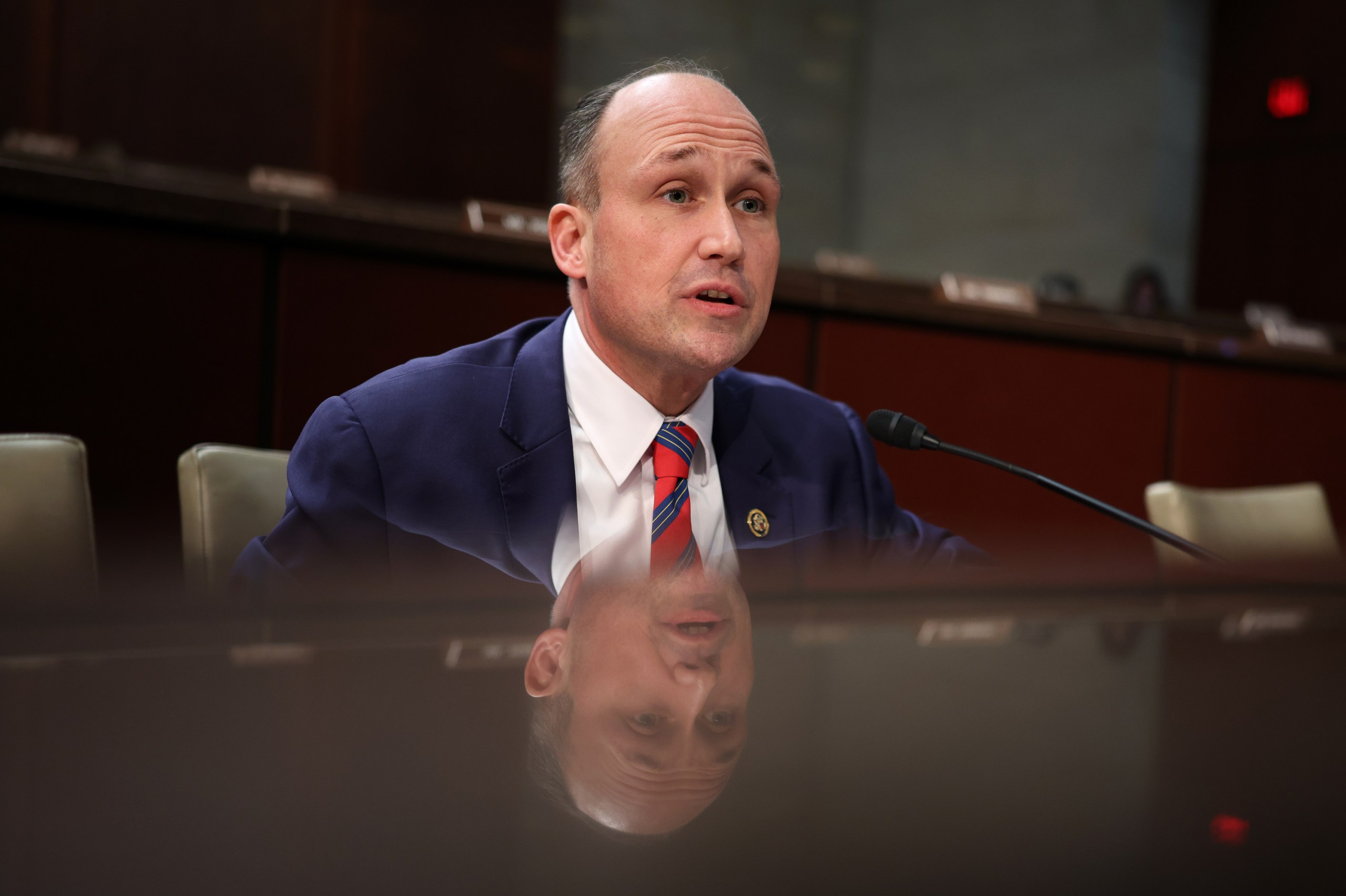
The Recycled Materials Attribution Act, introduced by Rep. Nick Langworthy, a New York Republican, would require the Federal Trade Commission to edit the Green Guides — advertising guidelines designed to prevent greenwashing — so mass balance is recognized as “an acceptable method for substantiating recycled content claims.”
It would bypass the FTC’s own process for revising the Green Guides, which began several years ago. The agency had collected more than 1,000 public comments, including ones on whether limits should be placed on mass balance.
The bill also prevents states from adopting stricter laws on mass balance.
The Recycling Leadership Council is an industry consortium supporting Langworthy’s bill. The consortium quoted Langworthy in its February press release, touting the legislation as modernizing recycling guidelines “with a uniform national standard that protects consumers from misleading claims while giving American manufacturers the certainty they need to invest, innovate, and compete.”
In the first half of this year, the council spent $120,000 lobbying for Langworthy’s bill and related issues, including “advanced recycling” — the industry’s preferred term for chemical recycling.
“Advanced recycling technologies offer an important opportunity to keep more plastic waste out of landfills,” John Hewitt, spokesperson for the Recycling Leadership Council, said in an email.
Hewitt, who also represents the Consumer Brands Association, cited a report from a center-left think tank, which concluded that investing in chemical recycling could more than double the U.S. plastic recycling rate.
Hewitt also defended the bill’s endorsement of mass balance, which “is an established method for tracking recycled materials through complex manufacturing processes, allowing companies to incorporate more recycled content into products.”
Chemical recycling has struggled to operate at scale. If the mass balance bill passes, it could help ExxonMobil and other companies grow their business, as consumers are willing to pay a premium for sustainable products.
Rep. Nick Langworthy introduced the Recycled Materials Attribution Act, which would allow companies to use mass balance accounting to drastically increase the advertised recycled content in plastic products.Kayla Bartkowski/Getty Images
ExxonMobil spent more than $5 million in the first half of 2026 lobbying on the mass balance bill and many other energy or environmental issues. The company didn’t return requests for comment.
Langworthy’s campaign committee received $157,000 from the energy sector in the 2026 election cycle, including oil and gas producers and chemical companies. He did not respond to requests for comment.
Bound for a Landfill
The other bill, the Packaging and Claims Knowledge (PACK) Act, would regulate which items can be marketed as recyclable, compostable or reusable. Consumer product packaging could only be stamped with the chasing arrows recycling symbol if at least 60% of consumers have access to recycling programs that accept the product. The item must also be technically recyclable, meaning it “can be” reprocessed into a new product — but there’s no requirement to show it’s economically feasible to do so.
Recycling programs sometimes accept plastic products even when there’s no affordable way to ship them to a factory that will make them into something new; as a result, plastic that’s been collected for recycling ends up in a landfill or incinerator.
Products not meeting the 60% criteria must include qualifying language, such as “check locally” to see if it’s accepted for recycling.
The bill, introduced by Rep. Randy Weber, a Texas Republican, targets states like California that have stronger requirements for the chasing arrows symbol. A recent California law requires 60% of Californians to have access to facilities that routinely collect, sort and sell the products for reprocessing. In addition, products will be disqualified if they have inks or labels that prevent recycling, or if they contain certain levels of heavy metals and the “forever chemicals” known as PFAS, some of which are carcinogenic.
When Weber introduced the bill last December, his press release called out California’s law: “Packaging and labeling standards in the United States are increasingly influenced by state-level regulations, particularly those adopted in California.”
“The PACK Act cuts through that confusion,” he said in the press release. “It’s pro-environment, pro-business, and rooted in common sense.”
The bill provides little detail about who will make the crucial decisions on which products qualify or what data will be used.
But at least some power will be given to unspecified “accredited third-party certification” groups, which will certify every product’s recyclability claim. These nominally independent organizations provide sustainability labels for various companies.
One example of such a group is How2Recycle, which provides recycling labels — for a fee — to companies. The labels are meant to erase consumer confusion, by instructing them to “empty and replace cap” before recycling a particular kind of bottle, for instance.
These third-party groups are supposed to be independent, but they’re easily captured by industry interests, said Kate O’Neill, an environmental science professor at the University of California-Berkeley who specializes in the politics of recycling.
How2Recycle’s parent organization, the Sustainable Packaging Coalition, has a membership dominated by retailers, brands and packaging companies. Members include Google, Chobani, 3M, Clorox and Lego. (The EPA and United States Postal Service are also members.) Several years ago, How2Recycle made the questionable claim that No. 5 plastics, used in yogurt tubs, were widely accepted for recycling.
How2Recycle and the Sustainable Packaging Coalition didn’t return requests for comment before publication.
California’s law is under a preliminary injunction due to a lawsuit from food producers and packaging companies. However, consumers can still bring private lawsuits if they suspect companies of falsely using the recycling symbol on their products, Lynn Dyer, president of the packaging trade group Ameripen, said in an email.
“AMERIPEN recognized early that differing state rules could make it harder for businesses to explain how consumers should handle packaging after use,” Dyer said. So Ameripen brought together a coalition and “helped make the case to Congress,” resulting in Weber’s bill. The group has “been engaged in discussions with congressional staff from the outset, have closely followed the bill’s development, and draw on the experience of organizations across the packaging value chain.”
ProPublica reached out to every co-sponsor of the House bills. Rep. Earl L. “Buddy” Carter, a Republican from Georgia who supports the PACK Act, was the only lawmaker who responded.
“American consumers deserve clear, consistent, and reliable information about the products they purchase, and our manufacturers deserve a predictable set of rules to follow,” Carter said in a statement. “The PACK Act is about establishing a uniform national standard that eliminates confusion, supports American manufacturing, and provides greater certainty for businesses and consumers alike. We can promote responsible recycling practices without forcing American businesses to navigate a patchwork of conflicting state regulations.”
The co-sponsors of the Packaging and Claims Knowledge (PACK) Act are:
Rep. Troy Balderson, Republican of Ohio Rep. Earl L. “Buddy” Carter, Republican of Georgia Rep. Dan Crenshaw, Republican of Texas Rep. Neal Dunn, Republican of Florida Rep. Randy Feenstra, Republican of Iowa Rep. Russ Fulcher, Republican of Idaho Rep. Adam Gray, Democrat of California Rep. Glenn Grothman, Republican of Wisconsin Rep. David Joyce, Republican of Ohio Rep. John Joyce, Republican of Pennsylvania Rep. Nick Langworthy, Republican of New York Rep. Laurel M. Lee, Republican of Florida Rep. Addison McDowell, Republican of North Carolina Rep. Mariannette Miller-Meeks, Republican of Iowa Rep. Barry Moore, Republican of Alabama Rep. Michael Rulli, Republican of Ohio Rep. Bryan Steil, Republican of Wisconsin Rep. Glenn Thompson, Republican of Pennsylvania Rep. Tony Wied, Republican of Wisconsin
The co-sponsors of the Recycled Materials Attribution Act are:
Rep. Troy Balderson, Republican of Ohio Rep. Dan Crenshaw, Republican of Texas Rep. Henry Cuellar, Democrat of Texas Rep. Donald Davis, Democrat of North Carolina Rep. Gabe Evans, Republican of Colorado Rep. Vicente Gonzalez, Democrat of Texas Rep. Jeff Hurd, Republican of Colorado Rep. Jonathan Jackson, Democrat of Illinois Rep. Michael Lawler, Republican of New York Rep. Addison McDowell, Republican of North Carolina Rep. August Pfluger, Republican of Texas Rep. Marc Veasey, Democrat of Texas Rep. Randy Weber, Republican of Texas
With voters set to cast ballots in two critical races that could help determine control of both chambers of the U.S. Congress, fears of potential voter suppression are running high in Maine.
Officials in the state have prepared for months against the possibility of election interference from federal officials, and the state remains on high alert in the run-up to the general election on November 3.
Training materials were updated this year to include references to federal statutes barring armed federal agents from polling sites.
Training materials for law enforcement officials in the state, obtained by The Intercept through a public records request, were updated this year for the elections to include explicit references to federal statutes barring armed federal agents from polling sites.
In an interview with the New York Times this week, Maine Secretary of State Shenna Bellows said the inclusion of such references was a direct defense in response to the fearmongering around election integrity from President Donald Trump and his administration.
“This is the first time ever that we have had to engage in scenario planning to safeguard against potential federal interference in elections,” Bellows said. “It seems like the federal government is now adversarial to the states.”
Bellows’s office offered up the training slideshow, which cites a U.S. law that bars armed civil or military officers from posting at voting sites, to law enforcement personnel in the run-up to Maine’s primary election in June and again in the lead-up to the general election on November 5.
Nationwide, Democratic officials have expressed fears that the Trump Administration might weaponize U.S. Immigration and Customs Enforcement or other federal agencies to undermine the rights of voters. In New York, state Attorney General Letitia James issued a reminder to voters that federal officials may not “police the polls,” and the Arkansas chapter of the NAACP called out the assignment of federal election monitors to two counties in the state as potential intimidation.
The Trump administration, meanwhile, has sounded the alarm about the alleged scourge of non-citizens on the voter rolls, sending agents from the FBI and ICE’s Homeland Security Investigations division to probe alleged fraud. A handful of people in California, New York, and North Carolina have been indicted for allegedly voting as non-citizens, but a review of similar cases by the Washington Post found that such cases were often the result of honest mistakes.
In Maine, worries about federal interventions at polling places flared when — following a slew of social media videos from Trump allies suggesting that fraud is already taking place among the state’s Somali American community — a local outlet reported that the Department of Justice would be sending election monitors to the state.
Jon Fetherston, a journalist with the far-right Maine Wire, which is funded by conservative megadonor Leonard Leo, was seen following people in and around an early voting site at Lewiston City Hall and aggressively questioning them. (The Maine Wire did not immediately respond to a request for comment.)
Critics said the moves were tantamount to voter harassment, but Maine Wire editor-in-chief Steve Robinson later defended them as an act of election transparency. Robinson, who has led a crusade against what he alleges to be a network of fraud in the state’s Somali American community, questioned the role of interpreters tasked with helping “jobless Somali bums” cast their ballots.
In the wake of the Maine Wire controversy in Lewiston, Bellows confirmed to the Maine Morning Star that a wave of federal election monitors would be headed to polling sites in Lewiston and Portland.
The Department of Justice on Tuesday confirmed to The Intercept that it intends to send election monitors to Maine for Election Day, but did not elaborate or respond to specific questions about where the monitors were to be sent.
“We will have around 1,000 monitors in counties throughout the United States, but we will not share the full list until Election Day,” a Justice Department spokesperson told The Intercept in an email Tuesday. “All monitors must meet the same legal and ethical requirements, including that they not interfere with the voting process. Every monitor has the same role: observe for potential violations of federal law and report concerns to the Department, which the Department will review after Election Day and act where appropriate.”
Robinson did not immediately respond to a request for comment.
Collins Takes Right-Wing Bait
With Maine a key battleground state for control of Congress — Democratic challenger Troy Jackson is seeking to topple long-serving GOP Sen. Susan Collins, and the Democratic House candidate Matt Dunlap is seeking to best former Gov. Paul LePage in Maine’s 2nd Congressional District — temperatures are running high in the state.
Progressives in Maine worry that even without a robust federal presence at voting places — whether monitors are armed or not — activist campaigns like the one undertaken by the Maine Wire journalists could pose a potential threat to voters’ rights.
“Basically, if you were walking into City Hall and you were Black, you could expect to have this guy come up to you with his phone and ask you all sorts of rude and obviously racist questions,” said Ben Chin, co-director of the progressive Maine People’s Alliance. “We’re trying to encourage everyone to come out to vote, but it makes sense why that might give people pause. You hear a guy like that is outside a polling location, it’s reasonable to wonder, ‘Should I go down there right now?’”
“We have received complaints about the intrusive filming, photography, and harassment of voters in the City of Lewiston by political operatives.”
In a statement to The Intercept, Bellows said the state and the city of Lewiston were taking steps to ensure that voters could cast a ballot free of harassment.
“We have received complaints about the intrusive filming, photography, and harassment of voters in the City of Lewiston by political operatives,” Bellows told The Intercept in a statement. “All voters should be able to exercise their right to vote without feeling watched, questioned, or harassed, and we take these allegations seriously, particularly when it appears that voters were targeted for no other reason than their race or ethnicity. We understand the City of Lewiston has taken steps to address the problem, and we will continue to monitor the situation.”
Collins, meanwhile, took the Maine Wire’s reporting seriously after Fetherston asked the senator at a campaign event about the role of interpreters, which he and the Maine Wire cast as “electioneering.”
“I’m unaware of those allegations, but certainly only Americans should be voting in American elections,” Collins said. “And it is troubling to me if people are being accompanied into voting booths and handling ballots in a way that is not sanctioned by law.”
The failure of Tel Aviv and Washington to achieve their war aims in Iran has resulted in the most dramatic American retreat from a region since the U.S. flight from Vietnam in 1975. This startling American defeat — after a generation of forever war failures and stalemates — has been thrown into broad relief by the resumption of another regional conflict that has received far less attention than the Trump administration’s sputtering war with Tehran. This fall, the forces that most Americans know as “the Houthis” have conducted a blitzkrieg in their native Yemen and have been pummeling Saudi Arabia’s aviation and energy infrastructure with missiles and drones. In doing so, they have put a spotlight on the limits of American power, and the shrinking U.S. military footprint, in the Middle East.
The long-standing conflict between Saudi Arabia and northern Yemen’s Ansarullah, or “Helpers of God,” led by the Houthi clan, heated up again in July 2026, when Saudi Arabia struck Sanaa International Airport to prevent a Houthi delegation from landing on its return from the funeral in Iran for slain Ayatollah Ali Khamenei. The Ansarullah government launched its own attacks and, in October, managed briefly to close Saudi Arabia’s own airport. The renewed war has now expanded into a regional conflict, with Pakistan, Türkiye, and, recently, Egypt pledging to defend the kingdom from attack, though none of these regional powers appear eager to conduct operations in Yemen itself. Notably absent from the current conflict is Saudi Arabia’s most powerful ally, the United States, since President Donald Trump has repeatedly declined to intervene on behalf of his Saudi allies.
The typical U.S. press framing of Ansarullah as an “Iran-backed militia” is inaccurate, since the movement has local, Arab nationalist reasons for its actions and is a full-scale government that rules some 80 percent of Yemen’s population. Still, it does receive surreptitious technical and military support from Iran, though nothing like the hundreds of billions of dollars’ worth of high-tech armaments — from kits turning 2,000-pound “dumb” bombs into precision munitions to advanced air-to-air missiles — that the U.S. provides the Saudis. Ironically, Trump’s war on Iran, fought in conjunction with Israeli Prime Minister Benjamin Netanyahu, weakened the Saudis and exposed their vulnerabilities to military attack by Iranian drones and missiles, impelling them to seek a symbolic win over a less formidable enemy in neighboring Yemen. But the weaknesses exposed by Iran’s drones helped encourage a vigorous Ansarullah rejoinder.
The Incredible Shrinking Superpower
The American refusal to join Saudi Arabia’s war signals a profound degradation in U.S. capabilities and standing in the Middle East. The U.S. military had, for decades, dominated the region from a network of about 20 major bases. The U.S. Navy operated out of the headquarters of the Fifth Fleet in Manama, Bahrain. The U.S. Air Force flew missions from the massive al-Udeid Air Base in Qatar, which housed 10,000 U.S. personnel. Thousands of ground troops were barracked in Kuwait, the United Arab Emirates, and Jordan. The Pentagon admitted that “Iranian strikes damaged and destroyed hundreds of buildings and structures at U.S. bases in Kuwait, Bahrain, Qatar, UAE, Saudi Arabia, Iraq, Oman, and Jordan during the conflict. In addition, dozens of U.S. aircraft were destroyed or damaged during OEF.”
The naval base at Manama, one of America’s most important naval facilities and headquarters of the Navy’s Fifth Fleet, was destroyed by Iranian strikes. (Acting Navy Secretary Hung Cao admitted last month that Iran “blew the hell out of Bahrain.”) The loss of Manama led to supply shortages and poor morale aboard the USS Lincoln and other ships patrolling the Strait of Hormuz, bedeviling Secretary of Defense Pete Hegseth.
The CIA offices at the U.S. Embassy in Riyadh were annihilated. Iran struck al-Udeid’s evacuated Combined Air Operations Center in Qatar, from which the Pentagon had directed its strikes on enemies as diverse as the Taliban and ISIL over recent decades, and rendered this facility inoperable. All U.S. troops were also withdrawn from Iraq, a process accelerated by the inability of U.S. missile interceptors to protect them from attacks by Iran and allied Shiite militias there.
Iran’s deployment of swarms of Shahed drones caused the United States and Israel to use up much of their stock of interceptors, which are time-consuming and expensive to replace. A basic Shahed costs as little as $20,000, though new hardened versions are more expensive — whereas a Patriot interceptor costs $4 million. One reason the Trump administration may be reluctant to intervene in Yemen is that if the U.S. cannot fly missions from al-Udeid, and cannot be sure any new fighter-jet fleets stationed in the region will be safe from Iran, given the paucity of interceptors, the Pentagon will have a limited ability to rescue any U.S. pilots shot down over Yemen.
America’s Profound Weakness in the Middle East
Saudi Arabia launched a war against the ascendant Ansarullah in 2015 when the latter staged a coup in the capital of Sanaa. The Ansarullah movement is rooted in Yemen’s Zaidi Shiism, though it is more radical than traditional Zaidism. (Zaidi Shiism differs substantially from Iranian Shiism, having no ayatollahs and having relatively good relations with Sunnis.)
About a third of Yemenis are Zaidis, who predominate in the north of the country, and many have long resented the dominance of their politics and culture by neighboring, oil-rich, Sunni Saudi Arabia, whose official ideology is hard-line Wahhabism, a puritanical form of Islam that insists on a literal interpretation of the Quran. Wahhabi proselytizing among the Shia enraged the Houthi clan and their followers began rebelling against the government of military dictator Ali Abdullah Saleh in 2004. But when he was deposed by popular demonstrations during the Arab Spring in 2012, Saleh gradually allied with the Houthis, and by 2015 about half the Yemeni military rallied to their side, along with some major Sunni tribes.
In response to the Houthis’ rise, a Saudi-led coalition that included the United Arab Emirates began bombing Yemen in 2015. Until 2022, the U.S, then militarily dominant in the region, provided the Saudis with strategic advice, weaponry, and in-air refueling for their fighter jets in the Yemen war, though Riyadh’s tendency to bomb civilian infrastructure rather than confining themselves to military targets caused tension between the two allies. While the Saudis and their coalition pushed the Houthis out of much of the south of the country, including Aden, they were unable to dislodge them from the north. The Saudis implicitly acknowledged their failure with a United Nations-brokered truce in April 2022, which largely held until this past summer.
The Forever Wars Effect
America’s forever wars against Middle Eastern countries that decline to accept the Israel project or American corporate neocolonialism helped reignite the Saudi–Yemeni conflict. Iran is the last major state in the region that rejects Israel and is off-limits to U.S. corporate investment, a stance that inspires much of Washington’s animus. Netanyahu was therefore easily able to persuade Trump, as a privileged visitor to the White House Situation Room, to attack Iran in February.
The glib expectation of Netanyahu and of his Mossad chief at that time, David Barnea, that the Islamic Republic would crumble if Israel murdered Ayatollah Ali Khamenei and around 50 other high-ranking regime figures proved wishful thinking. The notion that Iran was vulnerable to a tightened petroleum blockade was turned on its head by the hard-liners who ascended to power after Khamenei’s death. Largely veterans of the grueling eight-year Iran–Iraq War of the 1980s, the country’s new leaders pursued a policy of “de-basing” toward the United States, taking out its main regional military facilities.
By successfully striking Saudi Arabia, Iran demonstrated that the kingdom’s ability to protect itself is imperfect and its infrastructure is vulnerable.
In addition, Iran launched precision strikes at the energy facilities of their Arab Gulf neighbors who had hosted those American bases. They struck Kuwait’s national petroleum company and its fields and refineries. They took out 17 percent of the production of Qatar’s Ras Laffan natural gas facility, even though Doha had good relations with Tehran and had mediated for Iran. Tehran also struck ships passing through the Strait of Hormuz, using missiles and drones, scaring the major shipping insurers into withdrawing their contracts. Few shipping magnates would risk cargoes worth billions of dollars without insurance.
Iran threw the world into an energy crisis reminiscent of the 1970s, which would have been even more devastating had China not released oil from its vast private and public petroleum reserves and cut its oil imports from 11.5 million barrels a day to under 9 million barrels a day, a move partially enabled by its turn to electric vehicles, which saved it 1.5 million barrels a day. High gasoline and diesel prices hurt Asia more than the United States, but prices rose globally. A third of the world’s helium, essential for cooling computer chips in the production process, comes from the Gulf, and that supply was also interrupted, increasing the price of electronics.
By successfully striking Saudi Arabia, Iran demonstrated that the kingdom’s ability to protect itself is imperfect and its infrastructure is vulnerable. By blockading the Strait of Hormuz in a way that the United States had difficulty undoing, Iran demonstrated the vulnerability of key world maritime arteries, something Ansarullah had already highlighted by striking at shipping in the Red Sea to protest the Gaza genocide.
Blockade for Blockade
When the Saudis bombed Sanaa’s airport in July 2026, Ansarullah’s leadership appears to have decided that Riyadh posed an ongoing existential danger to their state and sought to strangle the Yemeni economy, just as Israel had done to Gaza. Moreover, they sensed that the kingdom could be rolled back in the wake of the failure of the Israeli–U.S. war on Iran. Just as Iran had weakened the Gulf Arab states with its blockade of the Strait of Hormuz, the Houthis believed they could seriously degrade the Saudi economy by blocking Riyadh’s shipping through the Bab al-Mandab, “the Strait of Tears,” between the Red Sea and the Gulf of Aden.
Saudi exports through the Strait of Hormuz had fallen substantially. The kingdom did, however, have an escape valve: its East-West pipeline to Yanbu on the Red Sea. Ships loading at Yanbu then headed for Saudi Arabia’s major Asian markets through the Bab al-Mandab. If Ansarullah could make the tanker captains fearful of this transit, they could reduce Saudi Arabia’s income even further. The Houthi spokesperson, Muhammad Abd al-Salam, warned that the prohibition of Saudi shipping was only the first step in a tit-for-tat strategy of “blockade for blockade.” The idea wasn’t original. The Saudis and the U.S. had often attempted to blockade petroleum imports to northern Yemen during the seven-year Saudi–Yemeni War.
In the subsequent three months, Ansarullah deployed missiles and drones constructed from Iranian models by military engineers trained by the old nationalist government of Ali Abdullah Saleh, many of whom had joined the Ansarullah military, in what has been called a Yemeni “military industrial complex.”
Just as the kingdom’s interceptors had proven unable to prevent Iranian strikes on targets such as the CIA section of the U.S. Embassy in Riyadh, they sometimes failed to halt the barrage of Yemeni missiles and drones. Refineries and oil installations, even the headquarters of the state oil giant, Saudi Aramco, in Dhahran, were hit. In October, Ansarullah closed Riyadh’s International Airport, just as the Saudis had attempted to close that of Sanaa in July. Ansarullah also surged out of their mountain strongholds and made a major push to Yemen’s southwest coast, taking the strategic port of Mocha overlooking the Bab al-Mandab. They also moved on Taiz, an inland industrial city of nearly 1 million inhabitants, one of the last major population centers not already under their control, in a campaign that tested the ability of the small Saudi-backed government of Rashad al-Alimi in Aden to resist it.
Highlanders and Oil Sheikhs
Just as the Vietnam War was one conflict among many fought in the Third World during the Cold War between the U.S. and the Soviet Union, so the Saudi–Yemeni War of 2026 is part of the larger struggle between the U.S. and Israel and Iran. Still, just as Vietnam was more about Vietnamese anticolonialism, nationalism, and sovereignty than about Communism and the ownership of the means of production, so the Saudi–Yemeni War is about Yemeni autonomy more than it is about the loose Houthi alliance with Iran. The conflict is not primarily between Zaidism and Wahhabism, though religious tensions are part of the story, but is far more rooted in a struggle between desperately poor Yemeni highlanders and fabulously wealthy Saudi sheikhs.
The plutocratic Saudi ruling elite is closely tied to Washington and has secret dealings with the Israelis, with whom it shares a distrust of the poverty-stricken Palestinian resistance, and views Ansarullah as cat’s paws of Iran in the Arabian Peninsula and as radical republicans trying to overthrow the region’s oil monarchies in favor of populism. For its part, Ansarullah are Arab nationalists, anti-American, and seek to use oil resources for populist purposes. And they have been willing to attack Israel to defend the Palestinians of Gaza from genocide.
Last week, Ansarullah battered targets across Saudi Arabia, prompting a further pullback from the region by Washington. The Yemeni forces attacked King Fahd International Airport in Dammam. An Ansarullah spokesperson said the group also targeted the Saudi defense ministry in the capital, Riyadh, along with an Aramco site in Yanbu, and an airport in the southern city of Abha. Reports also emerged of an attack on another Aramco oil field.
“Houthis have increasingly engaged in hostilities against Saudi Arabia, including attacks on civilian airports and other critical infrastructure,” wrote State Department spokesperson Tommy Pigott in an October 21 post on X, after the wave of attacks, ordering “non-emergency U.S. government employees and their family members” out of Saudi Arabia.
It’s just the latest evidence of the most significant regional retreat by the U.S. in half a century and evidence of profound American military decline. The outcome of their war with the Saudis will not determine the issue of the U.S.–Israeli contest with Iran, but the very ability of Ansarullah to prosecute it points to the profound weakening of the American posture in the Middle East.
Attorneys for alleged South American drug trafficker Sebastián Marset have asked a federal judge to halt the search of a potentially pivotal cellular phone until the U.S. government explains how it took control of the device from Bolivia.
Marset, a Uruguayan national and self-proclaimed “King of the South,” was arrested in March in a pre-dawn raid in Santa Cruz, Bolivia. Soon after his arrest, he was expelled to Peru and then whisked to the U.S. where he faces money laundering, drug trafficking and narco terrorism charges.
Law enforcement officers in Bolivia seized three phones from the house where they arrested Marset. However, it has emerged that they seized a fourth phone from an adjacent house.
Defense lawyers say in their motion — dated October 23 — that “it is impossible” for them to “be certain as to the timing of the search and whether it was done at the behest of the DEA [Drug Enforcement Administration] or was otherwise valid under Bolivian law.”
They argue that they weren’t notified about the fourth phone, which was a potential key piece of evidence for months, hampering their efforts and raising questions about the integrity of the operation.
The phone was sent to the DEA in mid-April, but didn’t appear in any court documentation shared with the defense team until late July.
“No contemporaneous report of the chain of custody appears to have been prepared,” Marset’s defense team wrote to U.S. District Judge Rossie Alston Jr., who presides in the Eastern District of Virginia.
The DEA confirmed to the defense team, the filing said, that it had extracted data from the phone without a court order. The agent “theorized that the search did not require a court order because the defendant had previously ‘consented’ to the search of his other devices.”
The lead prosecutor did not respond to a request for comment in time for publication. The DEA said it “does not comment on allegations.”
The prosecution has alleged that the four phones were used by Marset to access cryptocurrency accounts.
Crypto accounts have featured prominently in pre-trial disputes. Marset’s legal team alleges that DEA agents tried to trick his elderly mother into handing over passphrases for accounts that hold his digital currency, and later asked him to “donate” his $4 million in crypto assets.
“A seizure does not require asking the detainee’s mother for a photo of a notebook containing access phrases, which are used to move funds, not to secure them. Such contradictions warrant an explanation, which has yet to be provided,” Santiago Moratorio, Marset’s Uruguayan attorney, told OCCRP.
In a September court proceeding, the lead DEA agent denied the allegation that they had asked for a donation.
The Marset case is being closely watched across South America because of his connections to Colombia, and allegations that he had protection in Paraguay and Bolivia where more than a dozen officials were recently detained under suspicion that they had ties to Marset.
The State Department recently revoked visas for 12 Bolivian government, police, and political figures. It cited the need to defend against corruption and narco-trafficking, and said another unidentified nine Bolivians would be denied visas.
Marset’s lawyers argue that the initial charge of money laundering is invalid because it involved a single wire transfer between Portugal and China that did not involve the servers of a U.S. bank. The lawyers say Marset never trafficked drugs to the U.S. and the narco terror groups cited in court were not designated as such at the time of his dealing with them.
In pre-trial conferences, Marset’s defense team has challenged several elements of the case, trying to get the judge to strike down portions of the indictments and weaken the prosecution. Alston has said he would rule on these motions by November 6.
ProPublica’s Emerging Reporters Program provides support and mentorships to college students who are pursuing careers in investigative journalism and need additional training and financial support to help advance their goals.
Participants receive a $9,000 stipend, a trip to the annual NICAR investigative journalism conference, occasional training and presentations by speakers. They’ll also be paired one-on-one with ProPublica journalists who can help counsel them on stories, build their connections in the industry and expose them to the varied paths that careers in investigative journalism can take. Past Emerging Reporters have gone on to work at The New York Times, The Associated Press, Fresnoland, Capital B, The Tributary and other outlets.
Our goal is to encourage the next generation of journalists who seek to shine a light on abuses of power and produce stories with moral force that provoke change. In choosing the class, we look for students who demonstrate an early dedication to journalism as a career, through internships, work at local news outlets or work at campus publications. And where those opportunities — which are often unpaid — aren’t accessible, we look for other ways the student has shown an eagerness and a drive to learn the craft.
This year’s class of exceptional student journalists are from schools in Illinois, Texas, Nebraska, Iowa and New York.
Meet our 2026 class:
Annisyn Krebs-Carr (she/her)
Courtesy of Annisyn Krebs-Carr
Annisyn Krebs-Carr is a senior at the University of Illinois, Urbana-Champaign studying journalism and animal sciences. She is a reporter for Illinois Public Media Student Newsroom, where she reports on the ongoing housing crisis in Champaign-Urbana. Previously, she served as the arts and entertainment editor at The Daily Illini, the independent newspaper at the university. She is now the managing editor and oversees content produced by the entire newsroom. In 2026, she interned for St. Louis Public Radio and formed relationships with the investigative reporters at NPR’s Midwest Newsroom. This is where she developed a deeper appreciation for investigative journalism. As she continues her journalism career, she wants to focus on how the criminal justice system has failed, and continues to fail, Black people. She also wants to explore how environmental racism has impacted lower-income communities. After graduation, she hopes to work in a public media newsroom and report on local stories while honing her investigative journalism skills. Long term, Annisyn hopes to build a dedicated career as an investigative journalist in public media.
Jessica Meza (she/her)
Courtesy of Jessica Meza
Jessica Meza is a senior at the University of Nebraska, Lincoln studying journalism, advertising and public relations. Jessica works across mediums, including in data visualizations, video, print and social media, with an emphasis on audio reporting. Jessica hopes to begin her career in investigative, in-depth reporting, focusing on marginalized communities. She hopes to use her reporting to amplify the voice of people facing hidden injustices in her community. Other interests include housing, immigration and food reporting. Jessica currently works at Nebraska Public Media as a reporting intern. She previously interned at NPR’s Midwest Newsroom and, as the Hortencia Zavala Foundation intern, wrote for The Fulcrum and the Latino News Network. In 2025, she was part of the team at Nebraska News Service that was awarded a regional Society of Professional Journalists Mark of Excellence Award for its investigative project on missing and murdered marginalized women.
Lajward Zahra (she/her)
Courtesy of Lajward Zahra
Lajward Zahra is a senior English major at Rice University in Houston, originally from El Paso, Texas. Her reporting focuses on politics, immigration and the environment, particularly in Texas. She is a 2026 writing fellow at The Nation and has written for the magazine since 2023. She previously interned with the Houston Chronicle editorial board in summer 2025, reporting and writing on local and state politics, including the Texas Republican Party convention, among other issues. Lajward’s freelance work has also appeared in publications including The American Prospect, Teen Vogue, Business Insider, Rewire News Group and Scalawag. She was a 2024 Asian American Journalists Association Voices fellow.
Thai Theodoro (she/her)
Courtesy of Thai Theodoro
Originally from Brazil, Thai Theodoro studies political science with a concentration in Latin American studies at Grinnell College in Iowa. Now in her senior year, she is the managing editor of The Scarlet & Black, Grinnell’s independent student newspaper. Thai has interned at The Boston Globe, the Des Moines Register and the Pittsburgh Post-Gazette, and her reporting has been published in dozens of newspapers across the country. She is a member of the New York Times Corps and a former participant in the National Association of Hispanic Journalists’ Student Project. Thai is passionate about telling untold stories, pursuing investigative reporting with the power to challenge the status quo, using the three languages she speaks to reach underrepresented communities, and, of course, writing the occasional quirky story.
Tsehai Alfred (she/her)
Courtesy of Tsehai Alfred
Tsehai Alfred is a senior at Columbia University studying English. She is the 150th editor-in-chief and president of the Columbia Daily Spectator, the campus newspaper, and is also an intern on CNN’s criminal justice team. Over the summer, she was a Dow Jones News Fund intern at VTDigger, an accountability-focused newsroom in Vermont, investigating the troubled integration of AI into healthcare, a struggling dairy farming industry, and soaring police use-of-force payouts. Previously, she has interned at City & State New York, covering the 2025 mayoral race and city council; at PBS News as a Gwen Ifill Journalism Fellow; and at her local news outlet, the Virgin Islands Consortium. Her reporting interests include local government, economic inequality, and political and corporate accountability.