Category: OSINT & Investigations

  • How AIPAC and AI Spent Their Money This Midterm Election

    How AIPAC and AI Spent Their Money This Midterm Election

    It’s a superlative achieved again and again: The current election cycle is the most expensive on record, according to AdImpact, likely to be surpassed only by the next one. North of $16 billion have been raised ahead of Tuesday’s looming elections, with ad spending in House and Senate races topping $4 billion. Mega-donors this election season have overwhelmingly backed Republicans with contributions largely flowing from AI, crypto, and online gambling interests.

    Related

    AIPAC Isn’t Retreating. Here’s How It’s Already Shaping the Next Congress.


    The Intercept tracked how super PAC spending is flowing into the midterms and how growing public skepticism of special-interest money in politics is affecting campaign strategies. Hundreds of candidates are still taking donations from the American Israel Public Affairs Committee and its super PAC, the United Democracy Project, despite public sentiment turning against the pro-Israel lobby. 

    “The data overall reveals that [AIPAC is] still spending a ton of money on a lot of races, and more often than not, their candidates are still winning,” Intercept managing editor Maia Hibbett told The Intercept Briefing. “It is still quite meaningful money.”

    Artificial intelligence super PACs have also poured tens of millions of dollars into this election cycle, most of it on just a few races in the primaries. The two leading AI super PAC networks, affiliated with OpenAI or Anthropic, dropped a whopping $50.7 million on the primaries, but are noticeably spending much less in the lead-up to the general election, $8.5 million — likely responding to public backlash in the same way that AIPAC has.

    “The polls are just so startling on the public’s transformation on AI and data centers over the last year. … The entire life cycle of these AI super PACs, which started about a year ago, has followed that evolution of the public’s opinion,” said Intercept politics reporter Matt Sledge. “One of the things that’s been really interesting in the general election races is … candidates [trying] to paint themselves as the more pro-AI safety, pro-AI regulation candidate.”

    This week on the podcast, host Jessica Washington speaks to Hibbett and Sledge about the spending trends in the most expensive election cycle to date and unpack the intended impact.

    “No matter which party gets control of either or both houses of Congress, there will be a lot of people elected next week who got there on the backs of Big Tech and special interests,” said Hibbett.

    “They’re backing a lot of people in safe seats who don’t really have a tight election,” Sledge added. “The goal may just be to buy themselves a few friends in Congress, because sometimes in Congress, it’s just as good to have a few people who can stop regulation as it is to have people who can shape and actually pass laws.”

    For more, listen to the full conversation of The Intercept Briefing on Apple Podcasts, Spotify, YouTube, or wherever you listen to podcasts.

    Transcript

    Jessica Washington: Welcome to The Intercept Briefing, I’m Jessica Washington, politics reporter at The Intercept. 

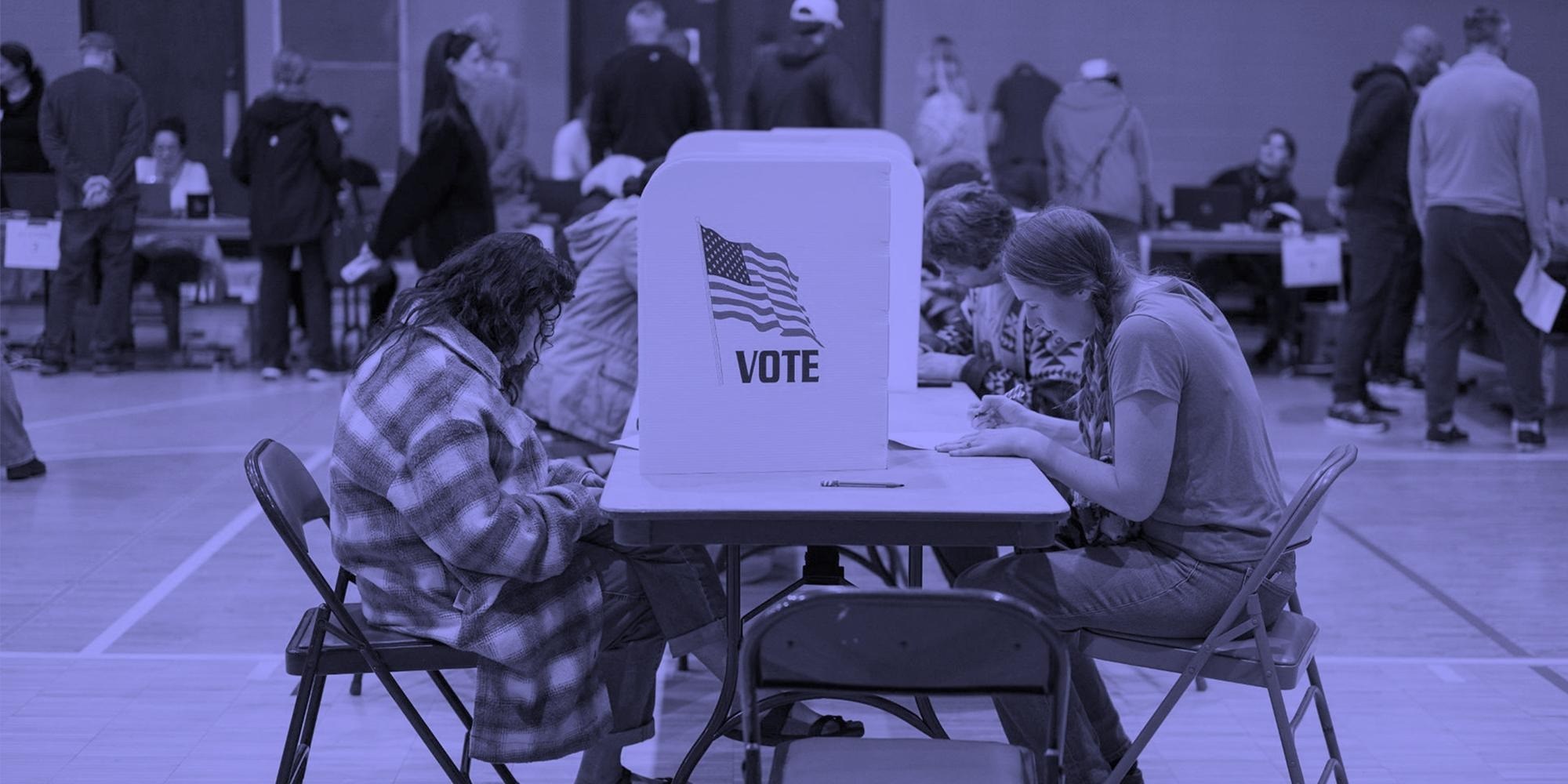
    On Tuesday, voters will head to the polls to cast their ballots in the most expensive election cycle ever in terms of campaign ad spending, even outpacing past presidential elections. That’s according to AdImpact. 

    North of $16 billion has been raised this cycle, with ad spending in House and Senate races topping $4 billion. Billionaire Elon Musk has dumped hundreds of millions into races across the country, using his enormous personal wealth to sway the election in favor of Republicans. Musk, who has a home and multiple businesses in Texas, has taken a particular interest in the state’s Senate race between Republican candidate Ken Paxton and Democratic candidate James Talarico.

    Most of the money from Musk and other donors has flowed not to candidates, but to powerful super PACs representing a variety of different special interests.  

    That super PAC spending is the subject of my colleagues, Intercept politics reporter Matt Sledge and senior politics reporter Akela Lacy’s new project, tracking how money is flowing into the midterms. 

    Maia Hibbett, managing editor for The Intercept, and Matt Sledge join me now to talk about the project and how big money is shaping the midterms. 

    Matt, Maia, welcome back to The Intercept Briefing 

    Maia Hibbett: Thanks for having us. 

    Matt Sledge: Thank you for having us, Jessie. 

    JW: Maia, I want to start with you. As a part of the super PAC project, The Intercept tracked how millions of dollars flow through the pro-Israel lobby in the United States.

    What did the reporting reveal about how the American Israel Public Affairs Committee and affiliated groups like the United Democracy Project mask their influence in U.S. elections in a political landscape where AIPAC’s contributions and endorsements have become largely politically toxic? 

    MH: The reporting showed that AIPAC and its affiliated super PAC UDP are a little bit weakened, but they’re still pretty dominant.

    The narrative out of this midterm cycle, especially during the primaries, was largely focused on a few high-profile races that an AIPAC-backed candidate lost — and that was a huge shock. These big upsets were AIPAC or UDP or a related group that, we can talk about a little bit later, had poured money into, and then the candidate didn’t succeed.

    But if you look at it in the aggregate, what the data overall reveals is that they’re still spending a ton of money on a lot of races, and more often than not, their candidates are still winning. It is still quite meaningful money. And even though AIPAC has been discussed as going underground, they are still directly invested in a lot of races.

    JW: I want to get into AIPAC’s shifting strategy and their latest announcement on that. But first, Matt, I wanted to talk about your reporting. AI super PACs have poured tens of millions of dollars into this election cycle.


    Related

    AI Tried to Buy the Midterms — Then the Lobby Learned Everyone Hates AI


    What do we know about the people and companies behind these super PACs? This may seem obvious, but what are they hoping to gain with this level of spending? Are there specific examples of friendly legislation these varied interest groups are hoping their candidates will see through if they win?

    MS: To answer your second question, I think it’s really more about setting the tone for future regulation at the federal level. You have two big super PAC networks. One is affiliated with OpenAI, and they broadly favor a laxer regulatory scheme for AI. Then there’s another network that’s affiliated with Anthropic that paints itself as supporting a stricter regulatory scheme.

    “It’s really more about setting the tone for future [AI] regulation at the federal level.”

    Skeptics will point out that these networks are both backed by big AI companies. So at the end of the day, they’re probably going to favor regulation that is favorable to the AI companies. I get into this a little bit in my story, but, just in the last few months, there’s also been this constellation of other smaller groups that are sometimes backed by individual employees at these firms or just by people concerned about AI that are pushing for stricter regulatory regimes and aren’t as directly connected to one of the big companies.

    JW: Matt, I’m curious about the impact on voters here. CNBC analysis from early October found that mega-donors this election season were overwhelmingly backing Republicans with contributions largely flowing from AI, crypto, and online gambling interests: “Fourteen of the 20 largest donors and donor groups this election cycle have exclusively or nearly exclusively backed GOP candidates or aligned groups.”

    Matt, are we seeing voters become more receptive to Republicans as a result of all this ad spending? Is it working on the voter base? 

    MS: It’s always hard to tease out the impact of an individual super PAC or industry, because you have to keep in mind that a lot of the time, if you’re a crypto super PAC, or an AI super PAC — or more recently, a prediction market super PAC — they are not running pro-crypto or pro-AI ads.

    They are running ads that look very similar to everybody else’s. Often, they’re doing negative campaigning that campaigns don’t want to do themselves, and they have such vague names that they’re not associated with crypto or AI. So I do think ads have an impact on the races, but overall what we’re seeing in polls is that it’s not a great environment for Republicans.

    So it may have served, just writ large, to potentially soften the blow to Republicans this time around. It does help them to have this many corporate allies, but it may still be overwhelmed by a blue tide. 

    JW: That makes a lot of sense in terms of just, this is a bad environment for Republicans. They have a president who is unpopular. We have an economy that is not amazing right now. It makes a lot of sense that despite all this ad spending, the baseline of the election is not in favor of Republicans. 

    Maia, I wanted to get back to something that you had said a little bit earlier about AIPAC and their shifting strategy. AIPAC recently announced that they would no longer officially endorse candidates or give money directly to campaigns.

    Were we seeing an early signal of shifting strategies from AIPAC during the 2026 midterm elections? And what does this change actually mean for AIPAC’s influence on our elections?

    MH: I’m so glad you asked, because we actually noted early in the 2026 cycle that AIPAC was starting to retreat and change its strategy. Our colleague Akela Lacy wrote a story in December 2025, and the headline was, “AIPAC is Retreating From Endorsements and Election Spending. It Won’t Give Up Its Influence.” I encourage anyone to go back and read that story because it was really prescient about what we would see in the cycle to come, which is that AIPAC used to do all of its spending behind closed doors.


    Related

    AIPAC Is Retreating From Endorsements and Election Spending. It Won’t Give Up Its Influence.


    In 2022, it made a big splash when it started doing direct spending in that year’s midterms. The group had helped fund some anti-Bernie Sanders ads during the 2020 presidential campaign, but it was 2022 when it went all in, rather than routing its donations through other groups or through dark-money pathways, it just started giving contributions to candidates. 

    After it spent so much money in that midterm cycle and in last cycle‘s 2024 races, and as public sentiment started to turn against the pro-Israel lobby’s interests and people became very critical of the U.S. support for genocide in Gaza, AIPAC started to essentially return to its roots.

    I think this is really interesting because in the press it has been talked about as a very new strategy. But really, it’s more that AIPAC is returning to the way it used to do business. 

    JW: Is that as effective as a strategy — the old model that they had? Should we expect that it’ll have just as much influence on elections as they did previously?

    MH: It’s a good question. I don’t know how effective it will be as a strategy. There’s a lot more scrutiny on AIPAC now than there was a few years ago, and so it’s much more difficult for them to hide what they’re doing because there are journalists like us who are going to try to follow the money and say, maybe you gave to something that’s called Elect Chicago Women, but it’s actually from UDP, which is the super PAC for AIPAC.

    I think in some cases, they can’t get away from the public perception that now exists. But on the other hand, there are many voters who might not really pay attention to the name of the PAC that sponsored the ad that they saw, and then go look it up and see where the money came from. So it remains to be seen how effective it will be.

    “It’s much more difficult for them to hide what they’re doing because there are journalists like us who are going to try to follow the money.”

    JW: Not everyone is reading The Intercept before voting, as they should, but it’s fine.

    Matt, I wanted to get back to you because there’s a lot happening with these big AI super PACs. You noticed in your reporting that, after spending a lot in the primaries in New York in particular, but in other places as well, the big AI super PACs have gone pretty much quiet in the general election.

    Are AI super PACs responding to public backlash in the same way that AIPAC is? What have you observed in terms of why they’ve gone a little bit quieter? 

    MS: In response to your question about backlash, I think the answer is yes.

    “It’s just a dramatic decline in spending from the primaries to the generals — even though they still have money they can tap.”

    They’re on this kind of accelerated timeline going through what AIPAC went through over the course of five years but essentially in five or six months. The polls are just so startling on the public’s transformation on AI and data centers over the last year. It’s just such a rapid change in public opinion, and the entire life cycle of these AI super PACs, which started about a year ago, has followed that evolution of the public’s opinion.

    It’s just a dramatic decline in spending from the primaries to the generals — even though they still have money they can tap. Leading the Future, which is the OpenAI-aligned network, they started first, and then the Anthropic-aligned network, Public First, they started a few months later as a response to the Leading the Future network.

    So it seems like, from what we’ve been able to tell, Leading the Future scaled back on spending as the general election came about, and Public First responded in turn and also scaled back its operations. That doesn’t mean they’re not spending anything, and we have seen a slight uptick in the final few days of this election when ads are probably just less effective than they would have been a couple weeks ago.

    “If Darline Graham narrowly gets away with winning her race in South Carolina of all places … then you can still say that Leading the Future and the AI industry played a pretty important role in the general race.”

    One really notable race is now South Carolina, where Leading the Future is helping prop up Sen. Darline Graham, who hasn’t been a great fundraiser on her own. So there’s actually still a world where AI plays a decisive role in this election in terms of control of the Senate.

    If Darline Graham narrowly gets away with winning her race in South Carolina of all places, and that narrowly hands control of the Senate back to the Republicans, then you can still say that Leading the Future and the AI industry played a pretty important role in the general race.

    JW: Just to be clear, you’re referring to Darline Graham, Lindsey Graham’s sister, correct? 

    MS: That’s correct. 

    JW: Maia, speaking of Big Tech, you also edited a story from Intercept reporter Jonah Valdez looking at how tech leaders, including John Hering, are dumping millions into the LA city attorney race to block Marissa Roy, a DSA-backed candidate, from winning. What is going on here — why such an interest in a race most people are likely not paying any attention to?

    MH: City attorneys are one of those jobs that, as you said, a lot of voters don’t pay attention to them. I think a lot of people in cities all over the country maybe couldn’t tell you who the top lawyer of whatever city they live in even is. But this is a job that is largely tasked with enforcing regulations and laws and making companies that might be based in that city or might operate in that city comply with them.

    Marissa Roy, this DSA-backed candidate, is currently a deputy attorney general for the state of California, and she’s one of the people who helped the state prosecute this historic Meta settlement where Meta ended up having to pay $17 billion for harms to children using its technology.

    We don’t know exactly why John Hering and other tech leaders, like the founders of Ring and Tinder and investors in Anthropic and SpaceX, are spending so heavily in this race, but you might be able to conclude that they’re interested in preventing a person who just helped carry out this huge settlement against Meta from becoming the city attorney of LA.

    Some of them are funding a group that’s called Neighbors for John McKinney, which is backing the opponent in the race. John McKinney is the other candidate, and he is much less likely to win, but is propped up now by a lot of spending. They frame him as a tough-on-crime candidate; they say he’s going to restore order to LA, help clean it up is the idea.

    Like Matt was saying, often these tech investments in races don’t actually foreground the interests of Big Tech, and they don’t say explicitly, “We want to stop this person from coming into office because we’re worried they’re going to regulate our industry.” Instead, they find a different issue and spend money on that.

    It’s also worth noting that John Hering, his group, frames John McKinney as a lifelong Democrat and very anti-MAGA, is the language they use. But John Hering himself is a big ally of Elon Musk. He has been an eager investor in his companies. He said Musk was an “American hero” this year, and he has spent pretty heavily also to support Musk’s America PAC and the Trump campaign after previously spending on the Hillary Clinton presidential campaign.

    Like many Silicon Valley types, he’s had an evolution. And although he lives in San Francisco, he also spent in favor of Spencer Pratt for LA mayor.

    JW: Wow. Yeah, Big Tech has really come a long way from the ’08 years in terms of their relationship with Democrats and Republicans, and propping up Spencer Pratt.

    Matt, I want to bring you in and get your perspective and kind of big picture. What has made this election cycle so popular for Big Tech? 

    MS: When it comes to AI and crypto and the prediction markets, it’s knowing that the next few years are really going to be critical for them in terms of regulation. These are all fairly young industries, and the rules haven’t been set yet. The Trump administration is doing its best to set them, but Congress has not had a final word on any of those industries.

    Related

    Prediction Markets Have a Lock on the Midterms


    They see a chance to shape the rules in a way that favors them, and they’re just using the old Washington playbook of spending a bunch of money on campaigns and a bunch of money on lobbyists to try to shape the rules in their favor.

    JW: Is this just also a matter of them having more money to play with than they’ve had before? Is this something tech probably would have done years ago if they’d had this access to capital? Or is this really, like you said, just they’re aware that there is existential risks to their industry if they don’t?

    MS: Tech for the last few decades has had a lot of money. It’s just been a huge part of the U.S. economy. But I think this move into more regulated spaces is maybe what’s newer.


    Related

    AI Almost Started a U.S.–China War — and No One Seems to Care


    When Microsoft is creating an internet browser or a word processor, that creates potential antitrust issues, and they have to spend political money in that sense. But they’re not playing in the same kind of highly regulated financial spaces, and nobody ever thought that Clippy posed an existential risk to humanity. So we are moving into new territory when it comes to techs. 

    JW: I miss Clippy. That is my one comment on that. 

    I want to get both of you back in here. We’ve been talking about some of the biggest donors in American politics today, and a few special interest groups in particular who’ve obviously been experiencing public backlash — AIPAC, AI, and data centers.

    What do you make of this new record-level spending in a midterm election in particular? We’ll obviously have more answers on this next week, but from what you’ve observed so far, is it having the intended impact on voters? Maia, let’s start with you. 

    MH: I think to use the cop-out that we keep coming back to, we won’t really know if it worked with voters until after the results next week. But it’s clear in this midterm cycle and maybe this is a reminder of kind of a perpetual truth in, when it comes to money in politics, that these big spenders are always going to fund candidates on both sides of the aisle. Often election narratives and questions about special interests will really look to one party or the other and try to map this kind of spending onto partisan issues.

    While some of that certainly happens, I think no matter which party gets control of either or both houses of Congress, there will be a lot of people elected next week who got there on the backs of Big Tech and special interests.

    That is something that voters are more and more aware of and more and more frustrated by, and we did see a lot of rejection of that kind of big-money spending in the primaries. But ultimately, I don’t know how much that narrative has changed. 

    JW: Matt, I know you’ve seen some specific examples of this impacting elections. Can you talk about that a little bit? 

    MS: One of the things that’s been really interesting in the general election races is this race from candidates to paint themselves as the more pro-AI safety, pro-AI regulation candidate.

    I’ve done some reporting in Michigan’s 7th [Congressional] District, where a co-founder of the Sunrise Movement is trying to unseat an incumbent Republican, and he has from the start really run on being an anti-data center candidate, campaigning with local activists in small towns of a few thousand people.

    His Republican opponent is now also trying to paint himself as a data center skeptic — using different language, more language about local control than about big, bad companies. 

    But there’s been such a backlash that we’ve seen some changing tactics from the big AI super PACs in the runoff. One has donated money to a nonprofit that’s more focused on building support for data centers. Good luck with that, I guess.

    And then another, the Anthropic-aligned network, has essentially handed off money to a pro-Scott Wiener super PAC in California that already existed and already has funding from other tech leaders in the San Francisco area. But that donation has generated this whole fight between Scott Wiener and his opponent, Connie Chan, over who is the more pro-AI regulation candidate now. So it’s a lot of candidates fighting to be the more pro-regulation candidate.

    Just thinking back to your question about the effect on voters, I think for the super PACs and for their funders, the impact on candidates may ultimately be more important, on elected officials. They’re backing a lot of people in safe seats who don’t really have a tight election. The goal may just be to buy themselves a few friends in Congress, because sometimes in Congress, it’s just as good to have a few people who can stop regulation as it is to have people who can shape and actually pass laws.

    JW: That’s a good point. Speaking of the election, which we know is just days away, what are you two going to be following closely next week? Maia, I want to start with you.

    MH: There’s obviously a lot to follow next week, and more races than we can keep track of. One I think that will be very interesting that I was thinking about in terms of AIPAC spending — when Matt just mentioned this thing about AI groups backing candidates who are not in close races — is, of course, the Senate race in Maine.

    One of the interesting takeaways we found in this AIPAC project is that in the primaries when AIPAC was spending, as it does in, in various races, one of the top recipients of its money was Susan Collins — who at the time did not have a primary challenger, but it spent heavily to support her primary campaign.

    So we’ll obviously watch the Collins–Jackson race in Maine. We have a reporter going there. Matt’s going to go to Michigan. We also have a reporter going to Texas to track some of the big Senate races. Depending on how the results look, I think we’ll pretty quickly be pivoting to accountability for, coverage for the people who are elected, who, maybe entered office vowing not to take corporate PAC money or not to take special-interest money, and to keep an eye on those now Congress members and see if they vote like it or if they continue to have that policy once they’ve been elected.

    JW: And Matt, what are you following? 

    MS: As Maia mentioned, I will be in Michigan. Super interested in that 7th District race that I mentioned between Will Lawrence and Tom Barrett. But then the race everybody’s going to be spinning and talking about for weeks probably: the Mike Rogers/Abdul El-Sayed race. It just is going to carry so much narrative heft going forward about what the voters were trying to say. 

    Where are you going to be, Jessie? What are you going to be up to? 

    JW: I will be in D.C., and I’ll be looking at what it means to have yet another election with the National Guard in town and essentially in an occupied city.

    I’ll also be looking into what it would mean for the district to have a socialist mayor, Janeese Lewis George, who is almost certain to win on Tuesday, particularly when it comes to ICE and the Metropolitan Police Department’s collaboration with ICE. That’s going to be something I’m really keeping an eye on, not just on Election Day, but going forward to see if she can implement some of these really bold ideas that she’s proposing in a city that’s very constricted in what it can actually do because of federal law.

    But that’s enough previewing from me. We’re going to leave it there. Maia, Matt, thank you so much for joining me on The Intercept Briefing. 

    MH: Thanks again. 

    MS: Thanks for having us. 

    JW: And thank you for listening. Next week we’ll be back in your feed early with a special midterm election episode, so stay tuned.

    That does it for this episode. We want to hear from you. Tell us what you’re following or want to see more coverage of. Email us at podcasts@theintercept.com or leave us a voice mail at 530-POD-CAST, that’s 530-763-2278.

    This episode was produced by Laura Flynn. Jordan Uhl is our social media producer. Ben Muessig is our editor-in-chief. Maia Hibbett is our managing editor. Nara Shin is our copy editor. William Stanton mixed our show. Legal review by David Bralow. Slip Stream provided our theme music.

    This show and our reporting at The Intercept do not exist without you. Your donation, no matter the amount, makes a real difference. Keep our investigations free and fearless at theintercept.com/join. 

    And if you haven’t already, please subscribe to The Intercept Briefing wherever you listen to podcasts. Do leave us a rating or a review, it helps other listeners find our reporting.

    Until next time, I’m Jessica Washington.

    Source: The Intercept · 2026-10-30
  • Federal and State Officials Ramp Up Scrutiny of DraftKings, Other Sports Betting Apps

    Federal and State Officials Ramp Up Scrutiny of DraftKings, Other Sports Betting Apps

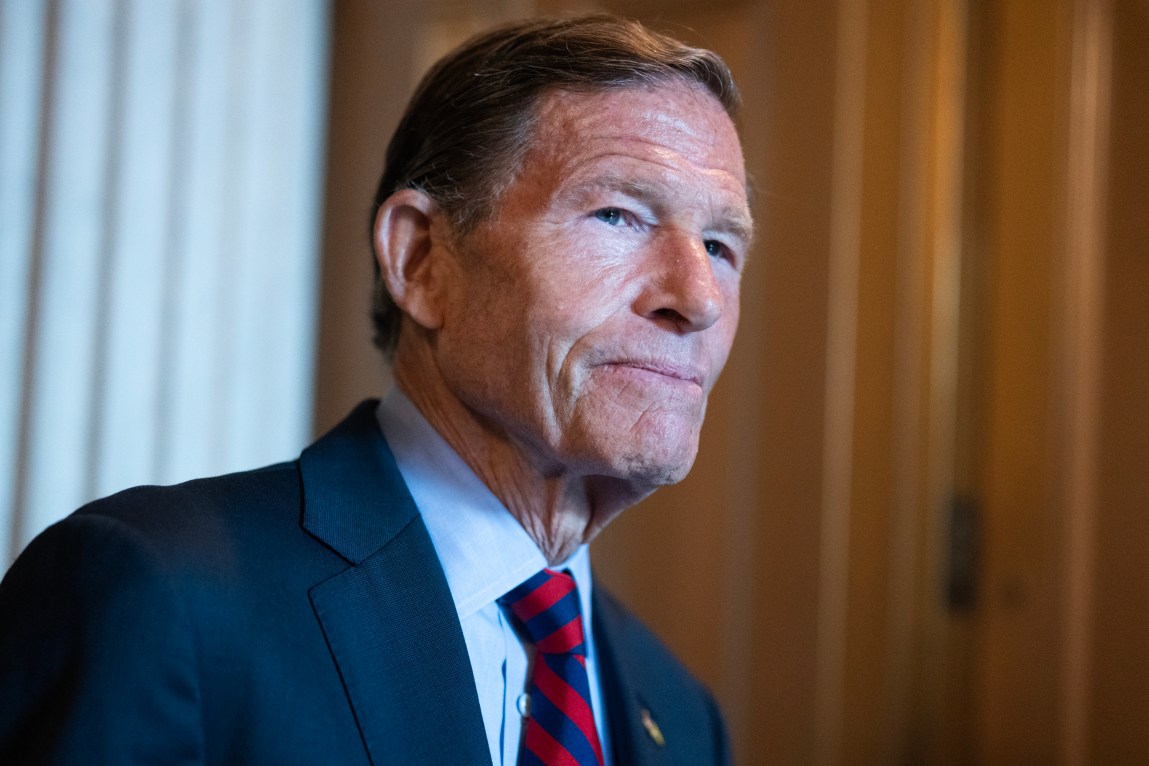
    A man with brown hair wearing a blue suit and striped tie stands inside a room and looks off in the distance.
    Connecticut Sen. Richard Blumenthal, one of three federal lawmakers who recently cited ProPublica reporting in a letter asking sports betting companies for more information about their business practices. Tom Williams/CQ-Roll Call, Inc via Getty Images

    State and federal officials have ramped up scrutiny of online sports betting companies in recent weeks, launching inquiries, demanding information and, in one case, proposing a new rule that would limit when companies like DraftKings can pitch their users to bet more.

    The moves — by gaming regulators, government lawyers and federal lawmakers — follow an investigation last month by ProPublica that tested the guardrails DraftKings and other sports betting companies have in place to protect users from spiraling out of control. That system is called responsible gaming, and executives say it’s integral to their companies’ long-term success.

    The ProPublica article showed how DraftKings bestowed VIP status on a reporter who deliberately bet like a problem gambler. The report detailed the ways in which the app’s user design and promotions encouraged more betting — even after the reporter opted into responsible gaming tools designed to slow users down. A week earlier, The New York Times reported that DraftKings had used machine learning and artificial intelligence to target promotions to losing bettors.

    Those articles were the focus of an Oct. 15 meeting of the Louisiana Gaming Control Board, which, partly in response to the stories, tabled the renewal of DraftKings’ five-year license. Instead, the board granted the company a temporary four-month permit while investigators look into the issues raised in the reports as well as other paperwork concerns.

    The board’s chair, Christopher Hebert, said the Times had raised some “very serious questions” and called ProPublica’s reporting “very troubling.”

    While news stories “are not findings of regulatory violations,” Hebert said, “as regulators we have a responsibility to examine these matters that could affect the integrity of gaming operations and the protections of our citizens here in Louisiana.”

    State health officials say the number of Louisianans believed to have a gambling disorder has risen in recent years amid the surge in popularity of online gambling and prediction market sites. One top official reported this summer that gambling addiction was among the health department’s “top three priorities.”

    What Does Your Data Reveal About Sports Betting Apps? Help ProPublica Find Out.

    If you’ve bet on sports with FanDuel or DraftKings, you can help ProPublica understand how these apps work. Use our browser extension to download your betting history, then upload your files.

    Paul Liberman, who co-founded DraftKings and serves as its president of operations, told the regulators: “We do not use artificial intelligence to target losing gamblers by any means.”

    DraftKings previously told ProPublica that it proactively closes the accounts of suspected problem gamblers “all the time” but declined to provide specific figures. Yet when asked by a Louisiana board member for those same specifics, Lori Kalani, DraftKings’ chief responsible gaming officer, said 175 accounts in the state had been shut down this year. She told the board she didn’t know how many total users DraftKings had in the Pelican State.

    “We’re not physicians, we’re not clinicians and that’s not our role, but we certainly want to help people enjoy the service, the platform that we’re offering them,” Kalani told the board. “I know that we’re doing our job and that when we see something, we say something and we engage. I just can’t tell you if 175 is the right number. I wish it was zero.”

    In a statement, a DraftKings spokesperson said: “As a legal, regulated operator, DraftKings values an open and ongoing dialogue with regulators and regular conversations and check-ins with regulators are normal course of business.”

    In response to ProPublica’s original investigation, Kalani said DraftKings’ responsible gaming system — which consists largely of in-app messages about the company’s tools — “worked the way it was supposed to.” She cautioned against “drawing broad conclusions” from one user’s experience.

    The day after the Louisiana meeting, regulators in Ohio proposed an amendment to the state’s sports gaming rule that would bar companies like DraftKings from sending direct ads or marketing to bettors for 48 hours after they’d opted into responsible gaming tools or updated their current settings.

    The proposed amendment speaks directly to a finding in ProPublica’s reporting: After blowing nearly $4,500 betting on tennis in 24 hours, the reporter used such tools to limit the amount of time and money he could spend on the app. Just 30 minutes later, though, he received the first of four push notifications promoting new betting opportunities. It wasn’t until he opted into a far more restrictive tool, called a “cool-off,” that the notifications temporarily stopped.

    Andromeda Morrison, the interim executive director of the Ohio Casino Control Commission, said that though her office had been working on its proposal for some time, ProPublica’s story illuminated the issue. “Hopefully this is something that is fairly easy for the industry to see as a common sense restriction to make sure those consumers are making good choices without those push notifications,” she said.

    But Keith Whyte, a former director of the National Council on Problem Gambling who now consults for industry and nonprofit groups, said the proposed amendment could unintentionally disincentivize users from using tools like deposit limits. “I think the implication is that using a responsible gaming tool is a sign of a gambling problem,” he said. The measure faces a long rulemaking process, including more rounds of public hearings and comments.

    Sports betting operators are also feeling the heat at the federal level.

    Citing ProPublica’s reporting, three Democrats who have long called for industry reforms are now demanding more information from major sports betting and prediction market companies about how the businesses entice their customers.

    The letters are signed by Connecticut Sen. Richard Blumenthal, New York Rep. Paul Tonko and North Carolina Rep. Valerie Foushee. They asked the companies to answer a series of questions, including how many customers are enrolled in their VIP programs and how much revenue is generated by them.

    “As repeated stories from exploited gamblers and media reports have vividly documented, VIP programs are driving the gambling industry’s most susceptible customers into debt and addiction through rewards tied to waging ever increasing amounts of money,” the lawmakers wrote.

    DraftKings conferred VIP status on a ProPublica reporter after he lost close to $6,000 in three weeks on the app by chasing losses with long-shot bets, playing late into the night and firing risky wagers on fast action, like whether a major league baseball player will take a strike, a ball or connect for a hit — betting behavior that experts say are clear red flags of problem gambling.

    In a statement, DraftKings said it would “respond accordingly once we have had a chance to review” the letter. Its biggest competitor, FanDuel, which has been trading letters with the lawmakers for months, wrote on Oct. 20 that the company was committed to responsible gaming and said “the VIP program is intended to provide enhanced service and encourage customers who chose to wager to use FanDuel rather than another platform.”

    The companies are likely to face further scrutiny.

    In New York, investigators for the state’s attorney general have contacted former DraftKings employees about issues raised in the Times’ story, the newspaper reported, citing people familiar with the probe and messages it had reviewed. A spokesperson for the office declined to comment.

    That inquiry follows proposals earlier this month by state gaming officials that they say will strengthen New York’s own standards governing the use of artificial intelligence and responsible gaming guidelines.

    Regulators in Maine, Massachusetts and Michigan have also said that they’re reviewing some of those same issues.

    DraftKings, the spokesperson said, “does not market to customers based on indicators of potential problem gaming.”

    Still, there are signs that yet more states may be interested in vetting those claims.

    Jennifer Davenport, New Jersey’s attorney general, recently told the RG Journal, a publication that focuses on responsible gaming and industry matters, that “we are monitoring recent press reports alleging certain sports books are ignoring our consumer safeguards and chasing customers who are clearly exhibiting signs of problem betting.”

    “Let them be warned, our office stands ready to take action against anyone who violates our gaming regulations and tries taking advantage of New Jerseyans and those who gamble here,” she said.

    A spokesperson for Davenport declined to comment.

    Source: ProPublica · 2026-10-30

  • DEF CON 33 Talk: Pretty Good Privacy, Examining The PGP Key Pair Creation Habits of Dark Net Vendors

    DEF CON 33 Talk: Pretty Good Privacy, Examining The PGP Key Pair Creation Habits of Dark Net Vendors

    Took me long enough, but I’ve finally uploaded my DEF CON 33 talk to Youtube for those who were unable to make it in person.

    submitted by /u/OSINTDojo
    [link] [comments]

    Source: Reddit r/OSINT · 2026-10-30

  • EU Satellite Imagery Delayed Over Gaza and Parts of West Bank by 24-hours

    EU Satellite Imagery Delayed Over Gaza and Parts of West Bank by 24-hours

    Sign up here to receive Bellingcat’s biggest investigations by email as soon as they are published. Become a member and support our work here.

    Imagery captured by the European Space Agency’s freely available Sentinel-2 and Sentinel-1 satellites appears to be delayed over Gaza and parts of the West Bank, a Bellingcat analysis has found.

    While the delay remains relatively short at just 24 hours, this can still impact the speed at which analysts and researchers can observe what is happening in the region.

    For example, the Israeli Defence Forces demolished homes in the West Bank Palestinian city of Hebron in recent days. New imagery captured on October 26, which included Hebron, would allow open source researchers to quickly confirm the demolitions, assess the impacted area and observe any unreported IDF activity. But imagery for the western half of Hebron was not available until October 27 due to the Sentinel-2 delay, inhibiting real-time fact-checking and reporting on this evolving situation.

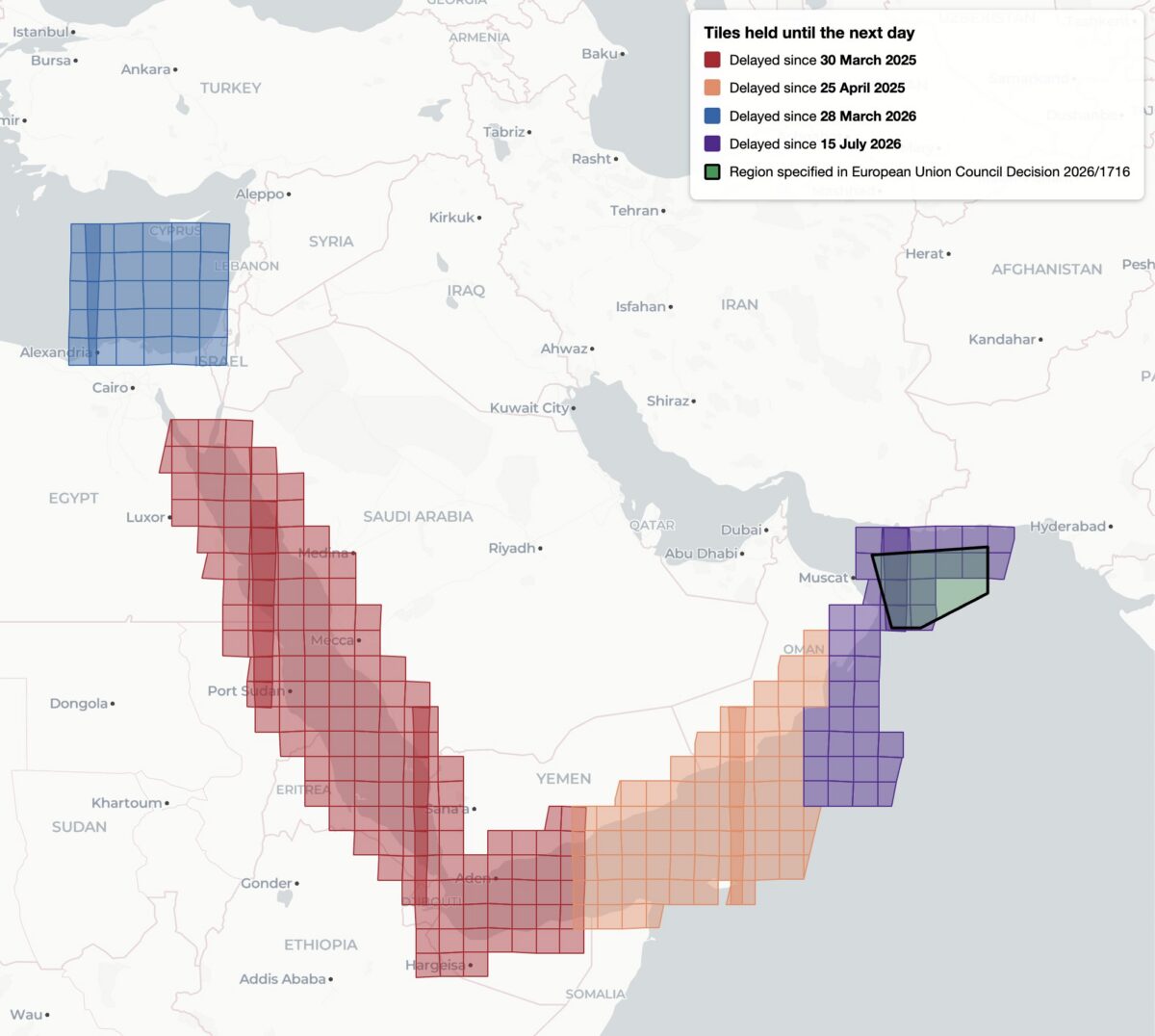
    A spokesperson for the European Union told Bellingcat that the delay was not related to events in Gaza but to “mitigate possible threats” due to the war in the Middle East “including Iran’s attacks on its neighbours and possible threats to European interests”. The delayed region of Sentinel tiles that cover Gaza as well as parts of Israel and the West Bank also extends over the Eastern Mediterranean Sea.

    The European Union ordered a 24-hour delay on Sentinel satellite imagery over the Gulf of Oman earlier this year during US and Israeli strikes on Iran. However the delay impacting Gaza and parts of the West Bank has not been announced or previously reported.

    “Such decisions are taken unanimously by all EU Member states and will stay in place as long as necessary,” the spokesperson said. They also said that while the Copernicus program, which includes the Sentinel satellites, operated a free and open data policy there were limitations to this for security. 

    When asked if the delay, which began in late March, was related to the presence of US vessels in the Eastern Mediterranean or if there were other areas of delay, the spokesperson said they had no further comment.

    Sentinel Delays

    The Sentinel-2 and Sentinel-1 satellites provide an invaluable source of imagery for open source researchers. This has been especially true this year, as commercial satellite imagery providers restricted access to imagery in the Middle East, including areas of active human rights concern, such as Gaza. 

    However, in July, the European Union published Council Decision 2026/1716, which ordered a 24-hour delay on Sentinel imagery over the Gulf of Oman, after a request from the US government which was involved in strikes on Iran at that time.

    Just two weeks later, the European Union issued a corrigendum that unpublished decision 2026/1716 and removed it from the Council of the European Union record, although satellite data shows the delay has remained. 

    This decision, while it was available, was reportedly the first public notification of delayed Sentinel imagery. Yet it was not the first time that Sentinel imagery has been restricted, analysis shows. Bellingcat found four distinct regions of delayed satellite imagery during 2025 and 2026: the Gulf of Oman, the Gulf of Aden/western Arabian Sea, the Red Sea as well as the previously unreported delay in the Eastern Mediterranean Sea and parts of Israel, the West Bank and the entirety of Gaza.

    Bellingcat’s analysis shows the regions where Sentinel-2 imagery is subject to a 24-hour delay, and when the delay was imposed. Only the July 15, 2026 delay over the Gulf of Oman was referenced by European Commission directives and the region referenced in 2026/1716 encompasses only a portion of the delayed tiles.

    Bellingcat’s analysis shows that these delays have been implemented in stages. Twenty-four hour delays of Sentinel-2 imagery were first observed by open source researchers in March and April 2025 after the US launched a naval and air strike campaign against Houthi targets in Yemen. 

    The previously unreported imagery delay in the Eastern Mediterranean began on March 28, 2026, the same month that commercial American space imaging company Planet Labs also restricted imagery across the Middle East. The Gulf of Oman delay began on July 15, 2026, two days after the publication of Council Decision 2026/1716.

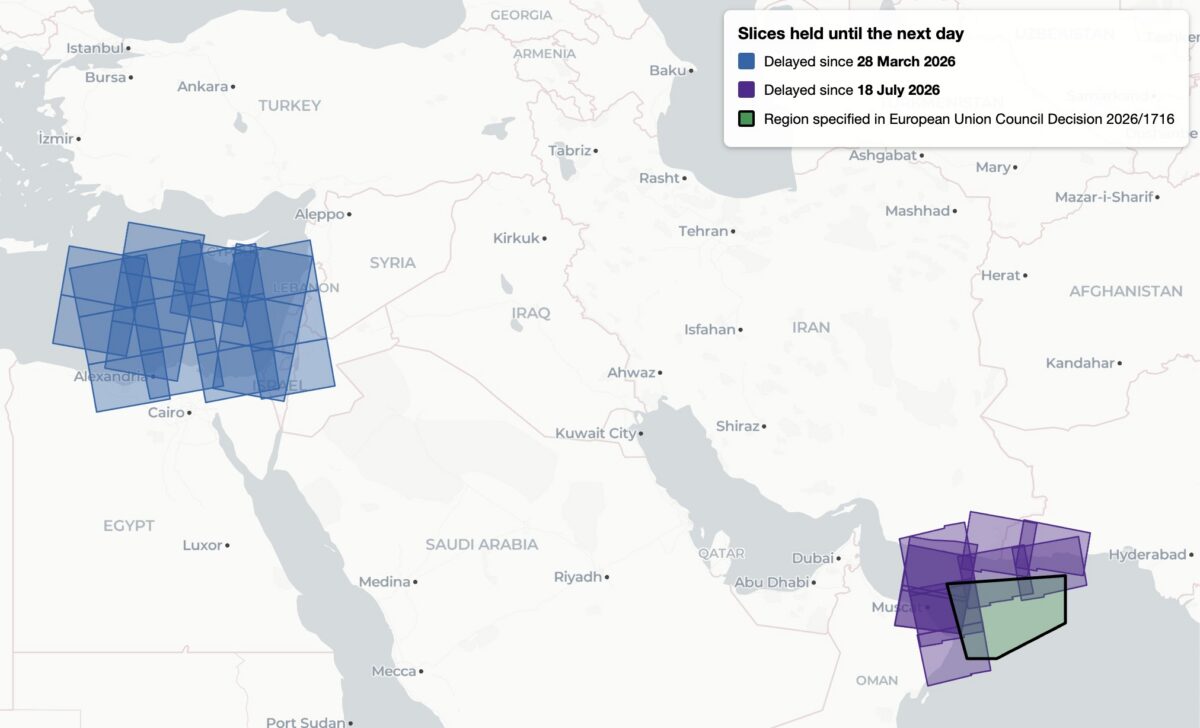
    Decision 2026/1716 also specified that the delay be implemented for both Sentinel-2 and Sentinel-1 radar imagery. Bellingcat’s analysis of Sentinel-1 image availability shows that this is the case for both the Gulf of Oman region and the unreported region over the Eastern Mediterranean Sea. However, the 2025 restrictions on Sentinel-2 imagery in the Red Sea and Gulf of Aden are not implemented in Sentinel-1. 

    Sentinel-1 imagery uses “synthetic aperture radar” to capture lower resolution radar images that can collect data at night and on cloudy days. This differs from Sentinel-2, which captures optical satellite imagery at higher resolution.

    Bellingcat’s analysis shows the regions where Sentinel-1 satellite imagery is subject to a 24-hour delay and when that delay was imposed.

    A Tale of Two Tiles

    Sentinel satellite imagery is most commonly accessed by open source researchers through Copernicus Browser, a free online platform, but it is also distributed as large tiled files in the Copernicus Data Space Ecosystem. These tiles are numbered using the Military Grid Reference System, and can be listed using APIs that provide information on each tile, including the capture and publication time. By comparing the capture and publication time, the publication delay can be computed.

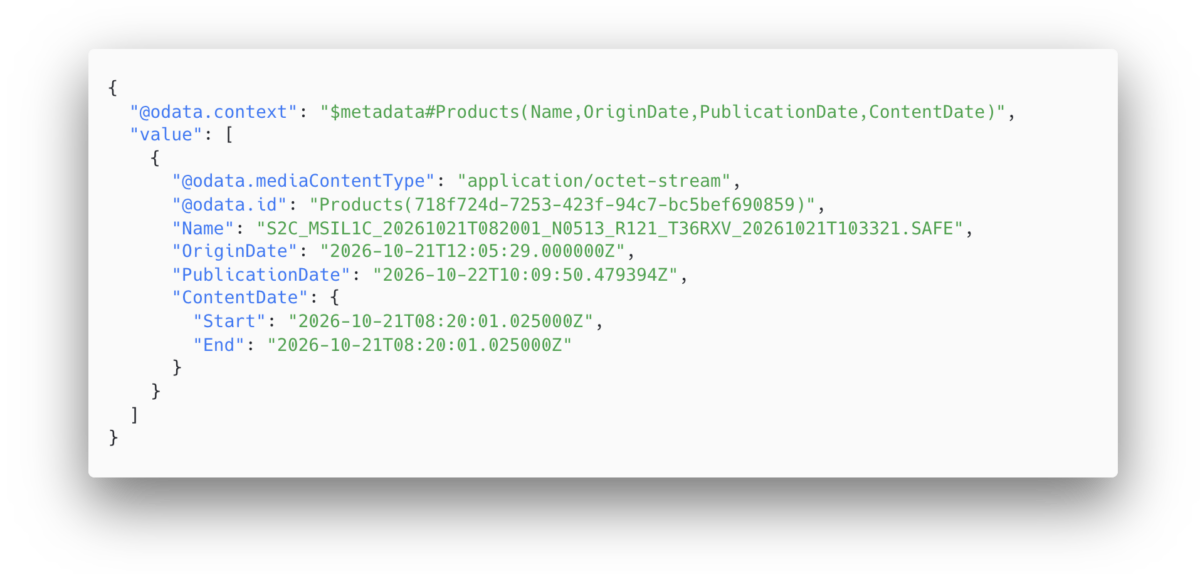
    For example, the catalog information for the tile T36RXV, which includes Gaza and portions of the West Bank, Negev and Egypt, provides the following metadata for the October 21, 2026 capture.

    Metadata from tile T36RXV, which includes Gaza and portions of the West Bank, Negev and Egypt.
    Metadata from tile T36RXV, which includes Gaza and portions of the West Bank, Negev and Egypt.

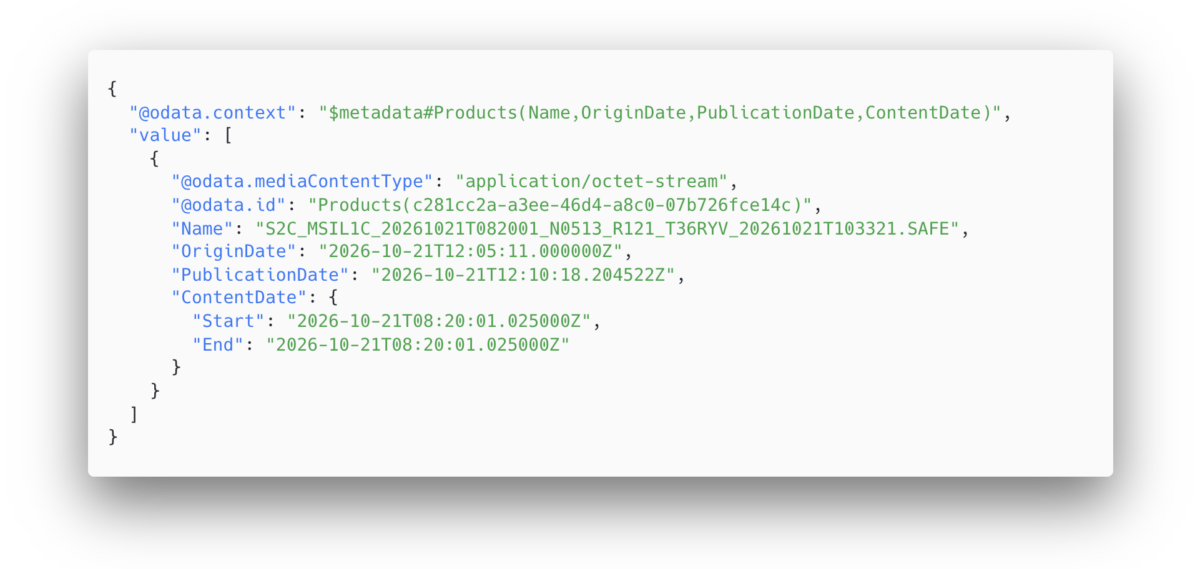
    This shows that while the image was captured at 08:20 UTC on October 21, it was not published until 10:09 UTC on October 22 — almost 26 hours later. This is in contrast to the neighboring tile T36RYV, which includes parts of the West Bank, Israel, and Jordan. API data for this tile shows that the image was published at 12:10 UTC on October 21, just under four hours after the capture time.

    Metadata from tile T36RYV, which includes parts of the West Bank, Israel, and Jordan.
    Metadata from tile T36RYV, which includes parts of the West Bank, Israel, and Jordan.

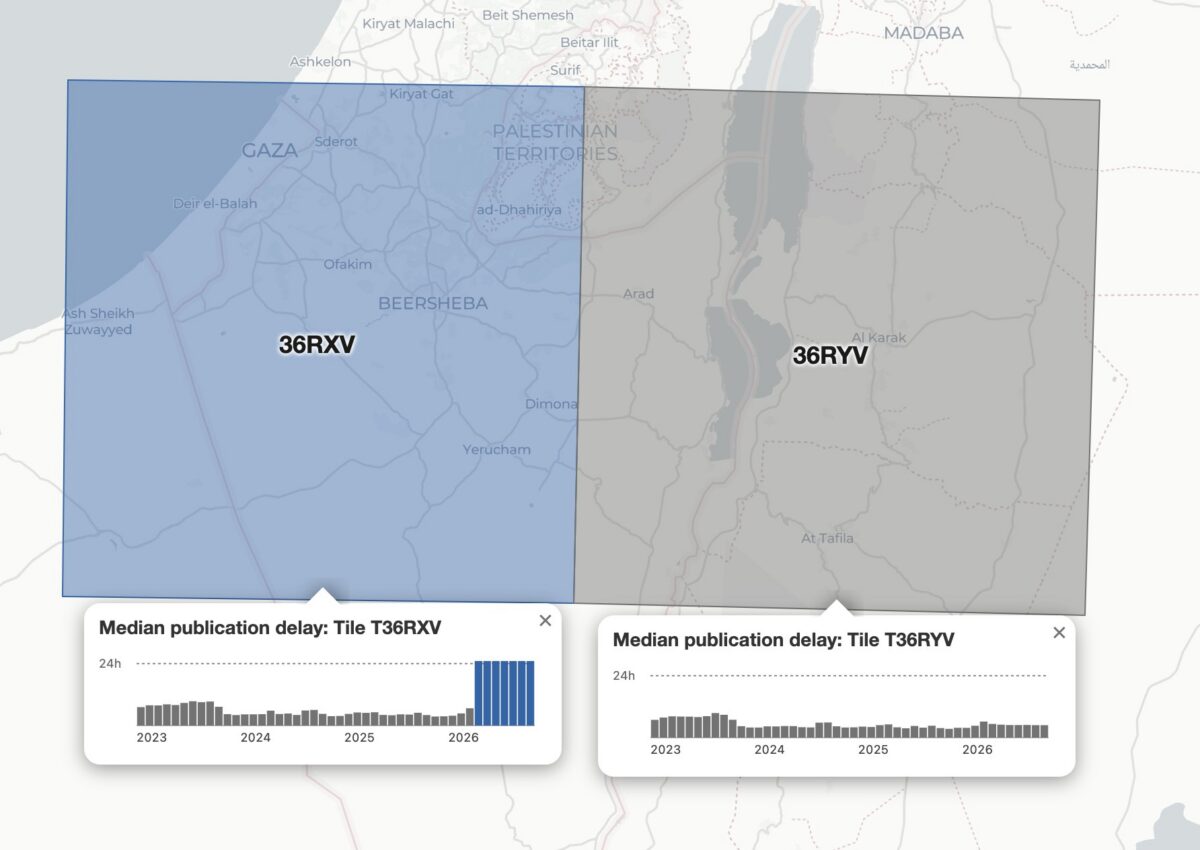
    This difference is not unique to this date either. Bellingcat’s analysis shows that this tile has been consistently delayed by one day since March 28, 2026.

    Graphing the publication delay for two adjacent Sentinel-2 tiles shows a clear difference beginning March 28, 2026.
    Graphing the publication delay for two adjacent Sentinel-2 tiles shows a clear difference beginning March 28, 2026.

    This method can be extended further, and by analysing every tile with valid publication date timestamps, Bellingcat identified all global Sentinel-2 and Sentinel-1 delays since 2023. The only consistent delays visible were those identified in the Gulf of Oman, the Gulf of Aden/western Arabian Sea, the Red Sea and Eastern Mediterranean in 2025 and 2026.

    Impact on open source investigations

    While the 24-hour delay on certain Sentinel imagery is a less severe restriction than other satellite providers have imposed, it can still impact the open source research process in fast moving situations. This is especially so in recent months as the European Space Agency’s Sentinel satellite data has emerged as a refuge as other satellite data is censored.

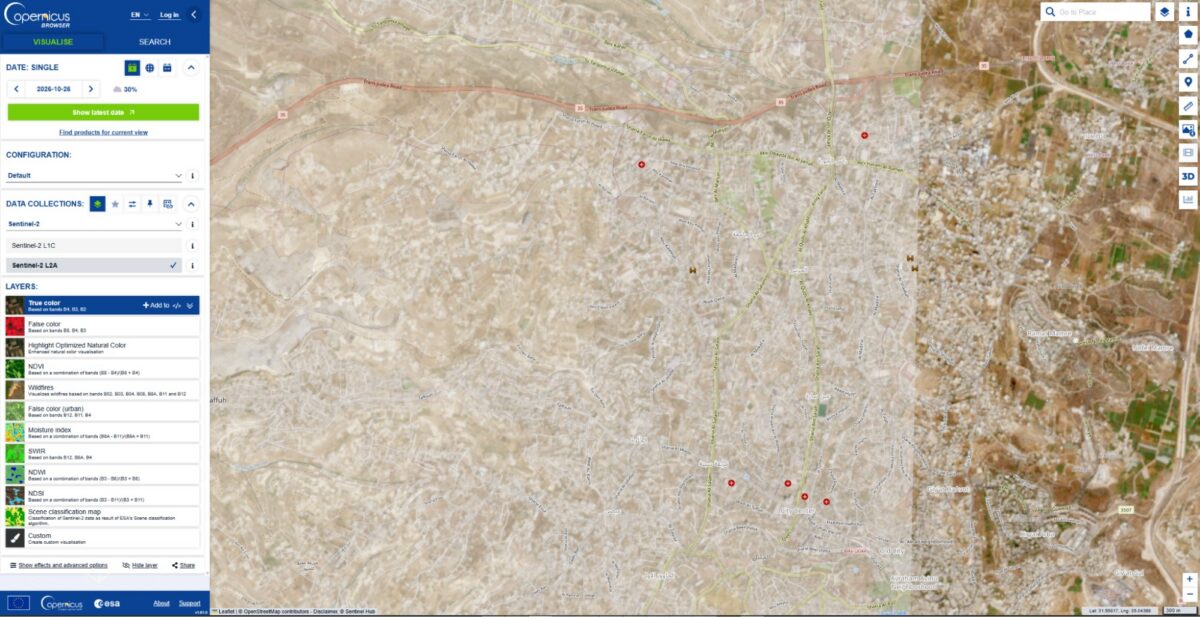
    The image below shows how imagery for the eastern half of Hebron was visible on October 26, but not the western half where demolitions took place earlier this week.

    The city of Hebron, Palestine, seen in Copernicus Browser on October 26, 2026. While imagery is available for the eastern half of the city, there is no recent imagery of the western half.
    The city of Hebron, Palestine, seen in Copernicus Browser on October 26, 2026. While imagery is available for the eastern half of the city, there is no recent imagery of the western half.

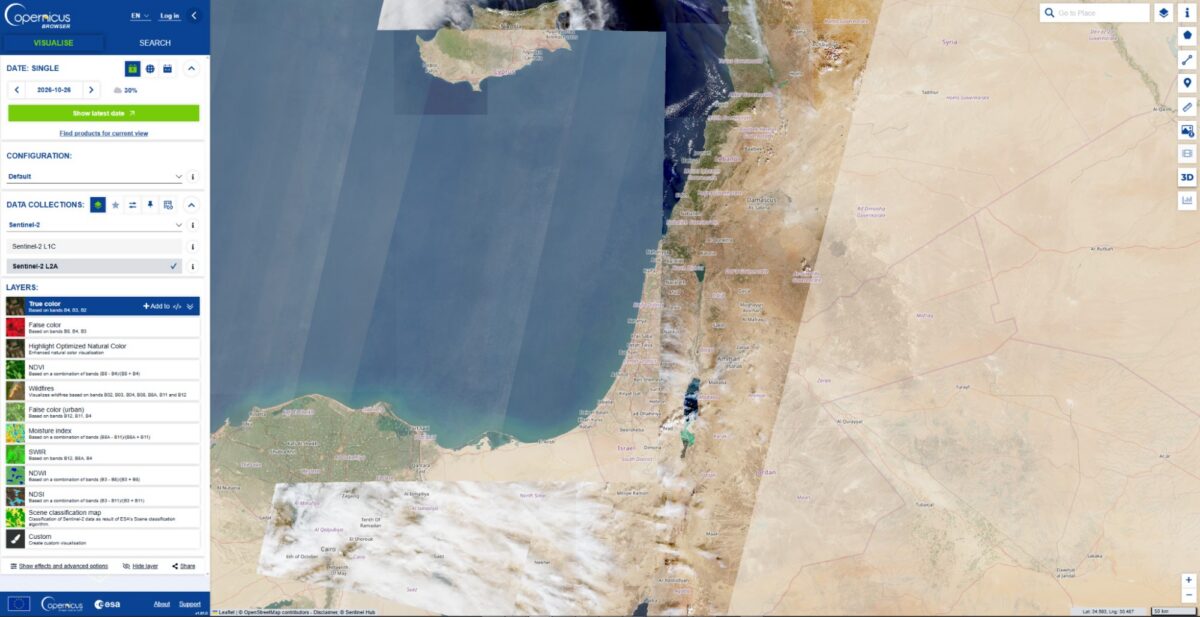
    The shape of the missing tiles can be seen by zooming out within the Copernicus browser, demonstrating how imagery of Gaza and other parts of Israel and the West Bank are also delayed.

    The missing tiles also include Gaza, parts of Israel, Egypt, and Cyprus, and the Eastern Mediterranean Sea.
    The missing tiles also include Gaza, parts of Israel, Egypt, and Cyprus, and the Eastern Mediterranean Sea.

    Sentinel imagery covering western Hebron after the demolitions took place was published on October 27. However, the delay prevented local reports from being verified with satellite imagery while the situation was still ongoing.

    Some Sentinel-2 users have previously described the challenges of covering fast-moving issues in the Gulf of Oman when the Sentinel delay was announced in March.


    Bellingcat is a non-profit and the ability to carry out our work is dependent on the kind support of individual donors. If you would like to support our work, you can do so here. You can also subscribe to our Newsletter and follow us on Bluesky here, Instagram here, Reddit here and YouTube here.

    Source: Bellingcat · 2026-10-29

  • Amazon mining boss wanted by Brazil for sheltering Jair Bolsonaro’s spy chief has businesses, properties in Florida

    Amazon mining boss wanted by Brazil for sheltering Jair Bolsonaro’s spy chief has businesses, properties in Florida

    A Brazilian gold miner wanted for allegedly helping former President Jair Bolsonaro’s spy chief flee to Florida has built a network of companies and properties in the Sunshine State, ICIJ media partner Agência Pública reports.

    Rodrigo Martins de Mello and his family are under investigation by Brazil’s Federal Police for helping Alexandre Ramagem, the former director of the country’s intelligence agency, escape Brazil and sheltering him in Miami, ICIJ and Agência Pública reported on Oct. 22.

    De Mello, known as Rodrigo Cataratas, is a strong Bolsonaro supporter. Convicted of leading illegal gold mining on Yanomami Indigenous land, De Mello champions Brazil’s informal miners to his more than 43,000 Instagram followers, attacks the leftist government and calls for amnesty for Bolsonaro, Agência Pública reported. That campaign suffered a blow Oct. 25, when President Luiz Inácio Lula da Silva came from behind to defeat Bolsonaro’s son Flávio in the presidential runoff. Three days after the election, Flávio, under investigation in Brazil for alleged money laundering, also fled to Florida.

    Photo of Jair Bolsonaro and Alexandre Ramagem wearing yellow Brazil tshirts, each with one arm around one another and the other hand raised in the air.

    Photo of Panama City's skyline at dusk, with cars headlights illuminating a road in front of tall buildings.

    https://www.icij.org/news/2026/10/the-us-is-letting-a-convicted-bolsonaro-spy-chief-stay-in-florida-brazil-wants-answers/

    LATIN AMERICA The US is letting a convicted Bolsonaro spy chief stay in Florida. Brazil wants answers. Oct 22, 2026

    https://www.icij.org/news/2026/10/bought-off-corrupt-argentine-president-attacks-icij-member-hugo-alconada-mon/

    PRESS FREEDOM ‘Bought-off, corrupt’: Argentine president attacks ICIJ member Hugo Alconada Mon Oct 27, 2026

    https://www.icij.org/investigations/panama-papers/panama-removed-from-eus-tax-haven-blacklist-a-decade-after-the-panama-papers/

    PANAMA Panama removed from EU’s tax haven ‘blacklist’ a decade after the Panama Papers Oct 15, 2026

    Recommended reading LATIN AMERICA The US is letting a convicted Bolsonaro spy chief stay in Florida. Brazil wants answers. Oct 22, 2026 PRESS FREEDOM ‘Bought-off, corrupt’: Argentine president attacks ICIJ member Hugo Alconada Mon Oct 27, 2026 PANAMA Panama removed from EU’s tax haven ‘blacklist’ a decade after the Panama Papers Oct 15, 2026

    Source: ICIJ · 2026-10-29

  • OpenCorporates paywalled their API (even plain search) — wrote a free GLEIF-based replacement

    If you’ve used OpenCorporatesCLI or hit OpenCorporates’ API directly recently, you may have noticed it now 401s on every call, including plain search, unless you have a paid account token. Doesn’t look like they’re issuing free ones anymore.

    I rebuilt the tool against GLEIF’s LEI registry API (https://www.gleif.org/) instead — free, no key. Search a company name, get legal entity detail: status, legal form, registered/HQ address, and the actual registration authority + link as the source of record.

    Repo: https://github.com/NPCmillionaire/OpenCorporatesCLI

    GLEIF only covers entities that hold/held an LEI (mostly stuff that touches financial markets), so it’s ny small-business lookupOpenCorporates did — but it’s free and it works.

    Caveat:

    submitted by /u/2cfly
    [link] [comments]

    Source: Reddit r/OSINT · 2026-10-29

  • Criminal Probe Launched in South Africa Over Contraband Baobabs Bound for Georgia

    Criminal Probe Launched in South Africa Over Contraband Baobabs Bound for Georgia

    South African authorities have opened a criminal investigation into the attempted illegal export of five baobab trees to Georgia, halting a massive shipment at the coastal port of Durban after discovering the exporter lacked required environmental permits.

    The five trees, estimated to be between 200 and 300 years old and weighing up to 30 tons each, remain impounded at a Durban logistics warehouse while investigators build a case under the country’s forestry laws.

    Under South Africa’s National Forests Act, the indigenous baobab is a protected species. It is illegal to cut down, harvest, transport, or export live specimens without explicit authorization from environmental regulators. While South Africa permits the commercial trade of processed baobab derivatives—such as fruit powder, seed oil, and cosmetic extracts—under strict licensing, the live specimen trade is tightly restricted to protect the slow-growing trees from international exploitation.

    According to the Daily Maverick, the shipment was intercepted this summer at a facility operated by Africa Global Logistics, a subsidiary of the maritime shipping firm MSC Group. Officials discovered that the exporter lacked the mandatory permits required to export the specimens. Days after the seizure, the exporter submitted a retrospective permit application, which environmental authorities rejected.

    “The department refused to issue a license retrospectively to regularize allegedly illegal criminal activities,” South Africa’s Department of Forestry, Fisheries and the Environment said in a statement to OCCRP, confirming that a criminal case had been opened under the National Forests Act.

    Department officials declined to publicly identify the exporter or the intended recipient in Georgia, citing the active investigation. However, a conviction carries severe penalties under South African law.

    “A person who contravenes the prohibition in the National Forests Act commits a first category offense and may upon conviction be sentenced to a fine or imprisonment for a period of up to three years, or to both,” Sello Molekwa, chief director of communication and advocacy at the department, told OCCRP.

    To botanists and conservationists, the uprooting of the trees—extracted from the Waterberg District in South Africa’s northern Limpopo province—represents a devastating loss of irreplaceable natural heritage.

    Dr. Sarah Venter, a baobab expert and founder of the Baobab Foundation in South Africa, explained that removing the trees required approval under two distinct pieces of South African legislation.

    “They didn’t have either,” Dr. Venter said, expressing hope that the impounded giants could still be saved. “I am hoping that the trees will be returned to Limpopo Province, where they came from, and replanted into their natural environment.”

    Although South African authorities have not officially named the buyer, the seizure coincides with reports in Georgian media indicating that a private residence linked to the country’s billionaire former prime minister, Bidzina Ivanishvili, is preparing for a major tree delivery.

    Ivanishvili has a documented history of importing ancient African trees for his personal estates and a public dendrological park on Georgia’s Black Sea coast. Between 2022 and 2023, eight massive baobabs were exported from Kenya to his park in Georgia. All eight trees withered and died last year, prompting the park’s management to issue an official statement blaming critical media coverage for extended procedures that then caused the demise of the trees.

    The appetite for live specimens appears to continue. On Sept. 15, Georgia’s independent Formula TV reported that a new private residence being built for Ivanishvili outside Tbilisi was undergoing a “special landscaping project,” with a new baobab expected to arrive by late October.

    The park is owned by a Georgia-registered firm ultimately controlled by Ivanishvili’s wife, while the residence is owned by its subsidiary. The director of the firm that owns the residence did not respond to requests for comment regarding whether the South African shipment was destined for the property. 

    Meanwhile, the five uprooted trees remain held at the Durban facility. Africa Global Logistics stated that it acted solely as a logistics agent, halted the shipment as soon as regulatory concerns were raised, and is cooperating fully with authorities without facing criminal charges.

    Source: OCCRP · 2026-10-29

  • Search More Than 500 Cases of U.S. Citizens Detained by Immigration Agents

    Search More Than 500 Cases of U.S. Citizens Detained by Immigration Agents

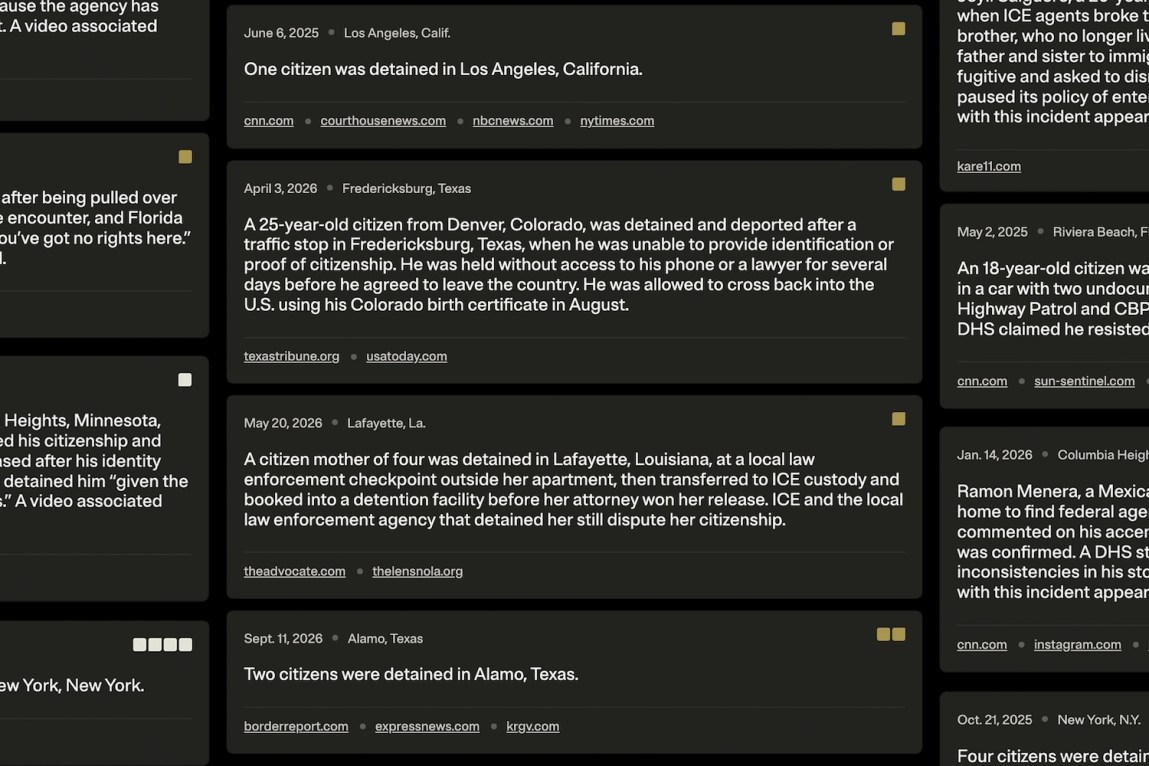
    A grid of digital cards displaying text describing incidents where U.S. citizens were detained or questioned by immigration agents. Visible examples include a 25-year-old citizen detained and deported after a traffic stop and a mother of four detained outside her apartment and handed over to ICE.
    ProPublica

    Experts have long warned that immigration dragnets will inevitably result not only in the erosion of rights for immigrants but also for citizens. Since the start of this Trump administration, we’ve watched those warnings come true. 

    So we have once again done what the government won’t: We have tallied and cataloged every case we can find of an immigration agent reportedly detaining a citizen during the current administration — more than 500 cases from Inauguration Day through Oct. 21, 2026. 

    Read our earlier reporting on U.S. citizens being detained.

    We compiled our list by scouring social media, court records and local media, and we included an incident only if we could find at least two sources for it. We asked the Department of Homeland Security about each incident, and we searched for any federal criminal charges that were brought in relation to each incident. (DHS has repeatedly said it is not arresting U.S. citizens.)

    Since the government itself does not track these cases, our list is almost certainly an undercount. Below, we’re showing you every case we found — the reality that the administration denies — along with the receipts. Read more about how we reported this project.

    Source: ProPublica · 2026-10-29

  • Iraqi MP Gets Six Years, $20M Fine for Oil Graft

    Iraqi MP Gets Six Years, $20M Fine for Oil Graft

    A specialized anti-corruption court in Iraq sentenced lawmaker Muthanna al-Samarrai to six years in prison and ordered him to repay nearly $20 million for exploiting his position to profit from state oil contracts.

    Al-Samarrai, who heads the Sunni political bloc Azm Alliance, used his parliamentary oversight role to benefit from public works and procurement deals involving the state-owned North and South Refineries companies. The lawmaker played a direct role in awarding contracts and steering payments to associates through four private companies, according to Iraq’s Federal Integrity Commission. The court ordered him to return 30 billion Iraqi dinars ($19.81 million) in illicit gains following his arrest in June 2026 alongside a former deputy oil minister.

    Source: OCCRP · 2026-10-29

  • How IRL Story Lab is Reimagining What Journalism Can Do

    How IRL Story Lab is Reimagining What Journalism Can Do

    The team at the Investigative Reporting Lab (IRL) in North Macedonia carried a frustration familiar to many newsrooms: They would spend months, sometimes a year, unraveling a complex system of corruption and then ask readers to sit through thousands of words to understand it. The information mattered, but the format didn’t always do it justice. So they decided to try a new approach.

    “We started experimenting with documentary, video, and social storytelling, and we saw very clearly that when you change the way you tell a story, you also change who is willing to engage with it,” says IRL editor in chief Saska Cvetkovska.

    That experimentation has now taken IRL somewhere few investigative newsrooms have gone: narrative fiction. Through IRL Story Lab, a production company built inside the newsroom, the team is adapting reporting into film — starting with “The Bench,” a dark comedy inspired by characters in “Spooks and Spin,” a 2017 investigation by IRL and OCCRP into information warfare in the Balkans.

    “Fiction can show you what these damaging systems do to people. It can enter a family, a friendship, a marriage, and show how corruption or institutional failure changes the way people live with each other,” says Cvetkovska.

    The Power of Fiction

    “The Bench” didn’t begin as a plan to adapt an investigation. It began with a conversation with her staff, when Cvetkovska described a family she’d reported on years earlier: two brothers, once inseparable, who stopped speaking after ending up on opposite sides of a political divide.

    The team brought on Director Trifun Sitnikovski and Chief of Production Gorjan Atanasov — both already with IRL before joining the Story Lab — who immediately saw a film in the story. 

    “We didn’t need the film to reproduce every fact from the investigation. OCCRP and IRL had already done that journalism. The film had a different job,” Cvetkovska explains.

    What the team captured was a family divided by media polarization, forced together by a family event, where the tension finally breaks open. The dialogue and humor were written for the screen — compressed, exaggerated, sharpened into dark comedy.

    “Political polarization often is absurd when you see what it does to ordinary human relationships,” Cvetkovska notes. “Fiction gives you freedom, but the research underneath it still has to be rigorous. We are not inventing social problems for dramatic effect.”

    A New Source of Funding

    Story Lab isn’t just an artistic detour — it’s a response to a structural problem facing independent media everywhere. Investigative journalism is expensive to produce and hard to monetize; the public benefits from it, but rarely pays for it directly. That, Cvetkovska says, is exactly why nonprofit journalism exists. But over the years, IRL built out a visual-oriented team well beyond a traditional newsroom — producers, cinematographers, editors, and designers. Today, half of IRL’s staff of 13 works with video.

    “That is creative capacity with value outside traditional journalism,” she explains.

    Story Lab lets IRL accept commissioned productions and eventually its own intellectual property that can travel to festivals and streaming platforms. Any profit generated is reinvested into investigative journalism.

    This model became urgent this year when the freeze of U.S. media assistance cost IRL nearly one-third of its annual budget. The team is looking to Story Lab and other innovative approaches as a new way to tell stories while also filling the gap in funding.

    “If we can build a model in which public-interest storytelling generates income that protects the independence of the journalism behind it,” Cvetkovska explains, “then funding this kind of experimentation is an investment in its survival.”

    Reaching a New Audience

    IRL learned this lesson once before, with young audiences.

    “We were told that young people didn’t care about politics, corruption, or public institutions. We never believed that,” IRL’s Assistant Managing Editor Denica Chadikovska says. “They cared about what these things did to their lives; they simply weren’t going to consume them in the formats journalism had decided were important.”

    The newsroom began making documentaries and social videos, and young people ages 25-34 now make up a significant part of its audience.

    Story Lab is the next step. Viewers of “The Bench” don’t necessarily need to know that it came from an investigation. They can come for the dark comedy, or because they recognize their own family at that dinner table.

    “If someone watches a 20-minute film about two brothers destroying their relationship over politics who would never click on an investigation about information warfare in the Balkans, we have reached someone journalism did not,” Cvetkovska says.

    “The Bench” has only just begun screening at festivals, but it opened strong: an Audience Award for Best Film and a Special Jury Mention for Best National Short Fiction Film at the Drim Short Film Festival, an annual film event in North Macedonia that serves as a platform for emerging European filmmakers to showcase their work.

    “An audience choosing the film tells us something about whether the story connects beyond our own newsroom and media community,” Chadikovska says.

    The production mirrored priorities IRL has held for years. More than 60 film and media professionals worked on “The Bench,” many of them young creatives from North Macedonia, a small media market where talented people often feel their only path to a serious career is to leave the country. All of the producers were female, reflecting an organization founded and led by women. “Building local filmmaking capacity and creating public-interest cinema are part of the same idea,” Chadikovska explains.

    IRL Story Lab is already developing its next project: a feature film, also inspired by “Spooks and Spin.” It is being developed by Sitnikovski through the Mediterranean Film Institute’s Script 2 Film program, with Academy Award-nominated filmmaker Tamara Kotevska as producer. 

    “Culture shapes how societies understand themselves,” said Cvetkovska. “Journalism can expose corruption, propaganda, and institutional failure. Film can make people recognize what those forces have done to their families, their communities, and their sense of what is normal. We believe both are forms of public service.” 

    Source: OCCRP · 2026-10-29