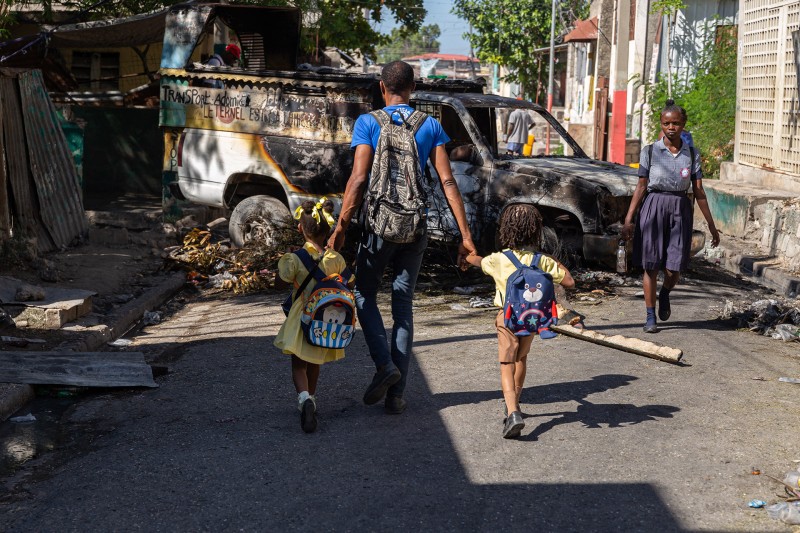
A letter by two senior United States lawmakers this week accused President Donald Trump’s administration of failing legal obligations to pursue the elites allegedly causing the gang violence that has plunged Haiti into a humanitarian crisis.
“By failing to name and sanction the political and economic elite fueling Haiti’s insecurity, the Administration allows those responsible to evade accountability and signals that their actions carry no consequences,” said the November 23 letter from New Hampshire Democratic Senator Jeanne Shaheen and New York Democratic Representative Gregory Meeks.
The Caribbean country has been in crisis since Haitian President Jovenel Moïse was assassinated in July 2021, in a plot for which five Haitian and American men so far have been convicted in U.S. federal court.
To fight armed criminal groups that have taken over swaths of the country, the United Nations last year deployed a Gang Suppression Force of roughly 2,000 personnel. This year, however, a record 1.5 million Haitians were displaced by violence, with more than half the 12 million population facing acute food insecurity.
The latest UN report said 1,167 people were killed and 459 injured in Haiti from July to September, with 45 percent of the casualties by gangs, 5 percent by self-defense groups and nonorganized members of the populations, and 50 percent during security force operations against gangs.
Amid the increasing violence, El Salvador rapidly dispatched troops to Haiti in the past month after four Salvadoran aviation technicians attached to the UN mission were reportedly abducted. The Central American country has deployed more than 2,000 additional soldiers, with Salvadoran President Nayib Bukele sharing battle updates on his X social media account.
U.S. security contractor Vectus Global, founded by Trump supporter Erik Prince, has also been hired by the Haitian government to fight gangs.
The letter by Shaheen and Meeks — the incoming Democratic leaders of the House Foreign Affairs Committee and the Senate Foreign Relations Committee — was addressed to Secretary of State Marco Rubio, Secretary of the Treasury Scott Bessent, and Secretary of Defense Pete Hegseth.
It alleged their departments had failed to fully implement the Haiti Criminal Collusion Transparency Act, the U.S. law enacted in 2025 to expose and sanction links between criminal gangs and Haitian political and economic elites.
The U.S. Departments of State, Treasury, and Defense did not respond to requests to comment before publication.
In compliance with the Haiti legislation, the State Department delivered its first report to U.S. Congress in June. The two Democratic lawmakers said that report “rightfully notes” that collusion between Haiti’s politicians and economic elite with “terrorist gangs” threatens the Haitian people and the viability of the state.
“However, the rest of the report and subsequent actions by your departments fail to show an intent to comply with the text or spirit of the law,” their letter said.
The report provided no new insights on gangs and criminal collusion in Haiti, and the Trump administration did not comply with law’s requirement that sponsors of gangs be sanctioned by September 28, 2026, the letter said.
“At a time when the Haitian people are preparing to vote for the first time in over a decade, Congress, the American public and the Haitian people deserve transparency about the nature and scale of collusion between gangs and their political and economic support networks,” Shaheen and Meeks wrote.
Haiti is scheduled to vote next year in its first national elections since 2016, but ongoing violence has raised concerns that criminal networks will infiltrate the process.
The Organization of American States has called on Haiti to ban candidates who are linked to gangs. The letter by Shaheen and Meeks noted that one such candidate, Michel Martelly, has already announced his candidacy.
A popular singer under the name Sweet Micky, Martelly was president from 2011 to 2016 and sanctioned by the U.S. in August 2024 for alleged ties to drug trafficking gangs. He has consistently denied accusations of links to gang and drug activities.
Slain President Moïse’s wife Martine Moïse has also announced she will run for president in the election. A May 2026 survey commissioned by U.K. thinktank Chatham House found 90 percent of Haitians believe the upcoming elections are important for determining the country’s future.
Source: OCCRP · 2026-11-25