Researchers uncover two threat groups, SilentAir and LIMINAL PANDA, exploiting mobile networks to spy on users and intercept calls and text messages.
Telecom security firm Enea published research on two threat actors, dubbed SilentAir and LIMINAL PANDA, working inside mobile networks. According to the experts, SilentAir has compromised operators since before 2025; however, a link between the two APT groups is possible and unconfirmed.
“Sophisticated threat actors are compromising Mobile Network Operators to steal information and launch attacks on other operators and their subscribers.” reads the report published by Enea. “Enea detected ongoing activity in 2026 by LIMINAL PANDA, a threat actor previously identified. We also uncovered SilentAir, a newly identified actor compromising operators since before 2025. Links between the two are possible but unconfirmed.”
Mobile networks need to communicate with each other to support roaming, calls, text messages and mobile data. They exchange this information through signalling protocols, much of it over a shared IP network called IPX. This system allows operators to work together, but attackers can also abuse the trust between them to access mobile networks.
Security problems involving SS7 were reported in 2014, followed by attacks exploiting the Diameter protocol. More recently, researchers have also identified attacks targeting GTP, another protocol used by mobile networks. This is particularly relevant because the GTPDoor malware uses it to communicate secretly with attackers.
GTPDoor is a Unix-based malware that uses the GTP-C protocol to receive hidden commands from attackers. HaxRob first analyzed it in February 2024. Palo Alto Networks later linked it to a threat cluster tracked as CL-STA-0969, which shares many characteristics with a group known as LIMINAL PANDA, tracked by CrowdStrike. In 2024, CrowdStrike assessed with low confidence that the group had links to China. Brandefence later reported with moderate confidence that some members may work for a regional office of China’s Ministry of State Security. In July 2026, POST Luxembourg reported the first detection of GTP-C attacks involving this malware.
Enea says its GTP firewall caught GTPDoor and related activity at several customers from the first quarter of 2026, and blocked it. It saw several hundred attempted covert sessions. It has directly seen or strongly suspects 5 to 10 infected operators, and believes there may be several dozen worldwide, mostly in Asia, Africa and Latin America.
The sessions carried commands to start and stop data tunnels, move sideways inside the operator, launch SSH, check the malware’s health and hide traces by deleting files and altering timestamps. Early in an infection the attackers tried to open tunnels often, and later the gaps grew. Half the tunnels lasted under 21 minutes, and a few ran over 24 hours. That doesn’t match the daily scheduled script CrowdStrike described.
LIMINAL PANDA has developed a new version of its malware, called GTPDoor v3. This version hides in GTP-U, the part of the protocol used to carry data. This makes it harder to detect because GTP-U traffic is more complex, carries much more data than GTP-C, and receives less security attention. The malware still uses the same XOR key, but now relies on libpcap to capture network traffic. This method is less visible to standard system tools such as netstat and lsof. Another important difference is that GTP-U is also used in 5G networks, while GTP-C is not.
SilentAir uses a different approach. Enea assesses with high confidence that the group is a state-level actor rather than a commercial surveillance provider. However, the researchers have only low confidence that it is linked to China. SilentAir launches SS7 and Diameter attacks from compromised network nodes inside mobile operators in at least six Asian countries. Its operations target subscribers in around a dozen other countries and territories. Taiwan is the main target, including political figures and government officials.
The attack mix gives it away. Interception makes up 18.30% of SilentAir’s activity, against 2.07% for typical surveillance firms. Those firms favor information harvesting (61.89%) and location tracking (30.90%), while SilentAir does 7.21% and 0.22%. The attacks come in bursts, from a handful of subscribers up to several thousand in a month, then go quiet for months.
For interception, the attacker moves a target’s registered location to a node it controls, so later calls and texts pass through it. Enea saw two-factor codes arrive right after interception for some targets, which suggests the goal is to break into their other accounts. Unlike the Russian-linked HiddenArt, SilentAir really runs the compromised nodes and answers transactions it started. Enea couldn’t analyze the binary because the operators kept tight discipline.
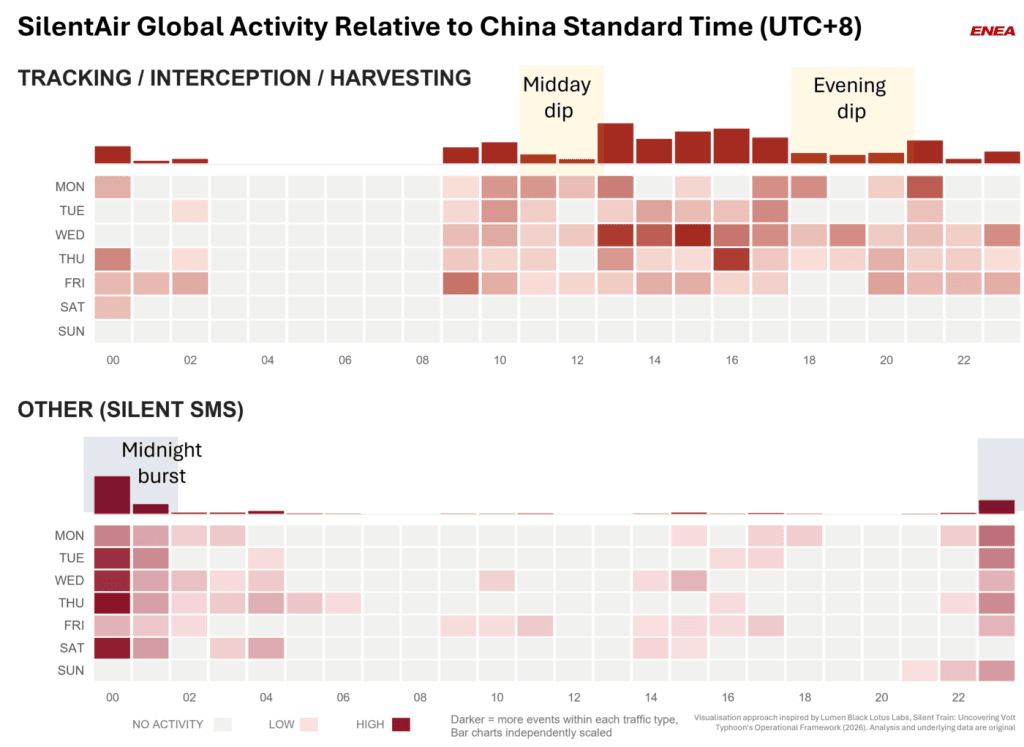
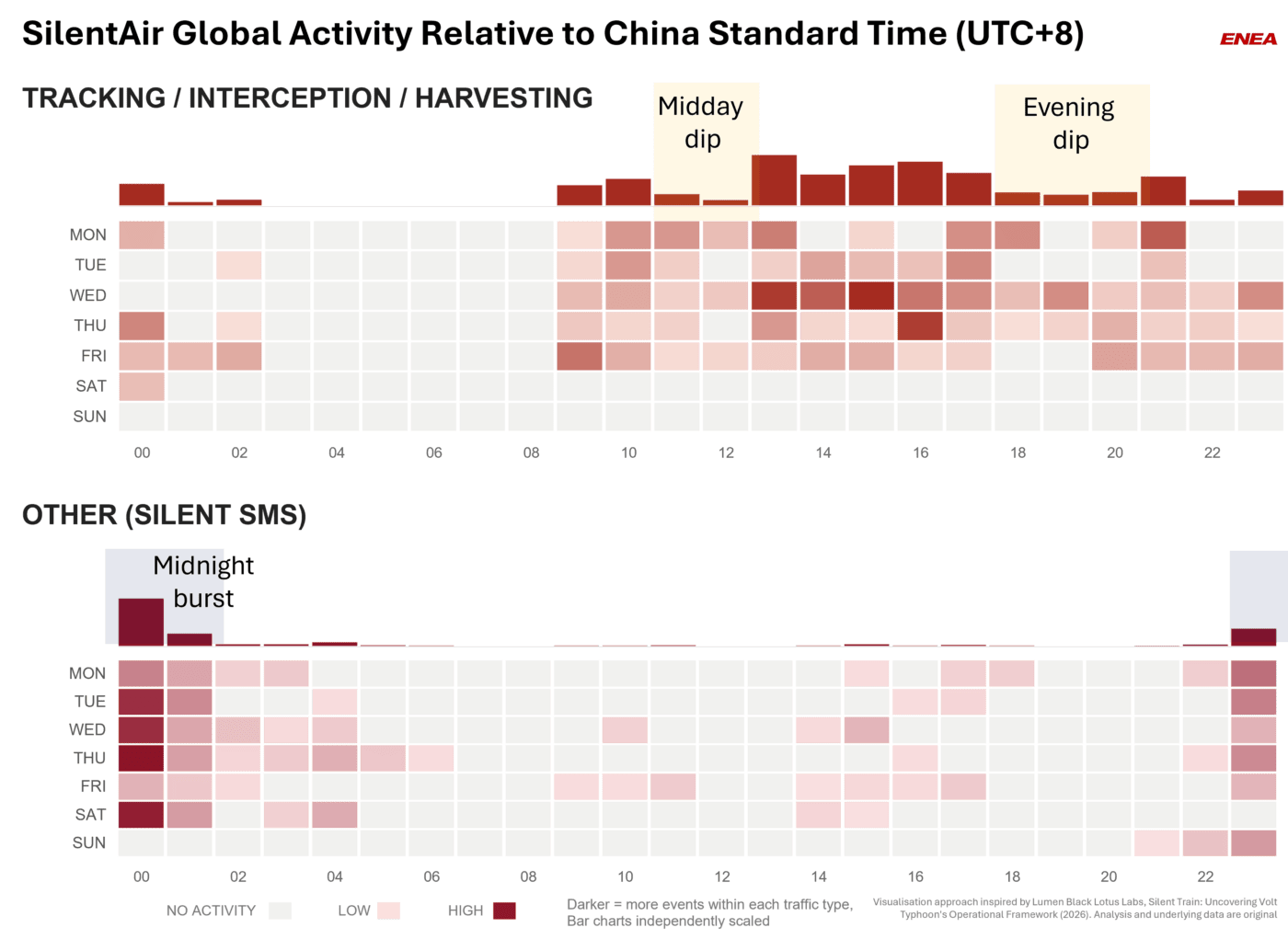
Silent SMS, which shows no alert on the phone, is the odd part. Most go to Taiwanese subscribers around midnight, and they probably test whether interception is still working, since phones are least likely to re-register then. They’re sent through a middleman SMS center and carry cheerful spam like health wishes, in case a carrier strips the silent flag and the message appears. Nobody should be suspicious of a stranger wishing them a strong body and a calm mind, which is exactly the idea.
The China-nexus judgment rests on state-level behavior, the Taiwan focus, no targeting of Chinese networks, and activity that fits a UTC+8 workday. There are dips in the morning and evening, pauses around Chinese holidays and essentially nothing on weekends, and the targets include political VIPs. Enea rates this low confidence, so treat it as a lead, not a verdict.
Enea couldn’t confirm a link to LIMINAL PANDA. Timing sometimes overlaps in the same operators, and the targeting matches, and a trojan called SCTPE tied to LIMINAL PANDA sends SS7 and Diameter traffic. But SilentAir answers transactions SCTPE can’t handle, its operational security looks better, and its working hours differ slightly. Two China-nexus actors sharing access, or both having compromised the same operators, are equally possible.
Enea says it helped customers remove LIMINAL PANDA activity, contacted other affected operators and warned those infected by SilentAir about malicious activity in their networks. Both groups have been stopped for now. Enea warns that access to one of the world’s 800-plus mobile operators can provide a way into others through IPX. AI also makes it easier to create new malware.
Enea recommends using GTP-C and GTP-U firewalls that share information with SS7 and Diameter security tools. Operators should go beyond industry checklists and monitor internal network traffic, where tools such as SIGTRANslator and Cordscan can go unnoticed. They should also connect telecom security with regular IT security. Outsourcing core network services can make investigations more difficult.
“The IPX interface must be regarded as untrusted. The evolution of signalling security has been based on the gradual realisation that the interconnect between mobile operators cannot be regarded as a trusted link.” concludes the report. “SilentAir and in particular LIMINAL PANDA exploits any available interconnect protocol, not just SS7, Diameter, GTP, but also other protocols like DNS, ICMP etc.”
Follow me on Twitter: @securityaffairs and Facebook and Mastodon
(SecurityAffairs – hacking, China)
Source: Security Affairs · 2026-11-16