Tag: Intelligence

  • Hackers Send Fake Nuclear Threat Alerts to Ukrainian and Russian Citizens

    Hackers Send Fake Nuclear Threat Alerts to Ukrainian and Russian Citizens

    Hackers reportedly hit Ukraine ‘s and Russia ‘s emergency alert apps, sending fake nuclear and attack warnings and raising concerns over public safety.

    Ukraine and Russia both said on Sunday night that hackers had compromised their emergency alert apps and used them to send fake warnings about air raids and other attacks, including nuclear threats. The BBC reported the incident, but neither side’s claims have been independently confirmed.

    Shortly before 11 p.m. local time (9 p.m. GMT), Ukraine’s widely used Air Alarm app sent the highest-level air raid warnings across the country. Some people, including residents of Kyiv, also received alerts about possible radiation, chemical attacks and street fighting. A message posted on Telegram said the app had likely been targeted by a cyberattack, confirmed there was no radiation threat and urged people to remain calm.

    “Shortly before 23:00 local time (21:00 GMT), Ukraine’s widely usedair raid app sent red-level air raid warnings nation-wide, with additional warnings of radiation, chemical attacks, and street fighting sent to some residents in areas including Kyiv.” reports BBC.

    “The Air Alarm application has probably been subjected to hostile interference. There is no radiation threat! Stay calm and follow our updates on our channel.” an alert on Telegram read.

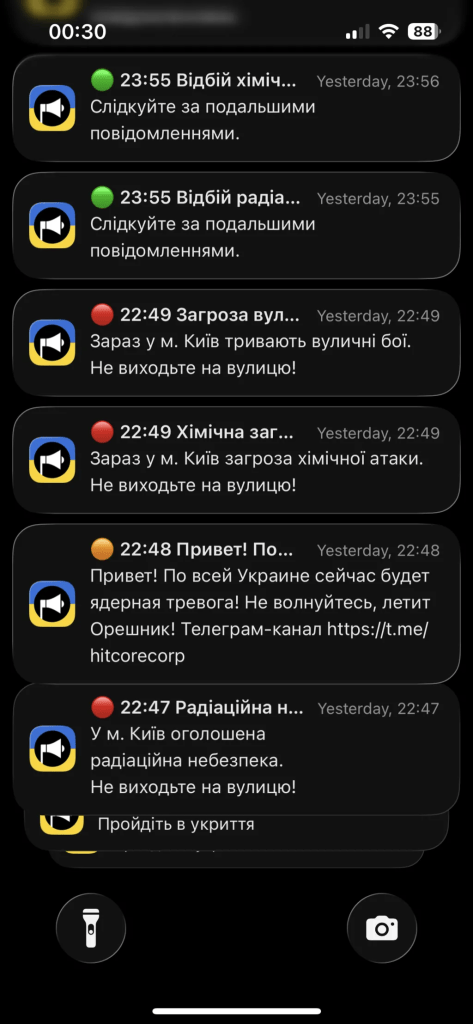
    The false alerts started at about 22:47 with a message that a radiation threat had been declared in Kyiv. At 22:48 came a message in Russian saying a nuclear alert would cover all of Ukraine and not to worry because “it’s Oreshnik flying”. Oreshnik is a Russian intermediate-range ballistic missile that can carry nuclear or conventional warheads, and Russia has the world’s biggest nuclear arsenal, with President Vladimir Putin repeatedly hinting he’s open to using every weapon available.
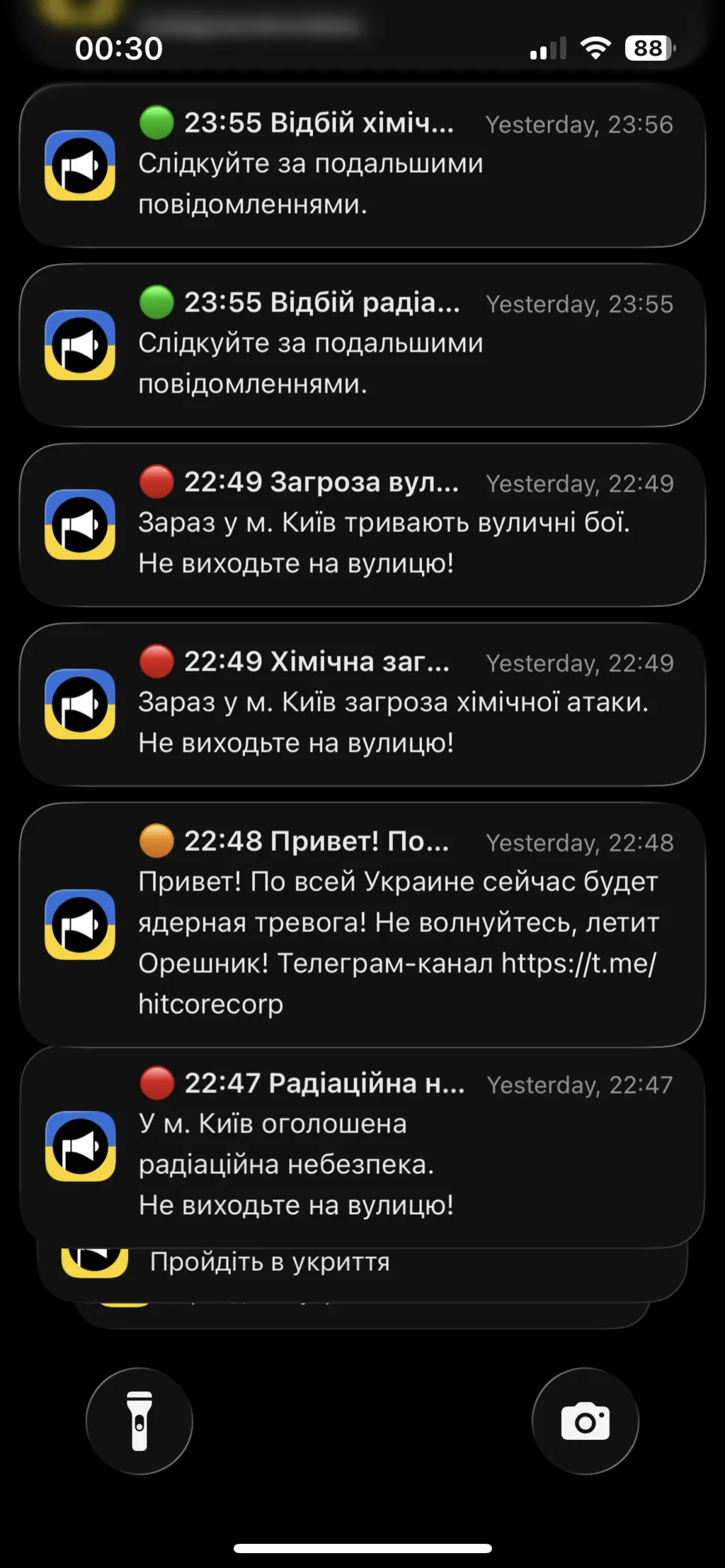
    Two more alerts arrived at 22:49. One, in Ukrainian, warned of a chemical attack on Kyiv and told people not to go outside, and the other said street fighting was taking place in the city. Red, orange and green messages reached phones, and at 23:53 users got all-clear messages, each declaring one of the Kyiv threats over.

    A Ukrainian intelligence body, which the BBC calls the Central Intelligence Agency, said there had been a failure in the app and urged people to use other sources of information. It added that the alerts triggered a radiation hazard signal on loudspeakers in the Lviv region, with no real threat.

    “The Air Alert app is supported by the Ministry of Digital Transformation of Ukraine, and informs users instantly about the beginning and end of defence alerts. The ministry said it temporarily disabled the app for maintenance after it had “apparently been compromised”. states BBC.

    “While the false alerts were quickly contained, cybersecurity experts suggested it was a new line in apparent Russian cyberattacks.”

    The temporary shutdown of the Air Alert app also carries significant risks, even if it lasts only a short time. During an outage, users may not receive timely warnings about incoming attacks, leaving them with less time to reach shelters or take protective measures. This is particularly dangerous in a country where missile and drone attacks can happen with little warning.

    The incident also highlights a difficult security trade-off: disabling a compromised alert system may prevent attackers from spreading false warnings, but it can temporarily remove a critical channel for delivering real emergency information. Any shutdown therefore needs reliable backup channels, such as sirens, official messaging services and other emergency communication systems.

    Regional leaders tried to calm people. Svitlana Onyshchuk, head of the Ivano-Frankivsk region, said everything was calm, even though the app had shown a red-level alert for her region from 22:50 to 23:57. Natalya Zabolotna, her counterpart in Vinnytsia, confirmed a cyberattack on the app and warned people not to click the link in the message, which could be phishing.

    Ukraine’s Centre for Countering Disinformation has advice for when the app isn’t working: turn on smartphone notifications, pay attention to sirens, and read only official sources. Oleksander Merezhko, chair of the foreign affairs committee in the Ukrainian parliament and a member of President Zelensky’s Servant of the People party, said the attack caused no panic. Ukrainians, especially in Kyiv, are used to practically non-stop alerts, he told the BBC, and the message in Russian aroused suspicion at once. The attackers picked a language that gave them away.

    A few hours later, Russia’s ministry of emergency situations said its own app had suffered “a massive cyberattack” that sent fake information to the public. Ukrainian outlet UNN reported that the hack sent fake nuclear threat alerts inside Russia, citing Atesh, a partisan Ukrainian group operating in Russian-held territory. A screenshot Atesh shared on Telegram, described as purported, claimed nuclear warheads mounted on Ukrainian P1-Sun attack drones had been launched at all regions of Russia, opened with a “risk of getting lively” warning and told residents to stock up on three weeks of food and hide. The alert also had profanities.

    Russia said it was still restoring the app but claimed the hack had not affected its wider alert system. It said people could still receive warnings through sirens, loudspeakers, text messages, TV and radio. The false alerts appeared minutes before a local ceasefire in Ukraine’s Kherson region ended on Sunday night. The truce had allowed civilians to leave Russian-occupied Oleshky. Although the fake warnings were quickly stopped, experts see the attack as a worrying escalation.

    “I think it’s the first time it’s happened to an official Ukrainian information app, but I suspect it won’t be the last,” Herbert Lin, a senior research scholar for cyber policy and security at Stanford University, told BBC World Service’s Newsday programme.

    Follow me on Twitter: @securityaffairs and Facebook and Mastodon

    Pierluigi Paganini

    (SecurityAffairs – hacking, Ukraine)

    Source: Security Affairs · 2026-11-02
  • Volt Typhoon Used Silent Train to Hide Zero-Day Attacks

    Volt Typhoon Used Silent Train to Hide Zero-Day Attacks

    Volt Typhoon used disposable relay chains to hide zero-day attacks on critical systems. Lumen linked Silent Train to at least four zero-days.

    Lumen’s Black Lotus Labs has spent three years tracking a covert network it calls Silent Train, which it ties to Volt Typhoon, the China-linked APT group. The cybersecurity firm says the network hid exploitation of software flaws the vendors didn’t know about yet. Black Lotus sent hundreds of victim notifications along the way, and the investigations that followed revealed the exploitation of at least four confirmed zero-days and one likely.

    “Volt Typhoon’s Silent Train is a covert network designed to gain and maintain access to the technologies businesses rely on to manage devices, networks and critical operations.” reads the report published by Lumen. “Black Lotus Labs® tracked how the group used rapidly changing chains of compromised infrastructure to conceal its activity while exploiting previously unknown vulnerabilities in centralized management platforms.”

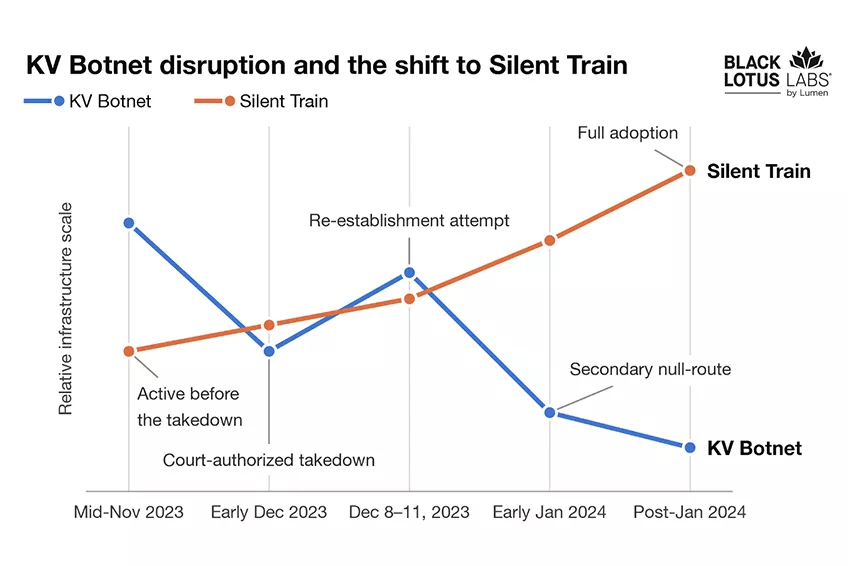
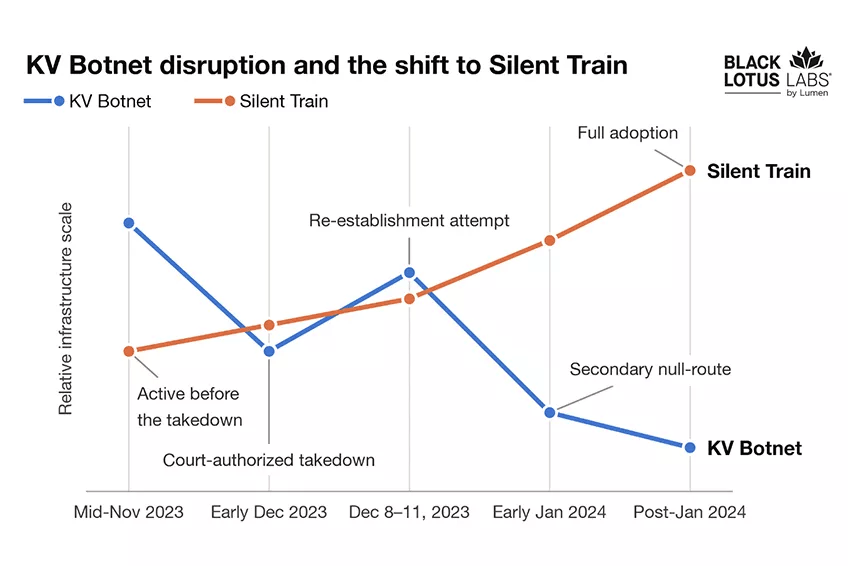
    Silent Train first showed up in November 2023, shortly before the first takedown of the KV-botnet, Volt Typhoon’s earlier network of hijacked routers. Activity rose after the second disruption. The group dropped persistent infrastructure and moved to disposable chains of compromised devices that it could rebuild whenever it wanted.

    Each session began on a rented server outside the United States. It then passed through another server and compromised small-office routers, home devices and IoT equipment in other countries. Finally, the traffic passed through a compromised device in the U.S., close to the target. This helped the attackers make their activity look like normal local traffic and bypass location-based blocks and IP reputation filters. On average, the chains passed through about four devices before reaching a U.S. IP address. Some used as many as six.

    Lumen identified more than 27 types of devices used in the network, including TP-Link routers and Fortinet appliances. Some of these devices had no known vulnerabilities, suggesting that Volt Typhoon may have used previously unknown exploits to compromise them and create relay points.

    “We observed more than 27 device classes exploited and used in Silent Train operations, ranging from SOHO and IoT devices like TP-Link routers and Netgear Orbi devices to enterprise platforms like Fortinet appliances and CyberPanel servers.” the report continues. “Some relay device types lack known vulnerabilities, suggesting Volt Typhoon leveraged undisclosed zero-day exploits to set up a single relay in a four-to-six hop chain and indicating a willingness to commit significant resources to protecting future access capabilities.”

    The attackers exploited exposed web interfaces and installed only the tools needed to connect the devices through SSH. These included temporary SSH services, keys, configuration files and tools already available on the systems. At the end of each session, they removed all traces of their activity and dismantled the relay chain. Sessions lasted about four hours on average, although some lasted only minutes. The attackers could also build a new chain in less than two minutes, suggesting that they had partly automated the process.

    The group worked with strict discipline. New device types arrived about one per quarter, and about one per month during the 2023 and 2024 build-out, always tested outside the U.S. first. Roles never changed: Intelbras modems served only as overseas relays, Netgear Orbi devices only as the U.S. hops facing victims, and the server providers stayed separated by layer too.

    By early 2025, enterprise platforms like Fortinet, Cisco, PRTG, Mirth Connect and CyberPanel joined as final hops. They stayed up one to three months and supported several intrusions. The group also added reverse tunnels using the open-source proxies Chisel and FRP, and the old and new methods ran in parallel.

    Volt Typhoon used Silent Train only during key stages of its attacks, including exploiting vulnerabilities, stealing credentials and data, and maintaining access to compromised systems. Each session targeted between one and five victims, often just one organization. The activity was carried out by human operators, mainly from Monday to Friday, between 9 a.m. and 10 p.m. China Standard Time. The group also paused operations for several weeks around Chinese New Year.

    The group targeted tools used to manage endpoints and networks, as well as SD-WAN systems and other control platforms. These systems can manage hundreds or thousands of devices, allowing attackers to reach many systems without moving through the network in the usual way. This approach also helped them leave fewer traces. After the attacks, investigators found webshells running in memory, stolen credentials, misuse of built-in features such as remote file transfers, and deleted logs.

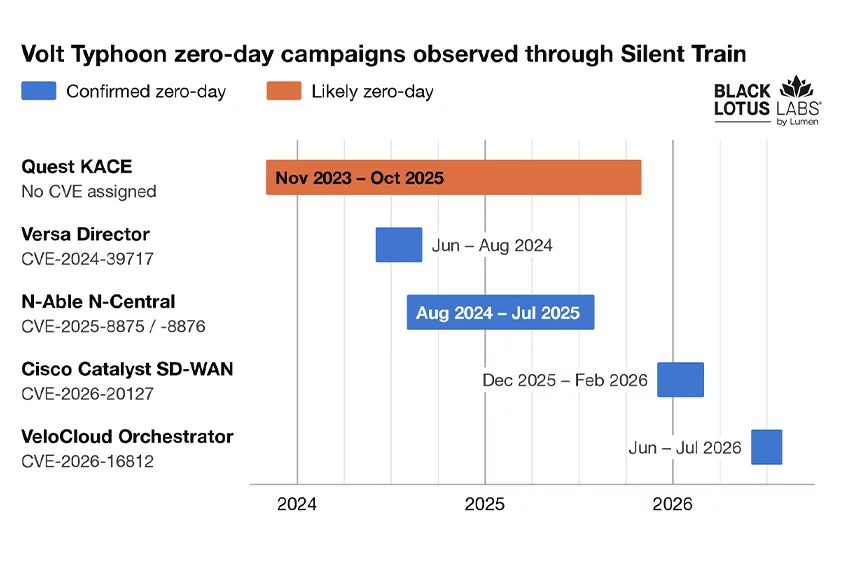
    The four confirmed zero-day campaigns hit Versa Director in 2024, N-able N-central through CVE-2025-8875 and CVE-2025-8876, Cisco Catalyst SD-WAN through CVE-2026-20127, and VeloCloud Orchestrator through CVE-2026-16812. The Cisco bug is a CVSS 10.0 flaw, and the group kept exploiting it well after Cisco disclosed it in February 2026. In the Versa case, the group used an in-memory JAR webshell to limit forensic evidence and reach downstream customers.

    The likely fifth is Quest KACE. The campaign hit more than 30 victims and faded after Quest’s October 2025 security updates.

    “The campaign affected more than 30 victims, followed vendor remediation timelines and declined after Quest’s October 2025 security updates.” the report states. “Despite limited forensic evidence, the available data supports a moderate-confidence assessment that Volt Typhoon exploited a zero-day vulnerability.”

    The actor stayed on the KACE server and used its admin features to take credentials.

    Victims include telecoms, government agencies, defense contractors, satellite and emergency communications, universities with ROTC programs, managed service and IT firms, and critical infrastructure such as water, energy, transportation, maritime, rail and aviation. What they share is access to bigger networks or customers. Hawaii, California and Texas were the top locations for several years. Lumen can’t say why, but the pattern fits pre-positioning for a crisis in the Indo-Pacific.

    “For enterprise leaders, the lesson is clear: systems with broad administrative reach can become high-value gateways to the entire organization and its customers. Reducing internet exposure, accelerating patching, strengthening access controls and preserving security telemetry are essential to detecting threats earlier and limiting their impact.” Lumen concludes.

    Follow me on Twitter: @securityaffairs and Facebook and Mastodon

    Pierluigi Paganini

    (SecurityAffairs – hacking, China)

    Source: Security Affairs · 2026-10-29