Tag: US & Canada

  • How Online Maps Lay Bare the US Military Bases Targeted by Iran

    How Online Maps Lay Bare the US Military Bases Targeted by Iran

    Sign up here to receive Bellingcat’s biggest investigations by email as soon as they are published. Become a member and support our work here.

    In September, CBS News obtained new images of the aftermath of attacks on US bases in the Middle East from active service members. One told the news channel: “This is major damage to our bases that hasn’t been communicated to the American public. “We’re standing there with our eyes closed getting punched in the face,” they added.

    While reports have detailed how Iran used Russian intelligence, including satellite imagery, to identify US troops, ships and aircraft, Bellingcat found that publicly available mapping platforms also reveal detailed and potentially sensitive information about US military bases in the Middle East. 

    Google Maps and other online mapping services contain dozens of labels identifying facilities including headquarters, accommodation, gyms and fuel points. Publicly available photographs and videos, including material published by the US military, provide further details about how these facilities are used.

    Experts told Bellingcat that such information could have helped inform Iranian targeting decisions by revealing where personnel gather and how bases operate. However, they cautioned that Iran would also have had access to other sources of intelligence. Reporting from Reuters earlier this year also highlighted how US officials believed commercially available location data was being used to target US troops in war zones.

    The bases examined by Bellingcat are not secret and have operated for years in a region where US forces maintained a strong sense of security. Joseph Jarnecki, a research fellow at the Royal United Services Institute, said the US had been able to maintain aerial superiority and was understood to have significant air defence capabilities, but that Iran’s missile and drone campaign has undermined both assumptions. 

    Iranian strikes have damaged at least 20 US military sites across Qatar, Bahrain, the United Arab Emirates (UAE), Jordan, Kuwait, Iraq and Saudi Arabia since the conflict began in February this year.

    Governments can request that Google blur or remove sensitive information from its services and Google publishes data on government requests for content removal.

    Bellingcat contacted the US Department of Defense who asked us to reach out to CENTCOM about the details in this story. We also contacted Google. However, we did not receive responses to questions from these respondents before publication.

    We examined four of the largest and most heavily affected US military installations by Iran’s missile and drone campaign: Camp Buehring and Camp Arifjan in Kuwait, Muwaffaq Salti Air Base in Jordan and Al Udeid Air Base in Qatar. At each one, we found publicly available Google Maps information providing details about facilities inside the bases and how they are used.
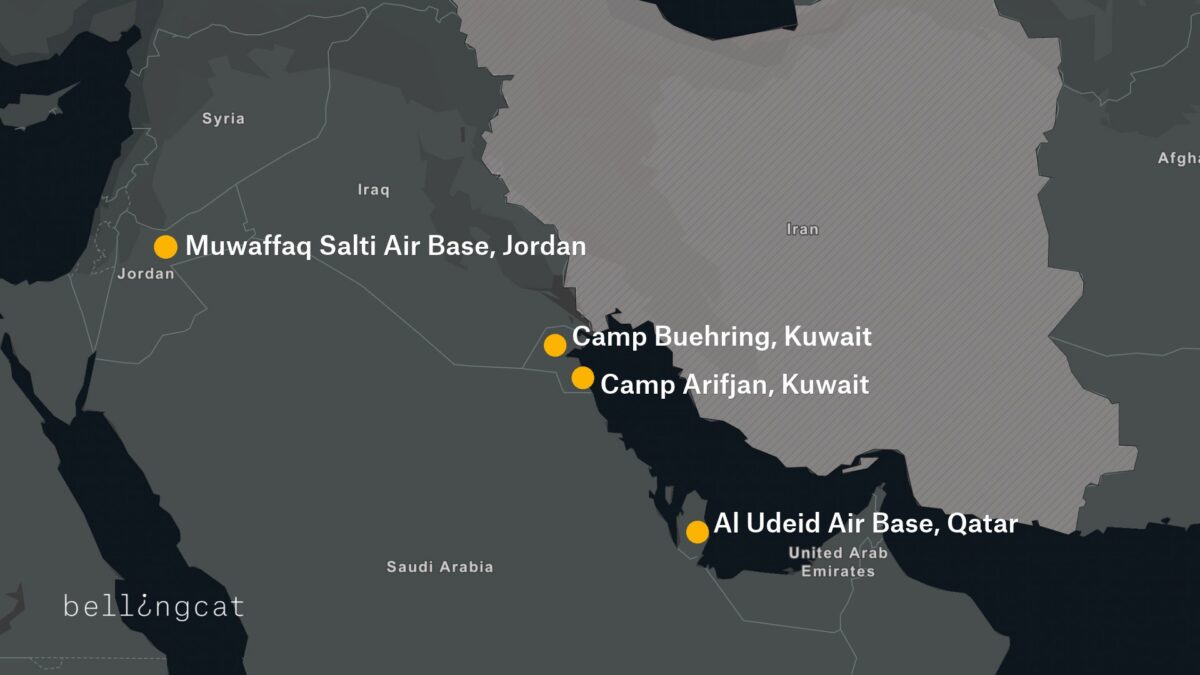
    A map detailing four US bases that were attacked by Iran during 2026 conflict.

    Camp Buehring

    At Camp Buehring in Kuwait, Google Maps identifies what is labelled as the main headquarters building, as well as a gym and a self-help facility, all of which were among locations destroyed by recent Iranian strikes. In addition to Google Maps place markers there are dozens of reviews and user-uploaded photographs.
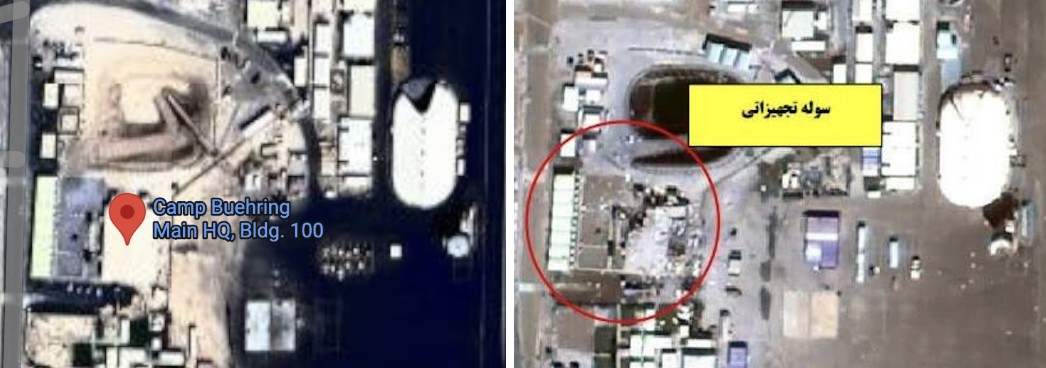
    Left: Screengrab showing “Camp Beuhring Main HQ, Bldg. 100” Google Maps label. Right: Same building seen destroyed on satellite image published by Iran’s Tasnim news agency.
    Left: Screengrab showing “Camp Beuhring Main HQ, Bldg. 100” Google Maps label. Right: Same building seen destroyed on satellite image published by Iran’s Tasnim news agency.

    Bellingcat verified that this was a headquarters building by matching the flagpoles and layout in a photo published by the US military’s Defense Visual Information Distribution Service (DVIDS) showing soldiers posing in front of the  building to the Google Maps satellite image.
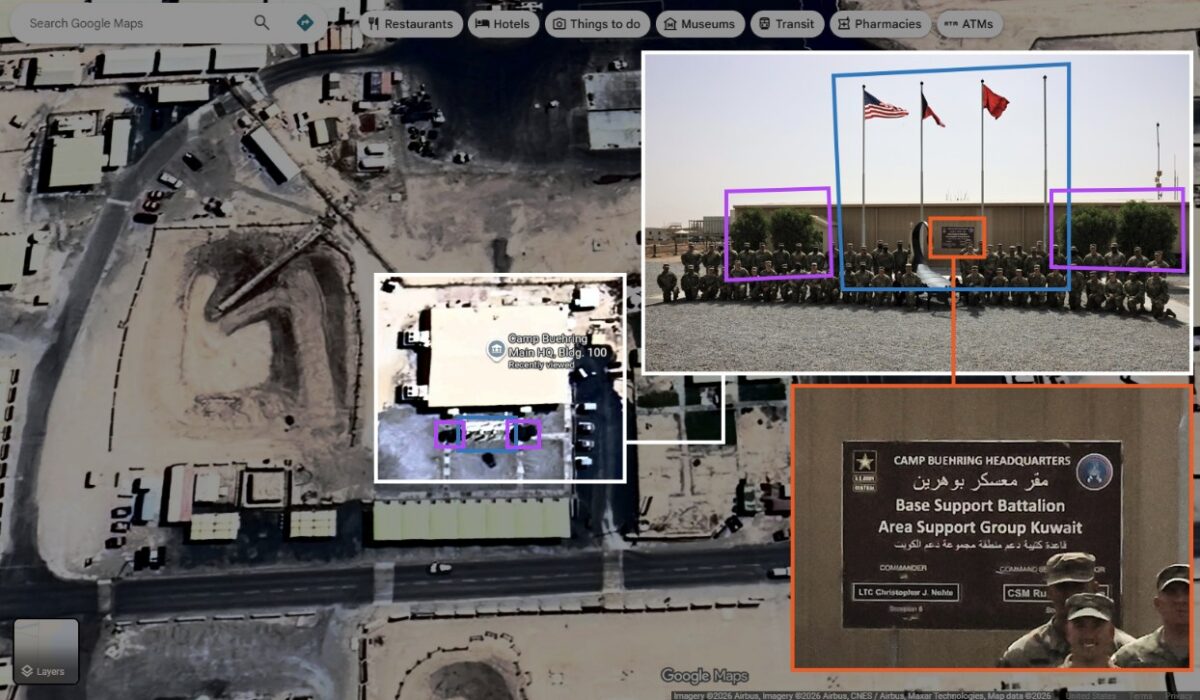
    Geolocation diagram using dvids photo to verify Google Maps Buehring main headquarters location, confirming the accuracy of the Google Maps place marker.
    Geolocation diagram using dvids photo to verify Google Maps Buehring main headquarters location, confirming the accuracy of the Google Maps place marker.

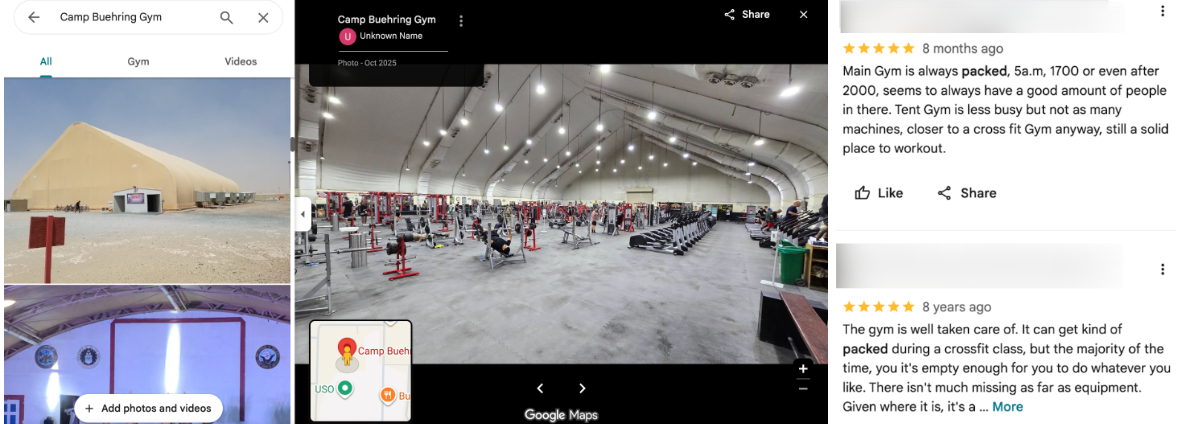
    We also identified details about one of the camp’s gyms, including the building’s layout and roof structure, as well as Google reviews that indicate when it is busiest.
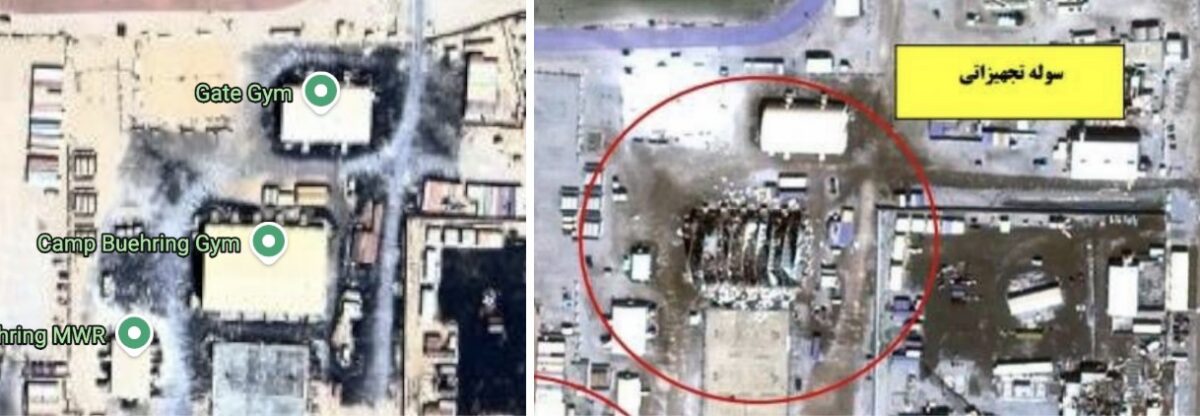
    Left: Google Maps label showing “Camp Beuhring Gym” Right: Destroyed gym building on satellite image published by Iran’s Tasnim news agency on 6 April 2026.
    Left: Google Maps label showing “Camp Beuhring Gym” Right: Destroyed gym building on satellite image published by Iran’s Tasnim news agency on 6 April 2026.

    Among the images published by CBS News in September was that of a heavily damaged tent-like structure with smoke rising from it. Bellingcat matched the location of this image to the above satellite imagery, verifying that it shows the gym building pinned on Google Maps.

    Left: Google Maps shows images of the gym’s interior and exterior. Right: Google Maps reviews indicate when the gym is busy (names blurred by Bellingcat).

    A building labeled on Google as “DPW Self-Help Center” was also destroyed at Camp Buehring. Its Google Maps listing includes opening hours, and a photo posted by a Master Sergeant in 2017 labeled “My office in Kuwait” shows the interior of an office. Some of the notices on the walls inside the office are legible, including what appears to be a floor plan.
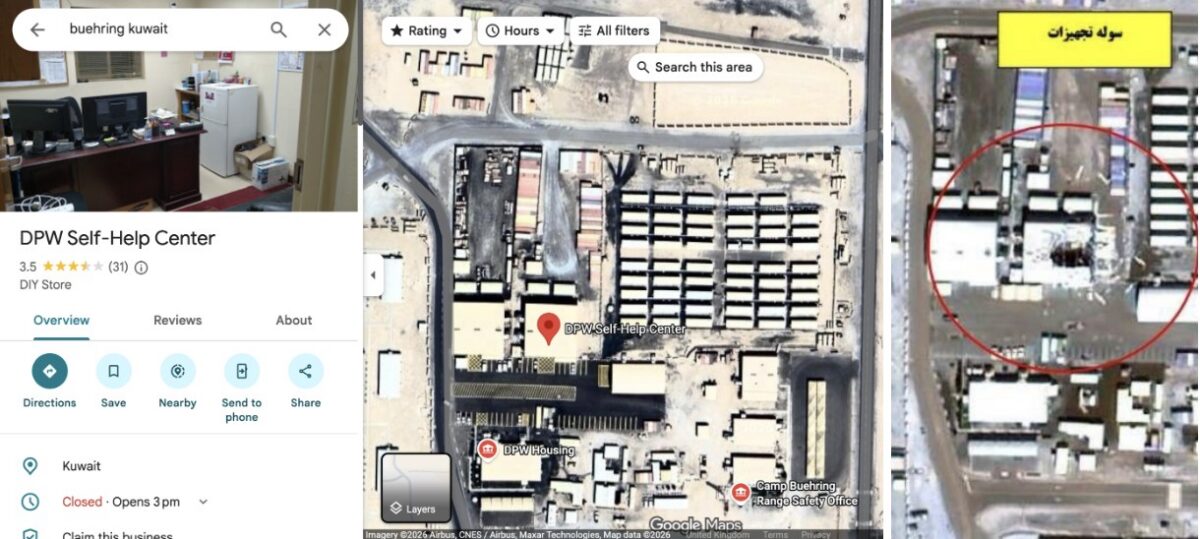
    Left: Google maps “DPW Self-Help Center” listing. Right: Same building seen destroyed on a satellite image published by Iran’s Tasnim news agency on April 6, 2026.
    Left: Google maps “DPW Self-Help Center” listing. Right: Same building seen destroyed on a satellite image published by Iran’s Tasnim news agency on April 6, 2026.

    A Google Maps placemark labelled “Transient Tent” identifies a large accommodation area, while another review includes a ground-level photograph of one of the tents. The dining facility can also be seen from the inside, including information regarding meal times.
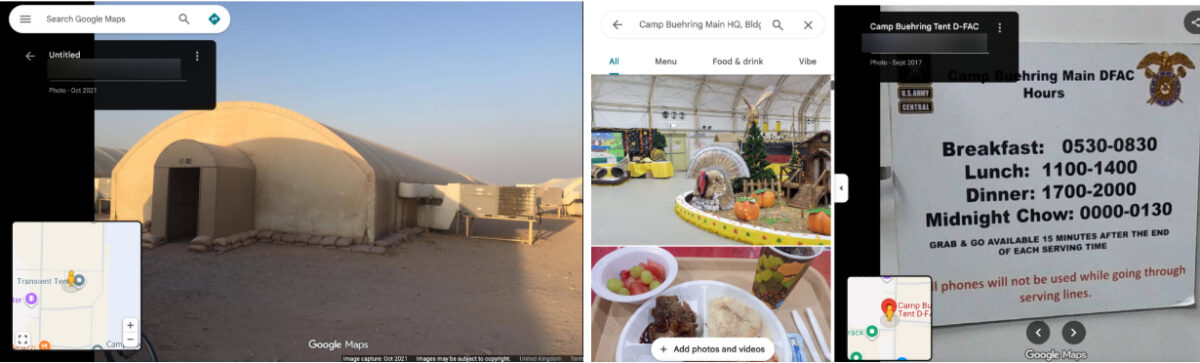
    Left: Google image that appears to show an accommodation area. Right: Photos of the dining facility, including information on meal times (names blurred by Bellingcat).

    William Goodhind of Contested Ground, a visual forensics consultancy that uses OSINT and satellite imagery to analyse military sites, said the information available on Google Maps could reveal “the camp’s layout, the division between secure and non-secure areas, confirms likely accommodation areas, and shows day/time periods of low and high activity.”

    Camp Arifjan

    A satellite image of Kuwait’s Camp Arifjan, captured by Planet on March 4, 2026 and published by the The Washington Post, shows damage to numerous structures at the base. Bellingcat compared the image with publicly available mapping data to identify two damaged facilities.

    A Google Maps listing for a lodging facility labelled “TPE FOR ARIFJAN” includes a soldier’s review discussing room reservations, accommodation shortages and cleaning schedules, indicating that the building was used for military housing. Although Google’s satellite imagery of the base is blurred, the facility is visible in unblurred Bing Maps imagery using coordinates obtained from its Google Maps listing. The satellite image published by The Washington Post shows heavy damage to the facility.
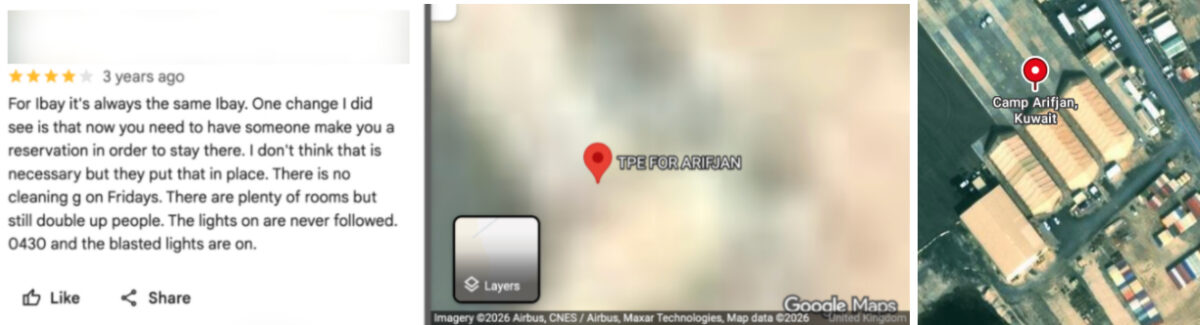
    Left and centre: Blurred Google Maps satellite image with Google review (name blurred by Bellingcat). Right: Unblurred Bing maps satellite image showing the same location.

    A “24hr Fuel Point” tagged on Google Maps is also blurred, but when the coordinates are copied and pasted into Bing Maps a clear satellite image of the fuel station appears. This facility is also seen destroyed on the satellite imagery published by The Washington Post.
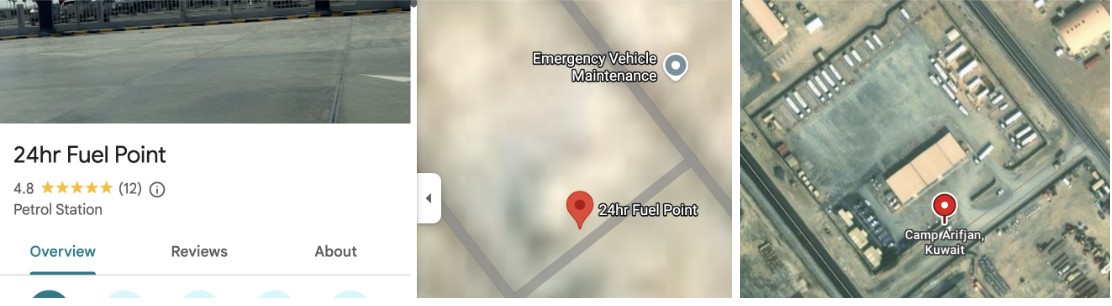
    Left and centre: Blurred Google Maps satellite image with Google review. Right: Unblurred Bing Maps satellite image.
    Left and centre: Blurred Google Maps satellite image with Google review. Right: Unblurred Bing Maps satellite image.

    Bellingcat contacted Microsoft to ask why the facility was not blurred out in the Bing Maps service. A spokesperson said: “When an entity requests removal from visibility on Bing Maps, we work through our process and act accordingly.”

    Muwaffaq Salti Air Base

    Three US service members were killed in Iranian ballistic missile strikes on Muwaffaq Salti Air Base in Jordan on July 17, 2026. The strikes appear to have caused extensive damage to a barracks in the north of the base, with satellite imagery released by Iran showing at least 20 structures destroyed.

    Less than 40 metres from the nearest destroyed structure, and within the same living quarters area, Google Maps reveals the location of an “Airman’s Attic”. These are volunteer-run thrift shops for US Air Force personnel. 

    A five-star review posted last year by a soldier includes a ground-level image of the facility, showing uniform drop-off points and fortifications along the perimeter. The listing provides information about the area’s use, while photographs of the shop’s exterior make it possible to match the satellite imagery to the location on the ground.

    A Sky News investigation also found that 80 percent of the runs shared publicly on the sporting app Strava at Muwaffaq Salti Air Base during the April ceasefire started or finished in this northern barracks.
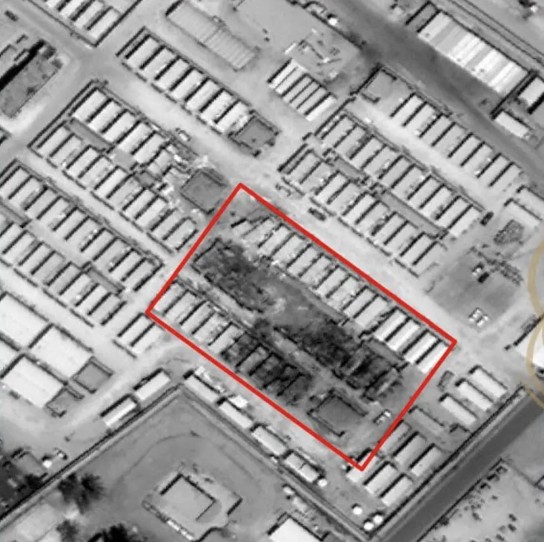
    Satellite image showing damage, highlighted in red, published by Iran’s Fars News Agency.
    Satellite image showing damage, highlighted in red, published by Iran’s Fars News Agency.

    Less than 100 meters from the destroyed area, “LSA DFAC” is pinned on Google maps. “DFAC” is the standard US military acronym for “dining facility”, according to Stars and Stripes. Several Google reviews also discuss the steak being served in this location.
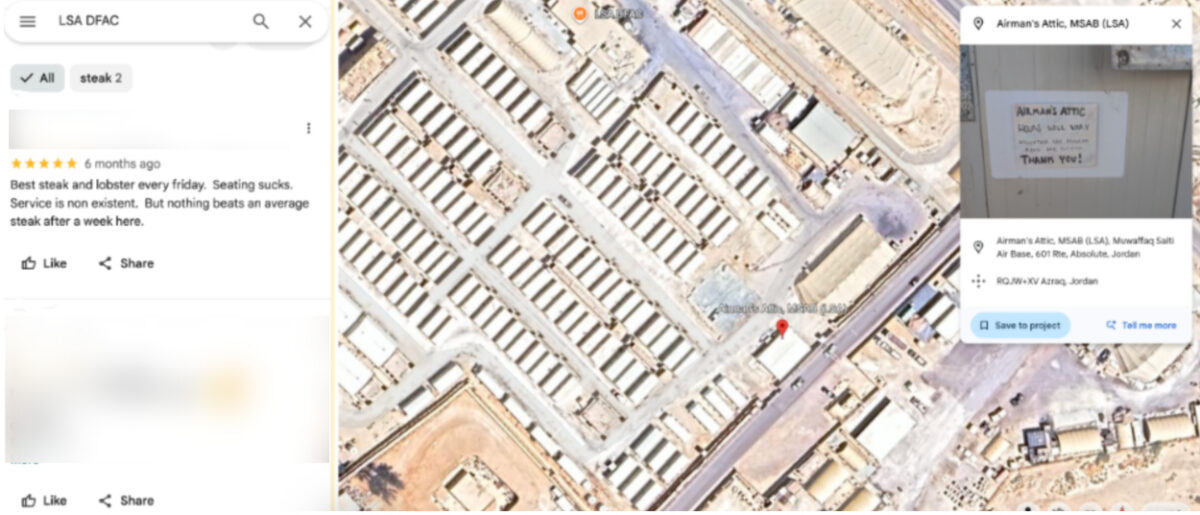
    Left: Google reviews for the dining facility (names blurred by Bellingcat). Right: Google Earth satellite image with the Airman’s Attic and dining facility visible in the area targeted by Iran.

    Al Udeid Air Base

    Similar mapping information is available for Al Udeid Air Base in Qatar, the largest US military installation in the Middle East. 

    The base appears unblurred on Google Maps and entries on the platform identify the functions of numerous buildings. These include lodging facilities, which videos and reviews indicate are used by US Air Force crews and show the interior layout of the facility.
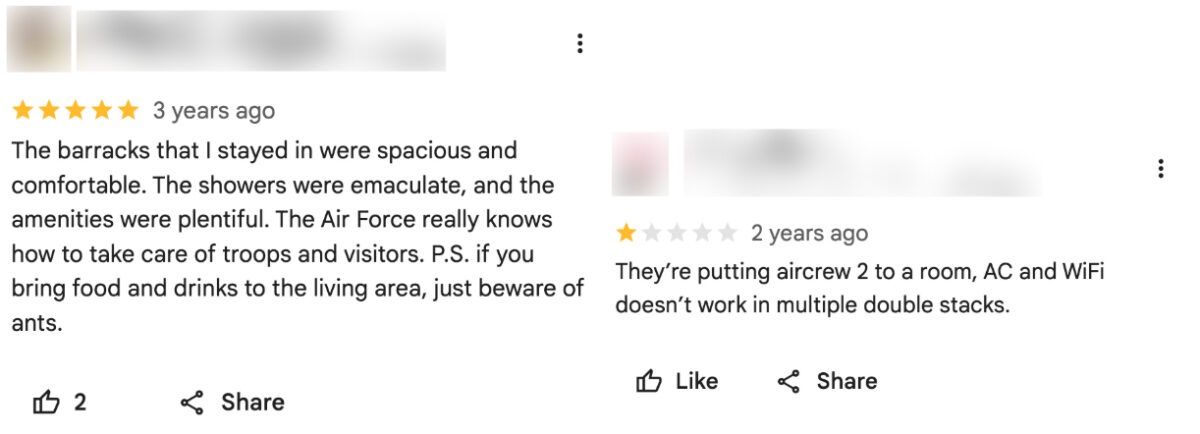
    Google reviews for “Al Udeid Lodging” indicate the presence of US Air Force crews (names blurred by Bellingcat).

    Meanwhile, Russia’s Yandex Maps details the site of two cinemas, a bar and a school on the base. This appears to match information provided on Google Maps.

    While Al Udeid Air Base was damaged during Iranian attacks earlier this year, the areas that were struck do not appear to be among those listed on Google. 

    Business Insider reported that a geodesic dome that housed secure communications equipment was hit in the strikes. ABC News detailed how another building had been damaged near the centre of the base. Google Maps shows a large warehouse-like structure at the location where ABC News reported this strike.

    A New Reality in the Middle East

    Former US Air Force targeting specialist Wes J. Bryant said the problem facing US bases in the Middle East reflected a broader assumption within the military that bases in allied countries were safe from serious attack. He said the belief that these were rear-area bases where “nothing’s going to happen out here” was a fundamental miscalculation, and that the Google Maps issue was an example of the military failing to account for that vulnerability.

    Matthew Savill, Director of Military Sciences at the Royal United Services Institute, said Western militaries do not have consistent policies governing what information can be publicly posted about sensitive sites. He said the issue needs to be considered before a conflict begins, rather than when attacks are already underway. “The start point should be, can we enforce operational security discipline?” Savill pointed to restrictions already in place at some UK military facilities, including Faslane, a naval base that houses the UK’s nuclear submarines, where he said personnel are not permitted to use mobile phones on site.

    Savill told Bellingcat that the different pieces of data available on Google Maps, even if outdated, provided a “pattern of life” about US bases in the Middle East. But he added that the use of Google to help with the military targeting of Western bases is not new, saying he encountered the issue while deployed to Iraq more than 20 years ago.

    “When I was in Iraq, we knew for a fact that insurgents and militants had been using commercial imagery, including Google Earth, to try and map our bases,” he said. “We have known for more than 20 years that there is a vulnerability that if you don’t stop the collection and layering of data early on, that your bases can be heavily mapped.” 

    The use of open-source information to support military targeting has been documented in Ukraine. In 2022, Foreign Policy detailed how Ukrainian private intelligence company Molfar used photographs of Russian soldiers published by Russian media alongside Google Earth satellite imagery to identify their location. Molfar passed its findings to Ukrainian intelligence, and the site was subsequently struck by the Ukrainian military.

    The security risks of publicly mapping military installations were recognised by the US military in 2008, when the Pentagon banned Google’s Street View from documenting the interiors of its bases. Since the Iran war started, US military commanders have also warned service members about posting photographs and videos from bases after Iranian attacks, cautioning that such footage could help Iran assess the effects of its strikes.

    Iranian attacks have forced US personnel to evacuate many additional locations that were deemed too vulnerable to further strikes. 

    In total, 23 US service members have been killed and 865 wounded in the US-Iran war, according to the Pentagon.


    Bellingcat’s Jake Godin, Charlotte Maher and Merel Zoet contributed to this report.

    Bellingcat is a non-profit and the ability to carry out our work is dependent on the kind support of individual donors. If you would like to support our work, you can do so here. You can also subscribe to our Newsletter and follow us on Bluesky here, Instagram here, Reddit here and YouTube here.

    Source: Bellingcat · 2026-11-05
  • Inside the Secretive, Contradictory World of Campaign Ads Funded by AI Super PACs

    Inside the Secretive, Contradictory World of Campaign Ads Funded by AI Super PACs

    Sign up here to receive Bellingcat’s biggest investigations by email as soon as they are published. Become a member and support our work here.

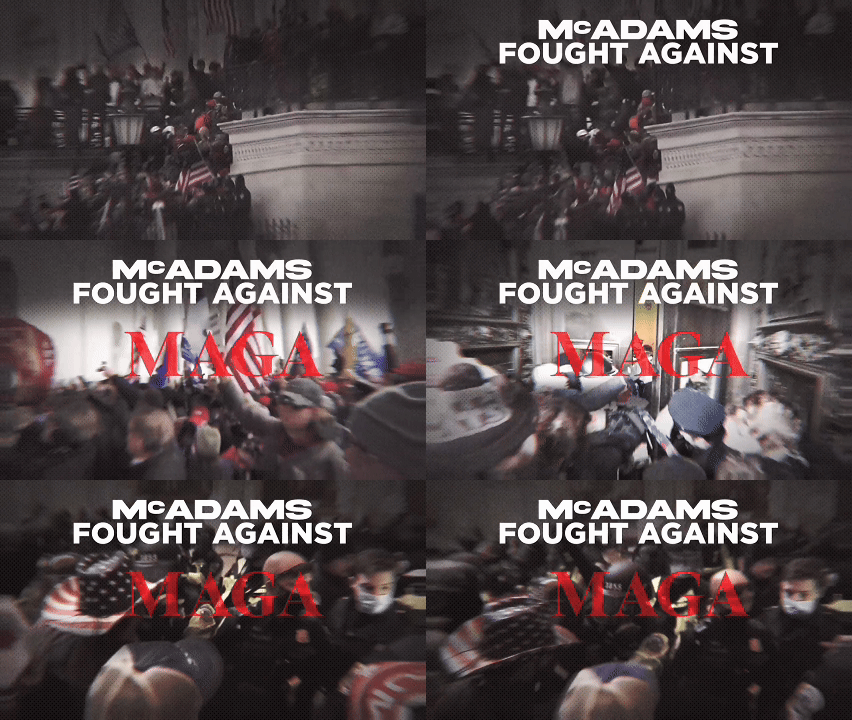
    An online ad for Ben McAdams, the Democratic candidate for Congress in Utah, emphasised that he could be trusted because he “fought back against MAGA”.

    Source: Think Big / Google Ad Transparency Center

    In Texas, another ad promoted Republican candidate Chris Gober, calling him a “MAGA warrior”.

    Source: American Mission / Google Ad Transparency Center

    What’s interesting is that both ads were ultimately paid for with money from the same organisation – Leading the Future (LTF), a Super PAC which opposes regulations that “constrain” innovation in AI. The network has received US$125 million in funding in total from OpenAI president Greg Brockman, his wife Anna Brockman, tech-focused venture capital firm Andreessen Horowitz (a16z) and a16z’s founders, Federal Election Commission (FEC) filings show. 

    Directly opposing LTF is Public First Action (PFA), which calls for AI safety regulations and guardrails. PFA has received $40 million in funding from AI company Anthropic. 

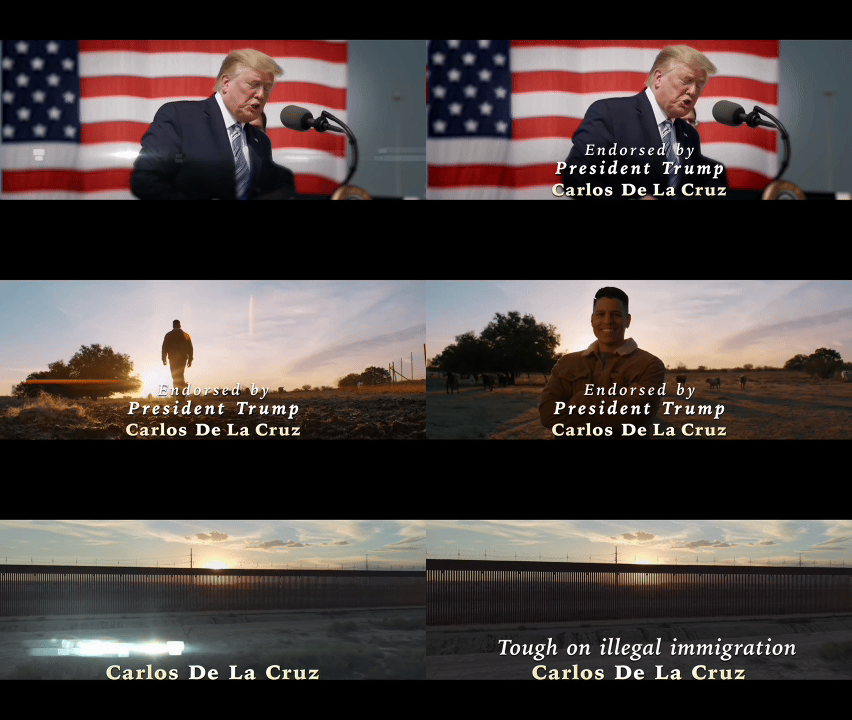
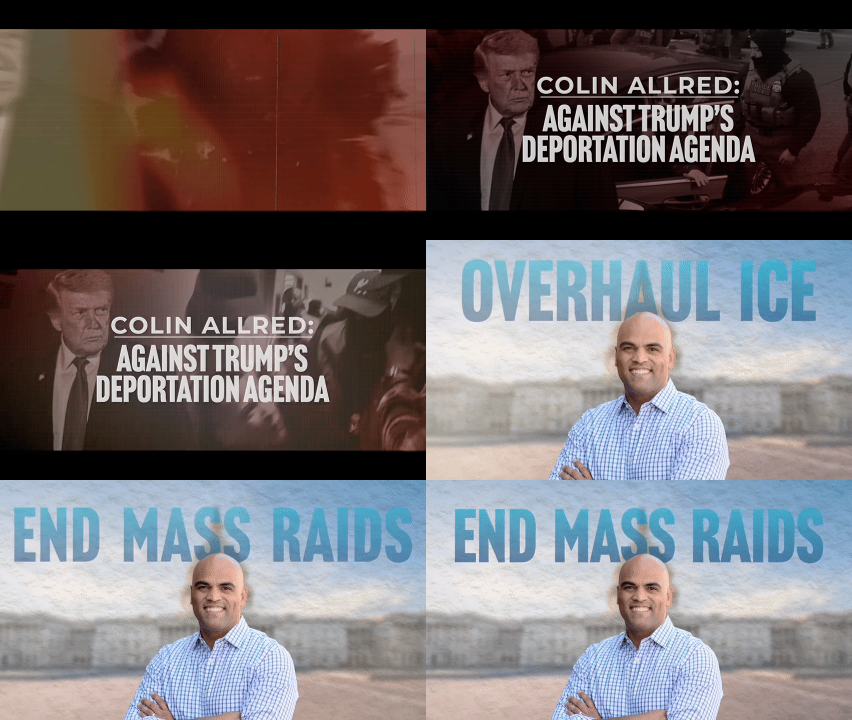
    Like the ads run by organisations funded by LTF, the Super PACs funded by PFA also ran ads that appeared supportive or critical of Trump depending on the voters they were targeting. 

    Ads in support of Republican Carlos De La Cruz (above) and Democrat Colin Allred (below) in Texas, paid for by Defending Our Values PAC, and Jobs and Democracy PAC, respectively. Source: Defending Our Values PAC / Jobs and Democracy PAC / Google Ad Transparency Center

    None of these ads mentions AI.

    As the US 2026 midterm elections approach on Nov. 3, Super PAC spending on political advertising has reportedly soared to record highs, surpassing US$11 billion last week and exceeding the amount spent on any other election cycle to date. 

    Super PACs are a particular type of political action committee (PAC) that may receive unlimited contributions from individuals, corporations, labour unions and other PACs for the purpose of financing independent expenditures and other independent political activity.

    In this year’s elections, LTF’s and PFA’s Super PACs, funded by the AI industry heavyweights, have played an outsized role in supporting or opposing candidates through advertising. But as polls show distrust of AI crosses party lines, the advertisements that Silicon Valley’s leaders are paying millions of dollars to try to sway the results in their chosen candidates’ favour often do not mention AI at all. 

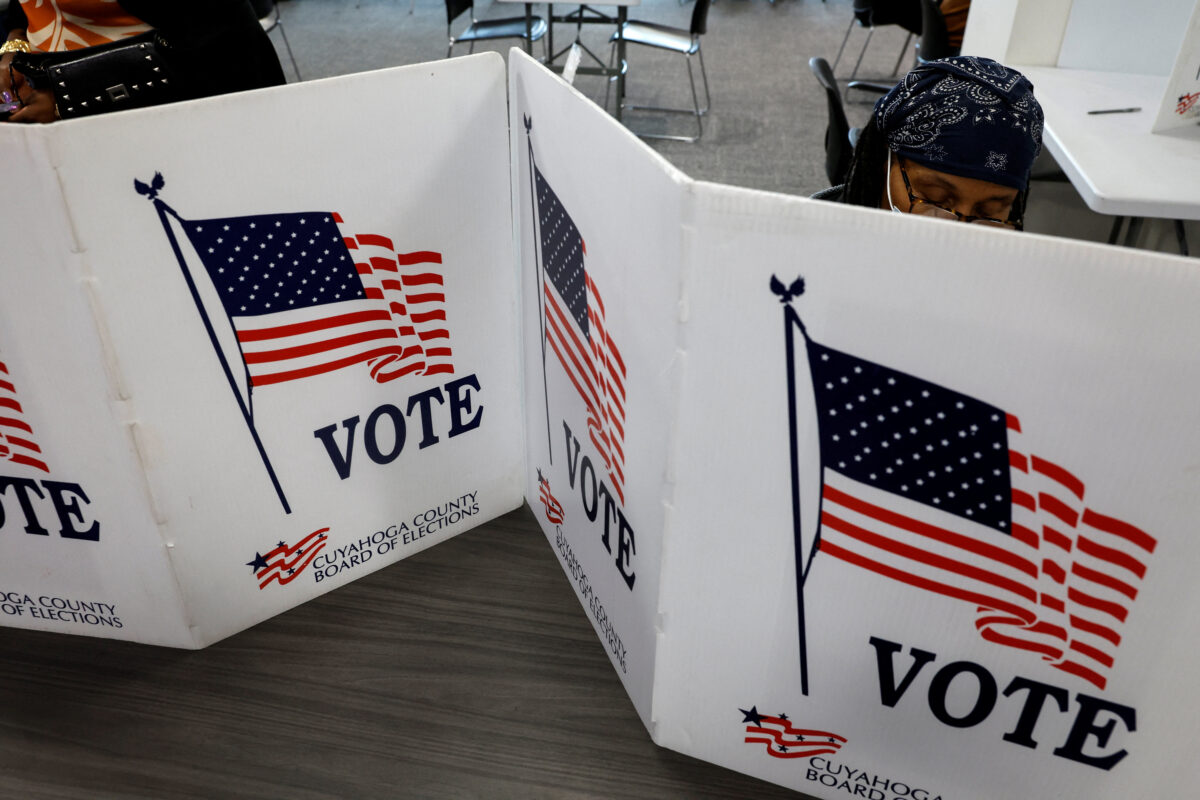
    Photo: Reuters/Shannon Stapleton

    While LTF is a registered Super PAC itself, FEC filings show it mainly disburses money to other Super PACs in its network which run political ads. 

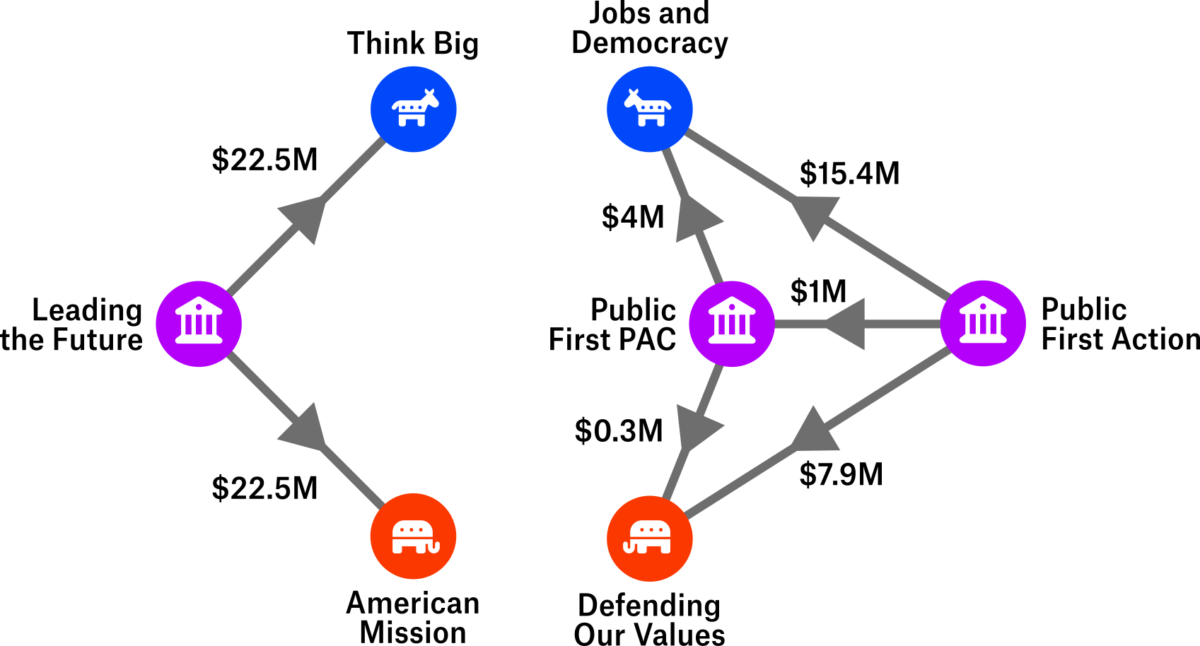
    Of about $52 million that LTF has disbursed to date, $20 million went to Think Big, which targets the Democratic voter base, and another $20 million went to American Mission, which focuses on Republicans. 

    PFA, meanwhile, is registered as a “social welfare”, or 501(c)(4), organisation. This type of non-profit is not required to disclose its donors or disbursements. However, PFA contributes funds to three Super PACs: the bipartisan Public First PAC, Jobs and Democracy for Democratic candidates and Defending Our Values for Republicans. FEC filings for these Super PACs show Public First PAC received $1 million, Jobs and Democracy received $15.4 million and Defending Our Values received $7.9 million from PFA. Public First PAC’s FEC filings also show that $4 million of its $4.4 million in disbursements disclosed so far went to Jobs and Democracy, while another $300,000 went to Defending Our Values. 

    Disbursements to Think Big, American Mission, Jobs and Democracy and Defending Our Values from Leading the Future, Public First PAC and Public First Action. Graphic: Bellingcat

    Super PACs are allowed to accept unlimited contributions from other political committees, and other similar networks of Super PACs have been observed in the current election cycle, such as cryptocurrency-linked Fairshake and its affiliated Super PACs.

    Bellingcat analysed data on more than 300 online video ad campaigns paid for by Think Big, American Mission, Jobs and Democracy and Defending Our Values from Google’s Ad Transparency Center. These ad campaigns, many of which used the same videos in slightly different formats or across different platforms, supported or opposed 40 candidates. 

    Estimated Super PAC Google Ad spend by state

    Loading map…

    Estimate total ad spend for selected Super PACs: $0

    Source: Google Ad Transparency Center, analysis by Bellingcat

    Only ads supporting or opposing two candidates mentioned AI, and none mentioned data centres, a top issue this election cycle. A New York Times analysis of 95 video ads paid for by the same four Super PACs, using data gathered by media tracking firm AdImpact, had similar findings. FEC rules state that Super PACs can spend money to support or oppose a candidate, but cannot coordinate with the candidate or their campaign on this. There is no evidence that any of the candidates or campaigns for which the Super PACs ran ads have coordinated with them.

    Michael Beckel, Director of Money in Politics Reform at cross-partisan political reform group Issue One, told Bellingcat that voters are at a disadvantage when special interests fund Super PACs running ads that don’t mention the priority issues of those underwriting them. 

    “Special interests seem keen on moving voters with messaging around hot-button issues, all while advancing a specific policy agenda that viewers of ads are kept in the dark about,” he said. The result of this, Beckel added, was that “the industry gains a stronger hand in Washington, while voters get little chance to judge the agenda their votes could help advance”. 

    A representative for PFA stated: “We endorse officials who support regulating AI. The aligned PACs run ads on the issues that matter most immediately to voters in each race, and for most electorates right now that means the economy, affordability, public safety, and other issues that they are facing on a daily basis.” 

    Jobs and Democracy, Defending Our Values, LTF, Think Big and American Mission did not respond to questions about their political advertising as of publication. 

    A recent survey by think tank Data for Action and non-profit Guardrails Action found that about three-quarters of likely voters would be less inclined to vote for a candidate if they found out they had accepted a donation from an AI Super PAC. 

    The ads distributed by the AI-backed Super PACs supporting or opposing 29 candidates mentioned economic issues such as taxes, the cost of living, consumer rights and local jobs or small businesses. Another 16 mentioned immigration or law enforcement and 17 mentioned US President Donald Trump or his “Make America Great Again” (MAGA) movement. 

    Like the ads mentioning Trump, those on immigration were sharply divided in messaging depending on whether they were targeting Democratic or Republican voters, even when they were paid for by the AI Super PACs in the same network. 

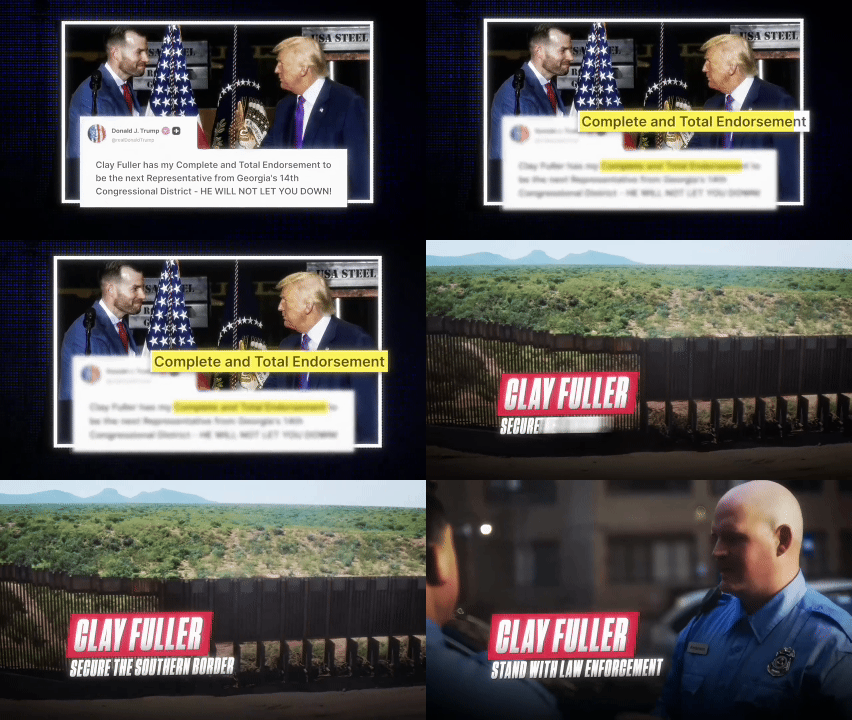
    LTF’s Think Big sponsored an ad for Democratic candidate Jeremy Moss in Michigan that talks about how he stood up to Immigration and Customs Enforcement (ICE), while American Mission’s ad for Republican Clay Fuller in Georgia mentions how he is focused on securing the southern border. 

    Ads for Moss (above) and Fuller (below) sponsored by Think Big and American Mission respectively. Source: Think Big / American Mission / Google Ad Transparency Center

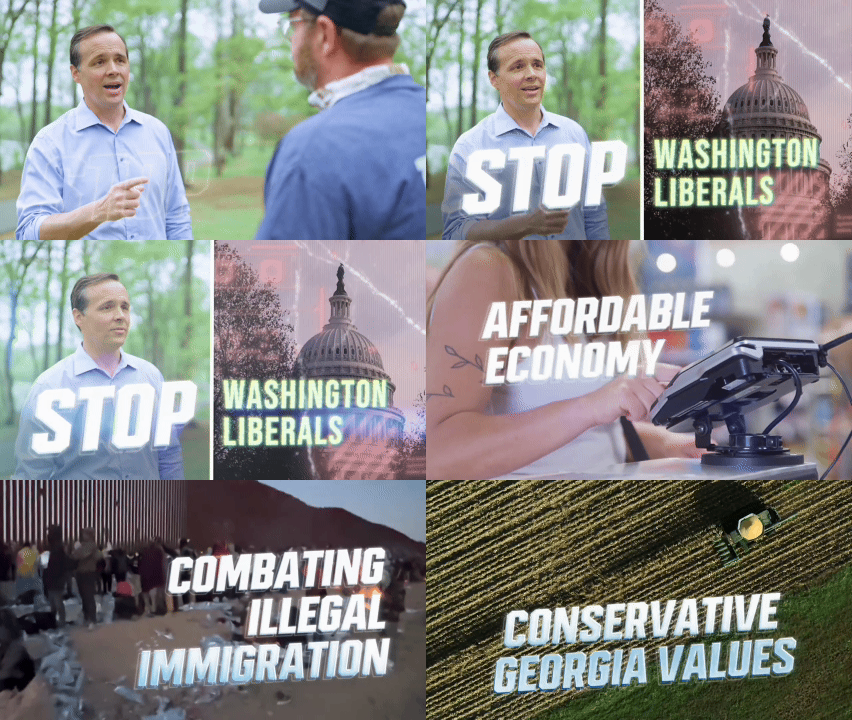
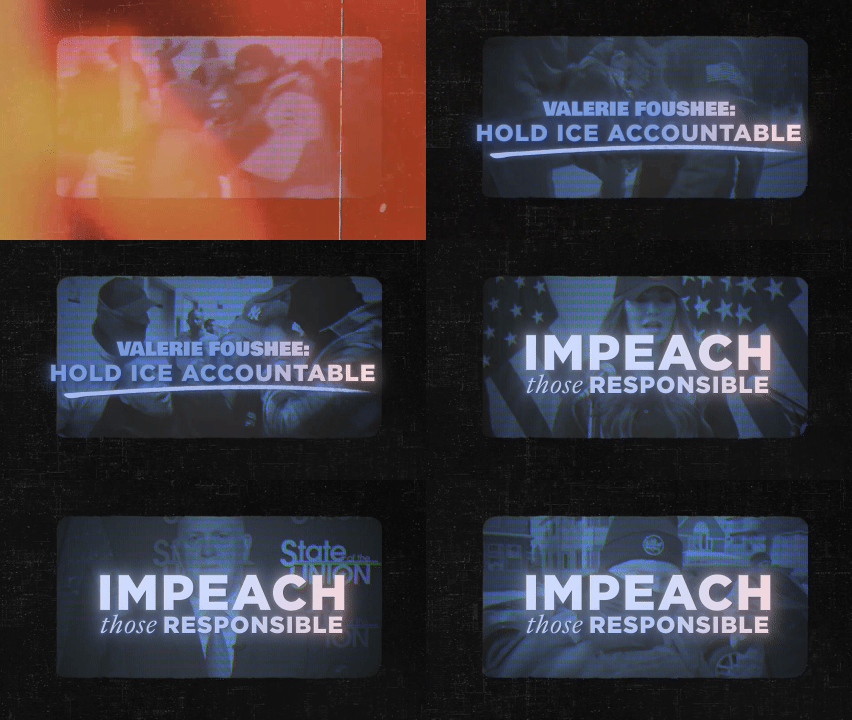
    We found similar messaging in ads mentioning immigration that were paid for by Super PACs in PFA’s network. Defending Our Values ran an ad in support of Republican John Cowan in Georgia emphasising that he will combat illegal immigration, whereas Jobs and Democracy’s ad for Democrat Valerie Foushee in North Carolina said she was “leading the fight to hold ICE accountable”.

    Ads for Cowan (above) and Foushee (below) sponsored by Defending our Values and Jobs and Democracy respectively. Source: Defending Our Values PAC / Jobs and Democracy PAC / Google Ad Transparency Center

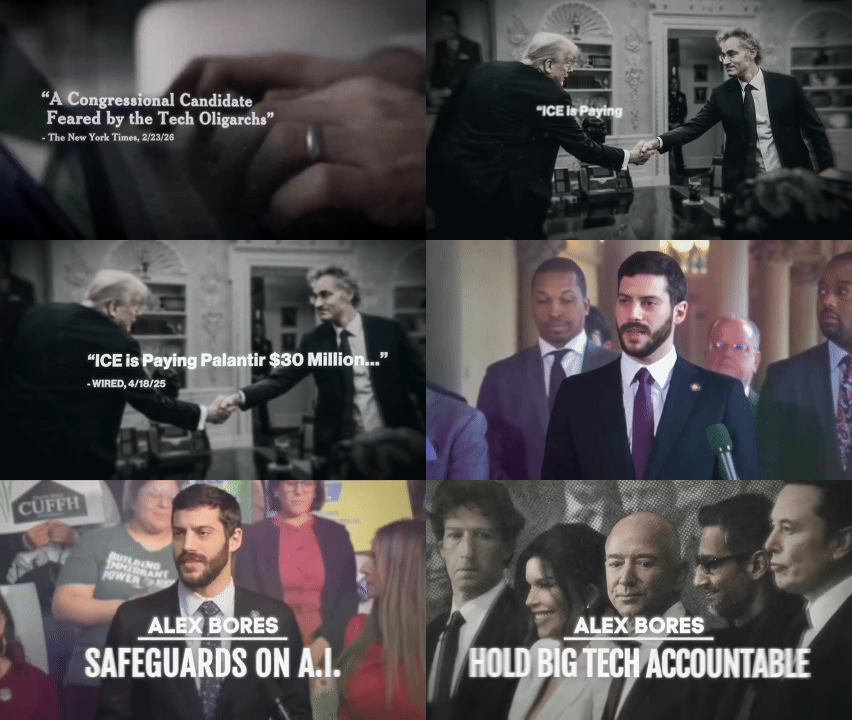
    For the ads that did mention AI, almost all were in support of Alex Bores’ primary in New York. PFA’s Jobs and Democracy PAC ran 152 ads supporting Bores’ candidacy, at least some of which mentioned that he was in favour of safeguards on AI and holding Big Tech accountable. 

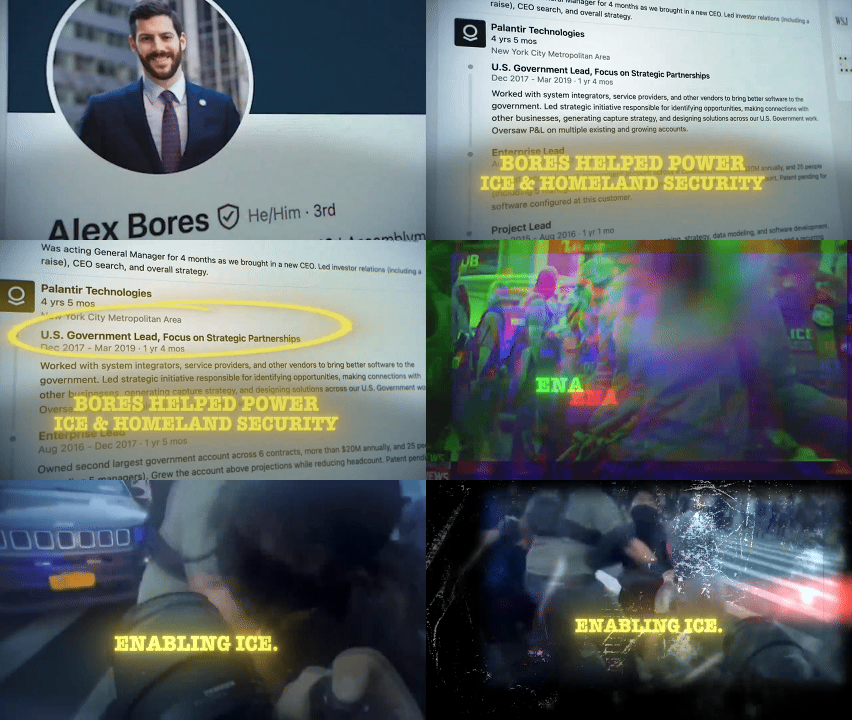
    LTF’s Think Big, on the other hand, ran 22 ads opposing Bores’ candidacy. While they did not mention his stance on AI, many of Think Big’s ads focused on him receiving funding from Anthropic, “dark money Super PACs” and his former employer Palantir, the software giant whose technology, including a new AI system, is used in ICE’s immigration enforcement operations. 

    Ads supporting Bores sponsored by Jobs and Democracy. Source: Jobs and Democracy PAC / Google Ad Transparency Center
    Ads opposing Bores, sponsored by Think Big. Source: Think Big / Google Ad Transparency Center

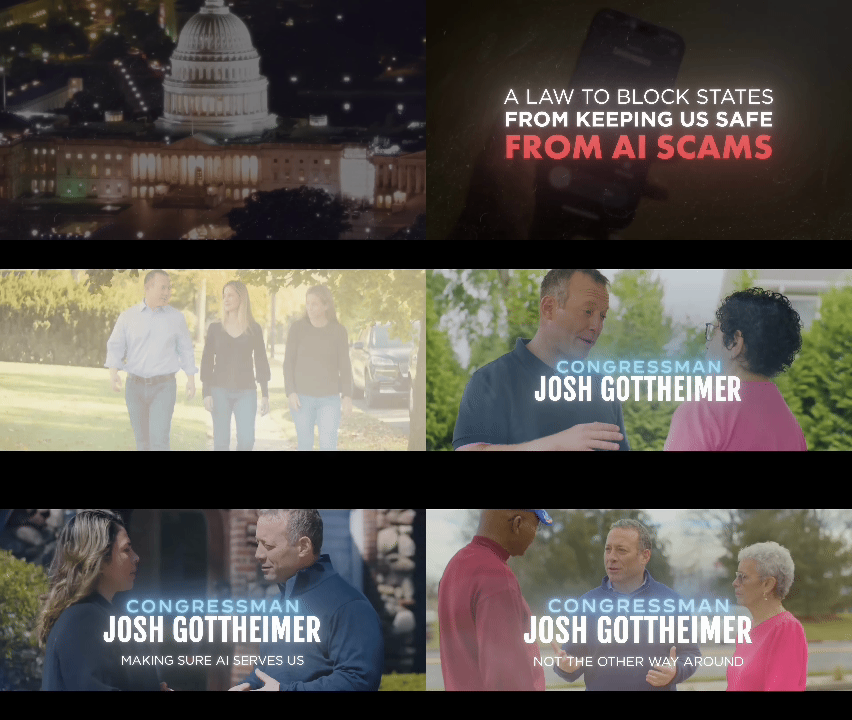
    Jobs and Democracy’s advertiser page also showed two ads for Josh Gottheimer in New Jersey that focused on the threats of AI scams and AI-generated media, urging voters to call Gottheimer to tell him to “stand strong for AI safeguards”. 

    Ad for Josh Gottheimer that mentions AI, listed on Jobs and Democracy PAC’s Google Ads Transparency Center advertising page. Source: Jobs and Democracy PAC / Google Ad Transparency Center

    Major donors to LTF that Bellingcat reached out to – Greg Brockman, a16z, and a16z founders Marc Andreessen and Ben Horowitz – did not respond to requests for comment on their funding to the Super PACs as of publication. We could not find any publicly available contact information for Anna Brockman, but we also asked about her contributions to LTF in questions to her husband.

    Related articles by Bellingcat

    What Meta’s Ad Library Shows About Harris and Trump’s Campaigns on Facebook and Instagram

    What Meta’s Ad Library Shows About Harris and Trump’s Campaigns on Facebook and Instagram

    OpenAI did not respond to questions about the Brockmans’ contributions to LTF as of publication. However, the company published a statement on the topic in June, which said “OpenAI does not direct the activities of LTF, or have visibility into their operations” and that “any engagement with that organisation has been in a personal capacity, not on behalf of the company”. 

    PFA’s main public donor, Anthropic, did not respond to Bellingcat’s queries about its funding for PFA and PFA’s political advertising as of publication. It said in a statement on its website in July that its donations to PFA were “to help promote policies that will maintain meaningful safeguards, sustain America’s AI leadership, and demand transparency from the companies building the most powerful AI models”.

    Unknown Vendors

    Federal campaign finance laws require federal political committees to file periodic campaign finance reports disclosing their receipts and disbursements. 

    Our analysis of FEC filings for LTF and the Super PACs in its network revealed that they were channelling more than $36.4 million in total towards four companies that were newly set up, with no apparent online presence outside of these filings. 

    A complaint to the FEC by the non-profit Campaign Legal Center (CLC) in May cited American Mission and Think Big’s payments to Summit Ridge and Lantern Productions, alleging that the Super PACs had “unlawfully evaded federal reporting requirements by funnelling their payments for goods and services through shell companies set up to conceal how the super PACs are actually spending their money”. The FEC has not yet ruled on the complaint. LTF, American and Think Big did not respond to Bellingcat’s queries about the complaint as of publication.

    FEC filings show that LTF paid a company called Prusik Partners LLC more than $966,000 for operational expenditures for a range of services including communications and strategy consulting, as well as legal fees. 

    The network’s Democrat-focused Super PAC, Think Big, paid a company called Lantern Production Consultants LLC more than $20 million, based on filings for disbursements from Aug. 20, 2025 to Oct. 14, 2026. 

    Support Bellingcat

    Your donations directly contribute to our ability to publish groundbreaking investigations and uncover wrongdoing around the world.

    The payments included $3.17 million for operational expenditures for a range of services such as media consulting and research, and another $17 million for independent expenditures. The FEC defines an independent expenditure as one that pays for “a communication that expressly advocates for the election or defeat of a clearly identified candidate”. The highest independent expenditures paid to Lantern ($8 million) were to oppose Bores’ candidacy, the filings show.

    Think Big also declared in its filings that it had paid a company called Blue Horizon Compliance Consultants LLC almost $55,700 for “compliance consulting”. 

    Republican-focused American Mission, on the other hand, paid a company called Summit Ridge Media LLC more than $13 million, based on filings for disbursements from Aug. 20, 2025 to Oct. 14, 2026. 

    This included $2.2 million for operating expenditures such as polling and website services, and $10.9 million in independent expenditures, with the highest amount (about $960,400) going towards communications in support of James Morris Kingston, the Republican candidate for the House of Representatives in Georgia.

    Bellingcat found that all four of these LLCs listed mailing offices and office supply goods stores in Nevada as their mailing addresses. We could not find records of them doing business with any entity outside of the LTF network – in fact, they appeared to have no online presence aside from their names appearing in the filings and business registrations. 

    Despite their addresses being listed in Nevada, none of the companies could be found in the state’s public business registry. Instead, Bellingcat found registrations for Prusik, Lantern Production and Summit Ridge across the country – in Delaware. 

    While Delaware is the second-smallest state in the US, more than half of all Fortune 500 companies are incorporated there according to the Delaware Secretary of State. The state’s business-friendly laws mean companies can reportedly incorporate in minutes, and are only required to name of a representative – who can be a paid agent unrelated to the business – in public registration documents, not the beneficial owners.

    Articles of incorporation from the Delaware Secretary of State showed that Prusik was registered on July 22, 2025, while Lantern Production and Summit Ridge were both registered on Oct. 30, 2025. We also found a Delaware registration for a company called “Blue Horizon Compliance Group LLC”, registered on Oct. 30, 2025. While the name differs slightly from the Blue Horizon Compliance Consultants LLC that Think Big declared payments for, the registration was signed by the same agent listed in the documents for Lantern Production and Summit Ridge. 

    The filings show that all of these companies – including Blue Horizon Compliance Group, if this was indeed the same entity referred to in Think Big’s filings – began receiving payments from the Super PACs within two to three months of their business registrations.

    Saurav Ghosh, CLC’s Director of Federal Campaign Finance Reform, told Bellingcat that the group filed the complaint because “when groups funded by big corporate special interests evade transparency laws, voters lose”. 

    “Federal reporting requirements help ensure transparency in our elections and protect voters’ legal right to know where the money is going,” Ghosh said. “Secret spending schemes like this make it virtually impossible to ensure that our elected officials are staying accountable to voters instead of wealthy special interests.”

    We were unable to reach out to the LLCs as none of them had phone numbers or email addresses listed online. LTF, Think Big, and American Mission did not respond to questions about the LLCs, including whether “Blue Horizon Compliance Consultants LLC” listed in Think Big’s filings was the same company as Delaware-registered “Blue Horizon Compliance Group LLC”. However, a WIRED story on these same LLCs quoted a spokesperson from LTF as saying that the complaint was “a desperate ploy for attention from Public First, Anthropic, and the groups aligned with their outside organisations”. WIRED also quoted a Public First spokesperson denying that the group had anything to do with the complaint.  

    Beckel suggested that stricter transparency measures relating to Super PAC spending would help inform and empower voters. For instance, Congress could pass legislation to require ads to include the names of the top donors, he said, adding that similar rules had been passed with cross-partisan support in places like Alaska and Arizona. 

    “Congress would be doing voters a huge service by passing more robust transparency requirements for political ads. Voters deserve to know who is behind the ads they’re seeing,” Beckel said. 

    About the Data

    Google Ads Analysis

    We reviewed ads available through Google’s Ads Transparency Center. These are ads served on Google platforms like Search, Display, Gmail and YouTube. We filtered specifically for ads shown between Jan. 1 and Oct. 23, 2026 in the US. 

    We focused only on video ads classified as political advertisements, not text- or image-based ads. We looked at ads purchased by the following advertisers: Think Big, THINK BIG, American Mission, Jobs and Democracy PAC, JOBS AND DEMOCRACY PAC, Defending Our Values PAC and DEFENDING OUR VALUES PAC. 

    In total, there were 336 advertisements in the dataset: 86 from Think Big, 57 from American Mission, 22 from Defending Our Values and 171 from Jobs and Democracy. Each ad listed on the platform was counted individually, although many of these were duplicates of the same ad that was run over a different period or platform. Some of the ads have also been removed for ad policy violations, but we were able to see which candidates they were for because they appeared when searching for ads specific to those candidates within the advertiser’s page. 

    For the coding of themes, we looked at whether each of the themes mentioned (AI, data centres, economy, Trump, and immigration or law enforcement) appeared in any of the ads for each candidate. This does not account for how many times each theme may have appeared in ads for a candidate.

    Our notes on the Google ad data and count of themes for each candidate can be found here. 

    For the accompanying map showing spending by each Super PAC by state, we used data from the Google Ad Transparency Center showing the total spend per advertiser and the spending range per ad to estimate the spend per ad (as the data does not show the exact spend per ad). For each advertiser, we separately added up the minimum and maximum spend amounts for all ads. We then calculated where in that range the total spend fell (e.g. 45 percent between the minimum and maximum spend). The per ad spend was estimated by applying this same proportion to the range of each ad and rounding down to the nearest dollar.

    FEC Campaign Finance Data

    Data from FEC filings for LTF, Think Big and American Mission are based on disclosures from Aug. 20, 2025 to Oct. 14, 2026. Data from FEC filings for Public First, Defending Our Values and Jobs and Democracy are based on disclosures for Jan. 1, 2026 to Sept. 30, 2026, which were the latest available as of publication.

    The amounts LTF and PFA contributed to their associated Super PACs are based on the recipient Super PACs’ receipts for contributions from “Leading the Future”, “Public First”, “Public First Action” and “Public First Action, Inc”. 

    Links to the source pages for these filings, as well as the data we exported for our analysis, are available here.


    This investigation was supported by a grant from the Tarbell Center for AI Journalism. 

    Data visualisations by Galen Reich. Melissa Zhu contributed research to this piece.

    Bellingcat is a non-profit and the ability to carry out our work is dependent on the kind support of individual donors. If you would like to support our work, you can do so here. You can also subscribe to our Newsletter and follow us on Bluesky here, Instagram here, Reddit here and YouTube here.

    Source: Bellingcat · 2026-11-02

  • Satellite Images Show Extent of Trump Admin’s Tree-Felling at DC Golf Course

    Satellite Images Show Extent of Trump Admin’s Tree-Felling at DC Golf Course

    Sign up here to receive Bellingcat’s biggest investigations by email as soon as they are published.

    Satellite imagery obtained by Bellingcat lays bare the extent of tree-felling at a Washington DC golf course that President Trump is reportedly seeking to transform into a championship-level course, despite moves to protect the site by conservationists. 

    The extent and circumstances surrounding the rapid changes prompted a judge to call an emergency hearing earlier this week, banning any further changes until later this month.

    Reports on Wednesday detailed that 430 trees were cut down at the East Potomac Golf Links  which is owned by the Federal government and managed by the National Park Service (NPS). This is despite a judge reportedly stating earlier this year that no more than 10 trees at the course could be cut down without first notifying the court. 

    NPR reported that officials notified the court just before 5pm on Friday Oct. 9 of plans to remove up to 529 trees in phases starting  the next day on Saturday Oct. 10. That prompted US District Court Judge Ana Reyes to call an emergency hearing on Oct. 12. By that time, 430 trees had reportedly been cut down.

    Reyes is reported to have said she was “furious” with the Justice Department for the lack of time afforded the court and plaintiffs before the tree removal was carried out.

    She was also reported to have said that the government’s actions had cost it “all of its credibility with me in this case.”

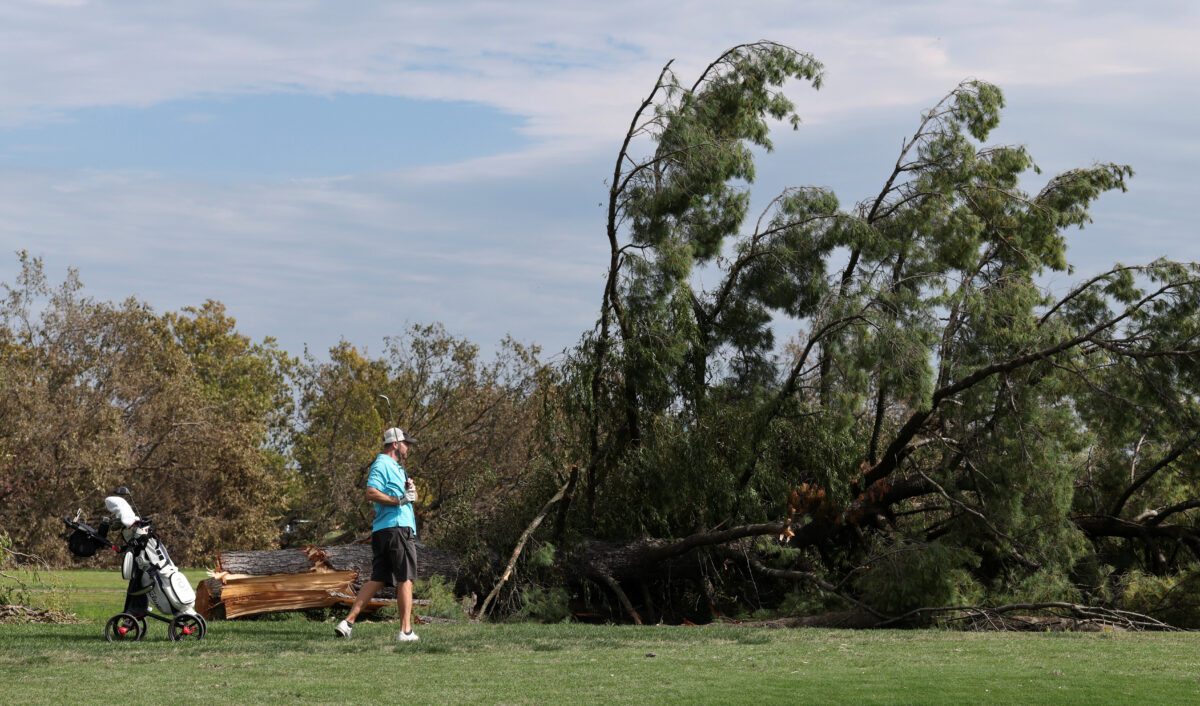
    Images taken at the course earlier this week show trunks and branches strewn out across fairways.

    But satellite imagery affords a broader look at exactly what sections of the course have been impacted.

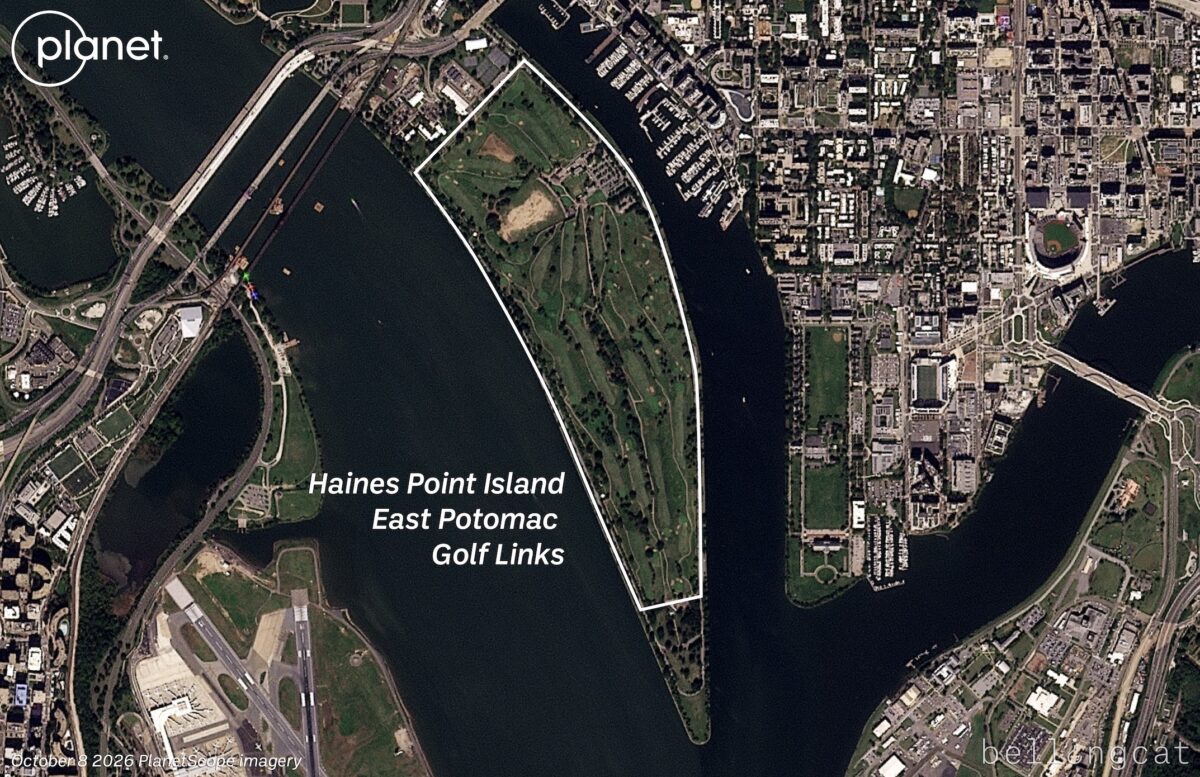
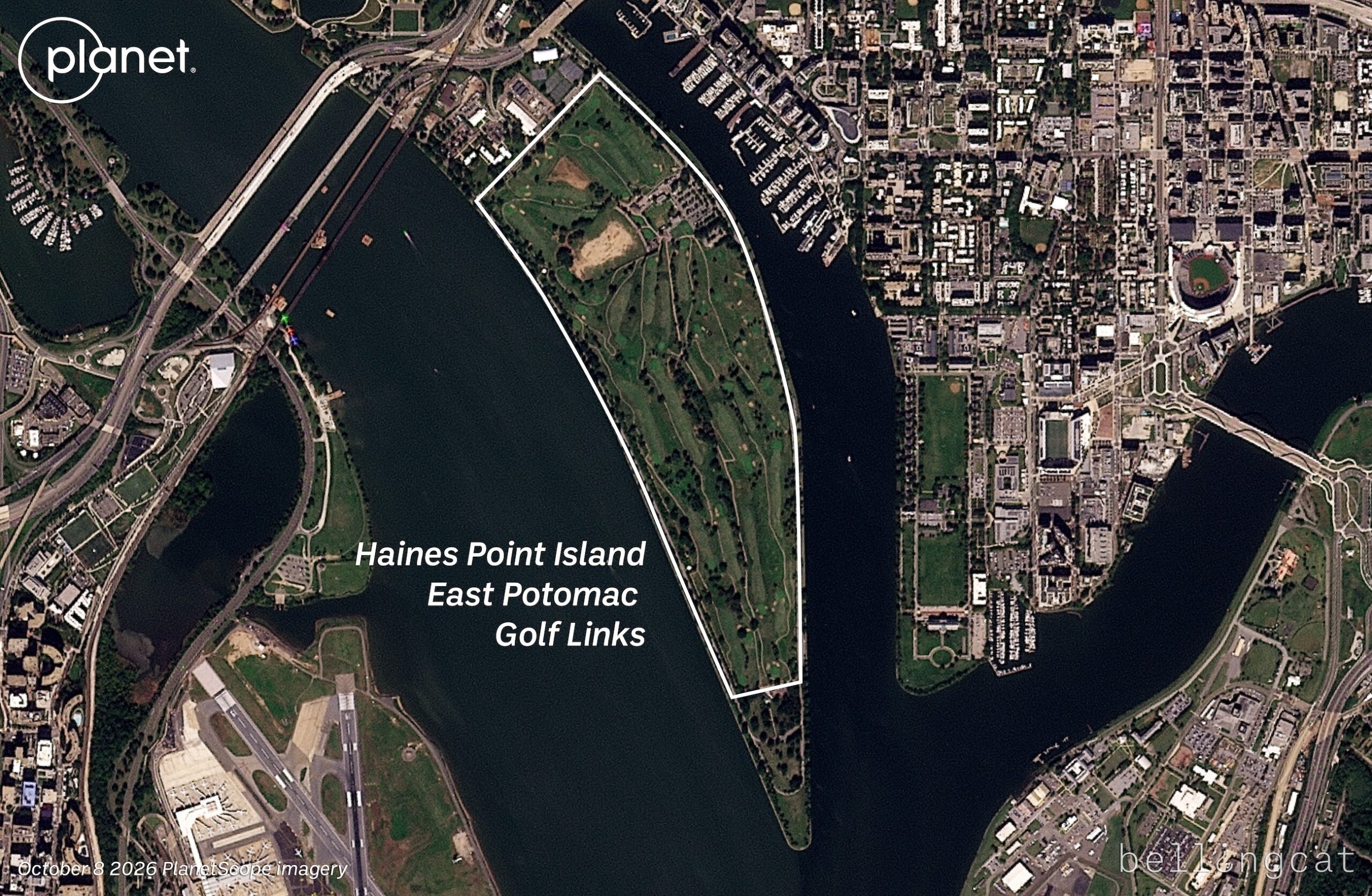
    The Image below from Planet Labs taken on October 8 shows the golf course before the tree-felling was carried out.

    A satellite image from Planet Labs PBC shows the East Potomac Golf Links on October 8.
    A satellite image from Planet Labs PBC shows the East Potomac Golf Links on October 8. Larger version visible here.

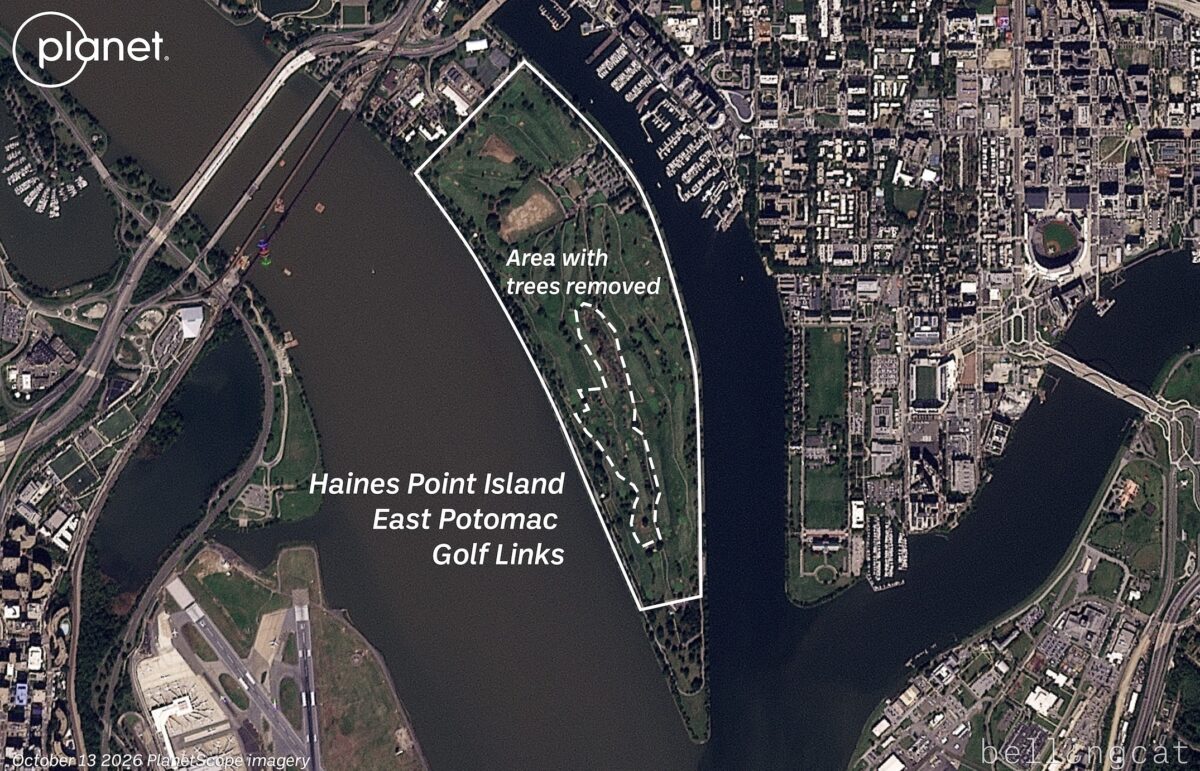
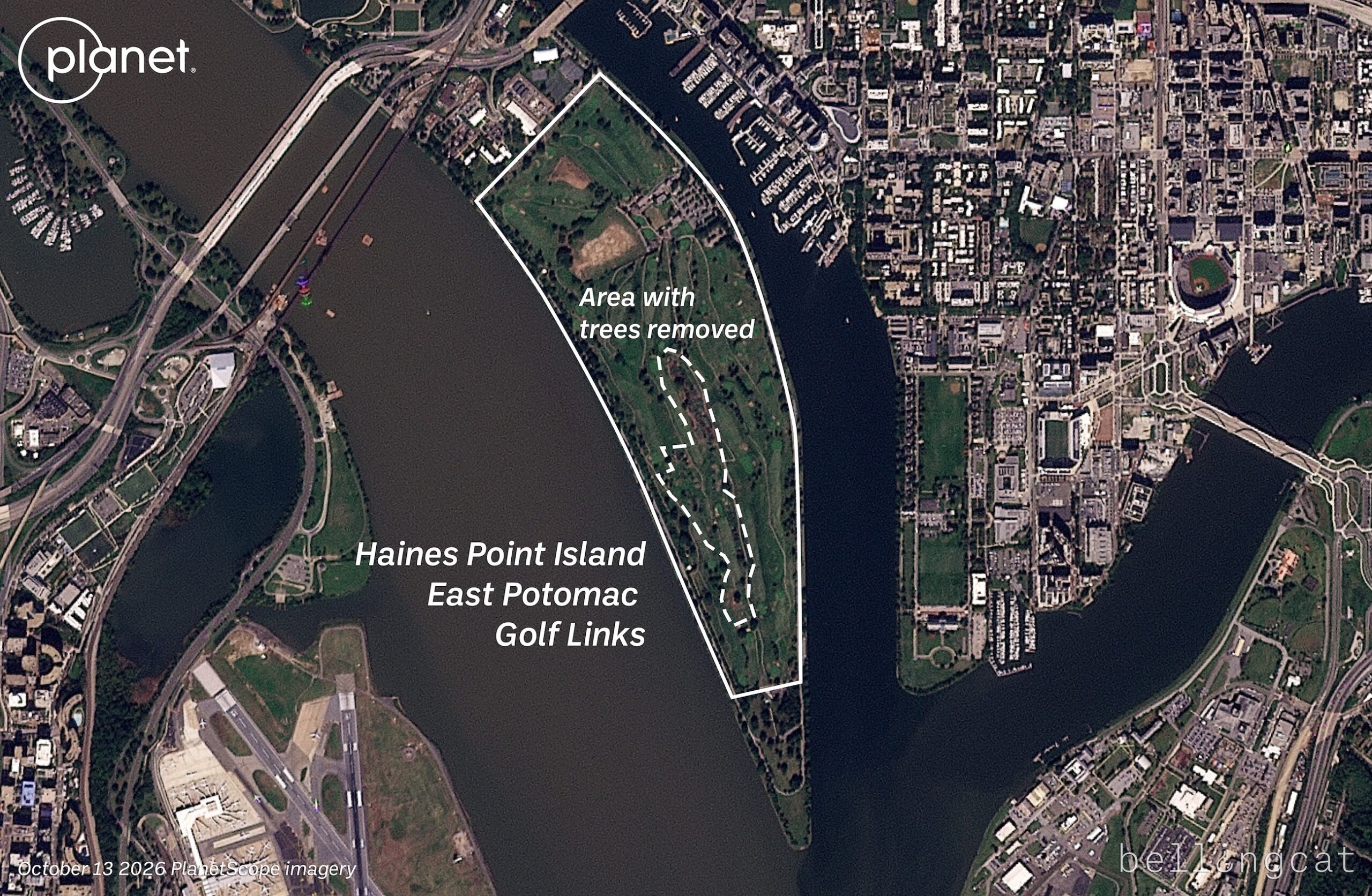
    Planet Labs imagery captured on Oct. 13 shows large barren sections towards the south and west of the course, where trees were removed.

    A satellite image from Planet Labs PBC shows the East Potomac Golf Links on October 13. Larger version visible here
    A satellite image from Planet Labs PBC shows the East Potomac Golf Links on October 13. Larger version visible here.

    A before and after slider allows for easy comparison of the Oct. 8 and Oct.13 images.

    Support Bellingcat

    Your donations directly contribute to our ability to publish groundbreaking investigations and uncover wrongdoing around the world.

    Reuters reported that an organisation called The ​DC Preservation League said in a February ​2026 lawsuit that President Donald Trump was flouting ⁠environmental laws to “irreparably destroy a priceless piece of American history” so he could “convert a public recreation space into an exclusive, high-end golf course.”

    Kevin Griess, an NPS official, reportedly stated at Monday’s hearing that tree removal was part of a 2019 plan that predates Trump’s aims for the course and sought to restore links-style vegetation.

    Bellingcat contacted NPS as well as the Department of Justice but did not receive a response before publication.

    A golfer hits toward felled trees at the East Potomac Golf Links. REUTERS/Kevin Lamarque
    A golfer hits toward felled trees at the East Potomac Golf Links. REUTERS/Kevin Lamarque

    The changes to the golf course are not the only ones President Trump has sought in Washington DC and the surrounding area since the beginning of his second term. In October last year  demolition began on the East Wing of the White House with the aim of building a new ballroom claiming it was “the safest building ever built.”  

    Trump has also proposed a 250-foot-tall “Triumphal Arch” to be built just outside the Arlington National Cemetery in Virginia.


    Correction: This article was updated on October 15 to reflect that a judge told the US government not to cut down more than 10 trees before providing notice. The article previously said that no more than 10 trees could be felled without the court’s approval. The headline has also been changed to reflect this.

    Bellingcat is a non-profit and the ability to carry out our work is dependent on the kind support of individual donors. If you would like to support our work, you can do so here. You can also subscribe to our Newsletter and follow us on Bluesky here, Instagram here, Reddit here and YouTube here.

    Source: Bellingcat · 2026-10-15

  • Groups Associated With India’s Far-Right Receive Millions Through US Donor-Advised Funds

    Groups Associated With India’s Far-Right Receive Millions Through US Donor-Advised Funds

    Sign up here to receive Bellingcat’s biggest investigations by email as soon as they are published.

    US non-profits whose founding leaders or organisations have been associated with India’s controversial Rashtriya Swayamsevak Sangh (RSS) – or initiatives the Hindu nationalist group has endorsed – received millions of dollars over recent years through grants that allow donors to remain anonymous, a Bellingcat analysis has found. 

    The right-wing and Hindu nationalist volunteer organisation is widely considered the ideological parent of India’s ruling Bharatiya Janata Party (BJP). Prime Minister Narendra Modi, a former RSS worker, is one of its most famous supporters. 

    But the RSS’ vision of India as a Hindu nation is controversial both at home and abroad: it was previously banned in India three times, and a bipartisan US commission on religious freedom recently called for the US government to sanction the group “for their responsibility and tolerance of severe violations of religious freedom”. Almost a hundred US politicians, both Democratic and Republican, recently pledged not to take funding from RSS-linked entities. 

    India’s far-right Hindu nationalist volunteer group RSS remains an unregistered entity in India. Source: Prabhat Kumar Verma/ZUMA Press Wire via Reuters Connect

    While there have been efforts to map out RSS-related entities, it can be challenging to establish concrete links between the organisations because the RSS remains an unregistered entity in India and has no formal membership, maintaining that it is a “body of individuals” with shared ideological views.

    “The RSS functions without independent oversight of its resources, finances, influence, and activities,” said Dr Angana P Chatterji, an anthropologist and scholar of South Asia studies at the University of California, Berkeley. “This is not proportional to the vast power, reach, and influence it possesses. Its leadership and cadre are protected from accountability and scrutiny,” she added.

    The RSS had not responded to multiple requests for comment, as of publication.

    Bellingcat identified two US-registered non-profits that appeared to have past and present ties to the RSS, or organisations associated with them, based on the non-profits’ or RSS websites and publications, as well as statements by the non-profits’ founders and spokespeople. The non-profits were the Ekal Vidyalaya Foundation of USA Inc (Ekal USA) and Sewa International Inc (referred to as Sewa USA). 

    We looked at all Form 990s – tax returns that US non-profit organisations are required to file annually – listing Ekal USA and Sewa USA as grant recipients, as well as the Form 990s of the charities themselves, from 2020 to 2024. As of September, the latest available Form 990s for Sewa USA were for the fiscal year ending December 2024, while Ekal USA also filed a form for the fiscal year ending December 2025, which was excluded for consistency, although the same pattern was observed during this period.

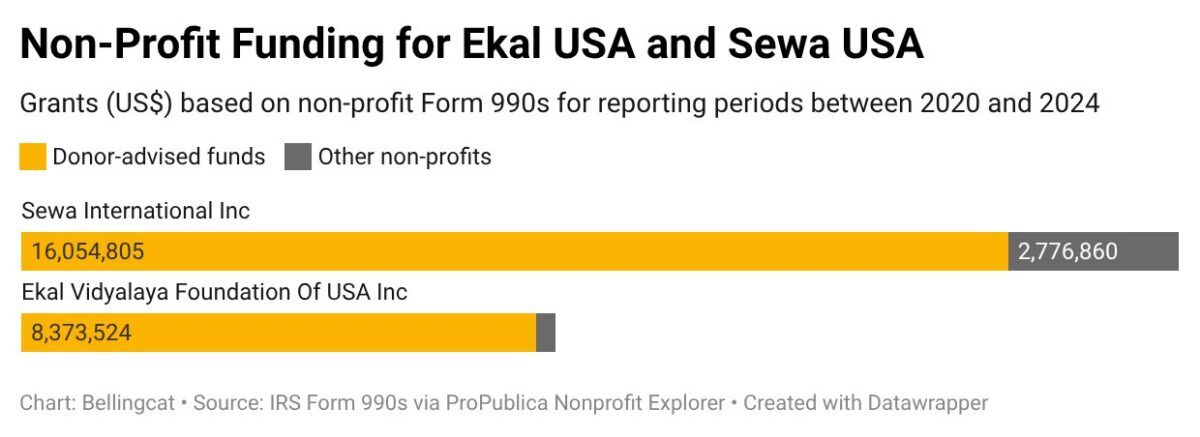
    This analysis showed that the charities received at least US$24.4 million from 34 organisations that manage donor-advised funds (DAFs), or 20.7 percent of the total $117.8 million they reported receiving in contributions and grants during this period. 

    The actual amount from DAFs may be higher, as we excluded filings that covered partial years outside of this period – for example, June 2019 to June 2020. The filings from the two charities we identified were based on the calendar year.

    The Form 990s also revealed that the vast majority of the money spent by these two charities on grants to other organisations or individuals was in India or the South Asia region rather than in the US: Ekal USA donated $33.7 million in foreign grants – all of which went towards the Ekal Vidyalaya project in India according to its filings –  and none in domestic grants in the five years from 2020 to 2024, while Sewa USA reported $29.7 million in foreign grants and $622,613 in domestic grants during the same period. 

    Support Bellingcat

    Your donations directly contribute to our ability to publish groundbreaking investigations and uncover wrongdoing around the world.

    DAFs are common vehicles for people in the US who want to make donations to charitable causes while receiving tax relief or benefits. Donors do not control the money once they donate it but can advise on which charities the money eventually ends up at.

    These funds are legally maintained and operated by non-profit sponsoring organisations. As public charities, DAF sponsor organisations detail the amounts and recipients of grants that they make on behalf of their donors in their Form 990s. However, they do not disclose who their donors are, and donors can choose to remain anonymous. (Note: Bellingcat US receives grants from donor-advised funds, and some grants do not disclose the name of the grant recommender. However, many of our donors are listed on our funding page.)

    There are many more organisations reportedly linked to the RSS that are not included in this analysis, but we focused on these two because of the large amounts of grants they received through DAFs, with the original sources of the funds untraceable from public information, as well as evidence pointing to both historical and current connections between them and the RSS or organisations associated with the RSS. 

    It is worth noting that some of the evidence we found pointing towards a connection between the two charities and the RSS or organisations associated with the RSS was from before or after the period we analysed (2020 to 2024). There is no evidence that DAF grants funded the RSS, only that they went to organisations that appear to have connections with the RSS. Experts told us that DAF grants undergo less regulatory scrutiny than other charitable donations and that DAF sponsor organisations have discretion over whether to restrict or permit donations to certain recipients.

    Ekal USA

    Houston, Texas-based Ekal USA is a non-profit that describes its mission in its Form 990s as “to provide free elementary education and free primary healthcare to children in remote and rural India”. The USA branch of Ekal Vidyalaya, according to its website, was founded in 2001 as part of efforts to “reach out to the global diaspora” in order to achieve a goal to “expand the reach of Ekal to 100,000 villages”. 

    RSS chief Mohan Bhagwat has appeared at multiple Ekal Vidyalaya events in India promoting the initiative over the years, as far back as 2014 and most recently in May.

    Ekal USA was started in the late 1990s as a programme of the Vishwa Hindu Parishad of America (VHPA), or World Hindu Council of America, VHPA spokesperson Shyam Tiwari told Bellingcat in an email response. He added that it was set up as an independent organisation in early 2000. According to VHPA’s website, Ekal USA was established in 2002.

    VHPA is based in the US, while the similarly named Vishwa Hindu Parishad (VHP) is in India. VHP lists VHPA in the “Hindus Abroad” section of its website. A 2017 article from VHPA’s magazine states that late founder Mahesh Mehta was trained by the RSS since he was 10 years old, and that the VHPA was born after Mehta was advised by the former supreme leader of the RSS to “build VHP in USA”. The national spokesperson of VHP in India, Vinod Bansal, said that it is an independent organisation that “sometimes shares ideology” with VHPA.

    RSS’ website states that VHP was launched to organise Hindus and “reconvert all those who had been knowingly or unknowingly proselytised to alien faiths and are now desirous of coming back to the Hindu fold”. Bansal referred to VHP as an “independent part of the RSS” and an “ideological brother”. 

    Ekal USA Chairman-Advisor Subhash Gupta wrote in an Ekal USA publication this year that in the ‘80s and ‘90s, he was “president of the VHP’s Houston chapter” and “often received many high-profile guests from RSS and VHP”.

    Related articles by Bellingcat

    How Four Hindu Nationalist Websites Make Their Money

    How Four Hindu Nationalist Websites Make Their Money

    Gupta did not respond to requests for comment as of publication.

    From 2020 to 2024, Ekal USA reported receiving more than $48.4 million in contributions and grants. Of this amount, at least $8.3 million was from DAF grants, based on Form 990s that listed Ekal USA as a grantee. 

    According to Ekal USA’s Form 990s, it transferred $33.7 million in foreign grants during this period and none in domestic grants for organisations or individuals. The forms also show that all the foreign grant money went towards building Ekal Vidyalaya schools in India. The rest of its expenses involved operational costs such as staff salaries.

    The Ekal Vidyalaya movement has been criticised over reports that allege the schools are used to indoctrinate millions of India’s poorest and most vulnerable children and women with Hindu nationalist ideology, including that Muslims and Christians are “enemies of Hinduism”. Ekal Vidyalaya in India did not respond to multiple requests for comment.

    Ekal USA did not respond to Bellingcat’s questions about these reports or any relationship it may have with the RSS. However, on its FAQ page, the group states that it does not teach religion in its schools and “does not discriminate based on caste, religious affiliation or linguistic affiliations”.

    Sewa USA

    Sewa USA, also based in Houston, describes itself as a “Hindu faith-based, humanitarian, nonprofit service organisation” and is listed under the heading of “Sewa Movement” on the website of India-based charity group Sewa International. 

    Sewa USA Vice President of Public Affairs Rakhi Israni told Bellingcat over email that the organisation “does not operate as a branch or affiliate of the RSS” or participate in political activity. 

    But multiple pages on the organisation’s website appear to indicate a connection between the non-profit and the RSS. In 2022, Sewa USA reposted an article on its website referring to Sewa International as “the US-based charitable non-profit organisation with links to the Rashtriya Swayamsevak Sangh (RSS)”. In a press release about the death of its founding member Ved Prakash Nanda in 2023, it noted that Nanda was “immersed in the ideals of the [RSS]”. And two different blog posts from 2021 and 2024 on Sewa USA’s website had volunteers citing RSS-led activities as the starting point for their involvement.

    In addition, Sewa USA has also posted multiple times on social media and its website about an India-based organisation – Sewa Bharati – that appears to have the support of the RSS. 

    Sewa USA referred to Sewa Bharati as a “sister organisation” in an X post in 2014, and its regional chapter in Purvanchal as a “partner organisation” in a Facebook post in 2022.

    On its website, Sewa USA said in a post that volunteers from its “partner organisations in India” had participated in rescue operations related to the 2023 train accident in Odisha, and listed several initiatives by Sewa Bharati in India. It also launched a fundraiser for families affected by floods in Maharashtra in September 2025, which mentioned that over 100 Sewa Bharati volunteers were already on the ground clearing debris and assisting communities. 

    “Foreign grants awarded to partner agencies in India, including service-oriented NGOs like Sewa Bharati, are strictly project-based, fully audited, and evaluated based on measurable humanitarian impact in education, health, and disaster relief,” Israni told Bellingcat.

    RSS’ website links directly to the main website of Sewa Bharati through a tab on its main navigation bar labelled “Sewa”, and Sewa Bharati is mentioned in RSS’ 2016 annual report under the heading “Seva Vibhag”, a Sanskrit term for “service department”. 

    A blog post on Sewa Bharati’s website from December 2024 about an event the group organised described Indian Defence Minister Rajnath Singh as highlighting the role of RSS leaders in establishing Sewa Bharati in his address and noting that “RSS not only builds the nation but also the individual”. RSS Joint General Secretary Alok Kumar also spoke at the Sewa Bharati event, according to the blog post. 

    In response to Bellingcat’s queries, Israni said that Sewa USA had “no role in Sewa Bharati’s governance or operations”. Sewa Bharati did not respond to multiple requests for comment as of publication.

    Sewa USA received almost $69.4 million in contributions and grants from 2020 to 2024, according to its Form 990s. Filings listing Sewa USA as a grantee show that at least $16 million was from DAFs. In its expenditure statements, Sewa USA reported giving $29.7 million in foreign grants to groups in South Asia during this period and about $622,613 in grants domestically in the US, while the rest of its expenditures included operational costs such as salaries and travel. It is not specified in the forms how much funding, if any, Sewa USA transferred to Sewa Bharati during this period, and Sewa USA did not respond to questions about any amounts transferred as of publication. 

    ‘Cause-Neutral’ Funding

    Experts told Bellingcat that there was less regulatory scrutiny of grants distributed through DAFs than some other types of charitable donations.

    “For donor-advised funds, there’s actually less oversight by the IRS because donor-advised funds are considered public charities rather than private foundations,” said Samuel Brunson, a law professor at Loyola University Chicago.

    “If a private foundation were giving money to organisations in India, that would be a little bit trickier. But if it’s a public charity … there’s not really a ton of oversight on that as long as the money that the US tax-exempt organisation is giving meets its charitable purpose.”

    Lloyd Hitoshi Mayer, a law professor at the University of Notre Dame who specialises in non-profits, said that it was “irrebuttably presumed” that funds granted to US organisations with the non-profit 501(c)(3) tax status were being used for good charitable purposes.

    “The existing federal tax laws related to donor-advised funds put some restrictions on what grants donor-advised fund sponsor organisations, which actually control the funds, can make. But the big exception is that Congress said, ‘If you make a grant to a Section 501(c)(3) charity, you’re good.’ You don’t have to do any additional oversight.”

    Some DAF sponsor organisations have previously faced criticism for granting money to charities that have promoted homophobic, anti-immigrant or anti-Muslim views. Several were also criticised for pausing funding to the Southern Poverty Law Centre earlier this year, although this case demonstrated how DAFs can prevent funds from going to some groups recommended by donors, if the DAFs deem them unsuitable. 

    Brunson told Bellingcat that DAF sponsor organisations “absolutely have the right and ability” to halt processing donations to certain organisations. “Whether we want them to do that or not is a separate question,” he said. 

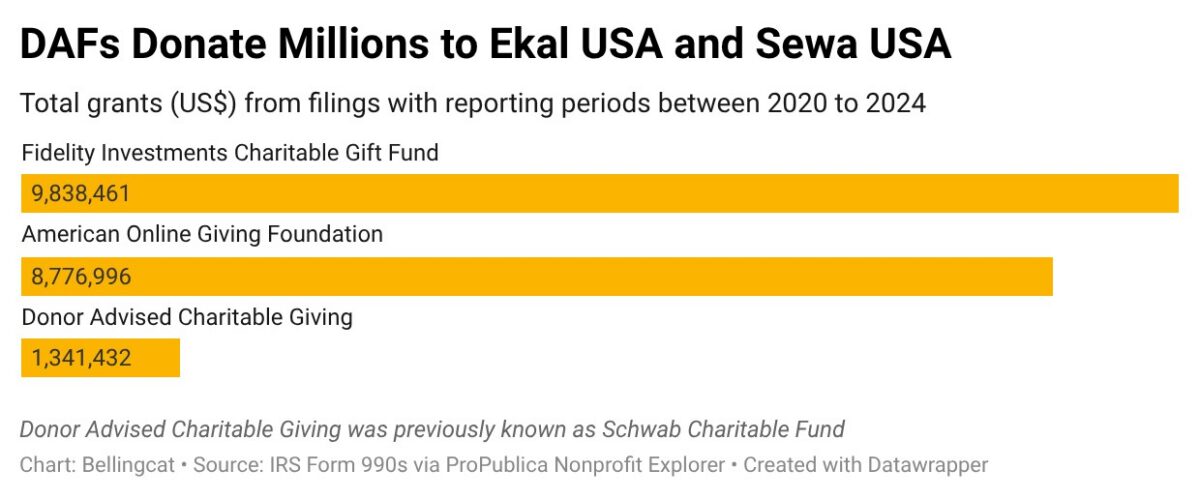
    Bellingcat reached out to the top three DAF sponsor organisations that donated to the two non-profits we identified – Fidelity Investments Charitable Gift Fund (Fidelity Charitable), American Online Giving Foundation (AOGF) and Charles Schwab-affiliated Donor Advised Charitable Giving (DAFgiving360; known before 2024 as Schwab Charitable) – to ask about their internal policies on assessing charities receiving donations through their funds. In total, the three DAFs accounted for almost $20 million, or 81.7 percent, of the DAF grants to Ekal USA and Sewa International for full reporting years between 2020 and 2024. 

    Fidelity Charitable, AOGF and DAFgiving360 all told Bellingcat that they had due diligence processes in place when evaluating non-profits. 

    Fidelity Charitable’s website states that it is a “cause-neutral” charity, but it ensures grants are used solely for charitable purposes. AOGF said non-profits must comply with eligibility requirements regarding hate speech, discrimination and the use of funds. 

    Meanwhile, DAFgiving360 said that a grant recipient may be subject to monitoring or placed under temporary suspension “due to circumstances that DAFgiving360 deems appropriate”, such as if there is a public interest consideration or if the recipient does not further DAFgiving360’s mission.


    Bellingcat is a non-profit and the ability to carry out our work is dependent on the kind support of individual donors. If you would like to support our work, you can do so here. You can also subscribe to our Newsletter and follow us on Bluesky here, Instagram here, Reddit here and YouTube here.

    Source: Bellingcat · 2026-10-06