Tag: Meta

  • Senators Demand Meta Answer for ‘Pervert Glasses’ Following 404 Media Investigation

    Senators Demand Meta Answer for ‘Pervert Glasses’ Following 404 Media Investigation


    Senators Demand Meta Answer for 'Pervert Glasses' Following 404 Media Investigation

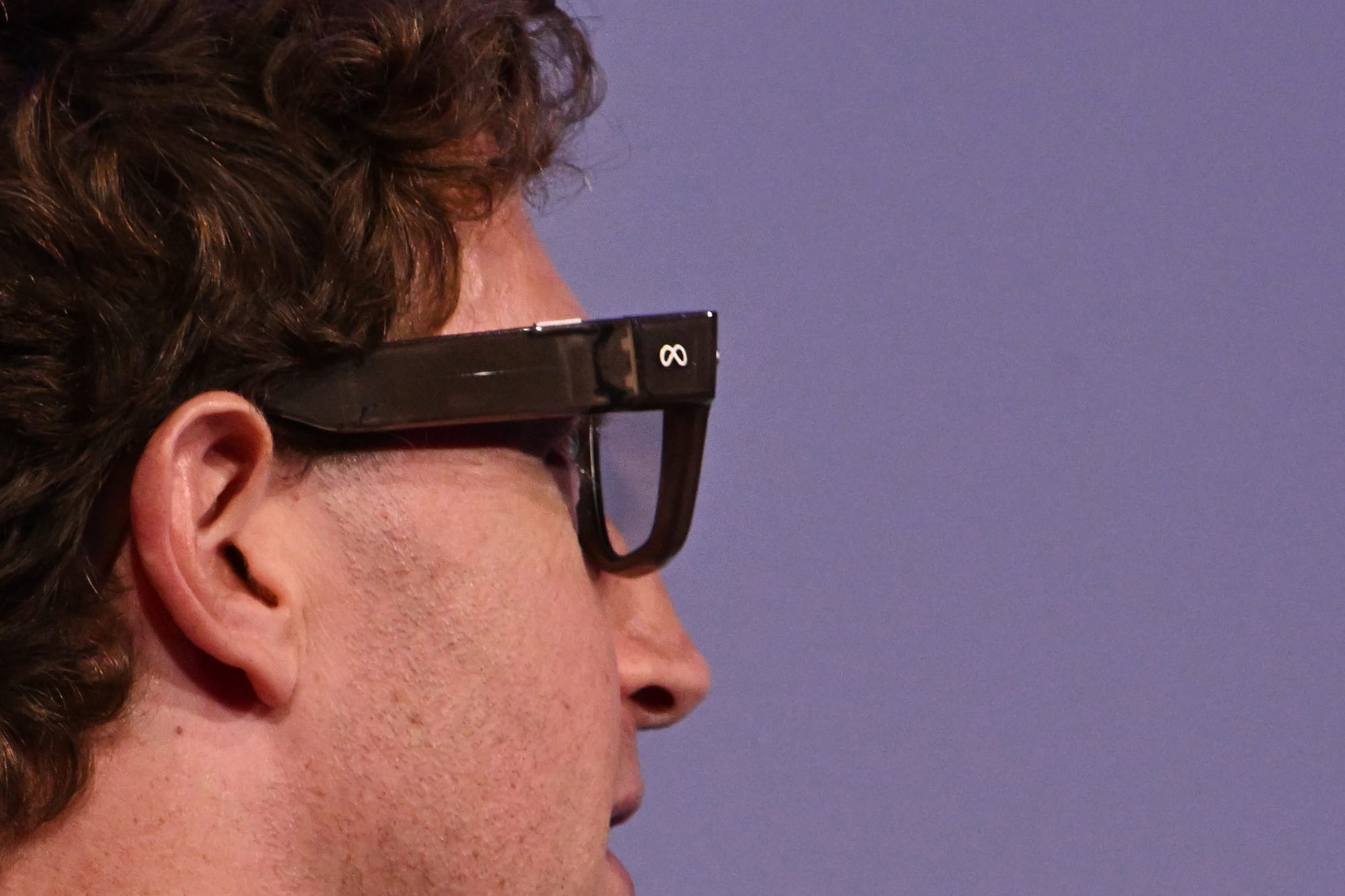
    Oregon Senator Ron Wyden and Massachusetts Senator Edward Markey sent a letter to Meta on Wednesday demanding the company answer for the privacy concerns its smart glasses pose to the public. 

    The letter cites 404 Media’s October 2025 investigation into how people use Meta’s smart glasses to harass massage parlor workers. That investigation found Instagram accounts with hundreds of thousands of followers and millions of views uploaded videos filmed with Meta’s Ray-Ban glasses, where men entered massage parlors across the country and solicited the workers for sex work. The full letter is here. 

    “Meta’s own disclosures confirm that imagery processed through its glasses’ visual AI features may be retained and used to train AI systems, including with the assistance of human reviewers,” the letter says. “Using intimate imagery for AI development is itself an invasion of privacy when the people depicted have not consented to that use, as is inherently the case for most bystanders captured by Meta’s glasses. Retaining that material for AI development, thereby extending the period during which it can be accessed, disclosed, or misused, exploits people’s highly sensitive information for Meta’s commercial benefit.”

    Researchers Show How Meta’s ‘Pervert Glasses’ Are Used to Harass Women

    A new study shows how pickup artist influencers use smart glasses to create content, and the connection between covert recording and harm.

    Research published in August revealed how Meta’s platforms encourage an ecosystem of abusive, harassing content from pickup artists and influencers who use Meta’s smart glasses to capture interactions with people minding their own business in public or at their workplaces, who might not even know they’re being filmed. In a January report by the BBC, a woman who was recorded with the glasses said she was “bombarded” with phone calls because her phone number was posted with the video, and men who had seen the video stalked her at work.

    Earlier this year, more than 70 people sued Meta, claiming that their intimate images and videos were exposed to workers hired by the company to label the data for AI. In March, Swedish journalists reported that Kenyan data labelers were viewing and annotating uncensored footage from Meta’s smart glasses, including sexual and violent content; Meta ended its contract with those workers less than two months later. These are labor conditions that groups like the Data Labelers Association in Kenya are fighting back against, and for the people whose images are in the videos and photos, it’s an obvious violation of their privacy. People have also been modding these glasses to disable the light that indicates they’re recording for years 

    Meta has played dumb about the difference between AI glasses you wear on your face and an iPhone for a long time. Now, these senators want the tech giant to answer for themselves. In the letter, Wyden and Markey demand answers about what safeguards, if any, Meta has in place to prevent the nonconsensual “capture, disclosure, or processing of sensitive and intimate imagery,” whether Meta specifically evaluated the potential for its glasses “to facilitate voyeurism, nonconsensual intimate image capture, or similar privacy invasions,” what imagery it uses for AI training, and whether people can request their biometric and other data captured by its glasses be deleted, along with several more questions about the glasses’ safety and design.

    “The reported disclosure of intimate footage to contractors for the purpose of AI training is particularly disturbing. Human review to fulfill a service knowingly requested by the person depicted is one thing; exposing unsuspecting individuals’ intimate moments to strangers for AI training is quite another,” Wyden and Markey wrote. “The individuals whose naked bodies, sexual activity, and other private moments have reportedly been captured by Meta glasses did not knowingly agree to having those images shared with strangers, much less for the purpose of improving Meta’s commercial AI systems. That disclosure and processing is an invasion of privacy, regardless of whether the footage is subsequently published or misused.” 

    💡
    Do you know anything else about harassment and Meta’s smart glasses? I would love to hear from you. Using a non-work device, you can message me securely on Signal at sam.404. Otherwise, send me an email at sam@404media.co.

    In the last few weeks, Meta has come under fire for quietly changing its privacy policies for business accounts and granting itself permission to scrape user’s content and connected websites to develop its AI products. 

    Meta has been pushing its smart glasses over the years with ads featuring A-list celebrities, including Chris Pratt, Chris Hemsworth, and Kris Jenner (all three in a 2025 Superbowl ad), Doja Cat, Jennie Kim from K-pop group BLACKPINK, and most recently, Kylie Jenner. Guerrilla ad makers have countered with their own anti-AI glasses ads around the world, and people have started calling the smart glasses “pervert glasses” in response to these widespread invasions of privacy they’ve come to represent. In August, Meta filed a patent to add facial recognition and highlight reel features to its smart glasses.  

    Source: 404 Media · 2026-10-29
  • If You’re In the UK or EU, Here’s How to Object to Meta’s AI Training

    If You’re In the UK or EU, Here’s How to Object to Meta’s AI Training


    If You're In the UK or EU, Here's How to Object to Meta's AI Training

    Earlier this month, Meta updated its commercial terms of use for business accounts to allow it to “use any content from such domains, web pages, or URLs to provide, develop, improve, research, train, and maintain the integrity of” Meta’s products. 

    Many artists and small business owners that rely on Instagram and Facebook are livid at Meta granting itself permission to use their content, including from websites simply connected to their Meta accounts, to train AI. But for users in the United Kingdom and European Union, for now, there’s a way to object.

    Meta buried this change in its Commercial Terms, and Nieman Lab first reported on the change. The update was originally set to go into effect on October 30, but following backlash, Meta changed the effective date to November 20. Adding to the confusion, Meta then removed the word “train” from a list of allowed use cases, Nieman Lab reported, and limited those uses to “advertising and business products,” where previously it said that data would be used for all Meta products. Those terms still allow Meta plenty of leeway for scraping users’ data to develop its products, however.

    EU users’ personal data rights are governed by the General Data Protection Regulation and the AI Act. GDPR, which became enforceable in 2018, requires explicit consent to use personal data. This includes the right to object to one’s data being used. The AI Act, which went into effect in 2024, dictates how AI companies can use personal data, and how people can opt in or out, stating that they can withdraw consent at any time. The UK has its own version of the GDPR. The European Commission states: “The GDPR rules only apply to personal data about individuals; they do not govern data about companies or any other legal entities. However, information in relation to companies may constitute personal data where it allows the identification of a natural person.” 

    Several users based in the UK and EU have explained how to object on Instagram. Instagram user bookish.sil posted a walkthrough of how they did it on mobile: by clicking the three lines on their account, going to the privacy center, and clicking “object,” which goes to a form that asks users to write why they are objecting to their data being used. They received an email from Meta saying their objection was approved. Instagram user jenniqueart posted a similar walkthrough with the same results. 

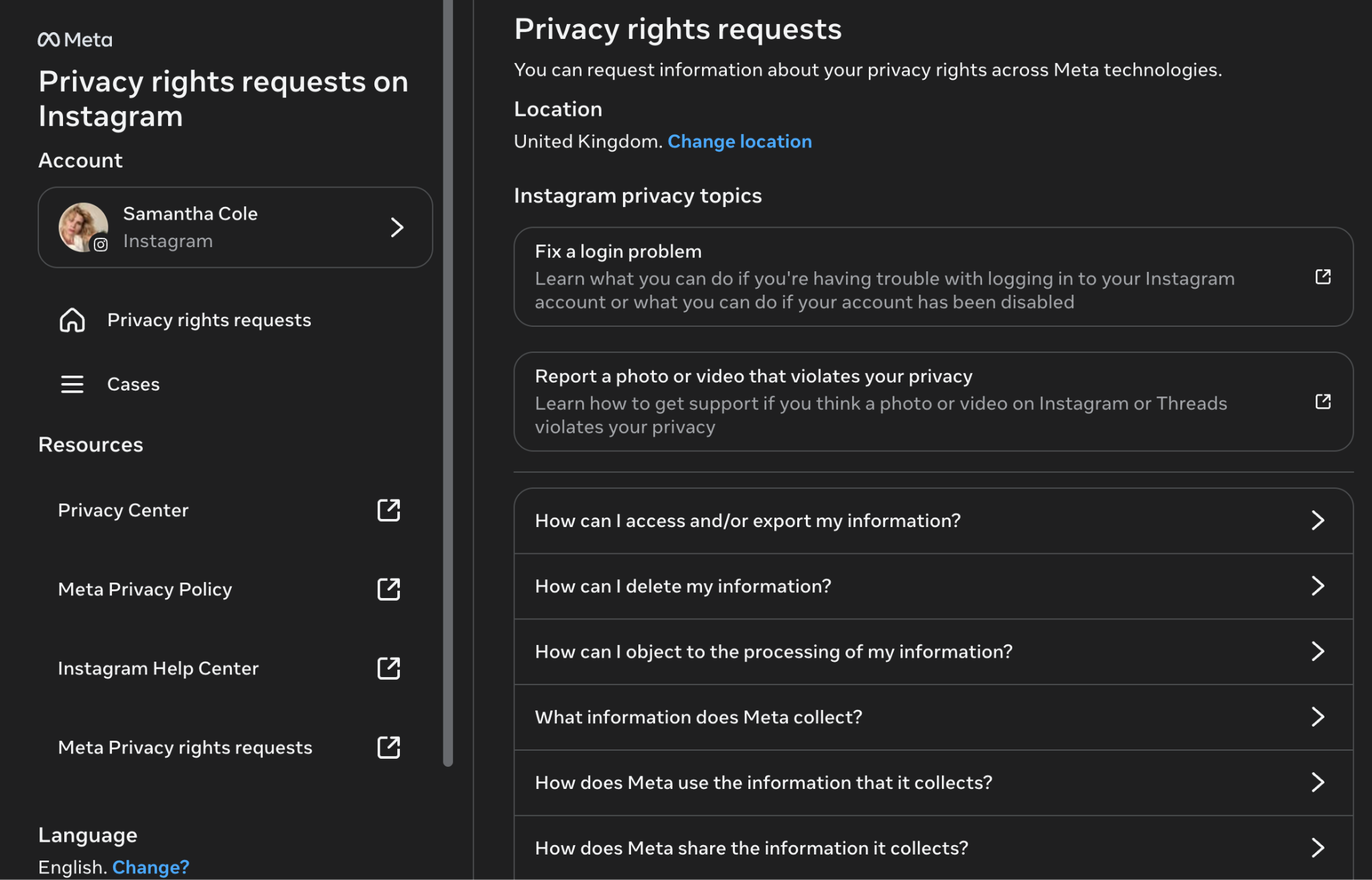
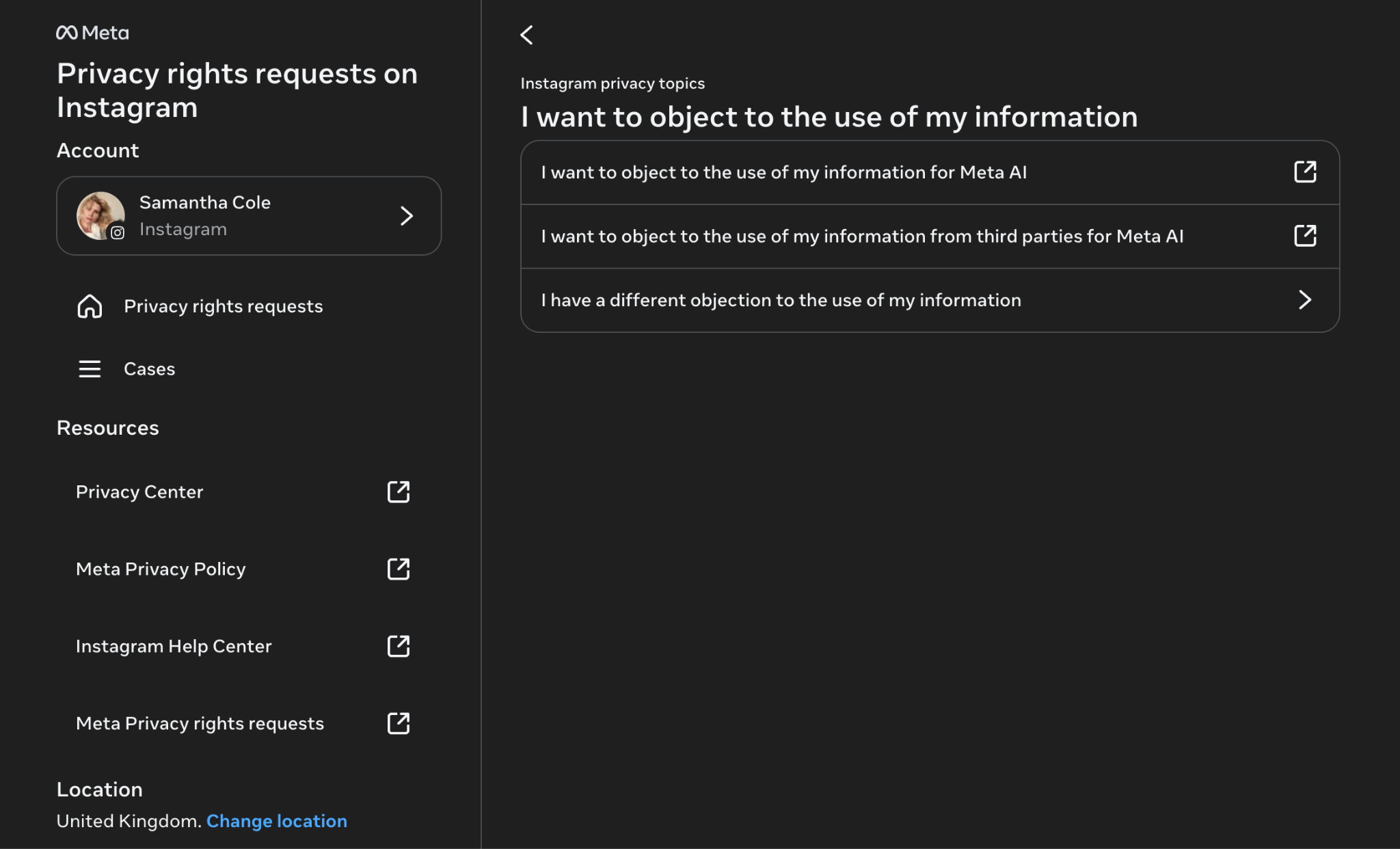
    My Meta accounts are based in the US, but using a VPN to locate my IP address in London, I could see options in my Meta privacy settings that would let me object to the use of my information by Meta AI. To get there on desktop with a VPN on, I went to my account privacy center, clicked “Submit a privacy rights request” at the bottom, selected Instagram, clicked “How can I object to the processing of my information?” and got to a page where I could choose to object to the use of my information for Meta AI or third parties, which were two separate options.

    If You're In the UK or EU, Here's How to Object to Meta's AI Training
    If You're In the UK or EU, Here's How to Object to Meta's AI Training

    When my location is based in the US, these options don’t appear.

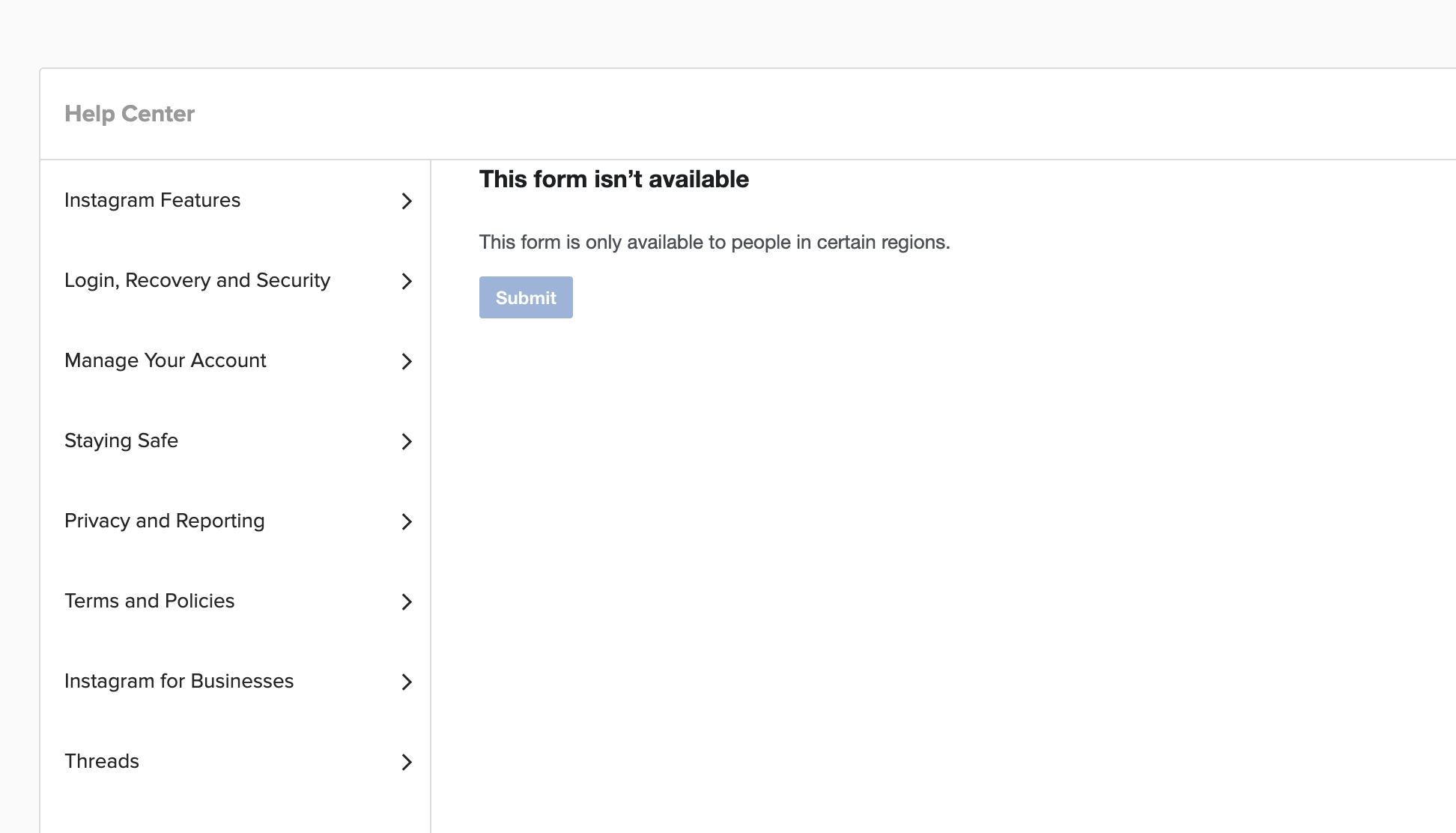
    When I clicked through the option to “object to the use of my information for Meta AI,” however, it returned an error page that said “This form is only available to people in certain regions.” GDPR is meant to apply to wherever someone is located at the time, but since this objection applies to the preferences of one account, it might be based on where the account was created. I tried again located in Belgium and got the same results. I’ve asked Meta to clarify. 

    If You're In the UK or EU, Here's How to Object to Meta's AI Training

    As many have already pointed out in the comments on UK and EU users who’ve posted walkthroughs, these objection steps aren’t available to people outside of those countries, and as Meta continuously changes its platform, these steps might not work for everyone always. Unless something changes before November 20, the rest of us are screwed.

    Source: 404 Media · 2026-10-28

  • Facebook’s misleading privacy claims land Meta a $25 billion penalty

    Facebook’s Cambridge Analytica scandal may feel like very old news. But the consequences are still arriving, and the latest comes with a $25 billion price tag.

    Reuters reports that a New Mexico judge has ordered Meta to pay $25 billion in civil penalties after a jury found that Facebook misled consumers about its data practices and its handling of hate speech and misinformation. Meta says it expects to win on appeal.

    This case is about more than information ending up in the wrong hands. It concerns what Facebook told people about who could access their information, how much control users had, and how the company enforced its own rules.

    What Facebook told its users

    In September, jurors found that the company and its leadership made 26 misleading statements on data privacy, hate speech, and other subjects. For example, Mark Zuckerberg’s 2010 statement that:

    “We do not share your personal information with people or services you don’t want.”

    That assurance appeared in a statement the jury found misleading. The judge found that choosing who could see a Facebook post did not necessarily control what outside app developers could access. That access was governed by separate settings that many users did not know existed.

    New Mexico’s attorney general filed the lawsuit in 2021, following revelations that Cambridge Analytica obtained personal information from as many as 87 million Facebook users through a third-party app.

    But New Mexico’s case went beyond Cambridge Analytica.

    The state challenged Facebook’s representations to consumers about its data practices and its efforts to address misinformation and hate speech. The case centered on misleading consumers under New Mexico’s Unfair Practices Act, the state’s consumer protection law.

    The state argued that third parties had broad access to users’ information and that Facebook tolerated harmful content when doing so benefited its business. Meta disputed the allegations, denied selling users’ information, and said the state had taken statements out of context.

    New Mexico’s Department of Justice says the jury found 43,899,725 violations of state law. That does not mean nearly 44 million individual New Mexicans had their data taken. The count reflected the estimated audience for each misleading statement, rather than the number of individual people affected.

    State law allows penalties of up to $5,000 per violation. Judge Francis Mathew found that a penalty exceeding $219 billion was warranted under the law but reduced the amount to $25 billion.

    The judge said earlier penalties had failed to stop Meta from misleading consumers, including a $5 billion FTC penalty in 2019.

    The money is not earmarked for compensation payments to individual Facebook users. According to Attorney General Raúl Torrez, state law directs the penalties to New Mexico’s school system.

    Meta’s chief legal officer, C.J. Mahoney, said the company is confident it will prevail on appeal and characterized the lawsuit as an attempt to impose “a tax on speech.” Meta has also argued that a multibillion-dollar penalty risks violating constitutional protections concerning due process and excessive fines.

    How to stay safe on social media

    The case illustrates why privacy is not just a matter of choosing who can see a post. In a separate 2019 case, the Federal Trade Commission (FTC) alleged that Facebook had shared users’ information with third-party apps used by their friends, even when those users had chosen restrictive privacy settings.

    A few precautions can help you limit what you share, although settings alone cannot guarantee privacy:

    • Share selectively. Leave optional profile details blank, limit who can see your posts, and avoid publishing sensitive details such as your address or live location. Ask permission before posting information or photos involving other people.
    • Check app permissions. Does a social media app really need your contacts, precise location, or entire photo library? Turn off unnecessary access in your device settings.
    • Review tracking and advertising settings. Look for controls covering personalized ads, activity outside the platform, and data sharing. Restrict what you can, but don’t assume opting out of personalized ads stops all collection.
    • Be selective about connected apps. Before connecting a quiz, game, or other service to your account, check what information it requests. Decline access that seems excessive for what the service does.
    • Remember what “private” means. Restricting your audience helps control who sees your posts. It does not stop the platform itself from collecting or using information about your activity.

    Scammers don’t need to hack you. They just need you to click once. 

    Malwarebytes Identity Theft Protection catches suspicious activity before it becomes a problem.

    Source: Malwarebytes Labs · 2026-10-22