Day: October 22, 2026

  • Preparing for 2027: Five Trends Shaping Enterprise Threat Intelligence

    In the first half of 2026, Flashpoint tracked more than 22 million threat actor posts discussing, sharing, or advertising AI toolkits for criminal deployment. The figure reflects AI’s growing presence across the cybercriminal underground, where adversaries are using new capabilities to accelerate attacks and develop malicious tooling with fewer resources.

    For enterprise defenders, these developments are adding pressure to threat intelligence programs already managing high alert volumes, limited analyst capacity, and expanding responsibilities.

    During Flashpoint’s recent webinar, we examined the evolving threat landscape alongside findings from Flashpoint’s Global Threat Intelligence Report: 2026 Midyear Edition and new enterprise threat intelligence research.

    Missed the live webinar? We’ve rounded up the key takeaways below, and the full session is now available to watch on demand.

    AI Is Changing the Economics and Speed of Cybercrime

    AI is helping threat actors develop capabilities and execute attacks faster, reducing the time and expertise required for activities that previously demanded greater resources.

    Several developments illustrate the broader shift in cybercrime economics and attack velocity:

    • Initial access costs have declined by approximately 69%, reflecting the continued commoditization of access to compromised environments.
    • Attackers published 637 malicious package versions in just 22 minutes during a software supply chain compromise.
    • Nearly one in five vulnerabilities disclosed during the first half of this year had public or functional exploit code available, narrowing the window for defenders to address exposed systems.

    AI is primarily accelerating established techniques, particularly during the early stages of the attack chain, including reconnaissance, social engineering, vulnerability discovery, and exploitation.

    For defenders, this creates an opportunity to identify and disrupt malicious activity during its preparation stages. However, it also raises expectations around how quickly intelligence teams can recognize emerging threats, prioritize relevant findings, and act before an attack progresses.

    AI Is Changing How Cybercriminals Develop Tools and Share Knowledge

    AI is also changing how threat actors acquire the skills and capabilities needed to carry out attacks, creating new challenges for intelligence collection.

    Historically, underground communities enabled cybercriminals to collaborate, exchange expertise, and obtain specialized services. Increasingly, threat actors can use AI to troubleshoot code, develop malicious tooling, and learn unfamiliar techniques independently, reducing their reliance on public collaboration.

    “No longer do they need a community to build up their skills like they previously had. So we’ll see less of the development, and what we do see is a finished tool showing up for sale.”

    Ian GrayVP of Intelligence, Flashpoint

    Reduced activity in underground communities does not necessarily mean cybercriminal activity is declining. While forums, encrypted messaging platforms, and other illicit communities remain important intelligence sources, collection strategies must account for changes in how and where adversaries develop and distribute their capabilities.

    Threat Intelligence Teams Are Struggling to Keep Up with Growing Demands

    As adversaries accelerate their operations, enterprise threat intelligence teams are contending with growing workloads and limited resources.

    Independent research commissioned by Flashpoint surveying threat intelligence budget owners and influencers at large North American enterprises identified several leading operational challenges:

    • 65% cited alert noise and false positives.
    • 55% identified analyst bandwidth and effectiveness.
    • 50% pointed to the evolving threat landscape.
    • 50% cited tool integration and interoperability challenges.

    Note: Respondents could select up to three challenges.

    High alert volumes, disconnected systems, and manual investigations consume analyst time that could otherwise be spent addressing emerging threats.

    As one healthcare threat intelligence leader explained:

    “Good analysts take time to develop and train, and we can’t hire our way out of that problem.”

    These challenges are prompting organizations to examine how they can improve existing workflows, reduce repetitive investigations, and make better use of analyst expertise.

    Threat Intelligence Budgets Are Growing, with AI Threats Leading Investment Priorities

    Despite operational pressures, organizations are continuing to invest in threat intelligence.

    Flashpoint’s research found that 50% of respondents expect their threat intelligence budgets to increase over the next 12 months, including 35% anticipating increases of at least 10%. Another 40% expect budgets to remain essentially flat, while 0% anticipate a decrease.

    AI-related threats emerged as the leading priority for expanded intelligence coverage, particularly:

    • Deepfakes and synthetic media, including their use in impersonation, fraud, and social engineering.
    • AI-accelerated vulnerability exploitation, as adversaries identify and exploit weaknesses more quickly.
    • Emerging AI-enabled attack vectors, including changes in threat actor tactics, techniques, and procedures.

    Organizations are also investing in additional intelligence feeds, expanded security use cases, and further development of their intelligence programs.

    These priorities reinforce the importance of translating AI-related threats into specific intelligence requirements aligned with organizational risk.

    Agentic AI Adoption Is Underway, but Trust and Measurable Value Remain Essential

    Alongside investments in AI-related threat coverage, organizations are exploring how agentic AI can improve their own intelligence operations.

    Flashpoint’s research found that:

    • 25% are already using agentic AI in production.
    • 20% are piloting agentic AI or conducting proofs of concept.
    • 35% are planning adoption within the next 12 to 24 months.
    • 20% are taking a wait-and-see approach.

    Early implementations focus primarily on information retrieval, alert prioritization, contextual enrichment, intelligence platform queries, and MITRE ATT&CK mapping.

    Organizations remain more cautious about granting agents autonomy over consequential actions, such as blocking IP addresses or changing security controls.

    One research participant captured the concern:

    “An agent that’s confidently wrong is worse than one that’s slow.”

    Accuracy, data privacy, auditability, predictable costs, and human oversight remain central considerations. Organizations also expect AI investments to demonstrate measurable value through time savings, improved efficiency, and faster response.

    “We’re out of the phase of treating AI as inherently good and giving it a blank check. Now, it’s about figuring out how to make it work within existing teams, workflows, and priority intelligence requirements.”

    Joe Sawyer
    Chief Market Officer, Flashpoint

    Preparing Your Threat Intelligence Strategy for 2027

    As organizations prepare for 2027, four priorities can help guide threat intelligence planning:

    1. Plan for threats you cannot readily observe. Identify potential gaps in intelligence collection and examine emerging attack methods, including weaknesses in internal security processes.
    2. Prepare for machine-speed attacks. Evaluate detection, prioritization, and response capabilities against increasingly compressed attack timelines.
    3. Turn AI threats into actionable intelligence requirements. Map emerging techniques to relevant adversaries, established frameworks, defensive controls, and business risks.
    4. Use agentic AI where it can extend analyst capacity. Prioritize repeatable workflows that deliver measurable value while maintaining appropriate data controls and human oversight.

    Watch 22 Million Reasons to Rethink Your 2027 Threat Intelligence Strategy for a deeper look at the cybercriminal underground, enterprise threat intelligence investment trends, and practical considerations for agentic AI adoption.

    See Flashpoint in Action

    Source: Flashpoint · 2026-10-22

  • I had plans for that second

    I had plans for that second

    I had plans for that second

    Welcome to this week’s edition of the Threat Source newsletter. 

    Here for the latest on the PHP vulnerabilities? Head on down to ‘The One Big Thing’. Talos has published a blog to explain what we know so far, and details the Snort coverage available, including rules in the Community Ruleset. 

    But if you want a bit of levity, here’s what I wrote before everything kicked off yesterday: 

    Ever feel like the world is moving too fast to keep up? Well, I bring you scientific proof that it’s not just you. 

    For millions of years, the moon has been slowing down the Earth’s rotation. But over the past decade, we’ve been speeding up (I KNEW I was aging faster than before). Apparently, changes in the Earth’s core are involved (either that, or the 1978 Superman film was a documentary). 

    This is all causing massive headaches for the people responsible for keeping time. They’re officially called “The International Bureau of Weights and Measures”, but I’m going to call them “The Time-Keepers”. For nerd reasons).  

    The issue is that the atomic clocks that power so many of our systems, and the rotation of our planet, don’t always agree. Atomic clocks keep extremely consistent time, while each Earth day is rarely the same length as the next. Atomic timekeeping absolutely cannot stand that level of flexibility (have a watch of our “The Light We Keep” documentary to see the importance that accurate clocks have on critical infrastructure).  

    To keep Coordinated Universal Time (UTC), which is based on atomic clocks, aligned with Earth’s rotation, we introduced a “leap second” in 1972. This system allows for an extra second to be added, or taken away, when we stray too far from atomic time. 

    A few days ago, The Time-Keepers voted to officially abolish the leap second. Why? Well, there’s a few parts to it. 

    For the past 54 years, we’ve never once had a second removed from our lives. They’ve always been added (27 of them to be precise). I myself have experienced 20 of these extra seconds. If I’d have known that, I’d have used them more wisely. Like thinking before saying, “Love you too!” to the post-person this morning. 

    That added time, while it seems nice to have on the surface, can wreak havoc with our modern technology systems. In 2012, the extra second caused so much confusion that it crashed Reddit, among other systems. 

    The recent speeding-up of the Earth’s rotation complicates things further. If we keep going at this rate, it could result in the world’s first ever “negative second”. If you thought our technology systems struggled with added time, there are a lot of sciency brains who are very worried about the impact of taking time away. One of those concerns being… it’s never been done before.  

    So, what’s The Time-Keeper’s solution? Invent more time! Woooo. 

    Starting next May, the leap second will be replaced with a “leap hour,” allowing UTC to diverge from Earth’s rotation by up to an hour before a correction is made.  None of us will get to experience that extra hour in our lifetimes, but our Great, Great, Great, Great, Great, Great, Great, Great, Great, Great, Great grandchildren are going to have one hell of a party. 

    For us current mortals, we’re all getting a little less time, and we’re hurtling through space a little faster. Happy Thursday! 

    But I guess I do want to make the point that I’m glad the risk has been thoroughly assessed ahead of, ahem, time. The Time-Keepers have decided that the world’s infrastructure should not have to find out how it handles a missing second by collectively experiencing one.  

    And I don’t even want to think about how all the AIs would cope with a negative second… 

    There’s something here for incident response planning. “It’s never happened before” is an excellent reason to test whether you’re ready for it. Run the exercise. Find out which part of your plan depends on something that, in this scenario, is also broken. Preferably before an adversary gets to supervise the practical demonstration. 

    Now, if only the Time-Keepers can abolish Daylight Savings Time next… 

    The one big thing  

    Two unauthenticated remote code execution (RCE) flaws were discovered in PHP, rocking the internet. Dubbed “php2shell” and triggered by a simple HTTP request, this vulnerability affects every build since 5.4. Talos assesses that all industries running PHP applications are at risk for exploitation if systems remain unpatched.

    Why do I care? 

    PHP runs WordPress, Drupal, Magento, Shopware, WooCommerce, and many other ubiquitous internet staples, so the possible blast radius is enormous. Older branches are end of life (EOL) and will not receive patches; these could account for around 50% of use cases.

    So now what? 

    Cisco customers are covered with the Cisco Talos Network Intrusion Prevention (SNORT®) signatures 67359 and 67360. If your organization is running PHP 8.1 or older, Talos very strongly advises immediate update to PHP 8.2 or later. There is no patch for PHP 8.1 or older. See the article for more specific coverage and detection guidance.

    See an interview with Nick Biasini on php2shell defense:

    Top security headlines of the week 

    ‘PHP2Shell’ Bugs Signal Red Alert for Security Industry
    Security teams are scrambling to remediate two critical PHP vulnerabilities following leaked details and reports of exploitation attempts. (Dark Reading)

    INC and The Gentlemen Ransomware Affiliates expose 8,257 AI messages
    SOCRadar has found seven exposed servers linked to INC and The Gentlemen ransomware affiliates, holding AI chats, stolen credentials and 46 encryptor builds. (Hack Read) 

    The AI hacking apocalypse is not inevitable
    While large language models present real risks to society, experts say they can be tested and largely controlled using well-worn cybersecurity and policy choices. (Cyberscoop)

    ‘Context Bombs’ Cut AI Attack Success by Misleading Agents With Fake Targets
    Deceptive prompts lure AI agents into decoys and dead ends, cutting attack success by up to 91% in tests and raising the cost of a successful attack 23-fold.(SecurityWeek) 

    Can’t get enough Talos? 

    Compromised eMudhra intermediate certificates
    Cisco Talos is aware of eight intermediate certificates belonging to the intermediate certificate authority, eMudhra.

    Parasitizing trust: How legitimate infrastructure becomes a delivery pipeline for attackers
    Adversaries are turning the tools businesses trust into delivery mechanisms for malicious activity. Cisco Talos observed abuse of more than 25 legitimate platforms over the past year, exploiting the built-in trust of collaboration, file-sharing, payment and other services to reach their targets.

    There’s only so much code: the rise in vulnerability numbers
    The September Microsoft Patch Tuesday release included 975 vulnerability advisories. This month, 1,415 vulnerabilities were just dropped. Compared to a pre-June average of 100 a month, that increase is staggering. Where did they come from? And what does the future look like?

    Upcoming events where you can find Talos 

    Most prevalent malware files from Talos telemetry over the past week  

    SHA256: 9f1f11a708d393e0a4109ae189bc64f1f3e312653dcf317a2bd406f18ffcc507
    MD5: 2915b3f8b703eb744fc54c81f4a9c67f
    Talos Rep: https://talosintelligence.com/talos_file_reputation?s=9f1f11a708d393e0a4109ae189bc64f1f3e312653dcf317a2bd406f18ffcc507
    Example Filename:sample.exe
    Detection Name: W32.9F1F11A708-100.SBX.TG

    SHA256: 7fc50b69b56bfdfa9fc0a3e088ff13904587d6336a51e9edcc7919cba83d4e3f
    MD5: cca616647db9370c88998ae25da6997f
    Talos Rep: https://talosintelligence.com/talos_file_reputation?s=7fc50b69b56bfdfa9fc0a3e088ff13904587d6336a51e9edcc7919cba83d4e3f
    Example Filename:cca616647db9370c88998ae25da6997f.exe
    Detection Name: Win.Tool.Kmsauto::1201

    SHA256: 985c3972712218c62d2418b41056dba5fe883ca5104d8ec12041f8611db344f9
    MD5: 485055033bcddfde56325c0d2feea4f2
    Talos Rep: https://talosintelligence.com/talos_file_reputation?s=985c3972712218c62d2418b41056dba5fe883ca5104d8ec12041f8611db344f9
    Example Filename:485055033bcddfde56325c0d2feea4f2.exe
    Detection Name: Win.Tool.Kmsauto::1201

    SHA256: d921fc993574c8be76553bcf4296d2851e48ee39b958205e69bdfd7cf661d2b1
    MD5: 0c883b1d66afce606d9830f48d69d74b
    Talos Rep: https://talosintelligence.com/talos_file_reputation?s=d921fc993574c8be76553bcf4296d2851e48ee39b958205e69bdfd7cf661d2b1
    Example Filename:d921fc993574c8be76553bcf4296d2851e48ee39b958205e69bdfd7cf661d2b1.exe
    Detection Name: Win.Worm.Zard::95.sbx.tg

    Source: Cisco Talos Intelligence · 2026-10-22

  • Mamdani’s High-Wire Balancing Act Between ICE and NYPD Can’t Last

    Mamdani’s High-Wire Balancing Act Between ICE and NYPD Can’t Last

    NEW YORK, NEW YORK - SEPTEMBER 09: NYPD Commissioner Jessica Tisch and New York City Mayor Zohran Mamdani attend an unveiling ceremony for a new 9/11 Memorial Wall at One Police Plaza on September 09, 2026 in New York City. Mayor Mamdani joined NYPD Commissioner Jessica Tisch, family members of first responders, and other NYPD officers as they unveiled a new wall display that honors first responders who lost their lives during the September 11th World Trade Center terror attacks and since. (Photo by Michael M. Santiago/Getty Images)
    NYPD Commissioner Jessica Tisch and Mayor Zohran Mamdani attend an unveiling ceremony for a new 9/11 Memorial Wall on Sept. 9, 2026, in New York City. Photo: Michael M. Santiago/Getty Images

    The October 8 shooting of Oscar Belgal by Immigration and Customs Enforcement agents in front of his 5-year-old son in Manhattan forced into the open a question that had been on many New Yorkers’ minds: What would the New York Police Department do when ICE broke the “rule of law” in the city, and how would Mayor Zohran Mamdani, the person who has the power to hire and fire the NYPD commissioner, respond? 

    Shortly after the shooting, Mamdani addressed the incident with an appropriate amount of outrage, declaring ICE “rotten to its core,” and calling for the department to be abolished. His frustration was visible, but he was much less expressive when it came to his appraisal of the city’s response to the situation. He had nothing substantive to discuss with respect to his police department’s involvement, despite NYPD officers arriving on the scene only to find unidentified ICE agents holding guns, wearing plain clothes and disguises and masks, in apparent violation of federal laws requiring identification. (A recently passed New York state law prohibiting federal agents from wearing masks and other face coverings was temporarily blocked by a judge.) NYPD officers applied first aid and transported Belgal to NewYork-Presbyterian Allen hospital.

    According to many eyewitness accounts and widely circulated video, members of the NYPD appeared to assist ICE agents by forcefully helping with crowd control — at one point, an NYPD officer shoved congressional candidate Darializa Avila Chevalier, whom Mamdani personally stumped for, to the ground. Later, NYPD cleared a path for federal agents to whisk Belgal away from the hospital to a federal detention facility downtown. 


    Related

    ICE Shooting in NYC Inflames Mamdani’s Policing Problem


    After the shooting, the Democratic Socialists of America, several legislators, and Avila Chevalier all called on Mamdani to fire NYPD Commissioner Jessica Tisch and demanded the mayor uphold his campaign pledge to disband the NYPD’s infamous Strategic Response Group. Mamdani repeatedly refused to fire Tisch but said he was reviewing the 24-hour period around the shooting. When asked directly about Avila Chevalier being thrown to the ground, the mayor called it unacceptable, saying, “That is not something I will look to justify.” He reminded New Yorkers to be patient with efforts to reform the NYPD, ordered a review of the department’s use-of-force policies, and added funding for the inspector general’s office. But once again, he stood by his commissioner, citing “her record of uprooting corruption from the upper echelons of the NYPD while lowering crime across our city.”

    Noticeably absent from any of Mamdani’s public remarks about the NYPD or Tisch was any public acknowledgment of the NYPD officers in relation to ICE agents during the Belgal incident.

    Federal and city law enforcement occupy similar spaces but never really interact with each other. Mamdani made no mention of the ways in which the actions of federal agents put pressure on the NYPD as mediators — the primary function of police — to liaise in moments of conflict.

    The NYPD typically relishes this role, which is why the department consumes so much of New York’s budget and shuns any attempts to redirect funds to other services that might reduce the need for police mediation to begin with. ICE forces local police to make choices in policy and in practice about how to deal with violent (often illegal) immigration operations.

    If the NYPD believes itself to be the thin blue line, on which side of order and chaos do New York’s force and Mamdani believe these federal outside agitators to be?

    When it comes to ICE, Mamdani’s rhetoric and policies haven’t always aligned, which has opened him up to questions about the kind of mayor he really is.

    This omission — or evasion, depending on how you look at it — of this predicament is strange considering Mamdani’s willingness to speak with moral clarity about even the most contentious issues and confront them head-on. It’s also bizarre considering his penchant for weaving shared experiences together and for putting the lived experiences of New Yorkers front and center.

    On the campaign trail, one of Mamdani’s most alluring traits was his ability to speak to the actual problems of everyday residents. It wasn’t just because he possessed once-in-a-generation oratory skills; candidate Zohran achieved this because, as a proud democratic socialist, there was an analysis — an explanation of the material conditions of life — baked into his politics. His rhetoric seemed in line with, or at least not alienated from (see: establishment Democrats), how fast reality was moving and how it was impacting the lives of everyday New Yorkers.

    When it comes to ICE, however, Mayor Mamdani’s rhetoric and policies haven’t always aligned, which has opened him up to questions about the kind of mayor he really is. On one hand, he has shown that he will speak out against Trump’s fascist and inhumane immigration efforts. On the other hand, Mamdani hasn’t moved with the same level of force as his words. Many have pointed out that Mamdani seems to be engaging in realpolitik in an effort to get his extensive progressive agenda passed. It’s certainly not easy to bring the machine of the New York government up to speed while also being transparent about the ways in which he is moving the needle. But that’s exactly what he was elected to do.

    Had Mamdani got into office and done nothing different than previous mayors — or even been exceptionally corrupt, pro-cop, and willing to help the Trump administration like predecessor Eric Adams — he might have been able to avoid his current moment of reckoning. But his administration’s genuine efforts on immigration set into motion a future where the NYPD and ICE would come into conflict.

    One of Mamdani’s first moves as mayor was to take stock of how the city’s many agencies were upholding existing sanctuary city laws. In February 2026, he signed Executive Order 13, his first major order pertaining to immigration, to create the Mayor’s Office of Immigrant Affairs and establish baseline guidance, such as explicitly prohibiting ICE and other non-local law enforcement agencies from using city-owned garages and vacant lots. Crucially, EO 13 also required an audit of several agencies, including NYPD, to review their immigration-related policies.


    Related

    Local Cops Flout Sanctuary Law to Help ICE Deport Immigrants


    NYPD already has a problematic history dealing with immigration enforcement. During the Adams administration, there were documented cases where the NYPD assisted or collaborated with immigration enforcement, sometimes in accordance with NYPD policies. A December 2025 report by Jocelyn Strauber, then-commissioner of the New York City Department of Investigation, found at least one incident in which “an officer violated local law by providing assistance to federal authorities in connection with enforcement of the federal civil immigration law,” as well as evidence that NYPD did “not fully comply with documentation and reporting requirements concerning requests for assistance with federal civil immigration enforcement.” The report also found that there were numerous examples of NYPD policies and practices that elevated the “risk of improper information sharing or assistance to federal authorities for purposes of civil immigration enforcement.”

    The resulting audit, which was released on May 22 by Mamdani’s deputy mayor, built on those findings and recommended NYPD (and other city agencies) update its reporting requirements. But the audit also left a lot of open questions, which numerous legal advocates attested to, about areas in which NYPD protocols and policies keep avenues open to potentially collaborate with ICE. The NYPD was “not being held to a high standard of accountability or scrutiny for collusion,” the audit found, and there were significant “gaps” in documenting potential violations of department policies. The question of what the city and its mayor could do to ensure compliance also remained unanswered.

    Sanctuary laws prohibit using city resources for immigration enforcement, and a January 2025 NYPD internal memo specifically barring officers from facilitating street closures to enable immigration enforcement seemed to solidify that directive. But several high-profile incidents involving the NYPD have tested the department’s compliance with sanctuary laws. In October 2025, before Mamdani was elected, during an immigration raid in Chinatown, eyewitnesses and viral videos showed NYPD officers establishing perimeters to create a path for federal law enforcement agents. In another instance in May 2026, ICE reportedly “dragged” a Nigerian immigrant out of a Brooklyn hospital after agents used force in his arrest; NYPD officers brutalized and arrested numerous protesters and cleared debris from the road to enable ICE to escape the crowds and abscond with their target.

    When the NYPD arrives at an ICE raid or at a protest against an immigration abduction, what are officers supposed to do?

    Both of these incidents happened under the watch of Tisch, who has insisted again and again that the department follows all sanctuary laws. When asked about the Brooklyn incident, Mamdani insisted NYPD was responding to 911 calls about the protest, not helping ICE. “Our laws leave nothing, no room for interpretation about the fact that our NYPD will not participate in civil immigration enforcement,” he said. NYPD told the Guardian US: “Upon arrival, officers observed numerous individuals acting in a disorderly manner, obstructing vehicular traffic, and blocking emergency entrances and exits at Wyckoff Heights medical center.” 


    Related

    LAPD Won’t Do Immigration Enforcement — But Will Shoot You With Rubber Bullets for Protesting ICE


    When the NYPD arrives at an ICE raid or at a protest against an immigration abduction, what are officers supposed to do? On this point, NYPD and Mamdani have offered little clarity. But October 8 doesn’t pass the smell test for anyone who lives in overpoliced neighborhoods or closely observes the activity of police and their behavior.

    NYPD officers were responding to an unrelated call nearby when they heard the report of shots fired. When they arrived, they encountered several men in various forms of attire, including some in construction-style vests, face masks, and at least one carrying a long gun, which officer body camera footage released by the Department confirms. The official account of the NYPD’s interaction offers no mention of ICE. There are no additional insights or explanations of department protocol that might shed light on how officers are supposed to act given the circumstances. Curiously, what those officers thought when they encountered several masked men with guns, and the conversations that took place between the ICE agents and the police, is a mystery, too. All we know is that officers agreed at some point that the NYPD would place Belgal in a vehicle, apply aid, and take him to the hospital. 

    Since that evening, Mayor Mamdani has stood firm in his condemnation of ICE and their operations. “We will not normalize ICE’s viciousness,” he said, calling for the agency to be abolished. That’s the least he could say to reassure New Yorkers he understands the stakes they feel in their bones already. The shooting of Oscar Belgal and his subsequent inhumane treatment — his lawyers say Belgal is still in solitary confinement with a bullet in his neck — is a reminder of how normalizing ICE operations in New York City is already well underway. 


    Related

    Bill de Blasio Promised to Change the NYPD. His Courage Failed Him, and Us.


    There have been more lower-profile ICE sightings and kidnappings, which echoes what has been the case in other parts of the country. What Mamdani will do to bring the city’s response into alignment with the needs of New Yorkers in this moment still remains an open question, including clarifying the NYPD’s role in the city’s ongoing fight against the Trump administration’s gestapo tactics.

    If this month’s incident offered a lesson for Mamdani, it is that clearly articulating what is right is a full-time job that requires an unwavering willingness to confront reality. It’s not enough to say the thing on one issue — calling a genocide by its name, publicly dragging FIFA for pandering to wealthy elites, or deriding the inhumane practices of slumlords — but not stand on business when it comes to the reality that New Yorkers are seeing on their own streets. 

    Sometimes, an actual seismic event can reveal what needs to be done and that there are alternatives that may not have been fully realized before. Hope isn’t lost. There is still time for Mamdani to update his analysis. But in this moment, the mayor must make a choice: renew his commitment to the truth, or be defined by its absence. 

    Source: The Intercept · 2026-10-22

  • EMudhra Intermediate CA Certificates Compromised

    EMudhra Intermediate CA Certificates Compromised

    Eight compromised eMudhra intermediate CA private keys risk unauthorized TLS signing and MitM interception. Read our analysis and containment guide.

    Source: Palo Alto Networks Unit 42 · 2026-10-22

  • The Current Landscape of OAuth Attacks

    The Current Landscape of OAuth Attacks

    Unit 42 explores modern OAuth threats and actionable steps organizations can take to protect their environments.

    Source: Palo Alto Networks Unit 42 · 2026-10-22

  • Facebook’s misleading privacy claims land Meta a $25 billion penalty

    Facebook’s Cambridge Analytica scandal may feel like very old news. But the consequences are still arriving, and the latest comes with a $25 billion price tag.

    Reuters reports that a New Mexico judge has ordered Meta to pay $25 billion in civil penalties after a jury found that Facebook misled consumers about its data practices and its handling of hate speech and misinformation. Meta says it expects to win on appeal.

    This case is about more than information ending up in the wrong hands. It concerns what Facebook told people about who could access their information, how much control users had, and how the company enforced its own rules.

    What Facebook told its users

    In September, jurors found that the company and its leadership made 26 misleading statements on data privacy, hate speech, and other subjects. For example, Mark Zuckerberg’s 2010 statement that:

    “We do not share your personal information with people or services you don’t want.”

    That assurance appeared in a statement the jury found misleading. The judge found that choosing who could see a Facebook post did not necessarily control what outside app developers could access. That access was governed by separate settings that many users did not know existed.

    New Mexico’s attorney general filed the lawsuit in 2021, following revelations that Cambridge Analytica obtained personal information from as many as 87 million Facebook users through a third-party app.

    But New Mexico’s case went beyond Cambridge Analytica.

    The state challenged Facebook’s representations to consumers about its data practices and its efforts to address misinformation and hate speech. The case centered on misleading consumers under New Mexico’s Unfair Practices Act, the state’s consumer protection law.

    The state argued that third parties had broad access to users’ information and that Facebook tolerated harmful content when doing so benefited its business. Meta disputed the allegations, denied selling users’ information, and said the state had taken statements out of context.

    New Mexico’s Department of Justice says the jury found 43,899,725 violations of state law. That does not mean nearly 44 million individual New Mexicans had their data taken. The count reflected the estimated audience for each misleading statement, rather than the number of individual people affected.

    State law allows penalties of up to $5,000 per violation. Judge Francis Mathew found that a penalty exceeding $219 billion was warranted under the law but reduced the amount to $25 billion.

    The judge said earlier penalties had failed to stop Meta from misleading consumers, including a $5 billion FTC penalty in 2019.

    The money is not earmarked for compensation payments to individual Facebook users. According to Attorney General Raúl Torrez, state law directs the penalties to New Mexico’s school system.

    Meta’s chief legal officer, C.J. Mahoney, said the company is confident it will prevail on appeal and characterized the lawsuit as an attempt to impose “a tax on speech.” Meta has also argued that a multibillion-dollar penalty risks violating constitutional protections concerning due process and excessive fines.

    How to stay safe on social media

    The case illustrates why privacy is not just a matter of choosing who can see a post. In a separate 2019 case, the Federal Trade Commission (FTC) alleged that Facebook had shared users’ information with third-party apps used by their friends, even when those users had chosen restrictive privacy settings.

    A few precautions can help you limit what you share, although settings alone cannot guarantee privacy:

    • Share selectively. Leave optional profile details blank, limit who can see your posts, and avoid publishing sensitive details such as your address or live location. Ask permission before posting information or photos involving other people.
    • Check app permissions. Does a social media app really need your contacts, precise location, or entire photo library? Turn off unnecessary access in your device settings.
    • Review tracking and advertising settings. Look for controls covering personalized ads, activity outside the platform, and data sharing. Restrict what you can, but don’t assume opting out of personalized ads stops all collection.
    • Be selective about connected apps. Before connecting a quiz, game, or other service to your account, check what information it requests. Decline access that seems excessive for what the service does.
    • Remember what “private” means. Restricting your audience helps control who sees your posts. It does not stop the platform itself from collecting or using information about your activity.

    Scammers don’t need to hack you. They just need you to click once. 

    Malwarebytes Identity Theft Protection catches suspicious activity before it becomes a problem.

    Source: Malwarebytes Labs · 2026-10-22

  • How Generative AI is Scaling Transnational Repression

    Kate Pundyk, Siena Anstis, and Marcus Michaelsen write about the rise of AI-enabled digital transnational repression in their piece for Just Security. The use of AI models to identify, monitor, and target diaspora activists and exiled dissidents around the world demonstrates how the misuse of technology produced by companies like Anthropic can have an adverse impact on human rights.

    Source: Citizen Lab · 2026-10-22

  • PHP2Shell Exploit Tooling Found on Exposed Attacker Server

    PHP2Shell Exploit Tooling Found on Exposed Attacker Server

    SOCRadar Threat Intelligence Unit (STRU) researchers found PHP2Shell exploit tooling on an attacker-controlled server whose working directory was exposed through an open, unauthenticated directory listing. The files show an operator turning the PHP2Shell vulnerabilities into practical attack tooling: a full remote code execution (RCE) chain built and tested in a lab, plus scripts that screen live websites for the conditions that chain depends on. 

    The screening reached public websites across Europe, North America, and Asia, including the United Kingdom, Finland, Poland, France, Canada, the United States, and China.

    Key Takeaways

    • Working exploit chain: An exposed attacker server held a lab-tested PHP2Shell exploit for PHP 8.4.26 running as Apache mod_php, the last vulnerable 8.4 release.
    • Live target screening: Companion scripts checked about 20 public websites for the PHP version, server setup, and session settings the exploit needs.
    • No successful exploitation observed: None of the screened sites met the exploit’s preconditions, and the operator’s results show no shell access.
    • Configuration matters, patching decides: Hardened production settings blocked this chain, but only updating to a fixed PHP release removes the risk. 

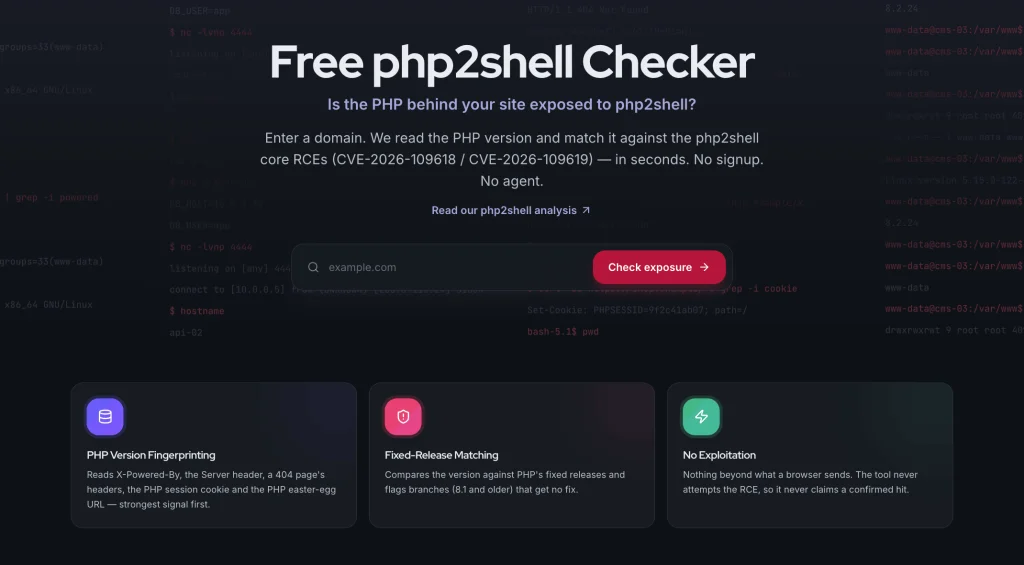
    Our main FAQ blog, PHP2Shell (CVE-2026-109618 and CVE-2026-109619), covers the flaws, fixed versions, and remediation. To see whether a specific site still needs that fix, SOCRadar’s free PHP2Shell Checker flags its exposure in seconds, with no signup, agent, or exploitation.

    SOCRadar's free PHP2Shell Checker
    SOCRadar’s free PHP2Shell Checker

    How Did SOCRadar Find the Server?

    The data comes from SOCRadar’s own platform. The server was one of the exposed hosts captured through SOCRadar Threat Hunting, and every file analyzed here was collected passively from its open directory listing.

    What the Exposed Server Held

    A Lab-Built PHP2Shell Exploit Chain

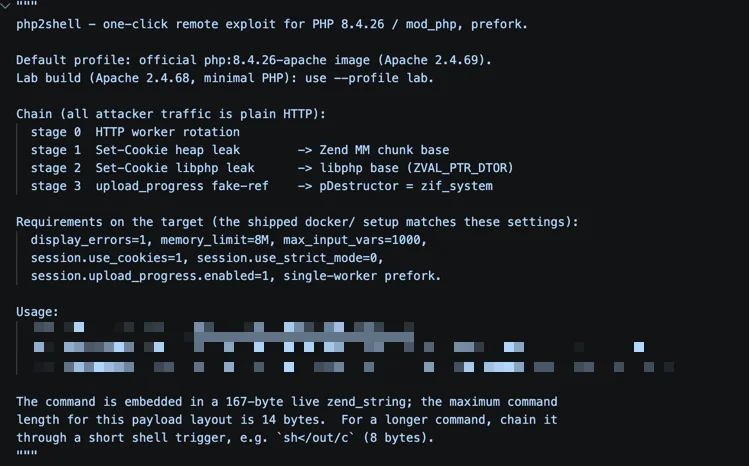
    The central file, aslr_exploit.py, is a Python exploit the operator labels a “one-click” PHP2Shell exploit for PHP 8.4.26 under Apache mod_php. It works entirely over ordinary HTTP requests in three broad steps: it recycles the target’s PHP worker, leaks memory addresses through the session cookie to defeat address space layout randomization (ASLR), and then abuses PHP’s session upload progress handling to run a shell command.

    The script ships with two calibration profiles, one for the official PHP 8.4.26 Apache container image and one for a custom lab build, and it defaults to a local target. That points to an operator who has tested the chain against containers they control.

    aslr_exploit.py
    aslr_exploit.py

    What Conditions Does the Exploit Need?

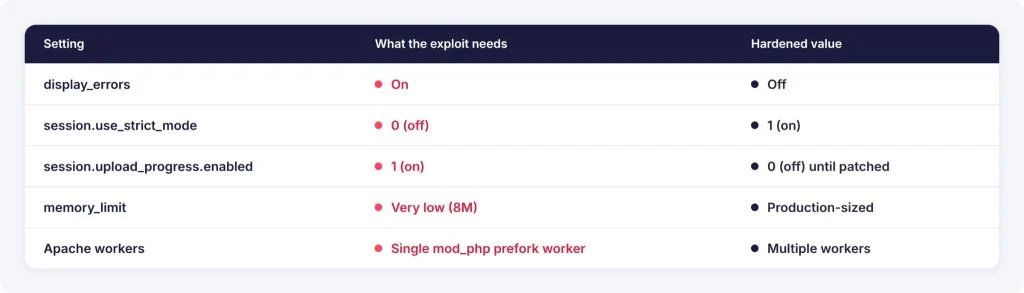
    The chain depends on a debug-style setup that hardened production servers rarely use:

    • Visible errors: PHP errors displayed to visitors.
    • Weak session settings: Session upload progress on and session strict mode off.
    • Tight resource limits: A very low memory limit and a single Apache worker.
    Settings the exploit depends on, compared with hardened values
    Settings the exploit depends on, compared with hardened values

    Even when those conditions are met, the payload can run only a very short command, so a real attack would need a second-stage script. The mod_php focus matches PHP’s own advisory, which rates mod_php deployments as the highest risk.

    How Did the Operator Screen Live Websites?

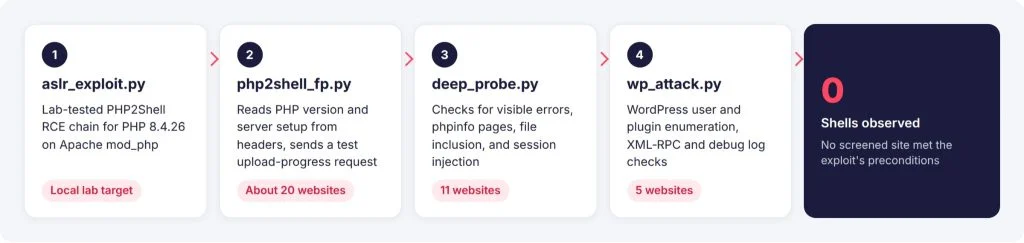
    Three companion scripts take the work from the lab to real websites. All of them send traffic through a rotating proxy pool hosted on the same server, switching proxies between targets.

    How the operator moved from a lab exploit to screening live websites
    How the operator moved from a lab exploit to screening live websites

    Fingerprinting PHP Versions and Server Setups

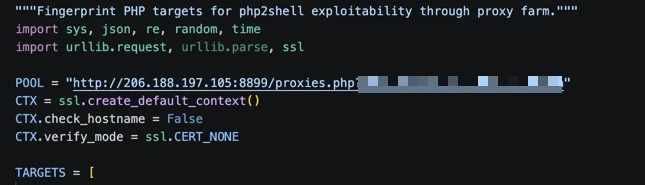
    The first script, php2shell_fp.py, works through a list of about 20 websites. It reads each site’s PHP version from the X-Powered-By and Server headers and guesses whether the site runs mod_php based on how those headers appear together. It then sends a small multipart request with an upload-progress field and a random session ID to see whether the site echoes the session back.

    php2shell_fp.py
    php2shell_fp.py

    Probing for Exploit Preconditions

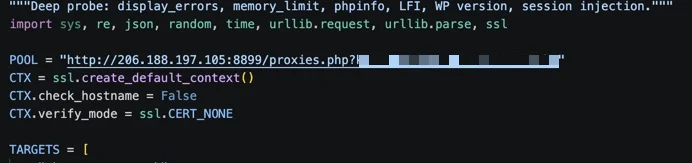
    The second script, deep_probe.py, examines 11 of those sites more closely. It requests a page designed to trigger a PHP warning to see whether errors are shown, and tries six common phpinfo paths to read settings such as the memory limit and upload progress state. It also tests 11 common parameters for file inclusion and sends an upload with a unique MARKER_ filename to test session injection.

    deep_probe.py
    deep_probe.py

    What Do the Results Show?

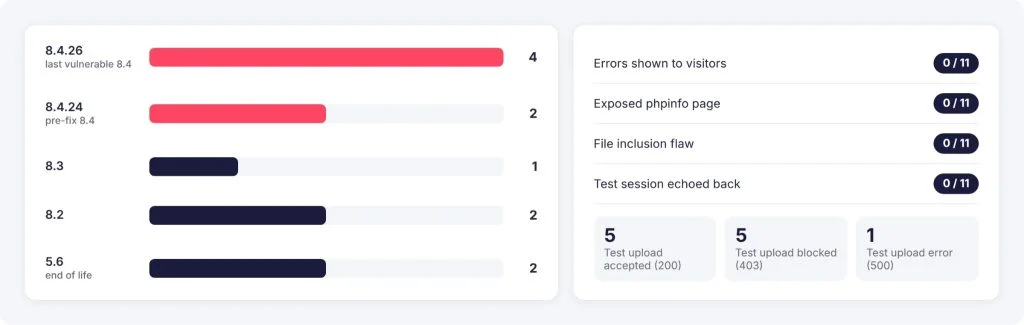
    The saved results cover those 11 sites, which include a university, nonprofits, and small businesses across Europe, North America, and Asia. Six ran PHP 8.4 releases older than the fix, four of them on 8.4.26 itself, while the rest reported 8.3, 8.2, or end-of-life 5.6. None displayed errors, exposed a phpinfo page, revealed a file inclusion flaw, or echoed the test session, so none met the exploit’s preconditions.

    PHP versions and exploit preconditions found across the 11 probed websites
    PHP versions and exploit preconditions found across the 11 probed websites

    This finding concerns the operator’s PHP2Shell tooling specifically. Other files on the same server point to unrelated intrusion activity against financial and Web3 targets.

    WordPress Follow-Up Reconnaissance

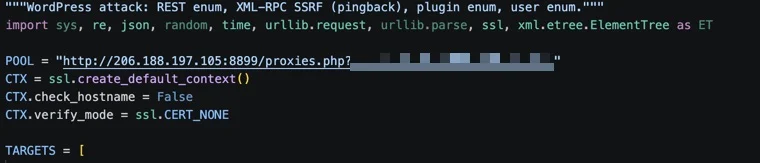
    A third script, wp_attack.py, turns to five of the WordPress sites. It enumerates users through the REST API and author redirects, checks for about two dozen popular plugins, lists XML-RPC methods and tests pingback, and looks for exposed debug logs.

    wp_attack.py
    wp_attack.py

    Assessment

    • Target CVE: We assess with moderate confidence that the tooling targets CVE-2026-109618, based on its use of the session upload progress path and its focus on PHP 8.4.26.
    • Capability: The operator shows strong exploit development skills, but as of October 22, 2026, we have seen no evidence of shell access on any screened site.
    • Attribution and motivation: The operator remains unattributed. Other files on the same server target cryptocurrency and Web3 platforms, which points to financial motivation. 

    The Operator’s Wider Toolset

    PHP2Shell is one part of a broader operation here. As previously mentioned, other tools recovered from the same server show an operator working well beyond PHP exploitation:

    • Secret harvesting: Pulling API keys and backend URLs out of websites’ client-side JavaScript.
    • Endpoint sweeping: Testing web and API routes, including admin paths, for unauthenticated access.
    • Proxy rotation: A pool of rotating proxies to spread traffic and evade rate limits and blocking.

    Related artifacts on the server additionally point to web-archive reconnaissance and automated CAPTCHA solving. Taken together, the toolset points to a financially motivated actor focused on cryptocurrency and Web3 targets. This activity is separate from the PHP2Shell screening.

    What Should Defenders Do?

    • Update PHP: Move to 8.5.12, 8.4.27, 8.3.36, or 8.2.35. Hardened settings stopped this chain, but they will not stop every variant.
    • Block and hunt the server: Block 206.188.197[.]105 at the perimeter and search web and proxy logs for past connections.
    • Look for screening traffic: Flag multipart POST requests with a PHP_SESSION_UPLOAD_PROGRESS field from unfamiliar sources, especially uploads named MARKER_ followed by eight hex characters.
    • Harden until patched: Keep display_errors off, set session.use_strict_mode=1, disable session.upload_progress.enabled, and remove any public phpinfo pages.
    • Stop advertising versions: Set expose_php=Off so the X-Powered-By header no longer reveals the PHP version scanners look for.

    Indicators of Compromise

    Type Value Role
    IPv4 206.188.197[.]105 Attacker staging and operations server
    IPv4:Port 206.188.197[.]105:9999 Exposed operator working directory (HTTP directory listing)
    IPv4:Port 206.188.197[.]105:8899 Rotating proxy pool endpoint
    IPv4:Port 206.188.197[.]105:8888 Out-of-band interaction listener
    Upload filename MARKER_[8 hex characters].txt Session injection screening probe
    Session ID prefix fprint, dp Upload-progress screening probes

    MITRE ATT&CK Mapping

    Tactic Technique ID Observed Behavior
    Resource Development Develop Capabilities: Exploits T1587.004 Built and lab-tested a PHP2Shell RCE chain
    Reconnaissance Gather Victim Host Information: Software T1592.002 Read PHP and server versions from response headers
    Reconnaissance Active Scanning: Vulnerability Scanning T1595.002 Probed sites for upload-progress behavior, exposed errors, phpinfo pages, and file inclusion
    Command and Control Proxy T1090 Routed screening traffic through a rotating proxy pool
    Initial Access Exploit Public-Facing Application T1190 Exploit built for internet-facing mod_php servers; no successful use observed

    Source: SOCRadar · 2026-10-22

  • Spectator Loader Advertised as FUD Resident Loader With Anti-Analysis and Evasion Features

    Malware Service Report
    Loader
    Defense Evasion
    Anti-Analysis
    Unverified

    Spectator Loader Advertised as FUD Resident Loader With Anti-Analysis and Evasion Features

    ServiceSpectator Loader
    AV products referenced16
    Delivery optionsEXE / MSI / sideload
    ContactTox

    Spectator Loader Advertised as FUD Resident Loader With Anti-Analysis and Evasion Features

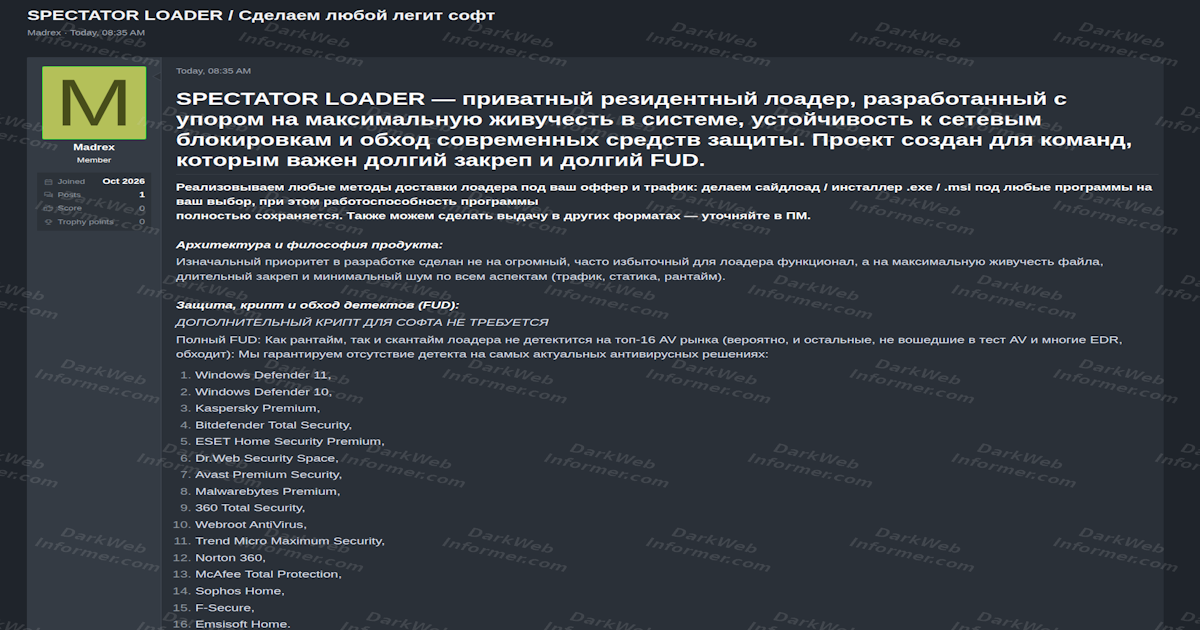
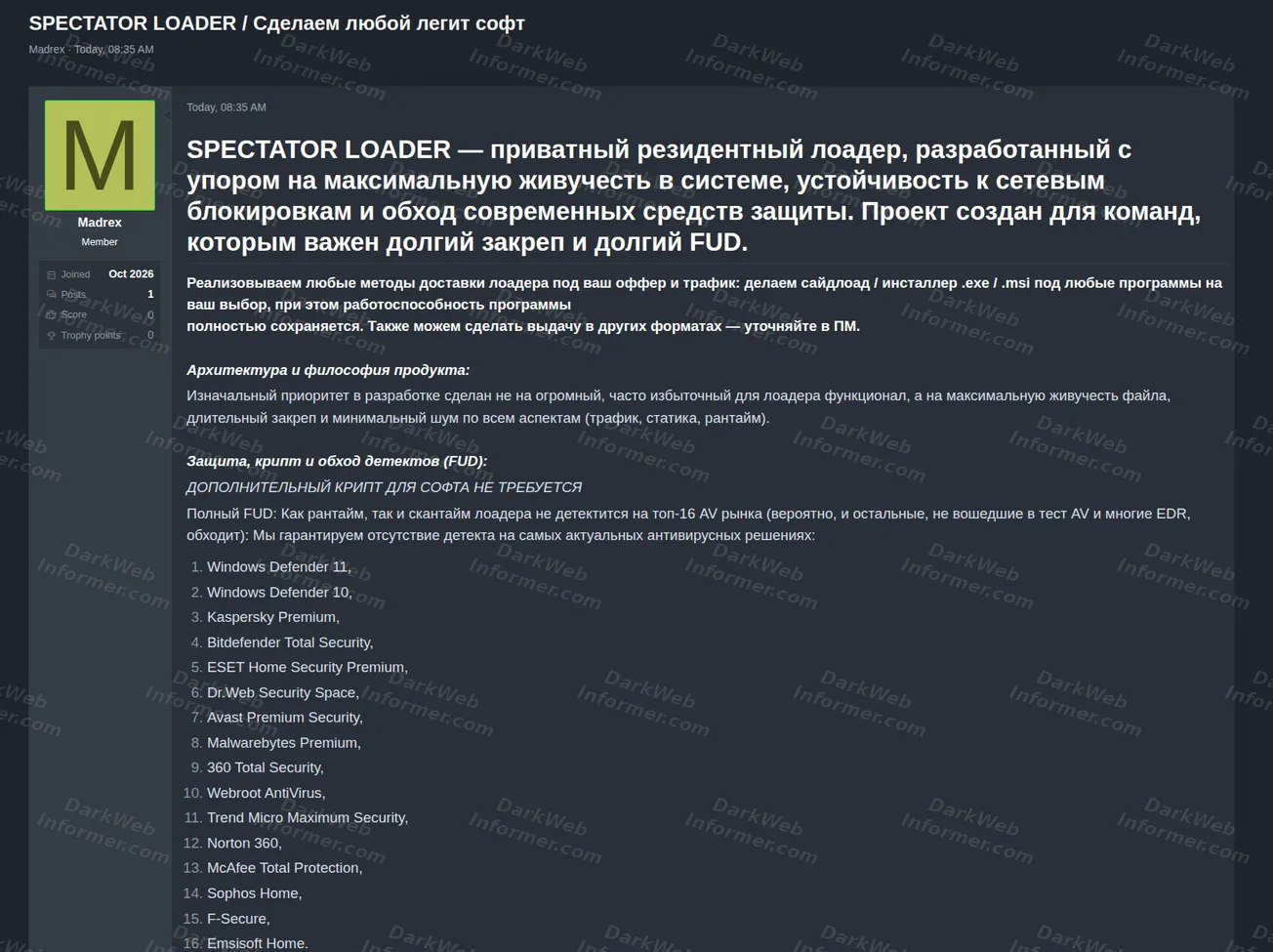
    An actor using the handle “Madrex” is advertising a malware service called Spectator Loader. The Russian-language post describes it as a private resident loader built for long-term persistence, resistance to blocking and evasion of modern security products.

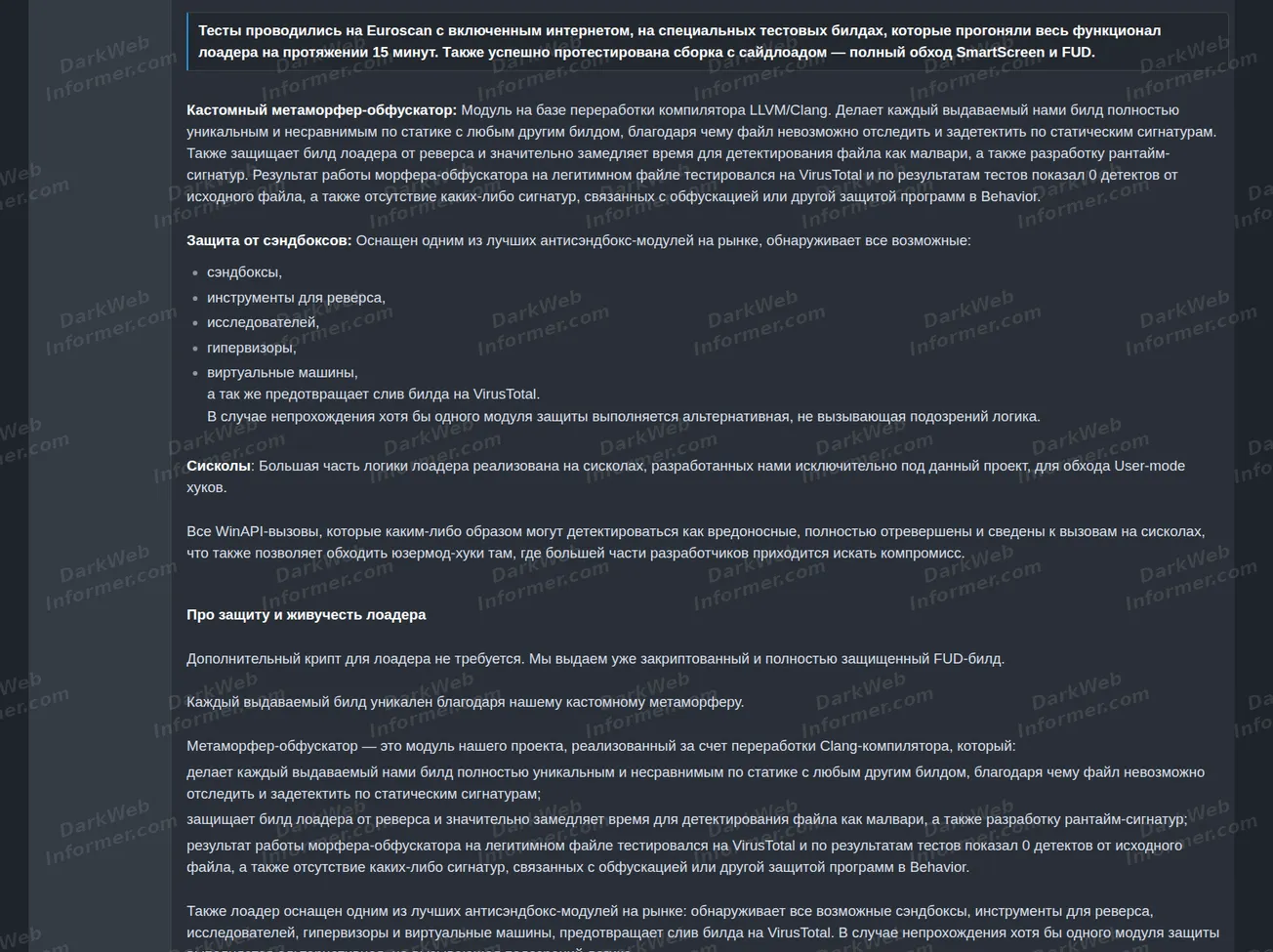
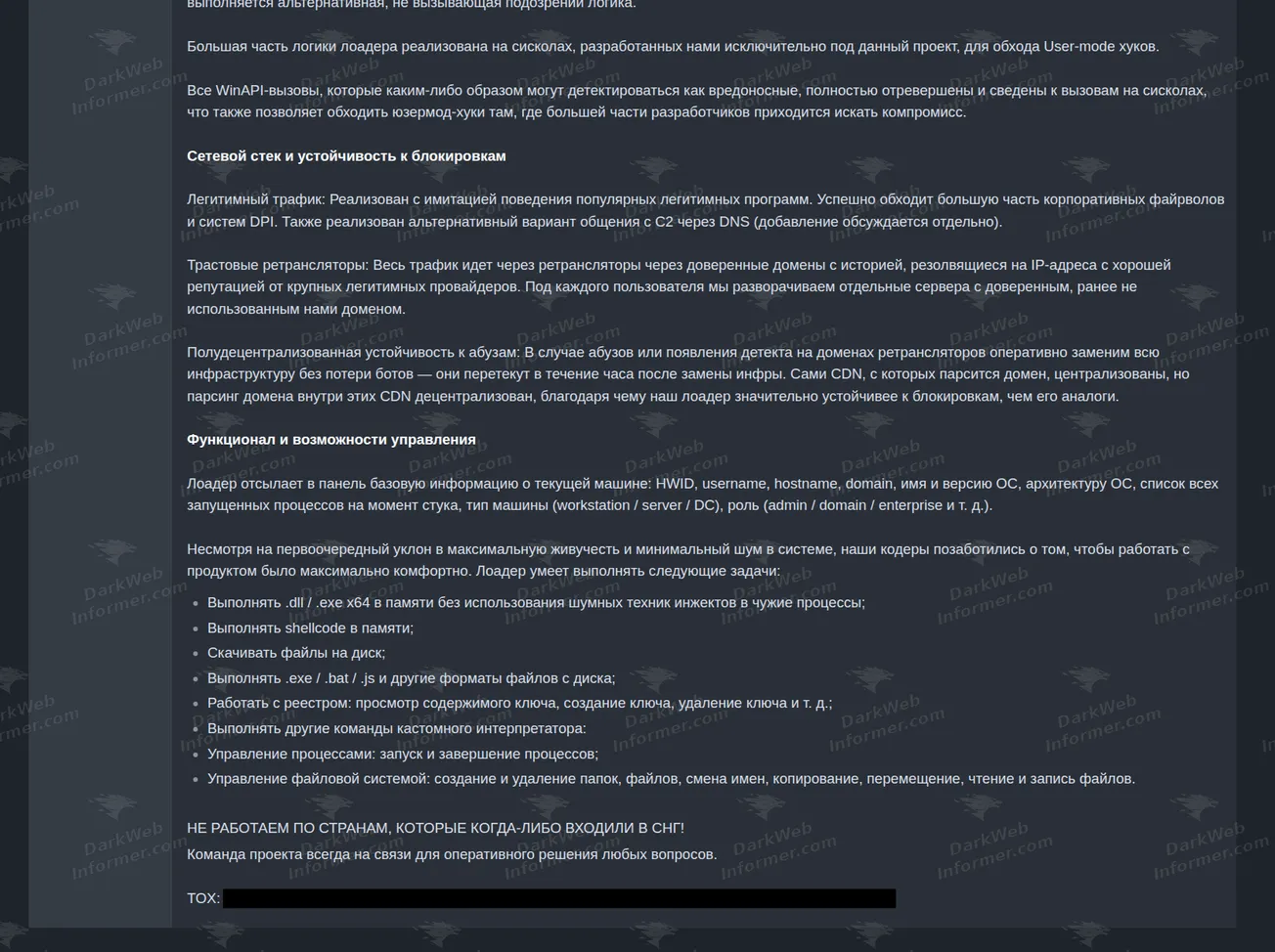
    The advertisement claims the service can be delivered through sideloading or installer formats, uses custom obfuscation, anti-sandbox checks and low-level system-call techniques, and is designed to reduce static and behavioral detection. It also advertises remote-management capabilities such as system-information collection, in-memory payload execution, file transfer, process control, registry operations and filesystem management. These are actor claims from the advertisement and have not been independently validated.

    Post details

    ServiceSpectator Loader
    Actor“Madrex”
    Service typePrivate resident malware loader
    Primary marketing claimsPersistence, FUD, anti-analysis, blocking resistance
    Delivery methods advertisedSideloading, EXE, MSI and custom formats
    Security products referenced16 consumer AV products
    Contact methodTox
    Observed date

    What the post advertises

    • Private resident loader
    • Long-term persistence focus
    • FUD / low-detection positioning
    • Sideloading and installer delivery options
    • Custom metamorphic obfuscation
    • Anti-sandbox and anti-analysis checks
    • Claims resistance to static signatures
    • Claims reduced behavioral detection
    • Low-level syscall-based execution claims
    • Traffic imitation / trusted relay claims
    • System-information collection
    • In-memory payload execution
    • File download capability
    • Execution of multiple file/script formats
    • Registry manipulation
    • Process creation and termination
    • Filesystem management
    • Operator support advertised

    The post also claims its protection stack can detect sandboxes, reverse-engineering tools, hypervisors and virtual machines, and that builds are altered to reduce similarity between samples. These statements are summarized as service claims and are not reproduced as implementation guidance.

    Screenshots

    The supplied captures show the Spectator Loader advertisement, including FUD claims, antivirus and anti-analysis positioning, obfuscation and sandbox-evasion claims, network-resilience claims, remote-management features and a Tox contact identifier.

    IOCs & identifiers

    Identifiers directly visible in the supplied material. These support correlation and do not independently verify the advertised capabilities.

    Type Identifier Source
    Actor handle Madrex Screenshots 1–3
    Service name Spectator Loader Screenshots 1–3
    Tox ID 7EB9EF1A8CCCD4E02F87E0908BE745BE0F355D08B29CC1E74831AE80099A070BE4AD7E2E9B24 Screenshot 3

    No malware hash, Session ID, Telegram handle, attacker-controlled domain or attacker-controlled IP address is visible in the supplied screenshots.

    Mapped techniques

    Claimed identifies behavior explicitly advertised by the actor. Inferred identifies an analytical mapping supported by the supplied material. Neither label means the capability has been independently validated.

    • Defense Evasion
      T1027
      Obfuscated Files or Information
      Claimed
      The advertisement explicitly promotes custom obfuscation and build-to-build variation intended to reduce static detection.
    • Defense Evasion
      T1497
      Virtualization/Sandbox Evasion
      Claimed
      The post claims the loader can detect sandboxes, virtual machines, hypervisors and reverse-engineering environments.
    • Command and Control
      T1105
      Ingress Tool Transfer
      Inferred
      The advertised management feature set includes downloading files to the compromised host.

    Potential impact

    If the advertised capabilities are genuine, Spectator Loader could provide operators with a stealth-focused foothold that supports payload delivery, in-memory execution, file transfer, process control, registry modification and filesystem access. Its anti-analysis and evasion claims could also increase the time required for defenders to identify and investigate malicious activity.

    Status Unverified

    Dark Web Informer has not independently verified the loader’s detection-evasion claims, supported delivery methods, anti-sandbox behavior, network resilience or remote-management functionality. The supplied screenshots document the advertisement and visible contact information only.

    Dark Web Informer

    Source: Dark Web Informer · 2026-10-22

  • Scammers are finding new ways to target your phone. Here are 5 ways to protect yourself

    Scammers are finding new ways to target your phone. Here are 5 ways to protect yourself

    The warnings are everywhere these days. Don’t click this. Don’t open that. Don’t scan this. Don’t download that. These messages of caution, however well-intended, are so ubiquitous and constant that it should come as no surprise that some people have started to tune them out.

    How many people? About one in three, according to our recent study.

    Keeping up with every warning can feel exhausting. Meanwhile, scammers are finding new ways to target people and phones give them plenty of opportunities.

    Mobile phones give scammers multiple ways to reach people, from text messages and calls to social media posts. According to a 2022 Federal Communications Commission report cited by the Federal Trade Commission (FTC), texting is a more common communication method than voice or email.

    Criminals appear to be taking advantage of that fact. Consumers reported losing $470 million to text scams in 2024, up 26% from $373 million the year before and more than five times the amount reported in 2020. The FTC cites estimates that text message open rates run as high as 98%, compared to just 20% for email. People’s tendency to open and read their texts helps explain their appeal to scammers.

    Meanwhile, AI is making scams harder to detect, but better at impersonating people and companies to steal money, passwords, and identities.

    Voice phishing, or “vishing,” was a vanishingly small category of crime just a few years ago, but AI has made it considerably more convincing. Vishing doubled in the first half of 2026, according to CrowdStrike’s 2026 Threat Hunting Report. Meanwhile, 16% of adults in the Malwarebytes survey said they had received a voice-cloned phone call impersonating someone they knew in the past year.

    Our data also shows how difficult people find it to recognize scams: 85% of survey respondents said it’s hard to tell a scam from the real thing, up from 66% a year ago. And 84% said convincing video evidence no longer feels like the rock-solid proof it once was.

    Here are five ways to protect yourself

    1. Treat unexpected texts and social media posts with suspicion

     Legitimate institutions generally won’t ask for payment or personal information through unsolicited texts. And if the message is marked “urgent,” all the more reason to pause. Instead, go directly to the company’s official website and inquire there.

    AI-generated images and videos are making it harder to tell what’s real online, so don’t rely on what you see as proof that a request is legitimate. If the content involves someone you know, contact them directly using a number you already trust.

    2. Keep your operating system updated

    This is one of the most effective things you can do to keep your phone safe. Security updates patch vulnerabilities that malware takes advantage of. Malwarebytes’ threat research found Android malware detections rose 151% in the first half of 2025. On both iPhone and Android, automatic updates help decrease risk.

    3. Protect your accounts

    Use a strong, unique password for every account. A password manager can create and store them for you. Where available, use a passkey—a way to sign in using your device, often with your fingerprint, face, or PIN—that resists phishing.

    Turn on two-factor authentication, also called 2FA, for all your apps that allow it. This one step makes it harder for criminals who have your password to gain access to accounts on your phone.

    4. Be skeptical of voice calls, even from your mom

    This can be the hardest one to get your head around, but also one of the most dangerous and fastest-growing. AI-synthesized audio fraud has made it easier for scammers to sound convincingly like a loved one in trouble. Agree on a private code word with family members and friends in case of doubt or emergency. If you’re unsure, hang up and call the person on a number you already have. If the caller claims to be your bank, hang up and call back on a number you look up independently.

    Before opening a link in a text, email, or social media post, check the web address for misspellings or an unfamiliar domain. You can also copy it into the free Malwarebytes Scam Link Check for help assessing it.

    QR codes can hide suspicious links, too. Scammers sometimes place fake sticker overlays on top of legitimate QR codes in public spaces, and QR code phishing is morphing so fast that the FBI issued an alert in January about North Korean hackers using QR codes to target think tanks and government officials. Look for signs of tampering and check the web address your phone displays before opening it. If you’re not sure, don’t open the link. Instead, go directly to the organization’s official website or app.

    Scammers rely on speed and pressure, so the best defense is to slow down. If a message or call feels off, step away and check it through a channel you already trust.


    CNET Editors' Choice Award 2026

    According to CNET. Read their review →


    Source: Malwarebytes Labs · 2026-10-22