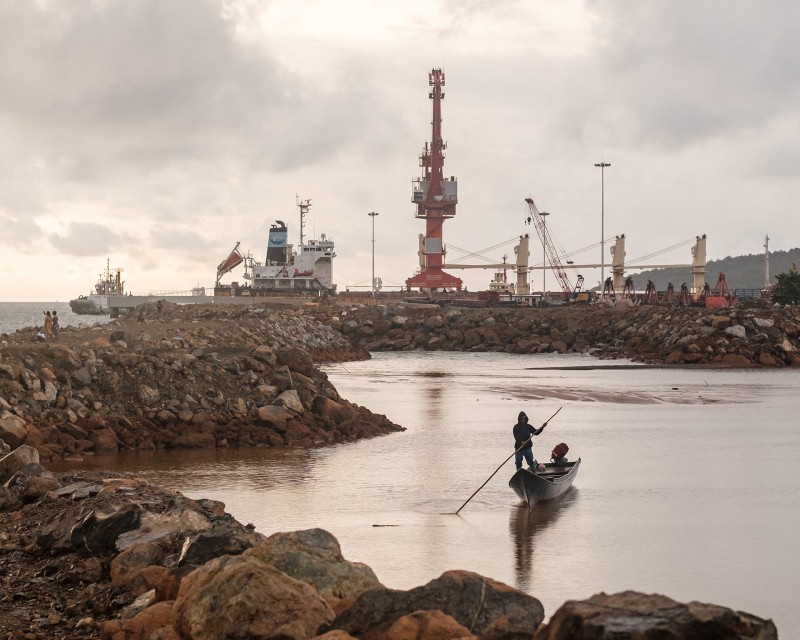
When senior mining executive Stevi Thomas was convicted alongside an Indonesian governor for bribery in 2024, the ruling was seen as a rare case of accountability for corruption in the Southeast Asian nation.
The court case revealed how the politician had received some $60,000 in bribes for facilitating permits for Harita Group, a conglomerate that has sourced up to eight percent of the world’s nickel supply in recent years — and has also left a trail of environmental damage in its wake.
Now, leaked internal records obtained by OCCRP reveal a host of other payments that Harita executives earmarked for local politicians, individuals identified by the firm as community leaders, and the military between 2013 and 2023.
The planned or approved payments amounted to at least $389,000 and took the form of flights for politicians, “incentives” for the community leaders, and financial support for military projects.
Evidence of these outlays was found in leaked company emails, internal memos, and invoices.
Reporters were unable to independently verify if the money was ultimately disbursed in every instance, or establish the precise purpose of some of the approved payments.
But anti-corruption and mining experts said that some of the planned payments could violate Indonesian laws, including those regulating the giving of gifts to officials and a mining company’s use of corporate social responsibility funds.
Harita Group and the employees involved in approving the payments did not respond to requests to comment.
Though many of the individual outlays were not large in size, such as $80 earmarked for the head of the local port office, money of this magnitude can go far in Indonesia, where the average monthly salary is approximately $200.
The findings raise questions about whether the cash was used to reward individuals who acted in Harita’s commercial interests. In one case, Harita approved payments for a village chief who later, according to an internal company memo, monitored local residents who were protesting the miner’s operations.
The documents also provide a glimpse into the dealings between Harita executives and Indonesian officials, including how in one instance, the company drafted its own government permission decision and ultimately removed a legally-required clause.
“Harita or any private company has no legal authority to draft a government’s own policy or decision document, at any level of government,” Aryanto Nugroho, the national coordinator of the transparency organization Publish What You Pay Indonesia, told OCCRP.
“Drafting government decisions is a state function, not something delegated to the party the decision is meant to regulate.”
The Indonesian government did not respond to requests to comment.
In most cases, the payments were authorized by senior Harita executives such as Thomas, the company director who was imprisoned in 2024 for bribery, the leaked emails show. Thomas did not respond to requests to comment.
Harita is one of the largest nickel producers in Indonesia, and its mines feed the supply chains of some of the world’s biggest electric vehicle makers. But it has also come under scrutiny for its environmental record. In 2025, an investigation by OCCRP and partners found the company knew for a decade that its mining operations were regularly breaching legal limits on the release of a toxic chemical into surrounding waterways, and that the contamination had reached residents’ main source of drinking water.
Ferdian Yazid, a researcher at Transparency International Indonesia, said that the bribes that landed Harita executive Thomas and the governor in prison set “a bad precedent” in a country where anger over corruption erupted into nationwide protests late last year.
“Although Harita claims to adhere to anti-corruption and environmental principles, the reality is far from what it has stated.”
Yazid added that private companies such as Harita have disproportionate influence over regulatory frameworks at the expense of the public interest.
Given the severity of corruption in Indonesia’s nickel sector, he added, “corruption prevention must be strategic, targeting critical minerals.”
‘Building Relations’
The small island of Obi, which forms part of the North Maluku province in eastern Indonesia, is covered in dense, mountainous forest. Harita opened a nickel mine there in 2010, and five years later, the company started building the first in a series of new smelters to process nickel ore into a material used in the production of stainless steel.
At the groundbreaking ceremony for Harita’s first smelter on Obi Island in June 2015, members of the Kasuba family, a powerful force in regional politics, watched on and gave the project their blessing.
But some residents of Kawasi — a village now encircled by Harita’s facility — were less cheerful about the expansion after already having seen the company’s mines strip away rainforest surrounding their homes.
Internal company emails show that Kawasi villagers met with company representatives and accused Harita of breaking the law by failing to hold a public consultation into the construction of the smelter. They also demanded that the company stop work and allow time for a new environmental impact assessment.
But Harita’s senior general manager dismissed their concerns, writing in an email to a colleague in July 2015 that he suspected “a third party is stirring up the public.”
It turns out Harita had already established financial ties with local residents they referred to as “influential” local officials and community members.
In 2013, an internal Harita spreadsheet titled “building relations” detailed planned payments totaling $2,300 for Kawasi’s elected leader, Arifin Saroa, and at least 11 other individuals. Around $400 of this total was earmarked specifically for Saroa, who could not be reached for comment.
Another July 2014 email chain marked as “confidential” details around $13,500 in “incentives” between March and July designated for dozens of individuals identified as community figures, including local imams and pastors listed as “partners” and “stakeholders.”
While the emails don’t state the exact reason for what were marked as monthly outlays, the correspondence shows Harita’s senior general manager evaluating payments based on the community figures’ level of influence.
In one message, he wrote that a certain reverend’s “role was quite significant” despite being from a different town, as he had managed to make a phone call that stopped a threat from protesters to halt production.
While it could not be confirmed if there was any connection to Harita’s planned payment, several years later Kawasi’s village head Saroa appeared to be providing the company with a valuable service. A 2020 internal security memo from Harita noted that he would be passing on any information about members of the community “suspected of being masterminds or participants” in a protest against the company.
This would allow the company to “give them special attention by rejecting them and their families” from employment opportunities, the document says.
According to the memo, Saroa had confirmed that “every [Harita] applicant from the village must go through the Kawasi Village Head for recommendation or otherwise be blacklisted,” and that a local widow was being monitored by the Kawasi village authorities.
Four Kawasi residents confirmed to OCCRP that those who wanted to work for Harita or sell supplies to the company had to go through Saroa for a recommendation.
They also alleged the company had offered financial incentives to those who complained about the damage caused by the mine, and who have also faced intimidation.
“Whenever people refuse to sell their land [to Harita], police personnel show up at odd hours to persuade and intimidate them,” said one resident, whose name OCCRP has chosen not to publish to protect him from potential reprisals. “Even the slightest protest here is immediately reported to the police or the military.”
Head of the village Saroa himself did sell land to the company among other substantial financial transactions with the Harita Group, the documents show.
He earned approximately $304,000 primarily between January 2020 and August 2022 in return for selling cropland close to Kawasi that he either owned or farmed, according to more than a dozen joint agreement letters seen in the leaked records by OCCRP. Harita planned to use the land to build a second smelter and other infrastructure, the documents say.
Separately, Harita had also contracted two companies it understood to be owned by Saroa to provide loading services at the island’s port, according to a contract and loading report.
In 2021, Harita’s stakeholder engagement plan identified the village leader as “critical” for the mine’s success — stating that he provided a high-level of support, and remained in regular contact with the company.
Harita did not respond to questions about where the funds for its various payments were drawn from.
However, in one case, reporters found that $1,400 earmarked for the military’s inauguration of a navy ship was categorized internally as CSR spending.
Under Indonesian law, mining companies are required to put CSR funds towards improving the quality of life of the community directly impacted by mining, as well as the broader society.
“Corporate social responsibility is supposed to be given to the community,” said Laode Muhammad Syarif, a former commissioner for Indonesia’s Corruption Eradication Commission.
“A volleyball court is built because there’s no place to play, or the mobile clinic is improved — that’s CSR. But if it’s given to the police and military, what’s the connection?”
The military did not respond to requests for comment.
‘Good Relations’
In the summer of 2016, Harita’s senior director Lalu Mahfi had a problem. Harita was already a year into the building of its first smelter on Obi Island, but the company did not have a construction permit.
“Normally, a building should not be constructed without first obtaining an IMB [building permit], but through good relations with the local government, we have been able to continue the smelter construction,” Mahfi wrote in an email to colleagues that June. “In other places, such a project could be shut down or ordered to stop.”
In the same email Mahfi urged staff to make a hotel booking at a four-star hotel in Jakarta for Bahrain Kasuba, the nephew of Abdul Ghani Kasuba — the governor later jailed for accepting bribes from Harita in a separate instance — and several team members. At the time, Bahrain was serving as regent — a position equivalent to a district head — of South Halmahera, an area that includes Obi island.
Though there is no evidence Bahrain ultimately facilitated the construction permit for Harita, Mahfi explained in an email to colleagues that his “arrival in Jakarta is very important for the company in securing the building permit for the smelter.”
Mahfi did not respond to requests to comment and reporters sent questions for Bahrain through the regency government, which is currently headed by his cousin, but did not receive a response.
By that point Harita and Bahrain already had a working relationship. A year earlier, on the day he took office, the official signed a joint agreement with companies belonging to Harita Group to “smooth and accelerate” the company’s mining operations in “anticipation of social conflict” around the mining areas, the document says.
Although Bahrain canceled the June 2016 Jakarta plans, the company ultimately booked six flight tickets between North Maluku and Jakarta for the official and in one case his wife over the next five years, according to receipts, booking forms, and memos from Harita’s finance department. None of the documents provide a reason for why the company purchased these flights.
On November 15, 2016, Harita finally obtained the construction permit for the new smelter.
Yassar Aulia, researcher at Indonesia Corruption Watch, said the hotel booking and flight purchases raise questions over the propriety of Harita’s relationship with a public official, and whether there was any “kickback intent.”
The country’s Corruption Eradication Commission did not respond to queries about whether Bahrain reported the flight purchases.
Under Indonesian law, public officials have 30 working days to report any gift to the Commission, and must prove the gift was not a bribe in cases where the value is over $440. For lower value gifts, evidence of a bribe would need to be proven by a prosecutor, the law states. (The costs of the flights for Bahrain and his wife that are mentioned in the documents were typically around $140.)
In August 2017, Mahfi also sent the senior general manager a draft contract to hire Muhammad Kasuba — Abdul Ghani Kasuba’s brother and a former regent of South Halmahera — as an external relations consultant to, among other tasks, “foster relations with the Regional Government and community” for a minimum of $3,700 per month, a figure 20 times the average salary.
It is not known if Muhammad Kasuba ever signed the draft contract, but the former official has continued to publicly champion Harita as recently as last year. He did not respond to requests to comment.
Drafting a Government ‘Decision’
Company emails indicate that Harita was given an unusual level of free rein by authorities.
In May 2016, Mahfi emailed Harita’s then-president director a draft government “decision” permitting the company to store hazardous waste.
Although the official government document was to be signed by Bahrain — the regional official who would later have flights booked by Harita — it was apparently put together by Mahfi himself.
“I compiled this draft from various sources,” Mahfi wrote in an email to colleagues.
The emails show Mahfi went on to further edit the decision, removing a clause which stated that the permit had been issued after a legally-required field verification.
Nugroho, the national coordinator of Publish What You Pay Indonesia, described this intervention as “a private party stepping into a function that belongs exclusively to the state.”
“That is precisely the mechanism governance experts describe as state capture.”
He also added that if the regency government issued the permit as written by Mahfi without the field verification clause, the permit could be revoked and the officials who signed off on it could be liable to either civil or criminal action.
Paying for Positive News
In 2018, international consultancy firm Hatch delivered a technical review commissioned by Harita into the company’s smelter operations.
According to the review, which OCCRP found a copy of in the leaked Harita emails, the company used hazardous waste materials during the construction of the smelter without government permission.
Harita had also not completed a number of crucial environmental and social impact assessments, the report said.
However, Harita spent money painting a different picture to the public.
Between August 2022 and January 2023, Stevi Thomas signed off on spending a total of about $6,000 to place news stories about Harita in more than 40 Indonesian media outlets, internal memos show.
The stories described Harita’s contribution to the economy, the job market, and how the nickel industry was on track to meet net zero targets, among other topics.
On the ground, meanwhile, Kawasi villagers blame Harita’s operations for the degradation of their farmland through landfilling, flooding, and groundwater contamination. Most were eventually relocated to an “eco-village” built by the company.
Today, only a handful remain in the original Kawasi village, where homes and streets are subject to frequent blackouts, as well as severe flooding with contaminated water from the mine’s overflowing sediment pond.
Source: OCCRP · 2026-10-22