Threat actors don’t need to rely on malware to breach organizations anymore. They’re simply calling help desks and politely asking for access, with a little help from artificial intelligence.
After the Mississippi attorney general cleared a white cop for firing into a car and killing a Black toddler in a Walmart parking lot, video footage released by the Mississippi Department of Public Safety has revealed the fullest picture to date of what happened.
The videos, provided to The Intercept in response to a public records request, come on the heels of leaked footage that exposed how a needlessly aggressive and reckless police confrontation of two suspected shoplifters led to 1-year-old Kohen Wiley’s violent death in his mother’s arms.
While the newly released videos include redacted versions of the previously leaked footage — including body camera footage for some of the officers, as well as Walmart surveillance video — the new footage reveals for the first time the body camera video belonging to the Senatobia police officer who fired the shots that killed Kohen Wiley: Sgt. Hunter Foster.
While the state concluded that the shooting was “justified” based on a probe by the Mississippi Bureau of Investigation, the videos show how police escalated a non-life-threatening situation — one that could have ended with a mere shoplifting charge — by pursuing Kohen’s mother, Vel’lesiya Wiley, and the driver, Latoya Ferrell, after they ran from the store and tried to drive away.
Foster’s body camera footage makes clear that he positioned himself in front of the vehicle, aimed his gun at the car, and fired the fatal shot into the passenger side window after the car was moving past him and posed no threat.
This is consistent with the conclusions of Dr. Roger Mitchell, a forensic pathologist hired by Kohen Wiley’s family, who determined in June that the fatal bullet was most likely fired into the side window, entering his small body on his right side and exiting his left.
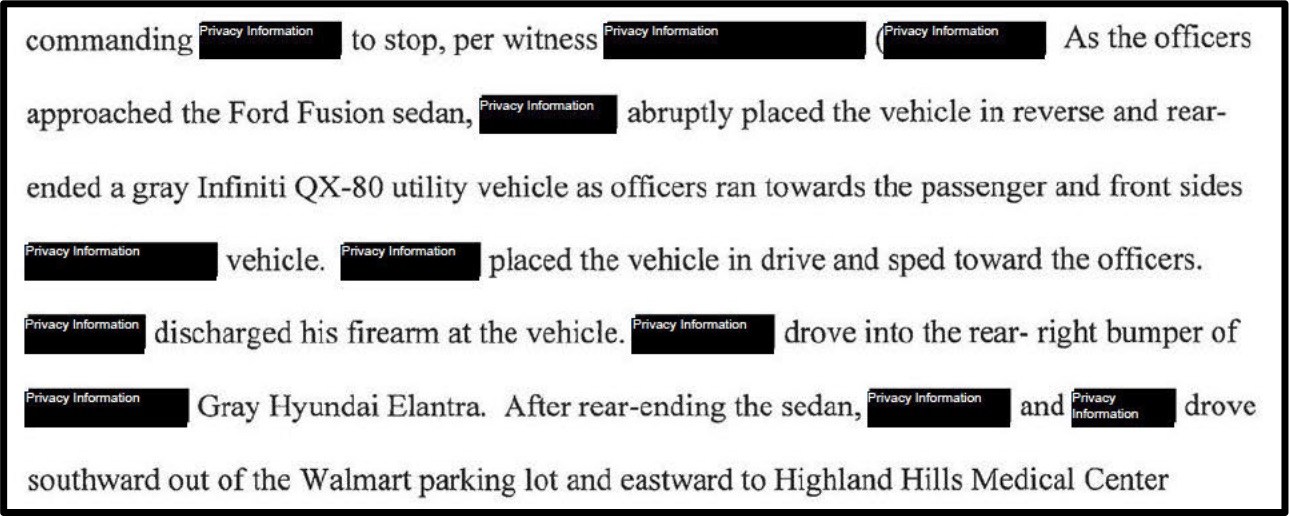
The report’s narrative is misleading: Its only description of the shooting is that one officer “discharged his firearm” after the car “sped toward the officers.” The report does not discuss the fact that the firing officer was beside the car when he first fired, which is clear in Foster’s body camera footage. The report also redacts Kohen Wiley’s cause of death.
An excerpt of the report on the police shooting of Kohen Wiley from the Mississippi Bureau of Investigation released on Oct. 22, 2026, through a public records request.Screenshot: The Intercept
Foster resigned from the Senatobia police department on Wednesday. Afterward, Foster’s lawyer told CNN, “The driver of the vehicle was attempting to kill those 5 officers, and Hunter Foster had no choice but to discharge his weapon.” (Neither Foster nor his lawyer responded to The Intercept’s requests for comment.)
Residents of Senatobia had called for months for the body camera footage and Walmart surveillance videos to be released. After the state attorney general announced that the police had been cleared, a spokesperson for the Mississippi Department of Public Safety, which houses the state’s Bureau of Investigations, told The Intercept that the videos would be released after the family had a chance to watch them.
Instead, as with the attorney general’s announcement, the family first saw the leaked videos on social media. By the time Kohen Wiley’s parents and grandparents met with state officials to view the videos on Thursday morning, most of the footage had been circulated online. At a press conference on Thursday afternoon, Kohen’s maternal grandmother, Veronica Roberson, called it “a slap in the face.”
Roberson said she’d been haunted by the word “justified” all week, slamming the idea that Foster fired the lethal shots because he feared for his life.
“You shot my grandbaby from the side of the car,” she said. “How are you in danger?”
“Get the Car!”
The incident began with what appeared to be a routine occurrence in retail outlets all over the country: a shoplifting allegation.
The earliest footage is from a Walmart security camera. An apparent Walmart employee dressed in a black hoodie is stationed by the store entrance when Wiley and Ferrell approach, carrying a child and a box of diapers. They pause at the door and appear to have a brief exchange with the Walmart employee before breaking into a run toward the parking lot.
In body camera footage, which begins moments later, the staffer in the hoodie appears in the doorway of a small security room, where other Walmart employees, three Senatobia police officers, and two Tate County sheriff’s deputies are gathered around a pair of computer monitors. According to the MBI report, the officers had been called to the store in response to a complaint that a man was sexually harassing customers.
The employee in the hoodie tells the cops and Walmart staffers that two people are running and gestures toward the store entrance.
Moments later, the five officers dash from the room and out into the parking lot, running toward a gray sedan. A sheriff’s deputy reaches the driver’s side door and puts his hand on the hood of the car while someone yells “stop.” The car backs up and starts to turn, but hits a parked SUV. Someone yells, “Stop the car!”
As the officers continue to run toward the car, it begins to move forward. At one point, two officers are directly in front of the vehicle, including Foster, the police sergeant identified as the shooter, who aims his gun at the front windshield.
The car starts to turn left, away from the three officers on the vehicle’s right side, and either narrowly misses or grazes Foster, who stumbles to the passenger side and aims his gun at the window. He then appears to fire three shots in rapid succession.
As the car pulls away, the officers continue their pursuit.
“Get the car! Get the car! Get the car!” one of them yells.
The gray sedan pauses briefly before taking off again.
The records released by state officials do not include any footage of what happened after the officers return to their vehicles. But the leaked footage, which was compiled into a nearly 7-minute long video, shows Foster pacing next to a police vehicle outside the nearby Highland Hills Medical Center an hour and 20 minutes after the shooting.
“I didn’t even see a fucking baby in her lap,” Foster says.
His colleague responds that nobody else did either: “All I saw was two females in the car.”
Reckless and Aggressive
As the leaked video began to circulate on social media on Tuesday, much of the attention focused on the moment the car moved toward Foster.
The Senatobia Police Department claimed from the start that the car drove toward officers and nearly hit one, suggesting the shots were fired in self-defense. Darkhorse Press, the independent Mississippi outlet that first published the leaked footage, even stated in a headline that the car “actually hit at least two officers.”
Among those who have repeated a version of this story is Republican Gov. Tate Reeves, who said the driver tried to “run over the policeman,” despite admitting that he had not actually watched the footage.
What the videos show is that the police officers themselves needlessly escalated a shoplifting incident into the scenario that they claim put them at risk. Almost immediately after being informed that two people were “running,” the five armed officers sprinted out to the parking lot, surrounded the car, and, at various points in the confrontation, drew their guns. They also positioned themselves in a way that cut off any escape route for the driver.
These are reckless, aggressive tactics in response to a minor shoplifting charge. They also violate best practices in policing.
Most departments today prohibit officers from standing in front of the possible escape route of a car when someone inside is suspected of only minor offenses. Many also require officers to get out of the way of a vehicle if it drives toward them. While most departments authorize a police officer to use deadly force if they “reasonably” believe it’s necessary to protect their or others’ lives, this generally does not excuse using lethal force if the “reasonable” fear arose from a cop’s own violation of department policy.
The police officers themselves needlessly escalated a shoplifting incident into the scenario that they claim put them at risk.
Policies and best practices, however, don’t establish the bounds of legal liability; they are related but separate. Under the landmark Supreme Court case Tennessee v. Garner, a police officer can use deadly force if he “has a good-faith belief that the suspect poses a significant threat of death or serious physical injury to the officer or others.” The law is less clear about criminal liability when an officer’s own illegal or ill-advised actions caused the circumstances that led him to fear for his safety.
Other examples of self-defense law hold people criminally liable if their own actions put them in harm’s way. In general, those cases indicate that a person can’t argue self-defense after killing someone if they instigated the altercation that led to the killing — even if it was reasonable to deploy lethal force when they did.
By that standard, if an officer puts themselves in the path of a moving vehicle, they shouldn’t be able to justify lethal force by claiming to fear for their life because the vehicle was about to hit them. The law, however, isn’t crystal clear on this, and there’s at least some indication that the current Supreme Court may adopt a more lenient standard for police officers.
Moving Vehicle
Most police departments prohibit officers from shooting into moving vehicles unless someone inside poses a direct threat to the safety of others unrelated to use of the vehicle itself — for instance, if the person is armed and shooting at people. The reason is simple: Killing the driver of a moving car does not stop the car and can therefore exacerbate threats to public safety.
Like many other departments, the Senatobia police department’s policy contains vague language warning officers that firing into moving vehicles is dangerous to bystanders and unlikely to stop a car; it reads more like guidance than prohibition. One portion of the policy, however, is much clearer: Officers “will not” discharge firearms into a fleeing vehicle — with “will not” underlined for emphasis.
It seems clear from the leaked footage that Ferrell, the driver, maneuvered the car in what appeared to be an attempt to flee rather than to kill or injure officers. The video shows her at first trying to reverse away from police. After striking the SUV, however, she then appears to try to drive around and then between the officers. She then strikes another car while trying to drive away.
The videos depict a driver showing far more awareness for the officers’ safety from behind the wheel than Foster showed for the occupants of the car — or the surrounding bystanders.
Foster’s actions aren’t consistent with any reasonable concept of self-defense. Footage shows that he fired at least three shots into the passenger side of the car. This was already apparent in the leaked body camera footage. It’s even clearer in the newly released video from Foster’s camera. By the time he fires the first of the three shots, he is clearly beside — not in front of — the car. By the time he fires the last shot, the car has passed him.
Even if Foster wanted to claim that he fired to disable the driver — and, again, his own department firmly prohibits shooting at a fleeing car — he fired through the passenger side window. He did so despite being told that there were two people inside, which means that whatever the driver was doing, he was also putting the other person at risk.
Ultimately, the videos depict a driver showing far more awareness for the officers’ safety from behind the wheel than Foster showed for the occupants of the car — or the surrounding bystanders.
Police policies should reflect how people behave in the real world, and people accused of stealing tend to flee. For armed officers to quickly escalate a shoplifting allegation puts everyone nearby at risk. Amid the frenzied response from the cops, Ferrell struck two other cars while attempting to escape. Anyone in or near those cars could have been injured or killed. Foster also fired his gun in a crowded parking lot. That, too, could have resulted in additional death or injury.
The police had other options. They could easily have written down the car’s license plate or obtained the plate number from the numerous surveillance tools at their disposal: their body camera footage, Walmart security footage, or one of the many Flock cameras nearby.
If they had to arrest the women, they could have done so later, at home and under less duress. They may not have caught Wiley or Ferrell red-handed with the alleged stolen goods, theoretically making a shoplifting prosecution more difficult. Creating an obstacle to prosecuting a shoplifting case, however, should be an easy tradeoff for not putting lives at risk.
Walmart’s Role
Finally, the leaked video footage raises important questions about Walmart’s role in Kohen Wiley’s death. The company has yet to publicly comment about the incident — and has not responded to repeated inquiries from The Intercept.
When the Walmart employee in the hoodie entered the room where officers were viewing security monitors, he told them that two people were fleeing the store. He did not say that one of them had a baby in her arms, even though surveillance footage showed Wiley carrying Kohen as she passed him. This would prove consequential, as Foster said in video footage that he had no idea there was a baby in the car.
Does Walmart policy require staff to tell police when a suspected shoplifter is accompanied by children? And how often does Walmart call on police for such minor crimes?
This isn’t the first time aggressive policing of shoplifting at a Walmart has resulted in the death of an unarmed person. Earlier this year, deputies shot suspected shoplifters in two separate incidents at Walmarts in Florida. When police tackled a fleeing shoplifter in Anchorage, Alaska, recently, he pulled a gun and shot two officers before they returned fire, killing him.
Even the best policing policies are useless if they aren’t enforced when officers violate them.
Walmart seems to have wavered over the years between aggressive crackdowns on suspected shoplifters and more lenient policies that factor in whether the suspect has been accused before, the necessity of the items they’re accused of stealing, and the value of the stolen goods.
Like many national retailers, the company’s policy when it comes to its own employees is to avoid confrontations with suspected shoplifters. A previous lawsuit revealed that the company’s stated policy as of 2010 was “PUT PEOPLE FIRST” (all caps in original) and prioritized “the physical well-being of suspects, customers and Walmart associates.”
That policy means little if the store simply outsources enforcement to police who take a far more aggressive approach. Walmart itself has also been criticized by police groups, who claim that cost-saving reductions in staff have made the store a more attractive target for shoplifting, which then leads to more calls to police.
And in Senatobia, the last high-profile incident of police violence before Kohen Wiley was killed took place in 2025 — at the same Walmart parking lot.
Even the best policing policies are useless if they aren’t enforced. And officers are rarely prosecuted, period. Foster’s resignation is at least some form of accountability, but the insistence from state officials that police did nothing wrong means there will be little to stop similar killings from happening again.
This week, residents of Senatobia returned to the Walmart for a vigil in honor of Kohen Wiley, in the same place where a makeshift shrine once stood. A community gathering has also been scheduled next weekend to mark what would have been his second birthday.
At the press conference Thursday, family and activists vowed to keep fighting for justice. As with so much police violence, however, the most pressing question isn’t whether Foster himself is punished. It’s whether we’re willing to tolerate more deaths like that of Kohen Wiley — whether Senatobia, Walmart, and the state of Mississippi will do anything to make clear that a 1-year-old’s life is more important than a pack of diapers.
As the PHP2Shell chaos continues, researchers have found a third PHP vulnerability that could allow attackers to take over websites or remotely run malware on vulnerable systems. But this one won’t receive an emergency fix. The PHP Foundation on Friday told The Register that it has reserved a CVE identifier (CVE-2026-115560) for a third RCE flaw to go with the first two that comprise PHP2Shell, and it will release a full advisory and fixed software with the next regular PHP release. CVE-2026-115560 “requires a very unlikely combination of configuration and specific PHP application code, which we do not expect to occur in practical use of PHP,” Elizabeth Barron, executive director of the PHP Foundation, told The Register. “The issue can be mitigated with a configuration setting. So for the moment the PHP Security Team has only published an informational advisory on the PHP website, explaining exactly this situation.” The informational advisory, published on Friday, suggests that users “set session.upload_progress.enabled=0 until the next regular bugfix release, to fully protect from an unlikely RCE vector.” These unlikely RCE attacks require an application to set “session.serialize_handler to php_binary or php_serialize in its configuration and then switch it to php at runtime with ini_set() before calling session_start().” Additionally, the session upload progress feature must be enabled. This setup, according to the PHP Foundation, is unlikely in real-world applications, and as such doesn’t pose the same massive risk as the earlier two CVEs that set the internet on fire earlier this week. Those, of course, are CVE-2026-109618 and CVE-2026-109619, collectively called PHP2Shell. The related vulnerabilities involve memory-safety flaws in PHP, the open source programming language running on about 70 percent of websites with a known server-side programming language. The PHP Foundation officially disclosed and patched both bugs on Wednesday. Despite reports of mass exploitation attempts, and multiple proof-of-concept exploits both before and after the CVE disclosures, as of Friday there have been no publicly confirmed successful compromises attributed to PHP2Shell. “We have no evidence of successful exploitation of the two vulnerabilities from Wednesday prior to disclosure, and we currently have no evidence of any exploitation of these vulnerabilities on patched PHP versions,” Barron said. “We received no further indication from OpenAI, Wiz or Calif, with whom we’re working closely on this issue, regarding any issues on patched systems.” The Register reached out to multiple other security researchers, all of whom said they’ve documented exploitation attempts – but no confirmed successful attacks in the wild. “Nonetheless, exploitation may have already begun in a limited fashion and the threat is viable and very serious,” Mandiant Chief Technology Officer Charles Carmakal said in a Friday LinkedIn post. Google Cloud owns Mandiant, along with cloud security biz Wiz, which is one of the organizations credited with finding and reporting the PHP2Shell vulnerabilities. Despite “no evidence of successful wide scale exploitation,” Carmakal noted that there are several exploit PoCs publicly circulating online. Many of these, he said, “appear to be ‘vibe-coded’ and are incapable of remote code execution. We have validated some PoCs, however, that are capable of RCE against default deployments of mod_php but not PHP-FPM.”®
An independent evaluation of OpenAI’s internal misalignment monitoring system revealed that the system was not fit for purpose during a period when the company’s bots were breaking into model-hosting platform Hugging Face. The safeguards weren’t nearly strong enough. “The METR and Redwood employees discovered a number of novel vulnerabilities in the asynchronous internal misalignment monitoring system as it existed on and before July 21st,” said evaluation partners METR and Redwood Research in a report released on Thursday. The system, since improved according to OpenAI, was intended to monitor AI agent behavior. But as described by METR and Redwood Research, its monitoring capability was incomplete and could be bypassed by the agents it was supposed to monitor. Bypassing the system wasn’t always necessary because it wasn’t always operative. Monitoring was suspended, for example, during compaction events. Compaction is a process by which AI models condense the data in their context window to make room for further input. And between May and July 2026, about 10 percent of eligible internal Codex traffic went unmonitored during compaction, according to the report. That gap was theoretically large enough to allow AI agents to postpone monitoring indefinitely: agents could further suppress monitoring by continuing to take actions without returning control to the user. “At the time of the exercise, the monitoring system triggered when agents returned control to the user, so during the time period when compaction events were not being monitored, agents could indefinitely postpone being monitored by simply continuing to take actions,” the report explains. This is not to say that OpenAI agents necessarily did so – the actions they did take, against Hugging Face and other organizations, have now been well documented. But OpenAI’s internal monitoring system could easily have missed any misbehavior, were the company’s AI agents inclined to conceal their activities – by acting during compaction – or simply to operate in system blind spots. The report continues in this vein, citing not only monitoring gaps but poorly constructed software – dare we say vibe-coded? – that gave OpenAI agents the means to evade the shoddy monitoring. “We found a way Codex agents could in principle bypass Codex sandboxing and Auto-Review, allowing them to take any action that the host user could take,” the report says. “We also discovered an exploit agents could use that would prevent hundreds of recent actions (including the actions involved in the exploit itself) from being monitored.” The details of this exploit were redacted by OpenAI, but to summarize: the monitoring system that missed some traffic could be avoided by agents that were constrained by a non-working sandbox and had access to an exploit to evade monitoring. But that’s not all. The evaluators found that AI agents could craft inputs that caused monitoring to fail, that there were two client-controllable headers capable of disabling the monitoring of new agents, and that there were two unmonitored agentic tools that were thought to be read-only but could be exploited to take arbitrary action in the sandbox – which as noted above leaked like a sieve. In conclusion, METR and Redwood Research propose that the agent monitoring systems used by AI companies actually work and are robust enough to “withstand deliberate, strategic, and sustained attacks from highly capable internal agents at scale.” ®
Democrats may be ahead in the polls. But can they withstand billions in campaign spending by Elon Musk and other MAGA oligarchs? Will the election be safe from intimidation and interference? And even if they do prevail, what would a Democratic Congress actually do to obstruct Trump’s attacks on democracy?
For decades, former Labor Secretary Robert Reich has been sounding the alarm about rising inequality and the concentration of power in America. Having served in three presidential administrations, he’s become one of the loudest and clearest voices challenging Democrats for their failures in the Trump era.
Reich joins Intercept Briefing host Akela Lacy for a live conversation about the most pressing issues this midterm season. He is the author of numerous books, including his memoir “Coming Up Short,” out in paperback now. His media company, Inequality Media, has also made a timely new documentary, called “The Work in Progress,” exploring how everyday Americans across the country are navigating our democracy in these times.
Debit and credit cards have long used microchips, which protect against skimming. Now the U.S. Department of Agriculture is mandating that all 50 states adopt the technology to prevent SNAP benefit theft. Ramon Dompor
The Trump administration this week announced an overhaul of the nation’s food stamp payment system, aimed at modernizing benefit cards to protect families from electronic theft. The move comes a week after ProPublica published an investigation showing how $470 million in Supplemental Nutrition Assistance Program, or SNAP, benefits were stolen from recipients last year alone, in large part because these cards are technologically outdated.
ProPublica’s story highlighted victims’ experiences and examined repeated failures by Congress and the U.S. Department of Agriculture to upgrade Electronic Benefits Transfer, or EBT, cards nationally. ProPublica’s reporting was shared around the department, according to two USDA officials.
The new proposed rule, officially issued by the USDA’s Food and Nutrition Administration on Friday, has been in the works since 2023 — but it was continually delayed until now. Reasons included understaffing at the USDA, especially in the wake of the Department of Government Efficiency’s cuts last year, and a backlog of other regulations that the White House budget office had prioritized. White House and USDA officials did not immediately respond to a request for comment on the sudden shift.
The rule will mandate that all 50 states transition from EBT cards with just a magnetic stripe on the back — which are easy for criminals to skim data from — to ones with digital microchips, which credit and debit cards have had for more than a decade, and tap-to-pay technology. Other changes include creating new federal “SNAP EBT Operating Standards” to be revised on an ongoing basis, so that the feds and states together can do a better job of keeping up with best practices in the credit card industry and the changing tactics of fraudsters.
A handful of states have already transitioned to chip cards on their own, including California, where the theft of SNAP and other public benefits was reduced by 83% in two years after the technology was adopted. But more than 40 states haven’t added chips, and hundreds of thousands of lower-income Americans continue to show up at grocery store checkout lines only to find that their food assistance for the month has been drained by thieves. NPR and other news outlets have also recently reported on this crisis.
Members of the public, including state SNAP administrators and grocery store owners who may have logistical questions about how to overhaul their EBT systems, now have 60 days to submit comments on the new USDA regulation; these will be reviewed by agency officials before the rule is formally enacted. After that, states will have two years to switch to chip cards, although their ability to meet that deadline will depend on several factors. For one, many are budget-strapped right now, due in large part to the fact that President Donald Trump’s One Big Beautiful Bill Act slashed states’ funding for administering their SNAP programs — dollars that they could have used to upgrade their EBT systems and print and mail out the new cards.
Multiple current and former FNA officials, as well as state program administrators, told ProPublica that they are worried the agency is mandating expensive changes for states but that Congress so far has shown little sign it will provide federal funding for the chip card transition. As ProPublica reported last week, the Senate’s version of this year’s Farm Bill includes money for this purpose, but the House version does not; Democrats and Republicans remain at loggerheads about overall SNAP spending, and it is unclear what will happen. The estimated total federal and state cost of the changes is $283 million, as compared with the more than $600 million in SNAP and other benefits that are stolen from existing cards every year.
Still, the mandate that all states implement chip EBT cards “is a big deal for low-income households,” said Justin King, a longtime safety net advocate who is now the policy director for Propel, a company that helps SNAP recipients access their benefit information. He added that he was “legit surprised” by the administration’s decision.
“Theft rings don’t care about state lines. You’re just squeezing a balloon if you update one state at a time,” King said of the prospect of individual states continuing to gradually adopt chip cards without a federal requirement. “A national standard means there’s nowhere left to go” for the criminals, he said.
For the moment, at least, there are signs that the Trump administration’s posture toward this issue has shifted more broadly. On Wednesday, while barnstorming in Ohio for Republican candidates, Vice President JD Vance (whose roles include serving as the administration’s “fraud czar”) called a press conference and made a point of emphasizing that low-income families are often the victims of SNAP fraud.
This was at odds with how Vance has portrayed the problem in the past. “There are people who have Lamborghinis who currently receive SNAP benefits,” he has previously said, in a typical comment. For ProPublica’s previous article, research reporter Gabriel Sandoval reviewed dozens of speeches, social media posts and press accounts of statements made by Vance and other Trump officials, and found that they have consistently portrayed SNAP recipients as the perpetrators of fraud.
Vance also took a startlingly different tone this week toward the food stamp program itself. In his 2016 memoir “Hillbilly Elegy,” which first propelled him to fame, he wrote that SNAP recipients in Kentucky and Ohio “live off of government largesse”; he said that people in that part of the country are largely “hardworking, except of course for the many food stamp recipients who show little interest in honest work.”
But this week from the stage in southern Ohio, he said, “Step back for a minute and realize that the [SNAP] program is one of the most important social service programs that we have in the United States of America.” He went on at length: Food stamps ensure that “all of our fellow citizens, particularly children, are able to have a full belly at the end of every single night, that regardless of whether they can pay for a meal, we don’t let American children and American families go hungry. That is one of the most important and sacred things that our tax dollars go to.”
The White House and Vance’s press office did not immediately respond to a request for comment on his rhetorical about-face.
Vance then had Attorney General Todd Blanche and other top officials give more details on multiple recent SNAP theft prosecutions. These included several ongoing EBT card skimming cases in Oregon in which criminal groups had allegedly pilfered the SNAP account numbers and PINs of legitimate beneficiaries and then used that data to buy bulk quantities of goods like energy drinks and baby formula — which the scammers resold for over $3 million. This is exactly the type of case that ProPublica reported on last week.
“The simple reality is that it is actually a very tough thing to go through a [grocery store checkout] line with kids,” Vance said. “To present that card, to expect to be able to take that food home to your family, to be able to cook it and provide a meal for your kids, and to be told that because of the theft of a fraudster, that you are being rejected. And there are hundreds of thousands of families all across our country, all across the state of Ohio who have had that experience.”
One campaign targets 105 sites using open-weight models; in another, public models gained full domain control for $12. Cyber-defense will have to change.
Senior research associate Kate Robertson spoke about the legal concerns that Canada’s proposed Lawful Access Act poses in a discussion hosted by the Canadian Internet Society. She emphasized the importance of repairing and preventing vulnerabilities “rather than drilling more holes in our every day communications systems.”