Tag: Pollution

  • How a Secret Vote by U.N. Scientists Legitimized Carbon Capture and Skewed Decades of Climate Policy

    How a Secret Vote by U.N. Scientists Legitimized Carbon Capture and Skewed Decades of Climate Policy

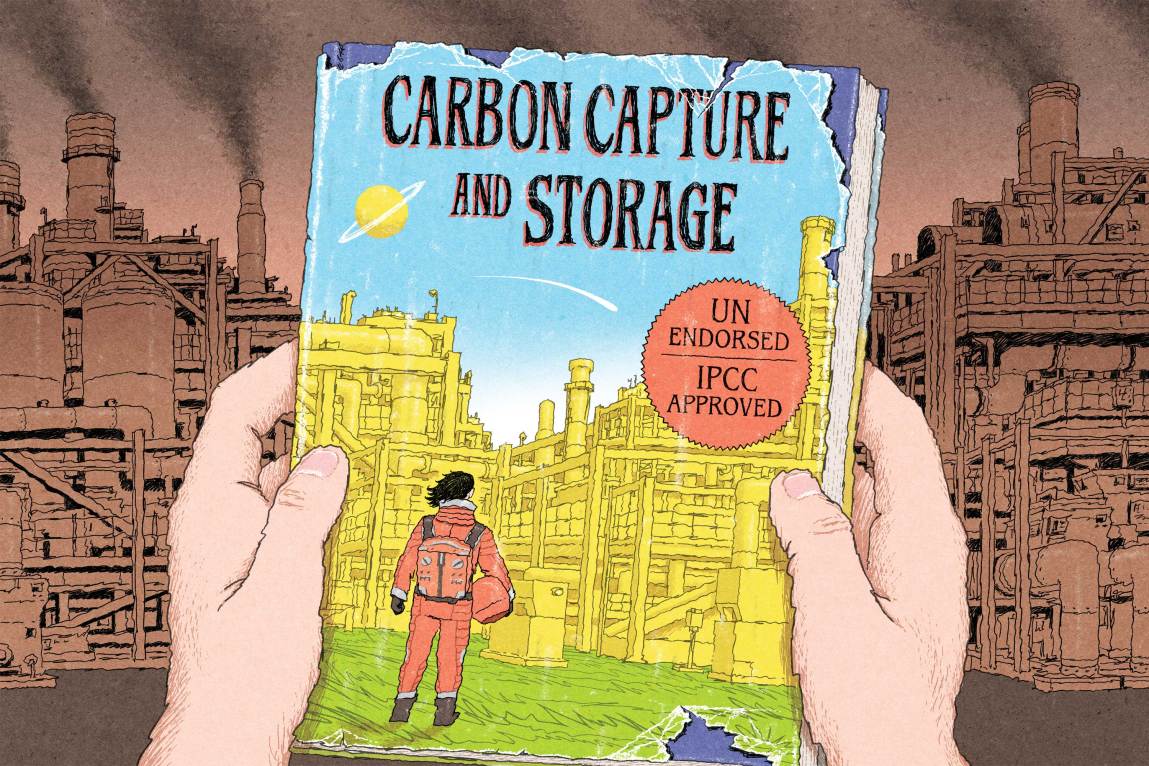
    A pair of hands holds up a worn book titled “Carbon Capture and Storage.” On it, a red badge marked “UN Endorsed, IPCC Approved” is set against a sepia-toned backdrop of a smoggy industrial plant.
    Illustration by Chris W. Kim for ProPublica

    In the spring of 2005, the United Nations convened more than 100 of the world’s top scientists in the medieval town of Oviedo, Spain. They were there to finish writing a paradigm-shifting report about a technology that they hoped could help stop climate change. 

    To celebrate the report’s impending completion, the meeting’s hosts handed out bottles of cava, Spanish sparkling wine, with tongue-in-cheek labels stating that they were to be opened only by those who truly believed it could work.

    Belief was necessary because the technology — carbon capture and storage, or CCS — had barely been tested. The idea was simple: strip carbon dioxide from smokestacks before it could flow into the air and warm the planet. Then pump it into a porous part of the Earth’s crust and leave it there. Forever. 

    The experts in Oviedo had stacks of papers proving that parts of the process worked. But major questions remained about how much space exists inside the Earth to store the CO2, how effectively it could be monitored and whether the poisonous, concentrated gas would reliably stay underground. 

    Tasked with wrangling roughly three dozen of those scientists toward consensus was Sally Benson, a geoscientist from Lawrence Berkeley National Lab who was co-leading the report’s chapter on underground storage of carbon. After a quarter-century of studying how fluids and gases move beneath Earth’s surface, she was an unimpeachable authority on the subject. She was also a savvy and diplomatic leader, skilled at managing rooms full of big egos and big tempers. It was proving handy in a process that had at times devolved into unruly debate.  

    The scientists had clashed for years over what the report should say, first at a meeting in Canada, then in Norway,  Australia and Brazil. The evidence was scant. Three large-scale experiments were underway, but only one — a Norwegian operation that captured carbon from a natural gas field and pumped it under the bed of the North Sea — had rigorously tested permanent storage. There, the injected CO2 astonished engineers when it floated 700 feet upward through a series of geologic formations. To their relief, it hit a ceiling of shale that kept it underground, and the project was deemed a success. But with so little to go on, the scientists warned in their first draft that any broad statement about leakage risk would be “almost meaningless.”

    The researchers were in Oviedo only because Saudi Arabia and other oil-exporting countries had pressured the U.N. to write the report despite the paucity of evidence, according to U.N. officials and records. The oil, gas and coal industries had spent years casting doubt on climate change while quietly fretting that policies to address it would one day put them out of business. The industry, documents show, saw CCS as a way to forestall that outcome, allowing the world to keep burning fossil fuels while simply burying the pollution underground. A U.N. report would bring the technology into the mainstream. 

    In turn, the U.N. hoped such a report would draw the oil-producing nations into its search for climate solutions. So despite objections from some nations and environmental organizations, which warned that the report would distract from the imperative to phase out fossil fuels, the U.N.’s preeminent climate science authority, the Intergovernmental Panel on Climate Change, went ahead. And for the first time, it invited a large contingent of industry researchers to join the scientists in writing the report, as well as several representatives from environmental groups.  Benson’s chapter included authors and editors from Shell, Chevron and Saudi Aramco. 

    The process that followed would make some of the chapter’s scientists uneasy. The IPCC’s procedures stated that reports should assess the existing research on a topic based on peer-reviewed literature and that exceptions must be reviewed and clearly cited. 

    Bert Metz, one of the highest-ranking U.N. officials at the meeting, was pressing the group to come up with more definitive language about CCS’ potential. The report would be better if it could offer hard numbers, even where none existed in the literature: Precisely how many gigatons of storage capacity did the planet likely have? How long would a well-designed reservoir hold the CO2 injected into it? More than a year? A thousand years?

    With so little evidence to work with, David Keith, a Canadian physicist, proposed a workaround: The authors could conduct an “expert elicitation,” taking an anonymous survey about what they expected the evidence to eventually show. 

    At first, not everyone was willing to go along. Some scientists worried that making what amounted to educated guesses would mislead the public, they told Drilled and ProPublica. Benson and Metz, though, both argued that on such an important matter informed advice was better than nothing.

    In the end, the group agreed to take the survey and to keep it off the record —  they would “burn it afterward,” Keith recounted, making no mention of it in the official report. When the meeting concluded, some of the scientists popped their bottles of cava in celebration.

    “It’s not the hard science that you would prefer, obviously,” Metz would later tell Drilled and ProPublica. 

    Five months later, the IPCC published its special report, which would help legitimize CCS for a generation.

    The 431-page document portrayed CCS as a potential savior for the climate that could enable countries “to continue to include fossil fuels in their energy mix.” It stated that using CCS could lower the cost of stabilizing global CO2 concentrations by at least 30% and that if fully supported by policy, it could account for as much as 55% of the world’s efforts to limit climate change through this century.

    It acknowledged that there were still gaps in research and experience with the technology — offering extensive detail deep within its pages about the challenges and uncertainties of piecing together separate but proven steps in the CCS process. But its summary stated that “there are no major technical or knowledge barriers” to storing captured CO2 underground. 

    All of those assertions, however, rested on the critical determinations made by the scientists handling the storage chapter. 

    Benson’s group wrote that the planet offered vast CO2 storage capacity. Storage sites that were well selected and well managed, they said, were likely to retain 99% of the carbon pumped into them for at least 1,000 years.

    Two hands hold a green Champagne bottle with a label that reads, “For true believers only.”
    Illustration by Chris W. Kim for ProPublica

    A Consequential Decision

    The scientists’ conclusions that day in Spain have had profound, compounding consequences.

    The special report has been cited in thousands of academic papers, in legislative testimony and in media coverage validating carbon capture and storage as a realistic solution to global warming.

    When climate forecasters built models, their calculations assumed CCS would work. When governments and corporations began making so-called “net zero” pledges, promising to subtract as much CO2 from the atmosphere as they add, they assumed CCS would work. When policymakers gave energy companies billions of dollars in public funds to develop “clean coal,” they assumed CCS would work. 

    These presumptions shifted the world’s discourse from how to limit carbon pollution to how to remove it from the atmosphere after the fact.

    Enthusiasm for the technology has only grown. This spring, California embarked on one of the world’s largest carbon burial endeavors yet. While President Donald Trump eviscerated most programs addressing the climate, he has expanded subsidies for CCS. There are more than 100 applications for storage sites pending in the U.S. alone. U.N. analyses suggest that to achieve environmental goals, a CCS industry the size of the entire global oil production industry would have to be built by 2050. 

    But 21 years after Oviedo, a staggering gap lies between expectations for the technology and its operational reality. Since 1996, just 12 large-scale geological storage projects have been constructed. Collectively, they bury less CO2 than a single power plant can emit in a year, according to our analysis of sites listed in an International Energy Agency database. Seven of them have faced technical, financial or performance issues. An investigation by Drilled and ProPublica found there’s reason to doubt carbon capture and storage will ever succeed at the scale needed to offer a significant climate solution.

    History is full of audacious technological leaps — moments when visionary engineering solved seemingly intractable problems. Scientists told Drilled and ProPublica that they have devoted themselves to studying CCS in that spirit, hoping a grand techno-fix could help the world solve the climate crisis without a painful overhaul of the global energy system.

    But that ambition did not exist in isolation. It was bankrolled in large part by companies that stood to profit from its success.

    Industry documents show that oil company executives have long seen CCS as a way to hedge against climate regulation, greenwash their brands and preserve their core business. Internal Exxon documents obtained by Drilled and ProPublica show that in 1988, the company determined that any climate research Exxon supported should serve the dual purposes of protecting the value of its oil, gas and coal while preserving the company’s business options; the company would eventually become one of the world’s major funders of CCS research. 

    Later, the American Petroleum Institute would write in internal communications that the industry’s “license to operate” depended on companies lowering climate pollution, and CCS, it wrote, “enables the use of petroleum and natural gas by providing an opportunity to capture and/or offset emissions.” And at a 2023 prominent oil industry conference in Houston, the CEO of Occidental Petroleum, Vicki Hollub, would explain that a novel form of CCS that sucks carbon directly from the air “is going to be the technology that helps to preserve our industry over time.” 

    For many university faculty, the rewards for studying the industry’s favored climate solution have been numerous, opening opportunities, funding papers and raising their profiles. Benson is a clear example. When the IPCC was awarded in 2007 with the Nobel Peace Prize for its climate work, she and her co-authors were recognized among the scientists who contributed. When Stanford University sought a new director for its ExxonMobil-funded climate research center, it tapped her. When President Joe Biden prioritized climate policy, he brought Benson into the White House. 

    Keith, the Canadian physicist, benefited from oil industry interest in a different way: He developed technology to capture CO2. Occidental Petroleum paid more than $1 billion to buy the company he founded.

    There is no evidence that Benson, widely described by colleagues as scrupulous, skewed her scientific findings to suit the interests of her industry patrons, and Benson has described CCS’ flaws in her publications. 

    However, in speeches, presentations and even congressional testimony, she has been a dogged champion of CCS technology, time and again describing it as safe and ready for large-scale deployment, despite having a ringside view to its many setbacks. 

    She has frequently referenced the most affirmative statements from her group’s work in Oviedo as evidence. But the methodology Benson and her co-authors used to reach those conclusions 21 years ago has not been generally understood. When Drilled and ProPublica told prominent climate researchers about the expert elicitation process, several were disconcerted to learn that there was so little scientific basis for the report’s conclusion that 99% of CO2 was likely to remain underground. 

    A survey, said Oliver Geden, a vice chair of the IPCC’s forthcoming climate assessment, was “an inappropriate way of assessing the literature.” 

    Authors “are not supposed to do original research. They’re supposed to just collect what’s out there,” said Roger Cooke, who was a lead author on a subsequent IPCC report. Cooke said expert elicitation, done rigorously, can be valuable, but “just asking a bunch of experts to give their best guess is one of the worst things you can do.”

    In a detailed written response, Benson said she did not believe that the survey undertaken in 2005 violated IPCC norms and said the group’s leadership was aware of the process. She disputed that the approach amounted to an informed guess and said that “there was an enormous amount of data” to draw on. The group was trying to agree on the best language to synthesize evidence detailed deeper in the report. She rejected the notion that her research or career were influenced by industry funding, writing that she has worked “tirelessly for 30 years on CCS and other climate solutions” in a sincere effort to combat an escalating planetary crisis. And, she offered, she views CCS as one valuable tool among many needed to address climate change. 

    Keith said the goal of the expert elicitation was not to seek precision, but to provide a sense of the orders of magnitude of the capacity and risks, “because that’s what’s relevant to public policy.” He said even sites with problems haven’t leaked large amounts of CO2 and that the report’s broad statements “have stood the test of time.” The chapter authors’ confidence in CCS doesn’t suggest “that a bunch of us are tools of the fossil fuel industry.”

    The IPCC declined to comment on specific questions about how the report came about. “We are not in a position to comment on individual recollections,” a spokesperson wrote about the expert elicitation. However, they said that the group’s process was in keeping with the organization’s procedures at the time and that it reflected contemporaneous understanding of the technology. The IPCC did not directly respond to the assertion that the authors conducted what amounts to new research during the writing process, and it did not provide requested records that would detail the scientists’ vote. “The IPCC’s role is to assess the full range of available scientific knowledge,” the statement said. Metz referred to the IPCC’s response. 

    Chevron, Shell and Saudi Aramco did not respond to requests for comment. 

    Drilled and ProPublica spoke with more than 100 experts on carbon capture, climate modeling and influence in academia, including a dozen people who attended the Oviedo meeting. We compiled records of geologic storage tests and surveyed an extensive body of peer-reviewed literature. This investigation is part of a broader examination into how fossil fuel industry funding of climate research has shaped climate policy, solutions and public understanding. It follows our report in June about a BP-funded program at Princeton University and the oil company’s role in crafting one of the program’s most influential climate papers. 

    Since Benson and her co-authors met in Oviedo, weather catastrophes have multiplied, oceans have acidified and the amount of carbon in the atmosphere has soared. In September, the U.N. released an urgent new report declaring that the race to avert disruptive warming has been all but lost. It concluded that “overshoot” — the notion that temperatures will rise above the world’s adopted goal of 1.5 degrees Celsius of warming — is now a certainty. 

    Carbon capture and storage, it said, is one of the only ways to bring those temperatures back down.

    A woman with short blonde hair and glasses wears a black harness fitted with horse blinders over her eyes.
    Illustration by Chris W. Kim for ProPublica

    Looking at a Failure and Calling It Triumph 

    Just a few days before the meeting in Oviedo, BP put Benson and a handful of other scientists on a chartered flight from London to Algeria. Their destination: the world’s second major geologic carbon storage experiment, in the Sahara.

    The British oil giant, along with the state-owned oil companies of Algeria and Norway, had begun to drill for gas at a new field named for a nearby oasis called In Salah. Most natural gas comes out of the ground as a cocktail of methane and CO2. The CO2 must be stripped out and is usually vented into the sky. But at In Salah, the companies saw an opportunity to try out a greener process — one that could become big business.

    Earth’s crust is a layer cake of rock. Some layers, like sandstone, contain honeycombed pores capable of holding CO2, while others, like mudstone, can act as impermeable seals, trapping the buoyant gas underground. 

    That layer cake is impossible to precisely chart from the surface, but engineers sent sound waves into the ground and interpreted what echoed up into rough maps. They learned their target sandstone reservoir sat below a 3,000-foot-thick brick of mudstone they believed would be impermeable. They also learned the sandstone was “tight” — less honeycombed than they had hoped — but still capable of holding gas. So they had begun to inject the CO2.

    The plane landed on a sand-strewn strip circled by jeep tracks and rocky plateaus. A photograph shows Benson, medium height, her blond bob tucked beneath a hard hat, standing in the desert alongside a BP-funded physicist from Princeton named Robert Socolow and seven other men in front of a well that was pushing CO2 under the desert. In Salah had been operating for less than a year but seemed to be going smoothly. 

    Afterward, Benson traveled to Oviedo to finish drafting the special report, which listed In Salah among key sites that “indicate that it is feasible to store CO2” underground at significant scale.

    That assessment has not held up.

    Energy companies had first begun pumping CO2 into the ground commercially in the 1970s, when they realized it would loosen up stubborn crude oil, sometimes doubling an oil field’s output. They called it “enhanced oil recovery,” and though they didn’t try to lock the CO2 in place, much of it seemed to stay underground.

    The idea to use carbon injection as a climate fix came a few years later from an Italian physicist named Cesare Marchetti, who suggested disposing of carbon deep in the ocean or underground. In the 1980s Exxon tried, and gave up on, efforts to develop the idea. And it wasn’t until 1996 when the first large-scale CCS project — the operation in the North Sea — began.

    In a recent interview inside her narrow, fluorescent-lit office at Stanford University’s earth sciences building, Benson said it was shortly after that that she first heard of CCS. A colleague at the Department of Energy had sent her a slide deck by Princeton’s Socolow about the technology. “I was like, ‘I think this is nuts,’” she told Drilled and ProPublica.
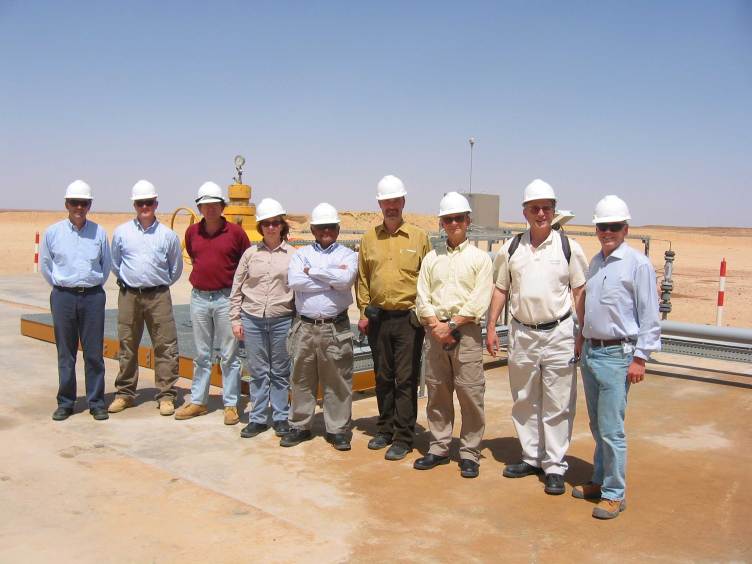
    Nine people wearing hard hats, sunglasses and field clothes stand in a line at an industrial energy site in a desert landscape.
    Sally Benson, fourth from the left, and others tour the In Salah carbon dioxide injection site in Algeria in 2005. Photo courtesy of Robert Socolow

    “I just couldn’t really picture it working at scale.” 

    But, as both an idealist and a pragmatist, she was drawn to the potential for science to solve difficult environmental problems. She made a crude calculation of how much CO2 might fit beneath California and was surprised by the answer: a lot. At least in theory. And it changed her mind. 

    As Benson became one of CCS’ leading experts and champions, she increasingly found herself in rooms full of oil industry veterans. In 2000, she helped establish a partnership between the Department of Energy and companies including Chevron, Texaco and BP. That program had a focused mission: make large-scale geological storage an operational reality by 2015.  

    In 2002, Benson was asked to sit on the advisory council of a new BP and Ford Motor Co.-funded climate research center at Princeton University. At a summit there the following year, Benson expressed concern that focusing on leaks could undermine public support for CCS, according to meeting records and the account of another person in attendance. 

    “Need to present optimistic estimates,” the minutes recapping her presentation say.

    By 2007, Benson was helping to run her own industry-funded research center. A few years earlier, ExxonMobil CEO Lee Raymond, a thunderous voice of climate denial, had put up $100 million of the company’s money to fund climate and energy work at Stanford University. With another $125 million from three other companies, Stanford’s Global Climate and Energy Project became one of the best-funded climate research centers in America. 

    The donation came with strings: ExxonMobil and the other sponsors had veto power over which research projects received funding.

    Students and activists protested the funding structure, accusing ExxonMobil of retracing the path of tobacco companies, which paid for scientific work on obscure causes of cancer as a distraction from their culpability. 

    Benson defended the arrangement ardently and often. ExxonMobil and the other sponsors approved every grant that Stanford recommended, never exercising their veto power, she said. Reporting by Drilled and ProPublica did not contradict that assertion. Benson also pointed to the fact that the program funded an array of research, including on renewable energy.  

    In an interview and written response, Benson said researchers who take funding from oil companies are motivated not by corporate agendas, but by genuine interest in the work. The funding underwrites the inquiry, she said, not its conclusions. Where there’s “alignment,” she added, the industry support can be “amazingly catalytic and helpful.”

    In response to a request for comment, Stanford University directed Drilled and ProPublica to former law school dean Paul Brest, who led a committee that reviewed energy research funding at the school. Brest said that faculty have a right to seek any funding they choose, so long as sponsors cannot direct the work.

    Most important to Benson was that scientists and their students have the opportunity to research matters of great consequence. She has published more than 50 papers on geologic carbon storage since joining Stanford, most of them highly technical evaluations of CCS that reiterated its importance to reducing emissions, and many underwritten by ExxonMobil and other industry sources. “I don’t know anybody else,” she told Drilled and ProPublica, “who would eventually provide, you know, $225 million of funding” to study climate solutions.

    But whether researchers intended to serve their funders’ agenda on CCS or not, some say the effect has been undeniable. “It seems like a credible solution because you have credible people at credible institutions working on it,” said Naomi Oreskes, a Harvard historian of science and an expert in corporate influence. 

    Benson was still getting settled into her new job at Stanford when the project in Algeria ran into major problems. 

    On a 118-degree day in 2007, In Salah’s inspectors heard CO2 whistling through the top of an abandoned oil well nearly a mile from the nearest injection site. Engineers had believed it would take years before the CO2 plume could spread so far underground, but the gas had cracked through the sandstone and found a new path.

    To stop the leak, workers poured cement into the well, plugging it permanently. But soon a second problem arose: Satellite data revealed the desert floor above the injection sites had bulged. When project engineers again used sound waves and other tools to map the layers underground, they arrived at an alarming discovery: Pressurized CO2 had sent cracks a quarter of the way up through the 3000-foot-thick layer of mudstone. If it breached the rest, it could leach into the pan-Saharan aquifer, acidifying a source of drinking water millions of people depend on. 

    BP and its partners eventually summoned Benson and the other science advisers to London. The dangerous gas, they could now see, was moving in ways they had predicted it could not. Nonetheless, the advisers suggested that injection proceed temporarily to see whether it could safely be done under lower pressure and with careful monitoring. 

    But the Algerians had had enough. In 2011 BP and its partners stopped injection, and in 2012 they quietly scrapped the project. 

    Benson would later describe In Salah as a technical failure but a triumph of detection. “It was monitored and people found a problem,” she told Drilled and ProPublica. 

    “Then,” she added, they “learned from it.”

    A crumbling bridge buckles under the weight of an aircraft carrier.
    MIT professor Charles Harvey likens small-scale geologic storage to putting a pea on a bridge, then assuming it can scale. “But will this bridge collapse if I set an aircraft carrier on it? Yeah. It probably will.” Illustration by Chris W. Kim for ProPublica

    More Problems, More Dependence

    As she did in Oviedo, Benson still maintains that the fundamental mechanics of CCS are well enough understood to know that it can work. 

    As proof that geologic formations can handle high-pressure gas, she points to the natural gas industry, which injects large amounts of its product back underground for temporary storage. 

    She also points to enhanced oil recovery. Over the last 40 years, American companies have injected 100 times more CO2 into drilling fields as a way to extract more oil than they have into what CCS industry insiders call “dedicated” CO2 storage reservoirs. There are few reports of accidents or leaks at these sites. 

    Unlike dedicated CO2 storage, though, enhanced oil recovery is less likely to cause pressure to build up underground, because the CO2 pumped in fills space left by the oil that’s forced out. (These sites also can result in a net addition of CO2 in the atmosphere, since they wind up producing still more oil.) 

    The record of the industry’s largest CCS sites — ones designed solely to help the climate — has been far more troubled.

    Around the time In Salah shut down, the world’s third large project — a Norwegian site named Snøhvit several hundred miles north of the Arctic Circle — also met critical obstacles. When injection began in 2008, engineers had calculated the site would have an 18-year capacity. But they had radically overestimated how much CO2 it could absorb and had to relocate the project after just three years.

    In the U.S., a decadelong effort to build a “clean coal” power plant  outfitted with CCS proved impossible within a reasonable budget and was abandoned in 2015 — but not before the government had spent $378 million in taxpayer money. Benson was on the project’s advisory board for part of that time.

    That year in Canada, Shell opened a $1 billion carbon capture and storage facility — also largely paid for by the country’s taxpayers — connected to open-pit oil sands mines. The industry routinely promises that plants like this one, called Quest, capture at least 90% of emissions. But at Quest, once the energy required for the capture process itself is accounted for, the capture rate instead has hovered around 68%, according to a report by the research group Institute for Energy Economics and Financial Analysis. It has also caused hundreds of microearthquakes.

    Shell did not respond to a request for comment.

    As one carbon storage project struggled after another, Benson and other academic researchers continued to insist they could flourish. 

    In a keynote speech at a 2018 conference in Sweden, Benson showed a slide with a map of CCS facilities across the world, most of which were enhanced oil recovery sites. Her map included In Salah, which had shuttered. And it included another project, in Australia, which had yet to open. “The operations have been very good at all of these projects. And they’ve gone well in terms of safety,” she said.

    She also showed a slide pointing to the 2005 U.N. special report’s statement that an “appropriately selected,” well-managed reservoir would likely retain 99% of its carbon for more than 1,000 years. “This was an expression that if you find the right site, the CO2 should be permanently stored,” she said.

    In a written response, she said she continues to cite the 21-year-old special report’s conclusions on leakage because “the methodology was sound then and remains so.” Benson said that she is careful to qualify her characterizations and show evidence in her presentations, and that during her presentation in Sweden she did so. She did not directly address the status of projects portrayed in her map.

    When the Australian project, called Gorgon, did open the following year, it turned out to be the biggest CCS fiasco yet. Australia had allowed Chevron, ExxonMobil and Shell to drill a major new natural gas field there with the requirement that the companies buried at least 80% of the CO2 that came out of the ground with it. It was billed as the world’s largest CCS operation. 

    Instead, it has been plagued by clogged injection wells and underground pressure spikes. In their operating year ending in 2025, the companies were able to inject just a quarter of the CO2 collected there. Since they vent the remainder, Gorgon, once billed as a model for climate solutions, became the largest single source of industrial carbon pollution on the continent.

    “Like any pioneering endeavour, it takes time to optimise a new system to ensure it performs reliably over 40-plus years of operation,” a Chevron spokesperson wrote in an emailed response. “We realise that people refer to the challenges at Gorgon in an attempt to discredit CCS, however, as we have shown, we can capture and store greenhouse gas at scale.” Shell and ExxonMobil did not respond to requests for comment.

    An overturned paper cup with a green label reading “Carbon Net Zero,” spilling pink ice cream topped with rainbow sprinkles next to a small pink spoon.
    Illustration by Chris W. Kim for ProPublica

    An Idea Takes Root

    While operators struggled to prove CCS could be viable, the world became dependent on it working. 

    As soon as the IPCC published the 2005 report, climate modelers that help assess the most economic ways to limit global warming began folding CCS into their calculations.

    They projected not only that CCS could stop billions of tons of emissions from reaching the sky, but that it could suck old carbon pollution out of the atmosphere. They adopted a theory that supposed vast fields of switchgrass or fast-growing willow could absorb carbon into their stalks and leaves, and when those plants were harvested and burned for electricity, their emissions, too, would be captured and buried. 

    The modelers incorporated this subtractive approach so prodigiously that, on paper, they could reverse climate change. Global temperatures could overshoot targets in the short term, so long as enough carbon was eventually sucked back out of the air to bring those temperatures back down. 

    World leaders embraced the wiggle room this theory provided them. When they signed the U.N. Paris Climate Agreement in 2015, pledging to keep warming to 1.5 degrees Celsius, they counted on these so-called negative emissions among the key tools that could make it possible. In 2018, when the IPCC published a special report on how to reach that goal, 89 out of its 90 scenarios included using large-scale CCS. 

    Now, in its latest report, the U.N. says that it is virtually impossible to still get to a 1.5 C future — or anything close — without removing carbon from the atmosphere. There are several ways to do that — reforestation and the use of minerals spread on fields to absorb carbon, for instance. But these methods are either small scale or even less proven than CCS. 

    By 2015, the tantalizing idea of “negative emissions” was showing up in new, mainstream ways. “Net zero” pledges to one day offset carbon emissions began rolling in from most of the world’s nations, as well as cities like Omaha, Nebraska; the band Coldplay; ice cream chains; funeral homes; and even ExxonMobil.

    But real-world CCS projects have not met the moment. 

    To scale the technology as much as U.N. analyses suggest is needed to limit warming to 2 C would require not only a technological feat but almost unimaginable resources, Drilled and ProPublica found. Carbon dioxide injection would have to almost immediately increase by more than 400 times. That would require more than 2,000 new geological waste sites to be established — a new large-scale CCS project put into operation every four days, on average, for the next 25 years.

    To move the CO2 to those sites would require 68,000 miles of specialized pipeline in the U.S. alone. Globally, at least 85 custom-built tankers would be needed to carry the high-pressure gas safely across oceans. Just four exist.

    And if all of that were accomplished, the effort would come at an almost inconceivable cost: tens of trillions of dollars.

    A hand gripping a broken magic wand with a bent tip emitting a wisp of smoke.
    Illustration by Chris W. Kim for ProPublica

    “Fuck, OK, It’s Harder Than We Thought” 

    At Benson’s office at Stanford, in a building where rocks painstakingly collected from field sites fill cabinets in the halls, the Society of Petroleum Engineers hosts Friday socials — beer and snacks provided — and the adjacent courtyard is named after the oil company Arco. 

    Inside, propped on a stack of boxes, is a framed copy of Biden’s keystone climate legislation, the Inflation Reduction Act. On it, national climate adviser Ali Zaidi scrawled in blue sharpie, “Thank you, Sally, for helping truly transform our energy & climate future!” 

    Benson returned to Stanford after a nearly two-year stint in Biden’s White House as the head of the energy division of the Office of Science and Technology Policy, where she says she provided periodic scientific advice as the act was being pushed through Congress. One of the most ambitious climate policy efforts in history, it offered a large set of incentives for CCS, which the fossil fuel industry had lobbied for intensely.

    But even while oil industry leaders have pushed the world to embrace CCS, behind closed doors, they have remained skeptical of its potential as a climate solution. 

    In 2007, as ExxonMobil funded Benson’s center at Stanford, its former CEO Raymond told a room full of industry leaders that carbon storage might be considered “kind of the Holy Grail.” Executing it, though, would be “a whole different animal” than injecting carbon underground for enhanced oil recovery. “You can’t assume that’s going to happen. And the cost is going to be very, very significant.”

    A 2011 internal slide deck from BP stated that while carbon storage would allow fossil fuels to remain the world’s dominant source of energy, “the pace of CCS development has been slow and the future pace remains uncertain.” And in a 2018 internal presentation, ExxonMobil predicted hardly any CCS would be deployed by 2050, even as it modeled that global CO2 emissions from energy production would continue to skyrocket. 

    Yet the industry saw brand value in encouraging CCS anyway. An ExxonMobil document from 2021 describes a public relations campaign to persuade the political and financial “elites” to “believe ExxonMobil is committed to helping solve climate change,” in part by proving its efforts on CCS will “play an indispensable role” in a greener economy.  

    For her part, Benson still has faith in the technology’s viability, despite the failures. “These are big projects, right? The idea that everything goes exactly according to plan, especially for these first-of-a-kind projects — it’s unrealistic.”

    As proof that CCS is on the rise, she pointed to 77 operating CCS projects identified in a report by the industry group the Global CCS Institute and said that another report demonstrated a tenfold growth in CO2 injected underground since 2005.

    When ProPublica and Drilled reviewed that same data, however, and excluded the enhanced oil recovery projects, we found just eight operating large-scale carbon burial projects on that list (10 using the group’s more recent data), and half the increase in annual injections that Benson stated. 

    Experts interviewed for this story insisted — often in an anguished timbre — that CCS simply must work because decades of delay have foreclosed other paths to a stable climatic future. 

    But just because the world now needs CCS to work doesn’t mean it can. 

    “It’s always some issue,” said Glen Peters, a senior researcher at the Cicero Center for International Climate Research in Oslo, Norway. “I think there’s been a lack of willingness for the community to say, ‘Fuck, OK, it’s harder than we thought.’”

    The latest CCS effort got underway this spring, in California, when the oil company California Resources Corp. began injecting CO2 beneath the state’s Central Valley. 

    California — long a vanguard of environmental policy — has embraced the technology. In 2021, as it was formulating a plan for how the state should reach its climate targets, the California Air Resources Board invited Benson to give a presentation on the role CCS could play. 

    “The fraction of CO2 retained underground is likely to be very high,” she told the board, again pointing to the 2005 special report: “This study said 99% over 1,000 years.” 

    The board set the ambitious goal of burying more than 100 million tons of CO2 a year by 2045, more than all the carbon that has ever been geologically stored around the world combined. Since it opened in May, the new project has injected just 7% of its advertised capacity, but California Resources Corp. is now seeking permits for eight more CCS projects across California, and other oil and gas companies have proposed four more, including two that Stanford is directly involved with.

    California Resources Corp., in a written response, said the company is injecting the amount it had planned for early operations and will increase to capacity as the project develops. 

    Could California truly be burying 100 million tons of CO2 a year by 2045? For the first time, in an interview, Benson was hesitant to commit. “I think it’s very challenging,” she said. “That’s a lot of infrastructure, a lot of money, a lot of projects.” 

    Asked a second time, she once again demurred. “Oh gosh. If we really set our mind to it. If we could wave a wand.”

    Source: ProPublica · 2026-10-30
  • This Oil Company Is Linked to 1,000 Pollution Incidents and Other Violations. Oklahoma Never Punished It.

    This Oil Company Is Linked to 1,000 Pollution Incidents and Other Violations. Oklahoma Never Punished It.

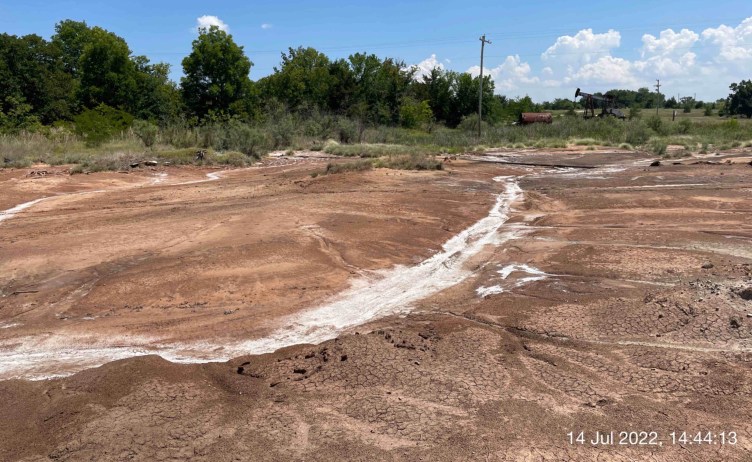
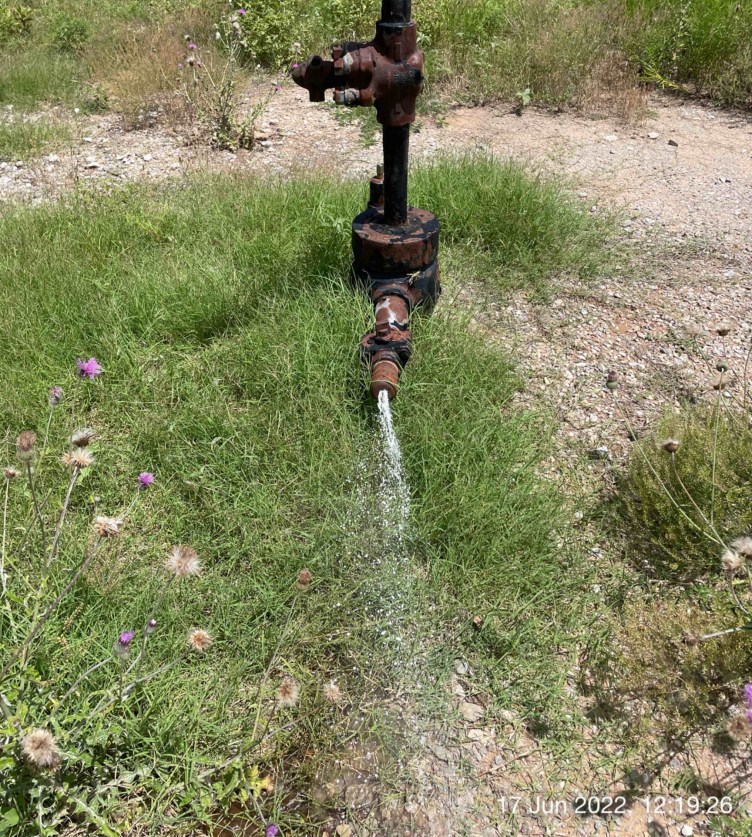
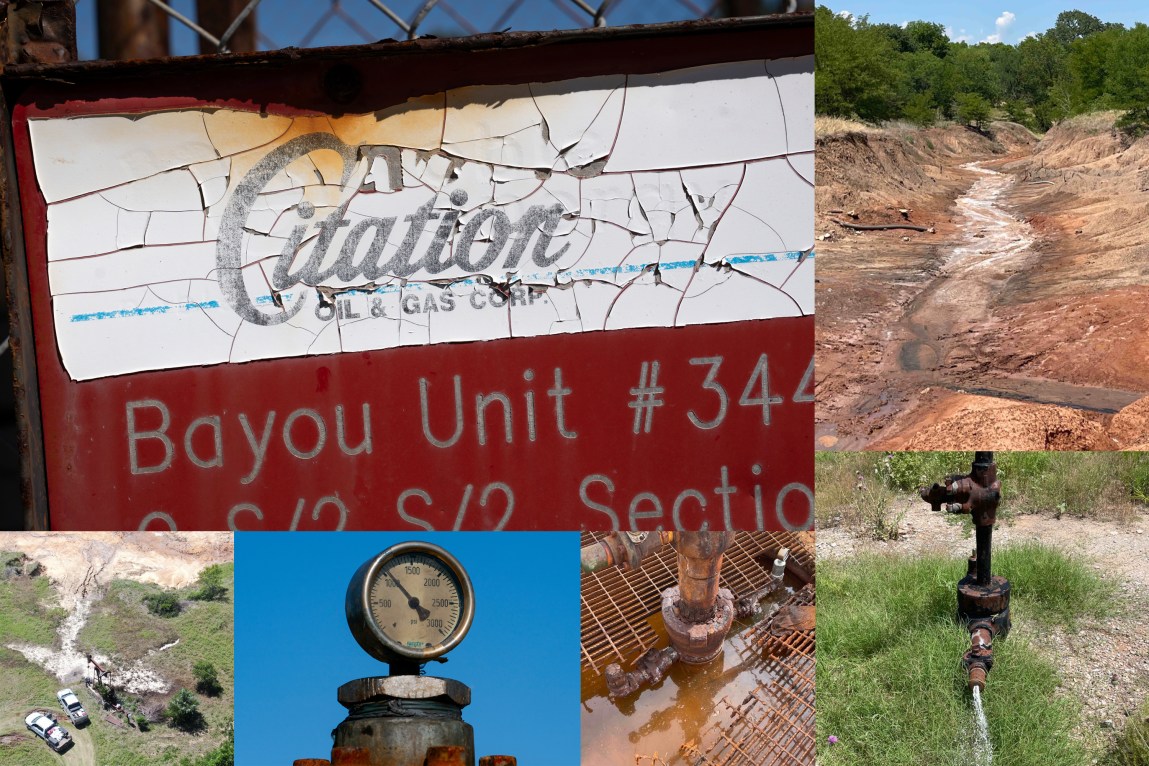
    A grid of photos show a cracked sign with the words “Citation Oil & Gas Corp.” and “Bayou Unit”; a pressure gauge; water pooling under a rusted metal grid; a pipe emitting water; and white streaks of salt on two patches of land.
    Photo illustration by Jovelle Tamayo/ProPublica. Source images: Nick Oxford for ProPublica, courtesy of Mike Faulkner, and obtained in an open records request from the Oklahoma Corporation Commission.

    In June 2023, staff at an Oklahoma regulatory agency were fed up. The state isn’t known for cracking down on oil and gas companies for polluting the environment, but for over a year, the staff had been building a case to punish Citation Oil & Gas, one of the nation’s largest privately owned oil companies. 

    About 30 miles north of the Texas border, toxic wastewater was gushing from the ground outside the small city of Ardmore. In the mile-wide oil field known as the Bayou, an oily sheen glistened on creeks and long streaks of salt scarred the land. The so-called purges, bubbling up among stands of oak and walnut trees, also threatened drinking water sources, drawing attention from the Environmental Protection Agency, according to a federal report.

    State investigators pinned the blame on Citation’s injection wells, which pump wastewater from oil production back underground at high pressures and volumes in order to produce more oil. But this injection came with risks. 

    Days earlier, the agency had asked Citation to cut injection pressures in half. The company refused, prompting staff at the oil division of the Oklahoma Corporation Commission, the state’s oil and gas regulator, to recommend an official punishment through the agency’s court system.

    “This will be an important case to get some of these purges stopped and particularly concerning Citation’s operations,” Danny Ray, an agency manager at the time, emailed his colleagues.

    He restated the urgency three days later in an email to oil division leaders and Citation officials: “We consider this an emergency situation that needs to be addressed promptly.”

    To stop the flow of wastewater, the agency temporarily shut down the Bayou’s 22 injection wells — all but three of which were owned by Citation — kicking off a yearlong fight over the terms under which injection could restart. 

    Under state rules, companies must not pollute, and oil and gas regulators at the Corporation Commission can revoke injection permits and issue fines to those that violate regulations. 

    But agency leadership ultimately did not follow staff guidance to punish Citation through the commission’s administrative law court. Instead, in April 2024, state officials, including the oil division’s then-Director Robyn Strickland, would allow Citation to restart injection at higher-than-recommended pressures. 

    Agency leaders’ reluctance to punish Citation reflects a longstanding pattern of Oklahoma regulators letting oil companies contaminate drinking water, farmland and people’s homes with scant consequences, The Frontier and ProPublica have found in a yearlong investigation. 

    In fact the commission has no record of ever fining or completing an enforcement case against Citation, the company named more than any other in the agency’s database of pollution reports and other rule violations, listed more than 1,000 times over the past decade. That’s hundreds more incidents than any other operator, including comparably sized companies. In recent years, purges linked to Citation include some of Oklahoma’s longest, most damaging oil field pollution events.

    Current and former employees at the Oklahoma Corporation Commission describe top agency officials as wary of going after habitual violators like Citation. Citation has become Oklahoma’s second-largest well owner after taking over collections of aging, low-producing wells from oil giants that have largely left the state for more lucrative oil fields in Texas and elsewhere; the company acquired its Bayou wells in 2010. Regulators treat Citation gently, current and former agency employees say, because the company holds onto aging wells that are worth little — wells that could easily become a financial liability for the state if Citation were to sell or walk away from them. 

    A spokesperson for the Oklahoma Corporation Commission declined to answer questions about the regulatory agency’s handling of Citation’s record, noting the possibility of future enforcement actions or litigation involving the company. 

    “The OCC Oil and Gas Conservation Division must remain mindful of its regulatory and adjudicatory responsibilities and avoid making public statements that could potentially affect future proceedings or legal considerations,” spokesperson Jack Damrill said in an email. 

    Strickland has since left the agency for a job as chief projects officer for the Interstate Oil and Gas Compact Commission, a quasi-governmental organization that often advocates for industry interests. She did not respond to requests for comment.

    A Citation executive declined to comment in response to written questions. 

    Regulators in other jurisdictions have at times come down hard on Citation, which owns wells in 11 other states. In 2017, the company settled with the U.S. Department of Justice for $2.25 million over allegations of underpaid royalties from drilling on federal land in Wyoming, though the settlement did not rule that the company was liable in the case. And in 2025, Utah reached a $700,000 settlement with the company after a crude oil and wastewater spill. Texas and Colorado have also fined Citation in recent years for violations. 

    “Citation has been the thorn in my side for a long time,” said a current manager at the Oklahoma agency who spoke on the condition of anonymity to protect their job. “They just operate however they want. They’ve had major pollution issues, and you can’t really touch them.”

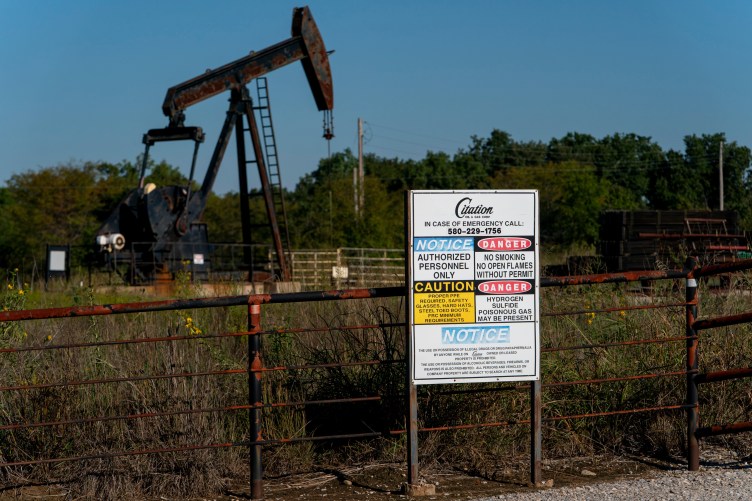
    Signage for Citation Oil & Gas on a fence in front of a field with an oil well.
    A Citation Oil & Gas oil well in the Bayou. The company is named more often than any other in Oklahoma’s database of oil field pollution incidents and other rule violations. Nick Oxford for ProPublica

    Preparing a Case for Punishment

    In November 2023, five months into the wells’ shutdown, Citation was getting antsy. Its officials had repeatedly demanded permission to restart their wells and had even challenged the state through the commission’s court to prove the connection between the Bayou purges and its operations. Regulators and company officials packed into a small conference room in the Oklahoma Corporation Commission’s Oklahoma City headquarters to discuss how that might happen. More than a dozen others joined via video. 

    On the state’s side, a team of consultants took the lead, displaying a report with evidence that tied Citation’s injection to the wastewater that gushed to the surface in the Bayou. The state had hired the environmental engineering firm Halff earlier that year on a $550,000 contract to investigate the fast-growing number of oil field wastewater eruptions around Oklahoma. The consultants and agency staff presented a unified front in identifying the problem: Citation’s nearly two dozen Bayou injection wells were operating at unsafely high pressures, according to a video recording of the meeting obtained by The Frontier and ProPublica. Over the years, the injected wastewater had shattered underground rock layers, allowing the toxic fluid to spread uncontrollably. 

    “You definitely have overpressurization,” Carolyn May, Halff’s director of environmental remediation, told Citation officials as she presented her team’s calculations, which were based on well records, field data collected by agency staff and a standard set by the federal government. “It’s allowing that rock to fracture.”

    The consultants were meant to serve as independent experts to mediate any disagreements within the agency over what to do about the wastewater eruptions, according to current and former commission officials.

    In the meeting, May and agency staffers ticked off a number of problems with Citation’s wells that regulators had overlooked for years. Not only had they allowed the company to inject wastewater at excessive pressures, regulators had also given out more than a dozen exemptions to testing and well-construction standards that endangered groundwater. Several wells had checkered compliance records; agency documents noted that one had been in “perpetual violation” of its permit for “nine years running,” injecting tens of millions of gallons of wastewater beyond the legal limit. 

    Citation’s active wells weren’t the only issue, they said. Nearby were dozens of abandoned, unplugged wells that offered the pressurized wastewater open pathways to reach shallow freshwater sources and the surface. May singled out a handful of those wells that especially troubled her team, and oil division deputy director Mike McGinnis suggested that Citation permanently plug them.

    May noted that imaging below the surface by agency staff showed a distinct plume of highly polluted wastewater rising from deep underground, where injection took place. This posed a threat to the freshwater sources beneath the Bayou, she said — water that some residents rely on for drinking and cooking. “That’s our primary concern here.” 

    The consultants were not alone in this fear. Earlier in 2023, the Environmental Protection Agency had warned of “potential endangerment to underground sources of drinking water” in the Bayou from oil field injection. Groundwater tests taken near the purge sites showed evidence of oil field wastewater pollution, including high levels of salt, bromide and the carcinogen benzene, which exceeded the EPA drinking water standard by five times.

    For its part, Citation came to the meeting armed with a very different argument: the pollution was caused by a combination of historic oil drilling and recent rainfall — not by the company. 

    It was a claim the company had repeatedly made, especially in the months since the agency had shut down its wells. To bolster its case, the company’s consultants had produced a series of detailed reports citing the area’s history of oil production, along with Citation’s own water testing data. Oil drilling began in the Bayou in the 1920s, a time of lawless extraction, and for decades, companies would simply dump their wastewater into large, unlined pits, allowing the fluid to seep into the ground. Old pollution that saturated the land was being flushed to the surface by rainfall, the reports argued. Each one concluded that there was no link between Citation’s injection and the Bayou pollution. 

    At the meeting with regulators, company representatives reiterated these arguments. Jeff Lewis, a Citation engineering manager, assured the agency that the company’s data indicated that its wells were not behind the Bayou purges and that it could safely inject at pressures higher than Halff had recommended. He proposed that the company restart injection on its deeper wells because they were separated by layers of rock from the abandoned wells that Halff identified as likely pathways for the wastewater to surface. 

    Agency staff did not buy this. In prior internal meetings and emails, staff and consultants had criticized Citation’s water sampling practices as biased in favor of the company’s conclusion that rainfall was causing old pollution to resurface. There was no question that old pollution covered the Bayou, but in recent purges, wastewater had pushed to the surface in significant volumes, covering creek beds in layers of snow-white salt. Old pollution would not be this forceful, according to internal documents written by agency staff.

    “A purge is created by pressure and is not due to old pits,” Ray, the agency manager, wrote in a memo distributed months earlier within the oil division that urged agency leaders not to allow Citation to restart injection.

    May, the agency’s consultant, echoed these rebuttals during the meeting and said the state’s evidence pointed to an injection problem. She concluded her presentation with a warning: Citation must change its injection practices in the Bayou. 

    “If y’all want to start injecting again,” she told company representatives, “I think we’re going to have to look at those pressures and the volumes very carefully.”

    The meeting ended without a resolution.

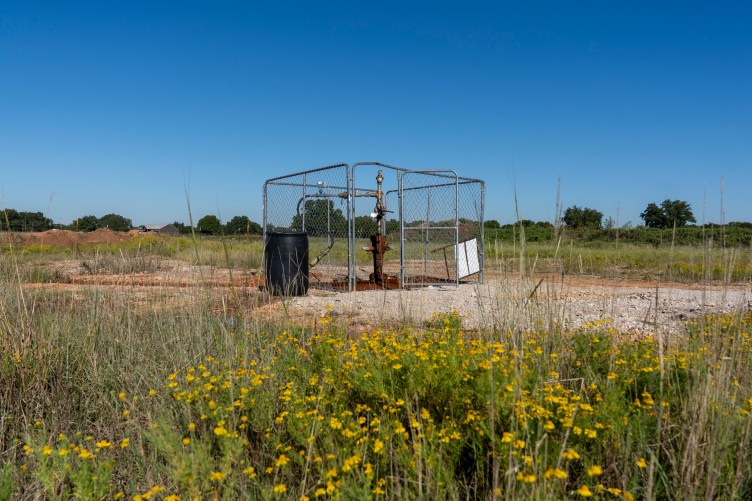
    A structure made of pipes, with the lower ones deeply rusted, rises in a field with yellow flowers. Chain-link fencing encloses a small area around the pump.
    An injection well in the Bayou Nick Oxford for ProPublica

    “They Wore Us Out”

    Over the next four months, Citation and state regulators would continue to debate the terms of restarting the Bayou. Neither side budged. By the time they gathered for another face-off in March 2024, oil division leaders appeared weary of fighting.

    May and the Halff geologists from the consulting firm began by again insisting that Citation substantially reduce pressures in order to be allowed to restart a handful of wells. But even as they presented their case, Citation representatives including Lewis, the engineer, and Bob Redweik, a company vice president, repeatedly spoke over them. After more than two hours of disagreement, Redweik and Citation’s attorney ended the meeting abruptly. “We’re not going anywhere,” Redweik said.  

    Several top oil division officials attended, including Strickland, McGinnis and commission attorney Tyler Trout. They remained largely silent throughout. 

    The next week, Trout tried to end the impasse by passing along a memo from Citation. 

    “In an effort to reach an agreement and move this situation forward,” Trout wrote to top oil division officials and May, “would we consider meeting Citation in the middle as far as recommended injection pressures are concerned?” 

    May stood firm. “From Halff’s standpoint, our recommendations aren’t going to change,” she responded, adding that it would ultimately be up to agency leaders. 

    In early April, the agency went with a compromise, approving a plan to bring seven of Citation’s 19 Bayou injection wells back online. The company would be able to inject at pressures higher than Halff had recommended, though less than Citation had requested.

    Current and former employees say that the decision to restart injection came from the top of the oil division, including Strickland and McGinnis, among others — bypassing staff who objected to the plan. Like Strickland, McGinnis did not respond to requests for comment.

    “They wore us out,” said an agency manager who spoke on the condition of anonymity to protect their job. 

    Before injection restarted, three oil division officials chosen by Strickland conducted a walkthrough of the Bayou with Halff and Citation, according to an email from Strickland. The rest of the division was left in the dark. That same day, a pollution abatement manager noted in an email to the commission’s general counsel that agency critics of the plan had not been invited.

    Around the time agency leaders allowed Citation to restart injection in the Bayou, staff were drafting an extensive contempt case against the company for rule violations in other parts of the state, according to public records obtained by The Frontier and ProPublica. Field staff and consultants were still turning up considerable problems related to Citation’s injection, including excessive pressures at the sites of destructive eruptions of wastewater. The staff complaint called for the agency to issue fines and to terminate well permits. But oil division leaders never signed the paperwork for the case. 

    There was ongoing trouble in the Bayou as well. Weeks after Citation restarted injection, field staff discovered a “severely contaminated” private water well nearby that had been polluted by oil field waste. Testing showed high levels of salt as well as the “highest levels of bromide that we have ever sampled,” according to internal emails, referring to another chemical constituent of oil and gas waste that poses a public health risk. (The landowners declined to comment because of an ongoing lawsuit against Citation, but according to court records, they do not drink from the well. The company, which has fought the family’s claims, says in a court filing that it has spent hundreds of thousands of dollars addressing the pollution on their land as part of a plan approved by the commission.) 

    By the end of 2024, oil division leaders had allowed six more Citation wells back online, bringing the total to 13. And the next spring, the agency closed the Bayou investigation, along with several others related to Citation, without taking further action.

    Collection of New Complaints

    In the year and a half since the Bayou case closed, several of the oil division staff who had pushed agency leaders to punish Citation have left the agency, as have a handful of senior leaders. Staffers told The Frontier and ProPublica they grew frustrated with the agency’s unwillingness to crack down on repeat corporate offenders that agency staff had spent months — at times, years — investigating.

    Tracy Case, an attorney for the oil and gas division, admitted as much at a national conference for oil regulators in Oklahoma City in May. “I’ve been there 11 years doing this and we’ve never pursued what we call our ‘bad actors,’” she said, according to a recording of a meeting obtained by the news outlets. She explained that the oil division is extremely short-staffed while dealing with hundreds of potential enforcement cases at any one time. An agency spokesperson declined to comment on behalf of Case. 

    Less than a third of the roughly 750 enforcement cases filed by the oil division in the agency’s administrative law courts since 2023 have resulted in punishment so far, according to a review by The Frontier and ProPublica. The average fine given out by the agency was about $1,700. The most common punishment was a $500 fine, combined with using company insurance money to plug unused wells.  

    Neither the Oklahoma Corporation Commission nor Halff responded to questions about whether the consulting firm still has a role at the state agency.

    At the Bayou, nearly all of Citation’s wastewater injection wells are back on, many operating at pressures beyond Halff’s recommendations. And industry data indicates that Citation has ramped up oil production to pre-shutdown levels even as evidence of new purges continues to emerge. In September, fresh layers of salt — residue of the wastewater — covered the dirt near yellowish puddles of standing water. Nearby, streaks of oil shone on the ground. The preceding weeks had been hot and dry, with hardly any rain. 

    In early October, an agency field staffer requested that Citation install a specialized well in the Bayou to pump out polluted groundwater, according to a report in the agency’s incident database. 

    A slew of new pollution complaints against Citation have continued to appear in that state database, including more than 60 spills and leaks at well sites over the past year. Among the complaints were three purges that blew out in southern Oklahoma over the last three months. All those investigations remain active, according to state records.  

    Another ongoing complaint against Citation originated about 10 miles east of the Bayou, where a rancher named Mike Faulkner noticed an unusual amount of salt water gurgling to the surface and flowing down a creek on his land in April. Nearby, dozens of Citation wells pump wastewater underground.

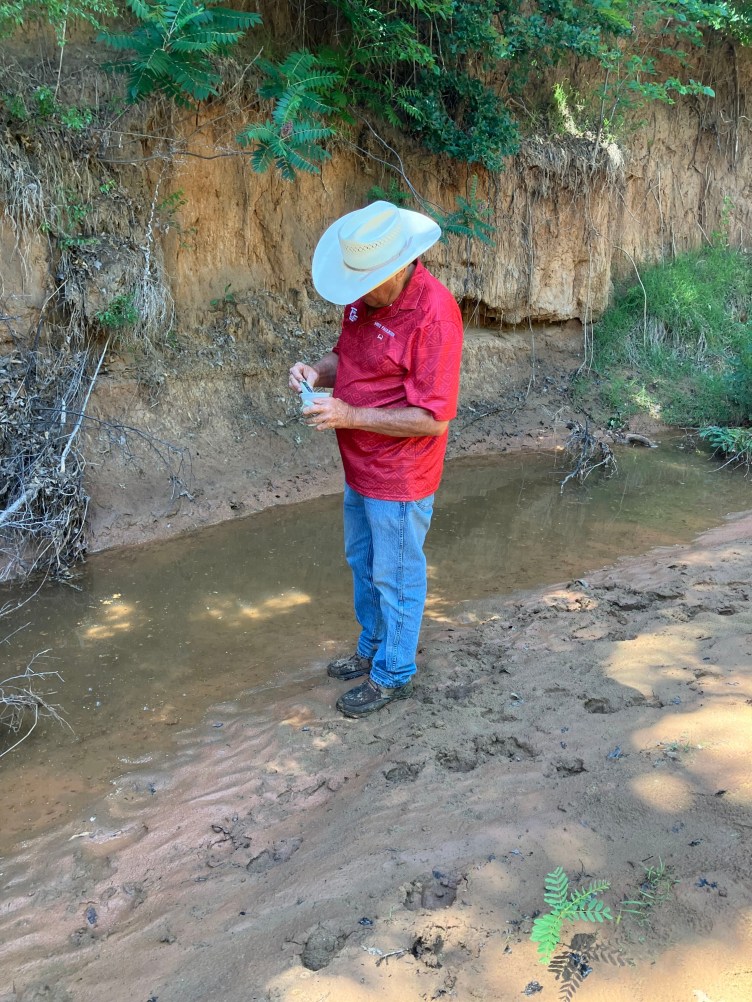
    A man in a red shirt and cowboy hat holds a small device with its end in a cup while he stands on muddy ground.
    Rancher Mike Faulkner measures the water quality on his property in June. Nick Bowlin/The Frontier

    In response, Citation once again blamed the pollution on old drilling practices, according to an email from one of the company’s engineers to the Oklahoma Corporation Commission.

    Nevertheless, the agency told the company to temporarily shut down some of its nearby injection wells, and, according to Faulkner, the purge on his land dried up for the first time in years. 

    “That tells me that they know the why and the how of that saltwater purging,” he said in July. 

    The agency also instructed Citation to install monitoring wells to test for pollution and to build a pit with a rock dam on Faulkner’s land to catch the polluted water, along with a fence to keep the cattle out.

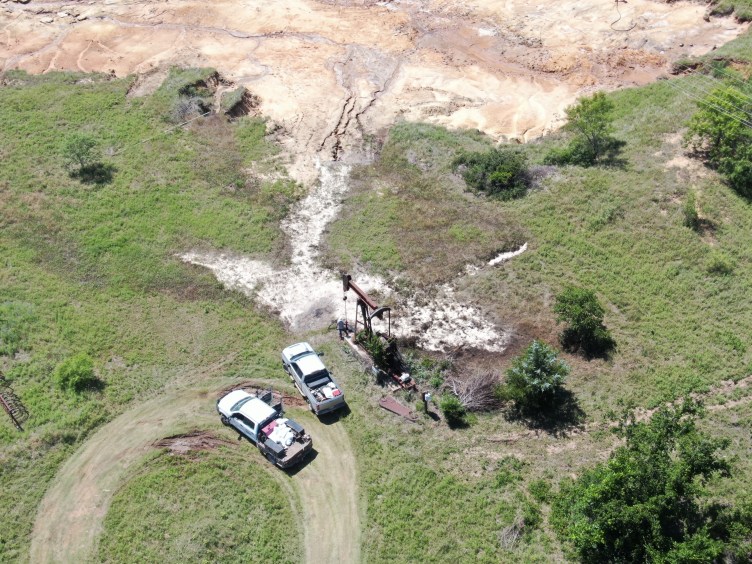
    An aerial photo of two trucks parked on grass near an oil well with white salt covering the area downhill from the well.
    Faulkner’s land was scarred by salt water and contaminated by oil after a Citation well blew out in June. Courtesy of Mike Faulkner

    But in the months since, the agency has given Citation multiple extensions on the deadline to build the dam and the fencing. In September, Faulkner learned that the agency granted Citation yet another extension — until December, seven months after his initial pollution report. 

    As of October, he said, the wells where the state had asked Citation to pause operations are injecting — at reduced pressure. 

    Faulkner said he is fed up with Citation’s yearslong pattern of degrading his pastures. But he blames state officials for their unwillingness to rein in the company. 

    “They’re like a spoiled kid,” he said. “They’ve just gotten away with it for a long time.”

    Source: ProPublica · 2026-10-27

  • Nuclear Weapons Waste Made Workers Sick. Despite a Law Meant to Help, the DOE Keeps Fighting Their Claims.

    Nuclear Weapons Waste Made Workers Sick. Despite a Law Meant to Help, the DOE Keeps Fighting Their Claims.

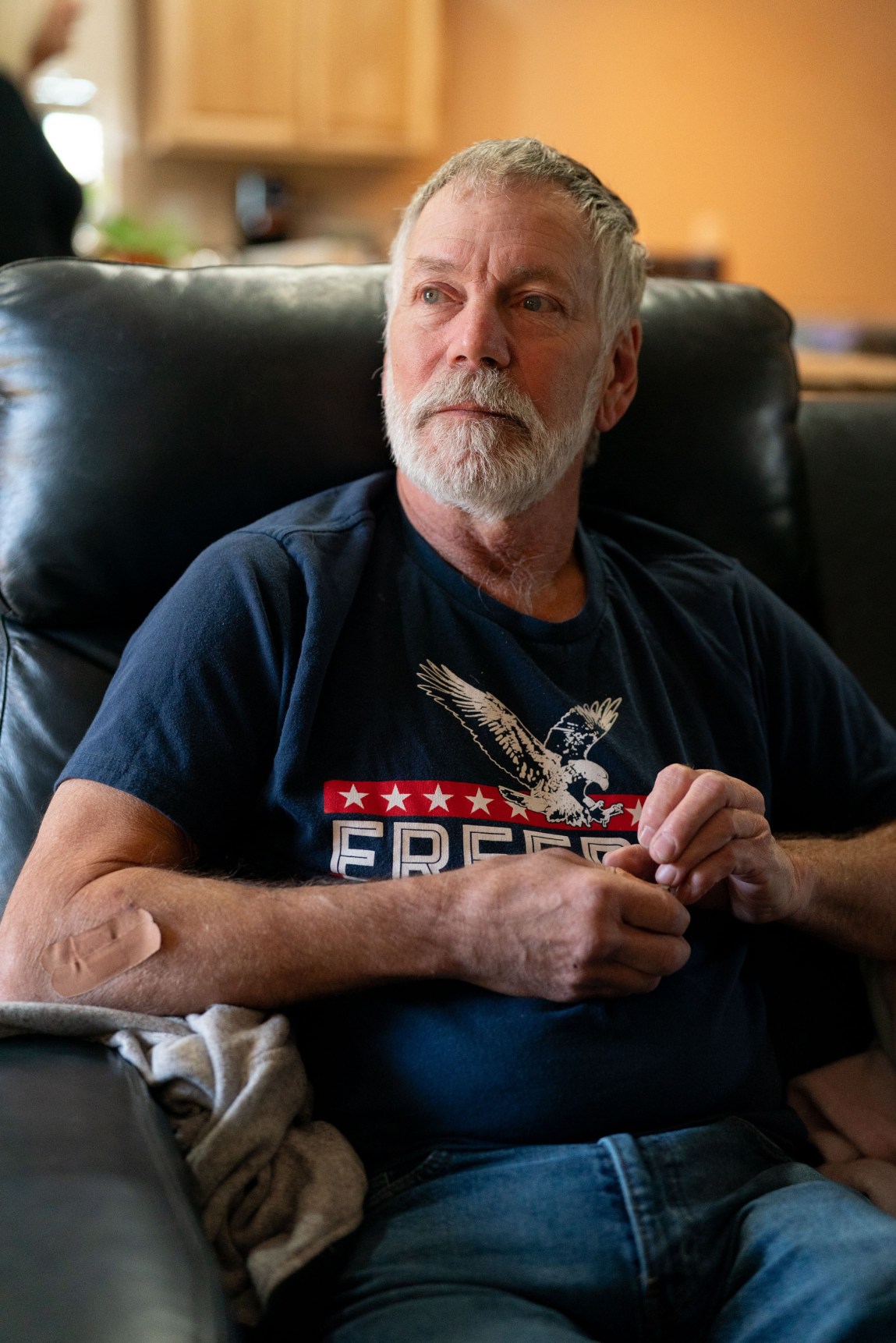
    A white man sits in a leather chair with his hands in front of his chest.
    Lonnie Rouse was diagnosed with a neurological disorder that medical experts attributed to exposure to chemicals during his work cleaning up the Hanford nuclear site in Washington. Margaret Albaugh for ProPublica

    Lonnie Rouse shuffled into a wood-paneled conference room at the Washington state Capitol in March 2018. It had been nearly a decade since medical experts diagnosed him with a neurological disease they attributed to his exposure to chemicals at work. In the time since, he had acquired a stutter, begun limping and lost several teeth biting into a banana.

    For nearly 20 years, Rouse had packaged plutonium and monitored radioactive waste at the Hanford Site, a now-decommissioned Department of Energy nuclear weapons production plant in south-central Washington and one of the most contaminated nuclear sites in the country. Tanks full of radioactive sludge exposed him to at least 48 potentially hazardous chemicals. The worksite was so toxic, he said, that the floor once melted the rubber off his boots. 

    Rouse was among the thousands of workers responsible for the ongoing environmental cleanup at Hanford, which has been underway since the DOE shut down the last reactor in the late 1980s. Congress has acknowledged, based on voluminous studies, that radiation at DOE sites poses health risks to workers.

    Over time, some people at Hanford became so sick they could no longer work. Like Rouse, they filed for workers’ compensation. The DOE consistently challenged their claims and tried to shift the blame onto the workers themselves. 

    By the time Rouse took his place behind then-Gov. Jay Inslee, he was desperate. His 2009 workers’ compensation claim had been denied. He had burned through his retirement savings and declared bankruptcy. 

    As he watched, the governor signed a bill that was supposed to change his life.

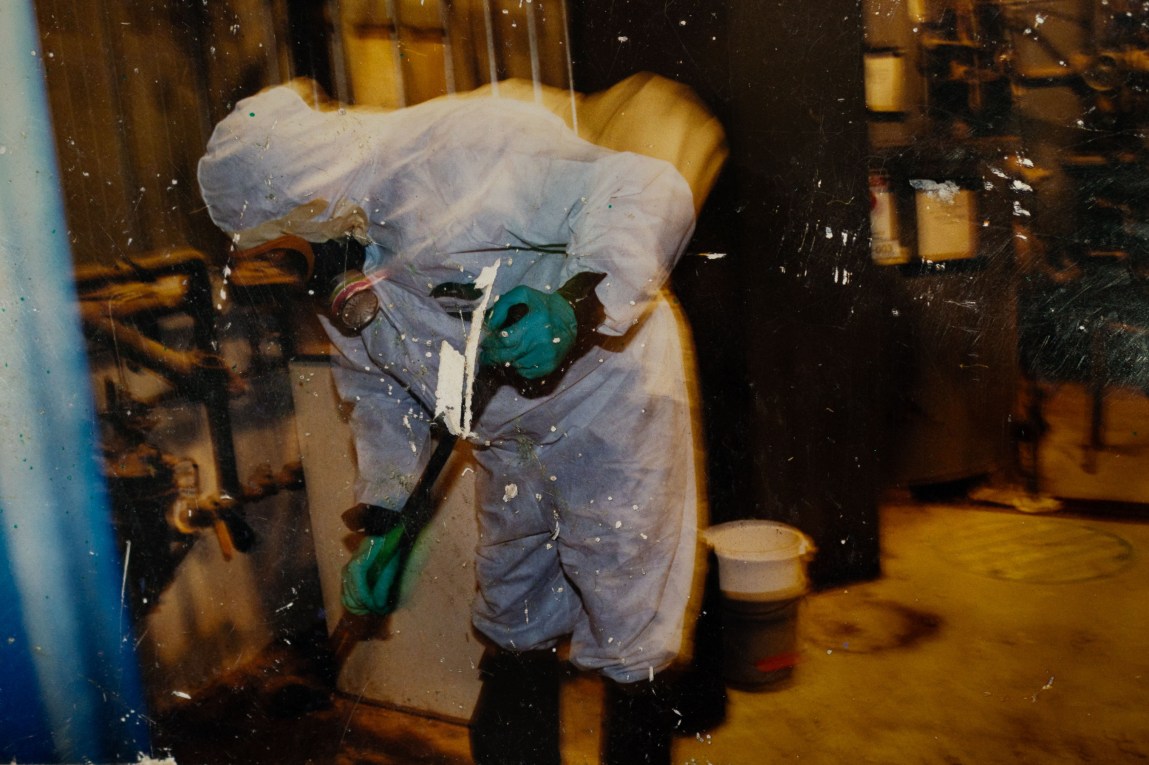
    A scuffed-up photo of a man in a hazmat suit cleaning.
    Rouse hung onto an old photo of himself cleaning rodent feces while working at the Hanford Site. Rouse packaged plutonium and monitored radioactive waste at the site for almost 20 years. Image photographed by Margaret Albaugh for ProPublica

    For years, Hanford employees filing workers’ compensation claims had to prove the chemicals they were exposed to on the job made them sick. The new law Inslee signed flipped that burden of proof. Under the law, agencies were instructed to presume that working at Hanford had caused certain cancers, neurological diseases and respiratory illnesses. Now the Department of Energy would have to prove to the state that something other than the job had made the workers sick if it wanted to deny their claims. 

    Rouse thought the presumption law would speed up his claim for benefits. State lawmakers and the former governor thought it would force the DOE to take responsibility for the harm Hanford workers were experiencing. 

    But despite the law, the DOE continues to fight new and existing claims, Cascade PBS and ProPublica found. We asked the state for claims records going back to the presumption law’s passage in 2018, but the state only provided records going back three and a half years, to 2023. In that period, workers filed 102 new claims for benefits, state data shows. The DOE did not recommend approving a single one. 

    The state, which has final say, overruled the DOE and approved 75% of those claims. The DOE appealed all but seven of those approvals.

    Cascade PBS and ProPublica spoke to workers, surviving family members, lawyers representing workers and state officials. They all pointed to a pattern: The DOE systematically challenges and then drags out workers’ compensation claims for years with recommended denials and subsequent legal appeals. Along the way, it has spent millions on outside lawyers and expert testimony, including doctor evaluations that point to other causes for workers’ illnesses. 

    The DOE has paid out benefits to Hanford workers in some cases, lawyers and families said, but it has done so while still actively appealing the claims. It warns workers that they may have to pay the money back.  

    Our reporting found that not even death ends the cycle of appeals. About 152 workers’ claims remain stranded in this legal limbo — approved by the state but still under appeal by the DOE. Half of those workers are dead. The DOE continues to fight to deny their families survivors’ benefits.

    “It seems pretty coldhearted, calculated, that they’re trying to save money on the back of sick workers who they made sick,” said Gerry Pollet, one of the Washington state representatives who sponsored the 2018 presumption law, who is also a co-founder of the Hanford cleanup watchdog group Heart of America Northwest. “That’s why we needed a state law.”

    After Cascade PBS and ProPublica raised questions about the DOE’s pattern of litigating claims, regulators at the Washington State Department of Labor and Industries met twice with DOE staff, state agency spokesperson Carrie McCausland said. But she could not point to any other actions the agency has taken beyond the two meetings.

    “Agency staff are concerned and are right now assessing the severity of patterns we’ve seen,” McCausland wrote in an email.

    The DOE did not answer detailed questions or respond to the newsrooms’ findings. In a statement, a spokesperson wrote that the DOE is following “all applicable local, state, and federal laws” and “has a long and successful record of accomplishment of protecting human health and the environment.”

    The DOE has the right to file multiple appeals against a claim. According to court records, its appeals have sought to overturn claims approved by the state, narrow the period of back wages, or block survivors’ benefits, among other things. In appeals filings, the DOE’s lawyers have argued that factors other than work at Hanford played a role in the workers’ illnesses, including smoking, drinking, obesity or genetics.

    In Rouse’s case, the energy department blamed alcoholism and family conflicts. The state agency that handles appeals did not find those arguments persuasive. DOE awarded Rouse most of his back pay in 2024, his lawyer said. Rouse declined to say how much that was, but said he is not touching the money until the legal process concludes.

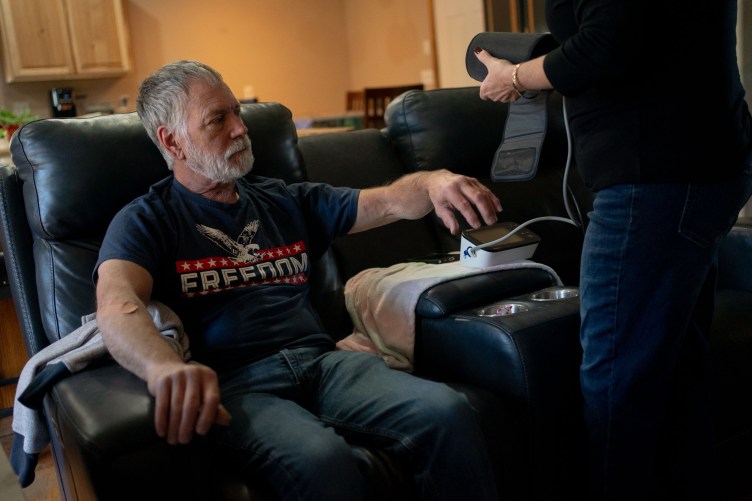
    A woman holds a blood pressure cuff while Lonnie Rouse raises his arm to allow her to put the cuff on.
    Rouse’s wife, Melinda, takes his vital signs. Margaret Albaugh for ProPublica

    In the nearly eight years it has been fighting his claim, the DOE has filed more than 20 appeals contesting different aspects of his claim. 

    “We were always told that nothing is out here that’s going to harm you — you do what you are supposed to do, and you do what you are trained to do, and you’re going to be fine,” said Rouse, who now receives 24-hour care.

    “But that’s not what happens.” 

    “Depleted and Disgusted”  

    The smell of ammonia serves as a warning, workers say, that the underground tanks holding a mix of radioactive sludge have burped chemical vapors into the air above. From 1998 to 2008, it was Rouse’s job to monitor the toxic waste held in the “tank farms.” The containers together hold more than 50 million gallons of liquid waste. Rouse says he lost count of how many times tanks released toxic vapor that took his breath away, sometimes knocking him to the ground and making him vomit and bleed from his nose. According to a 2014 report funded by the federal government, tank farm workers exposed to chemical vapors commonly reported nausea, headaches and nosebleeds.

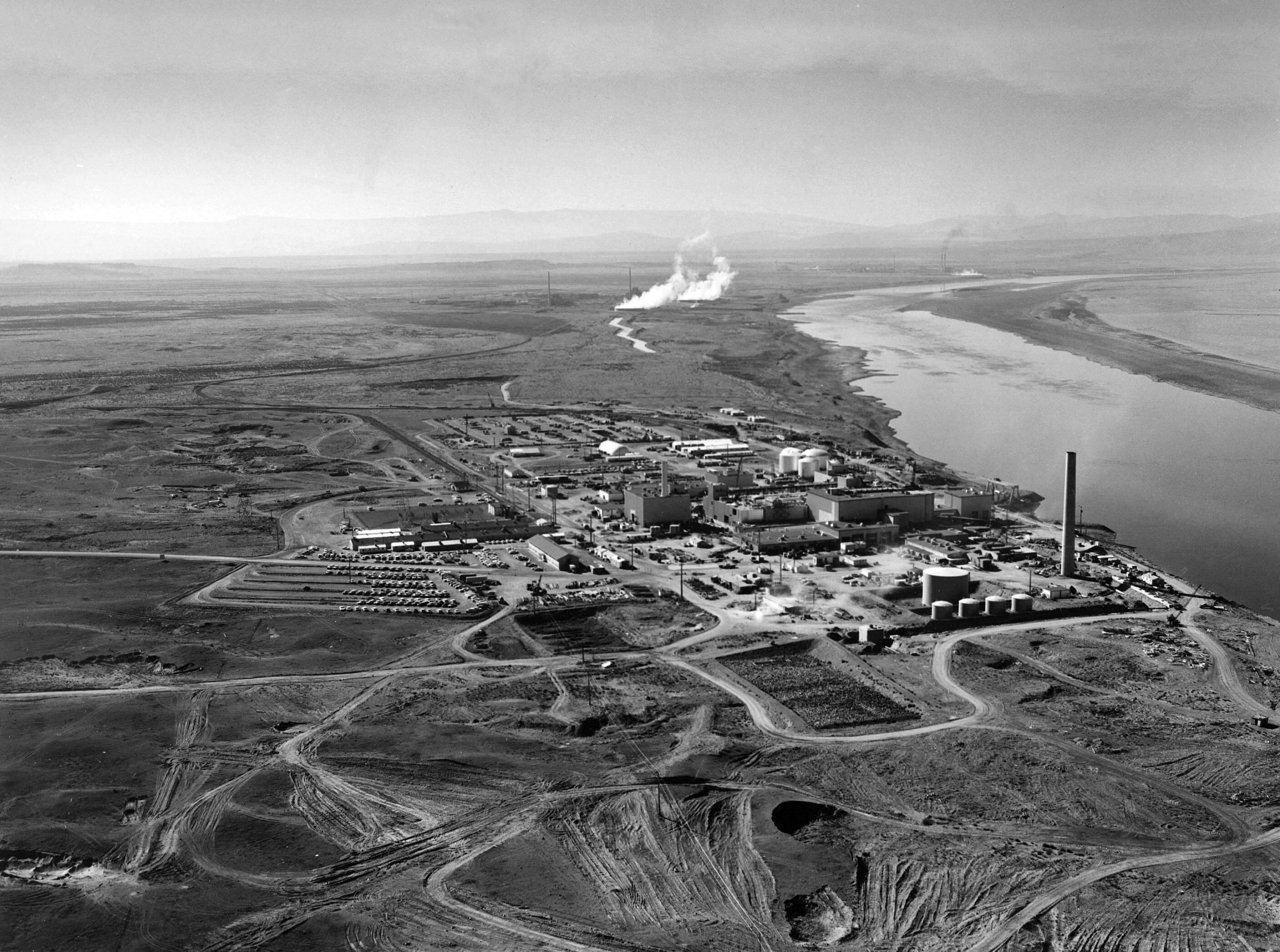
    The liquid sloshing around in those tanks represented the radioactive byproducts of the Cold War. Hanford produced two-thirds of the plutonium for the nation’s nuclear arsenal and fueled the atomic bomb dropped on Nagasaki, Japan, in 1945. 

    A black-and-white aerial photo of a plant with a tall smokestack and many big and small buildings. It sits in a dry environment next to a wide river.
    The Columbia River flows by nuclear reactors at the Hanford Site in Washington state in 1960. Department of Energy

    The end of production in the late 1980s launched a cleanup effort that is expected to continue until at least 2086. As of January 2025, more than 13,000 people were working at Hanford, nearly all of them for private companies contracted by the DOE. It is one of the largest and most expensive efforts to remediate toxic waste in the nation’s history. 

    In 2000, Congress passed the Energy Employees Occupational Illness Compensation Program Act, which provides medical care and one-time payouts to workers at DOE sites across the country. It was an acknowledgement that the nation’s nuclear weapons workers had been exposed to radioactive substances known to cause cancer. In it, lawmakers referred to a DOE policy “to litigate occupational illness claims, which has deterred workers from filing workers’ compensation claims and has imposed major financial burdens for such employees who have sought compensation.”

    But the benefits of the federal program were limited: It capped payouts at $400,000. 

    Washington’s workers’ compensation system, by contrast, can provide steady wage replacement or a pension benefit, in some cases, for the rest of an injured employee’s life. It’s a program that can easily surpass the maximum federal benefit. 

    The state went further with its 2018 presumption law. Such laws generally protect firefighters who are regularly exposed to smoke, burned plastics and extreme heat. The National Council on Compensation Insurance, the Washington state attorney general and Pollet all said they were unaware of any other state that has extended that protection for radiological workers.

    The federal government challenged Washington’s state law later that year in court, arguing it was discriminatory because it only applied to Hanford and the DOE.

    Anticipating a Supreme Court decision that ultimately agreed, lawmakers passed an expanded version that covered all workers at “radiological hazardous waste facilities” in the state, including the state’s only functioning nuclear power plant and a French-owned facility that manufactures nuclear fuel rods. Nonetheless, roughly 75% of the 428 claims filed since 2018 have come from the DOE’s Hanford workers, according to the state Department of Labor and Industries. 

    Kathleen Kersey spent 10 years at Hanford, during both the production and cleanup stages. Much of her work involved measuring radiation around the site and making sure levels were safe. She says her safety training covered radiation, but not other hazards like chemical vapors burping from the waste tanks.

    Kersey struggles to walk, has short-term memory problems and at one point lost vision in her right eye for three months. A doctor diagnosed her with multiple sclerosis, which is a neurological disorder, one of the categories of illnesses the state’s presumption law recognizes as related to chemical exposure at Hanford. In 2019 she filed a claim, which the state approved. 

    The DOE has appealed, arguing that something other than her time at Hanford caused her multiple sclerosis.

    Kersey is one of the 152 workers still awaiting a resolution on her workers’ compensation claim. The DOE has not paid her any back wages, she said. The DOE declined to comment on her case. 

    “I feel depleted and disgusted,” Kersey said of the appeals process. “It makes me feel like I’m worthless. I have no value.” 

    “When Does This End?”

    State records show that the DOE has filed more than 500 appeals since the presumption law passed in 2018. In 20 cases, as it did with Rouse, the DOE has appealed a single worker’s claim half a dozen times or more.

    “We have seen tremendous pushback from DOE on essentially almost every single case that’s been brought,” said Washington State Attorney General Nick Brown. 

    Rouse’s wife, Melinda, said she knew something was wrong when he could not remember how to cut an orange. His vision started to blur, he stumbled often, and suddenly he felt irritable all the time. His primary care physician first thought he might have had a brain tumor. The physician referred him to a neurologist who noted cognitive impairment, possibly due to exposure to multiple toxins at the Hanford Site. The neurologist then referred him to a neuropsychologist, who diagnosed him with “toxic encephalopathy” in 2009, saying it was “more likely than not” that chemical exposure damaged his brain, according to court records.

    Rouse at home with his wife, Melinda, and their dogs. After working at Hanford, he developed a neurological disorder that medical experts attributed to exposure to chemicals on the job. Lizz Giordano/Cascade PBS

    The U.S. Department of Labor agreed too, approving him in 2010 for benefits under the Energy Employees Occupational Illness Compensation Program Act, saying it was “at least as likely as not” that Hanford contributed to his illness. A federal medical consultant even praised the neuropsychologist who assessed Rouse for his “unusually thorough analysis of causation.” 

    Rouse refiled his 2009 state workers’ compensation claim under the new law in 2018. Washington state approved it later that year. 

    The DOE appealed. It hired a medical toxicologist, who reviewed Rouse’s medical records and testified that he did not have the disease he claimed, and brought in an industrial hygienist, who downplayed the exposure risks at Hanford. The DOE’s toxicologist testified that Rouse’s drinking was “the most significant, what we might term, ‘toxic exposure’ that’s described in the medical record.”

    A group of three physicians and an industrial hygienist have collectively earned over $1.7 million testifying against Hanford workers since the presumption law’s passage, according to DOE invoices the newsrooms obtained by a federal records request. One of the DOE’s go-to expert witness doctors earned more than $200,000 from the DOE last year alone. He did not respond to multiple emails seeking comment. 

    A single law firm, Wallace, Mann, Capener, Bishop & Debney, handles all of the DOE’s appeals. In addition to the fees paid to expert witnesses, the department paid the firm nearly $10 million between 2018 and 2025. The law firm did not reply to multiple requests for comment. 

    In cases where the DOE has appealed the state’s approval of a claim since 2018, the agency that handles appeals has sided with workers nearly 9 times out of 10, according to state data. 

    Pollet, the state representative who sponsored the 2018 presumption bill, acknowledged that the law has fallen short of his expectation. 

    “This was supposed to have ended a decade ago,” he said about sick Hanford workers still awaiting back wages and medical care. “It’s even worse than it was 10 years ago.”

    “I think their actions are not only despicable, but they are criminal,” he said of the DOE. 

    The state Department of Labor and Industries said it expected “to engage further with the DOE,” which could include putting the department on an improvement plan and monitoring its progress. 

    Another option state regulators have is to revoke the DOE’s ability to accept and pay out claims directly. According to the state Department of Labor and Industries, the contractors that employ Hanford workers on behalf of the DOE would then decide whether to join the state-managed fund or seek state approval to manage claims themselves. Doing so could limit the DOE’s power to appeal, but contractors would still have that right. 

    Brown, the state attorney general, said he wants to wait and see how the DOE’s appeals of claims play out in higher courts. He hopes that once the DOE’s losses start stacking up, it will slow the volume of its litigation. 

    Attorney Charlynn Hull said she thought the DOE’s approach might soften during the Biden administration. But Hull said she observed no change in the DOE’s behavior. Her firm, Smart Law, represents the majority of Hanford workers’ compensation claimants, including Rouse and Kersey.

    One of the hardest things about the DOE’s appeals, Hull said, is the testifying that the children and spouses of dead workers must do. 

    “I think that it’s just, it’s tormenting to them, in many ways, to relive how awful that experience was, especially with the cancer-related death,” Hull said. “When does this end?”

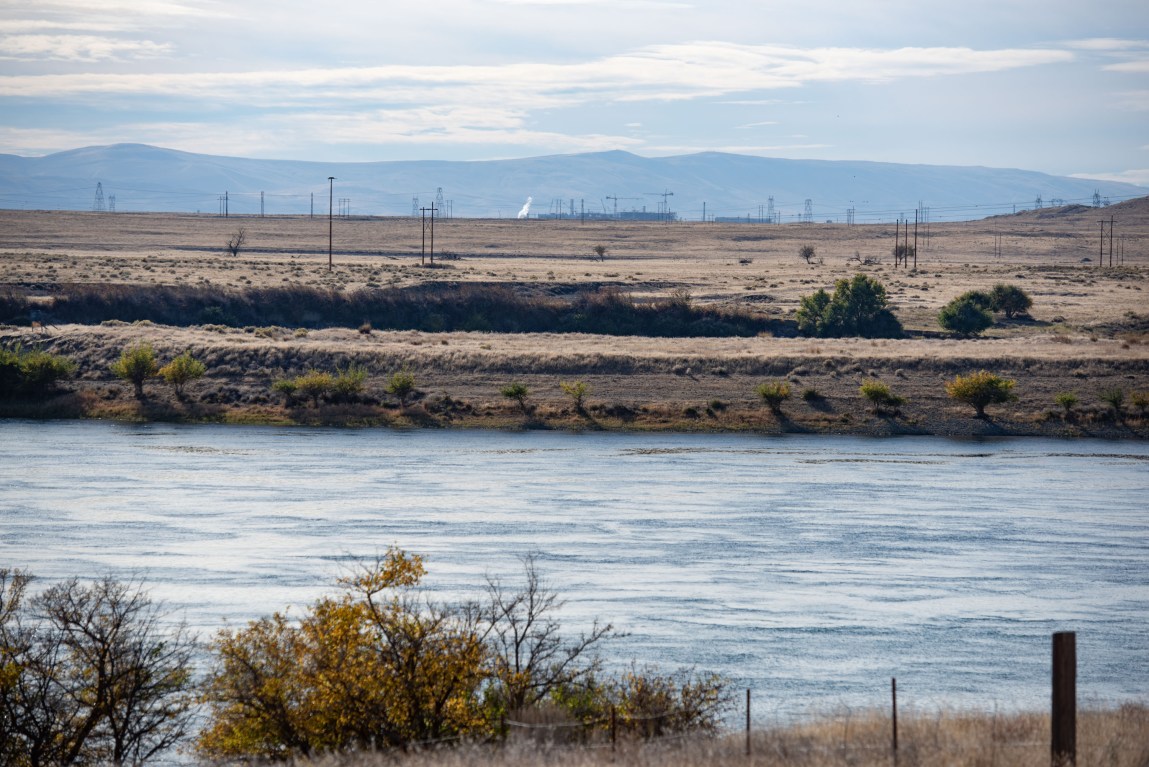
    Telephone poles and some low buildings stick up from the desert, as seen from across the Columbia River. Mountains rise up behind the site.
    A view of the Hanford Site, which is undergoing one of the largest and most expensive toxic waste remediation efforts in the nation’s history. Margaret Albaugh for ProPublica

    Dying While Under Appeal

    For Isidoro Mata Jr., it ended with his children draining fluid from his lungs through a tube doctors had surgically inserted into his chest.

    Mata demolished buildings at Hanford for nearly 30 years. Court records show he was diagnosed in 2015 with thyroid cancer, one of the illnesses that Washington’s law ties to work at Hanford. Sara Chilcoat, his daughter, said he kept working as long as he could.

    State claims managers approved Mata’s claim in 2019. The DOE appealed, arguing that “medical opinion supports denial of this claim as not related to the distinctive conditions of employment.” The appeal did not elaborate further. The state forced the DOE to pay his wages and the cost of his medications, Chilcoat said. But the DOE filed a separate motion to stop his benefits while the appeal was adjudicated. 

    In its motion, the DOE argued that it was likely to prevail in its appeal because a doctor who examined Mata in 2019 believed his cancer was unrelated to his work at Hanford, according to court records. The state found the doctor’s examination “lacking in objective findings.” 

    “He was fighting for his life while they were trying to do that,” Chilcoat said. “That makes me mad.” 

    Mata’s case file notes that he missed three meetings with DOE lawyers in 2020. The state attorney general’s office sent the appeals judge a letter in July explaining that Mata was unable to participate because of his chemotherapy treatments. The DOE, which did not respond to questions about Mata’s case, dropped its appeal in December.

    Less than three months later, Mata died.

    Source: ProPublica · 2026-10-22