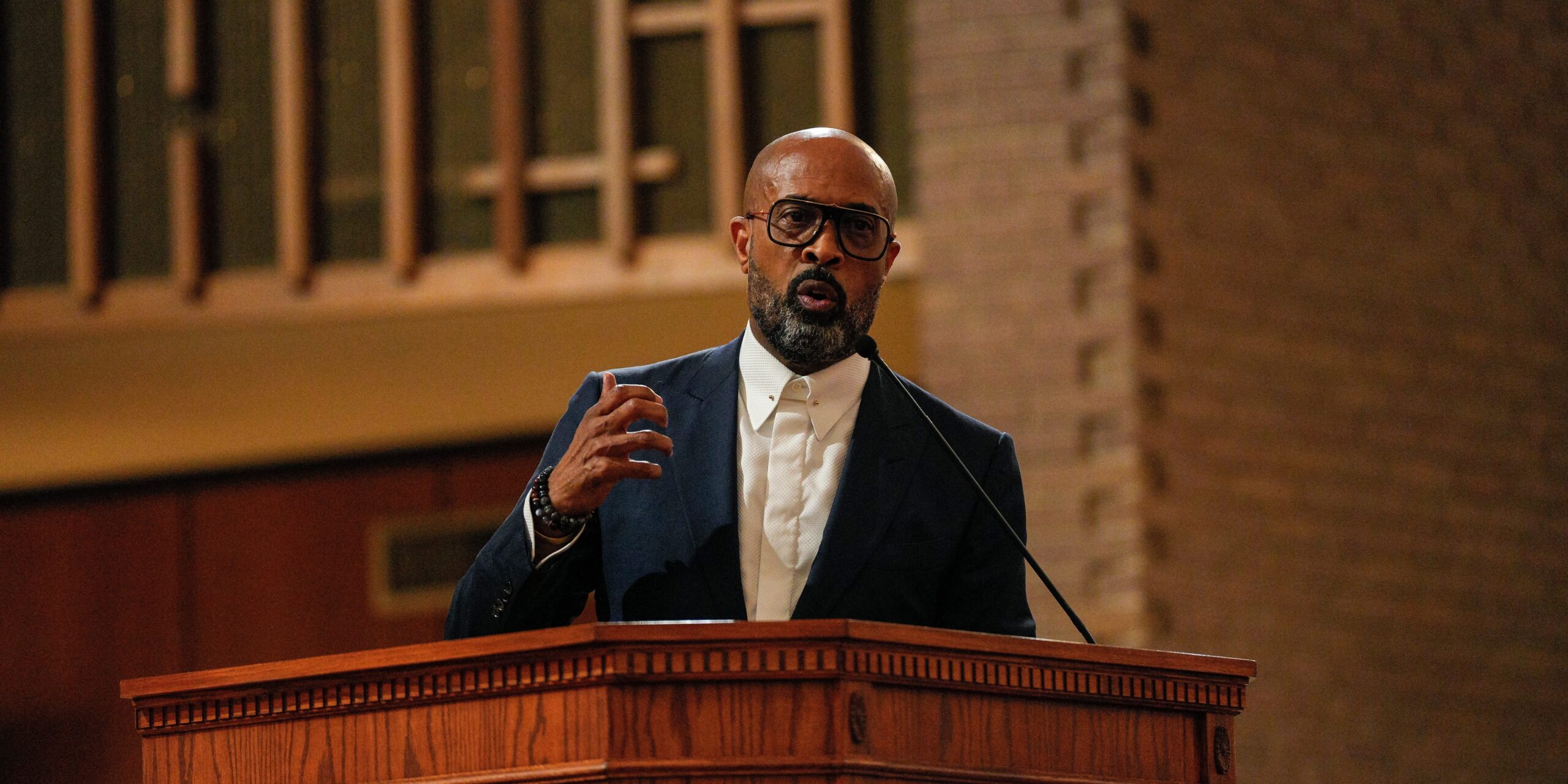
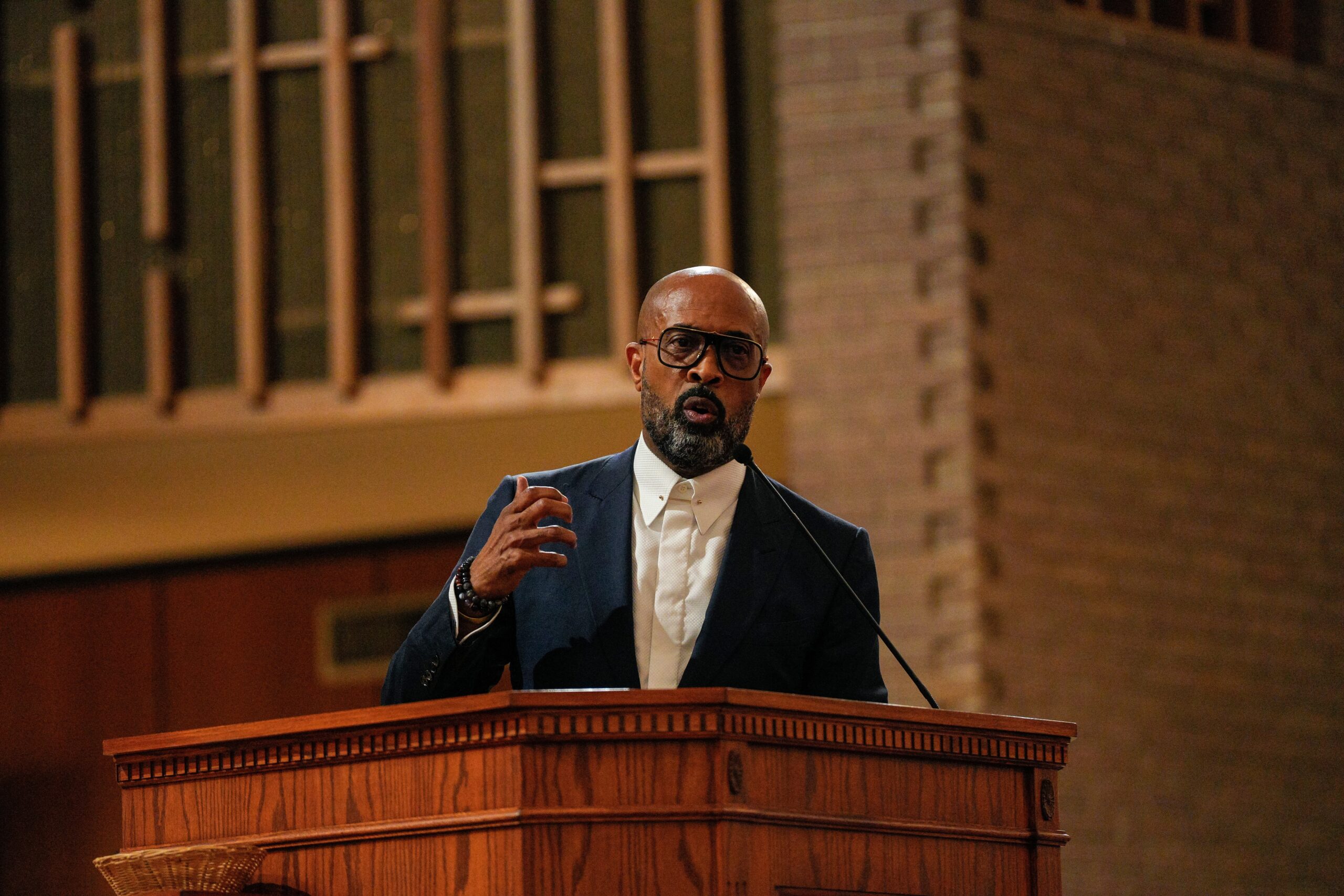
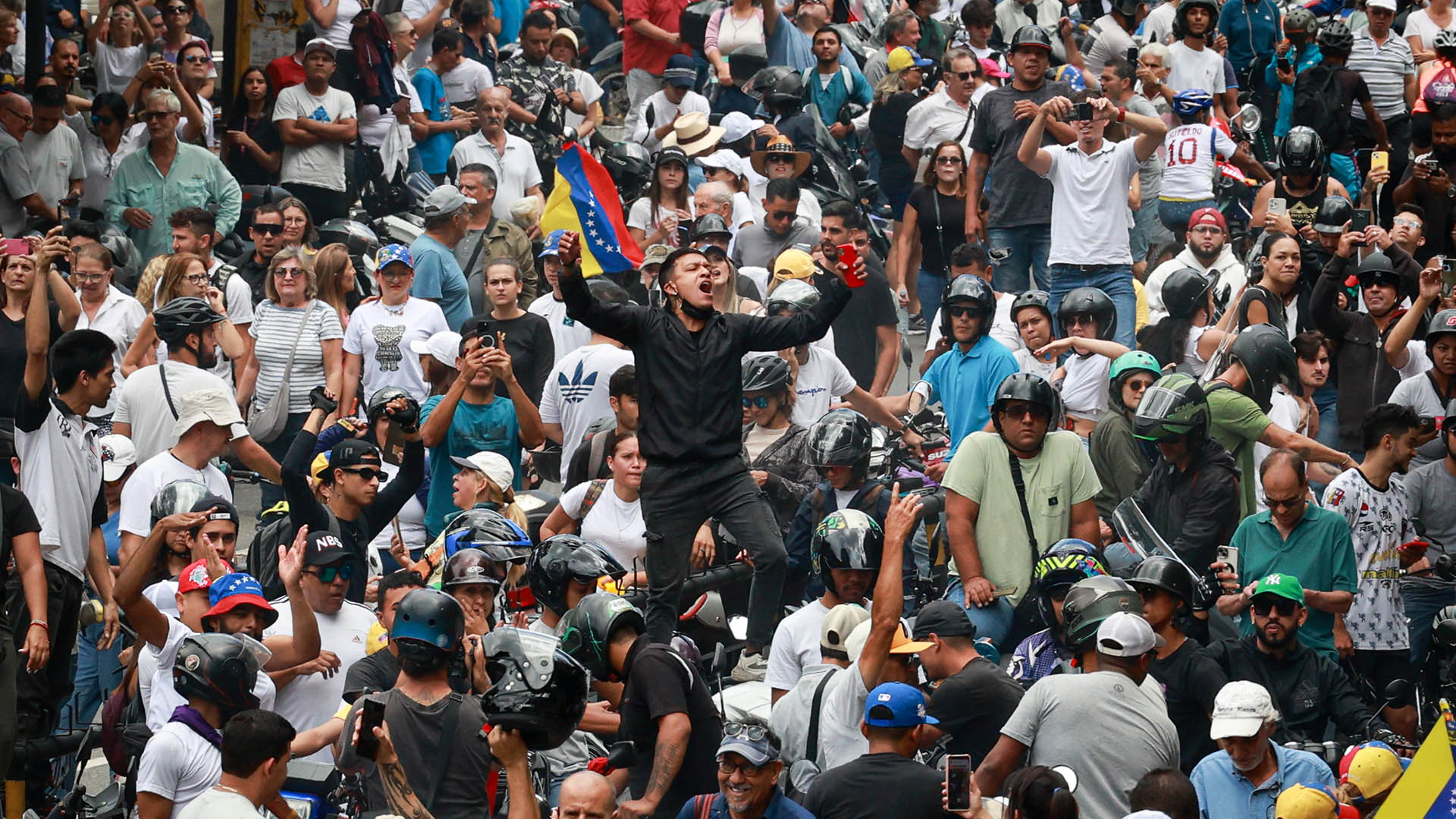
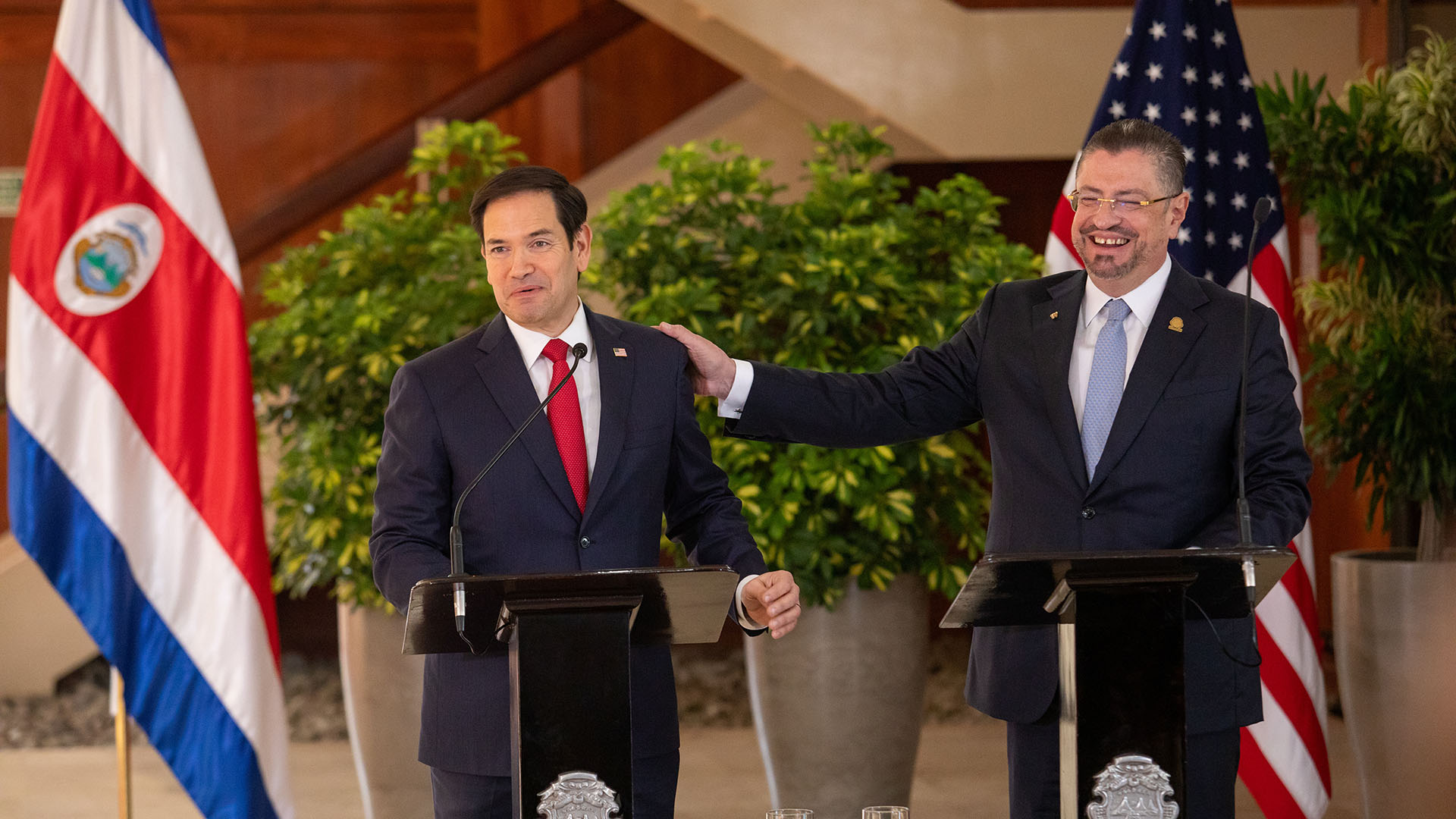
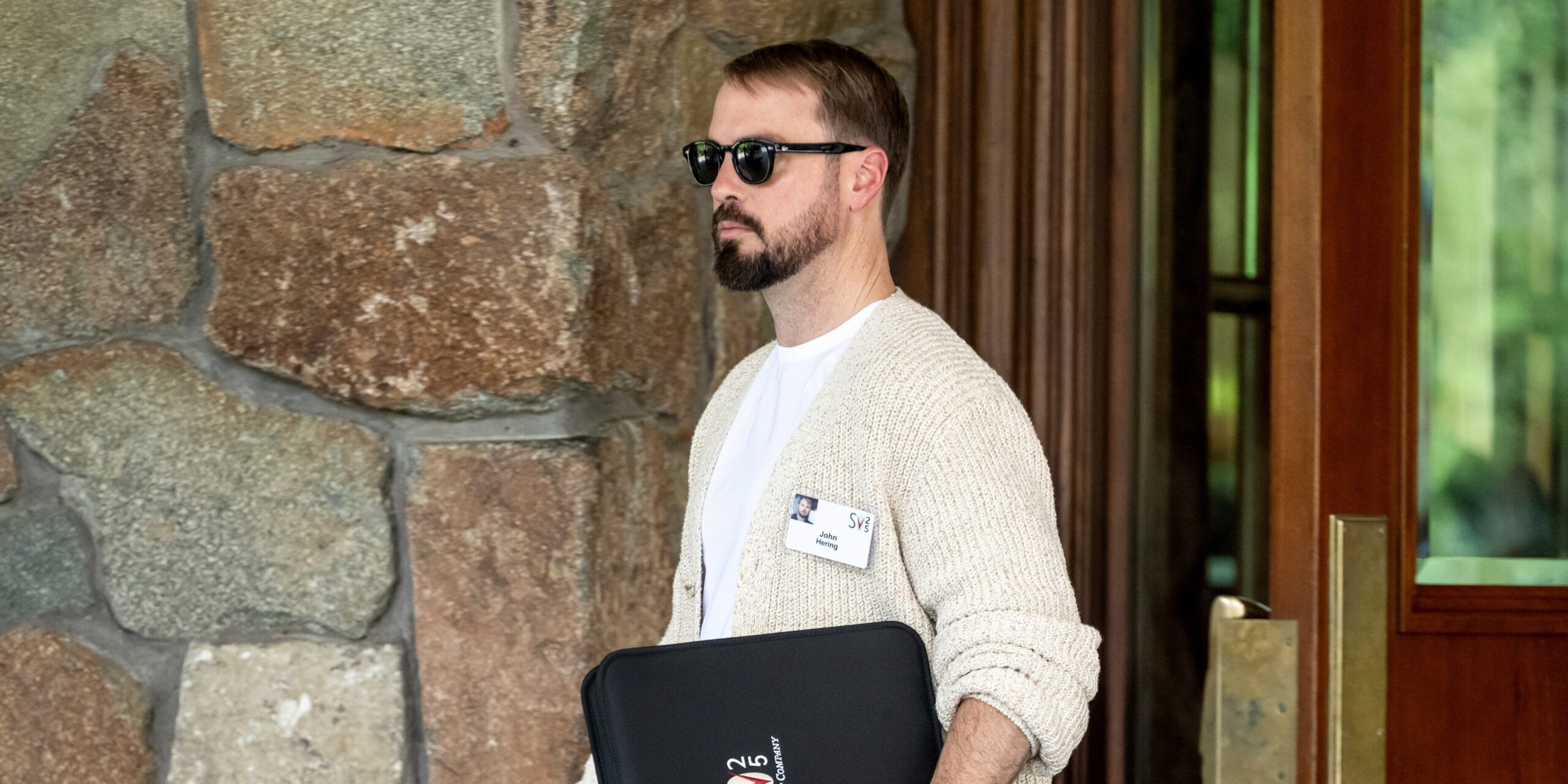
Rev. Frederick D. Haynes III speaks to the crowd during the We the People TX interfaith service, “A Night of Moral Resistance,” in Dallas, on Sept. 9, 2026.Photo: AP Photo/Gabriela Passos
“Why do you wanna have a pep rally when people are hurting?”
That was the question Rev. Frederick Douglass Haynes III posed at a September food drive in South Dallas, where volunteers were collecting groceries for struggling families. Across town, Republicans were holding a midterm convention. Haynes, a longtime Baptist pastor and Democratic congressional nominee, was introducing James Talarico, the party’s candidate for U.S. Senate in Texas.
A month later, speaking at a Dallas megachurch, Talarico offered his own interpretation of Christian duty.
“I try to love my neighbor through public policy,” the Presbyterian seminarian told the congregation. “I’m trying to make my neighbor’s life easier, better, less stressful.”
Both men are making a deceptively simple argument in some of the staunchly staunch red-as-hell, Republican territory in America, one that might transcend the conventional wisdom about national campaigns and the millions poured into competing campaign war chests: When far-right policy translates into actual pain, at what point does intervening become a spiritual obligation?
Amid the big-ticket ad buys, fundraising appeals, and armies of political consultants, Talarico and Haynes are tapping into a political tradition that has long sustained communities across the South: showing up.
At Haynes’s Friendship-West Baptist Church, the ministry extends to legal services, immigration advocacy, counseling, economic justice, and food policy. It is an example of how churches often form the connective tissue of communities suffering under economic and political strain.
When far-right policy translates into actual pain, at what point does intervening become a spiritual obligation?
That strain is measurable. Texas is home to four of the nation’s 10 most financially distressed major cities, including Houston, which ranks second nationwide, according to a 2026 analysis. Feeding America estimates that nearly 1 in 5 Texans experienced food insecurity in 2024. Meanwhile, federal analysts project that changes to Medicaid eligibility enacted last year will increase the number of uninsured Americans by 7.5 million by 2034.
While Democratic Party leaders publicly debate how to punish Donald Trump politically, allege corruption, or navigate the ideological divide between moderates and democratic socialists, a different argument is emerging from Southern pulpits.
The Underground Church
From Quaker abolitionists to the Social Gospel’s challenge to industrial exploitation, progressive religious institutions have helped drive some of America’s most consequential political transformations. Christian farmworker ministries supported migrant laborers before joining the United Farm Workers’ California grape boycotts in the 1960s. And while Black churches overwhelmingly led, sustained, and suffered the brunt of violence in the fight for equal civil rights in this country, a handful of white denominations joined them.
Of course, churches also defended slavery, segregation, and exploitation. The blunt reality is that throughout American history, Christianity has always been political and has been used to justify a wide variety of competing political ends.
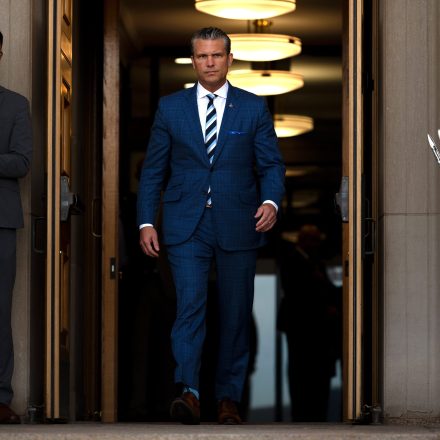
But Republicans have deftly exploited the perception that they alone speak for American Christians. The Trump administration has readily embraced religious iconography, from evangelical leaders praying over the president in the Oval Office to Defense Secretary Pete Hegseth’s frequent invocations of the medieval Crusades.
There is no way around the fact that Republicans have built a formidable religious coalition, particularly among white evangelicals. Last year, the nonprofit, nonpartisan Public Religion Research Institute, or PRRI, found a majority of Republicans qualified as either Christian nationalist adherents or sympathizers in 2025, compared with 17 percent of Democrats.
But Republicans don’t have a monopoly on Christian voters. Pew Research Center polling this month found 73 percent of white evangelical Protestant registered voters preferred Republican House candidates, while 74 percent of Black Protestants and 59 percent of Hispanic Catholics preferred Democrats. None of that is particularly surprising on the surface.
Nor is this some newly discovered religious awakening. According to PRRI’s Census of American Religion, which was published in April, 57 percent of Democrats identified as Christian in 2025, a significant drop from 70 percent in 2013. The white Christian left isn’t necessarily growing, but it’s far from insignificant. Much of it has simply been politically overlooked.
It’s a perception the GOP has routinely capitalized on, often spending a great deal of their election campaigns attacking opponents on religious ground.
“My faith is my moral compass,” Hinojosa told the National Catholic Register in September. “It grounds me in purpose and gives me the courage to do what is right regardless of obstacles or consequences.”
Faith Without Works Is a Dead End
For those who have spent years watching their faith become synonymous with a politics they don’t recognize, frustration may finally be giving way to something else: a determination to be heard.
There are signs that this long-overlooked religious tradition is finding a more public voice. An August study by PRRI documented progressive Christians organizing against Christian nationalism in eight states, including Texas and Louisiana, channeling local meetings, religious discussions, and community networks into political action. Elsewhere, hundreds of members of the clergy have joined protests against immigration enforcement, and some have been trained in direct action and civil resistance. While the movement may not be growing in numbers, its willingness to challenge political power is increasingly visible.
As retired Texas Rev. Kathleene Card, who has thrown her support behind Talarico, told the Houston Chronicle, “faith should influence how people respond to poverty, human rights, the environment, and the well-being of their community.”
Whether any of this will translate into winning on Tuesday is still an open question. An October Fox News poll put Talarico and Republican Ken Paxton at 49 percent apiece among likely voters, but newer polls show Talarico with a small lead. Abbott led Hinojosa by 5 percentage points in that Fox poll, and most polls in the race show the governor with a slim lead.
No matter the result, the Texas campaigns offer a different, more nuanced way of understanding political persuasion. They also challenge a long-standing assumption among national Democrats: that their voters are a monolith, moved by the same issues, values, and appeals.
There is something to be said for people willing to put boots on the ground, to do the work instead of endlessly debating how to begin and whether it matters, in the name of service.
It’s a moral code not too dissimilar to a Western: When confronted with injustice, you stand for what’s right, even if you stand alone and are ridiculed for what you believe. It’s a mode of Christianity that harkens back to Abraham Lincoln (and maybe even John Brown.)
That might be a more enduring political proposition than many Democrats’ feigned, helpless aggrievance to the latest Republican spectacle. Campaigns come and go; so do their promises, if they existed in the first place. But the obligation to one’s neighbors remains.
A Brazilian gold miner wanted for allegedly helping former President Jair Bolsonaro’s spy chief flee to Florida has built a network of companies and properties in the Sunshine State, ICIJ media partner Agência Pública reports.
Rodrigo Martins de Mello and his family are under investigation by Brazil’s Federal Police for helping Alexandre Ramagem, the former director of the country’s intelligence agency, escape Brazil and sheltering him in Miami, ICIJ and Agência Pública reported on Oct. 22.
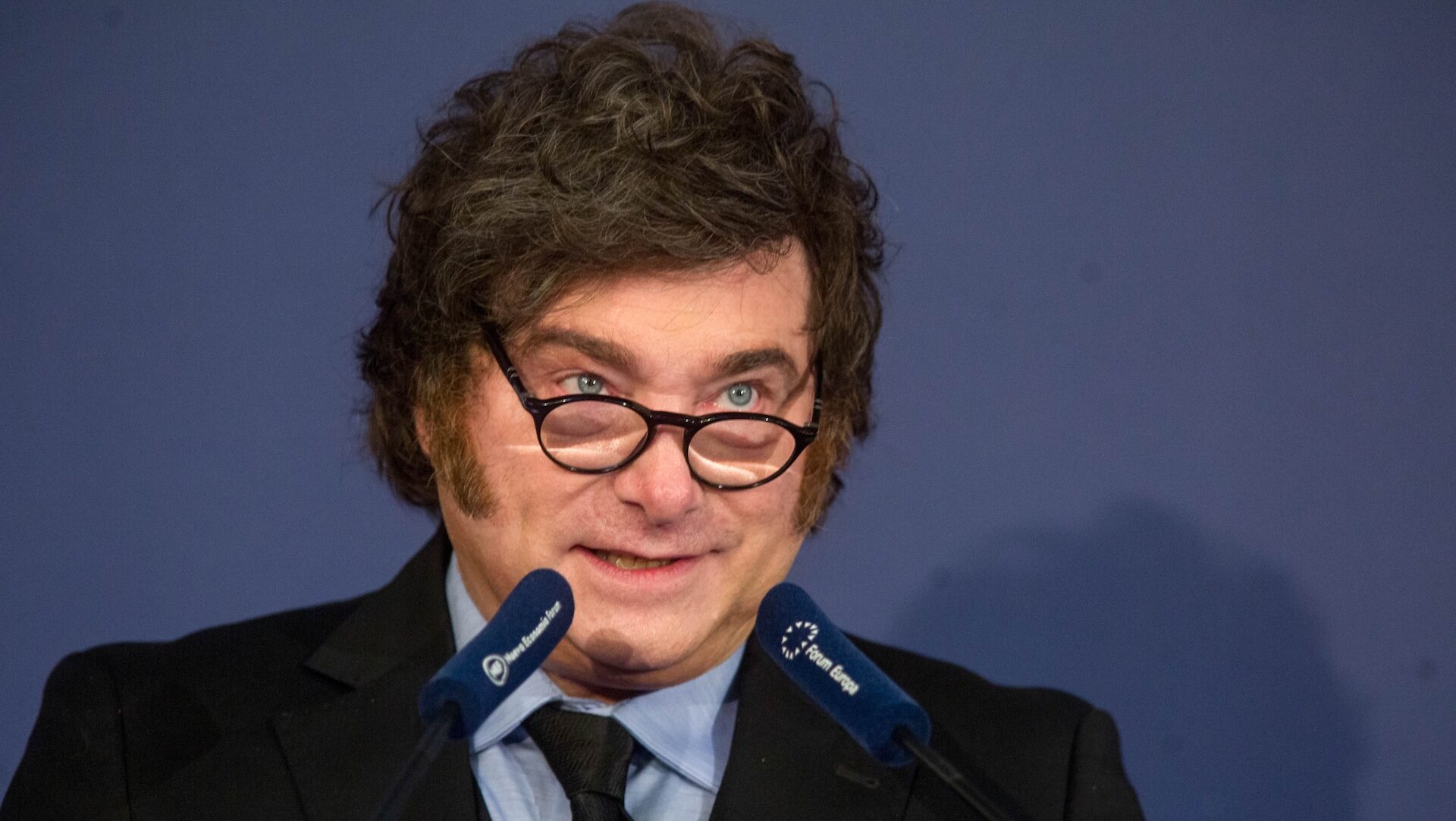
De Mello, known as Rodrigo Cataratas, is a strong Bolsonaro supporter. Convicted of leading illegal gold mining on Yanomami Indigenous land, De Mello champions Brazil’s informal miners to his more than 43,000 Instagram followers, attacks the leftist government and calls for amnesty for Bolsonaro, Agência Pública reported. That campaign suffered a blow Oct. 25, when President Luiz Inácio Lula da Silva came from behind to defeat Bolsonaro’s son Flávio in the presidential runoff. Three days after the election, Flávio, under investigation in Brazil for alleged money laundering, also fled to Florida.
Recommended reading LATIN AMERICA The US is letting a convicted Bolsonaro spy chief stay in Florida. Brazil wants answers. Oct 22, 2026 PRESS FREEDOM ‘Bought-off, corrupt’: Argentine president attacks ICIJ member Hugo Alconada Mon Oct 27, 2026 PANAMA Panama removed from EU’s tax haven ‘blacklist’ a decade after the Panama Papers Oct 15, 2026
The artificial intelligence industry was poised to act as a kingmaker in the midterm elections.
Super PAC networks bankrolled with millions of dollars from Anthropic and OpenAI executives spent heavily in competitive primaries earlier this year, including a high-profile race in New York City. They were touted as the looming successor to another single-issue group, the American Israel Public Affairs Committee, as AIPAC moved its spending underground.
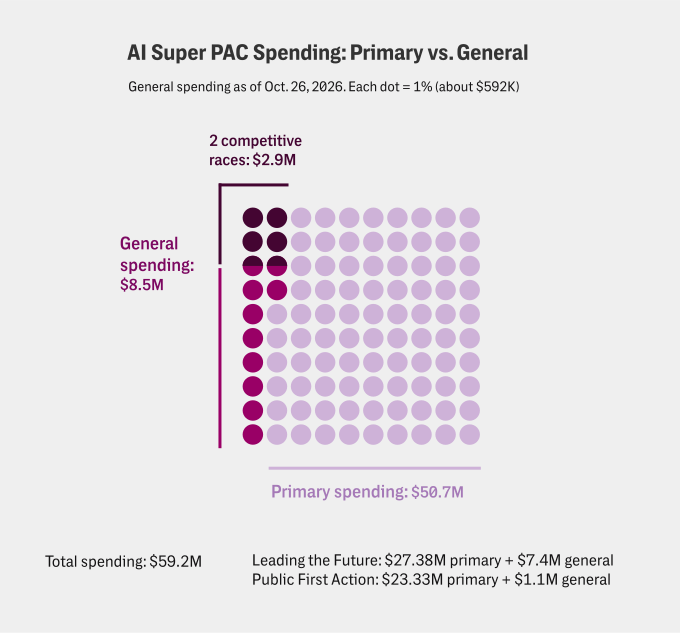
Yet as public outrage over data centers and AI’s threat to jobs soared, artificial intelligence super PACs dramatically throttled back spending on congressional races compared to the primaries. The biggest AI super PAC network has spent only modestly ahead of next week’s general election — and mostly in safe seats.
An Intercept analysis of AI spending in the 2026 midterms, based on Federal Election Commission records and independent race ratings, shows that only 5 percent of their direct expenditures have gone to contested general election races. The industry’s avoidance of the contested races that could determine control of the next Congress suggest that the PACs have realized how the public has soured on the tech, campaign finance and industry observers told The Intercept.
“Essentially these companies underestimated how much the public despises the data center buildout, and the inescapability of AI systems that no one asked for that say they will automate jobs and maybe kill us all,” said Rick Claypool, a research director for the president’s office at Public Citizen, a nonprofit campaign finance watchdog.
Although there is still time for a last-minute flurry of spending, the story of AI’s role in the 2026 midterm elections may turn out to be the story of a single race — a primary in New York — that forced the industry to step away from the limelight.
Claypool’s group released an analysis earlier this year of “corporate supremacist” super PACs, a new breed of campaign committees modeled on a crypto super PAC called Fairshake that spent tens of millions on the 2024 elections.
The model was to amass a massive war chest and use it to punish candidates who opposed the company’s preferred government regulations, while throwing cash at allies or potential allies from both parties.
The first big AI super PAC to launch in August 2025 was Leading the Future, which was bankrolled by the president of OpenAI and its investors. A rival super PAC network, Public First, launched months later with the goal of countering Leading the Future’s influence. Its donors include Anthropic CEO Dario Amodei, who gave $1 million. Anthropic has also given a nonprofit associated with Public First millions of dollars, while stipulating that the money cannot be used on elections. Public First says that it supports tighter regulations than its rival.
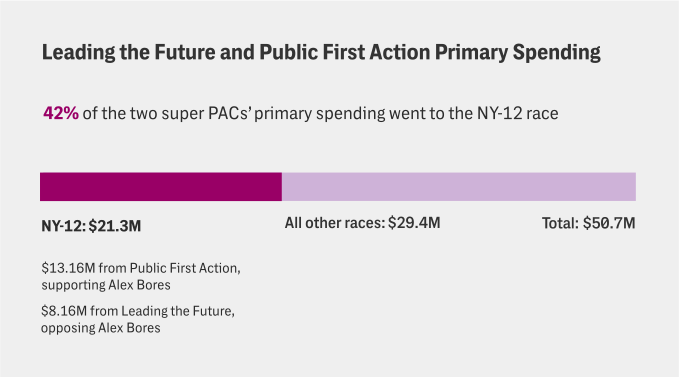
The two networks plowed $50.7 million into the primaries, campaign finance records show. Most of that money was spent on primary races where the outcome was in doubt, driven by an eye-popping $21.3 million the networks spent on supporting or opposing a single congressional candidate, Alex Bores, in the Democratic primary for New York’s 12th Congressional District.
Data visualizations: Stella Ioannidou
Bores, a New York State Assembly member, attracted the ire of those in the industry who favor a laissez-faire approach by authoring an AI regulation bill in the state legislature.
Leading the Future succeeded in defeating Bores, who lost to his State Assembly colleague Micah Lasher in June. But the group drew intense blowback in the process. Many observers suggested Leading the Future’s spending had boosted Bores rather than hurt him, because it gave him a chance to position himself as a foe of the AI industry — while also benefiting from a PAC aligned with the Public First network.
“Down to the wire, they were sweating,” Bores told The Intercept, referring to Leading the Future. “I think people who have been in politics for a while will realize that their spending really served to elevate the issue of AI.”
Leading the Future did not respond to a request for comment.
After wading into contested primary elections, the two leading AI super PAC networks have held back from spending on competitive general elections — even though they have plenty of money in the bank.
Until a few days ago, Public First had spent nothing on general election races. Leading the Future has spent only $7.4 million on general election races as of October 26, according to the FEC data, despite having $34 million in cash on hand across its network as of its most recent report.
Data visualizations: Stella Ioannidou
Only 31 percent of that total has gone toward competitive races, as measured by the independent analytics website FiftyPlusOne. The only reason Leading the Future has spent money on competitive general election races at all is because it’s backing U.S. Sen. Darline Graham, R-S.C., who filled the seat of her late brother Lindsey Graham and is now facing an unexpectedly fierce challenge from a Democrat to win a full term in ruby-red South Carolina.
“They are not going to have an impact on the balance of power in Congress,” said Shaunna Thomas, one of the founders of Guardrails Alliance, another new super PAC set up to counter Leading the Future’s influence. “They are spending money on candidates who they think will protect their ability to control if and how they are regulated.”
Public First has only recently started spending a relatively small sum on a handful of general election races. The spending had amounted to $1.1 million as of the morning of October 26, according to processed FEC data.
Asked for comment on how its strategy has changed since the primaries, a Public First spokesperson said that it was still trying to support “strong advocates for AI regulation.”
“Public First was founded as a counterweight to Leading the Future, and that fight looks very different today. Leading the Future is going dark. Its biggest backers are walking away,” said Anthony Rivera-Rodriguez, the spokesperson.
Into that gap have stepped new groups pushing for tougher AI regulation such as the Guardrails Alliance, which bills itself as a grassroots alternative to corporate-backed super PACs. It is funded in large part by Silicon Valley tech workers but has taken a more aggressive stance against “tech oligarchs.” Guardrails has spent about $2 million thus far and reported having $1.2 million on hand as of October 14.
About three-quarters of voters are less likely to support a candidate they know has received support from an AI super PAC, according to a Data for Progress poll of more than 3,000 likely voters in Iowa, Michigan, and Ohio commissioned by Guardrails. Voters were more concerned about spending from AI companies than from crypto companies or AIPAC.
Voters were more concerned about spending from AI companies than from crypto companies or AIPAC.
The dislike for data centers and AI cuts across party lines. In Michigan’s purple 7th Congressional District, Democratic candidate Will Lawrence has seized on data centers as one of his leading issues.
“The politics of this are terrible. Eighty percent of everybody is against it, whether you’re a Democrat, independent, or Republican,” he told supporters at a recent town hall.
Notably, neither of the super PAC networks has intervened in Lawrence’s race, despite it being one of the closest in the nation. (Lawrence’s campaign has pointed out that Elon Musk, who leads AI company xAI, has spent against Lawrence via his America PAC.)
There are emerging signs that the big AI super PAC networks are changing tactics in response to that public distaste. Public First’s dark-money affiliate donated $3 million since August to a preexisting super PAC supporting California state Sen. Scott Wiener, one of two Democrats vying to replace retiring Rep. Nancy Pelosi in California.
Leading the Future, meanwhile, gave a $500,000 donation on October 9 to a pro-data center nonprofit called Build American AI.
AI super PAC critics are also watching to see what Leading the Future will do, given its large war chest.
“I think they are going to continue to spend. I think they are going to try to do more and more spending that isn’t as easily tracked, because they are such political dead weight,” said Bores.
Delaware Corporations
When single-issue super PACs know their issue is unpopular, they use vague names, “pop-up” affiliates, and other dubious tactics to hide their activities from voters.
Add another one to the list: Leading the Future has routed more than $30 million of spending through newly minted Delaware corporations, blocking transparency during an election that has been defined by voter backlash against the industry.
Those apparent shell corporations have accounted for the lion’s share of the largest artificial intelligence super PAC network’s expenses during this year’s election.
The practice is a flagrant violation of Federal Election Commission guidelines that require campaign organizations to disclose which consultants, pollsters, and advertisers they are paying, a campaign watchdog alleged in a complaint filed in May.
There may be little recourse for observers worried about the lack of transparency for now, however. The FEC is short of the quorum that would allow it to take action on complaints such as the one filed by the Campaign Legal Center. (Leading the Future, which did not respond to a request for comment, has previously defended its tactics as legal in a statement to Wired.)
The Leading the Future network was funded in large part by an executive at or investors in OpenAI, one of the world’s largest AI companies. (In 2024, The Intercept sued OpenAI in federal court over the company’s use of copyrighted articles to train its chatbot ChatGPT. The case is ongoing.)
Company president Greg Brockman and his wife, Anna Brockman, donated $25 million to the network last year. When it came time to spend that money, the Leading the Future network leaned on two affiliate super PACs, one for Democratic candidates called Think Big and the other for Republican candidates called American Mission.
That is a typical tactic of the new breed of single-issue super PACs popularized by the crypto industry. Campaign finance reform advocates say it may help obscure the origin of campaign ads from voters but does not run afoul of any laws itself.
What those super PACs did next raised red flags for watchdogs, however. Since December, American Mission has reported spending $17.4 million through a Delaware-incorporated limited liability corporation called Summit Ridge Media Group, on services ranging from media placement to ad production to consulting.
Think Big has spent $21.3 million through a different Delaware corporation, Lantern Production Consultants, on a similarly wide range of expenses.
The grab bag of expenses is a giveaway that the super PACs are likely using the newly created corporations to hide their true vendors, according to Shanna Ports, a senior legal counsel at the Campaign Legal Center.
“There’s no way of knowing what is motivating this arrangement — but I know there is backlash to AI. It is possible that the vendors who are working with American Mission and Think Big don’t want to be identified in FEC reports,” Ports said.
Thomas, of the rival super PAC Guardrails Alliance, told The Intercept she thinks the network is obscuring its spending because a lax regulatory approach has become “politically toxic.”
“Their donors don’t want to be associated, their candidates don’t want their support, and their vendors don’t want to be associated,” Thomas said. “If you were public, you are running away. If you are not, you are interested in not being exposed.”
This story was supported by a grant from the Tarbell Center for AI Journalism.
In the words of the biggest name in the outside elections-spending game, “Being pro-Israel is good policy and good politics.”
This midterms cycle, however, the American Israel Public Affairs Committee’s strategy seems to suggest the opposite. Contrary to its signature slogan, AIPAC’s name has become anathema to voters across the political spectrum repulsed by Israel’s genocide in Gaza and frustrated by Washington’s outpouring of military aid for a foreign government while domestic costs soar.
So it’s going underground. As The Intercept reported in December, AIPAC entered the 2026 midterms by returning to its strategic roots — funding other groups and uniting donors, rather than focusing on direct-to-candidate spending. Now, AIPAC has announced that it will no longer officially endorse or contribute directly to candidates.
Though progressives welcomed the announcement as evidence of AIPAC’s retreat, it’s far from a sign that AIPAC is backing down. The group is expected to continue spending heavily on elections through its super PAC, which took advantage of campaign finance loopholes to conceal its involvement in several races this cycle until after elections had already passed. To Lara Friedman, president of the Foundation for Middle East Peace, AIPAC’s opting for obscurity shows that “its brand has become politically radioactive.”
But how much has really changed? As AIPAC shifts strategy, a new project by The Intercept reveals the hundreds of candidates still taking its cash, plus how the money paid off for them. The data suggests that though the pro-Israel lobbying giant may be weakened, it’s still dominant.
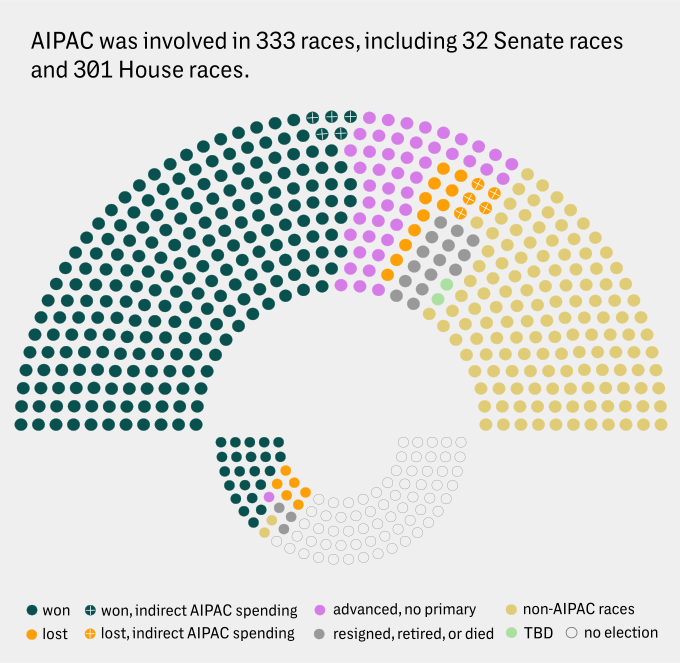
The Intercept tracked how much the group and its super PAC spent on elections to put pro-Israel candidates on the ballot in this year’s midterms — including the money it tried to keep out of the public eye. While AIPAC makes use of a series of new pop-ups and pass-throughs, it still poured millions directly into 2026 midterm races. Its candidates usually still win.
The new data builds on a 2024 project in which The Intercept documented just how AIPAC shaped the last congressional class. At the time, Donald Trump was preparing for his return to the presidency as Kamala Harris ran a campaign hamstrung by public disillusionment over the Biden administration’s unflinching support for Israel’s genocide in Gaza. To critics of Israel desperate to stop the violence, the two parties looked equally bleak, and the pro-Israel lobby’s grip on Congress appeared unshakeable.
It’s been different this cycle. Primaries across the country saw candidates win after vowing to cut off or restrict military aid to Israel, and incumbents signed on to legislation blocking weapons transfers in an attempt to keep their seats. But the shift should not be overstated: AIPAC still waded into nearly three-quarters of races, and its candidates still won far more often than they lost.
In total, AIPAC or its super PAC, United Democracy Project, spent on 333 of the 473 seats up for election this year.
Data visualizations: Stella Ioannidou
These are the dollars AIPAC and UDP spent directly in races. The former makes contributions to candidates, while the latter, as AIPAC’s leading super PAC, makes independent expenditures, like buying ads. They made up the bulk of the pro-Israel lobby’s known elections spending — $53.3 million from AIPAC and $66.7 million from UDP, compared to$53.7 million and $41.4 million last cycle. Simultaneously, the groups took up another tack: making it harder to tell which races they were actually involved in. The group’s donors poured money into races where AIPAC didn’t officially endorse a candidate. AIPAC’s board president hosted a fundraiser for a candidate who swore the group wasn’t backing her. And in a series of races, no one knew for certain that AIPAC had spent on the election until after it was over.
The group tested different strategies in different states, spending directly in the Michigan Senate race, for example, while concealing its spending in several other primaries. In those races, UDP gave money to other committees, including a series of “pop-up PACs,” groups that registered just before primaries, allowing them to delay disclosing their donors until after the election passed. Several of those groups took money from AIPAC’s super PAC, spent on ads against candidates critical of Israel, and then disappeared.
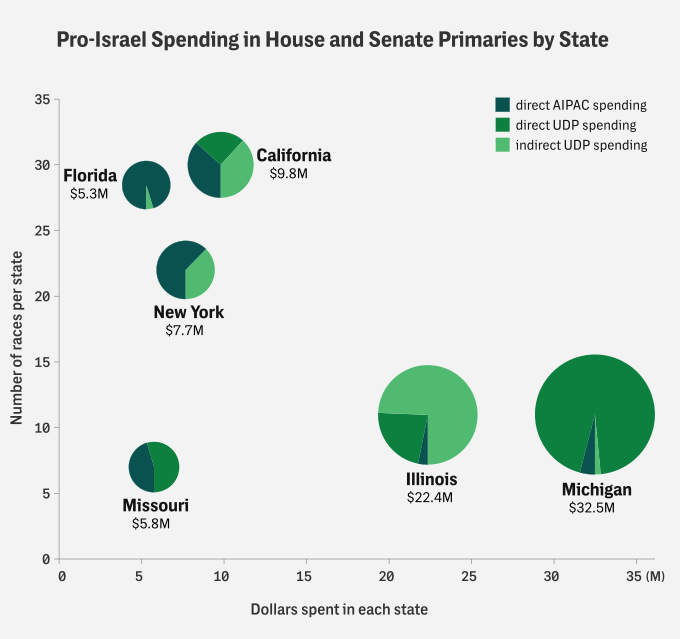
The pop-ups and pass-throughs represent AIPAC’s most talked-about new tactic, but the lobbying group and its flagship super PAC still sunk the bulk of their spending into key races and high-priority states. The Intercept analyzed where AIPAC employed which strategy, how UDP dollars flowed through pop-up PACs, and which candidates received the most AIPAC and UDP cash in their primaries.
The Direct Spending
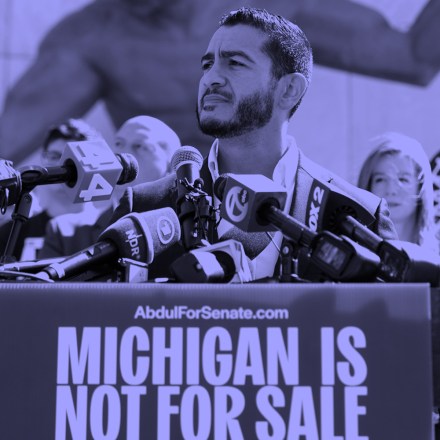
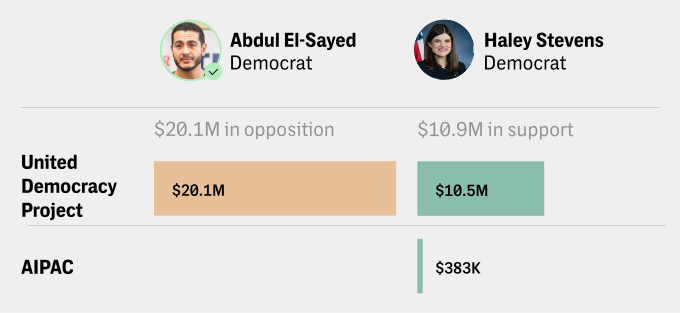
The pro-Israel lobby’s biggest investment in the primaries turned out to be a disappointment. UDP spent more than $30 million on ads attacking Democratic candidate Abdul El-Sayed in the Michigan Senate race or backing his opponent, Rep. Haley Stevens. Now that El-Sayed is the Democratic nominee, UDP is also battling El-Sayed in his general election contest with Republican Mike Rogers, spending just over $500,000 so far.
Data visualizations: Stella Ioannidou
Thanks in part to the deluge of spending, the El-Sayed–Stevens contest was one of the marquee primaries of 2026, pitting a vocal critic of the pro-Israel lobby who could become the first Muslim U.S. senator against an enthusiastic AIPAC cash recipient who famously said: “Israel comes to me in my dreams.” It’s one of the key races where we’re breaking down the money AIPAC and UDP spent in favor of one candidate and against a clear opponent. We’re skipping Democratic House candidate Adrian Boafo, who benefited from $5.7 million in UDP spending, because his Maryland primary included 23 other candidates.
Data visualizations: Stella Ioannidou
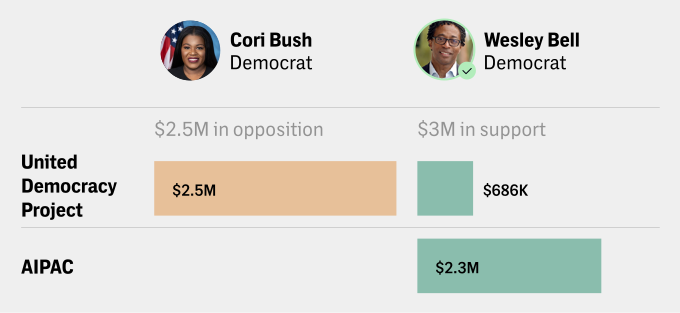
After Stevens and Boafo, the top AIPAC and UDP recipient from this year’s primaries was Rep. Wesley Bell, a moderate Democrat from Missouri who fended off a challenge from former Rep. Cori Bush to return to the House (AIPAC spent millions to oust her last cycle). When UDP spending is excluded, Bell received more AIPAC funding in the primaries than any other Democrat.
Data visualizations: Stella Ioannidou
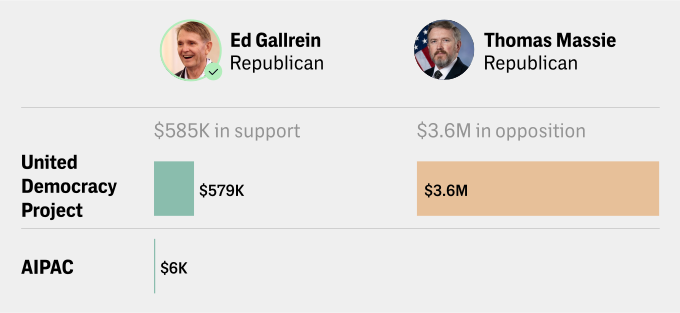
On the Republican side, the top beneficiary was Ed Gallrein, the Trump-backed challenger who unseated Rep. Thomas Massie in Kentucky. Massie, a libertarian critic of all foreign aid — including to Israel — was the relatively rare Republican incumbent AIPAC and UDP opposed.
Often, the pro-Israel groups backed Republican incumbents. Two more top recipients were Sen. Tom Cotton, who easily won his primary in Arkansas, and John Cornyn, who lost to state attorney general Ken Paxton in Texas.
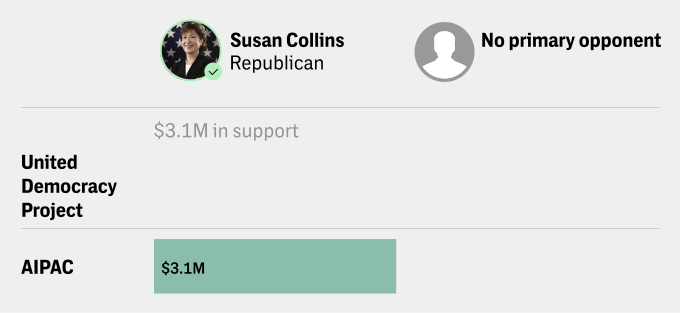
But the greatest Republican recipient of AIPAC largesse — ahead of Gallrein, when UDP is excluded — did not face a primary opponent.
Data visualizations: Stella Ioannidou
Republican Sen. Susan Collins of Maine, now facing a tight general election contest against Democratic candidate Troy Jackson, has been a longtime beneficiary of campaign cash aligned with the pro-Israel lobby. Asked by Zeteo last year for her comment on Americans killed by the Israeli military, Collins shook her head and said only: “I am pro-Israel.”
The Pop-Ups
On top of the $53.6 million it spent directly on races this cycle, United Democracy Project poured another $13.1 million into Democratic primaries by giving money to other committees whose names or stated agendas indicated no connection to Israel policy. That $13.1 million, more than triple the $3.5 million United Democracy gave through other groups last cycle, helped fund at least three pop-up PACs that formed this year.
The groups’ names offered little insight into their political agendas, as The Lever recently highlighted. UDP spent the most on popup PACs in a series of Democratic primaries around Chicago, where groups with names like Elect Chicago Women, Chicago Progressive Partnership, and Affordable Chicago Now! used their funds to attack candidates running on rejecting AIPAC money or ending U.S. military support for Israel. Several of the groups also received funding from major United Democracy Project donors, and three of them shut down after the primaries and gave their money back to United Democracy Project.
Data visualizations: Stella Ioannidou
In other cases, United Democracy Project funded long-established political action committees with ties to current or former House Democratic leaders, like Bold America, which was formed by former members of the Congressional Hispanic Caucus. That group got almost a quarter of the $12.2 million it reported raising this year from UDP. The UDP share, $2.8 million, was nearly equivalent to the $2.9 million Bold America spent against Darializa Avila Chevalier, a democratic socialist and pro-Palestine activist who defeated incumbent and Congressional Hispanic Caucus Chair Adriano Espaillat in New York.
The super PAC EDW Action Fund was similar. Former Democratic Congressional Campaign Committee Chair Cheri Bustos and former Rep. Annie Kuster formed that group in late 2023 as an offshoot of the political action committee Elect Democratic Women. Like Bold America, EDW Action got about a quarter of its funding from UDP. It also provided more than 80 percent of the funding for Pro-Choice Majority Action, a new PAC that formed in May and spent in 12 primaries. The group presents itself as supporting Democratic women, but Pro-Choice Majority Action notably spent against pro-Palestine candidates like Melat Kiros, who ran a primary challenge against Rep. Diana DeGette, D-Colo., and won.
In a statement to The Intercept, Pro-Choice Majority Action spokesperson Lenny Young dismissed reporting characterizing the group as a pop-up PAC and said it had backed 23 candidates with a range of views on Israel across the primaries and general election.
“To suggest that we would deny a Democratic woman from being elected to Congress because of her position on Israel, on either side, misses the whole point,” Young said. “We want more Democratic women in Congress because we believe it would improve the lives of women and families. Period.”
Bold America did not respond to The Intercept’s request for comment. Emails to Elect Chicago Women, Chicago Progressive Partnership, and Affordable Chicago Now! bounced back because the groups have shut down.
UDP gave another $2.65 million to groups that did not spend directly on ads in Democratic primaries this cycle.
In August, United Democracy Project gave $1.65 million to a group called SD PAC, also known as Save Democracy PAC, which registered in 2020 and has supported Democratic candidates in past general elections. The group did not directly conduct any outside spending in Democratic primaries this year, but it funneled money to affiliate groups that did — some of which funded attacks against progressives.
The other recipient of money from UDP, Palmetto Action, formed in May and only spent in South Carolina’s Republican Senate primary. The group backed Sen. Lindsey Graham before his death in July, then received a cash infusion from UDP and started supporting Graham’s sister, Darline, ahead of a special Senate primary. The group did not report any additional spending in its last filing due before the general election.
Palmetto Action, Save Democracy PAC, and EDW Action Fund did not respond to The Intercept’s requests for comment.
New pro-Palestine groups have sprung up to spend against AIPAC — though their pockets aren’t nearly as deep. When candidates went head-to-head this cycle in primaries defined by U.S. military support for Israel’s genocide in Gaza, pro-Palestine candidates often came out on top.
For decades before it started spending directly on elections, “AIPAC operated in the shadows,” Friedman, of Foundation for Middle East Peace, said. Its endorsements were once “clear but unofficial,” she added, and its funding operated through “informal understandings with big donors and allied but ostensibly independent PACs.”
Today, “AIPAC is trying out a sort of middle road,” Friedman said. “It will return in part to the shadows — no direct endorsements, no direct donations — but it will also continue to flex its power directly in elections, via tactics it has been testing and honing these past four years.”
If anything, next cycle could see an expansion of the recent pop-up PAC strategy, making it harder to tell when AIPAC is involved — until it’s too late.
With voters set to cast ballots in two critical races that could help determine control of both chambers of the U.S. Congress, fears of potential voter suppression are running high in Maine.
Officials in the state have prepared for months against the possibility of election interference from federal officials, and the state remains on high alert in the run-up to the general election on November 3.
Training materials were updated this year to include references to federal statutes barring armed federal agents from polling sites.
Training materials for law enforcement officials in the state, obtained by The Intercept through a public records request, were updated this year for the elections to include explicit references to federal statutes barring armed federal agents from polling sites.
In an interview with the New York Times this week, Maine Secretary of State Shenna Bellows said the inclusion of such references was a direct defense in response to the fearmongering around election integrity from President Donald Trump and his administration.
“This is the first time ever that we have had to engage in scenario planning to safeguard against potential federal interference in elections,” Bellows said. “It seems like the federal government is now adversarial to the states.”
Bellows’s office offered up the training slideshow, which cites a U.S. law that bars armed civil or military officers from posting at voting sites, to law enforcement personnel in the run-up to Maine’s primary election in June and again in the lead-up to the general election on November 5.
Nationwide, Democratic officials have expressed fears that the Trump Administration might weaponize U.S. Immigration and Customs Enforcement or other federal agencies to undermine the rights of voters. In New York, state Attorney General Letitia James issued a reminder to voters that federal officials may not “police the polls,” and the Arkansas chapter of the NAACP called out the assignment of federal election monitors to two counties in the state as potential intimidation.
The Trump administration, meanwhile, has sounded the alarm about the alleged scourge of non-citizens on the voter rolls, sending agents from the FBI and ICE’s Homeland Security Investigations division to probe alleged fraud. A handful of people in California, New York, and North Carolina have been indicted for allegedly voting as non-citizens, but a review of similar cases by the Washington Post found that such cases were often the result of honest mistakes.
In Maine, worries about federal interventions at polling places flared when — following a slew of social media videos from Trump allies suggesting that fraud is already taking place among the state’s Somali American community — a local outlet reported that the Department of Justice would be sending election monitors to the state.
Jon Fetherston, a journalist with the far-right Maine Wire, which is funded by conservative megadonor Leonard Leo, was seen following people in and around an early voting site at Lewiston City Hall and aggressively questioning them. (The Maine Wire did not immediately respond to a request for comment.)
Critics said the moves were tantamount to voter harassment, but Maine Wire editor-in-chief Steve Robinson later defended them as an act of election transparency. Robinson, who has led a crusade against what he alleges to be a network of fraud in the state’s Somali American community, questioned the role of interpreters tasked with helping “jobless Somali bums” cast their ballots.
In the wake of the Maine Wire controversy in Lewiston, Bellows confirmed to the Maine Morning Star that a wave of federal election monitors would be headed to polling sites in Lewiston and Portland.
The Department of Justice on Tuesday confirmed to The Intercept that it intends to send election monitors to Maine for Election Day, but did not elaborate or respond to specific questions about where the monitors were to be sent.
“We will have around 1,000 monitors in counties throughout the United States, but we will not share the full list until Election Day,” a Justice Department spokesperson told The Intercept in an email Tuesday. “All monitors must meet the same legal and ethical requirements, including that they not interfere with the voting process. Every monitor has the same role: observe for potential violations of federal law and report concerns to the Department, which the Department will review after Election Day and act where appropriate.”
Robinson did not immediately respond to a request for comment.
Collins Takes Right-Wing Bait
With Maine a key battleground state for control of Congress — Democratic challenger Troy Jackson is seeking to topple long-serving GOP Sen. Susan Collins, and the Democratic House candidate Matt Dunlap is seeking to best former Gov. Paul LePage in Maine’s 2nd Congressional District — temperatures are running high in the state.
Progressives in Maine worry that even without a robust federal presence at voting places — whether monitors are armed or not — activist campaigns like the one undertaken by the Maine Wire journalists could pose a potential threat to voters’ rights.
“Basically, if you were walking into City Hall and you were Black, you could expect to have this guy come up to you with his phone and ask you all sorts of rude and obviously racist questions,” said Ben Chin, co-director of the progressive Maine People’s Alliance. “We’re trying to encourage everyone to come out to vote, but it makes sense why that might give people pause. You hear a guy like that is outside a polling location, it’s reasonable to wonder, ‘Should I go down there right now?’”
“We have received complaints about the intrusive filming, photography, and harassment of voters in the City of Lewiston by political operatives.”
In a statement to The Intercept, Bellows said the state and the city of Lewiston were taking steps to ensure that voters could cast a ballot free of harassment.
“We have received complaints about the intrusive filming, photography, and harassment of voters in the City of Lewiston by political operatives,” Bellows told The Intercept in a statement. “All voters should be able to exercise their right to vote without feeling watched, questioned, or harassed, and we take these allegations seriously, particularly when it appears that voters were targeted for no other reason than their race or ethnicity. We understand the City of Lewiston has taken steps to address the problem, and we will continue to monitor the situation.”
Collins, meanwhile, took the Maine Wire’s reporting seriously after Fetherston asked the senator at a campaign event about the role of interpreters, which he and the Maine Wire cast as “electioneering.”
“I’m unaware of those allegations, but certainly only Americans should be voting in American elections,” Collins said. “And it is troubling to me if people are being accompanied into voting booths and handling ballots in a way that is not sanctioned by law.”
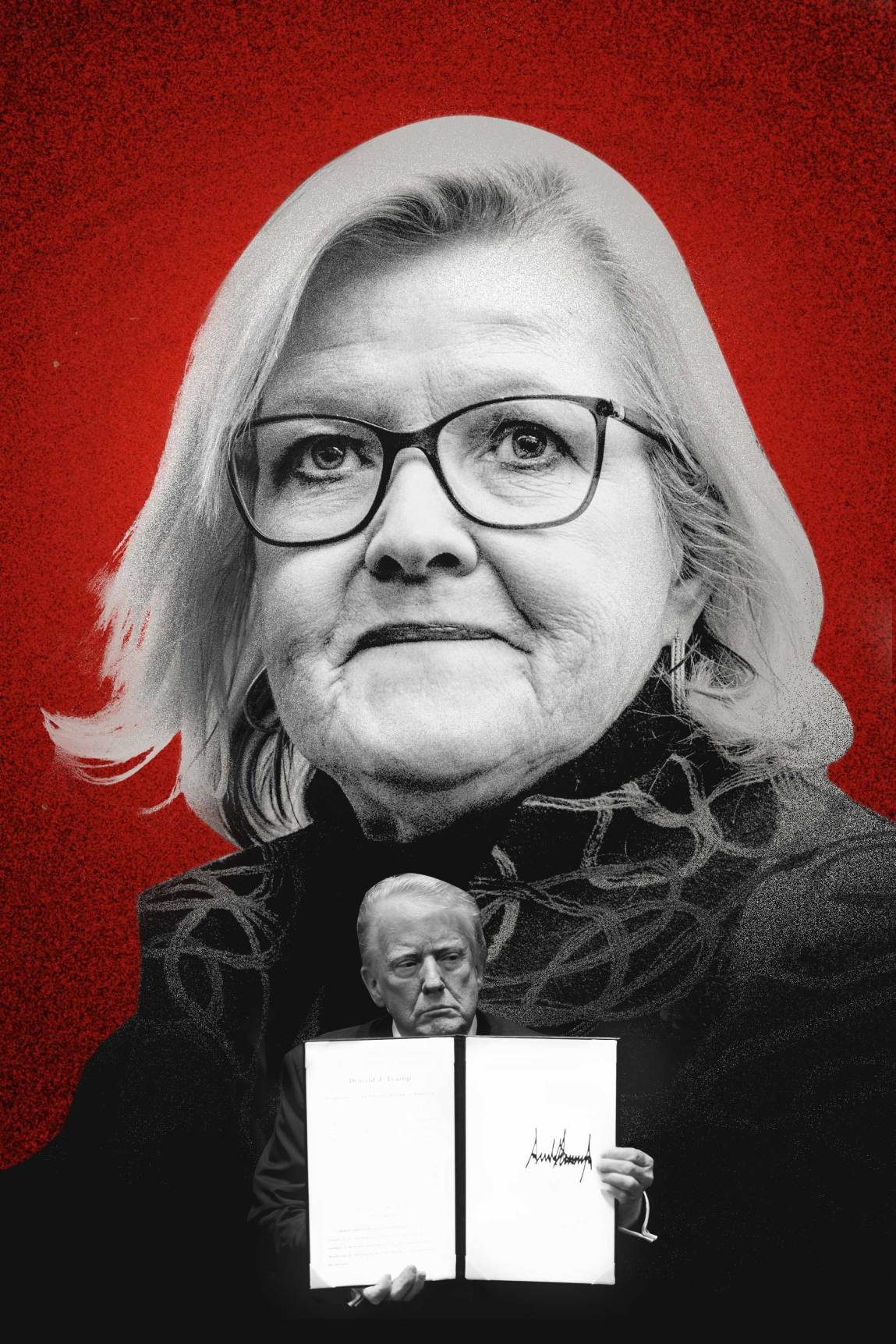
Photo illustration by Lisa Larson-Walker/ProPublica. Source images: Tom Williams/CQ-Roll Call, Inc via Getty Images; Win McNamee/Getty Images.
In July, not long before President Donald Trump delivered a primetime address questioning the legitimacy of American elections, the pioneering conservative election lawyer Cleta Mitchell and about two dozen of her associates logged onto a private video briefing with the White House.
Mitchell, who holds no formal position in the Trump administration, had been pivotal to Trump’s bid to challenge his loss in 2020, spearheading efforts to prove his claims of fraud and reverse his defeat in court.
After Joe Biden took office, when others abandoned the fight or scoffed as Trump clung to conspiracy theories, Mitchell doubled down, founding a grassroots organization devoted to rewriting election laws and rules to be more restrictive. Members of her group, the Election Integrity Network, were named to vital election-related positions in swing states and, later, in the second Trump administration.
The pre-speech briefing was an acknowledgment of just how consequential Mitchell and her organization had become. The White House had held similar sessions for key political players, such as governors, members of Congress and major press outlets.
Help Us Report on Key Election Issues
ProPublica’s reporters are on the lookout for what’s going right and what isn’t. We’re monitoring voter suppression and interference, election observers andpoll watchers, extremism tied to the election, and ICE activity at the polls. Have you seen something?
At the appointed time, the screen filled with the faces of EIN leaders and supporters, some sitting in front of digital backgrounds with the group’s logo on them. Mitchell shushed those who’d forgotten to mute and introduced John Solomon, an ally of hers who was helping prepare the speech.
Mitchell and her network hardly needed the run-through, though: Much of the speech was a compendium of allegations and conspiracy theories they had originated or spread.
Her lieutenants were thrilled to hear that the president would assert there were more than 275,000 noncitizens on state voter rolls — a since-debunked claim based on work led by one of her proteges, who occupied a top post at the Department of Homeland Security.
The speech would end with an exhortation for Congress to pass the SAVE America Act, a bill requiring voters to provide documentary proof of citizenship to register, which Mitchell had helped draft.
To Seth Keshel, an EIN adviser on the call, none of it was surprising — Mitchell was in and out of the White House all the time. He’d joined her for one such meeting.
“She’s got an open door with the president,” he said.
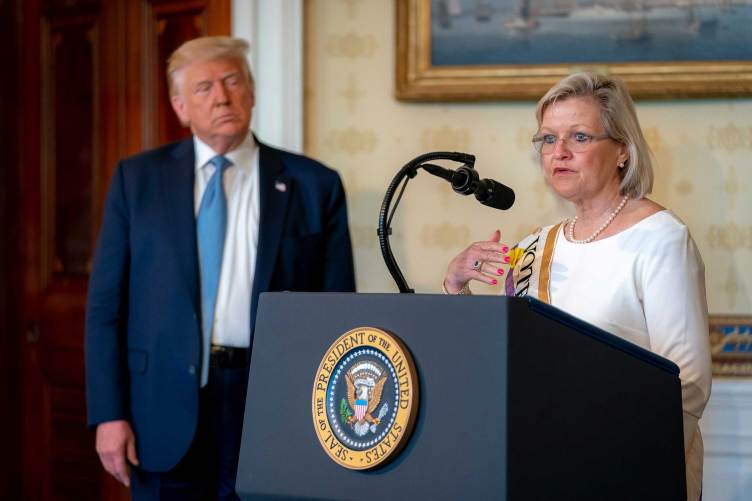
Cleta Mitchell founded a grassroots organization, the Election Integrity Network, devoted to rewriting election laws and rules to be more restrictive.Travis Dove/The New York Times/Redux
“Opposed to Honest Elections”
Obtained by ProPublica
No one besides Trump himself has done more than Mitchell, 76, to turn the mundane processes of how ballots are cast and counted in American elections into mortal combat.
Since Trump returned to the White House, Mitchell and her acolytes have been deeply entwined in his unprecedented bid to assert federal control over voting, an effort that has increasingly defined his second term.
Friends and enemies alike credit her with providing much of the administration’s election road map. The White House has turned to those close to her to enact the plan, appointing her associates to help lead the hunt for noncitizens on voter rolls and to reinvestigate 2020 voting irregularities.
“She has the president’s ear,” Steve Bannon, Trump’s former chief strategist and a close ally of Mitchell’s, said in a July interview. “A lot of the momentum things we’ve seen over the last six months or so come directly from Cleta’s involvement.”
To understand how Mitchell became the hand behind this transformational push, ProPublica traced her obsession with politics and elections back to its roots.
From the start, those who knew her told us, she stood out for her willingness to embrace options others wouldn’t and to do whatever it took to win.
Her relentlessness and long-term strategic vision have enabled her to outflank or outlast not only her liberal opponents, but her conservative rivals.
Much of Mitchell’s influence derives from years of groundwork she’s done to put a foundation under the so-called election-integrity movement, once dismissed as a collection of oddballs and fringe actors.
Beyond building the EIN and raising millions of dollars to fund its activities, she’s helped direct tens of millions more to like-minded policy shops, researchers, law firms and advocacy groups.
The net effect has been to make an agreed-upon set of beliefs about elections — that the 2020 presidential vote was stolen, that U.S. voting systems are rigged, that there’s rampant voting by noncitizens — a core part of conservatism.
Rick Wilson, a former Republican strategist who collaborated with Mitchell before Trump’s election and now heads the anti-Trump Lincoln Project, said she had been crucial in building the institutional infrastructure that has sustained Trump’s “big lie.”
“What she found in Trump was less of a client and more of a movement,” he said.
Mitchell declined multiple requests to speak with ProPublica for this article but occasionally answered emails. “Hahahaha!!!” she wrote in response to one email asking for an interview. To another, she replied: “You’re my opponent. … You’re never going to write in any objective, non-judgmental way about the election integrity movement.”
She responded in writing to about a quarter of our detailed questions, disputing that her efforts were designed to undermine elections or upend their results.
“Nothing that we do is designed or intended to ‘sway’ any election outcomes,” she wrote. “What we focus on is making sure the election process is accurate, transparent, and honest. The ONLY steps I’ve urged the Administration to take are those that will give the voters — ALL voters — confidence that the outcomes are correct.”
A White House spokesperson didn’t answer specific questions about Mitchell, saying she has no official role in election policy but is an effective private advocate.
To tell Mitchell’s story, ProPublica interviewed more than 35 people who have worked with her or know her personally, including participants in her network, Republican election lawyers, current and former Trump administration officials, family members and friends. Many, especially conservatives who’ve fallen out with her, spoke on the condition of anonymity because they feared retribution.
We examined thousands of emails related to her work obtained from public records requests and sources, as well as court filings and an oral history she gave in 2007.
We also reviewed hundreds of hours of recordings of her network’s organizing calls spanning a four-year period, many of which were shared exclusively with ProPublica, as well as numerous speeches she’s given at private events for conservatives.
On a call earlier this year, she emphasized that Democrats “only win when they cheat” and that people who resist EIN’s agenda are “opposed to honest elections” and “depraved.”
As much as Mitchell has been able to achieve with Trump in the White House, several people we spoke with noted she hasn’t been able to push important parts of her agenda over the finish line.
Her signature legislation — the SAVE Act and its successor, the SAVE America Act — have been blocked by moderate Republicans in the Senate. Election changes she’d hoped the president could push through before the midterms, such as compelling states to turn over confidential voter information to the Justice Department, have been blocked by the courts. And Trump’s mid-July address on elections drew shrugs even from some conservative media.
Critics, including some inside the election-integrity movement, told ProPublica they are worried that Mitchell’s growing frustration is prompting her to press Trump and his allies toward ever more extreme actions. Her lifelong pattern, ProPublica’s reporting shows, has been to escalate conflicts into winner-take-all battles — a pattern playing out now as she tries to shape the midterms.
Hours after Trump’s speech, Mitchell appeared on Bannon’s “War Room” podcast, sounding openly exasperated at the dismissive coverage, her lips pressed into a thin line.
Bannon suggested the evidence of election fraud cited by the president justified declaring a national emergency, which he argued would enable Trump to immediately force states to implement parts of the SAVE America Act.
Mitchell went even further, one-upping the right-wing provocateur. Trump needn’t bother with this step, she said, which would inevitably be met with court challenges. He already had authority under a law empowering the government to protect critical infrastructure to unilaterally enforce the bill’s requirements, she insisted.
“We’ve got the blueprint. We’ll help,” she said. “We just need someone in authority to say, ‘Let’s do it.’”
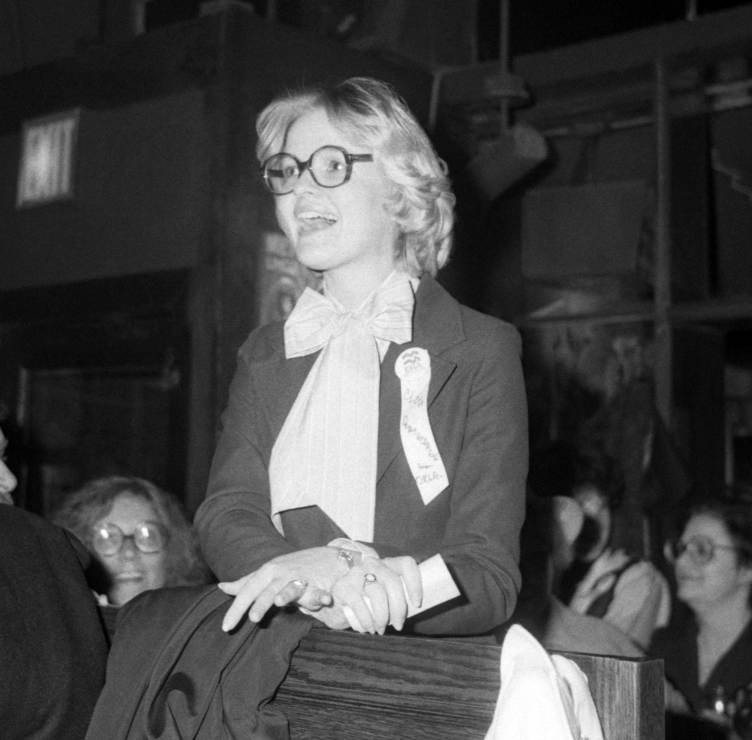
Mitchell in 1978 speaking at a gathering for the Equal Rights Amendment, the proposed constitutional change to guarantee women the same legal rights as men. The ERA, her signature issue, failed to pass in her home state of Oklahoma and nationally.Oscar Abolafia/TPLP/Getty Images
“I Was Always Interested in Politics”
Via Oklahoma State University Library
Mitchell’s fascination with politics and voting began at an early age.
One of her first memories, she would recount in the 2007 oral history, was begging her mother “please not to go vote” until she got home from school and could accompany her. Later, she recalled, “I would study all the voter guides and tell my mother who I thought she ought to vote for.”
Mitchell grew up poor in Oklahoma City, the third of six children born to Jack Deatherage and Modean Lane. She’s often credited her mother, a secretary, for pushing her relentlessly to excel. About her father, she’s said much less, telling The Wall Street Journal only that he was “kind of a no-account.”
She hid the family’s struggles behind a peppy disposition, piling up accolades at school. At 15, she was runner-up in the Oklahoma City Junior Miss pageant. (Asked about these events, Mitchell replied: “I am peppy. I was also named Miss Congeniality in that pageant.”)
At the University of Oklahoma, which she attended on a journalism scholarship, Cleta was known as a “good girl, sorority girl, untouched by the sexual revolution,” one contemporary said.
Before long, she found a seemingly perfect consort: Duane Draper, who’d been the university’s student body president. While friends believed their shared interest in politics brought them together, they had another bond: He, too, had grown up with an abusive father.
“They were mirror images,” said Conrad Draper, Duane’s brother. “They both felt powerless in their childhood, so in their adulthood they constantly pursued power.”
They married in 1971, when Cleta was a junior. When she ran to be student body president, he served as her unofficial campaign manager.
She lost, a setback she blamed mostly on misogyny. Still, she emerged as ambitious as ever. She spearheaded voter drives to defeat Republicans, worked to expand students’ access to voting and helped launch the Oklahoma chapter of the National Women’s Political Caucus. She served as a delegate at the 1972 Democratic National Convention.
As soon as she graduated from law school, Cleta ran for a seat in the Oklahoma House of Representatives, taking on an incumbent Republican. She knocked on every door in her district, prospecting for votes at bowling alleys, beauty shops and high school football games. When she won, Duane had the campaigning shoes she’d worn to near-shreds bronzed.
At 26, she joined a Legislature that was literally smoke-filled (it hadn’t banned cigars) and full of men uneasy at the arrival of “this young, pretty, opinionated blond,” she said in the oral history. She was undaunted, swiftly moving up the ranks by cultivating wealthy donors and building a fundraising machine.
Less than two years later, when Cal Hobson, a small-town mayor contemplating a House run, asked whose backing he should seek, he was sent to Cleta. She had only one question when he sought her endorsement, he recalled: Did he back the Equal Rights Amendment, the proposed constitutional change to guarantee women the same legal rights as men? Hobson said yes and became her ally in the Legislature, watching as she made “some friends and a lot of enemies.”
With Democrats in control of the Oklahoma House, she exploited a battle between candidates for speaker to win a top post on the powerful Appropriations and Budget Committee, then became its chair.
Once in leadership, she backed a slate of liberal initiatives, from expanding open records laws to creating training centers to help divorced women improve their career prospects.
But her idealism coexisted with a ruthless pragmatism, said David Walters, who came up in Democratic politics in the same era and would eventually become the state’s governor. He remembered his shock when she promised him she’d oppose a powerful state development official in a battle over a new building on the University of Oklahoma campus, then switched sides behind the scenes.
“It was quite remarkable,” Walters said. “This was an example of Cleta saying one thing publicly and doing in private something entirely different.”
In 1982, with her political fortunes on the rise, Cleta’s marriage to Duane ended. The filings offered little explanation, citing only “incompatibility,” but those close to her knew Duane had come out as gay. The heartbreak was “devastating,” Hobson said.
Duane left Oklahoma for Boston, where he became a gay-rights activist. He died of AIDS in 1991.
After the divorce, Cleta did what she’d always done: She “put her nose to the grindstone,” Hobson said, “writing the budget and getting her way at the Capitol.”
She found a new partner in Dale Mitchell, a former college baseball player, registered Republican and bank executive. In 1984, when they married, they agreed that Dale would change his party affiliation if Cleta would take his last name.
Later that year, Time magazine named the newly minted Cleta Mitchell as one of a group of star Democratic state legislators, all female, who might one day “set their sights on a higher prize: the presidency itself.” About a year after they got married, they welcomed a baby girl.
Then, over two years, their life collapsed.
Her political fortunes waned after the ERA, her signature issue, failed to pass in Oklahoma and nationally. Her main political patron, the speaker of the House, had become entangled in a voting-fraud scandal, costing her her position in leadership. She chose not to defend her House seat, then two years later ran for lieutenant governor. When she lost, she found herself out of office completely.
Dale’s troubles dwarfed hers. When oil prices sank, his overleveraged bank collapsed and federal regulators shut it down. He was banned from the banking industry and later convicted on multiple counts of bank fraud, for which he was put on five years’ probation and ordered to pay $3 million in restitution. The crisis ruined them financially.
Cleta emerged from the ordeal infuriated by what she viewed as federal government’s overreach in prosecuting her husband, whom she has defended as “the most honest person I’ve ever known.”
Once out of Democratic politics, Mitchell gravitated toward conservatives, who were gaining ground in much of the country. She explained the shift as a way to realign her politics to match her personal philosophy of self-sufficiency (and no government handouts). Others say she saw a route back to power and took it.
Hobson, who rose to lead Oklahoma’s senate, was gobsmacked by her transformation.
“No one,” he said, “has changed more politically in my lifetime than Cleta Deatherage Mitchell.”
Mitchell and President Donald Trump in August 2020 at an event marking the 100th anniversary of the ratification of the 19th amendment, which gave women the right to vote. Mitchell, once involved in Democratic politics, switched her party affiliation to the Republicans in 1996.Tia Dufour/White House/Planet Pix via ZUMA Wire/Reuters
“Consigliere to the Vast Right-Wing Conspiracy”
Hillsdale College, via YouTube
Starting in the early 1990s, Mitchell embarked upon a three-and-a-half decade climb up the conservative power ladder.
She and Dale moved to Washington, D.C., so she could help lead a mostly Republican campaign for congressional term limits. Though ultimately unsuccessful, the fight endeared Mitchell, brought in as the token Democrat, to the conservative elite. She switched her party affiliation in 1996 and, within the next few years, had recovered enough financially to buy a home in an upscale gated community and a luxury vacation getaway in the U.S. Virgin Islands.
After the 2000 election, as George W. Bush fought to hold onto a narrow lead over Al Gore in Florida, Mitchell became one of the Bush campaign’s high-profile media surrogates and defenders. In TV appearances, she argued that Democrats’ demands for recounts were an attempt to manipulate the election system.
She emerged determined to focus more of her legal practice on countering what she saw as an assault by progressive groups on election integrity. If “Republicans don’t commit themselves to learning and practicing the art of political war,” she wrote in a Wall Street Journal column, “there may not be much of a GOP to kick around anymore in the future.”
Over the next eight years, she became a go-to election lawyer for Republican politicians and a partner at a powerful D.C. law firm. Later, when the Tea Party emerged, Mitchell embraced hard-right candidates and causes that some other GOP attorneys would not.
As an attorney, Mitchell didn’t particularly shine in the courtroom, those who worked with her said, but she was a masterful and aggressive backroom negotiator and strategist.
No longer a candidate herself, she was free not to be “Miss Congeniality,” she acknowledged in a mentorship speech to conservative women titled “It’s Better to Be Respected Than Liked.” She won over allies with Southern warmth but could be a dangerous enemy if crossed. She’d do anything — within the law — to win, a dynamic one fellow election lawyer called “part of her brand.” (Mitchell didn’t respond to the questions about these assessments.)
Mitchell was one of the first Republican lawyers to support Trump’s presidential ambitions.
Michael Cohen, Trump’s fixer, who helped launch the exploratory bid, said Mitchell had come recommended as the most aggressive lawyer in the field and first met the future president when she came to Trump Tower to discuss the case. Cohen said Trump subsequently retained Mitchell several more times.
“Each matter was resolved to our benefit, something both Trump and I appreciated,” Cohen said in a brief phone interview. When ProPublica asked what the other matters were, Cohen responded, “I can’t disclose those,” then hung up.
When Trump ran for real in 2016, Mitchell transferred her support to him once he’d knocked out her longtime client Marco Rubio. Some of her allies were shocked she’d back an insurgent candidate who often chafed at constitutional limits on executive power and violated conservative principles she’d long espoused.
During Trump’s first term, Reuters reported, Mitchell teamed with other prominent GOP lawyers on efforts to tighten election laws and rules, focusing on those related to mail-in voting and voter ID. Mitchell helped steer millions of dollars into these initiatives, as well as backing lawsuits against Democratic-leaning cities and counties aimed at compelling them to purge voters from their rolls.
In the run-up to the 2020 election, Mitchell was among the first GOP lawyers to urge the Trump campaign to develop plans to dispute the contest’s results, focusing on six to eight battleground states.
Mitchell’s subsequent role in helping Trump try to challenge his loss has been much chronicled in news articles and examined in multiple investigations. Over time, experts said, it’s become clear she helped originate several of the most aggressive actions taken by the president and his allies.
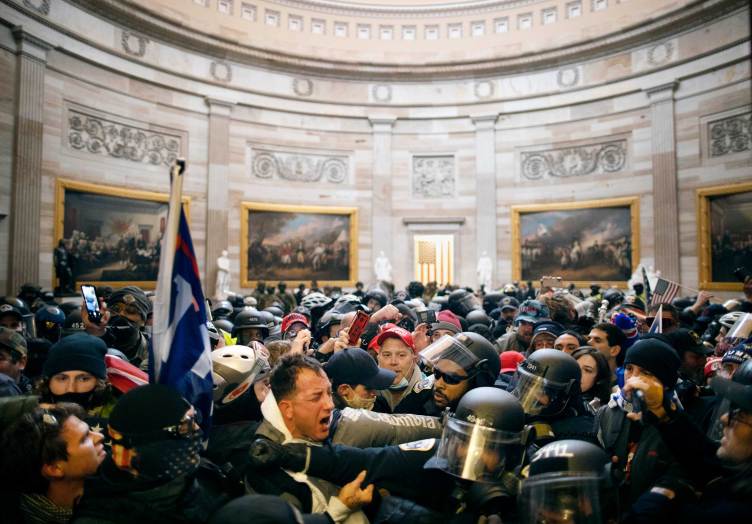
Police and rioters clash during the Jan. 6, 2021, attack on the U.S. Capitol.Mostafa Bassim/Anadolu Agency via Getty Images
“She had her finger in just about every pie the select committee looked at,” said Marc Harris, senior investigative counsel to the House congressional committee that investigated the Jan. 6, 2021, attack on the capitol.
Mitchell led litigation on the president’s behalf in Georgia, accumulating 1,800 pages of election fraud allegations. She maintains events moved too fast for this material to be properly evaluated by a judge. “President Trump NEVER got his day in court in GA,” she wrote in response to ProPublica’s questions.
These claims figured prominently in the infamous phone call on which she joined Trump as he pressed Georgia Secretary of State Brad Raffensperger to “find” him enough votes to overcome Biden’s slim margin in the state.
As Trump poured on the pressure, Mitchell fed him details of election irregularities from her case and demanded that Raffensperger share his findings from investigations into them.
Mitchell insisted to ProPublica they merely wanted to provide Raffensperger with evidence, not to push him “to take any official action to ‘overturn the election.’”
In her emailed responses to ProPublica, Mitchell called the idea an outgrowth of work she’d done early that year advising the American Legislative Exchange Council about steps state lawmakers could take to help Trump in a contested election.
“A movement is stirring,” Mitchell wrote to Eastman in an email two days after the election released by the House Jan. 6 Committee. “But needs constitutional support.”
Ultimately, what congressional investigators came to call the “Trump-Eastman scheme” culminated with a plan for Vice President Mike Pence to certify the fake electors’ votes, flipping the Electoral College in Trump’s favor. But Pence rejected the idea, becoming the target of enraged Trump supporters when they stormed the Capitol on Jan. 6.
Experts said Mitchell helped set the day’s events in motion though she was not at the riot.
“She worked closely with John Eastman in developing and seeking to implement dubious legal strategies to overturn the election result,” Harris said. “She encouraged the selection of fake electors.”
Mitchell denied any responsibility for Eastman’s work or what ensued.
“I was completely uninvolved in the Jan 6 rally at the Capitol,” she wrote in response to ProPublica’s questions. “I had nothing to do with the issues and advice from Dr. Eastman to the President, the Vice-President, or anyone else involved in that. None whatsoever.”
In an email responding to ProPublica’s questions, Eastman acknowledged Mitchell had solicited the memo but disputed his strategy was aimed at upending the election.
Mitchell resigned from her law firm after the Raffensperger call sparked backlash, blaming her exit on pressure from anti-Trump groups.
But unlike many who’d fought alongside her, Mitchell wasn’t dispirited once Biden entered the White House. She was just getting started.
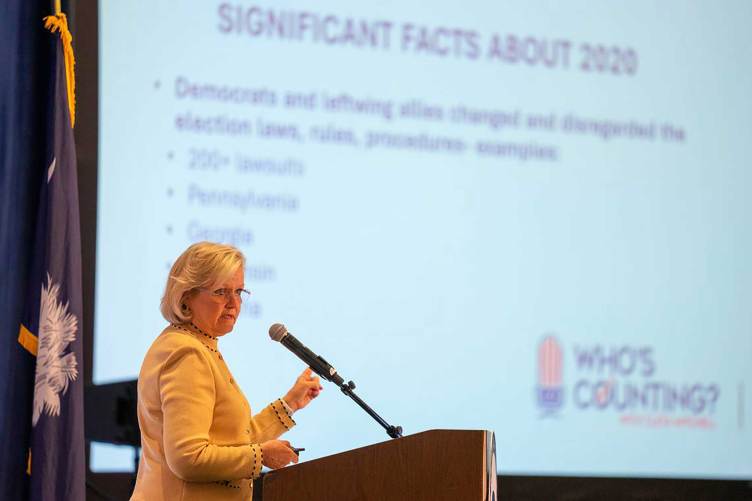
Mitchell speaks about election integrity at a South Carolina Republican Party conference in Myrtle Beach.Gerard Albert III/Myrtle Beach Sun News/Tribune News Service via Getty Images
“Hand-to-Hand Combat With the Left, Starting at the Local Level”
Obtained by ProPublica
In 2022, behind the closed doors of hotel ballrooms and conference suites, Mitchell appealed to crowds of conservatives in seven swing states, asking them to help her overhaul U.S. elections.
“Welcome, fellow deplorables!” she said to open the proceedings in Michigan, after a welcome video from Trump urging the crowd to get behind her. “As an old Southern Baptist, I like evangelizing. So, this is your Bible!”
Brandishing the 20-page manual provided to each participant, Mitchell implored attendees to master the arcane rules of American elections, work the polls and cozy up to — or, better yet, serve on — local election boards.
The tour was part of the nationwide launch of the Election Integrity Network. In the aftermath of losing the fight over 2020, Mitchell decided she needed an army — a popular movement large and loud enough to tear down what she saw as an election system dominated by Democrats.
“My sole focus has been for the last year and a half, how we as conservatives could build an infrastructure to do hand-to-hand combat with the Left, starting at the local level,” she said on a September 2022 EIN organizing call.
The network served as the centerpiece, providing the boots on the ground, but Mitchell also created an ecosystem to support it, spreading money to allied researchers, law firms and policy shops.
A ProPublica analysis of data from the Campaign Legal Center, a government watchdog nonprofit, shows that between 2021 and 2025, Mitchell helped put more than $70 million into this work. According to tax filings, at least $11 million of that total came from nonprofits she oversaw. Tens of millions more came from the Bradley Foundation, where she served on the board, and the Conservative Partnership Institute, a Trump-aligned think tank where she was a senior legal fellow.
Roughly 30 conservative election-integrity nonprofits were started after 2020. Well over half have received money from Mitchell or have close ties with her, the data shows.
“She occupies a unique position,” connecting donors, activists and political leaders, said Brendan Fischer, the Campaign Legal Center’s director of strategic investigations. She’s leveraged this spot, he said, “to turn election denial from a fringe position into an organized national movement.”
In assembling the EIN, Mitchell built chapters from scratch in some states; in others, she absorbed long-standing groups that did similar work.
Much of the network’s organizing takes place on the regular video calls held by each state chapter and about half a dozen national working groups, which focus on subjects such as reshaping voter rolls and scrutinizing voting machines.
In reviewing hundreds of hours of these meetings, ProPublica found a mixture of mind-numbing technical discussions, wild speculation and hyperpartisan vitriol.
On a July 2025 call to honor Eastman, heurged network leaders to assault the Left as the Romans attacked the ancient city of Carthage. “They will never stop until not only are they defeated, but the land from which they came is salted over so they can’t grow up again,” he said.
Mitchell disputed that EIN was partisan. “I defy you to show me hyperpartisan vitriol on any EIN related call,” she wrote to ProPublica. “That is not what we do. Mind-numbing technical discussions, yes.”
Local calls often fixate on micro-efforts aimed at a single county or election office. Members — who sometimes call themselves “election believers,” a counter to the “election denier” label used by critics — discuss lobbying particular politicians or combing voting records for evidence of fraud. If, as often happens, they find no widespread problems, the meetings serve as echo chambers in which supporters are urged to keep the faith and see conspiracies behind small bureaucratic mistakes.
Current and former members said being in the network made them feel like part of a special strike force saving America. Mitchell’s charm could be irresistible.
“It’s like she’s the sun and you’re the sunflower,” a former EIN leader said, speaking on the condition of anonymity for fear of retaliation. But Mitchell’s wrath could be volcanic if members disagreed with her or explored working with other election-integrity groups.
“Vindictive is not a strong enough word,” the former EIN leader said. “She treats you like a heretic.”
(Mitchell didn’t respond to these observations.)
Mitchell joins rank-and-file calls every month or so, on which she’s praised effusively and given titles like “the world’s leading expert on election integrity” and “our patron saint.” She also chairs a Friday morning leadership meeting that draws high-profile guests like Lisa Nelson, the head of the American Legislative Exchange Council, state election officials and luminaries from conservative think tanks. “It’s a who’s-who of who matters in the movement,” the former member said.
Since Trump retook the White House, officials from his administration have occasionally attended, discussing how they can coordinate with the network’s activists.
In summer 2025, a DHS official joined a network call to discuss an effort to persuade states to use an agency tool to search their voter rolls for noncitizens. Many states had resisted, uneasy about sharing confidential data with the federal government. The official wanted network members to encourage state and local officials to cooperate.
“This is your team,” an EIN leader said. “These are the people that are going to do the work in the states that you need to make this magic happen.”
Early on, many EIN branches weren’t particularly effective and several had notable stumbles. A then-participant in North Carolina’s chapter accompanied a group that unsuccessfully tried to force its way into a voting office. The chapter’s leader was accused of following election workers in his car and other disruptive behavior. (He denied his actions were problematic.)
But by 2023, the network started getting significant wins.
Mitchell and EIN were instrumental in spurring Republican states to pull out of a program to cross-check voter rolls for duplicate registrations. Mitchell claimed the program aided Democrats by requiring states to encourage unregistered residents to sign up to vote.
EIN members also helped persuade numerous states to pass laws banning “Zuckerbucks” — private donations from Meta CEO Mark Zuckerberg and others aimed at bolstering underfunded local election offices. Mitchell had claimed the donations helped Democratic turnout, paying for things like Spanish translators in election offices.
EIN continued to grow, expanding from seven chapters in 2022 to at least 26 today.
In Georgia, the network came close to realizing the goals Mitchell sketched out when she first pitched the group.
As her state-level plans advanced, Mitchell readied an even bigger swing, one aimed at changing elections across the country and setting the agenda for a second Trump administration.
Mitchell speaks during a news conference in May 2024 to introduce the Safeguard American Voter Eligibility Act.Tom Williams/CQ-Roll Call, Inc via Getty Images
“God Made Me Do This”
Obtained by ProPublica
In January 2024, Mitchell met with a small group of Republican lawyers and election-integrity leaders to discuss how best to prevent fraud in the November presidential election.
Arizona had passed a law compelling residents to provide proof of citizenship when they registered, rather than just swearing they were citizens under penalty of perjury, as is typical in most states.
Mitchell suddenly had an inspiration, she later recounted in a private speech to Virginia’s EIN chapter: She’d lead a push for a similar federal law. “I didn’t think of this,” she told those at the event. “God made me do this.”
When Mitchell returned from Arizona, she was, indeed, a woman on a mission. She convened her closest congressional allies, Sen. Mike Lee of Utah and Rep. Chip Roy of Texas. Their staffers met with her to help draft the Safeguard American Voter Eligibility Act.
The bill set a high bar for proving citizenship, demanding that would-be voters produce documents like certified birth certificates and passports that many Americans don’t have. It also required states to use the DHS’ databases to purge noncitizens from their voter rolls.
The ideas in the measure would presage some of the second Trump administration’s most norm-breaking actions. “When we look back to the original SAVE Act in 2024 to the administration’s actions today, the through line is clear,” said Michael McNulty, a director for the watchdog nonprofit Issue One.
Mitchell knew the initial version of the act wouldn’t pass. When it was introduced in May 2024, Democrats controlled the Senate and the White House.
Rather, people in the election-integrity world said, she saw the measure as a strategic opportunity — both to cement her position atop the movement and to reignite the fervor for voting restrictions among the Trump faithful. For years, she’d fought behind the scenes for Trump’s ear on election issues, vying with more moderate Republican election experts as well as fringe activists.
To make sure her rivals had no choice but to support the SAVE Act, she brought on a backer too powerful to ignore: Stephen Miller, senior adviser to Trump in his first term and architect of his immigration policy. (Miller didn’t respond to questions about his relationship to Mitchell or the SAVE Act.)
Mitchell denied Miller had a hand in the measure. “Stephen is someone I greatly admire but we never worked together on the SAVE Act,” she wrote to ProPublica.
Stephen Miller, center, senior adviser to Trump in his first term and architect of his immigration policy, attends the May 2024 news conference for the SAVE Act.Kent Nishimura/Getty Images
But Roy, the bill’s House sponsor, said in a podcast interview that Miller helped draft it. Mitchell sought to dovetail her election agenda with Miller’s immigration agenda, those who’ve worked with them said. They stood side by side at an event at the Capitol to launch the bill, warning that Democrats were letting people into the country illegally in part to swing elections.
In a coup for Mitchell — anointed the Mother of the SAVE Act — pretty much every significant player in the election-integrity space joined the Only Citizens Vote Coalition, a group she launched to back the bill.
Mitchell directed more than $6 million to groups that bought ads, put out research and took other actions supporting SAVE, tax filings show. Some $800,000 went to the nonprofit arm of the conservative media organization The Federalist, which provided glowing coverage of the legislation.
Sean Davis, The Federalist’s CEO, didn’t answer questions about whether the donation affected coverage. “Cleta Mitchell is a saint,” he said in an email.
The measure sailed through the House in July 2024, then predictably died in the Senate. The bill had drawn fire from voting advocacy groups, which said the measure could disenfranchise millions of eligible voters, particularly women, the poor and minorities, all critical Democratic voting blocs.
That November, Trump won back the presidency and Republicans secured majorities in both chambers of Congress.
Mitchell saw the chance not only to pass an even tougher federal version of SAVE — a “SAVE Act on steroids” as she called it in a November organizing call — but to make even more far-reaching changes to American elections.
“This is a once-in-a-generation opportunity,” she told attendees on the call. “I don’t want us to miss this.”
President Donald Trump in March 2025. When Trump won back the presidency and Republicans secured majorities in both chambers of Congress, Mitchell saw the chance to make even more far-reaching changes to American elections.Win McNamee/Getty Images
“If Plan A Doesn’t Work, I Have a Plan B”
Obtained by ProPublica
Two months after Trump took the oath of office, America got its first glimpse of how he planned to overhaul the nation’s election system.
His March 25, 2025, executive order — titled Preserving and Protecting the Integrity of American Elections — looked a lot like the SAVE Act. It required voters to prove their citizenship when they registered, mirroring the types of identification listed in the bill.
It also expanded on the notion of using DHS data to verify voters’ eligibility, saying that all of the federal government’s relevant troves of sensitive information should be made available for this use. Further, it directed the Justice Department to prioritize the prosecution of election crimes and noncitizen voting.
Mitchell was close to a pair of White House lawyers involved in drafting the order and was among a small group of outside attorneys who provided suggestions for it, according to several people who helped write it.
The order was the first in a string of behind-the-scenes victories that have not only allowed Mitchell to shape the Trump administration’s election blueprint, but have given her substantial influence over who’s been chosen to carry it out.
At least 25 administration appointees have close ties to Mitchell, ProPublica’s reporting shows, with several holding key posts directly related to elections.
“She’s had a lot to do with even White House hires in this regard,” Bannon said. (The White House denied Mitchell had swayed its hiring decisions.)
Heather Honey, a senior counselor to Homeland Security Secretary Markwayne Mullin, has a portfolio that touches on almost everything the administration does on elections. She’s figured centrally in the government’s efforts to find and prosecute noncitizen voters.
Before joining DHS, Honey was a Mitchell protege and led EIN’s Pennsylvania chapter. A high-ranking federal official knowledgeable about the hiring process told ProPublica that the agency hired Honey over more experienced candidates. Her “sole qualification was who she worked with,” the former official said. “She worked with Cleta.”
A DHS spokesperson called this “false,” saying Honey had been recommended by senior government leaders for her election expertise.
Mitchell also has had a hand in shaping the administration’s reinvestigation of fraud allegations involving the 2020 election, beginning with the FBI’s seizure of election records from Fulton County, Georgia.
As ProPublica has reported, the affidavit justifying the raid included material compiled by an EIN-affiliated researcher and cited network participants as witnesses.
When the case bogged down as the prosecutor overseeing it began to doubt its strength, Mitchell was among those who recommended a replacement: Dan Bishop, a former North Carolina congressman whom she’s praised on social media and supported with campaign donations.
At a May meeting, a Georgia EIN leader said Bishop was tapped “thanks in large part to Cleta Mitchell,” an account echoed by an administration official familiar with the matter.
A Justice Department spokesperson said the agency “has no knowledge of any role Cleta Mitchell played” in Bishop’s appointment.
Mitchell told ProPublica she didn’t believe she’d affected this decision. “I was very worried about the direction of the case earlier this year and made known my displeasure quite strongly,” she said. “The decision to appoint Dan was made by the President and I applaud it, but I cannot claim credit for that brilliant idea.”
Soon after stepping in, Bishop tried to subpoena personal information for thousands of Fulton County poll workers, a move the county and election experts denounced as politically motivated intimidation. A court quashed the subpoena. Bishop has appealed.
As she’d envisioned in her call with EIN members just after the 2024 election, Mitchell has gotten the president to sink enormous political capital into passing even tougher versions of the bill, now known as the SAVE America Act.
The 2026 measure would require voters nationwide to present photo ID to vote and compel states to turn over their voter rolls to DHS, which would scour them for noncitizens. Trump has repeatedly called the measure his top legislative priority, threatening not to sign other bills until it passes.
Lee, the Utah senator who sponsored the bill, said Mitchell was central to the updated version, especially the strict voter ID provisions. Trump, he added, gave it the new name.
Former officials and people in the election-integrity movement told ProPublica that Mitchell has had to overcome naysayers within the administration, including White House Chief of Staff Susie Wiles.
On an EIN call in early 2025, Mitchell complained that Wiles had responded frostily to plans she offered for the incoming administration, “saying, ‘Thank you, I’ll take a look as soon as I come up for air.’”
At the time, Mitchell said she’d wanted to reply that wouldn’t happen for four years. When ProPublica followed up about the incident, she wrote: “Susie is remarkable and a great chief of staff. She doesn’t have time to read all the things that people like me send her.”
Mitchell has surmounted these obstacles, in part, by continuing to build out her array of alliances.
By the middle of this year, when the White House brought on Solomon — a longtime Mitchell supporter who vetted material for Trump’s prime-time elections address — it was clear she had found another way in. (A White House spokesperson said that Solomon, who also runs a conservative news site, interacted with Mitchell as a journalist would speak to a subject-matter expert.)
A former administration official who said he’d tried to stymie Mitchell acknowledged she’d won out. “The White House listens to her,” he said.
Mitchell had told her EIN disciples not to worry after Wiles’ brush off. She had more cards to play, she assured them.
“I always know if plan A doesn’t work, I have a plan B,” she said. “If plan B doesn’t work, I have a plan C. And so forth.”
Mitchell in January 2026. “Even if she fails, she always finds another point of attack,” said Max Flugrath, a director at the voting advocacy group Fair Fight. “She’s relentless.”Tom Williams/CQ-Roll Call, Inc via Getty Images
“Today”
Steve Bannon’s “War Room” Podcast
By the time the first mail-in ballots of the midterms were cast in September, Mitchell had shaped and staffed the Trump administration’s election efforts to an astonishing extent. And yet, the knockout blow had eluded her.
Courts had blocked large parts of Trump’s executive orders. The hunt for noncitizen voters and the reinvestigation of 2020 voting irregularities had produced little of consequence, despite the considerable resources poured into them.
Mitchell’s critics and even her allies, including some in the election-integrity movement, say frustration has prompted her to push for more drastic steps.
Mitchell has taken a similarly all-or-nothing approach in pressing states to pass laws modeled on the SAVE America Act, sometimes with similarly self-defeating results.
Earlier this year, she waded into a battle over an Ohio bill despite being warned that the governor would veto the tougher version she preferred. The final bill contained the provision Mitchell sought. The governor promptly vetoed it.
Former Ohio Secretary of State Ken Blackwell, an election-integrity movement leader who’s worked with Mitchell for decades, said Mitchell sometimes runs the risk of making elections less secure by torpedoing practical solutions.
“It was her way or the highway,” he said. “We need to focus on getting concrete wins.”
(Mitchell didn’t respond to Blackwell’s broader criticism but called the more moderate election measure he’s backed in Ohio “not nearly as good as it should be.”)
As the midterms near, she has become increasingly vocal — in media appearances, online and with her network members — in calling for the president to exert unprecedented powers to sway the vote.
“Even if she fails, she always finds another point of attack,” said Max Flugrath, a director at the voting advocacy group Fair Fight. “She’s relentless.”
On the Oct. 6 episode of “War Room,” Mitchell angrily pounded home that several agencies, particularly the Commerce Department, could intervene “today” to shore up purported vulnerabilities in voting machines. She repeated the word “today” seven times during the appearance, like a drumbeat.
Some of those who’ve known Mitchell the longest say her urgency has crescendoed as, at 76, she’s confronted the possibility that this administration is her last chance to realize her goals.
“In her mind, in her timeline, it’s existential,” the former network leader said. “She’s got to do it all, and she’s got to do it now. … The election integrity movement, c’est moi.”
Brazilian right-wing presidential candidate Flávio Bolsonaro holds a picture of his father, convicted former President Jair Bolsonaro, during a motorcade with supporters in Goiania, Brazil, on Sept. 27, 2026.Photo: Sergio Lima/AFP via Getty Images
“I never thought about leaving the country,” Flávio Bolsonaro, a Brazilian senator and son of the deposed, disgraced leader, told his 16 million Instagram followers on Monday. It was the day after he lost the presidential election to President Luiz Inácio Lula da Silva by a margin of more than 4 million votes.
Flávio promised to stay in Brazil to “organize the opposition” during Lula’s next term.
“I’m the last obstacle to the Workers’ Party’s plan to destroy the country,” Flávio warned, referring to the party of Lula, who defeated his father four years earlier.
A few hours later, he left his mansion in Brasilia and sought asylum in the U.S. The Trump State Department told The Associated Press that it will grant him and his family visas.
The affinities become obvious when you watch Bolsonaro’s failsons end up in Trump’s America.
“I didn’t take sides, but it looked like another rigged election,” President Donald Trump told reporters on Monday, echoing Flávio’s election night talking points without providing any credible evidence that casts doubt on Lula’s come-from-behind victory — even as Flávio’s own party put out a statement acknowledging the results later that day.
It is no coincidence that the Trumps and the Bolsonaros are so fond of each other. Their modus operandi is nearly identical.
Both wrap themselves in the rhetoric of patriotism and moral righteousness, while treating their political offices as personal get-rich-quick schemes. And, when their lies finally catch up with them, you can be sure that they will jump ship to save themselves first and abandon their followers.
The affinities become obvious when you watch Bolsonaro, his failsons, and co-conspirators all end up in Trump’s America, where Flávio is about to join his brother, and in the denialism and violence that follow their failures.
Coups and Flight Risks
Flávio Bolsonaro’s election denial and hasty escape are his version of Trump’s infamous January 6 speech: Rile up the troops to do your dirty work and get the hell out of the way.
It’s not the first time a Bolsonaro ran this playbook. After Jair Bolsonaro became the first modern Brazilian president to lose a reelection bid, he refused to attend the January 2023 inauguration ceremony. Instead, he also fled to the U.S., staying in a Minions-themed children’s bedroom in the Orlando, Florida, home of retired UFC fighter José Aldo.
A week later, on January 8, the ex-president’s allies laid siege to the capital, Brasília, vandalizing Congress, the presidential palace, and the Supreme Court, as foot soldiers in a larger coup plotted to overthrow the Lula government. Nearly four decades of Brazilian democracy was only spared when key military leaders blinked before they could finish the job.
Jair Bolsonaro eventually returned to Brazil and was sentenced to 27 years in prison for leading the plot, which included a plan to assassinate Lula, Vice President Geraldo Alckmin, and Supreme Court Justice Alexandre de Moraes. Allies, including top military brass, were also convicted. Jair remains under house arrest — widely thought to be pinning his hopes for freedom on a Flávio presidency that wasn’t to be.
Flávio, however, will not be lonely in the States. His brother, former Brazilian Congress member Eduardo Bolsonaro, just received green cards for his family and is living in a $1.2 million McMansion in Southlake, Texas, in the Dallas-Fort Worth area, as we revealed in The Intercept Brasil earlier this year. Eduardo, who is a regular on the Trumpworld circuit, was sentenced in absentia to four years and two months in prison for lobbying the U.S. government to interfere in his father’s trial.
Flávio, too, seems poised to receive news of his own prison sentence while sitting on a couch in a Texas suburb. In May, our reporting at The Intercept Brasil put the first nail in the coffin of his presidential campaign when we published chat logs and audio recordings of the senator negotiating $24 million — and being wired $10 million — from disgraced billionaire banker Daniel Vorcaro, who is a sort of Brazilian cross between Charles Ponzi and Jeffrey Epstein.
The payments, wired to a U.S. account, were supposedly meant to finance “Dark Horse,” a biopic about Jair Bolsonaro starring Jim Caviezel. Brazilian Federal Police, though, have already poked holes in Flávio’s story as they investigate whether the money was actually used to bankroll Eduardo’s treasonous lobbying of the Trump administration to sanction Brazil and help his brother’s electoral chances.
Flávio is also being investigated for his alleged ties to a billion-dollar money-laundering scheme through an online betting company run by Willer Tomaz. The two are not only close friends but also business partners. Flávio even had unfettered access to one of Tomaz’s offshore bank accounts. You will not be surprised to learn that Tomaz left Brazil in August and is now living in Miami.
Police argued that, after losing the election, Flávio would pose a flight risk, especially in light of his closest associates’ recent actions. They asked the Brazilian Supreme Court to order Flávio to turn over his passport, which is permitted under Brazilian law. A top justice granted the request and, when the deadline passed, canceled the senator’s travel documents.
By then, Flávio was already on his way to the U.S.
Argentine president Javier Milei escalated his rhetoric against journalists on Friday, singling out veteran investigative reporter and ICIJ member Hugo Alconada Mon along with four other reporters as “mercenaries of lies” and suggesting they should be “burned at the stake.”
Journalists associations in the country leapt to their colleagues’ defense, calling the remarks a “death threat” and asking the United Nations special rapporteur for freedom of expression to intervene. The remarks took place at a private, livestreamed event after a judge dropped a fraud investigation into Milei and his sister that was propelled by reporting into the so-called ‘$Libra scandal.’
In 2025, the president posted on the social media platform X about $Libra coin, a cryptocurrency available for trade in Argentina, saying it would help finance small businesses. The price skyrocketed and then fell sharply after the president deleted his post, causing significant losses to some investors.
Journalists, including Alconada Mon, subsequently reported ties between the creators of $Libra, Milei and his sister, Karina Milei, dating back to 2024, prompting investors to file a complaint accusing the president and his sister of fraud and influence peddling.
Recommended reading PRESS FREEDOM Journalists in Peru seek protection from justice system amid rising threats, harassment by officials Sep 26, 2025 PRESS FREEDOM ‘Many journalists have left’: How post-election repression compounded press freedom fears in Venezuela Nov 15, 2024 PRESS FREEDOM US bars executives of Costa Rica’s leading newspaper La Nación from entry May 06, 2026
A DSA-backed California prosecutor who helped force Meta to pay a historic $17 billion settlement this year is on a glide path to become the top lawyer for Los Angeles — unless a tech investor cozy with Elon Musk can spend enough to stop her.
San Francisco resident John Hering has sunk more than $1.25 million into an effort to defeat Marissa Roy, a deputy attorney general at the California Department of Justice endorsed by the LA chapter of the Democratic Socialists of America, and to support John McKinney, a county prosecutor running an uphill general election campaign. It’s a heavy injection of cash from a single individual in a local race for a little-known office, but it pales in comparison to Hering’s private-sector spending: In 2022, his investment firm Vy Capital pumped $700 million into Musk’s takeover of the company then known as Twitter and $300 million into his tunnel-construction Boring Company.
A co-founder of the cybersecurity company Lookout, Hering is spending in line with the tech industry in which he’s long been invested. While the city attorney’s office is commonly used as the city’s defense against litigious residents, the office also carries the power to mold legislation, enforce state law, such as labor protections, and take on corporations and the federal government in court. Roy has vowed to wield the office’s regulatory muscle against corporations — including Big Tech.
“Monopolies and Big Tech are things that [Roy] sees as an opportunity to wage battle against,” said former LA City Councilmember Mike Bonin, who has not endorsed either candidate. “If I were Big Tech, I would certainly think, ‘OK, well, this is someone who is a potential threat.’”
Hering, who did not respond to The Intercept’s request for comment, is part of a group of tech titans backing McKinney. Others include the founders of Ring, Tinder, and Boingo, and investors in Anthropic, Anduril, and SpaceX, who have collectively put more than $1.9 million into pro-McKinney committees. A group called “Committee to Expand the Middle Class Candidate” — backed by the property rental tech giant Airbnb — donated an additional $4.2 million to a committee supporting McKinney.
To help get McKinney through the June primary election, Hering and fellow tech investor Diego Berdakin poured more than $1 million into another committee. Over the past month, Hering’s general-election spending group, Neighbors for John McKinney, has been paying for TV and online ads and mailers that play up McKinney as “a lifelong Democrat” and “100% anti-MAGA.”
The same can hardly be said for the group’s top funder.
After giving to Hillary Clinton’s failed 2016 presidential bid and Democratic candidates like Beto O’Rourke, Hering donated $41,300 to the Republican National Committee and $500,000 to Musk’s America PAC in 2024 to support Donald Trump’s run for president. He has publicly praised Musk’s chaotic purge of the federal government through his so-called Department of Government Efficiency program and called the world’s richest man an “American hero” for offering to pay TSA salaries during the spring government shutdown. In 2025, Hering and Ring founder Jamie Siminoff, who has also donated to Neighbors for John McKinney, attended a White House dinner where Trump hosted dozens of high-profile Silicon Valley figures. The pro-McKinney group is also funded by billionaires Rick Caruso, a failed LA mayoral candidate, and Ron Burkle, a Democratic megadonor.
Earlier this cycle, Hering, who listed San Francisco as his residence in campaign finance documents, also waded into the LA mayoral election — boosting right-wing reality star Spencer Pratt.
Tech industry spending in LA’s elections arrives amid a midterm cycle where Big Tech and artificial intelligence have doled out millionsof dollars to exert influence in congressional and state races across the U.S. as lawmakers grapple with how to regulate the industries. Musk, for example, has dropped more than $442 million into the midterms, including more than $70 million in his political action committee, America PAC, in October alone. And in state Assembly and Senate races across California, tech and AI executives have spent more than $29 million, according to Tech Equity Action, a political nonprofit that lobbies to craft tech-related legislation while advocating for workers’ rights.
California Gov. Gavin Newsom gave big AI companies a scare last month, when he signed a slate of bills protecting workers from AI overreach, like limiting its use to terminate or discipline workers, banning employers from using AI to surveil employees in bathrooms, and assuring that human healthcare workers will have the final say on patient care decisions.
The tech industry had fought hard to kill the bills, and while Newsom did offer the industry some concessions, labor organizers say the new laws offer them an opportunity to expand local worker protections, too.
In LA, Roy has said she would use the city attorney’s office to fight for workers against losses in potential wages, promising that she would go after “large corporations and big tech companies” that “misclassify workers as independent contractors to avoid paying them minimum wage and providing benefits,” according to her campaign website. She also spoke against companies who are increasingly using automation “to evade regulations and eliminate jobs.”
Tech leaders may view a city attorney with an appetite for regulation as “existential to their business model,” said Brian Justie, a researcher at the UCLA Labor Center who was part of the coalition that pushed for the bills.
“What happens in California sets a precedent and serves as a blueprint for the rest of the country,” Justie said. “And so if you’re a Big Tech, you really need to have a certain outcome come to pass here to avoid ripple effects elsewhere.”
For his part, McKinney has blasted Roy for her desire to “turn the city attorney’s office into the country’s largest public interest law firm” as out of touch with what LA voters want. However, voters across the U.S. have increasingly expressed opposition to the expansion of artificial intelligence and the construction of data centers. Roy’s campaign has shown a willingness to lend an ear to growing AI anxieties.
“Billionaires don’t want to answer to the working people, consumers, and communities they exploit,” Roy said in a statement to The Intercept. “But as Los Angeles’ City Attorney, I intend to hold them, their corporations, and the MAGA Republicans that permit their behavior accountable — that’s why they’re spending on someone who won’t.”
McKinney did not respond to The Intercept’s request for comment.
Ads put out by Neighbors for John McKinney assert that McKinney would “take on crooked landlords.” The committee’s website said he would fight for tenant’s “legal protections” against things like “illegal eviction.” But among the committee’s biggest funders is the Santa Monica-based real estate firm, Douglas Emmett Properties, which attempted to carry out one of the largest mass evictions in LA history until it was overruled by a judge. Douglas Emmett donated $250,000 to Neighbors for John McKinney in late September.
Neighbors for John McKinney has also funded attack ads against Roy that paint her as an inexperienced attorney who is weak on crime and has “extreme DSA” positions. The ads cite an article by the conservative California Post, a West Coast spinoff of the New York tabloid, that claimed she had supported a freeze on prosecuting misdemeanors, which she denies.
McKinney campaigns in the mold of law-and-order candidates, pledging to address homelessness and public safety by prosecuting misdemeanors, touting closer relationships with police, and promising to revive a neighborhood prosecutor program. Other California tech-supported efforts have echoed the same — like when tech leaders in the San Francisco Bay Area fueled a successful effort to oust progressive District Attorney Chesa Boudin.
But the LA city attorney’s office holds limited criminal enforcement power, Bonin pointed out. He suspects the tech investment in the LA race is more concerned with potential civil litigation, and he thinks that if voters make that connection, it could spell an issue for the campaign.
“Voters are concerned about Big Tech, they’re certainly concerned about AI, they’re concerned about the influence of — I don’t think you can describe it any other way — 21st-century robber barons,” said Bonin, who now runs the Pat Brown Institute for Public Affairs at California State University, Los Angeles. “Income inequality is a big issue in Los Angeles, so if they make the connection that this funding is symbolic of the agenda that McKinney will pursue … then it becomes more of an issue.”
Roxana Tynan, senior advisor of the Los Angeles Alliance for a New Economy, called the amount of Big Tech money being spent in the race “outrageous.” As she and other labor rights groups gear up for a fight for more worker AI protections in LA — like expanding safeguards to include temporary and gig workers, and banning employers from using AI software to collect sensitive worker information — she said she hoped people would follow the money being poured into the race and the influence that a few figures look to exert on the city.
“These are people who really believe that not only can they buy elections,” Tynan said, “but that they deserve to buy elections.”
Correction: October 29, 2026 This story has been updated to correct Roxana Tynan’s title.
Jess Asato’s public campaigning for victims of online abuse put her in the crosshairs of Grok’s deepfake scandal. Then the UK member of parliament became a victim of the abuse herself.