The FaceStealer scheme used hijacked messaging accounts, fake video meetings and secretly recorded webcam footage to target cryptocurrency…
Source: HackRead · 2026-11-13
North Korean state hackers have stolen more than $400 million in cryptocurrency over the past 18 months by pulling targets into fake Zoom and Teams calls filled with webcam footage of earlier victims. The FBI calls the scheme FaceStealer. It has seized more than 900 of those recordings, and on November 12 it warned crypto and web3 workers and open-source maintainers about the scheme. Source: FBI Every successful call infects the target and records them, … More
Source: Help Net Security · 2026-11-13
Material Security followed suspected North Korean fake IT workers through the hiring pipelines of organizations it monitors and counted 27 personas that reached onboarding over one year. At one company where a persona got that far in the past month, about 277,000 files containing Social Security numbers were shared company-wide or by public link. The personas are fabricated job seekers, complete with résumés and faces, applying for remote engineering roles. Over the year, 2,429 of … More
Source: Help Net Security · 2026-11-13
Also Thursday, the FBI blamed North Korea for a separate social engineering scheme that officials say resulted in the theft of $400 million worth of cryptocurrency.
Source: SecurityWeek · 2026-11-13
The Justice Department on Thursday announced coordinated actions against North Korean groups’ campaigns that have stolen billions of dollars in cryptocurrency, seizing cloud infrastructure behind a social engineering scheme known as FaceStealer and the court-authorized seizure of more than $1.2 billion stolen from cryptocurrency exchange Binance.
The larger of the two operations is tied to the theft of more than $6 billion in virtual assets from Binance, which the FBI has attributed to North Korean military hackers it calls TraderTraitor. Investigators working with private virtual asset service providers have frozen more than $2.7 billion of the stolen funds, and courts have authorized the seizure of more than $1.2 billion of that amount.
A. Tysen Duva, the assistant attorney general in charge of the DOJ’s Criminal Division, said its computer crime section and partners froze the stolen Binance assets “before they got beyond law enforcement reach,” halting “about half of this historic breach.”
The FBI also issued an alert Thursday that detailed the scheme’s mechanics. Hackers known publicly as Sapphire Sleet, BlueNoroff, APT38 and Stardust Chollima hijack accounts on Telegram, LinkedIn, Slack and Discord and invite targets to video meetings. Links lead to typo-squatted domains, hosting imposter versions of Zoom and Microsoft Teams “designed by the hackers to be indistinguishable from the genuine interfaces.”
The infrastructure seized by the FBI contained a library of more than 900 secretly recorded webcam videos that the hackers played to impersonate victims in follow-on attacks. The footage was captured from victims as they waited for video chats to begin. The alert published redacted and blurred examples of the library. Because each compromise yields the next victim’s video and contact lists, the pool of targets and victims “grows exponentially,” the alert warned.
The campaign has drained more than $400 million from the cryptocurrency and Web3 sectors over the past 18 months. The FBI said it has seized more than 900 victim videos used to impersonate victims in follow-on attacks.
Patrick Grandy, the assistant director in charge of the FBI’s Los Angeles field office, said the scheme is “capable of deceiving even the most experienced technical and security conscious computer user.”
“It exploits our trust in ubiquitous video conference platforms and valued personal relationships,” he said.
The alert also showed the scheme’s reach beyond its direct victims, showing how it was used earlier this year to lure the maintainer of a significant open-source JavaScript library into a fake Teams meeting. Hackers then used the maintainer’s access to create malicious dependencies that could have been downloaded alongside legitimate ones.
For years, North Korea has committed cryptocurrency heists alongside the regime’s expansive scheme to get remote IT workers hired at U.S. businesses, ultimately to launder ill-gotten money and evade economic sanctions.
Justin Moore, director of adversary operations at Arctic Wolf, told CyberScoop that even with the law enforcement actions, there has been a “significant evolution in both the scale and sophistication” of North Korean schemes.
“While the tactics continue to evolve, the goal remains the same,” Moore told CyberScoop. “They’re exploiting trust to lower a target’s guard and convince them to take an action that leads to compromise. That’s what makes operations like this so effective and why efforts to disrupt them are so important.”
“Cryptocurrency unfortunately has become fertile ground for North Korea to defraud victims and fund its malign activities,” said Bill Essayli, a U.S. attorney for the Central District of California. “Today’s seizure shows that America will continue the fight against rogue states who financially gain from cybercrime.”
The FBI credited the cybersecurity firms Arctic Wolf, Jumpsec and Microsoft Threat Intelligence Center for assisting in the investigation and seizure.
Source: CyberScoop · 2026-11-13
Hardware wallets protect private keys, but clear signing, open-source firmware and on-device verification let users see malicious crypto transactions.
Source: HackRead · 2026-11-05
Binance’s first incident report traces the record theft to a months-long campaign that compromised three engineers’ computers.
Source: SecurityWeek · 2026-11-04
Binance explains how North Korean hackers used fake job interviews, malicious developer tools and an internal AI tool…
Source: HackRead · 2026-11-04
In recent months, North Korea has accelerated its weapons tests in a likely bid to increase its leverage in potential diplomacy with the US.
Source: SecurityWeek · 2026-11-04
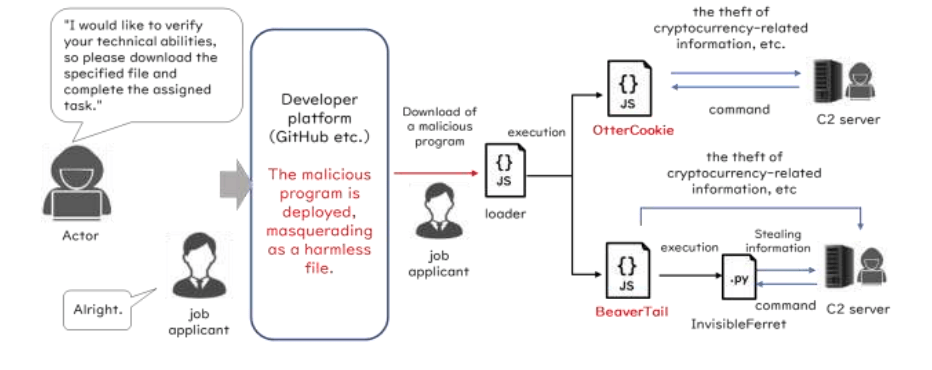
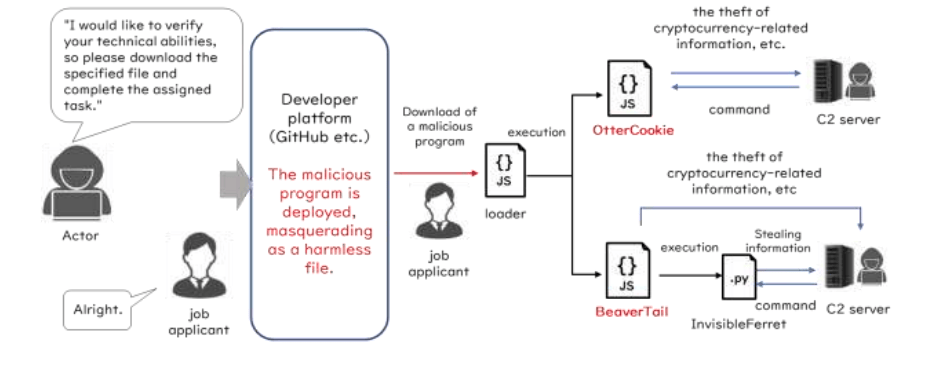
The Binance security incident on October 29 shows how a fake recruitment process can become the entry point to critical financial infrastructure. The attackers combined social engineering, compromised developer tools, stolen credentials and abuse of an internal AI application to reach the cryptocurrency exchange’s wallet signing systems.
“Woah – so the Binance hack was indeed via a dodgy job interview for one of its developers who was tricked into downloading malware as part of the “interview” – costing the company >$3bn…” the popular best seller author and cybercrime expert Geoff White wrote on LinkedIn. “Worth noting:
– The 2016 hack of Bangladesh Bank also attributed to North Korea’s Lazarus Group of hackers was via a job application
– The 2022 theft of $625m from video game Axie Infinity happened via offering an employee a juicy job offer
RECRUITMENT IS RISK. If you’re not educating employees on this, start now…
– The 2024 heist of $1.5b from Bybit relied on tricking an employee of its supplier into downloading a dodgy share trading app onto the work machine (so not using a recruitment lure, but still deceiving a target into downloading malware)”
In its initial findings and response update, published on November 3, Binance described the operation as a “sophisticated, multi-stage campaign.” The company estimates that approximately $6.34 billion in digital assets were affected. The FBI attributed the incident to the North Korea-linked APT “TraderTraitor,” also tracked as Lazarus Group and APT38.
“Our current investigation indicates that this was a sophisticated, multi-stage campaign. It was not a single isolated breach or a simple phishing incident.” reads the update published by the crypto firm. “The attackers combined a range of techniques, including social engineering by fake recruitment interviews, malicious software downloads, compromised internal AI tooling, endpoint compromise, and an advanced transaction-authorisation method.”
The operation began months before the theft. In June 2026, an engineer from Binance’s Wallet DevOps team downloaded a tampered Homebrew installation while searching online for a popular AI coding tool. Binance detected the suspicious activity, replaced the device and rotated the associated credentials, but information about the engineer’s role and colleagues had already been exposed.
The attackers then targeted another software engineer through a legitimate job-hunting platform. In September, someone posing as a Project Director arranged two interviews: first with an HR representative, then with someone claiming to be the CEO of a fictitious company. During the first video interview, the supposed HR representative shared a social media account containing personal photos and videos to establish credibility.
At the end of the second interview, the engineer was asked to download a technical assignment containing a malicious code repository onto his work computer. The malware executed during setup, replacing a legitimate development tool component with a malicious version. It used obfuscation to evade detection, executed commands and established communication with an attacker-controlled server. Binance said its endpoint security tools didn’t detect the malware at the time.
“The second interview was conducted in a popular social chat app, near the end of the interview, Engineer B was instructed to download an “assignment” containing a malicious code repository onto his work computer.” states the firm. “The repository contained malicious code that executed during the setup process, initiating a series of unauthorized activities.”
The compromise then moved beyond the affected workstation. On October 20, attackers used the compromised computer to abuse an internal AI tool and gain access to the systems of two other employees, including the Wallet DevOps engineer initially targeted in June. They discovered that his computer contained a token with container deployment permissions.
This is one of the more significant aspects of the incident. The report doesn’t identify a vulnerability in the AI model itself. Instead, it shows how an internal application can become an attack pivot when an adversary gains access to a compromised employee’s environment and the permissions available to that user.
“The attacker leveraged the compromised computer of engineer B and used an internal AI tool to gain control over the Wallet DevOps Engineer A and another Wallet Software Engineer C.” states the report. “The attacker soon discovered Wallet DevOps Engineer A had a container deployment permission token on his computer.”
On October 29, the attackers used stolen credentials to access another engineer’s computer, deploy a container and execute a malicious script. This gave them access to Binance’s internal wallet signing service, allowing them to initiate transactions outside the normal withdrawal process.
The transfers involved several blockchain networks. Five Binance hot wallets sent 233.46 million XRP to an attacker-controlled address, while other transfers involved approximately 970,500 SOL, 44.2 million OP and 18,270 BTC.
The attackers also exploited Ethereum’s EIP-7702 authorization mechanism to grant a malicious smart contract partial execution rights over a Binance hot wallet.
“EIP-7702 allows an account to delegate certain execution rights to a smart contract without exposing the private key. In this case, the attacker used that mechanism to give an attacker-controlled smart contract partial execution rights over a Binance hot wallet.” the company states.
Suspending withdrawals wasn’t enough to stop the transfers because the malicious authorizations already existed on-chain and operated independently of Binance’s normal withdrawal infrastructure.
Binance had to develop a specific procedure to revoke them. The use of Multi-Party Computation (MPC) meant there was no single private key that could immediately invalidate the unauthorized permissions. The final unauthorized transfer, involving 2,961.9 ETH, was finalized at 23:56 UTC. Binance cleared the malicious authorization at 00:10 UTC on October 30.
The company estimates that approximately $6.34 billion in assets were affected, of which around $2.85 billion had been frozen or intercepted as of its November 3 update. Binance says it will absorb the financial impact and has already replenished 98% of the affected token assets, based on figures reported on October 31.
The exchange has rebuilt the affected wallet infrastructure and internal AI tool, replaced compromised devices, revoked associated credentials and tokens, and strengthened endpoint monitoring and wallet-service controls. It is also engaging independent cybersecurity firms to review the incident.
The attack highlights the need to treat recruitment processes, developer workstations and internal AI applications as part of the corporate attack surface. Technical assignments should run in isolated environments, deployment credentials should be short-lived and tightly restricted, and internal AI tools should never inherit unnecessary access to sensitive systems.
Binance also said its security team had detected and prevented 57 suspected North Korea-linked cyber threat cases during 2026. These included fake job interviews, malicious developer tools, compromised software packages and browser extensions, fake video-conferencing applications and campaigns designed to steal credentials or deploy remote-access malware.
The incident is another reminder that attackers don’t always need to break directly into critical infrastructure. Sometimes, compromising the people and tools that manage it is enough.
“We are sharing this initial report because security improves when the industry learns together.” concludes the update.
In September, Japan’s National Police Agency, the FBI, the US Department of Defense’s Cyber Crime Center, and intelligence agencies from Australia and Germany published a joint advisory about a group called WaterPlum, better known as Contagious Interview. The name says it all. The job interview is the infection vector.
The numbers in the advisory are hard to shrug off. At least 30,000 devices infected across more than 100 countries, funds or credentials stolen from over 7,000 cryptocurrency wallets, and a total of 1.7 billion yen, roughly $10.71 million, funneled back to North Korea. The victims are almost always the same type: freelance developers and specialists in blockchain and Web3 work.
Japan’s NPA and the FBI assess that both WaterPlum operators and some North Korean IT workers report to the same place, the 313 General Bureau of the Munitions Industry Department, under the Workers’ Party’s Central Committee. That’s not a loose affiliation. It’s an org chart.
The trap itself is almost embarrassingly simple. WaterPlum actors pose as recruiters or hiring managers, often impersonating real AI, crypto, or NFT companies, and reach out on social media, job boards, and freelance platforms. Candidates get invited to a technical interview, then told to download a file to complete a coding test or fix a supposed bug on the video call.
Follow me on Twitter: @securityaffairs and Facebook and Mastodon
(SecurityAffairs – hacking, Binance)
Source: Security Affairs · 2026-11-03