Tag: elections

  • Voting in 2026 Is Getting an AI Slop ‘I Voted’ Sticker

    Voting in 2026 Is Getting an AI Slop ‘I Voted’ Sticker


    Voting in 2026 Is Getting an AI Slop 'I Voted' Sticker

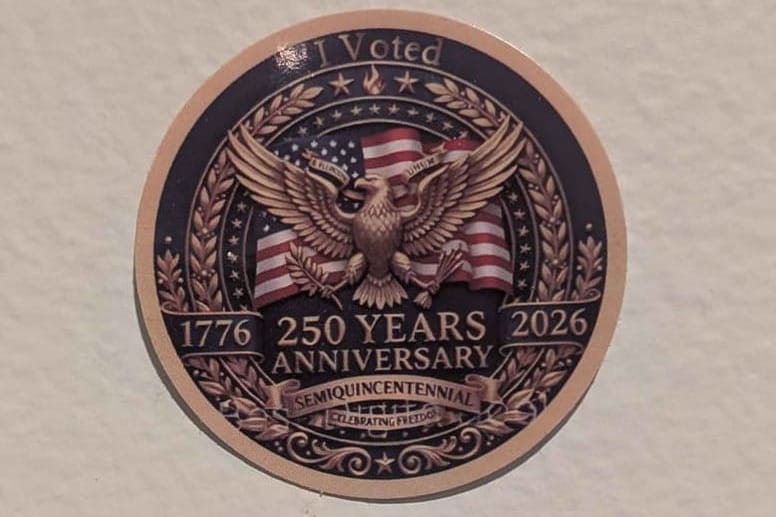
    It’s a small pleasure, but receiving an “I Voted” sticker after casting my ballot is one of my favorite parts of the whole voting process. I slap the sticker on my chest and spend the rest of the day feeling like I accomplished a little something. I participated in democracy and everyone who sees me will know it. Artificial intelligence robbed me of that small joy this year and replaced it with a small horror. My “I Voted” sticker is AI-generated slop. 

    Getting a little sticker when you vote has been a tradition in the US since the 1980s. It’s a symbol of the election cycle. People take selfies and post them or share them with friends. It’s a celebration of democracy and a small way to pressure people into going to the ballot box. 

    The voting sticker has been subject to every kind of discourse imaginable. Are “I Voted” stickers worth the cost? Wondered Marketplace in 2020. A cemetery in New York has spent time and money tending to the grave of Susan B Anthony because voters coat it in stickers during voting season. In 2008, companies like Starbucks and Ben and Jerry’s ran afoul of election laws for offering free treats to people who showed their “I Voted” stickers.

    It’s appropriate but depressing that I got an AI slop “I Voted” sticker in 2026, the year it feels like the mainstream began to reckon with AI.

    My sticker is ugly. It’s a busy circular nightmare. “I Voted” is spelled out in small bronze text at the top of the ring. Bronze laurels encircle a bronze bald eagle that stretches atop the American flag. Below this is more text: “250 YEARS ANNIVERSARY” and “SEMIQUENCENTENNIAL.” Below that, another line reads — as best I can tell — “CEKEVPATIVG EDELDOA.” I assume this was meant to say “CELEBRATING FREEDOM,” but whoever churned out this slop wasn’t using the latest models and the fine detail is lost.

    I put the sticker on reluctantly, but I was not proud. I sent a photo of the offending sticker to journalist friends with my face cropped out. They immediately noticed it was AI-generated. I did not post my sticker online. I shared it with no one else. My democratic joy turned to shame.

    A few hours later, a friend sent me a selfie. He’d just left the voting booth. His sticker was beautiful, tasteful, a testament to the subtle art of the “I Voted” sticker. A red ring enclosed a blue field. The crescent and palmetto (symbols of South Carolina) sat elegantly behind a bold white “I VOTED.”

    His sticker catches the eye. Passers-by will know exactly what the sticker says. They know he voted. Anyone looking at my sticker will wonder how I spilled some bronze paint on my chest. I trembled with indignation. One town over from me they’re giving out the good stickers and I’m stuck with slop. First my town of 12,000 installs 33 Flock cameras and now this? 

    I spent some time scrolling through social media to see other “I Voted” stickers. So many are so beautiful. Michigan runs a contest where students can submit their own idea for a sticker and the state will print up the winners. Kentucky, Albany, and several other places around the country do the same. Louisiana commissions local artists to produce gorgeous stickers. My mouth hung up in a jealous scowl as I stared at pictures of New Orleanians bedecked with a sticker showing a hand drawn trumpet blasting out “I Voted” alongside Mardi Gras beads.

    Only Denton, Texas (another place I’ve lived, weirdly) seems to also have AI-generated slop stickers. Denton’s sticker is, at least, personalized. The city’s court house is in the corner looking more or less correct. The “I Voted” is large and centered in the sticker itself. Like mine, the image is too busy. Too much text, too many fireworks, and the inclusion of the Liberty Bell clutters the whole thing up. The central message — “I Voted” — is bright white. It doesn’t sink into a busy bronze soup like on my sticker.

    Complaining about AI-slop “I Voted” stickers may seem trivial in a world where AIs are choosing targets in warzones and vibecoders are reverse-engineering every piece of software ever written. But these little things are important. These small annoyances pile up until things like ChatGPT flyers are so ubiquitous that you don’t notice them anymore. The AI drive-thru works well enough and one day you stop worrying about it so much. You get an ugly AI slop “I Voted” sticker and you slap it on or toss it out. Enough of these build up until you don’t notice that AI all around you. And then, one day, it’s all normal.

    Right now we’re figuring out where our AI lines are. Society is negotiating what the future will look like. We’re fighting data centers, figuring out how to burn tokens to keep our bosses happy, and learning what we will and won’t abide.

    Me? I draw the line at AI-generated “I Voted” stickers.

    Source: 404 Media · 2026-11-02
  • California officials confirm grand jury subpoenas as states, civil groups brace to protect elections from federal encroachment

    The Trump administration is taking direct aim at California state election officials, issuing grand jury subpoenas to election offices statewide ahead of the final day of voting on Nov. 3.

    The investigations, first reported by Bloomberg, center on alleged administration of illegal voting. They are ostensibly tied to demands by the U.S. Justice Department that California and other states use federal voter lists to determine whether a voter is a “potential noncitizen” and should be removed.

    The Los Angeles County Registrar of Voters told CyberScoop it received multiple grand jury subpoenas last week related to the investigation. The office called the federal efforts an attempt to intimidate California election officials into accepting federal supremacy over state voter registration authority.

    “At every step, the U.S. Department of Justice has taken a confrontational, adversarial approach,” said Los Angeles County Registrar Dean Logan in a statement. “Election officials are acting in accordance with state and federal law. Clear court rulings at both the U.S. District Court level and the Court of Appeals have confirmed that. Threats and intimidation have no place in elections. We will take whatever steps necessary to ensure the safety of our employees and to remain focused on serving the voters of Los Angeles County so they can exercise their voting franchise.”

    California Secretary of State Shirley Weber, also reportedly a target of the federal probe, did not respond to a request for comment from CyberScoop.

    One California election official, Clint Curtis, the outgoing registrar of voters in Shasta County, endorsed the federal government’s efforts to remove 20,000 voters from California voter rolls. Curtis, whose term ends in January, was previously part of a failed effort to hire Tina Peters, a felon and former Mesa County, Colorado, election clerk to help with the upcoming midterms. Curtis has long believed in widespread election fraud.

    He told CyberScoop earlier this year that he believed Shasta County elections in 2024 were plagued by suspicious mail-in ballots, saying they looked, felt and “smelled” different from normal mail ballots.

    The U.S. Constitution gives states the authority to administer elections and Congress the power to make election laws, something courts have repeatedly upheld in dozens of legal challenges by the Trump administration.

    The Department of Justice has claimed there are at least 20,000 such potential noncitizens on California’s voter lists, while the Department of Homeland Security told CyberScoop the figure could be as many as 190,000. The administration’s data, drawn from public voter lists, federal databases and commercially purchased personal information, has been repeatedly criticized by election officials, voting experts and federal courts as inaccurate and unreliable for determining voter eligibility.

    Most people identified as “potential noncitizens” turn out to be naturalized citizens who have since gained voting rights, or the result of state administrative errors that mistakenly registered a small number of ineligible voters. Many of those mistakenly registered never cast a ballot.

    State officials have had to defend against attempts at federal coercion as well as third-party activists who are constantly testing and probing election procedures nationwide, sometimes without understanding the laws election officials must follow to verify voters.

    On Wednesday, the Hennepin County Attorney’s Office in Minnesota announced felony charges against a pair of right-wing provocateurs, James O’Keefe and Cam Higby, for unlawful voting and identity theft. According to a statement from Hennepin County Attorney Mary Moriarty, the two showed up at various election offices, provided false identities of real voters to election judges, violating state laws against misrepresenting their identity in applying for a ballot.

    “Elections are the bedrock of democracy and their protection is one of our highest priorities. Individuals engaging in unlawful conduct related to our elections will be held accountable,” said Moriarty. “Our office has had regular meetings with Hennepin County Elections staff in preparation for both the primary and the general elections this year and we are fully prepared.”

    Voting rights and civil society groups are also executing short- and long-term plans to combat potential voter disenfranchisement ahead of Tuesday.

    Jessica Ayoub, deputy political director for the Michigan American Civil Liberties Union, said her organization has “never been more prepared” for any expected fights with the federal government or local officials seeking to disenfranchise voters, saying they first began planning for different scenarios 18 months ago, cultivating relationships with hundreds of clerks and election staff across Michigan.

    “We’ve gamed out 25 potential scenarios and have rapid response strategies that we’ll deploy to ensure our elections are protected and that our democracy remains intact,” said Ayoub, who cited a desire not to publicize further details ahead of next month.

    On Friday, voting rights groups filed a new lawsuit against the Department of Justice and Department of Homeland Security in California, seeking to block the federal government’s efforts against state election officials.

    The groups are asking a judge to declare that the federal government has exceeded its constitutional authority and that state officials are legally carrying out their duties. They also want the court to force the departments to contact all California election officials who received subpoenas and tell them the investigation has halted due to a court order.

    Source: CyberScoop · 2026-10-30

  • Five election scams to watch out for

    Five election scams to watch out for

    Elections give scammers plenty to work with: urgent deadlines, familiar faces, passionate supporters, and messages asking people to take action.

    Some want you to “fix” your voter registration. Others want a donation, an answer to a survey, or payment for merchandise supposedly endorsed by your favorite politician. The details change, but the objective stays the same: get your money, your personal information, or both.

    Here are five election-themed scams to watch out for.

    Scam 1. “We’ll help you vote”

    Not every election-themed lure starts with a threat. Some offer to make voting easier.

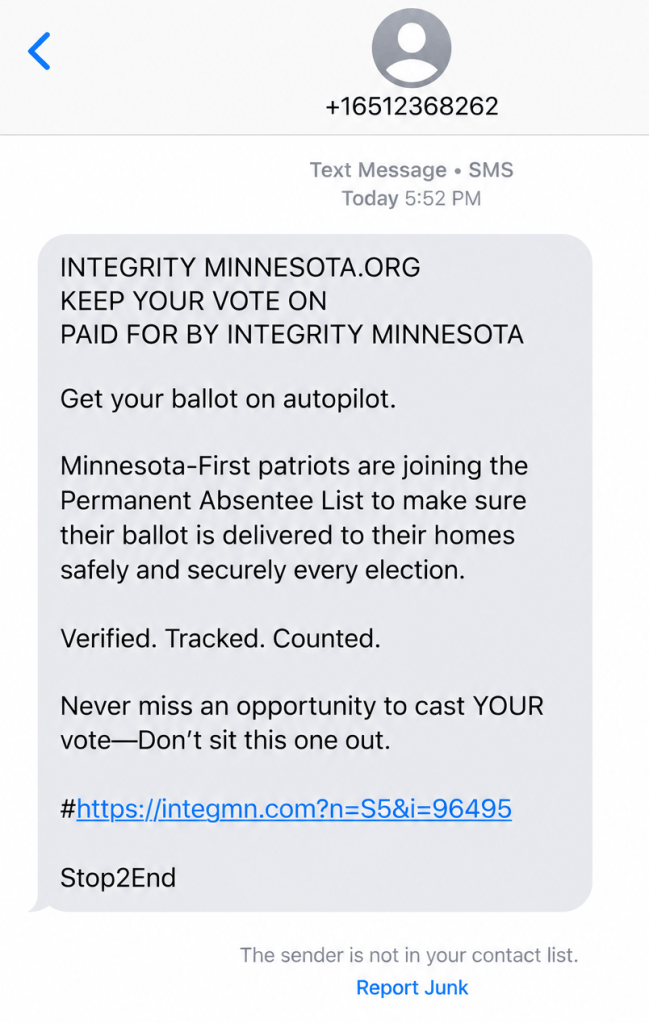
    “Get your ballot on autopilot,” reads one text message we reviewed. It encourages recipients to join a permanent absentee list so their ballots arrive at home for every election, adding the reassuring words: “Verified. Tracked. Counted.”

    A voting-assistance text message reviewed by Malwarebytes. Reconstructed from the message text.
    A voting-assistance text message reviewed by Scam Guard

    The message is a scam, though it borrows the language of a real Minnesota voting service. Minnesota does have a permanent absentee voter list, but the link in this text is fraudulent. To check or sign up, go directly to your election authority’s official website.

    Other messages take the opposite approach: instead of offering convenience, they warn that you could lose your chance to vote.

    A message might say you are not registered to vote, your details are incomplete, or your registration is about to be cancelled. Then it offers a link to sort everything out.

    The FBI recently warned about messages that send recipients to fraudulent voter-registration pages. Instead of helping people vote, these sites collect personal information that criminals can use for further fraud.

    In Brazil, scammers used a fake WhatsApp account with the Superior Electoral Court’s logo. It claimed to be the court’s “Customer Service Department” (which doesn’t exist) and told people to download an app called “Soluciona Pendência,” roughly translated as “Resolve an outstanding issue.” The message falsely warned that people could lose access to banking or government services.

    Scam 2. “Donate now to help your candidate win”

    A fundraising appeal arrives just as an election reaches a critical moment. It uses the candidate’s photograph, familiar campaign language, and an urgent request for money.

    That does not necessarily mean the campaign sent it.

    The FBI warns that scammers impersonate candidates and political fundraising organizations to collect supposed campaign contributions. Victims believe they are supporting a legitimate organization, but the money goes to criminals instead.

    Before donating, find the campaign or organization’s official website yourself and check who will receive the payment. Don’t let a countdown, a matching-donation claim, or a message about an impending defeat rush your decision. The Better Business Bureau (BBB) advises researching political fundraising requests and resisting pressure to act immediately.

    Scam 3. “Take our political survey and claim your reward”

    Not every political poll is suspicious. But a request for your opinion can also be an opening for a scam.

    The BBB warns about fraudulent polling calls that promise a prize in exchange for answering questions. After the “survey,” the caller asks for credit card information to cover shipping, taxes, or other costs associated with the supposed reward.

    At that point, the questions about candidates have served their purpose: keeping you engaged long enough to introduce a payment request.

    Other election-themed messages ask people to complete surveys through links. Treat those links with the same caution you would an unexpected donation or registration request. A familiar political organization’s name does not establish who operates the website.

    You can decline an unsolicited poll. You should not need to hand over payment details simply to share your political views or claim a surprise reward.


    Link Checker

    Scam 4. “Pay this electoral fine” or “Report for election duty”

    Few things make a message feel urgent quite like an official-looking demand backed by a possible penalty.

    Brazil’s Superior Electoral Court (TSE) has warned about messages falsely claiming people had an unresolved voting issue. The messages link to fake government websites designed to steal personal information or trick people into paying.

    Brazil does have legitimate electoral fines, which can be paid through official channels, including Pix. So a fine or Pix request alone doesn’t prove a message is a scam. If a message says you owe money or must perform election duty, check with the relevant authority using contact details from its official website. Don’t use the message’s phone number, link, or QR code.

    Scam 5. Your favorite politician “wants you to buy this”

    A politician’s name can be used to sell more than a political message.

    Criminals use candidates’ names, photographs, logos, and slogans to advertise merchandise that never arrives. What looks like a way to support a candidate becomes an ordinary shopping scam wrapped in campaign branding.

    Apply the same skepticism to a “commemorative,” “patriotic,” or supposedly collectible product advertised using a politician’s name. Before buying, ask:

    • Is the seller actually affiliated with the politician or campaign?
    • What, exactly, are you buying?
    • Is there evidence for claims about the product’s quality, usefulness, or future value?
    • What are the total price, refund terms, and any recurring charges?

    A product does not become useful, valuable, or a sound investment because an ad places it beside a politician’s photograph. Nor does a photograph prove that the politician endorsed it.

    There is also a difference between a product you consider poor value and a fraudulent offer. A product being poor value doesn’t automatically make it a scam. Look for clear deception: a fake endorsement, false claims, hidden fees, or an order that never arrives.

    How to stay safe from election scams

    You don’t need to work out every detail of a suspicious message before deciding whether to act on it. Verify the message through a route the sender does not control.

    • Go directly to official election websites to check registration, voting requirements, deadlines, and alleged penalties.
    • Verify donation requests independently. Find the campaign or organization yourself and confirm where your money will go.
    • Keep payment details out of unsolicited surveys. A political poll that turns into a request to pay for a prize is a red flag.
    • Check sellers before buying political merchandise. A candidate’s name or logo does not authenticate the shop.
    • Don’t mistake personal details for proof. A message can contain accurate information about you and still be a scam.
    • Keep political choices separate from requests for money or personal information. You can support a cause without responding to an unexpected message.
    • Use real-time web protection to help block known malicious websites.
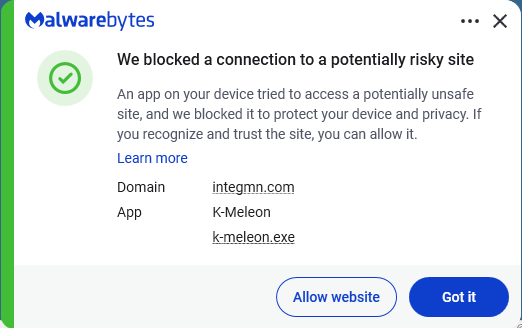
    Malwarebytes blocks integmn.com
    Malwarebytes blocks integmn.com

    Pro tip: Unsure whether a message is a scam? Check it with Malwarebytes’ Scam Guard for an assessment and advice on what to do next.


    Something feel off? Check it before you click.  

    Malwarebytes Scam Guard helps you analyze suspicious links, texts, and screenshots instantly.  

    Available with Malwarebytes Premium Security for all your devices, and in the Malwarebytes app for iOS and Android.  

    Try it free → 

    Source: Malwarebytes Labs · 2026-10-27