Polymarket confirms $2.7 million stolen through the compromised third-party script and pledges $3.9 million in refunds, including compensation for pause losses.
Source: HackRead · 2026-10-31
Polymarket confirms $2.7 million stolen through the compromised third-party script and pledges $3.9 million in refunds, including compensation for pause losses.
Source: HackRead · 2026-10-31
A China state-backed threat group is using ARTEX, the automated agentic AI penetration testing framework, to achieve remarkable speed, scale and success in a campaign that already compromised about 140 sensitive targets in 11 days, according to CrowdStrike.
The threat group, which CrowdStrike tracks as Vapor Panda, targeted more than 200 organizations in at least 14 countries since Oct. 17, the security company said in a threat report Thursday. Targets and confirmed victims include foreign ministries, a European country’s presidency and prime minister’s office, defense and intelligence agencies; 19 U.S.-based organizations in the pharmaceutical, semiconductor, defense, nuclear and financial sectors; and telecom providers in the United States, Belgium and the Philippines.
CrowdStrike told CyberScoop about 70% of Vapor Panda’s targets were confirmed compromised or had evidence indicating moderate confidence of a successful intrusion.
Vapor Panda’s use of ARTEX, paired with DeepSeek, allowed it to accomplish more tasks with shocking speed — requests occurring as often as every 10 seconds — and pursue multiple attack paths concurrently.
“This is the first time that we’re seeing an agentic adversary nation-state threat actor at this scale, and I think that this is probably, unfortunately, something we’ll see more of,” Adam Meyers, senior vice president of counter adversary operations at CrowdStrike, told CyberScoop.
Hands-on-keyboard activity tracked by CrowdStrike for the past 15 years typically involved up to 40 commands per hour. “Now, with ARTEX, we could see it exceed 1,500 commands an hour,” Meyers said.
“If you diversify that across 200 targets, it costs them very little to run a mass-exploitation campaign and drop a websell,” he added. “They can hit more targets in a faster period of time.”
Vapor Panda’s broad-access campaign, which remains active, has targeted think tanks and government agencies spanning defense, justice, finance and diplomacy.
“I would characterize it as a diverse operational mission that tends to focus on sectors and geographies that Beijing considers economically or politically important,” Meyers said.
The active campaign attributed to Vapor Panda is separate from the ARTEX activity Microsoft Threat Intelligence attributed to Storm-0940 earlier this month, including a supply-chain attack targeting ConnectWise customers.
Adversarial use of AI is relatively new, yet also quickly becoming the new normal, Meyers said. “We’re scrambling because we’re seeing so many of these agentic adversaries.”
Agentic AI use for malicious purposes is growing month-over-month at a rate of almost threefold. CrowdStrike observed roughly 45 agentic adversary attacks in September and it’s already at 126 for October, and climbing.
Adversarial use of agentic AI isn’t an intractable problem, but rather another reminder that organizations need visibility into their endpoints, identities and cross-domain capabilities, Meyers said.
These attacks aren’t showcasing anything new, “it’s just doing it at a speed and scale that we’re unaccustomed to,” he said. “It’s not hopeless, but you’ve got to take action. You can’t put your head in the sand.”
Source: CyberScoop · 2026-10-30
A vulnerability in TeamViewer could let attackers run code on an IT support technician’s computer when the technician…
Source: HackRead · 2026-10-30
The Trump administration is taking direct aim at California state election officials, issuing grand jury subpoenas to election offices statewide ahead of the final day of voting on Nov. 3.
The investigations, first reported by Bloomberg, center on alleged administration of illegal voting. They are ostensibly tied to demands by the U.S. Justice Department that California and other states use federal voter lists to determine whether a voter is a “potential noncitizen” and should be removed.
The Los Angeles County Registrar of Voters told CyberScoop it received multiple grand jury subpoenas last week related to the investigation. The office called the federal efforts an attempt to intimidate California election officials into accepting federal supremacy over state voter registration authority.
“At every step, the U.S. Department of Justice has taken a confrontational, adversarial approach,” said Los Angeles County Registrar Dean Logan in a statement. “Election officials are acting in accordance with state and federal law. Clear court rulings at both the U.S. District Court level and the Court of Appeals have confirmed that. Threats and intimidation have no place in elections. We will take whatever steps necessary to ensure the safety of our employees and to remain focused on serving the voters of Los Angeles County so they can exercise their voting franchise.”
California Secretary of State Shirley Weber, also reportedly a target of the federal probe, did not respond to a request for comment from CyberScoop.
One California election official, Clint Curtis, the outgoing registrar of voters in Shasta County, endorsed the federal government’s efforts to remove 20,000 voters from California voter rolls. Curtis, whose term ends in January, was previously part of a failed effort to hire Tina Peters, a felon and former Mesa County, Colorado, election clerk to help with the upcoming midterms. Curtis has long believed in widespread election fraud.
He told CyberScoop earlier this year that he believed Shasta County elections in 2024 were plagued by suspicious mail-in ballots, saying they looked, felt and “smelled” different from normal mail ballots.
The U.S. Constitution gives states the authority to administer elections and Congress the power to make election laws, something courts have repeatedly upheld in dozens of legal challenges by the Trump administration.
The Department of Justice has claimed there are at least 20,000 such potential noncitizens on California’s voter lists, while the Department of Homeland Security told CyberScoop the figure could be as many as 190,000. The administration’s data, drawn from public voter lists, federal databases and commercially purchased personal information, has been repeatedly criticized by election officials, voting experts and federal courts as inaccurate and unreliable for determining voter eligibility.
Most people identified as “potential noncitizens” turn out to be naturalized citizens who have since gained voting rights, or the result of state administrative errors that mistakenly registered a small number of ineligible voters. Many of those mistakenly registered never cast a ballot.
State officials have had to defend against attempts at federal coercion as well as third-party activists who are constantly testing and probing election procedures nationwide, sometimes without understanding the laws election officials must follow to verify voters.
On Wednesday, the Hennepin County Attorney’s Office in Minnesota announced felony charges against a pair of right-wing provocateurs, James O’Keefe and Cam Higby, for unlawful voting and identity theft. According to a statement from Hennepin County Attorney Mary Moriarty, the two showed up at various election offices, provided false identities of real voters to election judges, violating state laws against misrepresenting their identity in applying for a ballot.
“Elections are the bedrock of democracy and their protection is one of our highest priorities. Individuals engaging in unlawful conduct related to our elections will be held accountable,” said Moriarty. “Our office has had regular meetings with Hennepin County Elections staff in preparation for both the primary and the general elections this year and we are fully prepared.”
Voting rights and civil society groups are also executing short- and long-term plans to combat potential voter disenfranchisement ahead of Tuesday.
Jessica Ayoub, deputy political director for the Michigan American Civil Liberties Union, said her organization has “never been more prepared” for any expected fights with the federal government or local officials seeking to disenfranchise voters, saying they first began planning for different scenarios 18 months ago, cultivating relationships with hundreds of clerks and election staff across Michigan.
“We’ve gamed out 25 potential scenarios and have rapid response strategies that we’ll deploy to ensure our elections are protected and that our democracy remains intact,” said Ayoub, who cited a desire not to publicize further details ahead of next month.
On Friday, voting rights groups filed a new lawsuit against the Department of Justice and Department of Homeland Security in California, seeking to block the federal government’s efforts against state election officials.
The groups are asking a judge to declare that the federal government has exceeded its constitutional authority and that state officials are legally carrying out their duties. They also want the court to force the departments to contact all California election officials who received subpoenas and tell them the investigation has halted due to a court order.
Source: CyberScoop · 2026-10-30
A defense contractor with top secret security clearance pleaded guilty to aiding North Korea’s remote worker scheme by allowing co-conspirators to use his identity to apply for jobs, including positions with national security implications, the Justice Department said Wednesday.
John Allen Kurrle Jr. participated in a short-lived but prolific conspiracy that spanned at least 88 job applications at U.S.-based companies, resulting in nine job offers, according to court records.
The 62-year-old allowed co-conspirators to use his identity and government clearance for prospective sensitive work, often with U.S. government contractors. The nine job offers Kurrle’s co-conspirators received between June and October 2025 had annual salary ranges of $120,000 to $190,000.
The scheme had a limited success rate. The longest and most lucrative job a co-conspirator landed under Kurrle’s identity lasted about three weeks, netting a total pay of $4,800.
His identity was also used to gain employment as a software engineer at a Ventura, California-based company to work on a generative AI project for a component of the U.S. military. The company sent a laptop to Kurrle’s residence in Gainesville, Virginia, where he received and hosted laptops shipped by multiple victim companies, enabling co-conspirators to remotely access the devices from outside the United States.
Yet, during a video call to verify employment eligibility, the company noticed that the person who appeared on the video call did not match Kurrle’s age or physical characteristics, according to court records. The unnamed company terminated the employment of Kurrle’s co-conspirator before he did any work on the military contract and Kurrle shipped the laptop back to the company.
The company paid Kurrle’s co-conspirator almost $2,200 for 32 hours of onboarding, which Kurrle is now ordered to pay in restitution along with the $4,800 received from the other company.
Kurrle also, as part of his plea agreement, admitted to using the identity of a third person, without their consent, to apply for some remote work positions. He doesn’t dispute that the scheme likely benefitted North Korea, but claims he wasn’t aware of the connections to North Korea during the duration of his involvement in the conspiracy.
Michael Barnhart, nation state investigator at DTEX, said researchers previously identified Kurrle as a facilitator for North Korea’s remote worker scheme. Yet, until recently, he wasn’t sure if Kurrle was a victim or impersonated.
The case underscores North Korea’s efforts to gain access to roles with a strategic intelligence requirement, as it focuses on contractor roles because those present the path of least resistance.
Kurrle joins a growing list of people who have been charged or jailed for supporting the North Korea regime’s scheme that generates hundreds of millions of dollars annually for the country’s military and organizations involved in its weapons programs.
Authorities have been cracking down on the malicious insider activity by seizing cryptocurrency linked to the theft, and targeting U.S.-based facilitators who provided forged or stolen identities and hosted laptop farms for North Korean operatives.
Some of that money is also funneling through a web of front companies and intermediaries, including sanctioned entities, that partly fund Russia’s war effort against Ukraine, DTEX said in a report in July. This includes manufacturing weapons and supplying them to Russia’s military, according to the security firm.
The countermeasures are stacking up, but the scheme is widespread and has infiltrated an undetermined number of businesses, including hundreds of Fortune 500 companies.
Federal judges previously sentenced other people to prison for their involvement in the scheme, including Matthew Issac Knoot and Erick Ntekereze Prince; Keija Wang and Zhenxing Wang; Audricus Phagnasay, Jason Salazar and Alexander Paul Travis; Oleksandr Didenko and Christina Chapman.
Kurrle pleaded guilty to conspiracy to commit wire fraud and faces up to 20 years in prison upon sentencing, which is currently scheduled for Jan. 28, 2027.
Source: CyberScoop · 2026-10-30
Binance probes a DevOps engineer’s hacked laptop after a $6.3 billion theft linked by researchers to North Korean hackers, and promises to cover all customer losses.
Source: HackRead · 2026-10-30


A modern organization protects its information systems with a whole suite of technologies that generate thousands of security alerts every day. Looking at these alerts in bulk, you’ll see that a significant share are false positives. Ideally, these alerts would be filtered out automatically so that analysts could focus on the ones that may point to a real incident. However, writing filters is a time-consuming task in itself. To create a correct filter, an analyst needs to:
This post looks at how filter creation itself can be automated to reduce analyst workload.
In the context of security alerts, a filter is a combination of event field values that marks a detection as a false positive and not worth the analyst’s attention. Filters can be generated for any combination of event fields, but not every combination yields a valid filter. That’s why we need to define validity criteria: conditions showing that a specific filter actually removes noise and doesn’t suppress useful alerts.
Detection rules in security systems typically contain a set of conditions, and each of them can generate an alert. A specific event triggers a given fragment of a detection rule. The set of events that a given fragment responds to is what we’ll call its context. A good filter should cover the entire context where possible, without going beyond it. Filters that are too broad or too narrow are useless. For example, a filter based solely on PowerShell would exclude too many events, including some that deserve the analyst’s attention. Most of the filtered events would also be unrelated to the rule in question. A filter on a specific ID, on the other hand, would cover only one event, which may never recur.
We can run into a number of problems when creating filters. First, events often contain an excessive number of fields (around 400 on average), and most of them aren’t needed for filtering. At the same time, generating and ranking combinations of these fields is also fairly resource-intensive. So, the first step is to discard the irrelevant fields and keep only those worth using in the filter. For example, out of 400 fields in an event, four may be enough for filtering.
Another problem is string normalization. Field values (for example, the path to the same application on different systems) can vary depending on system settings, user folder names, and so on. For a filter to account for all these variations, the strings must be normalized. For file paths, in particular, you can replace the drive letter and user folders with standard environment variables and convert all paths to a single case.
Finally, if a filter completely mirrors the query of a detection rule, it effectively disables that rule. To fix this, remove the event fields used in the detection rule from the filter. For example, if a rule triggers on a file path, there are two ways to filter out unwanted alerts:
file_path: ".../something.exe", you can set up a filter that excludes events with the user/unique_files/ directory in the file path.Given the problems described above, automatically generating filters for security alerts should consist of the following steps:
For example, consider an event described by the following JSON:
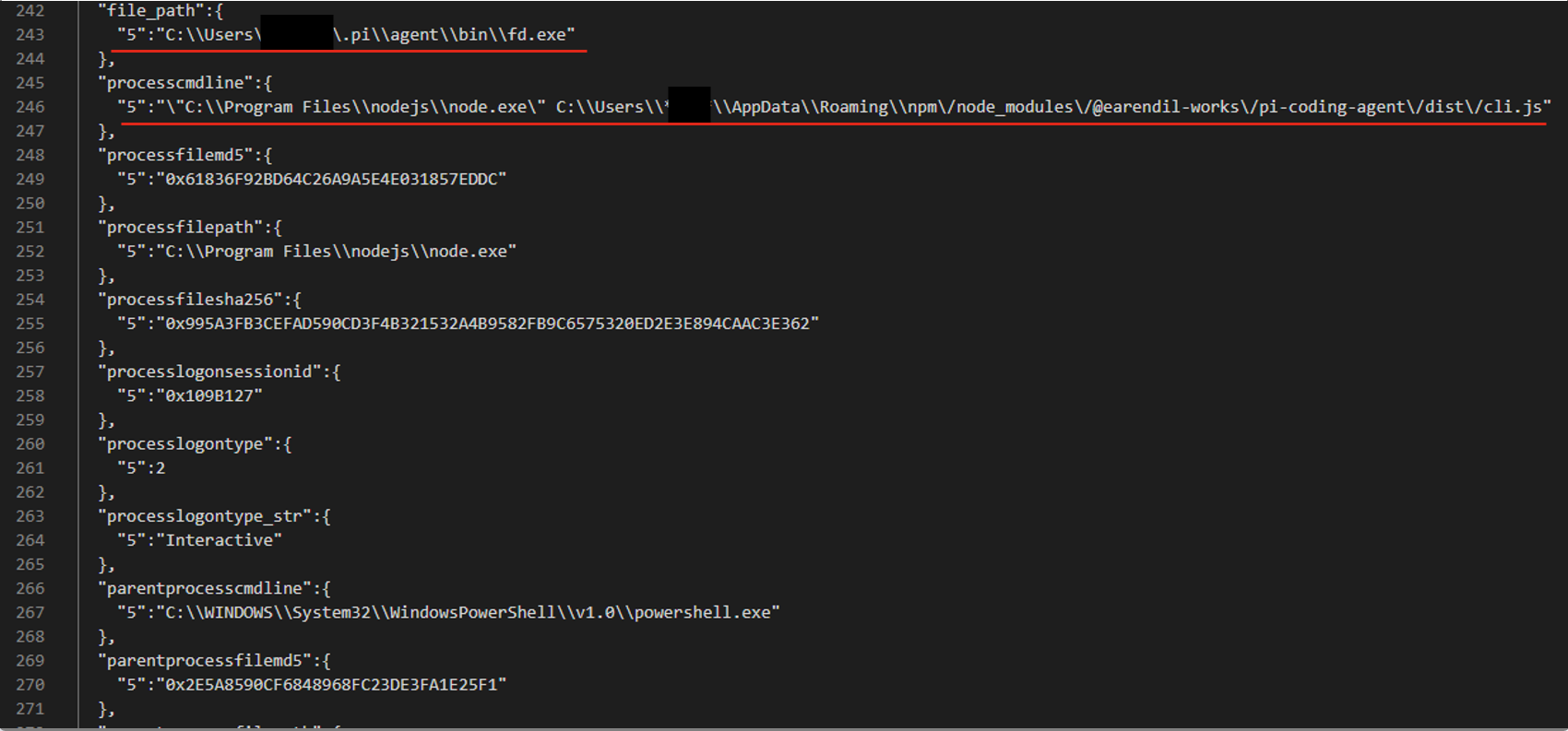
After generating and ranking the combinations, we got three filters based on file paths:
processcmdline:("nodejs\\node.exe" AND "*****\\appdata\\roaming\\npm\/node_modules\/pi-coding-agent\/dist\/cli.js")
file_path:"*****/.pi\\agent\\bin\\fd.exe"
processcmdline: "programfiles\\nodejs\\node.exe"
The last filter turned out to be too broad, but the analyst marked the other two as valid.
The algorithmic approach to filter generation has several advantages. First, it’s simple and deterministic: the same alert always produces the same result. Second, it’s interpretable, meaning we can see why a given combination ranked near the top of the list and why a particular field didn’t make it into the list of candidate fields at all. Third, the stages of the process are independent of each other, so individual steps can be improved and tuned without the risk of breaking the algorithm elsewhere. Finally, it has no external dependencies or models, which makes it easy to deploy in any customer environment.
However, it also has drawbacks. The first is its dependence on context. If there’s no context for some reason — for example, the rule’s first-ever trigger — a filter can’t be created. The second problem is string normalization. There’s a high chance of running into atypical cases that the normalization rules don’t cover. Often such cases can’t be described correctly at all, because they contradict each other.
These problems can be solved with large language models (LLMs). When an LLM generates the filters, no context is needed, because the LLM doesn’t iterate over or rank combinations. The LLM also takes a more flexible approach to string normalization, including non-standard cases. That said, an LLM doesn’t have to be involved at every stage of the generation process. We decided to keep the algorithmic solution where it works well. For example, a simple algorithm selects suitable fields without errors, so we didn’t move this stage to the model.
The LLM-based filter generation looks like this:
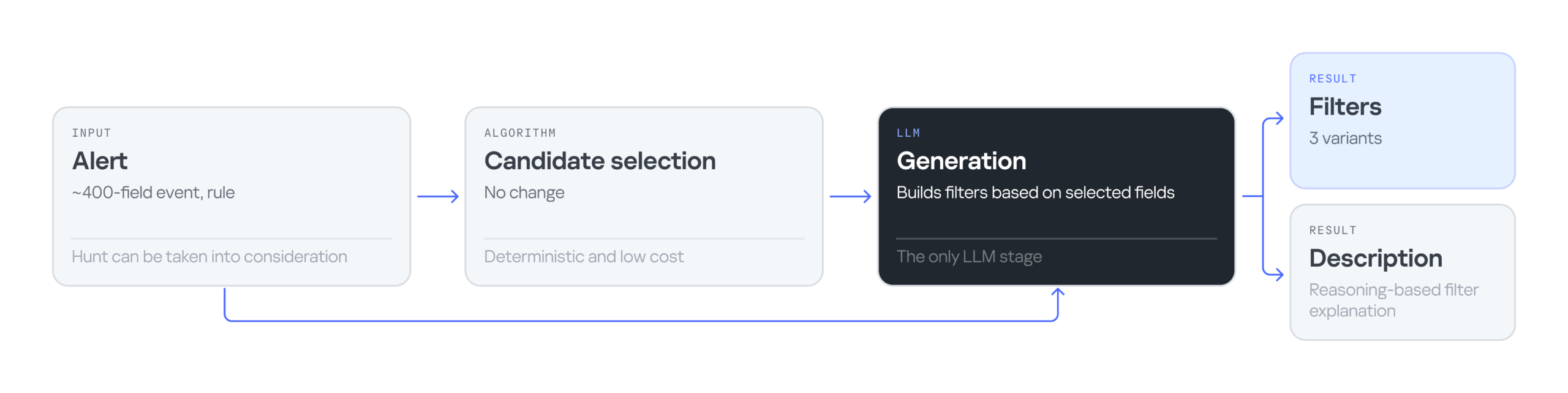
The input is still an alert containing an event with 400 fields, plus the rule that triggered on that event. Then an algorithm selects the most suitable fields for the filter. Next, the LLM processes the input — the event, the selected fields, and the detection rule — and generates three filter options along with an explanation for them. The explanation helps the analyst understand why these particular filters were suggested and make an informed choice.
Consider the following event in JSON format:
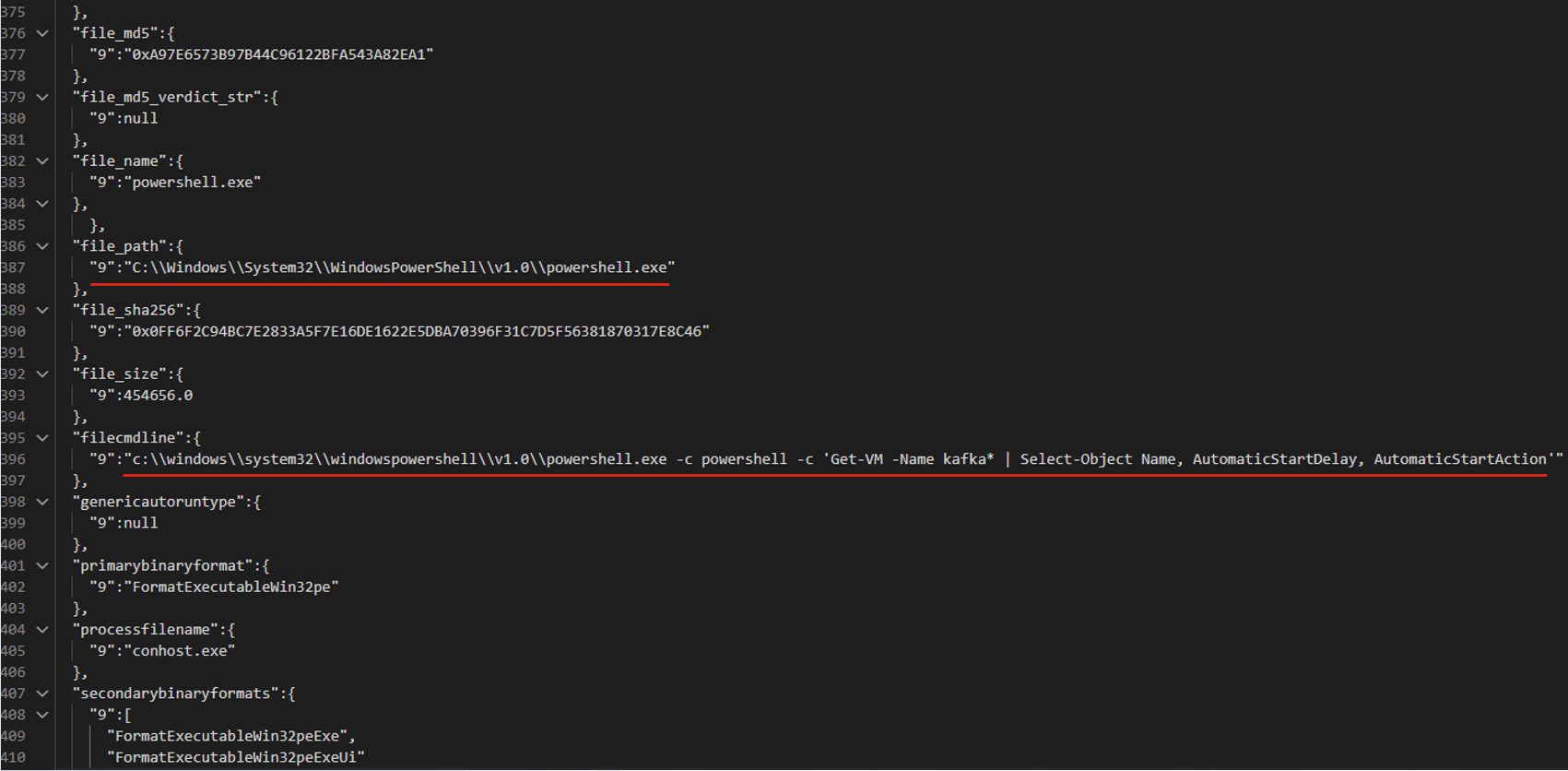
The LLM suggested three filter options that all contain the same command line fragment:
file_path: "\\WindowsPowerShell\\powershell.exe" AND filecmdline: "Get-VM -Name kafka\*"
filecmdline: "Get-VM -Name kafka\*"
filecmdline: "kafka*"
As in the previous example, two of the three output filters were valid. The last one was too broad to be usable. The analyst chose the first filter with minor edits:
file_path: "powershell.exe" AND filecmdline: "Get-VM -Name kafka\*"
Using an LLM solved the problems of purely algorithmic filter generation: dependence on context and errors in string normalization. However, the single-request approach had its own drawbacks. First, it had no output validation. The LLM returned filters as-is, with no syntax check and no way to correct errors. Second, unlike in the algorithmic version, all filter generation tasks were handled by a single system prompt. As a result, a minor fix in one place could break the logic in another.
To address the problems of generating filters with a single model and a single system prompt, we tried distributing the tasks across different LLM agents. In this version, we brought in agents as early as the stage of selecting relevant fields. The chain includes four agents in total:
For the following JSON event, the agents produce three valid filters based on the file path.
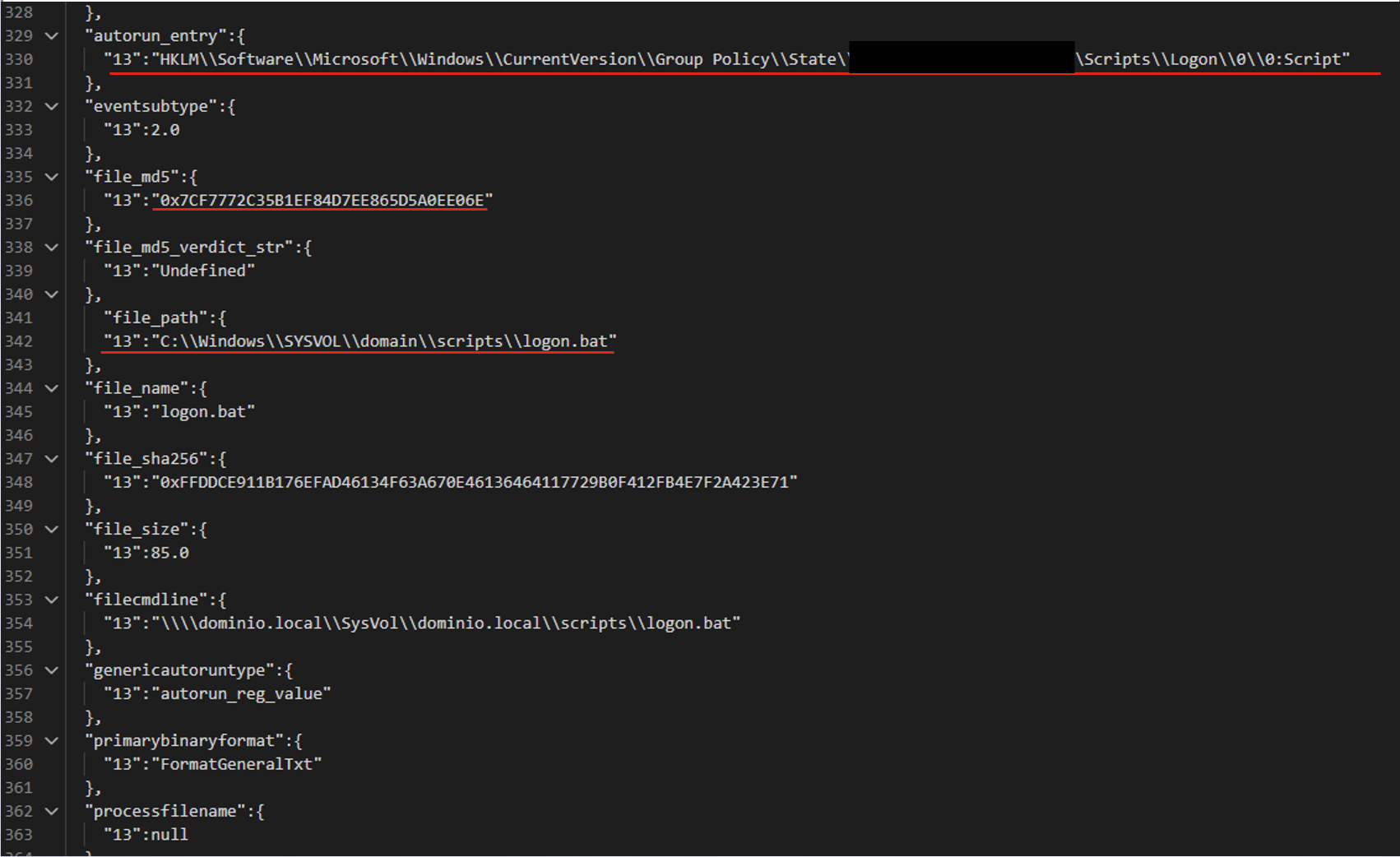
The filters differ in the additional parameters that support the detection:
file_path:"sysvol\\domain\\scripts\\logon.bat"
file_path:"sysvol\\domain\\scripts\\logon.bat" AND file_md5:"0x7..6E"
autorun_entry: "Group Policy\\State" AND file_path: "SYSVOL\\domain\\scripts\\logon.bat"
LLM agents give us a system that can validate and correct filters. Its modular architecture also lets us tune and improve different stages of generation independently. However, this approach makes more LLM calls than the previous ones, so the system is slower. It also depends on access to a model, which may not be available in the organization’s isolated environment.
To evaluate how well the filter generation system works, we use two main metrics:
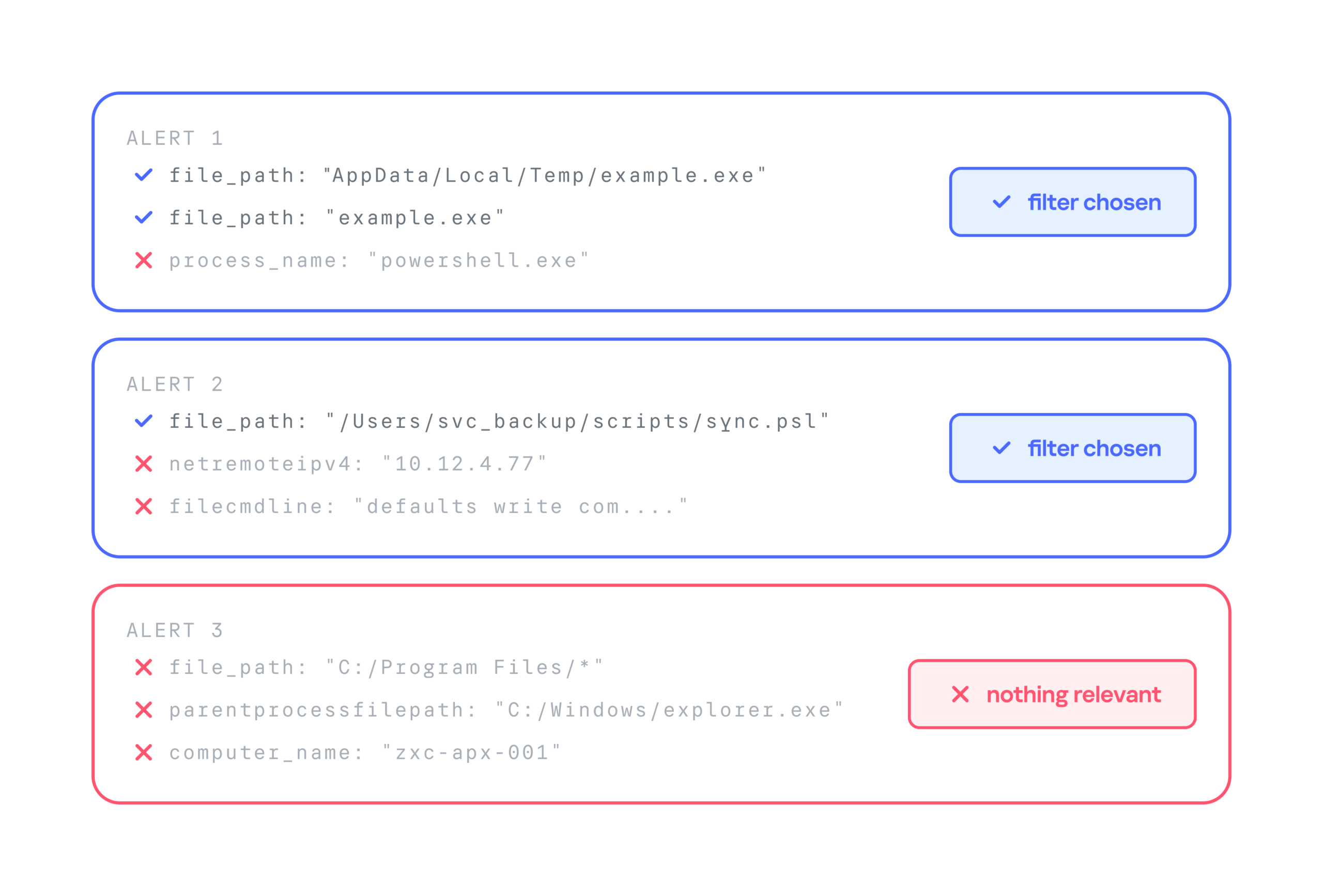
Below is a comparison of the three filter generation approaches by these metrics:
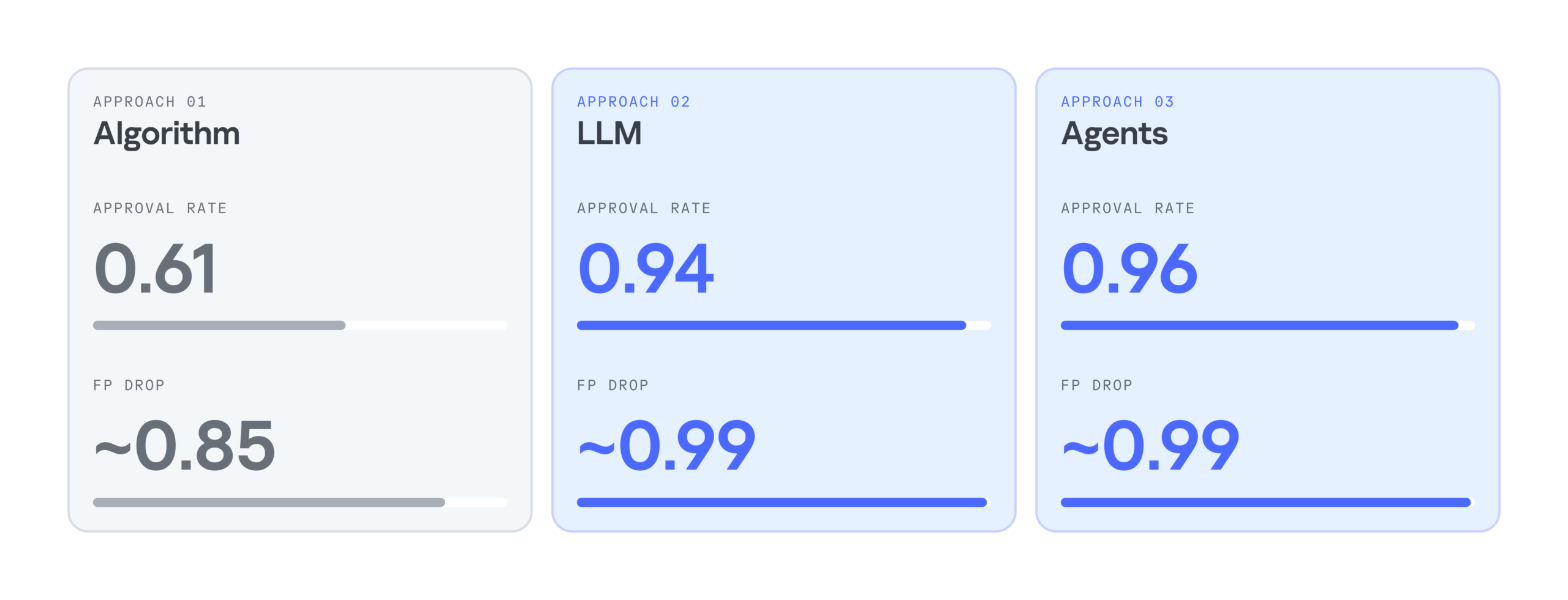
As the results show, LLMs significantly improve the efficiency of filter generation. At the same time, the LLM agentless and agent-based approaches perform almost identically. So we chose the simpler and faster option: an LLM with a single system prompt. As a result, we cut false positives by 99%, increased the number of filters generated per day by 28%, and made analysts’ alert handling 17% more efficient.
Practice has shown that filter generation can be automated effectively. We’ve looked at several options for automatically generating filters for false-positive security alerts: a purely algorithmic approach, an LLM-based approach, and an approach built on a group of LLM agents. All of them can generate valid filters and make the analyst’s work much easier, but each has its own pros and cons.
The algorithmic approach scored lower on the evaluation metrics, but in two-thirds of cases, it still produces filters that satisfy the analyst. It works especially well when there’s already a set of similar events to filter out, meaning enough context has accumulated. The algorithmic generator can also be deployed in any environment. Both standalone LLM and multi-agent LLM approaches show high accuracy, and their results differ only slightly, so the slower agent-based approach looks excessive at this stage. If an LLM is available, the best option appears to be a single model that handles several stages of the generation cycle.
Source: Securelist (Kaspersky GReAT) · 2026-10-30
Attackers posing as IT help desk staff contacted employees by phone, email and Microsoft Teams in the third quarter of 2026 and talked them into opening remote access sessions, Cisco Talos Incident Response (Talos IR) found across several engagements. In one case, that access ended in ransomware. They knew names and email addresses “The attackers appeared to know employee names and email addresses, as they contacted users directly by email and Teams and used identities … More
Source: Help Net Security · 2026-10-30
Gartner recently released a new category of assessing security tools: the Integrated Security Operations Center (ISOC). Even though SIEM isn’t going anywhere, a rapidly evolving threat landscape is forcing a shift in industry logic that is reflected in the emergence of this new category. For years, SIEM has dominated as an all-encompassing category. But SIEMs are no longer sufficient to collect data, support investigations, and manage incidents; instead, the SIEM has separated into distinct architectural … More
Source: Help Net Security · 2026-10-30
One retail scam used more than 1,200 look-alike .shop domains sharing a single IP address. The sites reused HTML, JavaScript and payment-page designs intended to harvest card numbers, expiry dates and security codes, according Akamai’s Fraud and Abuse Report 2026. A ticket scam used a similar setup. Several websites impersonating official ticketing and hospitality portals for a major sporting event were designed to route payment and personal information to the same collection system. Some checkout … More
Source: Help Net Security · 2026-10-30