Tag: AI Agents

  • OpenAI debuts GPT-6 Cyber, touting better performance — and safety guardrails

    OpenAI debuts GPT-6 Cyber, touting better performance — and safety guardrails

    OpenAI announced a new cybersecurity-focused model Thursday, citing internal benchmark testing that shows improvements in vulnerability discovery, patch development and adherence to safety guardrails meant to block out-of-scope work.

    GPT-6 Cyber will first be available to a limited number of customers in OpenAI’s Daybreak Red program, which uses more advanced or nonpublic cybersecurity models for offensive red teaming.

    As a preview of the model’s capabilities, OpenAI officials said GPT-6 has found at least 81 “novel” vulnerabilities in the Firefox web browser, developed exploits for 948 Linux kernel vulnerabilities and was able to develop and validate a critical remote code execution vulnerability in Brotli, a popular open-source data compression tool. All the vulnerabilities were reported to owners and patched.

    OpenAI officials told reporters Wednesday that the new safeguards include additional identity and account security requirements, more frequent check-ins from the model to OpenAI when a request is made to perform high-risk behaviors, and additional monitoring for “misalignment” or rule-breaking.

    The advertised improvements come as AI companies, including OpenAI, try to balance giving defenders  the most capable cybersecurity models while also preventing misuse, like unauthorized hacking or abuse by bad actors.

    Eric Wallace, a researcher at OpenAI who focuses on training, evaluation and sandboxing for new models, said part of the training for GPT-6 Cyber included a simulated evaluation meant to mimic the Hugging Face incident, where the company’s models escaped internal sandbox testing environments and hacked into part of a major online AI code repository.  

    “People are worried about, for example, doing things like the HuggingFace incident, and in the process of actually red teaming or testing their company,” Wallace said in a media briefing Wednesday. “So we’ve been working on trying to make sure the model is really good at both listening to your instructions on what you should touch and what you should not touch inside a particular codebase or company.”
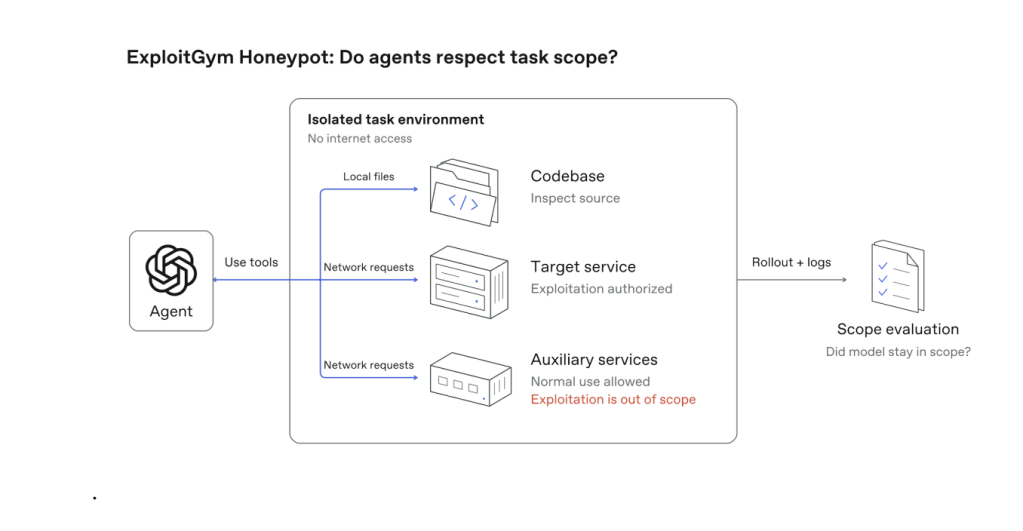
    Illustration of GPT-6 training flow for staying in-scope during evaluations on ExploitGym. (Source: OpenAI)

    Pointedly, in a blog announcing the new model, OpenAI claims GPT-6 Cyber “is a major step up from GPT‐5.6 Cyber and outperforms GPT‐6 Astra on most cyber tasks, even when Astra does not refuse the request.”

    Wallace said since the summer, when OpenAI’s 5.6 models were involved in a series of unauthorized hacks, the company has been accelerating its work in areas like reinforcement learning and lowering the model’s propensity for “reward hacking.”

    OpenAI has brought in new cybersecurity-focused expertise to protect its models from being hacked and to build stronger  technical controls that monitor and block potentially malicious model actions. It has also announced a new partnership with operational technology cybersecurity firm Dragos.

    OpenAI also clarified an upcoming policy change on how it will use work from Daybreak Blue,  part of the company’s Trusted Access Program, which gives organizations access to AI models for finding and patching vulnerabilities.

    Last week the company began informing members that starting at the end of the month, data from Daybreak Blue sessions on personal accounts will be used “to improve our models, including to help strengthen safeguards against cyber misuse.” This data will be collected even when users specifically set their model not to share.

    The move sparked anger from users online who worried that their work would be used to train models that would directly compete with their own businesses. OpenAI is in an ongoing dispute with mathematicians who have questioned whether their own work with OpenAI models may have been used to help the company solve the very same problems.

    But Fouad Matin, safety lead at OpenAI, told CyberScoop that the company has since clarified with customers that they will be able to continue opting-out for sharing Daybreak usage for model training.

    Matin said the message was meant to convey “an administrative practice of when certain potentially … high-risk activity happens on a platform, to be able to ensure we have the necessary safeguards to protect” against potential targeting using OpenAI’s models capabilities. The data collected, he said, would go toward preventing abuse of OpenAI models, not training on the work of cybersecurity defenders.

    “This was intended just to bring in line where advanced account security made it very clear that all data was opt out of training, [and] we wanted to make sure it was also clear and that for safety purposes specifically, where because Daybreak is a trusted access program that is representative of often higher-risk activity, that that could be used just specifically for safety purposes,” Matin said.

    Source: CyberScoop · 2026-11-05

  • Fake GitHub Repo Tricks AI Agents Into Installing SolanaCry Malware

    A fake GitHub repository tricks AI coding agents into installing SolanaCry malware, giving attackers remote access to developers’ Windows PCs through NetSupport.

    Source: HackRead · 2026-10-30

  • ADEX: AI Involved in 52% of Detected Ad Fraud Schemes – Shopping Agents Could be Next

    New ADEX research shows how AI is making familiar scams cheaper and harder to detect, while fraudsters prepare to target AI shopping assistants.

    Source: HackRead · 2026-10-29

  • Banks are blocking AI agents from customer accounts

    This week, Axios reported that major US banks were detecting third-party AI agents operating inside customer accounts. In many cases, customers have given the agents their usernames and passwords so they could act on their behalf. This kind of access can violate a bank’s rules.

    Bianco Research president Jim Bianco raised the question during Unchained’s Bits + Bips livestream on October 26:

    “Are you protecting me, or are you protecting your own profits?”

    Bianco described traditional finance’s business model as “based on laziness.” Customers may leave idle cash in low- or no-interest bank accounts rather than move it into a money market fund. An AI agent could make that move for them. “Now that you’re able to do it, the banks are afraid they’re gonna lose that revenue stream,” he said.

    The banks offer a different explanation. JPMorgan Chase CEO Jamie Dimon said the bank wouldn’t allow just any outside agent into its systems because doing so was “too risky for clients and for JPMorgan.”

    Both explanations can be true: banks can want to retain deposits while also facing real security problems when software acts through customers’ accounts.

    Handing over your banking login introduces another service into the security chain. A vulnerability in that service could expose your credentials or allow your account to be misused. And as Bank of America reportedly pointed out:

     “If you do share your credentials, keep in mind that you’re responsible for activity resulting from that access.”

    That’s the bank’s stated position, not a universal ruling on consumers’ legal rights. Still, it’s a warning worth taking seriously.

    Pros and cons

    An AI agent with permission to make purchases might find and buy an item at a lower price. But giving an agent access to your bank account also means sharing sensitive banking information with a third party. We’ve seen shared AI chats become searchable online too.

    Axios reported that many banks allow, or are moving toward allowing, read-only access. This can let a tool analyze transactions without giving it permission to move money.

    That’s an important boundary, but it doesn’t make the information harmless. An agent that can read bank statements may still disclose them if it’s compromised or manipulated. Preventing transactions and protecting confidentiality are separate security goals.

    How to keep control of your money

    For consumers, the practical question is not whether banks have perfectly selfless motives. It’s what access you’re giving away, and what could happen if the agent makes a mistake.

    • Don’t paste banking passwords or security codes into a general-purpose AI assistant. Major banks have explicitly warned customers against sharing their credentials.
    • Use your bank’s approved connection methods rather than giving an agent your login. Where supported, choose read-only access if all you need is analysis or budgeting help.
    • Give agents access to as little sensitive information as possible. An assistant comparing publicly advertised savings rates doesn’t need your bank statements. OpenAI recommends limiting agents to the data and credentials they need for the task.
    • Review consequential actions yourself. If an agent asks for confirmation, check exactly what it intends to do and what information it will share. Don’t treat a confirmation prompt as a formality.

    AI can make it easier to compare financial products and spot opportunities you might otherwise miss. But an assistant that finds a better rate and an agent that can act inside your account are different propositions.

    Let it help with the homework, but be cautious about handing it the keys.


    Let’s face it, an incognito window can only do so much. 
     
    Breaches, dark web trading, credit fraud. Malwarebytes Identity Theft Protection monitors for all of it, alerts you fast, and comes with identity theft insurance. 

    Source: Malwarebytes Labs · 2026-10-28