Category: Security News

  • Workshop on Economics and Information Security (WEIS) Archive

    There’s a new archive of all the papers from twenty-five years of the Workshop on Economics and Information Security (WEIS).

    Really nice resource. It’s fun to reread my 2002 essay on the economics of information security.

    Source: Schneier on Security · 2026-10-21

  • SafePay Has Compromised 600 Critical Infrastructure Victims Worldwide, CISA Warns

    A new CISA advisory warns of the threat posed by SafePay to businesses and critical infrastructure, and urges defenders to take action to mitigate the group’s tactics

    Source: Infosecurity Magazine · 2026-10-21

  • Critical PHP Vulnerabilities Leaked Ahead of Scheduled Security Patches

    Two critical vulnerabilities in PHP were leaked one day before their scheduled disclosure and security patches

    Source: Infosecurity Magazine · 2026-10-21

  • Parasitizing trust: How legitimate infrastructure becomes a delivery pipeline for attackers

    Parasitizing trust: How legitimate infrastructure becomes a delivery pipeline for attackers

    • Legitimate infrastructure has become a powerful delivery mechanism for attackers, carrying the inherent trust they once had to build. As Cisco Talos explored in our previous research on weaponizing software-as-a-service (SaaS) notification pipelines, these platforms are increasingly repurposed as proxies for malicious intent.  
    • Talos has since tracked a significant acceleration in this trend, observing abuse across more than 25 distinct legitimate platforms in the past year.  
    • The abused infrastructure included collaboration, productivity, file-sharing, survey, payment, and AI-related platforms.  
    • This demonstrates that attackers are not limiting themselves to traditional phishing infrastructure or lookalike domains. Instead, they are systematically subverting the very tools businesses trust.  

    Order notification abuse 

    Parasitizing trust: How legitimate infrastructure becomes a delivery pipeline for attackers

    Talos recently analyzed two order notification campaigns abusing Staples and Dell transactional email pipelines. Together, these campaigns accounted for roughly 1,400 messages observed by Talos. 

    The malicious element was not the outer sender identity, like a simple forged sender or lookalike domain. It was the content of the legitimate order notification workflow rendered. The suspicious content appeared inside the notification itself, in fields that would normally contain shipping information. The attacker’s objective was to use a trusted retail pipeline to create urgency around a high-value purchase and push the recipient toward an attacker-controlled phone number. 

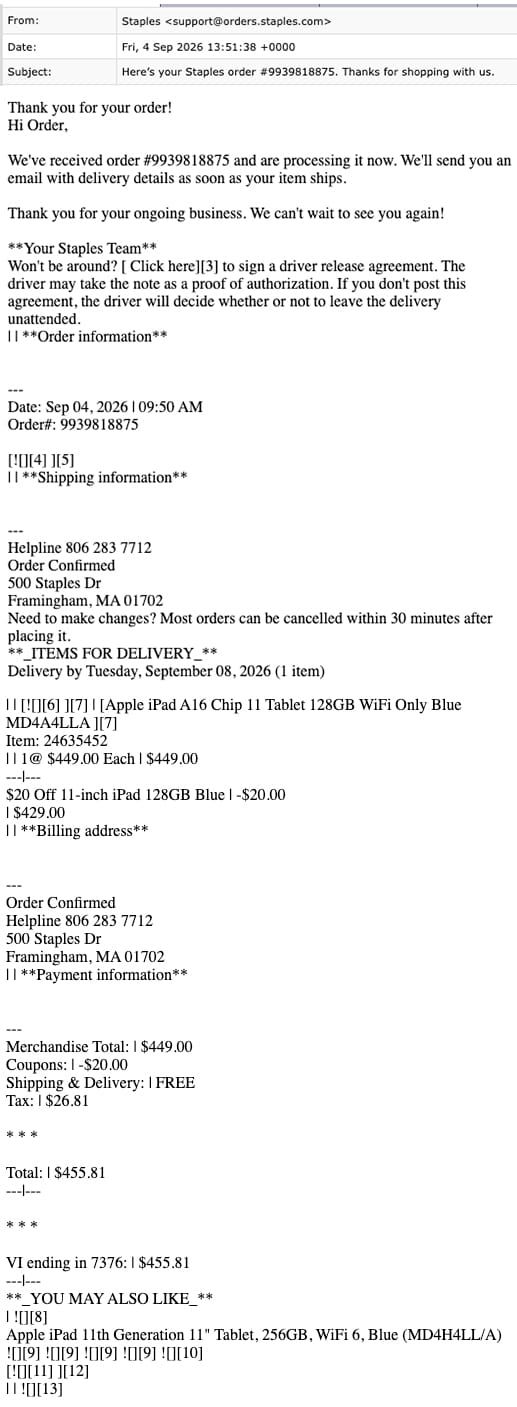
    In the first campaign, the message appeared as a Staples order confirmation from “support@orders.staples.com” with the subject line, “Here’s your Staples order #9939818875. Thanks for shopping with us.” The body displayed a plausible purchase for an Apple iPad, including order number, delivery timing, pricing, billing information and standard Staples footer content. The suspicious element was embedded in the order details: “Helpline 806 283 7712,” “Order Confirmed,” and the Staples corporate address appeared in fields normally associated with shipping or billing information. 

    Parasitizing trust: How legitimate infrastructure becomes a delivery pipeline for attackers
    Figure 1. Staples order notification

    The structure of the message matters. The attacker was not trying to persuade the user to click a crude phishing link. Instead, the message created the impression that an expensive order had already been placed and that the fastest way to resolve it was to call the embedded “helpline.” The desired user action was a phone call. Once the victim moved from email to voice, the attacker could continue the scam through social engineering, payment manipulation, credential theft, or remote assistance fraud. 

    The headers reinforced the trust problem. The Staples message showed DKIM alignment for “orders.staples.com” and DMARC passed for the visible Staples domain. The message also passed through forwarding and re-encapsulation paths, including Proton Mail, Microsoft 365, and downstream enterprise mail infrastructure. These hops complicate provenance analysis, but they do not change the core issue: Authentication helped establish that the outer message was credible, while offering no assurance that the phone number or transaction context was legitimate.  

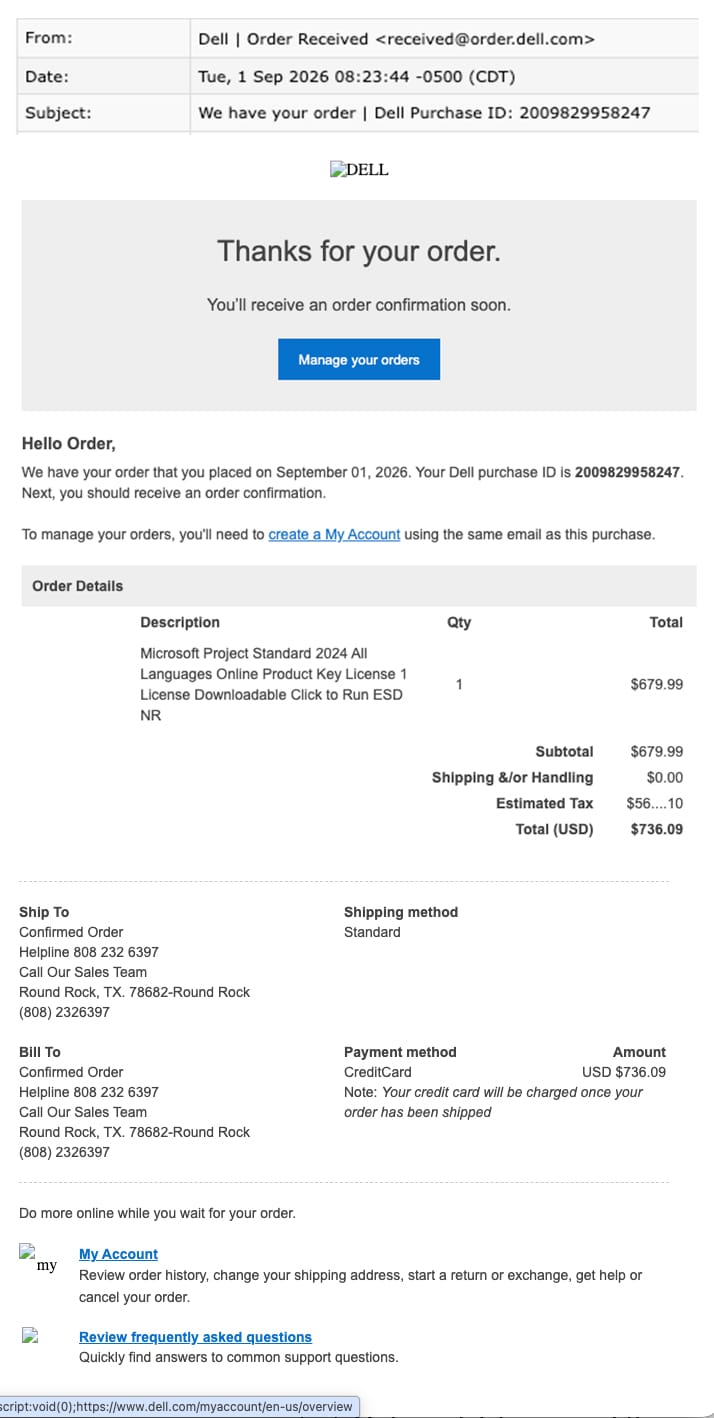
    The second campaign used the same pattern in a Dell order received notification. The message was sent from “Dell | Order Received <received@order.dellcom>” with the subject line, “We have your order | Dell Purchase ID: 2009829958247.” The body presented a purchase for Microsoft Project Standard 2024, totaling $736.09. As with the Staples example, the suspicious content appeared in transaction fields. The “Ship To” and “Bill To” sections included “Confirmed Order,” “Helpline 808 232 6397,” and “Call Our Sales Team”. 

    The Dell message used the same psychological lever: an unexpected high-value purchase, a legitimate-looking order template, and a phone number positioned as the path to resolution. The attacker did not need the recipient to trust a new domain or unfamiliar brand. The message borrowed credibility from Dell’s order pipeline and redirected the recipient toward attacker-controlled contact information. 

    Authentication results showed DKIM passing for Dell-related infrastructure and DMARC passing for “order.dell.com”. As with the Staples sample, forwarding artifacts and SRS-style return paths appeared as the message moved through Microsoft and enterprise mail infrastructure. But the malicious intent did not live in an obviously forged sender. It lived inside the rendered order content. 

    Parasitizing trust: How legitimate infrastructure becomes a delivery pipeline for attackers
    Figure 2. Dell order notification

    These campaigns illustrate the same trust-boundary failure described in our earlier research on platform-as-a-proxy (PaaP) abuse. In those cases, attackers placed malicious content into SaaS fields that trusted platforms later rendered into notifications. Here, the same concept appears in commerce infrastructure, in the retailer’s order pipeline. The attacker supplies the intent, while the trusted system performs the delivery.  

    From a defensive perspective, sender authentication is necessary, but it is not sufficient. SPF, DKIM, and DMARC help answer whether a message came from expected infrastructure. However, they do not answer whether the transaction was legitimate, whether the rendered fields make business sense, or whether the user is being pushed toward an attacker-controlled action. 

    Order notifications should be treated as sensitive content. Any field reflected into a transactional message — shipping name, billing name, address line, company name, order note, support field, or fulfillment instruction — can become a delivery vehicle if it is not validated before rendering. Retailers and security teams should correlate order notification content with account history, payment state, shipping context, and known support channels. Transactional templates should reject or flag unexpected phone numbers, URLs, urgency language, and support instructions when they appear in fields where they do not belong. 

    In both campaigns, the wrapper was legitimate enough to inherit trust. The payload was attacker-influenced. That distinction is the center of this attack class. 

    The abuse of commerce pipelines is merely one manifestation of a broader, systemic vulnerability. Whether the attacker initiates a fake purchase or a fraudulent account sign-up, the root cause remains the same: Platforms are implicitly trusting data that enters their systems from untrusted sources, only to render that data into high-reputation, automated notifications. This same mechanism of reflection — where input is echoed back into an email to a third party — is the engine behind an evolution in list bombing, moving the attack from simple denial-of-service to a sophisticated vehicle for content delivery.  

    List bombing: From inbox disruption to content delivery 

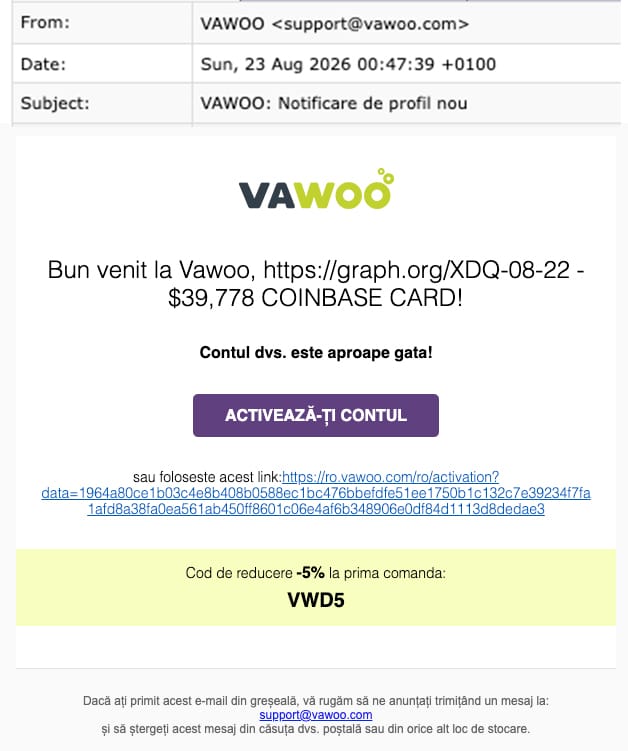
    List bombing is an abuse technique in which attackers submit a victim’s email address to numerous legitimate registration, subscription or notification workflows, flooding the inbox with automated messages. While this vector is traditionally viewed as a denial-of-service or distraction tactic designed to bury critical alerts in a flood of junk, Talos has observed a subset of cases where this behavior is being repurposed as a delivery vehicle for malicious content. This abuse occurs when an attacker identifies public-facing registration, profile, or project-naming forms that lack sufficient input validation. By inputting a “hostile string” — such as a cryptocurrency-themed lure — into fields intended for a name, company, or title, the attacker forces the platform to treat this data as legitimate user information. When the service reflexively incorporates this input into its automated welcome, verification, or notification templates, the system acts as an unintended carrier, delivering the attacker’s content inside a high-reputation, system-generated email that can pass standard authentication checks. 

    The attacker’s objective in these cases is to bypass the security perimeter by laundering their malicious content through the brand reputation of a trusted service provider. While this is not yet a broad industry shift, it represents a calculated abuse of a platform’s trust boundary. By embedding their lure in an automated notification, the adversary ensures that the message arrives with the appearance of administrative legitimacy, significantly increasing the likelihood that the recipient will trust the content. The goal is to reach the target’s inbox with enough platform authority that the message may be evaluated as routine notification traffic rather than attacker-controlled content. 

    Parasitizing trust: How legitimate infrastructure becomes a delivery pipeline for attackers
    Figure 3. Registration field reflection

    Beyond the risk to the individual recipient, this vector creates a significant brand liability. When a service provider’s infrastructure is used to broadcast fraudulent content, the resulting user complaints and bounce-backs can degrade the platform’s own sender reputation, potentially triggering blocklisting that impacts their legitimate business communications. 

    Bounce abuse: When delivery reports carry the lure 

    The final vector moves the abuse pattern into the mail system itself. Instead of relying on a retailer, SaaS platform, or registration workflow to generate the message, the attacker attempts to make a delivery status workflow carry attacker-controlled content. 

    Bounces, formally known as delivery status notifications (DSNs) or non-delivery reports (NDRs), are generated when a message cannot be delivered. Under normal conditions, a mail system sends the delivery report back to the original SMTP envelope sender. Depending on the implementation, that report may include the original headers, portions of the message body, URLs, attachments, or an encapsulated copy of the failed message. That returned content creates the abuse opportunity.  

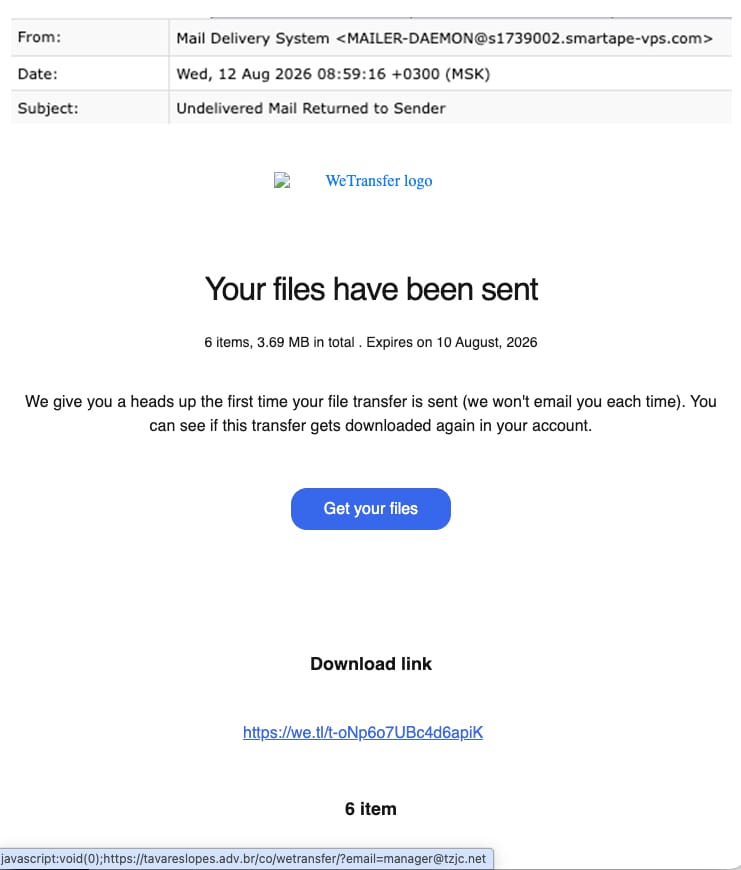
    In one example Talos observed, a mail delivery system notification carried a WeTransfer-themed file-sharing lure. The administrative wrapper made the message look like routine mail-system noise, while the nested content asked the recipient to engage with what appeared to be a file transfer workflow. The attacker’s goal was to make the phishing lure feel less like an unsolicited external message and more like part of a technical delivery failure that required review. Users are conditioned to view system errors as benign and are far more likely to engage with an “administrative” fix than a suspicious, standalone phishing email.  

    Parasitizing trust: How legitimate infrastructure becomes a delivery pipeline for attackers
    Figure 4. Bounce carrying a file-sharing lure

    There are several ways this kind of message can reach a victim. In opportunistic backscatter, an attacker sends mail using the victim’s address as the forged envelope sender. If an intermediate system accepts the message and later fails to deliver it, the resulting DSN may be sent back to the forged sender. If the DSN includes enough of the original message, the bounce itself can carry the lure. 

     A second possibility is intentional bounce abuse, where the attacker uses an authenticated, compromised, or otherwise controllable sending context to trigger a delivery failure that returns attacker-influenced content. This differs from an outright forged NDR, where the attacker simply fabricates the bounce message and sends it directly. From the recipient’s mailbox, however, these cases can look similar: A delivery-failure wrapper contains content the attacker wants the user to trust. 

    This distinction matters for defenders. A DSN’s administrative appearance does not validate the content inside it. The outer message may be a legitimate delivery report, while the returned or encapsulated content may still contain a phishing link, credential harvesting page, malicious attachment, or social engineering prompt. 

    The content-trust gap: A defensive imperative 

    Across these vectors, the defensive failure is consistent: Trusted infrastructure is being treated as a shortcut for trusted content. 

    Sender authentication remains essential. SPF, DKIM, DMARC, reputation, and infrastructure analysis help determine whether a message came from an expected source. But these controls do not answer a separate and increasingly important question: What was that trusted system instructed to carry? 

    Order notifications, registration workflows and delivery reports all create opportunities for attacker-influenced content to appear inside messages that users and security tools are conditioned to trust. In the Staples and Dell campaigns, the suspicious content was a phone number placed into transactional fields. In list bombing and registration abuse, the lure can appear inside reflected account or profile data. In bounce abuse, the malicious content may sit inside returned message data or a nested MIME object. 

    Defending against this requires content-aware validation at multiple points in the delivery chain. Platform owners should treat any user-controlled value rendered into an email template as untrusted data. Fields used for names, addresses, company names, project titles, order notes or support instructions should be validated before storage and again before rendering. Phone numbers, URLs, markup, line breaks, and urgent support language should be rejected or flagged when they appear in fields where they do not belong.  

    Security gateways should inspect the fully rendered message, not only the sender or template. That includes HTML, text, URLs, redirects, attachments, personalization fields, and nested MIME content. For transactional email, defenders should also evaluate whether the message content aligns with the workflow that produced it. An order notification containing unexpected support numbers, cancellation instructions, or high-urgency language should be treated differently from a routine receipt. 

    For delivery reports, recursive MIME inspection is especially important. Gateways should parse DSN containers, extract returned messages or message fragments, and apply normal phishing, malware, and URL analysis to the nested content. A bounce should explain a delivery failure, not provide a blind path for untrusted payloads. 

    The broader lesson is that attackers are no longer only exploiting technical vulnerabilities in infrastructure. They are exploiting the assumptions built into business processes. When legitimate systems render attacker-influenced data into trusted notifications, the result can pass authentication checks and still deliver malicious intent.  

    Defenders should therefore treat sender trust and content trust as separate but complementary signals. The wrapper can explain where a message came from. It cannot prove that the payload is safe. 

    Acknowledgments 

    Special thanks to Eric Peterson, Dev Shah, and Adam Katz for their professional guidance and input during the development of this research. 

    Source: Cisco Talos Intelligence · 2026-10-21

  • She Was the DEA’s Premier Crypto Detective. The Clues Led Straight to Her Own Family

    She Was the DEA’s Premier Crypto Detective. The Clues Led Straight to Her Own Family

    To escape the chaos of her Russian childhood, Lili Infante became an American law enforcement prodigy. She pioneered the DEA’s investigations of the dark web—never suspecting who she’d find hiding there.

    Source: WIRED Security · 2026-10-21

  • Operation FlashHole: Lazarus breaks security, defies control

    Operation FlashHole: Lazarus breaks security, defies control

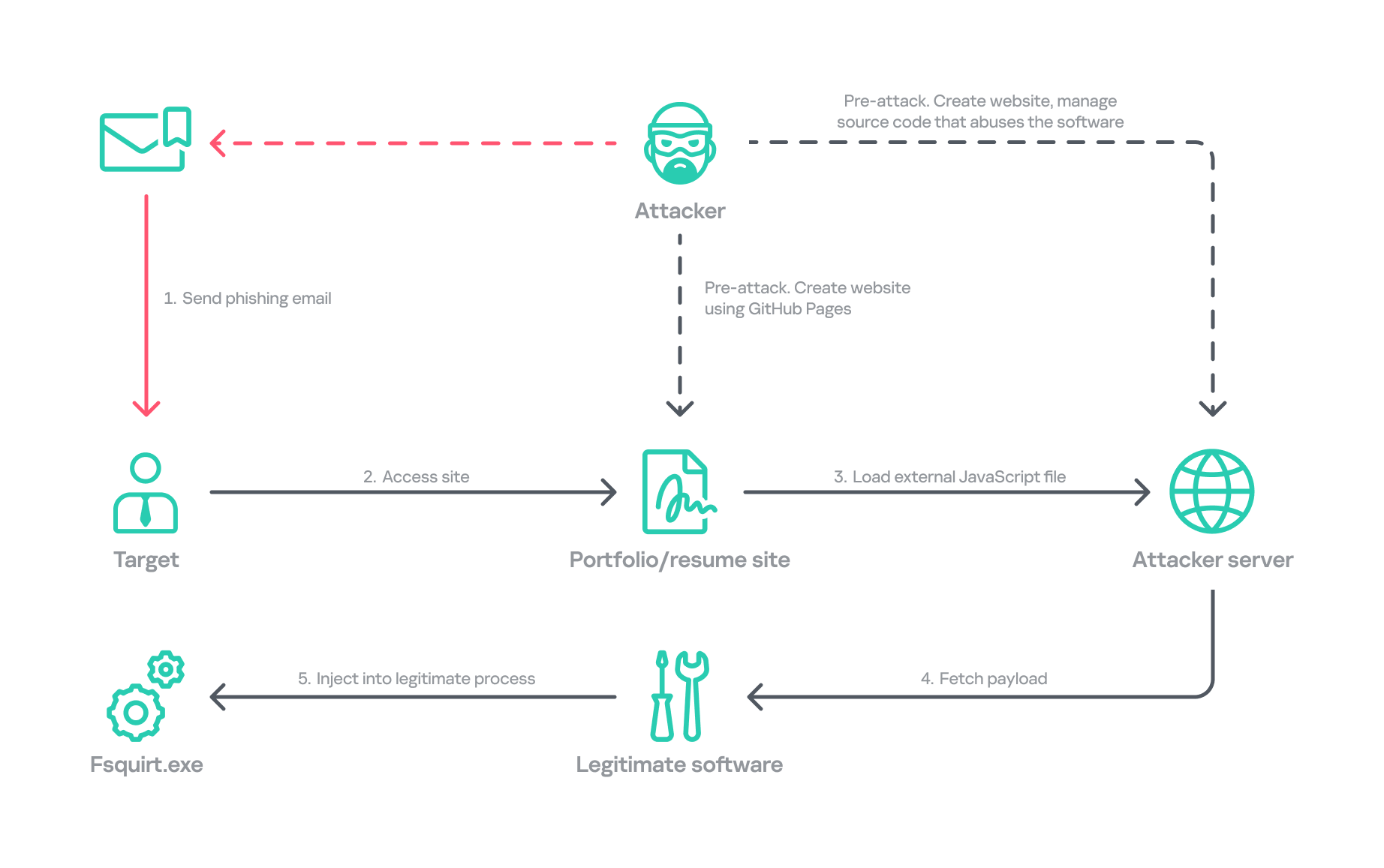
    In January, we responded to the Lazarus Group’s novel attack campaign against South Korea, which followed last year’s Operation SyncHole. In this new operation, the group employed an updated malware chain that included both their old and new malware, which we disclosed in full, and used another mandatory South Korean security software program as a part of infection chain using a watering‑hole strategy. Notably, the group targeted victims more selectively, sending spear‑phishing emails with links to fabricated but relevant sites, such as portfolio and résumé pages tailored to each target. We dubbed this activity Operation FlashHole.
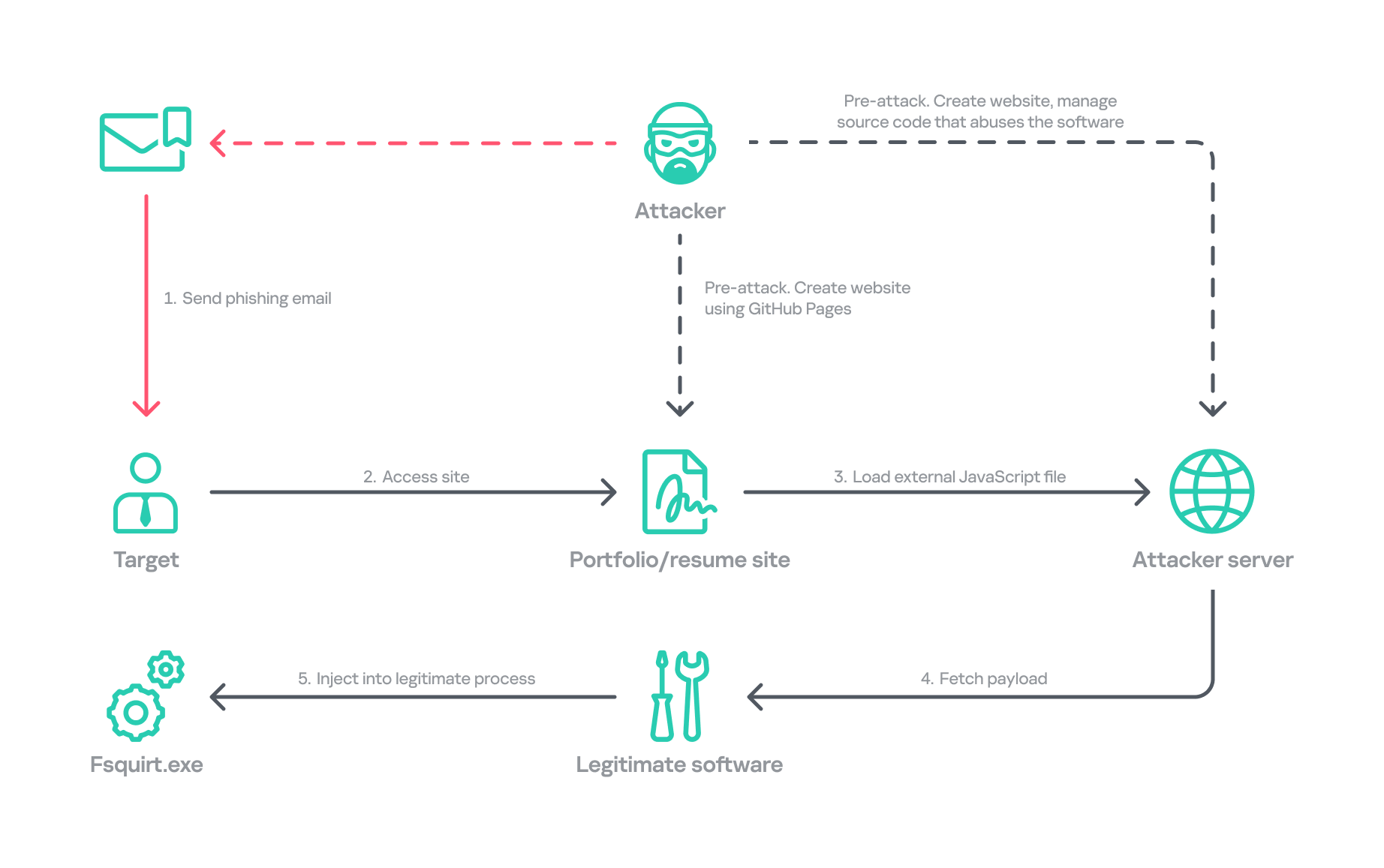
    Operation FlashHole attack flow during initial compromise

    Operation FlashHole attack flow during initial compromise

    Our examination reveals that the earliest evidence of this new operation dates back to July 2025. This suggests the group began preparing for the campaign shortly after ending Operation SyncHole, which lasted at least four months. We identified a minimum of three organizations impacted by the campaign in South Korea’s software, construction, and wired communication equipment manufacturing sectors. These sectors differ from those affected by Operation SyncHole, indicating that the group has expanded its target scope over time.

    Background

    After more than a year since the first observation of Operation SyncHole, we detected a suspicious execution chain originating from legitimate South Korean software. This chain mirrors the one from the previous operation; however, this time, the attacker abused CrossWeb EX instead of Cross EX, which was abused in Operation SyncHole. Both applications appear to be maintained by the same vendor, and both are related to financial security. CrossWeb EX is a financial security solution that is required to access widely used online banking and government websites. It encrypts communications between the user’s browser and the web server using public key infrastructure (PKI). This is not the first time Lazarus has abused this software. It was also used in 2021 to deploy the Racket downloader and again in 2022 and 2023. Although the exact method by which CrossWeb EX was abused remains unclear, we determined that the attack chain ultimately leads to the execution of the malware in memory.

    We noted that the spawned process was running with a high integrity level. The parent process, INISAFECrossWebEXSvc.exe, originates from the installation bundle of INISAFE CrossWeb EX V3 version 3.4.1.2, released in 2023 after KrCERT’s public advisory.

    As we already mentioned in our SyncHole blog post, this pattern closely mirrors the long‑standing strategy employed by the Lazarus Group to target South Korea. Since CrossWeb EX and similar software is mandatory for South Korean users and typically runs in the background to interact with the browser, it has been leveraged as a critical attack vector by the group. In 2025, a paper was presented at the USENIX Security Symposium that investigated vulnerabilities in South Korea’s mandatory security software and demonstrated how such software can unintentionally create a massive attack surface.

    In July 2026, the South Korean government and several local security vendors also published a joint security advisory covering typical Lazarus attack techniques, including exploitation of financial security software. While this advisory overlaps with our findings from Operation FlashHole and Operation SyncHole, and AhnLab’s detailed analysis report Operation Double Barrel covers a wide range of recent Lazarus Group activities, we are conducting a more granular classification based on their TTPs. We will discuss this further in the attribution section.

    Initial infection vector

    Although we could not precisely determine what triggered the infection chain, our analysis uncovered a suspicious website hosted on GitHub Pages that is associated with the GitHub account used as the C2 channel. The GitHub account was created last September, and the initial version of the site was designed to showcase the résumé of a senior network appliance developer. In January, however, this site was replaced with another featuring an interior design showcase. The first site was likely accessed by an employee of a wired communication manufacturing company, while the second site likely affected a target in the construction sector.

    Appearance of the malicious websites

    Appearance of the malicious websites

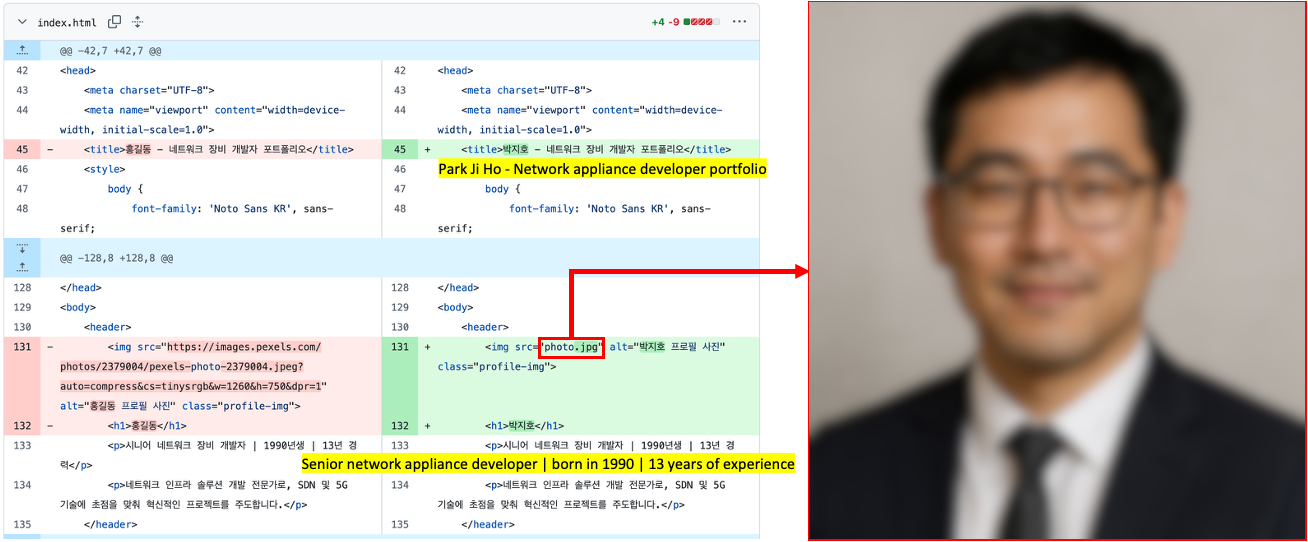
    The first site with the résumé had a photograph supposedly of a job seeker, but the lack of EXIF metadata and the unnatural texture of the image indicate that it was generated by AI. This suggests the Lazarus Group has incorporated AI into its long‑standing strategy, like other Korean‑speaking threat actors (1, 2). The group most likely also used AI to create the lure site: the job seeker’s name resembles the Korean version of “John Doe,” and the portfolio was populated with seemingly meaningless details and random companies. The generated site was then manually tailored to specific targets.
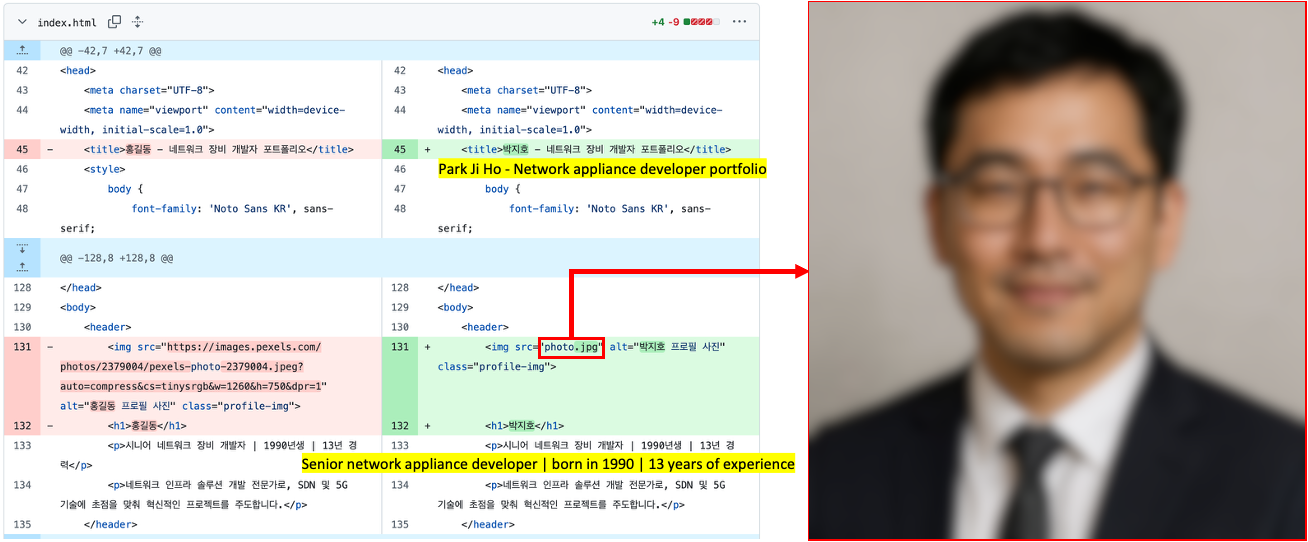
    Suspected use of an AI-generated image on the résumé site

    Suspected use of an AI-generated image on the résumé site

    The websites contained embedded links that loaded an external JavaScript file via a script tag.

    • Malicious link embedded in the résumé site: hxxps://javadevhouse.co[.]kr/ajax/libs/jquery/1.7.3/jquery.min.js
    • Malicious link embedded in interior design site: hxxps://pythonapischool[.]com/api/detach

    Based on the analysis, we assess with medium-to-high confidence that the targets received phishing emails containing links to the malicious site hosted on GitHub Pages (using the domain <username>.github.io). The research results showed a high possibility that visiting the malicious site initiated an infection process involving CrossWeb EX software. This assessment aligns with Lazarus’s recent approach, as detailed in the joint advisory published by the South Korean government and security companies.

    Full infection chain

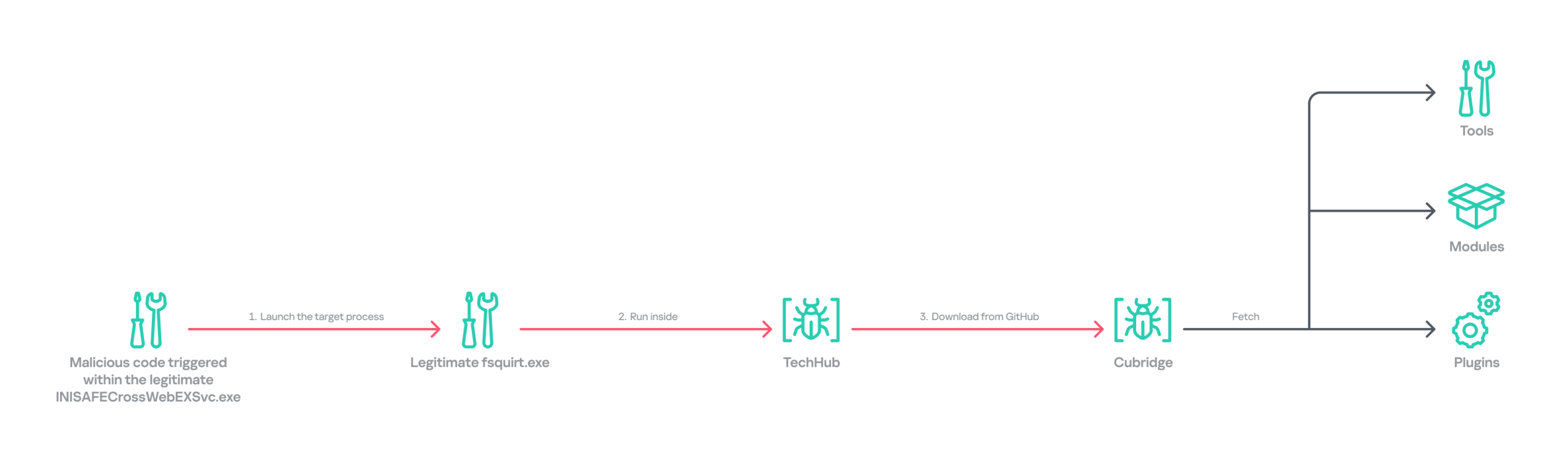
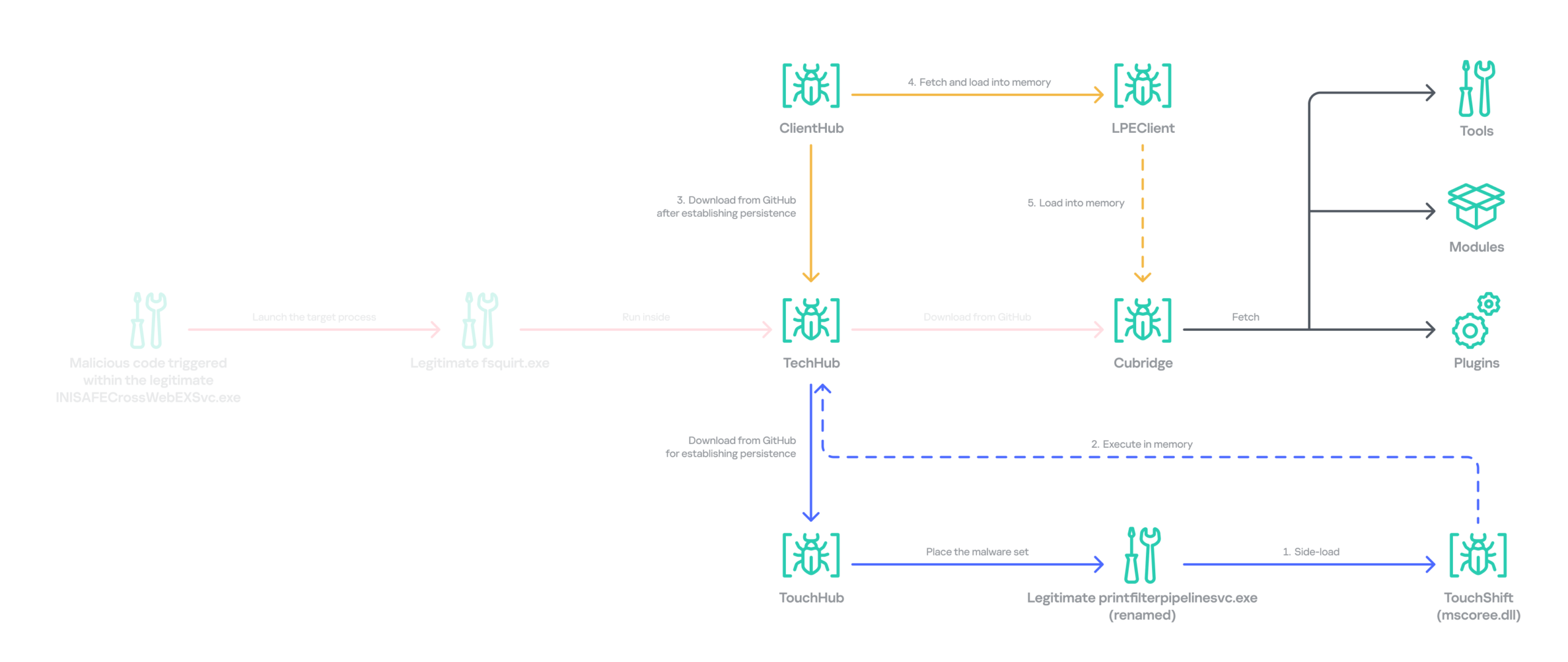
    Following the initial compromise, the legitimate Windows binary fsquirt.exe was executed under the CrossWeb EX process and injected with shellcode containing a malicious DLL – TechHub malware. From our extensive and thorough examination, we identified several malicious payloads and reconstructed the complete infection chain. The infection chain is rather complex and reveals the Lazarus Group’s advanced operational techniques on targeted hosts. These techniques conceal their malicious payloads, intent and their sophisticated malware delivery framework. The latter was updated extensively compared to the previous campaign, despite the new operation starting less than a year later. Significantly, the execution chain below exists only in memory during the initial infiltration, highlighting the attackers’ considerable efforts to hide the initial compromise.
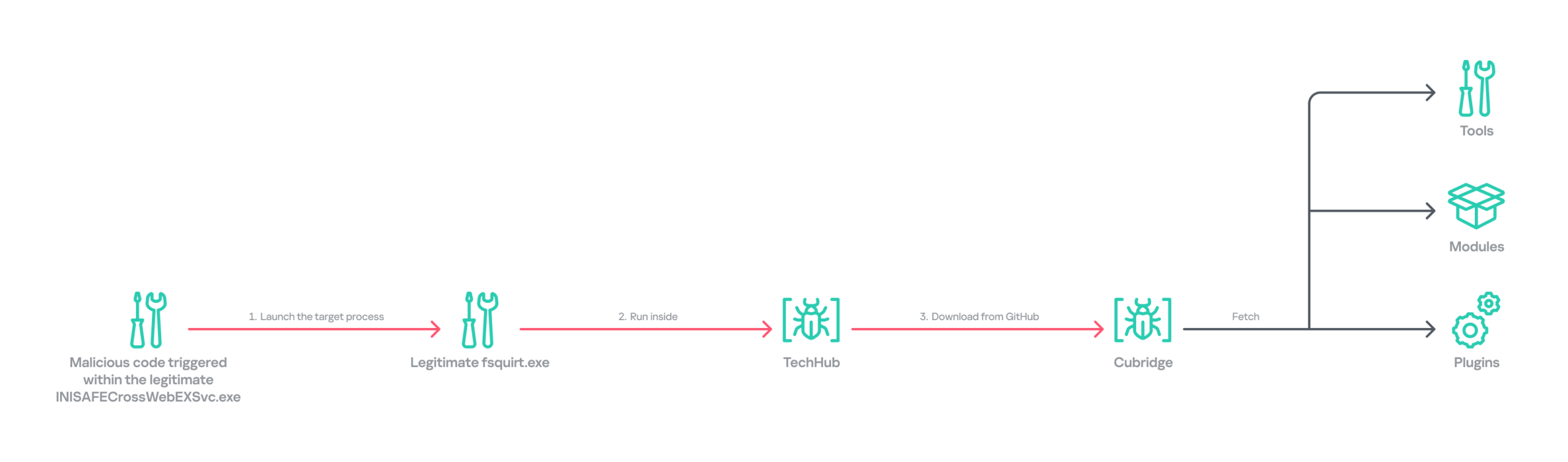
    Initial infection chain

    Initial infection chain

    Following the initial compromise, the group sought to maintain persistence on the network by installing a pair of malware strains – TouchHub and TouchShift – leveraging DLL side‑loading under the name mscoree.dll. TouchHub was deployed by the first instance of TechHub. It then used DLL side-loading to launch TouchShift, which led to the in‑memory execution of another TechHub instance. After launching the second time, TechHub deployed another pair, ClientHub and LPEClient, rather than executing Cubridge directly. Only minimal traces of these files were found on disk; the remainder of the malicious code persisted exclusively in memory.
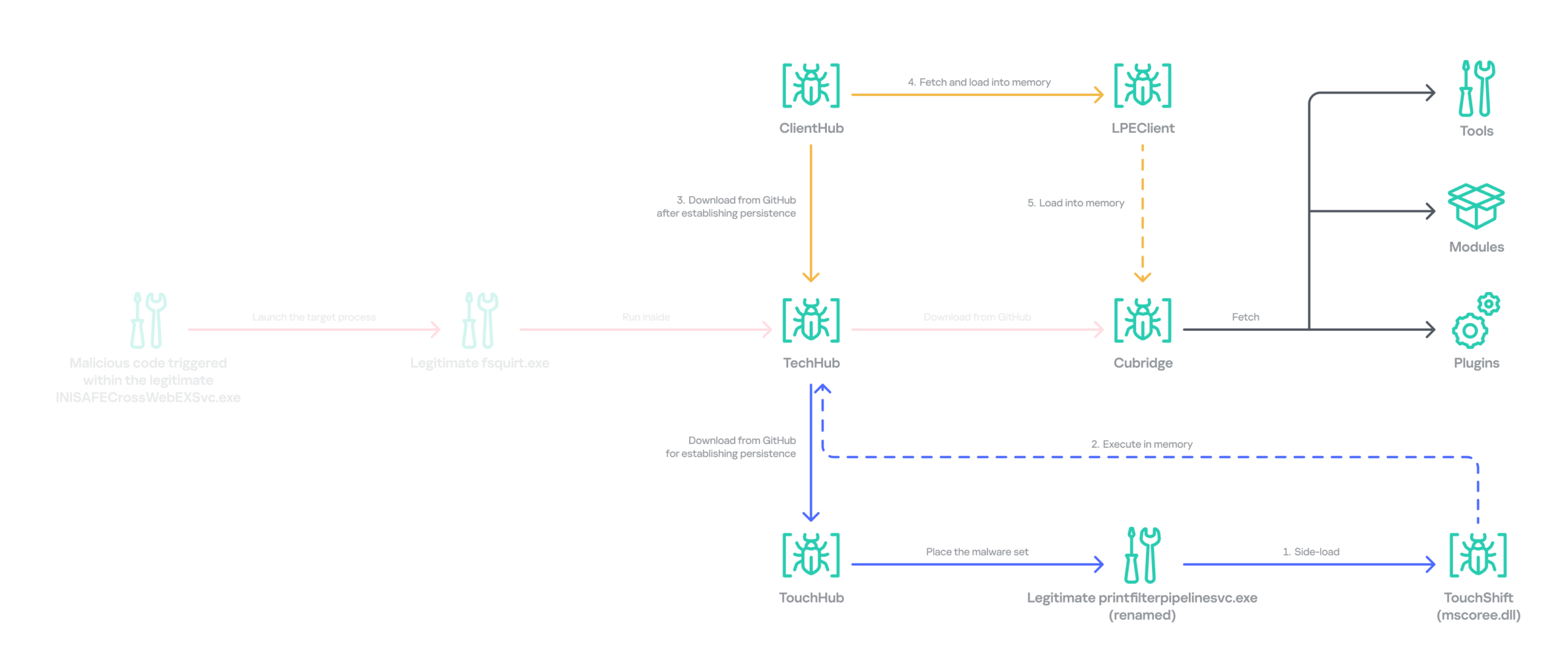
    Expanded infection chain after gaining persistence

    Expanded infection chain after gaining persistence

    Since Cubridge remains only in memory at the initial compromise stage, we suspect the group designed this indirect, multistage chain to deliberately redeploy Cubridge after gaining persistence, as it serves as the most sophisticated orchestrator of the attack.

    Malware set

    The full chain comprises advanced variants of the known Lazarus malware strains, including TechHub, Cubridge, TouchShift, LPEClient, and the newly identified TouchHub and ClientHub.

    TechHub – the start of the chain

    TechHub, a downloader that plays a central role in this attack, communicates with GitHub using a Personal Access Token (PAT). It serves as the initial payload, providing the top of the chain with sufficient functionality to profile compromised hosts and facilitate subsequent payloads.

    This variant is a more advanced version of the malware named CLOUDBURST by Mandiant and NickelLoader by ESET. According to their reports, the earlier version communicated with a C2 server via HTTP(S) to fetch additional payloads. The latest iteration we found, however, communicates with GitHub instead and has updated command strings.

    We identified three variants of TechHub in the chain: an in‑memory version, a simple DLL side‑loading version, and a DLL side‑loading version that uses a registered Windows service. Depending on which stage loads the malware, it contacts a private GitHub repository via the GitHub API using either hard‑coded credentials or credentials retrieved from its configuration file.

    When TechHub loads, it creates a 4‑byte hexadecimal identifier (ID) in the range 0x1000–0xFFFF or reads one from the configuration file, enabling the attackers to distinguish between compromised hosts. TechHub then checks a GitHub issue by sending the request GET /issues?state=[open/closed] to determine whether any previous communication remains active and removes any traces of it if found. It then proceeds with the handshaking process.

    1. It creates a new issue titled 1[ID] with the body “hel” using the POST /issues request, and sets its status to open.
    2. It then retrieves a file from the repository containing the 2[ID] value in its name. This file contains the RSA public key.
    3. It generates a random 16‑byte XOR key, encrypts it with the provided RSA public key, and uploads the result, prefixed with 1[ID], to the repository.
    4. The hard‑coded IV is XORed with the generated 16‑byte key and then used after the handshake.

    During file exchange, filenames follow the pattern [1|2][ID][random-16-byte-key] throughout communication. The “2” prefix indicates delivery from the repository to TechHub, while “1” indicates delivery from TechHub to the repository. The random 16‑byte key in the filename is used for AES encryption or decryption of each file’s contents, employing either a hard‑coded IV or an updated IV.

    After the key exchange is complete, TechHub reads a file with the prefix “2” once again and verifies that the delivered data equals “hel”. If the check passes, TechHub gathers extensive information from the infected host. This data is then encrypted and sent to the repository. After transmitting the device information, the process concludes by updating the body of the previously created issue from “hel” to “hey” using PATCH /issues/[issue number]. The malware is now fully prepared to receive commands from the repository.

    TechHub supports four commands. The laeca command deploys a payload packaged in shellcode that reflectively loads the embedded payload directly into memory.

    Command Description
    mqdrz Collect information about the device and its running processes
    laeca Directly invoke the received shellcode in memory
    aqvxp Terminate the current process
    rtcya Beaconing after finishing the handshake process

    Cubridge – the framework orchestrator

    Cubridge, deployed via TechHub on the compromised host, is capable of retrieving various payloads through multiple methods. It serves as the central orchestrator of the entire malware framework, supporting a range of plugins, modules, and tools. An earlier version of Cubridge was also disclosed in the reports covering the previous version of TechHub. In those reports, Mandiant identified it as SIDESHOW, and ESET identified one of its modules as LightlessCan.

    To establish communication with the C2 server, Cubridge randomly selects one of the predefined C2 servers and constructs a dedicated C2 URL for every request, using the pattern [C2_URL]/[page1]/[page2]/[page3]. This is achieved by concatenating terms from predefined word lists. Our analysis identified a single hardcoded C2 server – hxxps://cubedesign[.]co[.]kr/news/AABBCC – associated with the examined instance that is configured to version 5.1. During URL generation, AABBCC is substituted with a null value. The page3 segment is assigned a randomly generated integer between 10000000 and 99999999. Consequently, each generated URL is designed to appear authentic and remain unique for each request.

    The predefined list for page1 is shown below. TechHub randomly selects one item from the list.

    economy, opinion, politics, national, international, medical, investment, sports, lifestyle, shopping, culture

    The predefined word list for page2 is shown below.

    article, list, story

    This means the hardcoded URL can later be transformed, for example, into hxxps://cubedesign[.]co[.]kr/news/economy/article/12345678 by following the steps described above.

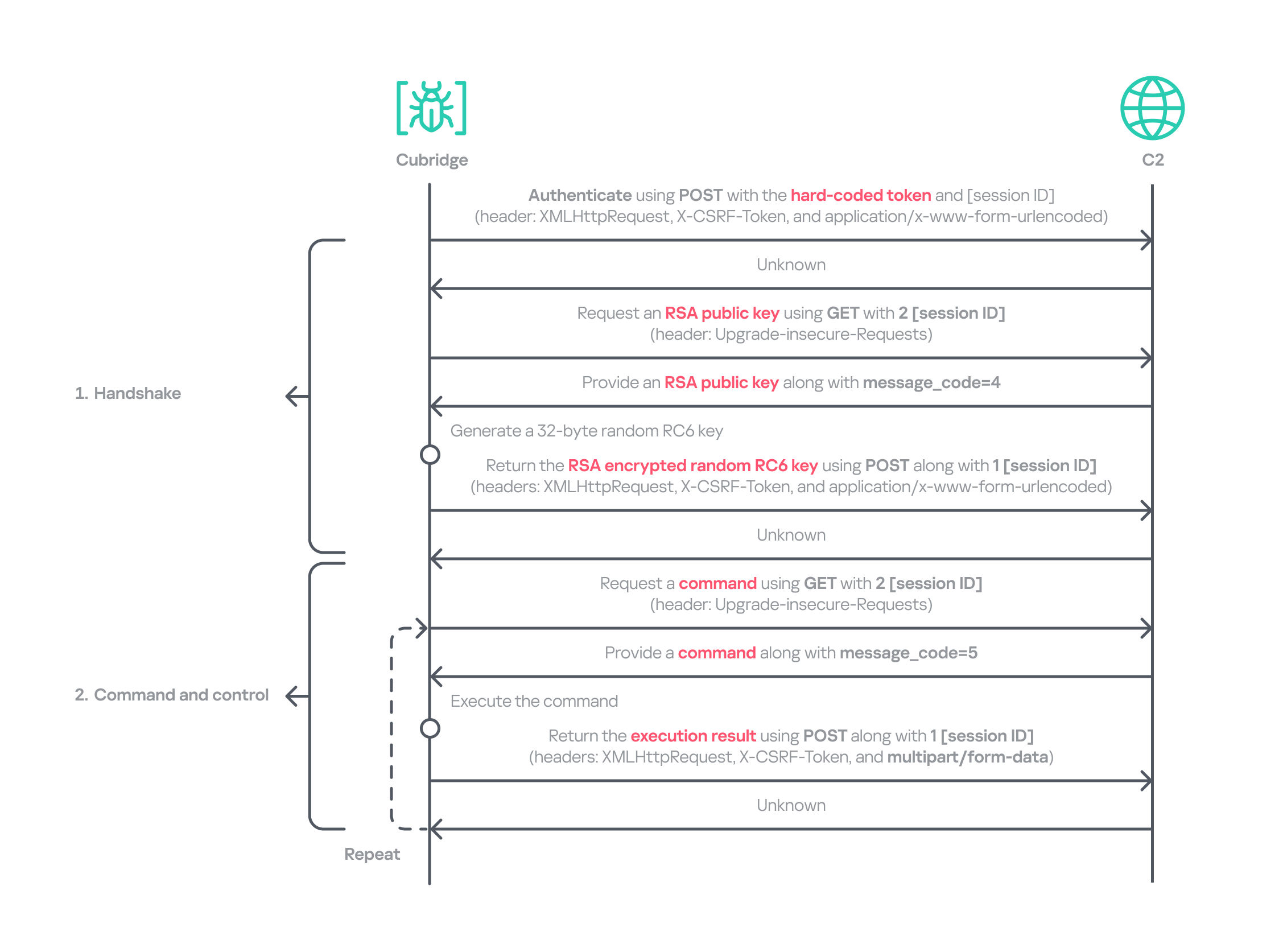
    Authentication using the POST request with the C2 server requires three parameters in the form of key‑value pairs. Each key is randomly generated using a different predefined word dictionary, and the associated values consist of a randomly generated 8‑byte hexadecimal bot ID, a fixed authentication token (KW4Ofw982CNJjxd51AVqkGAop), and a randomly generated 16‑byte hexadecimal session ID.

    Cubridge employs a more robust handshaking process than TechHub, combining the RSA and RC6 algorithms. Unlike TechHub, it skips the profiling step and proceeds directly to command and control after the handshake. During communication, the malware mimics browser requests, using X‑CSRF‑Token and X‑Requested‑With headers for authentication and the Upgrade‑Insecure‑Requests header to request additional data.
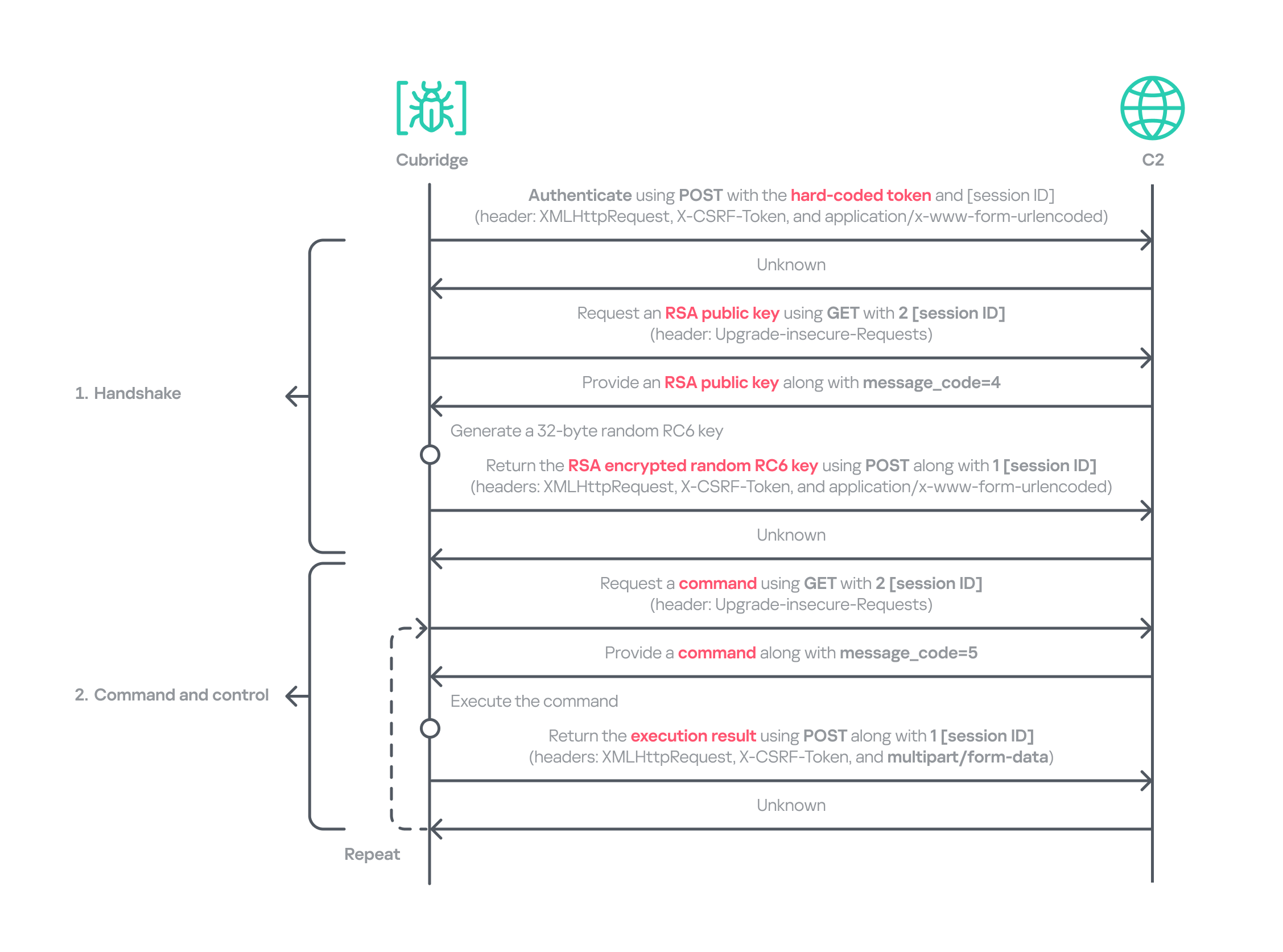
    Cubridge's communication sequence

    Cubridge’s communication sequence

    Cubridge contains extensive functionality, with a particular focus on loading subsequent‑stage payloads. The commands employ various techniques, such as DLL injection, reflective loading, and section‑mapping injection. The payloads may be delivered in various forms:

    • Plugins – reusable extensions that add functionality as needed and can be invoked at any time (in shellcode and DLL form);
    • Tools (in DLL form) – independent utilities that perform one-off tasks;
    • Modules – components that are loaded once and remain active providing an extended set of functionalities.

    It is anticipated that the commands for plugins and shellcode will load identical types of plugins because both support a similarly formed exported function for subsequent activity. The shellcode can be generated using the open‑source sRDI tool to package a DLL‑style plugin. The capabilities of a single DLL are likely utilized to load a tool that works independently because when a single DLL is loaded, only its DllMain entry point and its parameters are accessible; no other exported functions are exposed.

    Command Payload type Description
    0 – Collect device info including the computer name, time zone, PID, and other similar details
    1 Archive the specified file/directory using the legacy ZipCrypto algorithm and the hard‑coded password: xdkiTajAAxc3i/w[<881fnC!G*cb1Dit2sh.gAk/
    2 Create a file at the specified path
    3 Possibly plugin Inject the provided DLL payload into the target process and load it reflectively using reflective DLL injection
    4 Plugin Reflectively load a plugin in DLL format
    5 Retrieve the address of the specified exported function from the target plugin and run it with the provided parameters
    6 Retrieve all information about the loaded plugins
    7 Unload the specified plugin
    8 Shellcode Inject the provided shellcode into the target process and load it using section mapping injection
    9 Load the provided shellcode directly into memory
    10 Retrieve the address of the specified export function from the target shellcode (likely a plugin in shellcode form) and run it with the provided parameter
    11 Retrieve all information about the loaded shellcode
    12 Unload the specified shellcode
    13 – Set the scheduled Cubridge execution time (in minutes) by updating a global variable
    14 Set the scheduled Cubridge execution time (in minutes) by updating a global variable, while disabling monitoring by also updating another global variable
    15 Terminate in a controlled manner
    16 Get the configuration for Cubridge: retrieve the global flags, the number of C2 servers, the C2 addresses, etc.
    17 Update the global flags, the number of C2 servers, the C2 addresses, etc.
    18 Tool Load a DLL reflectively with the specified parameter
    19 Configure the parameters for loading a single DLL
    20 Unload the single DLL
    21 Module Load the “action module” (ActionModule.dll) reflectively and invoke its AppinfoView export function
    22 Load the “function module” (FunctionModule.dll) reflectively and invoke its PresentationFontConfig export function

    Commands 21 and 22 each load a different module. As their internal names imply, the action module manages basic file and process operations, while the function module implements Windows’ default commands. The action module covers commands 23–41, and the function module handles commands 42–79.

    The action module handles system operation commands, file system interactions, and process behavior. It is invoked by passing the appropriate command and parameters to its AppinfoView export function. The module supports 19 commands, numbered 23 through 41. Execution results are first sent to Cubridge, which then forwards them to the C2 server.

    Command Role
    23 Get local disk space for each drive
    24 Get information about the specified file or directory
    25 Execute the provided command
    26 Get information about the specified file or directory (similar to command 24)
    27 Execute the provided command under the target process (PPID spoofing)
    28 Execute the provided command under the target process within the provided session (PPID spoofing + session impersonation)
    29 Get detailed information about processes
    30 Terminate the provided process
    31 Suspend all threads belonging to the specified process
    32 Resume all threads belonging to the specified process
    33 Permanently delete the file by overwriting its entire contents with the sequence: 0 → 1 → random bytes → 1 → 0
    34 Rename the provided file to :EFS (the alternate data stream area) and delete it using the native API SetFileInformationByHandle
    35 Set the current working directory
    36 Copy the specified file to the provided path
    37 Delete the specified directory
    38 Move the specified file to the provided path
    39 Create the provided directory
    40 Initiate a non‑blocking connection attempt to the specified IP address and port (possibly for port scanning)
    41 Read the specified file

    The function module implements commands that emulate Windows’ built-in commands. Similar to the action module, its DllMain routine initializes all supported command functions, which are later accessed through the PresentationFontConfig export. Altogether, the module offers 38 commands, numbered from 42 to 79. While we believe this module is based on the previous LightlessCan, this is the first time we’ve seen it in the form of a separate module.

    Command Role
    42 Capture all displays and archive them using the legacy ZipCrypto algorithm with the hard‑coded password: xdkiTajAAxc3i/w[<881fnC!G*cb1Dit2sh.gAk/
    43 Synchronize the MAC (Modified, Accessed, and Created) times of the file provided in the second argument to match those of the file provided as the first argument
    44 Get information about the specified directory
    45 Get information about the specified drive
    46 Inject the provided DLL payload into the target process
    47 Unload the specified DLL from the specified process
    48 Implementation of the ipconfig command
    49 Implementation of the net command
    50 Implementation of the netsh advfirewall firewall command
    51 Implementation of the netstat command
    52 Implementation of the ping -6 command
    53 Implementation of the reg command
    54 Implementation of the sc command
    55 Implementation of the ping command
    56 Implementation of the whoami command
    57 Implementation of the nslookup command
    58 Implementation of the schtasks command
    59 Implementation of the systeminfo command
    60 Implementation of the arp command
    61 Call the CryptUnprotectData function to retrieve the AES key that DPAPI protects. Extract the key using the encrypted_key keyword from Chromium’s Local State file located at: %LOCALAPPDATA%\Google\Chrome\User Data\Local State
    62 Not implemented
    63 Not implemented
    64 Read the specified file and decrypt it using an XOR operation with the key 0x59. Then extract the paths from the decrypted buffer and archive files and directories at these paths with the legacy ZipCrypto algorithm, using the hard‑coded password: xdkiTajAAxc3i/w[<881fnC!G*cb1Dit2sh.gAk/
    65 ~ 79 Not implemented

    Besides the modules, we also observed that the actor deployed various plugins and tools.

    Type of payload Name Description
    Plugin ADFinder (AdFinder.dll) Launches LDAP queries in an Active Directory environment, taking six arguments such as log file path, ADsPath, search filter, and attribute names
    Plugin FileCollector (Dll.dll) Recursively scans every subdirectory and file in the provided directory, gathering detailed information about each
    Tool Browser stealer Can be injected into Chromium-based browsers, such as Google Chrome, Microsoft Edge, and Brave. Once injected, it extracts files and credentials from the victim’s browsers, including stored passwords, bookmarks, history, preferences, and cookies
    Tool Process collector Iterates over all running processes, collecting each process’s ID, path, and command line

    TouchHub installs a service for TouchShift

    During our analysis, we obtained a previously unknown malware sample from TechHub’s private GitHub repository, which served as a parent installer for TouchShift. We dubbed this malware TouchHub. Upon execution, it copies the legitimate printfilterpipelinesvc.exe to C:\Windows\System32\RasConv\ImeBroker.exe, registers it as a service, and places an embedded TouchShift payload named mscoree.dll in the same directory. Following creation, the malware synchronizes the MAC timestamps of C:\Windows\System32\drivers\monitor.sys with those of the newly written file, hindering forensic analysis.

    It then goes through the service registration process by collecting up to 100 legitimate service names that are registered under the netsvcs svchost group in HKLM\SOFTWARE\Microsoft\Windows NT\CurrentVersion\Svchost. It randomly selects one of these names, appends two random alphabetic characters to form a new service name, and uses this name to create a service that runs the hard‑coded command line C:\Windows\System32\RasConv\ImeBroker.exe -TimeBroker with the description Microsoft Service. The newly created service is started immediately.
    Overall, TouchHub creates three files in the designated directory to launch TouchShift with SYSTEM privileges.

    Path Type Description
    C:\Windows\System32\RasConv\ImeBroker.exe Executable file registered as a service Copied from C:\Windows\System32\printfilterpipelinesvc.exe
    C:\Windows\System32\RasConv\mscoree.dll Side-loaded TouchShift payload Dropped by TouchHub. It contains encrypted payloads and includes portions of a legitimate DLL’s contents, which significantly inflates its size
    C:\Windows\System32\RasConv\ActivationStore.dat TechHub’s configuration file Dropped by TouchHub after extracting configuration values

    TouchShift, a prevalent loader employed across multiple infection chains

    The version of TouchShift dropped by TouchHub is almost identical to the version described in Mandiant’s blog post, even sharing the same malicious export function, LockClrVersion. It takes the argument supplied by TouchHub and XORs it with a hard‑coded key. The resulting value is XORed once more with the executable’s filename, and this result is used as the AES key. All strings involved in this process (the argument, the XOR key, the filename) must be exactly 16 bytes long. If a string is shorter, it is padded with NULL bytes (\x00); if it is longer, it is truncated to 16 characters. For example, one of the string combinations in the obtained sample was:

    • Argument: -TimeBroker\x00\x00\x00\x00\x00 (padded with NULL)
    • Hard-coded XOR key: x809G736iC3f8Wp8
    • Executable filename: ImeBroker.exe\x00\x00\x00 (padded with NULL)

    After deriving the key, the malware decrypts the embedded payload using AES‑CBC‑128 without padding. The decrypted data is shellcode that starts with a call instruction. It wraps the next‑stage payload – identified as the third version of TechHub (DLL side-loading with a registered service) – that reads the ActivationStore.dat file as an external configuration.

    ClientHub

    We also identified a new piece of malware stored in TechHub’s private repository, which we named ClientHub. It supports various commands formed using a bitmask. There are at least two versions of ClientHub: one that communicates with websites via HTTP(S) and one that interacts with the Dropbox API using credentials.

    Depending on the version, its configuration is sourced from internal resources or the external configuration file C:\Program Files\Common Files\System\msadc\msadc.inc. The configuration comprises keys and IVs for the SNOW 1.0 algorithm, scheduled execution times, and C2 server addresses encrypted with the SNOW stream cipher. The SNOW cipher is a family of high‑speed stream ciphers used for secure data encryption in telecommunications and wireless networks. This is the first time it has been observed in the malware of the Lazarus Group.

    To establish C2 communication, the malware initially generates a 32‑byte random array. It subsequently overwrites portions of this array with data collected from the compromised device. The resulting 32‑byte array comprises a blend of random bytes and relevant information. This array is later used as the key for the SNOW algorithm to decrypt data received from the C2 server. Finally, the key array is encrypted with a hard‑coded RSA public key and encoded in Base64.

    Offset Size Field value
    0 4 Current process ID
    4 4 First four bytes of the decrypted C2 server information.
    8 7 Randomly generated bytes
    15 1 Calculated flag value that indicates a state machine.
    16 8 Current system time, represented as a FILETIME structure.
    24 8 Randomly generated bytes

    The ciphertext is delivered to the C2 server via GET requests. Each request contains headers that are atypical for malware: Sec-CH-UA, Sec-CH-UA-Platform, Sec-CH-UA-Mobile, Sec-Fetch-Mode, and Sec-Fetch-Dest. These headers are normally used by legitimate Chromium‑based browsers and enable malware to imitate legitimate traffic and evade detection. The C2 server replies with commands in a custom header and message body.

    struct header
    {
      int has_more_data // whether more body data remains 
      int body_checksum;// ROR13 checksum for the body data
      int body_type;    // specifies the body type
      int unknown;
      int body_length;  // Length of the body data
      int IV[2];        // Random IV used to encrypt the body data
    };

    The body_type field in the header determines how the subsequent payload is processed. This value functions as a bitmask, with each bit representing a distinct flag (e.g., 0x1, 0x2, 0x4, etc.). The resulting behavior also depends on whether the least‑significant bit (bit 0) is set: when the value is odd, the malware interprets the incoming message body as an additional payload that is subsequently loaded into memory. Conversely, when the value is even, the malware invokes the previously loaded payload.

    The odd value supports four distinct loading methods based on the received message body and ensures that each method executes only once.

    Bitmask Value in decimal Description Result sent to the C2
    0x00000001 1 DLL loading: load the received body reflectively along with the provided parameter The payload’s image base
    0x00000011 3 Plugin: load the received body reflectively, obtain the address of a function in the payload, and then invoke that function along with the provided parameter The payload’s image base, the address of the invoked function, and the execution result
    0x00000101 5 Plugin: load the received body reflectively, obtain the address of a function in the payload, but refrain from invoking it immediately The payload’s image base, the address of the function
    0x00001011 11 Plugin: execute the behavior associated with value 3, then unload immediately after invoking the plugin –
    0x00010001 17 DLL loading: load the received body reflectively with the provided parameter, maintaining stateful communication via a persistent interactive session using a shared buffer The payload’s image base, the address of the interactive shared buffer, and the execution result

    The even value provides two distinct invocation methods for DLLs and plugins that have already been loaded and are associated with the odd‑value bitmask. The 2 (0x10) flag allows the payload previously loaded with the 1, 3, or 5 bitmask to be reused and invoked directly. The value 16 (0x10000) corresponds to the 17 (0x10001) flag in loading mode and uses the established interactive shared buffer to exchange data. All values are guaranteed to act independently.

    Bitmask Value in decimal Description Result sent to the C2
    0x00000010 2 Invoke the previously loaded DLLs and plugins along with the provided parameter The execution result
    0x00000100 4 Not implemented –
    0x00001000 8 Unload the previously loaded DLLs and plugins The execution result
    0x00010000 16 Send the updated parameter to the payload loaded by the command with the value 17, and exchange data through the interactive session. This command also determines whether to retrieve the execution result or unload the payload The execution result

    Taking into account the loading mechanism, we identified four plugins deployed to the target that work perfectly with ClientHub.

    Plugin Description
    File archiver Archives the provided file using the legacy ZipCrypto algorithm (without password protection) and returns the compressed data
    File collector Searches for all files matching the provided search pattern and collects metadata including filename, MAC timestamps, file size, and attribute values
    File cleaner Overwrites the provided file with NULL bytes, renames it to a randomly generated filename of the same length, and then deletes it. If a directory with a search pattern is provided, it locates all matching files, renames each to a randomly generated name of identical length to its original name, and deletes them
    Drive and session monitor Monitors remote session changes and local drive changes for the provided duration (in 10-minute intervals) and returns the collected status information

    In addition to the plugins, ClientHub supports the loading of LPEClient malware and communication with it. We found that ClientHub’s body_type values 16 and 17 correspond to LPEClient’s C2 communication mechanism.

    LPEClient

    LPEClient is the only malware that was also observed in Operation SyncHole, indicating that the actor relies heavily on it for sophisticated victim profiling and payload delivery across multiple operations. LPEClient first appeared in 2019, and was discovered in 2020. Since then, the tool has been widely observed in the Dream Job and Cascade Hole campaigns that targeted South Korea. Recent research conducted by Check Point revealed that LPEClient was used to deploy the FudModule malware using a zero-day.

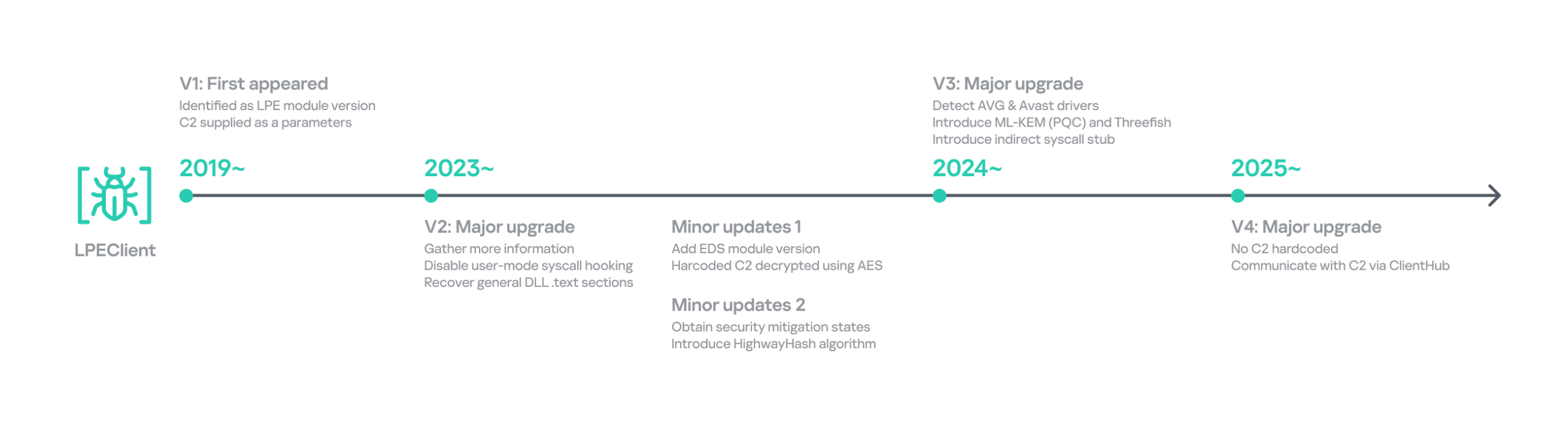
    LPEClient has evolved continuously over time, but we discovered that it recently underwent a major operational revamp. It no longer contains the C2 server address itself; instead, it interacts with ClientHub via a shared buffer. We believe this change is intended to enhance concealment.
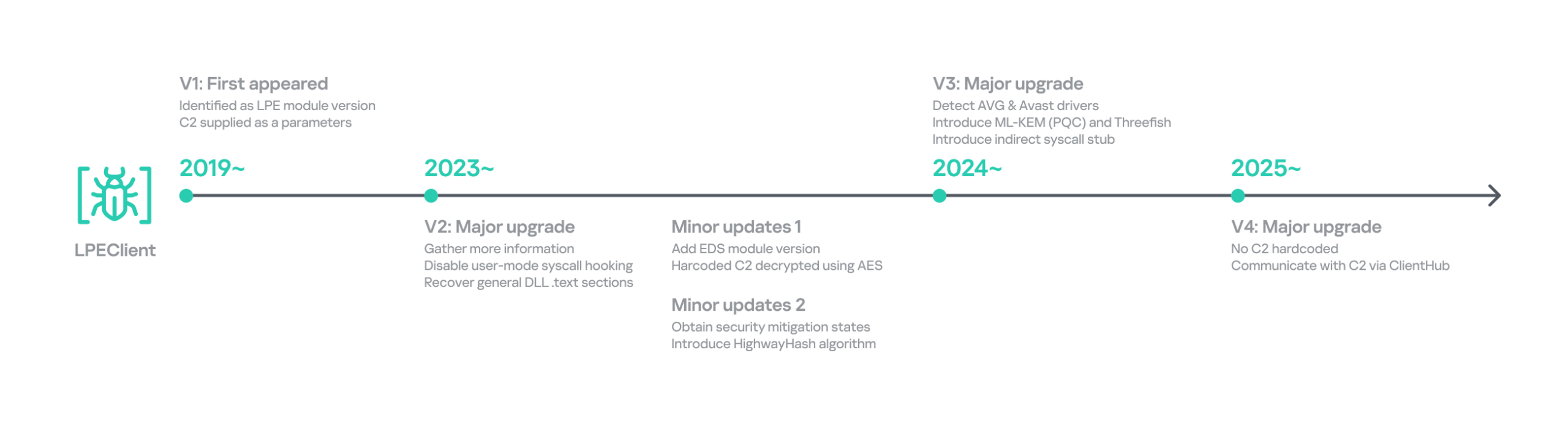
    Timeline of LPEClient

    Timeline of LPEClient

    The previous version collected the computer name, memory status, CPU specifications, operating system details, version of the ntoskrnl.exe file, firmware table, antivirus name, domain name, user name, the integrity level of the current process, and a random byte sequence of 1,568 bytes. The newly updated LPEClient variant mostly collects the same information; however, it also introduces several changes.

    • It does not collect the version of the ntoskrnl.exe file by querying the FileVersion value. Instead, depending on the specific build, it reads either the HKLM\SOFTWARE\Microsoft\Windows NT\CurrentVersion\UBR registry key or the SYSTEM_BUILD_VERSION_INFORMATION structure to retrieve the revision portion of the Windows build number. These values can be used to infer the system’s cumulative update or patch level.
    • To collect information about installed antivirus products, it switched from querying a WQL command to reading the WMI repository file directly. It now reads C:\Windows\System32\wbem\Repository\OBJECTS.DATA and searches for keywords such as AntiVirusProduct, companyName, and displayName to identify the installed products.
    • It also collects low‑level Windows security mitigation states. To achieve this, it queries the SYSTEM_KERNEL_VA_SHADOW_INFORMATION structure for the Kernel VA Shadow mitigation status and the SYSTEM_SHADOW_STACK_INFORMATION structure for the Shadow Stack (CET) protection status.

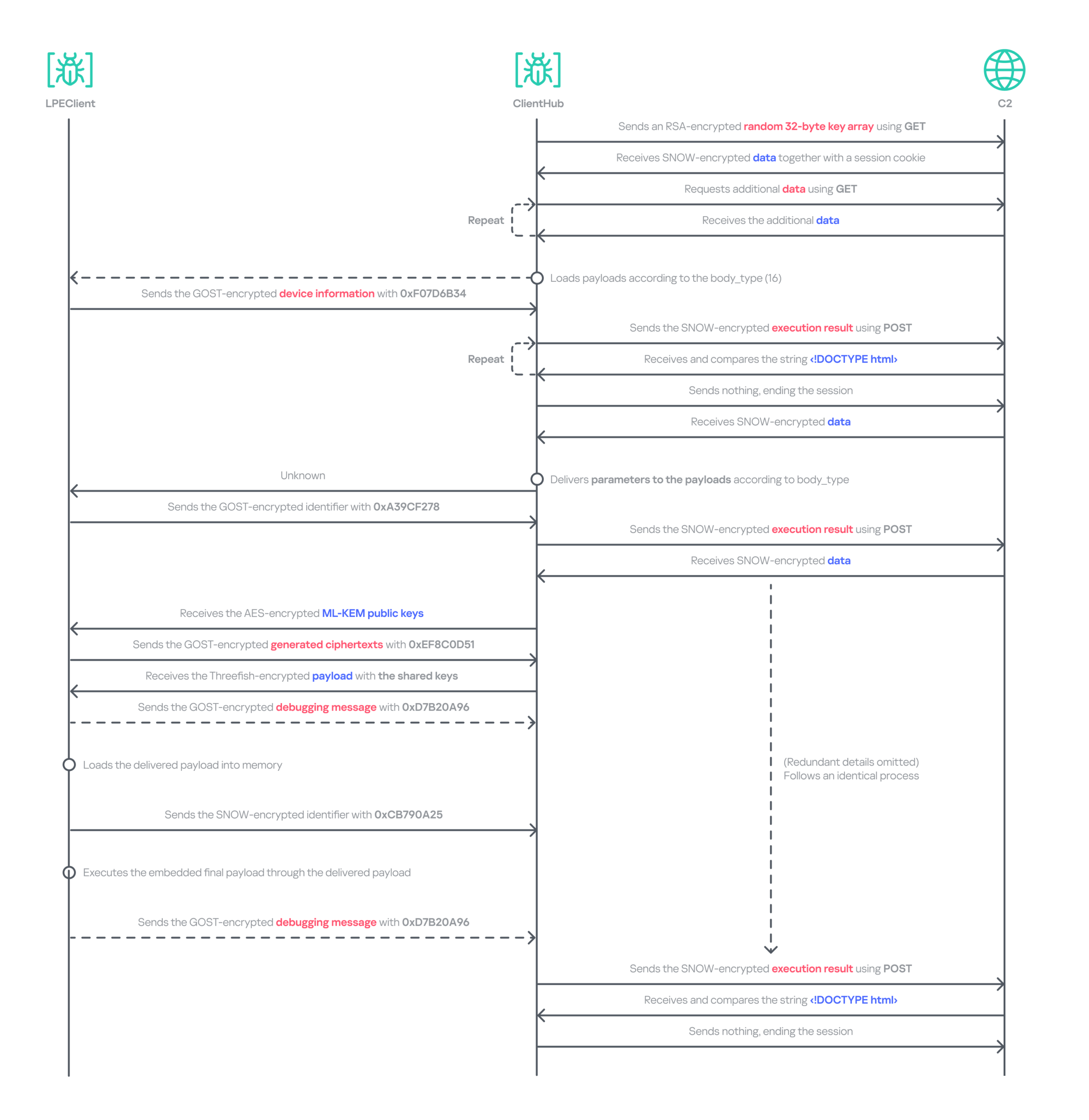
    Additionally, it generates a 32‑byte random unique identifier by using the HighwayHash algorithm and an XOR operation with the current system time. The collected information, including the generated identifier, is compressed with the XPRESS Huffman algorithm using the maximum compression setting. The compressed data is then concatenated with the message ID 0xF07D6B34 and encrypted using GOST (also known as Magma), Russia’s national cryptographic standard that employs a DES‑like structure, before being sent to the ClientHub via a shared buffer. Initially, KrCERT described the algorithm as a custom DES‑like scheme. However, further analysis by us and Check Point confirmed that it is actually the GOST algorithm. The key is randomly generated by a proprietary key‑generation algorithm and prepended to the encrypted message.

    The next request handles the key exchange by delivering the message ID 0xA39CF278 together with the generated unique identifier. The response is decrypted using the AES‑CBC‑256 algorithm. The SHA‑256 hash of the previously generated 1,568‑byte random value, which was originally sent to the C2 server during the collection phase, serves as the key for this decryption.

    Through this process, LPEClient obtains a byte array comprising four 1,568‑byte blocks from the C2 response. Each block contains an ML‑KEM‑1024 public key, where ML‑KEM is a NIST‑standardized post‑quantum key encapsulation mechanism derived from CRYSTALS‑Kyber. LPEClient then generates four distinct pairs of shared keys and ciphertexts from these blocks, encrypts the ciphertexts with the GOST algorithm, and transmits them to the C2 server via ClientHub together with the message identifier 0xEF8C0D51 and the associated identifier. Now that the preparation phase for receiving payloads is complete, the malware is ready to receive payloads forwarded by ClientHub from the C2 server, along with the necessary parameters. The use of post-quantum cryptography shows that the group intends to hide subsequent payloads.

    The response to the 0xEF8C0D51 message is decrypted with the Threefish algorithm using a 128-byte key, composed of the four distinct shared keys. Threefish is a tweakable block cipher that accepts a ‘tweak’ value alongside the key and the message. The concept of a tweak is similar to that of a nonce or initialization vector, which are used in different types of ciphers. In LPEClient communication, the tweak for the decryption is derived by XORing the unique identifier with 165 (0xA5). The first four bytes of the decrypted message must specify the parameter’s length, followed by the parameter itself and then the payload. The payload must be larger than 4 KB and start with the characters 'MZ', which indicates that the decrypted payload is an executable file. The payload is then reflectively loaded into memory. After successful loading, LPEClient sends the message ID 0xCB790A25 to the C2 server.

    Before loading the acquired payload, LPEClient takes measures to bypass security products. Instead of invoking VirtualProtect directly, the malware uses the identified HeapPageAllocator::ProtectPages in jscript9.dll to modify the memory page protection of the MD4Update function. The beginning of the function is then overwritten with a hard‑coded opcode sequence that serves as a syscall stub with the required arguments. LPEClient then uses the syscall stub to disable a user‑mode syscall instrumentation hook.

    We identified the final payload that was ultimately loaded as Cubridge. The overall communication process is as follows.
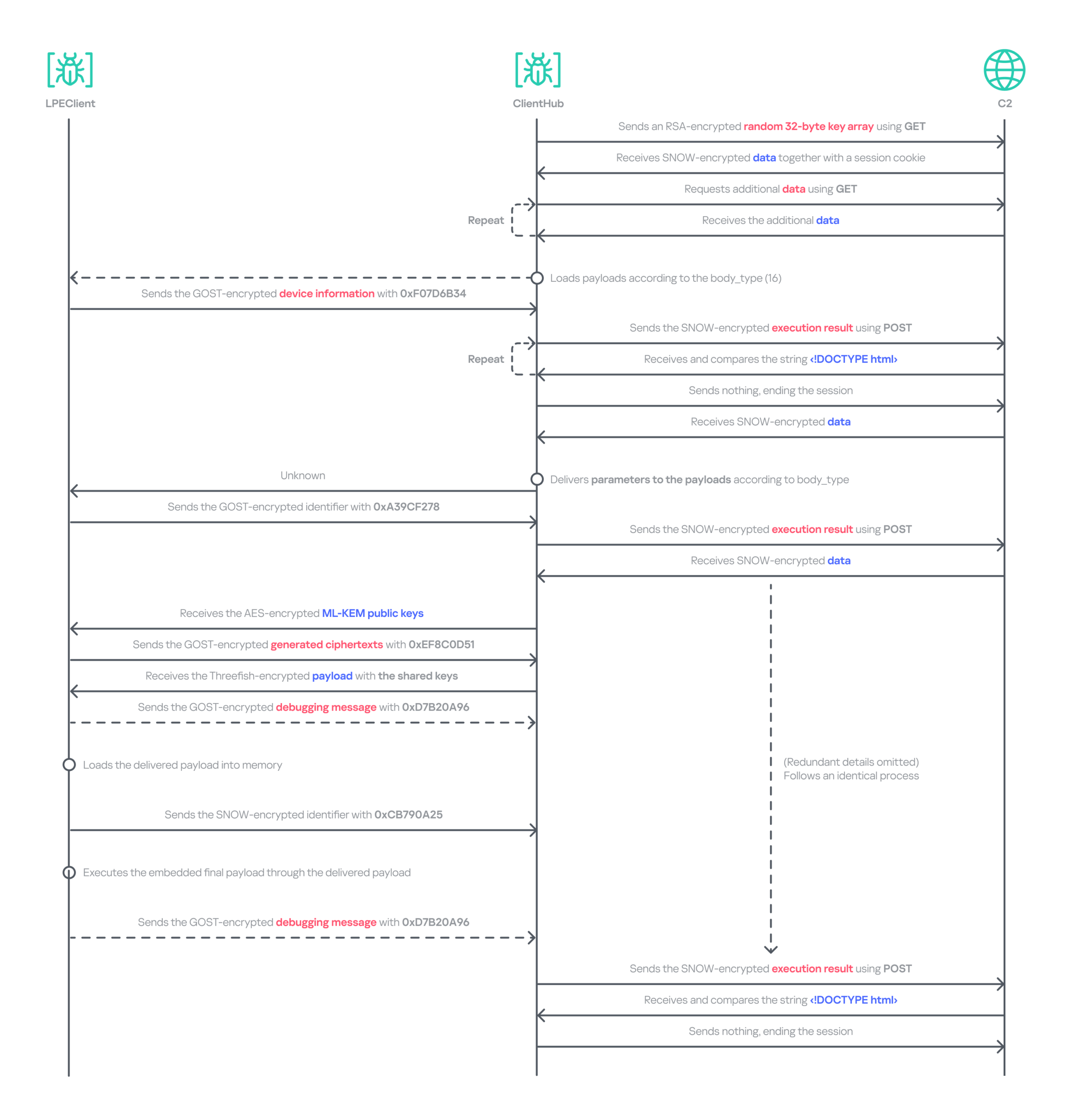
    Data relay flow between LPEClient and C2 via ClientHub

    Data relay flow between LPEClient and C2 via ClientHub

    Comparison of plugins and modules

    Throughout the engagement, we identified a variety of payloads deployed by TechHub, Cubridge, and ClientHub. These payloads have been categorized as tools, plugins, and modules that constitute the group’s modular malware framework. While we have not yet ascertained which payloads are deployed under specific conditions, the evidence suggests that the Lazarus Group’s toolkit is becoming increasingly sophisticated and segmented into specialized components rather than a single comprehensive backdoor. We also believe that TechHub and Cubridge may share similar tools.

    Deployed via Type of payload Family
    TechHub/Cubridge Tool Process collector,
    Browser stealer
    Cubridge Module Action module, Function module
    Cubridge Plugin ADFinder, FileCollector
    ClientHub Plugin File archiver, File collector, File cleaner, Drive/session monitor

    These modularizations are not confined to the instances within this campaign. As previously noted, similar patterns have been identified in CookiePlus, MISTPEN, SIGNBT, and IMETHOD. Note that we have reclassified the ThreatNeedle variant used in Operation SyncHole as the latest version of IMETHOD, the predecessor of ThreatNeedle in use since at least 2016.

    Infrastructure

    Based on the information we obtained from the TechHub malware, we identified at least three primary repositories used as the C2 server and one fallback repository. The earliest evidence indicates that the group has been leveraging GitHub as a C2 server since at least July 2025. We suspect that all the accounts were created using hijacked email accounts, and disguised as normal repositories by copying or creating normal projects to avoid suspicion.

    For the Cubridge and ClientHub C2 servers, the Lazarus Group employed only a minimal number of compromised yet legitimate South Korean media and interior design websites. Later, we observed that a broader range of compromised legitimate sites across various industries were also exploited. In addition, one ClientHub sample that we detected used Dropbox as a C2 channel.

    Victims

    We have identified at least three firms from the software, construction, and wired communication equipment industries in South Korea that were targeted by Operation FlashHole. As with the previous operation, however, we remain confident that a considerably larger number of organizations across a broader spectrum of industries have been affected.

    The software sector was the only sector targeted in both the SyncHole and FlashHole campaigns. This suggests the actor is eager to compromise the sector, steal source code, and exploit vulnerabilities for further attacks.

    Operation FlashHole is the latest wave in the broader Cascade Hole campaign, which involves the use of South Korean software as a potential entry point to deliver malware targeting the country. Although the malware chain has advanced significantly since last year, we assess with medium-to-high confidence that the same actor is responsible for both the SyncHole and FlashHole operations based on the initial vector, targets, multi‑stage chain, and technical and operational improvements. The use of LPEClient in particular is a strong indicator supporting this assessment.

    The malware strains used in the attack are historically linked to the toolsets observed in the Lazarus Group’s notorious Dream Job campaign. Earlier versions of TechHub (also known as CLOUDBURST and NickelLoader), Cubridge (also known as SIDESHOW and LightlessCan), and TouchShift were all observed in that campaign, especially between 2022 and 2023.

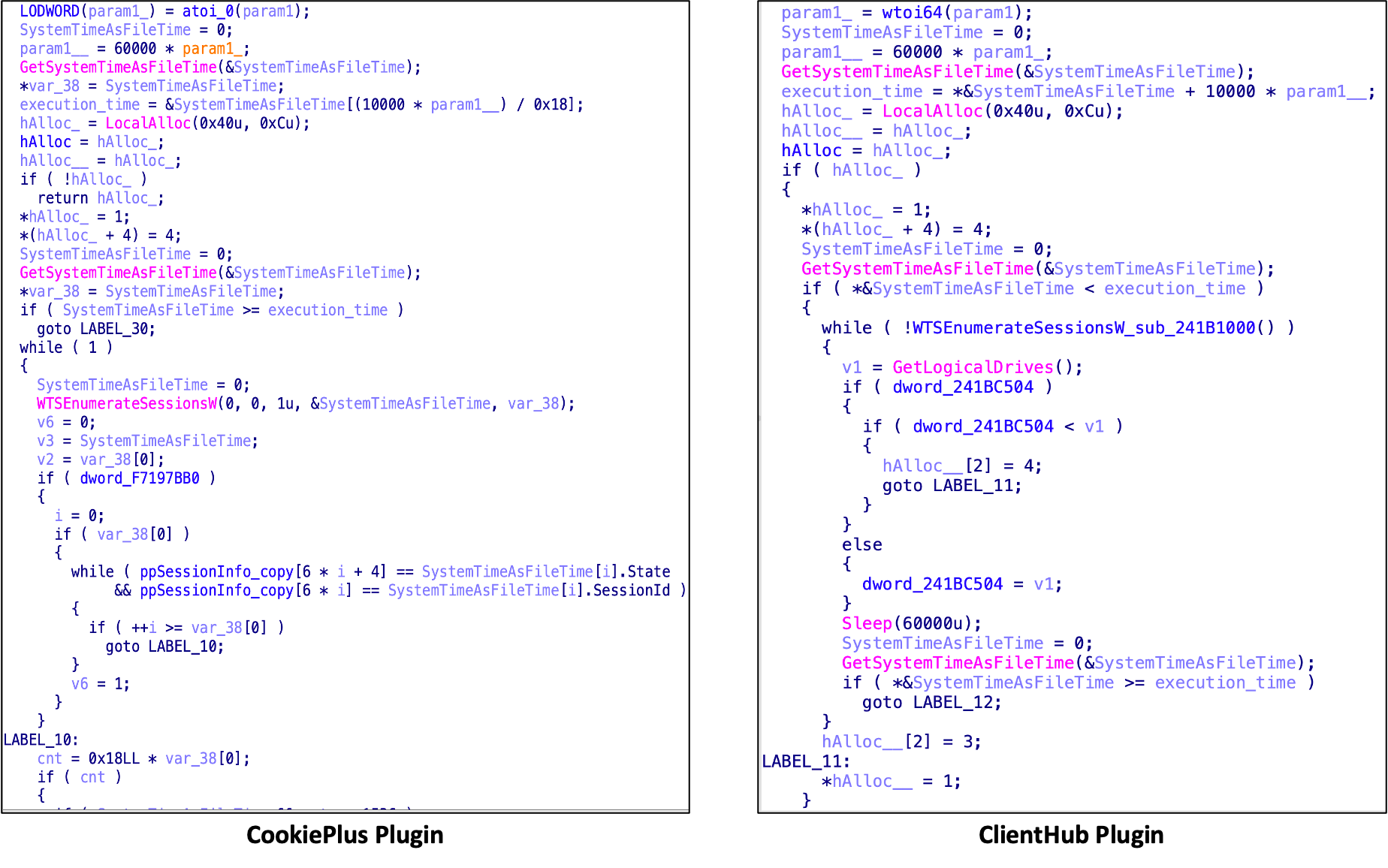
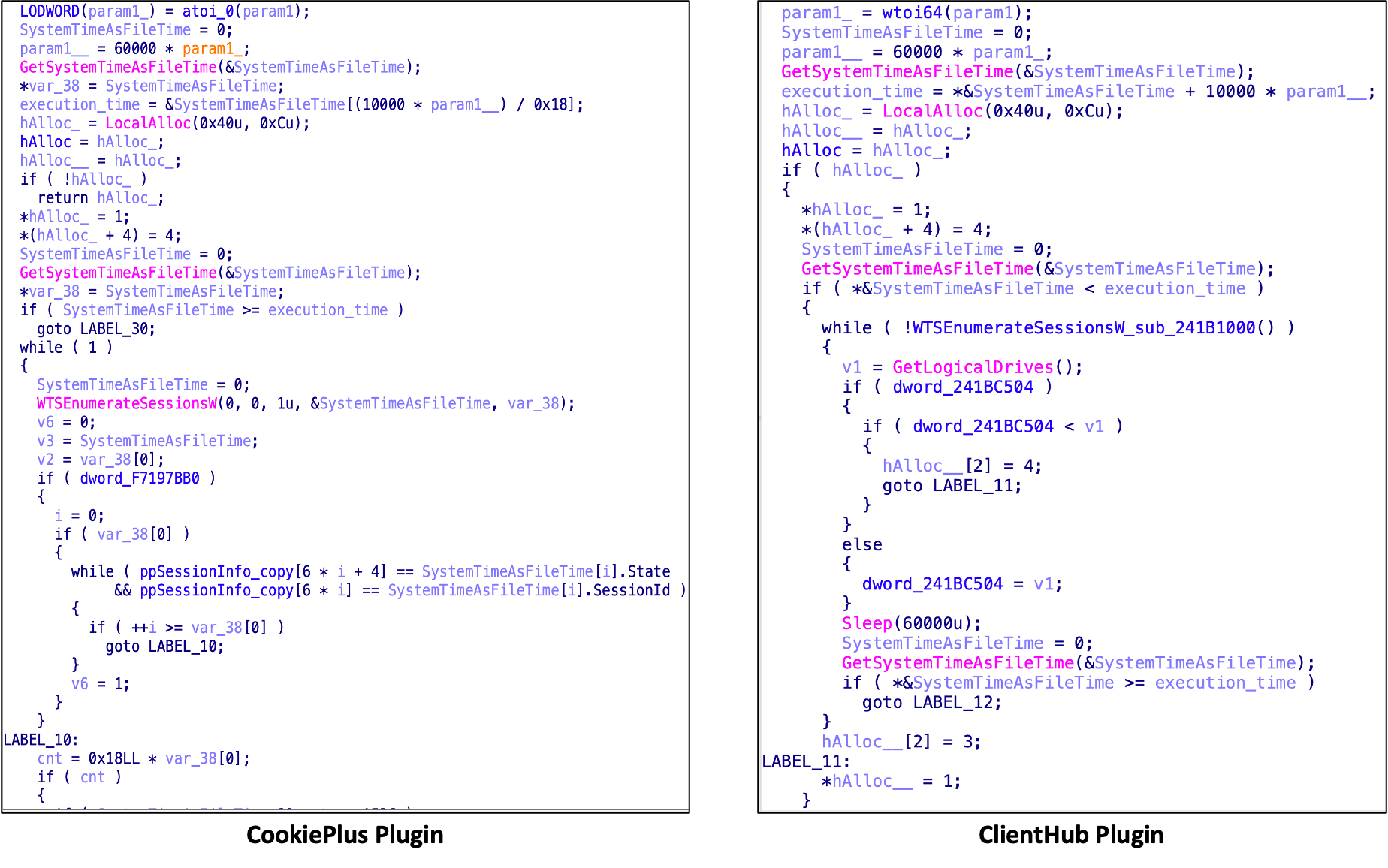
    We also discovered that both CookiePlus and ClientHub have significant overlaps in class name, configuration path, and plugins. Based on these similarities, we assess with medium‑high confidence that ClientHub is an advanced version of CookiePlus.
    Since July, around the time Operation SyncHole began winding down, we have also observed several notable attacks against South Korea employing the COPPERHEDGE backdoor and targeting various South Korean organizations. Interestingly, the start times of these activities align with the earliest evidence we have identified for Operation FlashHole. Although the backdoor was part of the second phase of Operation SyncHole, it has been operating independently with its custom loader since then. These incidents featured malware chains and tools that were distinct from those used in Operation SyncHole and FlashHole.

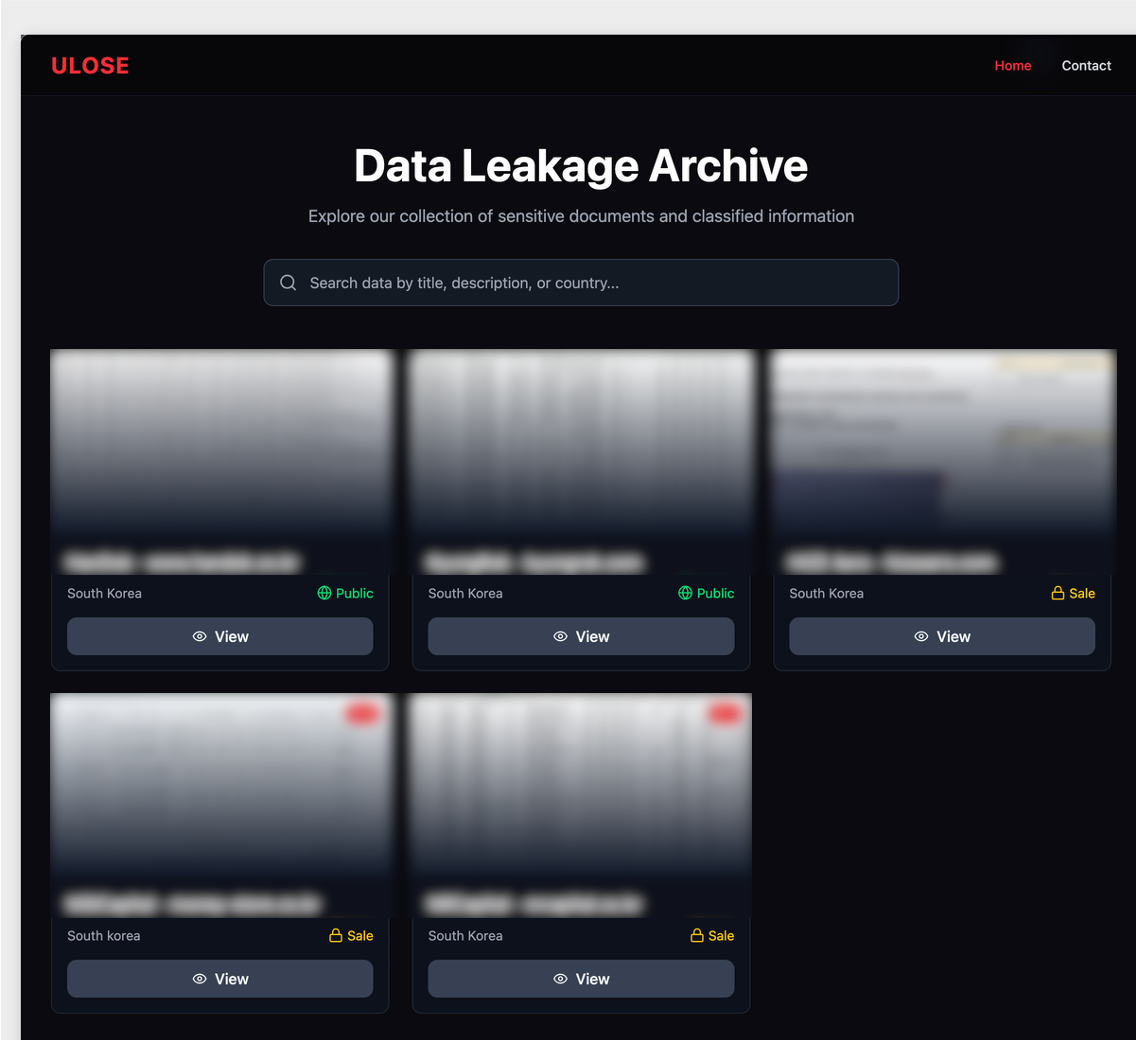
    As AhnLab noted in their report, the same backdoor was likely observed in atypical activity, specifically the Gunra ransomware infection. Our investigation further revealed that one instance of a backdoor infection ultimately resulted in the exfiltration of data to a dark web leak site, which clearly differed from Gunra’s. The site appears to have been crafted exclusively for this activity. In summary, unlike other attacks, the backdoor was used in conjunction with both ransomware and data exfiltration.
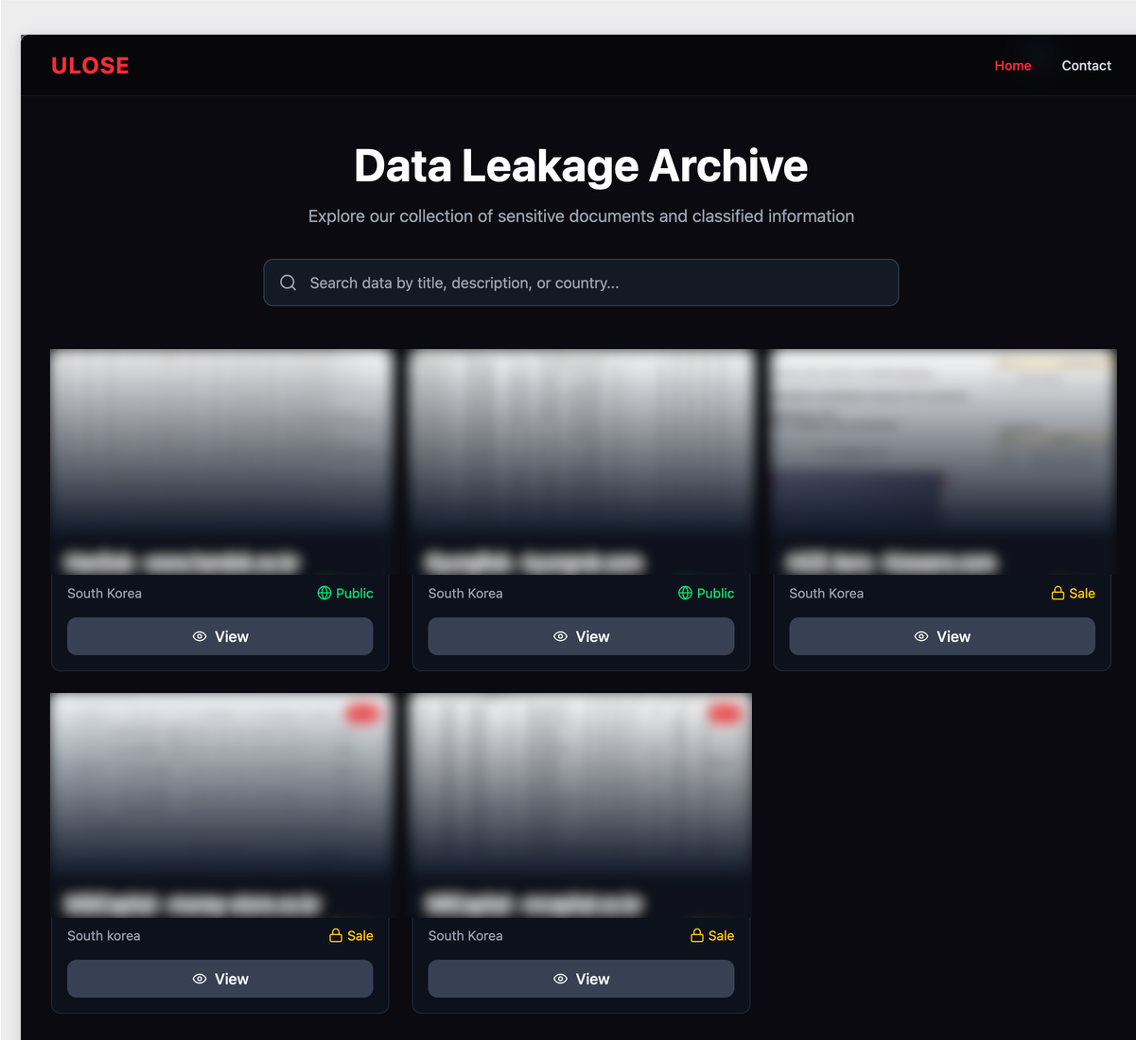
    Data leakage site linked to the COPPERHEDGE backdoor on the dark web

    Data leakage site linked to the COPPERHEDGE backdoor on the dark web

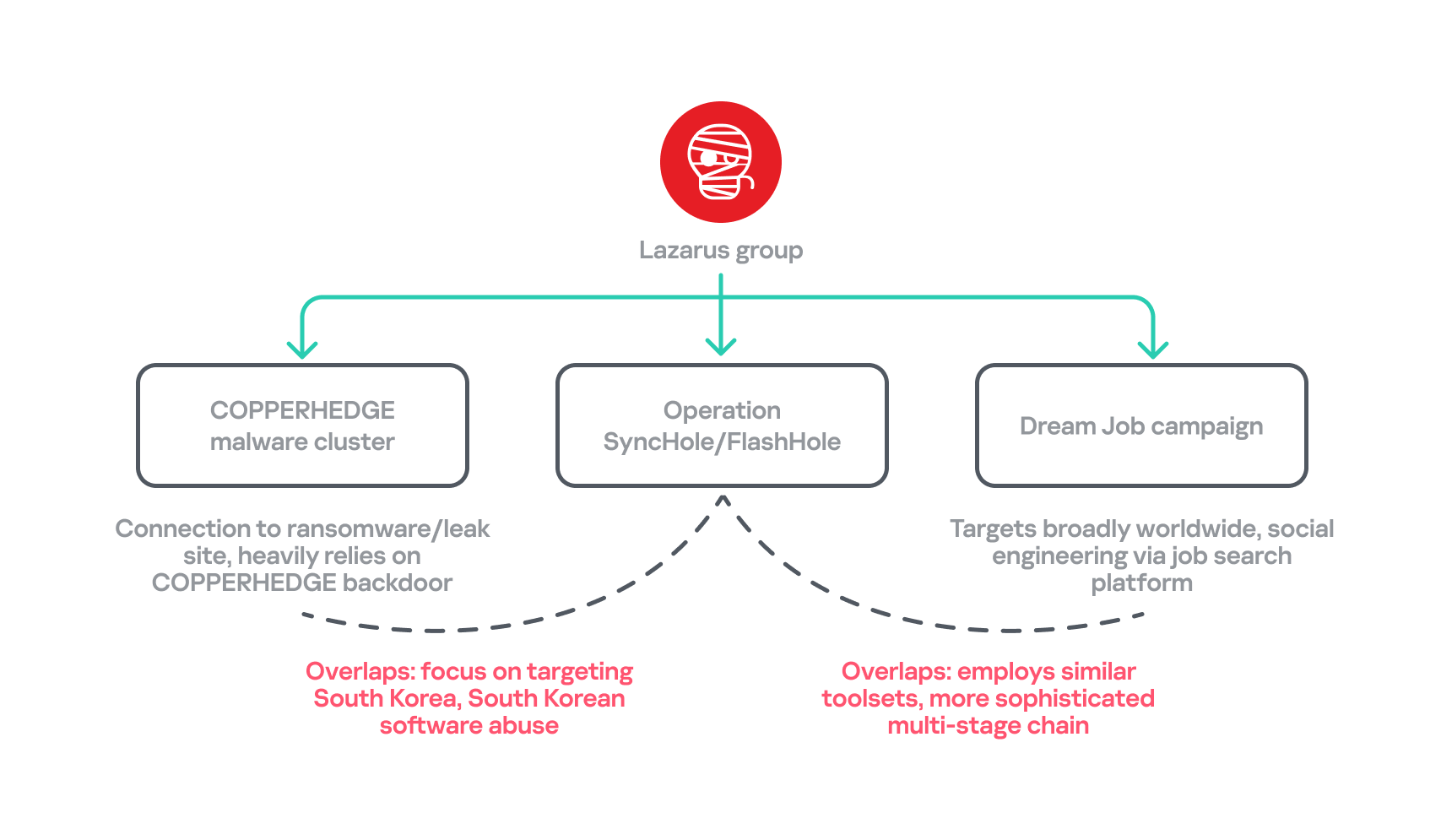
    Another noteworthy point is that the recent Dream Job campaign employs an updated malware chain that, since around 2024, has primarily involved MISTPEN and ForestTiger rather than the earlier arsenal that included tools such as TechHub and Cubridge. However, the updated versions of this older malware have now re-emerged as part of Operation FlashHole. Considering these changes and all aspects of each attack’s TTPs, we have organized a classification for each attack.
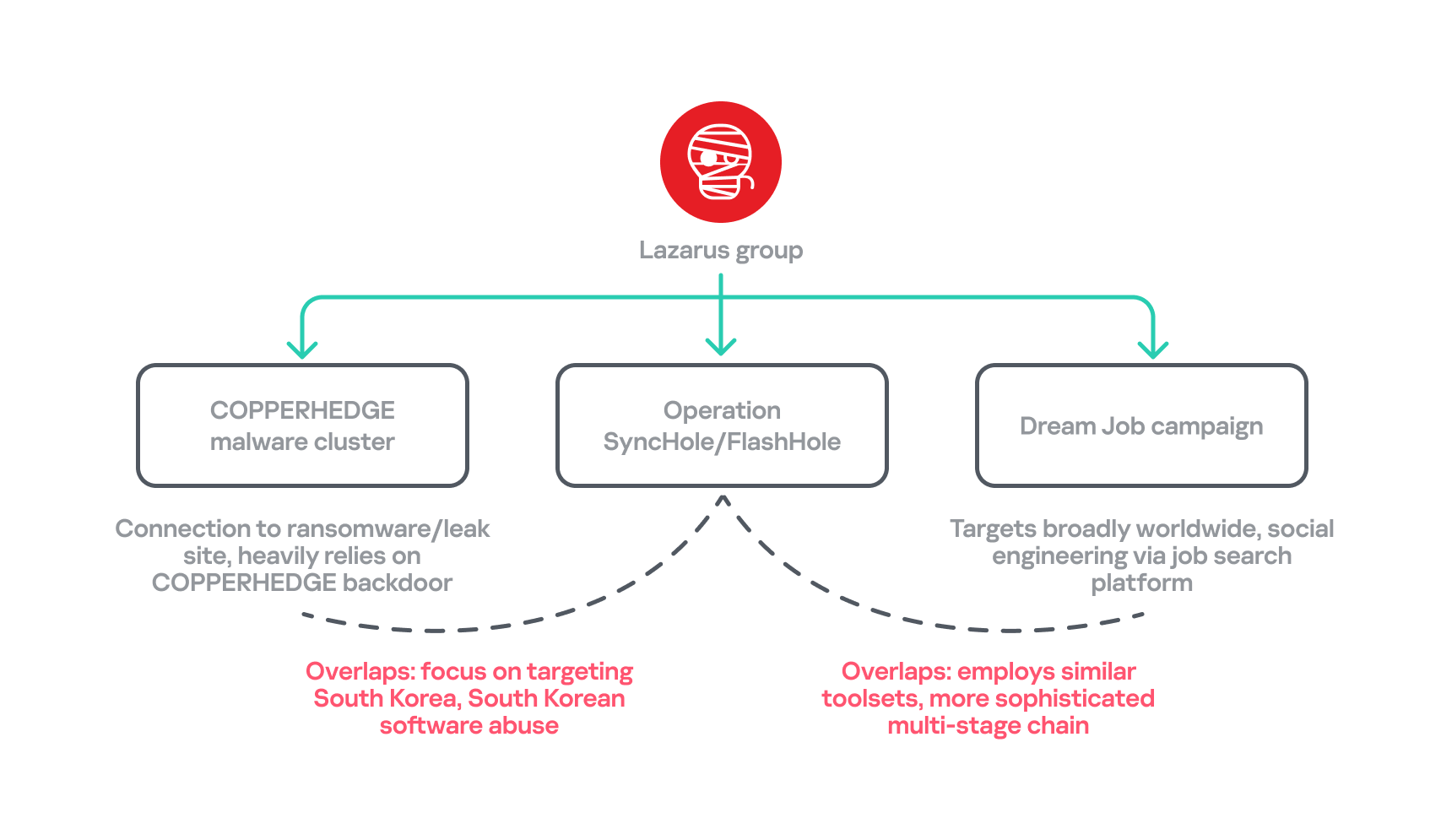
    Overlaps between the recent attacks by Lazarus Group

    Overlaps between the recent attacks by Lazarus Group

    Conclusion

    Our analysis shows that the Lazarus Group begins preparing for its next operation shortly after completing the previous one, ultimately deploying an enhanced malware chain by refining existing tools. The group continues to use the advanced version of LPEClient for profiling and payload delivery, indicating that the tool is meticulously managed and well maintained. Ironically, the group seems to have adopted more secure post-quantum cryptography faster than many legitimate security products. These observations suggest the involvement of a dedicated developer, with others orchestrating comprehensive attack scenarios against newly targeted software.

    We anticipated that specialized attacks targeting South Korea would persist. However, we did not foresee multiple attack campaigns being executed simultaneously, each leveraging different types of software and tools. Notably, the COPPERHEDGE cluster appears to be involved in monetizing the attacks, while Operation FlashHole is focused on espionage. We are closely monitoring these changes to understand their motivations and ultimate goals.
    In October 2025, the South Korean government unveiled a comprehensive cybersecurity plan that will phase out the mandatory installation of security software for users beginning in 2026. We estimate that operations exploiting this software will remain highly active for some time, maximizing efficiency, before the software is fully eliminated or mitigated.

    Kaspersky products detect the exploits and malware used in this attack with the following verdicts: MEM:Trojan.Win64.Shellcode.gen, Trojan.Win64.DLLhijack.*, Trojan.Win64.Lazarus.*.

    Indicators of compromise

    File hashes

    TouchShift
    ec84d6cb2ae7974767aedac246b50a3e             mscoree.dll
    a28cba214058fcae2883d8cffc883abd                mscoree.dll
    c105d6b16f544582772de0159f24c00a               mscoree.dll
    2f8475a90a25624ed02f1d18d4e6d65d              mscoree.dll
    676fabe30a28b53925fba98e34b35986              mscoree.dll
    b4a7eff35f048f06fb0a2d7631f23a7d                  mscoree.dll

    ClientHub Loader
    ff07641dc56914dd90ee0bd7404d7ad7               liblzma.dll

    File paths

    C:\ProgramData\Package.txt
    C:\ProgramData\RasConv\mscoree.dll
    C:\ProgramData\Apple\mscoree.dll
    C:\ProgramData\ssh\mscoree.dll
    C:\ProgramData\qorestor\mscoree.dll
    C:\ProgramData\Dell\mscoree.dll
    C:\ProgramData\Dell\Dell1.tmp
    C:\ProgramData\Dell\Dell3.tmp
    C:\Windows\System32\RasConv\mscoree.dll
    C:\Windows\System32\RasConv\ActivationStore.dat
    C:\Windows\System32\DrvConh\mscoree.dll
    C:\Windows\System32\DrvConh\ActivationStore.dat
    C:\Program Files\Common Files\System\msadc\msadc.inc
    C:\ProgramData\desktops.ini

    C2 servers

    javadevhouse.co[.]kr
    pythonapischool[.]com
    hxxps://cubedesign[.]co[.]kr/news            C2 of Cubridge
    hxxps://cubedesign[.]co[.]kr/mobile/fashion            C2 of Cubridge
    hxxps://fp-news[.]co[.]kr/shop/cart                                C2 of Cubridge
    hxxps://k-wbc[.]co[.]kr/skin/social/social_view.php         C2 of ClientHub
    hxxps://rcsh[.]co[.]kr/modules/bbs/tiles/bbs_div/inputForm.php    C2 of ClientHub
    hxxps://www[.]ksog[.]org/insert_file/handle.php                   C2 of ClientHub

    Source: Securelist (Kaspersky GReAT) · 2026-10-21
  • Active Exploitation of May 2026 PAN-OS CVE-2026-0257 (Updated October 20)

    Active Exploitation of May 2026 PAN-OS CVE-2026-0257 (Updated October 20)

    Ransomware operators including Spikey Scorpius (aka Qilin) and Tarnished Scorpius (aka Inc) are exploiting PAN-OS vulnerability CVE-2026-0257.

    Source: Palo Alto Networks Unit 42 · 2026-10-20

  • There’s only so much code: the rise in vulnerability numbers

    There’s only so much code: the rise in vulnerability numbers

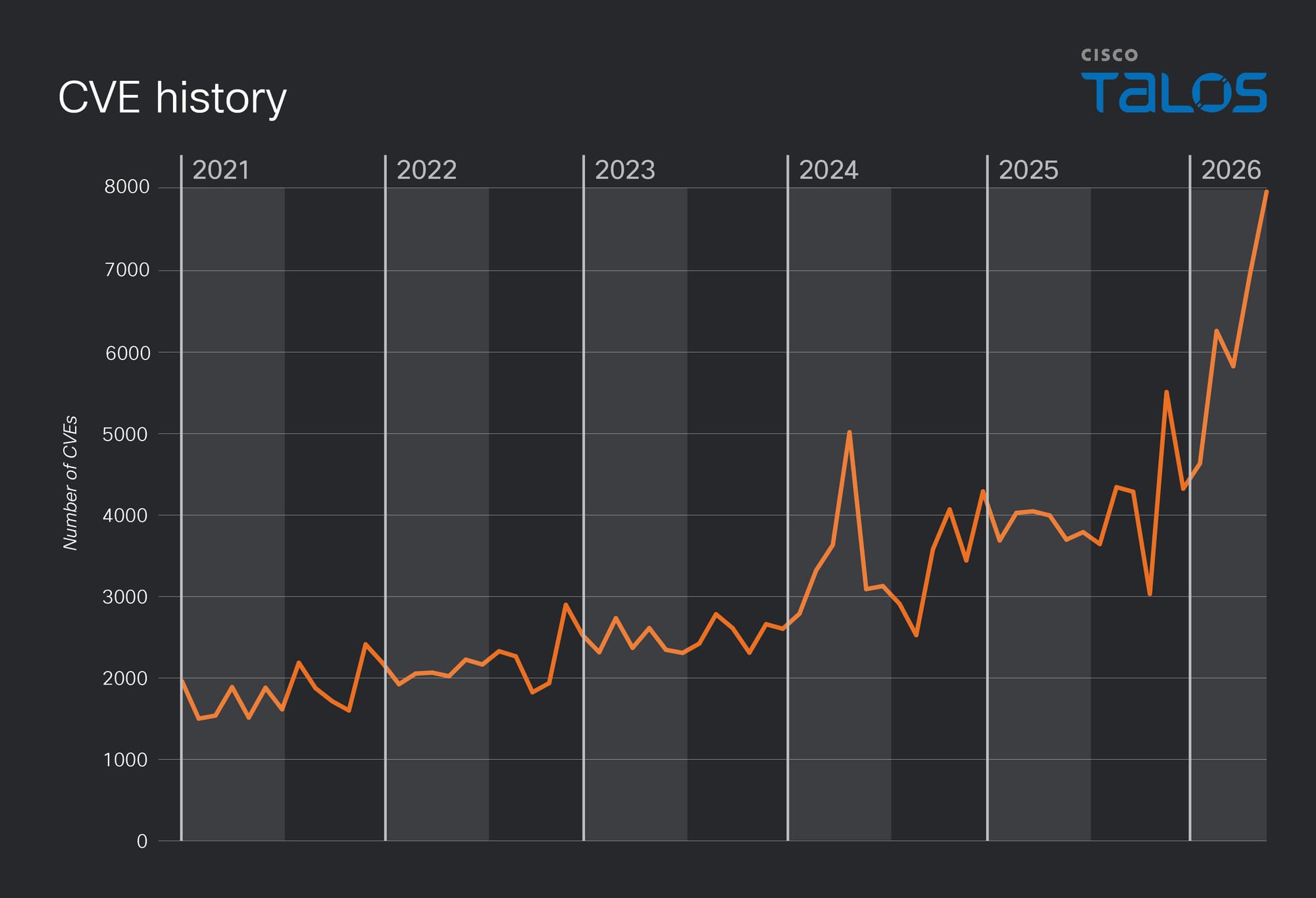
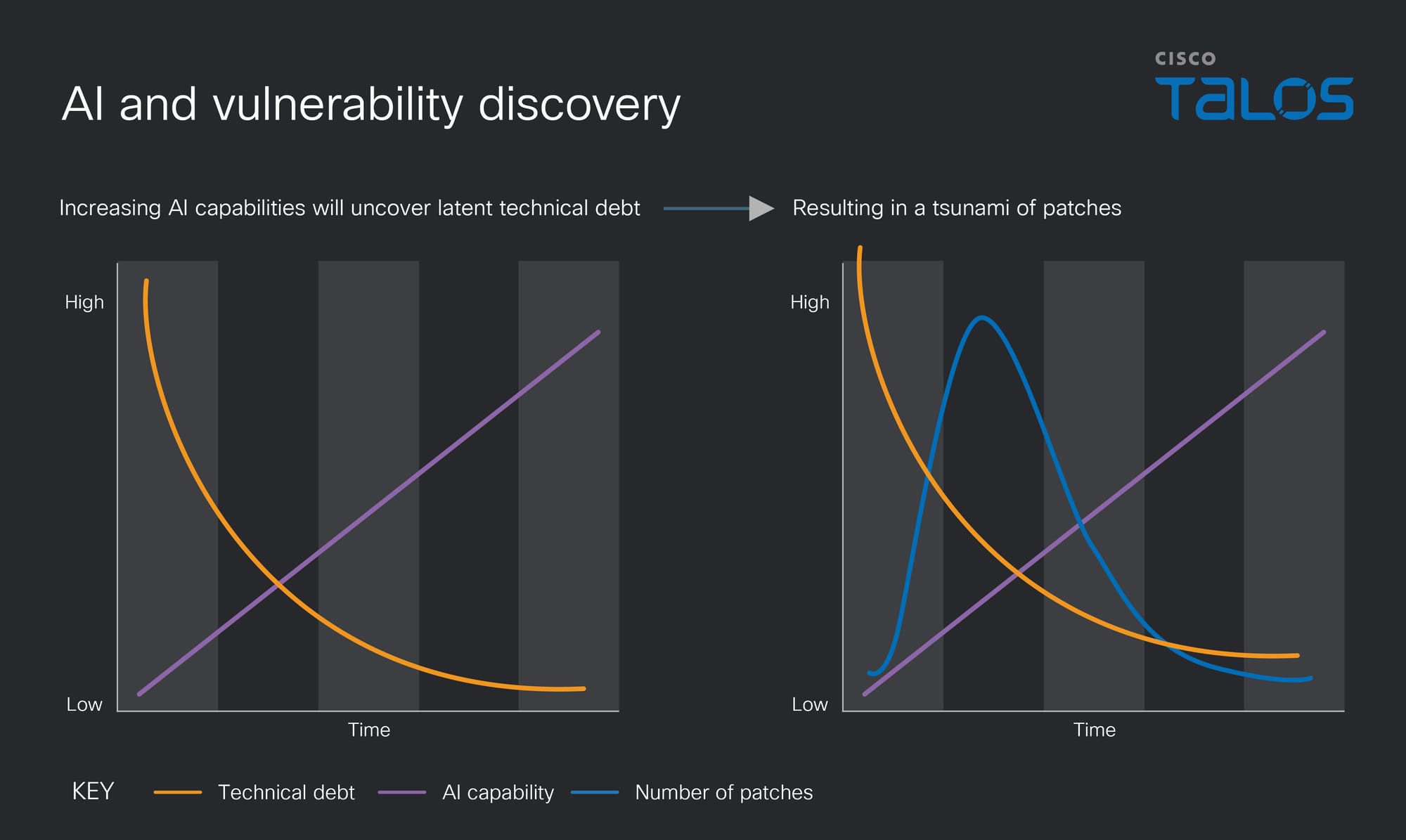
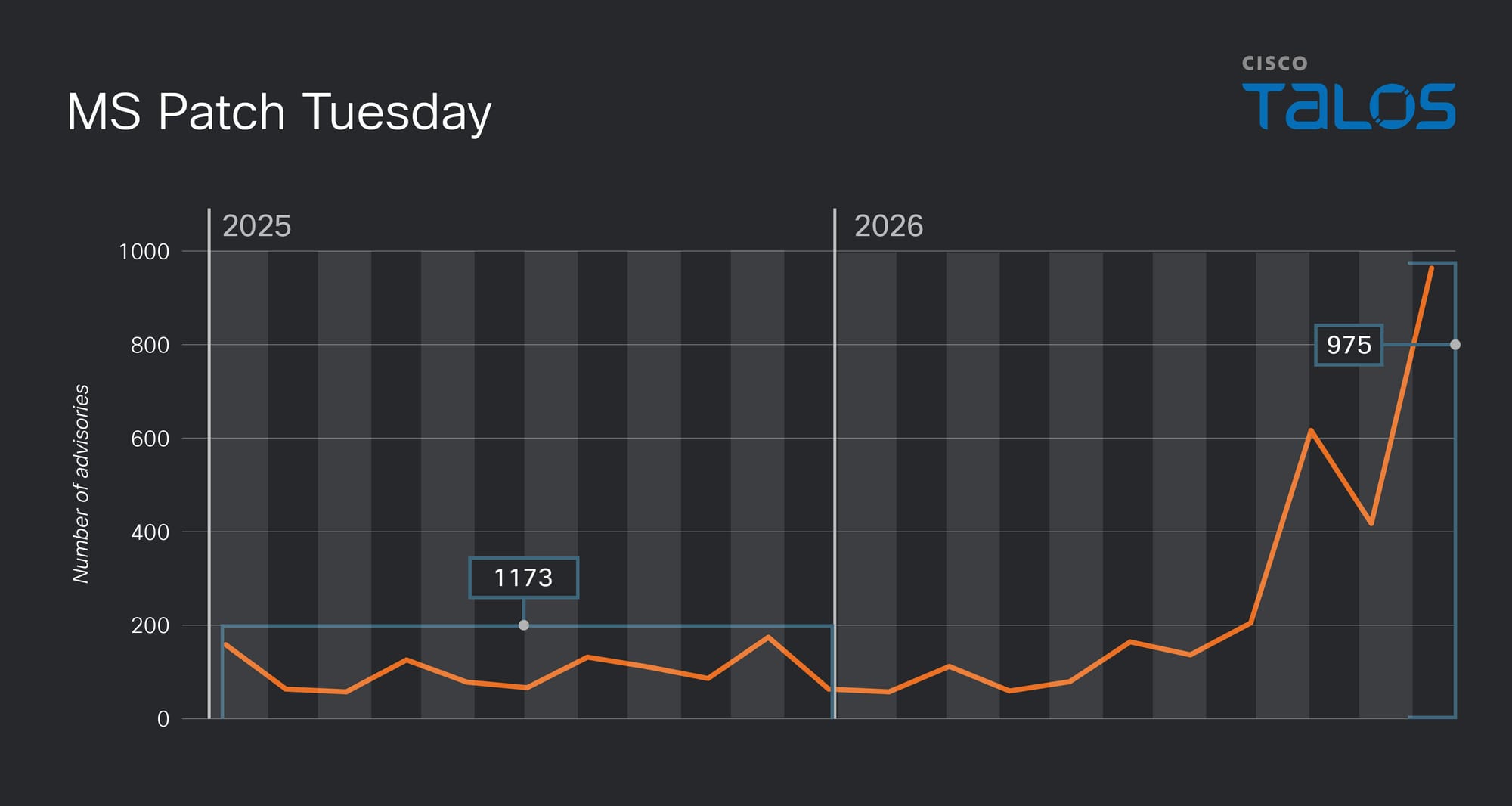
    • Frontier AI models (like Mythos) are rapidly mining decades of technical debt across ubiquitous legacy libraries, driving monthly Microsoft Patch Tuesday vulnerability advisories up more than tenfold (reaching 1,415 this month). This volume is overwhelming open-source maintainers and putting pressure on the traditional 90-day coordinated disclosure model. 
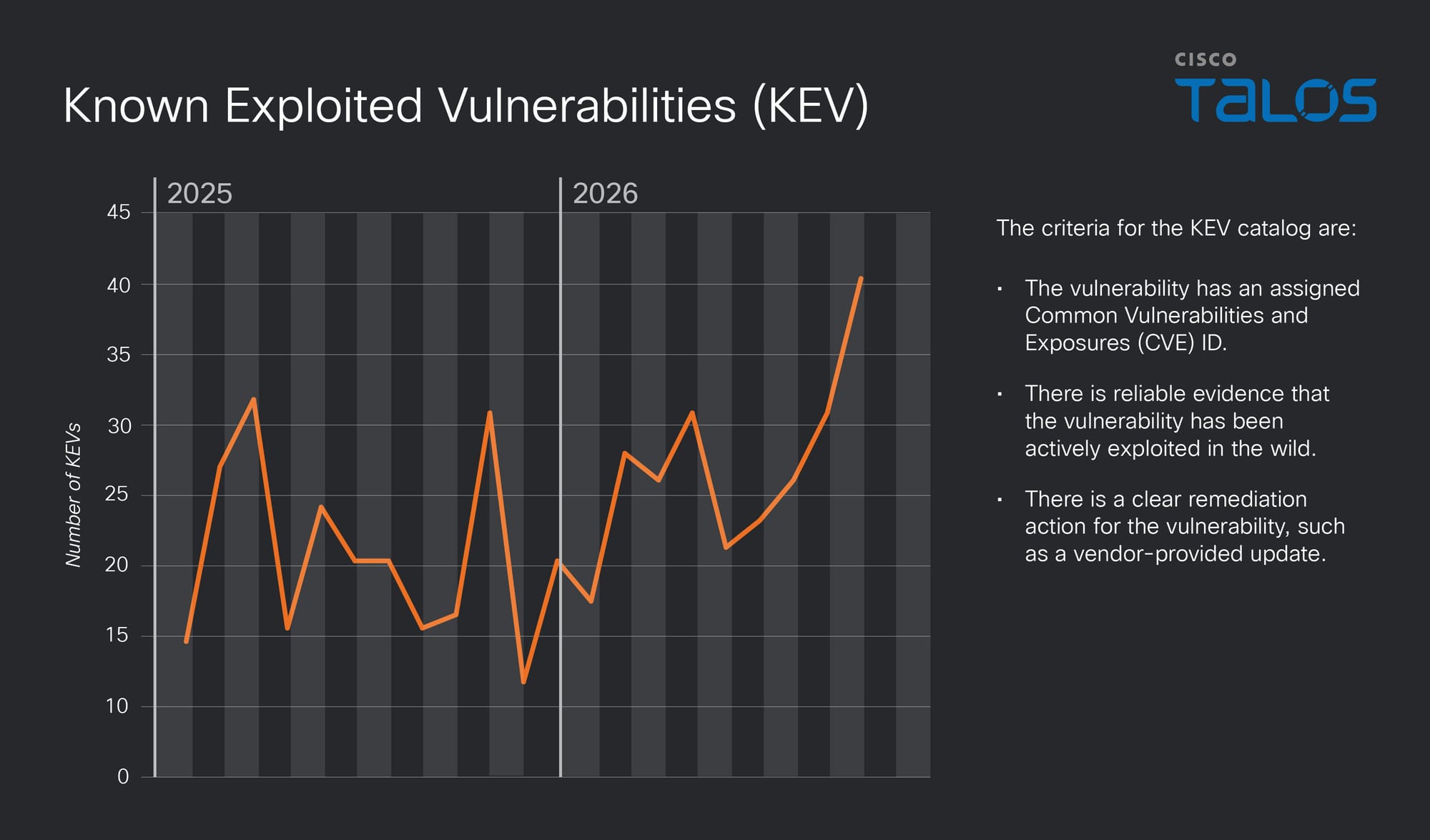
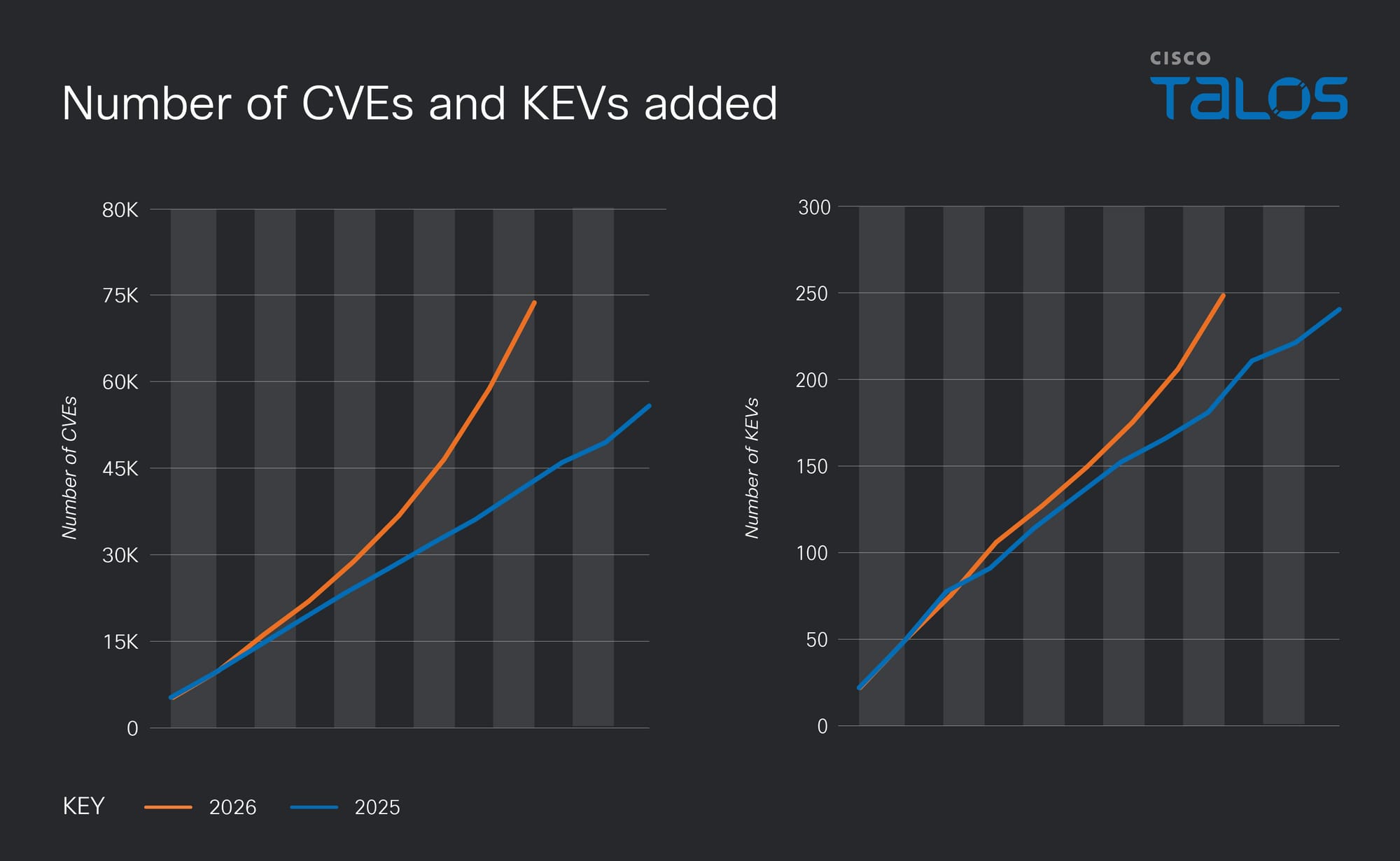
    • Despite a 105% year-over-year surge in CVEs, Known Exploited Vulnerabilities (KEVs) grew by only 37%, and only 3 of September’s 975 Microsoft advisories saw in-the-wild exploitation, demonstrating that the vast majority of AI-discovered bugs are not practically exploited. 
    • We may be able to take new-bug-class vulnerability spikes as evidence that these vulnerabilities will eventually level off and decline, once the historical code backlog is remediated and AI verification is embedded directly into new development pipelines. 
    • With attackers able to parse patches faster via AI, defenders cannot cover for all possible threats. Organizations should continue to build robust defense-in-depth. Prioritize high-exploitability flaws in their specific environments, implement interim mitigations (such as LiveProtect), deploy behavioral anomaly detection, and integrate current AI evaluation models into their software build chains. 

    There's only so much code: the rise in vulnerability numbers

    The September Microsoft Tuesday release included 975 vulnerability advisories. This month, 1,415 vulnerabilities were just dropped. Compared to a pre-June average of 100 a month, that increase is staggering. Where did they come from? 

    As of April, frontier models came onto the scene more fine-tuned than ever toward vulnerability detection, particularly with the introduction of Mythos. The deluge brings a lot of questions: 

    • If these numbers are real, why hasn’t the internet collapsed? 
    • Are these vulnerabilities a new breed, and if not, why didn’t analysts find them in code that is sometimes decades old? 
    • Is the coordinated disclosure model still relevant in an era of this kind of speed? 
    • How in the world do defenders deal with those numbers? 
    • Should we go home, kiss our spouses, and prepare for the end? 

    The answer to many of these questions boils down to this: The majority of these vulnerabilities are coming from repositories of old code from large-profile products and systems; and disclosure does not equal weaponization. 

    Where is it from? 

    AI is chewing through a backlog of technical debt in libraries and tools used as the dependable, best-practice lynchpins of so many environments. These models have a new perspective, an ability to “think” without some of the hangups or assumptions of human defenders, and they are thorough in listing those vulnerabilities. 

    There's only so much code: the rise in vulnerability numbers

    Entrenched older tools have always been prime targets because of their predictability; attackers know those tools and all their secrets, and they know what is likely to be present in a network with them. Multi-exploit attacks can be deployed with little variability.  

    Pre-Mythos threat actors exploited log4j (CVE-2021-44228) to immense success. The library was ubiquitous, included in nearly every environment, but not a component that got cataloged in visibility scans. A combination of scale and low visibility meant defenders were blindsided, scrambling to find out if they even used the log4j library before starting to concoct a mitigation plan. 

    Talos has ongoing relationships with some of the largest technical vendors (such as the Microsoft Active Protections Process (MAPP) agreement). Organizations share additional information—detection guidance or maybe a POC — for vulnerabilities that are most likely to be exploited, to enable Talos to provide adequate coverage when the advisories are announced.  “Microsoft believes it is important for us to provide detection content, based on their guidance,” as Yves Younan, Director of Talos Vulnerability Discovery, Detection, and Testing, says.  

    Talos has needed to invest more resources to get coverage in on time for critical vendors like Microsoft to keep up with notifications coming in fast and often on staggered or out-of-band timelines. 

    For larger vendors, the pressure is handleable for now. However, open-source projects are getting flooded. Some projects have a trusted group that can combine to tackle patches, and some share with the full community for immediate assistance, but it is up to the project. The internet runs on open-source work. 

    The pace of discovery presents a challenge for the traditional coordinated disclosure system vulnerability hunters have been using for years, and some are calling it into question.  

    Security vulnerabilities should be reported, to enable an informed defender base and regular patching, and vendors responsible for vulnerable code need time to create coverage. A timed disclosure model where notifications are sent to a vendor, who then has a set period of time (typically 90 days) to provide coverage before the disclosure is released publicly, has created a more secure online environment for decades.  

    Now, many practitioners are releasing advisories publicly without a disclosure period beforehand. The reasoning is that if one AI can find a weakness, any other could, so the vulnerability is already, effectively, released.  

    This conversation is actively changing expectations around vulnerability disclosure, and guidance is in flux. 

    Will it stay this high? 

    No one knows the future, but we can always look to the past for insight.  

    Numbers of vulnerabilities jump drastically when a new bug class is identified, as their possibilities are explored to the fullest. Then the discoveries plateau and drop off. 

    When format string vulnerabilities were discovered as a new bug class in 2000, the initial influx of discoveries ramped up and up, until reaching a peak in 2005 and then slowly declining over the next couple of years. Format string vulnerabilities are still discovered, but they are a smaller overall fraction of the number of CVEs discovered in a year.  

    Theoretically, AI-assisted vulnerability discovery could go the same way.  

    There's only so much code: the rise in vulnerability numbers

    While frontier models have not discovered a new vulnerability class, they are more efficient at discovering known types of software vulnerabilities. Given that a lot of vital software has a long history of code releases, there’s plenty of code to mine for weaknesses. But there’s only so much code… right? 

    Old and commonly used tools are often under the highest scrutiny, lending them one kind of safety: Because of their popularity, utility, and stability, when popular tools have vulnerabilities, they are discovered fast and patched promptly. 

    As the historical backlog of essential systems is turned over by AI, vulnerabilities will be found and patched. New code will ideally be run through AI bug-checkers that will prevent new vulnerabilities from being introduced. The rate of new vulns should level off and drop accordingly.  

    There are some caveats. In the past, as vulnerability disclosures increased through coordinated disclosures, we saw increased adoption of mitigations. Exploitation became significantly harder. Attackers often need to chain together 3 or more vulnerabilities to successfully exploit a system.  

    However, more awareness of vulnerabilities often leads to more exploitation. Attackers often use vendor patches meant to protect customers to discover where vulnerabilities might exist. The frequency of patching has delayed human attackers via parsing bottlenecks, but AI can eliminate that problem.  

    Are the numbers the real issue? 

    The volume is certainly up.  

    There's only so much code: the rise in vulnerability numbers

    Fresh as this blog is being finished, the October Patch Tuesday dropped almost 500 more than last month. 

    With refinement, any vulnerability could become a link to a path of effect. But… not all vulnerabilities are exploitable. Some are wildly impractical for attacker use. In fact, the percent of Known Exploited Vulnerabilities (KEVs) is vastly smaller than the found vulnerabilities.  

    There's only so much code: the rise in vulnerability numbers

    Of the 975 vulnerabilities Microsoft reported in September, there were only three in-the-wild exploits detected. When viewed by percentage, vulnerabilities versus KEVs tell a different and perhaps reassuring story. 

    There's only so much code: the rise in vulnerability numbers

    Compared with the same period last year, additions to the known-exploited vulnerability list increased by 37%, while published CVEs increased by 105%. However, we wouldn’t necessarily expect those figures to grow in proportion. Adversaries only need enough useful vulnerabilities to compromise their targets, and the same vulnerabilities can be reused against many organizations. The KEV count tracks distinct vulnerabilities known to be exploited, not the number of attacks or successful compromises. 

    AI helps ingest code, advisory reports, and attack surfaces with inhuman speed, but it cannot currently make judgment calls about the value of a weakness. 

    For defenders, the question remains the same: Which vulnerabilities provide a viable path into their environment, and how do you close those paths?  

    What do we do now? 

    The undeniable danger here is in exploitation time going down rapidly, while the vulnerabilities that could become exploits is still going up. The biggest hurdle for a defender is determining what is a real vulnerability for their environment, and what is not.  

    Different defenders have different forms of control depending on their role.  

    For those who are writing code, the new standard validation chain should include AI evaluation by models at least as up to date as those being used to hunt for vulnerabilities. It is relatively cheap to run new code through AI, but very expensive to run a cumbersome backlog of old code through. Bite it off in chunks. 

    For those whose role involves keeping the tools ready: Upgrade ASAP.  Don’t stop there.  

    • For Cisco customers, implement LiveProtect to mitigate vulnerabilities between advisory release day and patching, to give time for that patching. Do this for everything you own. 
    • Move beyond static domain blocking and implement behavioral detection that alerts on anomalous traffic patterns directed toward automation platforms. 
    • Hone your focus to the vulnerabilities with the highest exploitability in your environment. KEVs are far less common among the sea of advisories, and their numbers have not risen proportionally with the AI-assisted deluge. 
    • Focus on building defense-in-depth. Employ multiple protection systems, to cover for delays in patching. Implement interim mitigations (such as LiveProtect), create custom IPS/Snort triggers to block pre-patched traffic using SnortML, deploy behavioral anomaly detection, and integrate current AI evaluation models in software build chains. 

    Dive deeper into this conversation with the latest TTP interview with Yves Younan and vulnerability researcher Bella Fusari.

    For more numbers and advice for defenders: 

    Source: Cisco Talos Intelligence · 2026-10-20

  • The Risk of AI-Powered Antidetect Browsers in Online Fraud and Influence Operations

    The Risk of AI-Powered Antidetect Browsers in Online Fraud and Influence Operations

    Key Findings

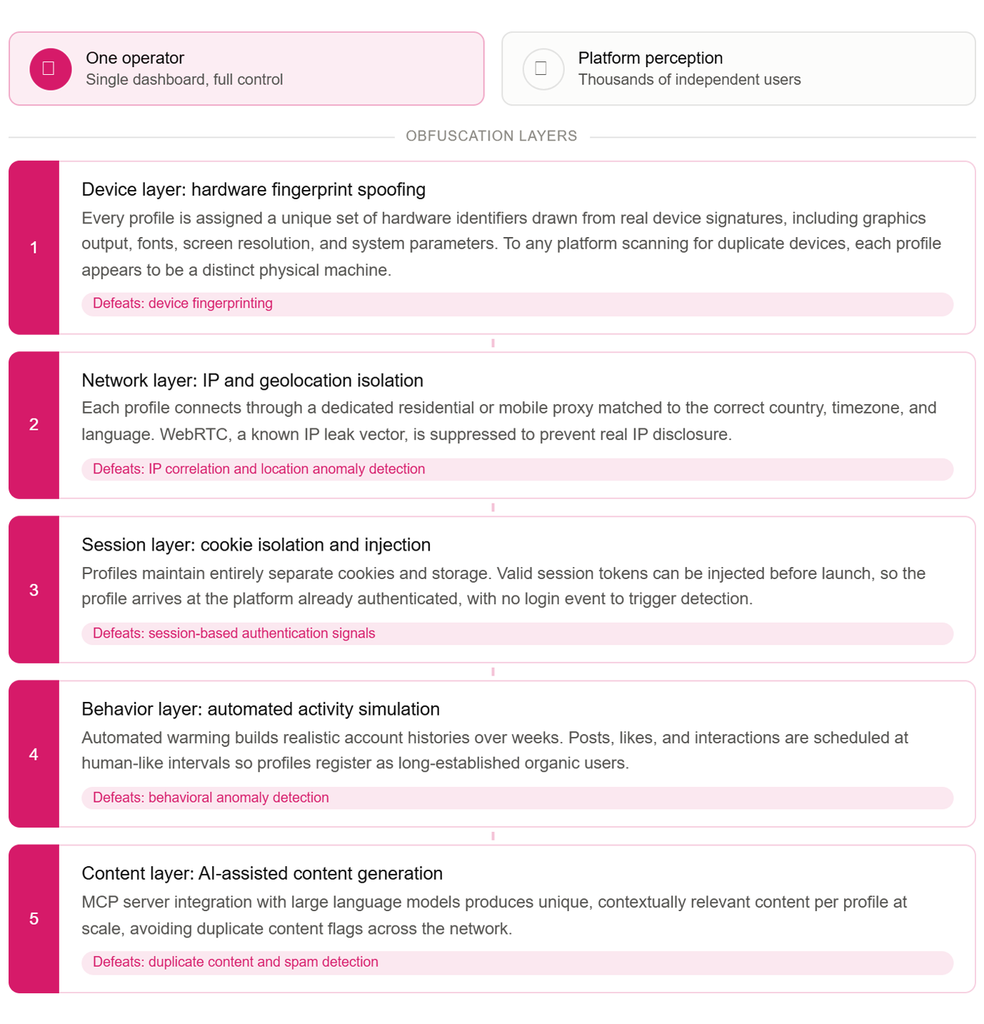
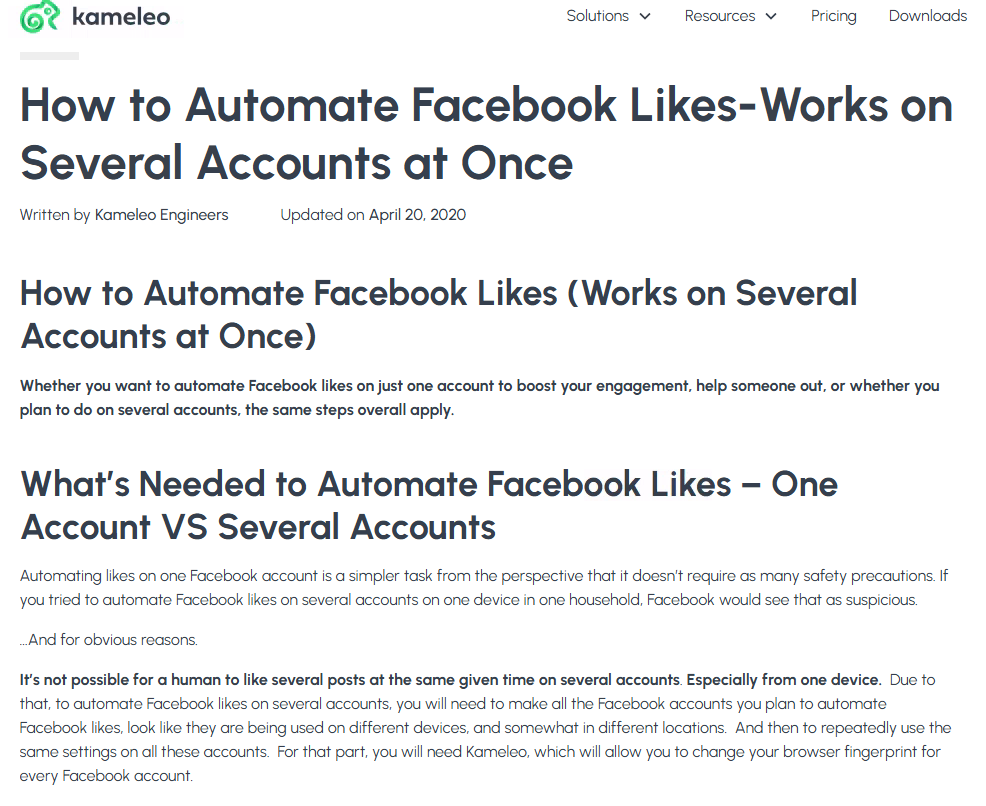
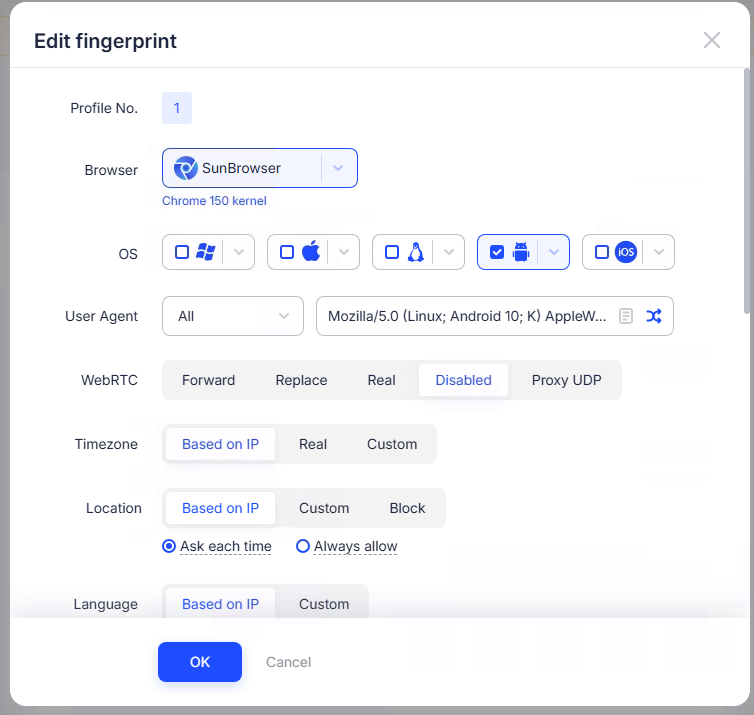
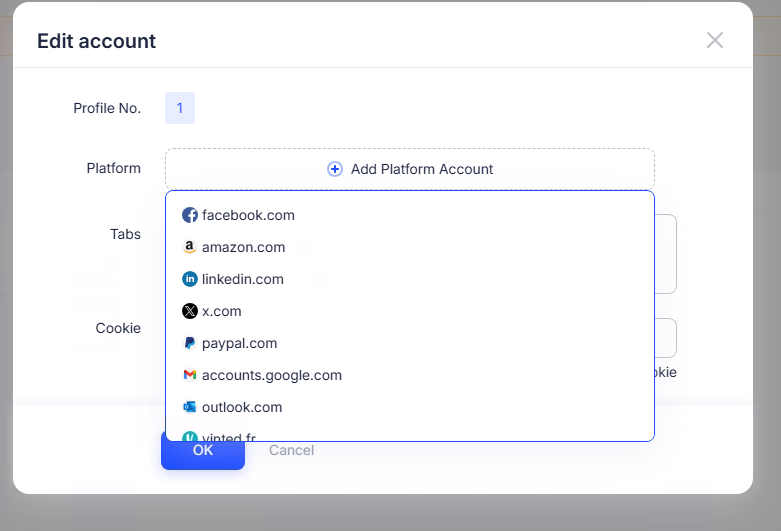
    • Antidetect browsers obscure the digital identity of their users, enabling a single operator to silently manage thousands of isolated accounts across multiple platforms (including Facebook, TikTok, Instagram, and YouTube), while evading detection systems that look for scams and coordinated inauthentic behavior.
    • Threat actors abuse these platforms, taking over accounts and using them for financial fraud, phishing and malware distribution. These accounts can also be used to coordinate influence operations, which becomes an even greater concern ahead of elections.
    • Social platforms primarily detect coordinated activity at the account and behavioral layer. Antidetect browsers run below the surface enabling them to remain undetected.
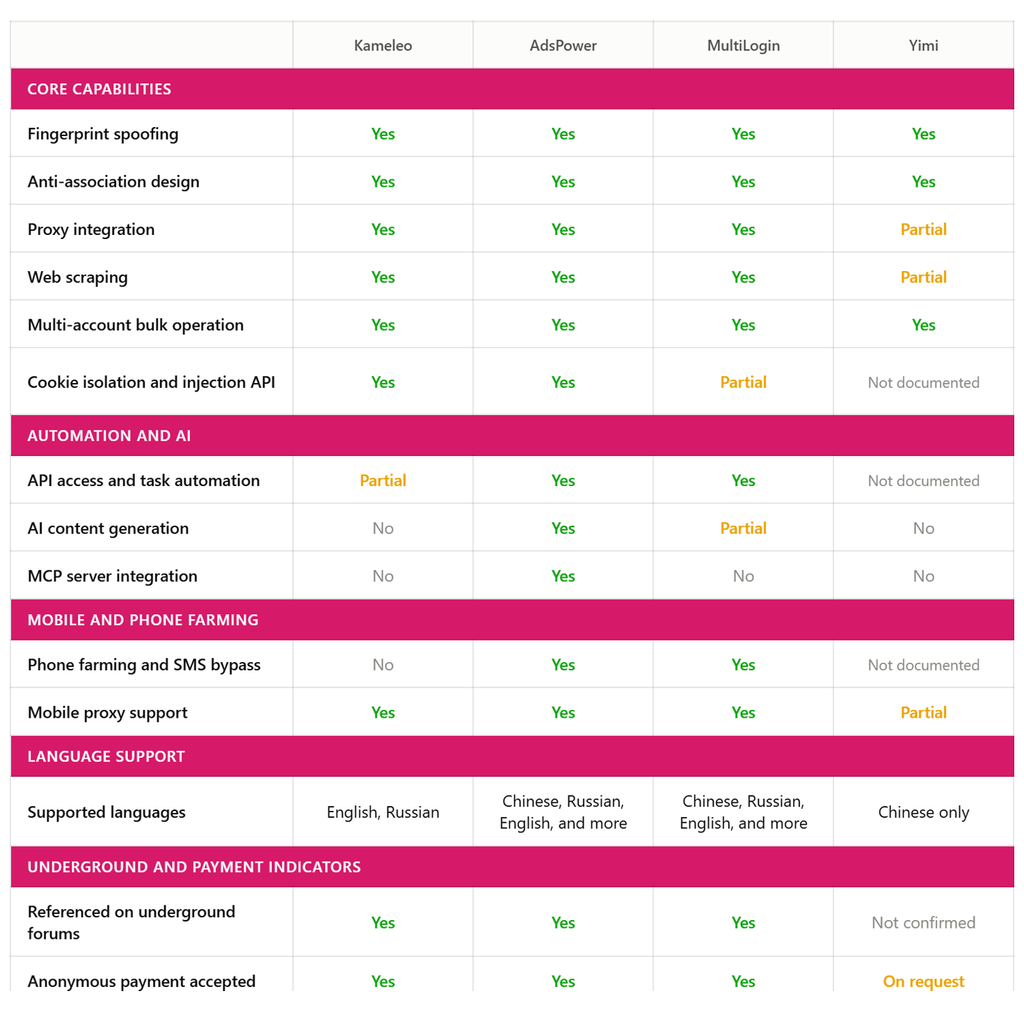
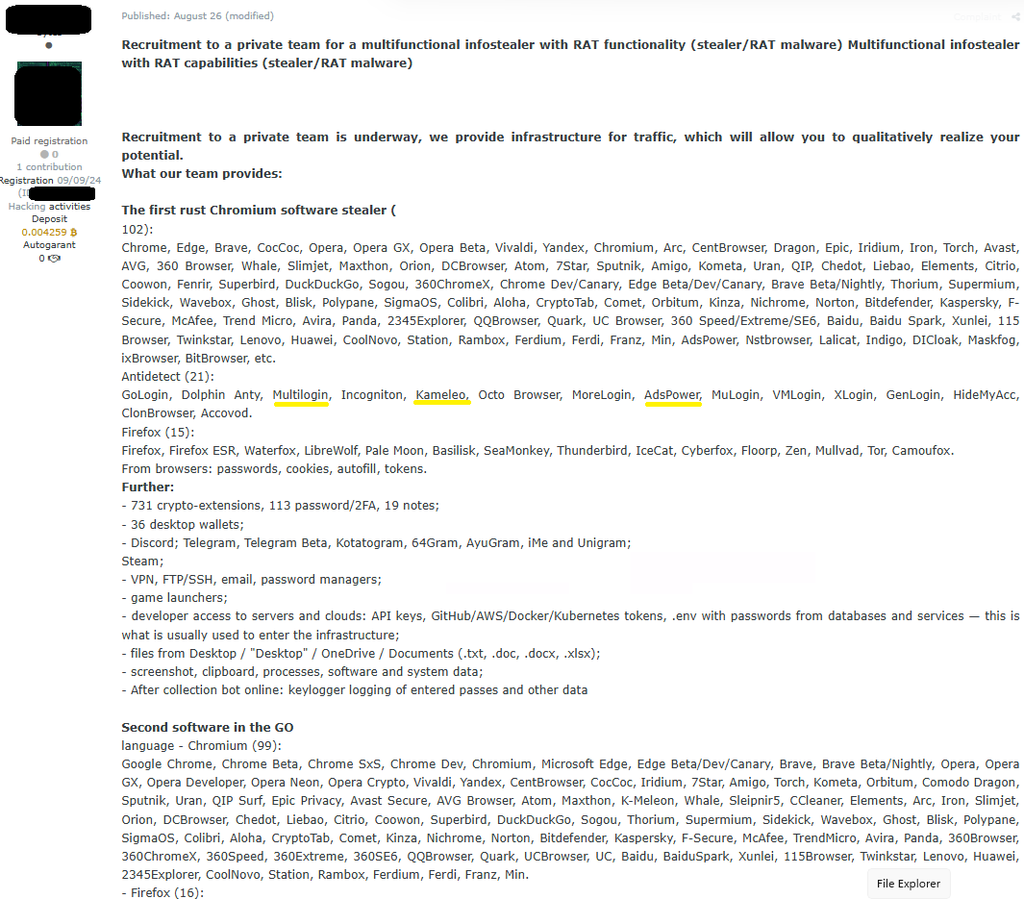
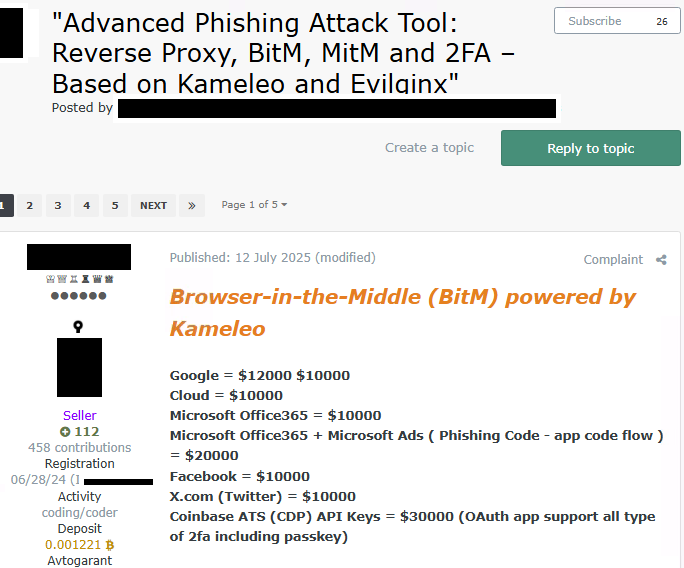
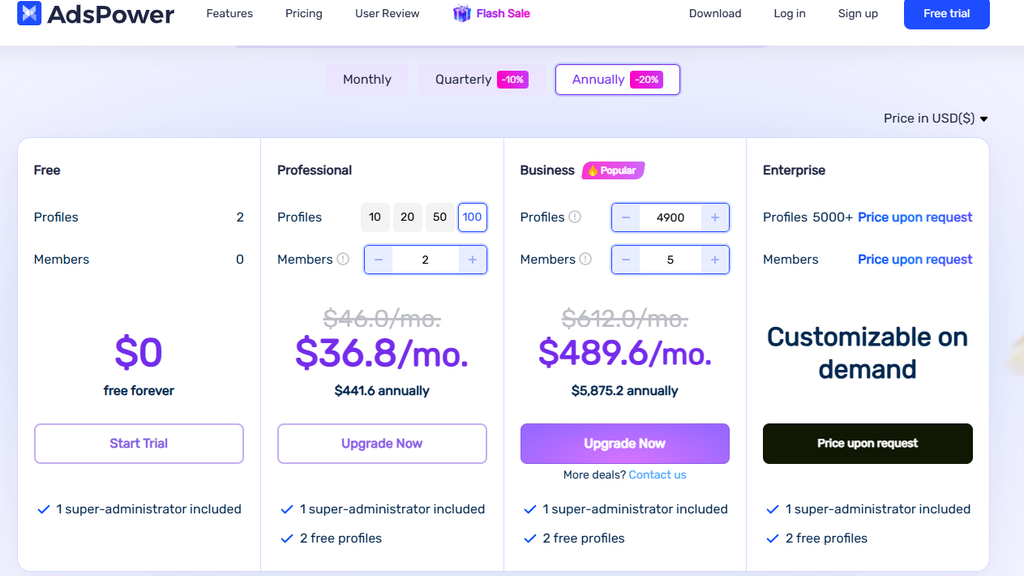
    • The three main antidetect browsers we discuss in this report are Kameleo, AdsPower, and MultiLogin.
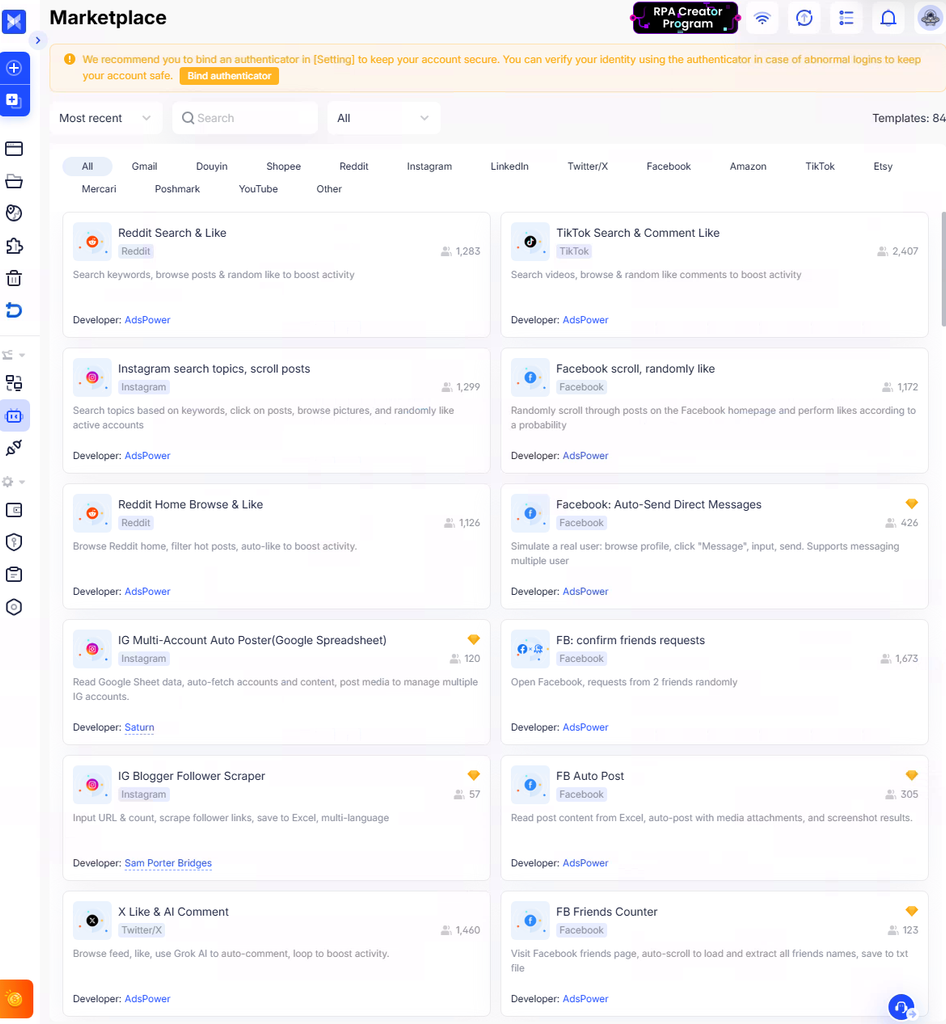
    • These tools already use AI integration, from built-in automation templates to offering a dedicated MCP server that pipes LLM-generated content directly into pre-warmed account profiles at machine speed. Running a large-scale social media operation now requires only a credit card instead of a technical team.

    Introduction

    Antidetect browsers conceal their users’ digital identities, enabling a single operator or small team to simultaneously run thousands of isolated accounts across multiple platforms such as Facebook, Instagram, TikTok, YouTube, Twitter/X, Discord, LinkedIn, Reddit, and many more, without triggering the detection systems employed by those platforms.

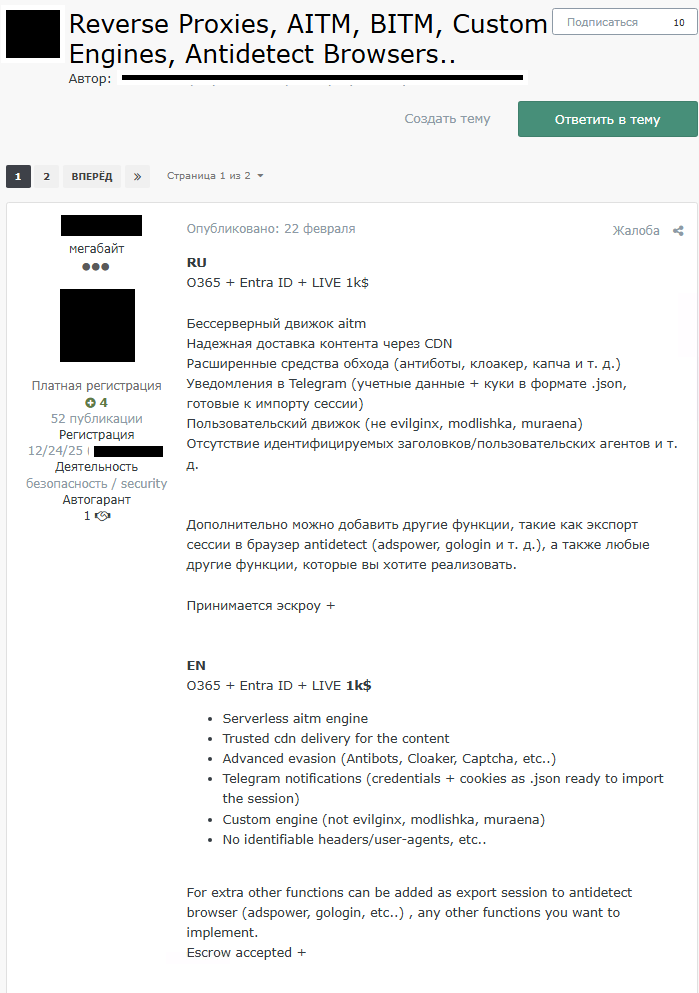
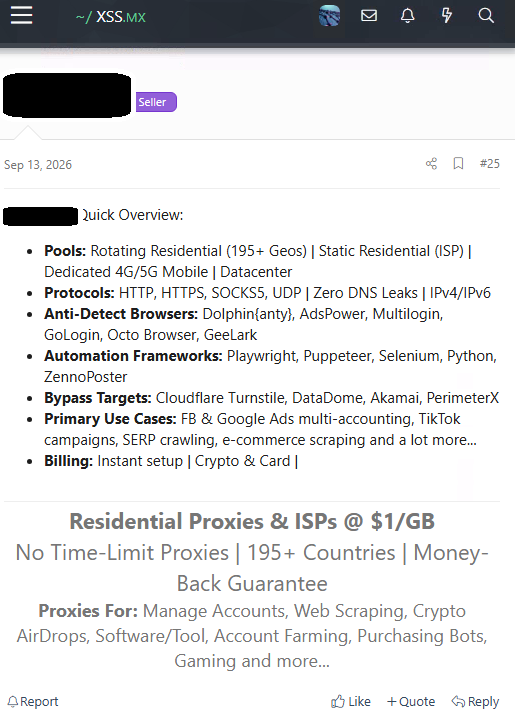
    In this report, we highlight three main tools: Kameleo, AdsPower, and MultiLogin. We selected these specifically on the basis of documented references across underground forums and criminal marketplaces, indicating active adoption beyond their stated commercial purposes. Confirmed use cases include:

    • Account takeover operations in which session cookies harvested by infostealer malware are injected into clean browser profiles to assume control of banking accounts and cryptocurrency wallets without triggering authentication alerts.
    • Carding operations in which stolen payment credentials are tested across e-commerce platforms under the guise of distinct legitimate users.
    • Fraudulent loan applications submitted under fabricated identities.
    • Bulk creation of artificial accounts used to generate fraudulent advertising revenue at scale.

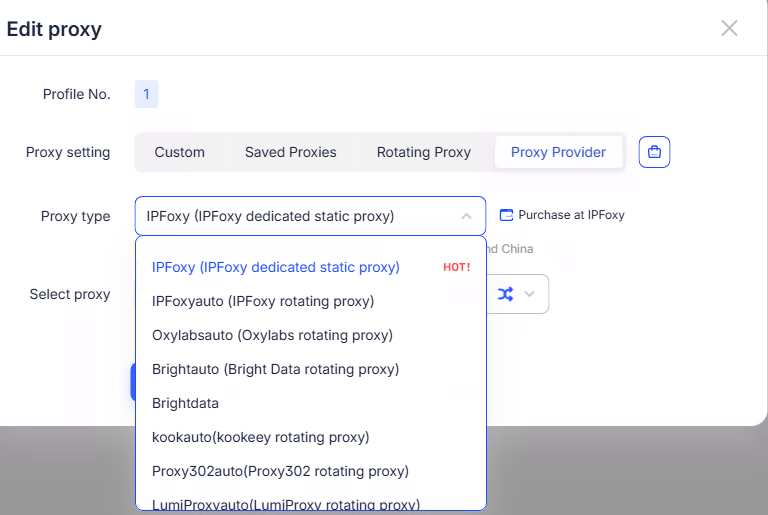
    As documented in Anthropic’s September 2026 Threat Intelligence Report, attackers used antidetect browsers in a fraud campaign that targeted cryptocurrency exchanges and financial marketplaces. They combined antidetect browser profiles, residential proxies, automated CAPTCHA-solving, and identity-verification bypass tools to create large numbers of verified accounts while avoiding onboarding security checks. These accounts were later used in fraud operations.

    The risk posed by antidetect browsers is greater because these accounts pass KYC verification, build legitimate activity histories, and appear benign during transactions. As a result, fraud detection systems that rely on user behavior or device identity often cannot identify these accounts as suspicious until after fraudulent activity has already occurred.

    The antidetect browsers documented in this research are commercially available, legally registered platforms with documented legitimate use cases in digital marketing, e-commerce, and privacy protection. When deployed by threat actors, the same infrastructure that enables financial fraud at scale is equally applicable to Coordinated Inauthentic Behavior (CIB), the term used to describe organized manipulation campaigns in which false identities are central to the operation and adversarial methods are used to evade detection.

    Meta’s most recent transparency reporting explicitly flagged this as a growing concern, with Russia, Iran, and China identified as the three leading sources of such activity globally.

    The Identity Obfuscation Stack – How antidetect browsers defeat social media platform detection at every layer

    Figure 1 – The five layers through which antidetect browsers defeat platform detection methods.

    While antidetect browsers are not a new phenomenon, their threat potential has increased with the integration of AI. Previously, their operational impact was constrained by the manual effort required to run and maintain large account networks at scale. AI-assisted content generation, automated persona management, and machine-speed distribution pipelines now enables a single actor with a subscription and a prompt to do the work of a coordinated team.

    In the following sections, we provide a technical breakdown of each tool, examining capabilities documented on their own platforms, underground forum references, and the specific features that position them as an emerging threat.

    Figure 2 – Comparison of popular antidetect tools.

    Defeating Platform Detection: The Identity Layer No Platform Can See

    Companies like Meta, TikTok, and Google have spent billions of dollars building behavioral and identity detection systems to identify abuse of their platforms for scams, financial fraud, and coordinated inauthentic activity. Antidetect browsers are engineered to defeat every signal on which those systems rely.

    Every antidetect browser uses fingerprint spoofing. When a browser connects to a website, it exposes dozens of identifying parameters that the website can collect to build a browser fingerprint, including canvas rendering output, WebGL vendor and renderer strings, font enumeration behavior, screen resolution, time zone, user agent, and hardware identifiers. Platforms cross-reference these signals to determine whether two accounts originate from the same device. Antidetect browsers intercept and fabricate each of these parameters individually, assigning a unique combination to every profile.

    The criminal ecosystem surrounding these tools extends well beyond their commercial vendors. As seen in Figure 3, a threat actor on a Russian-language underground forum advertised an AiTM engine as a commercial service, with built-in functionality to export harvested session credentials directly into antidetect browsers. The post confirms that the pipeline from credential harvesting to antidetect-assisted account takeover is a documented, commercially available and actively traded workflow with dedicated tooling, published instructions, and an active buyer community.

    Figure 3 – An AiTM engine advertised as a commercial service on a Russian-language underground forum, with built-in functionality to export harvested session credentials directly into antidetect browsers.

    Kameleo

    Modifying browser engines at the source level rather than applying surface overrides, Kameleo produces fingerprints drawn from real device signatures, making them significantly harder to flag as anomalous. Its adoption within criminal ecosystems is evidenced by its repeated appearance across the most active Russian-language hacking forums. As seen in Figure 4, Kameleo is listed alongside other antidetect browsers in a post by a proxy seller on an underground forum, advertising residential proxy services explicitly marketed for account farming, CAPTCHA bypass, and shield evasion against security systems including DataDome, the same platform for which Kameleo’s own blog publishes dedicated bypass guides.

    Figure 4 – A proxy seller on an underground forum listing Kameleo as part of a complete operational stack. The service is explicitly marketed for account farming and bulk account management.

    Kameleo’s engineering team published a guide detailing how to automate Facebook likes across multiple accounts simultaneously using precisely this fingerprint manipulation. As seen in Figure 5, evading platform detection is not a side effect but the tool’s primary operational value.

    Figure 5 – Kameleo’s guide on how to automate Facebook likes across multiple accounts simultaneously using browser fingerprint manipulation.

    Beyond fingerprinting, Kameleo suppresses WebRTC, a protocol that can leak a device’s real IP address even when a proxy is active, and provides explicit configuration options to prevent non-proxied UDP connections. The documentation frames this not as a privacy feature but as a counter to a known de-anonymization vector used by platform security teams.

    At the session layer, Kameleo’s dedicated cookie injection API accepts complete cookie objects including session IDs, refresh tokens, and authentication flags, allowing a pre-authenticated session state to be inserted into a profile before it is launched. The platform sees the profile as an already-authenticated user, with no login event occurring to trigger anomaly detection. As independently documented by threat intelligence research and confirmed by security researchers, this workflow is established and active in the criminal ecosystem. Figure 6 shows a recruitment post on a Russian-language underground forum advertising a multifunctional infostealer with RAT capabilities explicitly designed to operate within antidetect browser environments, listing Kameleo, AdsPower, and MultiLogin among 21 compatible platforms capable of harvesting session cookies, authentication tokens, cryptocurrency wallets, API keys, and 2FA credentials.
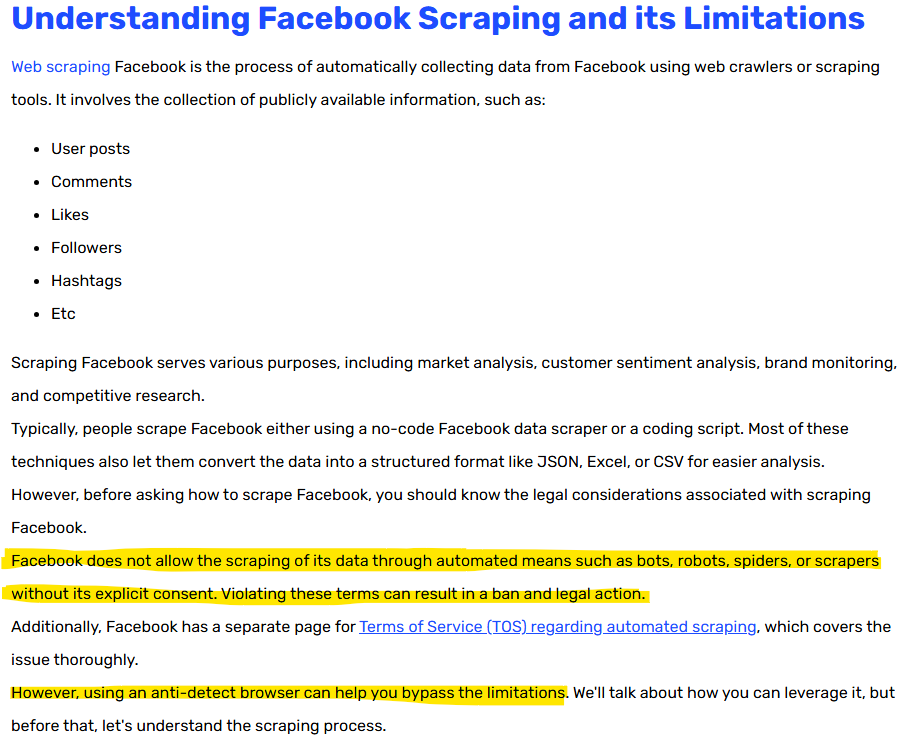
    Figure 6 – A recruitment post on a Russian-language underground forum lists 21 browsers including Kameleo, AdsPower, and MultiLogin as compatible platforms.
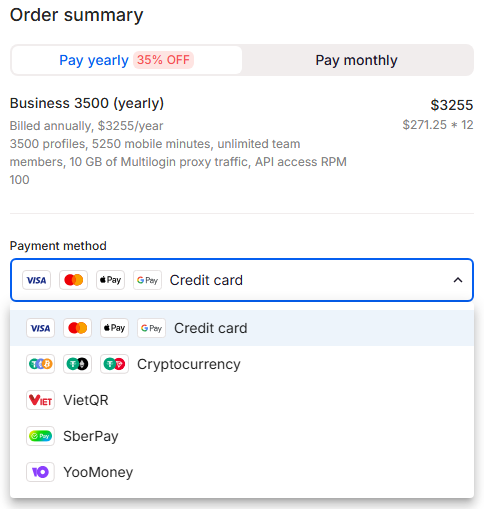
    As seen in Figure 7, a threat actor on a Russian-language underground hacking forum explicitly introduces Kameleo as a component of Browser-in-the-Middle phishing kits targeting credentials across Google, Microsoft, Facebook, and financial platforms. In a Browser-in-the-Middle attack, the phishing server instructs the antidetect browser to create a new profile for the victim, assigned a residential proxy in their country and a clean device fingerprint. The victim’s credentials, entered on the phishing page, are passed in real time into the real login page of the target service through an automation framework. The target platform sees a login attempt from a consistent, locally coherent device with a residential IP address in the expected country, none of the signals that would trigger a security challenge or step-up authentication.

    Figure 7 – A post on a Russian-language underground hacking forum introducing Kameleo as a component of Browser-in-the-Middle phishing kits targeting credentials across Google, Microsoft, Facebook, and financial platforms.

    AdsPower

    Chinese in origin and subsequently registered across multiple jurisdictions and localized into more than 20 languages, AdsPower applies fingerprint spoofing logic across more than 20 configurable parameters per profile and advertises a 99.2% ban avoidance rate. As seen in Figure 8, its proxy editor provides a built-in catalog of compatible third-party residential and rotating proxy providers, assignable directly within the profile creation interface. Figure 9 illustrates the granularity of fingerprint control available, with each profile’s WebRTC handling, time zone, geolocation, and language individually configurable to ensure the synthetic identity is consistent across every detectable signal.

    Figure 8 – AdsPower’s proxy integration interface lists compatible third-party residential and rotating proxy providers available within the platform.

    Figure 9 – AdsPower’s fingerprint editor displaying granular per-profile identity parameters including WebRTC, timezone and location derived from the assigned proxy IP.

    The scale of AdsPower’s intended use is reflected in its pricing structure, with published tiers supporting up to 5,000 distinct profiles as seen in Figure 10, and enterprise arrangements available on request. As seen in Figure 11, its account editor supports platforms spanning social media, e-commerce, financial services, and professional networks including Facebook, Amazon, LinkedIn, X, PayPal, and Google.

    Figure 10 – AdsPower’s pricing table reflects the intended operational scale, with enterprise tiers supporting more than 5,000 profiles available upon request.

    Figure 11 – AdsPower’s account editor shows supported platforms available for bulk profile management, including Facebook, Amazon, LinkedIn, X, PayPal, and Google.

    Scalability is further addressed through a built-in RPA engine and a dedicated Marketplace, as seen in Figure 12, offering pre-built templates for automated liking, commenting, direct messaging, follower scraping, and AI-assisted engagement across hundreds of profiles simultaneously. The multi-window synchronizer replicates identical actions across hundreds of profiles from a single input, while account warming automation builds synthetic activity histories over weeks to reduce platform suspicion before deployment.

    Figure 12 – AdsPower’s RPA Marketplace lists pre-built automation templates for bulk account activity across major platforms, including automated liking, commenting, direct messaging, follower scraping, and AI-assisted engagement.

    On the AI front, AdsPower advertises a dedicated Model Context Protocol server enabling direct integration with large language model workflows, creating a pipeline in which AI-generated content can be produced, injected into pre-warmed account profiles, and distributed across platforms in a fully automated sequence requiring no human involvement. A companion feature, the Cookie Robot, automates cookie warming on TikTok and Twitter/X accounts prior to operational use. The RPA Marketplace is the delivery mechanism for this pipeline, with ready-to-deploy workflows designed to operate in direct combination with AI-generated content, resulting in an end-to-end operation at a scale and speed previously associated only with state-sponsored actors.

    As seen in Figure 13, AdsPower’s own published scraping guide explicitly acknowledges that scraping Facebook constitutes a violation of the platform’s terms of service and may result in legal action, before advising users that an antidetect browser can help bypass these limitations.

    Figure 13 – AdsPower’s official scraping guide advises users that an antidetect browser can help bypass scraping limitations.

    MultiLogin

    MultiLogin operates as a fully featured antidetect browser platform, offering isolated browser profiles with unique device fingerprints covering canvas output, WebGL parameters, fonts, timezone, screen resolution, and user agent, with each profile maintaining separate cookies, local storage, and session data. The platform supports automation through Selenium, Playwright, and Puppeteer, enabling fully scripted, headless operation of multiple profiles simultaneously. MultiLogin has been referenced on Exploit, a Russian-language underground hacking forum, in a thread dedicated to antidetect browsers, indicating active discussion and adoption of the platform within criminal communities (see Figure 6).

    MultiLogin extends its multi-account capability into the mobile layer through a phone farming infrastructure that replaces physical Android devices with cloud-hosted equivalents. Every cloud Android profile maintains its own persistent mobile device parameters, with proxies assigned per profile to control location and network identity. MultiLogin’s own documentation states that most account bans in phone farm environments occur due to multiple accounts sharing the same device signals, storage, or network patterns, and positions its product as the solution to this detection problem, an explicit acknowledgment that the platform is designed to defeat association detection at the mobile layer.

    According to their website, virtual phone number provisioning through partner integrations enables SMS-based account verification without physical SIM cards or mobile devices. Each virtual number is paired with a mobile device fingerprint profile, enabling the rapid creation of large volumes of accounts that appear to originate from distinct mobile devices across different geographic locations.

    MultiLogin maintains a dedicated web scraping solution page and publishes operational guides for scraping platforms including Facebook, LinkedIn, Amazon, and Twitter, with its built-in residential proxy infrastructure marketed as enabling scraping operations that bypass bot detection and IP-based rate limiting. Its stated use cases listed on its own website include ticket scalping automation, a practice explicitly illegal in multiple jurisdictions and prohibited by major ticketing platforms, with the platform’s infrastructure documented as tested daily against major ticketing services for compatibility. MultiLogin additionally lists AI Quick Actions Automation among its documented product capabilities, indicating a degree of AI integration into its operational workflow.

    As seen in Figure 14, MultiLogin’s payment infrastructure accepts cryptocurrency alongside credit card payments and regional systems including SberPay and YooMoney. Notably, YooMoney has been designated on the OFAC Specially Designated Nationals list since April 2022 under Executive Order 14024 as a Sberbank subsidiary, and SberPay operates as a product of Sberbank, itself under comprehensive OFAC blocking sanctions since February 2022. The acceptance of these payment methods, alongside cryptocurrency, enables anonymous and potentially sanctions-non-compliant transactions. MultiLogin offers 24/7 support through dedicated Telegram channels staffed by human representatives and is tested daily against more than 50 major social media platforms to ensure continued compatibility. Taken together, MultiLogin’s mobile infrastructure, AI automation layer, scraping capabilities, criminal community presence, and payment infrastructure make it one of the most operationally complete platforms in this category.

    Figure 14 – MultiLogin’s payment infrastructure accepts a variety of different payment services.

    AI-Powered Campaign Infrastructure

    The most consequential recent development is AI integration directly into the operational stack. AdsPower advertises a dedicated Model Context Protocol server enabling direct integration with large language model workflows, creating a pipeline in which AI-generated content can be produced, injected into pre-warmed account profiles, and distributed across platforms in a fully automated sequence requiring no human involvement. A companion feature, the Cookie Robot, automates cookie warming on TikTok and Twitter/X accounts prior to operational use, simulating browsing behavior to establish account credibility before the content distribution phase begins.

    The RPA Marketplace mentioned in the previous section is the delivery mechanism for this pipeline. Available templates contain ready-to-deploy workflows maintained and updated by the vendor, designed to operate in direct combination with AI-generated content. This creates an end-to-end influence operation pipeline that requires no active operator presence once the campaign is initiated. The result is a single automated workflow that places coordinated influence operation capacity within reach of any sufficiently motivated actor, regardless of resources or technical expertise.

    Web Scraping as Operational Intelligence

    The web scraping capabilities documented across these platforms serve a function that extends well beyond data collection. Scraped data is the intelligence layer that makes the operation more precise. Several of the tools we reviewed maintain dedicated scraping solution pages describing capabilities including fingerprint rotation, CAPTCHA bypass, and headless browsing designed to extract data from platforms including LinkedIn, Amazon, Facebook, and Twitter while evading their anti-scraping defenses. As seen in Figure 13, the AdsPower published scraping guide explicitly acknowledges that scraping Facebook constitutes a violation of the platform’s terms of service and may result in legal action, before advising users that an antidetect browser can help bypass these limitations.

    The combination of well-farmed personas and targeted scraping capabilities enables a precision influence operation at scale.

    Workflow:

    1. An artificial account, warmed up over several weeks of simulated activity, accumulates sufficient credibility to be accepted into a closed group on a social media platform.
    2. Once inside, the platform’s scraping infrastructure extracts available information on every member, including names, profile data, religious affiliations, political interests, age, geographic markers, and engagement patterns.
    3. The harvested dataset becomes the targeting intelligence for a bulk coordinated campaign, allowing artificial personas to engage each member with content calibrated to their specific profile, amplify narratives that resonate with the group’s demonstrated interests, and simulate the kind of peer validation that drives genuine behavioral change.

    A Sophisticated and Professionally Maintained Ecosystem

    The commercial availability of these tools reflects a fundamental shift in the influence-operation threat landscape: what was once the domain of well-resourced state actors and advanced persistent threat groups is now accessible to any motivated individual with a credit card. These are all professionally maintained, customer-supported, multilingual software platforms with pricing pages, knowledge bases, release notes, and dedicated sales teams. The only barrier to running a large-scale coordinated inauthentic operation is not a user’s technical sophistication but the need to pay a subscription fee.

    The language coverage and market reach of these tools reflects the scale of their intended user base. AdsPower is available in 20 languages. MultiLogin supports English, Chinese, Russian, Vietnamese, and Portuguese, and is tested daily against more than 50 platforms. Kameleo maintains a public blog catalog of dedicated technical guides on bypassing Cloudflare bot detection, defeating DataDome, and solving Cloudflare Turnstile challenges, which are all security systems deployed specifically to identify and block automated or inauthentic browser sessions.

    The customer support infrastructure surrounding these tools mirrors that of legitimate enterprise software, with MultiLogin offering 24/7 support through dedicated Telegram channels staffed by human representatives. As seen in Figure 14, MultiLogin’s payment infrastructure accepts cryptocurrency alongside credit card payments and regional systems including SberPay and YooMoney, both Russian payment services.

    As seen in Figure 15, independent threat actors have developed and are actively selling purpose-built antidetect solutions on underground forums, complete with feature documentation, technical support, and monthly subscription pricing. This particular tool targets Android devices specifically, offering automated geolocation spoofing, device ID replacement, Wi-Fi environment manipulation, and Play Integrity bypass at 100 USD per month, reflecting the breadth of threat actor demand across different device categories and operational requirements.

    As seen in Figure 16, the downstream commercial activity built on this infrastructure extends to farmed platform accounts advertised for sale on underground forums alongside explicit instructions to access them using antidetect browsers. Cryptocurrency is the default payment method. These posts confirm a mature commercial underground market in which these antidetect tools function as the operational backbone of a broader fraud and influence ecosystem.

    Figure 15 – An antidetect tool designed for Android devices advertised on an underground forum, offers automated geolocation spoofing, device ID replacement, and Play Integrity bypass at 100 USD per month.

    Figure 16 – Farmed Google Ads accounts advertised for sale on an underground forum.

    Conclusion

    The antidetect browser ecosystem represents a sophisticated, commercially mature, and increasingly AI-driven infrastructure that has fundamentally lowered the barrier to running scam and fraud operations, as well as coordinated inauthentic operations at scale. These commercially maintained tools are available in dozens of languages, backed by customer support teams, tested daily against the world’s largest social media platforms, and are now integrated with LLM pipelines that remove the human operator from the execution layer. The coupling of identity spoofing infrastructure, automated content distribution, and AI-assisted persona management represents a threat surface that platform detection systems may struggle to address, particularly in the context of elections taking place across multiple countries.

    The infrastructure we documented is commercially available today. Its capabilities are not constrained by technical sophistication, national resources, or operational scale. The question is no longer whether these tools are being actively used for fraud, account takeover, and coordinated manipulation, but whether the detection, enforcement, and awareness frameworks across every layer of the ecosystem are prepared to counter them.

    Recommendations

    Security and threat intelligence teams:

    • The detection priority should shift from the account and behavioral layer, where these tools are already designed to appear invisible, to the network and infrastructure layer.
    • Indicators include residential proxy infrastructure operating at scale, WebRTC suppression patterns, anomalous cookie injection sequences, and known antidetect browser user agent strings in web traffic logs.
    • Account warming patterns, simulated by these tools over several weeks, may be indistinguishable from legitimate organic behavior without cross-referencing device fingerprint consistency over time.

    Social media platforms:

    • Antidetectbrowser infrastructure should be treated as a first-class priority.
    • The capabilities operate below existing detection thresholds, and infrastructure-layer signals may be the only reliable detection surface available.
    • Platforms should consider actively acquiring and reverse engineering antidetect tools to map their proxy patterns, fingerprint rotation behaviors, and detection bypass mechanisms, and use those findings to recalibrate banning logic specifically against these tools’ TTPs.

    CISOs and companies:

    • The risk posed by antidetect browser infrastructure extends well beyond influence operations.
    • Silent account takeover using cookie injection workflows can bypass multi-factor authentication without generating a login event.
    • Organizations are advised to review whether their session monitoring infrastructure can detect pre-authenticated session anomalies, and to incorporate antidetect-specific attack scenarios into red team exercises and threat models.
    • Threat actors can leverage antidetect browsers to replicate victim device fingerprints and geolocation to execute unauthorized transactions without triggering behavioral anomaly detection.
    • Fraud detection systems that rely on device consistency and session continuity signals should be specifically reviewed for resilience against fingerprint spoofing and session injection at the identity infrastructure layer.

    Source: Check Point Research · 2026-10-20

  • Possible new Cellebrite iPhone Radio Zero-Day

    Justin.sh is reporting on a confidential Cellebrite document that has been leaked to him:

    Cellebrite calls it Advanced Unlocks (AU from here on), not to be confused with the “advanced unlocking services” they’ve marketed for years. A press release from earlier this year confirms AU is a new product for 2026.

    […]

    According to Cellebrite, AU:

    • is a “next-generation AFU vector that is more resilient to Apple’s OS changes”
    • works with Stolen Device Protection enabled, which tightens USB restrictions
    • is enabled by a dedicated appliance with a stated range (!) of about 8 meters.

    AU = Advanced Unlocks, Cellebrite’s term. AFU = after first unlock.

    Source: Schneier on Security · 2026-10-20