Threat intelligence analysts now observe large-scale evidence of exploitation of the two critical PHP vulnerabilities
Source: Infosecurity Magazine · 2026-10-22
Threat intelligence analysts now observe large-scale evidence of exploitation of the two critical PHP vulnerabilities
Source: Infosecurity Magazine · 2026-10-22
ESET researchers uncover MythicRatatoskr – a previously unknown Go-based backdoor hiding its C&C server inside the Yggdrasil mesh network – that paved the way for a destructive attack against a Ukrainian grain firm
Source: WeLiveSecurity (ESET) · 2026-10-22
Nearly all organizations now run production workloads in the cloud, but a new SANS survey found most have yet to achieve mature cloud security programs
Source: Infosecurity Magazine · 2026-10-22


Back in October 2022, Kaspersky GReAT was looking into a peculiar advertisement on a hacking forum. A cybercriminal had been advertising a UEFI bootkit, dubbed BlackLotus, that could bypass Secure Boot, for $5,000. Given the low price for such powerful capabilities, the cybersecurity community initially took this advertisement with a grain of salt. As no BlackLotus samples were found in the wild, no one could at the time verify the claims made in the forum post.
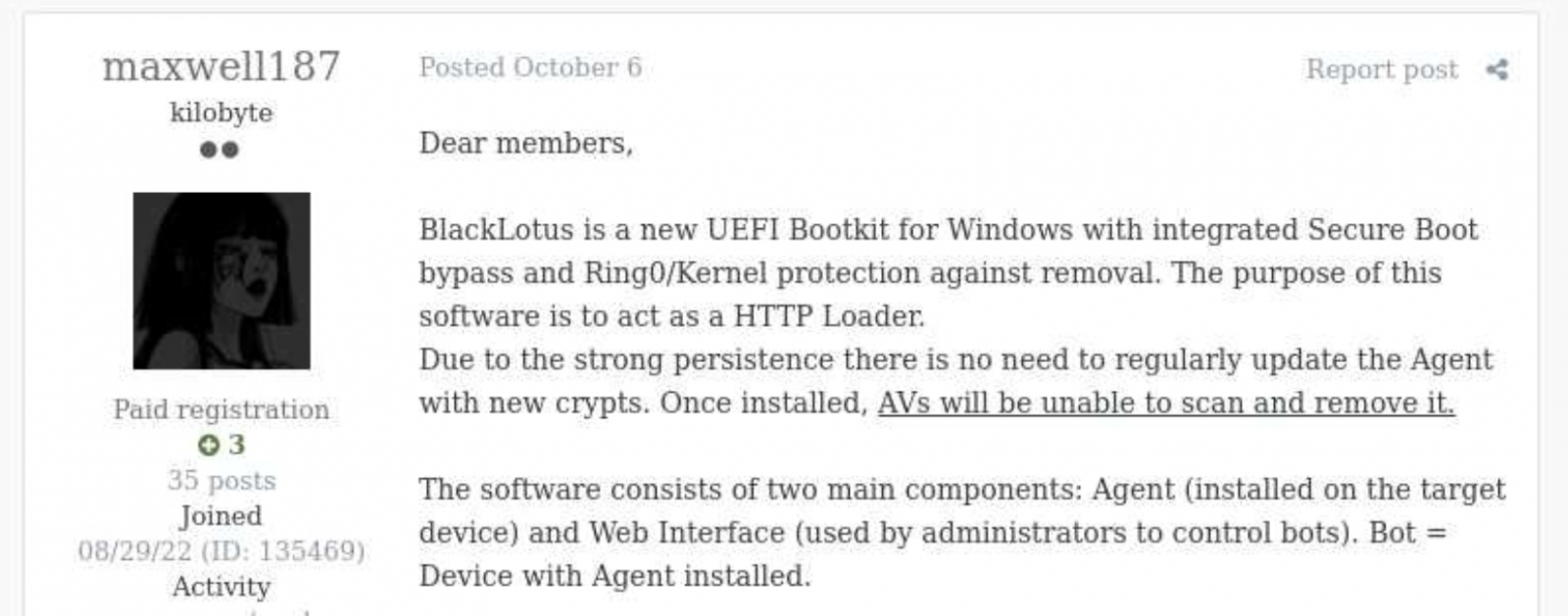
BlackLotus advertisement
However, about half a year later, in March 2023, ESET confirmed that the BlackLotus advertisement was genuine. The researchers tracked down samples of this bootkit and confirmed that it can indeed bypass Secure Boot through a vulnerability called Baton Drop (CVE-2022-21894). As this vulnerability was still exploitable in 2023, Microsoft had to release multiple security updates to address it.
Since the release of these updates, the BlackLotus bootkit has gone quiet — no publicly known attacks have used it. Yet in early 2026, we discovered a malware sample similar to BlackLotus that was used in an APT campaign in Central Asia. In this report, we share our findings, including new payloads and possible attribution of this campaign.
In early 2026 we identified a complex APT attack targeting diplomatic agencies in Central Asian countries — namely Tajikistan, Uzbekistan, and Turkmenistan. This attack involved a UEFI bootkit that we dubbed BlackX. Having examined it, we found it to be similar to BlackLotus.
Attackers have been deploying BlackX after compromising the victim machine networks and obtaining administrator privileges. To install the bootkit, we observed them dropping the following files:
inst.exe, an installer executablePVMDIJGKAX2, an RC4-encrypted extensionless file containing files and strings required for the installationThe installer was launched with the command line C:\ProgramData\Intel\inst.exe PVMDIJGKAX2 Q46F6MDLI3RX2KV1. The last argument here is the RC4 key used for decryption.
Curiously, the file inst.exe does not contain any malicious strings or embedded blobs. All the files needed to install the malicious payload are inside PVMDIJGKAX2, which makes it harder for incident responders to retrieve the bootkit components.
The installer package drops a set of files to both system and UEFI partitions, designed to exploit the Baton Drop vulnerability. We noted that the implementation of the exploit is remarkably similar to the one used in the BlackLotus malware. As with BlackLotus, the goal of the exploit is to install custom Machine Owner Keys (MOK), which allows loading arbitrary EFI files on the target machines to manipulate Secure Boot.
While the vulnerability exploitation chain was implemented very similarly to BlackLotus, we spotted differences between the exploits in BlackLotus and BlackX. That said, the source code of the BlackLotus bootkit has never been published online. This could mean that the attackers behind BlackX either reverse-engineered the BlackLotus bootkit or purchased its source code from cybercriminals. Either way, this is an interesting observation, as we rarely see APT actors borrow ideas or code from cybercrime actors.
The UEFI payload delivered during the Baton Drop exploitation has a classic bootkit goal — to inject a malicious driver into the Windows kernel. This driver differs from the one deployed by BlackLotus and is signed with a certificate belonging to an organization named 温江区明宇网络技术服务工作室 (English: Wenjiang District Mingyu Network Technology Service Studio). At the time of writing, this certificate (serial number: 0bcdf5e0da32d68900b8b7638459d072) has been revoked by its issuer.
The driver aims to tamper with security solutions installed on the machine. For example, it disables process, thread, and registry callbacks related to security solutions. It also tampers with ETW providers so that security solutions cannot access their output. Curiously, some of the tampering procedures are designed to run only if Kaspersky or Avast solutions are installed on the infected machine. However, during dynamic analysis of this driver, we found that these procedures are useless — they fail to interfere with Kaspersky products in any way.
The driver also protects the bootkit’s files from tampering. It intercepts kernel requests to open these files and returns a handle to calc.exe instead of a malicious file handle.
Apart from tampering with security solutions, the driver also deploys a user-mode payload. We observed two such payloads, used for cyberespionage, in the wild. One of them is a RAT that can load further-stage .NET payloads. This RAT uses cloud storage for C2 server communications — we observed its versions using Google Drive, OneDrive, and Yandex.Disk. Having connected to a cloud storage service, this RAT iterates over files available there and interprets them depending on the file suffix. Below is a list of supported suffixes:
| File suffix | Description | Type |
| 0X01 | A .NET file. The task is to parse it and run the method TEST.Class1.RunCMD(argument_array) from the module | Input |
| 0X02 | Result of the call TEST.Class1.RunCMD(argument_array) | Output |
| 0X03 | Task to upload a file to the drive | Input |
| 0X04 | Uploaded file | Output |
| 0X05 | Task to download a file to an infected machine | Input |
| 0X06 | File download status | Output |
| SSSR | Contains initial system info | Output |
We also observed another payload delivered through the bootkit, which we dubbed OxiDLLRunner. It is a malicious DLL obfuscated with OLLVM. It is loaded by the legitimate file googleupdate.exe (original filename: jcef_helper.exe, MD5: AF8A983B9ADA07EAE1259BF2953ABD40), which is also delivered by the bootkit. The DLL decrypts the contents of the file v8_context_snapshot.bin, which resides in the same folder, and then jumps to the beginning of the decrypted content. The decrypted data starts with shellcode followed by a PE file, which is a Rust payload designed to communicate with the www[.]archivetj[.]com C2 server. During communication, this payload is supposed to receive DLL files exporting a function named create_plugin, which are then executed in separate threads.
Based on the following facts, we have attributed this attack to the APT41 threat actor with medium confidence:
During our initial analysis of BlackX, we thought that attackers succeeded in deploying it due to the negligence of the target organizations. Baton Drop, the vulnerability used to deploy BlackX, was disclosed back in 2023 and was patched, so we first thought that the infected machines lacked the relevant updates. However, our investigation proved this wrong — the targeted machines were fully patched.
Instead, we found out that the problem was with the patch itself. As it turned out, the patch for the Baton Drop vulnerability is designed to revoke the “Windows Production PCA 2011” certificate used to sign vulnerable UEFI components. However, this revocation does not happen automatically upon patch installation — the user has to trigger it manually. This is done with the following steps:
This patch is designed to be applied manually — for instance, applying it automatically could break dual-boot systems relying on the “Windows Production PCA 2011” certificate to load. At the same time, this patch deployment practice creates a problem — as it is extremely unusual for a system administrator to take extra steps after installing an update. Usually, when applying patches, system administrators take no further action unless an installation failure occurs. These instructions for activating the patch are buried deep on the Microsoft website, and we assess that they are quite hard for an average IT administrator to notice.
Curiously, Microsoft’s plan for deploying the Baton Drop patches mentions an “Enforcement Phase” that involves revoking the “Windows Production PCA 2011” certificate automatically, without user interaction. At the time of publishing this post, this stage has not been implemented. On October 19, 2026, this certificate expired, but this does not prevent the vulnerable binaries from loading unless the certificate is blocklisted.
It is likely that the threat actor behind this campaign took into account that few organizations realized the importance of manually activating the Baton Drop patch. As such, we believe they decided to invest time in understanding how BlackLotus works and creating a copycat of this bootkit.
Patch management is important for every organization, as updates from vendors help protect software and hardware against known vulnerabilities. However, sometimes installed patches fail to protect against the flaws they address. The BlackLotus story we described is not the only such example — for instance, in 2025 Microsoft released an update against the ToolShell vulnerability that also had to be applied manually.
However, modern security solutions are designed to account for such cases when installed patches fail to protect against security flaws for one reason or another. For instance, the Exploit Prevention component available in Kaspersky products prevents exploits from running if the patch is not applied, or if it is a zero-day vulnerability with no available patch. It is thus crucial to equip all machines in an organization with security solutions and constantly monitor the alerts they raise.
Source: Securelist (Kaspersky GReAT) · 2026-10-22

The United Arab Emirates says it’s creating a foundation of security and safety as it transforms its public service footprint.
Source: Dark Reading · 2026-10-22

Amazon Web Services logged attempts to leverage the internet-melting PHP2Shell bugs four days ago. They’re now being “broadly exploited” across the internet.
Source: WIRED Security · 2026-10-22
Imagine buying a brand new hardware wallet for your cryptocurrency with the shrink-wrap still on… what could possibly be hiding inside? We break out a Geiger counter and a cat to find out.
Meanwhile, malicious ads are targeting journalists with zero-click attacks.
Plus, Origin’s Spencer Thompson reveals what AI agents are really getting up to on your employees’ laptops when nobody’s looking.
All this and more in episode 489 of the “Smashing Security” podcast with cybersecurity expert and keynote speaker Graham Cluley, and special guest Lianne Potter.
Source: Graham Cluley · 2026-10-21

Cloud providers may be storing sensitive customer data, without either party knowing it. But when a provider is breached, the unseen information comes to light.
Source: Dark Reading · 2026-10-21
Cisco Talos is aware of eight compromised intermediate certificates belonging to the intermediate certificate authority, eMudhra. Rather than possessing the mandatory 384 bits of pseudo-random security, several private keys evaluated single-digit and double-digit integers. This misconfiguration allows an attacker with the private key of any of the compromised intermediate CAs to impersonate any website or service. Six of the TLS certificates, trusted by Chrome, Mozilla, and Apple have been blocked by these vendors already. Two other certificates, used for codesigning by Microsoft, have also been blocked. Talos expects there will be additional patches available across a variety of technologies as software applications work to remediate the certificates’ exposure.
Following the disclosure, eMudhra has revoked the compromised certificates and stopped issuing new certificates under its G3 root.
The cause of this issue, originated during an April 30, 2025 key generation activity conducted by eMudhra under its emSign Root TLS CA – G3 and cross-signed Comodo AAA Certificate Services. During a key generation ceremony for 24 subordinate CAs, a flaw in eMudhra’s key generation process created a second set of weak P-384 keys during a wrap/unwrap step. Those keys were mistakenly used for eight intermediate CA certificates. This flaw took the encryption from 384 bytes of entropy down to 3 – 8, making recovering the private keys trivial. The following are the impacted certificates, as illustrated in Mozilla’s bug report:
EM EV TLS CA - G3B (eMudhra BV), CCADB A012304
SHA-256 E7568FE6E12331F4FD7DE61DA4C7559D0F8EB192A218D4741A3BA75184333838
serial c7c41efe92d825f05eae841a4a82c1, issuer emSign Root TLS CA - G3

EM OV TLS CA - G3B (eMudhra BV), CCADB A012308
SHA-256 98B896625C0C230ADEEC3EB2CF6AAD5001ECF9156A68644E82374CE5833BC25B
serial 6cada367fb1c100088120ea202d568, issuer emSign Root TLS CA - G3

EM DV TLS CA - G3B (eMudhra BV), CCADB A012302
SHA-256 42C4ACCD12C4F59597925E1A08A7A90102608543809308D50EC427E118BA1493
serial a4aee678f23362b4c0e460b772f214, issuer emSign Root TLS CA - G3

EM EV TLS CA - G3C (eMudhra Inc), CCADB A012296
SHA-256 432EC25F0D28DE9006D97BF752F17BBB2CD41F669933FCB072D9A1148D0261F3
serial 8009928a64107601af05fa2f19f109, issuer emSign Root TLS CA - G3

EM OV TLS CA - G3C (eMudhra Inc), CCADB A012300
SHA-256 CB6E15165AC802E9B3F993F16C25D41F4E81C21EBDE71AE1B012AC00BF9C7C3F
serial 296926c227a3a1526392b19482a504, issuer emSign Root TLS CA - G3

EM DV TLS CA - G3C (eMudhra Inc), CCADB A012294
SHA-256 0164D7CEAE5BB909C272AF151FF44B1177AE9B47D9424B94F1D9558C30934D19
serial 588b2e3c2bb8cda13e1a1209254321, issuer emSign Root TLS CA - G3

EM OV CS CA - G3B (eMudhra BV), CCADB A012306
SHA-256 9E39DE2881273ACC225A149C72BA3E0F51424963669AB633EE1DC7DF5DB067B4
serial 7818933f8f85b4619a2b35fba83d0a, issuer emSign Root CS CA - G3

EM OV CS CA - G3C (eMudhra Inc), CCADB A012298
SHA-256 4B2460A466F95FD40113BCDCCA2CEB29B3B093921DE45474DA7DF48874C630B1
serial 544b7f922c31ae220a4a922916f6e6, issuer emSign Root CS CA - G3
Unlike languages that defer entirely to external dynamic system libraries (like OpenSSL), the Go programming runtime implements its own X.509 chain verification engine in the standard library (crypto/x509). While Go usually queries platform certificates, several platforms or static container environments rely on embedded or legacy root certificate pools where certificate revocations are ignored.
To eliminate exploitation across the entire cloud-native ecosystem including Docker, Kubernetes, Terraform, and Prometheus, the Go team designated the compromised certificates as a vulnerability, CVE-2026-111943, and released Go versions 1.27.3 and 1.26.10.
The fixed versions filter out chains containingthe SHA-256 hashes of the SubjectPublicKeyInfo (SPKI) for all eight compromised eMudhra intermediate certificates.
These compromised certificates could allow adversaries to impersonate servers and intercept or modify traffic. The impact of their exposure is far more than just web browsers. Other programs that check for TLS certificates might still be impacted since they may not check revocation lists. One clear example is related to virtual private networks (VPNs); these technologies will likely require software updates to mitigate the issue. Based on this guidance, Talos strongly recommends users update software using and handling TLS certificates as fixes become available.
Talos is actively monitoring the impact of these compromised certificates and has not seen any malicious incidents involving them in the wild yet (as of October 21, 2026 14:00 UTC / 10:00 a.m. ET).
Public key infrastructure relies on trust being delegated through certificate chains: root CAs authorize intermediate CAs, which can issue certificates within the scope of their authority. An attacker who obtains an intermediate CA’s private key may be able to issue fraudulent certificates that clients accept, subject to the intermediate certificate’s constraints and each client’s validation controls. In this incident, six compromised intermediates were for TLS and two were for code signing.
For TLS, an attacker able to intercept or redirect a connection could use a fraudulent certificate to impersonate a server and potentially read or modify traffic if the client still trusts the affected key and no applicable protection blocks it. Protections such as revocation, key distrust, certificate transparency enforcement, and certificate pinning can prevent or expose such an attack. Browser vendors have blocked the affected TLS keys, but other applications may rely on separate trust stores or validation paths:
Enterprise infrastructure and VPNs
Organizations should assess TLS-using software and appliances, including proxies, reverse load balancers, VPN clients, and gateways. Exposure depends on the certificate chain being validated and the trust store and revocation behavior in use. A stale or separately managed trust store may need an application, operating-system, firmware, or trust-bundle update; verify the required action for each product.
Software supply chains and CI/CD
Build runners and package managers may be exposed if they fetch content over TLS while still trusting an affected key and an attacker can intercept the connection. A fraudulent TLS certificate could enable registry impersonation, but it would not by itself bypass separate package integrity checks, such as lockfile hashes, checksums, signatures, or provenance controls. Assess the actual package-manager configuration and dependency path.
Industrial IoT and embedded systems
Review devices that use bundled or independently managed CA stores, especially where certificate revocation or trust-store updates may be limited. Some devices may require a vendor update or compensating control, but the necessary action depends on each device’s validation and update mechanisms.
Talos recommends updating affected software and trust stores as vendor fixes become available.
The following SNORT® SIDs provide coverage for this threat: 67363 – 67374.
Talos would like to highlight the efforts of Chris Morrison for providing emergency coverage and mitigations for this threat.
Source: Cisco Talos Intelligence · 2026-10-21

The effort is aimed at standardizing a NIST FIPS 140-3 Level 3 integrated HSM for cloud and hyperscale data center infrastructure.
Source: Dark Reading · 2026-10-21