Category: Security News

  • Yoba Malware Hides a Crypto Miner Behind Legitimate OpenAI and Anthropic Binaries

    Yoba Malware Hides a Crypto Miner Behind Legitimate OpenAI and Anthropic Binaries

    Yoba malware uses fake ChatGPT and Claude apps to sideload malware through signed installers and deploy a cryptocurrency miner.

    Check Point Research has spent two months tracking a campaign it calls Yoba, which uses the popularity of AI tools to spread a custom malware chain. The attackers build fake GitHub projects that pose as AI desktop applications such as GPT-5.6 Sol, GPT-6 Astra and Claude Opus. The projects look convincing and run on real GitHub infrastructure, which helps them seem legitimate to potential victims.

    “These projects look convincing and use real GitHub infrastructure, which helps them appear legitimate to potential victims. The website exhibits search-targeted content and suspicious installer-delivery tactics consistent with an SEO-poisoning lure.

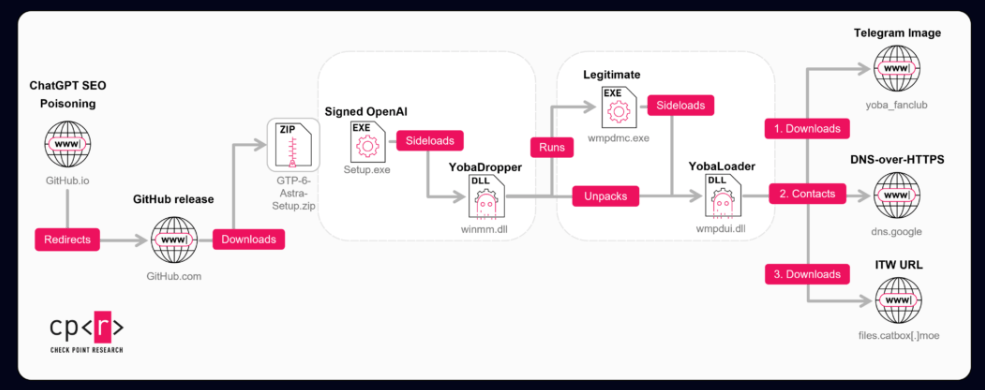
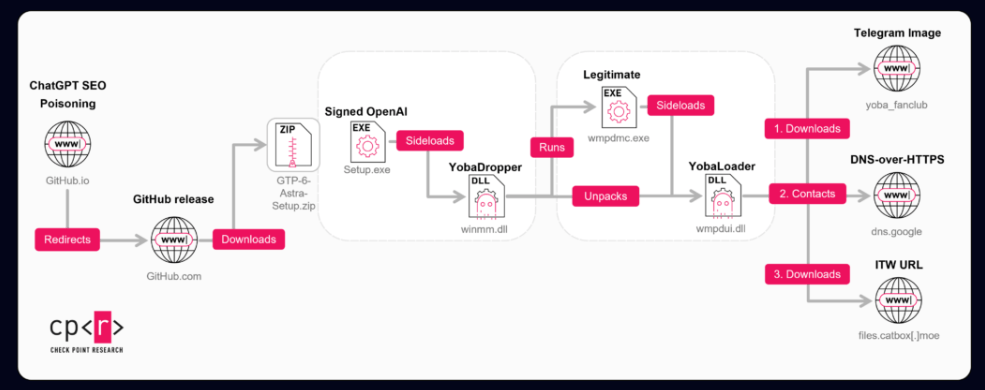
    Inside the installers, there is a malicious component we refer to as the YobaDropper. This dropper includes another component, the YobaLoader, which is responsible for contacting attacker-controlled infrastructure and fetching the final payload.” reads the report. “In this report, we describe how victims are lured to these fake projects, how the YobaDropper and YobaLoader work together, and how the attackers ultimately use this chain to run unwanted software on infected systems.”

    The lure is simple. Each project has a repository, a GitHub.io page describing the software, and a ZIP release with the malware. The repositories show no fake stars or forks, yet they still rank among the top Google results, most likely through SEO poisoning that optimizes titles, descriptions and hosting domains.
    The first repository appeared around July 2026, but the first malicious releases landed only on August 30 and 31, and a third followed about five days later on September 4. Each repository uses a different Outlook address, and commit times point to UTC+4, UTC-4 and UTC+3, which Check Point reads as a deliberate attempt to hide the actor’s real time zone.

    Here’s the trick that gives the report its title. Each ZIP holds a legitimate signed executable from OpenAI or Anthropic, named Setup.exe, next to a malicious winmm.dll. The signed program loads the DLL on its own, a technique known as DLL sideloading, which is often used to bypass security protections.

    The ZIP files were not even password-protected. Attackers often use passwords to prevent security tools from automatically unpacking and scanning files. However, these binaries already had very low detection rates because they used anti-sandbox and other techniques to avoid analysis. The DLL’s compilation date is another clue: it was built on the same day it was added to the archive, unlike the legitimate files around it.

    The dropper, called YobaDropper, checks the environment before running. It calculates a hash of the name of the program that launched it and continues only if the name is Setup.exe. This means that sandboxes that run the DLL on its own will fail this check. When that happens, the process does not exit. Instead, it sleeps 200,000 times for 5.5 seconds each, a total of about 12.73 days.

    The malware also avoids victims in CIS countries by checking the keyboard layout. It excludes Russian, Belarusian, Tajik, Armenian, Azerbaijani, Georgian, Kazakh, Kyrgyz, Turkmen, Uzbek, and Tatar. Interestingly, Ukraine, which has often appeared in similar exclusion lists, is not included.

    Next, the malware requests administrator privileges. If the user does not have them, it displays the message “Please run this program as Administrator.” and exits. The victim must then restart it with administrator rights.

    Once it has the required privileges, the malware creates a folder called WMProcess under ProgramData. It copies the legitimate WMPDMC.exe file from System32 into this folder and places the second-stage payload there under the name wmpdui.dll.

    The malicious code achieves persistence by using a scheduled task dressed up as Microsoft. The author is set to Microsoft Corporation, the description says it collects device metadata for Windows Media Player, and it starts three minutes after boot as Local System. The task launches the legitimate program, which sideloads the malicious DLL.

    The second stage, YobaLoader, shares code with the dropper, which points to the same developer. It only runs under WMPDMC.exe and uses a different seed for its hashing than the dropper does, which separates the stages and weakens hash-based detection. Its job is to find its payload without a classic command server.

    It goes to a Telegram channel, t[.]me/yoba_fanclub, and downloads the channel’s profile picture. The last 50 bytes of the image seed a domain generator that builds names from word lists in the form adjective-noun-verb-number on dedyn[.]io. Change the picture and the operator gets a new domain.

    Then it asks Google’s DNS-over-HTTPS service for a TXT record on that domain. The reply is signed, and the loader checks the signature before decrypting it, which gives a link to a payload on Catbox. Check Point says this reliance on DoH and common hosting aims to bypass passive DNS monitoring and some gateway protections, and the campaign avoids dedicated command-and-control infrastructure, using Telegram, Tor, Catbox and DoH instead.

    The operator can choose how the payload runs. It can inject it into svchost.exe, save it as an executable after removing the Zone.Identifier mark, or run it as a hidden PowerShell script while bypassing execution policies.

    “Finally, the injected payload into svchost.exe is an XMRig 6.26.0 miner with a hidden command line targeting a TLS-enabled onion mining endpoint through a local Tor SOCKS5 proxy. It can unpack and start Tor 0.4.9.12 plus lyrebird 0.8.1, monitor user-input activity to pause mining, and conditionally load the WinRing0 driver service for MSR-based mining optimization.” continnues the report.

    The miner uses Tor to connect to an encrypted mining server. It can start its own Tor components, use about 85% of CPU threads, and pause mining when the user is active. It resumes after 240 seconds of inactivity and can load the WinRing0 driver to optimize mining performance.

    However, YobaLoader is not limited to cryptocurrency mining. Its DNS tasking system allows operators to deliver any PE executable or PowerShell payload, meaning future attacks could distribute other malware families.

    Earlier versions appeared in June 2026. They used Cursor.exe for sideloading, a startup shortcut for persistence, and excluded only Russia. They also used .aber[.]ir instead of dedyn[.]io and included anti-debugging and anti-VM checks that later versions dropped.

    Check Point believes the attackers may have Russian origins and mainly operate in the UTC-4 time zone, but this is an assessment, not a confirmed attribution.

    Defenders should look for suspicious WMPDMC.exe copies under ProgramData, fake Microsoft scheduled tasks, Telegram-related traffic, DNS lookups for dedyn[.]io through dns.google, and unexplained high CPU usage.

    “The Yoba campaign shows how attackers can use trusted platforms and the current interest in AI tools to distribute malware in a way that looks believable and harmless at first glance. By packaging their code together with well-known software names and hosting it on GitHub, they lower the chances that users or basic security checks will immediately flag the files as suspicious.” concludes the report. “Organizations should be cautious about installing “AI helpers” or similar tools from unverified repositories and should enforce policies that restrict running software from unknown sources. Combining user awareness with basic technical controls.”

    Follow me on Twitter: @securityaffairs and Facebook and Mastodon

    Pierluigi Paganini

    (SecurityAffairs – hacking, Yoba malware)

    Source: Security Affairs · 2026-10-30

  • Critical Linux kernel flaw allows remote root attacks on MPTCP servers

    Security researchers at Anthropic have developed an exploit for a critical Linux kernel vulnerability that allows unauthenticated attackers to remotely execute commands as root on servers running Multipath TCP (MPTCP) listeners. […]

    Source: BleepingComputer · 2026-10-30

  • Friday Squid Blogging: Bigfin Squid Off California Coast

    Neat video:

    The sighting, announced September 2, marks the first time anyone has spotted a live bigfin squid, which belongs to the Magnapinna genus, in the northeastern Pacific Ocean.

    As usual, you can also use this squid post to talk about the security stories in the news that I haven’t covered.

    Blog moderation policy.

    Source: Schneier on Security · 2026-10-30

  • DOJ raises privacy concerns over potential sale of Character.AI chats

    DOJ raises privacy concerns over potential sale of Character.AI chats

    The DOJ’s Executive Office for U.S. Trustees said a consumer privacy ombudsman is needed to advise the court on how to regulate what data from Character.AI can be sold and under what terms.

    Source: The Record · 2026-10-30

  • A Supply Chain Attack Put Malicious Anthropic Claude Extensions on Thousands of Devices

    A Supply Chain Attack Put Malicious Anthropic Claude Extensions on Thousands of Devices

    Thanks to a lucky break, flawed code in a tainted Claude extension prevented the attacker from fully worming their way into some 5,000 developer machines.

    Source: WIRED Security · 2026-10-30

  • U.S. CISA adds GitLab and Cisco flaws to its Known Exploited Vulnerabilities catalog

    U.S. Cybersecurity and Infrastructure Security Agency (CISA) adds GitLab and Cisco flaws to its Known Exploited Vulnerabilities catalog.

    The U.S. Cybersecurity and Infrastructure Security Agency (CISA) added GitLab and Cisco vulnerabilities to its Known Exploited Vulnerabilities (KEV) catalog:

    Below are the flaws added to the catalog:

    • CVE-2026-97229 (CVSS score of 10.0) GitLab Community Edition and Enterprise Edition Integer Overflow or Wraparound vulnerability
    • CVE-2026-76418 (CVSS score of 8.6) Cisco Secure Firewall ASA Software and Cisco Secure FTD Software Unchecked Return Value to NULL Pointer Dereference Vulnerability

    CVE-2026-97229 is a critical security flaw that could let attackers run code on its servers without logging in.

    The flaw affects Community Edition (CE) and Enterprise Edition (EE), it is an integer overflow bug caused by weak validation of regular expressions in CI/CD configurations. The issue affects GitLab versions 19.2 before 19.2.8, 19.3 before 19.3.5, and 19.4 before 19.4.2. Users should upgrade to a patched version to protect their systems. GitLab advisory

    “GitLab has remediated an issue that, under certain conditions, could have allowed an unauthenticated user to execute arbitrary code on the GitLab server via a specially crafted regular expression in a CI/CD configuration, due to insufficient regular expression validation.” reads the advisory.

    The researchers joaxcar reported this vulnerability through the company’s HackerOne bug bounty program.

    Alpine Linux recently reported that an unknown attacker tried to exploit the vulnerability against Alpine Linux on October 20 and 21, 2026, but the attempts failed.

    CVE-2026-76418 is a NULL pointer dereference vulnerability affecting Cisco Secure Firewall ASA and FTD Software. It could allow an unauthenticated remote attacker to force a device to reload, causing a denial-of-service (DoS) condition.

    Cisco said it became aware of active exploitation earlier this month. The company has not disclosed who is behind the attacks, how many organizations have been targeted, or what attackers may have done after gaining access.

    According to Binding Operational Directive (BOD) 22-01: Reducing the Significant Risk of Known Exploited Vulnerabilities, FCEB agencies have to address the identified vulnerabilities by the due date to protect their networks against attacks exploiting the flaws in the catalog.

    Experts also recommend that private organizations review the Catalog and address the vulnerabilities in their infrastructure.

    CISA orders federal agencies to fix the two vulnerabilities by November 1st, 2026.

    Follow me on Twitter: @securityaffairs and Facebook and Mastodon

    Pierluigi Paganini

    (SecurityAffairs – hacking, CISA)

    Source: Security Affairs · 2026-10-30

  • Devs Hit by Trojanized Claude Code Extension for Cursor

    Devs Hit by Trojanized Claude Code Extension for Cursor

    Two serious security issues hit Cursor on the same day, highlighting the risks for AI-powered integrated development environments (IDEs).

    Source: Dark Reading · 2026-10-30

  • Behind the Scenes of How Operation Blackout Went Down

    Behind the Scenes of How Operation Blackout Went Down

    A recent law enforcement operation to dismantle harmful scam centers was a big success. A threat intelligence expert walks us through what happened and why he wants more of the same.

    Source: Dark Reading · 2026-10-30

  • Crim spent $7K+ on AI services in extortion attacks, then left evidence for all to see

    Crim spent $7K+ on AI services in extortion attacks, then left evidence for all to see

    A n0n ransomware operator tried to break into 23 organizations across 14 countries, but couldn’t secure its own front door, leaving its server exposed with all of its methods on view. The criminals used a mix of new (AI) and old (stolen credentials) tooling during their data-theft spree, and in some cases not only stole and encrypted files, but also deleted data and backups, eliminating victims’ ability to recover their information. And despite the fear and hype around the breachpocalypse, with AI finding and developing exploits for critical vulnerabilities affecting most organizations across the globe, these crooks did not exploit a single bug to gain entry into any of their victims’ IT environments. “In every documented compromise in this investigation, access relied on weak or stolen credentials,” said Ensar Seker, chief information security officer of threat intelligence firm SOCRadar. “What stands out is the combination of AI-assisted development and very conventional entry points,” Seker told The Register. “We found no evidence of vulnerability exploitation in the cases examined.” The gang breaks into organizations at scale using widespread Remote Desktop Protocol (RDP) scanning and automated FortiGate SSL-VPN credential stuffing. To access US-based IT managed services provider ChiBiTek, the crew used a 15-thread residential SOCKS5 proxy pool to test credentials (ip:port:user:password) against FortiGate portals (GET /remote/login). The operators also gained entry using exposed cloud credentials and reused hosting portal sessions. In one case linked to e-commerce site Fanatics, SOCRadar found that n0n used an exposed AWS access key with permissions to list, read, and delete objects in S3 buckets. The criminals then used this key to pull data from 40 S3 buckets, with up to 110 GB per bucket, and ultimately deleted data, including bank-transaction archives, and purged keys across 12 sensitive buckets. AI-assisted extortion While the threat hunters didn’t find any evidence of a fully autonomous attack system, the ransomware operator did use AI to assist with these intrusions, incurring more than $7,216 in AI usage costs by October 22. Specifically: the criminal or criminals used OpenCode, an open-source AI coding agent, configured with 154 model entries across seven providers. Models included Gemini, Mistral, Nemotron, Llama, Claude, GPT-5.x, Grok, Kimi, GLM, DeepSeek, MiniMax, Qwen, and many, many others, some with safety training removed and others marketed as “uncensored” models. “The operator used AI to write and debug hundreds of scripts. That shows how AI can help an attacker turn basic access into a broader, tailored operation,” Seker said. “The destructive behavior is equally significant,” he added. “The operator did more than steal and encrypt files: in some cases, it deleted data and backups, and in one case changed firewall policies to block traffic. That creates a recovery problem that a decryption key alone cannot solve.” SOCRadar’s threat hunters found the operator’s workspace – a publicly accessible Python HTTP file server hosted in Sweden at 185.157.161[.]148 on port 8877 – last month, and documented the exposed directory in snapshots on September 25 and 26. “Across those snapshots, we identified 1,719 files, including attack scripts, ransomware source code, extortion infrastructure, and an AI coding agent environment,” Seker said. “This gave us visibility into the operation behind the victim listings, including how the operator prepared attacks and handled stolen data.” Meet n0n It also provided a close look at n0n, a newcomer to the data-theft and extortion game that has claimed 108 victims since it emerged last month. On October 12, the group added 38 maritime, port and logistics organizations across 18 countries to its leak site in a single batch. Researchers have linked at least 21 of them to customers of South Korean maritime software provider CyberLogitec, although the software provider has not confirmed an intrusion. The crooks set an October 19 deadline for the maritime firms, with ransom demands ranging from $400,000 to $28 million, payable in Bitcoin. After the deadline, however, none of the 38 listings were marked “settled” and none of their payment addresses showed any transaction. All affected organizations’ stolen data was published. While a handful of the gang’s claimed victims have been marked “honored – data destroyed” on n0n’s leak site, indicating the victim orgs paid the ransom demand, SOCRadar hasn’t validated any transactions on-chain. In its profile details, the security shop rates the gang a 10 out of 10 for “aggressiveness” and a zero out of 10 for “lethality.” The group is believed to be based in Russia, although the server uncovered by SOCRadar, which it attributed to a single operator or small team, didn’t provide any definitive geographic or national attribution. Every case that the exposed server documented followed the same lifecycle, moving from initial access to establishing persistence and credential collection via hidden admin accounts disguised as services, covert proxies, credential and session-token theft, mailboxes and emailed multi-factor authentication codes. The crooks then collected sensitive data and sent everything to the operator’s central storage with the attack impact shifting between data-theft, encryption, destruction, and network disruption, depending on the targeted organization. After breaking into Transcom, a Netherlands-based financial services provider, the crims sent a secondary ransom alert directly to PayPal’s security team, even though the compromised data was only on Transcom’s network. Stupid mistakes and n0n security basics Finally, the crims send ransom notes, post a countdown clock on the leak site, establish negotiation rooms and emails for victims – and then leak the stolen files or destroy backups when the organizations don’t pay up. In some cases, and to apply increased pressure on victimized companies, n0n also broadcasts automated countdown warnings to businesses’ service providers, clients, and media outlets. Despite its aggressive tactics, the operator in this case – as with other stupid criminals The Register has gleefully documented in earlier stories – still struggles with basic security hygiene. “There is a striking gap between operational ambition and security discipline,” Seker said. “The operator invested thousands of dollars in AI services while leaving its own workspace exposed. The locker also contained hardcoded encryption keys, with evidence suggesting reuse across victims. An operation can have serious destructive capability while still making fundamental mistakes.”®

    Source: The Register — Security · 2026-10-30

  • Crim spent $7K+ on AI services in extortion attacks, then left evidence for all to see

    Crim spent $7K+ on AI services in extortion attacks, then left evidence for all to see

    A n0n ransomware operator tried to break into 23 organizations across 14 countries, but couldn’t secure its own front door, leaving its server exposed with all of its methods on view. The criminals used a mix of new (AI) and old (stolen credentials) tooling during their data-theft spree, and in some cases not only stole and encrypted files, but also deleted data and backups, eliminating victims’ ability to recover their information. And despite the fear and hype around the breachpocalypse, with AI finding and developing exploits for critical vulnerabilities affecting most organizations across the globe, these crooks did not exploit a single bug to gain entry into any of their victims’ IT environments. “In every documented compromise in this investigation, access relied on weak or stolen credentials,” said Ensar Seker, chief information security officer of threat intelligence firm SOCRadar. “What stands out is the combination of AI-assisted development and very conventional entry points,” Seker told The Register. “We found no evidence of vulnerability exploitation in the cases examined.” The gang breaks into organizations at scale using widespread Remote Desktop Protocol (RDP) scanning and automated FortiGate SSL-VPN credential stuffing. To access US-based IT managed services provider ChiBiTek, the crew used a 15-thread residential SOCKS5 proxy pool to test credentials (ip:port:user:password) against FortiGate portals (GET /remote/login). The operators also gained entry using exposed cloud credentials and reused hosting portal sessions. In one case linked to e-commerce site Fanatics, SOCRadar found that n0n used an exposed AWS access key with permissions to list, read, and delete objects in S3 buckets. The criminals then used this key to pull data from 40 S3 buckets, with up to 110 GB per bucket, and ultimately deleted data, including bank-transaction archives, and purged keys across 12 sensitive buckets. AI-assisted extortion While the threat hunters didn’t find any evidence of a fully autonomous attack system, the ransomware operator did use AI to assist with these intrusions, incurring more than $7,216 in AI usage costs by October 22. Specifically: the criminal or criminals used OpenCode, an open-source AI coding agent, configured with 154 model entries across seven providers. Models included Gemini, Mistral, Nemotron, Llama, Claude, GPT-5.x, Grok, Kimi, GLM, DeepSeek, MiniMax, Qwen, and many, many others, some with safety training removed and others marketed as “uncensored” models. “The operator used AI to write and debug hundreds of scripts. That shows how AI can help an attacker turn basic access into a broader, tailored operation,” Seker said. “The destructive behavior is equally significant,” he added. “The operator did more than steal and encrypt files: in some cases, it deleted data and backups, and in one case changed firewall policies to block traffic. That creates a recovery problem that a decryption key alone cannot solve.” SOCRadar’s threat hunters found the operator’s workspace – a publicly accessible Python HTTP file server hosted in Sweden at 185.157.161[.]148 on port 8877 – last month, and documented the exposed directory in snapshots on September 25 and 26. “Across those snapshots, we identified 1,719 files, including attack scripts, ransomware source code, extortion infrastructure, and an AI coding agent environment,” Seker said. “This gave us visibility into the operation behind the victim listings, including how the operator prepared attacks and handled stolen data.” Meet n0n It also provided a close look at n0n, a newcomer to the data-theft and extortion game that has claimed 108 victims since it emerged last month. On October 12, the group added 38 maritime, port and logistics organizations across 18 countries to its leak site in a single batch. Researchers have linked at least 21 of them to customers of South Korean maritime software provider CyberLogitec, although the software provider has not confirmed an intrusion. The crooks set an October 19 deadline for the maritime firms, with ransom demands ranging from $400,000 to $28 million, payable in Bitcoin. After the deadline, however, none of the 38 listings were marked “settled” and none of their payment addresses showed any transaction. All affected organizations’ stolen data was published. While a handful of the gang’s claimed victims have been marked “honored – data destroyed” on n0n’s leak site, indicating the victim orgs paid the ransom demand, SOCRadar hasn’t validated any transactions on-chain. In its profile details, the security shop rates the gang a 10 out of 10 for “aggressiveness” and a zero out of 10 for “lethality.” The group is believed to be based in Russia, although the server uncovered by SOCRadar, which it attributed to a single operator or small team, didn’t provide any definitive geographic or national attribution. Every case that the exposed server documented followed the same lifecycle, moving from initial access to establishing persistence and credential collection via hidden admin accounts disguised as services, covert proxies, credential and session-token theft, mailboxes and emailed multi-factor authentication codes. The crooks then collected sensitive data and sent everything to the operator’s central storage with the attack impact shifting between data-theft, encryption, destruction, and network disruption, depending on the targeted organization. After breaking into Transcom, a Netherlands-based financial services provider, the crims sent a secondary ransom alert directly to PayPal’s security team, even though the compromised data was only on Transcom’s network. Stupid mistakes and n0n security basics Finally, the crims send ransom notes, post a countdown clock on the leak site, establish negotiation rooms and emails for victims – and then leak the stolen files or destroy backups when the organizations don’t pay up. In some cases, and to apply increased pressure on victimized companies, n0n also broadcasts automated countdown warnings to businesses’ service providers, clients, and media outlets. Despite its aggressive tactics, the operator in this case – as with other stupid criminals The Register has gleefully documented in earlier stories – still struggles with basic security hygiene. “There is a striking gap between operational ambition and security discipline,” Seker said. “The operator invested thousands of dollars in AI services while leaving its own workspace exposed. The locker also contained hardcoded encryption keys, with evidence suggesting reuse across victims. An operation can have serious destructive capability while still making fundamental mistakes.”®

    Source: The Register Security · 2026-10-30