Category: Security News

  • Attackers turn GitHub issues into supply chain campaign against 61 public repos in less than an hour

    Attackers turn GitHub issues into supply chain campaign against 61 public repos in less than an hour

    EXCLUSIVE Researchers identified at least 83 attacks against 61 public GitHub repositories, including popular open source projects such as Google LangExtract, Trivy, Brave browser, and MLflow, in what they suspect is a coordinated campaign to execute commands in CI/CD environments and steal credentials and access tokens. It all happened very quickly, the Radware threat hunters said in an exclusive interview with The Register. Most (77) of the malicious items were published during a 43-minute time span on September 1, with the remaining six occurring within the next two minutes. “Our guess is that the final aim was a supply-chain attack in which the attacker gains credentials for the repo, and then he has the power to change the contents – the code – as he wishes” and then push the malicious changes to others, Radware VP and researcher Gabi Nakibly told The Register. Nakibly and fellow Radware researcher Zvika Babo say they suspect a single individual is behind this supply chain campaign. This attacker used 74 different GitHub accounts, many of which had legitimate development histories, meaning they were likely compromised. “Considering that dozens of accounts posted the same type of payload, on the same day, within a narrow time window, and to the same infrastructure, it is reasonable to assess that the activity was coordinated,” the team wrote in research shared ahead of publication with The Register. A novel attack chain They discovered the campaign while investigating prompt injection in GitHub – and they told us the attack chain is part of what makes this supply-chain campaign novel, and extremely stealthy. First, the attacker publishes an issue, pull request, or comment containing malicious commands hidden in HTML comments. This ensures the content is not visible in the rendered page. Plus, a GitHub event – like a pull request or issue – can automatically trigger a workflow if the repository is configured to respond to that event, meaning the attacker can be pretty hands-off at this point. “The workflow automatically is triggered within a second, and if the workflow is indeed vulnerable, then the attack is executed successfully,” Nakibly said. The workflow incorporates attacker-controlled content directly into shell source code, and the shell executes the hidden, malicious command, which hoovers up environment variables and attempts to exfiltrate those to an attacker-controlled server. While the researchers examined logs from actual runs, and told us they found two cases containing evidence that the malicious command ran inside the automation environment, they can’t definitively say whether the attacker successfully obtained repository write permissions, modified source code, or compromised downstream software. But they’re trying. “The big picture is that the attackers are trying to find every possible way to get inside the repos to get credentials,” Nakibly said. Plus, “the attacker doesn’t need to compromise the repository or to have access to its codebase” to do this, Babo added. “Basically, every user with a GitHub account can try to run this attack – it’s very easy to start this attack.” Which repos were affected? As of October 13, the threat hunters identified 83 GitHub items with a verified payload across 61 different repositories. The repos span AI frameworks, security tools, development infrastructure, databases, and other widely used open source software projects. The Radware report lists agno-agi/agno (42.7K stars), ToolJet/ToolJet (41.1K), google/langextract (38.9K), aquasecurity/trivy (38.4K), CopilotKit/CopilotKit (38K), and podman-container-tools/podman (33K), among the most popular. Other notable targets included QwenLM/qwen-code (28.5K), mlflow/mlflow (28.4K), discordjs/discord.js (26.8K), cilium/cilium (25.6K), brave/brave-browser (23.9K), dotnet/maui (23.3K), Homebrew/homebrew-cask (22.2K), github/docs (21K), apache/doris (16K), and PX4/PX4-Autopilot (12.8K). “These projects are used by thousands of organizations,” Babo said. The researchers disclosed their findings to all of the projects’ maintainers, and most of the repositories were closed or fixed, but they can’t confirm that all of them were. This campaign follows several earlier supply chain attacks against open source security and dev tools as attackers increasingly look for new methods to steal credentials and other secrets. “There is no way to stop the attackers from attempting,” Nakibly said. “The only way is to make sure that the workflow code is resilient, and not vulnerable to such attacks.” The researchers recommend applying least-privilege access to CI/CD workflows, and separating as much as possible workflows triggered by external events from jobs with elevated permissions. “Developers should treat external content as untrusted, and also limit the secrets and environment variables that are available to the workflow,” Babo said. ®

    Source: The Register — Security · 2026-10-29

  • Attackers turn GitHub issues into supply chain campaign against 61 public repos in less than an hour

    Attackers turn GitHub issues into supply chain campaign against 61 public repos in less than an hour

    EXCLUSIVE Researchers identified at least 83 attacks against 61 public GitHub repositories, including popular open source projects such as Google LangExtract, Trivy, Brave browser, and MLflow, in what they suspect is a coordinated campaign to execute commands in CI/CD environments and steal credentials and access tokens. It all happened very quickly, the Radware threat hunters said in an exclusive interview with The Register. Most (77) of the malicious items were published during a 43-minute time span on September 1, with the remaining six occurring within the next two minutes. “Our guess is that the final aim was a supply-chain attack in which the attacker gains credentials for the repo, and then he has the power to change the contents – the code – as he wishes” and then push the malicious changes to others, Radware VP and researcher Gabi Nakibly told The Register. Nakibly and fellow Radware researcher Zvika Babo say they suspect a single individual is behind this supply chain campaign. This attacker used 74 different GitHub accounts, many of which had legitimate development histories, meaning they were likely compromised. “Considering that dozens of accounts posted the same type of payload, on the same day, within a narrow time window, and to the same infrastructure, it is reasonable to assess that the activity was coordinated,” the team wrote in research shared ahead of publication with The Register. A novel attack chain They discovered the campaign while investigating prompt injection in GitHub – and they told us the attack chain is part of what makes this supply-chain campaign novel, and extremely stealthy. First, the attacker publishes an issue, pull request, or comment containing malicious commands hidden in HTML comments. This ensures the content is not visible in the rendered page. Plus, a GitHub event – like a pull request or issue – can automatically trigger a workflow if the repository is configured to respond to that event, meaning the attacker can be pretty hands-off at this point. “The workflow automatically is triggered within a second, and if the workflow is indeed vulnerable, then the attack is executed successfully,” Nakibly said. The workflow incorporates attacker-controlled content directly into shell source code, and the shell executes the hidden, malicious command, which hoovers up environment variables and attempts to exfiltrate those to an attacker-controlled server. While the researchers examined logs from actual runs, and told us they found two cases containing evidence that the malicious command ran inside the automation environment, they can’t definitively say whether the attacker successfully obtained repository write permissions, modified source code, or compromised downstream software. But they’re trying. “The big picture is that the attackers are trying to find every possible way to get inside the repos to get credentials,” Nakibly said. Plus, “the attacker doesn’t need to compromise the repository or to have access to its codebase” to do this, Babo added. “Basically, every user with a GitHub account can try to run this attack – it’s very easy to start this attack.” Which repos were affected? As of October 13, the threat hunters identified 83 GitHub items with a verified payload across 61 different repositories. The repos span AI frameworks, security tools, development infrastructure, databases, and other widely used open source software projects. The Radware report lists agno-agi/agno (42.7K stars), ToolJet/ToolJet (41.1K), google/langextract (38.9K), aquasecurity/trivy (38.4K), CopilotKit/CopilotKit (38K), and podman-container-tools/podman (33K), among the most popular. Other notable targets included QwenLM/qwen-code (28.5K), mlflow/mlflow (28.4K), discordjs/discord.js (26.8K), cilium/cilium (25.6K), brave/brave-browser (23.9K), dotnet/maui (23.3K), Homebrew/homebrew-cask (22.2K), github/docs (21K), apache/doris (16K), and PX4/PX4-Autopilot (12.8K). “These projects are used by thousands of organizations,” Babo said. The researchers disclosed their findings to all of the projects’ maintainers, and most of the repositories were closed or fixed, but they can’t confirm that all of them were. This campaign follows several earlier supply chain attacks against open source security and dev tools as attackers increasingly look for new methods to steal credentials and other secrets. “There is no way to stop the attackers from attempting,” Nakibly said. “The only way is to make sure that the workflow code is resilient, and not vulnerable to such attacks.” The researchers recommend applying least-privilege access to CI/CD workflows, and separating as much as possible workflows triggered by external events from jobs with elevated permissions. “Developers should treat external content as untrusted, and also limit the secrets and environment variables that are available to the workflow,” Babo said. ®

    Source: The Register Security · 2026-10-29

  • Webinar: How to Build AI Threat Readiness Into Your Security Operations

    Webinar: How to Build AI Threat Readiness Into Your Security Operations

    Security teams have spent years trying to detect threats faster. AI is changing the harder part: how much time defenders have left to act.

    Advanced AI models can now help attackers discover vulnerabilities, generate exploit code, and move through weaknesses faster than traditional security processes were built to handle.

    The challenge is no longer just finding another vulnerability or

    Source: The Hacker News · 2026-10-29

  • Telegram Android Flaw Lets Attackers Run Code When Users Answer Voice Calls

    Telegram Android Flaw Lets Attackers Run Code When Users Answer Voice Calls

    A flaw in Telegram for Android could be chained with two other bugs to take full control of a victim’s phone through a voice call, once the victim answered, according to security startup NebuSec.

    The attacker needed only an ordinary Telegram account. Telegram fixed the flaw in version 12.10.4 of the app, released in late September, and NebuSec disclosed it on October 29.

    Combined with an

    Source: The Hacker News · 2026-10-29

  • The Rise of the Threat Operator: How AI Will Redefine Security Operations and Careers

    The Rise of the Threat Operator: How AI Will Redefine Security Operations and Careers

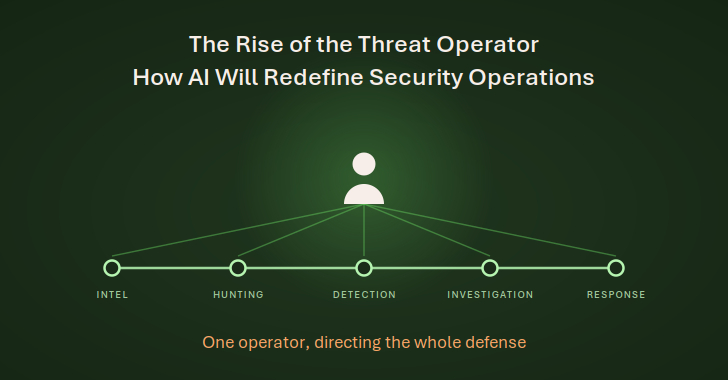
    AI is beginning to take over much of the work that has traditionally defined the security analyst’s job. Investigating alerts, collecting evidence, correlating activity across tools, and executing response actions are becoming tasks that AI systems can perform on their own. As these capabilities mature, security operations centers (SOCs) will see major changes in how work is organized, how

    Source: The Hacker News · 2026-10-29

  • 26,400 Valid Cloud and AI Credentials Found Exposed in Public Gitee Repositories

    26,400 Valid Cloud and AI Credentials Found Exposed in Public Gitee Repositories

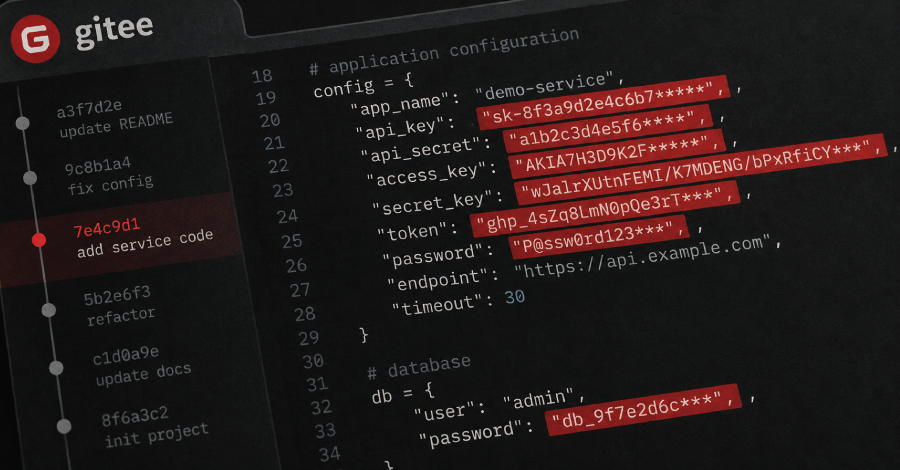
    26,400 credentials that developers left in public code on Gitee, a Chinese code-hosting service, still worked when a researcher tested them. Anyone who copied one from that code could have used it.

    Independent researcher Ben Zimmermann found them by scanning 7.25 million public Gitee repositories and reported the results on October 28. Most were keys for cloud and AI services, led by

    Source: The Hacker News · 2026-10-29

  • Online Scam Volumes Double to Overtake Phishing

    Akamai research reveals that scam detections topped six million in Q2 2026

    Source: Infosecurity Magazine · 2026-10-29

  • Have an older iPhone or iPad? Apple has a security update for you

    Apple’s latest updates include a fix for a CoreGraphics bug that may have been exploited in targeted attacks. The fix is now available for older iPhones and iPads.

    Apple released security updates on October 26. Apple first fixed the flaw in iOS 26.7.1. Its latest updates also bring the fix to older devices that can’t run iOS 26, including the iPhone XS, iPhone XS Max, iPhone XR, and seventh-generation iPad.

    The iOS 18.7.11 update is a backport: it brings a fix from a newer software version to an older one. Here, Apple has made the fix available to older devices running iOS 18, so they can be protected without upgrading to an operating system they don’t support.

    Updates for your particular device

    The table below shows which updates are available and links to Apple’s security information for each one.

    Name and information link Available for
    iOS 27.2 and iPadOS 27.2 iPhone 11 and later, iPad Pro 12.9-inch 4th generation and later, iPad Pro 11-inch 2nd generation and later, iPad Air 4th generation and later, iPad 9th generation and later, and iPad mini 6th generation and later
    iOS 26.7.2 and iPadOS 26.7.2 iPhone 11 and later, iPad Pro 12.9-inch 3rd generation and later, iPad Pro 11-inch 1st generation and later, iPad Air 3rd generation and later, iPad 8th generation and later, and iPad mini 5th generation and later
    iOS 18.7.11 and iPadOS 18.7.11 iPhone XS, iPhone XS Max, iPhone XR, iPad 7th generation
    macOS Golden Gate 27.2 macOS Golden Gate
    macOS Tahoe 26.7.2 macOS Tahoe
    macOS Sequoia 15.8.2 macOS Sequoia
    tvOS 27.2 Apple TV 4K 2nd generation and later
    watchOS 27.2 Apple Watch Series 9 and later
    visionOS 27.2 Apple Vision Pro (all models)
    Safari 27.2 macOS Sequoia and macOS Tahoe
    tvOS 26.6.1 (no published CVE entries) Apple TV HD and Apple TV 4K 1st generation

    How to update your Apple devices

    How to update your iPhone or iPad

    For iOS and iPadOS users, here’s how to check if you’re using the latest software version:

    Go to Settings > General > Software Update. You will see if there are updates available and be guided through installing them.

    Turn on Automatic Updates if you haven’t already—you’ll find it on the same screen.

    How to update your Mac

    To update macOS on any supported Mac, use the Software Update feature, which Apple designed to work consistently across all recent versions. Here are the steps:

    • Click the Apple menu in the upper-left corner of your screen.
    • Choose System Settings (or System Preferences on older versions).
    • Select General in the sidebar, then click Software Update on the right. On older macOS, just look for Software Update directly.
    • Your Mac will check for updates automatically. If updates are available, click Update Now (or Upgrade Now for major new versions) and follow the on-screen instructions. Before you upgrade to macOS Tahoe 26, please read these instructions.
    • Enter your administrator password if prompted, then let your Mac finish the update (it might need to restart during this process).
    • Keep your Mac plugged in and connected to the internet until the update is done.

    How to update your Safari browser

    Safari updates are included with macOS updates, so installing the latest version of macOS will also update Safari. To check manually:

    • Open the Apple menu > System Settings > General > Software Update.
    • If you see a Safari update listed separately, click Update Now to install it.
    • Restart your device when prompted.

    Technical details

    The headline bug is CVE-2026-86950, in CoreGraphics, Apple’s framework for drawing graphics, images and PDF content. It’s an out-of-bounds write flaw, where software writes data outside the memory set aside for it. The result is that “processing a maliciously crafted file may lead to arbitrary code execution.”

    Apple says it is aware of a report that the flaw may have been exploited in an “extremely sophisticated attack against specific targeted individuals” on versions of iOS before iOS 27.

    That wording indicates Apple believes the bug was used in real attacks against a limited group of users.

    Usually, journalists, activists and officials are the targets of this kind of attack. If you think you could be a target of highly sophisticated spyware, you should update, restart your phone, and consider applying Apple’s Lockdown Mode.


    Scammers know more about you than you think. 

    Malwarebytes Mobile Security protects you from phishing, scam texts, malicious sites, and more. With real-time AI-powered Scam Guard built right in. 

    .wp-block-kadence-advancedbtn.kb-btns97520_6de029-2f{gap:var(–global-kb-gap-xs, 0.5rem );justify-content:flex-start;align-items:center;}.kt-btns97520_6de029-2f .kt-button{font-weight:normal;font-style:normal;}.kt-btns97520_6de029-2f .kt-btn-wrap-0{margin-right:5px;}.wp-block-kadence-advancedbtn.kt-btns97520_6de029-2f .kt-btn-wrap-0 .kt-button{color:#555555;border-color:#555555;}.wp-block-kadence-advancedbtn.kt-btns97520_6de029-2f .kt-btn-wrap-0 .kt-button:hover, .wp-block-kadence-advancedbtn.kt-btns97520_6de029-2f .kt-btn-wrap-0 .kt-button:focus{color:#ffffff;border-color:#444444;}.wp-block-kadence-advancedbtn.kt-btns97520_6de029-2f .kt-btn-wrap-0 .kt-button::before{display:none;}.wp-block-kadence-advancedbtn.kt-btns97520_6de029-2f .kt-btn-wrap-0 .kt-button:hover, .wp-block-kadence-advancedbtn.kt-btns97520_6de029-2f .kt-btn-wrap-0 .kt-button:focus{background:#444444;}

    ul.menu .wp-block-kadence-advancedbtn .kb-btn97520_074a67-a8.kb-button{width:initial;}.wp-block-kadence-advancedbtn .kb-btn97520_074a67-a8.kb-button{color:var(–color-neutral-10);background:var(–color-brand-blue-60);border-top-left-radius:40px;border-top-right-radius:40px;border-bottom-right-radius:40px;border-bottom-left-radius:40px;padding:var(–kb-btn-padding);margin:var(–kb-btn-margin);box-shadow:1px 1px 2px 0px rgba(0, 0, 0, 0.2);}.wp-block-kadence-advancedbtn .kb-btn97520_074a67-a8.kb-button:hover, .wp-block-kadence-advancedbtn .kb-btn97520_074a67-a8.kb-button:focus{box-shadow:0px 4px 0px 0px var(–color-brand-blue-90);}Try it now

    Source: Malwarebytes Labs · 2026-10-29

  • Cisco Patches Actively Exploited ASA and FTD VPN Flaw That Can Crash Firewalls

    Cisco Patches Actively Exploited ASA and FTD VPN Flaw That Can Crash Firewalls

    Cisco has released patches to address a high-severity security flaw in Secure Firewall Adaptive Security Appliance (ASA) Software and Secure Firewall Threat Defense (FTD) Software that it said has been exploited in the wild.

    The vulnerability, tracked as CVE-2026-76418, is rated 8.6 on the CVSS scoring system. Successful exploitation could allow an unauthenticated, remote attacker to cause the

    Source: The Hacker News · 2026-10-29

  • Volt Typhoon Used Silent Train to Hide Zero-Day Attacks

    Volt Typhoon Used Silent Train to Hide Zero-Day Attacks

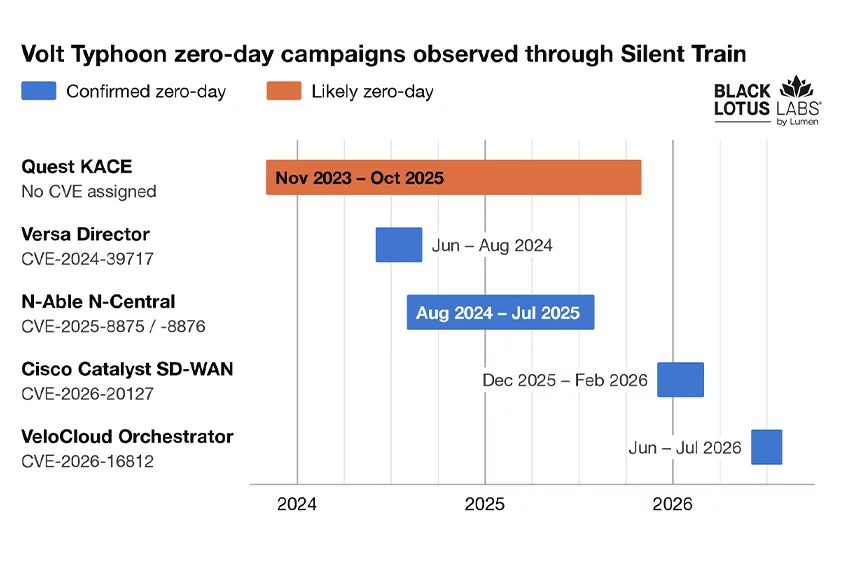
    Volt Typhoon used disposable relay chains to hide zero-day attacks on critical systems. Lumen linked Silent Train to at least four zero-days.

    Lumen’s Black Lotus Labs has spent three years tracking a covert network it calls Silent Train, which it ties to Volt Typhoon, the China-linked APT group. The cybersecurity firm says the network hid exploitation of software flaws the vendors didn’t know about yet. Black Lotus sent hundreds of victim notifications along the way, and the investigations that followed revealed the exploitation of at least four confirmed zero-days and one likely.

    “Volt Typhoon’s Silent Train is a covert network designed to gain and maintain access to the technologies businesses rely on to manage devices, networks and critical operations.” reads the report published by Lumen. “Black Lotus Labs® tracked how the group used rapidly changing chains of compromised infrastructure to conceal its activity while exploiting previously unknown vulnerabilities in centralized management platforms.”

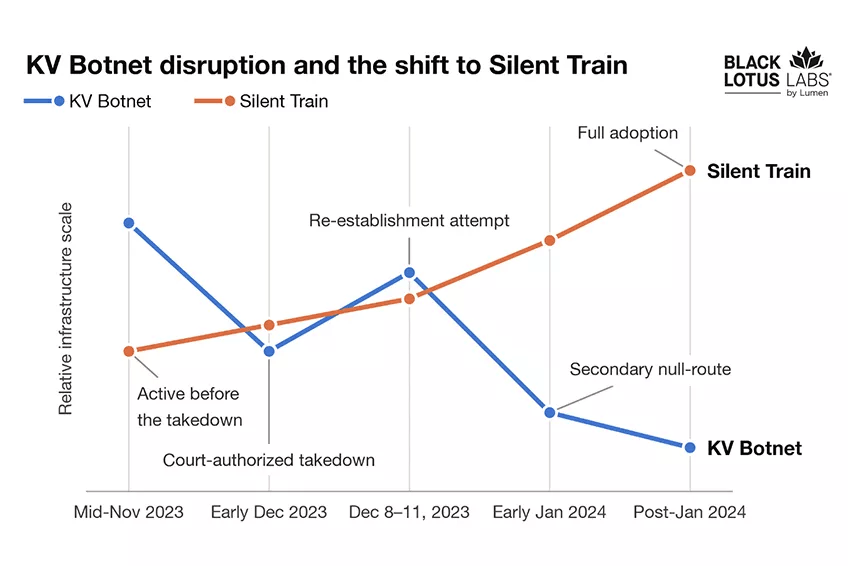
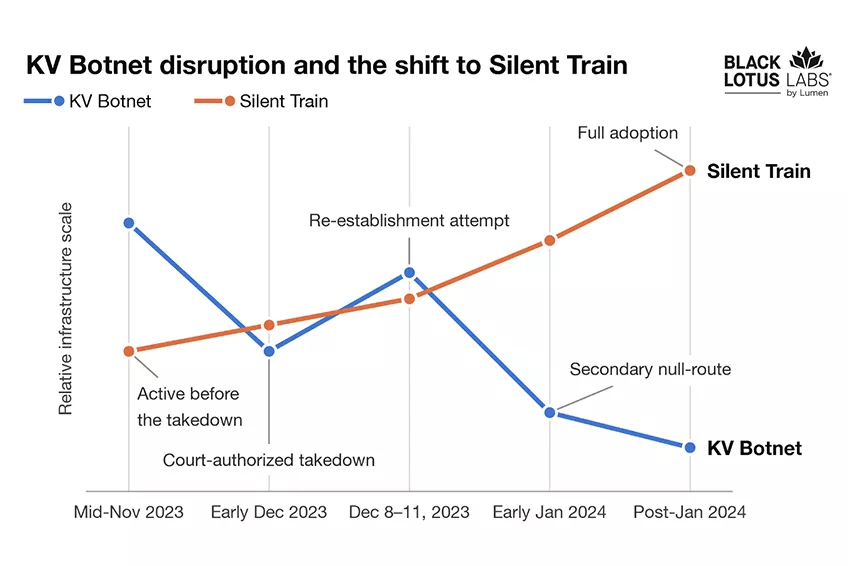
    Silent Train first showed up in November 2023, shortly before the first takedown of the KV-botnet, Volt Typhoon’s earlier network of hijacked routers. Activity rose after the second disruption. The group dropped persistent infrastructure and moved to disposable chains of compromised devices that it could rebuild whenever it wanted.

    Each session began on a rented server outside the United States. It then passed through another server and compromised small-office routers, home devices and IoT equipment in other countries. Finally, the traffic passed through a compromised device in the U.S., close to the target. This helped the attackers make their activity look like normal local traffic and bypass location-based blocks and IP reputation filters. On average, the chains passed through about four devices before reaching a U.S. IP address. Some used as many as six.

    Lumen identified more than 27 types of devices used in the network, including TP-Link routers and Fortinet appliances. Some of these devices had no known vulnerabilities, suggesting that Volt Typhoon may have used previously unknown exploits to compromise them and create relay points.

    “We observed more than 27 device classes exploited and used in Silent Train operations, ranging from SOHO and IoT devices like TP-Link routers and Netgear Orbi devices to enterprise platforms like Fortinet appliances and CyberPanel servers.” the report continues. “Some relay device types lack known vulnerabilities, suggesting Volt Typhoon leveraged undisclosed zero-day exploits to set up a single relay in a four-to-six hop chain and indicating a willingness to commit significant resources to protecting future access capabilities.”

    The attackers exploited exposed web interfaces and installed only the tools needed to connect the devices through SSH. These included temporary SSH services, keys, configuration files and tools already available on the systems. At the end of each session, they removed all traces of their activity and dismantled the relay chain. Sessions lasted about four hours on average, although some lasted only minutes. The attackers could also build a new chain in less than two minutes, suggesting that they had partly automated the process.

    The group worked with strict discipline. New device types arrived about one per quarter, and about one per month during the 2023 and 2024 build-out, always tested outside the U.S. first. Roles never changed: Intelbras modems served only as overseas relays, Netgear Orbi devices only as the U.S. hops facing victims, and the server providers stayed separated by layer too.

    By early 2025, enterprise platforms like Fortinet, Cisco, PRTG, Mirth Connect and CyberPanel joined as final hops. They stayed up one to three months and supported several intrusions. The group also added reverse tunnels using the open-source proxies Chisel and FRP, and the old and new methods ran in parallel.

    Volt Typhoon used Silent Train only during key stages of its attacks, including exploiting vulnerabilities, stealing credentials and data, and maintaining access to compromised systems. Each session targeted between one and five victims, often just one organization. The activity was carried out by human operators, mainly from Monday to Friday, between 9 a.m. and 10 p.m. China Standard Time. The group also paused operations for several weeks around Chinese New Year.

    The group targeted tools used to manage endpoints and networks, as well as SD-WAN systems and other control platforms. These systems can manage hundreds or thousands of devices, allowing attackers to reach many systems without moving through the network in the usual way. This approach also helped them leave fewer traces. After the attacks, investigators found webshells running in memory, stolen credentials, misuse of built-in features such as remote file transfers, and deleted logs.

    The four confirmed zero-day campaigns hit Versa Director in 2024, N-able N-central through CVE-2025-8875 and CVE-2025-8876, Cisco Catalyst SD-WAN through CVE-2026-20127, and VeloCloud Orchestrator through CVE-2026-16812. The Cisco bug is a CVSS 10.0 flaw, and the group kept exploiting it well after Cisco disclosed it in February 2026. In the Versa case, the group used an in-memory JAR webshell to limit forensic evidence and reach downstream customers.

    The likely fifth is Quest KACE. The campaign hit more than 30 victims and faded after Quest’s October 2025 security updates.

    “The campaign affected more than 30 victims, followed vendor remediation timelines and declined after Quest’s October 2025 security updates.” the report states. “Despite limited forensic evidence, the available data supports a moderate-confidence assessment that Volt Typhoon exploited a zero-day vulnerability.”

    The actor stayed on the KACE server and used its admin features to take credentials.

    Victims include telecoms, government agencies, defense contractors, satellite and emergency communications, universities with ROTC programs, managed service and IT firms, and critical infrastructure such as water, energy, transportation, maritime, rail and aviation. What they share is access to bigger networks or customers. Hawaii, California and Texas were the top locations for several years. Lumen can’t say why, but the pattern fits pre-positioning for a crisis in the Indo-Pacific.

    “For enterprise leaders, the lesson is clear: systems with broad administrative reach can become high-value gateways to the entire organization and its customers. Reducing internet exposure, accelerating patching, strengthening access controls and preserving security telemetry are essential to detecting threats earlier and limiting their impact.” Lumen concludes.

    Follow me on Twitter: @securityaffairs and Facebook and Mastodon

    Pierluigi Paganini

    (SecurityAffairs – hacking, China)

    Source: Security Affairs · 2026-10-29