To be announced…
- Group: leakeddata
- Discovered: 2026-10-30 16:26 UTC
This entry reflects a claim published by an extortion group and collected by a public tracker. It has not been independently verified.
Source: RansomLook — Recent Posts · 2026-10-30
To be announced…
This entry reflects a claim published by an extortion group and collected by a public tracker. It has not been independently verified.
Source: RansomLook — Recent Posts · 2026-10-30
Rapid Manufacturing — a 50-year-old electronics contract manufacturer in Anaheim, California with operations in Ensenada, Mexico.
Rapid Manufacturing is not a household name. But it is a critical Tier-1 supplier to SpaceX (Falcon & Starship programs), Anduril, Northrop Grumman, Rocket Lab, L3Harris, Collins Aerospace (RTX), and Millennium Space (Boeing). It builds the wire harnesses, electro-mechanical assemblies, and box builds that go inside rockets, missiles, and satellites.
The exposed material includes:
<redacted>>
ITAR-controlled engineering drawings and manufacturing processes for Falcon 9/Heavy, Starship, and Draco propulsion systems — RTD soldering acceptance criteria, visual inspection standards, cable thermocouple assemblies, and production master plans.
26 ITAR customer quoting accounts including SpaceX, Anduril, Northrop Grumman, Rocket Lab, L3Harris, Collins Aerospace, and Millennium Space — the complete defense/space revenue architecture.
<redacted>
<redacted>
600–1,200 employee records spanning US (SSN, bank accounts, payroll, I-9/immigration) and Mexico (RFC, CURP, IMSS, bank accounts, nóminas) with data from 2019 through August 2026.
<redacted>
Attorney-client privileged materials — settlement agreements, severance terms, internal investigation files, and a recorded termination meeting (audio).
This entry reflects a claim published by an extortion group and collected by a public tracker. It has not been independently verified.
Source: RansomLook — Recent Posts · 2026-10-30

Flashpoint’s weekly analysis tracks shifting kinetic and cyber threat radiuses, geopolitical disruptions, and provides critical operational forecasts for the ongoing Middle East conflict.

 Table Of Contents

Following Operation Epic Fury, regional kinetic operations have transitioned into direct, persistent threats against commercial shipping, energy infrastructure, and critical supply chains.
The Flashpoint Threat Intelligence Brief: Middle East cuts through headline noise to deliver tactical, ground-level intelligence for government agencies, corporate security leads, and global logistics teams—turning Flashpoint’s primary source intelligence into proactive risk mitigation.
Here are the updates from this week that your security operations team should be tracking.
Between October 23 and October 29, Ansarallah (the Houthi movement) continued its campaign against Saudi aviation, military, and energy infrastructure. Houthi military spokesperson Yahya Saree claimed ballistic missile and drone strikes on King Khalid International Airport, Saudi Aramco facilities in Yanbu, crude oil pumping stations, and the Ras Tanura refinery. On October 27, the group also claimed to have struck Saudi Arabia’s Ministry of Defense headquarters in Riyadh and military transport aircraft at Abha airport along with King Khalid Air Base. Saudi authorities have not confirmed damage at several of these sites.
Saudi-led coalition forces reported intercepting missiles and drones targeting Riyadh, Khamis Mushait, the Eastern Province, and other areas, including 10 ballistic missiles directed toward southern Saudi Arabia on October 25. King Khalid International Airport resumed international flights that day, although Ansarallah warned airlines that the airport remained a military target. Coalition air strikes continued in northern Yemen, with the Sanaa-based Health Ministry reporting eight fatalities following a strike on workers’ housing in Hamdan.
Houthi ground operations also intensified around Taiz and Lahj, with reported advances along the Jabal Sabr front and an assault on Al-Maqatira Castle. On October 29, Yemeni government forces reported that Ansarallah fired two ballistic missiles at Aden International Airport, extending the threat to another major aviation facility.
The United States ordered nonessential staff and families to depart its embassy in Riyadh and consulates in Jeddah and Dhahran following statements by Islamic Revolutionary Guard Corps (IRGC) officials identifying American diplomats as legitimate targets. Similar precautionary measures were reported at US missions elsewhere in the Middle East. US officials also cited intelligence indicating potential Iranian assassination planning against American diplomatic and government personnel.
Iran continued operations against Kurdish opposition groups in Iraq, with the IRGC conducting a drone strike on a Komala facility near Erbil on October 24. Maritime incidents persisted near the Strait of Hormuz, including a UKMTO report of a vessel on fire north of Khasab, Oman on October 29. The IRGC Navy separately claimed to have electronically seized and landed a US drone west of the strait, although that claim remains unverified.
In the cyber domain, researchers from TrendAI, Citizen Lab, and Confiant identified additional surveillance activity involving Israeli advertising technology firm Discover-Tech. The company reportedly bid on advertising traffic associated with Starlink users in more than 100 countries, enabling potential identification and geolocation of individuals in conflict-affected regions. Google and Comcast subsequently removed the firm from their advertising platforms.
The resumption of international flights at King Khalid International Airport does not eliminate the risk of further disruption. Ansarallah has continued to designate the airport as a military target, while missile interceptions have created additional hazards for surrounding communities. In Khamis Mushait and Ahad Rafidah, falling debris injured two people and damaged residential buildings and vehicles. Similar debris was reported across parts of western Saudi Arabia, including areas around Jeddah, Taif, and Rabigh.
In Yemen, Houthi advances along the Jabal Sabr front have brought fighting closer to government-held positions overlooking Taiz, including areas near Taiz University. The expanding offensive threatens access routes around a city where the UN has warned that approximately 800,000 people urgently need humanitarian assistance. Continued operations in Lahj and attacks toward Aden add further uncertainty for transport and government facilities in southern Yemen.
Western-linked personnel and facilities face increased exposure following Iranian threats against American diplomats. The US drawdown extends beyond Saudi Arabia, with similar precautionary measures reported at diplomatic missions in the UAE, Lebanon, Qatar, Jordan, Bahrain, and Kuwait. Iranian allegations that US aircraft are operating from Gulf states could also increase the risk of Tehran identifying host-nation military facilities as potential targets in a renewed confrontation.
At sea, the reported incidents near Khasab and Iraq’s Al-Faw port highlight risks across both the Strait of Hormuz approaches and the northern Gulf. The reporting identifies 113 maritime attacks in and around the Strait of Hormuz since February 28, underscoring the sustained exposure of commercial vessels operating through the region.
The latest Discover-Tech findings raise particular concerns about the information exposed through real-time advertising auctions. Researchers found that the firm could use advertising bid requests to identify and geolocate Starlink users, with activity concentrated in countries affected by conflict or political instability. This creates potential surveillance exposure for personnel relying on satellite internet services in areas where other communications infrastructure may be limited or disrupted.
The research also builds on earlier findings connecting Discover-Tech to the delivery of Candiru spyware through online advertisements. Although advertising-based tracking does not itself establish that a device was compromised, the ability to identify and locate specific users could support subsequent targeting. Google and Comcast’s removal of Discover-Tech from their advertising platforms represents a response to the reported activity.
Separately, the IRGC Navy’s claimed electronic takeover of a US drone near the Strait of Hormuz remains unverified. If substantiated, the incident would indicate an electronic warfare capability relevant to unmanned aircraft operating near Iranian-controlled waters. Iran’s announcement of arrests involving alleged US- and Israel-linked intelligence cells also reflects its continued focus on identifying suspected foreign intelligence activity, although the alleged affiliations have not been independently established.
Organizations with personnel, facilities, or operations exposed to the conflict should maintain heightened awareness of physical security, travel, maritime, and surveillance risks.
Cyber Defense
Physical and Operational Defense
Over the next 48–72 hours, Houthi forces are likely to sustain missile and drone attacks against Saudi aviation, energy, and military infrastructure while continuing operations around Taiz, Lahj, and Aden. The resumption of international flights at King Khalid International Airport does not eliminate the threat of renewed disruption, particularly given Ansarallah’s continued designation of the airport as a target. Saudi-led coalition strikes in northern Yemen are also likely to continue.
The US diplomatic drawdown reflects heightened concern about threats to American personnel, while reported planning for additional US strikes against Iran introduces uncertainty ahead of the November 3 midterm elections. Iranian Foreign Minister Abbas Araghchi’s statements about continued diplomatic contacts suggest negotiations remain possible, although no breakthrough has been reported.
Maritime incidents near the Strait of Hormuz and northern Gulf are likely to persist, with additional uncertainty surrounding the IRGC’s claims of electronic warfare operations against US aircraft. Iranian strikes against Kurdish opposition positions near Erbil may also continue, alongside further counterintelligence arrests and public accusations of foreign involvement.
In the cyber domain, the latest Discover-Tech findings may prompt additional scrutiny of advertising-based surveillance and the exposure of satellite internet users in conflict-affected regions.
As the conflict continues to affect military operations, commercial shipping, regional infrastructure, and digital communications, security teams need timely intelligence to assess emerging risks and protect their organizations.
Flashpoint combines primary-source monitoring, open-source intelligence, and geospatial analysis to help organizations identify developing threats, assess operational exposure, and make informed security decisions.
Request a demo to learn how Flashpoint supports physical security intelligence, threat monitoring, and operational risk assessment.
What is the Flashpoint Physical Threat Intelligence Brief?
The Flashpoint Physical Threat Intelligence Brief: Middle East is a recurring threat intelligence update that translates raw primary-source open-source intelligence (OSINT) and geospatial data into actionable physical security analysis. It focuses on kinetic conflict developments, standoff weapon capabilities, maritime corridor security, and critical infrastructure risks across the Middle East.
How does Flashpoint gather physical security intelligence for the Middle East?
Flashpoint Physical Security Intelligence (PSI) gathers data by combining global open-source intelligence (OSINT), geolocated social media signals, satellite imagery, and primary-source threat monitoring. The platform uses AI-driven natural language processing and geospatial mapping to track kinetic developments, weapon strike radiuses, and physical security threats in real time.
Source: Flashpoint · 2026-10-30
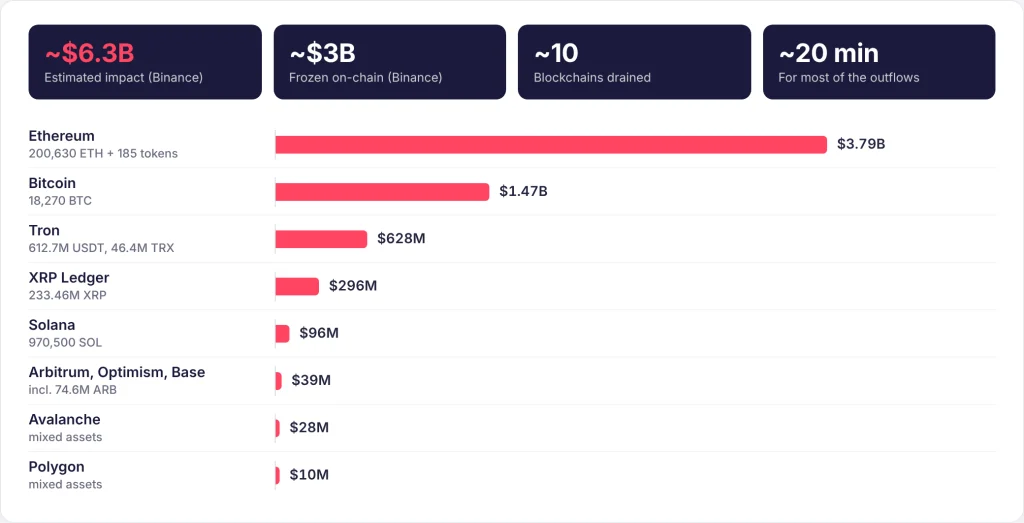
The Binance hack drained an estimated $6.3 billion from the exchange’s hot wallets across roughly 10 blockchains on the evening of October 29, 2026. The Binance hack is a hot wallet compromise in which an attacker made Binance’s own withdrawal infrastructure sign and send funds to attacker-controlled addresses, mostly within about 20 minutes.
Binance has confirmed the incident, and the evidence points to a serious, well-resourced operation: staged in advance, executed across chains at once, and built to get unauthorized transactions through the controls meant to stop them. About $3 billion has been blocked through on-chain freezes, and Binance has committed to paying for the rest.
| Incident | Unauthorized hot wallet withdrawals at Binance |
| Date | October 29, 2026, starting around 20:05 UTC |
| Estimated Loss | Around $6.3 billion (Binance estimate); independent estimates range from $6.36 billion to $6.4 billion |
| Blockchains Affected | About 10, including Ethereum, Bitcoin, Tron, XRP Ledger, Solana, Arbitrum, Optimism, Base, Avalanche and Polygon |
| Initial Access (Preliminary) | Compromised DevOps engineer laptop plus additional points of breach (Binance, October 30, 2026); full root cause not yet published |
| Private Key Exposure | No evidence found (Binance) |
| Frozen So Far | About $3 billion on-chain (Binance) |
| Loss Coverage | More than $6.34 billion in company funds reserved; about $5 billion already held in the stolen token types |
| Attribution | Assessed by blockchain analysts as TraderTraitor (North Korea); not confirmed by Binance or governments |
| Service Status | Withdrawals paused while the service is rebuilt and retested; Binance expects them back before Sunday, November 1, 2026; deposits unaffected |
October 30, 2026 Binance
Binance says it has reserved more than $6.34 billion in company funds, about $5 billion of it already held in the stolen token types, and is buying the rest through market and OTC channels. Co-CEO Richard Teng says the attack was not carried out by one person, the attacker used a self-destruct mechanism to wipe tooling and traces, and a full Proof of Reserves report is planned for Monday.
October 30, 2026, 08:47 UTC Binance
Binance says its investigation has uncovered additional points of breach beyond the compromised laptop identified earlier, calling it a complex attack. The outflows stopped when withdrawals were paused, about $3 billion is frozen, and withdrawals remain on track to resume in about 45 hours. Deposits are unaffected.
October 30, 2026, 04:17 UTC Status
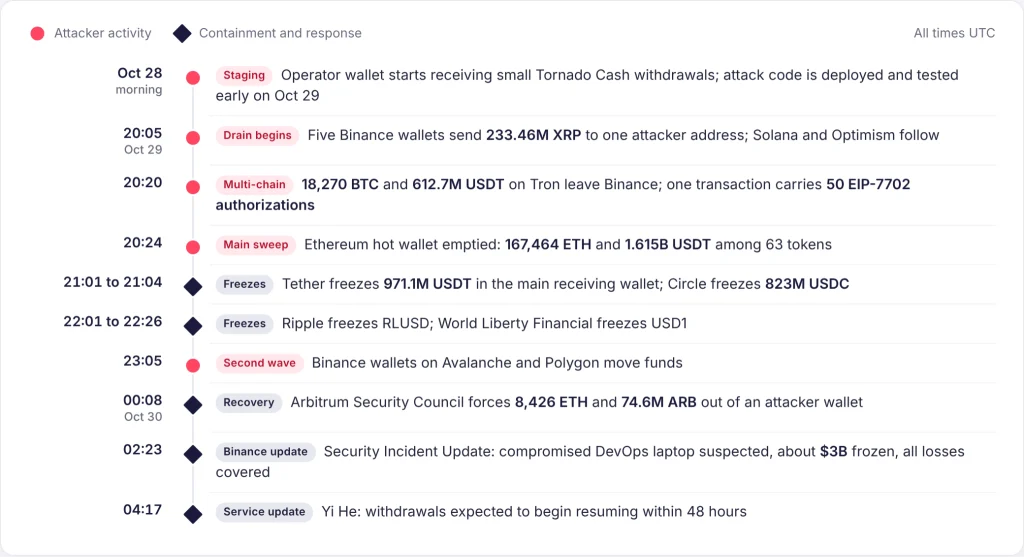
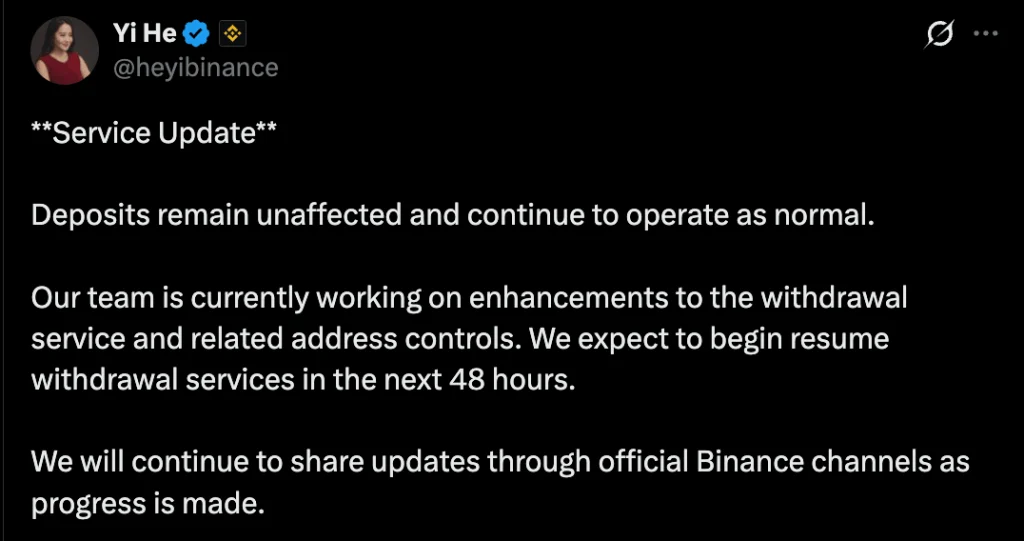
Binance co-CEO Yi He says withdrawals remain paused while the team improves controls on the withdrawal service and related addresses, and should begin resuming within 48 hours. Deposits are operating normally.
October 30, 2026, early morning UTC Attribution
October 30, 2026, 02:23 UTC Binance
Binance’s initial investigation suggests a compromised DevOps engineer’s laptop gave the attacker access to a service container that submitted unauthorized withdrawals. Binance says it found no evidence of a wallet private key leak, estimates the impact at around $6.3 billion with about $3 billion frozen on-chain, and will cover all losses from SAFU and company funds.
October 30, 2026, 00:30 UTC Attribution
Blockchain analysts attribute the theft with high confidence to North Korea’s TraderTraitor and value the stolen assets at $6.36 billion. As of 00:30 UTC, about $2.4 billion remains under attacker control, mostly more than 420,000 ETH and 18,270 BTC. Binance and government agencies have not confirmed the attribution.
October 30, 2026, 00:08 UTC Response
The council forces 8,426 ETH and 74.6 million ARB, worth about $30 million, out of the attacker’s Arbitrum wallet.
October 29, 2026, 23:05 UTC Attack
Binance wallets on Avalanche and Polygon send out funds in a second wave, and smaller sweeps continue until about 23:56 UTC.
October 29, 2026, about 22:30 UTC Binance
Binance suspends withdrawals on multiple networks as a precaution, says user funds are safe, and warns users not to trust unofficial links or messages about the incident.
October 29, 2026, 22:01 to 22:26 UTC Response
Ripple freezes the RLUSD the attacker had not yet sold, and World Liberty Financial freezes 27.8 million USD1 in the attacker’s main receiving wallet.
October 29, 2026, 21:01 to 21:04 UTC Response
Within about 40 minutes of the main Ethereum sweep, Tether freezes 971.1 million USDT in the attacker’s main receiving wallet and Circle freezes 823 million USDC, in coordination with law enforcement.
October 29, 2026, 20:20 to 20:24 UTC Attack
October 29, 2026, 20:05 UTC Attack
Five Binance wallets send 233.46 million XRP to a single attacker address. Within roughly 20 minutes, Binance wallets on about 10 blockchains have sent funds out.
October 28, 2026 Staging
A fresh operator wallet starts receiving small Tornado Cash withdrawals on the morning of October 28, and the attack code is deployed and tested early on October 29.
Attackers pushed unauthorized withdrawal transactions through Binance’s hot wallet infrastructure on October 29, 2026, moving an estimated $6.3 billion in crypto to attacker-controlled wallets. The outflows hit about 10 blockchains at once. Binance confirmed a security incident, suspended withdrawals, and revoked authorization for the affected address.
Binance published a Security Incident Update on October 30, 2026, laying out its preliminary findings and response. The key points:
In an October 30 update at 08:47 UTC, Binance said its investigation had identified additional points of breach beyond the laptop, indicating a more complex attack. The exchange confirmed that outflows stopped after withdrawals were suspended, approximately $3 billion remains frozen, and asset recovery for affected users is underway. Binance is also cooperating with law enforcement. In a video statement, co-CEO Richard Teng said the attack “was not carried out by one person.”
Binance first traced the breach to a compromised DevOps engineer’s laptop, which gave the attacker access to a service container that could submit withdrawal transactions. The company adds that the compromised computer was only the first stage, and that its investigation has not assigned responsibility to any individual employee. Its latest update goes further: the investigation has uncovered additional points of breach, which Binance describes as part of a complex attack.
As of October 30, 2026, Binance has not said what the additional points of breach are or published a full root cause.
The on-chain evidence points to a carefully engineered operation. Blockchain tracing shows the attacker funded an operator wallet on October 28, then deployed and tested code early on October 29. When the theft began, Binance wallets on about 10 chains sent funds out within roughly 20 minutes.
The withdrawals carried valid signatures from Binance’s own hot wallet infrastructure, so the approval path that should have blocked them signed them instead. Analysts assess that the attacker gained the ability to make Binance’s signing system approve transactions of its choosing across chains. Binance itself now describes the incident as a complex attack involving more than one point of breach. Co-CEO Richard Teng added that the attacker used a self-destruct mechanism that destroyed tooling and traces along the way, making the investigation harder.
Binance puts the total impact at around $6.3 billion. Independent tracing values the stolen assets at $6.36 billion at the moment they were taken, and another analytics firm raised its estimate to about $6.4 billion on October 30. The gap reflects different pricing snapshots and timing.
The first unauthorized transfers began around 20:05 UTC on October 29, 2026, when five Binance wallets sent XRP to a single attacker address. Bitcoin, Tron, Solana and Ethereum outflows followed within roughly 20 minutes. A second wave hit Avalanche and Polygon around 23:05 UTC, and smaller sweeps continued until about 23:56 UTC.
EIP-7702, an Ethereum feature that lets a regular account delegate its behavior to smart contract code, was used to empty one of Binance’s Ethereum hot wallets. The attacker submitted a single transaction carrying 50 authorizations signed by that wallet, each pointing to an attacker-controlled sweeper contract.
The 50 authorizations covered consecutive nonces, guaranteeing one would be valid at execution time. About three and a half minutes later, the wallet’s full balance, including 167,464 ETH and 1.615 billion USDT, moved to the attacker. EIP-7702 only provided the sweep mechanism; the authorizations still carried the hot wallet’s signature. Binance says the delegation did not pass through its normal approval controls.
Binance says it has found no evidence of any wallet private key leak. The on-chain pattern is consistent with that: apart from the EIP-7702 sweep, funds on Ethereum and the other chains left through ordinary signed transfers. That pattern fits an attacker who controlled what the signing system approved, rather than one holding stolen keys.
Blockchain analysts attribute the theft with high confidence to TraderTraitor, a North Korean state-backed cluster often grouped under the Lazarus umbrella. Their assessment cites on-chain and off-chain intelligence and overlaps with earlier thefts, including small Tornado Cash withdrawals for staging and signatures obtained in advance. A second analytics firm says TraderTraitor likely carried it out.
Other investigators are more cautious. One person familiar with crypto investigations told reporters the theft is not yet definitively attributed. As of October 30, 2026, neither Binance nor any government agency has publicly named the attackers.
Possibly. An independent on-chain investigator found that funds from the Binance hack and from the September 2026 Bitget exploit were commingled at the same address after passing through THORChain, and said the same actor is likely behind both. Bitget had already said it suspected North Korean attackers in its roughly $387 million loss. Neither exchange has confirmed a shared attacker.
Binance reports about $3 billion frozen on-chain as of October 30, 2026, close to half of the estimated loss. Stablecoin issuers did most of the work because they can blacklist addresses holding their tokens, and the first large freezes landed within about 40 minutes of the main Ethereum sweep.
Roughly $2.4 billion remained under attacker control as of 00:30 UTC on October 30, 2026, mostly more than 420,000 ETH and 18,270 BTC. The bitcoin is moving through a peel chain that splits it into 1,000 BTC and 100 BTC pieces.
The cash-out moved fast, and the attacker accepted heavy losses to stay ahead of the freezes:
Later reporting shows some funds moving through THORChain, a cross-chain swap protocol, an early sign of the cross-chain laundering stage seen after earlier North Korea-linked thefts.
Binance says user funds are safe and that it will cover all losses from its Secure Asset Fund for Users (SAFU) and company funds. With about $3 billion frozen, that commitment means Binance absorbs the unfrozen remainder itself. The stolen assets came from Binance’s hot wallets, and an updated Proof of Reserves will follow remediation.
More than $6.34 billion in company funds were reserved to cover the losses. About $5 billion of that is already held in the same token types that were stolen, such as USDT, USDC, BTC, ETH and BNB, and Binance is buying the rest through market and OTC channels, which may take longer for low-liquidity tokens. The reserve excludes the roughly $3 billion in frozen assets, which remain subject to recovery. Teng said Binance never uses customer funds, and that most user assets sit in cold wallets and move to a hot wallet only when a user withdraws. A full Proof of Reserves report is targeted for Monday, November 2, 2026.
The SAFU fund was created in 2018 to protect users in extreme cases and reportedly holds about $1 billion in bitcoin, so it cannot absorb a loss of this size alone; Binance says company funds will cover the rest. SAFU last covered a major theft in May 2019, when attackers stole 7,000 BTC from Binance.
Not yet. As of October 30, 2026, Binance withdrawals remain paused while the team rebuilds and retests the withdrawal service, and Binance says it will not switch it back on until it passes rigorous testing. Co-CEO Yi He first said withdrawals should resume within 48 hours, and in a later video statement, co-CEO Richard Teng said users should be able to withdraw before Binance’s Sunday, November 1 deadline, which he put at within 40 hours. Deposits are unaffected.
Richard Teng outlined four priorities in his video statement on X:
Binance.US was not affected, as live incident coverage of the exchange’s statements noted. Binance.US runs as a separate platform, and the unauthorized withdrawals came from Binance’s global hot wallets. Customers of either platform should treat unsolicited messages that reference the hack with suspicion, since attackers often use major incidents as phishing bait.
Prices fell as news of the theft spread. Bitcoin slid below $77,000, BNB dropped about 7% and ether lost about 5% over 24 hours. Leveraged traders took the brunt, with about $1.55 billion in liquidations over the same period, $1.34 billion of them long positions.
The estimated loss equals roughly 4% of the about $144 billion in assets Binance held before the hack. Market makers Wintermute and GSR disclosed exposure to Binance of less than 20% and less than 5% of net equity, respectively, while Coinbase said it is blocking transfers to compromised wallets.
The Binance hack is about four times the size of the $1.5 billion Bybit theft in February 2025, which the FBI attributed to TraderTraitor. Both began with a compromised developer machine: in Bybit’s case, one belonging to its wallet provider Safe{Wallet}. In both, legitimate signing systems ended up approving the attacker’s transactions.
Binance has not published indicators of compromise, so the indicators below come from public on-chain analysis and explorer labels. Exchanges, bridges and DeFi protocols can screen deposits against these addresses, and wallet operators can watch for the transaction pattern behind the Ethereum drain.
| Type | Indicator | Context |
| Ethereum address (attacker) | 0x8532FA14ACAf483729C449b8458aedDb900543D4 | Received about 195,460 ETH from the main receiving wallet at 20:38 UTC on October 29, 2026; labeled Binance Hot Wallet Exploiter 8 on Etherscan |
| Ethereum address (attacker, frozen) | 0x5227f603C1eE34CE3C06eFe6477003BDfCCB2f8c | Main receiving wallet funded by the Binance 14 hot wallet; holds 971.1M USDT and 823M USDC frozen by Tether and Circle |
| Transaction pattern | EIP-7702 (type-4) transaction carrying 50 authorizations across consecutive nonces | Delegated a Binance Ethereum hot wallet to an attacker-controlled sweeper contract at 20:20 UTC |
| Funding pattern | Small Tornado Cash withdrawals into a fresh operator wallet | Staging that began on the morning of October 28, 2026 |
Engineer and DevOps endpoints are now a direct path to hot wallet funds. TraderTraitor has a long record of targeting crypto staff, including DevOps personnel, with social engineering such as fake job offers carrying trojanized applications. The priorities below aim to make sure a single compromised laptop can never reach a service that submits withdrawals.
Thefts like this one typically begin before any funds move, with targeted lures, stolen sessions and reconnaissance on staff. SOCRadar helps crypto platforms catch those early signals:
Combined with internal telemetry and strict signing controls, these signals give exchanges and custodians more time to act before an attacker reaches the systems that can move funds.

Source: SOCRadar · 2026-10-30
La Caisse Nationale d’Assurance Sociale (CNAS) a signalé des perturbations temporaires de ses services électroniques suite à une cyberattaque sur ses systèmes d’information. L’institution conseille aux utilisateurs de faire preuve de vigilance, de ne pas fournir de données personnelles par téléphone ou message, et de n’utiliser que le site web officiel (www.cnas.gov.md).
Source: ransomware.live — Cyberattacks in the News · 2026-10-30
Categories: Threat Research
Tags: advisory, Cursor
Source: Sophos X-Ops Threat Research · 2026-10-30
Table Of ContentsThe abuse of legitimate, vulnerable drivers remains a persistent method of evading endpoint security controls. As EDR killer techniques become publicly available, researchers and threat actors alike are examining how weaknesses in driver access controls can be exploited to terminate protected security processes.
An older Microsoft Defender driver, dating back to 2011, can still be loaded on the latest version of Windows 11 and abused to terminate security software. The technique, publicly demonstrated through an open-source proof of concept (POC) called DefenderKiller, exploits weaknesses in how the driver restricts access to its process termination functionality.
Flashpoint analysts have identified 13 publicly available samples incorporating the DefenderKiller technique, including obfuscated variants that indicate modifications to the original POC.
On June 29, 2026, security researcher Jehad Abudagga, also known as redteamfortress, published research demonstrating how an older Microsoft driver could be abused to terminate security software. The researcher subsequently released the DefenderKiller POC on GitHub. The technique targets KSLDriver.sys, version 1.1.0013.0, a driver associated with Microsoft’s malware protection infrastructure. Although its digital signature dates to 2011, the driver remains accepted by Windows’ driver verification mechanisms and can load into the kernel on the latest version of Windows 11.
KSLDriver includes access controls intended to restrict which processes can communicate with it. When loaded, the driver retrieves an AllowedProcessName value from its service registry configuration and applies restrictions limiting access to SYSTEM and administrator accounts. When a user-mode process attempts to communicate with the driver, its process image path is compared against the configured registry value. If the values match, the driver accepts input/output control (IOCTL) requests.
DefenderKiller exploits this mechanism by configuring the driver’s service and authorized process path before starting the driver. Once authorized, the requesting process can invoke functionality that accepts a target process identifier (PID), obtains the corresponding kernel process object, and terminates the process using ZwTerminateProcess(). This allows a sufficiently privileged attacker to leverage the legitimate driver to terminate security processes.
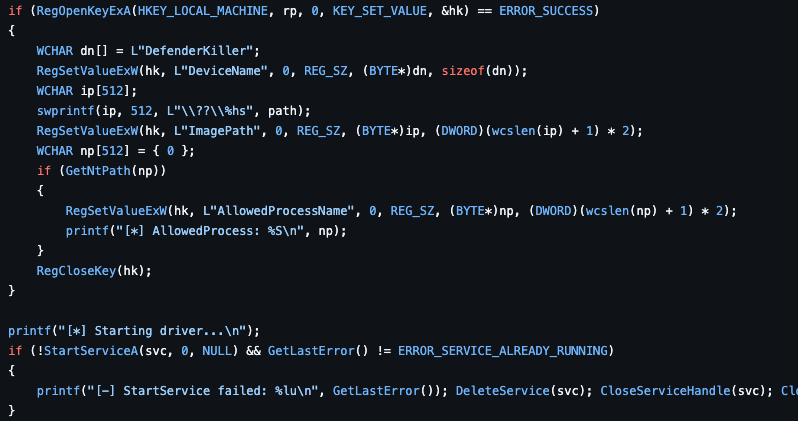
Following publication of the original POC, Flashpoint analysts identified 13 publicly available samples incorporating the DefenderKiller technique, including obfuscated versions. These findings indicate that the original code has been modified, although the available evidence does not establish whether the samples have been deployed in confirmed intrusions.
The findings illustrate how Bring Your Own Vulnerable Driver (BYOVD) techniques can exploit legitimate, digitally signed drivers to interfere with endpoint security. KSLDriver relies on process authorization checks that can be bypassed through manipulation of registry-controlled information, while remaining loadable on the latest version of Windows 11.
Flashpoint analysts assess that advances in large language models may be contributing to growing interest in BYOVD research and EDR killer development by making user-mode and kernel-mode code development more accessible. Exploitation generally requires administrative privileges to create the services necessary to load these drivers, although attackers may obtain these privileges through local privilege escalation.
Security teams should consider monitoring for unexpected kernel driver installations, changes to driver service configurations, and termination of security processes following driver loading. In particular, modifications to registry values such as AllowedProcessName and ImagePath may provide useful investigative context when correlated with suspicious service creation or driver activity.
The following artifacts were identified during Flashpoint’s analysis and may support threat hunting and further investigation.
| Artifact | Value |
| DefenderKiller service | DefenderKiller |
| DefenderKiller service registry key | HKLM\SYSTEM\CurrentControlSet\Services\DefenderKiller |
| Microsoft driver | KSLDriver.sys (1.1.0013.0) |
| Microsoft driver SHA-256 | d5764d24e78914ab2a9db6b24e323342d0b37998f43add1a9e49b00992b0d645 |
The presence of these artifacts should be evaluated in context, as legitimate software may use some of these components.
The discovery of vulnerable drivers beyond those targeted by publicly available EDR killers highlights the need for continued research into the techniques used to disable endpoint defenses. The public release of DefenderKiller, along with the emergence of modified variants, highlights the need for continued visibility into defense evasion techniques and the vulnerable drivers that enable them.
Flashpoint continuously monitors emerging threats and adversary techniques, combining primary source intelligence with technical research to help organizations understand how threats are evolving. Request a demo to learn how Flashpoint can help your team identify emerging threats and strengthen its defenses.
Source: Flashpoint · 2026-10-29
 Argentina
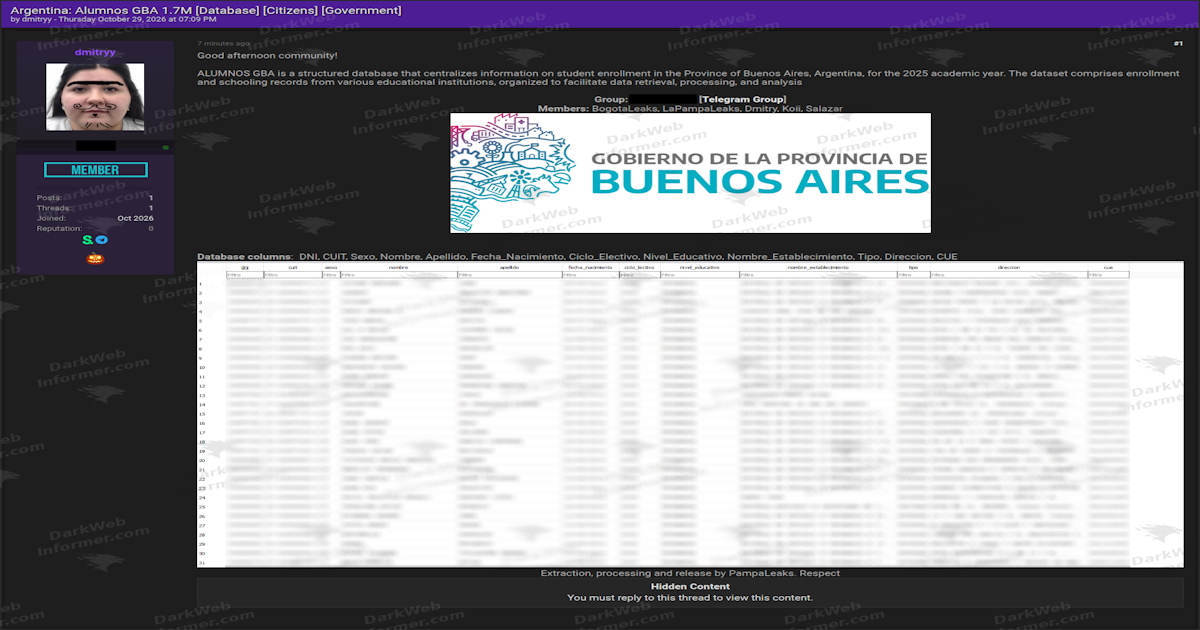
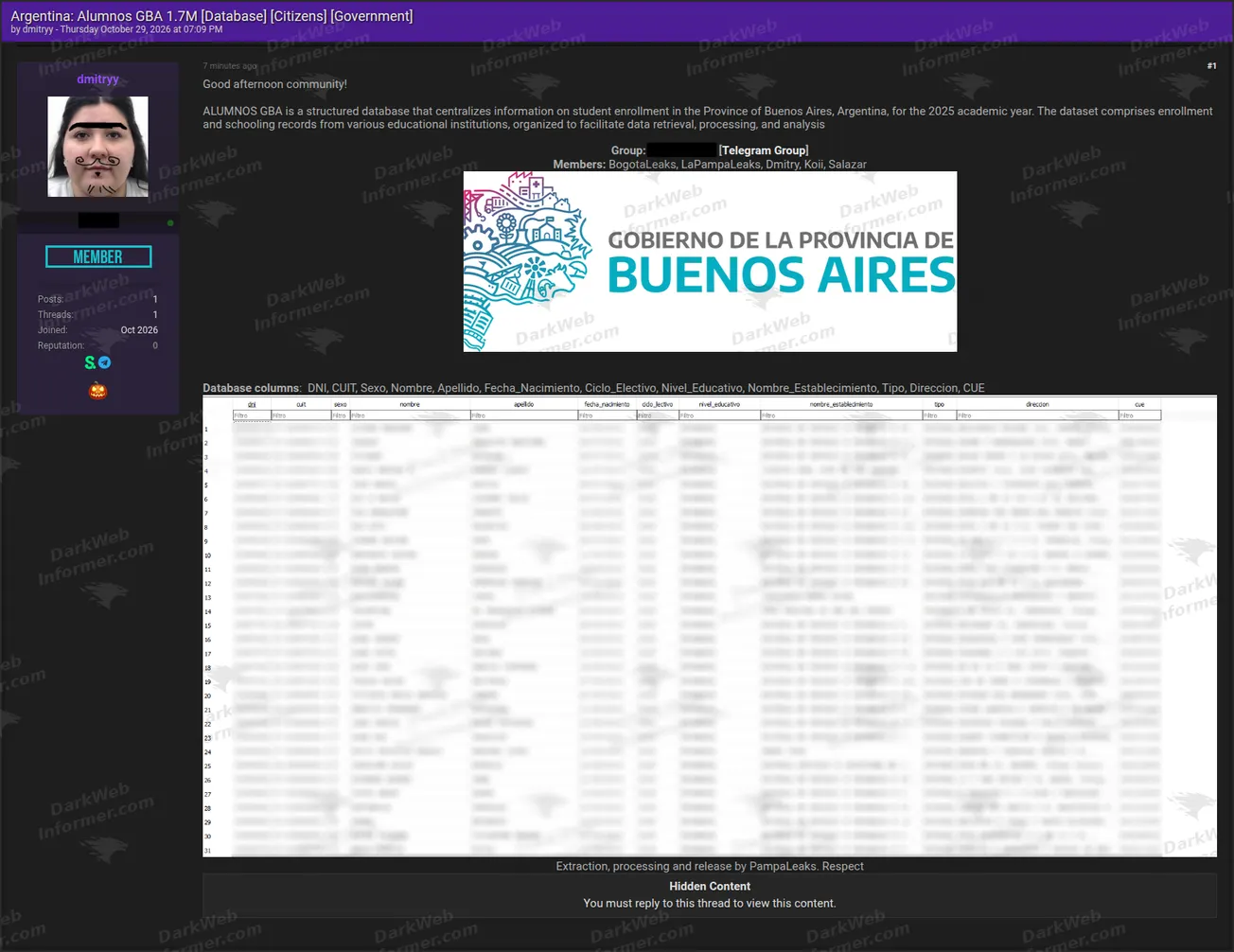
An actor using the handle “dmitryy” claims to have released a database called ALUMNOS GBA, described as a structured dataset containing student enrollment information from the Province of Buenos Aires, Argentina, for the 2025 academic year.
The post advertises approximately 1.7 million records and says the dataset centralizes enrollment and school records from multiple educational institutions. The visible columns include DNI, CUIT, sex, first name, last name, date of birth, academic year, education level, school name, institution type, address and CUE. The dataset, its source, the claimed volume and current availability have not been independently verified.
ArgentinaThe visible sample contains student identity information and school-enrollment details. Individual student names, DNI/CUIT values, dates of birth, school names and addresses shown in the screenshot are not transcribed in this report.
Identifiers directly visible in the supplied material. These support correlation and do not independently verify the dataset claim.
| Type | Identifier | Source |
|---|---|---|
| Actor handle | dmitryy |
Screenshot 1 |
| Group | PampaLeaks |
Screenshot 1 |
| Named organization | Gobierno de la Provincia de Buenos Aires |
Screenshot 1 |
The screenshot references PampaLeaks as a Telegram group and lists several member handles. Those names are not expanded here because they are not necessary to describe the exposed student dataset. No malware hash, Tox ID, Session ID, attacker-controlled domain or attacker-controlled IP address is visible in the supplied material.
Claimed identifies behavior explicitly described by the actor. Inferred identifies an analytical mapping supported by the supplied material. Neither label means the activity has been independently verified.
If authentic, the claimed dataset could expose student names, national identifiers, dates of birth, sex, education level, school names and school addresses at very large scale. Because the sample visibly includes school-age students, the exposure could create heightened risks of identity fraud, targeted phishing, impersonation, harassment or other privacy-related abuse.
Dark Web Informer has not independently verified the dataset’s authenticity, source, completeness, approximate 1.7 million-record count, sample contents or current availability. The supplied screenshot documents the listing and visible sample rows, not independent confirmation of the underlying database.
Source: Dark Web Informer · 2026-10-29
The GOLD OGRE threat group has used AI extensively to develop tools and to orchestrate and execute ransomware operations
Categories: Threat Research
Tags: AI, Ransomware, Aur0ra
Source: Sophos X-Ops Threat Research · 2026-10-29
 Egypt
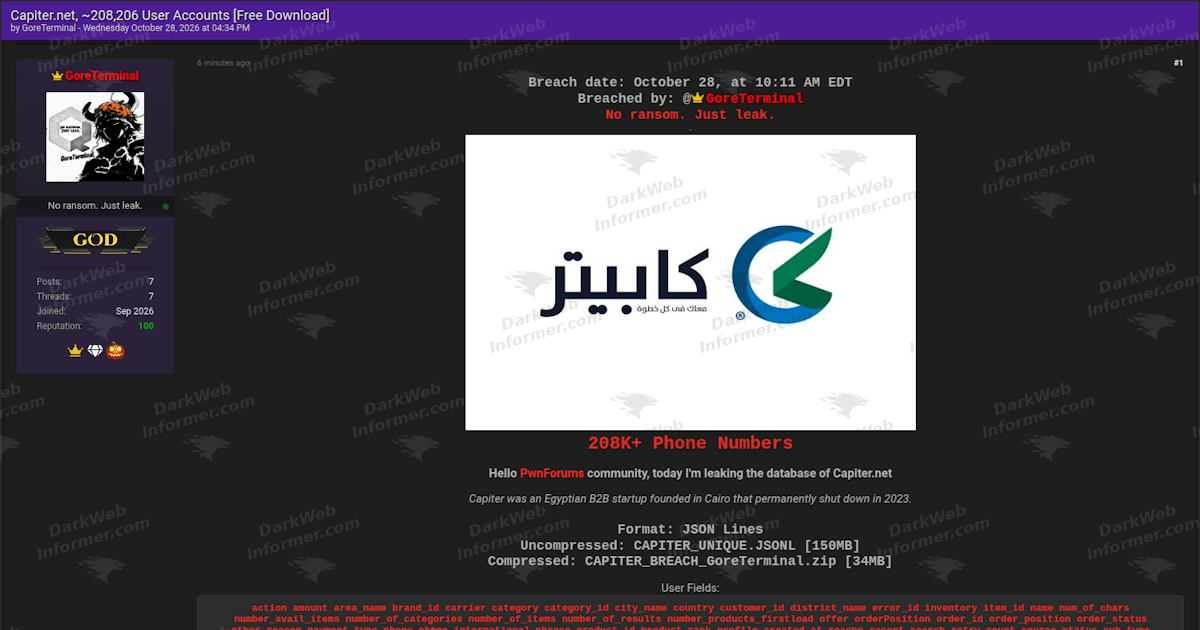
An actor using the handle “GoreTerminal” claims to have leaked a Capiter dataset containing approximately 208,206 user accounts. The post describes Capiter as an Egyptian B2B startup founded in Cairo that permanently shut down in 2023.
The actor states the breach occurred on October 28, 2026 at 10:11 AM EDT and characterizes the release as a leak rather than a ransom event. The archive is described as JSON Lines, with an uncompressed file named CAPITER_UNIQUE.JSONL at 150 MB and a compressed archive at 34 MB. The visible schema includes phone numbers, international phone numbers, customer IDs, country, carrier, city, district, area, order and product metadata, payment type, inventory data and profile timestamps. The dataset, its source, the stated counts and current availability have not been independently verified.
EgyptThe sample shown in the source material contains structured customer and transaction-related records. Individual phone numbers, customer identifiers and other personal values visible in the sample are not transcribed in this report.
Identifiers directly visible or supported by the supplied material. These support correlation and do not independently verify the breach claim.
| Type | Identifier | Source |
|---|---|---|
| Actor handle | GoreTerminal |
Screenshots 1–2 |
| Named organization | Capiter |
Screenshots 1–2 |
No organization domain, malware hash, Tox ID, Session ID, Telegram handle or attacker-controlled IP address is visible in the supplied screenshots. Personal identifiers shown in the sample are not included in this table.
Claimed identifies behavior explicitly described by the actor. Inferred identifies an analytical mapping supported by the supplied material. Neither label means the activity has been independently verified.
If authentic, the claimed dataset could expose mobile phone numbers, customer identifiers, location information and transaction-related metadata for more than 200,000 accounts. The combination could support targeted phishing, SMS abuse, impersonation, profiling or other customer-focused social engineering.
Dark Web Informer has not independently verified the dataset’s authenticity, source, completeness, 208,206-account count, archive sizes, sample contents or the actor’s claimed October 28 breach time. The supplied screenshots document the listing and visible sample records, not independent confirmation of the underlying data.
Source: Dark Web Informer · 2026-10-28