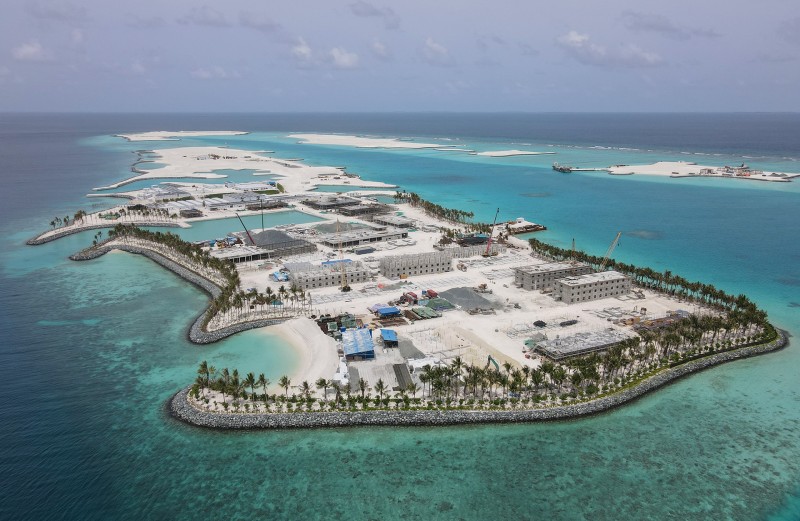
Once an isolated haven for scuba divers searching for technicolor marine life, the shallow turquoise waters of the Noonu Atoll in the Maldives are in the midst of a makeover.
A fleet of dumper trucks, excavators, forklifts, and cranes has moved into the habitat for protected parrot fish and nurse sharks to sculpt 25 artificial islands and islets from over six million cubic metres of sand dredged from the seabed.
Known as Project Ayla, the $790 million private development will host over 70 luxury dwellings and represents the vanguard of a new government strategy to lure the high-net-worth crowd to the debt-saddled nation.
A view of the main worksite island for Project Ayla in July 2026. CREDIT: Hassan Moosa/Maldives Independent
Yet beyond the plumes of coral-smothering sediment churned up by the dredgers, opposition politicians and transparency advocates are warning of an even murkier threat: the prospect of a new international tax shelter and potential money-laundering hub carved from the ocean floor.
The Maldives’ constitution bars foreigners from owning land, but in this new Special Economic Zone (SEZ), outsiders will be allowed to purchase a long-term lease of 99 years on a slice of the synthetic paradise, while avoiding or paying reduced rates on many local taxes including capital gains and import duties.
Under the country’s SEZ law, zones like Project Ayla are also able to host offshore banks authorized to provide services for trusts — vehicles known for helping the wealthy hide assets. Disclosing the ultimate beneficial owners of the banks’ customers — or the banks themselves — will be illegal without a court order or the owner’s consent.
For the Maldives’ former Information Commissioner Ahmed Ahid Rasheed, this lack of transparency creates “a significant accountability gap.”
The country’s SEZ framework should include publicly searchable registers for beneficial ownership and land ownership inside the zones, he told OCCRP’s partner the Maldives Independent.
“There is no principled reason that these [pieces of] information should not be publicly accessible. Us citizens have a right to know who is buying property in our country.”
The Asia/Pacific Group on Money Laundering (APG), a regional watchdog, has already flagged concerns that the Maldives lacks clear regulations for trusts, and cites the government’s own risk assessment that its real estate sector is “highly vulnerable” to money laundering.
Compounding the concern is the rollout of a new residency by investment scheme known as the Maldives Pearl Residence program, which will allow foreigners to purchase residency in exchange for a minimum investment that has yet to be announced.
These types of “golden” visa and passport schemes are notoriously vulnerable to misuse by those seeking to launder illicit proceeds, conceal assets, evade law enforcement, or facilitate further criminal activity, according to the global watchdog Financial Action Task Force.
“The balance ultimately depends on the programme’s design and oversight, as well as the strength of the jurisdiction’s wider legal, regulatory and institutional framework,” a spokesperson for the FATF secretariat told reporters in a statement.
Fayyaz Ismail, a former economic minister and opposition politician in the Maldives, said he worried whether the government would be able to keep the wrong people from gaining residency.
“What I’m concerned about is whether the safeguards are in place or not,” he said.
When reached for comment, the Maldives Ministry of Economic Development said the visa program “remains subject to completion of the legislative and regulatory framework,” and was being “developed with a robust multi-layered due diligence framework incorporating international screening, financial and reputational assessment, and screening by relevant government national security and regulatory agencies as part of the due diligence process.”
In response to questions about the risk that Project Ayla could attract various forms of illicit finance, the ministry said the zone “remains subject to the SEZ legal framework and all other applicable laws,” including anti-money laundering and counter-terrorism financing requirements.
Islands from Nothing
Maldives’ President Mohamed Muizzu — whose office did not respond to requests to comment — has touted the new residency and investment programs as much-needed boosts for a country looking to escape severe fiscal distress.
Indeed, the Maldives currently faces the world’s eighth-highest gross debt burden relative to the size of its economy, which the International Monetary Fund projects will reach around 130 percent of its gross domestic product this year.
Economic Development and Trade Minister Mohamed Saeed has cited estimates that the residency scheme could bring more than $1 billion into the country “in direct and indirect inflows” over an unspecified time period.
“Our residency by investment framework, much like the pearl on a string, that program connects large-scale investment and development with long-term residency,” he said during a speech at Project Ayla’s groundbreaking ceremony in January this year.
The drive to bring in foreign residents comes amid a broader land reclamation boom in a country that faces both a burgeoning population and rising sea levels.
Around 80 percent of the Maldives’ nearly 1,200 islands sit less than one meter above sea level, making it one of the most vulnerable nations to climate change.
Nearly half of its population of just over half a million people are packed into the capital city of Malé, a small island that is only two square kilometers in size.
The government has spent recent years expanding existing islands and building brand new ones to ease overcrowding. There are plans to connect one future artificial island city, Ras Malé, to the capital via an undersea tunnel featuring what the president’s office has called a “railway on which tourists can observe the underwater beauty.”
Tourism has followed the same path. Since 2019, developers have begun opening up artificial island complexes that host a mix of hotels, shops, and entertainment at a scale impossible on smaller, naturally occurring islands.
But with the exception of a handful of leasehold villas built on some resorts, existing developments have left little room for foreigners to call the Maldives home – until now.
Some Maldivian politicians are trying to push back. In July, opposition lawmaker Ahmed Shamheed filed a resolution calling for the Maldives Pearl Residence program to be immediately suspended and to disclose all related agreements. (His resolution was rejected by parliament in August.)
The lawmaker also fears SEZs like Project Ayla could effectively become miniature states within a state.
“Money laundering, terrorism financing, and what they do with banks set up there, we don’t know any of this. We have very few resources in the Maldives. We’re talking about billionaires, and we wouldn’t know if the world’s big mafia gangs come and operate there,” Shamheed told reporters.
“And this is just one city — apparently many such cities are to come.”
Azza Mohamed, a governance manager at Transparency International’s Maldives chapter, said the SEZ push is raising fears authorities could recreate the same sort of permissive conditions that led to a massive corruption scandal a dozen years ago.
That scandal, investigated by OCCRP, saw senior politicians improperly lease islands to tourism developers in 2014 and 2015, while pocketing tens of millions of dollars in proceeds.
Avoiding a similar fate “would require full transparency over beneficial ownership, genuinely independent oversight of procurement and approvals, and enforcement systems that can trace, freeze, and recover illicit funds, including across borders,” Mohamed said.
Meanwhile, precisely who is financing Project Ayla is unknown.
The project is being developed by the local entity Crystal Holdings Private Limited, which holds the SEZ permit, and the Dubai-based BluRock Group, both of whose underlying investors, equity partners, and ultimate beneficial owners are not made available to the public.
Crystal Holdings and BluRock did not respond to reporters’ requests for comment.
‘Sovereign Portfolios’
The new residency by investment program will be developed and implemented by the Maldives government and Henley & Partners — a passport brokerage firm that has left behind a string of scandals in other island states.
In the Caribbean nation of St. Kitts and Nevis, for instance, an OCCRP investigation found that Henley & Partners had facilitated applications for passports for nearly a dozen figures including high-profile politicians and alleged criminals and fugitives.
When reached for comment, Henley & Partners said there was “no factual basis for treating a collection of historic and disputed allegations concerning different jurisdictions and periods as evidence, or as a way to wrongly infer that due diligence under the new Maldives Pearl Residence programme will be inadequate.”
The firm “takes its due-diligence responsibilities extremely seriously,” and previous allegations against it “have been addressed in detail and proven wrong,” the company added.
Its role in the Maldives’ program will be to “support application processing, administration, and the preparation of recommendations,” while the Maldives government will decide on applications, the company said.
Henley & Partners, whose chairman Christian Kälin has been dubbed the “Passport King,” has famously made a business out of helping countries looking for novel revenue streams draft the legal framework and marketing for golden visa and citizenship schemes.
The practice allows the wealthy to collect what the company calls “sovereign portfolios” by shopping for the best “residence rights, citizenship options, business interests, and assets across multiple jurisdictions.”
While the business is legal, critics say the schemes are ripe for abuse, providing an offramp for the criminal and corrupt to hide offshore assets and undermine tax transparency.
“Criminal exploitation of citizenship and residency programmes is a multi-billion-dollar business to launder the proceeds of fraud and corruption, evade justice, or access third countries,” OECD Secretary-General Mathias Cormann said in 2023 alongside the release of a report into the risks associated with such programs.
The European Parliament has further warned about potential conflicts of interest when the same private firm that advises governments on these schemes is also tasked with preparing applications.
In the face of such criticism, Henley & Partners has previously defended its programs as robust enough to fend off risks like money laundering, corruption, and tax evasion, and argued that they deliver significant economic and social benefits to the host countries.
Though both golden visas and passports come with risks, Kristin Surak, the author of the book “The Golden Passport: Global Mobility for Millionaires,” noted that the stakes are lower with residency schemes because such visas are not often inheritable or as “sticky” as citizenship status.
“Visas can be revoked, they’re not passed down in the family, and they bring a more limited range of possibilities,” Surak said.
The Maldives Ministry of Economic Development told reporters that the Pearl Residency concept was pitched to the government by Henley, has since been formalized as a “private sector initiated proposal,” and that the regulations governing the program are still under development.
In near-identical language, Henley described the ongoing development of “a multi-layered due diligence framework incorporating international screening, independent background verification reports, financial and reputational assessment, together with screening by the relevant Maldivian national security and regulatory authorities.”
‘Irreversible Harm’ to Marine Life
As Project Ayla lurches ahead, environmentalists and civil society organizations warn that such land reclamation schemes are already causing widespread damage.
The dredging of sand from the seabed kills “the ecosystem in its entirety” and causes “irreversible harm” to marine life, said Humaida Abdul Ghafoor, an environmental activist with the Save Maldives campaign.
“It also changes the currents, water movements, the hydrology. It also generates sediment, which becomes a killer,” she said.
In a podcast series produced by the president’s office, President Mohamed Muizzu said the government’s goal is to ensure essential works such as land reclamation have a minimal impact, and are balanced with environmental programs like coral spawning and planting.
“We want to carry out development intertwined with the environment. We are shaping the future of our nation, and in doing so, we want to protect our environment and become an example for other nations,” Muizzu said.
Source: OCCRP · 2026-10-14