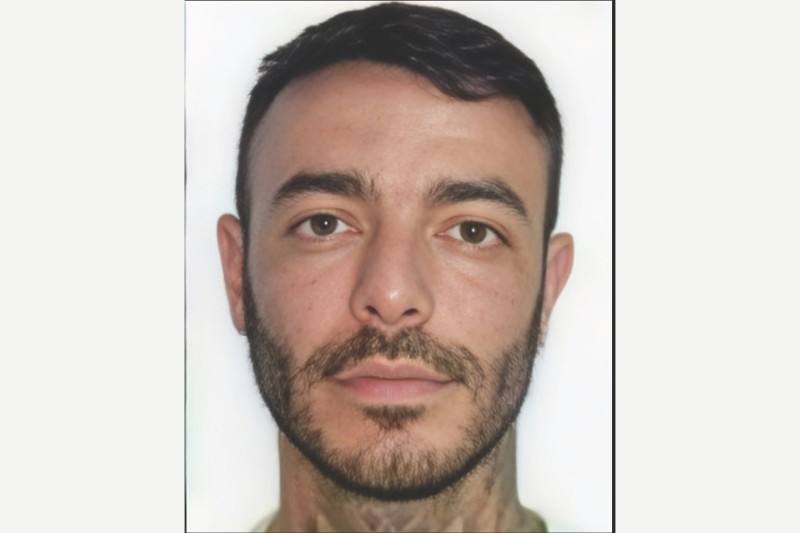
Sebastián Marset, an accused South American drug lord, appears headed for a January jury trial after a federal judge in Virginia this week rejected multiple efforts by the defense to dismiss charges.
U.S. District Judge Rossie Alston Jr. on Tuesday rejected arguments from Marset’s lawyers that the Uruguayan national was being subjected to a vindictive prosecution and misconduct by prosecutors.
Marset’s defense team had argued their client’s Miranda rights, which protect against self-incrimination, were violated when agents from the Drug Enforcement Administration interviewed him without a lawyer present.
But the judge held that Marset had initiated some of the conversations after his arrest in southern Bolivia and was not coerced into talking with DEA agents during his expulsion to Peru and subsequent transfer to the United States and custody in Virginia.
The judge also rejected the defense’s “fruit of the poisonous tree” motion that asserted that evidence should be excluded because it was obtained improperly.
“In short, the Government has met its burden to demonstrate that there was no Miranda violation and, thus, there is no basis to suppress Defendant’s statements,” the judge said in his 23-page ruling. “Moreover, there is no basis to suppress any physical evidence collected as fruit of the poisonous tree.”
In rejecting Marset’s allegation that his rights against self-incrimination were violated, the judge added in a footnote that there was “no evidence in the record” to support the Uruguayan’s assertion that DEA agents asked him to “donate” his crypto currency, an accusation the lead DEA agent denied under oath in a recent pre-trial conference.
Marset, who was known as the King of the South, was arrested in a pre-dawn raid in Santa Cruz, Bolivia, in March and expelled to Peru and then sent to the U.S. with the assistance of the DEA. He was initially charged with money laundering counts, but was later indicted on drug trafficking and narco-terrorism charges.
Prosecutors last week asked the judge to admit as evidence in the case intercepted messages and documentation of alleged payoffs made by Marset to officials in Uruguay, Paraguay, Bolivia, and Venezuela.
Defense attorneys have alleged that the Justice Department was vindictive in its arrest and prosecution of Marset and that prosecutors engaged in misconduct, but Judge Alston held Tuesday that the prosecutors “are seasoned litigators whose professionalism and ethics are well-known to the Court.”
The judge added that “nothing about the manner of the arrest as described by the parties, ‘shocks the conscience.’”
Marset’s defense team did not respond to requests for comment.
Photos and videos have circulated online showing a shirtless, tattooed Marset in the back of a police car in Bolivia with a red face. He alleged in court that Bolivian police put a bag over his head that caused him to lose consciousness.
Videos from Marset’s arrest sparked a sweeping purge of high-ranking officials in Bolivia, just 48 hours after the U.S. State Department announced visa restrictions targeting Bolivian political and judicial officials over allegations of high-level corruption and illicit drug ties. Weeks later, even more Bolivians were hit with U.S. visa restrictions.
Last week’s filing by prosecutors, which has not yet been decided on by the judge, alleges that Marset’s bribes “allowed the defendant to receive drug trafficking files from Bolivian law enforcement, to evade capture operations, and to receive notice of DEA meetings with Bolivian officials.”
Judge Alston’s Tuesday ruling leaves Marset’s case on track for a scheduled jury trial to begin Jan. 11th. The judge has yet to rule on the prosecution’s efforts to introduce bribery evidence and testimony from alleged co-conspirators. Also pending is a defense request to dismiss evidence obtained from encrypted messages from the now-defunct Sky Global network.
Source: OCCRP · 2026-11-18