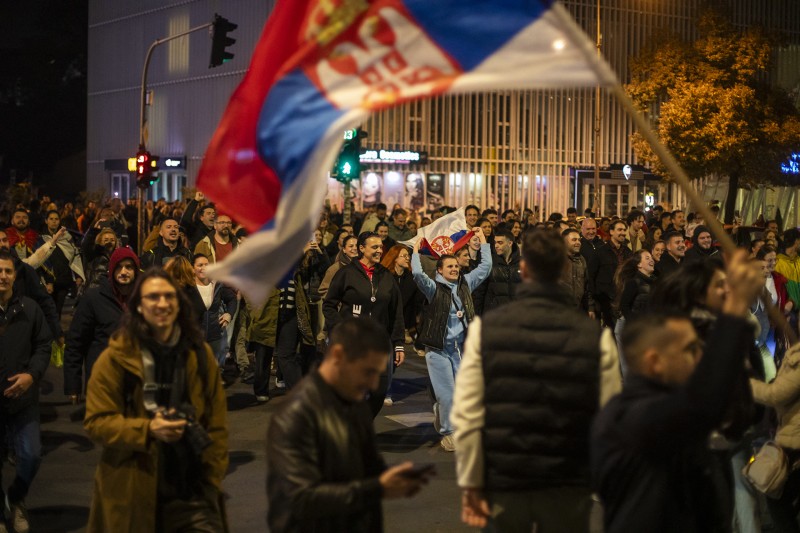
A new political party organized by student protesters made history last month when it ousted Serbia’s longtime leader Aleksandar Vučić at the polls, ending his party’s 14-year stranglehold on power.
Long seen as immovable, Vučić was defeated by students who managed to rally support from across the country around a central, unifying goal: freeing Serbia’s institutions and economy from the corruption that flourished under the rule of his Serbian Progressive Party (SNS).
Their electoral victory was decisive and undeniable. But dismantling the former regime’s networks of influence will not be easy. Serbia’s democratic credentials deteriorated under Vučić, with the leader and his party accused of cultivating extensive patronage networks inside the country’s judiciary, security forces, media, and private sector.
The students, whose leaderless protest movement selected a range of political novices to represent them in parliament under the banner of the “Student List,” have vowed to restore independence to state bodies and end impunity for the corrupt.
OCCRP spoke to Tena Prelec, an assistant professor at the University of Rijeka who has researched corruption and kleptocracy in the Western Balkans, about the opportunities and pitfalls that await the incoming government, and how they should balance calls to prosecute corruption in the past with plans to steer Serbia towards a more democratic future.
Let’s start with what the incoming government will be inheriting after 14 years of domination by the SNS party. Vučić and the former ruling party are accused of “state capture” — a term used to describe a type of systemic corruption in which elites amass influence over key institutions or oversight bodies, and rewrite the rules of the game to their own benefit. What has state capture looked like in Serbia?
So after nearly 15 years, we have a situation in which you don’t have only corruption within individual institutions, but it’s really a system in which political loyalty but also public resources and private interests are deeply, deeply intertwined. And so there has been this capturing at the level of the state, but also in some sense a societal capture too, because the extent to which everything has become interconnected is really deep in Serbia.
The important thing for the incoming government will be to dismantle the mechanisms of state capture without simply replacing one set of loyalists with another. Now, the positive aspect of this great change at the elections, this really remarkable achievement that very few thought was possible — that a leaderless movement would manage to get to such a convincing electoral victory despite the state capture mechanisms at the level of electoral manipulation — is that the incoming government will have a mandate to dismantle state capture because this is what unites all the voters who voted for the Student List. They want a renovation, they want a different Serbia.
They [the Student List candidates] all focused on the aspects of governance, on the rule of law, and so on and so forth. And that’s also why in their program you won’t see so much about issues related to foreign policy, for instance, but you had a lot of focus on basically dismantling these mechanisms and giving Serbia a fighting chance for a democracy at some point down the line.
Which parts of Serbia’s captured state do you think could present the biggest challenge to the incoming government? Do you expect SNS to maintain loyalties in some of these areas that could complicate the newcomers’ efforts to pass reforms?
The ruling party has definitely been embedded in a number, if not all, areas of society. Clearly the entrenched networks in Serbian society are very strong and the incoming government will be subject to huge pressures from these sectors and others. So this should not be underestimated.
On the other hand, what we’re seeing now is that things are changing quite quickly. There is quite a big momentum of change. And it seems that quite a lot of people who were close to the regime have been trying to jump off the boat even before being given a clear signal that they should leave, or before being fired.
So now there is a window of opportunity and it’s very crucial to act quickly because otherwise these pressure groups might regroup and mount even a bigger challenge to the student movement.
I would distinguish three particularly different areas in terms of dismantling state capture. One is the security services and the police. This is potentially the hardest because of the institutional secrecy, the hierarchies, the access to sensitive information, and so on and so forth. But we’re seeing even here recent arrests that are an encouraging signal of things happening maybe even faster than many people have thought.
A second particularly difficult area will be the judiciary and prosecution. We know that vetting the judiciary and generally a renovation of the whole judicial apparatus is something that is very difficult to do. It can be done, but it often takes a long time, and there are entrenched interests here too.
A third area I would also highlight are public enterprises and procurement, and this is perhaps the most underestimated challenge. Because this is where patronage connects to money but also employment, private sector beneficiaries, and also foreign investors, and so on and so forth. So these networks tend to survive a change of government. They’re quite difficult to dismantle.
But as I said, the speed of change is very remarkable in these first days after the elections. You’ll have seen that some media personalities and even whole editorial teams have resigned before even being asked to resign. So you can see that the challenge is immense, but the momentum is big too.
How should the incoming government balance a desire to right the wrongs of the past with their ambition to reshape Serbia for the future?
Both are important. History is important and the future is important because if you don’t deal with the history of state capture, you risk relapsing into it. And Serbia has already already been through this after the changes that happened in October 2000 and this opportunity for a different paradigm. Unfortunately, there has been this relapse. So they know now that these mistakes shouldn’t be repeated.
On the other hand, it’s also important to immediately show that this is a new paradigm with a new generation. And this is so clear to everybody: That the old generation is on its way out, and that this is the upcoming generation that is behind this big change. And crucially, I mean it’s not even the ones who might be seated in parliament that are driving it — it’s really those students, those who are the youngest in society. So a different paradigm is here.
And the focus on the future is intrinsic within this moment. I would mention the great opportunity that Serbia has to reactivate vast portions of society who have been unable to participate in change and in building their institutions so far because they’ve been sidelined, because the machinery of state capture didn’t allow them to be part of decision making, of giving input to what was going on. Well now the political will is there to reactivate them and Serbia has a wealth of knowledge and of skill inside the country, in think tanks, civil society, academia, and so on and so forth, but also outside the country in the diaspora, where a lot of people have moved because they didn’t agree with the rules of the game in Serbia. Well, now they can participate in rewriting these rules of the game themselves.
Serbia’s trajectory has often been compared to that of Hungary’s, where one of Vučić’s political allies, Viktor Orbán, was also recently ousted at the polls after a long run in power that saw his party bend the country’s institutions and media to its will. What can Serbia learn from Hungary?
There are big similarities between Serbia and Hungary. We’ve seen how the [former] leaders of these two countries have gotten along very well in many respects, in their modus operandi, in their countries, but also with international deals, on the other hand, have learned from each other for a long time. So the similarities are there, but the ways in which this change has happened at the ballot box are quite different. In Hungary, there has been a much more conventional type of party structure and approach with a clear leader, Péter Magyar, and his party, Tisza. So the challenge in front of the Student List is different. They will now have to change the way that they’ve been operating, which so far has been very bottom-up, and they will have to insert a bit more hierarchy in what they’re doing.
At the same time they have, I think, the confidence that the innovative methods through which they’ve approached deliberation and really a new way of doing democracy have worked despite the odds, despite what many critics would have said. So there is an opportunity to insert into political life some of these innovations that have already shown [to be successful].
One aspect that I would also highlight in terms of whether the Student List and the new government makes it or not is to manage expectations well. Because in this moment the hopes they’ve raised are so high among the population that they might, you know, get ahead of themselves and perhaps be exposed to criticism if they don’t make it very clear what they have already said in a way, which is that this government and this experiment is indeed an experiment and the transition from one way of doing things to another.
So they need to keep their eye on the prize, on the goal, which is to frame it over and over again that they are actually engaging in a transition period to give Serbia a chance to do things differently. And if they manage to do that, they will also be less exposed to criticism, for instance, about their values or stances in terms of foreign policy or other areas, because they’ll manage to send a message that what matters now is that their priorities lie in a different field, which is the one related to governance, the rule of law, and the fight against corruption, which should be indeed front and center now.
Your research has focused on the role of “corrosive capital,” which refers to state or private financing that lacks transparency and accountability. One example could be the Chinese-led reconstruction of the railway canopy in northern Serbia whose collapse killed 16 people two years ago and triggered the protest movement that culminated in this recent electoral victory. How should the new government tackle this type of complex and transnational corruption?
So a faux pas that has been made repeatedly in the European Union in particular is their focus on foreign influence in the Balkans. There is no denying that a lot of what has been termed in research and academia as corrosive capital happens between authoritarian countries and countries in regions such as the Western Balkans, and further, it’s not only limited to the Western Balkans.
But we need to be aware of the fact that it’s not only a unilateral one-way approach from the outside. Corrosive capital and transnational corruption is always co-produced, right? So the domestic elites have a key role in providing the basis for this to happen. So that’s why, for instance, the Chinese investments in mining and in other sectors in Serbia have been so corrosive environmentally, also socially, sometimes in work in terms of workers’ rights and so on and so forth. Whereas in Croatia, [a state-owned Chinese company] has just participated in an EU tender and completed a bridge, Pelješac Bridge, within the framework of EU procurement rules, albeit not without controversy. So there is this difference.
Furthermore, in addition to these foreign and internal and domestic aspects, there is also the element of the transnational enablers. To join the dots, there are professional service providers who provide these activities sometimes in big financial centers, in rule of law jurisdictions. So they participate in something which is ultimately a corrosive type of a network with corrosive effects, but from a legal standpoint. So this is a key thing that will be very difficult now to pick apart in a captured state such as Serbia was and still is. Which is the fact that a lot of the corruption will be legal, a lot of it has been legalized, and a lot of it has happened in ways that will not be possible to point at the predicate crime itself.
Investigating this type of transnational corruption while there is political will — by following the money, getting to the bottom of it — is crucial. But another policy solution that my colleagues and I have proposed is the so-called Kleptocratic enterprise, meaning that we need to designate the people who are part of a network committing a crime, or you know a corrupt and illicit activity at the beginning of it, when the source of wealth is still quite visible. Because afterwards, in these many opportunities that the international political economy gives to kleptocrats and other corrupt people, this nexus gets more and more diluted, and therefore we lose sight of what was the predicate crime. Now, this might seem outlandish at first, but actually it has already been put in law, for instance, in Italy, where the mafia laws have allowed law enforcement to gather and to identify the networks that comprise basically a mafiosi structure in a much clearer way and in a way in which law enforcement was able to act upon.
So Serbia now in this moment, in this window of opportunity, will have the incredible, you know, chance to put this in action and to really try to get to the bottom of some complicated issues and complicated international scandals, and it should take it.
Source: OCCRP · 2026-11-16