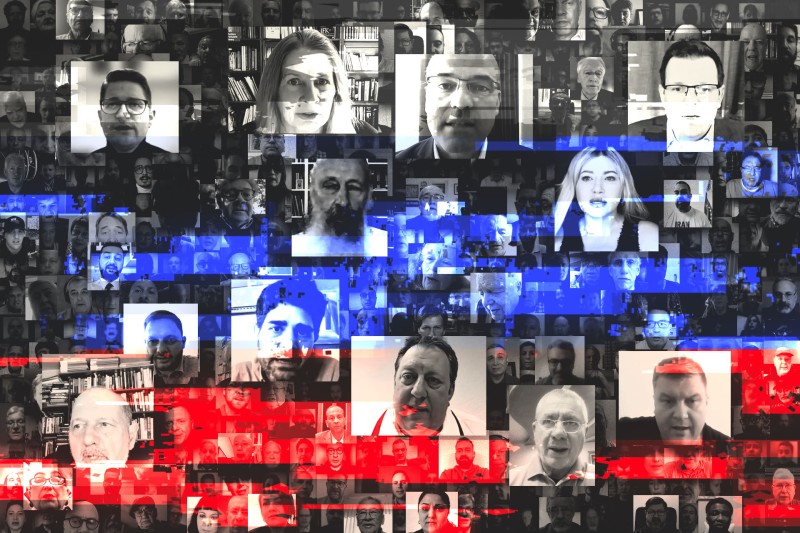
OCCRP and Delfi Estonia reviewed the videos and found that the men and women interviewed hail from more than 50 countries and span a wide range of personalities, from a French farmer to a Finnish conspiracy theorist to scores of former European and U.S. officials, including elected lawmakers and former high-ranking military officers from NATO countries.
Many are known for pro-Russian views and were interviewed on topics such as NATO, Ukraine, and the internal politics of countries like the U.S., Germany, and France.
According to researchers and authorities in the U.S. and Europe, Doppelgänger is one workstream in a broader digital propaganda effort run by the Social Design Agency (SDA), a sanctioned Russian PR firm, and other affiliated organizations that work closely with the Russian Presidential Administration, such as ANO Dialog, a sanctioned non-profit created by the Moscow city government.
Several leaks from within SDA have already laid bare the scope and sophistication of its influence campaigns, with goals that include “deepening internal contradictions between ruling elites” in Western countries and “stimulating protest activity among [their] opposition forces.” Another internal document, cited by the FBI, described a plan to “use a wide range of information tools” to “influence real life conflicts and artificially create conflict situations” in countries allied with the United States.
SDA is also known to have monitored thousands of “opinion leaders” across the world. A leaked internal meeting note from 2022 cited by the FBI stressed: “We need influencers! A lot of them and everywhere. We are ready to wine and dine them.”
OCCRP reached out to more than 60 people interviewed for Doppelgänger sites to understand how they were approached and by whom. Most did not respond to the questions or said they could not recall who arranged the interviews. But the small number who did helped provide a rare look into how the operation works.
As it turns out, not all of the people behind Doppelgänger were Russian. For instance, several interviewees said they were contacted by Brazilian followers of ultra-nationalist Russian ideologue Alexander Dugin, who rejects Western liberalism and promotes a vision of a world order led by dominant “civilizations” — including a Russian one — as opposed to individual nation states.
Several other figures were contacted over social media by a young man who described himself as a journalist, though OCCRP could find no record of his journalistic work.
“I think your vision of the geopolitical situation is very deep and interesting,” reads a WhatsApp message he sent in June 2024 to Matthew Gordon-Banks, a former U.K. parliamentarian who later advised governments like Kuwait, Bahrain, and the UAE.
Gordon-Banks told OCCRP he spoke to the self-described journalist on three occasions. In total, he is cited in more than a dozen articles featured on websites associated with the Doppelgänger project, covering topics like instability in Western countries and alleged plans by the U.S. to “move on” from supporting Ukraine.
Gordon-Banks told reporters he does not “deliberately take part in propaganda operations for anyone” and that he “would always comment on any matter relating to Russia from my own experience, which is now some 40 plus years.”
SDA, ANO Dialog, and Russia’s presidential administration did not respond to requests to comment.
A Modern Model of Russian Propaganda
The effectiveness of the Doppelgänger campaign has been disputed by researchers, who suspect companies like SDA have inflated figures purporting to show its reach.
Yet there is little doubt that the effort was ambitious and well-resourced.
The hundreds of interviews apparently carried out as part of the project capture the “vast nature” of the influence campaigns tied to SDA and affiliated actors, said James Pamment, the director of the Lund University Psychological Defence Research Institute and a co-author of a 2025 report on Doppelgänger.
These campaigns represent a newer model of Russian propaganda, carried out not by state media or intelligence agencies but by a multi-million-dollar industry of organizations that seek funding from the Russian state, according to the report.
Previous leaks show that SDA reports high interaction rates and viewership numbers for its online content, Pamment noted.
“They use amplification bots and basically every other tool possible on every stage to maximize reach,” he said. “But reach doesn’t mean effect.”
According to his research, more than pushing any particular narrative, SDA’s goal has been “penetration of the Western information environment.”
“It doesn’t matter who is the messenger and what is the message, so long as the Russian Federation’s thematic lines seize a share of the marketplace of ideas,” reads his 2025 report.
Keir Giles, an expert on the Russian military, noted that companies like SDA must prove the value of their work to the Kremlin to keep receiving new grants, and that the large volume of Doppelgänger interviews may reflect that incentive.
“When an enormous sum from the budget has been set aside for propaganda, you may need to show you have used all of it,” he said.
Giles and other experts noted that the library of some 500 interviews, which generated some 1,800 articles, includes a number of conspiracy theorists, such as believers in alien abductions.
“A loose grip on reality is a good leverage point,” said Giles. “When you boost conspiracy theorists who say you need to distrust the government — that’s a useful point for Russia.”
Many of those interviewed have also cooperated with the Russian state in other ways, such as serving in election-monitoring missions in occupied regions of Ukraine or giving interviews to Russian state media, he added. “Some of these people may completely be content to be taken advantage of in this fashion.”
For John Sipher, an intelligence and national security expert formerly with the CIA, the ability to collect such a high volume of interviews reflects the current social media environment, in which “we have all become used to having some sort of public profile.”
“The Russians understand this and seek a means to weaponize it for their purposes,” he said.
Dugin Fans from Brazil
Those who conduct the Doppelgänger interviews typically do not appear in the videos themselves, which show only tight headshots of their subjects.
But by speaking with interviewees, reporters learned that in the case of Gordon-Banks and three others, subjects were approached over social media by a young Russian man who went by the name Nikolay Maslov.
In the message he sent to Gordon-Banks, Maslov described himself as a “journalist and producer” and said he was developing a “young German media company with a Russian background.”
The link he shared was for Meisterurian, a German-language news site that was outed for its connections to the Doppelgänger campaign by the FBI, which seized the domain later that year.
Reporters could find no record that Maslov, who lists Moscow as his location on social media, has ever worked as a journalist. In 2022, he submitted a resume to a job portal describing his experience as a KYC analyst in the banking sector. There is no mention of any journalistic training or experience. He did not respond to requests to comment.
Gordon-Banks told reporters he had given at least three interviews to Maslov over the years, and that he believed his interlocutor was “a financial analyst based in Moscow who very infrequently undertakes some video interviews to maintain his English.”
Several Doppelgänger interviewees pointed to a different set of intermediaries: Brazilian followers of Dugin, the sanctioned Russian ideologue who has built a fanbase among the international far right.
Five said their conversations were set up or conducted by Raphael Machado, the leader of the Brazilian chapter of New Resistance, a transnational neo-fascist movement inspired by Dugin’s ideology. According to the U.S. State Department, New Resistance has deep connections to Russia’s disinformation and propaganda ecosystem.
Among the interviews Machado conducted was one with Simona Mangiante Papadopoulos, the wife of a former aide to U.S. President Donald Trump’s 2016 campaign. In the interview, parts of which are quoted in a March 2026 article on the French-language propaganda site Phrygien, she disparages Europe’s economic prospects and describes them as the consequences of turning away from a more “dynamic” Russia.
When reached for comment, Mangiante Papadopoulos told OCCRP that she did not recognize the French site and did not knowingly collaborate with the Doppelgänger campaign. After OCCRP shared the videos of her interview, she recalled that Machado was the man with whom she had spoken. Machado did not respond to requests to comment.
The Brazilian also organized interviews with at least four other subjects in the U.S., U.K., and Canada, according to the interviewees OCCRP spoke with and a source familiar with the conversations. Reporting by the German outlet t-online previously found that he arranged interviews with a French and a Brazilian source as well.
Many of the people interviewed are also associated with Dugin and his ideas. At least 20 attended an online conference in 2023 called the “First Global Conference on Multipolarity” that was co-organized by Dugin and Machado’s New Resistance, among other groups.
Another interviewee, the right-wing Norwegian political figure Christen Krogvig, told OCCRP he was contacted on Telegram by someone using the name Antonio Andreas, but knew nothing else about the person and never saw his face.
OCCRP identified a Telegram account using the name Antonio Andreas that has regularly shared content to a channel dedicated to Dugin. A Brazilian man named Antonio Andreas Pires is also the administrator or owner of several other Dugin fan channels on platforms like Telegram and Facebook, which also regularly share Machado’s content.
On LinkedIn, an Andreas Pires whose photo matches those used in the other social media accounts describes himself as a social media manager of Rossiya Segodnya, a state-owned media group that operates Sputnik and other outlets aimed at an international audience.
Andreas Pires did not respond to requests for comment.
According to Krogvig, “Antonio Andreas” sent a list of written questions on topics such as German aid to Ukraine and German public opinion on buying Russian gas and asked Krogvig to record his answers on video himself.
“How do I know what Germans prefer?” the Norwegian recalled wondering at the time.
Yet he recorded the video anyway and his comments were subsequently used in articles on Doppelgänger’s German-language website Östlicher Wind.
“Merz receives bribes from Zelenskyy,” reads the headline of the article featuring Krogvig’s “insights” on German society.
Moving to Turkey
By June 2026, many of the Doppelgänger websites were found to have gone offline.
Only two appear to remain active, both registered to Turkish domains and continuing to publish interviews with Western and local talking heads.
One of these sites, a Turkish-language website known as Kıtalararası, is run by Mehmet Perinçek, a member of Turkey’s pro-Russian Vatan party who has described himself as close to Dugin’s family and who has also previously collaborated with Machado’s New Resistance. He did not respond to requests to comment.
After RRN was hacked, the brand also started to operate under a Turkish domain, changed its name to Researchers & Reporters Network, and now publicizes a staff of Turkish journalists who have held formal roles in the Vatan party.
“This portal provides reliable information from verified sources. News, analysis, and expert opinions,” a banner stretching across the top of the webpage reads in Turkish.
The Turkish RRN continues to feature interviews with Western political figures, such as the German politician Frederick Broßart, who represents Sahra Wagenknecht’s left-wing party in Lower Saxony.
Journalists first contacted the politician in July 2026 about four of his interviews that had been published by the Doppelgänger-linked German news site Militärblatt. He replied that he would be more “cautious when it comes to interview requests from unknown media outlets and examine much more closely who is behind a request.”
Yet as recently as October 9, he had given an interview to the latest incarnation of RRN, in which he called on Germany to halt arms shipments to Ukraine and end economic sanctions against Russia in favor of diplomatic negotiations to secure peace.
“In retrospect, I must acknowledge that my checks were not sufficiently thorough, despite my previous experience with Militärblatt. I openly admit this,” the politician said after OCCRP reached out to inquire about the latest interview. He added that he had never knowingly cooperated with a Russian disinformation network or supported any related influence operation.
RRN did not respond to requests to comment.
The Nerve (U.K.), de Volkskrant (The Netherlands) and ICJK (Slovakia) contributed to reporting.
Source: OCCRP · 2026-11-10