AI-powered penetration testing is moving from periodic assessments to continuous, autonomous security validation. But before allowing an AI agent to test production systems, organizations must answer a critical question: How do we ensure the testing itself does not become a security incident?
Traditional penetration testing relies heavily on human judgment. Experienced security professionals understand when to stop, which systems are too sensitive to test aggressively, and how to balance vulnerability discovery with operational safety.
Autonomous AI agents are changing this model. They can discover assets, identify vulnerabilities, generate exploit attempts, adapt their strategies based on responses, and investigate attack paths at machine speed. This creates significant opportunities for security teams. Instead of waiting months between assessments, organizations can continuously validate their exposure to real-world attacks.
However, greater autonomy introduces new risks. An AI agent that discovers a vulnerability may also trigger an unexpected application behavior, overwhelm a production service, access sensitive customer data, or move beyond its authorized testing scope.
Finding vulnerabilities is the easier part. The harder question is whether AI can validate them safely in production.
Before deploying autonomous penetration testing, security leaders should ask their vendors the following 15 questions. They focus on one decision: whether an AI agent can be trusted to test live production systems.
CISO Checklist: The 15 Questions at a Glance
All 15 controls confirmed
You asked how safely the AI pentester can operate, and every answer held up. Keep the vendor’s evidence for each control with your Rules of Engagement.
1. Is the Testing Scope Enforced Technically or Just Through AI Instructions?
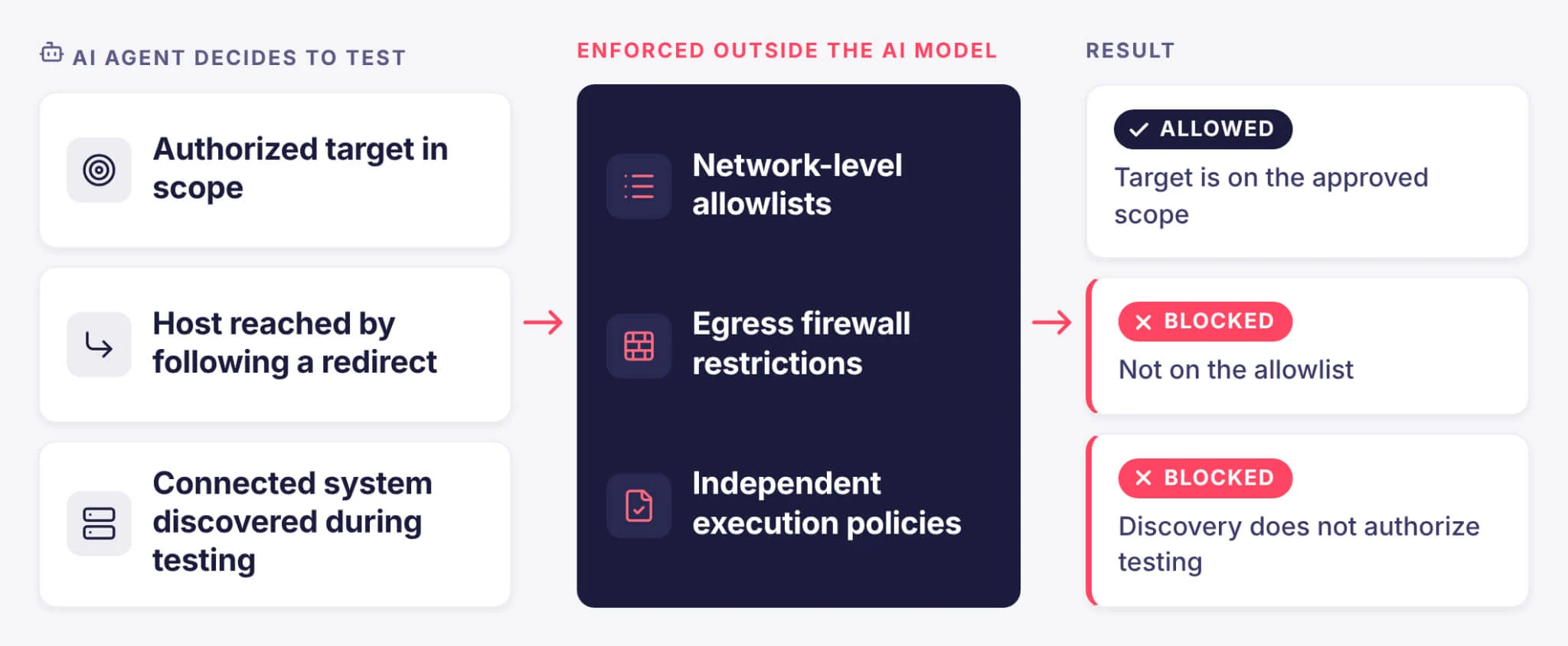
Every penetration test begins with a defined scope. But autonomous agents can dynamically discover additional hosts, follow redirects, identify connected systems, and expand their investigation. A simple instruction telling the AI to stay within scope is insufficient.
A production-ready platform should enforce scope through network-level allowlists, egress firewall restrictions, and independent execution policies. Even if the AI decides to investigate an unauthorized system, the infrastructure must prevent the connection.
What to demand: Demonstrable network-level scope enforcement that operates independently of the AI model.
2. Can the AI Agent Execute Destructive Operations?
Some exploitation techniques can modify data, crash applications, consume excessive resources, or disrupt business operations. A production-ready platform must classify testing activities by risk and prohibit destructive operations by default. High-risk activities should require separate authorization and appropriate safeguards.
What to demand: Explicit restrictions on destructive operations and technical evidence that unauthorized actions cannot execute.
3. When Does the AI Agent Require Human Approval?
Autonomy should not mean unlimited authority. Organizations should be able to define different levels of agent autonomy.
For example, reconnaissance and low-impact vulnerability checks may run automatically, while privilege escalation, sensitive data access, and lateral movement require human approval. The approval process must be enforced by the execution system rather than relying on the AI model to request permission voluntarily.
What to demand: Configurable autonomy levels and mandatory approval gates for high-risk actions.
Low impact
Runs automatically
- Reconnaissance
- Low-impact vulnerability checks
High risk
Requires human approval
- Privilege escalation
- Sensitive data access
- Lateral movement
Approval gates are enforced by the execution system, independent of the AI model
Low-impact checks run automatically, while high-risk actions wait at an approval gate the execution system enforces
4. Does Every Test Run in an Isolated Environment?
AI agents may generate code, execute tools, process untrusted content, and interact with external systems. These activities should run in isolated environments with restricted privileges, network access, filesystem permissions, and resource consumption.
However, sandboxing alone does not guarantee production safety. A sandboxed agent can still send harmful requests to a production application. Isolation must be combined with execution policies and network restrictions.
What to demand: Ephemeral sandboxes, least-privilege execution, and independent controls over external actions.
5. How Does the Platform Prevent Service Disruption?
AI agents can generate requests significantly faster than human penetration testers. Even legitimate security tests can affect application availability when executed at excessive speed or concurrency.
Production-safe testing requires configurable request limits, concurrency controls, timeouts, and resource budgets. The platform should also back off automatically when its own traffic starts producing errors, timeouts, or latency spikes, so that a test never escalates into an outage.
What to demand: Request rate limits, concurrency caps, resource budgets, and circuit breakers that react to test-induced errors.
6. Can the Customer Immediately Stop an Active Test?
Every autonomous testing platform needs an emergency stop mechanism. Customers must be able to terminate active testing without waiting for the AI agent to complete its reasoning process. The kill switch should operate independently of the AI model and prevent additional execution or network activity.
What to demand: A customer-controlled emergency stop mechanism demonstrated during an active test.
7. What Happens to Sensitive Data Discovered During Testing, and Where Does It Go?
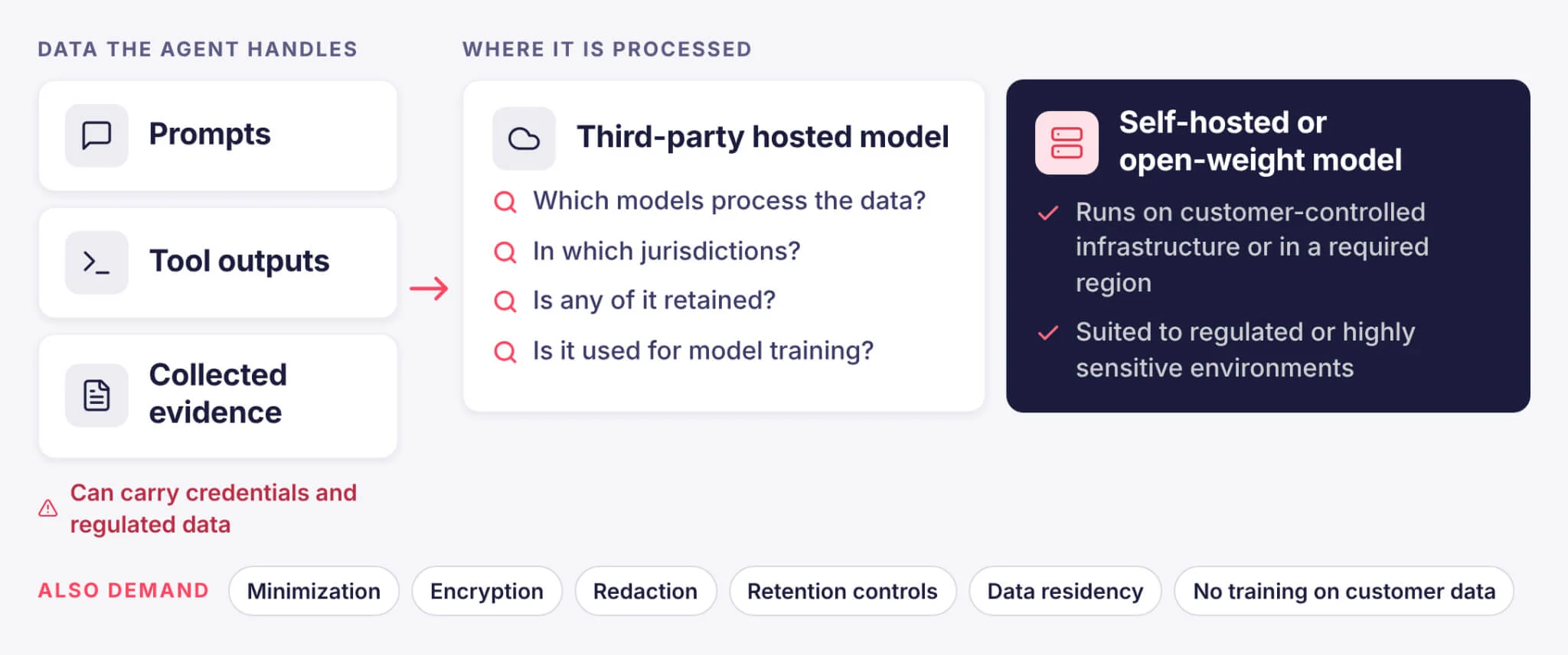
Successful exploitation may expose credentials, authentication tokens, customer records, or confidential business information. A secure platform should collect only the minimum evidence required to demonstrate impact. Sensitive data should be encrypted, redacted where possible, and retained according to clearly defined policies.
Organizations must also understand whether their data is transmitted to external AI providers and how those providers process it. This is a data sovereignty question as much as a privacy one. Prompts, tool outputs, and collected evidence can carry credentials and regulated data, so security leaders need to know which models process that data, in which jurisdictions, and whether any of it is retained or used for model training.
For regulated or highly sensitive environments, the platform should offer alternatives to third-party hosted models, such as self-hosted or open-weight models running on customer-controlled infrastructure or in a required region.
What to demand: Data minimization, encryption, retention controls, documented AI-provider data flows, data residency options, no training on customer data, and support for self-hosted or open-weight models.
8. Can Attackers Manipulate the AI Agent Through Prompt Injection?
Autonomous pentesting agents regularly process untrusted information, including web pages, API responses, application errors, and source code. Attackers may embed malicious instructions inside this content to influence the agent’s behavior. For example, a compromised web page could attempt to convince the agent to ignore its scope or execute an unauthorized command.
A secure platform must treat untrusted content as data rather than instructions. Every tool invocation should be validated against independent authorization policies.
What to demand: Prompt-injection defenses, tool-level authorization, and adversarial security testing.
9. Can Every Agent Action Be Audited?
Autonomous testing must be transparent and accountable. Security teams should be able to reconstruct exactly what the agent did, which systems it accessed, what requests it sent, and why particular actions were permitted.
Execution logs should include timestamps, source IP addresses, target systems, tool invocations, approval decisions, and validation evidence.
What to demand: Detailed audit trails and exportable execution records.
10. What Privileges Does the Agent Receive?
AI pentesting agents should follow the principle of least privilege. They should not receive unrestricted administrative access simply because they are conducting a security assessment.
Credentials should be limited to authorized systems and operations, preferably with short expiration periods. Privileged actions should require additional controls.
What to demand: Scoped credentials, role-based access control, secure secrets management, and credential expiration.
11. Can the Agent Perform Unauthorized Lateral Movement?
An AI agent investigating a vulnerable application may discover connected databases, internal services, cloud infrastructure, or third-party systems. Discovering these systems does not automatically authorize testing them. Lateral movement must remain within explicitly approved boundaries.
What to demand: Network segmentation, target allowlists, and controls preventing unauthorized pivoting.
12. How Does the Platform Prove Exploitability Without Causing Damage?
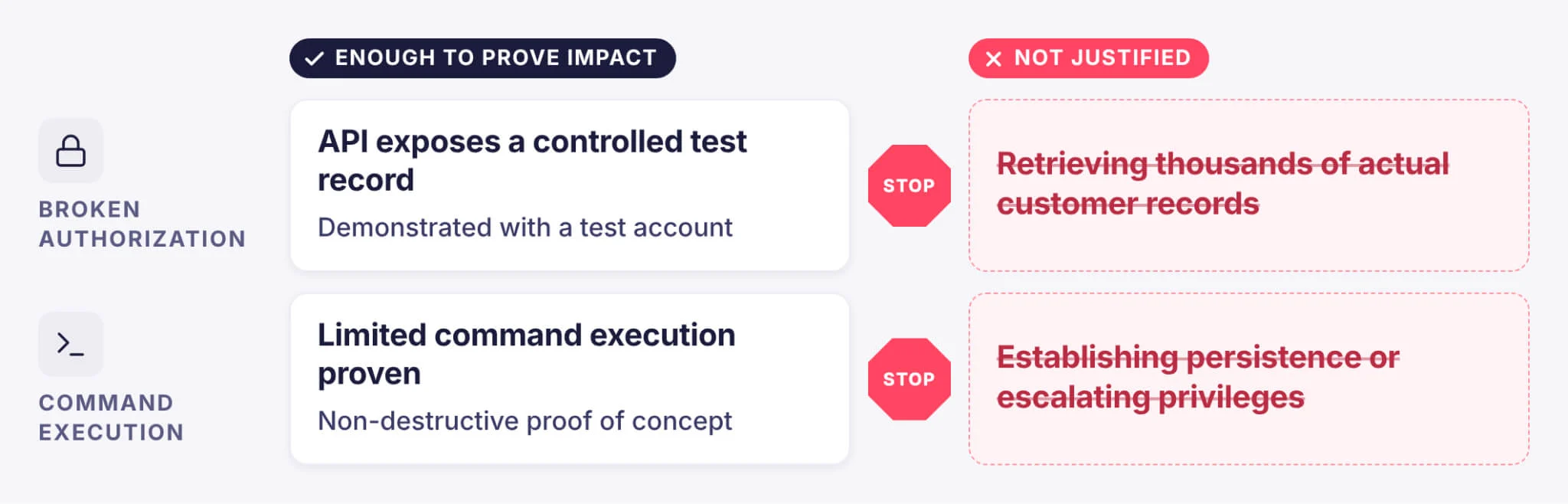
The purpose of vulnerability validation is to demonstrate sufficient evidence of security impact. It is not necessary to maximize exploitation.
For example, proving that an API exposes a controlled test record may be sufficient to demonstrate broken authorization. There is no reason to retrieve thousands of actual customer records. Similarly, proving limited command execution does not automatically justify establishing persistence or escalating privileges.
What to demand: Non-destructive proof-of-concept techniques, controlled test accounts, and stop-on-proof policies.
13. What Happens When Production Becomes Unstable?
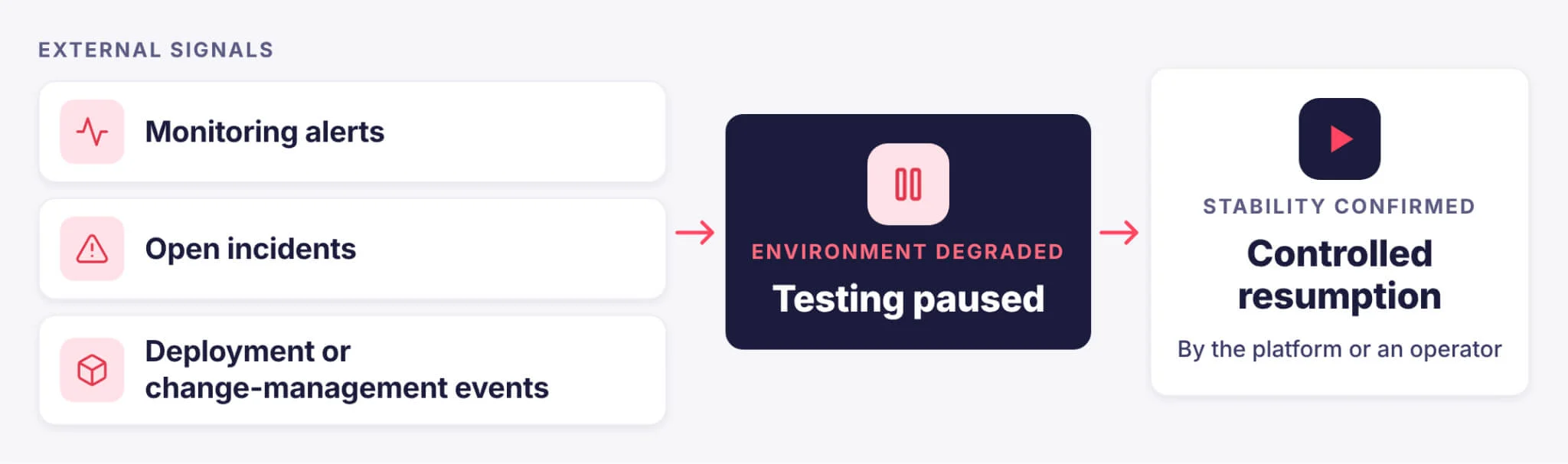
Production environments are dynamic. An application that was healthy when testing began may experience increased traffic, infrastructure failures, deployment activity, or unrelated operational incidents. These conditions have nothing to do with the test itself, but they change whether testing is safe to continue.
An autonomous pentesting platform should consume external signals, such as monitoring alerts, open incidents, and deployment or change-management events, and pause testing while the environment is degraded. Testing should resume only after the platform or an operator confirms the environment is stable again.
What to demand: Integration with monitoring and change-management signals, automatic pausing during incidents and deployments, controlled resumption, and operational escalation procedures.
14. Can the Platform Respect Business and Operational Restrictions?
Not every technically available system should be tested at every moment. Organizations may need to exclude peak transaction periods, financial closing windows, major product launches, or critical maintenance activities.
Rules of Engagement should define authorized targets, permitted techniques, testing schedules, prohibited actions, and emergency contacts.
For particularly sensitive environments, such as industrial control systems, simulated testing may be safer than direct production exploitation.
What to demand: Configurable testing windows, blackout periods, and technically enforced Rules of Engagement.
15. Can the Platform Safely Verify That Vulnerabilities Were Fixed?
Finding vulnerabilities is only the beginning. After a patch or mitigation is applied, security teams need evidence that the exposure has actually been eliminated.
AI agents can help by safely repeating the relevant validation procedure. However, remediation verification must follow the same production safety controls as the original assessment. A platform should never assume that a closed ticket means the vulnerability has been fixed.
What to demand: Controlled revalidation, technical proof of remediation, and verified closure.
The Future of Pentesting Is Autonomous. Safety Cannot Be Optional.
AI-powered penetration testing is creating a fundamental shift in cybersecurity. Organizations are moving from periodic assessments toward continuous exposure validation, and AI agents can discover vulnerabilities, investigate attack paths, validate exploitability, and verify remediation faster than traditional manual approaches.
But speed and autonomy introduce responsibility. A production-ready AI pentesting platform must operate within clearly defined technical and operational boundaries.
The AI agent can decide how to investigate. It must never decide what it is authorized to do.
That authority belongs to the organization and must be enforced through infrastructure, security policies, and human oversight.
The next generation of penetration testing platforms will be judged on how many vulnerabilities they discover and how sophisticated their techniques are, and equally on their ability to produce reliable security evidence without introducing unacceptable operational risk.
Before asking how powerful an AI pentester is, ask how safely it can operate.
That is the question every security leader should answer before allowing autonomous testing in production.
References
- NIST SP 800-115: Technical Guide to Information Security Testing and Assessment
- NIST SP 800-82 Rev. 3: Guide to Operational Technology (OT) Security
- OWASP Cheat Sheet Series: AI Agent Security Cheat Sheet
- OWASP GenAI Security Project: Top 10 for Agentic Applications
- 30 Questions to Ask Before Buying an AI Pentesting Tool

Source: SOCRadar · 2026-11-26