Prediction market platform Polymarket temporarily suspended trading on Thursday after hackers compromised a third-party service to distribute cryptocurrency-draining JavaScript, with approximately $2.5 million in assets traced to a suspected attacker wallet. […]
A Brazilian gold miner wanted for allegedly helping former President Jair Bolsonaro’s spy chief flee to Florida has built a network of companies and properties in the Sunshine State, ICIJ media partner Agência Pública reports.
Rodrigo Martins de Mello and his family are under investigation by Brazil’s Federal Police for helping Alexandre Ramagem, the former director of the country’s intelligence agency, escape Brazil and sheltering him in Miami, ICIJ and Agência Pública reported on Oct. 22.
De Mello, known as Rodrigo Cataratas, is a strong Bolsonaro supporter. Convicted of leading illegal gold mining on Yanomami Indigenous land, De Mello champions Brazil’s informal miners to his more than 43,000 Instagram followers, attacks the leftist government and calls for amnesty for Bolsonaro, Agência Pública reported. That campaign suffered a blow Oct. 25, when President Luiz Inácio Lula da Silva came from behind to defeat Bolsonaro’s son Flávio in the presidential runoff. Three days after the election, Flávio, under investigation in Brazil for alleged money laundering, also fled to Florida.
Recommended reading LATIN AMERICA The US is letting a convicted Bolsonaro spy chief stay in Florida. Brazil wants answers. Oct 22, 2026 PRESS FREEDOM ‘Bought-off, corrupt’: Argentine president attacks ICIJ member Hugo Alconada Mon Oct 27, 2026 PANAMA Panama removed from EU’s tax haven ‘blacklist’ a decade after the Panama Papers Oct 15, 2026
A company working on behalf of the Department of Homeland Security sought to cut off online access to information on more than 41,000 employees that hacktivists said they obtained from a database breached at DHS.
A search tool for the database, named Icepick, went offline for a spell before coming online again Thursday under a different registrar.
Icelandic hosting company FlokiNET said Thursday that it received a request from DHS contractor ZeroFox to remove the data, which it refused.
“By mid-morning, icepi.cx no longer resolved. Its registrar, CentralNic, had placed the domain on serverHold,” FlokiNET said in a blog post. “Our refusal kept nothing online. The request that decided the outcome to take the site down was not the one sent to us. A registrar reached the opposite conclusion the same morning, published nothing, and a global audience lost access to the site. In the meantime the site is online again under a domain from a different registrar.”
CentralNic and ZeroFox did not immediately respond to requests for comment Thursday.
DHS said late Wednesday that it was working to protect its employees against any breach.
“DHS is aware of a potential breach and is actively working to address the situation swiftly and effectively,” a spokesperson said. “We take all security threats against our employees and officers seriously and will work to ensure all are properly protected. We will update the public when more information is available.”
The social media site Bluesky was also blocking links to the archive because it shared people’s contact information without their permission, although a company official said changes were coming because the wording had identified it as a malicious link.
FlokiNET said it refused the ZeroFox request that mislabeled the archive as part of a doxxing campaign.
“Doxxing publishes private details about private people so that others can find them at home. Icepick publishes work identities of government employees,” it wrote. “Who they work for. What their role is. How they can be reached in that role. The information describes people in the exercise of public authority, not in their private lives. Federal officers carrying out an enforcement programme are not private individuals while they are carrying it out.”
“The public has a legitimate interest in knowing who is doing that work, under whose authority, and in which office,” it continued. “Journalists cannot report on an agency whose personnel are structurally unknowable.”
ZeroFox said that regardless of that, the data made it possible to locate people whose information was in the database.
“The request does not depend on who the listed individuals are or what their duties are,” ZeroFox wrote to FlokiNET. “It rests on two facts: the data was stolen, and it is personal data that identifies and locates real people.”
This installment of the Reporters’ Notebook video series discusses some of the trends and topics from Cybersecurity Awareness Month, from using AI for better training to educating next-generation workforces on modern risks and emerging threats.
If you’ve used OpenCorporatesCLI or hit OpenCorporates’ API directly recently, you may have noticed it now 401s on every call, including plain search, unless you have a paid account token. Doesn’t look like they’re issuing free ones anymore.
I rebuilt the tool against GLEIF’s LEI registry API (https://www.gleif.org/) instead — free, no key. Search a company name, get legal entity detail: status, legal form, registered/HQ address, and the actual registration authority + link as the source of record.
GLEIF only covers entities that hold/held an LEI (mostly stuff that touches financial markets), so it’s ny small-business lookupOpenCorporates did — but it’s free and it works.
John Rupolo reports: University of New Mexico Health is addressing concerns after a cyberattack on Monday, with reports surfacing this week that a ransomware group claimed responsibility for the incident. “So what I can say is we’re also aware of those claims by that group,” said Chris Ramirez, communications director for UNMH. The community’s top…
Eric Weiss reports: The Florida Department of Education says a breach of its student financial aid website may have exposed personal information, including Social Security numbers, belonging to approximately 4.9 million people. The department said staff learned of unauthorized criminal access to the Florida Student Financial Aid website on Oct. 19. It activated cybersecurity response…
The abuse of legitimate, vulnerable drivers remains a persistent method of evading endpoint security controls. As EDR killer techniques become publicly available, researchers and threat actors alike are examining how weaknesses in driver access controls can be exploited to terminate protected security processes.
An older Microsoft Defender driver, dating back to 2011, can still be loaded on the latest version of Windows 11 and abused to terminate security software. The technique, publicly demonstrated through an open-source proof of concept (POC) called DefenderKiller, exploits weaknesses in how the driver restricts access to its process termination functionality.
Flashpoint analysts have identified 13 publicly available samples incorporating the DefenderKiller technique, including obfuscated variants that indicate modifications to the original POC.
DefenderKiller Exploits a Legacy Microsoft Driver
On June 29, 2026, security researcher Jehad Abudagga, also known as redteamfortress, published research demonstrating how an older Microsoft driver could be abused to terminate security software. The researcher subsequently released the DefenderKiller POC on GitHub. The technique targets KSLDriver.sys, version 1.1.0013.0, a driver associated with Microsoft’s malware protection infrastructure. Although its digital signature dates to 2011, the driver remains accepted by Windows’ driver verification mechanisms and can load into the kernel on the latest version of Windows 11.
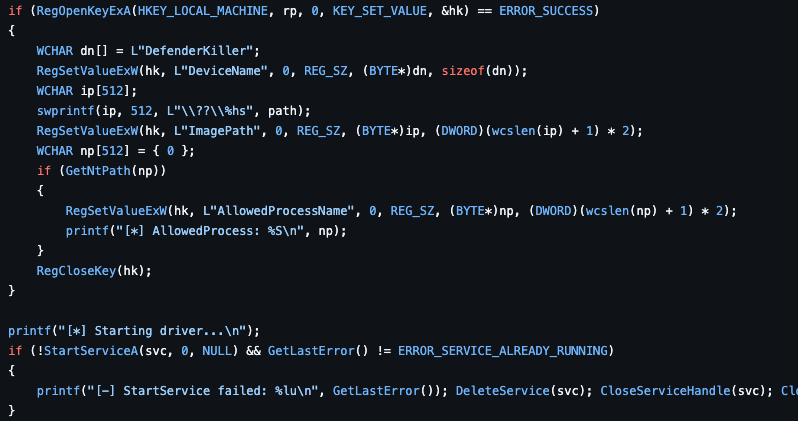
KSLDriver includes access controls intended to restrict which processes can communicate with it. When loaded, the driver retrieves an AllowedProcessName value from its service registry configuration and applies restrictions limiting access to SYSTEM and administrator accounts. When a user-mode process attempts to communicate with the driver, its process image path is compared against the configured registry value. If the values match, the driver accepts input/output control (IOCTL) requests.
DefenderKiller exploits this mechanism by configuring the driver’s service and authorized process path before starting the driver. Once authorized, the requesting process can invoke functionality that accepts a target process identifier (PID), obtains the corresponding kernel process object, and terminates the process using ZwTerminateProcess(). This allows a sufficiently privileged attacker to leverage the legitimate driver to terminate security processes.
Source code of the user-mode application performing the registry bypass before starting the driver. (Source: Flashpoint)
Following publication of the original POC, Flashpoint analysts identified 13 publicly available samples incorporating the DefenderKiller technique, including obfuscated versions. These findings indicate that the original code has been modified, although the available evidence does not establish whether the samples have been deployed in confirmed intrusions.
Implications for Endpoint Security
The findings illustrate how Bring Your Own Vulnerable Driver (BYOVD) techniques can exploit legitimate, digitally signed drivers to interfere with endpoint security. KSLDriver relies on process authorization checks that can be bypassed through manipulation of registry-controlled information, while remaining loadable on the latest version of Windows 11.
Flashpoint analysts assess that advances in large language models may be contributing to growing interest in BYOVD research and EDR killer development by making user-mode and kernel-mode code development more accessible. Exploitation generally requires administrative privileges to create the services necessary to load these drivers, although attackers may obtain these privileges through local privilege escalation.
Security teams should consider monitoring for unexpected kernel driver installations, changes to driver service configurations, and termination of security processes following driver loading. In particular, modifications to registry values such as AllowedProcessName and ImagePath may provide useful investigative context when correlated with suspicious service creation or driver activity.
Indicators of Compromise and Technical Artifacts
The following artifacts were identified during Flashpoint’s analysis and may support threat hunting and further investigation.
The presence of these artifacts should be evaluated in context, as legitimate software may use some of these components.
Stay Ahead of EDR Evasion Techniques With Flashpoint
The discovery of vulnerable drivers beyond those targeted by publicly available EDR killers highlights the need for continued research into the techniques used to disable endpoint defenses. The public release of DefenderKiller, along with the emergence of modified variants, highlights the need for continued visibility into defense evasion techniques and the vulnerable drivers that enable them.
Flashpoint continuously monitors emerging threats and adversary techniques, combining primary source intelligence with technical research to help organizations understand how threats are evolving. Request a demo to learn how Flashpoint can help your team identify emerging threats and strengthen its defenses.
Data Exposure Report Argentina Government Student & Education Data Leak Claim Unverified
Buenos Aires Student Database Leak Claim Lists 1.7 Million Enrollment Records
Claimed records1.7M
Academic year2025
RegionBuenos Aires
Data typeStudent enrollment
Severity HIGH
Overview
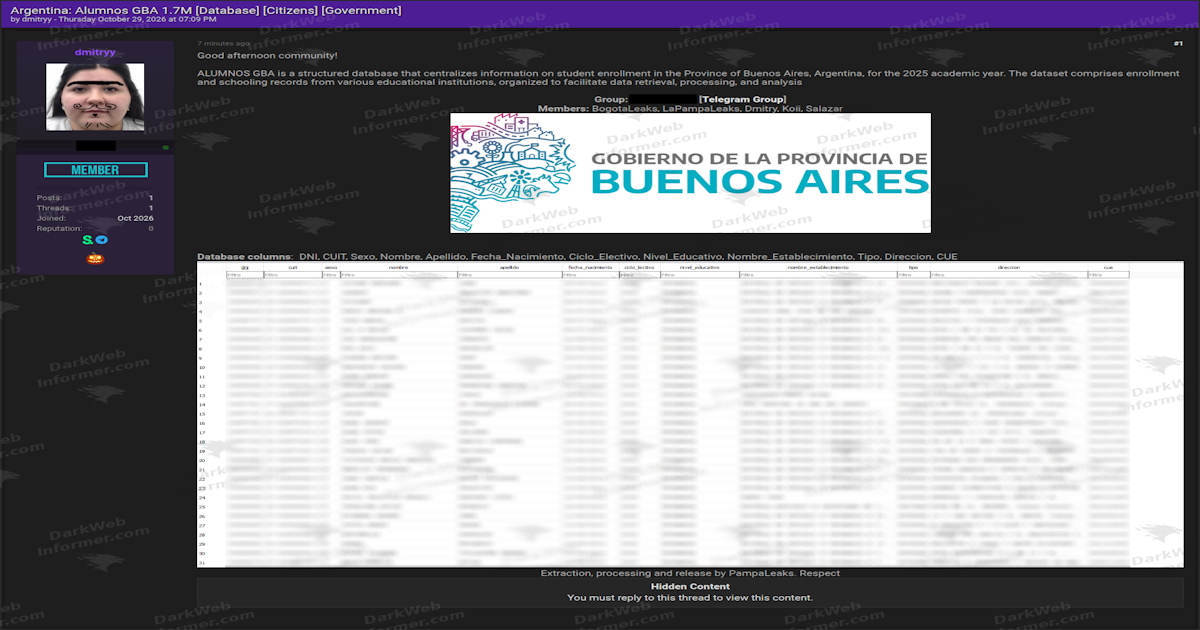
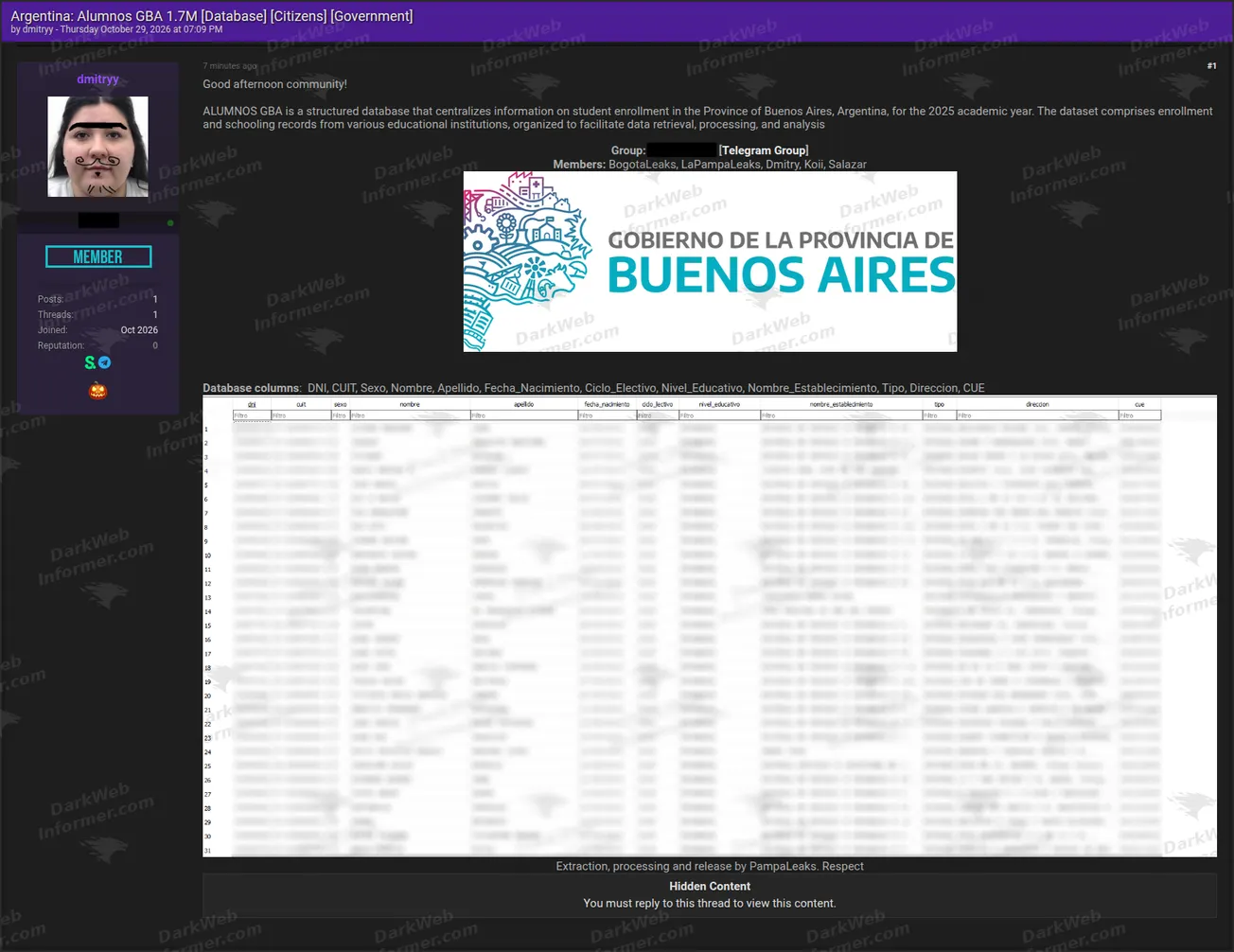
An actor using the handle “dmitryy” claims to have released a database called ALUMNOS GBA, described as a structured dataset containing student enrollment information from the Province of Buenos Aires, Argentina, for the 2025 academic year.
The post advertises approximately 1.7 million records and says the dataset centralizes enrollment and school records from multiple educational institutions. The visible columns include DNI, CUIT, sex, first name, last name, date of birth, academic year, education level, school name, institution type, address and CUE. The dataset, its source, the claimed volume and current availability have not been independently verified.
Post details
OrganizationGovernment of the Province of Buenos Aires
CountryArgentina
SectorGovernment / education
Actor“dmitryy”
Dataset nameALUMNOS GBA
Claimed volumeApproximately 1.7 million records
Academic year2025
Post date shown
What the post claims
Approximately 1.7 million student records
2025 academic-year data
DNI field included
CUIT field included
Sex field included
First-name and last-name fields included
Date-of-birth field included
Academic-year field included
Education-level field included
School-name field included
Institution-type field included
School-address field included
CUE institution code included
Sample rows displayed
The visible sample contains student identity information and school-enrollment details. Individual student names, DNI/CUIT values, dates of birth, school names and addresses shown in the screenshot are not transcribed in this report.
The supplied capture shows the ALUMNOS GBA claim, the Province of Buenos Aires branding, the advertised student-enrollment columns and sample rows containing identity and school information. Personal student data from the sample is not repeated here.
IOCs & identifiers
Identifiers directly visible in the supplied material. These support correlation and do not independently verify the dataset claim.
Type
Identifier
Source
Actor handle
dmitryy
Screenshot 1
Group
PampaLeaks
Screenshot 1
Named organization
Gobierno de la Provincia de Buenos Aires
Screenshot 1
The screenshot references PampaLeaks as a Telegram group and lists several member handles. Those names are not expanded here because they are not necessary to describe the exposed student dataset. No malware hash, Tox ID, Session ID, attacker-controlled domain or attacker-controlled IP address is visible in the supplied material.
Mapped techniques
Claimed identifies behavior explicitly described by the actor. Inferred identifies an analytical mapping supported by the supplied material. Neither label means the activity has been independently verified.
Collection T1213.006 Data from Information Repositories: Databases Inferred The listing presents a structured student-enrollment database containing identity and school information. The supplied material does not disclose how the data was obtained or independently establish unauthorized access to Buenos Aires government systems.
Potential impact
If authentic, the claimed dataset could expose student names, national identifiers, dates of birth, sex, education level, school names and school addresses at very large scale. Because the sample visibly includes school-age students, the exposure could create heightened risks of identity fraud, targeted phishing, impersonation, harassment or other privacy-related abuse.
Status Unverified
Dark Web Informer has not independently verified the dataset’s authenticity, source, completeness, approximate 1.7 million-record count, sample contents or current availability. The supplied screenshot documents the listing and visible sample rows, not independent confirmation of the underlying database.
Want everything on this threat? Paid subscribers get the full unredacted claim details and more. After subscribing, check out the threat feed and search there for this alert.





 Table Of Contents

 Argentina