This Cybersecurity Awareness Month’s theme, “Securing the Next 250,” asks us to look beyond vulnerabilities and consider what will make our digital systems resilient for generations.
Source: Dark Reading · 2026-10-26

This Cybersecurity Awareness Month’s theme, “Securing the Next 250,” asks us to look beyond vulnerabilities and consider what will make our digital systems resilient for generations.
Source: Dark Reading · 2026-10-26
You may have forgotten about Popcorn Time. Unfortunately, its updater didn’t forget about your device.
Security researchers have intervened to disable an abandoned update mechanism in Time4Popcorn, a version of the once-popular streaming app. If left running in the background, the updater could have allowed attackers to take control of Windows and Mac computers, even if their owners hadn’t opened the app in years.
Eye Security estimates that the vulnerable updater was present on millions of devices worldwide, including 2.5–3 million Windows computers and around 250,000–350,000 Macs.
Popcorn Time made watching movies and TV shows through BitTorrent look more like browsing Netflix. Rather than making users find torrent files and open them in a separate client, it wrapped the process in a familiar streaming-style interface.
Amid concerns about copyright infringement and its possible consequences, the original developers abandoned it shortly after its launch in 2014. But because its source code was publicly available, other developers could pick it up and create their own versions, known as forks.
One of those was Time4Popcorn, which was also distributed under the name “Popcorn Time.” That shared branding matters because people may have installed the affected software without ever seeing the Time4Popcorn name.
Time4Popcorn was eventually abandoned too. But its update infrastructure was left behind, and at some point the domains associated with the software became available for others to register.
In other words, the people maintaining the software had gone away. The software’s ability to accept instructions had not. Time4Popcorn’s updater used unencrypted HTTP connections and accepted executable updates without checking digital signatures to verify their authenticity. So, someone who controlled an update domain or was able to tamper with the unencrypted traffic could supply their own program instead.
That combination created a remote code execution vulnerability, tracked as CVE-2026-30612, which could let an attacker run malicious software on a device. An attacker wouldn’t need to persuade someone to watch a movie or click a suspicious attachment. The forgotten updater could do the work for them.
Although Android was affected too, users had an extra layer of protection. Its updater checked for updates when the application was opened, but installing an attacker-supplied APK required the user to approve the installation. It was not the same silent, background takeover route researchers found on Windows and macOS.
Eye Security registered an abandoned update domain and used the vulnerable mechanism to distribute an update that disabled the updater itself. On Windows, it stopped and disabled the service; on macOS, it prevented the update process from starting. The researchers say their intervention did not delete users’ files or collect host data.
By March 2026, Eye Security reported more than two million downloads of its updater-disabling fix, and update requests to its domains had fallen by 98%. Later that month, it transferred the 15 domains it controlled to the nonprofit Shadowserver Foundation.
Researchers could not remotely disable the Android updater in the same way. And the desktop application still contained other weaknesses, including an obsolete Chrome engine dating from 2014 and disabled sandbox protections, which normally help contain malicious code.
If you used Popcorn Time years ago, check the devices on which you installed it. Don’t assume that no longer using an application means its background components have stopped running.
Updater.exe, normally inside a Popcorn Time folder under Program Files or Program Files (x86), running through a service called Update Service. On macOS, the component is /Library/PrivilegedHelperTools/PT.updd, with a launch daemon at /Library/LaunchDaemons/PT.updd.plist. Its advisory provides instructions for disabling these components if needed.As we saw recently, cybercriminals can use software updates to distribute malware. Remove abandoned apps and check for any background updaters they leave behind.
From reporting threats to removing them.
Cybersecurity risks should never spread beyond a headline. Keep threats off your devices by downloading Malwarebytes today.
Source: Malwarebytes Labs · 2026-10-26
Here’s the lowdown on CVE-2026-109618 and CVE-2026-109619, as well as what website owners and IT teams should do to stay safe – all in a little more than two minutes
Source: WeLiveSecurity (ESET) · 2026-10-26

We’ve spent the past several decades using duct tape, string, and chewing gum to chain the world’s computers together into this thing we call the internet, so there’s really no good reason to be surprised that most of it is full of software containing vulnerabilities that are practically just as old. You can listen to the latest episode of The Kettle right here on this page, as well as on Spotify, Apple Music, or YouTube. Those platforms also let you subscribe to Kettle, so you are always notified when the latest episode goes live. The world is still reeling from the PHP2Shell revelations that hit the news cycle this week, and on The Kettle there’s no better topic for host Brandon Vigliarolo, cybersecurity editor Jessica Lyons, and FOSS reporter Liam Proven to tease apart. Join us to discuss what exactly is going on, how AI was key to finding another issue no human likely ever would have discovered on their own, and why exposing more bad code in the backbone of the world’s computers might be just what we need to rethink the whole thing for the better. A lightly edited transcript follows: Brandon (00:01) Hi everyone, and welcome to the latest episode of The Register’s Kettle podcast. I’m your host, Reg reporter Brandon Vigliarolo. And hey, there’s only one thing we could focus on for this week’s episode, given all the hubbub around it, and that’s the PHP apocalypse. It turns out most of the internet is running software that could allow remote code execution on host systems via a pair, or as of today apparently three, vulnerabilities that have come to collectively be known as PHP2Shell. So that’s not great. With me to talk about this is our security editor Jessica Lyons and open source reporter Liam Proven, who has a few things to say about PHP itself and why it’s probably not surprising we’re finding ourselves in this mess. Thanks to you both for coming on. Liam Proven (00:43) Absolute pleasure. Jessica Lyons (00:43) Nice to be here. Brandon (00:44) So Jess, let’s start with the basics. What is this? How big of a problem is it? And where do we stand on getting things fixed? Jessica Lyons (00:51) Great. The short answer is it’s a very big problem. So we have these two related memory safety vulnerabilities, and they are in the PHP core. Collectively they’re called PHP2Shell, and they affect every version that’s been released in the last decade affected by one or both of these, going back to about version 5.4. So the general consensus is this is about 70 percent of all of the websites on the internet are running this code. So it basically affects everyone at this point. What happened here is that this dates actually back to August. An independent researcher first spotted this, and then we can talk a little bit more later about who found more of the exploits and what the (PHP) Foundation did with that. But so he found this vulnerability. There was a coordinated disclosure process with the PHP Foundation, and then that broke a little bit starting over the weekend, and then onto Monday, there were some leaks. There was a video posted that purported to show this exploit. And so we get this emergency warning from the PHP Foundation late Monday saying, “Hey, we are going to be releasing these emergency patches, so everybody get ready so you can implement them as soon as possible. It’s very serious.” So by Wednesday, they did release these, and there’s this mass attempt to patch before any of the attackers get a hold of this and are able to attack websites with it. And one of the issues too is that some websites are running really, really old versions and so they aren’t able to patch. So they’re just sitting there, these legacy servers are still vulnerable. Brandon (02:52) So there’s no direct update path for those old versions, right? It’s basically shut this down and reinstall it kind of thing. Jessica Lyons (02:59) Exactly. So basically they’re both these memory corruption vulnerabilities and by exploiting them, an attacker can kind of shape the memory that PHP trusts. And then they can use that to hijack what happens next. And that can mean remote code execution. They can take over the websites, they can steal data. And so people are visiting these websites they trust and they don’t realize that the underlying code is stealing their data or delivering malware to their computer. And again, this is potentially 70 percent of the internet. So it’s a big deal. Brandon (03:36) Quite a few sites were offline. I know even some big services. I stopped playing because I had a baby, but I used to play Final Fantasy XIV pretty religiously. And I know that the entire login server was offline a couple days ago Jessica Lyons (03:50) Right. Brandon (03:50) They were like, “You’ve got to fix this. Sorry, no one can play the game. If you’re not logged in right now, you’re not getting logged in for the foreseeable future.” It’s just insane how much of the internet was affected by this. Now It’s under exploit, is that correct? But maybe not successfully exploited yet? Jessica Lyons (04:11) Right. So after the patches were released on Wednesday, later Wednesday, AWS came out and said, “We’ve seen exploitation attempts at least four days before the patches were released.” So that kind of caused another frenzy that, “My God, it’s under attack, the whole internet is on fire.” There haven’t been any successful attacks to date. There’s been a ton of attempts. There’s a lot of POCs; some work, some don’t. But as of Friday, according to the Foundation and according to all of the security experts that I’ve spoken to, we haven’t seen any evidence of successful exploitation. I don’t think that means we’re in the clear. I think it just means it’s taking a while for people – and honestly AIs – to develop successful attacks, but that’s where we are right now. Brandon (05:06) Because it’s a complicated attack chain, correct? Jessica Lyons (05:10) Right. Yes. Brandon (05:11) So basically, right. This is not working yet, but especially with some of these older websites that are running older versions of PHP that are going to have to take a more thorough approach to getting this fixed and possibly going down for some time, this could be one of those problems that remains serious for a while. And let’s not forget, 70 percent of the websites on the internet, that’s almost three-quarters of the entire internet. I don’t know how many hundreds of thousands or millions of sites that is, but some of those are probably never going to get patched. Jessica Lyons (05:41) Right. Exactly. Brandon (05:43) Just the way it goes. Right. This is going to be the sort of thing that we end up hearing about months or years from now. Jessica Lyons (05:49) I would say years. Brandon (05:53) I’m sure there’ll be some bank somewhere that eventually ends up getting – we’ll hear about some breach disclosure letter from the state of Maine in four or five years. Jessica Lyons (06:02) And local governments, federal and state governments, I think these are the ones that we’re going to be hearing about quite a while from now. Brandon (06:09) Because that’s one of the things I was thinking about even for me in my tiny little town in northern Michigan. I wonder if my township or the county is going to be all over it to update their PHP server. Does their IT guy, who probably is a retired dude who lives in the area, even know this is a problem? It really is one of those things that is a big deal, but if you’re not kind of following the news on this, it could probably go completely unnoticed. And for many websites, I’m sure it will. Jessica Lyons (06:37) Right. Exactly. Brandon (06:37) So, it’s pretty crazy. Liam, you’re working on a story, I think, as we are recording this, about some of the history of PHP and how it really probably wasn’t very well designed or intended to become so ubiquitous on the internet. What’s going on there? Liam Proven (06:53) I’ve seen one angle on this, which is people saying, “This is 1990s code and it has 1990s problems,” which is one way to look at it. But I’m a 1980s internet guy; that’s when I started exploring it. My primary email address is older than the web, and it still works. My gods, it gets a lot of spam, but it still works. I’ve watched the rise and rise of PHP since the first releases. Now, I have no personal interest in web development. I can program, but I don’t because I’m really bad at it and nobody needs to have my code inflicted upon them. The guy that wrote PHP in the first place, Rasmus Lerdorf, is my age. I’ve never met him; I’m sure he’s a nice guy. But he said in a very early interview about it, “I really don’t like programming. I built this tool to program less so that I could just reuse code.” And that was about 1993. He built a little tool that allowed him to put macros in HTML for his own website, and it’s just grown. In a later interview, he said something along the lines of, “I don’t know anything about writing programming languages. I’m just improvising this as I go and people seem to like it.” It originally stood for “Personal Home Page,” I think, and later was given a recursive acronym of “PHP: Hypertext Preprocessor.” This is a programming language that you mix in with the HTML of a website. It predates the modern model of building websites where a database contains the text and a content management system of some kind assembles on the fly the pages that each person sees. This is an older model where you’re running programs that are part of the markup language, which was not a good idea, but that was how he did it. There was a lovely blog post. I’ve got an old friend who’s an extremely skilled and talented programmer who has built a career on PHP, and he said to me, “Look, those criticisms that you’ve mentioned are of the really early versions and it’s changed now.” And if he hears this, he’s going to be cross with me. But my favorite summary was from a blog called Eev.ee way back when that called PHP “a fractal of bad design.” Whatever level you look at it, it was done badly. If you look at the whole plan of “let’s just intermingle program code in with the markup language,” not a good idea. If you look at the details of how it was implemented, not a good idea. If you look down at low-level details of how the functions return values, not a good idea: inconsistent syntax, inconsistent functions, functions that do really weird things, by default no stack traces, not great error reporting. Now, I’m sure a lot of this has been papered over now, but really there is one reason PHP is still around and still so big: Zuck. Facebook was built in PHP. And Facebook makes lots and lots of money and it’s been throwing money at making PHP faster and more reliable and more scalable for decades. Brandon (11:03) Have they been big contributors to it? Liam (11:06) Yeah. They even built a compiler for it, which I suspect is still in use. Now, how much of Facebook today is in PHP? I don’t know, possibly none, but for a long time basically the world’s biggest and busiest public-facing website that wasn’t owned by Google – only because Google have failed to ever make a successful social network – was built on PHP. And it’s big, it’s complicated. Like Linux itself, nobody fully understands how the whole thing works anymore and hasn’t probably for decades. And now people have got bots that they can throw against it and ask them to analyze it. I think this is probably just the first, and I think there’s going to be many more. A friend of mine who’s a senior developer had a look at the patch, and he’s not a C guy, but he said – I’m quoting from comments on Mastodon – that the patch to the current version is 13,000 lines of C. That’s a doozy of a patch. Brandon (12:17) That’s huge. Liam Proven (12:20) A bunch of people have been working like crazy for quite some time. Some people who’ve looked at this say it looks handwritten to me. Others have said, “No, I think this is bot-generated.” I think the truth is probably a bit of both: some from one, some from the other. Brandon (12:32) Bit of both. I mean, you can’t pump out thirteen thousand lines that quickly and have it tested. God, I hope they tested it. Liam Proven (12:41) Right. But that’s just for the current version, and this hole affects every published version. So if they do manage to fix this one, how long till the next one comes along? Because I think there’s going to be – Brandon (12:56) Especially with the speed at which vulnerabilities are being discovered now. I feel like every time I turn around, I’ve written one Patch Tuesday article in the past few months, and that one broke the previous two records. And I think since then every month has included more patches, and a lot of those are probably – Jessica Lyons (13:14) October at this point is the record: over a thousand for Microsoft alone. So, yep. Brandon (13:21) That’s insane. Like you said, it is a fractal of bad design all the way down, and is going to probably have more vulnerabilities discovered. Jessica Lyons (13:32) Right. Brandon (13:32) Seventy percent of all websites on the internet are using this. What can we do? Are we stuck? Liam Proven (13:35) Well, there’s a reason for that, and it’s one that doesn’t get talked about an awful lot: Facebook aren’t the only people that use it extensively, because WordPress is also built on PHP, and it’s far from alone. Another senior Linux techie friend of mine gave me a free shell account on the machine that he runs for a few friends years ago, and I thought of resurrecting my old 1990s hand-coded HTML webpage for fun. So I found it on the Internet Archive and found a tool to scrape it and turn it back into HTML again. I looked at some CMSes and asked him if there was any CMS on the machine. He went, “No.” And I went, “Well, would you install one?” He went, “No.” “Well, why not?” He said, “Well, all the big ones are implemented in PHP, and I won’t let that near any server I run.” “Well, that’s a bit dramatic, isn’t it?” And he goes, “No, that’s pragmatic. I run a bunch of public-facing servers on my own, and this is how I keep them secure. No containers, no Docker, no PHP, nothing built in any of these technologies.” And I went, “Wow, what about…” So I went looking for non-PHP CMSes. There are a lot of CMSes out there. I got a commission about a decade ago to write a comparative assessment of the CMS market versus a company’s proprietary Windows product. I went and did a survey and came back and said, “I’ve found 1,300 so far.” And they said, “OK, we can give you five thousand words instead of a thousand words.” And I said, “You realize I’m going to have to go and look at 1,300 pieces of software here. Even if I only write three or four words about each one, ‘Mostly harmless,’ I’m still going to have to look at over a thousand bits of software. It will take me a year.” And they went, “Well, how can how can we do it quicker?” And I said, “You can’t. I cannot do this survey you want. Give me a full-time job and I’ll get it back to you in a couple of years’ time.” I found a few CMSes that weren’t built in PHP. Most of those were built in Ruby instead. And he went, “Yeah, I’m not keen on having that on my server either.” So it’s not even a case of people that have PHP deployments needing to update. They don’t know. They built it on something else which was built on something that was built in PHP. Jessica Lyons (16:15) I was just going to say, Liam, you said, “How long until the next one happens?” And we found out today from the PHP Foundation that there is a third one. They won’t be pushing an emergency release for this. They said it’ll be published with the next regular release cycle. The Foundation told me that this one, quote, “requires a very unlikely combination of configuration and specific PHP application code, which we do not expect to occur in practical use.” So, there’s already another one. Liam Proven (16:45) So weeks then. Brandon (16:47) Yeah. Jessica Lyons (16:48) I mean, and even with this, it’s hard to exploit. You can mitigate it with a configuration setting. But that was part of the thing we’ve heard with these other two. And then we did have researchers yesterday who developed this new exploit; this was Vulncheck. And that shows how even ASLR can be bypassed to attack these vulnerabilities on x86 machines. So saying it can be fixed with a configuration setting isn’t always a guarantee. Brandon (17:25) That brings me kind of to the elephant in the room of this whole story: AI. because of course it all comes back to AI nowadays. OpenAI and two other security firms reported this. I think Jess, one of your stories or one of the ones Lindsay wrote said that they all used AI to find this, right? Jessica Lyons (17:49) Right. So the companies: Calif, they are a newer startup doing AI pen testing and they’re part of OpenAI’s partner program, so they used OpenAI models working with OpenAI to find this. And then independently, Wiz, which is owned by Google, also did. So this happened back in August, and then they have been all working with the PHP Foundation on the patch since that point. They have all said these are vulnerabilities that probably wouldn’t have been found by humans alone. By all accounts, they’ve existed for decades and wouldn’t have just been found by human researchers. Brandon (18:34) Right. So either these are things that have never been discovered and would have never been exploited theoretically – the exploit path is complex, they’re not obvious vulnerabilities, so they needed an AI to find them – or perhaps this is the kind of thing that was known about but was privately held in the hands of some bug hunting company that sells exploits to governments. Who knows? Maybe that’s the case. I remember talking to a guy one time at Black Hat who basically said his company’s in the business of finding really sensitive vulnerabilities and then selling them to the highest bidder. So there are companies like that that exist. So there’s probably plenty of vulnerabilities in software that are not well known that governments and high-level functions are aware of. But in this case, this probably wasn’t the case. This is an incredibly difficult-to-find vulnerability. I’ve seen a lot of chatter online in the past few days about how the internet’s on fire and the AI bug-pocalypse has arrived. It seems like we’re having another case of people getting all freaked out because this is the end of time, history is over, and AI is going to kill us all. It just seems to me like this is another example of: well, maybe not. This has been getting hammered by potentially bad actors or pen testers, and no one’s managed, as far as we know, to successfully use this yet. Is this as serious as it seems, or is this another case of a serious vulnerability that is so complicated and convoluted that it’s not really going to be that big of a deal? Liam Proven (20:25) I want to note parenthetically that you described OpenAI as a security company, and if I had been drinking coffee, that would have been very bad for my keyboard. Brandon (20:32) Okay, whoops. Let me take that back. Jessica Lyons (20:31) Ha ha ha. Liam Proven (20:36) Calif is interesting because I just wrote about them. They found a hole in OpenBSD, and there aren’t many of those. And only about a week ago, they found a hole which they dubbed “Big Fish” in OpenBSD, and it was just days before OpenBSD 8 shipped. It looks like that had been there for 37 years, which is a neat trick because OpenBSD was founded 30 years ago. So this is in – going to pronounce this carefully – Berkeley Software Distribution Unix in the eighties. But there are doubtless more, and I’m an arch AI skeptic. Some people will claim that this will be the sort of problem that you can solve with AI by getting it to rewrite your stack. Well yes, but then you’ll replace it with a new stack that nobody ever understood any of. But there are ways to design, host, and run websites, forums, and chat channels without using any of this stuff. And it could be a net positive if holes like this keep getting found that people will be forced to go back to – sounds crazy, but – static websites serving pre-written code off a disk. One of my favourite websites – recently I discovered there’s a whole chain of them, and I hope you won’t mind me swearing; maybe you have to beep me. But there’s a marvellous website called “This Is a Motherfucking Website and It’s Perfect.” And recently somebody rewrote it and the new one looks almost identical: “This Is a Modern Motherfucking Website and It’s Perfect.” He’s written it with more CSS or something, but apparently there’s a whole chain of these things and they are extremely low on programming code. They contain interactive elements that you can do with just HTML, and you don’t need a whole web framework behind it. And the same AI companies are busily scraping the whole web multiple times a day to feed their training engines. Maybe we just have to suck it up, scrape some of these big websites, and redo them as simpler tech with fewer interpreted languages. We are all collectively victims of the sunk cost fallacy. We’ve got millions of websites. We spent billions and trillions of dollars building all this. We can’t just throw it all away. Well, maybe you have to. Brandon (23:27) Sunk cost was something that kept coming to my mind as I was writing up the script for this episode and just thinking about this. It seems like a whole big case of, “Well, all the websites in the world are now on PHP, so I guess we’re stuck.” Liam Proven (23:42) We have a script? Brandon (23:46) Well, not a formal script, just notes. Liam Proven (23:48) Haha. Well I didn’t get the memo. Jessica Lyons (23:50) I think that’s part of the problem though: it illustrates this larger issue with AI in general. AI bug hunting and exploit detection kind of illustrates this bigger problem about the internet, especially these legacy systems that underpin government services and critical infrastructure. It is literally held together by duct tape and string. So it’s a massive problem. Again, it takes some work to actually make anything of these vulnerabilities and chain them together. AI is getting better at that. So whether or not this ends up being the end of the world for the internet as we know it, it does illustrate a real problem. Brandon (24:42) Like Liam said, maybe this is the sort of catalyst that the wider internet community needs to realize that these systems – this duct tape and string – simply won’t keep working forever. We need to maybe modernize all the underlying infrastructure and make it simpler and less kludged together with all these different things over the years. PHP is poor design all the way down, right? It’s like: well, maybe we need to tear it out and start over. Even if these vulnerabilities are impractical to exploit and hard to find, the fact that they’re being discovered does illustrate that most of our code is a mess. Liam Proven (25:28) I am reminded , the other day I was talking in the comments about A/UX, Apple’s original Unix for the Mac, and Apple paid another company to develop A/UX because the US military had a tick box on the form that said to buy systems, they have to be able to run POSIX. The US Army at one point hosted its website on Classic Mac OS. And it wasn’t exactly security by obscurity. They said virtually all web server attacks in the mid-1990s were based on getting a remote shell, and Classic macOS didn’t have a shell at all, anywhere. There was no way to get a remote shell because you couldn’t get a shell if you were sitting in front of it. So they said, “They try and inject bits of x86 code: well, it’s not an x86. They try and get a shell: it hasn’t got one. They try and get it to run scripts: it doesn’t run scripts.” They said, “We just sit there and watch people throwing themselves at it. All the best attacks, and none of it works because the operating system’s kind of too primitive to do any of that stuff.” I don’t believe many customers actually ever used A/UX, but it got Apple some lucrative deals. Maybe we’re going to see a new trend of super primitive, super basic websites. There’ll be a new difficulty in trying to scale the things because Kubernetes expects a lot of this to be dynamically generated by microservices. But bring it on; I’d love to see that. Brandon (27:09) That’s a Kubernetes problem, right? Liam Proven (27:12) Yeah. Brandon (27:14) I feel like I would love a simpler internet. It would be amazing if I could just wake up in the morning, go to a news site, and just get the headlines. So often, I feel like – and I think The Register is good at having a relatively simple design, but – so often I feel like the news aggregators that I go to… I look for ones that are as minimal as possible. I look for websites that are simple. I don’t need all this in-your-face stuff; it’s not necessary. I think we probably are all pretty sick of it in a lot of ways. Jessica Lyons (27:49) But do we really think this is going to happen though? Brandon (27:52) No. Jessica Lyons (27:53) I feel extremely pessimistic about this. I think it’s much more profitable to just keep marketing solutions to the problem as opposed to a safe coding overhaul. Brandon (28:04) Unfortunately. Liam Proven (28:06) Geopolitics might yet get in the way. I wrote a piece about OpenEuler, one of the big Chinese enterprise server Linuxes, and one of only two companies actually showing off an OS at the Open Source Summit. The other was also Chinese: OpenKylin, which is more desktop focused. China makes its own chips, China makes its own operating systems, and it’s got its own programming languages. They’re all open source, taken from European and American developed software by and large, but they could still invade Taiwan and cut off much of the world’s chip supply. And suddenly it won’t just be that memory is way more expensive than it used to be; it will be that you can’t get more memory anymore and you have to keep using 10-year-old chips. And people will be potentially forced to find ways to keep getting more out of the same hardware until we can build new chip fabs, which will take a lot of time and a lot of money. And then quite possibly they’ll get blown away in a climate-change-induced hurricane and then we’ll have to start again. So, I hope they’re going to start building them in the north of Norway and places like that. But yeah we’ve got bigger problems coming down the pipe and it’s all a giant snowball of superficially unrelated things: AI attacks on overcomplicated stacks on one side, and the other kind of attack which involves whistling noises and large explosions on the other side, which cuts off the hardware market. It’s hard to plan for this, but nobody’s even trying yet. Brandon (29:52) Who would have thought a talk about a PHP vulnerability would have turned into geopolitical chaos and the endof modern technology as we know it? Break out the sundial, people. Liam Proven (30:07) Excuse me, I’ve just got to go and wind the web server. Hang on. Brandon (30:11) All right, guys. Thanks for coming on. I think this was a really valuable discussion and it shows just how interconnected all these issues in tech are right now. I mean, it is interesting how we’re kind of hurtling toward something in a lot of ways. AI will surely be a part of it, as will expensive chips and lots and lots of vulnerabilities being found every day. Hopefully we’ll still be here to cover it as that continues to happen. Jessica Lyons (30:40) If AI doesn’t kill us. Brandon (30:41) Right. If AI doesn’t kill us all. Well, if it doesn’t, we’ll be here on the Kettle to talk about it. And we hope that you, from whatever bunker you’re hiding in, will join us on future episodes. Liam Proven (30:53) Yeah, we’ll be publishing a telephone number so you can phone into future Kettle episodes. Brandon (30:59) All right, folks, we’ll talk soon. ®
Source: The Register — Security · 2026-10-26

.kadence-column480165_4ecc5f-ac > .kt-inside-inner-col{padding-top:20px;padding-right:20px;padding-bottom:10px;padding-left:20px;}.kadence-column480165_4ecc5f-ac > .kt-inside-inner-col{column-gap:var(–global-kb-gap-sm, 1rem);}.kadence-column480165_4ecc5f-ac > .kt-inside-inner-col{flex-direction:column;}.kadence-column480165_4ecc5f-ac > .kt-inside-inner-col > .aligncenter{width:100%;}.kadence-column480165_4ecc5f-ac > .kt-inside-inner-col{background-color:#ffe5e5;}.kadence-column480165_4ecc5f-ac > .kt-inside-inner-col:before{opacity:0.3;}.kadence-column480165_4ecc5f-ac{position:relative;}@media all and (max-width: 1024px){.kadence-column480165_4ecc5f-ac > .kt-inside-inner-col{flex-direction:column;justify-content:center;}}@media all and (max-width: 767px){.kadence-column480165_4ecc5f-ac > .kt-inside-inner-col{flex-direction:column;justify-content:center;}}
This Halloween, AI is doing the costumes. Upload a photo and you can become a vampire, surround your dog with pumpkins, or star in a viral “zombie love story:” Your partner has turned, you lower the gun, and the zombie’s leap ends in a hug.
But before you upload, do you know who will receive your photos?
In September, we wrote about more than 100 subscription sites built from the same cheap website kit. With Halloween approaching, we’ve found the same approach being used to sell AI Halloween videos.
We found no malware or phishing on the sites we examined. What concerned us was how little we could establish about who operated them and who would be responsible for the photos people uploaded.
These sites look professional and sound reassuring. They promise privacy, have FAQs and refund policies, and some even add consent checkboxes for photos of children. One calls itself “an independent tool with no ties to TikTok or any film studio.”

What they don’t tell you is who is behind them. On the sites we checked, we found no company name, address, or named operator, only a support email on the site’s own domain.
These sites ask for clear, well-lit photos of you, your partner, your friends, your pets, and, with a parent’s permission, your children.
The sites we looked at say they rely on outside AI providers to generate the videos. That means you’re trusting both the website collecting your photos and the providers processing them.
Wherever you upload photos, check who can access them and how they can be used. Scammers can use someone’s likeness to create fake intimate images and demand money to keep them private. In our Face Value report, 10% of respondents said someone had threatened to release AI-generated explicit content of them. We found no evidence of that happening through these Halloween sites, but it’s a reason to be careful where you share your photos.
The sites promise to delete uploads within days, and we have no evidence that they fail to do so. But we couldn’t independently verify those promises. Without an identifiable operator, it’s harder to establish who is accountable for handling your photos and responding to deletion requests.
These sites use the real Google sign-in window, so you type your password into Google, not the video site. But using Google to sign in doesn’t mean Google endorses the service or guarantees its privacy promises.
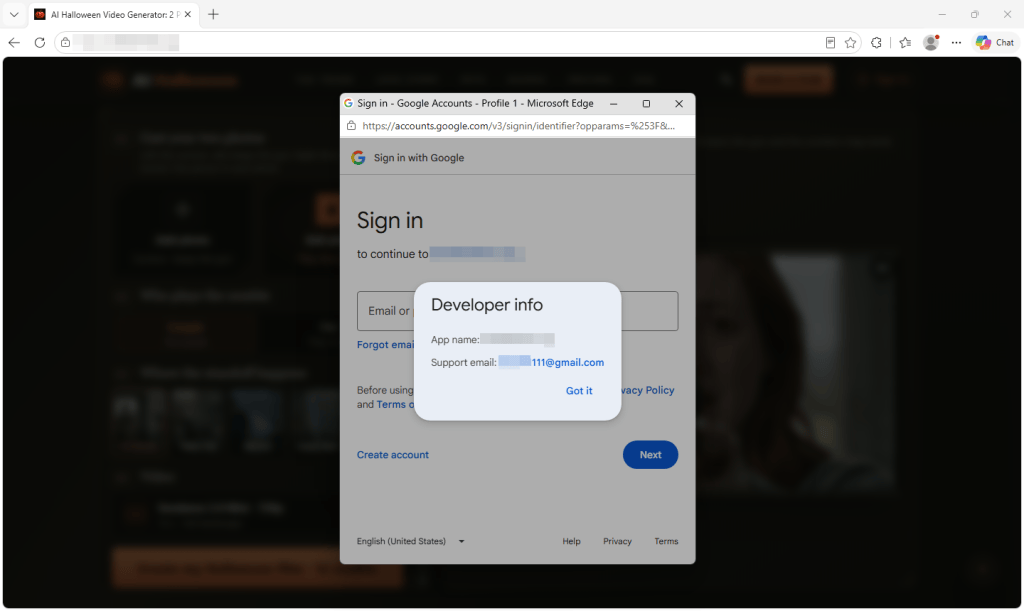
Click the app name in Google’s sign-in window and you’ll see Developer info. On one site we checked, the only contact listed was a Gmail address. We saw the same with the September sites. A Gmail address alone doesn’t establish wrongdoing, but it does little to identify the operator.
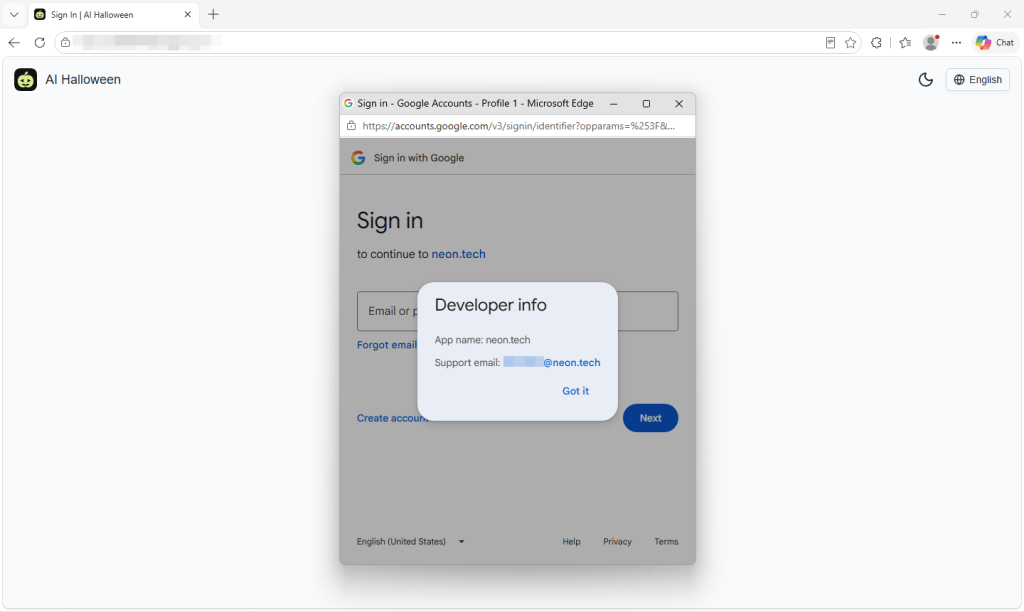
On another, Google said you were signing in “to continue to neon.tech.” Neon is a legitimate database company and authentication service provider. Its name appearing here doesn’t mean it operates or endorses the Halloween video site.
Login providers can handle Google sign-in on a site’s behalf. Depending on the setup, Google may display the provider’s domain instead of the video site’s name. Here, the sign-in screen gave visitors no clear indication of who operated the Halloween service.
Sites like these don’t necessarily take a team or months of work. Some use the same $249 website kit we wrote about in September, which promises you can “launch your AI product in one hour.” On one Halloween site, the builders hadn’t even cleared out the kit’s sample content. Hidden in the page was a note saying it was “a demo site” for the template, along with placeholder links like “your-app-name.”
Another site’s code contained remnants of an AI rap and dance video maker, including a “hotel lobby” stage, a recording studio, and AI-written raps. Those remnants suggest the site uses code also intended for other AI video services.
Using a website kit isn’t itself suspicious. But a polished page can be quick to assemble, so its appearance tells you little about the business handling your photos.
On one site, a single 15-second zombie clip cost $9.99. The pricing page nudged visitors toward bigger packs, bringing the advertised price per video down to $2.99. But that lowest price meant spending $199 on enough credits for roughly 66 zombie films. There were monthly and yearly plans too, costing up to $600 a year.
One site also used countdown offers, reminders in the browser tab, and claims about how many people had made films that day to encourage visitors to buy.
There’s no need to rush. Check the payment terms as carefully as the privacy policy. The sites themselves warn that AI can change faces, so your video may not look much like you. Under the policies we reviewed, credits are returned if a video fails to generate. But if you simply don’t like the result, trying again costs more credits.
Subscriptions renew until you cancel, yearly plans are charged in one go, and some credits expire before you use them.
Whichever tool or platform you choose, make sure you’re comfortable with how it will handle your data, your photos, and your payment info.
If you have concerns about a website, Malwarebytes Scam Guard can help you assess it. Malwarebytes Browser Guard helps block known scam and malicious sites.
But these tools can’t verify a service’s photo deletion promises. You should still check who operates it and what its privacy terms say before uploading.
Malwarebytes Scam Guard helps you analyze suspicious links, texts, and screenshots instantly.
Available with Malwarebytes Premium Security for all your devices, and in the Malwarebytes app for iOS and Android.
Source: Malwarebytes Labs · 2026-10-26
Microsoft’s updates address two newly disclosed vulnerabilities in the .NET developer platform, as well as flaws not fully addressed in an earlier release
Source: Infosecurity Magazine · 2026-10-26

UK Biobank (UKB) says its platform is now “secure” and that academics will soon regain access, months after a major data leak of volunteer health data. The charity, which runs the eponymous research project and describes itself as the custodian of the world’s most comprehensive biomedical dataset, said it is waiting for approval from health data controllers and central government before it relaunches the platform. UK Biobank’s Research Analysis Platform (UKB-RAP) has locked out all medical researchers trying to access its dataset since the April attack, which led to all 500,000 volunteers’ data being listed for sale on Chinese ecommerce website Alibaba. More than 20,000 researchers use the dataset provided by the cloud-based platform. They upload research projects and run experiments informed by the genomic data UKB collected from 40-to-69-year-olds between 2006 and 2010. The org makes around 30 petabytes worth of the stuff available to researchers, who investigate conditions including cancer, dementia, Parkinson’s disease, and COVID-19 immunity. Professor Sir Rory Collins, CEO at UKB, said on Friday that the organization has “completed the work to ensure that the UKB-RAP is secure,” and that the progress was checked by an independent cybersecurity company, whose report recommends reopening the platform. The charity will begin a phased re-introduction of researchers to its platform after it receives the necessary approvals, although boffins will not be able to download any results files at first. The platform will pilot a “manual output checking system,” where human reviewers will inspect files researchers wish to download before allowing them to do so, ahead of an automated process expected to roll out next year. According to the guide UKB compiled for researchers outlining the changes to the platform, researchers will also be restricted from building public apps and sharing tools with external colleagues until that manual checking system is fully up and running. Researchers were also warned that they will not be able to refresh or dispense data, only work with pre-existing data. They were also told to expect automatic logout out after 15 minutes of inactivity, with 2FA required upon re-authentication. Other technical changes include no longer being able to SSH into jobs, interactive tools being run via “isolated browsing” which restricts data transfer between web apps and the user’s local system, and some restrictions on CLI use. UKB is working toward a day when the researchers using its platform store no data on their own computers, working only with that which is uploaded to the repos it hosts. However, in uploading this data to online repos, de-identified data is accidentally included in the code. UKB says it runs daily automated scans of these repos to catch errors, and provides training to researchers to help prevent these occurrences. Collins said that since the attack, most researchers have confirmed the deletion of de-identified data from their projects, but others have not and won’t be admitted back to the UKB-RAP until they do. “Despite our repeated reminders, we are still detecting a small number of code repositories that include de-identified participant data,” he said. “As these constitute a serious breach of the Material Transfer Agreement, sanctions are being applied against the researchers who are responsible.” The charity also said researchers caught exposing participant data in their code will be forced to move their analyses to UKB-RAP, delete any downloaded data, and undergo additional training before being allowed back on the platform. It had initially told researchers to expect a relaunch of the platform by September 2026, although an update penned last month confirmed that it needed to wait for an independent assessment to be completed, despite already making the required security improvements. ®
Source: The Register — Security · 2026-10-26

[Update] October 28, 2026: CISA Adds Node2Shell to KEV as Exploit Traffic Emerges
[Update] October 27, 2026: PHP Ships Windows Builds With Brotli Fix
The Node2Shell Brotli flaw (CVE-2026-111497), disclosed alongside Node.js fixes on October 21, 2026, also reaches Python through the PyPI Brotli and brotlicffi packages. Both compile Google’s vulnerable Brotli C decoder, and popular HTTP clients such as requests, httpx and aiohttp use them to decompress responses automatically once they are installed.
That makes exposure easy to miss. A Python service can hand attacker-controlled Brotli data to the decoder without a single Brotli import in its own code. At this time, researchers have already shown Remote Code Execution (RCE) against Node.js through the same decoder code, so Python teams should move to the fixed versions, Brotli 1.2.1 and brotlicffi 1.2.1.0, without waiting.
CISA added CVE-2026-111497 to its Known Exploited Vulnerabilities (KEV) catalog on October 27, 2026, together with the Adobe Commerce and Magento flaw CVE-2026-48356 (PolyShell). FCEB agencies must remediate by November 10, 2026. The listing replaces the “no in-the-wild exploitation” status this post gave as of October 26.
The reported activity targets Node.js. Captured exploit traffic carried a payload built for the official Node.js 24.22.0 x86-64 binary, with a delivery layer copied from public proof-of-concept code. When researchers replayed the attacker’s chain in a lab, it produced no shell in 50 attempts: it triggered the bug and crashed the process but never reached its final execution step, which they assessed as a first-generation attempt with a defective last stage. The source IP, 94[.]154[.]43[.]7, has also been tagged for PHP2Shell exploitation. Separate honeypot telemetry logged one attempt from a U.S. IP on October 27, with no evidence that the target was vulnerable or that the attempt succeeded.
No exploitation through the Python Brotli or brotlicffi packages has been reported. The KEV listing covers the CVE as a whole, so the upgrade, rebuild and restart steps in this post now carry a federal deadline.
The table below summarizes the Node2Shell vulnerability as it applies to Python environments.
| Attribute | Details |
|---|---|
| CVE ID | CVE-2026-111497 |
| Common Names | Node2Shell, also HTTP2Shell and Brotli2Shell |
| Weakness | CWE-787 (Out-of-Bounds Write), CWE-252 (Unchecked Return Value) |
| Severity | 9.2 Critical (CVSS v4.0, Google as CNA); 8.1 (CVSS v3.1, a Linux distribution advisory and the .NET advisory) |
| Affected Upstream Versions | Brotli 1.0.3 through 1.2.0 |
| Affected Python Packages | Brotli 1.2.0 and earlier; brotlicffi 1.2.0.x and earlier |
| Fixed Versions | Upstream Brotli 1.0.10, 1.1.1 and 1.2.1; PyPI Brotli 1.2.1; brotlicffi 1.2.1.0 |
| Python Advisories | PYSEC-2026-4322 (Brotli), PYSEC-2026-4323 (brotlicffi) |
| Exploitation Status | Exploit attempts observed against Node.js; none reported against the Python packages |
| CISA KEV | Added October 27, 2026 (FCEB due date: November 10, 2026) |
| Reported By | Khai Tran and Sylvie Mayer, OpenAI Codex Security |
Node2Shell is the most widely used name for CVE-2026-111497, a memory safety flaw in the decoder of Google’s Brotli compression library. Its CVE record says a remote, unauthenticated attacker can use a crafted Brotli stream to corrupt adjacent decoder memory, with possible information disclosure, denial of service or arbitrary code execution.
Google, acting as the CVE Numbering Authority (CNA), published the record on October 22, 2026, with a CVSS v4.0 score of 9.2 (CVSS:4.0/AV:N/AC:L/AT:P/PR:N/UI:N/VC:H/VI:H/VA:H/SC:N/SI:N/SA:N). The Node2Shell name comes from researchers who demonstrated code execution against Node.js.
The bug sits in block switch handling in the decoder source file c/dec/decode.c. The DecodeBlockTypeAndLength() function returned an ambiguous result for an invalid block switch, and the fast decoding path ignored that return value. As the Node.js security release explains, the streaming decoder then treated a permanent format error as a temporary need for more input and kept appending bytes to an eight-byte internal buffer.
The upstream fix adds a dedicated error code, BROTLI_DECODER_ERROR_FORMAT_BLOCK_SWITCH (-17), so decoding stops on the malformed stream. The change entered Brotli’s source in February 2026 but reached tagged releases only on October 21, 2026, as Brotli 1.0.10, 1.1.1 and 1.2.1.
Python inherits the flaw because two PyPI packages compile Google’s C decoder into native extensions. Brotli is Google’s official CPython binding, and brotlicffi is a CFFI-based binding often used on PyPy. The PYSEC-2026-4322 advisory notes that Brotli 1.2.1 contains the upstream fix and otherwise differs from 1.2.0 only by a version bump.
The Brotli package alone draws over 82 million downloads a month, and it often arrives as a transitive dependency or optional extra that teams never chose directly.
Every release of both packages before the fixed versions is affected. Both fixes were published on PyPI on October 22, 2026, and the PyPI advisory database added entries for them on October 23.
| Package | Role | Affected Versions | Fixed Version | Advisory |
|---|---|---|---|---|
| Brotli | Google’s CPython binding | 1.2.0 and earlier | 1.2.1 | PYSEC-2026-4322 |
| brotlicffi | CFFI binding, common on PyPy | 1.2.0.x and earlier | 1.2.1.0 | PYSEC-2026-4323 |
A community analysis found that no advisory database listed the PyPI packages immediately after disclosure, so dependency scans run before October 23 may have missed them. Distribution-packaged Python bindings follow their own versioning and may carry backported fixes, so check the relevant Linux vendor advisory.
Exploitation requires a path that delivers attacker-controlled Brotli data to the decoder. The flaw works in both directions: a malicious server can target a vulnerable client, and a malicious client can target a vulnerable server.
Once Brotli or brotlicffi is installed, urllib3 and requests decode Brotli responses automatically, httpx does so with its brotli extra, and aiohttp does so when Brotli is present. Services that fetch attacker-influenced URLs, such as webhook senders, link previewers, crawlers and Scrapy-based scrapers, are the most direct targets.
Applications or middleware that decompress request bodies sent with Content-Encoding: br pass client-supplied data straight to the decoder. This path depends on the framework and its configuration, so teams should confirm whether any proxy, middleware or handler decodes Brotli bodies.
Some Python libraries ship their own Brotli copy. Apache Arrow pins a bundled Brotli 1.0.9, and its tracking issue was still open on October 26, 2026. Further research showed a 534-byte input sending pyarrow into an endless loop with no network connection involved, and upgrading the Brotli package does not patch such embedded copies.
CISA added CVE-2026-111497 to its Known Exploited Vulnerabilities (KEV) catalog on October 27, 2026, superseding the October 23 SSVC “exploitation: none” assessment. Observed exploit traffic actively targets Node.js environments.
Public exploit code for Node.js is available, and researchers confirmed it gets a shell on vulnerable builds; payloads are build-specific.
Red Hat states that the attack complexity is rated high, partly because of platform hardening such as ASLR and NX. Published research demonstrates impact, which is not the same as a reliable, weaponized exploit.
For Python specifically, no public research has shown memory corruption or code execution in the Brotli or brotlicffi extensions. The concern comes from the shared decoder code that already produced code execution on Node.js.
Results differ by platform, and the strongest evidence comes from Node.js:
Severity ratings diverge as well. Microsoft’s .NET advisory scores the flaw 8.1 under CVSS v3.1 and lists information disclosure, denial-of-service (DoS) and elevation of privilege, not RCE.
On October 26, 2026, the PHP team published updated Windows builds that bundle Brotli 1.2.1 and fix CVE-2026-111497: PHP 8.5.12-1, 8.4.27-1, 8.3.36-1 and 8.2.35-1. PHP joins the runtimes listed in this post that ship their own copy of the decoder and need an update separate from the Python packages.
In PHP for Windows, the vulnerable decoder is reachable through the cURL extension when automatic HTTP response decompression is enabled. cURL leaves this off by default, but applications and HTTP client libraries can turn it on. That puts PHP services fetching attacker-influenced URLs in the same risk category as the Python services described under Outbound HTTP Responses.
The -1 suffix marks a Windows package rebuild with updated dependencies. The PHP source and runtime versions are unchanged, so a version string alone does not separate patched and unpatched Windows builds; confirm the -1 package is installed.
These builds are unrelated to the PHP2Shell fixes for CVE-2026-109618 and CVE-2026-109619, which PHP 8.5.12, 8.4.27, 8.3.36 and 8.2.35 already include.
Python services often run beside components that bundle their own decoder, and each needs a separate update. Exposure depends on whether the component decodes untrusted Brotli data.
| Product | Fixed In | Exposure Condition |
|---|---|---|
| Node.js | 22.23.4, 24.22.1, 26.12.1 | Applications decompress untrusted Brotli data with node:zlib |
| .NET | 8.0.33, 9.0.22, 10.0.14, 11.0 RC3 | Brotli enabled in ASP.NET Core request decompression or HttpClient, or BrotliStream/BrotliDecoder used on untrusted data |
| Envoy | 1.40.0, 1.39.3, 1.38.6, 1.37.8, 1.36.12 | Brotli decompressor configured |
| Istio | 1.31.2, 1.30.6, 1.29.9 | Brotli decompression enabled, for example through an EnvoyFilter |
| PHP for Windows | 8.5.12-1, 8.4.27-1, 8.3.36-1, 8.2.35-1 (Brotli 1.2.1) | cURL extension with automatic HTTP response decompression enabled (off by default) |
| Apache Arrow (including pyarrow) | No fix as of October 26, 2026 | Bundled Brotli 1.0.9 decodes Brotli-compressed data in pyarrow |
Linux distributions are shipping Brotli updates on separate schedules, so check each vendor’s security tracker.
Brotli rarely appears in a top-level requirements file, so the inventory has to cover every place Python runs:
Upgrading the two packages closes the most common Python path, but only if every running process loads the fixed build:
Patch services that fetch untrusted URLs or accept compressed request bodies first. Afterward, confirm the version each running process actually loads.
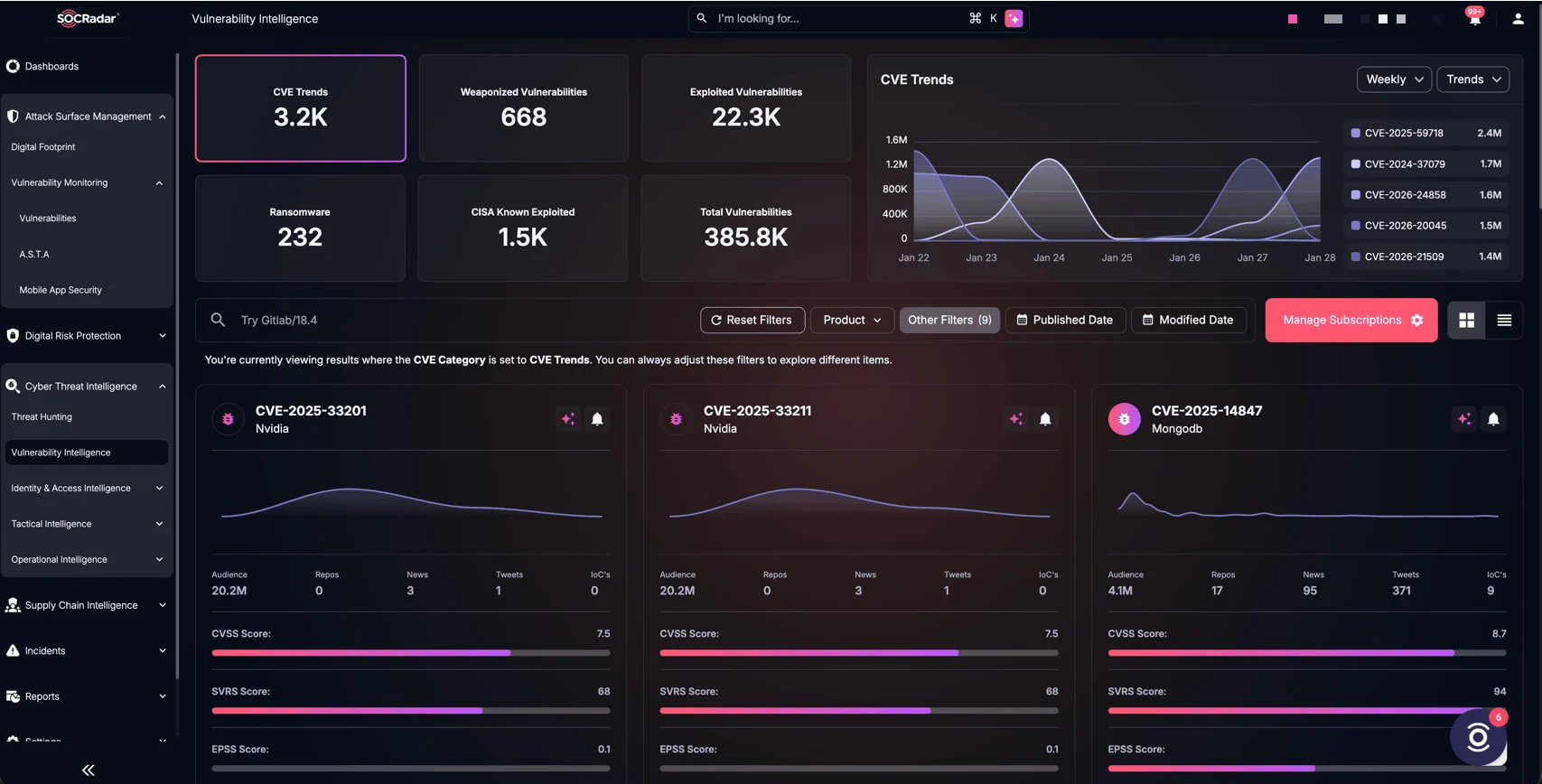
A shared library flaw gets fixed across packages, runtimes and distributions at different speeds, which makes status tracking the hard part. SOCRadar helps security teams identify exposure and track patches across their environments through several key capabilities:
These steps reduce exposure while an upgrade is pending, but none replaces the fixed versions:
Watch for unusually large inbound request bodies with Content-Encoding: br (the observed request was about 23 MB), unexplained Node.js process crashes, and traffic from 94[.]154[.]43[.]7. Restrict access to core dumps, since crashes can expose live session data.

Source: SOCRadar · 2026-10-26
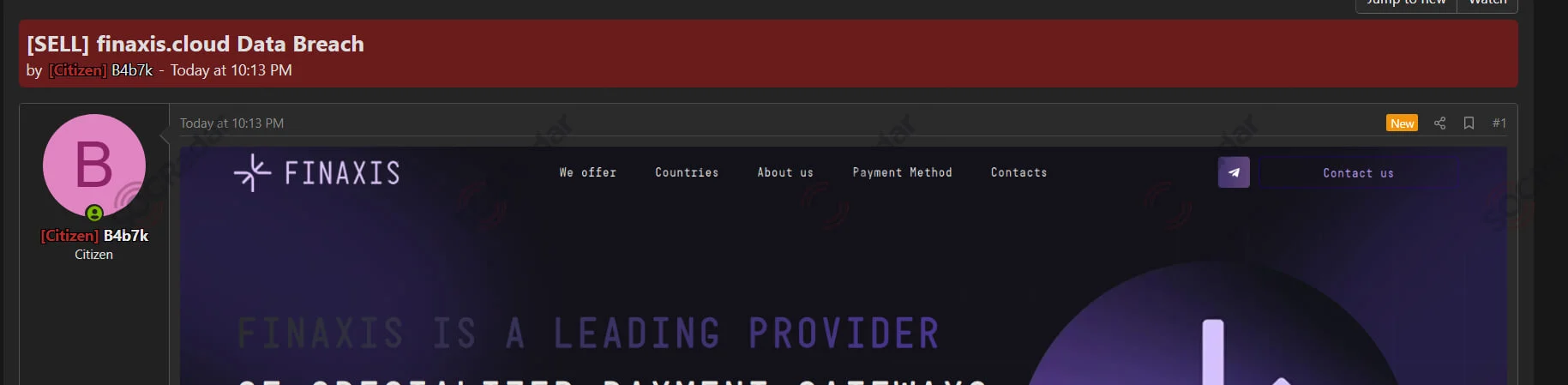
SOCRadar Dark Web Team identified several underground posts, including an alleged Finaxis.cloud data sale involving 400GB of information, a resurfaced WoWInstaller database containing historical user credentials, and an alleged Argentine Moodle platform data leak. Other posts advertised an alleged MyHairCare Australia customer database and an alleged HT Médica database containing 2.2 million records.
SOCRadar Dark Web Team detected a post advertising an alleged 400GB data breach involving Finaxis.cloud, a payment processing platform serving high-risk industries, including iGaming. The threat actor claimed to have obtained sensitive internal information after the company’s management allegedly refused to meet ransom demands.
The advertised data reportedly includes full source code, merchant and partner lists, P2P agent and trader contact information, financial statements, and banking details. The seller offered individual components for purchase or the complete dataset for $15,000. If authentic, the exposure could facilitate financial fraud, targeted attacks against business partners, and further exploitation of the platform’s infrastructure.
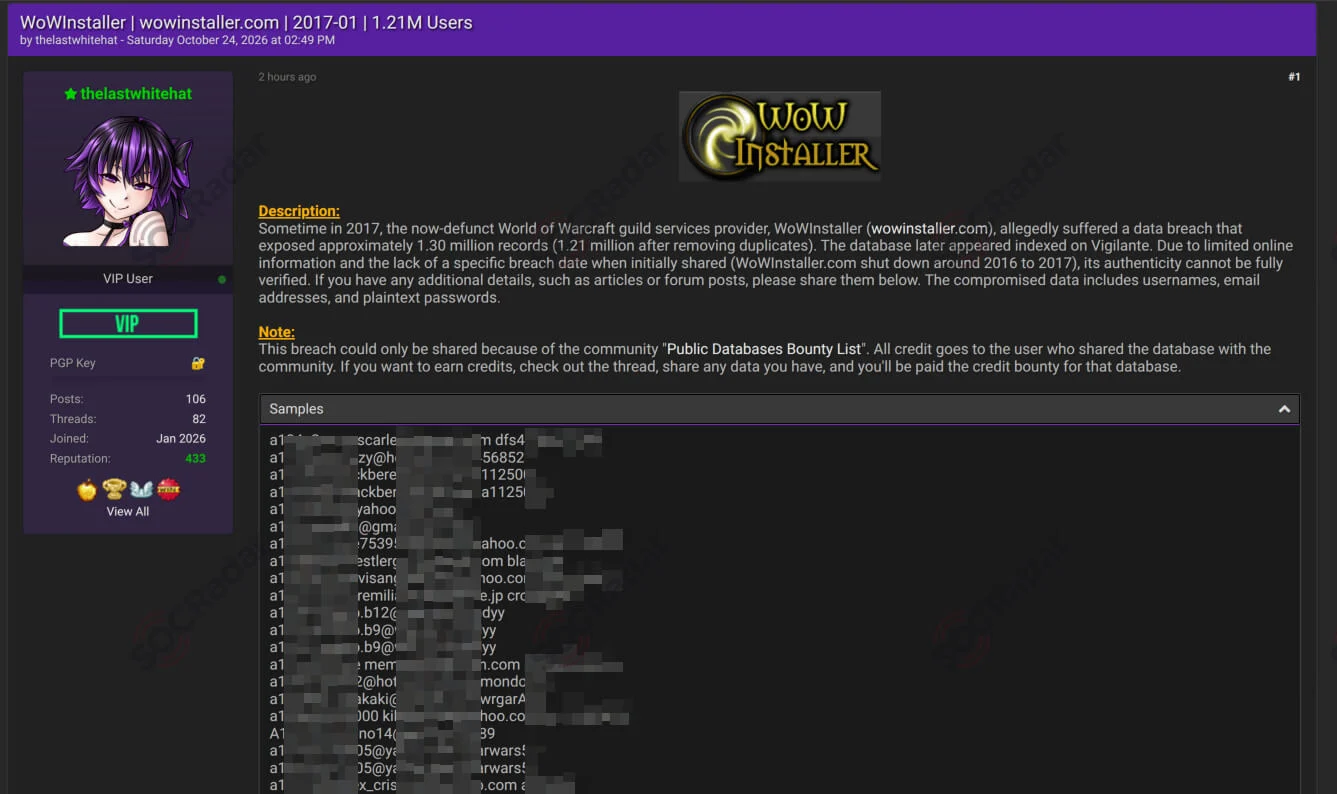
SOCRadar Dark Web Team identified a forum post sharing an alleged historical database belonging to WoWInstaller, a now-defunct World of Warcraft guild services provider. The seller claimed the database originated from a breach dating back to approximately 2017 and contained around 1.21 million records after duplicate entries were removed.
The dataset reportedly includes usernames, email addresses, and plaintext passwords. Although the service is no longer operational, the circulation of historical credentials could expose former users to credential stuffing and account takeover attempts if they reused the same passwords across other services. The authenticity of the database remains unverified.
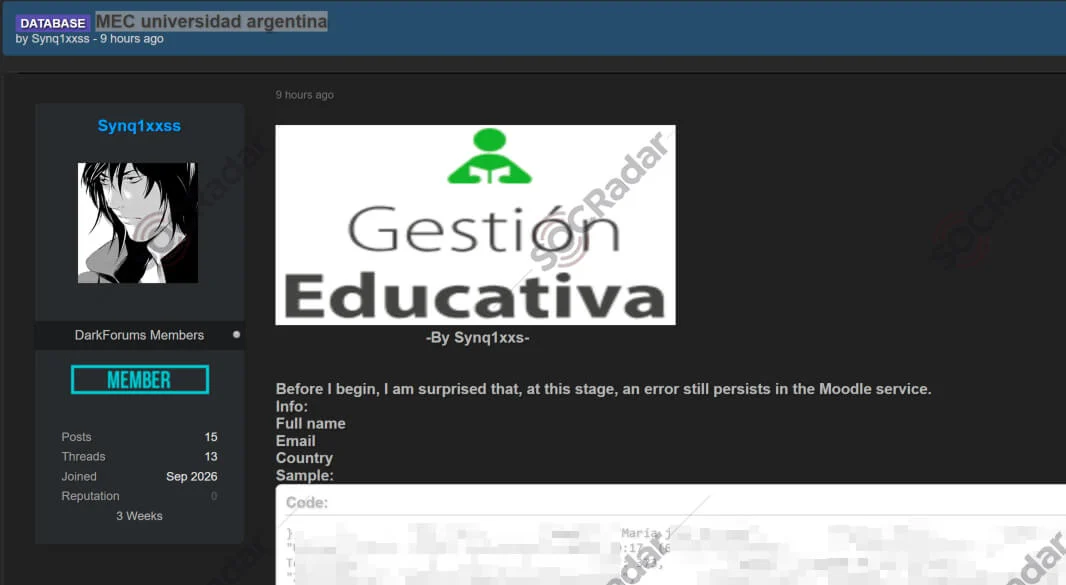
SOCRadar Dark Web Team detected a post claiming to expose user information from an Argentine educational platform using Moodle. The actor, operating under the alias Synq1xxs, shared sample records allegedly associated with an educational management system identified as MEC and claimed that a persistent issue within the Moodle service had enabled the exposure.
The advertised information reportedly includes full names, email addresses, country information, time zone settings, and course enrollment details. Some records allegedly contain recent login activity, suggesting the dataset may include current users. If verified, the exposure could support phishing, impersonation, and social engineering attacks targeting students and educational personnel. The platform’s precise institutional affiliation remains unconfirmed.
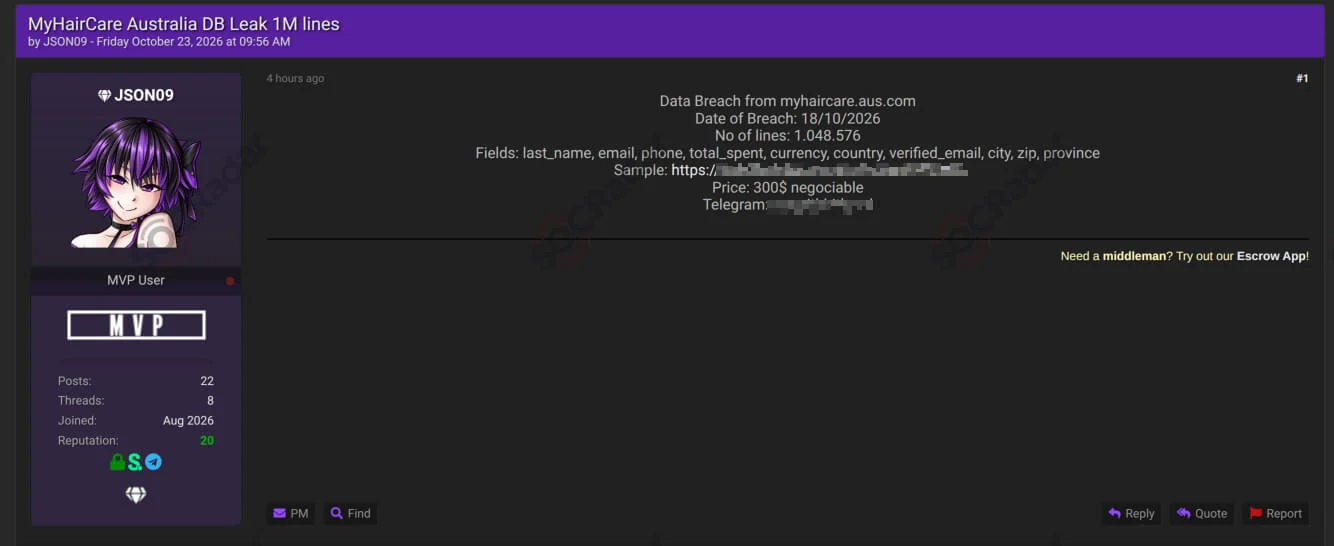
SOCRadar Dark Web Team identified a dark web post advertising an alleged database belonging to MyHairCare Australia, an Australian beauty and haircare retailer. The seller, identified as JSON09, claimed the dataset contained 1,048,576 records obtained during an incident dated October 18, 2026.
The advertised data reportedly includes customer last names, email addresses, phone numbers, total spending amounts, currency information, and geographic details, including cities, postal codes, and provinces. The dataset was offered for $300, with a sample link provided by the seller. If authentic, the information could facilitate targeted phishing, customer impersonation, and fraudulent communications using purchase-related details.
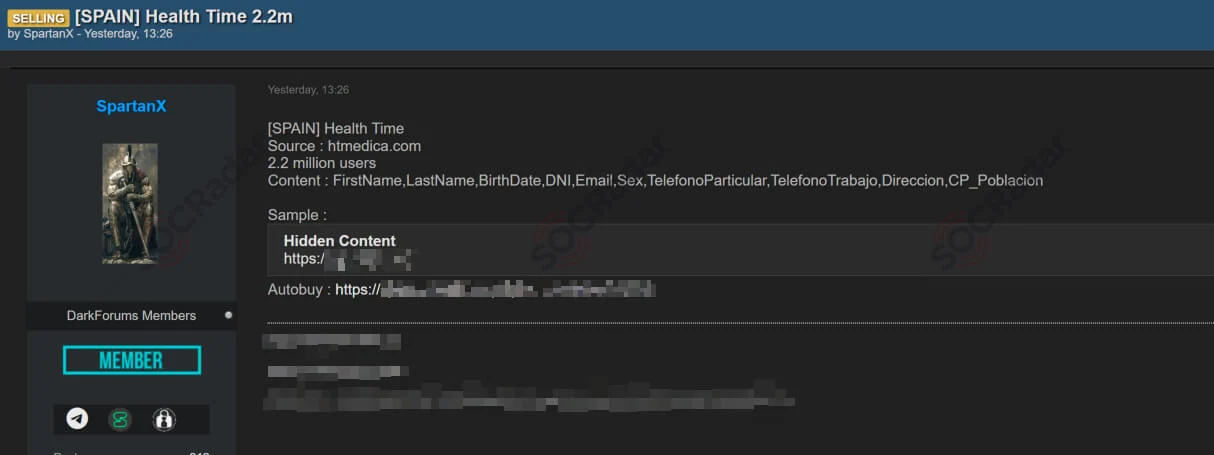
SOCRadar Dark Web Team detected a post advertising an alleged 2.2 million-record database associated with HT Médica, a Spanish healthcare provider specializing in diagnostic imaging. The seller, operating under the alias SpartanX, claimed to possess personal information associated with the organization and provided a sample link to support the listing.
The advertised dataset reportedly contains first and last names, dates of birth, DNI identification numbers, email addresses, gender information, personal and work phone numbers, and physical addresses. If authentic, the exposure could create significant privacy risks and facilitate identity theft, phishing, and targeted fraud against affected individuals. The breach remains unverified, and the listing does not establish that clinical records were compromised.

Gaining visibility into deep and dark web threats can be extremely useful from an actionable threat intelligence and digital risk protection perspective. However, monitoring all sources is simply not feasible, which can be time-consuming and challenging. One click-by-mistake can result in malware bot infection. To tackle these challenges, SOCRadar’s DarkMirror screen empowers your SOC team to follow up with the latest posts of threat actors and groups filtered by the targeted country or industry.

Source: SOCRadar · 2026-10-26
Quest Diagnostics has confirmed that an unauthorized party accessed a system healthcare providers use to order laboratory tests and view results, affecting personal information and patient records.
Quest is a major US laboratory testing company whose services help healthcare professionals diagnose and monitor medical conditions. Those services range from routine laboratory testing to specialized testing in areas such as cancer, infectious diseases, and neurology.
The company learned of unauthorized access to its Quanum Lab Services Manager, or LSM, on October 21. The compromised platform lets healthcare professionals order tests, access results, review historical trends, and order supplies. Quest paused access to the platform and began investigating. Quest says its core business operations remain up and running.
An investigation is ongoing. Quest has not yet published a count of affected patients or a complete list of the information accessed. It says it will notify affected patients, healthcare providers, and health plans.
The company said:
“personal information and patient records were affected.”
It confirms that health information and personally identifiable information were involved, but has not specified whether these included Social Security numbers, insurance identifiers, payment information, particular test results, or account passwords.
Quest says it will send notification letters to affected patients once its investigation is complete. Those letters will describe available resources, including credit and identity monitoring. If you receive one, read it carefully and follow the instructions. You can also check the FAQs posted in Quest’s breach notice for updates.

A breach does not automatically mean someone has misused your information, but you can take these precautions while you wait for more details:
Medical identity theft is not just a financial problem; it can also affect your care. Someone using your identity to obtain treatment or submit insurance claims could introduce incorrect information into your health records. Checking medical statements and reporting anything unfamiliar can help you catch that misuse.
Let’s face it, an incognito window can only do so much.
Breaches, dark web trading, credit fraud. Malwarebytes Identity Theft Protection monitors for all of it, alerts you fast, and comes with identity theft insurance.
Source: Malwarebytes Labs · 2026-10-26