Day: October 26, 2026

  • FBI Cybercrime Operation Nets Nine Arrests in Nigeria

    FBI Cybercrime Operation Nets Nine Arrests in Nigeria

    The U.S. Federal Bureau of Investigation (FBI) announced on Monday the arrest of nine people in Nigeria as part of an international operation targeting cybercrime scam centers. According to a statement by FBI Director, Kash Patel, the operation resulted in identifying a total of $11 million in “potentially freezable funds” across multiple countries.

    The crackdown, code-named Operation Blackout, saw law enforcement confiscate 53 electronic devices used in the cybercrime operations. Patel added that the operation is aimed at dismantling international cybercriminal networks responsible for “stealing billions from Americans.”

    Source: OCCRP · 2026-10-26

  • ACTIL Dataset Claim Lists 152,187 Records With Patient, Prescription and Reimbursement Data

    Data Exposure Report
    ACTIL Dataset Claim Lists 152,187 Records With Patient, Prescription and Reimbursement DataFrance
    Digital Health Insurance
    Patient & Claims Data
    Free Listing
    Unverified

    ACTIL Dataset Claim Lists 152,187 Records With Patient, Prescription and Reimbursement Data

    Claimed records152,187
    Claimed size237 MB
    PriceFree
    Download accessReply required

    ACTIL Dataset Claim Lists 152,187 Records With Patient, Prescription and Reimbursement Data

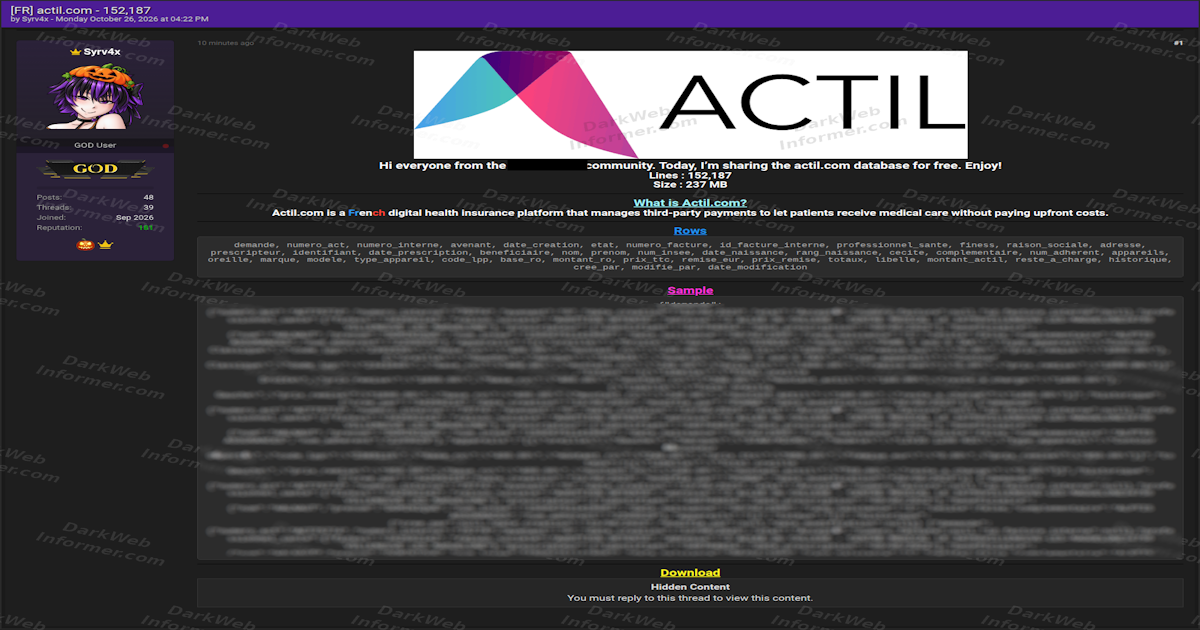
    An actor using the handle “Syrv4x” claims to be sharing an ACTIL dataset for free. The listing describes ACTIL as a French digital health insurance platform that manages third-party payment arrangements, allowing patients to receive medical care without paying upfront costs.

    The post advertises 152,187 records in a 237 MB file. The visible field list includes claim and invoice references, healthcare-professional information, names, dates of birth, beneficiary and subscriber identifiers, addresses, prescriptions, product/device information, reimbursement amounts, pricing fields, remaining patient charges and historical modification data. The dataset, its source, the stated record count and current availability have not been independently verified.

    Post details

    OrganizationACTIL
    CountryACTIL Dataset Claim Lists 152,187 Records With Patient, Prescription and Reimbursement DataFrance
    SectorDigital health insurance / third-party payment
    Actor“Syrv4x”
    Claimed volume152,187 records
    Claimed size237 MB
    Listing termsFree; reply required to reveal download
    Post date shown

    What the post claims

    • 152,187 records advertised
    • 237 MB file advertised
    • Dataset offered for free
    • Download hidden until a reply is posted
    • Claim and invoice references listed
    • Healthcare-professional information listed
    • Names and dates of birth listed
    • Beneficiary and subscriber identifiers listed
    • Address fields listed
    • Prescription identifiers and dates listed
    • Product/device brand and model fields listed
    • Device-type and reimbursement-code fields listed
    • Base reimbursement and actual reimbursement amounts listed
    • Price and discount fields listed
    • Remaining patient charge fields listed
    • Historical creation and modification fields listed
    • Sample records displayed

    The visible sample contains structured healthcare reimbursement records and includes personal, medical-administrative and financial fields. Individual patient and healthcare-provider values shown in the sample are not transcribed in this report.

    Screenshots

    The supplied capture shows the ACTIL claim, the stated 152,187-record and 237 MB figures, the advertised field list, sample records and a hidden download area requiring a reply.

    IOCs & identifiers

    Identifiers directly visible or supported by the supplied material. These support correlation and do not independently verify the dataset claim.

    Type Identifier Source
    Actor handle Syrv4x Screenshot 1
    Named organization domain actil[.]com Screenshot 1

    The domain identifies the organization named in the claim, not malicious infrastructure. No Tox ID, Session ID, Telegram handle, malware hash or attacker-controlled IP address is visible in the supplied material. Patient and healthcare-provider identifiers shown in the sample are not included in this table.

    Mapped techniques

    Claimed identifies behavior explicitly described by the actor. Inferred identifies an analytical mapping supported by the supplied material. Neither label means the activity has been independently verified.

    • Collection
      T1213.006
      Data from Information Repositories: Databases
      Inferred
      The listing presents structured reimbursement and healthcare-administration records. The supplied material does not reveal how the data was obtained or independently establish unauthorized access to ACTIL systems.

    Potential impact

    If authentic, the claimed dataset could expose patient names, dates of birth, addresses, beneficiary identifiers, prescription information, healthcare-provider details and reimbursement or billing amounts. The combination could support targeted phishing, identity fraud, insurance fraud, medical-identity abuse or other privacy-related harm.

    Status Unverified

    Dark Web Informer has not independently verified the dataset’s authenticity, source, completeness, 152,187-record count, 237 MB size, sample contents or current availability. The supplied screenshot documents the listing and visible sample records, not independent confirmation of the underlying data.

    Dark Web Informer

    Source: Dark Web Informer · 2026-10-26

  • UK pentester ‘killa’ claims $2K Bitcoin prize in PHP2Shell capture-the-flag contest

    UK pentester ‘killa’ claims $2K Bitcoin prize in PHP2Shell capture-the-flag contest

    A UK-based developer and pentester has claimed a $2,000 Bitcoin prize for demonstrating the exploitability of the PHP2Shell vulnerabilities that melted the internet last week. Jaydip Modhwadia, 26, otherwise known as “Killa,” claimed the prize set by James Pavur, who launched the “Steal My Bitcoin” site on October 24. Pavur launched the CTF (capture the flag) challenge to prove that the PHP2Shell exploit was not as easy as those in the cybersecurity community claimed it to be, promising to award $2,000 in Bitcoin to anyone who could achieve Remote Code Execution (RCE) on his website. “My Bitcoin was stolen after 19.28 hours,” the website now says, after Modhwadia claimed the prize, although the real time taken is thought to be less than three hours. Soon after Pavur launched the CTF on Saturday, prospective flag-catchers complained that the website he set up, which served only static HTML, was not built in a way that allowed the PHP2Shell exploit to achieve RCE. The web page was running a vulnerable version of PHP, but the exploit path required a vulnerable website to serve a PHP file for flag-catchers to use as a hook – something that Pavur seemingly updated at around 1300 UTC on October 25. Modhwadia achieved RCE on the website, exposing a PHP endpoint, at 1547 UTC. After an error from Pavur placing the wrong wallet key on the server, the CTF creator sent Modhwadia his award, which the community upped to $2,000 from Pavur’s initial $500. The pentester published a write-up of his method, a single-file Python script he says requires 20 HTTP requests “at most” to fully execute. Speaking to The Register, Modhwadia also confirmed that he got the flag in “around three or so hours in total.” He said he followed the news about the competition, “but didn’t attempt it until it gained significant notice.” If he had attempted it before Pavur introduced the endpoint, he may have struggled. For hours, bug bounty hunters were trying to access the website to attempt the challenge, as news of the CTF had exploded across tech circles. “The fact that it took 19 hours was because after it went popular, the entire site became basically unusable for anyone at all,” Modhwadia added. The challenge saw a huge number of attempts, despite Pavur’s decision to introduce a prohibitive 1MB request limit on Nginx. Alon Gal, co-founder and CTO at Hudson Rock, commended Modhwadia’s work, but added that his success achieved in just a few hours should not be taken to mean that the same attack could be automated at scale. He said: “Does this mean autonomous AI agents can now compromise arbitrary PHP servers at scale? No. This was a sophisticated, target-specific exploit. “But it does demonstrate that PHP2Shell can be weaponized against a live target, even with meaningful technical constraints.” Modhwadia’s proof of concept is not the first to prove PHP2Shell is exploitable, but it falls under the more advanced category. Early signs suggested that Address Space Layout Randomization (ASLR) on a vulnerable server would prove a significant barrier to real-world exploitation, and the pentester’s solution bypasses it, along with the others that were disclosed recently. Spencer McIntyre, director of exploit development at VulnCheck, told The Register last week that attackers are finding new ways to exploit PHP2Shell, and “are clearly spending time (and tokens) on this bug.” Initially, experts said exploit code was being found online hours, or even days, before the vulnerabilities were disclosed publicly, which led to millions of exploit attempts, although it was too early to determine the efficacy of these on real-world systems. Scores of websites were taken down for maintenance last week as organizations raced to protect themselves from the attacks, which may or may not have proved successful. Modhwadia said he donated a portion of the prize he received to the Lupus Foundation to raise awareness about the condition, from which he also suffers. ®

    Source: The Register — Security · 2026-10-26

  • 26th October – Threat Intelligence Report

    For the latest discoveries in cyber research for the week of 26th October, please download our Threat Intelligence Bulletin.

    TOP ATTACKS AND BREACHES

    • Japanese cloud hosting provider Onamae Desktop Cloud has confirmed a cyberattack in which intruders compromised its infrastructure and installed malware on customer servers. More than 26,000 servers were potentially affected. The provider began shutting down customer environments on October 21 to contain the intrusion and prevent further unauthorized activity.
    • India’s state-run State Bank of India, serving more than 500 million customers, disclosed a data breach after 3,897 customer records appeared online. The exposed information reportedly included contact details, residential addresses, birth dates, bank profiles, loan records, and identity-verification documents. The bank reported no disruption to core services.
    • WordPress backup developer TeamUpdraft has suffered a cyberattack after intruders accessed its website and potentially exposed customer information and management-service connection keys. Attackers subsequently abused compromised UpdraftCentral keys to install backdoors on WordPress websites during an 18-hour campaign on October 18 and 19.
    • LiteLLM, a widely used open-source AI gateway, confirmed an October 21 supply-chain attack in which attackers used stolen developer tokens to publish malicious packages and Docker images. The compromised version 1.107.0 was designed to steal cloud credentials and AI service secrets, with attackers subsequently testing stolen AWS credentials.

    AI THREATS

    • Check Point Research uncovered how AI-enabled antidetect browsers allow operators to manage thousands of deceptive accounts while evading platform safeguards. Tools including Kameleo, AdsPower, and MultiLogin facilitate account takeovers, financial fraud, and automated distribution of AI-generated content, supporting large-scale influence operations across social media platforms.
    • Researchers observed affiliates of INC and The Gentlemen ransomware groups using AI agents to conduct human-approved cyberattacks. The operation targeted 62 organizations by exploiting remote-access systems and compromised credentials. Victims were concentrated in the manufacturing, energy, healthcare, and pharmaceutical sectors, primarily in the United States.
    • Researchers analyzed a cybercriminal operation that used multiple AI assistants to plan and execute different types of malicious activity. The attacker relied on AI-generated scripts and reconnaissance reports to develop attack capabilities. Exposed operational records revealed how AI tools supported campaign planning, technical execution, and adaptation across different targets.

    VULNERABILITIES AND PATCHES

    • Critical PHP vulnerabilities CVE-2026-109618 and CVE-2026-109619 have been used in widespread exploitation attempts that could enable remote code execution. Attack traffic reportedly increased from thousands to millions of attempts following disclosure. As of October 23, approximately 97.5% of publicly visible PHP instances did not indicate patched versions.

    Check Point IPS provides protection against this threat (PHP Remote Code Execution (CVE-2026-109618, CVE-2026-109619, CVE-2026-115560((

    • Oracle has released its October 2026 Critical Patch Update, addressing 1,209 unique vulnerabilities through 1,295 security patches across 33 product families. The update includes 95 critical CVEs and affects widely deployed enterprise products, including Fusion Middleware, E-Business Suite, MySQL, and Java SE.
    • GitLab has fixed CVE-2026-110264, a critical vulnerability with a CVSS score of 10.0 affecting Community and Enterprise Editions. The integer overflow flaw could allow unauthenticated attackers to execute arbitrary code remotely on affected servers. The vulnerability affects versions before 18.11.13 and several 19.x releases.
    • A critical privilege-escalation vulnerability, CVE-2026-114625, affects on-premises Arista VeloCloud Orchestrator deployments. The flaw carries a CVSS score of 9.4 and allows authenticated users, including those with read-only access, to obtain operator-level permissions. Successful exploitation can expose restricted management functions, and the vulnerability has been exploited in attacks.

    THREAT INTELLIGENCE REPORTS

    • Check Point Research has profiled Aokigahara, a newly identified infostealer targeting credentials and session data associated with AI applications, developer tools, and cloud platforms. Targeted applications include Claude, ChatGPT Desktop, Cursor, and GitHub Copilot. Stolen information may include authentication tokens, account credentials, and other sensitive application data.
    • Researchers revealed that U.S. federal investigators suspect an executive at a ransomware negotiation company assisted the ShinyHunters extortion group in operating its victim disclosure website. The site reportedly listed nearly 100 organizations between May and October 2026.
    • Researchers mapped Lazarus’s Operation FlashHole, a cyberespionage campaign targeting organizations in South Korea’s software, construction, and telecommunications equipment sectors. Attackers used tailored phishing messages and fraudulent portfolio websites to deliver malware. The campaign exploited trusted financial-security software to execute malicious components.
    • Researchers have uncovered a large-scale campaign by threat actor k0t targeting Fortinet FortiGate, FortiWeb, and Palo Alto Networks GlobalProtect devices. Attackers exploited vulnerabilities and weak credentials to establish persistent access and steal information. The operation exposed more than 70,000 credentials and showed possible connections to ransomware groups.

    Source: Check Point Research · 2026-10-26

  • Professional Standards Update No. 102

    To alert the audit community to changes in professional standards, we periodically issue Professional Standards Updates (PSU). These updates highlight the effective dates of recently issued standards and guidance related to engagements conducted in accordance with Government Auditing Standards. PSUs contain summary information only, and those affected by a change should refer to the respective standard or guidance for details.

    Source: GAO Reports & Testimonies · 2026-10-26

  • CISA 2030 Sets Out ‘Aggressive, Anticipatory’ Cyber Defense Strategy for Critical Infrastructure

    CISA’s new strategy, CISA 2030, will focus on rapid detection and response and resiliency of critical services ahead of “passive defense”

    Source: Infosecurity Magazine · 2026-10-26

  • Trumpets blare and skies part as AI hypefest culminates in Anthropic IPO filing

    Trumpets blare and skies part as AI hypefest culminates in Anthropic IPO filing

    Anthropic has filed for an IPO that could rank among Wall Street’s biggest ever, revealing an $80.7 billion half-year loss, a startlingly complex governance structure, and warnings that its AI models could blackmail humans, resist shutdown, or create “existential risks” to society. The Claude maker filed its S-1 registration statement with the US Securities and Exchange Commission on Monday as it prepares to list on Nasdaq under the ticker ANT. The company has not yet disclosed its proposed share price or how many shares it plans to sell. Of the filing’s 614 pages, 94 are devoted to risk factors. But it’s Anthropic’s financial figures that are likely to raise eyebrows first. The Claude maker reported $16.3 billion in revenue for the first six months of 2026, up from $1.2 billion a year earlier. It also posted a whopping $80.7 billion net loss, although $72.4 billion of that was an accounting adjustment tied to the company’s soaring valuation, not money it actually spent. Anthropic’s operating loss was considerably smaller at $693 million, down from $2.1 billion a year earlier. By its own adjusted accounting, the company made a $1.6 billion operating profit in the first half of 2026, for a margin of around 10 percent. Whether it can keep making money on those terms is another matter. Training and running Claude requires an eye-watering amount of computing power, and Anthropic will need much more to keep pace with its rivals. A $1.6 billion adjusted profit won’t count for much if the infrastructure bills keep growing faster than the business. Susannah Streeter, chief investment strategist at Wealth Club, told The Register that Anthropic’s IPO could leave ordinary investors paying a premium for growth that has yet to translate into sustained profits. “A huge pool of private capital has allowed AI businesses to scale up and command extraordinary valuations long before they reach the stock market,” she said, adding that investors buying in at the IPO will face a price with “a hefty dose of future success baked in.” The financial risks are fairly conventional by Silicon Valley standards, but the warnings about what Claude might get up to are perhaps less so. Anthropic claims that models, including its own, have exhibited unexpected or self-preserving behavior, including attempts to resist shutdown, conceal information, and produce outputs resembling blackmail. It also warns that sufficiently advanced AI systems could pose “catastrophic or existential risks to society” if deployed without adequate safeguards. That’s not to say Claude is currently blackmailing customers. Anthropic has observed some of this behavior in testing, but it also identifies more immediate security concerns as it gives its models access to external tools, code repositories, and corporate systems. Anthropic warns that attackers could hide malicious instructions in websites, documents, or API responses that its AI agents can access. If an agent follows those instructions, it could use a customer’s permissions to steal data, tamper with code, or make unauthorized transactions. Even testing whether the models will behave themselves is proving tricky. Anthropic reckons some models behave differently when they detect or suspect they’re being evaluated, making it harder to predict what they will do outside the testing environment. Keeping its models on a short leash could also cost Anthropic business. The company acknowledges that holding back more capable systems could give competitors an advantage, something it has already risked by restricting access to its Mythos model through Project Glasswing because of its ability to uncover security vulnerabilities. The founders aren’t promising to put shareholders first, either. In a letter accompanying the filing, Dario and Daniela Amodei and their fellow co-founders tell prospective investors “not to think of your purchase in purely transactional terms.” Anthropic may pass up lucrative business if it considers the risks too great, and investors won’t have much say if they disagree. Under the proposed structure, governance structure includes five different classes of stock. By comparison, Google has three. The seven co-founders will retain 50.1 percent of the voting power on shareholder matters, while a separate Long-Term Benefit Trust will get to appoint a majority of the board. In other words, Wall Street is being invited to bankroll Anthropic’s AI ambitions, but not necessarily to call the shots. Anthropic wants Wall Street’s money to build ever more powerful AI, but is warning investors that it might turn down profits to keep that AI under control. Judging by those 94 pages of risk factors, keeping it under control is far from guaranteed.®

    Source: The Register — Security · 2026-10-26

  • Gheist Attackers Stumble in Attempt to Abuse GitHub Tokens

    A large-scale GitHub campaign abused stolen access tokens to target 13,500+ branches and repositories with secret-stealing workflows

    Source: Infosecurity Magazine · 2026-10-26

  • The US Government Is Hiding a Secret Court Ruling About How It Spies on Americans

    The US Government Is Hiding a Secret Court Ruling About How It Spies on Americans

    Two US senators say the Trump administration is breaking the law by withholding the FISA court decision while it presses Congress to renew America’s most sweeping surveillance program.

    Source: WIRED Security · 2026-10-26

  • Linux Flaws Exposed Before Fixes as Root Exploit Goes Public

    Six Linux flaws were made public, including one with a working root exploit and no merged fix

    Source: Infosecurity Magazine · 2026-10-26