YARA-X’s 1.22.0 release brings 11 improvements and 9 bugfixes.
Source: SANS Internet Storm Center · 2026-10-25
YARA-X’s 1.22.0 release brings 11 improvements and 9 bugfixes.
Source: SANS Internet Storm Center · 2026-10-25
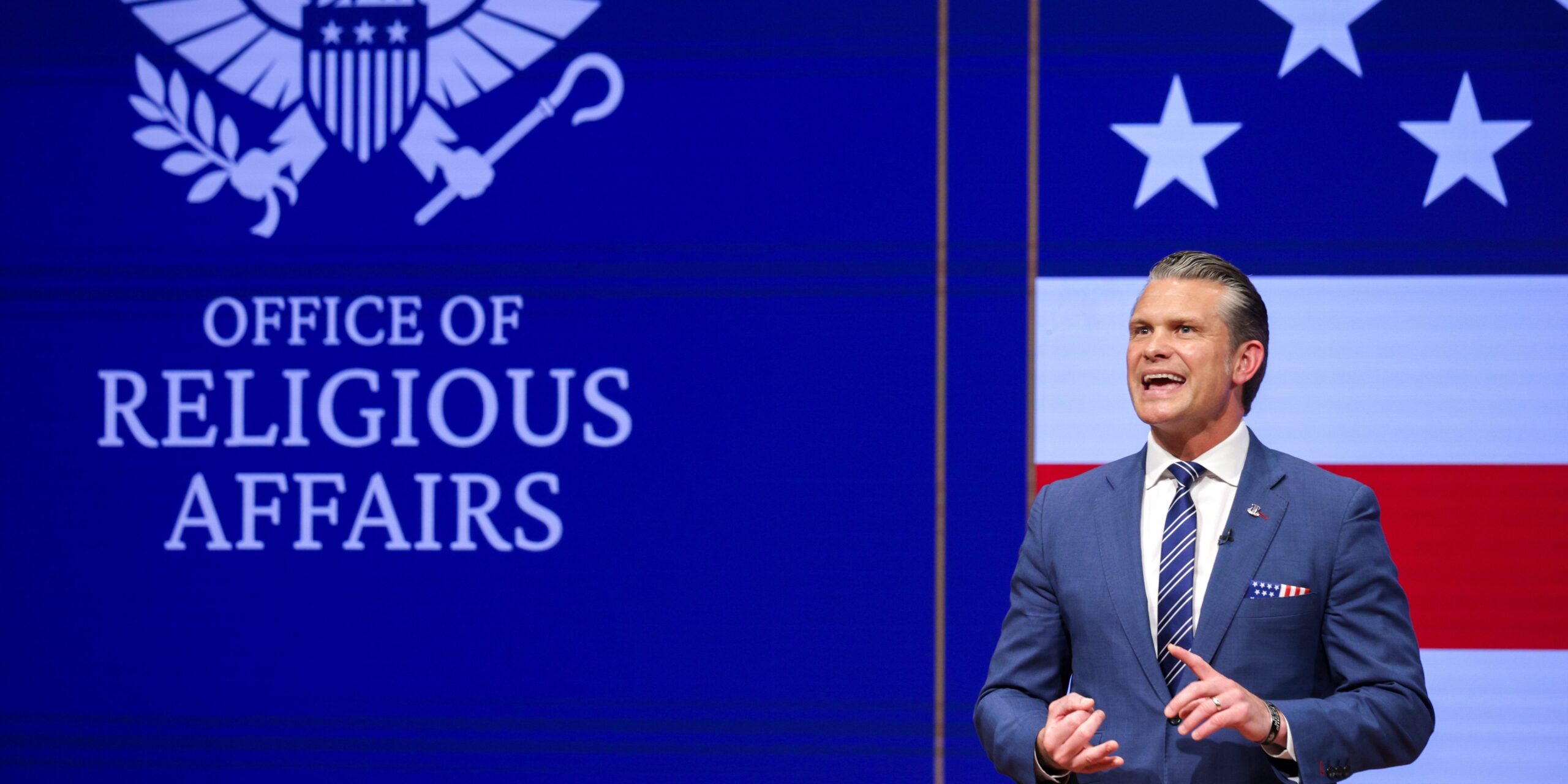
Defense Secretary Pete Hegseth has extended a line for the military’s religious leaders to reach him directly — and current and former military chaplains say they don’t want it.
Hegseth announced the creation of a new Office of Religious Affairs on September 30, vowing that the office would give members of the armed forces’ chaplain corps access to him without “bureaucratic dilution.” It coincides with his openly Christian “Send Me” campaign, an online propaganda effort that the Pentagon launched over the summer promoting a biblical phrase widely understood as a vow to accept a divine mission.
“We should not be in the business of wrapping the state’s mission in one particular religion,” an active-duty Army captain serving as a non-Christian chaplain told The Intercept. But as Hegseth’s Pentagon increasingly pushes Christianity, the chaplain, who was granted anonymity because he feared retaliation from the Defense Department, said he and other non-Christian chaplains worry the new religious affairs office will be used to do just that.
Hegseth’s body bears an assortment of Christian and Crusader imagery, including a Jerusalem cross across his chest and the Latin phrase “Deus vult,” or “God wills it,” on his bicep — a battle cry associated with the medieval Crusades that has since been adopted by far-right extremists. His forearm bears a cross and sword referencing Matthew 10:34, in which Jesus declares that he came not to bring peace but a sword, alongside the Hebrew name for Jesus. In 2021, a fellow National Guard member flagged Hegseth as a potential security threat over his Deus vult tattoo, before Hegseth was removed from an assignment protecting Joe Biden’s inauguration.
As defense secretary, Hegseth has frequently turned to messaging that centers religion and vengeance while promoting the U.S. and Israel’s unpopular war in Iran. His “Send Me” campaign is built around Isaiah 6:8, a biblical verse commonly invoked by Christians as a call to serve God. During his 9/11 speech last month at the Pentagon, Hegseth said the “struggle against evil” that followed the attacks continues today and “will continue until Judgment Day,” before turning to the current war with Iran.
“Using specific scriptural language for a military campaign inappropriately frames state-sanctioned armed conflict and government service as a Christian religious crusade,” the chaplain said. “Once a mission is declared God’s will, every act inside it is sanctified in advance.”
The new Office of Religious Affairs, the chaplain said, could entrench this dynamic. While the Pentagon memo establishing the office says it cannot compel religious participation or diminish the free-exercise rights of service members of any faith or no faith, the office’s director will report directly to Hegseth and the deputy defense secretary, oversee the Armed Forces Chaplains Board, and work with the civilian religious organizations that endorse military chaplains. The office will also oversee efforts to assess spiritual fitness, spiritual readiness, and spiritual resilience across the force. This consolidated control, the chaplain warned, may make it difficult to maintain pluralism among the chaplain corps.
“Our chaplain corps must serve [non-Christian service members], not just the soldiers that share a faith with the SecDef,” the Army chaplain said. While it’s too early to know what that authority will mean for non-Christian chaplains, he wondered how it might change the ranks of the chaplaincy itself.
“Will this group begin accepting fewer and fewer non-Christian chaplains into our ranks?” he said. “Will we begin seeing fewer and fewer non-Christian chaplains be chosen for promotions?”
The concerns extend beyond the active-duty chaplain. Rev. Dr. Rebekah Savage, a former military chaplain who now helps oversee the Unitarian Universalist Association’s endorsement of clergy serving as military chaplains, said the organization was not consulted before the office was established.
“I am deeply concerned about how this office will serve the religious needs of the members of the service,” she said. “I can’t speak for others who are a part of the chaplaincy corps, but I know I am not alone.”
In response to questions about the new office from The Intercept, Pentagon press secretary Kingsley Wilson wrote in a statement that the department “protects the constitutional right of every service member and civilian employee to practice their faith without coercion or discrimination. This is why Secretary Hegseth recently established the Office of Religious Affairs.” She said that prayer services and religious activities are always voluntary.
“The Christian faith is woven deeply into the fabric of our nation and shared by America’s wartime leaders like President George Washington, who prayed for his troops at Valley Forge, and President Franklin D. Roosevelt, who gifted Bibles to America soldiers during WW2 and encouraged them to read it,” Wilson added. “Despite the Left’s efforts to remove our Christian heritage from our great nation, Secretary Hegseth is among those who embrace it.”
In August, when “SEND ME” could still be dismissed as a string of social media posts, the Pentagon repeatedly declined to explain what the phrase meant or whether it represented a broader communications strategy.
As scholars of religion previously explained to The Intercept, the Pentagon’s use of the passage strips away part of the biblical story. Isaiah is not being sent to destroy God’s enemies; he is being sent to preach a warning to his own people. And the commission ends not in military triumph, but judgment. Cities are left empty, the land is devastated, and God’s own people suffer the destruction.
“Secretary Hegseth’s Send Me Tour is a military outreach and recruitment initiative focused on recognizing the Americans who volunteer to serve,” Wilson added in her statement. “We are grateful for the Americans—past, present, and future–who have raised their right hand and said, ‘Send Me.’”
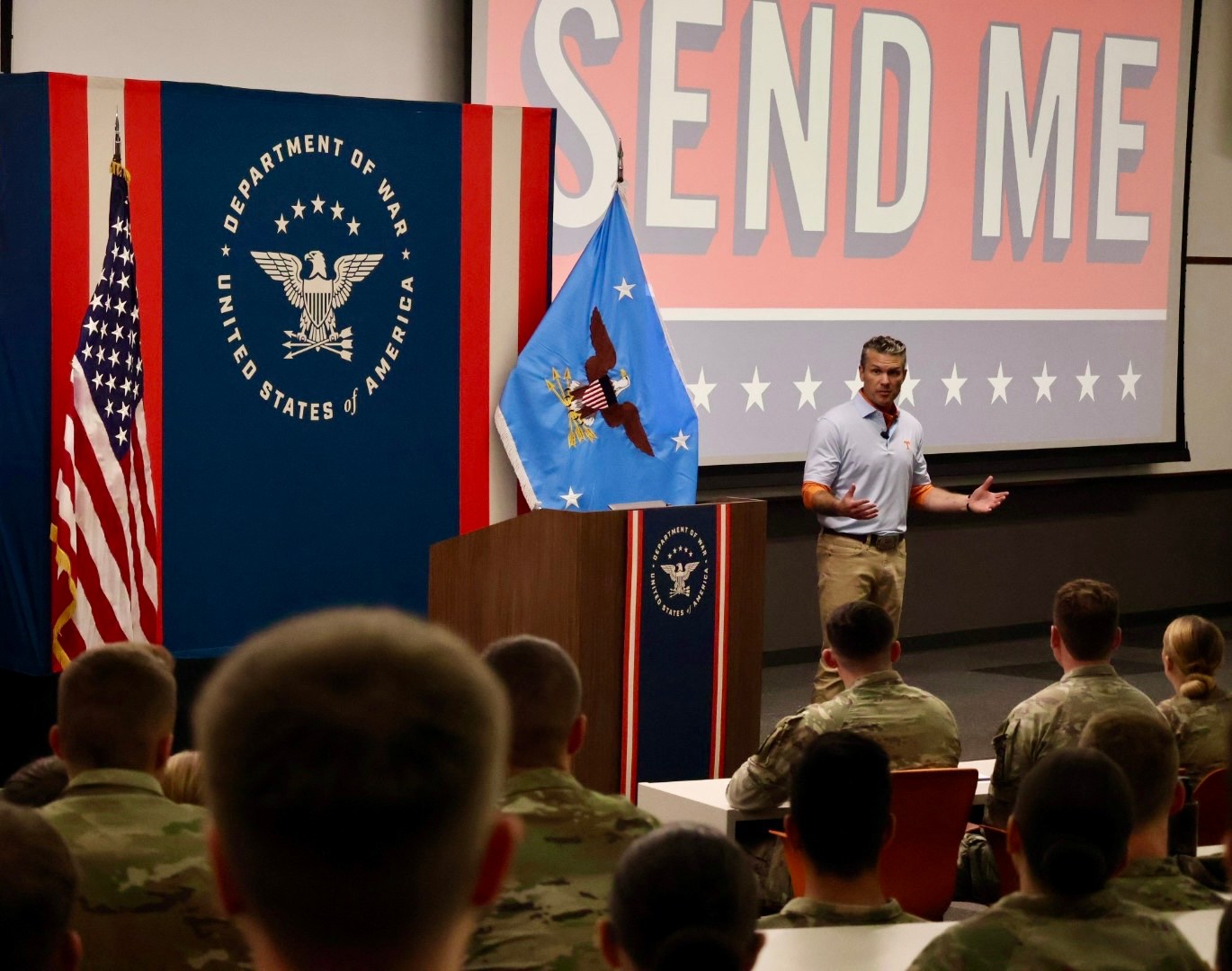
Questions about the Pentagon’s treatment of minority religious traditions predate the new office.
In June, Savage joined 10 other religious endorsers in a letter to Hegseth objecting to revisions to the military’s Religious Affiliations Code list. The signatories said the changes removed or obscured the identities of several religious communities, including Unitarian Universalists, historically Black churches, and Wiccan and Pagan practitioners.
The endorsers warned that the changes could affect religious accommodations, access to clergy, and the distribution of chaplaincy resources.
“Classification is resource allocation,” they wrote.
Savage said the earlier changes, combined with the establishment of the Office of Religious Affairs, “calls the Department’s commitment to meeting the spiritual needs of all of its members into question.”
The active-duty Army chaplain questioned how the office’s stated religious-freedom protections would work in practice under a defense secretary who has increasingly incorporated Christian scripture into his public messaging.
“What oversight will exist to prevent religious bias?” he said. “When investments are made, will they be defining spiritual fitness by Christian, or by more pluralistic metrics?”
The same concerns extend to money. The office’s funding priorities include faith-based home school support for military families, faith-based suicide-reduction programs, and contracts with faith-based organizations.
“Will the Humanists, Muslims, Jews, Hindus, and other groups receive an equal, commensurate amount of support and funding for such programs?” the Army chaplain said. “Or will all or most of the funding go to Christian based organizations?”
Beyond institutional support, the chaplain said the Pentagon’s religious messaging could interfere with one of the central responsibilities of his profession: helping service members navigate questions of conscience, morality, and killing.
In reporting for Task & Purpose last month, this reporter examined how Army chaplains were preparing to address the moral and spiritual consequences of artificial intelligence in warfare. As one scholar of military ethics pointed out, moral injury can arise when service members feel responsible for actions that violate their values, even when they have little meaningful control over those decisions.
The Army chaplain raised a related concern: What happens when the military itself invokes religious authority to justify its mission?
“What can I say to a non-Christian soldier who is being ordered to kill his fellow man or risk dying himself for a god he does not believe in?”
“If my role as a chaplain is to advise soldiers and commanders of issues of morality and ethics, what can I say to them now?” he said. “How can I advise a commander on doing moral and ethical actions if the state has announced that their god has ordained their war?”
For service members who do not share the religious beliefs invoked by military leadership, the Army chaplain said, that tension could be especially difficult to reconcile.
“What can I say to a non-Christian soldier who is being ordered to kill his fellow man or risk dying himself for a god he does not believe in?” he said. “What do I tell a soldier who believes an action is immoral, but also believes that God commanded it?”
Source: The Intercept · 2026-10-25
How would you monitor public pet-sale listings across multiple websites?
What’s the simplest setup for someone without coding experience?
submitted by /u/Complex_Western5364
[link] [comments]
Source: Reddit r/OSINT · 2026-10-25

The new patrol officer parked his black Dodge Charger outside a house off Main Street and approached on foot. A Mexican ballad was playing. Someone had called in a noise complaint, claiming it sounded as if people were fighting.
But as the officer, Jaron Alexander, got closer, he found nothing of the sort. A middle-aged woman greeted him as her daughter, Joanna Martinez, petite and visibly pregnant, looked on. “What kind of party are you all having?” she remembers him asking. Behind her were three generations of an extended family. They were celebrating a 3-month-old’s baptism over pozole verde, horchata and beers.
Alexander ran some IDs and found no issues. The music wasn’t even that loud, he thought. He told them to have a good night, and then he left.
That encounter, in early October last year, was the first of many that Alexander and Martinez would have in tiny Ingram, Texas, a 1.5-square-mile town of 1,900 people beside the Guadalupe River. But it was the only one before Ingram signed an agreement with U.S. Immigration and Customs Enforcement that would roil the town and tear Martinez’s family apart.
“Her and I, at the beginning, I felt like we were running into each other all the time,” Alexander told us, in one of eight conversations over four months that offer a rare window into the thoughts of one of the local police officers on the front lines of the Trump administration’s deportation campaign.
In a town as small as Ingram, drivable in five minutes end to end, more run-ins were probably inevitable. Later that October, Alexander pulled over a work truck for rolling through a stop sign, and soon there Martinez was, demanding that he let her friends go rather than let immigration take them. He didn’t. He pulled over another driver in November who turned out to be her cousin, the father of the baby they celebrated at the baptism party. Alexander handed him over to immigration agents as well.

He pulled over Martinez herself a few weeks before she was due to give birth, she says, surprising her when he knew her name and the type of car she typically drove. He warned her that the car’s window tint was illegal and let her go. After that, he says, he caught a glimpse of her and her husband and their newborn daughter in the toy aisle at Walmart. Martinez told us she doesn’t think it was even her that day — her baby girl was then just days old, and she couldn’t imagine running errands with her so soon. But in Alexander’s memory, she was shopping for Christmas presents, just like him.
Alexander, who is in his mid-30s, with dirty blond hair already turning gray, says he didn’t come back to Ingram to help deport his neighbors. In his telling, he just ended up making it part of his job. The town was where he started his law-enforcement career years earlier, before he took a better-paying position with the county, as a sheriff’s deputy. But things recently started to fall apart, first in his marriage, next at the sheriff’s office: A 185-page internal investigation found that he had an affair before his divorce was final and used a county vehicle to carry it out, then lied about it all. He says the investigator called him an “embarrassment to the profession.” The sheriff’s office fired him. (Alexander said at the time, and again to us, that he did not have the affair.)
Ingram’s Police Department took him back just when its new chief — its eighth in five years — was under pressure from the City Council to do more: more traffic stops, more citations, more arrests, more numbers. Alexander says he told the chief that the sheriff’s office had a deal with ICE and that Ingram should look into it; maybe it could help the department grow. “Blame me,” he eventually told people. “It’s my fault in a way.”
Donald Trump had retaken the presidency with a promise to carry out “the largest deportation in the history of our country.” America was still figuring out what that meant. Finding and expelling up to 4% of the U.S. population — the 14 million residents who are estimated to be undocumented — wasn’t something a few thousand ICE agents could do on their own.
Underway in Chicago that fall, and soon in Minneapolis, was one version of how the administration could try to do it: masked agents from across the federal government surging into a liberal city to round up immigrants, beating back — even killing — the citizens who tried to stand in their path.
But a quieter kind of surge was spreading across the country at the same time. In September 2025, ICE announced new incentives for a partnership program known as 287(g). The program’s most aggressive form, the so-called task force model, which Ingram opted in to, enlists local police officers as deputy immigration agents, and the new incentives included a $100,000 vehicle stipend, a $7,500 equipment stipend for every participating officer, quarterly performance bonuses and funding to help cover officer salaries and overtime. “By joining forces with ICE,” the announcement read, “you’re not just gaining access to these unprecedented reimbursement opportunities — you’re becoming part of a national effort to ensure the safety of every American family.”
Alexander completed an online course with ICE a few weeks after the baptism party, qualifying him for time-and-a-half pay whenever he helped the agency pick up immigrants. Here in the Texas Hill Country, he soon became the local face of the national crackdown.

Ingram was just starting to recover from its worst natural disaster in a century, the flood that summer that killed at least 139 people up and down the Guadalupe River, including 25 girls at Camp Mystic. In the riverbed, towering bald cypress trees now stood at a lean, their branches swept back by a 30-foot surge of water and mud, their trunks still plastered with debris. As construction workers rebuilding the community traveled to their jobsites via Junction Highway, Ingram’s five-lane main thoroughfare, a black Charger began stopping them before they could get there.
Within three months of the baptism party, Alexander and Ingram’s other patrol officer had delivered at least 70 people to immigration agents, picking off what the police chief called a “dumbfounding” number of undocumented drivers. Within a year, they would hand over the equivalent of 10% of Ingram to ICE.
The weight of what Alexander was doing started to settle on him after Christmas. He says he was out patrolling as one of his new ICE handlers, a man in a ball cap and dark glasses, hovered nearby in an unmarked SUV. Around lunchtime, Alexander followed two Latino men in a 2008 GMC truck for several blocks before stopping them, they recall him saying, for failing to signal a turn.
A young man sat in the passenger seat. Alexander checked his papers along with the driver’s and determined that both were undocumented. The agent in the unmarked SUV rolled up behind them. Alexander realized who the man in the passenger seat was only after Martinez arrived in tears. It was her husband, Ulices Macias, the father of her newborn daughter.
“I don’t normally do this,” Martinez recalls Alexander telling her, “but I’m going to open up the car. I’m going to take the handcuffs off him.” He let the family have a moment together. In a video taken by Martinez’s younger sister, Alexander stood by, expressionless, as Martinez embraced Macias by the rear door of the Charger. He watched Macias cradle his 2-week-old baby girl, swaddled in a white blanket, and hug Martinez’s 4-year-old son, his stepson.
Then the ICE agent put the handcuffs back on Martinez’s husband, wrapped a chain around his waist and led him away. Alexander says Martinez threw herself to the ground and sobbed.
Images of the family he broke up shortly after Christmas would intrude on Alexander’s thoughts for months, he told us. But it didn’t keep him from doing his job. His next shift came a few days after he handed over Macias, and he was back in the Charger, back to stopping cars on Junction Highway.
Alexander says he didn’t always want to be a police officer. He describes himself as “kind of a chameleon.” He grew up in nearby Harper, tried a few different colleges without graduating and spent his 20s cycling though jobs in freight logistics, pest control and insurance.
Still seeking his calling, he arranged a ride-along with a police officer outside Austin. What sold him on policing was the suburban officer’s power to enforce the law as he saw fit. That day, they pulled over a woman who had a warrant out for her arrest. She was coming back from the store with children and groceries in the back seat.
“You can use your discretion,” Alexander recalls the officer telling him. Wouldn’t they be doing more harm if they took her? What would the kids do without their mother? And wouldn’t it all create more paperwork? The officer let her go. Alexander imagined himself making the same kinds of judgment calls. In 2021, he enrolled in the police academy.
Even before the floods, tensions were rising in Ingram. Hundreds of Mexican immigrants and their families had settled there in recent decades as an increasingly militarized border made it harder for seasonal ranch hands and other workers to cross back and forth. Latinos would come to make up 45% of its population, and some residents began affectionately calling Ingram “mini Guanajuato,” after the central Mexican state where many have roots. Yet when Alexander returned, Ingram’s City Council still consisted of six white men.
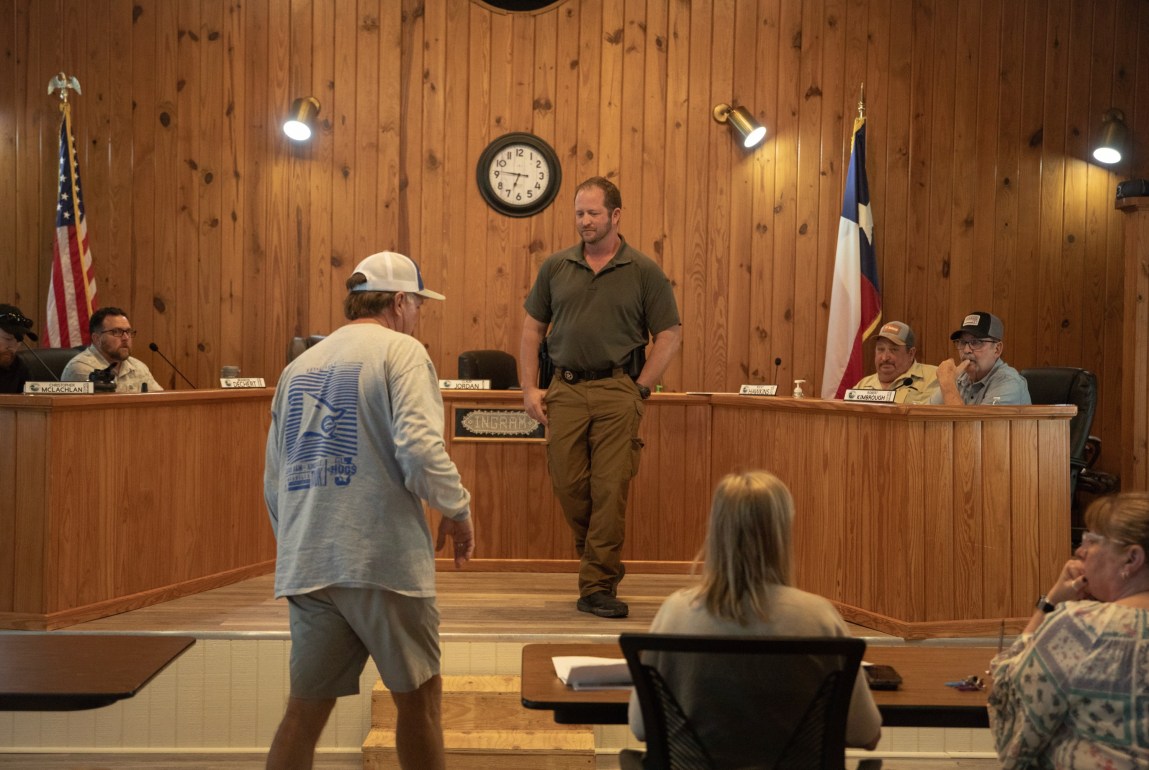
A council faction led by Claud Jordan, now the town’s mayor, and Rocky Hawkins, now the mayor pro tem, came to power in November 2020, in a revolt against a new sewer project. They abolished Ingram’s city administrator position and took direct control of the Police Department, cycling through chief after chief. Five former city employees say Hawkins regularly used racist slurs for Mexicans. Four say that he pressured the city to go after Latinos through code enforcement or targeted patrols, and two say that Jordan did, too. One of the employees recalls Hawkins complaining that Mexicans were “taking over Ingram.” (Hawkins and Jordan each declined to speak on the record or address detailed questions we sent them by email. In a brief text-message exchange, Hawkins said that none of it was right but declined to offer any specific concerns.)
These were the men the new chief, Dustin Breshears, had to answer to as ICE revived the task force program, which had been shut down for a dozen years until the day Trump returned to office in January 2025. ICE, under President Barack Obama, had phased out the program after some of the first sheriffs to participate in it, including Joe Arpaio of Maricopa County, Arizona, used it to disproportionately target Latinos in their communities. Investigations by the Department of Justice found that deputies in the task force program pulled over Latino drivers at up to nine times the rate of other drivers and that some retaliated violently against people who accused them of racial profiling. But now, under Trump, any law-enforcement agency, no matter how troubled or small, was encouraged to sign up.
Breshears began appearing at City Council meetings armed with statistics: number of arrests since the last meeting, number of traffic stops, number of cleared cases from the backlog of hundreds he inherited — and number of what he called “deportations.” (He later explained this was his imprecise shorthand for “immigration-related enforcement activities.”) At the council’s October 2025 meeting, held a couple of weeks after Alexander showed up at the Martinez family’s baptism party, Breshears reported a remarkable 162 traffic stops by Ingram’s two patrol officers — Alexander and Christian Perez, who was 25 — in just 20 days. (Perez declined to comment.) The officers made more stops in two months than the department had made in the entire previous year. The City Council gave Breshears an $18,000 raise.

Before Breshears arrived and Alexander returned in August 2025, the weekly blotter in The West Kerr Current, the local newspaper, documented the humdrum of community policing: loose dogs, neighborhood disputes, code violations. Then, suddenly, it was filled with drivers stopped for defective brake lights, damaged license plates, cracked windshields, illegal window tints or other unspecified “equipment violations.”
Breshears and Alexander strongly deny targeting Latinos. “It’s honestly not what’s happening,” Breshears says, noting that his half brother, wife and daughters have Mexican heritage. Ingram’s traffic stops were simply up across the board, he says, so more Latinos were getting stopped. He shared statistics showing that stops of Latinos were proportional to their share of the population.
Alexander, who on top of his roughly $70,000 base salary was now logging dozens of hours per month for ICE, told us the same. “I don’t care who’s in the car,” he says. “I really don’t.”
As the ICE program took hold in Ingram, warnings about Alexander and his black Charger — the department has several — spread through the Hill Country and far beyond. Groups on Facebook and WhatsApp seemed to track his every move. The Charger was outside Rita’s taco shop. The Charger was near Dollar General. The Charger was parked by the church. A member of one particularly active Facebook group texted him screenshots, and he scrolled through blurry photos of himself looming behind work trucks or leaning over car windows.
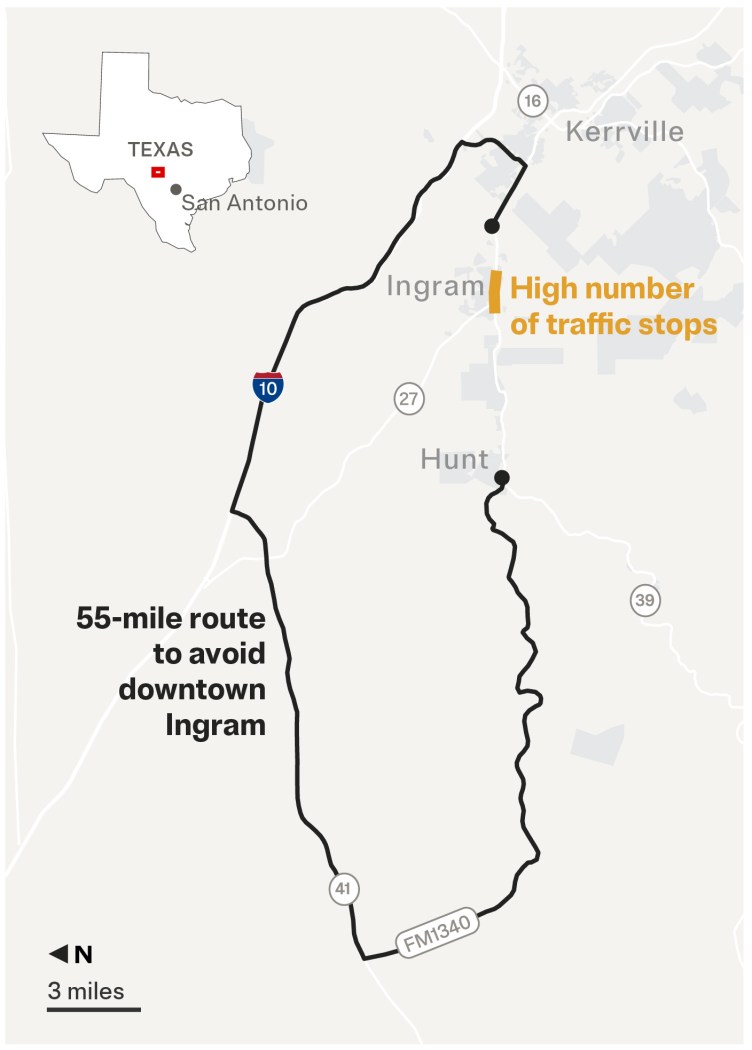
Many Latino motorists trying to reach worksites up the Guadalupe began driving an extra 90 minutes each day to avoid the section of Junction Highway that Alexander patrolled. Ranch hands began sleeping at their employers’ properties in nearby Hunt, coming to town only when they knew — or hoped — that Ingram’s officers would be off duty. Residents were rattled the day a Customs and Border Protection helicopter hovered above town and the elementary school went into lockdown as the police hunted for a Mexican man who had run from one of Alexander’s traffic stops.
One family notarized guardianship papers, in case the parents were detained and the children left behind. One woman swore Alexander showed up outside a memorial service and asked people for IDs. Another woman said he detained her and her husband when they returned home from church. Parties dwindled. Invite lists shrank. People began to move away, to Kerrville and San Antonio, and Alexander’s reputation reached as far as La Ceja, a village in the mountains of central Mexico, where an elderly resident said he and his neighbors were familiar with the Texas town’s police. “El Charger negro,” he said, with a knowing nod. He estimated that some 20 or 30 people in the village were recent deportees from Ingram.
Alexander’s fortunes seemed to rise as the Martinez family’s fell. With her husband gone, Joanna Martinez couldn’t afford payments on the trailer they shared. She and their infant and her 4-year-old son moved back into her childhood bedroom in her mother’s crowded home, where several relatives and their children also lived. She tried to stay connected with her husband, Macias, via WhatsApp calls while working as much as she could as a house cleaner to keep afloat. “I can’t lock myself up in my room and just cry,” Martinez says.
Winter for Martinez and her family brought a string of dark incidents. The January arrest of her cousin near the carwash as she drove to pick up her children from school. A canceled baby shower for her older sister, Jazmin, over a rumor that the Charger planned to show up. Another cousin, himself the father of a newborn, stopped and taken right in front of her mother’s house as Martinez watched.
A half dozen of the attendees from the October baptism party would soon be gone from Ingram, after being detained and deported or leaving to join relatives who had been. Some people had gotten wind that Alexander was making money off his enforcement. When a Spanish-language Facebook page shared a photo of him questioning the passenger of a beige Ford pickup, someone posted an animated image in the comments: a stack of green dollar bills growing taller and taller in an endless loop.
Alexander received his first ICE payments in early December. In January, as the country’s attention turned to the violent immigration crackdown in Minneapolis, he was often spending three or four hours a day and sometimes entire shifts working on behalf of the federal agency. By the time federal authorities announced a drawdown in Minneapolis on Feb. 12, Alexander had already made $3,264.46 from his task force hours, according to his pay stubs.
Ingram was by then one of more than 750 task force model partners around the country, up from not quite 500 when it signed up in October. At least 43 million U.S. residents, according to an analysis of ICE records by the legal data firm Titus Consulting, already lived in a county with an active task force agreement. Alexander was one of thousands of deputized officers in Texas alone.
Lucas Waldron/ProPublica
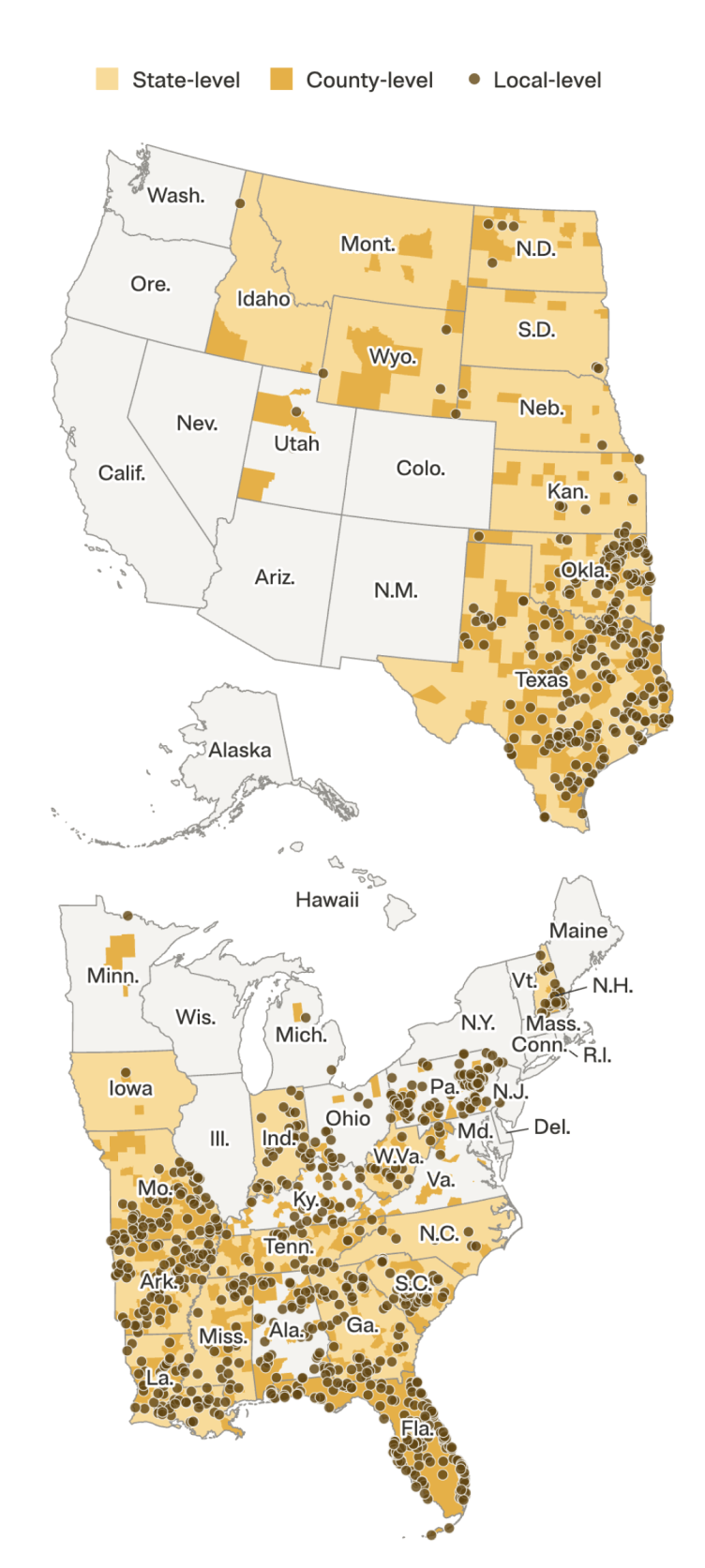
In interviews, Alexander described the immigration system he was enforcing as “skewed” and “weird,” but he saw himself as largely separate from these concerns. “If you’re taking federal money to do a job,” he says, “I think you should do the job.”
Still, he seemed to struggle with the contradictions of his role. He told us he sometimes shared his lunch with the people he detained and that he let them hold on to their phones to call loved ones from the rear seat of the Charger. He handcuffed them with their hands in the front rather than the back so they could use their hands.
Martinez told us about a moment when she watched him detain one of her cousins. He allowed the man’s wife and children to hug him goodbye and waited until his 7-year-old daughter wasn’t looking to handcuff him. To Martinez, it seemed as if Alexander was trying to prove to her that he wasn’t a bad person. “But I’m not going to fall for it,” she says.
There was a protest in Ingram the following day against Trump’s mass deportations. Martinez decided to go. As she stood among a few dozen protesters waving a handmade sign with the name “J. Alexander” circled and crossed out, she saw him drive by again and again.

A few weeks later, Katie Winer, the leader of the group that staged the protest, was following the Charger after Alexander detained another immigrant in a traffic stop. He approached her car and threatened to arrest her if she followed him in the future, on charges of interfering with public duties. But he also seemed to want to talk, and she recorded him as they discussed what was going on in Ingram. “I think you guys are making a bigger deal of it than they are,” he said of the people he handed over to ICE. The only outliers were “loudmouths” like Martinez and “her little crew.”
Winer interjected that Martinez’s husband was the family’s breadwinner, and it was Alexander’s actions that tore them apart.
“My actions did not,” Alexander said. “His actions did. I made a traffic stop. He was here illegally. That’s not my fault.”
Still, Alexander’s uncertainty seemed to be growing. In March, another of Martinez’s cousins confronted him outside the taco shop, pressing him about Macias as she filmed with her phone.
“If I’m being 100% honest,” he said, “I don’t enjoy when families are separated, like with the Joanna situation. That kind of fucked me up.”
A month later, as Ingram’s handoffs to ICE surpassed 100 people, another video of Alexander circulated among a small group of community members. It showed an evening traffic stop, at least the fifth stop Alexander made that day. He had followed a silver Ford F-250 from the highway until it pulled into the gravel driveway of a mobile home. There, the man in the passenger seat, a landscaper named Victor Ramirez Hernandez, tried to hurry inside. Alexander grabbed him before he could get there.
The truck’s driver pulled out his phone and began filming. “Why are you arresting him?” he asked.
“I’m not,” Alexander answered, struggling to place handcuffs on Ramirez as he squirmed. “I’m detaining him.” Then he wrapped his hands around the laborer’s chest, lifted him off the ground and slammed him down on the driveway. “I played nice with you, and now I’m done,” he said. He straddled Ramirez and cuffed his hands behind his back.
“He’s bleeding because you hit him,” the driver said evenly. They argued back and forth.
“You’re an idiot,” Alexander said, his face reddening. “Shut up. The more you talk it’s just making you look stupider.” (Alexander declined to comment on this incident. Breshears, who reviewed body-camera footage, says Alexander’s use of force was justified to control a potentially dangerous situation.)
Acrimony pulsed through Ingram that spring. In the Latino community, family members and neighbors accused one another of snitching, which Alexander says did happen. Young women accused one another of having affairs with him, which he denies, insisting that people just misinterpreted his attempts to be kind. “I’m friendly with the people that I meet,” he says, “especially when they’re friendly to me.”
One subject of these rumors was Martinez. She and her older sister scoffed at them. “He’s taken our whole family at this point,” Jazmin says. “And she’s going to sleep with him? It’s really annoying.” But some in the community, even cousins, stopped speaking with her. “It’s like ‘Hunger Games,’” Martinez says.
As Latinos fled and avoided Ingram, the daily takeout orders at one Mexican restaurant on the edge of town dropped to 50 from 200. A corner store catering to immigrants lost around half its revenue and most of its Latino regulars. Landlords in a mobile-home park just outside town struggled to find tenants.
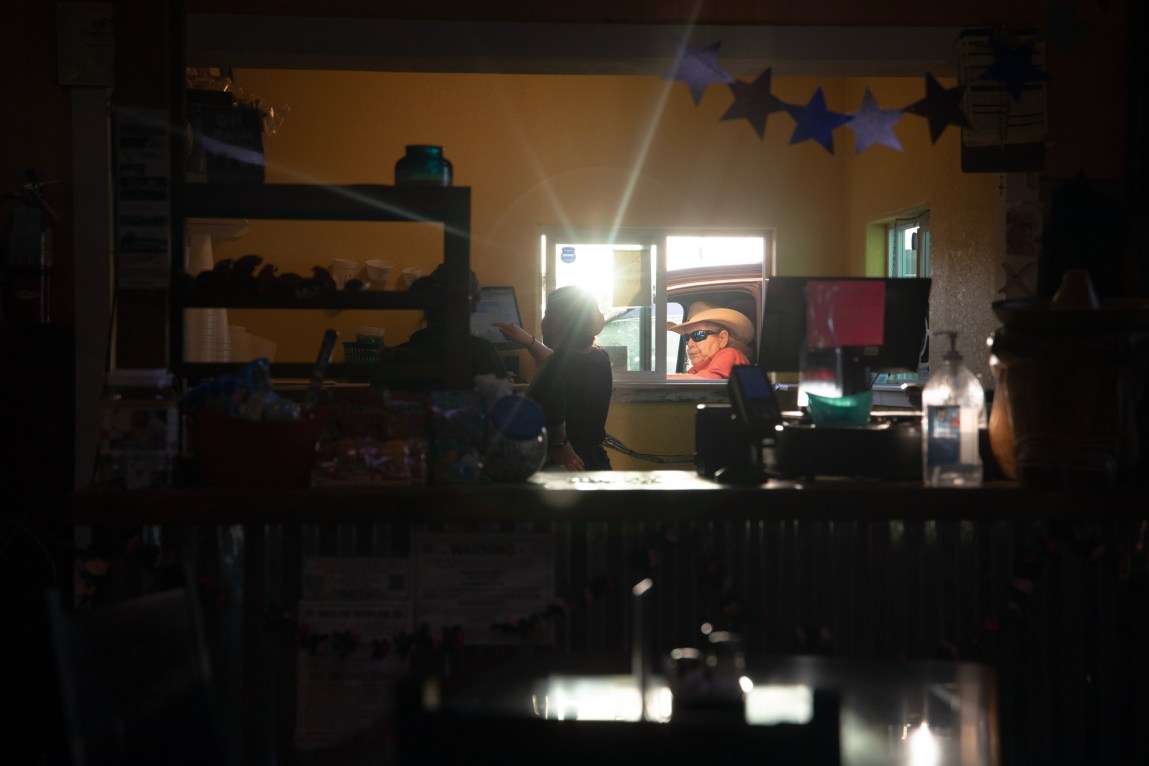
But it wasn’t just Ingram’s Latino community that was reeling. For Ingram’s non-Hispanic business owners, including many Republicans in a county that voted 77% for Trump in the 2024 election, the immigration crackdown was becoming an outrage. It was taking people they worked with and knew well. It was interfering with flood reconstruction. It was hurting the local economy.
The owner of a heavily damaged strip mall on the western edge of town, Steve Edelstein, lamented the loss of two workers who were helping him rebuild. “Technically local law enforcement is doing their job,” he told a reporter for The West Kerr Current, emphasizing that he supported Trump. “But it isn’t helping the community.” A manager overseeing the rebuilding of Ingram’s Little League field, which was washed away in the flood, made an angry call to the city after two of his workers were picked up, Breshears says. A contractor helping rebuild Hunt’s destroyed post office had his crew reduced to eight workers from 30 — causing what should have been a four-day job to stretch to two weeks.
Among the people who called Jordan, the mayor, to complain was his onetime high school classmate Neal Secor, who describes himself as “one of the most conservative guys you’ll ever meet.” His family business, a cluster of rental cabins called Waltonia on the River, was nearly destroyed by the flood. He was struggling to rebuild. He says that in the spring, in two separate stops, the Ingram police detained four of his workers and handed them over to ICE — the second set as they returned from a job repairing the docks at a nearby youth camp, a favor Secor was trying to do for a neighbor.
Secor says Jordan’s defense was simple: You voted for this. They’d all voted for this.
“Let me tell you something,” Secor says he told Jordan. “I didn’t vote for this. I voted to get the bad guys out.” The two employees detained coming back from the youth camp were like family, his friends and co-workers for over a decade. “There’s still a lot of bad guys here,” he continued. “These guys aren’t them.”

Secor recalls Jordan saying that Ingram’s officers were just following the law. But, Secor wondered, why was it that he could drive 85 every day on the 75-mile-an-hour interstate and police officers just let him pass? He told Jordan he’d put 175,000 miles on his truck and never been pulled over. “It’s a matter of what laws you want to pick and choose,” he recalls telling the mayor. “We all break laws every day if you really want to get down to it.”
On an unpaved side street in the Ingram hills in April, Alexander again faced a decision over whether to separate a young family. This time he had more of a choice; ICE had yet to arrive. A woman named Norma Luján took his hand and said she was praying for him.
Luján, 61, runs a successful housecleaning company based in Ingram. She had heard of Alexander long before she confronted him. She had seen him in the Charger, too: on the side of Junction Highway as she made her way to jobs at vacation homes or youth camps up in Hunt. On the side of the highway on the way back. In her rearview mirror for four excruciating minutes one afternoon as her “girls,” as she called her crew, held their breath and sank into their seats, protected by the tint of her car’s windows and the fact that a license-plate reader would show it was registered to her, a Texas-born U.S. citizen.

In January, at the carwash, Alexander had helped a sheriff’s deputy take one of Luján’s best employees into custody. The woman, Cinthya Carranza, was a single mother and asylum seeker from Guanajuato — and Joanna Martinez’s cousin. Carranza was on her way to get her children from school after she and Luján spent the day cleaning houses. Later that day, Luján saw a Facebook post showing a familiar face in a mug shot: Carranza’s. Luján broke into tears. To her, the arrest was a signal event. The Charger had mostly stopped men up to that point. This was the moment she understood that no one was safe.
Luján started losing workers in droves after Carranza was taken — some to traffic stops, most for fear of having to drive through Ingram. Her crew of 30 people dropped to fewer than 10. She worried for her business, but she worried more, she said, for her workers, the lives they had made in Ingram and the relationships she had built with them. They invited her to parties and baptisms, surprised her with presents on her birthday. She often led them in prayer. “I love them,” she says. She promised she would try to protect them.
When Luján’s employee Maria called that April afternoon to say the officer in the Charger was outside her house, detaining her husband as he returned from work, Luján jumped into action. Maria (who asked to be identified by her middle name because she is undocumented) was eight months pregnant and already terrified that she would have to give birth alone. Alexander had taken her brother a week earlier. Now Maria was hiding behind the curtains of her home, sneaking peeks outside, hoping Alexander would let her husband go.

“Cálmate” — calm down — Luján told herself as she approached the Charger. “Cálmate.” She took a deep breath. She says Alexander was sitting in the driver’s seat with the door propped open, staring at a tablet computer.
“Look, his wife has had a complicated pregnancy,” she told him. (This was true.) “She’s in the hospital.” (For that lie, Luján says, she later prayed for forgiveness.)
Then Luján reached out and grabbed Alexander’s hand. “I pray for your being, for your soul,” she recalls telling him as she cried. “I want you to think about what you’re doing. Feel it. Feel it, please.” She squeezed his hand. “I need you to look inside your heart,” she continued, “and let him go.”
Alexander didn’t react at first, in Luján’s telling. “God wanted me to meet you,” she said. He met her gaze.
“I’m that guy that everyone talks about on Facebook,” she recalls him finally saying. “If you think I don’t lose any sleep, you’re wrong.”
Luján pushed through the lump in her throat to speak. “I’m going to pray for you every night,” she promised him. She says Alexander squeezed her hand back, then pulled away. He walked off to make a call. She couldn’t make out much of what he said. It was quiet, save for the sound of Luján’s sobs and the pebbles from the unpaved road crunching beneath the officer’s feet.
Then he returned to the Charger. “Get him out of the car,” Luján recalls him saying. “Hurry up.”
“God bless you,” Luján said. “God will repay you for this.”
Alexander says he doesn’t remember the details of his interaction with Luján, but he confirms that he let Maria’s husband go, calling it a matter of “human decency.” He knew how hard it was to raise children. “A woman needs rest,” he says. “She needs help.” Maria’s husband “needs to be there helping out.”

At first, nothing seemed to change. Over the next two months, as the Hill Country prepared to welcome summer tourists and campers back after the devastation of the floods, Alexander worked around 100 task force hours, earning close to $5,000 from ICE.
But the next time he ran into Joanna Martinez, he seemed to be having misgivings. It was early June, and he was eight months into the ICE program. He had pulled over another of her family friends on Junction Highway, a person she had known since childhood. Martinez got a phone call and rushed to the scene, as she had so many times before. “I don’t feel good about this,” she recalls him saying when she arrived. “I signed up to be a cop, not an ICE agent.” (Alexander says he remembers that they talked and that he could have said something like that.)
Later that month, he pulled over a young man from Honduras who was on his way to a soccer game with his cousin, a 12-year-old with developmental disabilities. The boy’s father says he and his wife hid across the street watching it all happen, too terrified to step out and claim their son. The parents sent a friend from church, but she was not a legal guardian. Alexander says he had no choice but to hand the boy over to ICE, adding though that if he was one of the parents, he would see it differently. “If I’m in that position, there’s no way I’m letting my kid go,” he told us. “I’m probably fighting someone.”
Within a couple of weeks, Alexander’s task force hours dropped by about 40%, according to his pay stubs. It remains unclear if he tried to step back from immigration work or whether the number of undocumented drivers in Ingram had simply dwindled because of all he had already done.
According to Chief Breshears, Ingram had logged 194 “immigration-related incidents” as of this August. Whether every handover led to a deportation, Breshears couldn’t say. Alexander says he doesn’t know how many of the 194 are people he stopped. But he says he has now let at least 10 people go — many, though not all of them, mothers of young children.
Alexander sees this, and his relationship to the Martinez family, as evidence of his humanity, despite what people say about him. “For context, I’ve deported like six of their family members, and they’re still friendly to me,” he says. “So I’m not the monster they make me out to be.”
On July 16, the skies over Ingram opened again, dropping nearly 19 inches of rain in a single day, and the Guadalupe again overtopped its banks, again destroying businesses and homes. In the predawn darkness in the early hours of the emergency, Alexander began racing toward Ingram in his black Charger to help. He had barely left his house when surging floodwaters consumed the vehicle, destroying the Charger’s engine block. A driver in a pickup truck took him back home, and that’s where he stayed until the storm receded.
Alexander remains only one cog in a deportation machine for which the federal government has now earmarked $240 billion. Today more than 1,900 agencies in at least 30 states have signed up for ICE’s task force model, with more than 29,000 deputized officers. With their help, ICE recently hit a record of immigration arrests, totaling more than 50,000 in August.
On Sept. 11, Alexander met one of us at a taco spot on Junction Highway. Ingram had changed in the year since his return. Whole neighborhoods had emptied out, and residents noticed fewer drivers on the streets. In part because of the money from ICE, the Police Department had hired two additional officers. As a Mexican ballad played over the speakers, Alexander warned against making too much of the leniency he showed to families like Maria’s. “It’s like one free pass, I guess,” he said: If he encountered her husband again during a traffic stop, he would probably hand him over to ICE. He just thought letting the father-to-be go was the right call at the time. “I mean, don’t you?” he asked.
He said he hadn’t made all that much money working with ICE. But city records show that his earnings from the agency already totaled $18,793.25 in nine months, more than a quarter of his base salary. “I think it’s skewed a little bit,” he said, looking at the pay stubs we had gathered.
Alexander said it was hard for him to be out in public anymore. He can’t escape being recognized in Ingram and Kerrville. Sometimes he catches Latinos staring at him, then walking away, visibly uncomfortable. So he tries to do his shopping and errands in another town 30 minutes away.

He blamed the Facebook groups. They had created a climate of “unreasonable fear” in Ingram. “What do they think I’m going to do right now?” he asked, seated at his table in the taco shop. A steady stream of customers, many of them white, approached a counter staffed by two young Mexican sisters. He said their father used to hide out in Hunt to avoid being pulled over in town. Some of their co-workers had quit months before, too uncomfortable to serve Alexander when he came in for breakfast. But when the taco shop owner sees him, he said, she hugs him.
“I know the status of everybody in this room,” he said. He suggested everyone who worked there was undocumented. Whether they disappeared or were allowed to stay was up to him. And today, at least, he was just there for breakfast.
“They’re fine, right?”
Source: ProPublica · 2026-10-25
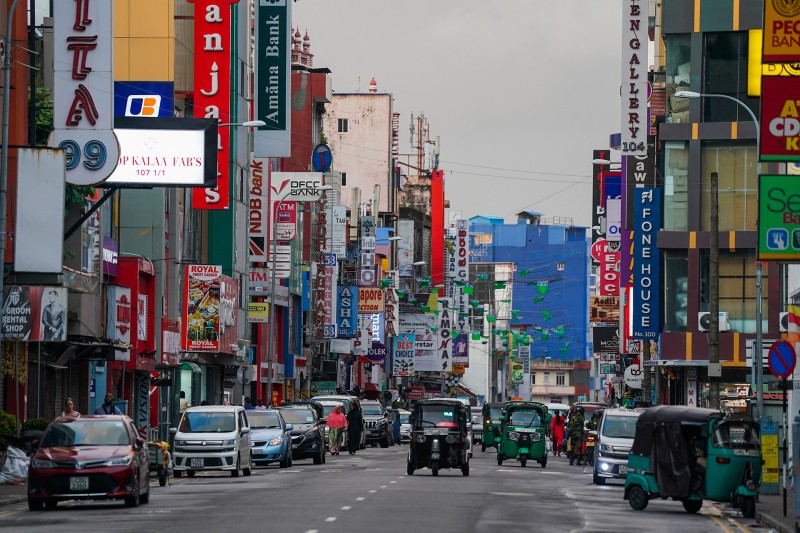
A Chinese cyber scam boss who was kidnapped and murdered in Sri Lanka’s capital in July went by three separate aliases and carried at least two passports, according to documents obtained by OCCRP and The Sunday Times.
Chen Guoqing, 31, was abducted from the Colombo Port City special economic zone in the early hours of July 23 by a group of over a dozen men, one of them brandishing a pistol, according to a copy of the police investigative report into the incident. He was driven to a rural area over 70 kilometers east of Colombo, tortured to death, and his body was abandoned.
The murder of Chen — and the hunt for his killers — received extensive media coverage in Sri Lanka, amid fears that the South Asian country is becoming a new base for Asian criminal syndicates that target victims around the world with sophisticated online fraud schemes.
Sri Lankan police told OCCRP and the Sunday Times that they have arrested five Chinese nationals over the murder and are seeking another three suspects, who are believed to have fled the country. Local authorities have said they believed Chen was involved at a high level in international criminal activity and was murdered over a money dispute with other criminals.
Investigative files show police recovered two passports belonging to the murder victim, each using a different name. One, a Cambodian passport, identified him as Chen Hao. The other, from Suriname, identified him as Tao Guoqing.
Reporters were able to find the murder victim’s real name — Chen Guoqing — by crosschecking his Cambodian passport with a publicly available copy of naturalization and name change records from that country’s Gazette.
Chen’s real name is not mentioned in the Sri Lankan police investigative report, and neither his Cambodian nor his Surinamese aliases have been reported in local media.
Details of Chen’s identity come as OCCRP and the Sunday Times have revealed that, despite over a thousand well-publicized arrests, Sri Lanka has failed to successfully prosecute a single person for using the country as a base to conduct online scams targeting foreigners.
Brian Hanley, the Asia-Pacific Director of the Global Anti-Scam Alliance, said Chen’s murder highlights the vulnerability of Sri Lanka to infiltration by scam syndicates fleeing crackdowns in traditional Southeast Asian epicenters like Cambodia.
“There’s weak enforcement [by Sri Lankan authorities],” Hanley said. “Scams pay. Nobody gets caught. Or if they do, there’s no sanction.”
“For a country like Sri Lanka this level of scam activity could easily start to see a single digit contribution to their entire GDP.”
Source: OCCRP · 2026-10-25
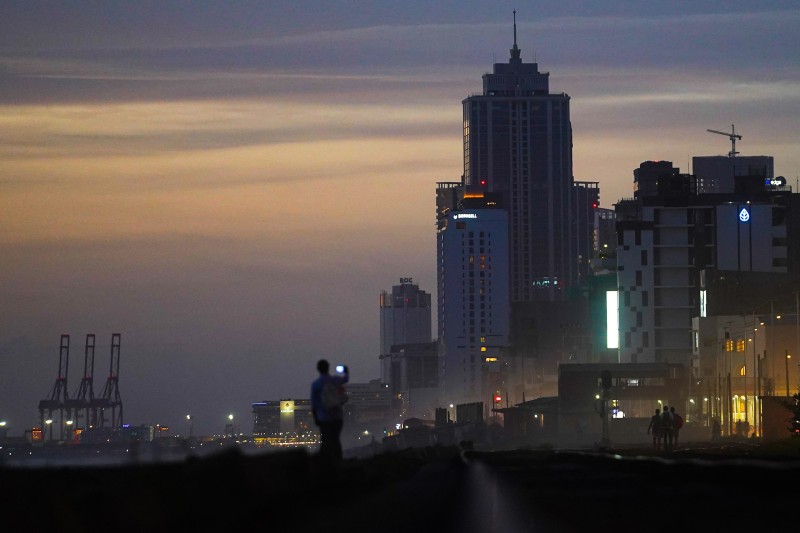
Authorities in Sri Lanka have failed to successfully prosecute a single transnational cyber scam case, police have said, despite more than a thousand arrests so far this year of suspected members of Asian fraud syndicates who have surged into the South Asian country.
The admission comes as experts warn the island nation is becoming a destination of choice for thousands of scam workers fleeing Southeast Asian nations such as Cambodia, which had in recent years become home to massive scam compounds, many of them reliant on trafficked workers.
Recently crackdowns in scam centers in Southeast Asia have driven mostly Chinese-origin scam syndicates to set up shop in vulnerable states from Madagascar to Papua New Guinea.
Among the countries of South Asia, Sri Lanka stands out for being at “serious risk of becoming a hub for industrial-scale cyber scams,” the Global Initiative Against Transnational Organized Crime (GI-TOC) said last month.
From January until September, Sri Lankan police have conducted raids on 27 suspected scam compounds around the country and arrested 1093 people, Sri Lankan police spokesman Fredrick Wootler told OCCRP and Sri Lanka’s The Sunday Times.
The figure represents a dramatic rise from 2025, when just 26 people were arrested, Wootler said. An additional 573 suspected scammers were arrested the year prior.
Despite the well-publicized arrests, “we have not had a successful prosecution yet” of anyone suspected of using Sri Lanka as a base for scamming victims abroad, Wootler said.
The issue, Wootler explained, is that Sri Lanka’s current computer crime law, which dates from 2007, only allows cases to be opened on the basis of a complaint from a victim. Since the majority of those getting scammed live abroad, few complaints have been received.
Instead, he added, the vast majority of suspected scammers are being charged for visa violations and being removed from the country.
“The current government is …very much keen to see that this type of criminal networks [must] be taken away from Sri Lanka,” Wootler said.
The head of Sri Lanka’s police cyber crime unit, Chandima Arumapperuma, told reporters that the majority of suspects arrested so far carry passports from Asian countries such as China, Vietnam, India, and Indonesia. Many come with travel records showing they had previously been in Cambodia or Myanmar, both well-known scam hubs, she added.
Efforts to interview suspects are hampered by language barriers while devices are often encrypted and difficult to analyse, Arumapperuma added.
“The volume of devices we find in each raid is so high, usually about 200 phones and laptops, and we simply do not have the resources to process all of them,” she said.
Adding to the difficulty, experts say, is another factor: Sri Lanka is desperate for foreign exchange. The tourism-dependent country offers visa-free travel to passport holders from 40 countries, including China. It has also opened up investment for online gambling and brick-and-mortar casinos, and has opened up a “special economic zone,” known as Colombo Port City, to attract investors in the digital economy sector.
“Online gambling and offshore gambling operate in legal gray areas in Sri Lanka. The country has an economically distressed project, the Colombo Port City. And then it has a mechanism for bringing large numbers of foreigners,” said Jason Tower, a transnational crime expert at GI-TOC.
In contrast to Southeast Asian scam hubs, where compounds have operated out in public view with protection from politicians and armed groups, Sri Lanka’s scam industry remains clandestine. But failure to tackle these networks could allow the industry to grow to a scale at which criminals become a force powerful enough to defy the government, Tower warned.
“The imagination is the limit. Going from what’s hidden and clandestine to what is open and obvious, “ he said.
“Right now Sri Lanka’s sort of on the threshold.”
Source: OCCRP · 2026-10-25